RHS Level 2 Certificate Week 19 – Outdoor food production.  Vegetables – perennial vegetables and legumes
Learning objectives 1.  Perennial vegetables 1.1  state the place in seasonal rotation of asparagus 1.2  state cultivation, propagation and care requirements of asparagus 1.3  state 1 pest and 1 disease of asparagus, their symptoms and their control 1.4  state harvesting period and technique and storage 2.  Legumes For named varieties of each of runner and broad beans state: 2.1  state the place in seasonal rotation and successional cropping 2.2 state cultivation, propagation and care requirements 2.3 state 1 pest and 1 disease of legumes, their symptoms and their control 2.4  state harvesting period and technique and storage 2.5  explain nitrogen fixing and its importance in crop production 2.6 Describe how quality and yield may be determined by the following: base and top dressings, thinning, weed control, crop support, irrigation and pest and disease control
Crop Rotation review Five main rotation groups (salad crops don’t fit into any of these) Principle is not to use the same soil for the same group two years running. One crop can benefit another – brassicas follow legumes. Intended to keep down build up of pests and diseases that are group specific.
Perennial vegetables - asparagus Not in a rotation  Grown from crowns (roots with growing tip) Require good, fertile, well drained soil – a bed can yield for 20 years so preparation is essential. All- male varieties preferred – higher yield Pests – Asparagus beetle, slugs Diseases – Rust, Violet root rot.
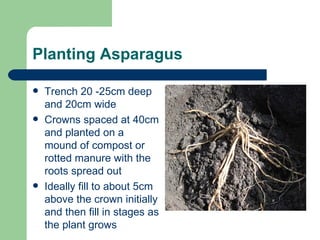
Planting Asparagus Trench 20 -25cm deep and 20cm wide Crowns spaced at 40cm and planted on a mound of compost or rotted manure with the roots spread out Ideally fill to about 5cm above the crown initially and then fill in stages as the plant grows
Nitrogen Fixing - review Bacteria can ‘fix’ nitrogen gas from the air by transforming it into a water soluble organic compound Rhizobia  live in nodules on the roots of legumes.  They provide the plant with nitrogen and the plant provides the bacteria with somewhere to live.  This is a  symbiosis The nitrogen is released to the soil when the plants roots and green growth decays.  So leave the roots in the soil when clearing the legume crop and compost the plants if they are not diseased.
Legumes – general points (1) With the exception of Broad Beans they are half-hardy or tender so are sown late Spring or earlier under cover. They need fertile soil but not additional nitrogen.  pH 6.5-7.0.  Good drainage Many require support They fix nitrogen so are usually followed by brassicas in the crop rotation
Legumes – general points (2) Manure or compost dug in the previous autumn. Prepare a Stale Seed Bed and incorporate a balanced fertilizer about two weeks before sowing (to allow time for the weeds to germinate), water, wait, hoe off weeds. Sow in single drills at the required spacing and depth or in broad drills as double rows. Can all be started early spring in pots or root trainers under cover  Watering is crucial at flowering and pod set.
Runner Beans -  Phaseolus coccineus   Prepare a bean trench – retains water and improves the soil. Add a balanced fertilizer if the soil is poor – but too much nitrogen = no beans. Put the support up  before  planting\sowing. Water – must be well watered or flower buds will drop/tough, tiny beans. Weeds – particular issue when plants are young, hand weed or careful hoeing.
Pests and diseases – Runner Beans Pea and Bean Weevil – notched leaves and tunnelled seeds.  No chemical control.  Start under cover, hoe to expose pupae in May/June. Bean Anthracnose – brown shrunken patches on pods, necrosis on leaves, stem cankers.  No chemical control, sow resistant varieties and do not save seed from infected plants. Remove and burn diseased plants.
Broad Beans Hardy – so some can be Autumn sown. Support – none needed for dwarf varieties (e.g. ‘The Sutton’) but Longpod and Windsor varieties need support. No need for a bean trench Watering is vital, particularly when flowers\pods are forming and swelling.
Pests and diseases – Broad Beans Black bean aphid – on Broad Beans, remove growing tip at four trusses; spray fatty acid spray. Chocolate Spot – lift and burn affected plants
Learning Outcomes 1.  Perennial vegetables 1.1  state the place in seasonal rotation of asparagus 1.2  state cultivation, propagation and care requirements of asparagus 1.3  state 1 pest and 1 disease of asparagus, their symptoms and their control 1.4  state harvesting period and technique and storage 2.  Legumes For named varieties of each of runner and broad beans state: 2.1  state the place in seasonal rotation and successional cropping 2.2 state cultivation, propagation and care requirements 2.3 state 1 pest and 1 disease of legumes, their symptoms and their control 2.4  state harvesting period and technique and storage 2.5  explain nitrogen fixing and its importance in crop production 2.6 Describe how quality and yield may be determined by the following: base and top dressings, thinning, weed control, crop support, irrigation and pest and disease control

Rhs year 1 week 19 2012

  • 1.
    RHS Level 2Certificate Week 19 – Outdoor food production. Vegetables – perennial vegetables and legumes
  • 2.
    Learning objectives 1. Perennial vegetables 1.1 state the place in seasonal rotation of asparagus 1.2 state cultivation, propagation and care requirements of asparagus 1.3 state 1 pest and 1 disease of asparagus, their symptoms and their control 1.4 state harvesting period and technique and storage 2. Legumes For named varieties of each of runner and broad beans state: 2.1 state the place in seasonal rotation and successional cropping 2.2 state cultivation, propagation and care requirements 2.3 state 1 pest and 1 disease of legumes, their symptoms and their control 2.4 state harvesting period and technique and storage 2.5 explain nitrogen fixing and its importance in crop production 2.6 Describe how quality and yield may be determined by the following: base and top dressings, thinning, weed control, crop support, irrigation and pest and disease control
  • 3.
    Crop Rotation reviewFive main rotation groups (salad crops don’t fit into any of these) Principle is not to use the same soil for the same group two years running. One crop can benefit another – brassicas follow legumes. Intended to keep down build up of pests and diseases that are group specific.
  • 4.
    Perennial vegetables -asparagus Not in a rotation Grown from crowns (roots with growing tip) Require good, fertile, well drained soil – a bed can yield for 20 years so preparation is essential. All- male varieties preferred – higher yield Pests – Asparagus beetle, slugs Diseases – Rust, Violet root rot.
  • 5.
    Planting Asparagus Trench20 -25cm deep and 20cm wide Crowns spaced at 40cm and planted on a mound of compost or rotted manure with the roots spread out Ideally fill to about 5cm above the crown initially and then fill in stages as the plant grows
  • 6.
    Nitrogen Fixing -review Bacteria can ‘fix’ nitrogen gas from the air by transforming it into a water soluble organic compound Rhizobia live in nodules on the roots of legumes. They provide the plant with nitrogen and the plant provides the bacteria with somewhere to live. This is a symbiosis The nitrogen is released to the soil when the plants roots and green growth decays. So leave the roots in the soil when clearing the legume crop and compost the plants if they are not diseased.
  • 7.
    Legumes – generalpoints (1) With the exception of Broad Beans they are half-hardy or tender so are sown late Spring or earlier under cover. They need fertile soil but not additional nitrogen. pH 6.5-7.0. Good drainage Many require support They fix nitrogen so are usually followed by brassicas in the crop rotation
  • 8.
    Legumes – generalpoints (2) Manure or compost dug in the previous autumn. Prepare a Stale Seed Bed and incorporate a balanced fertilizer about two weeks before sowing (to allow time for the weeds to germinate), water, wait, hoe off weeds. Sow in single drills at the required spacing and depth or in broad drills as double rows. Can all be started early spring in pots or root trainers under cover Watering is crucial at flowering and pod set.
  • 9.
    Runner Beans - Phaseolus coccineus Prepare a bean trench – retains water and improves the soil. Add a balanced fertilizer if the soil is poor – but too much nitrogen = no beans. Put the support up before planting\sowing. Water – must be well watered or flower buds will drop/tough, tiny beans. Weeds – particular issue when plants are young, hand weed or careful hoeing.
  • 10.
    Pests and diseases– Runner Beans Pea and Bean Weevil – notched leaves and tunnelled seeds. No chemical control. Start under cover, hoe to expose pupae in May/June. Bean Anthracnose – brown shrunken patches on pods, necrosis on leaves, stem cankers. No chemical control, sow resistant varieties and do not save seed from infected plants. Remove and burn diseased plants.
  • 11.
    Broad Beans Hardy– so some can be Autumn sown. Support – none needed for dwarf varieties (e.g. ‘The Sutton’) but Longpod and Windsor varieties need support. No need for a bean trench Watering is vital, particularly when flowers\pods are forming and swelling.
  • 12.
    Pests and diseases– Broad Beans Black bean aphid – on Broad Beans, remove growing tip at four trusses; spray fatty acid spray. Chocolate Spot – lift and burn affected plants
  • 13.
    Learning Outcomes 1. Perennial vegetables 1.1 state the place in seasonal rotation of asparagus 1.2 state cultivation, propagation and care requirements of asparagus 1.3 state 1 pest and 1 disease of asparagus, their symptoms and their control 1.4 state harvesting period and technique and storage 2. Legumes For named varieties of each of runner and broad beans state: 2.1 state the place in seasonal rotation and successional cropping 2.2 state cultivation, propagation and care requirements 2.3 state 1 pest and 1 disease of legumes, their symptoms and their control 2.4 state harvesting period and technique and storage 2.5 explain nitrogen fixing and its importance in crop production 2.6 Describe how quality and yield may be determined by the following: base and top dressings, thinning, weed control, crop support, irrigation and pest and disease control