Pandemic and Beyond:
Building Resilience in
Health Sector (from XV
Finance Commission)
PRESENTER - DR NAVEEN SHYAM R
JR,DEPARTMENT OF COMMUNITY MEDICINE,
SNPH,MGIMS ,SEVAGRAM
1
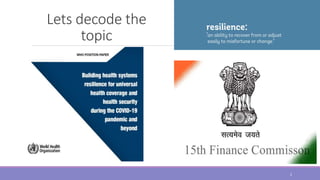
Lets decode the
topic
2
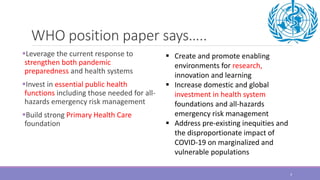
WHO position paper says…..
Leverage the current response to
strengthen both pandemic
preparedness and health systems
Invest in essential public health
functions including those needed for all-
hazards emergency risk management
Build strong Primary Health Care
foundation
 Create and promote enabling
environments for research,
innovation and learning
 Increase domestic and global
investment in health system
foundations and all-hazards
emergency risk management
 Address pre-existing inequities and
the disproportionate impact of
COVID-19 on marginalized and
vulnerable populations
3
About Finance Commission
A statutory body constituted once in every five years under Art. 280 of the Constitution
The primary function
 to study the trends and projections of the fiscal (receipts-expenditure) and
 socio-economic conditions - Share of net proceeds of central taxes and Revenue
Gap Grant.
 Terms of Reference (TOR),
 To determined the grants for the states to manage and Control Natural Calamity,
grant in aid to the local bodies (both rural and urban) to ensure the provision of
basic amenities to the citizens of the country,
 Sector Specific Grants meant to address certain Critical Sectors
4
The latest Commission, 15th Finance Commission, was constituted on the 27TH
November, 2017
 study the impact of GST
 Recommend performance based incentives for the states
The Commission submitted its first report on the 1st February, 2020
The final report of the Commission, called ‘Finance Commission in COVID
Times’was tabled in parliament on the 1st February, 2021
XV Finance Commission
5
Key recommendations
XV Finance Commission
Devolution of taxes to states
Vertical and horizontal distribution
Recommendations on fiscal roadmap
Financing of security-related expenditure
6
Empowering Local Governments
The total size of the grant to local governments should be Rs. 4,36,361 crore
for the period 2021-26.
Rs. 2,36,805 crore is earmarked for rural local bodies,
Rs. 1,21,055 crore for urban local bodies and
Rs. 70,051 crore for health grants through local governments.
Rs. 8,000 crore is performance-based grants for incubation of new cities
Rs. 450 crore is for shared municipal services
7
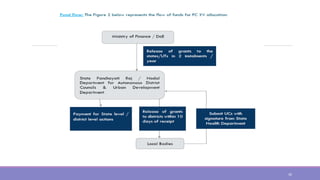
Constitute SFCs (State Finance Commission)
Sixty per cent of the basic grants
(a) sanitation and solid waste management and attainment of
star ratings as developed by the Ministry of Housing and
Urban Affairs;
(b) drinking water, rain water harvesting and water recycling.
Grants recommended shall be released in two equal
instalments each year in June and October
8
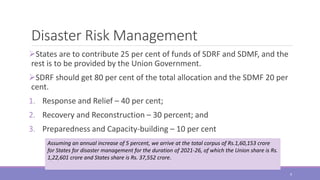
Disaster Risk Management
States are to contribute 25 per cent of funds of SDRF and SDMF, and the
rest is to be provided by the Union Government.
SDRF should get 80 per cent of the total allocation and the SDMF 20 per
cent.
1. Response and Relief – 40 per cent;
2. Recovery and Reconstruction – 30 percent; and
3. Preparedness and Capacity-building – 10 per cent
Assuming an annual increase of 5 percent, we arrive at the total corpus of Rs.1,60,153 crore
for States for disaster management for the duration of 2021-26, of which the Union share is Rs.
1,22,601 crore and States share is Rs. 37,552 crore.
9
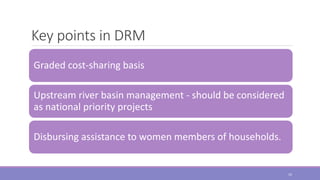
Key points in DRM
Graded cost-sharing basis
Upstream river basin management - should be considered
as national priority projects
Disbursing assistance to women members of households.
10
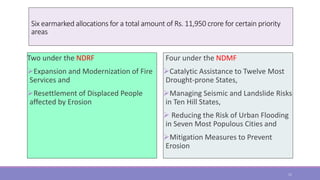
Six earmarked allocations for a total amount of Rs. 11,950 crore for certain priority
areas
Two under the NDRF
Expansion and Modernization of Fire
Services and
Resettlement of Displaced People
affected by Erosion
Four under the NDMF
Catalytic Assistance to Twelve Most
Drought-prone States,
Managing Seismic and Landslide Risks
in Ten Hill States,
 Reducing the Risk of Urban Flooding
in Seven Most Populous Cities and
Mitigation Measures to Prevent
Erosion
11
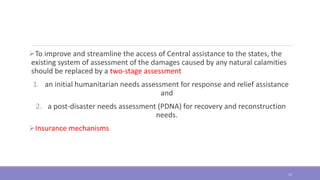
To improve and streamline the access of Central assistance to the states, the
existing system of assessment of the damages caused by any natural calamities
should be replaced by a two-stage assessment
1. an initial humanitarian needs assessment for response and relief assistance
and
2. a post-disaster needs assessment (PDNA) for recovery and reconstruction
needs.
Insurance mechanisms
12
Pandemic and Beyond:
Building Resilience in Health Sector
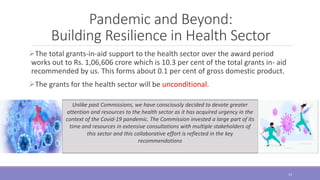
The total grants-in-aid support to the health sector over the award period
works out to Rs. 1,06,606 crore which is 10.3 per cent of the total grants in- aid
recommended by us. This forms about 0.1 per cent of gross domestic product.
The grants for the health sector will be unconditional.
Unlike past Commissions, we have consciously decided to devote greater
attention and resources to the health sector as it has acquired urgency in the
context of the Covid-19 pandemic. The Commission invested a large part of its
time and resources in extensive consultations with multiple stakeholders of
this sector and this collaborative effort is reflected in the key
recommendations
13
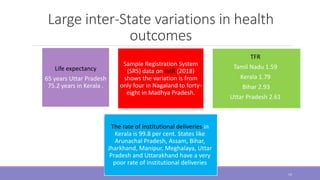
Large inter-State variations in health
outcomes
Sample Registration System
(SRS) data on IMR (2018)
shows the variation is from
only four in Nagaland to forty-
eight in Madhya Pradesh.
Life expectancy
65 years Uttar Pradesh
75.2 years in Kerala .
TFR
Tamil Nadu 1.59
Kerala 1.79
Bihar 2.93
Uttar Pradesh 2.61
The rate of institutional deliveries in
Kerala is 99.8 per cent. States like
Arunachal Pradesh, Assam, Bihar,
Jharkhand, Manipur, Meghalaya, Uttar
Pradesh and Uttarakhand have a very
poor rate of institutional deliveries
14
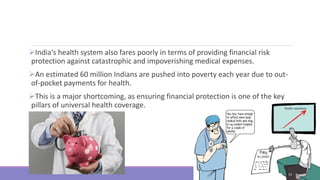
India's health system also fares poorly in terms of providing financial risk
protection against catastrophic and impoverishing medical expenses.
An estimated 60 million Indians are pushed into poverty each year due to out-
of-pocket payments for health.
This is a major shortcoming, as ensuring financial protection is one of the key
pillars of universal health coverage.
15
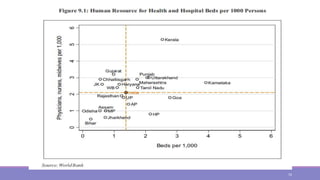
Health Infrastructure: An Assessment of
Vulnerabilities
16
Challenges in India's Healthcare System
Covid-19 crisis
local governance is weak
demand-side factors
lack of accountability in the service delivery.
17
Considerations…
Views of Previous Finance Commissions
Views of Union Government
Views of State Governments
Views of FC-XV in the Report for the Year 2020-21
Stakeholder Consultations
18
19
India Fights the Pandemic - various
measures specific to the pandemic
Recommendations/Way forward
policy
recommendations
grants/financial
recommendations.
20
Policy Recommendations
Health spending by states
should be increased to
more than 8 per cent of
their budget by 2022.
Primary health care should be the
number one fundamental commitment
of each and every state and that
primary health expenditure should be
increased to two-thirds of the total
health expenditure by 2022.
Public health expenditure of
union and states together
should be increased in a
progressive manner to reach
2.5 per cent of GDP by 2025.
21
Centrally sponsored schemes (CSS) co-financed
by the Government of India should be flexible
enough to allow States to adapt and innovate..
CSS should grant States significant latitude to
tailor implementation modalities to local
realities.
There is a need to shift the focus of inter-
governmental fiscal health financing from inputs to
outputs/outcomes while advancing the measurement
agenda as an accountability tool. the Union
Government can shift the focus of CSS and with States
being empowered to choose their own pathways to
achieve results.
22
Given the inter-State disparity in the availability of
medical doctors, it is essential to constitute an All
India Medical and Health Service as is envisaged
under Section 2A of the All-India Services Act,
1951. For this purpose, the Union Public Service
Commission (UPSC) would need to do annual
recruitments, based on the State-wise requisitions
by each State Government. We urge the Union
Government to implement this proposal in
coordination with State Governments.
The MBBS curriculum should be restructured to
make it competency based. A certain degree of
specialization should be included in the curriculum
and the MCI/NMC should develop small courses
on wellness clinic, basic surgical procedures,
anaesthesia, obstetrics and gynaecology, eye, ENT
etc. for MBBS doctors and encourage AYUSH as an
elective subject for medicine undergraduates.
23
The asymmetric distribution of medical colleges needs to be corrected as most of them are
located in the western and southern parts of India. All public health facilities including
district hospitals, private sector facilities and corporate hospitals should be utilised for
starting specialist DNB courses which will not only enhance the service provisioning but
will also ensure the availability of trained human resource.
Measures should be taken to assign a larger role for nursing professionals and the concept
of nurse practitioner, physician assistant and nurse anaesthetist should be introduced for
better utilization of nursing professionals. The early passage of this legislation should be
fast-tracked given its multiplier benefits.
24
Grants/financial recommendations
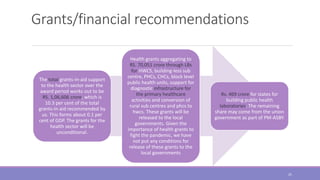
The total grants-in-aid support
to the health sector over the
award period works out to be
RS. 1,06,606 crore, which is
10.3 per cent of the total
grants-in-aid recommended by
us. This forms about 0.1 per
cent of GDP. The grants for the
health sector will be
unconditional.
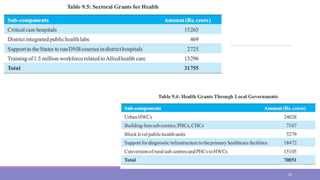
Health grants aggregating to
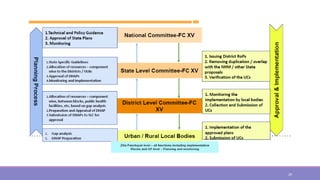
RS. 70,051 crore through LBs
for HWCS, building-less sub
centre, PHCs, CHCs, block level
public health units, support for
diagnostic infrastructure for
the primary healthcare
activities and conversion of
rural sub centres and phcs to
hwcs. These grants will be
released to the local
governments. Given the
importance of health grants to
fight the pandemic, we have
not put any conditions for
release of these grants to the
local governments
Rs. 469 crore for states for
building public health
laboratories. The remaining
share may come from the union
government as part of PM-ASBY.
25
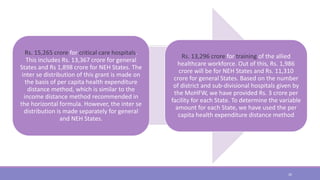
Rs. 15,265 crore for critical care hospitals.
This includes Rs. 13,367 crore for general
States and Rs 1,898 crore for NEH States. The
inter se distribution of this grant is made on
the basis of per capita health expenditure
distance method, which is similar to the
income distance method recommended in
the horizontal formula. However, the inter se
distribution is made separately for general
and NEH States.
Rs. 13,296 crore for training of the allied
healthcare workforce. Out of this, Rs. 1,986
crore will be for NEH States and Rs. 11,310
crore for general States. Based on the number
of district and sub-divisional hospitals given by
the MoHFW, we have provided Rs. 3 crore per
facility for each State. To determine the variable
amount for each State, we have used the per
capita health expenditure distance method
26
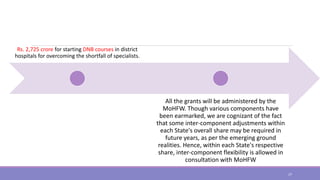
Rs. 2,725 crore for starting DNB courses in district
hospitals for overcoming the shortfall of specialists.
All the grants will be administered by the
MoHFW. Though various components have
been earmarked, we are cognizant of the fact
that some inter-component adjustments within
each State's overall share may be required in
future years, as per the emerging ground
realities. Hence, within each State's respective
share, inter-component flexibility is allowed in
consultation with MoHFW
27
28
29
30
My view points
31
Thank you
32

XV Finance commission .pptx

  • 1.
    Pandemic and Beyond: BuildingResilience in Health Sector (from XV Finance Commission) PRESENTER - DR NAVEEN SHYAM R JR,DEPARTMENT OF COMMUNITY MEDICINE, SNPH,MGIMS ,SEVAGRAM 1
  • 2.
  • 3.
    WHO position papersays….. Leverage the current response to strengthen both pandemic preparedness and health systems Invest in essential public health functions including those needed for all- hazards emergency risk management Build strong Primary Health Care foundation  Create and promote enabling environments for research, innovation and learning  Increase domestic and global investment in health system foundations and all-hazards emergency risk management  Address pre-existing inequities and the disproportionate impact of COVID-19 on marginalized and vulnerable populations 3
  • 4.
    About Finance Commission Astatutory body constituted once in every five years under Art. 280 of the Constitution The primary function  to study the trends and projections of the fiscal (receipts-expenditure) and  socio-economic conditions - Share of net proceeds of central taxes and Revenue Gap Grant.  Terms of Reference (TOR),  To determined the grants for the states to manage and Control Natural Calamity, grant in aid to the local bodies (both rural and urban) to ensure the provision of basic amenities to the citizens of the country,  Sector Specific Grants meant to address certain Critical Sectors 4
  • 5.
    The latest Commission,15th Finance Commission, was constituted on the 27TH November, 2017  study the impact of GST  Recommend performance based incentives for the states The Commission submitted its first report on the 1st February, 2020 The final report of the Commission, called ‘Finance Commission in COVID Times’was tabled in parliament on the 1st February, 2021 XV Finance Commission 5
  • 6.
    Key recommendations XV FinanceCommission Devolution of taxes to states Vertical and horizontal distribution Recommendations on fiscal roadmap Financing of security-related expenditure 6
  • 7.
    Empowering Local Governments Thetotal size of the grant to local governments should be Rs. 4,36,361 crore for the period 2021-26. Rs. 2,36,805 crore is earmarked for rural local bodies, Rs. 1,21,055 crore for urban local bodies and Rs. 70,051 crore for health grants through local governments. Rs. 8,000 crore is performance-based grants for incubation of new cities Rs. 450 crore is for shared municipal services 7
  • 8.
    Constitute SFCs (StateFinance Commission) Sixty per cent of the basic grants (a) sanitation and solid waste management and attainment of star ratings as developed by the Ministry of Housing and Urban Affairs; (b) drinking water, rain water harvesting and water recycling. Grants recommended shall be released in two equal instalments each year in June and October 8
  • 9.
    Disaster Risk Management Statesare to contribute 25 per cent of funds of SDRF and SDMF, and the rest is to be provided by the Union Government. SDRF should get 80 per cent of the total allocation and the SDMF 20 per cent. 1. Response and Relief – 40 per cent; 2. Recovery and Reconstruction – 30 percent; and 3. Preparedness and Capacity-building – 10 per cent Assuming an annual increase of 5 percent, we arrive at the total corpus of Rs.1,60,153 crore for States for disaster management for the duration of 2021-26, of which the Union share is Rs. 1,22,601 crore and States share is Rs. 37,552 crore. 9
  • 10.
    Key points inDRM Graded cost-sharing basis Upstream river basin management - should be considered as national priority projects Disbursing assistance to women members of households. 10
  • 11.
    Six earmarked allocationsfor a total amount of Rs. 11,950 crore for certain priority areas Two under the NDRF Expansion and Modernization of Fire Services and Resettlement of Displaced People affected by Erosion Four under the NDMF Catalytic Assistance to Twelve Most Drought-prone States, Managing Seismic and Landslide Risks in Ten Hill States,  Reducing the Risk of Urban Flooding in Seven Most Populous Cities and Mitigation Measures to Prevent Erosion 11
  • 12.
    To improve andstreamline the access of Central assistance to the states, the existing system of assessment of the damages caused by any natural calamities should be replaced by a two-stage assessment 1. an initial humanitarian needs assessment for response and relief assistance and 2. a post-disaster needs assessment (PDNA) for recovery and reconstruction needs. Insurance mechanisms 12
  • 13.
    Pandemic and Beyond: BuildingResilience in Health Sector The total grants-in-aid support to the health sector over the award period works out to Rs. 1,06,606 crore which is 10.3 per cent of the total grants in- aid recommended by us. This forms about 0.1 per cent of gross domestic product. The grants for the health sector will be unconditional. Unlike past Commissions, we have consciously decided to devote greater attention and resources to the health sector as it has acquired urgency in the context of the Covid-19 pandemic. The Commission invested a large part of its time and resources in extensive consultations with multiple stakeholders of this sector and this collaborative effort is reflected in the key recommendations 13
  • 14.
    Large inter-State variationsin health outcomes Sample Registration System (SRS) data on IMR (2018) shows the variation is from only four in Nagaland to forty- eight in Madhya Pradesh. Life expectancy 65 years Uttar Pradesh 75.2 years in Kerala . TFR Tamil Nadu 1.59 Kerala 1.79 Bihar 2.93 Uttar Pradesh 2.61 The rate of institutional deliveries in Kerala is 99.8 per cent. States like Arunachal Pradesh, Assam, Bihar, Jharkhand, Manipur, Meghalaya, Uttar Pradesh and Uttarakhand have a very poor rate of institutional deliveries 14
  • 15.
    India's health systemalso fares poorly in terms of providing financial risk protection against catastrophic and impoverishing medical expenses. An estimated 60 million Indians are pushed into poverty each year due to out- of-pocket payments for health. This is a major shortcoming, as ensuring financial protection is one of the key pillars of universal health coverage. 15
  • 16.
    Health Infrastructure: AnAssessment of Vulnerabilities 16
  • 17.
    Challenges in India'sHealthcare System Covid-19 crisis local governance is weak demand-side factors lack of accountability in the service delivery. 17
  • 18.
    Considerations… Views of PreviousFinance Commissions Views of Union Government Views of State Governments Views of FC-XV in the Report for the Year 2020-21 Stakeholder Consultations 18
  • 19.
    19 India Fights thePandemic - various measures specific to the pandemic
  • 20.
  • 21.
    Policy Recommendations Health spendingby states should be increased to more than 8 per cent of their budget by 2022. Primary health care should be the number one fundamental commitment of each and every state and that primary health expenditure should be increased to two-thirds of the total health expenditure by 2022. Public health expenditure of union and states together should be increased in a progressive manner to reach 2.5 per cent of GDP by 2025. 21
  • 22.
    Centrally sponsored schemes(CSS) co-financed by the Government of India should be flexible enough to allow States to adapt and innovate.. CSS should grant States significant latitude to tailor implementation modalities to local realities. There is a need to shift the focus of inter- governmental fiscal health financing from inputs to outputs/outcomes while advancing the measurement agenda as an accountability tool. the Union Government can shift the focus of CSS and with States being empowered to choose their own pathways to achieve results. 22
  • 23.
    Given the inter-Statedisparity in the availability of medical doctors, it is essential to constitute an All India Medical and Health Service as is envisaged under Section 2A of the All-India Services Act, 1951. For this purpose, the Union Public Service Commission (UPSC) would need to do annual recruitments, based on the State-wise requisitions by each State Government. We urge the Union Government to implement this proposal in coordination with State Governments. The MBBS curriculum should be restructured to make it competency based. A certain degree of specialization should be included in the curriculum and the MCI/NMC should develop small courses on wellness clinic, basic surgical procedures, anaesthesia, obstetrics and gynaecology, eye, ENT etc. for MBBS doctors and encourage AYUSH as an elective subject for medicine undergraduates. 23
  • 24.
    The asymmetric distributionof medical colleges needs to be corrected as most of them are located in the western and southern parts of India. All public health facilities including district hospitals, private sector facilities and corporate hospitals should be utilised for starting specialist DNB courses which will not only enhance the service provisioning but will also ensure the availability of trained human resource. Measures should be taken to assign a larger role for nursing professionals and the concept of nurse practitioner, physician assistant and nurse anaesthetist should be introduced for better utilization of nursing professionals. The early passage of this legislation should be fast-tracked given its multiplier benefits. 24
  • 25.
    Grants/financial recommendations The totalgrants-in-aid support to the health sector over the award period works out to be RS. 1,06,606 crore, which is 10.3 per cent of the total grants-in-aid recommended by us. This forms about 0.1 per cent of GDP. The grants for the health sector will be unconditional. Health grants aggregating to RS. 70,051 crore through LBs for HWCS, building-less sub centre, PHCs, CHCs, block level public health units, support for diagnostic infrastructure for the primary healthcare activities and conversion of rural sub centres and phcs to hwcs. These grants will be released to the local governments. Given the importance of health grants to fight the pandemic, we have not put any conditions for release of these grants to the local governments Rs. 469 crore for states for building public health laboratories. The remaining share may come from the union government as part of PM-ASBY. 25
  • 26.
    Rs. 15,265 crorefor critical care hospitals. This includes Rs. 13,367 crore for general States and Rs 1,898 crore for NEH States. The inter se distribution of this grant is made on the basis of per capita health expenditure distance method, which is similar to the income distance method recommended in the horizontal formula. However, the inter se distribution is made separately for general and NEH States. Rs. 13,296 crore for training of the allied healthcare workforce. Out of this, Rs. 1,986 crore will be for NEH States and Rs. 11,310 crore for general States. Based on the number of district and sub-divisional hospitals given by the MoHFW, we have provided Rs. 3 crore per facility for each State. To determine the variable amount for each State, we have used the per capita health expenditure distance method 26
  • 27.
    Rs. 2,725 crorefor starting DNB courses in district hospitals for overcoming the shortfall of specialists. All the grants will be administered by the MoHFW. Though various components have been earmarked, we are cognizant of the fact that some inter-component adjustments within each State's overall share may be required in future years, as per the emerging ground realities. Hence, within each State's respective share, inter-component flexibility is allowed in consultation with MoHFW 27
  • 28.
  • 29.
  • 30.
  • 31.
  • 32.