B Y - D R . D H A R M E N D R A G A H W A I
( P G S T U D E N T )
M O D E R A T O R -
P R O F . Y . D . B A D G A I Y A N
H E A D O F D E P A R T M E N T
D E P A R T M E N T O F C O M M U N I T Y M E D I C I N E
C I M S , B I L A S P U R ( C G )
An Overview of Health Care
Delivery System in India
INTRODUCTION
 As is well known , the majority of India’s population
lives in the rural areas
and
• this segment of population have been given
inadequate attention so far as health and medical
care facilities are concerned.
 The dense rural population with varied ethnic
background , high level of illiteracy, low per capita
income have been a challenge to Central and state
government to improve the quality of people’ lives.
 To cope up with various plans, programmes were
developed aiming to improve the level of living and
health of the people.
 This planned development of about five decades has
resulted in increase in the health infrastructure to
meet the increasing demand on health services at
various level.
 At the same time , there has been marked shift in
National Health Policy from hospital based services
to community based services duly backed by strong
referral services.
 Today , it is clear that health system in India do not
gravitate naturally towards the goal of HEALTH
FOR ALL through primary health care as
articulated in the Declaration of Alma-Ata.
 Health systems in India are developing in directions
that contribute little to equity and social justice
and
 Fail to get best outcomes for their resources.
 Three worrisome trends of health care system in
India -
 1.Health system that disproportionately focus on narrow
offer of specialized health care.
 2.Health system where a command and control approach
focused on short-term results and is fragmenting the
service delivery.
 3.Health systems where governance has allowed
unregulated commercialization of health to flourish.
SHORTCOMINGS OF HEALTH CARE
DELIVERY SYSTEM IN INDIA
Common shortcomings
 1.Inverse care.
 2.Impowerising care.
 3.Fragmented and fragmenting care.
 4.Unsafe care.
 5.Misdirected care.
INVERSE CARE
 People with most means - whose needs for health
care are often less - consume the most health care
services.
 Whereas those with the least means and greatest
health problems consume the least.
 Public spending on health services most
often benefits the rich more than the poor.
IMPOVERISHING CARE
 Wherever people are lack of social protection and
payment for health care , they are largely out of
pocket at the point of health services.
 They can be confronted with catastrophic expenses.
 Millions of people fall in to poverty because they
have to pay for health care services.
FRAGMENTED AND FRAGMENTING CARE
 The excessive specialization of health care providers
and the narrow focus on many disease control
programmes discourage the holistic approach to the
individuals and families.
 Health services for the poor and marginalized groups
are highly fragmented and severely under resourced .
UNSAFE CARE
• Poor system design that is unable to ensure safety
and hygiene standards leads to high rates of hospital
acquired-infection.
• Medication error and other avoidable adverse
effects are underestimated cause of death and ill
health.
MISDIRECTED CARE
 Resource allocation clusters around curative services
at great cost and it is neglecting the potential of
primary prevention and health promotion to
prevent up to 70% of disease burden in developing
countries.
 Health sector lacks to mitigate the adverse effects on
health from other sectors and
 At the same time, unable to make most of what these
sector can contribute to health.
ORGANIZATIONAL SET-UP
OF HEALTH CARE DELIVERY
IN INDIA
 Health development is integral to overall
socioeconomic development.
 Ministry of Health and Family welfare plays a vital
role in planning and making policies.
 Under the Constitutions of India, the item like
public health, sanitation, hospitals and dispensaries
fall in the state list.
 Health care is the subject of state government and
each state in India has developed its own system of
health care delivery independent of central
government.
 The central organization is mainly for policy making
and planning and is mostly consultative and
advisory.
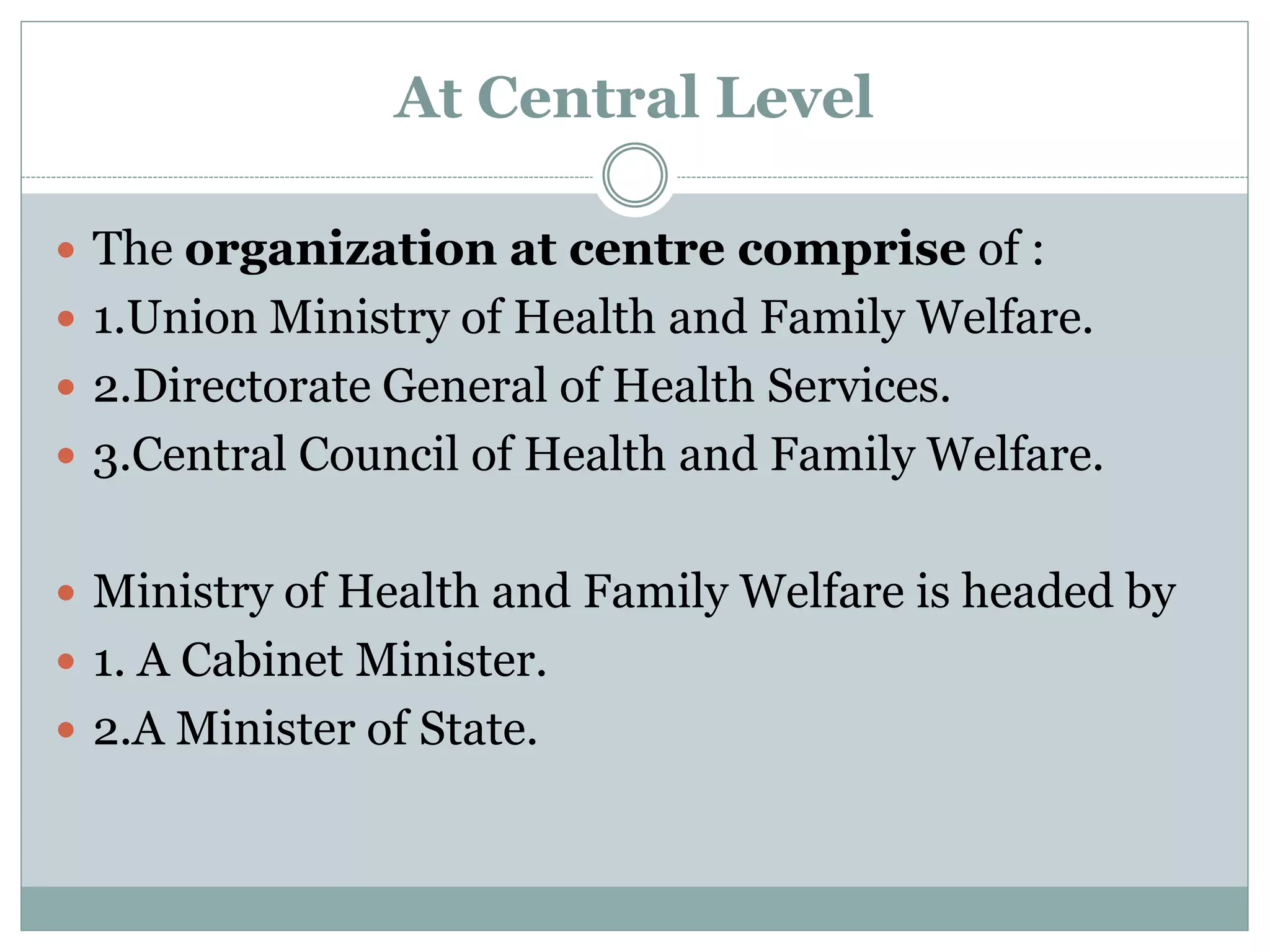
At Central Level
 The organization at centre comprise of :
 1.Union Ministry of Health and Family Welfare.
 2.Directorate General of Health Services.
 3.Central Council of Health and Family Welfare.
 Ministry of Health and Family Welfare is headed by
 1. A Cabinet Minister.
 2.A Minister of State.
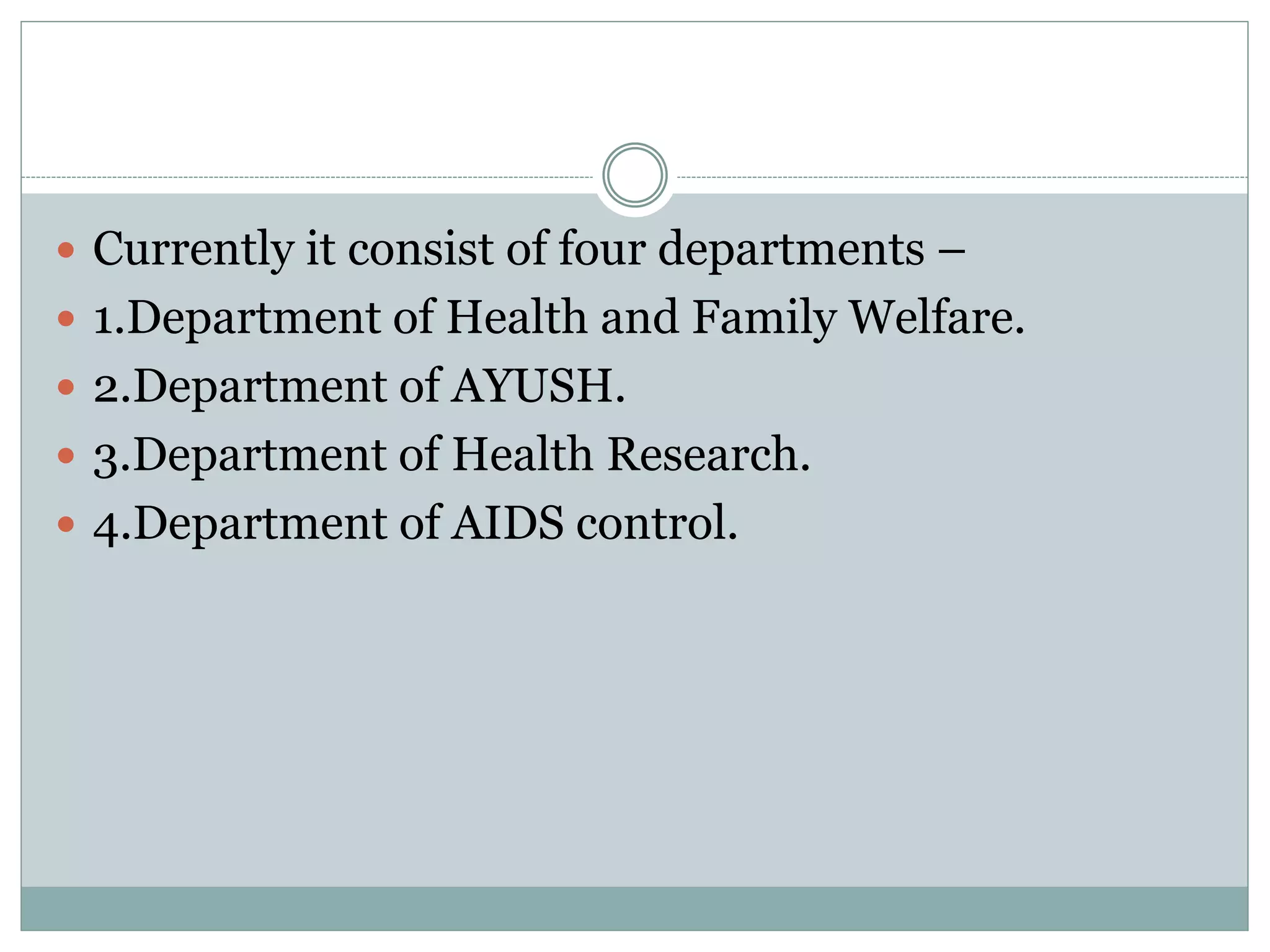
 Currently it consist of four departments –
 1.Department of Health and Family Welfare.
 2.Department of AYUSH.
 3.Department of Health Research.
 4.Department of AIDS control.
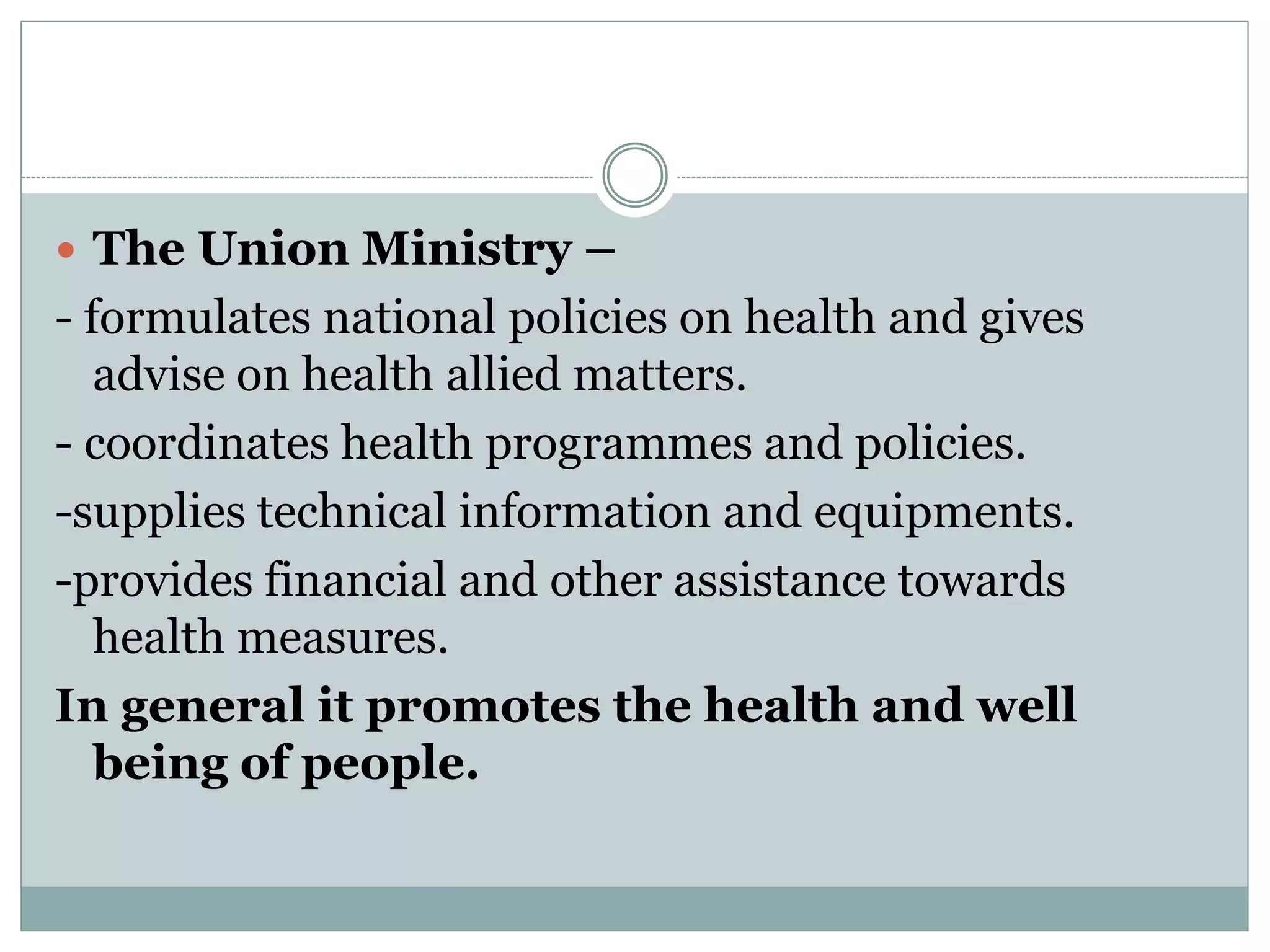
 The Union Ministry –
- formulates national policies on health and gives
advise on health allied matters.
- coordinates health programmes and policies.
-supplies technical information and equipments.
-provides financial and other assistance towards
health measures.
In general it promotes the health and well
being of people.
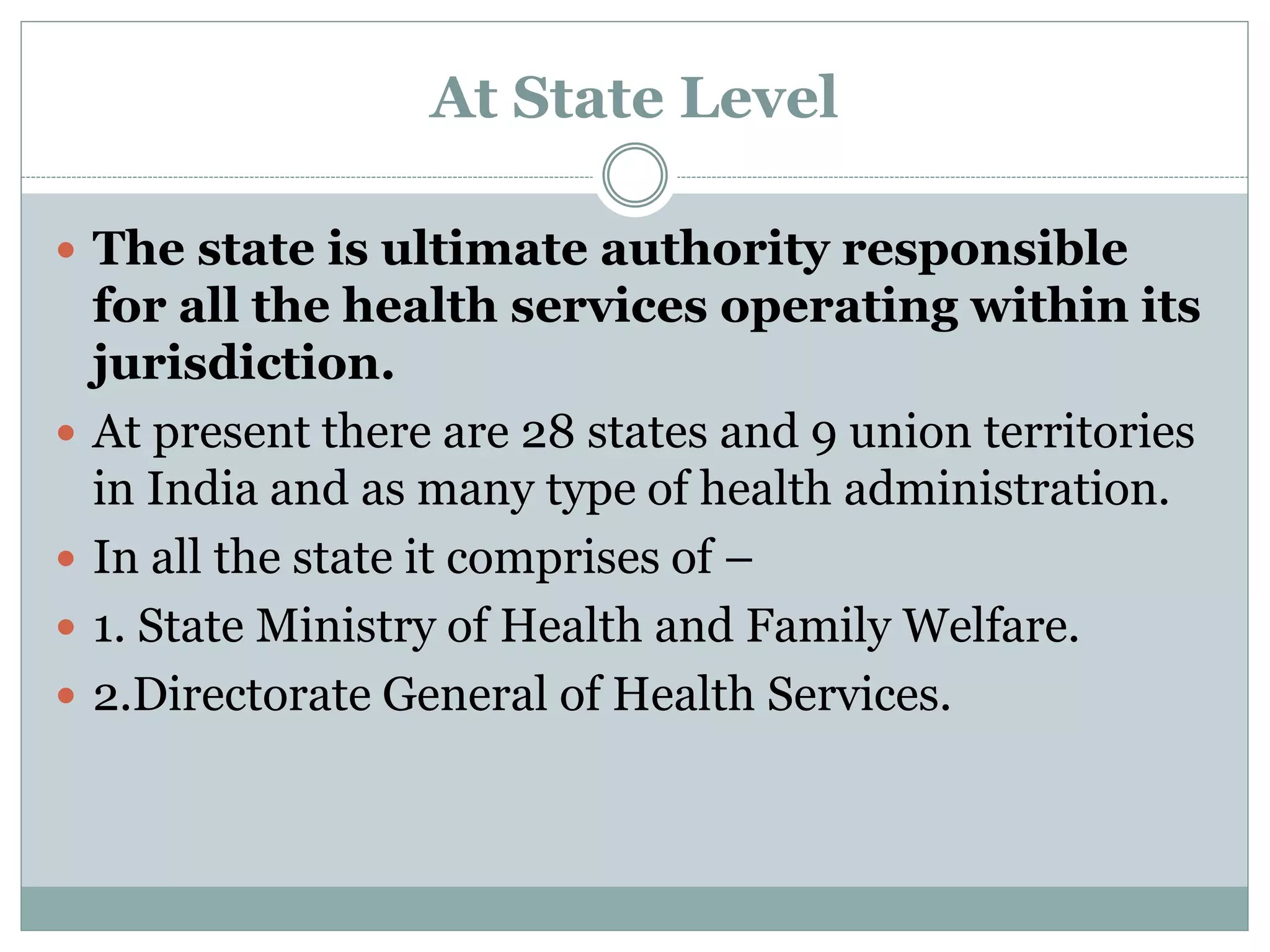
At State Level
 The state is ultimate authority responsible
for all the health services operating within its
jurisdiction.
 At present there are 28 states and 9 union territories
in India and as many type of health administration.
 In all the state it comprises of –
 1. State Ministry of Health and Family Welfare.
 2.Directorate General of Health Services.
 The State Ministry of Health and FW is headed by-
 1.A Minister of Health and Family Welfare.
 2.A Deputy Minister of Health and Family Welfare.
• Health Secretariat is a official organ-
• 1. Health Secretary.(Head)
• 2. Joint Secretaries.(2 or 3)
• 3. Deputy Secretaries and
• 4. Under Secretaries.
 Director General of Health Services is chief
technical advisor to the state government in all
matter of medical and public health.
 DGHS is assisted by 2-3 Joint Directors.
 Joint Directors may be-
 1. Regional.
 2. Functional.
 The Regional Directors are at Divisional level and
area classified according to geographical
distribution.
 The Functional Directors are in particular branch
of public health such as –
 Maternal and Child health
 Family Planning
 Nutrition
 Health Education.
 To coordinate the health and family welfare activities
between State government and Central government
there are 17 Regional Health Offices.
 For the large state there is one regional office while
2-3 smaller state have been linked with one regional
office.
At District Level
 The District level structure of health services is a
linkage between state structure on one side and
peripheral structure such as CHC , PHC and sub-
center on other side.
 The district officer of overall control designated as
CMHO.
 CMHO are assisted by deputies , programme officers
and State Civil Medical Officers of different
specialities.
 They are responsible for implementing health and
family welfare programmes according to policies lay
down at higher level.
At Block Level
 The block is unit of rural planning and development and
comprises about 80,000 to 1.2 lakh population.
 One Community Health Center is being established
in each block.
 The officer in-charge of CHC is k/as Superintendent
CHC or Block Medical Officer.
 Normally one CHC should have –
 - 30 bed hospital .
 - Specialist doctors in Pediatrics, Obstetrics, Medicine
and Surgery .
 - Four Medical Officer.
At Primary Health Center
 The delivery of Primary Health Care is principal
objective of rural health care system.
 One PHC covers about 20000 – 30000 population.
 PHC is manned by Medical Officer and paramedical
staff.
 The Primary Health Center is expected to provide
“essential health care” including MCH and
family planning.
 MCH services are provided through PHC clinic, sub-
center and out reach sessions.
At Sub-center level
 Sub-centers are peripheral outpost of health care
delivery system.
 Each sub center covers 3000-5000 population and
manned by one MPW male and one MPW female.
 MPW female is crucial to provide MCH services.
At Village level
 1.ASHA.
 2.AWW.
 3.Village Health Guide.
 4. Trained dais.
HEALTH CARE REFORMS
 The annual report of World Health Organization’s
(WHO) 2008 focused on “the place of primary
healthcare (PHC) in health systems”.
 The report arguing that, in three decades since the
Declaration of Alma-Ata (WHO 1978) on primary
healthcare, only little has changed.
 Member countries had largely implemented
'selective' primary care focused on provision of
medical care and services and treatment of specific
conditions.
FOUR SETS OF PHC REFORMS
 The WHO report (2008) laid out a four-point
framework for Primary Health Care policy.
 1.Universal Coverage Reforms.
 2.Service Delivery Reforms.
 3.Public Policy Reforms.
 4.Leadership Reforms.
1.Universal Coverage Reforms
 Universal coverage reforms is to improve health
equity, end exclusion and promote social justice.
 Primary care should be accessible to all and ideally,
be free at the point of services.
2.Service Delivery Reforms
 Service delivery reforms designed to re-organize
services around primary care.
 In this sense, the WHO argued that PHC should be
the ‘hub’ from which patients are guided through the
health care system.
 PHC should be delivered by multi-professional
teams that provide comprehensive care, co-ordinate
hospital and other specialized patient services, build
partnerships with patients, and promote disease
prevention.
3.Public Policy Reforms.
 The WHO advocated for public policy reforms that
integrate public health initiatives into primary care
delivery and
 work to promote health in the policies of other
sectors that influence community behaviour and
outcomes.
 'intersectoral collaboration'.
4.Leadership Reforms.
 The Leadership Reforms replace disproportionate
reliance on command and control on one hand.
 The inclusive , participatory , negotiation based
leadership is required by the complexity of health
system.
INDIAN PUBLIC HEALTH STANDARDS
 The health system in India has expanded
considerably over the last few decades.
 But , due to non availability of man power, problems
of access and lack of community involvement, the
quality of health services is not up to the mark.
 Hence, standards are being introduced in order to
improve the quality of health care at public health
level.
 The Bureau of Indian Standards has already
prescribed standards for health care facilities,
 but , at present these are not achievable as they are
very resource – intensive.
 IPHS are the set of standards envisaged to improve
the quality of health care delivery in the country.
 IPHS defining personnel , equipment and
management standards.
 It decentralized administration by a hospital
management committee and provision of adequate
funds and powers to enable these committees to
reach desired levels.
Objectives of IPHS
 1.To provide optimal support and comprehensive
primary health care to the community.
 2.To achieve and maintain an acceptable standards
of quality care.
 3.To make the services more responsible and
sensitive to the need of community.
 NRHM aims at strengthening hospital care for rural
areas.
 So, as the first step, requirement for Minimum
Functional Grade for CHCs, PHCs and Sub-center
are being prescribed.
CONCLUSIONS
 There have been significant advances in the
healthcare system in India over last few decades.
 Despite these recent strides the health system
remains ineffective in providing basic minimum
care as promised in the Indian Constitution.
 The fiscal constrains on the government make it
obligatory for the private healthcare providers to
take over part of the responsibilities.
 New ways for establishing, strengthening and
sustaining the public-private co-operation are
essential for rejuvenating the system.
 At the same time decentralization exercises can
make the health system more efficient and improve
the quality of healthcare delivery.
 All these changes will need to be based on a strong
political will and should be accompanied by
economic and social reforms.
THANK YOU

An overview of health care delivery system in

  • 1.
    B Y -D R . D H A R M E N D R A G A H W A I ( P G S T U D E N T ) M O D E R A T O R - P R O F . Y . D . B A D G A I Y A N H E A D O F D E P A R T M E N T D E P A R T M E N T O F C O M M U N I T Y M E D I C I N E C I M S , B I L A S P U R ( C G ) An Overview of Health Care Delivery System in India
  • 2.
    INTRODUCTION  As iswell known , the majority of India’s population lives in the rural areas and • this segment of population have been given inadequate attention so far as health and medical care facilities are concerned.
  • 3.
     The denserural population with varied ethnic background , high level of illiteracy, low per capita income have been a challenge to Central and state government to improve the quality of people’ lives.  To cope up with various plans, programmes were developed aiming to improve the level of living and health of the people.
  • 4.
     This planneddevelopment of about five decades has resulted in increase in the health infrastructure to meet the increasing demand on health services at various level.  At the same time , there has been marked shift in National Health Policy from hospital based services to community based services duly backed by strong referral services.
  • 5.
     Today ,it is clear that health system in India do not gravitate naturally towards the goal of HEALTH FOR ALL through primary health care as articulated in the Declaration of Alma-Ata.  Health systems in India are developing in directions that contribute little to equity and social justice and  Fail to get best outcomes for their resources.
  • 6.
     Three worrisometrends of health care system in India -  1.Health system that disproportionately focus on narrow offer of specialized health care.  2.Health system where a command and control approach focused on short-term results and is fragmenting the service delivery.  3.Health systems where governance has allowed unregulated commercialization of health to flourish.
  • 7.
    SHORTCOMINGS OF HEALTHCARE DELIVERY SYSTEM IN INDIA
  • 8.
    Common shortcomings  1.Inversecare.  2.Impowerising care.  3.Fragmented and fragmenting care.  4.Unsafe care.  5.Misdirected care.
  • 9.
    INVERSE CARE  Peoplewith most means - whose needs for health care are often less - consume the most health care services.  Whereas those with the least means and greatest health problems consume the least.  Public spending on health services most often benefits the rich more than the poor.
  • 10.
    IMPOVERISHING CARE  Whereverpeople are lack of social protection and payment for health care , they are largely out of pocket at the point of health services.  They can be confronted with catastrophic expenses.  Millions of people fall in to poverty because they have to pay for health care services.
  • 11.
    FRAGMENTED AND FRAGMENTINGCARE  The excessive specialization of health care providers and the narrow focus on many disease control programmes discourage the holistic approach to the individuals and families.  Health services for the poor and marginalized groups are highly fragmented and severely under resourced .
  • 12.
    UNSAFE CARE • Poorsystem design that is unable to ensure safety and hygiene standards leads to high rates of hospital acquired-infection. • Medication error and other avoidable adverse effects are underestimated cause of death and ill health.
  • 13.
    MISDIRECTED CARE  Resourceallocation clusters around curative services at great cost and it is neglecting the potential of primary prevention and health promotion to prevent up to 70% of disease burden in developing countries.  Health sector lacks to mitigate the adverse effects on health from other sectors and  At the same time, unable to make most of what these sector can contribute to health.
  • 14.
    ORGANIZATIONAL SET-UP OF HEALTHCARE DELIVERY IN INDIA
  • 15.
     Health developmentis integral to overall socioeconomic development.  Ministry of Health and Family welfare plays a vital role in planning and making policies.
  • 16.
     Under theConstitutions of India, the item like public health, sanitation, hospitals and dispensaries fall in the state list.  Health care is the subject of state government and each state in India has developed its own system of health care delivery independent of central government.  The central organization is mainly for policy making and planning and is mostly consultative and advisory.
  • 17.
    At Central Level The organization at centre comprise of :  1.Union Ministry of Health and Family Welfare.  2.Directorate General of Health Services.  3.Central Council of Health and Family Welfare.  Ministry of Health and Family Welfare is headed by  1. A Cabinet Minister.  2.A Minister of State.
  • 18.
     Currently itconsist of four departments –  1.Department of Health and Family Welfare.  2.Department of AYUSH.  3.Department of Health Research.  4.Department of AIDS control.
  • 19.
     The UnionMinistry – - formulates national policies on health and gives advise on health allied matters. - coordinates health programmes and policies. -supplies technical information and equipments. -provides financial and other assistance towards health measures. In general it promotes the health and well being of people.
  • 20.
    At State Level The state is ultimate authority responsible for all the health services operating within its jurisdiction.  At present there are 28 states and 9 union territories in India and as many type of health administration.  In all the state it comprises of –  1. State Ministry of Health and Family Welfare.  2.Directorate General of Health Services.
  • 21.
     The StateMinistry of Health and FW is headed by-  1.A Minister of Health and Family Welfare.  2.A Deputy Minister of Health and Family Welfare. • Health Secretariat is a official organ- • 1. Health Secretary.(Head) • 2. Joint Secretaries.(2 or 3) • 3. Deputy Secretaries and • 4. Under Secretaries.
  • 22.
     Director Generalof Health Services is chief technical advisor to the state government in all matter of medical and public health.  DGHS is assisted by 2-3 Joint Directors.  Joint Directors may be-  1. Regional.  2. Functional.
  • 23.
     The RegionalDirectors are at Divisional level and area classified according to geographical distribution.  The Functional Directors are in particular branch of public health such as –  Maternal and Child health  Family Planning  Nutrition  Health Education.
  • 24.
     To coordinatethe health and family welfare activities between State government and Central government there are 17 Regional Health Offices.  For the large state there is one regional office while 2-3 smaller state have been linked with one regional office.
  • 25.
    At District Level The District level structure of health services is a linkage between state structure on one side and peripheral structure such as CHC , PHC and sub- center on other side.  The district officer of overall control designated as CMHO.
  • 26.
     CMHO areassisted by deputies , programme officers and State Civil Medical Officers of different specialities.  They are responsible for implementing health and family welfare programmes according to policies lay down at higher level.
  • 27.
    At Block Level The block is unit of rural planning and development and comprises about 80,000 to 1.2 lakh population.  One Community Health Center is being established in each block.  The officer in-charge of CHC is k/as Superintendent CHC or Block Medical Officer.  Normally one CHC should have –  - 30 bed hospital .  - Specialist doctors in Pediatrics, Obstetrics, Medicine and Surgery .  - Four Medical Officer.
  • 28.
    At Primary HealthCenter  The delivery of Primary Health Care is principal objective of rural health care system.  One PHC covers about 20000 – 30000 population.  PHC is manned by Medical Officer and paramedical staff.  The Primary Health Center is expected to provide “essential health care” including MCH and family planning.  MCH services are provided through PHC clinic, sub- center and out reach sessions.
  • 29.
    At Sub-center level Sub-centers are peripheral outpost of health care delivery system.  Each sub center covers 3000-5000 population and manned by one MPW male and one MPW female.  MPW female is crucial to provide MCH services.
  • 30.
    At Village level 1.ASHA.  2.AWW.  3.Village Health Guide.  4. Trained dais.
  • 31.
  • 32.
     The annualreport of World Health Organization’s (WHO) 2008 focused on “the place of primary healthcare (PHC) in health systems”.  The report arguing that, in three decades since the Declaration of Alma-Ata (WHO 1978) on primary healthcare, only little has changed.  Member countries had largely implemented 'selective' primary care focused on provision of medical care and services and treatment of specific conditions.
  • 33.
    FOUR SETS OFPHC REFORMS  The WHO report (2008) laid out a four-point framework for Primary Health Care policy.  1.Universal Coverage Reforms.  2.Service Delivery Reforms.  3.Public Policy Reforms.  4.Leadership Reforms.
  • 34.
    1.Universal Coverage Reforms Universal coverage reforms is to improve health equity, end exclusion and promote social justice.  Primary care should be accessible to all and ideally, be free at the point of services.
  • 35.
    2.Service Delivery Reforms Service delivery reforms designed to re-organize services around primary care.  In this sense, the WHO argued that PHC should be the ‘hub’ from which patients are guided through the health care system.  PHC should be delivered by multi-professional teams that provide comprehensive care, co-ordinate hospital and other specialized patient services, build partnerships with patients, and promote disease prevention.
  • 36.
    3.Public Policy Reforms. The WHO advocated for public policy reforms that integrate public health initiatives into primary care delivery and  work to promote health in the policies of other sectors that influence community behaviour and outcomes.  'intersectoral collaboration'.
  • 37.
    4.Leadership Reforms.  TheLeadership Reforms replace disproportionate reliance on command and control on one hand.  The inclusive , participatory , negotiation based leadership is required by the complexity of health system.
  • 38.
  • 39.
     The healthsystem in India has expanded considerably over the last few decades.  But , due to non availability of man power, problems of access and lack of community involvement, the quality of health services is not up to the mark.  Hence, standards are being introduced in order to improve the quality of health care at public health level.
  • 40.
     The Bureauof Indian Standards has already prescribed standards for health care facilities,  but , at present these are not achievable as they are very resource – intensive.
  • 41.
     IPHS arethe set of standards envisaged to improve the quality of health care delivery in the country.  IPHS defining personnel , equipment and management standards.  It decentralized administration by a hospital management committee and provision of adequate funds and powers to enable these committees to reach desired levels.
  • 42.
    Objectives of IPHS 1.To provide optimal support and comprehensive primary health care to the community.  2.To achieve and maintain an acceptable standards of quality care.  3.To make the services more responsible and sensitive to the need of community.
  • 43.
     NRHM aimsat strengthening hospital care for rural areas.  So, as the first step, requirement for Minimum Functional Grade for CHCs, PHCs and Sub-center are being prescribed.
  • 44.
  • 45.
     There havebeen significant advances in the healthcare system in India over last few decades.  Despite these recent strides the health system remains ineffective in providing basic minimum care as promised in the Indian Constitution.
  • 46.
     The fiscalconstrains on the government make it obligatory for the private healthcare providers to take over part of the responsibilities.  New ways for establishing, strengthening and sustaining the public-private co-operation are essential for rejuvenating the system.
  • 47.
     At thesame time decentralization exercises can make the health system more efficient and improve the quality of healthcare delivery.  All these changes will need to be based on a strong political will and should be accompanied by economic and social reforms.
  • 48.