G.Arunkumar, A.Prakash, R.Subramanian / International Journal of Engineering Research
and Applications (IJERA) ISSN: 2248-9622 www.ijera.com
Vol. 3, Issue 3, May-Jun 2013, pp.128-132
128 | P a g e
A Simplified Topology for Seven Level Modified Multilevel
Inverter with Reduced Switch Count Technique
G.Arunkumar*, A.Prakash**, R.Subramanian***
*Department of Electrical and Electronics Engineering, Akshaya College of Engineering & Tech.,
Coimbatore-109
** Department of Electrical and Electronics Engineering, Akshaya College of Engineering & Tech.,
Coimbatore-109
*** Department of Electrical and Electronics Engineering, Akshaya College of Engineering & Tech.,
Coimbatore-109
ABSTRACT
In this paper, a seven level modified
cascaded multilevel inverter is proposed for
industrial drive applications. Apart from
selecting the conventional level inverters, Multi
level inverters has been chosen for the industrial
drive applications as it reduces the total
harmonic distortion. The involvement of higher
number of switches increases the complexity of
the system, which leads to losses in switching,
producing huge harmonics and in the end, it
entirely reduces the efficiency of the system. The
cascaded multilevel inverter involves only fewer
switches, where it reduces the complexity of the
system which in turn reduces the harmonics and
reduces the complexity of the system and in total
it reduces the total harmonics distortion.
Keywords – Cascaded Multilevel Inverter,
Insulated Gate Bipolar Transistor, Pulse Width
Modulation, Total Harmonic Distortion.
I. INTRODUCTION
In recent years, huge industrial applications
require high power rating apparatus to improve the
efficiency of the system. In conventional two level
inverter, it is found that there are many problems in
accordance with the high power applications. Owing
to this, the implementation of Multi level inverters
takes place, which in turn reduces the total harmonic
distortion of the entire system. The multi level
inverters can be operated at higher switching
frequencies while producing lower order harmonic
components. In this technique, a H-bridge inverter is
introduced (full bridge inverter). The total output
voltage is the sum of the outputs produced at each
H-bridge cell. For a single phase system, only one
H-bridge cell is required, which involves one switch
and a diode for each voltage source.
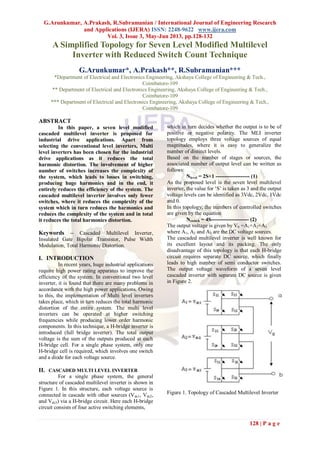
II. CASCADED MULTI LEVEL INVERTER
For a single phase system, the general
structure of cascaded multilevel inverter is shown in
Figure 1. In this structure, each voltage source is
connected in cascade with other sources (Vdc1, Vdc2,
and Vdc3) via a H-bridge circuit. Here each H-bridge
circuit consists of four active switching elements,
which in turn decides whether the output is to be of
positive or negative polarity. The MLI inverter
topology employs three voltage sources of equal
magnitudes, where it is easy to generalize the
number of distinct levels.
Based on the number of stages or sources, the
associated number of output level can be written as
follows:
Nlevel = 2S+1 ------------------- (1)
As the proposed level is the seven level multilevel
inverter, the value for „S‟ is taken as 3 and the output
voltage levels can be identified as 3Vdc, 2Vdc, 1Vdc
and 0.
In this topology, the numbers of controlled switches
are given by the equation
Nswitch = 4S--------------------- (2)
The output voltage is given by V0 =A1+A2+A3
where A1, A2 and A3 are the DC voltage sources.
The cascaded multilevel inverter is well known for
its excellent layout and its packing. The only
disadvantage of this topology is that each H-bridge
circuit requires separate DC source, which finally
leads to high number of semi conductor switches.
The output voltage waveform of a seven level
cascaded inverter with separate DC source is given
in Figure 2.
Figure 1. Topology of Cascaded Multilevel Inverter
G.Arunkumar, A.Prakash, R.Subramanian / International Journal of Engineering Research
and Applications (IJERA) ISSN: 2248-9622 www.ijera.com
Vol. 3, Issue 3, May-Jun 2013, pp.128-132
129 | P a g e
III. MODIFIED CASCADED MULTI LEVEL
INVERTER
The modified cascaded multilevel inverter
is a combination of a multi conversion cell and a H-
bridge. The proposed multilevel inverter is shown in
Figure 3. Here the multi conversion cell consists of
three separate voltage sources (Vdc1, Vdc2, and Vdc3).
With the help of one active switching element and a
diode, each voltage source is connected in cascade
with the other source, which leads to the output
voltage only in the positive level with several levels.
A different control pattern is followed in this
topology. First the switch S1 is turned on to obtain
the voltage level of +1Vdc. At this instant switch S2
and S3 are turned off. Similarly, the switches S1 and
S2 are turned on to obtain the voltage level of +2Vdc.
Now the switch S3 is turned off. Now the switched
S1, S2 and S3 are turned on to obtain the voltage
level of +3Vdc. Apart from producing all the voltage
levels at the output stage, a unique procedure of
calculating the required dc voltage source is
proposed. Pulse Width Modulation is proposed in
this topology.
The main advantage of this proposed multi level
inverter is obtaining seven level with reduces
number of switches.
Based upon the number of DC Sources taken and the
associated number output level can be calculated by
using the equation
Nlevel = 2S+1---------------- (3)
As the proposed multilevel inverter is designed for
seven level, taking S=3, the output will have seven
levels as follows: 3Vdc, 2Vdc, 1Vdc and 0
In this topology, the numbers of controlled switches
are given by the equation
Nswitch = 2S+4-------------- (4)
The output voltage is given by V0 =A1+A2+A3
where A1, A2 and A3 are the DC voltage sources.
Figure 2. Typical Output Waveform for Cascaded
Multilevel Inverter
IV. REDUCTION OF HARMONICS BY PULSE
WIDTH MODULATION TECHNIQUE
The most extensively used method for
reducing the harmonics in the inverters is the Pulse
Width Modulation Technique. In this control, the
selected switches are turned ON and OFF several
times during the half cycle and the output voltage is
controlled by varying the pulse width. Among the
existing modulation techniques, sinusoidal PWM is
the most widely used method in controlling the
motor and inverter application. In order to verify the
proposed multilevel inverter topology, programmed
SPWM technique is applied in order to determine
the required switching angles. This method is
applied in order to synthesize the output voltage with
desired amplitude and to obtain better harmonic
spectrum. It is clearly evident that in order to control
the fundamental output voltage and to eliminate the
harmonics, „n+1‟ equations are needed.
Figure 3. Proposed Topology of the Modified
Cascaded Multilevel Inverter
V. TOTAL HARMONIC DISTORTION
Generally harmonics have frequencies that
are integer multiples of the waveform‟s fundamental
frequency. The ideal sine wave has zero harmonic
components. The Total Harmonic Distortion is the
summation of all harmonic components of the
voltage or current waveform compared against the
fundamental component of the voltage or current
waveform. The general equation for THD is given
by
VI. SIMULATION RESULT ANALYSIS
G.Arunkumar, A.Prakash, R.Subramanian / International Journal of Engineering Research
and Applications (IJERA) ISSN: 2248-9622 www.ijera.com
Vol. 3, Issue 3, May-Jun 2013, pp.128-132
130 | P a g e
The proposed modified multilevel inverter
for induction motor drive is simulated using
MATLAB. The simulated diagram for the induction
motor drive using MATLAB is shown in Figure 4.
The switching pulse sequence for single phase is
given in Figure 5. The output voltage waveform of
three phase line to ground voltage and line to line
voltages are given in 6a and 6b. For the proposed
inverter, the phase voltage is 212 V and line voltage
is 370 V. Figure 7a and 7b shows the output
waveform of speed and torque curve of induction
motor. It is seen that the motor attains the rated
speed at 0.8 msec and the torque gets settled down at
0.5 msec. Figure 8 shows the detailed simulink
diagram for an individual phase. The output is
obtained for the permanent magnet asynchronous
machine. Figure 9 shows the FFT analysis. From the
FFT analysis it is seen that when the number of
levels are getting increased, the harmonics and the
total harmonic distortion is reduced. At load
conditions, the THD value of the proposed inverter
is found to be 33.58%.
Figure 4. Simulation of the Modified Cascaded
Multilevel Inverter
VII. CONCLUSION
From the above inferences, it is clear that
the proposed multilevel inverter topology can be
used for induction motor drive applications, which
involves less number of switches, which in turn
reduces the complexity of the system. As the
conventional seven level inverter involves twelve
switches, it increases the complexity of the circuit,
increases switching losses and cost of the circuit is
also increased. But in the proposed topology, the
same seven levels is obtained with only seven
switches, which reduces the harmonics, circuit
complexity, reduces the cost and moreover it reduces
the total harmonic distortion.
Figure 5. Switching Pulse Sequence of R-Phase
Figure 6(a) Output Voltage Waveform for Three
Phase Line to ground
Figure 6(b) Output Voltage Waveform for Three
Phase Line to Line
G.Arunkumar, A.Prakash, R.Subramanian / International Journal of Engineering Research
and Applications (IJERA) ISSN: 2248-9622 www.ijera.com
Vol. 3, Issue 3, May-Jun 2013, pp.128-132
131 | P a g e
Figure 7 (a) Modified Cascaded Multilevel Inverter
– Speed Curve
Figure 7 (b) Modified Cascaded Multilevel Inverter
– Torque Curve
Figure 8. Detailed Model for Individual Phase
Figure 9 Modified Cascaded Multilevel Inverter –
FFT Analysis.
REFERENCES
[1] Franquelo, L.G., (2008), “The age of
multilevel converter arrives”, IEEE
Industrial Electronics Magazine, Vol.2,
No.2, 28-39.
[2] Rodriguez, J., Lai, J.S. & Peng, F.Z.,
(2002) “Multilevel Inverters: Survey of
topologies, controls, and applications”,
IEEE Trans. Ind. Appl. Vol.49, No.4, 724-
738.
[3] Corzine, K.A., Wielebski, M.W., Peng, F.Z
& Wang, J., (2004), “Control of cascaded
multilevel inverters”, IEEE Trans. Power
Electron. Vol.19, No.3, 732-738.
[4] Chiasson, J.N. Tobert, L.M., McKenzie,
K.J. & Du, Z., (2004), “A Unified
Approach to Solving the Harmonic
Elimination Equations in Multilevel
Converters”, IEEE Trans. Power Electron,
Vol.19, No.2, pp. 478-490.
[5] Patel, H.S. & Hoft, R.G., (1973),
“Generalized Techniques of Harmonic
Elimination and Voltage Control in
Thyristor Inverters: Part I – Harmonic
Elimination”, IEEE Trans. Ind. Appl., 3, pp.
310-317.
[6] B. Ismail, S. T. “Development of a Single
Phase SPWM Microcontroller-Based
Inverter” First International Power and
Energy Conference PEC, Putrajaya,
Malaysia: IEEE, Nov, 28 -29, 2006.
[7] Fang Zheng Peng “A Generalized
Multilevel Inverter Topology with Self
Voltage Balancing”, IEEE Trans. Ind .Appl.,
Vol.37, No.2, March/April 2001.
[8] Z.Du, L.m.Tolbert, J.N.Chiasson, and
B.Opineci, “A cascaded multilevel inverter
using a single dc power source”, in Proc.
IEEE APEC, pp.426-430, 2006.
[9] W.Menzies, P.Steimer, and J.K.Steinke,
“Five level GTO inverters for large
induction motor drives,” IEEE Transactions
on Industry Applications, Vol.30, No.4,
pp.938-944, July 1994.
[10] Martin Veenstra, INVESTIGATION AND
CONTROL OF A HYBRID
ASYMMETRIC MULTI-LEVEL
INVERTER FOR MEDIUM-VOLTAGE
APPLICATIONS, 2003, Lausanne, EPFL.
G.Arunkumar, A.Prakash, R.Subramanian / International Journal of Engineering Research
and Applications (IJERA) ISSN: 2248-9622 www.ijera.com
Vol. 3, Issue 3, May-Jun 2013, pp.128-132
132 | P a g e
G.Arunkumar received the B.E
degree in Electrical and
Electronics Engineering from
Karpagam College of Engineering
in the year 2006 and M.E in
Embedded System Technologies
from Anna University in the year
2009. He is currently pursuing
Ph.D in the area of Power Quality and he is currently
working as Assistant Professor at Akshaya College
of Engineering & Technology, Coimbatore. His
research interests are Power Quality and FACTS. He
is a professional member of IEEE and a Life
Member in ISTE.
A.Prakash received the B.E
degree in Electrical and
Electronics Engineering from Sri
Nandhanam College of
Engineering and Technology in
the year 2005 and M.Tech degree
in Power Electronics and Drives
from PRIST University, Tanjore in the year 2011.
He is currently working as an Assistant Professor in
the Department of Electrical and Electronics
Engineering at Akshaya College of Engineering and
Technology, Coimbatore. His research interests are
Power System Modeling and Analysis and Power
Electronic applications to Power Systems. He is a
Life Member in ISTE.
R.Subramanian received the B.E
degree in Electrical and
Electronics Engineering from
Coimbatore Institute of
Technology in the year 2005 and
M.E degree in Power Systems
Engineering from Government
College of Technology, Coimbatore in the year
2007. He is currently doing PhD in the area of
Power system control and operation under Anna
University. Presently he is working as an Associate
professor in the Department of Electrical and
Electronics Engineering at Akshaya College of
Engineering and Technology, Coimbatore. His
research interests are power system analysis, power
system control and operation, mathematical
computations, optimization and Soft Computing
Techniques. He is a professional member of IEEE
and a Life Member in ISTE.

X33128132

  • 1.
    G.Arunkumar, A.Prakash, R.Subramanian/ International Journal of Engineering Research and Applications (IJERA) ISSN: 2248-9622 www.ijera.com Vol. 3, Issue 3, May-Jun 2013, pp.128-132 128 | P a g e A Simplified Topology for Seven Level Modified Multilevel Inverter with Reduced Switch Count Technique G.Arunkumar*, A.Prakash**, R.Subramanian*** *Department of Electrical and Electronics Engineering, Akshaya College of Engineering & Tech., Coimbatore-109 ** Department of Electrical and Electronics Engineering, Akshaya College of Engineering & Tech., Coimbatore-109 *** Department of Electrical and Electronics Engineering, Akshaya College of Engineering & Tech., Coimbatore-109 ABSTRACT In this paper, a seven level modified cascaded multilevel inverter is proposed for industrial drive applications. Apart from selecting the conventional level inverters, Multi level inverters has been chosen for the industrial drive applications as it reduces the total harmonic distortion. The involvement of higher number of switches increases the complexity of the system, which leads to losses in switching, producing huge harmonics and in the end, it entirely reduces the efficiency of the system. The cascaded multilevel inverter involves only fewer switches, where it reduces the complexity of the system which in turn reduces the harmonics and reduces the complexity of the system and in total it reduces the total harmonics distortion. Keywords – Cascaded Multilevel Inverter, Insulated Gate Bipolar Transistor, Pulse Width Modulation, Total Harmonic Distortion. I. INTRODUCTION In recent years, huge industrial applications require high power rating apparatus to improve the efficiency of the system. In conventional two level inverter, it is found that there are many problems in accordance with the high power applications. Owing to this, the implementation of Multi level inverters takes place, which in turn reduces the total harmonic distortion of the entire system. The multi level inverters can be operated at higher switching frequencies while producing lower order harmonic components. In this technique, a H-bridge inverter is introduced (full bridge inverter). The total output voltage is the sum of the outputs produced at each H-bridge cell. For a single phase system, only one H-bridge cell is required, which involves one switch and a diode for each voltage source. II. CASCADED MULTI LEVEL INVERTER For a single phase system, the general structure of cascaded multilevel inverter is shown in Figure 1. In this structure, each voltage source is connected in cascade with other sources (Vdc1, Vdc2, and Vdc3) via a H-bridge circuit. Here each H-bridge circuit consists of four active switching elements, which in turn decides whether the output is to be of positive or negative polarity. The MLI inverter topology employs three voltage sources of equal magnitudes, where it is easy to generalize the number of distinct levels. Based on the number of stages or sources, the associated number of output level can be written as follows: Nlevel = 2S+1 ------------------- (1) As the proposed level is the seven level multilevel inverter, the value for „S‟ is taken as 3 and the output voltage levels can be identified as 3Vdc, 2Vdc, 1Vdc and 0. In this topology, the numbers of controlled switches are given by the equation Nswitch = 4S--------------------- (2) The output voltage is given by V0 =A1+A2+A3 where A1, A2 and A3 are the DC voltage sources. The cascaded multilevel inverter is well known for its excellent layout and its packing. The only disadvantage of this topology is that each H-bridge circuit requires separate DC source, which finally leads to high number of semi conductor switches. The output voltage waveform of a seven level cascaded inverter with separate DC source is given in Figure 2. Figure 1. Topology of Cascaded Multilevel Inverter
  • 2.
    G.Arunkumar, A.Prakash, R.Subramanian/ International Journal of Engineering Research and Applications (IJERA) ISSN: 2248-9622 www.ijera.com Vol. 3, Issue 3, May-Jun 2013, pp.128-132 129 | P a g e III. MODIFIED CASCADED MULTI LEVEL INVERTER The modified cascaded multilevel inverter is a combination of a multi conversion cell and a H- bridge. The proposed multilevel inverter is shown in Figure 3. Here the multi conversion cell consists of three separate voltage sources (Vdc1, Vdc2, and Vdc3). With the help of one active switching element and a diode, each voltage source is connected in cascade with the other source, which leads to the output voltage only in the positive level with several levels. A different control pattern is followed in this topology. First the switch S1 is turned on to obtain the voltage level of +1Vdc. At this instant switch S2 and S3 are turned off. Similarly, the switches S1 and S2 are turned on to obtain the voltage level of +2Vdc. Now the switch S3 is turned off. Now the switched S1, S2 and S3 are turned on to obtain the voltage level of +3Vdc. Apart from producing all the voltage levels at the output stage, a unique procedure of calculating the required dc voltage source is proposed. Pulse Width Modulation is proposed in this topology. The main advantage of this proposed multi level inverter is obtaining seven level with reduces number of switches. Based upon the number of DC Sources taken and the associated number output level can be calculated by using the equation Nlevel = 2S+1---------------- (3) As the proposed multilevel inverter is designed for seven level, taking S=3, the output will have seven levels as follows: 3Vdc, 2Vdc, 1Vdc and 0 In this topology, the numbers of controlled switches are given by the equation Nswitch = 2S+4-------------- (4) The output voltage is given by V0 =A1+A2+A3 where A1, A2 and A3 are the DC voltage sources. Figure 2. Typical Output Waveform for Cascaded Multilevel Inverter IV. REDUCTION OF HARMONICS BY PULSE WIDTH MODULATION TECHNIQUE The most extensively used method for reducing the harmonics in the inverters is the Pulse Width Modulation Technique. In this control, the selected switches are turned ON and OFF several times during the half cycle and the output voltage is controlled by varying the pulse width. Among the existing modulation techniques, sinusoidal PWM is the most widely used method in controlling the motor and inverter application. In order to verify the proposed multilevel inverter topology, programmed SPWM technique is applied in order to determine the required switching angles. This method is applied in order to synthesize the output voltage with desired amplitude and to obtain better harmonic spectrum. It is clearly evident that in order to control the fundamental output voltage and to eliminate the harmonics, „n+1‟ equations are needed. Figure 3. Proposed Topology of the Modified Cascaded Multilevel Inverter V. TOTAL HARMONIC DISTORTION Generally harmonics have frequencies that are integer multiples of the waveform‟s fundamental frequency. The ideal sine wave has zero harmonic components. The Total Harmonic Distortion is the summation of all harmonic components of the voltage or current waveform compared against the fundamental component of the voltage or current waveform. The general equation for THD is given by VI. SIMULATION RESULT ANALYSIS
  • 3.
    G.Arunkumar, A.Prakash, R.Subramanian/ International Journal of Engineering Research and Applications (IJERA) ISSN: 2248-9622 www.ijera.com Vol. 3, Issue 3, May-Jun 2013, pp.128-132 130 | P a g e The proposed modified multilevel inverter for induction motor drive is simulated using MATLAB. The simulated diagram for the induction motor drive using MATLAB is shown in Figure 4. The switching pulse sequence for single phase is given in Figure 5. The output voltage waveform of three phase line to ground voltage and line to line voltages are given in 6a and 6b. For the proposed inverter, the phase voltage is 212 V and line voltage is 370 V. Figure 7a and 7b shows the output waveform of speed and torque curve of induction motor. It is seen that the motor attains the rated speed at 0.8 msec and the torque gets settled down at 0.5 msec. Figure 8 shows the detailed simulink diagram for an individual phase. The output is obtained for the permanent magnet asynchronous machine. Figure 9 shows the FFT analysis. From the FFT analysis it is seen that when the number of levels are getting increased, the harmonics and the total harmonic distortion is reduced. At load conditions, the THD value of the proposed inverter is found to be 33.58%. Figure 4. Simulation of the Modified Cascaded Multilevel Inverter VII. CONCLUSION From the above inferences, it is clear that the proposed multilevel inverter topology can be used for induction motor drive applications, which involves less number of switches, which in turn reduces the complexity of the system. As the conventional seven level inverter involves twelve switches, it increases the complexity of the circuit, increases switching losses and cost of the circuit is also increased. But in the proposed topology, the same seven levels is obtained with only seven switches, which reduces the harmonics, circuit complexity, reduces the cost and moreover it reduces the total harmonic distortion. Figure 5. Switching Pulse Sequence of R-Phase Figure 6(a) Output Voltage Waveform for Three Phase Line to ground Figure 6(b) Output Voltage Waveform for Three Phase Line to Line
  • 4.
    G.Arunkumar, A.Prakash, R.Subramanian/ International Journal of Engineering Research and Applications (IJERA) ISSN: 2248-9622 www.ijera.com Vol. 3, Issue 3, May-Jun 2013, pp.128-132 131 | P a g e Figure 7 (a) Modified Cascaded Multilevel Inverter – Speed Curve Figure 7 (b) Modified Cascaded Multilevel Inverter – Torque Curve Figure 8. Detailed Model for Individual Phase Figure 9 Modified Cascaded Multilevel Inverter – FFT Analysis. REFERENCES [1] Franquelo, L.G., (2008), “The age of multilevel converter arrives”, IEEE Industrial Electronics Magazine, Vol.2, No.2, 28-39. [2] Rodriguez, J., Lai, J.S. & Peng, F.Z., (2002) “Multilevel Inverters: Survey of topologies, controls, and applications”, IEEE Trans. Ind. Appl. Vol.49, No.4, 724- 738. [3] Corzine, K.A., Wielebski, M.W., Peng, F.Z & Wang, J., (2004), “Control of cascaded multilevel inverters”, IEEE Trans. Power Electron. Vol.19, No.3, 732-738. [4] Chiasson, J.N. Tobert, L.M., McKenzie, K.J. & Du, Z., (2004), “A Unified Approach to Solving the Harmonic Elimination Equations in Multilevel Converters”, IEEE Trans. Power Electron, Vol.19, No.2, pp. 478-490. [5] Patel, H.S. & Hoft, R.G., (1973), “Generalized Techniques of Harmonic Elimination and Voltage Control in Thyristor Inverters: Part I – Harmonic Elimination”, IEEE Trans. Ind. Appl., 3, pp. 310-317. [6] B. Ismail, S. T. “Development of a Single Phase SPWM Microcontroller-Based Inverter” First International Power and Energy Conference PEC, Putrajaya, Malaysia: IEEE, Nov, 28 -29, 2006. [7] Fang Zheng Peng “A Generalized Multilevel Inverter Topology with Self Voltage Balancing”, IEEE Trans. Ind .Appl., Vol.37, No.2, March/April 2001. [8] Z.Du, L.m.Tolbert, J.N.Chiasson, and B.Opineci, “A cascaded multilevel inverter using a single dc power source”, in Proc. IEEE APEC, pp.426-430, 2006. [9] W.Menzies, P.Steimer, and J.K.Steinke, “Five level GTO inverters for large induction motor drives,” IEEE Transactions on Industry Applications, Vol.30, No.4, pp.938-944, July 1994. [10] Martin Veenstra, INVESTIGATION AND CONTROL OF A HYBRID ASYMMETRIC MULTI-LEVEL INVERTER FOR MEDIUM-VOLTAGE APPLICATIONS, 2003, Lausanne, EPFL.
  • 5.
    G.Arunkumar, A.Prakash, R.Subramanian/ International Journal of Engineering Research and Applications (IJERA) ISSN: 2248-9622 www.ijera.com Vol. 3, Issue 3, May-Jun 2013, pp.128-132 132 | P a g e G.Arunkumar received the B.E degree in Electrical and Electronics Engineering from Karpagam College of Engineering in the year 2006 and M.E in Embedded System Technologies from Anna University in the year 2009. He is currently pursuing Ph.D in the area of Power Quality and he is currently working as Assistant Professor at Akshaya College of Engineering & Technology, Coimbatore. His research interests are Power Quality and FACTS. He is a professional member of IEEE and a Life Member in ISTE. A.Prakash received the B.E degree in Electrical and Electronics Engineering from Sri Nandhanam College of Engineering and Technology in the year 2005 and M.Tech degree in Power Electronics and Drives from PRIST University, Tanjore in the year 2011. He is currently working as an Assistant Professor in the Department of Electrical and Electronics Engineering at Akshaya College of Engineering and Technology, Coimbatore. His research interests are Power System Modeling and Analysis and Power Electronic applications to Power Systems. He is a Life Member in ISTE. R.Subramanian received the B.E degree in Electrical and Electronics Engineering from Coimbatore Institute of Technology in the year 2005 and M.E degree in Power Systems Engineering from Government College of Technology, Coimbatore in the year 2007. He is currently doing PhD in the area of Power system control and operation under Anna University. Presently he is working as an Associate professor in the Department of Electrical and Electronics Engineering at Akshaya College of Engineering and Technology, Coimbatore. His research interests are power system analysis, power system control and operation, mathematical computations, optimization and Soft Computing Techniques. He is a professional member of IEEE and a Life Member in ISTE.