Assessment Models to Improve the Usability of
             Security in Wireless Sensor Networks


                                                           Steffen Peter


                                                        IHP
                                               Im Technologiepark 25
                                               15236 Frankfurt (Oder)
                                                     Germany

IHP Im Technologiepark 25 15236 Frankfurt (Oder) Germany      www.ihp-microelectronics.com   © 2011 - All rights reserved
Outline


• Introduction WSAN4CIP, TAMPRES

• Motivation

• Model-based security assessment approach

• Example for practical security model


IHP Im Technologiepark 25 15236 Frankfurt (Oder) Germany   www.ihp-microelectronics.com   © 2011- All rights reserved
WSAN4CIP


• Protection of critical infrastructures
• Potential threats
  – Natural disasters (floods, earthquake)
  – Terrorism, Vandalism, Crime (stealing Iron)
• Providing monitoring capabilities for large scale
  infrastructure requires:
  – Low cost devices
  – No additional infrastructure
  – Robust, self-configuring systems
  – integration in SCADA infrastructures
• WSNs protecting CIP become part of the CIP
  – need to be protected
  –Development and integration of mechanisms to protect the WSN
  IHP Im Technologiepark 25 15236 Frankfurt (Oder) Germany   www.ihp-microelectronics.com   © 2011- All rights reserved
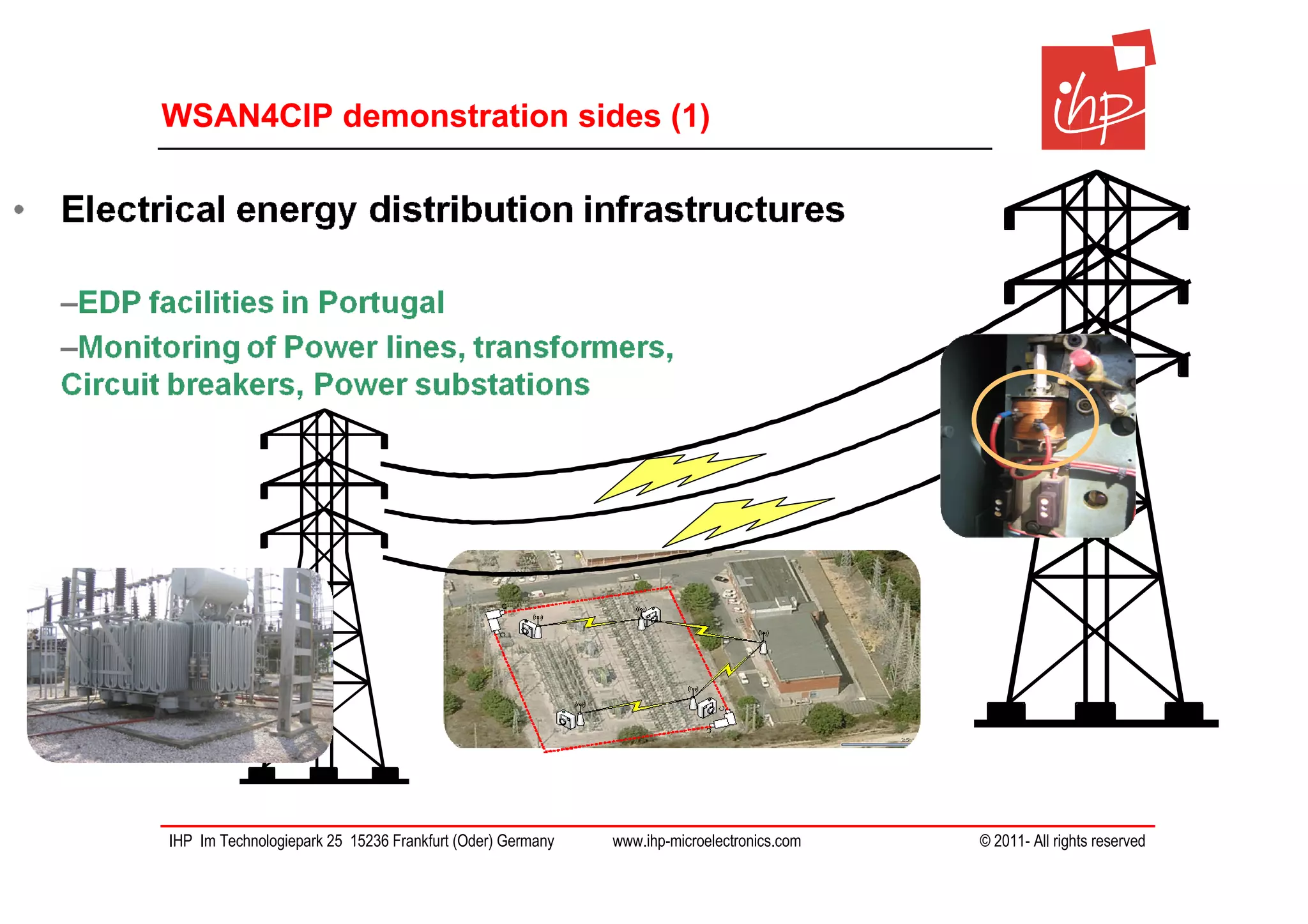
WSAN4CIP demonstration sides (1)


IHP Im Technologiepark 25 15236 Frankfurt (Oder) Germany   www.ihp-microelectronics.com   © 2011- All rights reserved
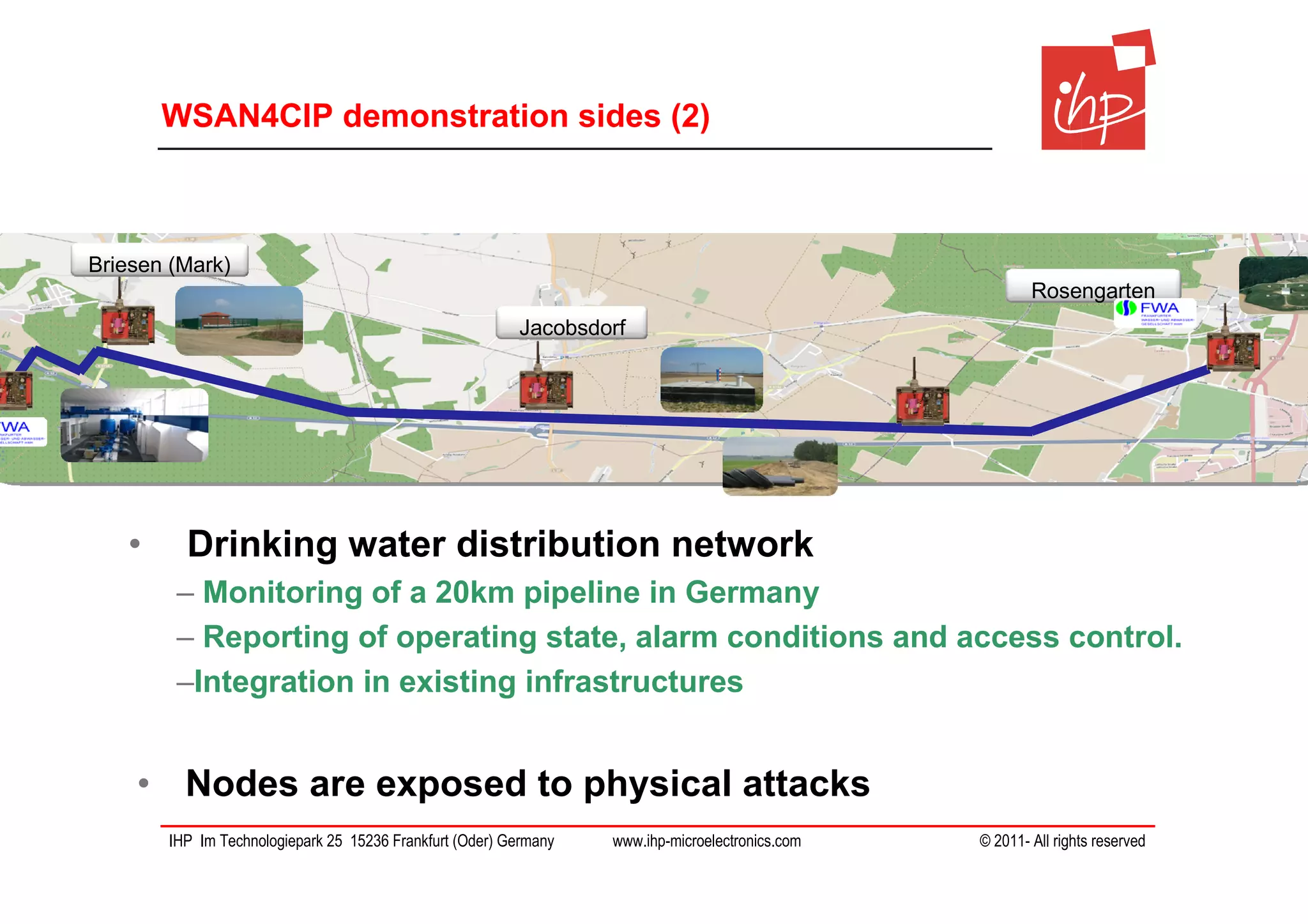
WSAN4CIP demonstration sides (2)


Briesen (Mark)
                                                                                                         Rosengarten
                                                         Jacobsdorf


   •     Drinking water distribution network
        – Monitoring of a 20km pipeline in Germany
        – Reporting of operating state, alarm conditions and access control.
        –Integration in existing infrastructures


    • Nodes are exposed to physical attacks
       IHP Im Technologiepark 25 15236 Frankfurt (Oder) Germany   www.ihp-microelectronics.com   © 2011- All rights reserved
TAMPRES


• Development of novel protection means to ensure
  tamper resistance and improve trustworthiness for
  severely contrained devices

• Enhancing the security of the Future Internet by
  improving the resistance of its weakest link, i.e.
  wireless sensor nodes against physical attacks

• Highly technical project with the goal to implement
  a tamper resistant sensor node with cryptographic
  accelerators and side-channel resistance


IHP Im Technologiepark 25 15236 Frankfurt (Oder) Germany   www.ihp-microelectronics.com   © 2011- All rights reserved
General Problem


• Gap between application level (users) and
  technological level (developers)

• Complex trade-offs on technological level often not
  understood on application level

• Particularly true for Wireless Sensor Networks
     –Energy, Memory , Security, Cost – Trade-offs
     –No one-fits-all solution


IHP Im Technologiepark 25 15236 Frankfurt (Oder) Germany   www.ihp-microelectronics.com   © 2011- All rights reserved
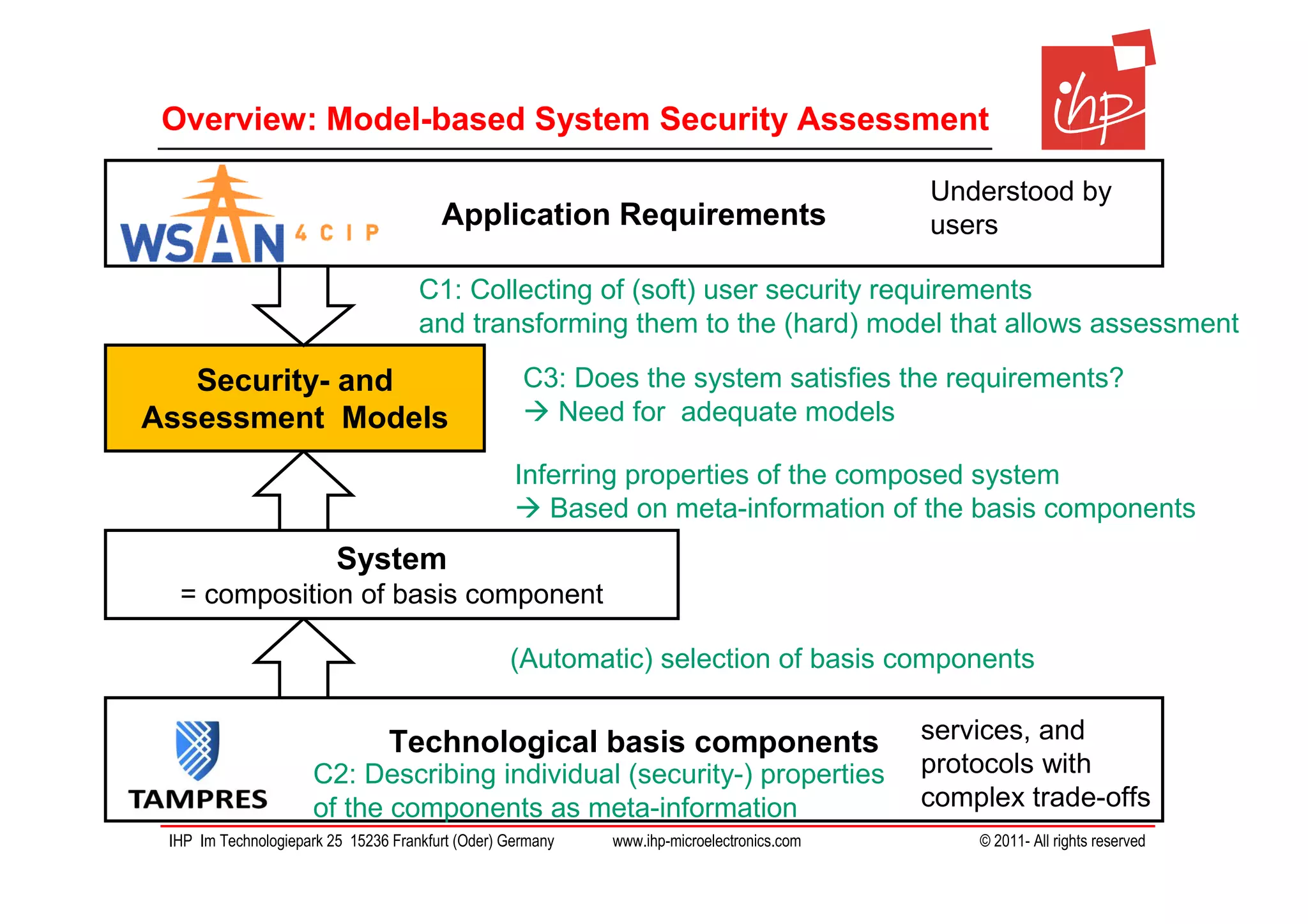
Overview: Model-based System Security Assessment

                                                                                           Understood by
                                        Application Requirements                           users

                                     C1: Collecting of (soft) user security requirements
                                     and transforming them to the (hard) model that allows assessment

   Security- and                                    C3: Does the system satisfies the requirements?
Assessment Models                                     Need for adequate models

                                                   Inferring properties of the composed system
                                                      Based on meta-information of the basis components
                         System
  = composition of basis component

                                                  (Automatic) selection of basis components


                                Technological basis components                             services, and
                     C2: Describing individual (security-) properties                      protocols with
                     of the components as meta-information                                 complex trade-offs
 IHP Im Technologiepark 25 15236 Frankfurt (Oder) Germany   www.ihp-microelectronics.com       © 2011- All rights reserved
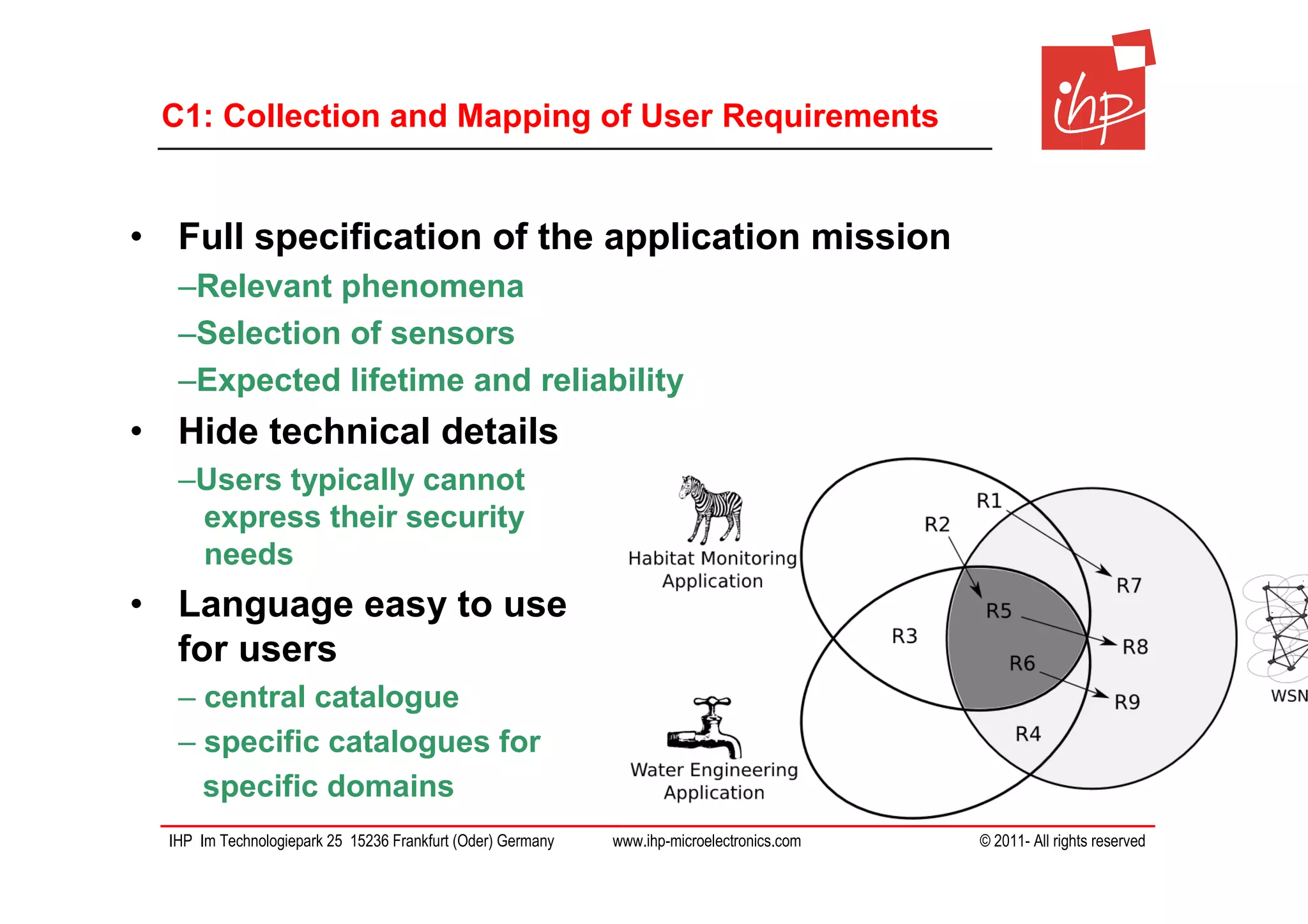
C1: Collection and Mapping of User Requirements


• Full specification of the application mission
   –Relevant phenomena
   –Selection of sensors
   –Expected lifetime and reliability
• Hide technical details
   –Users typically cannot
    express their security
    needs
• Language easy to use
  for users
   – central catalogue
   – specific catalogues for
     specific domains
  IHP Im Technologiepark 25 15236 Frankfurt (Oder) Germany   www.ihp-microelectronics.com   © 2011- All rights reserved
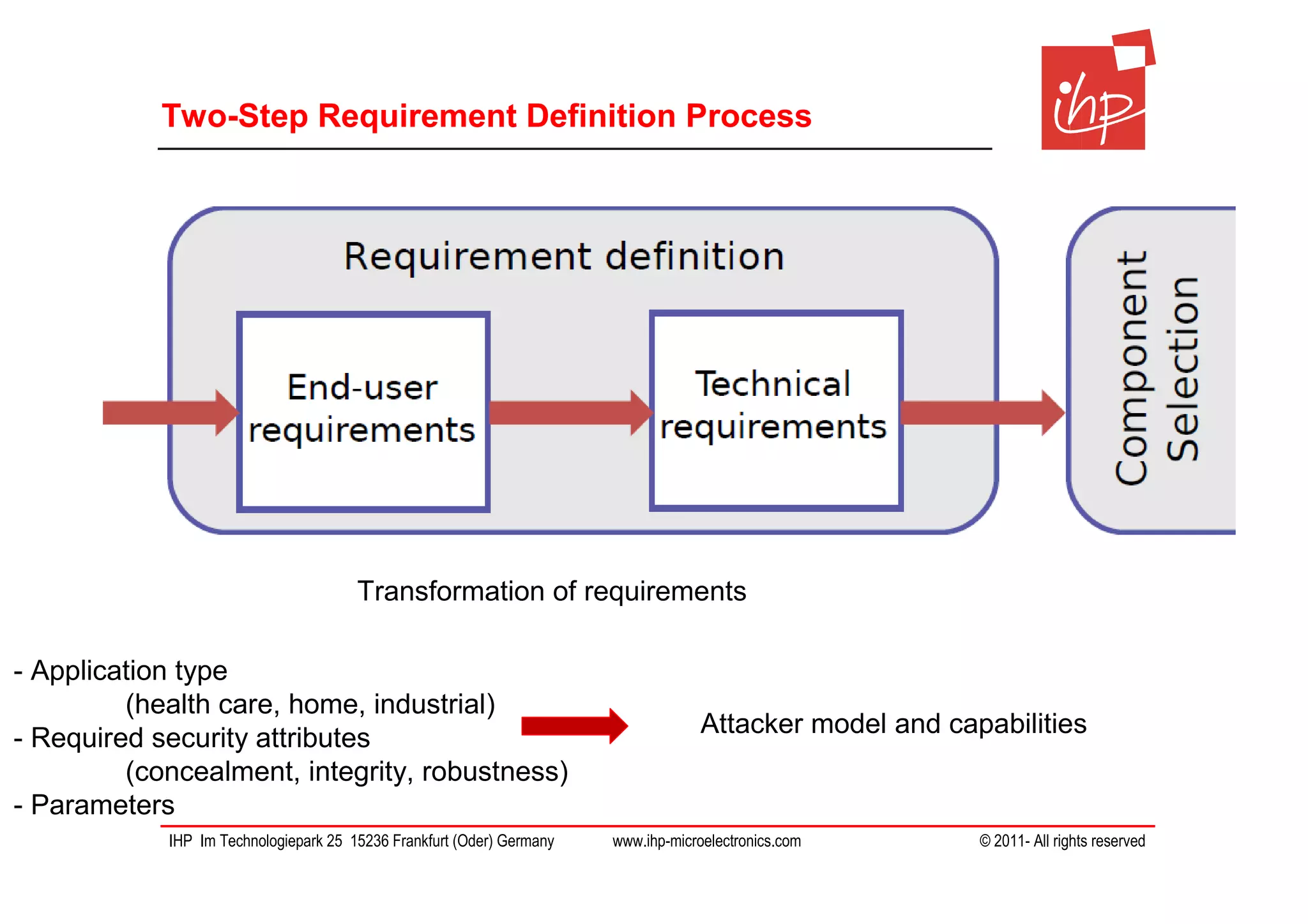
Two-Step Requirement Definition Process


                                       Transformation of requirements

- Application type
         (health care, home, industrial)
                                                                                    Attacker model and capabilities
- Required security attributes
         (concealment, integrity, robustness)
- Parameters
            IHP Im Technologiepark 25 15236 Frankfurt (Oder) Germany   www.ihp-microelectronics.com       © 2011- All rights reserved
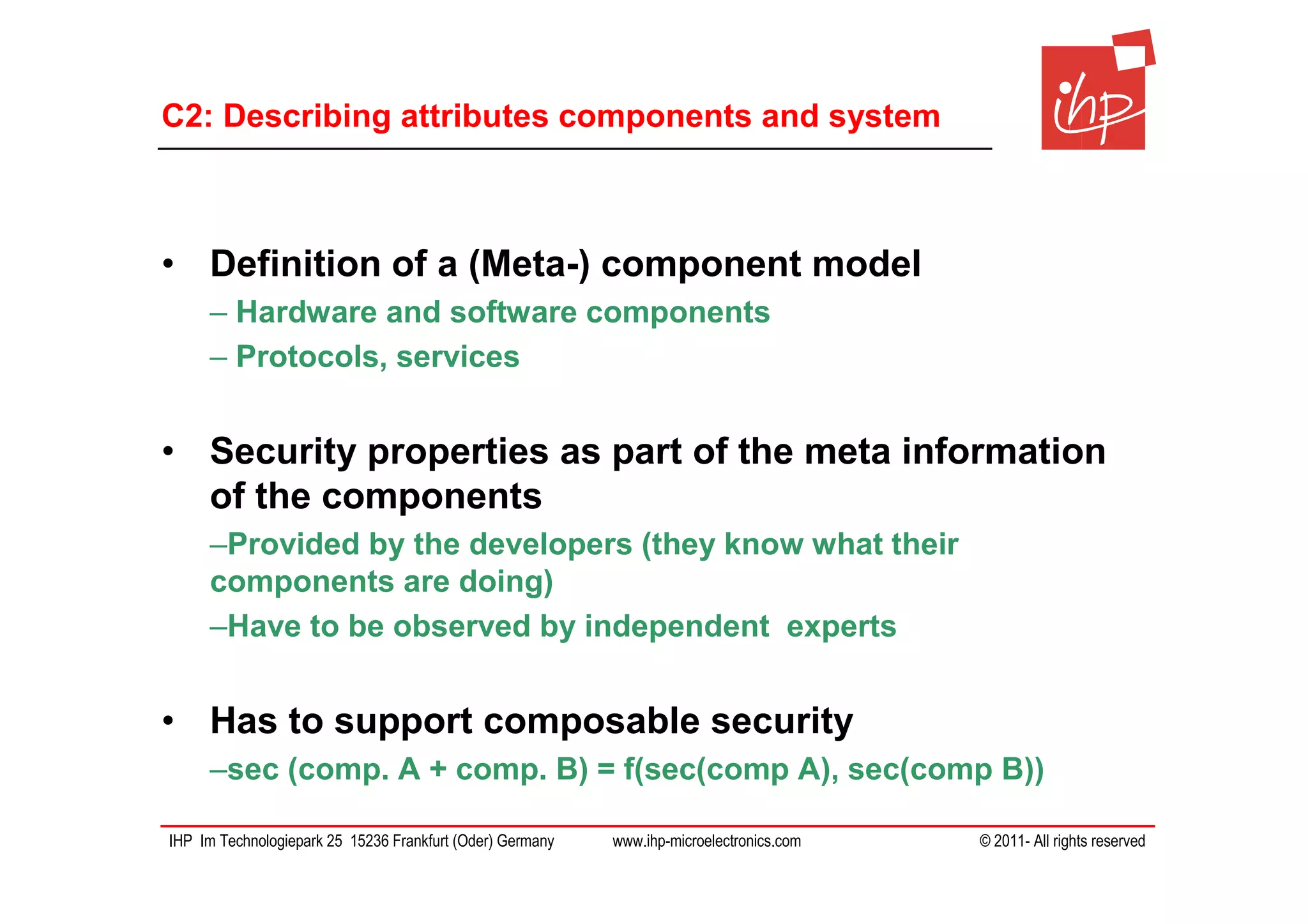
C2: Describing attributes components and system


• Definition of a (Meta-) component model
     – Hardware and software components
     – Protocols, services


• Security properties as part of the meta information
  of the components
     –Provided by the developers (they know what their
     components are doing)
     –Have to be observed by independent experts


• Has to support composable security
     –sec (comp. A + comp. B) = f(sec(comp A), sec(comp B))

IHP Im Technologiepark 25 15236 Frankfurt (Oder) Germany   www.ihp-microelectronics.com   © 2011- All rights reserved
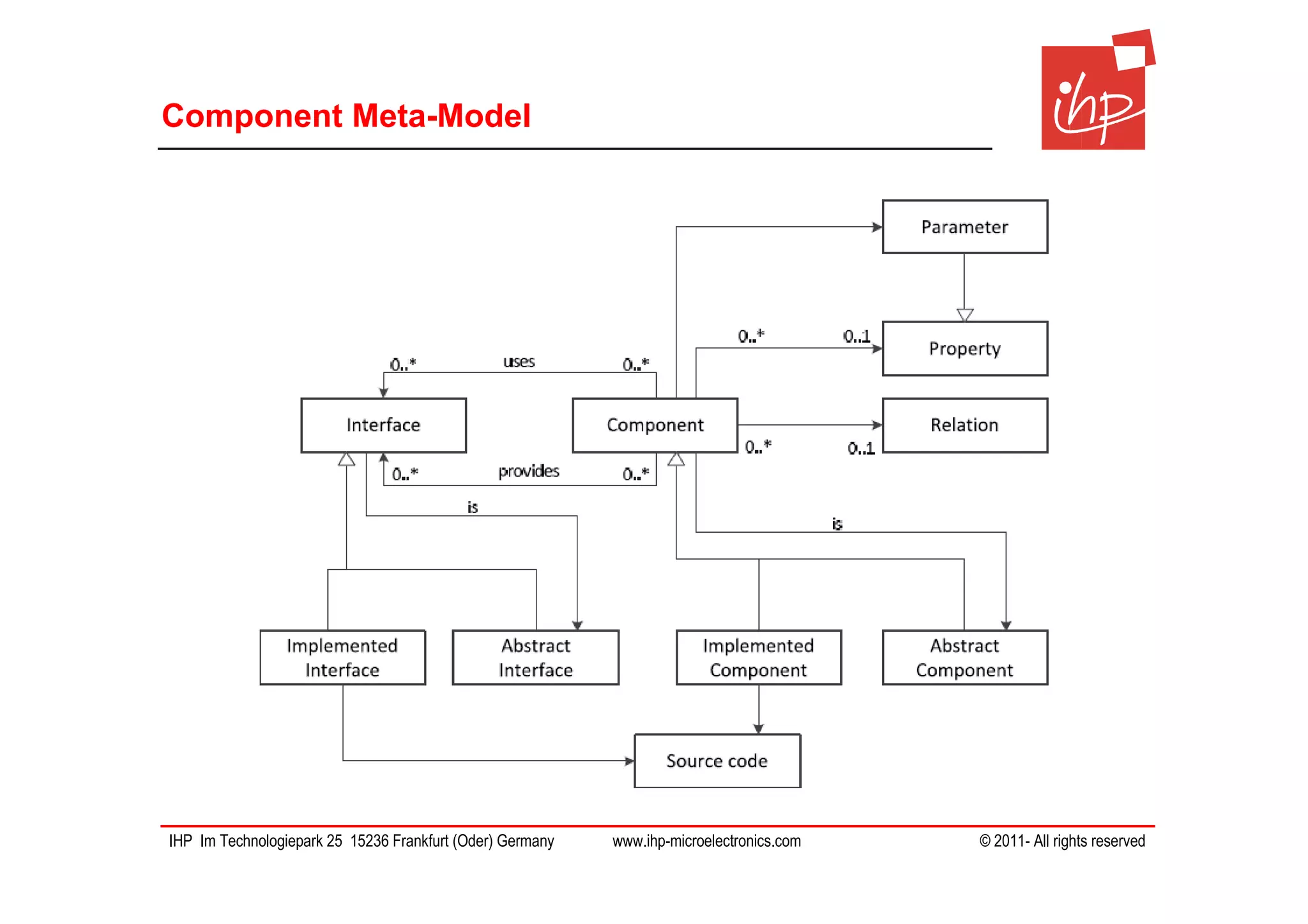
Component Meta-Model


IHP Im Technologiepark 25 15236 Frankfurt (Oder) Germany   www.ihp-microelectronics.com   © 2011- All rights reserved
C3: Definition of Security Models


• Should be able to decide whether a system is
  secure for the given requirements

• Inputs are:
     –Technical requirements
     –Properties of the system


• Output:
     –List of conflicts


IHP Im Technologiepark 25 15236 Frankfurt (Oder) Germany   www.ihp-microelectronics.com   © 2011- All rights reserved
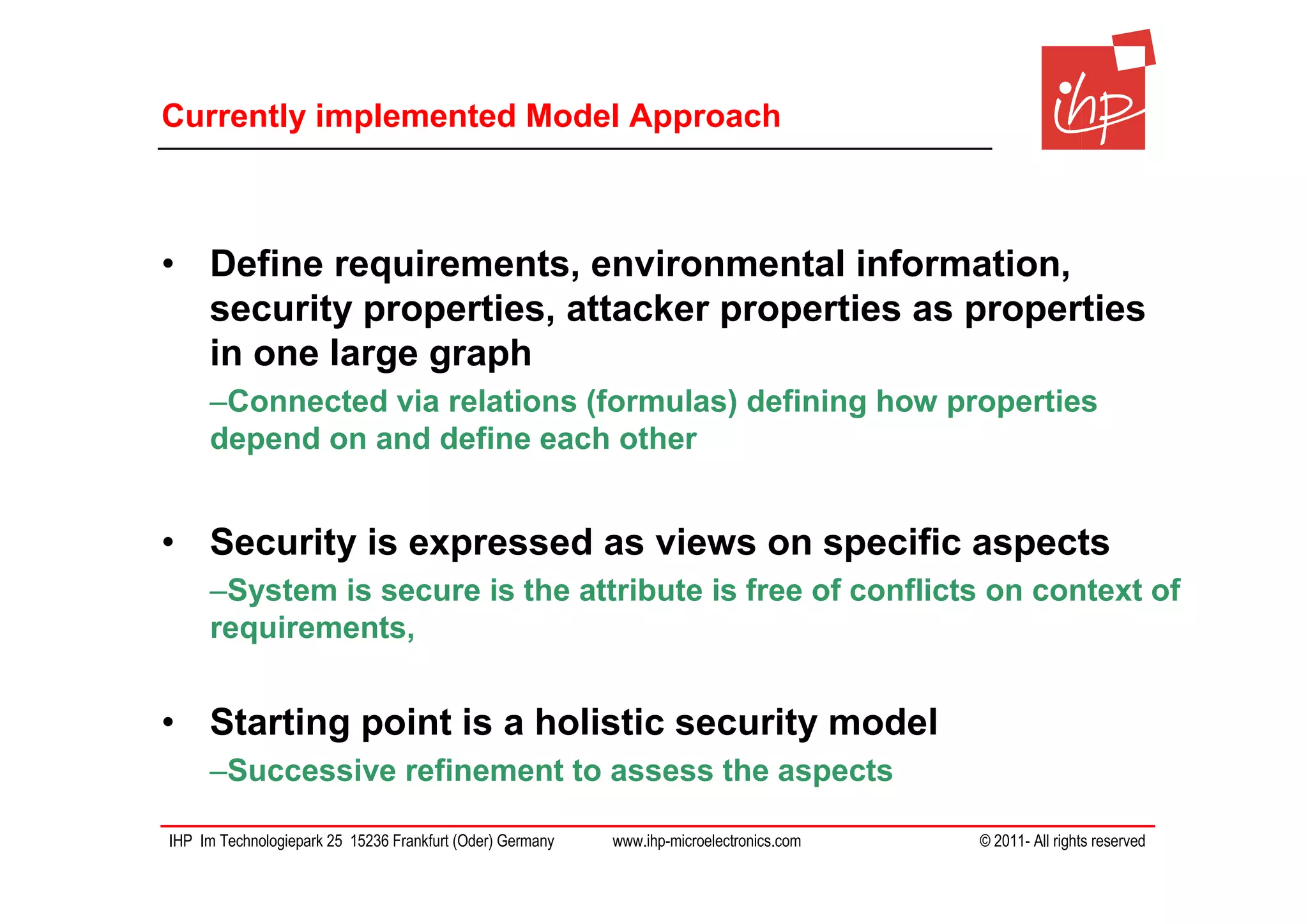
Currently implemented Model Approach


• Define requirements, environmental information,
  security properties, attacker properties as properties
  in one large graph
     –Connected via relations (formulas) defining how properties
     depend on and define each other


• Security is expressed as views on specific aspects
     –System is secure is the attribute is free of conflicts on context of
     requirements,


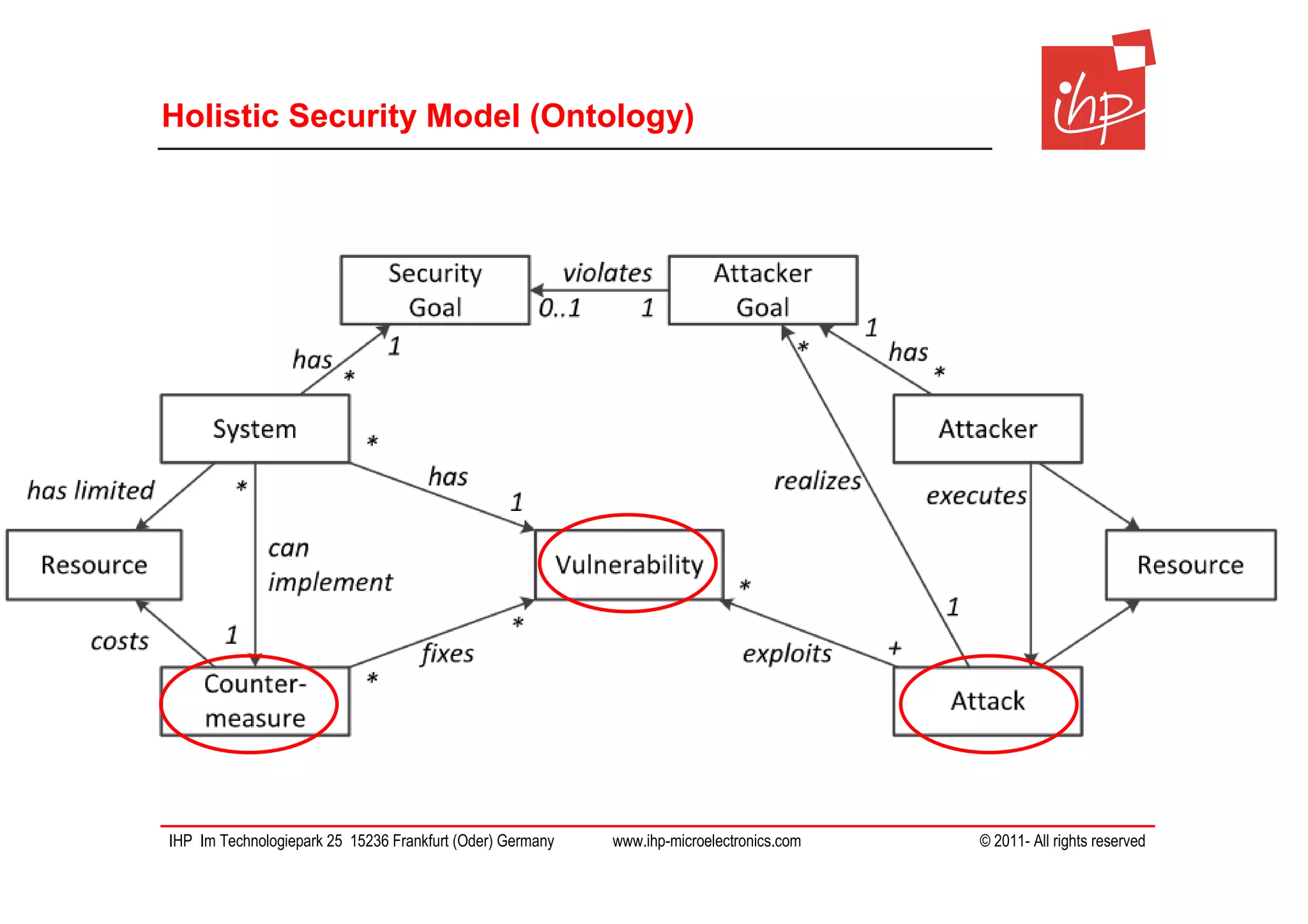
• Starting point is a holistic security model
     –Successive refinement to assess the aspects

IHP Im Technologiepark 25 15236 Frankfurt (Oder) Germany   www.ihp-microelectronics.com   © 2011- All rights reserved
Holistic Security Model (Ontology)


IHP Im Technologiepark 25 15236 Frankfurt (Oder) Germany   www.ihp-microelectronics.com   © 2011- All rights reserved
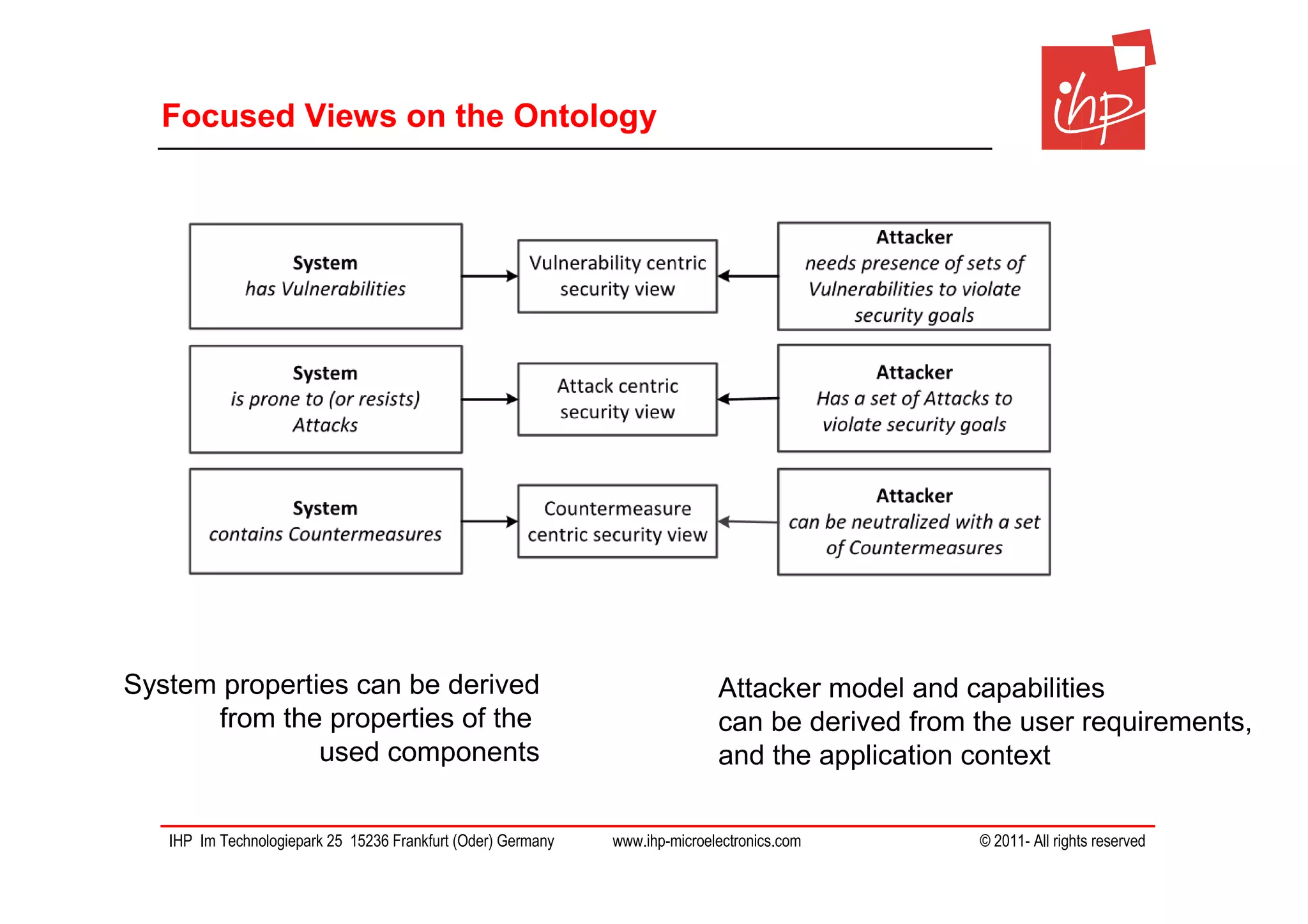
Focused Views on the Ontology


System properties can be derived                                             Attacker model and capabilities
      from the properties of the                                             can be derived from the user requirements,
               used components                                               and the application context

   IHP Im Technologiepark 25 15236 Frankfurt (Oder) Germany   www.ihp-microelectronics.com       © 2011- All rights reserved
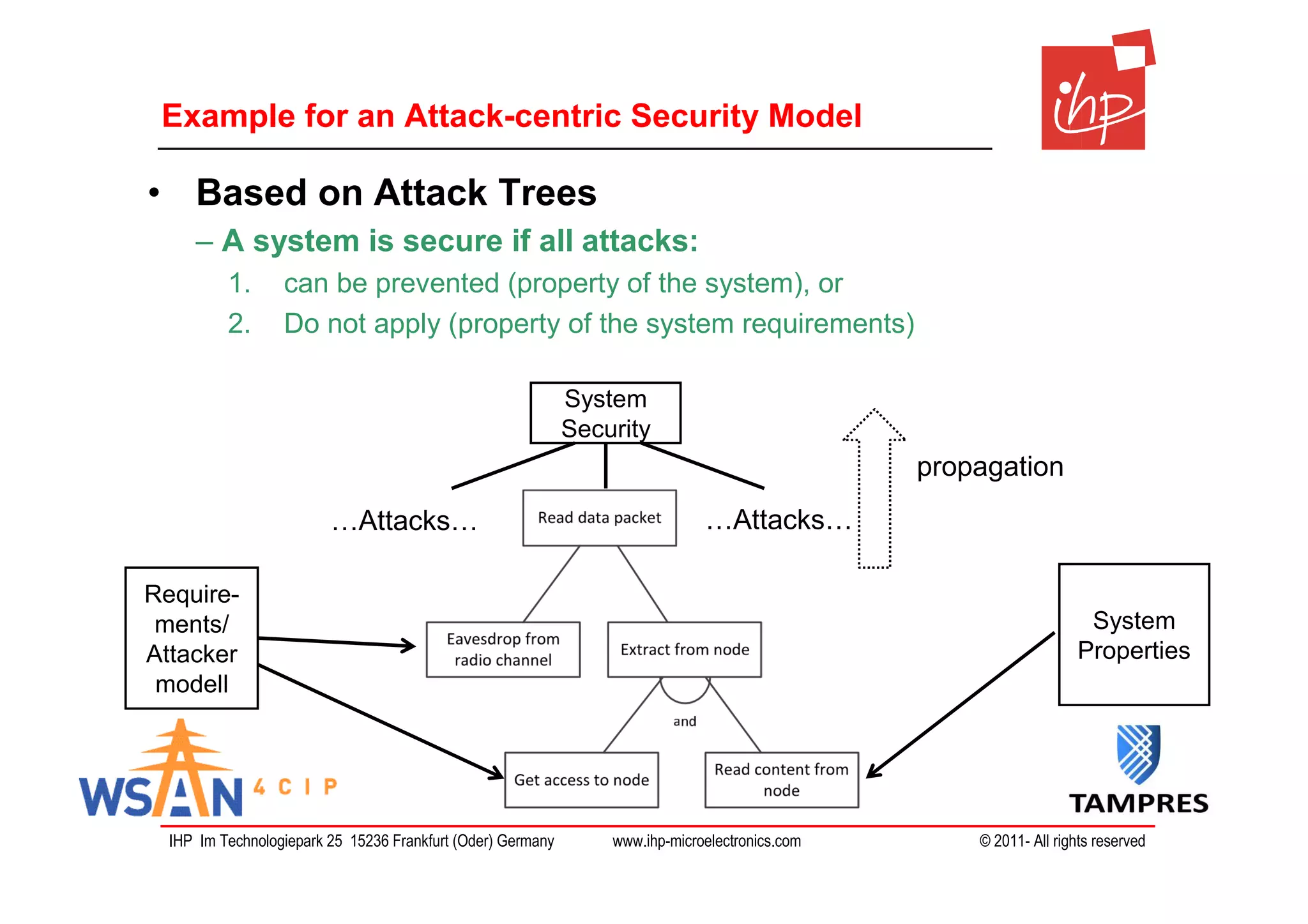
Example for an Attack-centric Security Model

• Based on Attack Trees
     – A system is secure if all attacks:
          1.      can be prevented (property of the system), or
          2.      Do not apply (property of the system requirements)

                                                             System
                                                             Security
                                                                                                propagation
                         …Attacks…                                            …Attacks…

Require-
 ments/                                                                                                             System
Attacker                                                                                                           Properties
 modell


  IHP Im Technologiepark 25 15236 Frankfurt (Oder) Germany       www.ihp-microelectronics.com       © 2011- All rights reserved
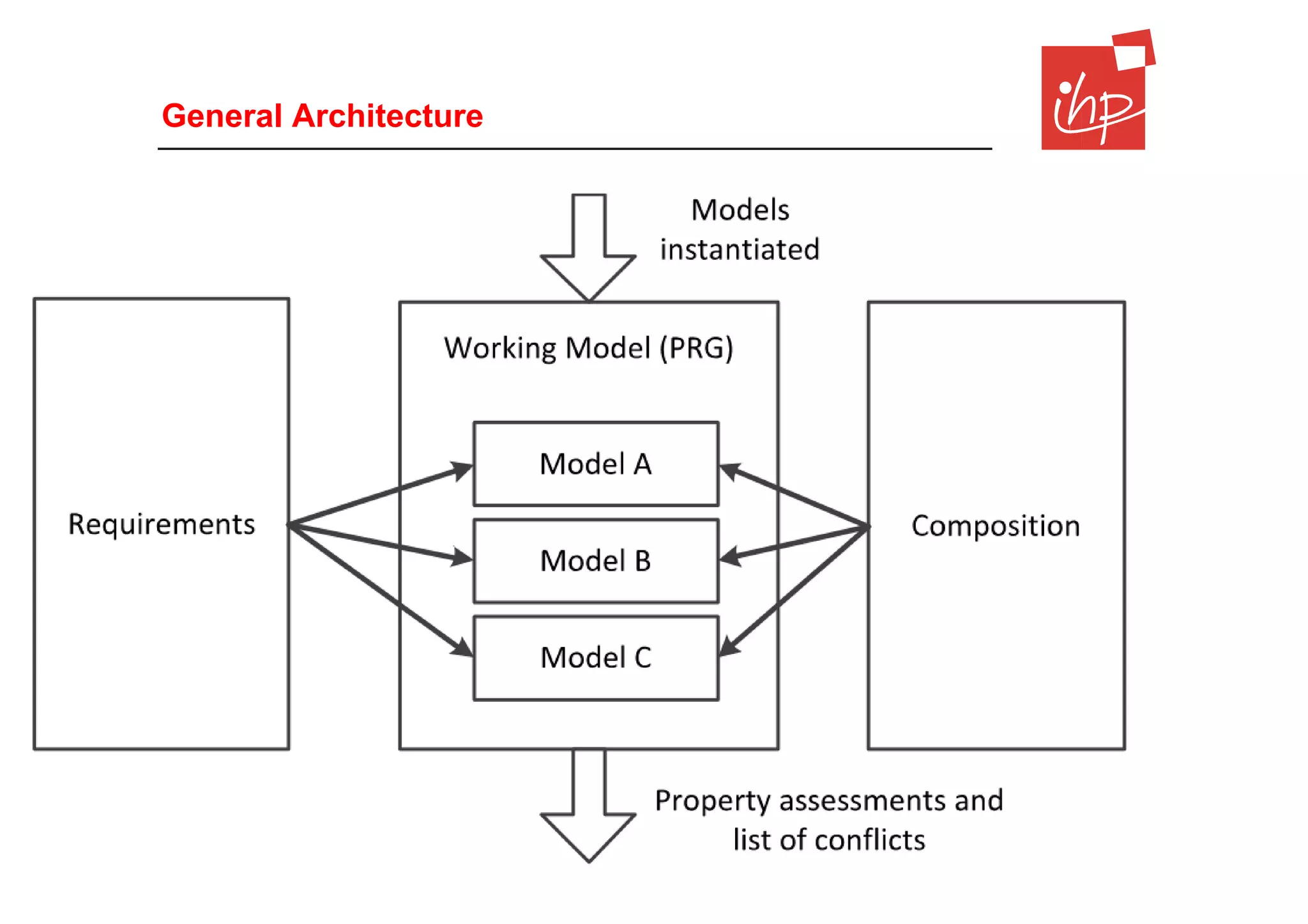
General Architecture


IHP Im Technologiepark 25 15236 Frankfurt (Oder) Germany   www.ihp-microelectronics.com   © 2011- All rights reserved
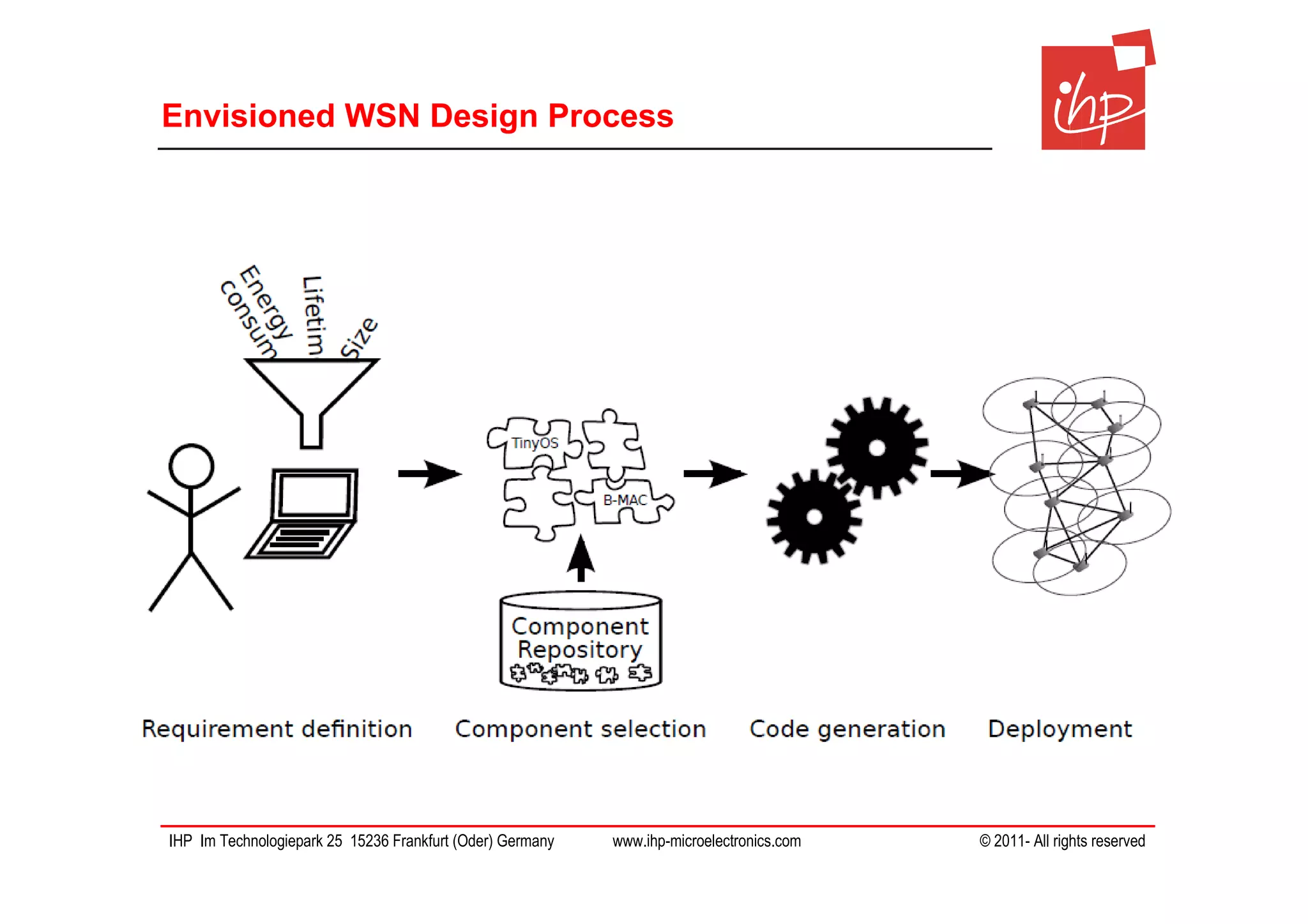
Envisioned WSN Design Process


IHP Im Technologiepark 25 15236 Frankfurt (Oder) Germany   www.ihp-microelectronics.com   © 2011- All rights reserved
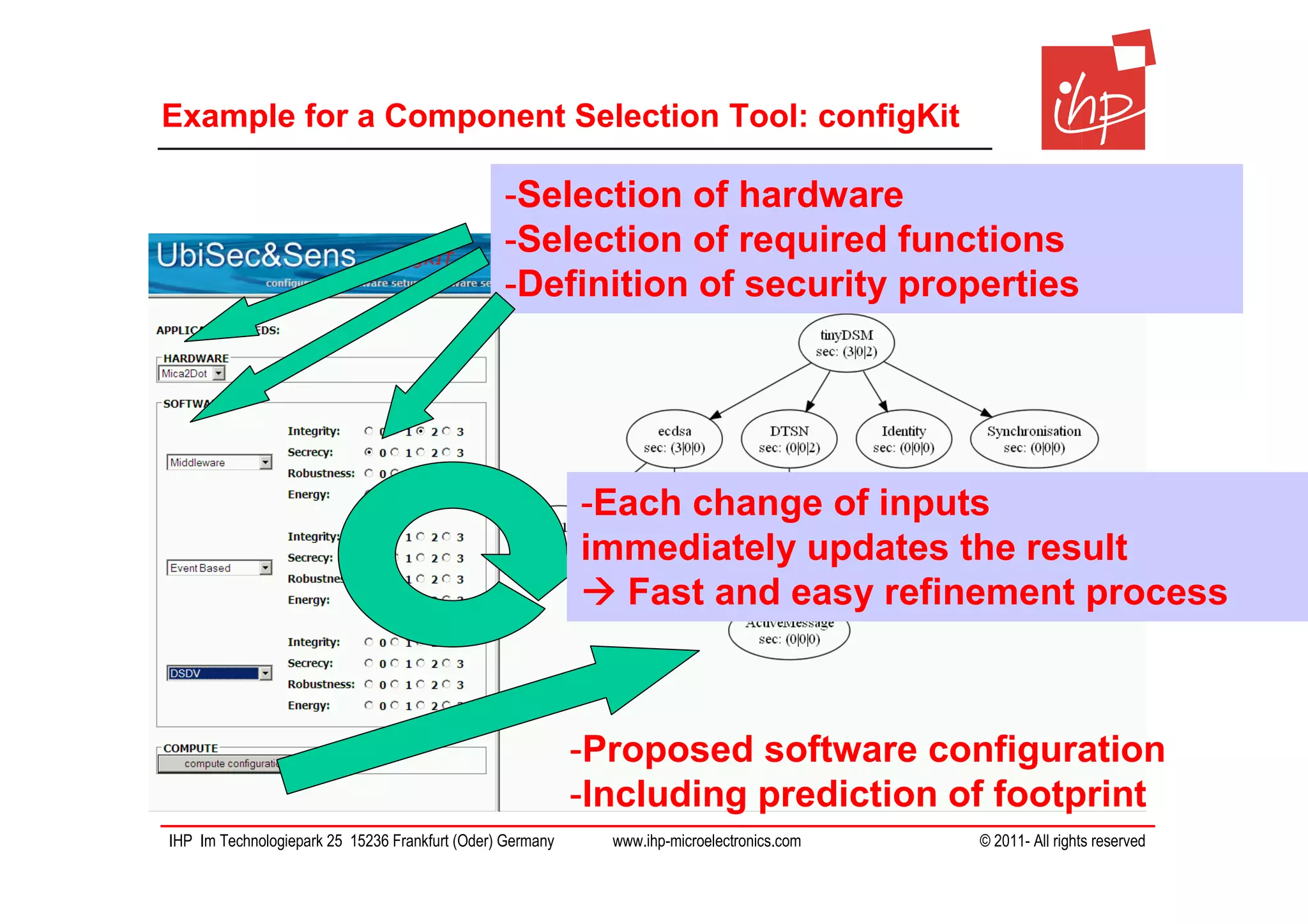
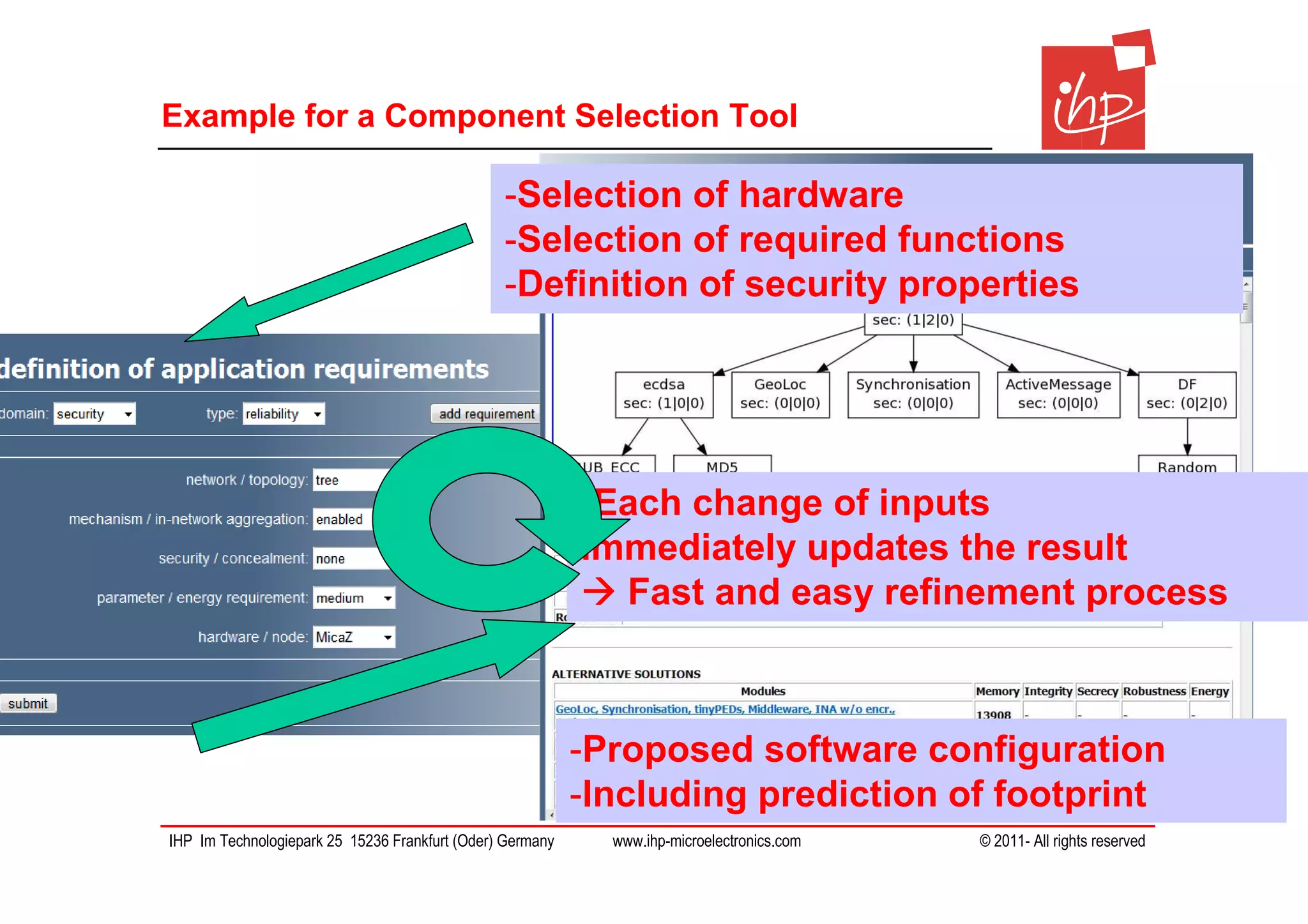
Example for a Component Selection Tool: configKit

                                                -Selection of hardware
                                                -Selection of required functions
                                                -Definition of security properties


                                                           -Each change of inputs
                                                           immediately updates the result
                                                             Fast and easy refinement process


                                                           -Proposed software configuration
                                                           -Including prediction of footprint
IHP Im Technologiepark 25 15236 Frankfurt (Oder) Germany     www.ihp-microelectronics.com   © 2011- All rights reserved
Example for a Component Selection Tool

                                                -Selection of hardware
                                                -Selection of required functions
                                                -Definition of security properties


                                                           -Each change of inputs
                                                           immediately updates the result
                                                             Fast and easy refinement process


                                                           -Proposed software configuration
                                                           -Including prediction of footprint
IHP Im Technologiepark 25 15236 Frankfurt (Oder) Germany     www.ihp-microelectronics.com   © 2011- All rights reserved
Conclusions


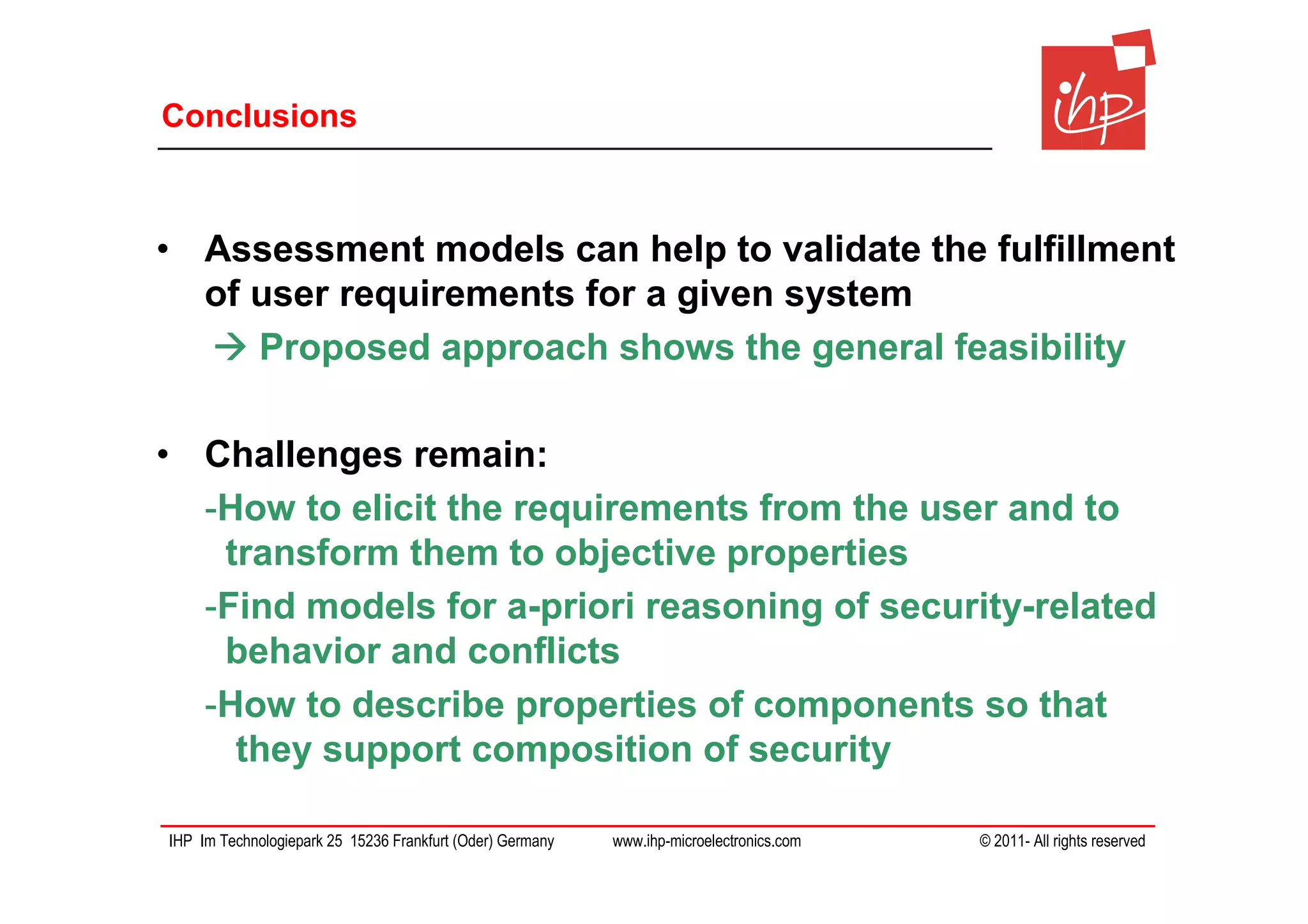
• Assessment models can help to validate the fulfillment
  of user requirements for a given system
     Proposed approach shows the general feasibility

• Challenges remain:
  -How to elicit the requirements from the user and to
   transform them to objective properties
  -Find models for a-priori reasoning of security-related
   behavior and conflicts
  -How to describe properties of components so that
    they support composition of security

IHP Im Technologiepark 25 15236 Frankfurt (Oder) Germany   www.ihp-microelectronics.com   © 2011- All rights reserved
Thank You


                                                  Questions?


                                                                                          Web: www.wsan4cip.eu
                                                                                                www.tampres.eu

                                                                       peter@ihp-microelectronics.com


IHP Im Technologiepark 25 15236 Frankfurt (Oder) Germany   www.ihp-microelectronics.com             © 2008 - All rights reserved

Wsanacip tampres cluster meeting

  • 1.
    Assessment Models toImprove the Usability of Security in Wireless Sensor Networks Steffen Peter IHP Im Technologiepark 25 15236 Frankfurt (Oder) Germany IHP Im Technologiepark 25 15236 Frankfurt (Oder) Germany www.ihp-microelectronics.com © 2011 - All rights reserved
  • 2.
    Outline • Introduction WSAN4CIP,TAMPRES • Motivation • Model-based security assessment approach • Example for practical security model IHP Im Technologiepark 25 15236 Frankfurt (Oder) Germany www.ihp-microelectronics.com © 2011- All rights reserved
  • 3.
    WSAN4CIP • Protection ofcritical infrastructures • Potential threats – Natural disasters (floods, earthquake) – Terrorism, Vandalism, Crime (stealing Iron) • Providing monitoring capabilities for large scale infrastructure requires: – Low cost devices – No additional infrastructure – Robust, self-configuring systems – integration in SCADA infrastructures • WSNs protecting CIP become part of the CIP – need to be protected –Development and integration of mechanisms to protect the WSN IHP Im Technologiepark 25 15236 Frankfurt (Oder) Germany www.ihp-microelectronics.com © 2011- All rights reserved
  • 4.
    WSAN4CIP demonstration sides(1) IHP Im Technologiepark 25 15236 Frankfurt (Oder) Germany www.ihp-microelectronics.com © 2011- All rights reserved
  • 5.
    WSAN4CIP demonstration sides(2) Briesen (Mark) Rosengarten Jacobsdorf • Drinking water distribution network – Monitoring of a 20km pipeline in Germany – Reporting of operating state, alarm conditions and access control. –Integration in existing infrastructures • Nodes are exposed to physical attacks IHP Im Technologiepark 25 15236 Frankfurt (Oder) Germany www.ihp-microelectronics.com © 2011- All rights reserved
  • 6.
    TAMPRES • Development ofnovel protection means to ensure tamper resistance and improve trustworthiness for severely contrained devices • Enhancing the security of the Future Internet by improving the resistance of its weakest link, i.e. wireless sensor nodes against physical attacks • Highly technical project with the goal to implement a tamper resistant sensor node with cryptographic accelerators and side-channel resistance IHP Im Technologiepark 25 15236 Frankfurt (Oder) Germany www.ihp-microelectronics.com © 2011- All rights reserved
  • 7.
    General Problem • Gapbetween application level (users) and technological level (developers) • Complex trade-offs on technological level often not understood on application level • Particularly true for Wireless Sensor Networks –Energy, Memory , Security, Cost – Trade-offs –No one-fits-all solution IHP Im Technologiepark 25 15236 Frankfurt (Oder) Germany www.ihp-microelectronics.com © 2011- All rights reserved
  • 8.
    Overview: Model-based SystemSecurity Assessment Understood by Application Requirements users C1: Collecting of (soft) user security requirements and transforming them to the (hard) model that allows assessment Security- and C3: Does the system satisfies the requirements? Assessment Models Need for adequate models Inferring properties of the composed system Based on meta-information of the basis components System = composition of basis component (Automatic) selection of basis components Technological basis components services, and C2: Describing individual (security-) properties protocols with of the components as meta-information complex trade-offs IHP Im Technologiepark 25 15236 Frankfurt (Oder) Germany www.ihp-microelectronics.com © 2011- All rights reserved
  • 9.
    C1: Collection andMapping of User Requirements • Full specification of the application mission –Relevant phenomena –Selection of sensors –Expected lifetime and reliability • Hide technical details –Users typically cannot express their security needs • Language easy to use for users – central catalogue – specific catalogues for specific domains IHP Im Technologiepark 25 15236 Frankfurt (Oder) Germany www.ihp-microelectronics.com © 2011- All rights reserved
  • 10.
    Two-Step Requirement DefinitionProcess Transformation of requirements - Application type (health care, home, industrial) Attacker model and capabilities - Required security attributes (concealment, integrity, robustness) - Parameters IHP Im Technologiepark 25 15236 Frankfurt (Oder) Germany www.ihp-microelectronics.com © 2011- All rights reserved
  • 11.
    C2: Describing attributescomponents and system • Definition of a (Meta-) component model – Hardware and software components – Protocols, services • Security properties as part of the meta information of the components –Provided by the developers (they know what their components are doing) –Have to be observed by independent experts • Has to support composable security –sec (comp. A + comp. B) = f(sec(comp A), sec(comp B)) IHP Im Technologiepark 25 15236 Frankfurt (Oder) Germany www.ihp-microelectronics.com © 2011- All rights reserved
  • 12.
    Component Meta-Model IHP ImTechnologiepark 25 15236 Frankfurt (Oder) Germany www.ihp-microelectronics.com © 2011- All rights reserved
  • 13.
    C3: Definition ofSecurity Models • Should be able to decide whether a system is secure for the given requirements • Inputs are: –Technical requirements –Properties of the system • Output: –List of conflicts IHP Im Technologiepark 25 15236 Frankfurt (Oder) Germany www.ihp-microelectronics.com © 2011- All rights reserved
  • 14.
    Currently implemented ModelApproach • Define requirements, environmental information, security properties, attacker properties as properties in one large graph –Connected via relations (formulas) defining how properties depend on and define each other • Security is expressed as views on specific aspects –System is secure is the attribute is free of conflicts on context of requirements, • Starting point is a holistic security model –Successive refinement to assess the aspects IHP Im Technologiepark 25 15236 Frankfurt (Oder) Germany www.ihp-microelectronics.com © 2011- All rights reserved
  • 15.
    Holistic Security Model(Ontology) IHP Im Technologiepark 25 15236 Frankfurt (Oder) Germany www.ihp-microelectronics.com © 2011- All rights reserved
  • 16.
    Focused Views onthe Ontology System properties can be derived Attacker model and capabilities from the properties of the can be derived from the user requirements, used components and the application context IHP Im Technologiepark 25 15236 Frankfurt (Oder) Germany www.ihp-microelectronics.com © 2011- All rights reserved
  • 17.
    Example for anAttack-centric Security Model • Based on Attack Trees – A system is secure if all attacks: 1. can be prevented (property of the system), or 2. Do not apply (property of the system requirements) System Security propagation …Attacks… …Attacks… Require- ments/ System Attacker Properties modell IHP Im Technologiepark 25 15236 Frankfurt (Oder) Germany www.ihp-microelectronics.com © 2011- All rights reserved
  • 18.
    General Architecture IHP ImTechnologiepark 25 15236 Frankfurt (Oder) Germany www.ihp-microelectronics.com © 2011- All rights reserved
  • 19.
    Envisioned WSN DesignProcess IHP Im Technologiepark 25 15236 Frankfurt (Oder) Germany www.ihp-microelectronics.com © 2011- All rights reserved
  • 20.
    Example for aComponent Selection Tool: configKit -Selection of hardware -Selection of required functions -Definition of security properties -Each change of inputs immediately updates the result Fast and easy refinement process -Proposed software configuration -Including prediction of footprint IHP Im Technologiepark 25 15236 Frankfurt (Oder) Germany www.ihp-microelectronics.com © 2011- All rights reserved
  • 21.
    Example for aComponent Selection Tool -Selection of hardware -Selection of required functions -Definition of security properties -Each change of inputs immediately updates the result Fast and easy refinement process -Proposed software configuration -Including prediction of footprint IHP Im Technologiepark 25 15236 Frankfurt (Oder) Germany www.ihp-microelectronics.com © 2011- All rights reserved
  • 22.
    Conclusions • Assessment modelscan help to validate the fulfillment of user requirements for a given system Proposed approach shows the general feasibility • Challenges remain: -How to elicit the requirements from the user and to transform them to objective properties -Find models for a-priori reasoning of security-related behavior and conflicts -How to describe properties of components so that they support composition of security IHP Im Technologiepark 25 15236 Frankfurt (Oder) Germany www.ihp-microelectronics.com © 2011- All rights reserved
  • 23.
    Thank You Questions? Web: www.wsan4cip.eu www.tampres.eu peter@ihp-microelectronics.com IHP Im Technologiepark 25 15236 Frankfurt (Oder) Germany www.ihp-microelectronics.com © 2008 - All rights reserved