Enterprise Architecture Models for Security AnalysisThe VIKING projectTeodorSommestadThe Royal Institute of Technology (KTH) Stockholm, Swedenteodor.sommestad@ics.kth.se
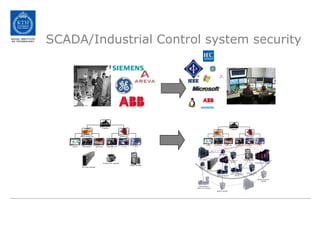
SCADA/Industrial Control system security
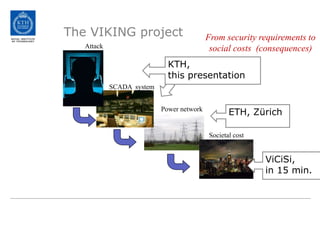
The VIKING projectFrom security requirements to social costs  (consequences)AttackSCADA  systemPower networkSocietalcostKTH, this presentationETH, ZürichViCiSi, in 15 min.
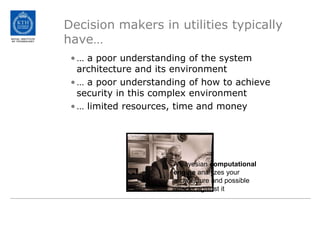
Decision makers in utilitiestypicallyhave…… a poorunderstandingof the system architecture and itsenvironment… a poorunderstanding of how to achievesecurity in thiscomplexenvironment… limitedresources, time and moneyA Bayesian computational engine analyzes your architecture and possible attacks against it
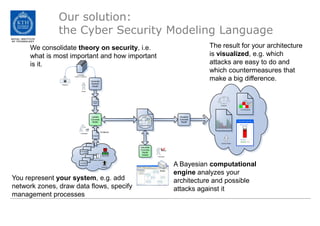
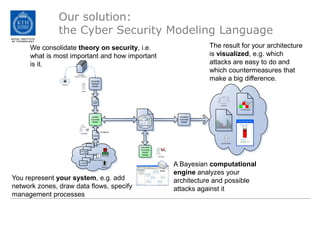
Our solution: the Cyber Security Modeling LanguageThe result for your architecture is visualized, e.g. which attacks are easy to do and which countermeasures that make a big difference.We consolidate theory on security, i.e. what is most important and how important is it.A Bayesian computational engine analyzes your architecture and possible attacks against itYou represent your system, e.g. add network zones, draw data flows, specify management processes
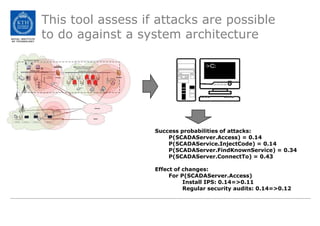
This tool assess if attacks are possible to do against a system architectureSuccessprobabilitiesof attacks:P(SCADAServer.Access) = 0.14P(SCADAService.InjectCode) = 0.14P(SCADAServer.FindKnownService) = 0.34P(SCADAServer.ConnectTo) = 0.43Effectofchanges:For P(SCADAServer.Access)Install IPS: 0.14=>0.11Regularsecurityaudits: 0.14=>0.12
We do not aim atInventing some new protection apparatus (e.g. firewall), solution or architecture.Tell cryptography/authentication/…/firewall experts which of their solutions that are secure and which are not.Explain which attacks that probably will be attempted against the system.
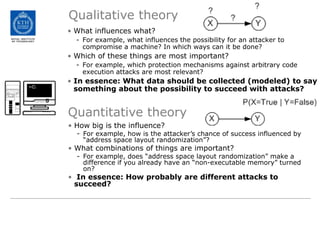
Qualitative theoryWhat influences what?For example, what influences the possibility for an attacker to compromise a machine? In which ways can it be done?Which of these things are most important?For example, which protection mechanisms against arbitrary code execution attacks are most relevant?In essence: What data should be collected (modeled) to say something about the possibility to succeed with attacks?Quantitative theoryHow big is the influence?For example, how is the attacker’s chance of success influenced by “address space layout randomization”?What combinations of things are important?For example, does “address space layout randomization” make a difference if you already have an “non-executable memory” turned on?In essence: How probably are different attacks to succeed?
[Qualitative theory]The metamodelAttribute dependenciesFor example:The probability that Remote Arbitrary Code Exploits on a Service can be performed depend on:If you can connect to the ServiceIf it has a high-severity vulnerabilityThe attacker can authenticate itself as a legitimate userIf its OS uses ASLR or NX memory protectionIf there is Deep Packet Inspection Firewall between the attacker and Service
[Quantitative theory]Example:Remote Arbitrary Code Exploits on a Service
Say that your architecture and our “rules” produces these dependencies[Quantitative theory]Canthis attack be done by professional penetration tester?
Our tool would answer:[Quantitative theory]1.00*0.24*1.00*0.51*1.00=0.1224=12.24% chance of success100%100%100%24%51%
What if analysis:Execute arbitrary code[Quantitative theory]Install a deep-packet-inspection firewall (IPS)As is.Remove Address Space Layout Randomization (ASLR)15 % probabilitythat the attacker canexecute his/hercode…24 % probabilitythat the attacker canexecute his/hercode…27 % probabilitythat the attacker canexecutehis/hercode……8 % for the attack scenario……12 % for the attack scenario……14% for the attack scenario…
Data sourcesThe relationships and dependency-structure:Literature, e.g. standards or scientific articles.Review and prioritization by external experts, e.g. FOI, SÄPO, Combitech, Chalmers, Ericsson, BTH, Management Doctors.The probabilities:Logical relationships, e.g.: if the firewalls allow you to connect to A from B and you have access to B, then you can connect.Others’ studies, e.g. time-to-compromise for of authentication codes or patch level vs patching procedures.Experts’ judgments, e.g. 165 intrusion detection system researchers estimating the detection rate in different scenarios.
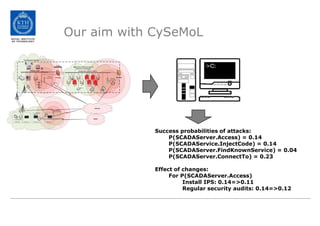
Successprobabilitiesof attacks:P(SCADAServer.Access) = 0.14P(SCADAService.InjectCode) = 0.14P(SCADAServer.FindKnownService) = 0.04P(SCADAServer.ConnectTo) = 0.23Effectofchanges:For P(SCADAServer.Access)Install IPS: 0.14=>0.11Regularsecurityaudits: 0.14=>0.12Our aim with CySeMoL
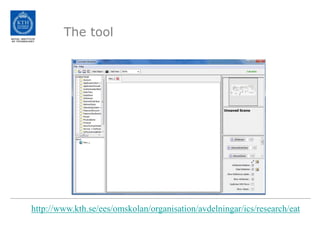
The toolhttp://www.kth.se/ees/omskolan/organisation/avdelningar/ics/research/eat
Our solution: the Cyber Security Modeling LanguageThe result for your architecture is visualized, e.g. which attacks are easy to do and which countermeasures that make a big difference.We consolidate theory on security, i.e. what is most important and how important is it.A Bayesian computational engine analyzes your architecture and possible attacks against itYou represent your system, e.g. add network zones, draw data flows, specify management processes
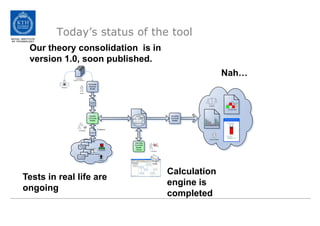
Today’s status of the toolOur theory consolidation  is in version 1.0, soon published.Nah…Calculation engine is completedTests in real life are ongoing
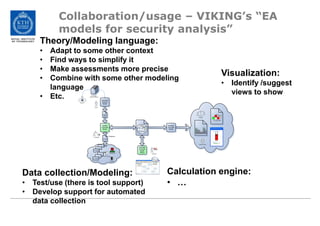
Collaboration/usage – VIKING’s “EA models for security analysis”Theory/Modeling language:Adapt to some other context

VIKING cluster meeting 1

  • 1.
    Enterprise Architecture Modelsfor Security AnalysisThe VIKING projectTeodorSommestadThe Royal Institute of Technology (KTH) Stockholm, Swedenteodor.sommestad@ics.kth.se
  • 2.
  • 3.
    The VIKING projectFromsecurity requirements to social costs (consequences)AttackSCADA systemPower networkSocietalcostKTH, this presentationETH, ZürichViCiSi, in 15 min.
  • 4.
    Decision makers inutilitiestypicallyhave…… a poorunderstandingof the system architecture and itsenvironment… a poorunderstanding of how to achievesecurity in thiscomplexenvironment… limitedresources, time and moneyA Bayesian computational engine analyzes your architecture and possible attacks against it
  • 5.
    Our solution: theCyber Security Modeling LanguageThe result for your architecture is visualized, e.g. which attacks are easy to do and which countermeasures that make a big difference.We consolidate theory on security, i.e. what is most important and how important is it.A Bayesian computational engine analyzes your architecture and possible attacks against itYou represent your system, e.g. add network zones, draw data flows, specify management processes
  • 6.
    This tool assessif attacks are possible to do against a system architectureSuccessprobabilitiesof attacks:P(SCADAServer.Access) = 0.14P(SCADAService.InjectCode) = 0.14P(SCADAServer.FindKnownService) = 0.34P(SCADAServer.ConnectTo) = 0.43Effectofchanges:For P(SCADAServer.Access)Install IPS: 0.14=>0.11Regularsecurityaudits: 0.14=>0.12
  • 7.
    We do notaim atInventing some new protection apparatus (e.g. firewall), solution or architecture.Tell cryptography/authentication/…/firewall experts which of their solutions that are secure and which are not.Explain which attacks that probably will be attempted against the system.
  • 8.
    Qualitative theoryWhat influenceswhat?For example, what influences the possibility for an attacker to compromise a machine? In which ways can it be done?Which of these things are most important?For example, which protection mechanisms against arbitrary code execution attacks are most relevant?In essence: What data should be collected (modeled) to say something about the possibility to succeed with attacks?Quantitative theoryHow big is the influence?For example, how is the attacker’s chance of success influenced by “address space layout randomization”?What combinations of things are important?For example, does “address space layout randomization” make a difference if you already have an “non-executable memory” turned on?In essence: How probably are different attacks to succeed?
  • 9.
    [Qualitative theory]The metamodelAttributedependenciesFor example:The probability that Remote Arbitrary Code Exploits on a Service can be performed depend on:If you can connect to the ServiceIf it has a high-severity vulnerabilityThe attacker can authenticate itself as a legitimate userIf its OS uses ASLR or NX memory protectionIf there is Deep Packet Inspection Firewall between the attacker and Service
  • 10.
  • 11.
    Say that yourarchitecture and our “rules” produces these dependencies[Quantitative theory]Canthis attack be done by professional penetration tester?
  • 12.
    Our tool wouldanswer:[Quantitative theory]1.00*0.24*1.00*0.51*1.00=0.1224=12.24% chance of success100%100%100%24%51%
  • 13.
    What if analysis:Executearbitrary code[Quantitative theory]Install a deep-packet-inspection firewall (IPS)As is.Remove Address Space Layout Randomization (ASLR)15 % probabilitythat the attacker canexecute his/hercode…24 % probabilitythat the attacker canexecute his/hercode…27 % probabilitythat the attacker canexecutehis/hercode……8 % for the attack scenario……12 % for the attack scenario……14% for the attack scenario…
  • 14.
    Data sourcesThe relationshipsand dependency-structure:Literature, e.g. standards or scientific articles.Review and prioritization by external experts, e.g. FOI, SÄPO, Combitech, Chalmers, Ericsson, BTH, Management Doctors.The probabilities:Logical relationships, e.g.: if the firewalls allow you to connect to A from B and you have access to B, then you can connect.Others’ studies, e.g. time-to-compromise for of authentication codes or patch level vs patching procedures.Experts’ judgments, e.g. 165 intrusion detection system researchers estimating the detection rate in different scenarios.
  • 15.
    Successprobabilitiesof attacks:P(SCADAServer.Access) =0.14P(SCADAService.InjectCode) = 0.14P(SCADAServer.FindKnownService) = 0.04P(SCADAServer.ConnectTo) = 0.23Effectofchanges:For P(SCADAServer.Access)Install IPS: 0.14=>0.11Regularsecurityaudits: 0.14=>0.12Our aim with CySeMoL
  • 16.
  • 17.
    Our solution: theCyber Security Modeling LanguageThe result for your architecture is visualized, e.g. which attacks are easy to do and which countermeasures that make a big difference.We consolidate theory on security, i.e. what is most important and how important is it.A Bayesian computational engine analyzes your architecture and possible attacks against itYou represent your system, e.g. add network zones, draw data flows, specify management processes
  • 18.
    Today’s status ofthe toolOur theory consolidation is in version 1.0, soon published.Nah…Calculation engine is completedTests in real life are ongoing
  • 19.
    Collaboration/usage – VIKING’s“EA models for security analysis”Theory/Modeling language:Adapt to some other context