Research & Innovation
     Community
Trust in Digital Life - Mission statement


   TDL is a consortium of Industry, Academics and

Government entities working together to set a research

            agenda for a Trustworthy ICT.


                Why Trust for ICT?

To stimulate a broad adoption by citizens of e-services
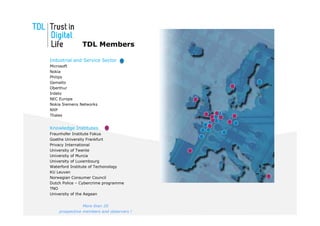
TDL Members

Industrial and Service Sector
Microsoft
Nokia
Philips
Gemalto
Oberthur
Irdeto
NEC Europe
Nokia Siemens Networks
NXP
Thales


Knowledge Institutes
Fraunhofer Institute Fokus
Goethe University Frankfurt
Privacy International
University of Twente
University of Murcia
University of Luxembourg
Waterford Institute of Techonology
KU Leuven
Norwegian Consumer Council
Dutch Police – Cybercrime programme
TNO
University of the Aegean


                More than 20
    prospective members and observers !
TDL ambitions and expected performances


1.   Self sustainable inspiring TRUST community providing
     directions and development of knowledge and collaborative
     projects & frameworks for trustworthy ICT solutions

2.   Innovative but realistic research agenda recognized by
     industry, knowledge institutes, the European commission,
     local governments and other independent authorities

3.   Create possibilities for public funding for collaborative R&D
     and deployment projects

4.   Create industrial, political and legal awareness for
     removing barriers through an extensive demonstrations
     and pilots program.
Key Performance Indicators


TDL is working on setting a Dash Board to measure Trust in
   ICT

Such KPIs can be:
– Adoption rate (%age) of citizens using e-services
– Number of ICT trust-related incidents reported
– Number of new e-services launch
– Consumers/Citizens surveys score cards
Trust in Digital Life at a glance

•   Gemalto, Microsoft, Nokia and Philips founded the Trust in Digital Life
    research and innovation consortium (TDL) in 2009 to stimulate the
    development of Trustworthy ICT solutions.

•   22 parties already joined the consortium and TDL is growing steadily.

•   In 2012 the consortium will count more than 40 complementary members.

•   TDL will set out a vision and strategic research agenda for trustworthy
    products relating to ICT.

•   TDL will provide recommendations for research for the European frame work
    program (FP8).

•   TDL is financially supported by the European commission.
Trustworthy ICT solutions

•   Trust is an essential pre-requisite for connecting people in effective human
    and enterprise transactions.

•   Trust builds on elements like security, privacy, transparency, accountability
    and reputation.

•   There is no clear understanding on the sources of trustworthiness, nor is
    there an industry recommendation on implementing principles to generate
    trust in digital services.

•   European strategy must aim at a strong competitive position in producing
    innovative trustworthiness solutions accepted by citizens, business and
    governments.

•   Coordination effort goes across Member States, industrial and service sectors,
    academia, public authorities and representatives of citizens.

•   Essential is the recognition of the importance of the rule of law, security, and
    privacy and other core democratic freedoms in contributing to
    trustworthiness.
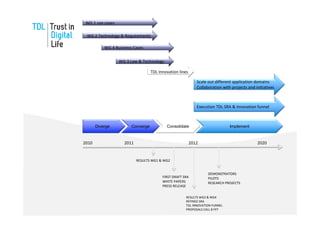
WG 1 use cases

 WG 2 Technology & Requirements

           WG 4 Business Cases


                  WG 3 Law & Technology

                                   TDL Innovation lines

                                                             Scale out different application domains
                                                             Collaboration with projects and initiatives


                                                             Execution TDL SRA & Innovation funnel


       Diverge          Converge           Consolidate                         Implement


2010                2011                                  2012                                2020


                           RESULTS WG1 & WG2


                                                                   DEMONSTRATORS
                                         FIRST DRAFT SRA           PILOTS
                                         WHITE PAPERS              RESEARCH PROJECTS
                                         PRESS RELEASE

                                                      RESULTS WG3 & WG4
                                                      REFINED SRA
                                                      TDL INNOVATION FUNNEL
                                                      PROPOSALS CALL 8 FP7
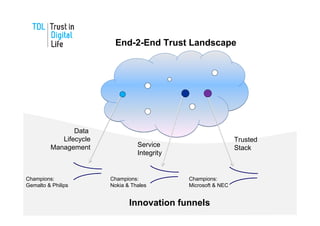
End-2-End Trust Landscape


                Data
            Lifecycle                                           Trusted
         Management               Service                       Stack
                                  Integrity


Champions:              Champions:            Champions:
Gemalto & Philips       Nokia & Thales        Microsoft & NEC


                               Innovation funnels
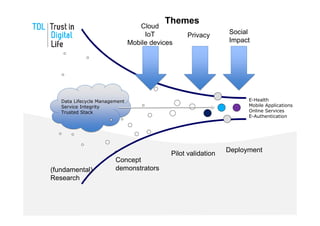
Themes
                                  Cloud
                                    IoT          Privacy       Social
                               Mobile devices                  Impact


   Data Lifecycle Management                                         E-Health
   Service Integrity                                                 Mobile Applications
   Trusted Stack                                                     Online Services
                                                                     E-Authentication


                                                               Deployment
                                            Pilot validation
                        Concept
(fundamental)           demonstrators
Research
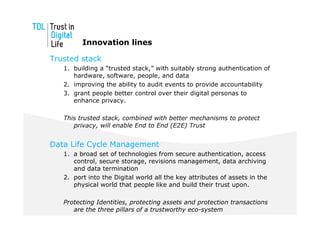
Innovation lines

Trusted stack
   1. building a “trusted stack,” with suitably strong authentication of
      hardware, software, people, and data
   2. improving the ability to audit events to provide accountability
   3. grant people better control over their digital personas to
      enhance privacy.

   This trusted stack, combined with better mechanisms to protect
      privacy, will enable End to End (E2E) Trust


Data Life Cycle Management
   1. a broad set of technologies from secure authentication, access
      control, secure storage, revisions management, data archiving
      and data termination
   2. port into the Digital world all the key attributes of assets in the
      physical world that people like and build their trust upon.

   Protecting Identities, protecting assets and protection transactions
      are the three pillars of a trustworthy eco-system
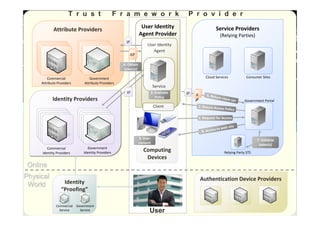
T r u s t                     F r a m e w o r k                   P r o v i d e r

            Attribute Providers                                    User Identity                          Service Providers
                                                                  Agent Provider                                (Relying Parties)
                                                       IP
                                                                       User Identity
                                                                          Agent
                                                         AP
                                                         AP

                                                      4. Obtain
                                                      token(s)

         Commercial               Government                                                       Cloud Services                Consumer Sites
     Attribute Providers       Attribute Providers
                                                                            Service
                                                        IP              3. Evaluate    IP   AA
                                                                           Policy                   6. Retu
                                                                                                            r   n claim
            Identity Providers
            Identity Providers                                                              P
                                                                                            P                             set   Government Portal
                                                                            Client           2. Return Acce
                                                                                                                 ss Policy

                                                                                             1. Request for Access

                                                                                                                        e
                                                                                                        ss t o   web sit
                                                                                                 8. Acce
                                                                  5. User                                                              7. Validate
                                                                  consent                                                               token(s)
        Commercial                Government
     Identity Providers        Identity Providers
                                                                    Computing                                      Relying Party STS
                                                                     Devices
 Online
Physical                                                                                         Authentication Device Providers
 World            Identity
                 “Proofing”

              Commercial   Government
                Service      Service                                    User
Working groups
Overview
Participating in working groups

•   Four interdependent working group charters develop relevant content for the
    strategic research agenda and project proposals:
     1. Use cases

     2. Technolgy & requirements

     3. Law & technology

     4. Business cases


•   Face-to–face working group meetings are held every quarter and
    teleconference meetings in between. Extensive interaction between working
    groups is organised.

•   Working groups produce papers and publications.

•   Parties can join one or more working groups.

•   Willingness to exchange knowledge and experience, sharing customer &
    market insights, commitments for joint research and cross sector
    development trajectories are key success factors.
Working group charter
Use cases
Use Cases for Trust in Digital Life

•   Use cases will identify, group and describe the common characteristics of the
    services the industry finds the most potential.

•   Description of generic use cases and associated digital services will be
    enriched with scenario’s “user stories”.

•   Possible threats to a user’s information security and privacy will be derived
    from user stories and will be offered to Requirements and Technology
    Working Group for further analysing and defining a threat landscape.

•   Current use cases:
     – Cloud Computing
     – Online Gaming
     – Online Auction Fraud
     – Child Online safety
     – E-Healthcare
     – E-Nergy

•   Deliverables:
         White papers on several use cases and user stories
Working group charter
Requirements & Technology
Roadmap of Trust

•   Technology and requirements WG addresses questions that relates to
    (unsatisfied) elements of trust and their requirements.

•   The role of technology and potential technical disruptive solutions for
    unsatisfied elements of trust are investigated and research areas are
    recommended.

•   A generic architecture and frameworks will be developed to support industry
    and government with guidelines and de facto standards for research and
    product development.

•   The approach is to analyse use cases, develop a threat landscape and create
    an overview of state-of-the art technology technology that support
    trustworthy products.

•   A technology roadmap covering the requirements is a key delivery.

•   Deliverables:
         Elements of trust
         Technical requirement for trust
         Roadmap of trust and authentication architecture
Technical challenges (WG2)


Derived Threats
   •   Not respecting co-ownership of data
   •   Location threats
   •   Unwanted retention of data
   •   Copying of Information without consent
   •   Authentication
   •   User interaction through a compromised end-user device
Technical challenges (WG2)

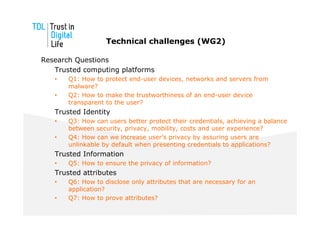
Research Questions
   Trusted computing platforms
   •   Q1: How to protect end-user devices, networks and servers from
       malware?
   •   Q2: How to make the trustworthiness of an end-user device
       transparent to the user?
   Trusted Identity
   •   Q3: How can users better protect their credentials, achieving a balance
       between security, privacy, mobility, costs and user experience?
   •   Q4: How can we increase user’s privacy by assuring users are
       unlinkable by default when presenting credentials to applications?
   Trusted Information
   •   Q5: How to ensure the privacy of information?
   Trusted attributes
   •   Q6: How to disclose only attributes that are necessary for an
       application?
   •   Q7: How to prove attributes?
Working group charter
Law & Technology
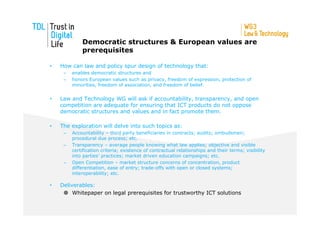
Democratic structures & European values are
             prerequisites

•   How can law and policy spur design of technology that:
     –   enables democratic structures and
     –   honors European values such as privacy, freedom of expression, protection of
         minorities, freedom of association, and freedom of belief.


•   Law and Technology WG will ask if accountability, transparency, and open
    competition are adequate for ensuring that ICT products do not oppose
    democratic structures and values and in fact promote them.

•   The exploration will delve into such topics as:
     –   Accountability – third party beneficiaries in contracts; audits; ombudsmen;
         procedural due process; etc.
     –   Transparency – average people knowing what law applies; objective and visible
         certification criteria; existence of contractual relationships and their terms; visibility
         into parties’ practices; market driven education campaigns; etc.
     –   Open Competition – market structure concerns of concentration, product
         differentiation, ease of entry; trade-offs with open or closed systems;
         interoperability; etc.

•   Deliverables:
         Whitepaper on legal prerequisites for trustworthy ICT solutions
Working group charter
Business cases
Value driven research

•   The impact of trustworthy ICT solutions
     – How can we measure the economic and societal impact
     – what are the business models that motivates the required research
        investments.

•   Business cases WG will develop business models and a portfolio of research
    project ideas for the development of Trustworthy ICT with scenario’s and
    sensitivity analyses to understand the economic and societal impact.

•   They approach is to identify market segments, market drivers and high level
    project description based on output of WG Technology & requirements. The
    expected value of research efforts is motivated.

•   Deliverables:
         Models for TDL business logic, addressable markets and technology
         roadmaps
         Portfolio of TDL research project ideas
         Motivation of expected quantitative value of TDL research
TDL Governance

 www.trustindigitallife.eu
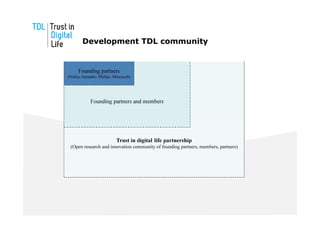
Development TDL community
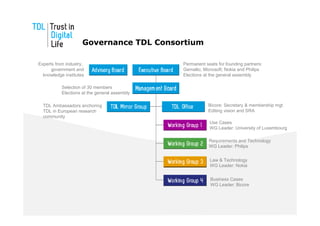
Governance TDL Consortium

Experts from industry,                         Permanent seats for founding partners:
      government and                           Gemalto; Microsoft; Nokia and Philips
  knowledge institutes                         Elections at the general assembly

           Selection of 30 members
           Elections at the general assembly

  TDL Ambassadors anchoring                                Bicore: Secretary & membership mgt
  TDL in European research                                 Editing vision and SRA
  community
                                                           Use Cases
                                                           WG Leader: University of Luxembourg

                                                           Requirements and Technology
                                                           WG Leader: Philips


                                                           Law & Technology
                                                           WG Leader: Nokia


                                                            Business Cases
                                                            WG Leader: Bicore
TDL Membership

 www.trustindigitallife.eu
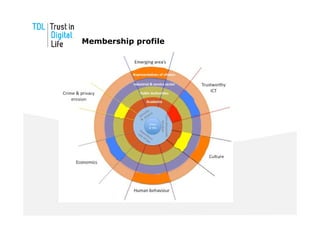
Membership profile
TDL membership objectives

•   A multidisciplinary open research community

•   Broad support to the research roadmaps

•   Active participation in the Working Group charters

•   Development & implementation of the SRA & Work plan

•   Development of a balanced research project portfolio

•   International recognition of TDL


                                                           30
5 reasons to join the TDL community

1.    Influence the European state-of-the-art vision on Trust in Digital Life.


2.    Share and enrich your knowledge and insights on law, markets and
      technology with complementary leading edge industry parties, knowledge
      institutes and policy makers.


3.    Create promising opportunities for public-private research projects in
      European frame work programs.


4.    Inside out: Identify yourselves with high quality content and papers.


5.    Outside in: Validate and improve your (business) strategy.


     TDL is an open community stimulating cross sector collaboration to enable
                        development of trustworthy solutions
5 reasons to become a TDL member

1. Actively contribute to the strategic research agenda, access to all information.

2. Support continuation of the TDL partnership after project period in 2012.

3. Receive funds for the development of demonstrators on trustworthy ICT
   solutions and execution of detailed expert studies on Law, Market and
   Technology.

4. Become member of management board.

5. Develop concrete public – private projects within frame work programs.


                          TDL membership will create
             vast business opportunities and leverage your activities
How to become a member

•   Your application should include a written statement indicating your relevant
    expertise and a description of the your envisioned contribution to the effort.

•   Approving and signing the Consortium Agreement and Policies and
    Procedures

•   Receiving 2 sponsorship letters from current Executive Board members

•   To become a Working Group or Management Board Member, you must submit
    an application. Declarations of accession to the Management Board and the Working
    Groups are included in the Consortium Agreement.

•   Possibility to apply for an observer status. In this case you don’t benefit the
    additional advantages of TDL membership status

•   For more information, please visit the website at www.trustindigitallife.eu or contact
    the TDL Office at TDLOffice@bicore.nl
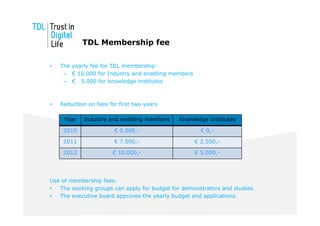
TDL Membership fee

•   The yearly fee for TDL membership:
     – € 10.000 for Industry and enabling members
     – € 5.000 for knowledge institutes


•   Reduction on fees for first two years

     Year    Industry and enabling members    Knowledge Institutes

     2010               € 5.000,-                     € 0,-

     2011               € 7.500,-                   € 2.500,-

     2012              € 10.000,-                   € 5.000,-


Use of membership fees:
•  The working groups can apply for budget for demonstrators and studies.
•  The executive board approves the yearly budget and applications.
Frequently Asked Questions

Who are the founders of TDL?
Gemalto, Microsoft, Nokia and Philips took the initiative for TDL and signed a consortium agreement in
   2009.

Can I participate in TDL without becoming a member?
This is possible as long as the European commission financially support TDL and you must be prepared
     to exchange relevant knowledge. You must apply for an observer role and accept the policies and
     procedures.

Can I use all information of TDL without limitation ?
All parties that participate in TDL have to accept the rules for using information. The principle is that
     parties are free to use the information that is shared between parties.

What type of parties are member of TDL?
Members of TDL are ICT industry parties; knowledge institutes; trade associations; law firms.

Are the results of TDL becoming public?
TDL has a procedure for publishing results. The vision and Strategic Research Agenda will be made
    public

Who should I contact to become a member?
TDLoffice@bicore.nl


             More frequently asked questions can be found on the website
                                 www.trustindigitallife.eu
www.trustindigitallife.eu

Tdl

  • 1.
  • 2.
    Trust in DigitalLife - Mission statement TDL is a consortium of Industry, Academics and Government entities working together to set a research agenda for a Trustworthy ICT. Why Trust for ICT? To stimulate a broad adoption by citizens of e-services
  • 3.
    TDL Members Industrial andService Sector Microsoft Nokia Philips Gemalto Oberthur Irdeto NEC Europe Nokia Siemens Networks NXP Thales Knowledge Institutes Fraunhofer Institute Fokus Goethe University Frankfurt Privacy International University of Twente University of Murcia University of Luxembourg Waterford Institute of Techonology KU Leuven Norwegian Consumer Council Dutch Police – Cybercrime programme TNO University of the Aegean More than 20 prospective members and observers !
  • 4.
    TDL ambitions andexpected performances 1. Self sustainable inspiring TRUST community providing directions and development of knowledge and collaborative projects & frameworks for trustworthy ICT solutions 2. Innovative but realistic research agenda recognized by industry, knowledge institutes, the European commission, local governments and other independent authorities 3. Create possibilities for public funding for collaborative R&D and deployment projects 4. Create industrial, political and legal awareness for removing barriers through an extensive demonstrations and pilots program.
  • 5.
    Key Performance Indicators TDLis working on setting a Dash Board to measure Trust in ICT Such KPIs can be: – Adoption rate (%age) of citizens using e-services – Number of ICT trust-related incidents reported – Number of new e-services launch – Consumers/Citizens surveys score cards
  • 6.
    Trust in DigitalLife at a glance • Gemalto, Microsoft, Nokia and Philips founded the Trust in Digital Life research and innovation consortium (TDL) in 2009 to stimulate the development of Trustworthy ICT solutions. • 22 parties already joined the consortium and TDL is growing steadily. • In 2012 the consortium will count more than 40 complementary members. • TDL will set out a vision and strategic research agenda for trustworthy products relating to ICT. • TDL will provide recommendations for research for the European frame work program (FP8). • TDL is financially supported by the European commission.
  • 7.
    Trustworthy ICT solutions • Trust is an essential pre-requisite for connecting people in effective human and enterprise transactions. • Trust builds on elements like security, privacy, transparency, accountability and reputation. • There is no clear understanding on the sources of trustworthiness, nor is there an industry recommendation on implementing principles to generate trust in digital services. • European strategy must aim at a strong competitive position in producing innovative trustworthiness solutions accepted by citizens, business and governments. • Coordination effort goes across Member States, industrial and service sectors, academia, public authorities and representatives of citizens. • Essential is the recognition of the importance of the rule of law, security, and privacy and other core democratic freedoms in contributing to trustworthiness.
  • 8.
    WG 1 usecases WG 2 Technology & Requirements WG 4 Business Cases WG 3 Law & Technology TDL Innovation lines Scale out different application domains Collaboration with projects and initiatives Execution TDL SRA & Innovation funnel Diverge Converge Consolidate Implement 2010 2011 2012 2020 RESULTS WG1 & WG2 DEMONSTRATORS FIRST DRAFT SRA PILOTS WHITE PAPERS RESEARCH PROJECTS PRESS RELEASE RESULTS WG3 & WG4 REFINED SRA TDL INNOVATION FUNNEL PROPOSALS CALL 8 FP7
  • 9.
    End-2-End Trust Landscape Data Lifecycle Trusted Management Service Stack Integrity Champions: Champions: Champions: Gemalto & Philips Nokia & Thales Microsoft & NEC Innovation funnels
  • 10.
    Themes Cloud IoT Privacy Social Mobile devices Impact Data Lifecycle Management E-Health Service Integrity Mobile Applications Trusted Stack Online Services E-Authentication Deployment Pilot validation Concept (fundamental) demonstrators Research
  • 11.
    Innovation lines Trusted stack 1. building a “trusted stack,” with suitably strong authentication of hardware, software, people, and data 2. improving the ability to audit events to provide accountability 3. grant people better control over their digital personas to enhance privacy. This trusted stack, combined with better mechanisms to protect privacy, will enable End to End (E2E) Trust Data Life Cycle Management 1. a broad set of technologies from secure authentication, access control, secure storage, revisions management, data archiving and data termination 2. port into the Digital world all the key attributes of assets in the physical world that people like and build their trust upon. Protecting Identities, protecting assets and protection transactions are the three pillars of a trustworthy eco-system
  • 12.
    T r us t F r a m e w o r k P r o v i d e r Attribute Providers User Identity Service Providers Agent Provider (Relying Parties) IP User Identity Agent AP AP 4. Obtain token(s) Commercial Government Cloud Services Consumer Sites Attribute Providers Attribute Providers Service IP 3. Evaluate IP AA Policy 6. Retu r n claim Identity Providers Identity Providers P P set Government Portal Client 2. Return Acce ss Policy 1. Request for Access e ss t o web sit 8. Acce 5. User 7. Validate consent token(s) Commercial Government Identity Providers Identity Providers Computing Relying Party STS Devices Online Physical Authentication Device Providers World Identity “Proofing” Commercial Government Service Service User
  • 13.
  • 14.
    Participating in workinggroups • Four interdependent working group charters develop relevant content for the strategic research agenda and project proposals: 1. Use cases 2. Technolgy & requirements 3. Law & technology 4. Business cases • Face-to–face working group meetings are held every quarter and teleconference meetings in between. Extensive interaction between working groups is organised. • Working groups produce papers and publications. • Parties can join one or more working groups. • Willingness to exchange knowledge and experience, sharing customer & market insights, commitments for joint research and cross sector development trajectories are key success factors.
  • 15.
  • 16.
    Use Cases forTrust in Digital Life • Use cases will identify, group and describe the common characteristics of the services the industry finds the most potential. • Description of generic use cases and associated digital services will be enriched with scenario’s “user stories”. • Possible threats to a user’s information security and privacy will be derived from user stories and will be offered to Requirements and Technology Working Group for further analysing and defining a threat landscape. • Current use cases: – Cloud Computing – Online Gaming – Online Auction Fraud – Child Online safety – E-Healthcare – E-Nergy • Deliverables: White papers on several use cases and user stories
  • 17.
  • 18.
    Roadmap of Trust • Technology and requirements WG addresses questions that relates to (unsatisfied) elements of trust and their requirements. • The role of technology and potential technical disruptive solutions for unsatisfied elements of trust are investigated and research areas are recommended. • A generic architecture and frameworks will be developed to support industry and government with guidelines and de facto standards for research and product development. • The approach is to analyse use cases, develop a threat landscape and create an overview of state-of-the art technology technology that support trustworthy products. • A technology roadmap covering the requirements is a key delivery. • Deliverables: Elements of trust Technical requirement for trust Roadmap of trust and authentication architecture
  • 19.
    Technical challenges (WG2) DerivedThreats • Not respecting co-ownership of data • Location threats • Unwanted retention of data • Copying of Information without consent • Authentication • User interaction through a compromised end-user device
  • 20.
    Technical challenges (WG2) ResearchQuestions Trusted computing platforms • Q1: How to protect end-user devices, networks and servers from malware? • Q2: How to make the trustworthiness of an end-user device transparent to the user? Trusted Identity • Q3: How can users better protect their credentials, achieving a balance between security, privacy, mobility, costs and user experience? • Q4: How can we increase user’s privacy by assuring users are unlinkable by default when presenting credentials to applications? Trusted Information • Q5: How to ensure the privacy of information? Trusted attributes • Q6: How to disclose only attributes that are necessary for an application? • Q7: How to prove attributes?
  • 21.
  • 22.
    Democratic structures &European values are prerequisites • How can law and policy spur design of technology that: – enables democratic structures and – honors European values such as privacy, freedom of expression, protection of minorities, freedom of association, and freedom of belief. • Law and Technology WG will ask if accountability, transparency, and open competition are adequate for ensuring that ICT products do not oppose democratic structures and values and in fact promote them. • The exploration will delve into such topics as: – Accountability – third party beneficiaries in contracts; audits; ombudsmen; procedural due process; etc. – Transparency – average people knowing what law applies; objective and visible certification criteria; existence of contractual relationships and their terms; visibility into parties’ practices; market driven education campaigns; etc. – Open Competition – market structure concerns of concentration, product differentiation, ease of entry; trade-offs with open or closed systems; interoperability; etc. • Deliverables: Whitepaper on legal prerequisites for trustworthy ICT solutions
  • 23.
  • 24.
    Value driven research • The impact of trustworthy ICT solutions – How can we measure the economic and societal impact – what are the business models that motivates the required research investments. • Business cases WG will develop business models and a portfolio of research project ideas for the development of Trustworthy ICT with scenario’s and sensitivity analyses to understand the economic and societal impact. • They approach is to identify market segments, market drivers and high level project description based on output of WG Technology & requirements. The expected value of research efforts is motivated. • Deliverables: Models for TDL business logic, addressable markets and technology roadmaps Portfolio of TDL research project ideas Motivation of expected quantitative value of TDL research
  • 25.
  • 26.
  • 27.
    Governance TDL Consortium Expertsfrom industry, Permanent seats for founding partners: government and Gemalto; Microsoft; Nokia and Philips knowledge institutes Elections at the general assembly Selection of 30 members Elections at the general assembly TDL Ambassadors anchoring Bicore: Secretary & membership mgt TDL in European research Editing vision and SRA community Use Cases WG Leader: University of Luxembourg Requirements and Technology WG Leader: Philips Law & Technology WG Leader: Nokia Business Cases WG Leader: Bicore
  • 28.
  • 29.
  • 30.
    TDL membership objectives • A multidisciplinary open research community • Broad support to the research roadmaps • Active participation in the Working Group charters • Development & implementation of the SRA & Work plan • Development of a balanced research project portfolio • International recognition of TDL 30
  • 31.
    5 reasons tojoin the TDL community 1. Influence the European state-of-the-art vision on Trust in Digital Life. 2. Share and enrich your knowledge and insights on law, markets and technology with complementary leading edge industry parties, knowledge institutes and policy makers. 3. Create promising opportunities for public-private research projects in European frame work programs. 4. Inside out: Identify yourselves with high quality content and papers. 5. Outside in: Validate and improve your (business) strategy. TDL is an open community stimulating cross sector collaboration to enable development of trustworthy solutions
  • 32.
    5 reasons tobecome a TDL member 1. Actively contribute to the strategic research agenda, access to all information. 2. Support continuation of the TDL partnership after project period in 2012. 3. Receive funds for the development of demonstrators on trustworthy ICT solutions and execution of detailed expert studies on Law, Market and Technology. 4. Become member of management board. 5. Develop concrete public – private projects within frame work programs. TDL membership will create vast business opportunities and leverage your activities
  • 33.
    How to becomea member • Your application should include a written statement indicating your relevant expertise and a description of the your envisioned contribution to the effort. • Approving and signing the Consortium Agreement and Policies and Procedures • Receiving 2 sponsorship letters from current Executive Board members • To become a Working Group or Management Board Member, you must submit an application. Declarations of accession to the Management Board and the Working Groups are included in the Consortium Agreement. • Possibility to apply for an observer status. In this case you don’t benefit the additional advantages of TDL membership status • For more information, please visit the website at www.trustindigitallife.eu or contact the TDL Office at TDLOffice@bicore.nl
  • 34.
    TDL Membership fee • The yearly fee for TDL membership: – € 10.000 for Industry and enabling members – € 5.000 for knowledge institutes • Reduction on fees for first two years Year Industry and enabling members Knowledge Institutes 2010 € 5.000,- € 0,- 2011 € 7.500,- € 2.500,- 2012 € 10.000,- € 5.000,- Use of membership fees: • The working groups can apply for budget for demonstrators and studies. • The executive board approves the yearly budget and applications.
  • 35.
    Frequently Asked Questions Whoare the founders of TDL? Gemalto, Microsoft, Nokia and Philips took the initiative for TDL and signed a consortium agreement in 2009. Can I participate in TDL without becoming a member? This is possible as long as the European commission financially support TDL and you must be prepared to exchange relevant knowledge. You must apply for an observer role and accept the policies and procedures. Can I use all information of TDL without limitation ? All parties that participate in TDL have to accept the rules for using information. The principle is that parties are free to use the information that is shared between parties. What type of parties are member of TDL? Members of TDL are ICT industry parties; knowledge institutes; trade associations; law firms. Are the results of TDL becoming public? TDL has a procedure for publishing results. The vision and Strategic Research Agenda will be made public Who should I contact to become a member? TDLoffice@bicore.nl More frequently asked questions can be found on the website www.trustindigitallife.eu
  • 36.