DENTURE
BASE
MATERIALS
2
CONTENTS
▰ INTRODUCTION
▰ HISTORY
▰ REQUISITES FOR IDEAL DENTURE BASE MATERIAL
▰ CLASSIFICATION
▰ METAL DENTURE BASE
▰ DENTURE BASE POLYMERS
▰ RECENT ADVANCES
▰ CONCLUSION
▰ REFERANCES
INTRODUCTION
4
DEFINITIONS
Denture: An artificial substitute for missing natural teeth and
adjacent structure. (GPT 9)
Denture Base: The part of a denture that rests on the
foundation tissues and to which teeth are attached. (GPT 9)
4
Denture Base Material: Any substance of which a denture
base may be made. (GPT 9)
HISTORY
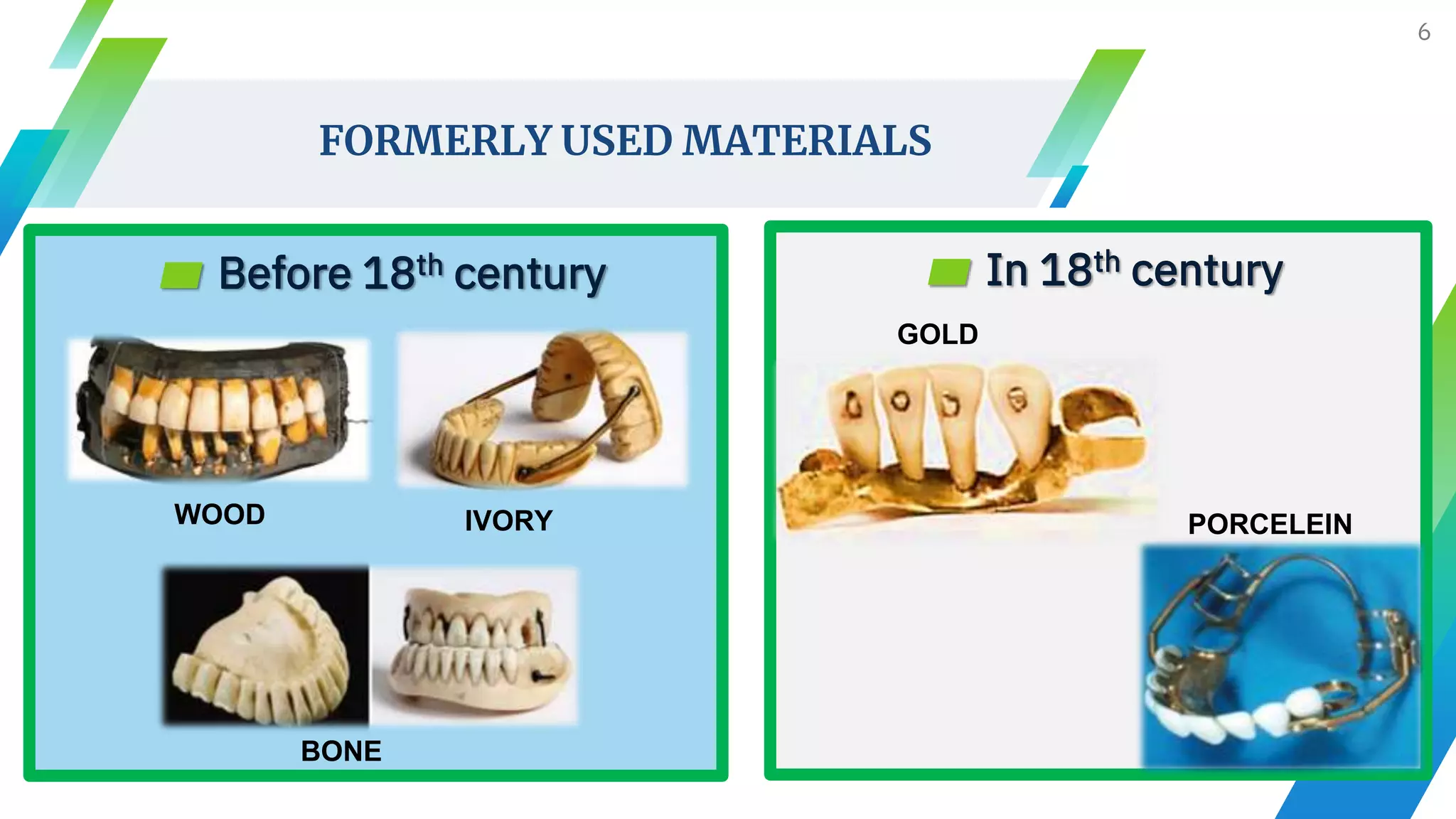
FORMERLY USED MATERIALS
▰ Before 18th century ▰ In 18th century
6
WOOD IVORY
BONE
GOLD
PORCELEIN
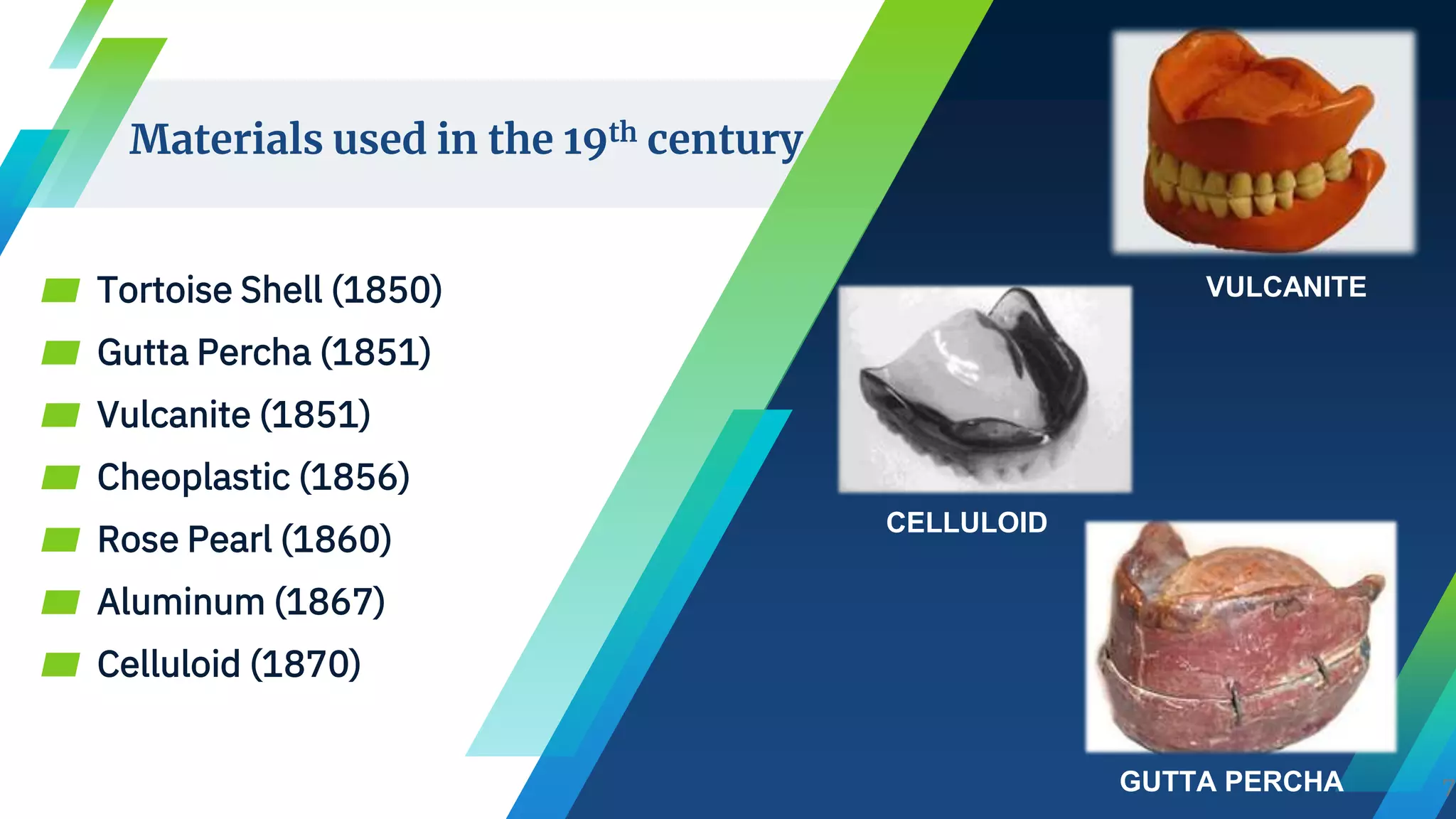
Materials used in the 19th century
▰ Tortoise Shell (1850)
▰ Gutta Percha (1851)
▰ Vulcanite (1851)
▰ Cheoplastic (1856)
▰ Rose Pearl (1860)
▰ Aluminum (1867)
▰ Celluloid (1870)
7
VULCANITE
CELLULOID
GUTTA PERCHA
Materials used in the 20th century
▰ Bakelite (1909)
▰ Stainless steel (1921)
▰ Cobalt Chromium (1930)
▰ Vinyl Resin (1932)
▰ Acrylic Resin (1937)
▰ Self cure Acrylic Resin
▰ Epoxy Resin (1951)
▰ Polystyrene (1951)
▰ Nylon (1955)
▰ Polycarbonates (1967)
▰ High impact acrylic (1967)
▰ Polysulphones (1981)
▰ Visible L.C (1947)Acrylic (1986)
▰ Pure Titanium (1998) 8
ACRYLIC RESIN
STAINLESS STEEL POLYSTYRENE
BAKELITE
Requisites For Ideal
Denture Base Material
10
•BIOLOGICA
L
• Non-toxic
• Non- irritant
• Odourless
• Tasteless
PHYSICAL
• Aesthetics
• Dimensionally stable
• Low value of specific gravity/
density
• High value of thermal
conductivity
• Radiopaque
•CHEMICAL
• Inert
• Insoluble
• Non-absorbant
11
MECHANICAL
• High value of modulus of elasticity - rigidity
• High value of elastic limit- permanent
deformation
• Sufficient flexural strength
• Adequate fatigue life and high fatigue limit
• Good impact strength
• Sufficient abrasion resistance
MISCELLANEOUS
• Inexpensive
• Long shelf life
• Easy to manipulate
• Easy to repair
CLASSIFICATION
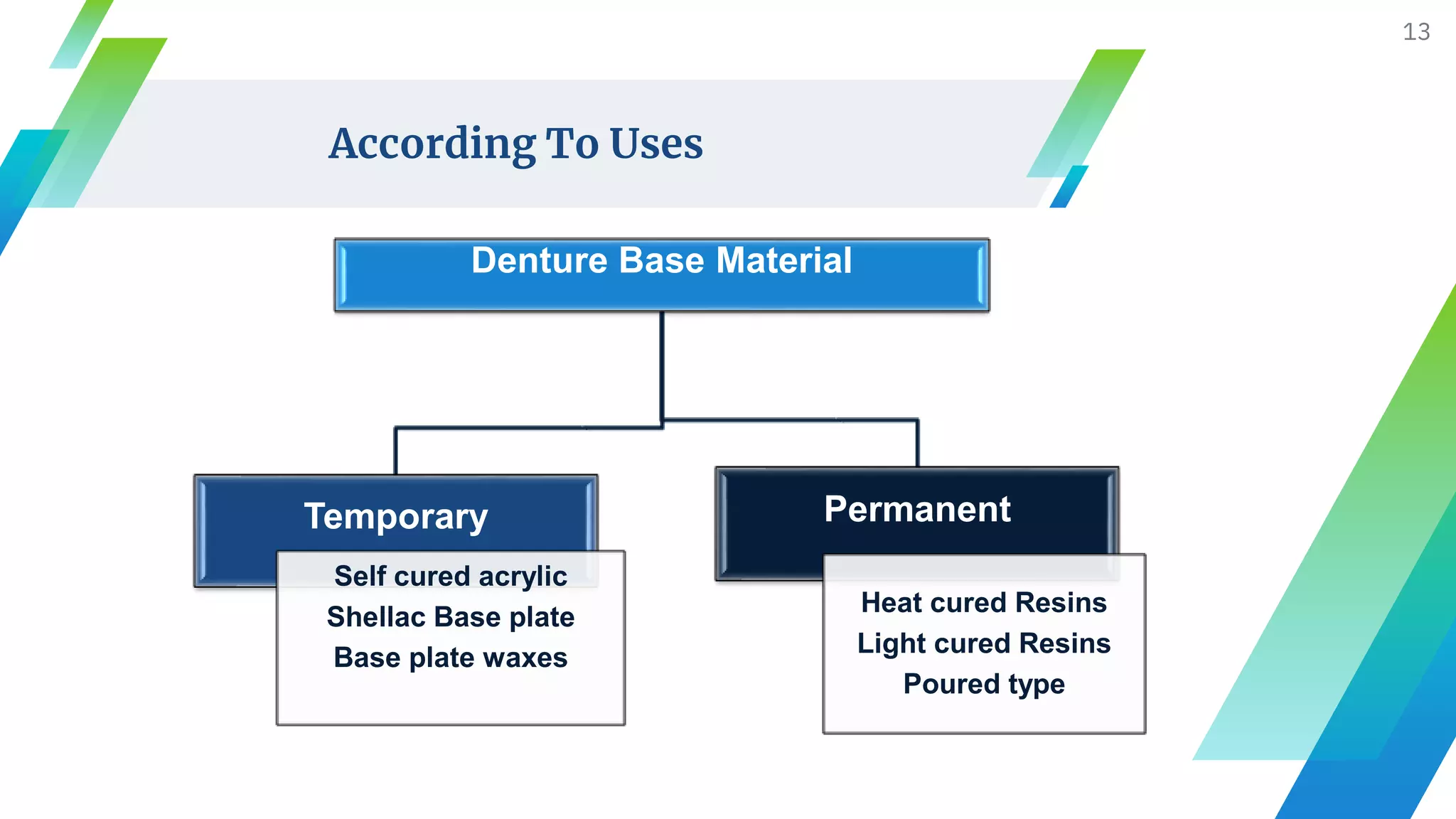
According To Uses
13
Denture Base Material
Temporary
Self cured acrylic
Shellac Base plate
Base plate waxes
Permanent
Heat cured Resins
Light cured Resins
Poured type
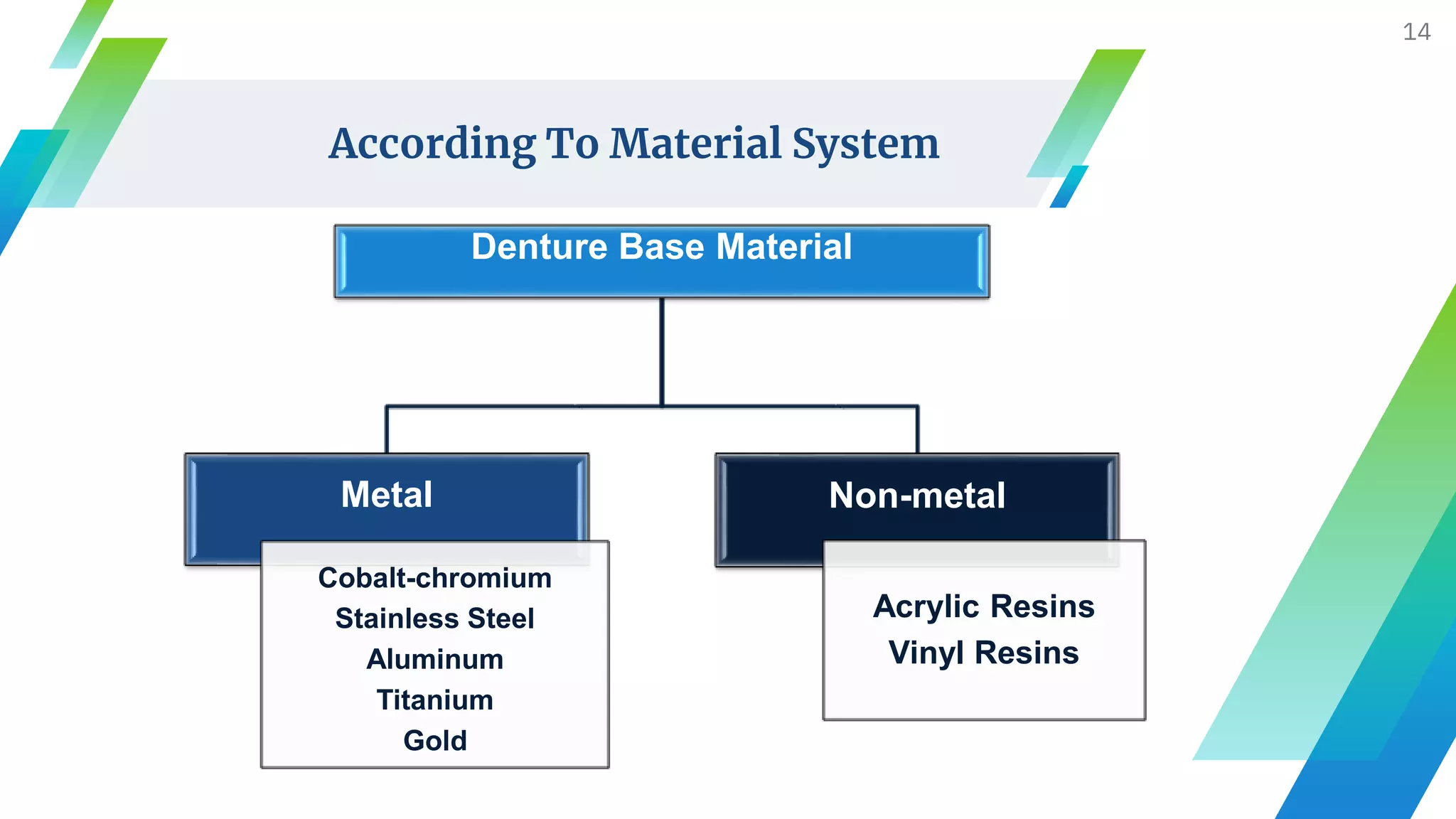
According To Material System
14
Denture Base Material
Metal
Cobalt-chromium
Stainless Steel
Aluminum
Titanium
Gold
Non-metal
Acrylic Resins
Vinyl Resins
According to mode of polymerization
15
Polymerization
Addition
Acrylic
Polyvinyl chloride
polymethyl methacrylate
Condensation
Bakelite
nylon
According to Method of activation
16
Activation
Thermal
Heat Cure Acrylics
Chemical
Self Cure Acrylics
Light
Activated
Microwave
Energy
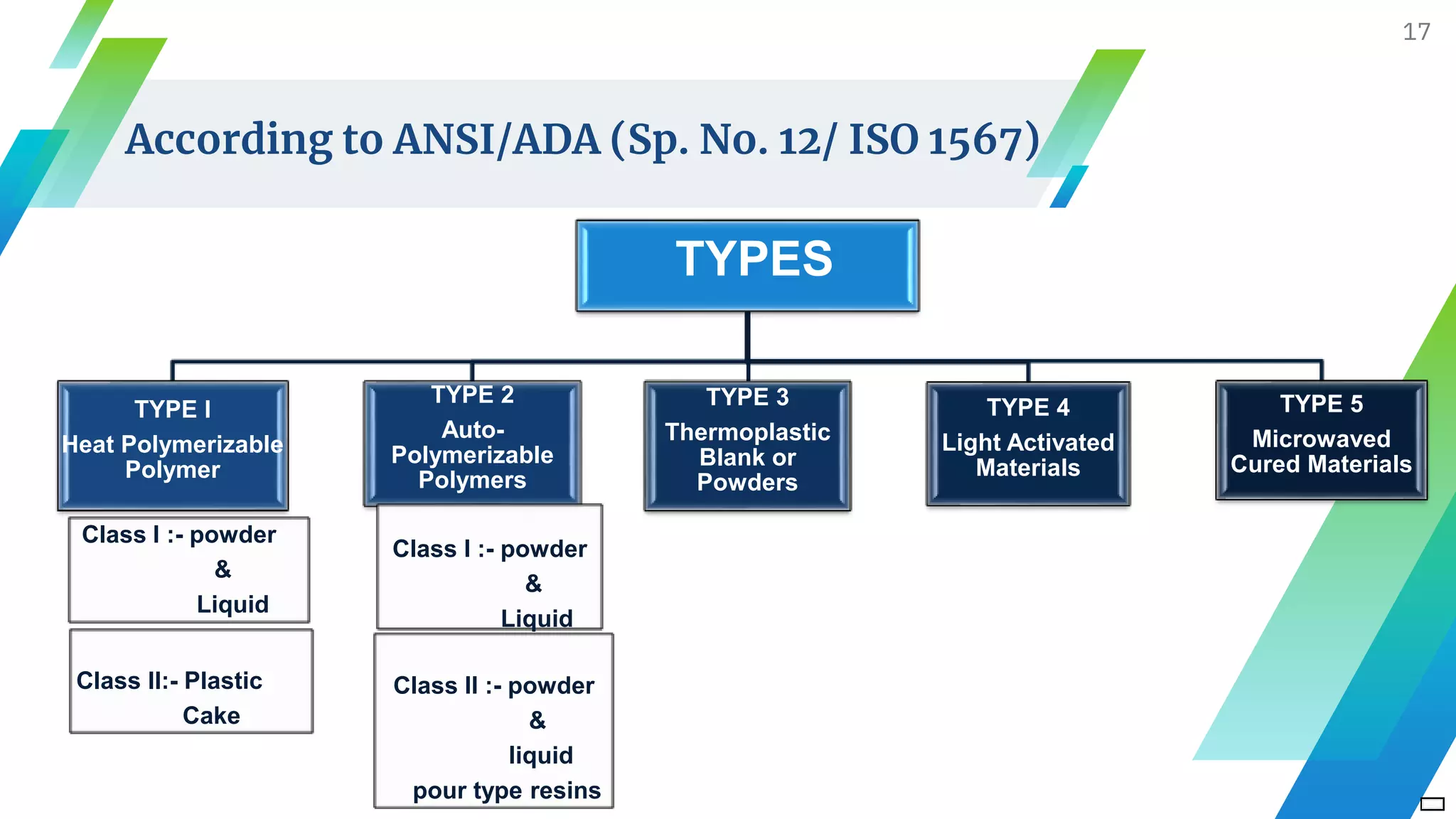
According to ANSI/ADA (Sp. No. 12/ ISO 1567)
17
TYPES
TYPE I
Heat Polymerizable
Polymer
Class I :- powder
&
Liquid
TYPE 2
Auto-
Polymerizable
Polymers
Class I :- powder
&
Liquid
TYPE 3
Thermoplastic
Blank or
Powders
Class II :- powder
&
liquid
pour type resins
TYPE 4
Light Activated
Materials
Class II:- Plastic
Cake
TYPE 5
Microwaved
Cured Materials
METAL DENTURE
BASE MATERIAL
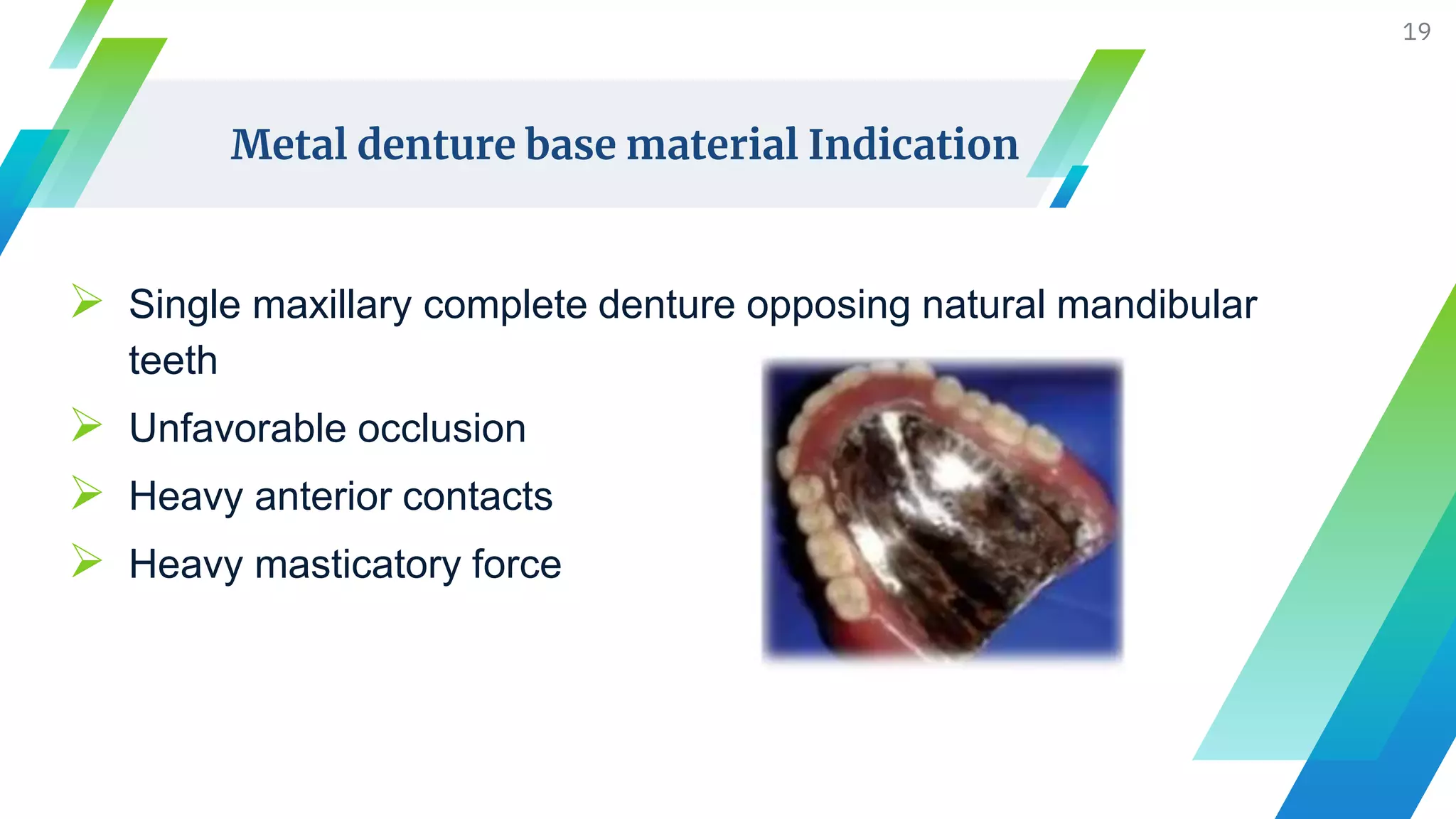
 Single maxillary complete denture opposing natural mandibular
teeth
 Unfavorable occlusion
 Heavy anterior contacts
 Heavy masticatory force
19
Metal denture base material Indication
Advantages of Metal Bases over Resin Bases:
(1) Accuracy and permanence of form
▰ More Accurate and maintain their accuracy of form without change in mouth.
▰ Internal strains released later to cause distortion not present.
▰ Accuracy - provides intimacy of contact, help in retention of denture
prostheses
(2) Comparative tissue response-
▰ Inherent cleanliness of cast metal base contributes to health of oral tissue.
▰ Bacteriostatic activity - Ionization and oxidization of metal bases
20
Advantages of Metal Bases over Resin Bases:
(3) Thermal conductivity-
▰ Temperature changes transmitted though metal to the underlying tissue so
prevent accidental burning by hot food.
▰ Patient acceptance.
(4) Weight and bulk-
▰ Thinner than acrylic resin and still have adequate strength.
▰ Certain situations demands use of acrylic denture base.
╺ Extreme loss of residual alveolar bone- fullness to denture base to restore
facial contours.
21
Disadvantages of Metal Bases over Resin
Bases:
1) Aesthetically not acceptable
2) Relining difficult
3) Restoration of normal facial contour can not be achieved
22
COBALT-CHROMIUM ALLOYS :
As early as 1949 nearly 80% of all partial denture were cast from Co-Cr
alloys.
NICKEL CHROMIUM ALLOYS :
• Nickel 70% , Chromium 18%
CHROMIUM :
• Responsible for the tarnish resistance and stainless.
• Should not contain more than 28% or 29% chromium
• Technique sensitive.
23
Different metallic denture base materials
24
COBALT AND NICKEL :
Cobalt increases the elastic modulus, strength and hardness more than
Nickel.
CARBON :
• Carbon content increases hardness of Co-based alloys.
• More than 0.2% results in a too hard and too brittle alloy not suitable for
dental appliances.
• Decrease of 0.2% will decrease the tensile and the yield strength.
MOLYBDENUM :
• (3% to 6% ) Contributes to the strength of the alloy.
• Initially tungsten was used , but it reduced the elongation.
ALUMINIUM :
Forms a compound with Ni and Al (Ni3Al) which increases the tensile and the
25
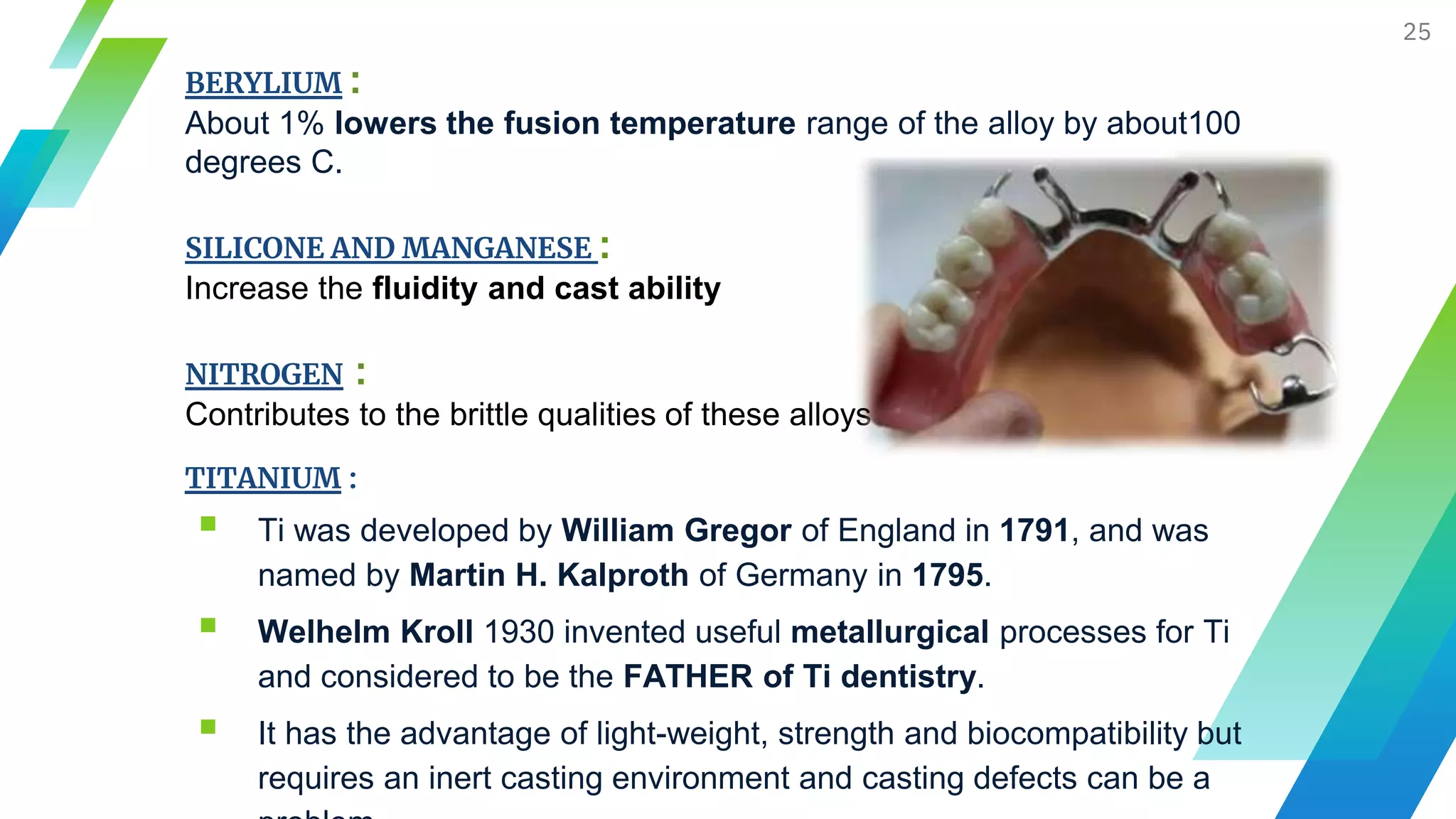
BERYLIUM :
About 1% lowers the fusion temperature range of the alloy by about100
degrees C.
SILICONE AND MANGANESE :
Increase the fluidity and cast ability
NITROGEN :
Contributes to the brittle qualities of these alloys
TITANIUM :
 Ti was developed by William Gregor of England in 1791, and was
named by Martin H. Kalproth of Germany in 1795.
 Welhelm Kroll 1930 invented useful metallurgical processes for Ti
and considered to be the FATHER of Ti dentistry.
 It has the advantage of light-weight, strength and biocompatibility but
requires an inert casting environment and casting defects can be a
DENTURE BASE
POLYMERS
POLYMER
27
▰ A polymer is a long chain organic molecule. It is produced by the
reaction of many smaller molecules called monomers, or mers.
▰ If reaction occurs between two different but compatible monomers
the polymeric product is called a COPOLYMER.
▰ RESIN : A broad term used to describe natural or synthetic
substances that form plastic materials after polymerization (GPT-9)
CLASSIFICATION
28
Based on spatial arrangement
Linear Branched
Cross -
linked
Based on type of
polymerization
Addition Condensation
Based on type of
copolymerization
Random Graft type Block type
▰ Monomers react to form polymer by a chemical reaction called
POLYMERIZATION.
▰ The most common polymerization reaction for polymers used in
dentistry is ADDITION POLYMERIZATION.
29
CHEMISTRY OF POLYMERIZATION
TERMINATION
CHAIN
TRANSFER
PROPOGATION
INDUCTION
INDUCTION
▰ ACTIVATION
Free radicals, can be generated by activation of
radical producing molecule.
▰ INITIATION
30
INITIATOR ACTIVATOR
Heat Activated Benzoyl Peroxide Heat
Chemical Activated Benzoyl Peroxide Tertiary Amine
Light Activated Champhoroquinone Visible Light
▰ Resulting free radical-monomer complex then acts as a new free
radical center when it approaches another monomer to form a
dimer.
31
PROPOGATION
▰ The active free radical of a growing chain is transferred to another
molecule (e.g., a monomer or inactivated polymer chain) and a new
free radical for further growth is created.
32
CHAIN TRANSFER
▰ Chain termination can result from chain transfer.
▰ Addition polymerization reactions are most often terminated.
╺ By direct coupling of two free radical chain ends.
╺ By the exchange of a hydrogen atom from one growing chain to another.
33
TERMINATION
CLASSIFICATION
34
• Light Activated
HEAT ACTIVATED DENTURE BASE RESINS
35
Polymer Monomer Ratio & Interaction
36
SANDY
Coarse / Grainy polymer
beads
STRINGY
Increased viscosity of monomer
 stickiness
DOUGH (IDEAL)
Increased polymerization
 pliable, dough like
RUBBERY
Elastic, evaporation of excess
monomer
STIFF
Complete evaporation of monomer
POLYMER :
MONOMER
3 : 1 (By wt.)
2 : 1 (By vol.)
▰ Dough Forming Time:
ADA specification no. 12 requires that dough like consistency be
attained in less than 40 min. from start of mixing process Clinically,
most resins reach dough like stage in less than 10min
▰ Working Time:
ADA specification no. 12 requires the dough to remain moldable for
atleast 5 min The working time of the resin may be extended by
refrigeration.
37
Dough Forming Time & Working Time
HEAT ACTIVATED DENTURE BASE RESINS
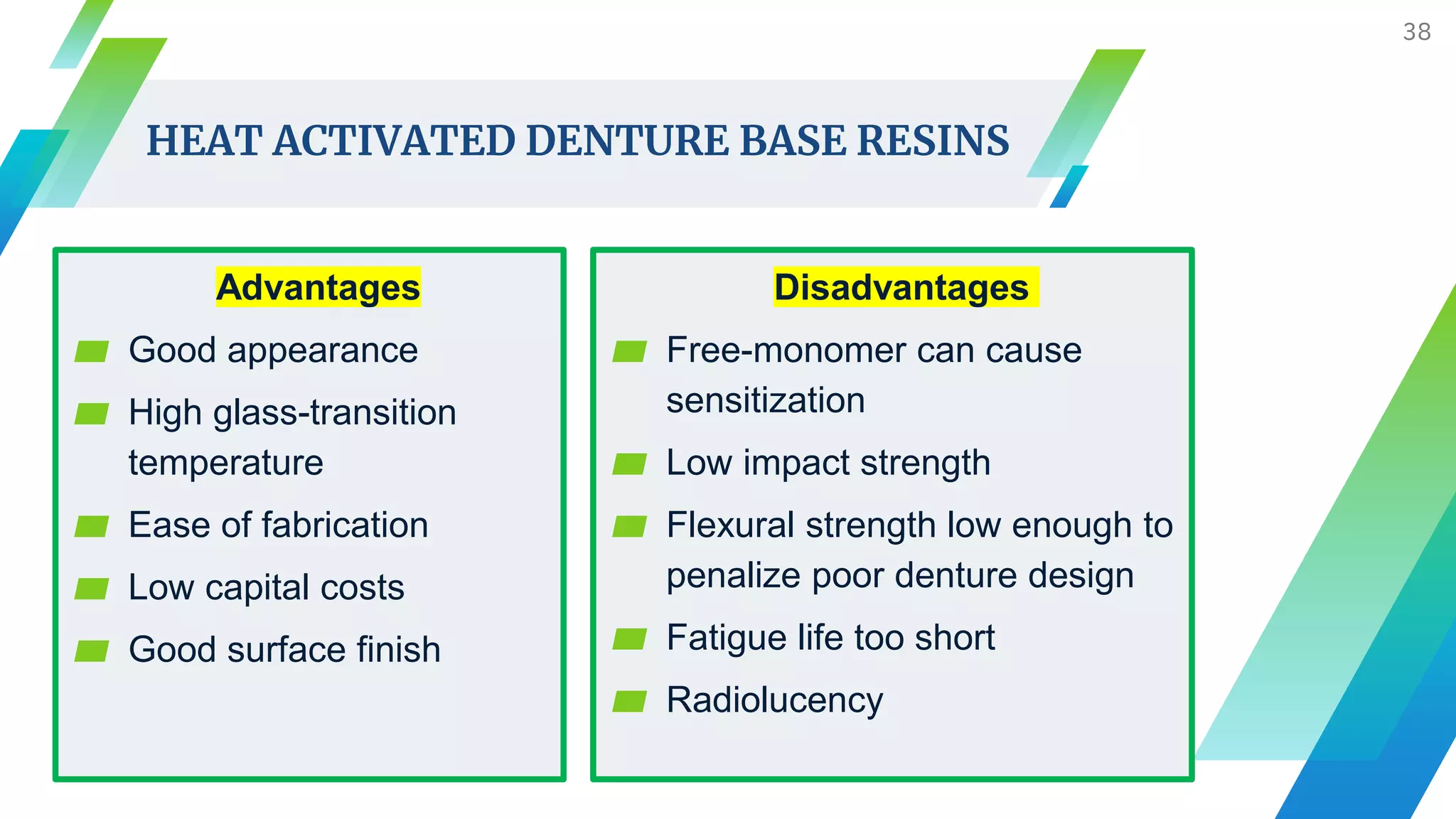
Advantages
▰ Good appearance
▰ High glass-transition
temperature
▰ Ease of fabrication
▰ Low capital costs
▰ Good surface finish
Disadvantages
▰ Free-monomer can cause
sensitization
▰ Low impact strength
▰ Flexural strength low enough to
penalize poor denture design
▰ Fatigue life too short
▰ Radiolucency
38
▰ Rubber reinforced (butadiene-styrene polymethyl methacrylate)
▰ Rubber particles grafted to MMA for better bond with PMMA.
▰ Indicated for patients who drop their dentures repeatedly e.g.
parkinsonism.
▰ Available as powder-liquid system & processing is same as heat cure
resin
39
HIGH IMPACT RESIN
Advantages
Good impact
strength
Disadvantages
Reduced stiffness
▰ Metal fiber reinforced
▰ Carbon / graphite fiber reinforced
▰ Aramid fiber reinforced
▰ Polyethylene fiber reinforced
▰ Highly drawn linear polyethylene fibers (HDLPF)
▰ Glass fibres (have best aesthetics)
40
FIBER REINFORCED RESINS
Advantages
▰ High stiffness & Very high impact strength
▰ Good fatigue life
▰ Polypropylene fibers: Good translucency &
surface finish
Disadvantages
▰Carbon and Kevlar fibers:
╺ Poor color Poor
surface
Polyethylene > glass > thick Kevlar >carbon >thin Kevlar > unreinforced
41
Comparison Of Impact Strength Of Resins Reinforced With
Different Fibers
▰ Same as conventional material except that they contain
altered initiation system. (heat + chemical)
▰ These initiator allow them to be processed in boiling water
for 20min.
▰ A problem with these is that areas of the base thicker than
approx. 6mm have a high level of porosity.
▰ Short duration of heating also leaves a higher level of
residual monomer, 3-7 times greater than conventional
heat cured denture base.
▰ Eg:- QC 20, Meliodent, trevalone
42
RAPID HEAT POLYMERIZED POLYMER
▰ Resins are the same as used with conventional material
and are processed in a microwave.
▰ Denture base cures well in Special Polycarbonate
flask(instead of metal).
▰ The advantages are that it greatly reduced curing time
(3min) at 450 watts
▰ shortened dough-forming time, minimal colour changes,
less fracture of artificial teeth and resin bases and superior
denture base adaptability, lower residual monomer ratio,
most stable.
43
MICROWAVE POLYMERIZED POLYMERS
44
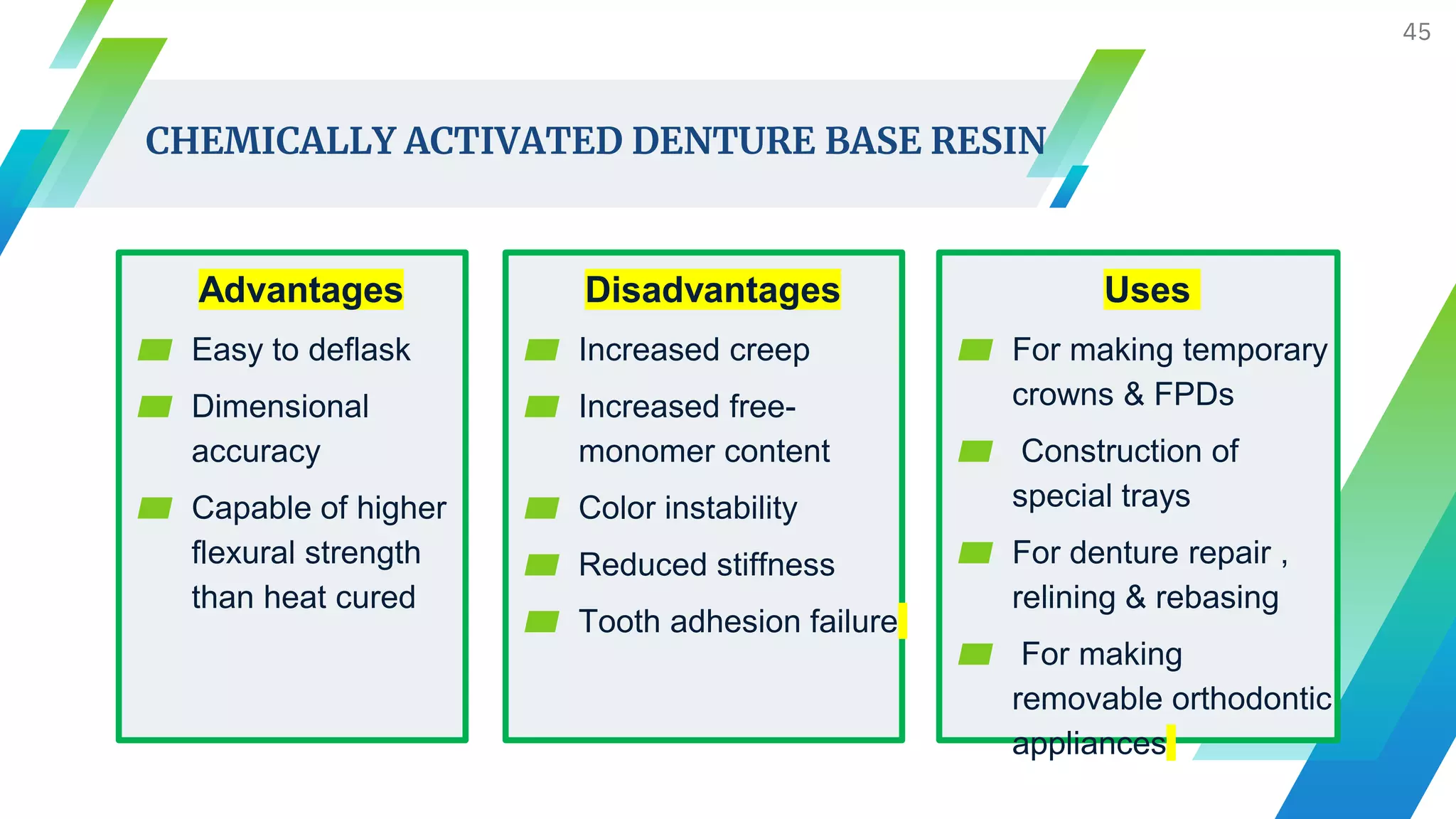
CHEMICALLY ACTIVATED DENTURE BASE RESIN
Advantages
▰ Easy to deflask
▰ Dimensional
accuracy
▰ Capable of higher
flexural strength
than heat cured
Disadvantages
▰ Increased creep
▰ Increased free-
monomer content
▰ Color instability
▰ Reduced stiffness
▰ Tooth adhesion failure
Uses
▰ For making temporary
crowns & FPDs
▰ Construction of
special trays
▰ For denture repair ,
relining & rebasing
▰ For making
removable orthodontic
appliances
45
CHEMICALLY ACTIVATED DENTURE BASE RESIN
Techniques
▰ Sprinkle on technique
▰ Adapting technique
▰ Fluid resin technique
▰ Compression molding
technique
46
47
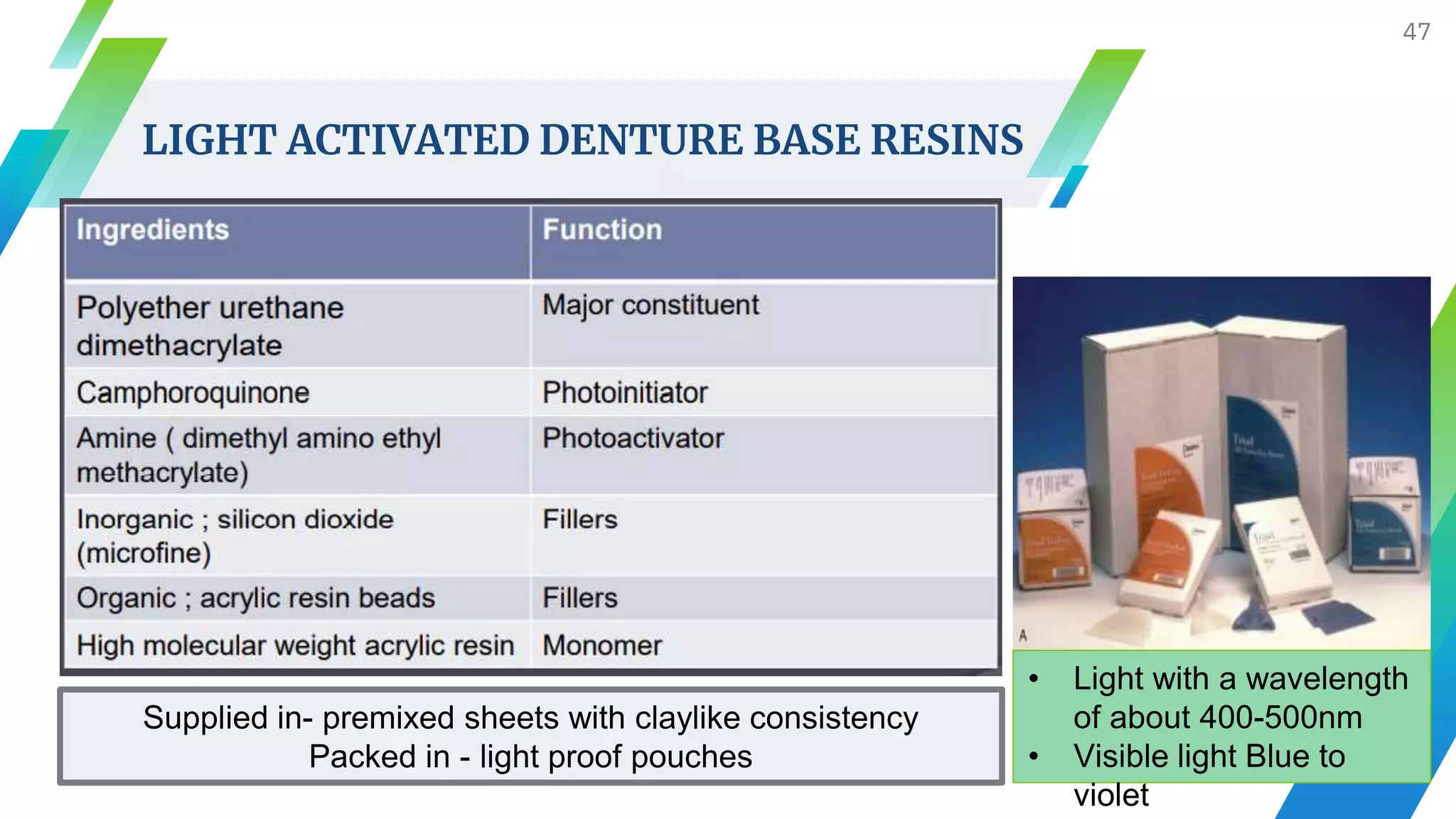
LIGHT ACTIVATED DENTURE BASE RESINS
Supplied in- premixed sheets with claylike consistency
Packed in - light proof pouches
• Light with a wavelength
of about 400-500nm
• Visible light Blue to
violet
LIGHT ACTIVATED DENTURE BASE RESINS
Advantages
▰ No methacrylate monomer
▰ Decreased polymerization
shrinkage
▰ Possible improved fit
compared to conventional
material
▰ Requires little equipment
Disadvantages
▰ Decreased elastic
modulus
▰ Requires high artistic
skills
▰ Technique sensitive
48
▰ These are made of Nylon or Polycarbonate.
▰ The material is supplied as a gel in the form of a
putty.
▰ It has to be heated and injected into a mold
▰ Equipment is expensive.
▰ Craze resistance is low.
▰ The SR-Ivocap system uses specialized flasks and
clamping presses to keep the molds under a constant
pressure of 3000 lbs
49
INJECTION MOLDED RESINS
Advantages
▰ Dimensional accuracy
▰ Low free-monomer
content
▰ Polycarbonate and nylon
Good impact strength
Disadvantages
▰ High capital costs
▰ Difficult mold design
problems
▰ Less craze resistance
▰ Less creep resistance
50
▰ Polymerization shrinkage
▰ Porosity
▰ Water absorption
▰ Solubility
▰ Strength
▰ Processing stresses
▰ Crazing
51
Physical Properties of Denture
Base Resins
▰ During polymerization shrinkage the density of the mass changes from 0.94 g/cm3 - 1.19
g/cm3
▰ Volumetric shrinkage – 7% , exhibit Linear shrinkage – 2%
▰ Linear shrinkage – denture base adaptation and cuspal interdigitation
▰ Greater linear shrinkage  greater discrepancy in initial fit
▰ Initial cooling – resin is soft- contraction at the same rate as that of dental stone
▰ At glass transition temperature – contraction occurs – faster rate than the surrounding
stone
52
POLYMERISATION SHRINKAGE
Volumetric shrinkage – 21%
Glass transition temperature
It is a thermal range in which the resin passes from a soft, rubbery stage to a rigid
glassy state
Beyond this  rigid mass
53
▰ Accepted linear shrinkage for heat
activated resin – 0.12%-0.97%
▰ Processing shrinkage
╺ Chemically activated resin-
0.26%
╺ Heat activated resin- 0.53%
▰ Fluid resin Technique - VD
▰ Heat & chemically activated resin - VD
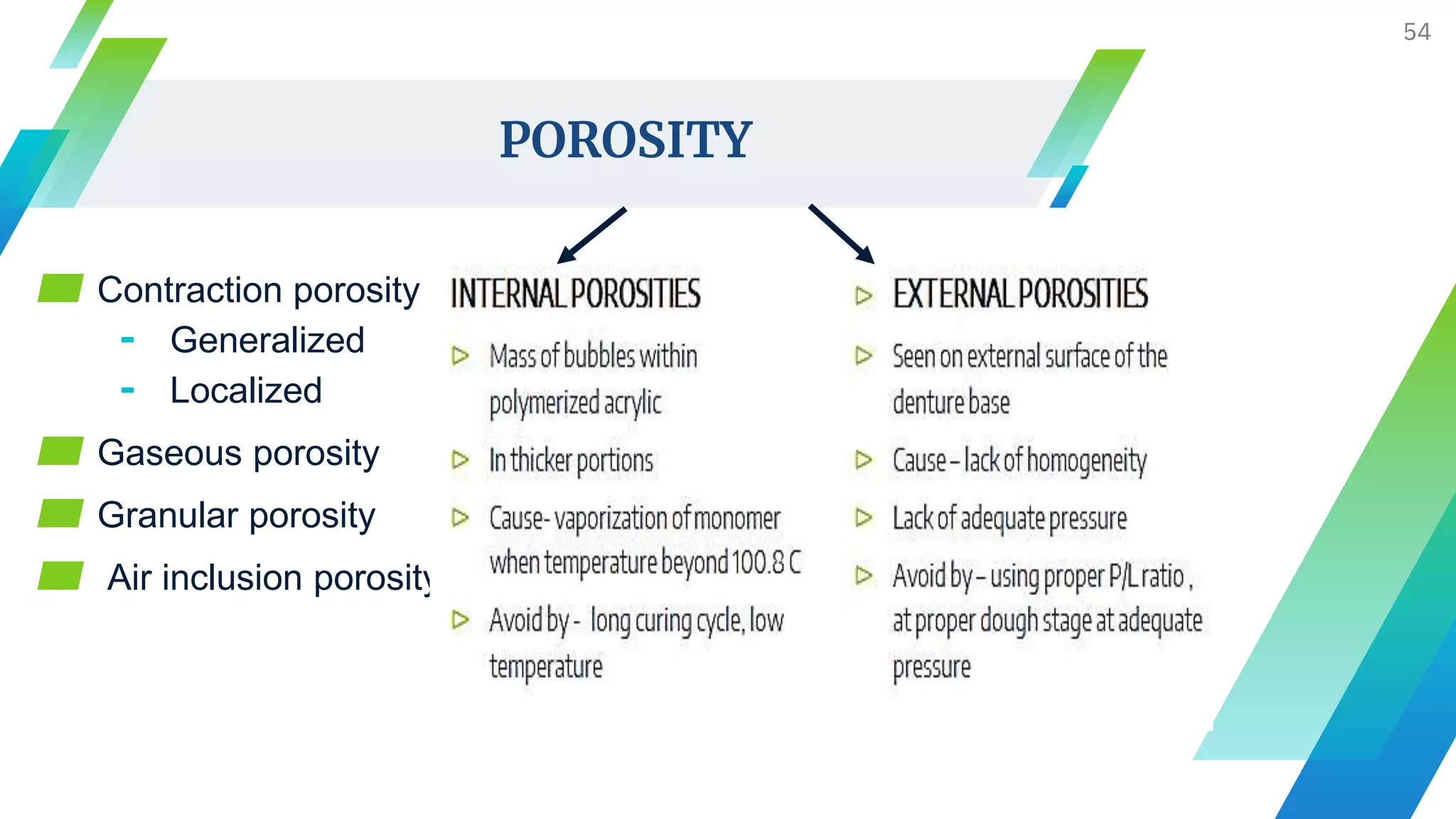
▰ Contraction porosity
╺ Generalized
╺ Localized
▰ Gaseous porosity
▰ Granular porosity
▰ Air inclusion porosity
54
POROSITY
55
CONTRACTION POROSITY
Contraction of monomer
during polymerization
Insufficient pressure /
material
GRANULAR POROSITY
Localized shrinkage
Improper mixing /
inadequate monomer
GASEOUS POROSITY
Volatilization of
monomer
In bulkier portion
AIR INCLUSION
POROSITY
Air incorporation
Fluid resins
CONTRACTION POROSITY
GASEOUS POROSITY
Insufficient pressure
Rapid heating
Insufficient mixing
▰ Absorbs relatively small amount of water when placed in water .
▰ Water molecules penetrate the PMMA and occupy positions between
polymer chains forces them apart .
╺ Slight expansion in polymerized mass.
╺ Water acts as plasticizer.
▰ Water absorption value – 0.69 mg/cm2
▰ Interferes with the polymer chain making them more mobile –
relaxation of stresses
╺ Changes in shape (insignificant)
▰ WATER SOLUBILTIY : Insoluble in oral cavity
56
WATER ABSORBTION
1%increase in weight
0.23% linear
expansion in acrylic
▰ During polymerization – tensile stresses are sustained
▰ Stresses relaxed – distortion occurs
▰ Additional factors include
╺ Improper mixing and handling of the resin
╺ Poorly controlled heating and cooling of flask assembly
▰ Dimensional changes due to small stresses – 0.1 to 0.2 mm
57
PROCESSING STRESSES
Inhibition of natural dimensional
change
Thermal change causing shrinkage
(cooling to glass transition
temperature)
STRESS
▰ Crazing is formation of surface Microcracks on denture
base resin.
▰ Causes
╺ Incorporation of stress (Tensile)
╺ Attack by solvent (alcohol)
╺ Incorporation of water during processing.
▰ Prevention
╺ Avoidance of solvent
╺ Metal moulds
╺ Use of cross linked acrylic
58
CRAZING
HAZY / FOGGY APPEARANCE
STRENGTH CREEP
▰ Load application – stresses
within the resin – change in
shape
▰ Strength α degree of
polymerization.
▰ Chemically activated resin –
lower degree of
polymerization.
▰ Acts as rubbery solids that
recover from elastic deformation
once stresses are eliminated –
VISCO-ELASTIC BEHAVIOR.
▰ If load is not removed additional
plastic deformation occurs –
CREEP.
▰ Rate at which this deformation
occurs – CREEP RATE (9Mpa)
59
Recent Advances
▰ Lower residual monomer content than PMMA, thus act as
alternatives to Poly Methyl Methacrylate in allergic
patients.
▰ Diurethane dimethacrylate, Polyurethane,
Polyethylenterephthalate and
Polybutylenterephthalate.
▰ Enterephthalate based (Promysan, thermoplastic) show
low water solubility than PMMA.
61
HYPOALLERGENIC RESINS
62
Resins With Modified Chemical Structure
FILLERS FUNCTION
Hydroxy-apatite Increases Fracture Toughness
Al2o3 Fillers Increases The Flexural Strength &
Thermal Diffusivity
2% Quaternary
Ammonium
Silver nanoparticals, Zinc
oxide, gentamycin
Antiseptic Properties
Ceramic Or
Sapphire Whiskers
Thermal Diffusivity
11-14% Bismuth Or
Uranium
35% Organo-zirconium
Triphenyl Bismuth
Impart Radiopacity Equivalent To
Aluminum.
cytotoxicity
▰ Fully polymerized basic
material is softened by
heat (without chemical
changes) and injected
afterwards.
63
THERMOPLASTIC RESINS
Advantages
▰ Excellent esthetics.
▰ Unbreakable ,flexible, light weight.
▰ Stable high fatigue endurance.
▰ Increased creep & wear resistance.
▰ Non Porous: no bacterial growth but
retains enough moisture to keep it
comfortable for gums.
▰ Can be relined and repaired.
Materials Used
▰ Thermoplastic Nylon
▰ Thermoplastic Acetal
▰ Thermoplastic Acrylic
▰ Thermoplastic
Polycarbonate
64
THERMOPLASTIC RESINS
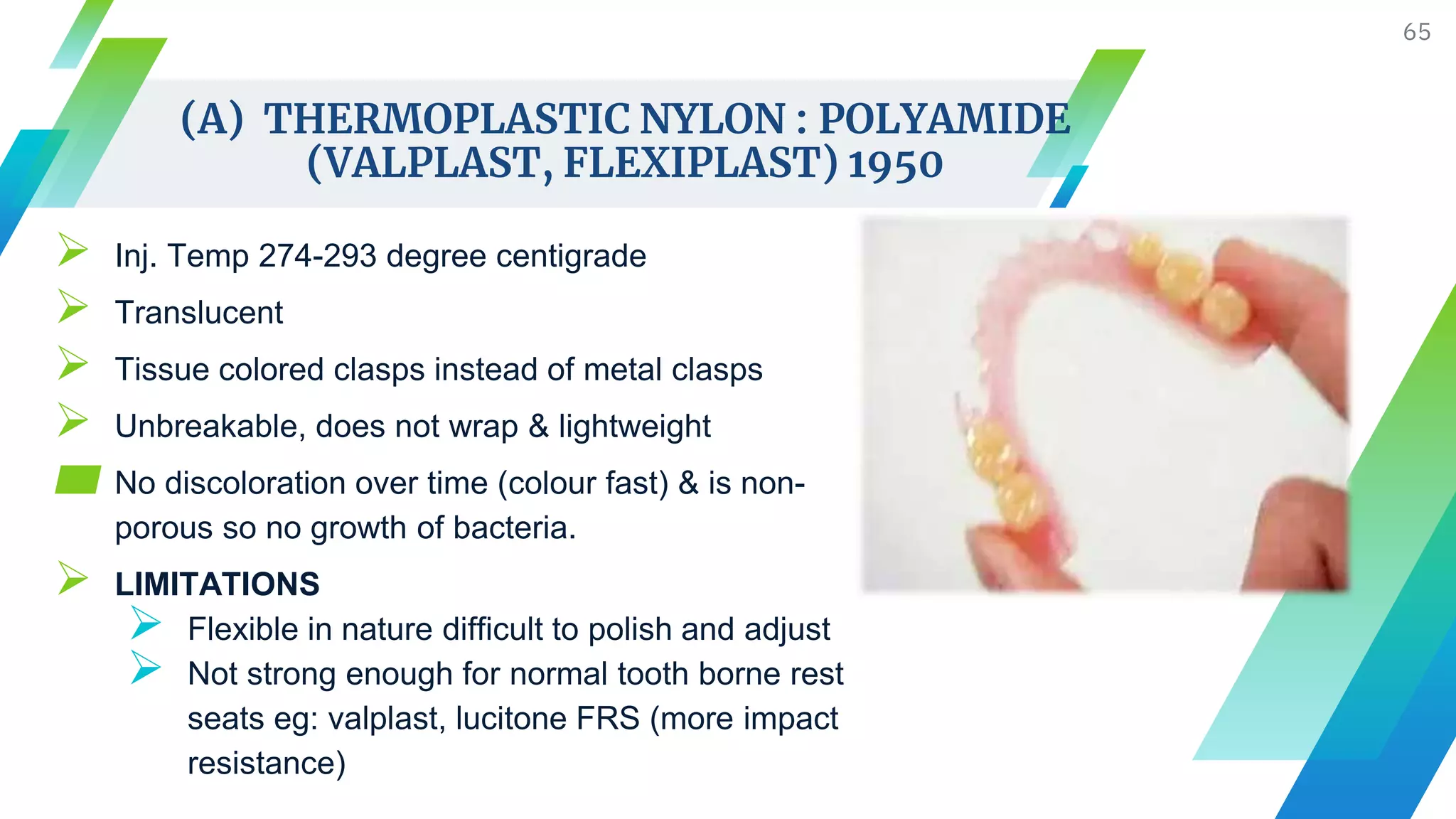
 Inj. Temp 274-293 degree centigrade
 Translucent
 Tissue colored clasps instead of metal clasps
 Unbreakable, does not wrap & lightweight
▰ No discoloration over time (colour fast) & is non-
porous so no growth of bacteria.
 LIMITATIONS
 Flexible in nature difficult to polish and adjust
 Not strong enough for normal tooth borne rest
seats eg: valplast, lucitone FRS (more impact
resistance)
65
(A) THERMOPLASTIC NYLON : POLYAMIDE
(VALPLAST, FLEXIPLAST) 1950
▰ Clasps engage first third of undercuts: 3-4 times
more retention.
▰ Can be placed more gingivally: better aesthetics.
▰ 18 vita +3 pink shades: for simulating lifelike
appearance.
▰ Metal clasps and bars can be replaced.
▰ Flexible & monomer free- hypoallergic.
▰ Teeth and clasps can be added on existing
denture bases.
66
(B) THERMOPLASTIC ACETAL:
POLYOXYMETHYLENE 1971
67
Limitations
 Cannot be used as major connector
 Does not seal the base of the denture which allows seepage of
fluid
 Can not be used as crib and clasp where diastema is Absent
Application
 Preformed clasp for RPDS
 Partial denture framework
 Provisional bridge
 Occlusal splints
 Implant abutment
 Decreased wear resistance
 Poor impact resistance
 Adequate tensile & flexural strength
 Easy to polish
 Repairable and relineable at chair side
▰ EXCEPTION: Flexite and M.P.-A -highest
impact resistance among acrylics (very popular
in bruxism and parkinsonism patients)
68
(C) THERMOPLASTIC ACRYLIC
 Strong, flexible and fracture resistant
 Low wear resistant-vdo wont be maintained over long term
 Used as provisional bridge and crown only
Clinical advantage
▰ Minimal residual monomer-can be used in allergic patients
▰ Very little water absorption-less smell and bacterial growth
▰ Good adherence and coherence
69
(D) THERMOPLASTIC POLYCARBONATE:
POLYMER OF BISPHENOL-A
70
ENIGMA GUM TONING
1) Custom shade matching of natural
gingival tissue using ‘Enigma’ color tones.
2) Gives extra confidence to patient in
appearance of their dentures.
3) Available in Ivory, Light Pink, Natural
Pink, Dark Pink & Light Brown.
4) Different colors are mixed to get the
desired gum tone.
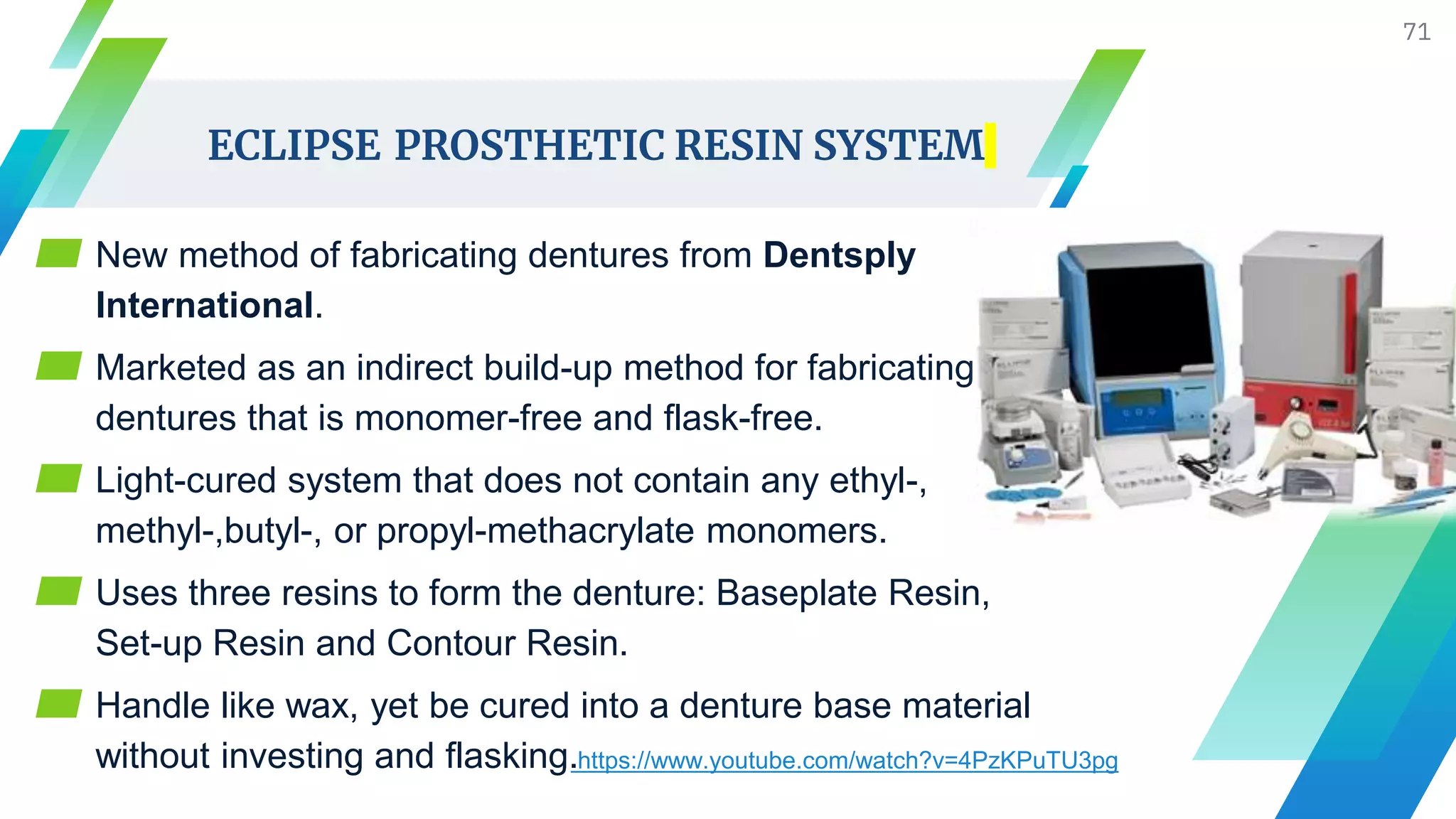
▰ New method of fabricating dentures from Dentsply
International.
▰ Marketed as an indirect build-up method for fabricating
dentures that is monomer-free and flask-free.
▰ Light-cured system that does not contain any ethyl-,
methyl-,butyl-, or propyl-methacrylate monomers.
▰ Uses three resins to form the denture: Baseplate Resin,
Set-up Resin and Contour Resin.
▰ Handle like wax, yet be cured into a denture base material
without investing and flasking.
71
ECLIPSE PROSTHETIC RESIN SYSTEM
https://www.youtube.com/watch?v=4PzKPuTU3pg
 The general properties of these materials are strength,
hardness, toughness, low curing shrinkage and good adhesion
to metals.
 The disadvantages for dental use are the toxicity, the yellow
colour which darkens further, high water absorption, poor
adhesion to vinyl polymers
72
EPOXY RESINS:
“
”
CONCUSION
 There is a wide variety of denture base
materials and the ever growing urge to find
the best and the most feasible material will
always bring an evolution in denture base
material sciences.
 As clinicians, we must understand the basic
nature of each of these, to provide the best
possible treatment to our patient.
73
▰ Phillips - science of dental materials – 11th ed.
▰ William J O’Brien Dental materials Selection 3rd edition
▰ NEW ERA IN DENTURE BASE RESINS: A REVIEW Dental
Journal of Advance Studies Vol. 1 Issue III-2013
▰ Denture Base Resins From Past to New Era European
Journal of Molecular & Clinical Medicine ISSN 2515-8260
Volume 07, Issue 06, 2020
▰ https://www.youtube.com/watch?v=4PzKPuTU3pg
74
REFERENCES
“
”
Thanks !
75

Denture Base Materials

  • 1.
  • 2.
    2 CONTENTS ▰ INTRODUCTION ▰ HISTORY ▰REQUISITES FOR IDEAL DENTURE BASE MATERIAL ▰ CLASSIFICATION ▰ METAL DENTURE BASE ▰ DENTURE BASE POLYMERS ▰ RECENT ADVANCES ▰ CONCLUSION ▰ REFERANCES
  • 3.
  • 4.
    4 DEFINITIONS Denture: An artificialsubstitute for missing natural teeth and adjacent structure. (GPT 9) Denture Base: The part of a denture that rests on the foundation tissues and to which teeth are attached. (GPT 9) 4 Denture Base Material: Any substance of which a denture base may be made. (GPT 9)
  • 5.
  • 6.
    FORMERLY USED MATERIALS ▰Before 18th century ▰ In 18th century 6 WOOD IVORY BONE GOLD PORCELEIN
  • 7.
    Materials used inthe 19th century ▰ Tortoise Shell (1850) ▰ Gutta Percha (1851) ▰ Vulcanite (1851) ▰ Cheoplastic (1856) ▰ Rose Pearl (1860) ▰ Aluminum (1867) ▰ Celluloid (1870) 7 VULCANITE CELLULOID GUTTA PERCHA
  • 8.
    Materials used inthe 20th century ▰ Bakelite (1909) ▰ Stainless steel (1921) ▰ Cobalt Chromium (1930) ▰ Vinyl Resin (1932) ▰ Acrylic Resin (1937) ▰ Self cure Acrylic Resin ▰ Epoxy Resin (1951) ▰ Polystyrene (1951) ▰ Nylon (1955) ▰ Polycarbonates (1967) ▰ High impact acrylic (1967) ▰ Polysulphones (1981) ▰ Visible L.C (1947)Acrylic (1986) ▰ Pure Titanium (1998) 8 ACRYLIC RESIN STAINLESS STEEL POLYSTYRENE BAKELITE
  • 9.
  • 10.
    10 •BIOLOGICA L • Non-toxic • Non-irritant • Odourless • Tasteless PHYSICAL • Aesthetics • Dimensionally stable • Low value of specific gravity/ density • High value of thermal conductivity • Radiopaque •CHEMICAL • Inert • Insoluble • Non-absorbant
  • 11.
    11 MECHANICAL • High valueof modulus of elasticity - rigidity • High value of elastic limit- permanent deformation • Sufficient flexural strength • Adequate fatigue life and high fatigue limit • Good impact strength • Sufficient abrasion resistance MISCELLANEOUS • Inexpensive • Long shelf life • Easy to manipulate • Easy to repair
  • 12.
  • 13.
    According To Uses 13 DentureBase Material Temporary Self cured acrylic Shellac Base plate Base plate waxes Permanent Heat cured Resins Light cured Resins Poured type
  • 14.
    According To MaterialSystem 14 Denture Base Material Metal Cobalt-chromium Stainless Steel Aluminum Titanium Gold Non-metal Acrylic Resins Vinyl Resins
  • 15.
    According to modeof polymerization 15 Polymerization Addition Acrylic Polyvinyl chloride polymethyl methacrylate Condensation Bakelite nylon
  • 16.
    According to Methodof activation 16 Activation Thermal Heat Cure Acrylics Chemical Self Cure Acrylics Light Activated Microwave Energy
  • 17.
    According to ANSI/ADA(Sp. No. 12/ ISO 1567) 17 TYPES TYPE I Heat Polymerizable Polymer Class I :- powder & Liquid TYPE 2 Auto- Polymerizable Polymers Class I :- powder & Liquid TYPE 3 Thermoplastic Blank or Powders Class II :- powder & liquid pour type resins TYPE 4 Light Activated Materials Class II:- Plastic Cake TYPE 5 Microwaved Cured Materials
  • 18.
  • 19.
     Single maxillarycomplete denture opposing natural mandibular teeth  Unfavorable occlusion  Heavy anterior contacts  Heavy masticatory force 19 Metal denture base material Indication
  • 20.
    Advantages of MetalBases over Resin Bases: (1) Accuracy and permanence of form ▰ More Accurate and maintain their accuracy of form without change in mouth. ▰ Internal strains released later to cause distortion not present. ▰ Accuracy - provides intimacy of contact, help in retention of denture prostheses (2) Comparative tissue response- ▰ Inherent cleanliness of cast metal base contributes to health of oral tissue. ▰ Bacteriostatic activity - Ionization and oxidization of metal bases 20
  • 21.
    Advantages of MetalBases over Resin Bases: (3) Thermal conductivity- ▰ Temperature changes transmitted though metal to the underlying tissue so prevent accidental burning by hot food. ▰ Patient acceptance. (4) Weight and bulk- ▰ Thinner than acrylic resin and still have adequate strength. ▰ Certain situations demands use of acrylic denture base. ╺ Extreme loss of residual alveolar bone- fullness to denture base to restore facial contours. 21
  • 22.
    Disadvantages of MetalBases over Resin Bases: 1) Aesthetically not acceptable 2) Relining difficult 3) Restoration of normal facial contour can not be achieved 22
  • 23.
    COBALT-CHROMIUM ALLOYS : Asearly as 1949 nearly 80% of all partial denture were cast from Co-Cr alloys. NICKEL CHROMIUM ALLOYS : • Nickel 70% , Chromium 18% CHROMIUM : • Responsible for the tarnish resistance and stainless. • Should not contain more than 28% or 29% chromium • Technique sensitive. 23 Different metallic denture base materials
  • 24.
    24 COBALT AND NICKEL: Cobalt increases the elastic modulus, strength and hardness more than Nickel. CARBON : • Carbon content increases hardness of Co-based alloys. • More than 0.2% results in a too hard and too brittle alloy not suitable for dental appliances. • Decrease of 0.2% will decrease the tensile and the yield strength. MOLYBDENUM : • (3% to 6% ) Contributes to the strength of the alloy. • Initially tungsten was used , but it reduced the elongation. ALUMINIUM : Forms a compound with Ni and Al (Ni3Al) which increases the tensile and the
  • 25.
    25 BERYLIUM : About 1%lowers the fusion temperature range of the alloy by about100 degrees C. SILICONE AND MANGANESE : Increase the fluidity and cast ability NITROGEN : Contributes to the brittle qualities of these alloys TITANIUM :  Ti was developed by William Gregor of England in 1791, and was named by Martin H. Kalproth of Germany in 1795.  Welhelm Kroll 1930 invented useful metallurgical processes for Ti and considered to be the FATHER of Ti dentistry.  It has the advantage of light-weight, strength and biocompatibility but requires an inert casting environment and casting defects can be a
  • 26.
  • 27.
    POLYMER 27 ▰ A polymeris a long chain organic molecule. It is produced by the reaction of many smaller molecules called monomers, or mers. ▰ If reaction occurs between two different but compatible monomers the polymeric product is called a COPOLYMER. ▰ RESIN : A broad term used to describe natural or synthetic substances that form plastic materials after polymerization (GPT-9)
  • 28.
    CLASSIFICATION 28 Based on spatialarrangement Linear Branched Cross - linked Based on type of polymerization Addition Condensation Based on type of copolymerization Random Graft type Block type
  • 29.
    ▰ Monomers reactto form polymer by a chemical reaction called POLYMERIZATION. ▰ The most common polymerization reaction for polymers used in dentistry is ADDITION POLYMERIZATION. 29 CHEMISTRY OF POLYMERIZATION TERMINATION CHAIN TRANSFER PROPOGATION INDUCTION
  • 30.
    INDUCTION ▰ ACTIVATION Free radicals,can be generated by activation of radical producing molecule. ▰ INITIATION 30 INITIATOR ACTIVATOR Heat Activated Benzoyl Peroxide Heat Chemical Activated Benzoyl Peroxide Tertiary Amine Light Activated Champhoroquinone Visible Light
  • 31.
    ▰ Resulting freeradical-monomer complex then acts as a new free radical center when it approaches another monomer to form a dimer. 31 PROPOGATION
  • 32.
    ▰ The activefree radical of a growing chain is transferred to another molecule (e.g., a monomer or inactivated polymer chain) and a new free radical for further growth is created. 32 CHAIN TRANSFER
  • 33.
    ▰ Chain terminationcan result from chain transfer. ▰ Addition polymerization reactions are most often terminated. ╺ By direct coupling of two free radical chain ends. ╺ By the exchange of a hydrogen atom from one growing chain to another. 33 TERMINATION
  • 34.
  • 35.
    HEAT ACTIVATED DENTUREBASE RESINS 35
  • 36.
    Polymer Monomer Ratio& Interaction 36 SANDY Coarse / Grainy polymer beads STRINGY Increased viscosity of monomer  stickiness DOUGH (IDEAL) Increased polymerization  pliable, dough like RUBBERY Elastic, evaporation of excess monomer STIFF Complete evaporation of monomer POLYMER : MONOMER 3 : 1 (By wt.) 2 : 1 (By vol.)
  • 37.
    ▰ Dough FormingTime: ADA specification no. 12 requires that dough like consistency be attained in less than 40 min. from start of mixing process Clinically, most resins reach dough like stage in less than 10min ▰ Working Time: ADA specification no. 12 requires the dough to remain moldable for atleast 5 min The working time of the resin may be extended by refrigeration. 37 Dough Forming Time & Working Time
  • 38.
    HEAT ACTIVATED DENTUREBASE RESINS Advantages ▰ Good appearance ▰ High glass-transition temperature ▰ Ease of fabrication ▰ Low capital costs ▰ Good surface finish Disadvantages ▰ Free-monomer can cause sensitization ▰ Low impact strength ▰ Flexural strength low enough to penalize poor denture design ▰ Fatigue life too short ▰ Radiolucency 38
  • 39.
    ▰ Rubber reinforced(butadiene-styrene polymethyl methacrylate) ▰ Rubber particles grafted to MMA for better bond with PMMA. ▰ Indicated for patients who drop their dentures repeatedly e.g. parkinsonism. ▰ Available as powder-liquid system & processing is same as heat cure resin 39 HIGH IMPACT RESIN Advantages Good impact strength Disadvantages Reduced stiffness
  • 40.
    ▰ Metal fiberreinforced ▰ Carbon / graphite fiber reinforced ▰ Aramid fiber reinforced ▰ Polyethylene fiber reinforced ▰ Highly drawn linear polyethylene fibers (HDLPF) ▰ Glass fibres (have best aesthetics) 40 FIBER REINFORCED RESINS Advantages ▰ High stiffness & Very high impact strength ▰ Good fatigue life ▰ Polypropylene fibers: Good translucency & surface finish Disadvantages ▰Carbon and Kevlar fibers: ╺ Poor color Poor surface
  • 41.
    Polyethylene > glass> thick Kevlar >carbon >thin Kevlar > unreinforced 41 Comparison Of Impact Strength Of Resins Reinforced With Different Fibers
  • 42.
    ▰ Same asconventional material except that they contain altered initiation system. (heat + chemical) ▰ These initiator allow them to be processed in boiling water for 20min. ▰ A problem with these is that areas of the base thicker than approx. 6mm have a high level of porosity. ▰ Short duration of heating also leaves a higher level of residual monomer, 3-7 times greater than conventional heat cured denture base. ▰ Eg:- QC 20, Meliodent, trevalone 42 RAPID HEAT POLYMERIZED POLYMER
  • 43.
    ▰ Resins arethe same as used with conventional material and are processed in a microwave. ▰ Denture base cures well in Special Polycarbonate flask(instead of metal). ▰ The advantages are that it greatly reduced curing time (3min) at 450 watts ▰ shortened dough-forming time, minimal colour changes, less fracture of artificial teeth and resin bases and superior denture base adaptability, lower residual monomer ratio, most stable. 43 MICROWAVE POLYMERIZED POLYMERS
  • 44.
  • 45.
    Advantages ▰ Easy todeflask ▰ Dimensional accuracy ▰ Capable of higher flexural strength than heat cured Disadvantages ▰ Increased creep ▰ Increased free- monomer content ▰ Color instability ▰ Reduced stiffness ▰ Tooth adhesion failure Uses ▰ For making temporary crowns & FPDs ▰ Construction of special trays ▰ For denture repair , relining & rebasing ▰ For making removable orthodontic appliances 45 CHEMICALLY ACTIVATED DENTURE BASE RESIN
  • 46.
    Techniques ▰ Sprinkle ontechnique ▰ Adapting technique ▰ Fluid resin technique ▰ Compression molding technique 46
  • 47.
    47 LIGHT ACTIVATED DENTUREBASE RESINS Supplied in- premixed sheets with claylike consistency Packed in - light proof pouches • Light with a wavelength of about 400-500nm • Visible light Blue to violet
  • 48.
    LIGHT ACTIVATED DENTUREBASE RESINS Advantages ▰ No methacrylate monomer ▰ Decreased polymerization shrinkage ▰ Possible improved fit compared to conventional material ▰ Requires little equipment Disadvantages ▰ Decreased elastic modulus ▰ Requires high artistic skills ▰ Technique sensitive 48
  • 49.
    ▰ These aremade of Nylon or Polycarbonate. ▰ The material is supplied as a gel in the form of a putty. ▰ It has to be heated and injected into a mold ▰ Equipment is expensive. ▰ Craze resistance is low. ▰ The SR-Ivocap system uses specialized flasks and clamping presses to keep the molds under a constant pressure of 3000 lbs 49 INJECTION MOLDED RESINS
  • 50.
    INJECTION MOLDED RESINS Advantages ▰Dimensional accuracy ▰ Low free-monomer content ▰ Polycarbonate and nylon Good impact strength Disadvantages ▰ High capital costs ▰ Difficult mold design problems ▰ Less craze resistance ▰ Less creep resistance 50
  • 51.
    ▰ Polymerization shrinkage ▰Porosity ▰ Water absorption ▰ Solubility ▰ Strength ▰ Processing stresses ▰ Crazing 51 Physical Properties of Denture Base Resins
  • 52.
    ▰ During polymerizationshrinkage the density of the mass changes from 0.94 g/cm3 - 1.19 g/cm3 ▰ Volumetric shrinkage – 7% , exhibit Linear shrinkage – 2% ▰ Linear shrinkage – denture base adaptation and cuspal interdigitation ▰ Greater linear shrinkage  greater discrepancy in initial fit ▰ Initial cooling – resin is soft- contraction at the same rate as that of dental stone ▰ At glass transition temperature – contraction occurs – faster rate than the surrounding stone 52 POLYMERISATION SHRINKAGE Volumetric shrinkage – 21% Glass transition temperature It is a thermal range in which the resin passes from a soft, rubbery stage to a rigid glassy state Beyond this  rigid mass
  • 53.
    53 ▰ Accepted linearshrinkage for heat activated resin – 0.12%-0.97% ▰ Processing shrinkage ╺ Chemically activated resin- 0.26% ╺ Heat activated resin- 0.53% ▰ Fluid resin Technique - VD ▰ Heat & chemically activated resin - VD
  • 54.
    ▰ Contraction porosity ╺Generalized ╺ Localized ▰ Gaseous porosity ▰ Granular porosity ▰ Air inclusion porosity 54 POROSITY
  • 55.
    55 CONTRACTION POROSITY Contraction ofmonomer during polymerization Insufficient pressure / material GRANULAR POROSITY Localized shrinkage Improper mixing / inadequate monomer GASEOUS POROSITY Volatilization of monomer In bulkier portion AIR INCLUSION POROSITY Air incorporation Fluid resins CONTRACTION POROSITY GASEOUS POROSITY Insufficient pressure Rapid heating Insufficient mixing
  • 56.
    ▰ Absorbs relativelysmall amount of water when placed in water . ▰ Water molecules penetrate the PMMA and occupy positions between polymer chains forces them apart . ╺ Slight expansion in polymerized mass. ╺ Water acts as plasticizer. ▰ Water absorption value – 0.69 mg/cm2 ▰ Interferes with the polymer chain making them more mobile – relaxation of stresses ╺ Changes in shape (insignificant) ▰ WATER SOLUBILTIY : Insoluble in oral cavity 56 WATER ABSORBTION 1%increase in weight 0.23% linear expansion in acrylic
  • 57.
    ▰ During polymerization– tensile stresses are sustained ▰ Stresses relaxed – distortion occurs ▰ Additional factors include ╺ Improper mixing and handling of the resin ╺ Poorly controlled heating and cooling of flask assembly ▰ Dimensional changes due to small stresses – 0.1 to 0.2 mm 57 PROCESSING STRESSES Inhibition of natural dimensional change Thermal change causing shrinkage (cooling to glass transition temperature) STRESS
  • 58.
    ▰ Crazing isformation of surface Microcracks on denture base resin. ▰ Causes ╺ Incorporation of stress (Tensile) ╺ Attack by solvent (alcohol) ╺ Incorporation of water during processing. ▰ Prevention ╺ Avoidance of solvent ╺ Metal moulds ╺ Use of cross linked acrylic 58 CRAZING HAZY / FOGGY APPEARANCE
  • 59.
    STRENGTH CREEP ▰ Loadapplication – stresses within the resin – change in shape ▰ Strength α degree of polymerization. ▰ Chemically activated resin – lower degree of polymerization. ▰ Acts as rubbery solids that recover from elastic deformation once stresses are eliminated – VISCO-ELASTIC BEHAVIOR. ▰ If load is not removed additional plastic deformation occurs – CREEP. ▰ Rate at which this deformation occurs – CREEP RATE (9Mpa) 59
  • 60.
  • 61.
    ▰ Lower residualmonomer content than PMMA, thus act as alternatives to Poly Methyl Methacrylate in allergic patients. ▰ Diurethane dimethacrylate, Polyurethane, Polyethylenterephthalate and Polybutylenterephthalate. ▰ Enterephthalate based (Promysan, thermoplastic) show low water solubility than PMMA. 61 HYPOALLERGENIC RESINS
  • 62.
    62 Resins With ModifiedChemical Structure FILLERS FUNCTION Hydroxy-apatite Increases Fracture Toughness Al2o3 Fillers Increases The Flexural Strength & Thermal Diffusivity 2% Quaternary Ammonium Silver nanoparticals, Zinc oxide, gentamycin Antiseptic Properties Ceramic Or Sapphire Whiskers Thermal Diffusivity 11-14% Bismuth Or Uranium 35% Organo-zirconium Triphenyl Bismuth Impart Radiopacity Equivalent To Aluminum. cytotoxicity
  • 63.
    ▰ Fully polymerizedbasic material is softened by heat (without chemical changes) and injected afterwards. 63 THERMOPLASTIC RESINS
  • 64.
    Advantages ▰ Excellent esthetics. ▰Unbreakable ,flexible, light weight. ▰ Stable high fatigue endurance. ▰ Increased creep & wear resistance. ▰ Non Porous: no bacterial growth but retains enough moisture to keep it comfortable for gums. ▰ Can be relined and repaired. Materials Used ▰ Thermoplastic Nylon ▰ Thermoplastic Acetal ▰ Thermoplastic Acrylic ▰ Thermoplastic Polycarbonate 64 THERMOPLASTIC RESINS
  • 65.
     Inj. Temp274-293 degree centigrade  Translucent  Tissue colored clasps instead of metal clasps  Unbreakable, does not wrap & lightweight ▰ No discoloration over time (colour fast) & is non- porous so no growth of bacteria.  LIMITATIONS  Flexible in nature difficult to polish and adjust  Not strong enough for normal tooth borne rest seats eg: valplast, lucitone FRS (more impact resistance) 65 (A) THERMOPLASTIC NYLON : POLYAMIDE (VALPLAST, FLEXIPLAST) 1950
  • 66.
    ▰ Clasps engagefirst third of undercuts: 3-4 times more retention. ▰ Can be placed more gingivally: better aesthetics. ▰ 18 vita +3 pink shades: for simulating lifelike appearance. ▰ Metal clasps and bars can be replaced. ▰ Flexible & monomer free- hypoallergic. ▰ Teeth and clasps can be added on existing denture bases. 66 (B) THERMOPLASTIC ACETAL: POLYOXYMETHYLENE 1971
  • 67.
    67 Limitations  Cannot beused as major connector  Does not seal the base of the denture which allows seepage of fluid  Can not be used as crib and clasp where diastema is Absent Application  Preformed clasp for RPDS  Partial denture framework  Provisional bridge  Occlusal splints  Implant abutment
  • 68.
     Decreased wearresistance  Poor impact resistance  Adequate tensile & flexural strength  Easy to polish  Repairable and relineable at chair side ▰ EXCEPTION: Flexite and M.P.-A -highest impact resistance among acrylics (very popular in bruxism and parkinsonism patients) 68 (C) THERMOPLASTIC ACRYLIC
  • 69.
     Strong, flexibleand fracture resistant  Low wear resistant-vdo wont be maintained over long term  Used as provisional bridge and crown only Clinical advantage ▰ Minimal residual monomer-can be used in allergic patients ▰ Very little water absorption-less smell and bacterial growth ▰ Good adherence and coherence 69 (D) THERMOPLASTIC POLYCARBONATE: POLYMER OF BISPHENOL-A
  • 70.
    70 ENIGMA GUM TONING 1)Custom shade matching of natural gingival tissue using ‘Enigma’ color tones. 2) Gives extra confidence to patient in appearance of their dentures. 3) Available in Ivory, Light Pink, Natural Pink, Dark Pink & Light Brown. 4) Different colors are mixed to get the desired gum tone.
  • 71.
    ▰ New methodof fabricating dentures from Dentsply International. ▰ Marketed as an indirect build-up method for fabricating dentures that is monomer-free and flask-free. ▰ Light-cured system that does not contain any ethyl-, methyl-,butyl-, or propyl-methacrylate monomers. ▰ Uses three resins to form the denture: Baseplate Resin, Set-up Resin and Contour Resin. ▰ Handle like wax, yet be cured into a denture base material without investing and flasking. 71 ECLIPSE PROSTHETIC RESIN SYSTEM https://www.youtube.com/watch?v=4PzKPuTU3pg
  • 72.
     The generalproperties of these materials are strength, hardness, toughness, low curing shrinkage and good adhesion to metals.  The disadvantages for dental use are the toxicity, the yellow colour which darkens further, high water absorption, poor adhesion to vinyl polymers 72 EPOXY RESINS:
  • 73.
    “ ” CONCUSION  There isa wide variety of denture base materials and the ever growing urge to find the best and the most feasible material will always bring an evolution in denture base material sciences.  As clinicians, we must understand the basic nature of each of these, to provide the best possible treatment to our patient. 73
  • 74.
    ▰ Phillips -science of dental materials – 11th ed. ▰ William J O’Brien Dental materials Selection 3rd edition ▰ NEW ERA IN DENTURE BASE RESINS: A REVIEW Dental Journal of Advance Studies Vol. 1 Issue III-2013 ▰ Denture Base Resins From Past to New Era European Journal of Molecular & Clinical Medicine ISSN 2515-8260 Volume 07, Issue 06, 2020 ▰ https://www.youtube.com/watch?v=4PzKPuTU3pg 74 REFERENCES
  • 75.

Editor's Notes