REPORT WRITING
By
Akhila Variyar
What is Academic writing?
 Academic writing or scholarly writing is any writing that one does for
academic purposes.
 Academic writing is clear, concise, focussed, structured and backed up by
evidence.
It includes:
 letters, especially formal letters requesting leave, change of course,
extension of dates etc.
 reports, projects, essays written for assignments and exams.
 thesis, dissertations and articles or papers for publication.
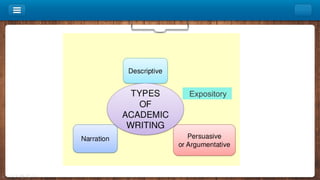
Expository
Types of Academic Writing
1. Descriptive:
It tells how something looks, feels, smells, tastes, and/or sounds. A good description is a word
picture, the reader can imagine the object.
2. Narration:
To give an account or tell the story of something, someone, or an event. Use time order to
organize sentences.
3. Expository:
To write about the provided information to the reader about a particular topic or subject.
3. Argumentative or Persuasive:
To induce readers to believe in writer’s opinions or views through appealing reasons. To convince
readers.
Characteristics of Writing
 Planning - There is a certain amount of planning before you start writing
the paper. analytical and organized.
 Outline - A proper outline is a must for academic writing. help you
formulate your thoughts, make you aware of certain relationships between
topics. It will help you determine the relevent information to be included in
your paper.
 Tone - A formal tone is used. You do not use slang words, abbreviations,
or many clichés.
 Language - The language in your paper needs to be clear and words need
to be chosen for their quality.
Characteristics of Academic Writing
 Point-of-view - The point of view in the third person, as the focus of
academic writing is to educate on the facts, not support an opinion.
 Approach - Deductive (logical) reasoning is a big part of academic writing
as your readers have to follow the path that brought you to your
conclusion.
 Much planning and forethought are needed to have a well organized
paper.
What to write about?
 Step 1: Deciding upon the topic and title
 Step 2: Finding Resources
 Step 3: Reading and making notes
 Step 4: Writing the Paper
 Step 5: Organizing the Paper
 Step 6: Editing
 Step 7: Formatting
Report writing
 A report is written for a clear purpose and to a particular audience.
Specific information and evidence are presented, analysed and applied to
a particular problem or issue.
 The information is presented in a clearly structured format making use of
sections and headings so that the information is easy to locate and follow.
 The report brief may outline the purpose, audience and problem or issue
that your report must address, together with any specific requirements for
format or structure.
 understand the purpose of the report brief and adhere to its specifications;
 gather, evaluate and analyse relevant information;
 structure material in a logical and coherent order;
 make appropriate conclusions that are supported by the evidence and
analysis of the report;
 make thoughtful and practical recommendations where required.
Structure of a report
 Title page
 Executive summary
 Table of contents
 Introduction
 Discussion or body
 Conclusion
 Recommendations
 Reference list
 Appendices.
The structure of a report
 Title Page: This should briefly but explicitly describe the purpose of the
report (if this is not obvious from the title of the work). Other details you
may include could be your name, the date and for whom the report is
written.
 Summary (Abstract): The summary should briefly describe the content of
the report. It should cover the aims of the report, what was found and
what, if any, action is called for. Aim for about 1/2 a page in length and
avoid detail or discussion; just outline the main points.
 Introduction: The introduction sets the scene for the main body of the report.
 The aims and objectives of the report should be explained in detail. Any
problems or limitations in the scope of the report should be identified, and a
description of research methods, the parameters of the research and any
necessary background history should be included.
 Conclusion : the conclusion you should show the overall significance of what
has been covered. You may want to remind the reader of the most important
points that have been made in the report or highlight what you consider to be
the most central issues or findings.
Writing the report: the essential stages
 Stage One: Understanding the report brief
 Stage Two: Gathering and selecting information
 Stage Three: Organising your material
 Stage Four: Analysing your material
 Stage Five: Writing the report
 Stage Six: Reviewing and redrafting
Academic Writing__Report Writing___.pptx

Academic Writing__Report Writing___.pptx

  • 1.
  • 2.
    What is Academicwriting?  Academic writing or scholarly writing is any writing that one does for academic purposes.  Academic writing is clear, concise, focussed, structured and backed up by evidence. It includes:  letters, especially formal letters requesting leave, change of course, extension of dates etc.  reports, projects, essays written for assignments and exams.  thesis, dissertations and articles or papers for publication.
  • 3.
  • 4.
    Types of AcademicWriting 1. Descriptive: It tells how something looks, feels, smells, tastes, and/or sounds. A good description is a word picture, the reader can imagine the object. 2. Narration: To give an account or tell the story of something, someone, or an event. Use time order to organize sentences. 3. Expository: To write about the provided information to the reader about a particular topic or subject. 3. Argumentative or Persuasive: To induce readers to believe in writer’s opinions or views through appealing reasons. To convince readers.
  • 6.
    Characteristics of Writing Planning - There is a certain amount of planning before you start writing the paper. analytical and organized.  Outline - A proper outline is a must for academic writing. help you formulate your thoughts, make you aware of certain relationships between topics. It will help you determine the relevent information to be included in your paper.  Tone - A formal tone is used. You do not use slang words, abbreviations, or many clichés.  Language - The language in your paper needs to be clear and words need to be chosen for their quality.
  • 7.
    Characteristics of AcademicWriting  Point-of-view - The point of view in the third person, as the focus of academic writing is to educate on the facts, not support an opinion.  Approach - Deductive (logical) reasoning is a big part of academic writing as your readers have to follow the path that brought you to your conclusion.  Much planning and forethought are needed to have a well organized paper.
  • 9.
    What to writeabout?  Step 1: Deciding upon the topic and title  Step 2: Finding Resources  Step 3: Reading and making notes  Step 4: Writing the Paper  Step 5: Organizing the Paper  Step 6: Editing  Step 7: Formatting
  • 11.
    Report writing  Areport is written for a clear purpose and to a particular audience. Specific information and evidence are presented, analysed and applied to a particular problem or issue.  The information is presented in a clearly structured format making use of sections and headings so that the information is easy to locate and follow.  The report brief may outline the purpose, audience and problem or issue that your report must address, together with any specific requirements for format or structure.
  • 12.
     understand thepurpose of the report brief and adhere to its specifications;  gather, evaluate and analyse relevant information;  structure material in a logical and coherent order;  make appropriate conclusions that are supported by the evidence and analysis of the report;  make thoughtful and practical recommendations where required.
  • 13.
    Structure of areport  Title page  Executive summary  Table of contents  Introduction  Discussion or body  Conclusion  Recommendations  Reference list  Appendices.
  • 14.
    The structure ofa report  Title Page: This should briefly but explicitly describe the purpose of the report (if this is not obvious from the title of the work). Other details you may include could be your name, the date and for whom the report is written.  Summary (Abstract): The summary should briefly describe the content of the report. It should cover the aims of the report, what was found and what, if any, action is called for. Aim for about 1/2 a page in length and avoid detail or discussion; just outline the main points.
  • 15.
     Introduction: Theintroduction sets the scene for the main body of the report.  The aims and objectives of the report should be explained in detail. Any problems or limitations in the scope of the report should be identified, and a description of research methods, the parameters of the research and any necessary background history should be included.  Conclusion : the conclusion you should show the overall significance of what has been covered. You may want to remind the reader of the most important points that have been made in the report or highlight what you consider to be the most central issues or findings.
  • 16.
    Writing the report:the essential stages  Stage One: Understanding the report brief  Stage Two: Gathering and selecting information  Stage Three: Organising your material  Stage Four: Analysing your material  Stage Five: Writing the report  Stage Six: Reviewing and redrafting