Nancy Burkhalter, PhD
Senior English Language Fellow
Lipetsk, Russia
April 11-12, 2013
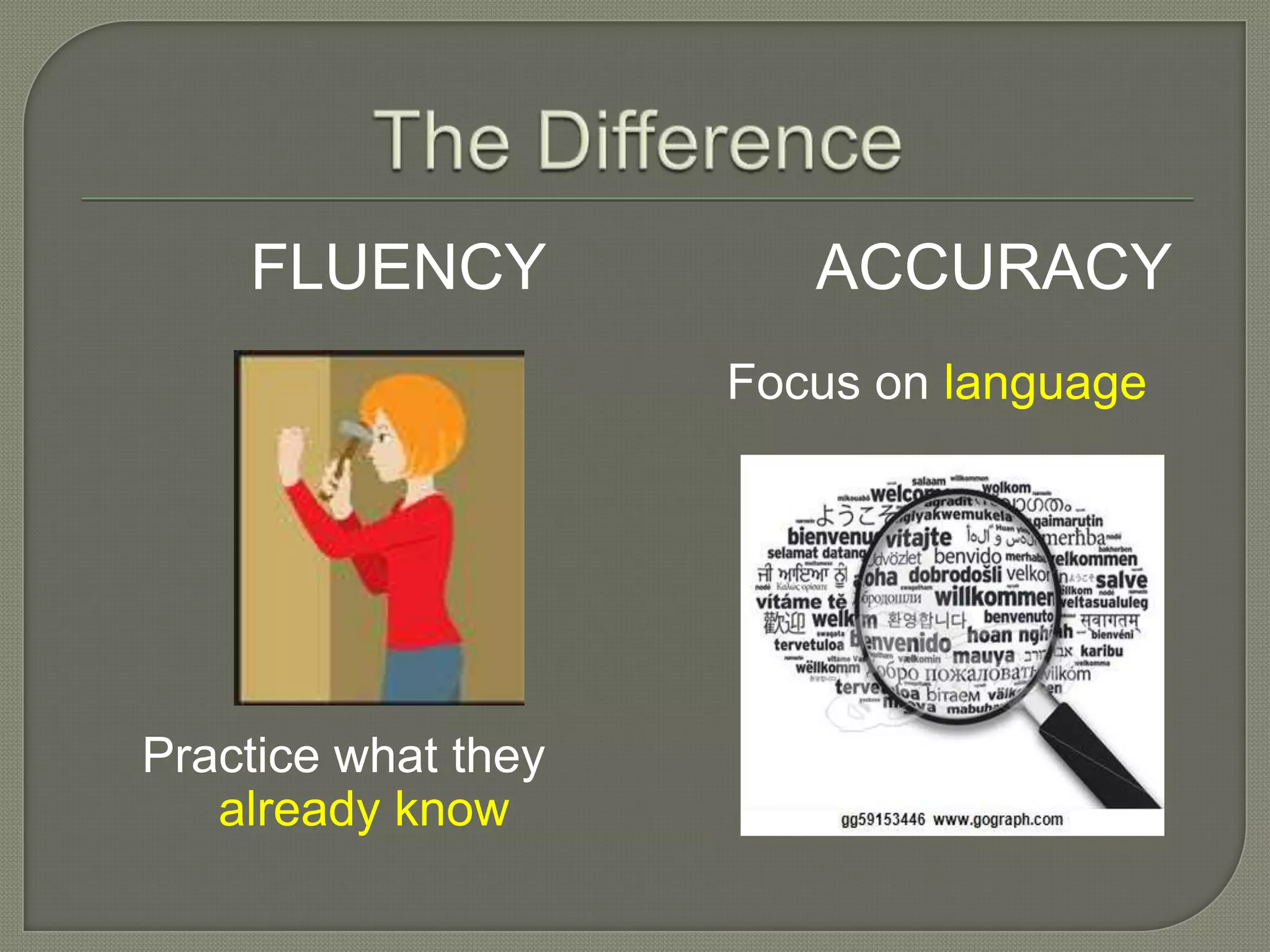
FLUENCY
Practice what they
already know
ACCURACY
Focus on language
Keep students at own level of vocabulary
and grammar.
Let them be creative.
Impose no rules.
DO NOT CORRECT THEM!
Limit teacher-talk.
if vocabulary is new?
if the focus is on grammar?
if there is no push to go faster or more
smoothly?
…Should be devoted to fluency?
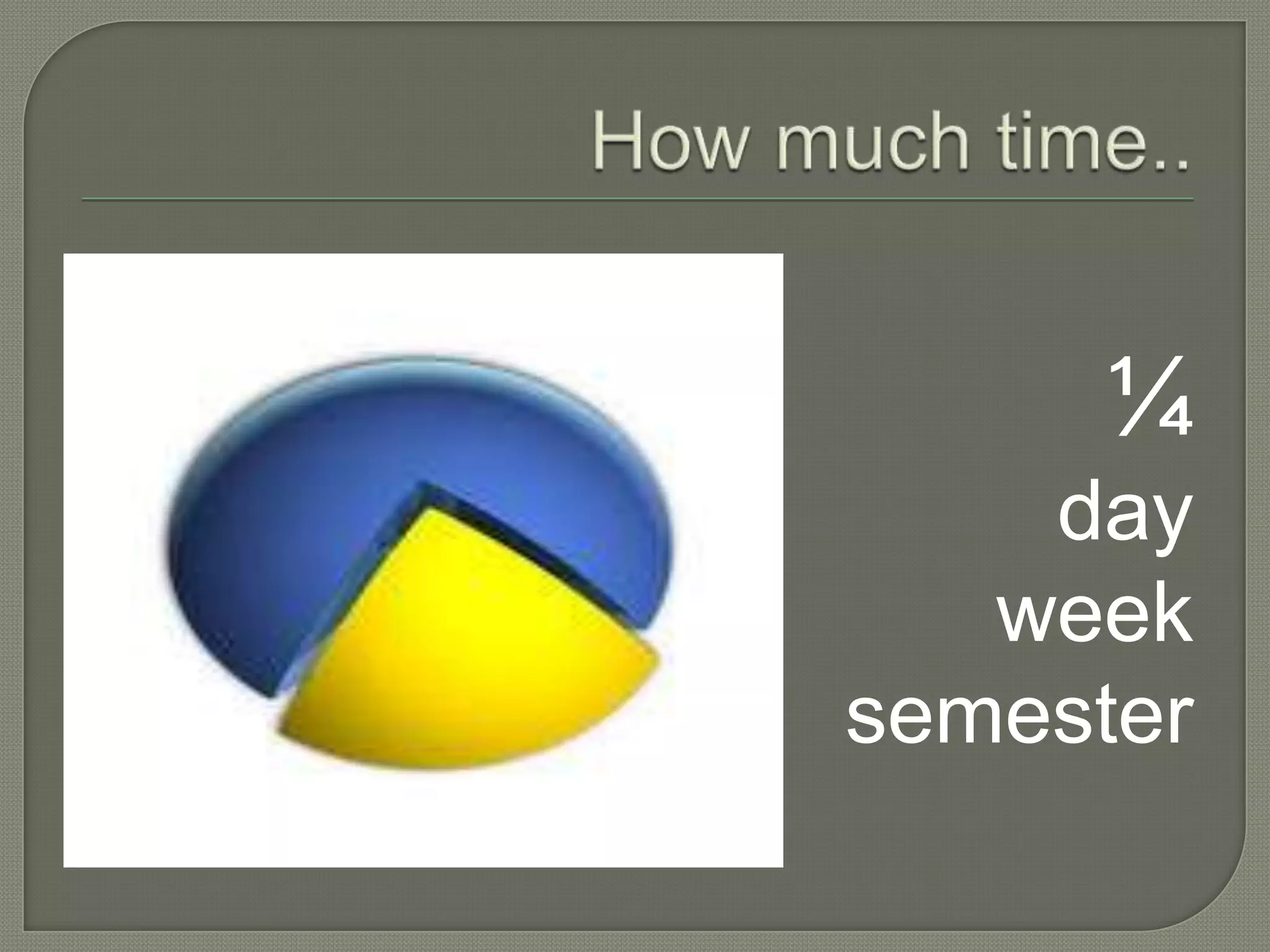
¼
day
week
semester
Practicing fluency with the Brooklyn Monk
Listen for:
How often he corrects students
How he engages the students
How much he talks
It slows down flow of the class. 
Students lose motivation.  
They may not remember the correction anyway.
  
OUR FEAR:
Students will practice mistakes.
Most want some kind of
correction.
It helps them improve.
Give students a chance, and time, to
correct themselves.
Use hand signals
• –e.g., Point behind you to indicate past tense.
Students can correct one another.
Peer correction often creates a positive
class atmosphere as students realize you
are not the only source of error correction
and they can learn a lot from one another.
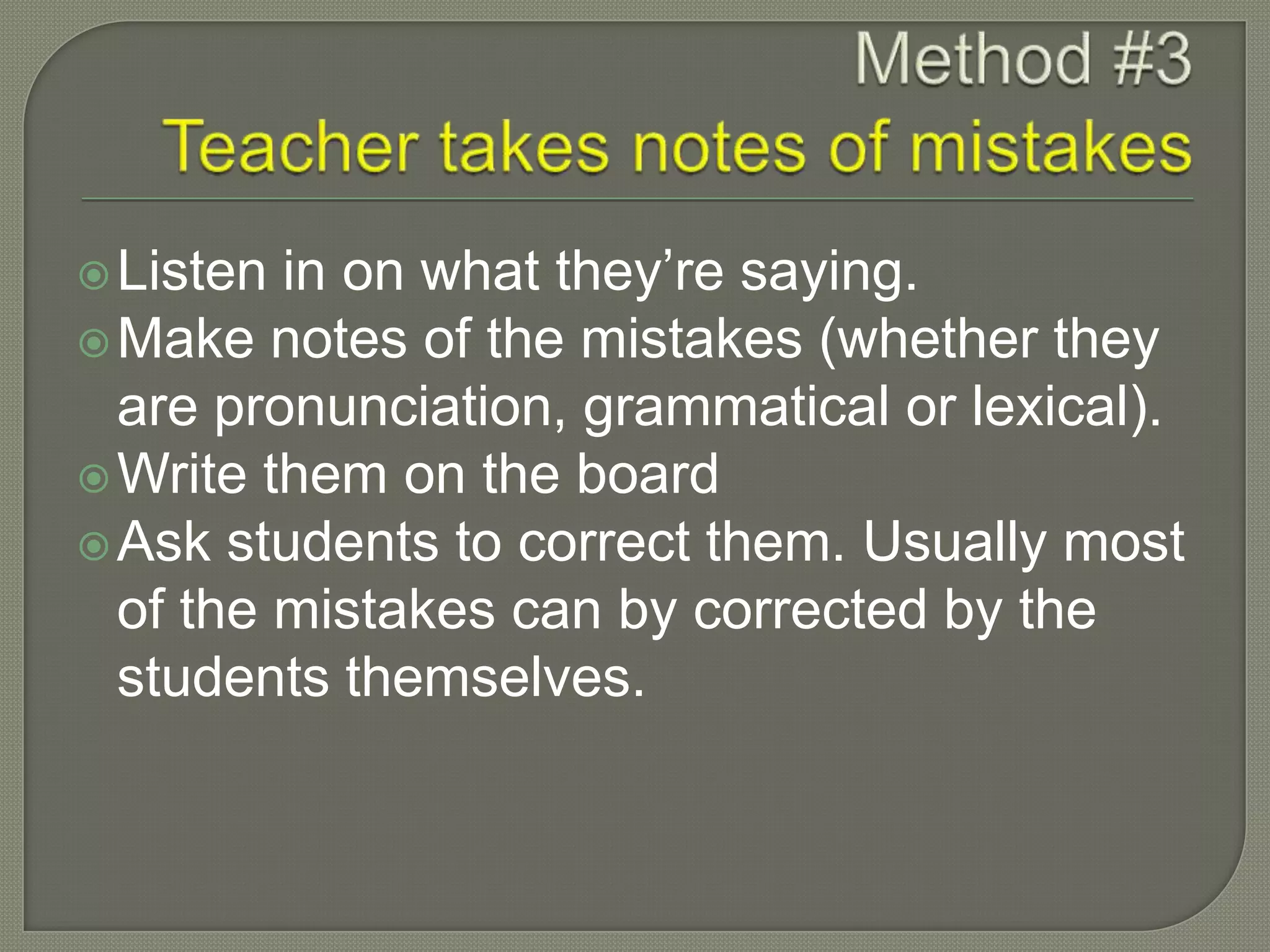
Listen in on what they’re saying.
Make notes of the mistakes (whether they
are pronunciation, grammatical or lexical).
Write them on the board
Ask students to correct them. Usually most
of the mistakes can by corrected by the
students themselves.
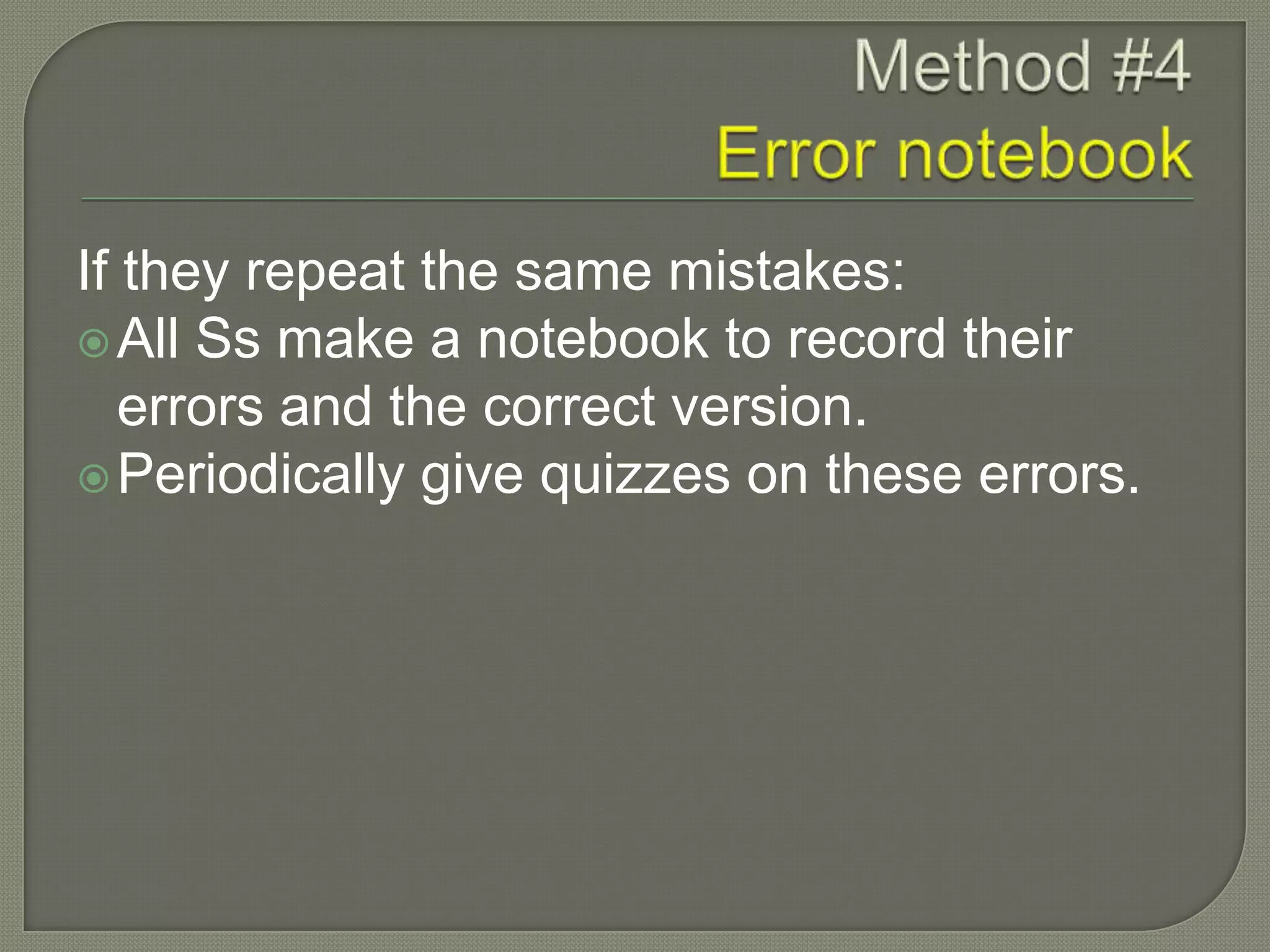
If they repeat the same mistakes:
All Ss make a notebook to record their
errors and the correct version.
Periodically give quizzes on these errors.
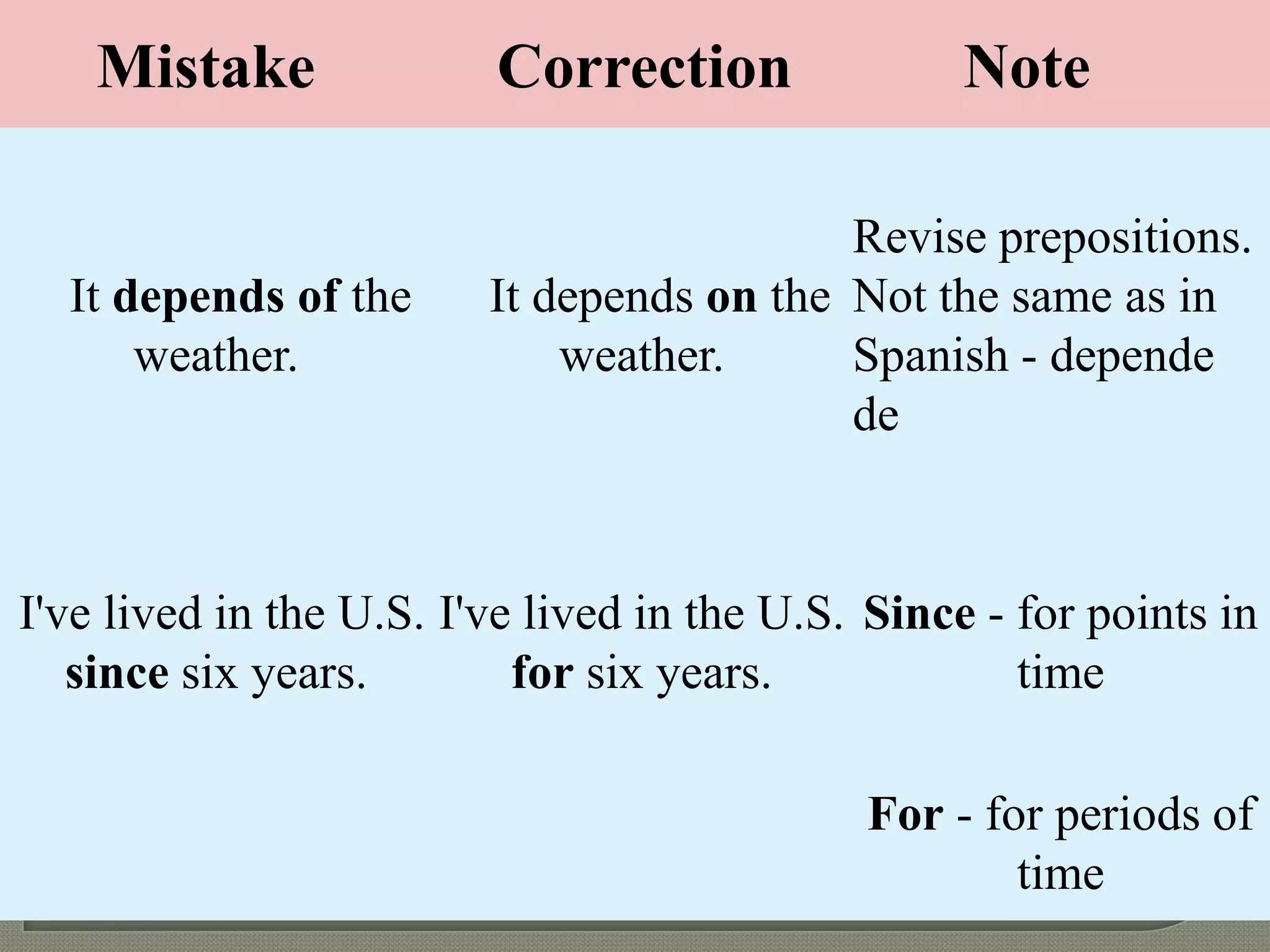
Mistake Correction Note
It depends of the
weather.
It depends on the
weather.
Revise prepositions.
Not the same as in
Spanish - depende
de
I've lived in the U.S.
since six years.
I've lived in the U.S.
for six years.
Since - for points in
time
For - for periods of
time
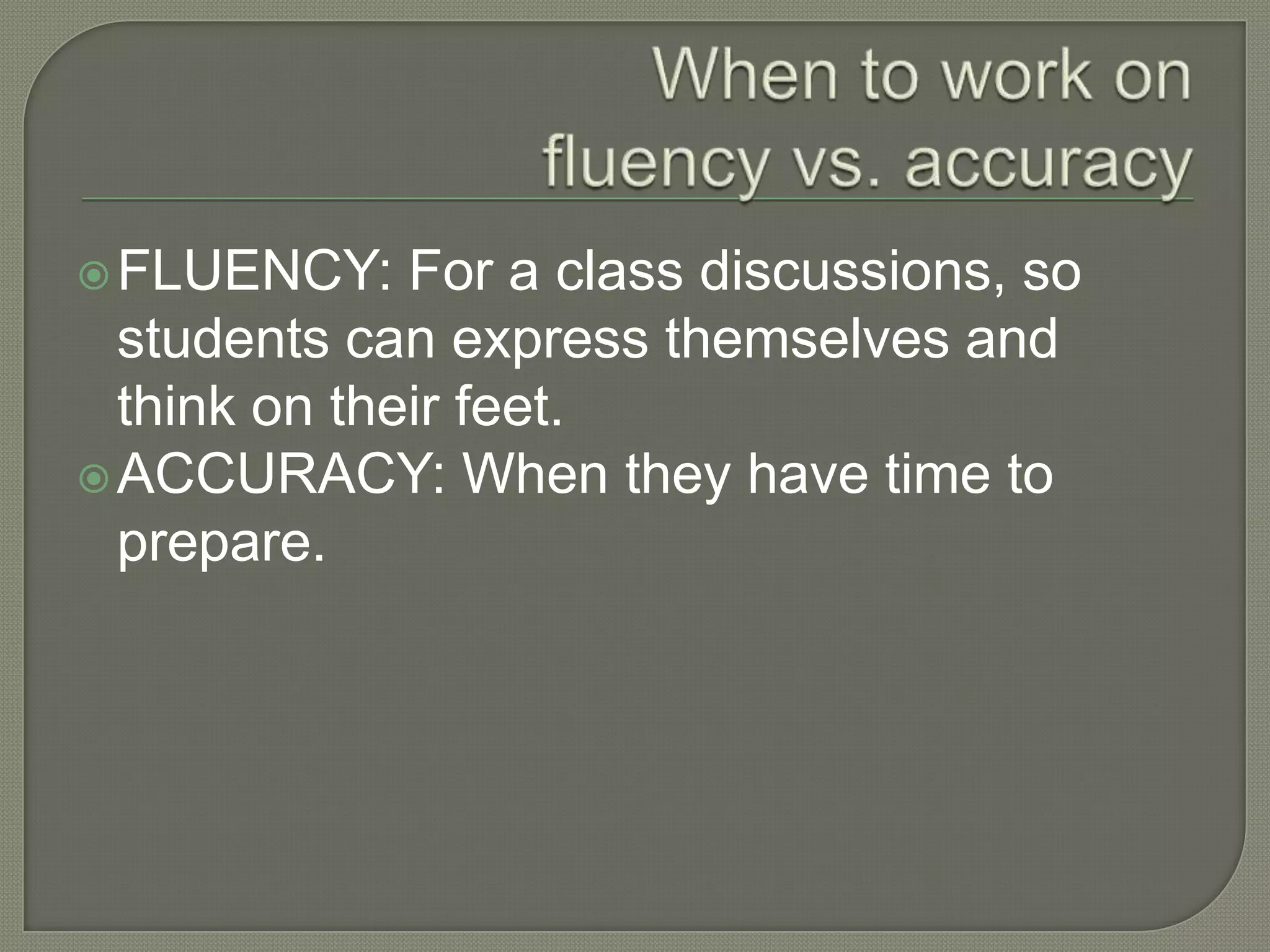
FLUENCY: For a class discussions, so
students can express themselves and
think on their feet.
ACCURACY: When they have time to
prepare.
Be clear of the aims of the task.
Make sure Ss know which task they are
being asked to do.
Avoid presenting an activity as a fluency
task and then correct every single mistake.
Allow students to work together to create a
utopian country.
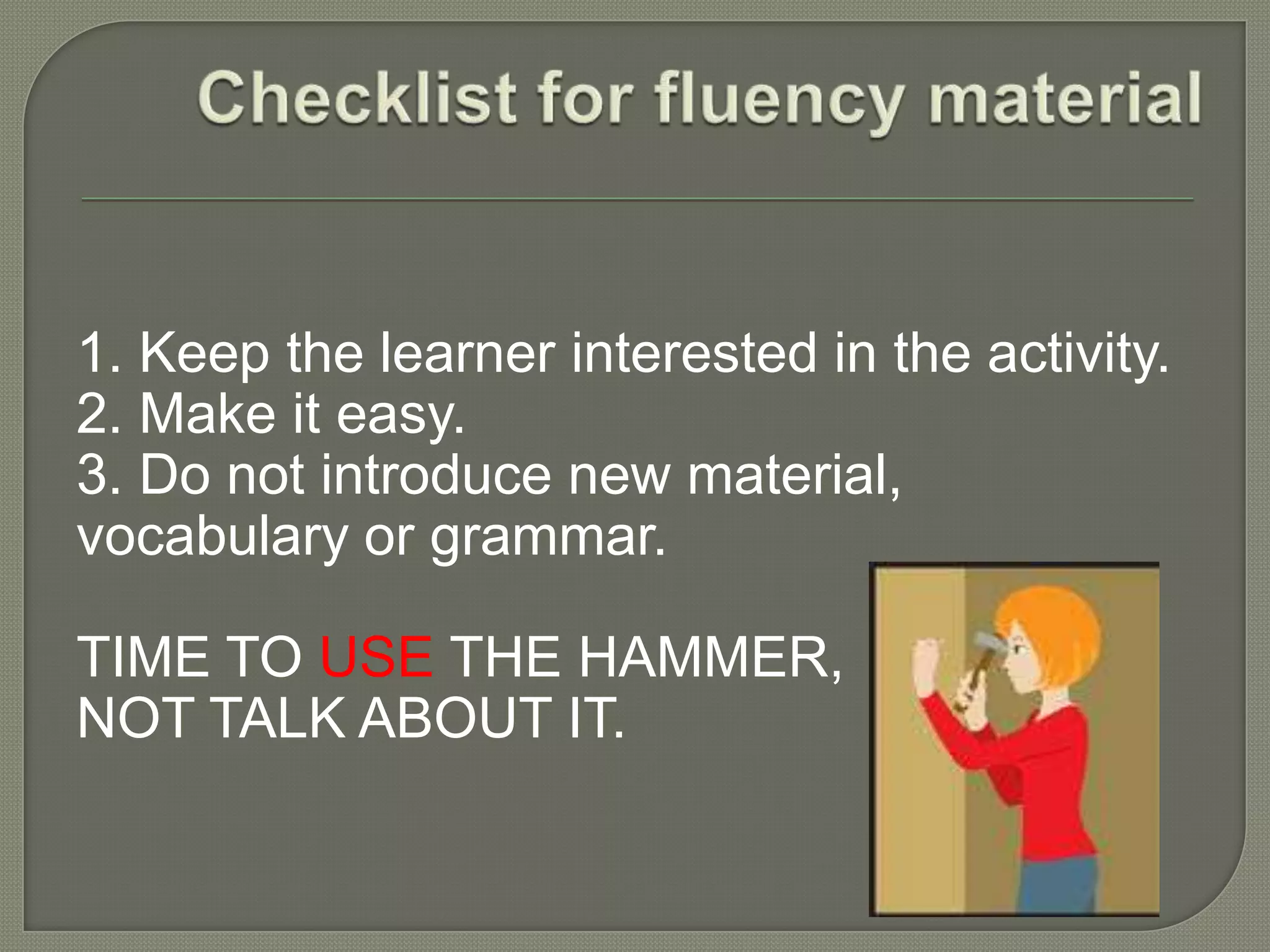
1. Keep the learner interested in the activity.
2. Make it easy.
3. Do not introduce new material,
vocabulary or grammar.
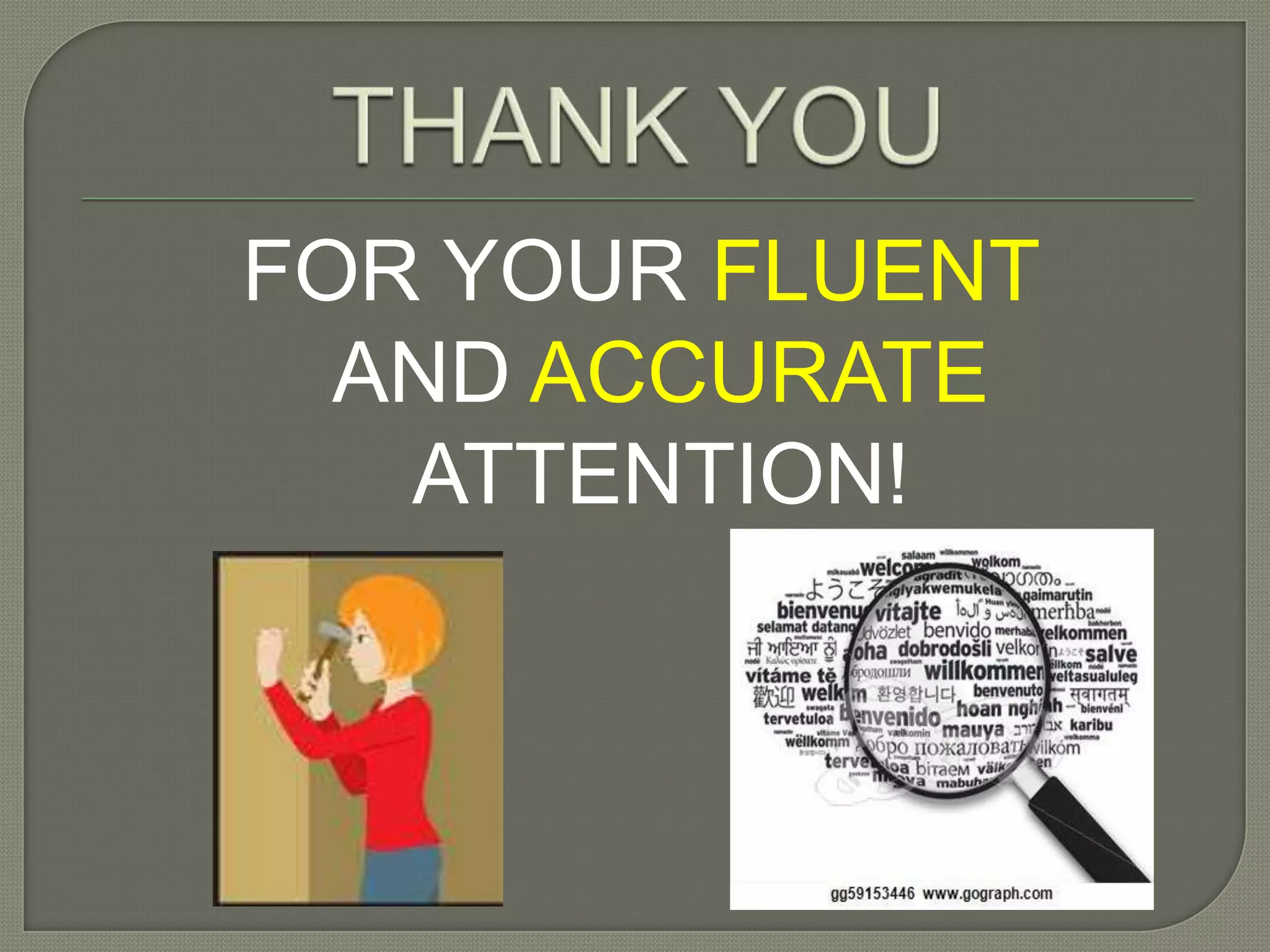
TIME TO USE THE HAMMER,
NOT TALK ABOUT IT.
Fluency strand = ¼ of the course time
(daily or weekly).
NOT a time to learn new items.
Time to use what they know.
#1 Rank-ordering
#2 Problem solving
#3 Planned speaking
#4 Group competition
#5 Role-Playing Scenarios
#6 Time pressure
Rank order these teacher qualities.
 Sense of humor
 Honesty
 Love of children
 Knowledge of subject
 Flexibility
 Clear speaking voice
 Enthusiasm for teaching
 Pleasant appearance
 Fairness
 Ability to create interest
 Ability to keep order
 Intelligence
-You and a friend are lost in the jungle. Put the following items in
order of importance for your survival.
 A sleeping bag
 Radio (listening only)
 Axe
 Gun and ten bullets
 Matches
 Tent
 Torch
 Map of the area
 Cooking pot
 Three cans of food
 Three meters of rope
 Story book
Everyone is given a text.
Team A leaves the room.
Team B (the class) then makes up and
asks them competitors questions about the
text. (They have not seen the questions.)
The class judges whether their answers
are correct.
Ask students to bring in one summarized
story from the news and talk about it to the
class. They must explain why they brought
it in/why it was important to them.
A student asks the teacher for an
extension on a paper. The teacher is not
inclined to do so.
8
ways
to
do
dictation!
Learners should know what mistakes they
made.
Text should have known vocabulary.
Use texts from familiar material.
Let them check their own or other’s work.
T sits outside the classroom and tells
student A one line of the dictation as he
comes out. Student A memorizes that
sentence, runs to Student B, who writes it
down.
Learners work in pairs. One reads dictation
and other writes. When pairs are finished
they yell “Stop!” The first pair that yells
Stop is the winner. They have limited time.
The one who is writing can ask to have
words repeated or spelled.
Do dictation, grade it, then return it so Ss
can look at mistakes. Then give the same
dictation, to make sure the Ss don’t make
the same mistake.
T records dictation into a tape recorder or
Ss’ mobile phone. Each student can do the
dictation on his own by using the rewind
and pause buttons. They can regulate the
speed of the dictation.
Pairs: the reader looks at a phrase in the
text, tries to remember it, and then looks
away from the text and then says it to their
partner, who writes it.
It forces the reader to rely on memory. It
goes from book to brain, and then from
brain to mouth.
Some consider the most valuable of
exercises.
S listens to a long phrase dictated by the
T, waits for several seconds, and then
repeats it.
NOTE: The length of the phrase a learner
can hold in memory is an indicator of
language proficiency.
S reads a phrase (by himself) and then tries
to hold as large a phrase as possible in the
language before writing it. Do not copy
word for word! Ideally suited for individual
practice.
T reads a text at normal speed.
Ss listen and take notes.
Ss get into groups and reconstruct the text
from memory.
Ss compare versions from various groups.
Class discusses usage points/mistakes.
*difficult!
Get in pairs or groups.
Design a simple exercise that begins with
fluency and ends with a dictation exercise
(or vice versa).
Fluency and accuracy – NOT the same!
Teach separately.
Fluency activities = practice.
Accuracy = language.
Tell them which activity you are doing.
FOR YOUR FLUENT
AND ACCURATE
ATTENTION!
Bailey, K. & Savage, L. (Eds.) New ways in
teaching speaking. Alexandria, VA:
TESOL.
Kehe, D., & Kehe, P. (2012). Discussion
strategies. Brattleboro, VT: ProLingua.
Nation, I., & Newton, J. (2009). Teaching
ESL/EFL listening and speaking. New
York: Routledge.

Fluency vs. accuracy

  • 1.
    Nancy Burkhalter, PhD SeniorEnglish Language Fellow Lipetsk, Russia April 11-12, 2013
  • 2.
    FLUENCY Practice what they alreadyknow ACCURACY Focus on language
  • 3.
    Keep students atown level of vocabulary and grammar. Let them be creative. Impose no rules. DO NOT CORRECT THEM! Limit teacher-talk.
  • 4.
    if vocabulary isnew? if the focus is on grammar? if there is no push to go faster or more smoothly?
  • 5.
  • 6.
  • 7.
    Practicing fluency withthe Brooklyn Monk Listen for: How often he corrects students How he engages the students How much he talks
  • 8.
    It slows downflow of the class.  Students lose motivation.   They may not remember the correction anyway.   
  • 9.
    OUR FEAR: Students willpractice mistakes.
  • 10.
    Most want somekind of correction. It helps them improve.
  • 11.
    Give students achance, and time, to correct themselves. Use hand signals • –e.g., Point behind you to indicate past tense.
  • 12.
    Students can correctone another. Peer correction often creates a positive class atmosphere as students realize you are not the only source of error correction and they can learn a lot from one another.
  • 13.
    Listen in onwhat they’re saying. Make notes of the mistakes (whether they are pronunciation, grammatical or lexical). Write them on the board Ask students to correct them. Usually most of the mistakes can by corrected by the students themselves.
  • 14.
    If they repeatthe same mistakes: All Ss make a notebook to record their errors and the correct version. Periodically give quizzes on these errors.
  • 15.
    Mistake Correction Note Itdepends of the weather. It depends on the weather. Revise prepositions. Not the same as in Spanish - depende de I've lived in the U.S. since six years. I've lived in the U.S. for six years. Since - for points in time For - for periods of time
  • 16.
    FLUENCY: For aclass discussions, so students can express themselves and think on their feet. ACCURACY: When they have time to prepare.
  • 17.
    Be clear ofthe aims of the task. Make sure Ss know which task they are being asked to do. Avoid presenting an activity as a fluency task and then correct every single mistake.
  • 18.
    Allow students towork together to create a utopian country.
  • 19.
    1. Keep thelearner interested in the activity. 2. Make it easy. 3. Do not introduce new material, vocabulary or grammar. TIME TO USE THE HAMMER, NOT TALK ABOUT IT.
  • 20.
    Fluency strand =¼ of the course time (daily or weekly). NOT a time to learn new items. Time to use what they know.
  • 21.
    #1 Rank-ordering #2 Problemsolving #3 Planned speaking #4 Group competition #5 Role-Playing Scenarios #6 Time pressure
  • 22.
    Rank order theseteacher qualities.  Sense of humor  Honesty  Love of children  Knowledge of subject  Flexibility  Clear speaking voice  Enthusiasm for teaching  Pleasant appearance  Fairness  Ability to create interest  Ability to keep order  Intelligence
  • 23.
    -You and afriend are lost in the jungle. Put the following items in order of importance for your survival.  A sleeping bag  Radio (listening only)  Axe  Gun and ten bullets  Matches  Tent  Torch  Map of the area  Cooking pot  Three cans of food  Three meters of rope  Story book
  • 24.
    Everyone is givena text. Team A leaves the room. Team B (the class) then makes up and asks them competitors questions about the text. (They have not seen the questions.) The class judges whether their answers are correct.
  • 25.
    Ask students tobring in one summarized story from the news and talk about it to the class. They must explain why they brought it in/why it was important to them.
  • 26.
    A student asksthe teacher for an extension on a paper. The teacher is not inclined to do so.
  • 28.
  • 29.
    Learners should knowwhat mistakes they made. Text should have known vocabulary. Use texts from familiar material. Let them check their own or other’s work.
  • 30.
    T sits outsidethe classroom and tells student A one line of the dictation as he comes out. Student A memorizes that sentence, runs to Student B, who writes it down.
  • 31.
    Learners work inpairs. One reads dictation and other writes. When pairs are finished they yell “Stop!” The first pair that yells Stop is the winner. They have limited time. The one who is writing can ask to have words repeated or spelled.
  • 32.
    Do dictation, gradeit, then return it so Ss can look at mistakes. Then give the same dictation, to make sure the Ss don’t make the same mistake.
  • 33.
    T records dictationinto a tape recorder or Ss’ mobile phone. Each student can do the dictation on his own by using the rewind and pause buttons. They can regulate the speed of the dictation.
  • 34.
    Pairs: the readerlooks at a phrase in the text, tries to remember it, and then looks away from the text and then says it to their partner, who writes it. It forces the reader to rely on memory. It goes from book to brain, and then from brain to mouth. Some consider the most valuable of exercises.
  • 35.
    S listens toa long phrase dictated by the T, waits for several seconds, and then repeats it. NOTE: The length of the phrase a learner can hold in memory is an indicator of language proficiency.
  • 36.
    S reads aphrase (by himself) and then tries to hold as large a phrase as possible in the language before writing it. Do not copy word for word! Ideally suited for individual practice.
  • 37.
    T reads atext at normal speed. Ss listen and take notes. Ss get into groups and reconstruct the text from memory. Ss compare versions from various groups. Class discusses usage points/mistakes. *difficult!
  • 38.
    Get in pairsor groups. Design a simple exercise that begins with fluency and ends with a dictation exercise (or vice versa).
  • 39.
    Fluency and accuracy– NOT the same! Teach separately. Fluency activities = practice. Accuracy = language. Tell them which activity you are doing.
  • 40.
    FOR YOUR FLUENT ANDACCURATE ATTENTION!
  • 41.
    Bailey, K. &Savage, L. (Eds.) New ways in teaching speaking. Alexandria, VA: TESOL. Kehe, D., & Kehe, P. (2012). Discussion strategies. Brattleboro, VT: ProLingua. Nation, I., & Newton, J. (2009). Teaching ESL/EFL listening and speaking. New York: Routledge.

Editor's Notes

  • #8 https://www.youtube.com/watch?v=AsM45FkBzq8 Youtube.com Speaking Real English
  • #19 http://www.youtube.com/watch?v=QirhNeIwQ0w BridgeTEFL Teaching speaking with task-based learning