The Use of Motor Skills to
Improve Dysgraphia in
Elementary Students
By: Angela Horne
EDN 501
What is dysgraphia?
 “Dysgraphia is a learning disability that affects writing
abilities. It can manifest itself as difficulties with spelling,
poor handwriting and trouble putting thoughts on paper.
Because writing requires a complex set of motor and
information processing skills, saying a student has
dysgraphia is not sufficient. A student with disorders in
written expression will benefit from specific
accommodations in the learning environment, as well as
additional practice learning the skills required to be an
accomplished writer.”
ldonline.org/article/12770
Study 1: Graphomotor skills in children with
developmental coordination disorder (DCD):
Handwriting and learning a new letter.
 Purpose of Investigation:
 analyze the specific handwriting difficulties children with developmental
coordination disorder (DCD), and test the hypothesis that a deficit in procedural
learning could offer an explanation.
 compare handwriting performance of children with DCD to a non-DCD group,
relying on motor skills in handwriting and learning a new letter using a graphic
tablet.
 The study also narrowed in on how a student with and without DCD process how
to write a letter, a word and a whole sentence.
Huau, A., Velay, J., & Jover, M. (2015). Graphomotor skills in children with developmental coordination
disorder (DCD): Handwriting and learning a new letter. Human Movement Science, 42, 318-332.
Doi:10.1016.j.humov.2015.03.008
Study 1: Graphomotor skills in children with
developmental coordination disorder (DCD):
Handwriting and learning a new letter.
 Procedure:
 Students were asked to reproduce a made up “sign” on a
graphic tablet.
 Student was asked to copy the sign six times with model
 The model was then removed, and students were expected
to copy the sign again
 Students were asked to do this in “normal” and “fast” speed
 Study continued with words, and eventually sentences.
Huau, A., Velay, J., & Jover, M. (2015). Graphomotor skills in children with developmental coordination
disorder (DCD): Handwriting and learning a new letter. Human Movement Science, 42, 318-332.
Doi:10.1016.j.humov.2015.03.008
Huau, A., Velay, J., & Jover, M. (2015). Graphomotor skills in children with developmental coordination
disorder (DCD): Handwriting and learning a new letter. Human Movement Science, 42, 318-332.
Doi:10.1016.j.humov.2015.03.008
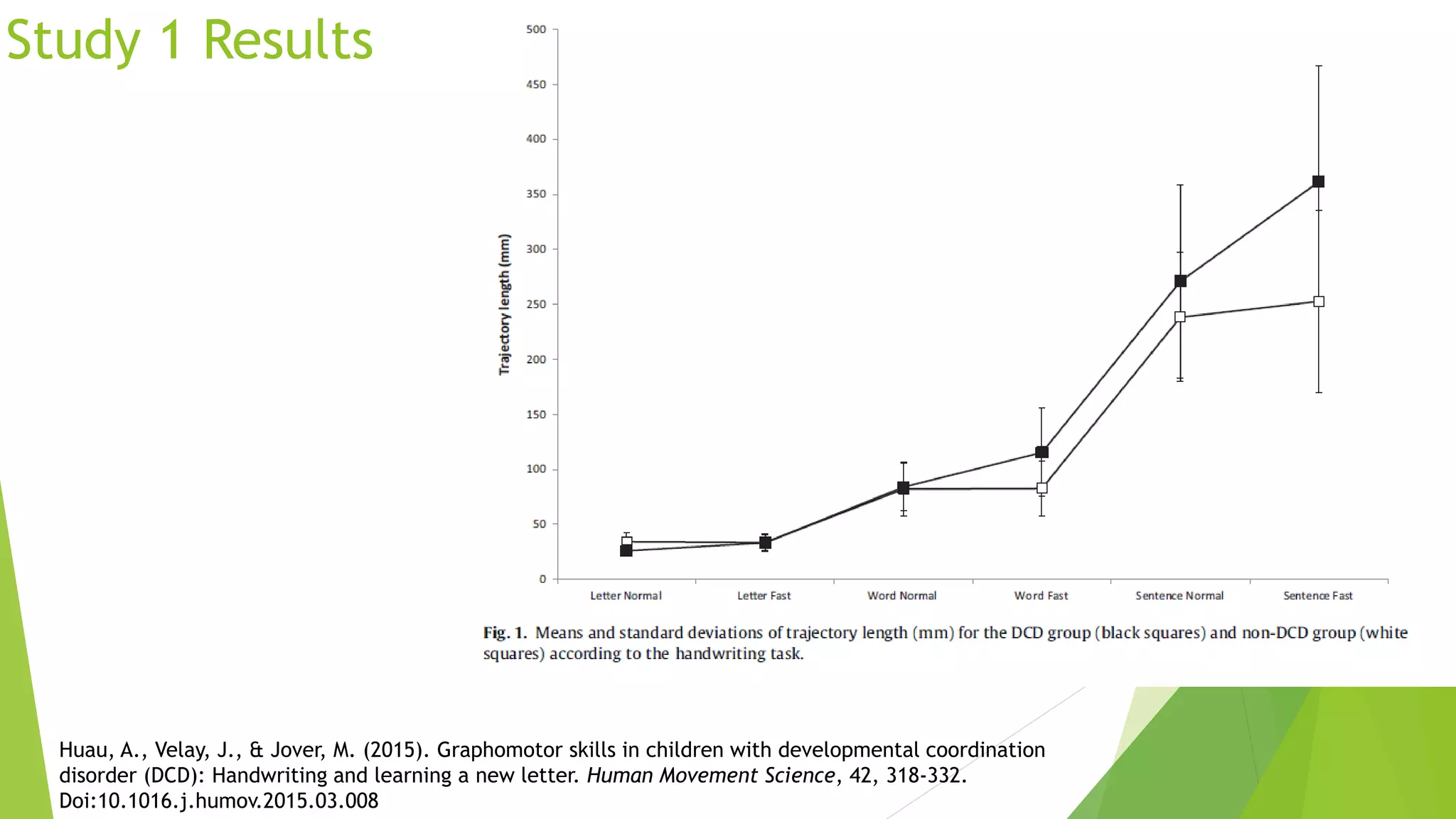
Study 1 Results
Huau, A., Velay, J., & Jover, M. (2015). Graphomotor skills in children with developmental coordination
disorder (DCD): Handwriting and learning a new letter. Human Movement Science, 42, 318-332.
Doi:10.1016.j.humov.2015.03.008
Study 1:
Results
Huau, A., Velay, J., & Jover, M. (2015). Graphomotor skills in children with developmental coordination
disorder (DCD): Handwriting and learning a new letter. Human Movement Science, 42, 318-332.
Doi:10.1016.j.humov.2015.03.008
Study 1: Results Debriefed
 Ultimately, children with DCD produced poorer quality new letters than non-DCD
children.
 Also, students with DCD also demonstrated that they made more “stops” in their
writing when the model was removed than non-DCD children.
 Children with DCD had difficulty performing this lengthy handwriting task. Half of
them exhibited dysgraphia, and none scored above the mean for handwriting quality.
The generally lower level in the children with DCD is consistent with previous studies
reporting impaired handwriting in DCD in a number of different tests.” (Huau, Velay,
Jover, 328)
 In regards to the procedural learning deficit hypothesis, it was expected that
children with DCD and non-DCD children would demonstrate a clear-cut difference
when learning a new letter. These results were not as clear as expected.
 Non-DCD children did produce better quality “new letters”, but the effect of
sequence did not significantly increase quality during the learning process. Both
groups of children performed similarly.
Huau, A., Velay, J., & Jover, M. (2015). Graphomotor skills in children with developmental coordination
disorder (DCD): Handwriting and learning a new letter. Human Movement Science, 42, 318-332.
Doi:10.1016.j.humov.2015.03.008
Study 2: Handwriting Performance, Self-
Reports, and Perceived Self-Efficacy Among
Children With Dysgraphia
 Purpose: To examine the relationships between
children’s self-reports of their handwriting
performance, their actual production of handwriting,
examined the relationships between children’s self-
reports on their handwriting, and their perceived
self-efficacy, and relate it to the possibility of
improving their hand writing skills.
Engel-Yeger, B., Nagauker-Yanuv, L., & Rosenblum, S. (2009). Handwriting Performance, Self-Reports, and Perceived Self-
Efficacy Among Children With Dysgraphia. American Journal of Occupational Therapy, 63(2), 182-192. Doi:
10.5014/ajot.63.2.182
Study 2:
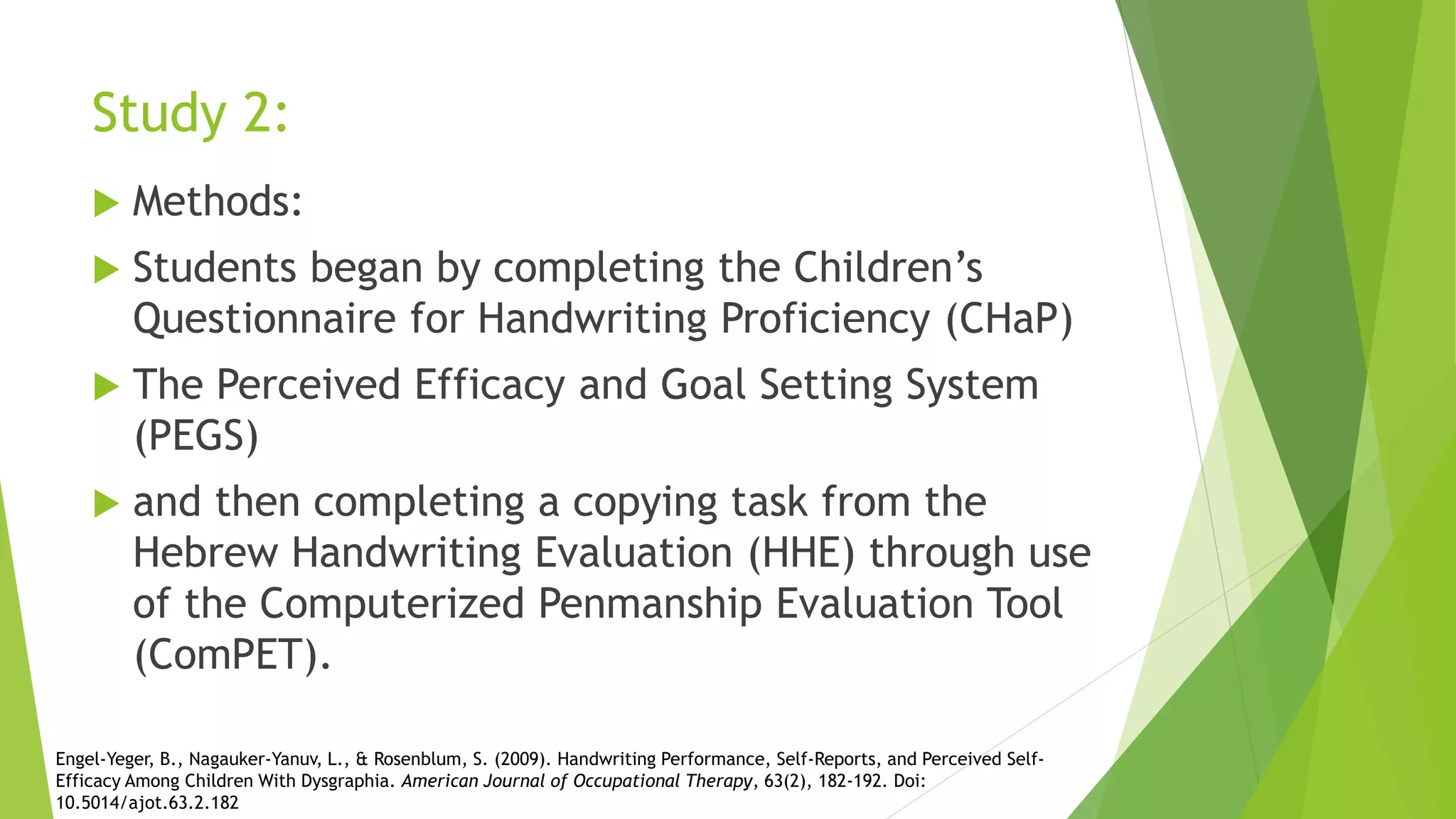
 Methods:
 Students began by completing the Children’s
Questionnaire for Handwriting Proficiency (CHaP)
 The Perceived Efficacy and Goal Setting System
(PEGS)
 and then completing a copying task from the
Hebrew Handwriting Evaluation (HHE) through use
of the Computerized Penmanship Evaluation Tool
(ComPET).
Engel-Yeger, B., Nagauker-Yanuv, L., & Rosenblum, S. (2009). Handwriting Performance, Self-Reports, and Perceived Self-
Efficacy Among Children With Dysgraphia. American Journal of Occupational Therapy, 63(2), 182-192. Doi:
10.5014/ajot.63.2.182
Study 2:
 Results:
 “When examining the relationship between the
CHaP and handwriting process and product
measures, it was found that children with
dysgraphia who exhibited lower self-efficacy
regarding handwriting abilities indeed had
impaired handwriting processes and products, as
manifested in impaired fluency and spatial
arrangement and slower handwriting velocity.”
(189)
Engel-Yeger, B., Nagauker-Yanuv, L., & Rosenblum, S. (2009). Handwriting Performance, Self-Reports, and Perceived Self-
Efficacy Among Children With Dysgraphia. American Journal of Occupational Therapy, 63(2), 182-192. Doi:
10.5014/ajot.63.2.182
Study 3: The Effect of Computer-Assisted
Therapeutic Practice for Children with
Handwriting Deficit: A Comparison with the
Effect of the Traditional Sensorimotor
Approach.
Purpose: to compare the effects of
computerized-assisted practice with the
sensorimotor approach to remediate
students with dysgraphia.
Chang, S., & Yu, N. (2014). The effect of computer-assisted therapeutic practice for children with handwriting deficit: A
comparison with the effect of the traditional sensorimotor approach. Research in Developmental Disabilities, 35(7),
1648-1657. doi:10.1016/j.ridd.2014.03.024
Study 3:
Computerized
Assistance
Chang, S., & Yu, N. (2014). The effect of computer-assisted therapeutic practice for children with handwriting deficit: A
comparison with the effect of the traditional sensorimotor approach. Research in Developmental Disabilities, 35(7),
1648-1657. doi:10.1016/j.ridd.2014.03.024
Study 3 Results
Chang, S., & Yu, N. (2014). The effect of computer-assisted therapeutic practice for children with handwriting deficit: A
comparison with the effect of the traditional sensorimotor approach. Research in Developmental Disabilities, 35(7),
1648-1657. doi:10.1016/j.ridd.2014.03.024
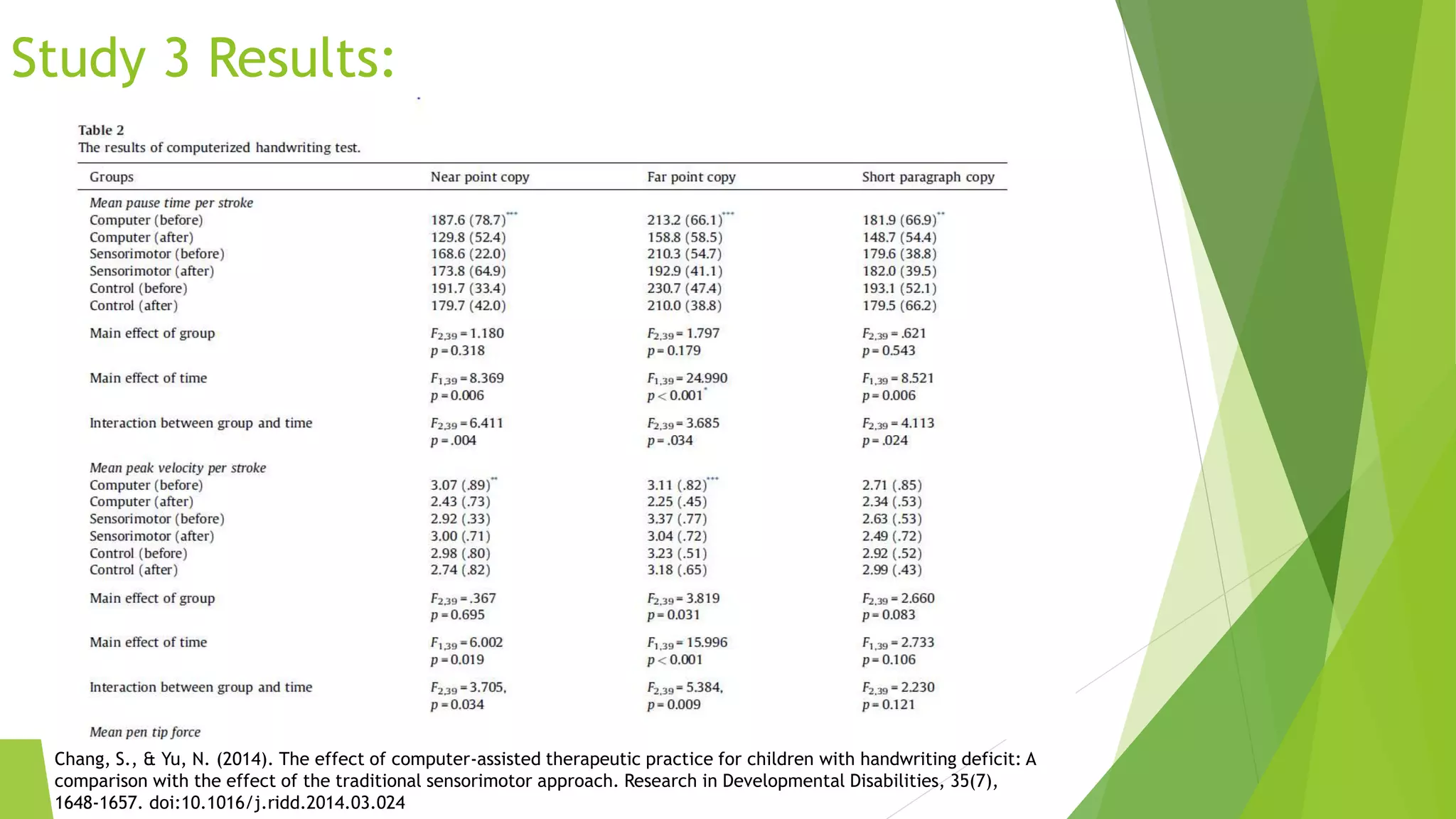
Study 3 Results:
Chang, S., & Yu, N. (2014). The effect of computer-assisted therapeutic practice for children with handwriting deficit: A
comparison with the effect of the traditional sensorimotor approach. Research in Developmental Disabilities, 35(7),
1648-1657. doi:10.1016/j.ridd.2014.03.024
Study 4: Changes in Kinetics and Kinematics
of Handwriting During a Prolonged
Writing Task in Children with and without
Dysgraphia
Purpose: to examine the changes in the
biomechanics of handwriting over a
prolonged writing task.
Kushki, A., Schwellnus, H., Ilyas, F., & Chau, T. (2011). Changes in kinetics and kinematics of handwriting
during a prolonged writing task in children with and without dysgraphia. Research in Developmental
Disabilities, 32(3), 1058-1064. doi:10.1016/j.ridd.2011.01.026
Study 4: Methods
 Before the assessment began, students
were given time to practice writing on the
digitizing tablet for one minute.
 Afterwards, students copied a fourth grade
text onto the digitizing tablet for 10
minutes. This duration was purposeful, as
it had previously shown to be an amount of
time which induced fatigue in children of
similar age.
Kushki, A., Schwellnus, H., Ilyas, F., & Chau, T. (2011). Changes in kinetics and kinematics of handwriting
during a prolonged writing task in children with and without dysgraphia. Research in Developmental
Disabilities, 32(3), 1058-1064. doi:10.1016/j.ridd.2011.01.026
Study 4: Setup
Kushki, A., Schwellnus, H., Ilyas, F., & Chau, T. (2011). Changes in kinetics and kinematics of handwriting
during a prolonged writing task in children with and without dysgraphia. Research in Developmental
Disabilities, 32(3), 1058-1064. doi:10.1016/j.ridd.2011.01.026
Study 4: Results
Kushki, A., Schwellnus, H., Ilyas, F., & Chau, T. (2011). Changes in kinetics and kinematics of handwriting
during a prolonged writing task in children with and without dysgraphia. Research in Developmental
Disabilities, 32(3), 1058-1064. doi:10.1016/j.ridd.2011.01.026
Study 4:
Results
Kushki, A., Schwellnus, H., Ilyas, F., & Chau, T. (2011). Changes in kinetics and kinematics of handwriting
during a prolonged writing task in children with and without dysgraphia. Research in Developmental
Disabilities, 32(3), 1058-1064. doi:10.1016/j.ridd.2011.01.026
Study 5: The Effect of a Computerized Visual
Perception and Visual-Motor Integration
Training Program on Improving Chinese
Handwriting of Children with Handwriting
Difficulties
 Purpose: To examine the effect of a computerized visual
perception and visual motor integration program to increase
Chinese handwriting performance among children with
learning disabilities, especially those with handwriting
deficiencies.
Poon, K., Li-Tsang, C., Weiss, T., & Rosenblum, S. (2010). The effect of a computerized visual perception and
visual-motor integration training program on improving Chinese handwriting of children with handwriting
difficulties. Research in Developmental Disabilities, 31(6), 1552-1560. doi:10.1016/j.ridd.2010.06.001
Study 5: Procedures
 The computerized training program used an interactive
computer. The software contains 8 different games:
Supermarket, School, Family, Sport, Restaurant, Picnic,
Occupation and Playground.
 Each game trains the child visual perception skills, visual-
motor integration skills and the grip modulation skill. This
study specifically focused on the intended training of visual-
motor integration ability of the participants, including hand-eye
coordination and fine motor control.
 Students were to complete 8, 45 minute computerized game
sessions. They were to practice once a week with parent
supervision.
Poon, K., Li-Tsang, C., Weiss, T., & Rosenblum, S. (2010). The effect of a computerized visual perception and
visual-motor integration training program on improving Chinese handwriting of children with handwriting
difficulties. Research in Developmental Disabilities, 31(6), 1552-1560. doi:10.1016/j.ridd.2010.06.001
Study 5:
Poon, K., Li-Tsang, C., Weiss, T., & Rosenblum, S. (2010). The effect of a computerized
visual perception and visual-motor integration training program on improving Chinese
handwriting of children with handwriting difficulties. Research in Developmental
Disabilities, 31(6), 1552-1560. doi:10.1016/j.ridd.2010.06.001
Study 5: Results
Poon, K., Li-Tsang, C., Weiss, T., & Rosenblum, S. (2010). The effect of a computerized visual
perception and visual-motor integration training program on improving Chinese handwriting of children
with handwriting difficulties. Research in Developmental Disabilities, 31(6), 1552-1560.
doi:10.1016/j.ridd.2010.06.001
REFERENCES
 Chang, S., & Yu, N. (2014). The effect of computer-assisted therapeutic practice for children
with handwriting deficit: A comparison with the effect of the traditional sensorimotor
approach. Research in Developmental Disabilities, 35(7), 1648-1657.
doi:10.1016/j.ridd.2014.03.024
 Engel-Yeger, B., Nagauker-Yanuv, L., & Rosenblum, S. (2009). Handwriting Performance, Self-
Reports, and Perceived Self-Efficacy Among Children With Dysgraphia. American Journal of
Occupational Therapy, 63(2), 182-192. Doi: 10.5014/ajot.63.2.182
 Huau, A., Velay, J., & Jover, M. (2015). Graphomotor skills in children with developmental
coordination disorder (DCD): Handwriting and learning a new letter. Human Movement
Science, 42, 318-332. Doi:10.1016.j.humov.2015.03.008
 Kushki, A., Schwellnus, H., Ilyas, F., & Chau, T. (2011). Changes in kinetics and kinematics of
handwriting during a prolonged writing task in children with and without dysgraphia.
Research in Developmental Disabilities, 32(3), 1058-1064. doi:10.1016/j.ridd.2011.01.026
 Poon, K., Li-Tsang, C., Weiss, T., & Rosenblum, S. (2010). The effect of a computerized visual
perception and visual-motor integration training program on improving Chinese handwriting
of children with handwriting difficulties. Research in Developmental Disabilities, 31(6), 1552-
1560. doi:10.1016/j.ridd.2010.06.001
Resource List
Websites:
 http://www.ldonline.org/article/5890/
 https://ldaamerica.org/types-of-learning-disabilities/dysgraphia/
 http://www.resourceroom.net/readspell/dysgraphia.html
Journals:
 Kouhbanani, S. S., Khosrorad, R., & Sani, A. R. (2014). The comparison of motor-
coordinated skill in students with dysgraphia disorder and normal ones. Journal of
Current Research in Science, 2(6), 977.
 Deuel, R. K. (1995). Developmental dysgraphia and motor skills disorders. Journal
of Child Neurology, 10 Suppl 1(1 suppl), S6-S8. doi:10.1177/08830738950100S103
 Tatiana, B. N. (2015). Physical therapy - an alternative for rehabilitating motor
dysgraphia in school age children. Gymnasium, 16(1), 311.
 Rostami, A., Allahverdi, F., & Mousavi, F. (2014). Dysgraphia: The causes and
solutions. International Journal of Academic Research in Business and Social
Sciences, 4(2), 7.

EDN 501 Horne Presentation

  • 1.
    The Use ofMotor Skills to Improve Dysgraphia in Elementary Students By: Angela Horne EDN 501
  • 2.
    What is dysgraphia? “Dysgraphia is a learning disability that affects writing abilities. It can manifest itself as difficulties with spelling, poor handwriting and trouble putting thoughts on paper. Because writing requires a complex set of motor and information processing skills, saying a student has dysgraphia is not sufficient. A student with disorders in written expression will benefit from specific accommodations in the learning environment, as well as additional practice learning the skills required to be an accomplished writer.” ldonline.org/article/12770
  • 3.
    Study 1: Graphomotorskills in children with developmental coordination disorder (DCD): Handwriting and learning a new letter.  Purpose of Investigation:  analyze the specific handwriting difficulties children with developmental coordination disorder (DCD), and test the hypothesis that a deficit in procedural learning could offer an explanation.  compare handwriting performance of children with DCD to a non-DCD group, relying on motor skills in handwriting and learning a new letter using a graphic tablet.  The study also narrowed in on how a student with and without DCD process how to write a letter, a word and a whole sentence. Huau, A., Velay, J., & Jover, M. (2015). Graphomotor skills in children with developmental coordination disorder (DCD): Handwriting and learning a new letter. Human Movement Science, 42, 318-332. Doi:10.1016.j.humov.2015.03.008
  • 4.
    Study 1: Graphomotorskills in children with developmental coordination disorder (DCD): Handwriting and learning a new letter.  Procedure:  Students were asked to reproduce a made up “sign” on a graphic tablet.  Student was asked to copy the sign six times with model  The model was then removed, and students were expected to copy the sign again  Students were asked to do this in “normal” and “fast” speed  Study continued with words, and eventually sentences. Huau, A., Velay, J., & Jover, M. (2015). Graphomotor skills in children with developmental coordination disorder (DCD): Handwriting and learning a new letter. Human Movement Science, 42, 318-332. Doi:10.1016.j.humov.2015.03.008
  • 5.
    Huau, A., Velay,J., & Jover, M. (2015). Graphomotor skills in children with developmental coordination disorder (DCD): Handwriting and learning a new letter. Human Movement Science, 42, 318-332. Doi:10.1016.j.humov.2015.03.008
  • 6.
    Study 1 Results Huau,A., Velay, J., & Jover, M. (2015). Graphomotor skills in children with developmental coordination disorder (DCD): Handwriting and learning a new letter. Human Movement Science, 42, 318-332. Doi:10.1016.j.humov.2015.03.008
  • 7.
    Study 1: Results Huau, A.,Velay, J., & Jover, M. (2015). Graphomotor skills in children with developmental coordination disorder (DCD): Handwriting and learning a new letter. Human Movement Science, 42, 318-332. Doi:10.1016.j.humov.2015.03.008
  • 8.
    Study 1: ResultsDebriefed  Ultimately, children with DCD produced poorer quality new letters than non-DCD children.  Also, students with DCD also demonstrated that they made more “stops” in their writing when the model was removed than non-DCD children.  Children with DCD had difficulty performing this lengthy handwriting task. Half of them exhibited dysgraphia, and none scored above the mean for handwriting quality. The generally lower level in the children with DCD is consistent with previous studies reporting impaired handwriting in DCD in a number of different tests.” (Huau, Velay, Jover, 328)  In regards to the procedural learning deficit hypothesis, it was expected that children with DCD and non-DCD children would demonstrate a clear-cut difference when learning a new letter. These results were not as clear as expected.  Non-DCD children did produce better quality “new letters”, but the effect of sequence did not significantly increase quality during the learning process. Both groups of children performed similarly. Huau, A., Velay, J., & Jover, M. (2015). Graphomotor skills in children with developmental coordination disorder (DCD): Handwriting and learning a new letter. Human Movement Science, 42, 318-332. Doi:10.1016.j.humov.2015.03.008
  • 9.
    Study 2: HandwritingPerformance, Self- Reports, and Perceived Self-Efficacy Among Children With Dysgraphia  Purpose: To examine the relationships between children’s self-reports of their handwriting performance, their actual production of handwriting, examined the relationships between children’s self- reports on their handwriting, and their perceived self-efficacy, and relate it to the possibility of improving their hand writing skills. Engel-Yeger, B., Nagauker-Yanuv, L., & Rosenblum, S. (2009). Handwriting Performance, Self-Reports, and Perceived Self- Efficacy Among Children With Dysgraphia. American Journal of Occupational Therapy, 63(2), 182-192. Doi: 10.5014/ajot.63.2.182
  • 10.
    Study 2:  Methods: Students began by completing the Children’s Questionnaire for Handwriting Proficiency (CHaP)  The Perceived Efficacy and Goal Setting System (PEGS)  and then completing a copying task from the Hebrew Handwriting Evaluation (HHE) through use of the Computerized Penmanship Evaluation Tool (ComPET). Engel-Yeger, B., Nagauker-Yanuv, L., & Rosenblum, S. (2009). Handwriting Performance, Self-Reports, and Perceived Self- Efficacy Among Children With Dysgraphia. American Journal of Occupational Therapy, 63(2), 182-192. Doi: 10.5014/ajot.63.2.182
  • 11.
    Study 2:  Results: “When examining the relationship between the CHaP and handwriting process and product measures, it was found that children with dysgraphia who exhibited lower self-efficacy regarding handwriting abilities indeed had impaired handwriting processes and products, as manifested in impaired fluency and spatial arrangement and slower handwriting velocity.” (189) Engel-Yeger, B., Nagauker-Yanuv, L., & Rosenblum, S. (2009). Handwriting Performance, Self-Reports, and Perceived Self- Efficacy Among Children With Dysgraphia. American Journal of Occupational Therapy, 63(2), 182-192. Doi: 10.5014/ajot.63.2.182
  • 12.
    Study 3: TheEffect of Computer-Assisted Therapeutic Practice for Children with Handwriting Deficit: A Comparison with the Effect of the Traditional Sensorimotor Approach. Purpose: to compare the effects of computerized-assisted practice with the sensorimotor approach to remediate students with dysgraphia. Chang, S., & Yu, N. (2014). The effect of computer-assisted therapeutic practice for children with handwriting deficit: A comparison with the effect of the traditional sensorimotor approach. Research in Developmental Disabilities, 35(7), 1648-1657. doi:10.1016/j.ridd.2014.03.024
  • 13.
    Study 3: Computerized Assistance Chang, S.,& Yu, N. (2014). The effect of computer-assisted therapeutic practice for children with handwriting deficit: A comparison with the effect of the traditional sensorimotor approach. Research in Developmental Disabilities, 35(7), 1648-1657. doi:10.1016/j.ridd.2014.03.024
  • 14.
    Study 3 Results Chang,S., & Yu, N. (2014). The effect of computer-assisted therapeutic practice for children with handwriting deficit: A comparison with the effect of the traditional sensorimotor approach. Research in Developmental Disabilities, 35(7), 1648-1657. doi:10.1016/j.ridd.2014.03.024
  • 15.
    Study 3 Results: Chang,S., & Yu, N. (2014). The effect of computer-assisted therapeutic practice for children with handwriting deficit: A comparison with the effect of the traditional sensorimotor approach. Research in Developmental Disabilities, 35(7), 1648-1657. doi:10.1016/j.ridd.2014.03.024
  • 16.
    Study 4: Changesin Kinetics and Kinematics of Handwriting During a Prolonged Writing Task in Children with and without Dysgraphia Purpose: to examine the changes in the biomechanics of handwriting over a prolonged writing task. Kushki, A., Schwellnus, H., Ilyas, F., & Chau, T. (2011). Changes in kinetics and kinematics of handwriting during a prolonged writing task in children with and without dysgraphia. Research in Developmental Disabilities, 32(3), 1058-1064. doi:10.1016/j.ridd.2011.01.026
  • 17.
    Study 4: Methods Before the assessment began, students were given time to practice writing on the digitizing tablet for one minute.  Afterwards, students copied a fourth grade text onto the digitizing tablet for 10 minutes. This duration was purposeful, as it had previously shown to be an amount of time which induced fatigue in children of similar age. Kushki, A., Schwellnus, H., Ilyas, F., & Chau, T. (2011). Changes in kinetics and kinematics of handwriting during a prolonged writing task in children with and without dysgraphia. Research in Developmental Disabilities, 32(3), 1058-1064. doi:10.1016/j.ridd.2011.01.026
  • 18.
    Study 4: Setup Kushki,A., Schwellnus, H., Ilyas, F., & Chau, T. (2011). Changes in kinetics and kinematics of handwriting during a prolonged writing task in children with and without dysgraphia. Research in Developmental Disabilities, 32(3), 1058-1064. doi:10.1016/j.ridd.2011.01.026
  • 19.
    Study 4: Results Kushki,A., Schwellnus, H., Ilyas, F., & Chau, T. (2011). Changes in kinetics and kinematics of handwriting during a prolonged writing task in children with and without dysgraphia. Research in Developmental Disabilities, 32(3), 1058-1064. doi:10.1016/j.ridd.2011.01.026
  • 20.
    Study 4: Results Kushki, A.,Schwellnus, H., Ilyas, F., & Chau, T. (2011). Changes in kinetics and kinematics of handwriting during a prolonged writing task in children with and without dysgraphia. Research in Developmental Disabilities, 32(3), 1058-1064. doi:10.1016/j.ridd.2011.01.026
  • 21.
    Study 5: TheEffect of a Computerized Visual Perception and Visual-Motor Integration Training Program on Improving Chinese Handwriting of Children with Handwriting Difficulties  Purpose: To examine the effect of a computerized visual perception and visual motor integration program to increase Chinese handwriting performance among children with learning disabilities, especially those with handwriting deficiencies. Poon, K., Li-Tsang, C., Weiss, T., & Rosenblum, S. (2010). The effect of a computerized visual perception and visual-motor integration training program on improving Chinese handwriting of children with handwriting difficulties. Research in Developmental Disabilities, 31(6), 1552-1560. doi:10.1016/j.ridd.2010.06.001
  • 22.
    Study 5: Procedures The computerized training program used an interactive computer. The software contains 8 different games: Supermarket, School, Family, Sport, Restaurant, Picnic, Occupation and Playground.  Each game trains the child visual perception skills, visual- motor integration skills and the grip modulation skill. This study specifically focused on the intended training of visual- motor integration ability of the participants, including hand-eye coordination and fine motor control.  Students were to complete 8, 45 minute computerized game sessions. They were to practice once a week with parent supervision. Poon, K., Li-Tsang, C., Weiss, T., & Rosenblum, S. (2010). The effect of a computerized visual perception and visual-motor integration training program on improving Chinese handwriting of children with handwriting difficulties. Research in Developmental Disabilities, 31(6), 1552-1560. doi:10.1016/j.ridd.2010.06.001
  • 23.
    Study 5: Poon, K.,Li-Tsang, C., Weiss, T., & Rosenblum, S. (2010). The effect of a computerized visual perception and visual-motor integration training program on improving Chinese handwriting of children with handwriting difficulties. Research in Developmental Disabilities, 31(6), 1552-1560. doi:10.1016/j.ridd.2010.06.001
  • 24.
    Study 5: Results Poon,K., Li-Tsang, C., Weiss, T., & Rosenblum, S. (2010). The effect of a computerized visual perception and visual-motor integration training program on improving Chinese handwriting of children with handwriting difficulties. Research in Developmental Disabilities, 31(6), 1552-1560. doi:10.1016/j.ridd.2010.06.001
  • 25.
    REFERENCES  Chang, S.,& Yu, N. (2014). The effect of computer-assisted therapeutic practice for children with handwriting deficit: A comparison with the effect of the traditional sensorimotor approach. Research in Developmental Disabilities, 35(7), 1648-1657. doi:10.1016/j.ridd.2014.03.024  Engel-Yeger, B., Nagauker-Yanuv, L., & Rosenblum, S. (2009). Handwriting Performance, Self- Reports, and Perceived Self-Efficacy Among Children With Dysgraphia. American Journal of Occupational Therapy, 63(2), 182-192. Doi: 10.5014/ajot.63.2.182  Huau, A., Velay, J., & Jover, M. (2015). Graphomotor skills in children with developmental coordination disorder (DCD): Handwriting and learning a new letter. Human Movement Science, 42, 318-332. Doi:10.1016.j.humov.2015.03.008  Kushki, A., Schwellnus, H., Ilyas, F., & Chau, T. (2011). Changes in kinetics and kinematics of handwriting during a prolonged writing task in children with and without dysgraphia. Research in Developmental Disabilities, 32(3), 1058-1064. doi:10.1016/j.ridd.2011.01.026  Poon, K., Li-Tsang, C., Weiss, T., & Rosenblum, S. (2010). The effect of a computerized visual perception and visual-motor integration training program on improving Chinese handwriting of children with handwriting difficulties. Research in Developmental Disabilities, 31(6), 1552- 1560. doi:10.1016/j.ridd.2010.06.001
  • 26.
    Resource List Websites:  http://www.ldonline.org/article/5890/ https://ldaamerica.org/types-of-learning-disabilities/dysgraphia/  http://www.resourceroom.net/readspell/dysgraphia.html Journals:  Kouhbanani, S. S., Khosrorad, R., & Sani, A. R. (2014). The comparison of motor- coordinated skill in students with dysgraphia disorder and normal ones. Journal of Current Research in Science, 2(6), 977.  Deuel, R. K. (1995). Developmental dysgraphia and motor skills disorders. Journal of Child Neurology, 10 Suppl 1(1 suppl), S6-S8. doi:10.1177/08830738950100S103  Tatiana, B. N. (2015). Physical therapy - an alternative for rehabilitating motor dysgraphia in school age children. Gymnasium, 16(1), 311.  Rostami, A., Allahverdi, F., & Mousavi, F. (2014). Dysgraphia: The causes and solutions. International Journal of Academic Research in Business and Social Sciences, 4(2), 7.