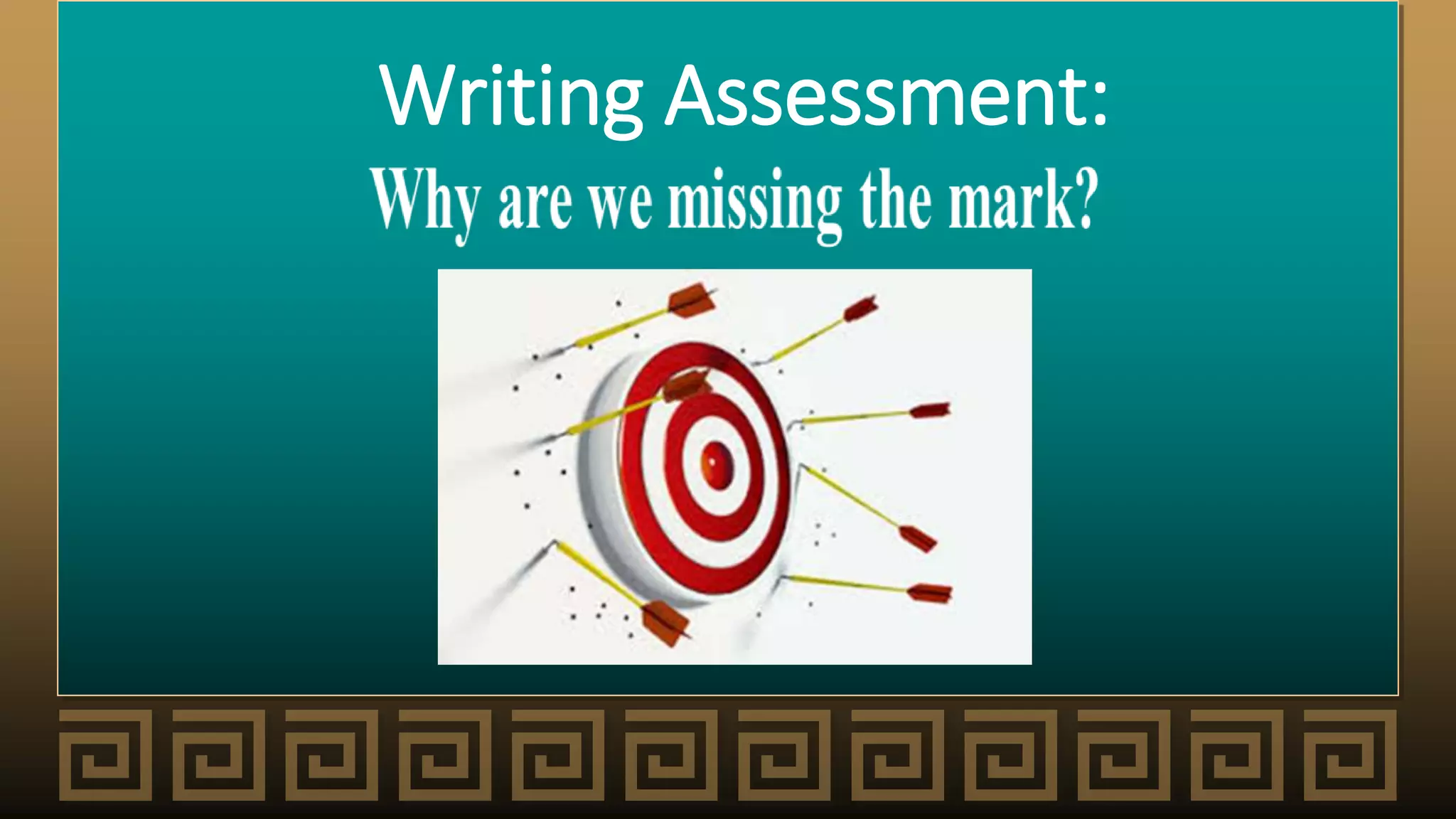

Writing Assessment:
Practice on the MIST site is a must—navigating the site,
keyboarding options (spellcheck, highlighting, no cut &
paste, no tabs); supposed to have a notepad for taking
notes as they read)
Student may move forward and backward through the
assessment. Students may start the second essay during
the first hour after completing the 1st essay.
Prompt types and lengths—
• Social studies and Science
• The website NEWSELA is a suggested
source for prompts from various subject
areas.
What is Evidence?
• Facts
• Definitions
• Concrete Details
• Quotations – limited by length…
• Other information
• Must be accurate and credible
What are Conventions?
• Sentence Structure
• Grammar
• Usage
• Spelling
• Capitalization
• Punctuation
Prompt #1
• Term/Phrase/Centrl Idea from
one text
• Students need to analyze the term/phrase
(central idea, point of view, theme, etc.) as
it is stated in the text; examine the usage
of the term at specific points in the text;
and show how it is developed in the text
i.e. explaining/analyzing how it is used in
the text.
• Use examples from the text throughout
your essay. Make them specific by
quoting/ paraphrasing…
• Length of the quotes need to be limited.
• Explain/analyze each quote/
paraphrase. (Back each quote
with 3 of y our own sentences)
Advice for Effective Use of
Quotes/Paraphrase
• Include author’s last name in an introduction
to the quote.
• Include line numbers after the quote (18).
• Quote only a portion of the sentence or
passage; paraphrase the rest.
Quoting/Paraphrasing/Summarizing
• Quotes/Paraphrases should be a
STRENGTH of the essay because they are
the words of a skilled writer. However, they
must directly connect to your thesis.
• Do not begin or conclude with a quote.
Quoting/Paraphrasing/Summarizing
• DO NOT summarize the article. Your thesis and
voice should dominate your essay (quotes/paraphrase
should be complementary/supportive).
• You MUSTcombine quotes/paraphrase evidence with
your analysis/explanation in the same paragraph.
Quoting/Paraphrasing/Summarizing
• Evidence is best used in a citable form (quotes or
paraphrases) in order for you to show clearly
that you know you are using it).
• Embedded quotes must be used as evidence to
support your thesis. If not, your quote is Static.
• Students need to show that they understand the
prompt and the stimulus (aka the article).
Misunderstanding what the stimulus (the
article) is stating or not writing DIRECTLY in
response to the prompt is deadly. You MUST
analyze the prompt as much as the article.
• Students need to practice how to
explain how an author uses and
develops a term, phrase, or idea
(central idea, point of view, theme
etc.).
• Writers may benefit from following a
specific, simple format: determine the
thesis (introduction), explain first point
with supports (paragraph #2), explain
second point with supports (paragraph
#3), conclude by wrapping up ideas by
restating the thesis in different words
(paragraph #4).
Introduction
• Include title of stimulus (article) and author’s
name.
• Introductions that generally summarize your
essay are effective, provided you also clearly
state a thesis.
Body
• Each paragraph should be a “unit of
thought,” i.e. You should focus on one
specific piece of evidence or point.
• Traditional paragraph structures are
effective, e.g., transition - topic sentence
(main idea)  evidence from stimulus 
analysis.
Conclusion
• The conclusion should be thoughtful, not a
collection of copied text from the article.
• Restate your thesis in new words, not the original
words used in the introduction.
• No new information.
• Do not use a rhetorical question.
• A thoughtful conclusion wraps up your ideas.
Prompt #2
• Comparing Two Texts
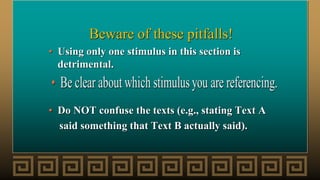
Beware of these pitfalls!
• Using only one stimulus in this section is
detrimental.
• Do NOT confuse the texts (e.g., stating Text A
said something that Text B actually said).
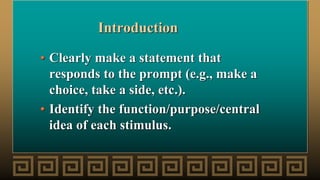
Introduction
• Clearly make a statement that
responds to the prompt (e.g., make a
choice, take a side, etc.).
• Identify the function/purpose/central
idea of each stimulus.
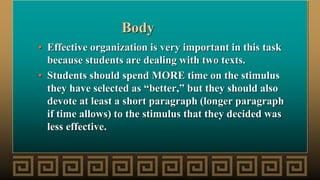
Body
• Effective organization is very important in this task
because students are dealing with two texts.
• Students should spend MORE time on the stimulus
they have selected as “better,” but they should also
devote at least a short paragraph (longer paragraph
if time allows) to the stimulus that they decided was
less effective.
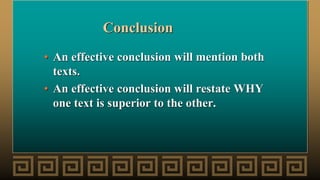
Conclusion
• An effective conclusion will mention both
texts.
• An effective conclusion will restate WHY
one text is superior to the other.
General Observations
• Rhetorical questions should not be
overused, but can be effective when
used sparingly.
• Students must balance the amount
of text (quoting, paraphrasing,
summarizing) they use from the
text.
• It is clear when students are
attempting to cleverly use the words
from the stimulus, so it is ineffective to
copy/paraphrase just to fill up space.
• Use of paragraphing is not required,
but it is highly recommended to receive
above a 2. A single, long paragraph
must be effectively organized and
transitioned. All essays should have a
definitive beginning, middle, and end.
• Using memorable words/phrases
from the stimulus without clearly
indicating they are using them as
evidence is ineffective.
• Avoid fluff words that fill space, e.g.
Dr. Ronald Smith from Duke
University in North Carolina said, “…
• Avoid becoming personal or using
language that makes the response seem
personal (use of “I” or “you”; use of
personal anecdotes). This assignment is a
text analysis.
• Transitions should NOT be formulaic
(e.g. first, second, third, in conclusion,
etc.) unless student is capable of only
formulaic transitions (anything is better
than nothing).
• Hyperbole and other propaganda-
type language are not effective.
• Attempts at humor should be
avoided.
• Students with better vocabulary
were noted. It may be effective to
provide students with a small,
usable list of academic words.
(See Jim Burke’s list as a starting
point.)
Recommendations
• Go over the rubric with your students
• Practice in a timed setting and online
when possible.
• Have students use the rubric to do peer
evaluation with justifications.
Goal of Maryville City Schools—Effective Writers

Writing assessment notes ppt

  • 1.
  • 2.
    Practice on theMIST site is a must—navigating the site, keyboarding options (spellcheck, highlighting, no cut & paste, no tabs); supposed to have a notepad for taking notes as they read) Student may move forward and backward through the assessment. Students may start the second essay during the first hour after completing the 1st essay.
  • 3.
    Prompt types andlengths— • Social studies and Science • The website NEWSELA is a suggested source for prompts from various subject areas.
  • 4.
    What is Evidence? •Facts • Definitions • Concrete Details • Quotations – limited by length… • Other information • Must be accurate and credible
  • 5.
    What are Conventions? •Sentence Structure • Grammar • Usage • Spelling • Capitalization • Punctuation
  • 6.
  • 7.
    • Students needto analyze the term/phrase (central idea, point of view, theme, etc.) as it is stated in the text; examine the usage of the term at specific points in the text; and show how it is developed in the text i.e. explaining/analyzing how it is used in the text.
  • 8.
    • Use examplesfrom the text throughout your essay. Make them specific by quoting/ paraphrasing… • Length of the quotes need to be limited.
  • 9.
    • Explain/analyze eachquote/ paraphrase. (Back each quote with 3 of y our own sentences)
  • 10.
    Advice for EffectiveUse of Quotes/Paraphrase • Include author’s last name in an introduction to the quote. • Include line numbers after the quote (18). • Quote only a portion of the sentence or passage; paraphrase the rest.
  • 11.
    Quoting/Paraphrasing/Summarizing • Quotes/Paraphrases shouldbe a STRENGTH of the essay because they are the words of a skilled writer. However, they must directly connect to your thesis. • Do not begin or conclude with a quote.
  • 12.
    Quoting/Paraphrasing/Summarizing • DO NOTsummarize the article. Your thesis and voice should dominate your essay (quotes/paraphrase should be complementary/supportive). • You MUSTcombine quotes/paraphrase evidence with your analysis/explanation in the same paragraph.
  • 13.
    Quoting/Paraphrasing/Summarizing • Evidence isbest used in a citable form (quotes or paraphrases) in order for you to show clearly that you know you are using it). • Embedded quotes must be used as evidence to support your thesis. If not, your quote is Static.
  • 14.
    • Students needto show that they understand the prompt and the stimulus (aka the article). Misunderstanding what the stimulus (the article) is stating or not writing DIRECTLY in response to the prompt is deadly. You MUST analyze the prompt as much as the article.
  • 15.
    • Students needto practice how to explain how an author uses and develops a term, phrase, or idea (central idea, point of view, theme etc.).
  • 16.
    • Writers maybenefit from following a specific, simple format: determine the thesis (introduction), explain first point with supports (paragraph #2), explain second point with supports (paragraph #3), conclude by wrapping up ideas by restating the thesis in different words (paragraph #4).
  • 17.
    Introduction • Include titleof stimulus (article) and author’s name. • Introductions that generally summarize your essay are effective, provided you also clearly state a thesis.
  • 18.
    Body • Each paragraphshould be a “unit of thought,” i.e. You should focus on one specific piece of evidence or point. • Traditional paragraph structures are effective, e.g., transition - topic sentence (main idea)  evidence from stimulus  analysis.
  • 19.
    Conclusion • The conclusionshould be thoughtful, not a collection of copied text from the article. • Restate your thesis in new words, not the original words used in the introduction. • No new information. • Do not use a rhetorical question. • A thoughtful conclusion wraps up your ideas.
  • 20.
  • 21.
    Beware of thesepitfalls! • Using only one stimulus in this section is detrimental. • Do NOT confuse the texts (e.g., stating Text A said something that Text B actually said).
  • 22.
    Introduction • Clearly makea statement that responds to the prompt (e.g., make a choice, take a side, etc.). • Identify the function/purpose/central idea of each stimulus.
  • 23.
    Body • Effective organizationis very important in this task because students are dealing with two texts. • Students should spend MORE time on the stimulus they have selected as “better,” but they should also devote at least a short paragraph (longer paragraph if time allows) to the stimulus that they decided was less effective.
  • 24.
    Conclusion • An effectiveconclusion will mention both texts. • An effective conclusion will restate WHY one text is superior to the other.
  • 25.
  • 26.
    • Rhetorical questionsshould not be overused, but can be effective when used sparingly.
  • 27.
    • Students mustbalance the amount of text (quoting, paraphrasing, summarizing) they use from the text.
  • 28.
    • It isclear when students are attempting to cleverly use the words from the stimulus, so it is ineffective to copy/paraphrase just to fill up space.
  • 29.
    • Use ofparagraphing is not required, but it is highly recommended to receive above a 2. A single, long paragraph must be effectively organized and transitioned. All essays should have a definitive beginning, middle, and end.
  • 30.
    • Using memorablewords/phrases from the stimulus without clearly indicating they are using them as evidence is ineffective.
  • 31.
    • Avoid fluffwords that fill space, e.g. Dr. Ronald Smith from Duke University in North Carolina said, “…
  • 32.
    • Avoid becomingpersonal or using language that makes the response seem personal (use of “I” or “you”; use of personal anecdotes). This assignment is a text analysis.
  • 33.
    • Transitions shouldNOT be formulaic (e.g. first, second, third, in conclusion, etc.) unless student is capable of only formulaic transitions (anything is better than nothing).
  • 34.
    • Hyperbole andother propaganda- type language are not effective. • Attempts at humor should be avoided.
  • 35.
    • Students withbetter vocabulary were noted. It may be effective to provide students with a small, usable list of academic words. (See Jim Burke’s list as a starting point.)
  • 36.
    Recommendations • Go overthe rubric with your students • Practice in a timed setting and online when possible. • Have students use the rubric to do peer evaluation with justifications.
  • 37.
    Goal of MaryvilleCity Schools—Effective Writers