WRIST INJURIES
MANAGEMENT
-Dr. Krupal Modi (MPT)
22/9/2018
Fracture of the scaphoid
• Post-immobilization rehabilitation
• Complication: stiff wrist joint and muscles wasting.
• Mobilization and strengthening of the wrist and other stiff
structures should begin immediately after cast removal.
• Paraffin wax bath
splints
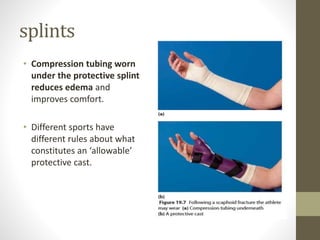
• Compression tubing worn
under the protective splint
reduces edema and
improves comfort.
• Different sports have
different rules about what
constitutes an ‘allowable’
protective cast.
De Q’s tenosynovitis
• Pre-operative:
• Splinting , electrical modalities, stretching, strenthening.
• Postoperative Management
• The hand is maintained in a soft bulky dressing for the first 2
to 3 days.
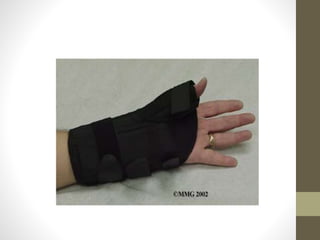
• A forearm-based thumb spica splint is then applied during the
first 2 weeks to control postoperative pain and swelling.
• Gentle active ROM and tendon gliding should be initiated in
the first few days postoperatively.
• Grip and pinch strengthening exercises may begin at
approximately 3 weeks and can be progressed gradually.
• By six weeks the patient usually is able to resume full
activities.
• Modalities
Modalities such as ultrasound, superficial heat, or
cryotherapy have been used in the postoperative treatment
of de Quervain’s release.
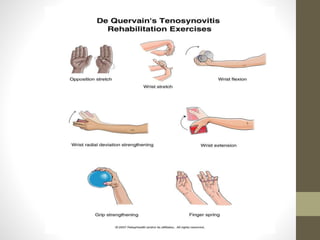
• Strengthening Exercises:
• Strengthening exercises can be initiated when painful
symptoms have subsided.
• Graded symptom-free exercises have bee shown to
increase metabolism, speed repair and prepare the
patient to meet the physical demands of daily
activities.
• Resistive exercises may be done in the isometric,
isotonic, or isokinetic modes depending on patient’s
tolerance.
• Putty, free weights, and theraband are practical for
home use.
Triangular fibrocartilage
complex tear
• Conservative Treatment: (RICE)
• The rehabilitation program has to consist of rest, activity
modification to remove the inciting force of injury, ice
application and splint immobilization for 3 to 6 weeks.
• After the immobilization, the patient should receive physical
therapy
• Treatment may include protective bracing,
• strengthening when able(more likely to give eccentric grip
strengthening exercises,),
• heat and/or electrotherapy modalities for pain.
• For restricted ROM - Passive mobilization of wrist joint.
• - To promote the wrist flexion we used the dorsal sliding
technique.
- To promote the wrist extension we used the volar sliding
technique.
- To promote the radial deviation we used the ulnar sliding
technique.
- To promote the ulnar deviation we used the radial sliding
technique
Carpal tunnel syndrome
• Most individuals with mild-to-moderate carpal tunnel
syndrome respond to conservative management, usually
consisting of splinting the wrist at nighttime for a
minimum of 3 weeks.
• Splinting
• Wrist splints are recommended for use either at night, or
both day and night.
• These help to keep wrist straight and reduce pressure on the
compressed nerve.
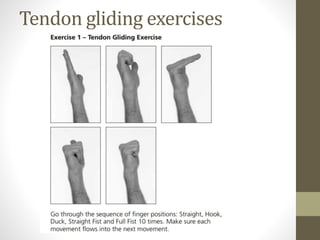
Tendon gliding exercises
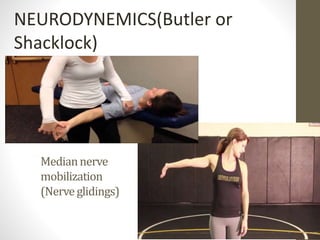
Mediannerve
mobilization
(Nerveglidings)
NEURODYNEMICS(Butler or
Shacklock)
Ulnar nerve compression
• Pain reduction : TENS , activity modification
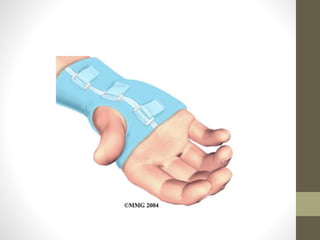
• Splinting
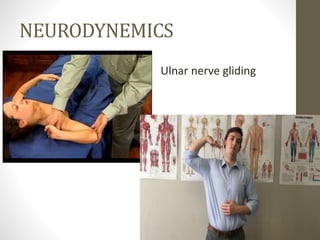
• Ulnar nerve mobilization
• Strengthening exercises (Grip)
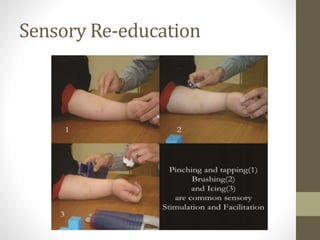
• Sensory Re-education
NEURODYNEMICS
Ulnar nerve gliding
Sensory Re-education
Wrist management

Wrist management

  • 1.
  • 2.
    Fracture of thescaphoid • Post-immobilization rehabilitation • Complication: stiff wrist joint and muscles wasting. • Mobilization and strengthening of the wrist and other stiff structures should begin immediately after cast removal. • Paraffin wax bath
  • 3.
    splints • Compression tubingworn under the protective splint reduces edema and improves comfort. • Different sports have different rules about what constitutes an ‘allowable’ protective cast.
  • 4.
    De Q’s tenosynovitis •Pre-operative: • Splinting , electrical modalities, stretching, strenthening. • Postoperative Management • The hand is maintained in a soft bulky dressing for the first 2 to 3 days. • A forearm-based thumb spica splint is then applied during the first 2 weeks to control postoperative pain and swelling. • Gentle active ROM and tendon gliding should be initiated in the first few days postoperatively.
  • 6.
    • Grip andpinch strengthening exercises may begin at approximately 3 weeks and can be progressed gradually. • By six weeks the patient usually is able to resume full activities. • Modalities Modalities such as ultrasound, superficial heat, or cryotherapy have been used in the postoperative treatment of de Quervain’s release.
  • 7.
    • Strengthening Exercises: •Strengthening exercises can be initiated when painful symptoms have subsided. • Graded symptom-free exercises have bee shown to increase metabolism, speed repair and prepare the patient to meet the physical demands of daily activities. • Resistive exercises may be done in the isometric, isotonic, or isokinetic modes depending on patient’s tolerance. • Putty, free weights, and theraband are practical for home use.
  • 9.
    Triangular fibrocartilage complex tear •Conservative Treatment: (RICE) • The rehabilitation program has to consist of rest, activity modification to remove the inciting force of injury, ice application and splint immobilization for 3 to 6 weeks. • After the immobilization, the patient should receive physical therapy • Treatment may include protective bracing, • strengthening when able(more likely to give eccentric grip strengthening exercises,), • heat and/or electrotherapy modalities for pain.
  • 10.
    • For restrictedROM - Passive mobilization of wrist joint. • - To promote the wrist flexion we used the dorsal sliding technique. - To promote the wrist extension we used the volar sliding technique. - To promote the radial deviation we used the ulnar sliding technique. - To promote the ulnar deviation we used the radial sliding technique
  • 11.
    Carpal tunnel syndrome •Most individuals with mild-to-moderate carpal tunnel syndrome respond to conservative management, usually consisting of splinting the wrist at nighttime for a minimum of 3 weeks. • Splinting • Wrist splints are recommended for use either at night, or both day and night. • These help to keep wrist straight and reduce pressure on the compressed nerve.
  • 12.
  • 13.
  • 14.
    Ulnar nerve compression •Pain reduction : TENS , activity modification • Splinting • Ulnar nerve mobilization • Strengthening exercises (Grip) • Sensory Re-education
  • 16.
  • 17.