DR. KRUPAL MODI
ASSISTANT PROFESSOR
SSPTC
KADODARA.
Yoga : A Holistic Approach
HOLISTIC MEANING……
 Holistic refers to addressing the whole
person, including their physical, mental, and
emotional health, while taking social factors into
consideration.
 This could be specific to diagnosis, in which case a
holistic approach might consider all possible
symptoms; or holistic treatment, which may be very
creative and empowers the patient to take charge of
their own care.
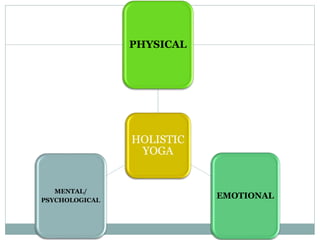
HOLISTIC
YOGA
PHYSICAL
EMOTIONAL
MENTAL/
PSYCHOLOGICAL
 Holistic approach
describing an approach to patient care in which the
physical, mental and social factors in the patient's
condition, rather than just the diagnosed disease, are
taken into account.
 Yoga helps a person to control his or her own
random thoughts and allows achieving stillness, a
calmness that creates inner harmony.
 Yoga is a holistic approach to well being. It has
physical, emotional and spiritual dimensions.
 Sage Patanjali who compiled the first yoga philosophy
defines yoga as an ability to control one’s own random
thoughts and achieve a stillness, a calmness that creates
inner harmony. This philosophy is usually referred to as
Ashtanga Yoga.
 Yoga is a holistic science embodying the basic principle
of organic, interconnectedness of different facets of life.
It is not a mere set of exercises.
 It goes beyond the physical exercises and connects
the body with thought processes. It seeks to build a
lifestyle that values calmness, harmony and positive
thinking. It is probably one of the most effective
therapies for many psycho-somatic disorders.
 It advocates purity of mind, speech and body,
contentment, acceptance of others,
perseverance, self study, self reflection,
contemplation of the supreme being.
 The word Yoga is derived from two roots. One
signifying “connection” and the second signifying
“concentration”.
 It connects physical health with mental equilibrium
and emotional tranquility.
 It promotes concentration and focused attention.
Apart from enhancing physical and mental
agility, yoga practice makes a person to adopt a
balanced attitude towards life at all times.
 It is a holistic system where the mind and
body act in unison and get completely rejuvenated
as physical postures, breathing exercises and
meditation help in overall well-being of an
individual.
Four basic principals of yoga’s healing system
 Human system is holistic entity.
 Each individual is unique.
 Self empowering.
 Quality and state of person’s mind.
Healing vs curing
 Yoga may not be able to cure disease but it can heal
the individual by positive change in attitude and
quality of life.
Qualities of healer
 Wise
 Has disciplined communication
 Has self control
 Generous and modest
 Ethical
 Has stable and focused mind
 Honest and confident
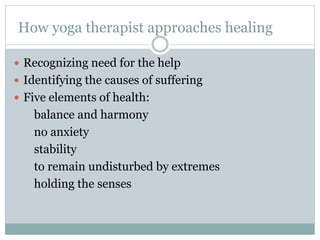
How yoga therapist approaches healing
 Recognizing need for the help
 Identifying the causes of suffering
 Five elements of health:
balance and harmony
no anxiety
stability
to remain undisturbed by extremes
holding the senses
some more benefits from holistic yoga:
• Stress relief
• Inner peace
• Improved immunity
• Living with greater awareness
• Better intuition
• Better relationships
• Better flexibility & posture
• Increased muscle strength and tone
• Improved respiration, energy and vitality
• Cardio and circulatory health
• Improved athletic performance
• Protection from injury
• Weight loss
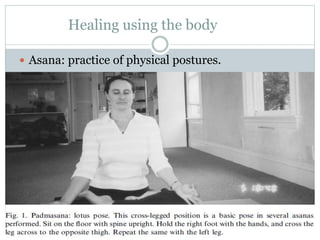
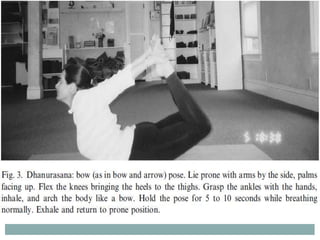
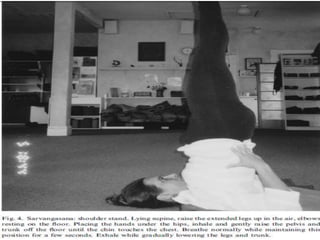
Healing using the body
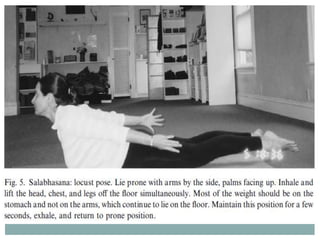
 Asana: practice of physical postures.
INTERNATIONAL YOGADAY
 On 11 December 2014, The 193-member United Nations General
Assembly approved by consensus, a resolution establishing 21
June as ‘International yoga day’. The declaration of this day
came after the call for the adoption of 21 June as International
Day of Yoga by Indian Prime Minister Narendra Modi during
his address to UN General Assembly on 27 September 2014. In
suggesting 21 June, which is the Summer Solstice, as the
International Day ofYoga.
 The first international day of Yoga was observed world over on
21 June 2015. About 35000 people, including IndianPrime
Minister Narendra Modi and a large number of
dignitaries, performed 21 Yoga asanas (yoga postures) for
35 minutes at Rajpath in New Delhi.
The event at Rajpath established two Guinness records
- largest Yoga Class with 35985 people and the record
for the most nationalities participating in it.
“You cannot always control what goes on
outside. But you can always control what
goes on inside”. - Wayne Dyer

Yoga- a holistic approach.pptx

  • 1.
    DR. KRUPAL MODI ASSISTANTPROFESSOR SSPTC KADODARA. Yoga : A Holistic Approach
  • 2.
    HOLISTIC MEANING……  Holisticrefers to addressing the whole person, including their physical, mental, and emotional health, while taking social factors into consideration.  This could be specific to diagnosis, in which case a holistic approach might consider all possible symptoms; or holistic treatment, which may be very creative and empowers the patient to take charge of their own care.
  • 3.
  • 4.
     Holistic approach describingan approach to patient care in which the physical, mental and social factors in the patient's condition, rather than just the diagnosed disease, are taken into account.  Yoga helps a person to control his or her own random thoughts and allows achieving stillness, a calmness that creates inner harmony.
  • 5.
     Yoga isa holistic approach to well being. It has physical, emotional and spiritual dimensions.  Sage Patanjali who compiled the first yoga philosophy defines yoga as an ability to control one’s own random thoughts and achieve a stillness, a calmness that creates inner harmony. This philosophy is usually referred to as Ashtanga Yoga.  Yoga is a holistic science embodying the basic principle of organic, interconnectedness of different facets of life. It is not a mere set of exercises.
  • 6.
     It goesbeyond the physical exercises and connects the body with thought processes. It seeks to build a lifestyle that values calmness, harmony and positive thinking. It is probably one of the most effective therapies for many psycho-somatic disorders.  It advocates purity of mind, speech and body, contentment, acceptance of others, perseverance, self study, self reflection, contemplation of the supreme being.
  • 7.
     The wordYoga is derived from two roots. One signifying “connection” and the second signifying “concentration”.  It connects physical health with mental equilibrium and emotional tranquility.  It promotes concentration and focused attention. Apart from enhancing physical and mental agility, yoga practice makes a person to adopt a balanced attitude towards life at all times.
  • 8.
     It isa holistic system where the mind and body act in unison and get completely rejuvenated as physical postures, breathing exercises and meditation help in overall well-being of an individual.
  • 9.
    Four basic principalsof yoga’s healing system  Human system is holistic entity.  Each individual is unique.  Self empowering.  Quality and state of person’s mind.
  • 10.
    Healing vs curing Yoga may not be able to cure disease but it can heal the individual by positive change in attitude and quality of life.
  • 11.
    Qualities of healer Wise  Has disciplined communication  Has self control  Generous and modest  Ethical  Has stable and focused mind  Honest and confident
  • 12.
    How yoga therapistapproaches healing  Recognizing need for the help  Identifying the causes of suffering  Five elements of health: balance and harmony no anxiety stability to remain undisturbed by extremes holding the senses
  • 13.
    some more benefitsfrom holistic yoga: • Stress relief • Inner peace • Improved immunity • Living with greater awareness • Better intuition • Better relationships • Better flexibility & posture • Increased muscle strength and tone • Improved respiration, energy and vitality • Cardio and circulatory health • Improved athletic performance • Protection from injury • Weight loss
  • 14.
    Healing using thebody  Asana: practice of physical postures.
  • 19.
    INTERNATIONAL YOGADAY  On11 December 2014, The 193-member United Nations General Assembly approved by consensus, a resolution establishing 21 June as ‘International yoga day’. The declaration of this day came after the call for the adoption of 21 June as International Day of Yoga by Indian Prime Minister Narendra Modi during his address to UN General Assembly on 27 September 2014. In suggesting 21 June, which is the Summer Solstice, as the International Day ofYoga.  The first international day of Yoga was observed world over on 21 June 2015. About 35000 people, including IndianPrime Minister Narendra Modi and a large number of dignitaries, performed 21 Yoga asanas (yoga postures) for 35 minutes at Rajpath in New Delhi.
  • 20.
    The event atRajpath established two Guinness records - largest Yoga Class with 35985 people and the record for the most nationalities participating in it.
  • 21.
    “You cannot alwayscontrol what goes on outside. But you can always control what goes on inside”. - Wayne Dyer