Worldwide
Telecommunications Inc.
Ana Bryant
Shawn Donnelly
Pennie Goodin
Casey Meyer
Geri Rowland
Ashley Walters
Introduction
• Cultural Changes in Business
• How Diversity Will Affect Teamwork and
Communication
• How Companies Can Embrace Cultural
Diversity in Their Workforce
Cultural Differences
• Pros
– Multiple New Ideas for Solutions to Problems
– Development of Language Skills
– Global Knowledge of New Processes
Cultural Differences
• Cons
– Language Barriers
– Miscommunication
– Lack of Communication
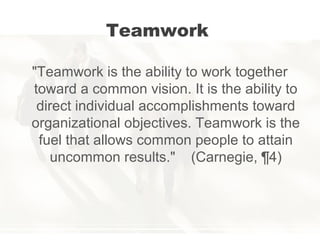
Teamwork
"Teamwork is the ability to work together
toward a common vision. It is the ability to
direct individual accomplishments toward
organizational objectives. Teamwork is the
fuel that allows common people to attain
uncommon results." (Carnegie, ¶4)
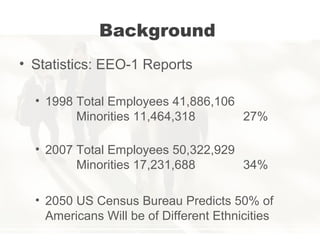
Background
• Statistics: EEO-1 Reports
• 1998 Total Employees 41,886,106
Minorities 11,464,318 27%
• 2007 Total Employees 50,322,929
Minorities 17,231,688 34%
• 2050 US Census Bureau Predicts 50% of
Americans Will be of Different Ethnicities
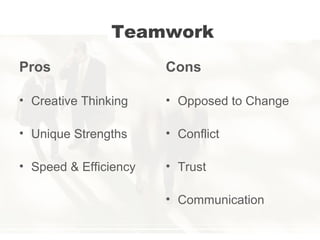
Teamwork
Pros
• Creative Thinking
• Unique Strengths
• Speed & Efficiency
Cons
• Opposed to Change
• Conflict
• Trust
• Communication
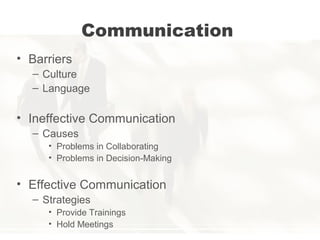
Communication
• Barriers
– Culture
– Language
• Ineffective Communication
– Causes
• Problems in Collaborating
• Problems in Decision-Making
• Effective Communication
– Strategies
• Provide Trainings
• Hold Meetings
Embracing Diversity
• Plan of Execution
– Education
– Training
– Implement
– Follow-up
• Participation
• Lead on Competition
• Increase Consumer Base
• Deter Bias
– Expand Knowledge
– Positive Attitude
Conclusion
• Between 1998 and 2008 41% of people
entering the workforce will be minorities
• Embrace advantages of diverse workforce to
increase productivity
• Make diversity part of the overall business plan
• Increase profitability
References
Clark, D. R. (November 7, 2008), Developing diversity. A big dog, little dog and knowledge jump production.
Retrieved July 3, 2009 from http://www.skagitwatershed.org/~donclark/leader/diverse.html
Devine, F., & Baum, T., & Hearns, N., & Devine, A. (2007). Managing cultural diversity: opportunities and challenges
for Northern Ireland hoteliers. International Journal of Contemporary Hospitality Management. Bradford: 2007.
Vol. 19, Iss. 2; pg. 120.
Green, K., Kepner, K., López, M., and Wysocki, A. (n.d.). Diversity in the workplace: benefits, challenges, and the
required managerial tools. University of Florida. Retrieved July 12, 2009, from http://edis.ifas.ufl.edu/hr022
Khurana, S. (2009) Andrew Carnegie quotations. Retrieved June 25, 2008, from
http://quotations.about.com/od/stillmorefamouspeople/a/AndrewCarnegie1.htm
Lee, M. (2005). Advantages of workplace diversity. Retrieved June 27, 2009, from
http://www.ethnoconnect.com/pdf/article08.pdf
Pitts, D., & Jarry, E. (2007). Ethnic diversity and organizational performance: Assessing diversity effects at the
managerial and street levels. International Public Management Journal, 10(2), 233-254.
The University of Vermont. (2009). The multicultural workforce overview. Retrieved July 12, 2009, from
http://www.uvm.edu/~farmlabr/?Page=multicultural/default.html&SM=multicultural/submenu_multicultural.html
The U.S. Equal Employment Opportunity Commission. (2009). Job patterns for minorities and women in private
industry. Retrieved July 12, 2009, from http://www.eeoc.gov/stats/jobpat/jobpat.html
The U.S. Equal Employment Opportunity Commission. (2009). 2007 EEO-1 national aggregate report. Retrieved
July 12, 2009, from http://www.eeoc.gov/stats/jobpat/2007/us/national.html
The U.S. Equal Employment Opportunity Commission. (2000). Table 1. occupational employment in private industry
by race/ethnic group/sex and by industry, united states, 1998. Retrieved July 12, 2009, from
http://www.eeoc.gov/stats/jobpat/1998/tables-1.html

Worldwide Telecomunications Inc. Communication

  • 1.
    Worldwide Telecommunications Inc. Ana Bryant ShawnDonnelly Pennie Goodin Casey Meyer Geri Rowland Ashley Walters
  • 2.
    Introduction • Cultural Changesin Business • How Diversity Will Affect Teamwork and Communication • How Companies Can Embrace Cultural Diversity in Their Workforce
  • 3.
    Cultural Differences • Pros –Multiple New Ideas for Solutions to Problems – Development of Language Skills – Global Knowledge of New Processes
  • 4.
    Cultural Differences • Cons –Language Barriers – Miscommunication – Lack of Communication
  • 5.
    Teamwork "Teamwork is theability to work together toward a common vision. It is the ability to direct individual accomplishments toward organizational objectives. Teamwork is the fuel that allows common people to attain uncommon results." (Carnegie, ¶4)
  • 6.
    Background • Statistics: EEO-1Reports • 1998 Total Employees 41,886,106 Minorities 11,464,318 27% • 2007 Total Employees 50,322,929 Minorities 17,231,688 34% • 2050 US Census Bureau Predicts 50% of Americans Will be of Different Ethnicities
  • 7.
    Teamwork Pros • Creative Thinking •Unique Strengths • Speed & Efficiency Cons • Opposed to Change • Conflict • Trust • Communication
  • 8.
    Communication • Barriers – Culture –Language • Ineffective Communication – Causes • Problems in Collaborating • Problems in Decision-Making • Effective Communication – Strategies • Provide Trainings • Hold Meetings
  • 9.
    Embracing Diversity • Planof Execution – Education – Training – Implement – Follow-up • Participation • Lead on Competition • Increase Consumer Base • Deter Bias – Expand Knowledge – Positive Attitude
  • 10.
    Conclusion • Between 1998and 2008 41% of people entering the workforce will be minorities • Embrace advantages of diverse workforce to increase productivity • Make diversity part of the overall business plan • Increase profitability
  • 11.
    References Clark, D. R.(November 7, 2008), Developing diversity. A big dog, little dog and knowledge jump production. Retrieved July 3, 2009 from http://www.skagitwatershed.org/~donclark/leader/diverse.html Devine, F., & Baum, T., & Hearns, N., & Devine, A. (2007). Managing cultural diversity: opportunities and challenges for Northern Ireland hoteliers. International Journal of Contemporary Hospitality Management. Bradford: 2007. Vol. 19, Iss. 2; pg. 120. Green, K., Kepner, K., López, M., and Wysocki, A. (n.d.). Diversity in the workplace: benefits, challenges, and the required managerial tools. University of Florida. Retrieved July 12, 2009, from http://edis.ifas.ufl.edu/hr022 Khurana, S. (2009) Andrew Carnegie quotations. Retrieved June 25, 2008, from http://quotations.about.com/od/stillmorefamouspeople/a/AndrewCarnegie1.htm Lee, M. (2005). Advantages of workplace diversity. Retrieved June 27, 2009, from http://www.ethnoconnect.com/pdf/article08.pdf Pitts, D., & Jarry, E. (2007). Ethnic diversity and organizational performance: Assessing diversity effects at the managerial and street levels. International Public Management Journal, 10(2), 233-254. The University of Vermont. (2009). The multicultural workforce overview. Retrieved July 12, 2009, from http://www.uvm.edu/~farmlabr/?Page=multicultural/default.html&SM=multicultural/submenu_multicultural.html The U.S. Equal Employment Opportunity Commission. (2009). Job patterns for minorities and women in private industry. Retrieved July 12, 2009, from http://www.eeoc.gov/stats/jobpat/jobpat.html The U.S. Equal Employment Opportunity Commission. (2009). 2007 EEO-1 national aggregate report. Retrieved July 12, 2009, from http://www.eeoc.gov/stats/jobpat/2007/us/national.html The U.S. Equal Employment Opportunity Commission. (2000). Table 1. occupational employment in private industry by race/ethnic group/sex and by industry, united states, 1998. Retrieved July 12, 2009, from http://www.eeoc.gov/stats/jobpat/1998/tables-1.html