1
Diversity…multicultural and
multigenerational
Lessons for the Healthcare Community
Sharon M. Weinstein, MS, RN, CRNI, FACW, FAAN
Learning Objectives
0 Define key terms: diversity, culture and generations
0 Discuss cultural awareness and its impact on interactions
with colleagues and clients
0 Identify five key techniques for creating a team culture of
acceptance
0 Describe a definition of diversity
0 Recognize the effect of a multigenerational workforce on
outcomes and productivity
Diversity
0 The qualities that make individuals different
from or similar to others, such as personal
history, gender, race, sexual preference,
abilities and disabilities, religion, class,
professional, and educational background, etc.
2
Culture
0 The vast structure of behaviors, ideas,
attitudes, values, habits, beliefs customs,
language, rituals, and ceremonies practiced by
a group of people.
0 Culture provides a general design for living
patterns for interpreting reality.
Cultural Archives
0 This is the knowledge gained through
individual cultural experiences.
0 Our cultural archives tell us how to interpret
and respond to the world around us.
Your Diversity IQ
0 What are your concerns about diversity?
0 Do you work in a diverse company?
0 What makes it diverse?
0 What would you like to see change?
3
Diversity and the Team
Teaching Tolerance
0 Tolerance is defined as “recognition of and respect
for the opinions, practices or behavior of others.”
Remember . . .
People long
to be celebrated,
not tolerated!
4
Forming a Team
0 There are three important characteristics of teams:
size, diversity and interdependence.
0 Teams diverse in skill sets and knowledge levels, as
well as ethnicity and culture, perform better than
those with identical skills sets.
0 Diversity actually decreases team conflicts and
enhances creativity.
Are You Part of the Team?
0 We are all unique
0 We are all part of something bigger
0 We choose who we are going to be
0 There is no perfection
0 You are the most incredible person in the world
Cultural Diversity Activities
0 Multicultural Calendars (cultural information
divided by the month, holiday and country)
0 Readings
0 Quizzes
0 Fact sheets
0 Other tools that foster dialogue and questions
within the organization
5
Why are Activities Important?
0 They help clinicians reach clients who may benefit
from a more hands-on or practical learning
experience.
0 They encourage clients to become actively involved
in the therapeutic process without bias, rather than
being passive recipients.
Four Steps to Success
0 Leadership driven
0 Staff oriented
0 Client oriented
0 Information driven
Leadership Driven
0 Create and maintain diversity by:
 Multiculturalism embedded into all
organizational units.
 Continued efforts to recruit, retain and
develop a culturally diverse workforce.
6
Staff Oriented
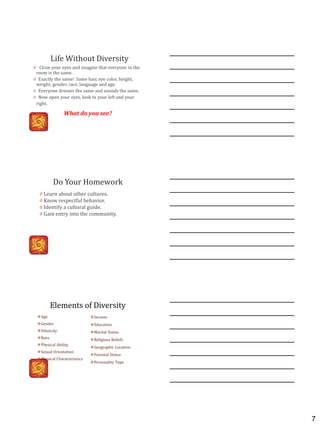
0 Support cultural competency
of the staff.
Client Oriented
0 To support and promote the
involvement of clients, families and
advocacy groups in the planning and
development of care.
Information Driven
0 To support monitoring and
dissemination of the level of cultural
awareness, knowledge and skills
7
Life Without Diversity
0 Close your eyes and imagine that everyone in the
room is the same.
0 Exactly the same! Same hair, eye color, height,
weight, gender, race, language and age.
0 Everyone dresses the same and sounds the same.
0 Now open your eyes, look to your left and your
right.
What do you see?
Do Your Homework
0 Learn about other cultures.
0 Know respectful behavior.
0 Identify a cultural guide.
0 Gain entry into the community.
Elements of Diversity
Age
Gender
Ethnicity
Race
Physical Ability
Sexual Orientation
Physical Characteristics
Income
Education
Marital Status
Religious Beliefs
Geographic Location
Parental Status
Personality Type
8
Incorporating Diversity
Recruiting from diverse talent pools to make the
company open to employees from various
backgrounds.
Diversity may be infused into advertising practices to
ensure products and services are targeted to all
consumers who represent the target market, whether
through print, online, television or radio.
Managing Diversity
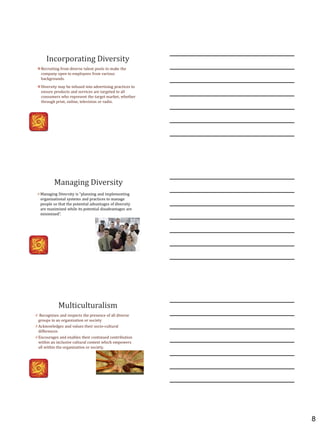
0 Managing Diversity is “planning and implementing
organizational systems and practices to manage
people so that the potential advantages of diversity
are maximized while its potential disadvantages are
minimized”.
Multiculturalism
0 Recognizes and respects the presence of all diverse
groups in an organization or society
0 Acknowledges and values their socio-cultural
differences
0 Encourages and enables their continued contribution
within an inclusive cultural context which empowers
all within the organization or society.
9
Key to growth
0 In today’s new
workplace, diversity
management is a time-
sensitive business
imperative.
0 Organizations that seek
global market relevancy
must embrace diversity
– in how they think, act
and innovate.
0 Diversity can no longer
just be about making the
numbers, but rather
how an organization
treats its people
Women in the Workplace
Today's workforce has the highest number of women
The number of dual income families and single
working mothers has increased.
Change in the family structure means that there are
fewer men and women in traditional family roles.
Therefore, diversity issues cut across both race and
gender.
The Multigenerational
Workforce
0 Generation Z (post-millennials, 11-20)
0 Generation Y (text, tweet, instant messaging)
0 Generation X (phone calls and email)
0 Baby boomers (phone calls and email)
Is a four-generation office in our future?
10
Stereotypes
0 Negative – lazy, entitled, tech-obsessed, over-eager
0 Been there and done that
0 Mobile work trends
0 Measuring performance
0 Work-life balance
The Competitive Edge
 Improves corporate culture
 Improves morale
 Facilitates recruiting
 Enables access to emerging
markets
 Increases creativity
 Reduction in skill shortages
 Decreased interpersonal
conflict among employees
 Improves client relations
 Increases productivity
 Improves the bottom line
 Maximizes brand identity
 Responsive service delivery
and enhanced staff skills
Benefits
Enhanced customer service
Improved image within the
Staff empowerment
Recognition and retention
11
Possible Barriers
Lack of diverse applicant pool
Lack of diversity at the senior ranks
Categorizing people into certain positions
Always recruiting from same source
Grooming/developing only one person
Pre-selection
“Golf course” meetings
Managing Diversity
Secure top management commitment
Alternative work arrangements
Increase diversity skills
Organizational assessment
Attracting employees
Accommodating work and family needs
 62000 people from 128 countries
 Believes in equal chance and offers to all its
employees
 Partnerships with community colleges all over
Germany
 Employees improve communication skills
Case Study
12
50 year old company
 A diverse workforce
 Strong belief that health is one’s greatest
wealth
 Powered by Heart
 Growth opportunities for all
Case Study
Summary
A diverse workforce is a reflection of a changing
world and marketplace.
Diverse work teams bring high value to organizations.
Respecting individual differences will benefit the
workplace by creating a competitive edge and
increasing work productivity.
Diversity management benefits associates by creating
a fair and safe environment where everyone has
access to opportunities and challenges.
Thank you
Sharon M. Weinstein
sharon@smwgroupllc.com
sharon@sharonmweinstein.com
sharon@gedinfp.com

diversity_SMW.11.20.14

  • 1.
    1 Diversity…multicultural and multigenerational Lessons forthe Healthcare Community Sharon M. Weinstein, MS, RN, CRNI, FACW, FAAN Learning Objectives 0 Define key terms: diversity, culture and generations 0 Discuss cultural awareness and its impact on interactions with colleagues and clients 0 Identify five key techniques for creating a team culture of acceptance 0 Describe a definition of diversity 0 Recognize the effect of a multigenerational workforce on outcomes and productivity Diversity 0 The qualities that make individuals different from or similar to others, such as personal history, gender, race, sexual preference, abilities and disabilities, religion, class, professional, and educational background, etc.
  • 2.
    2 Culture 0 The vaststructure of behaviors, ideas, attitudes, values, habits, beliefs customs, language, rituals, and ceremonies practiced by a group of people. 0 Culture provides a general design for living patterns for interpreting reality. Cultural Archives 0 This is the knowledge gained through individual cultural experiences. 0 Our cultural archives tell us how to interpret and respond to the world around us. Your Diversity IQ 0 What are your concerns about diversity? 0 Do you work in a diverse company? 0 What makes it diverse? 0 What would you like to see change?
  • 3.
    3 Diversity and theTeam Teaching Tolerance 0 Tolerance is defined as “recognition of and respect for the opinions, practices or behavior of others.” Remember . . . People long to be celebrated, not tolerated!
  • 4.
    4 Forming a Team 0There are three important characteristics of teams: size, diversity and interdependence. 0 Teams diverse in skill sets and knowledge levels, as well as ethnicity and culture, perform better than those with identical skills sets. 0 Diversity actually decreases team conflicts and enhances creativity. Are You Part of the Team? 0 We are all unique 0 We are all part of something bigger 0 We choose who we are going to be 0 There is no perfection 0 You are the most incredible person in the world Cultural Diversity Activities 0 Multicultural Calendars (cultural information divided by the month, holiday and country) 0 Readings 0 Quizzes 0 Fact sheets 0 Other tools that foster dialogue and questions within the organization
  • 5.
    5 Why are ActivitiesImportant? 0 They help clinicians reach clients who may benefit from a more hands-on or practical learning experience. 0 They encourage clients to become actively involved in the therapeutic process without bias, rather than being passive recipients. Four Steps to Success 0 Leadership driven 0 Staff oriented 0 Client oriented 0 Information driven Leadership Driven 0 Create and maintain diversity by:  Multiculturalism embedded into all organizational units.  Continued efforts to recruit, retain and develop a culturally diverse workforce.
  • 6.
    6 Staff Oriented 0 Supportcultural competency of the staff. Client Oriented 0 To support and promote the involvement of clients, families and advocacy groups in the planning and development of care. Information Driven 0 To support monitoring and dissemination of the level of cultural awareness, knowledge and skills
  • 7.
    7 Life Without Diversity 0Close your eyes and imagine that everyone in the room is the same. 0 Exactly the same! Same hair, eye color, height, weight, gender, race, language and age. 0 Everyone dresses the same and sounds the same. 0 Now open your eyes, look to your left and your right. What do you see? Do Your Homework 0 Learn about other cultures. 0 Know respectful behavior. 0 Identify a cultural guide. 0 Gain entry into the community. Elements of Diversity Age Gender Ethnicity Race Physical Ability Sexual Orientation Physical Characteristics Income Education Marital Status Religious Beliefs Geographic Location Parental Status Personality Type
  • 8.
    8 Incorporating Diversity Recruiting fromdiverse talent pools to make the company open to employees from various backgrounds. Diversity may be infused into advertising practices to ensure products and services are targeted to all consumers who represent the target market, whether through print, online, television or radio. Managing Diversity 0 Managing Diversity is “planning and implementing organizational systems and practices to manage people so that the potential advantages of diversity are maximized while its potential disadvantages are minimized”. Multiculturalism 0 Recognizes and respects the presence of all diverse groups in an organization or society 0 Acknowledges and values their socio-cultural differences 0 Encourages and enables their continued contribution within an inclusive cultural context which empowers all within the organization or society.
  • 9.
    9 Key to growth 0In today’s new workplace, diversity management is a time- sensitive business imperative. 0 Organizations that seek global market relevancy must embrace diversity – in how they think, act and innovate. 0 Diversity can no longer just be about making the numbers, but rather how an organization treats its people Women in the Workplace Today's workforce has the highest number of women The number of dual income families and single working mothers has increased. Change in the family structure means that there are fewer men and women in traditional family roles. Therefore, diversity issues cut across both race and gender. The Multigenerational Workforce 0 Generation Z (post-millennials, 11-20) 0 Generation Y (text, tweet, instant messaging) 0 Generation X (phone calls and email) 0 Baby boomers (phone calls and email) Is a four-generation office in our future?
  • 10.
    10 Stereotypes 0 Negative –lazy, entitled, tech-obsessed, over-eager 0 Been there and done that 0 Mobile work trends 0 Measuring performance 0 Work-life balance The Competitive Edge  Improves corporate culture  Improves morale  Facilitates recruiting  Enables access to emerging markets  Increases creativity  Reduction in skill shortages  Decreased interpersonal conflict among employees  Improves client relations  Increases productivity  Improves the bottom line  Maximizes brand identity  Responsive service delivery and enhanced staff skills Benefits Enhanced customer service Improved image within the Staff empowerment Recognition and retention
  • 11.
    11 Possible Barriers Lack ofdiverse applicant pool Lack of diversity at the senior ranks Categorizing people into certain positions Always recruiting from same source Grooming/developing only one person Pre-selection “Golf course” meetings Managing Diversity Secure top management commitment Alternative work arrangements Increase diversity skills Organizational assessment Attracting employees Accommodating work and family needs  62000 people from 128 countries  Believes in equal chance and offers to all its employees  Partnerships with community colleges all over Germany  Employees improve communication skills Case Study
  • 12.
    12 50 year oldcompany  A diverse workforce  Strong belief that health is one’s greatest wealth  Powered by Heart  Growth opportunities for all Case Study Summary A diverse workforce is a reflection of a changing world and marketplace. Diverse work teams bring high value to organizations. Respecting individual differences will benefit the workplace by creating a competitive edge and increasing work productivity. Diversity management benefits associates by creating a fair and safe environment where everyone has access to opportunities and challenges. Thank you Sharon M. Weinstein sharon@smwgroupllc.com sharon@sharonmweinstein.com sharon@gedinfp.com