
November 5, 2011
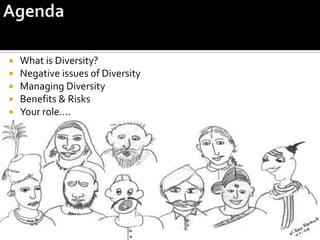
 What is Diversity?
 Negative issues of Diversity
 Managing Diversity
 Benefits & Risks
 Your role….
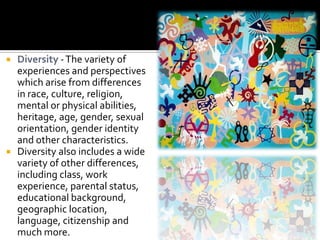
 Diversity - The variety of
  experiences and perspectives
  which arise from differences
  in race, culture, religion,
  mental or physical abilities,
  heritage, age, gender, sexual
  orientation, gender identity
  and other characteristics.
 Diversity also includes a wide
  variety of other differences,
  including class, work
  experience, parental status,
  educational background,
  geographic location,
  language, citizenship and
  much more.
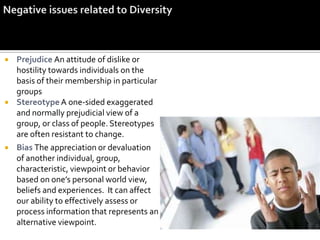
   Prejudice An attitude of dislike or
    hostility towards individuals on the
    basis of their membership in particular
    groups
   Stereotype A one-sided exaggerated
    and normally prejudicial view of a
    group, or class of people. Stereotypes
    are often resistant to change.
   Bias The appreciation or devaluation
    of another individual, group,
    characteristic, viewpoint or behavior
    based on one’s personal world view,
    beliefs and experiences. It can affect
    our ability to effectively assess or
    process information that represents an
    alternative viewpoint.
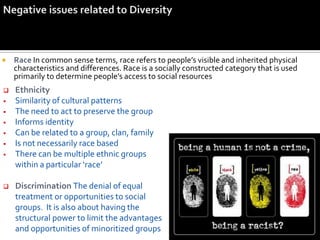
   Race In common sense terms, race refers to people’s visible and inherited physical
    characteristics and differences. Race is a socially constructed category that is used
    primarily to determine people’s access to social resources
   Ethnicity
•   Similarity of cultural patterns
•   The need to act to preserve the group
•   Informs identity
•   Can be related to a group, clan, family
•   Is not necessarily race based
•   There can be multiple ethnic groups
    within a particular ‘race’

   Discrimination The denial of equal
    treatment or opportunities to social
    groups. It is also about having the
    structural power to limit the advantages
    and opportunities of minoritized groups
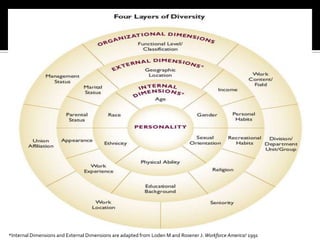
*Internal Dimensions and External Dimensions are adapted from Loden M and Rosener J: Workforce America! 1991
Managing Diversity involves….


1. Creating a workplace environment that values and
   utilizes the contributions of people with different
   backgrounds, experiences and perspectives
2. Recognizing the contribution that diversity of
   perspectives makes to generating new ideas and
   ways of doing things
3. Embracing the range of individual skills, educational
   qualifications, work experience background,
   languages, etc. that can improve the organization
4. Changing workforce practices to accommodate
   diverse individual realities eg. parental status, sexual
   orientation, religion etc
Benefits of Managing & Including Diversity


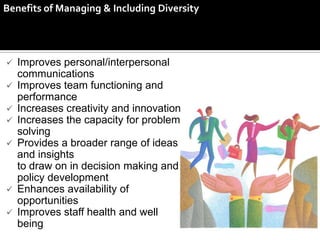
 Improves personal/interpersonal
  communications
 Improves team functioning and
  performance
 Increases creativity and innovation
 Increases the capacity for problem
  solving
 Provides a broader range of ideas
  and insights
  to draw on in decision making and
  policy development
 Enhances availability of
  opportunities
 Improves staff health and well
  being
Benefits of Managing & Including Diversity


   Reduces absenteeism
   Improves staff morale
   Includes a more varied talent
    pool
   Increases ability to attract
    and retain valued employees
   Improves quality of service
    and client satisfaction
   Can lead to an enhanced
    community image
   Can lead to savings in
    recruitment and training
    costs
Cost of Ignoring Diversity


  • Time
  • Money
  • Efficiency, loss of
    productivity
  • Unhealthy tensions
  • Increased conflict
  • Inability to attract and
    retain talented people
  • Complaints and legal
    actions
  • Inability to retain valuable
    employees
  • Lost investments in
    recruitment and training.
Your Role….


    Each person plays a key role in transforming the organizational culture
     to respect diversity. Some of the skills needed are:
    Develop an understanding and acceptance of diversity
    Recognition that diversity should be represented in every aspect of the
     organization
    Develop self-awareness, in terms of understanding your own culture,
     identity, biases, prejudices, and stereotypes
    Challenge and change institutional practices that present barriers to
     different groups
 Show respect
 Avoid embarrassment
 Enhance understanding
 Avoid weakened negotiating position
Latin American:
   • Business based on friendship
   • Relaxed atmosphere
European:
   • Belgian—conservative, efficient, impersonal
   • German—direct, factual
   • Dutch—little room for debate
   • French—intellectual approach
   • Greek—government contacts
   • Italian—confident, shrewd, competent
   • British—proper; neither imposing nor offensive
Japanese:
   • Indirect
   • Rely on trusted go-betweens
   • Build relationships
   • Try various strategies
   • Honor oral commitments
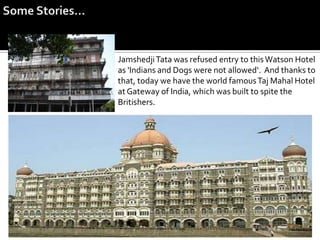
Jamshedji Tata was refused entry to this Watson Hotel
as 'Indians and Dogs were not allowed‘. And thanks to
that, today we have the world famous Taj Mahal Hotel
at Gateway of India, which was built to spite the
Britishers.
Thank you
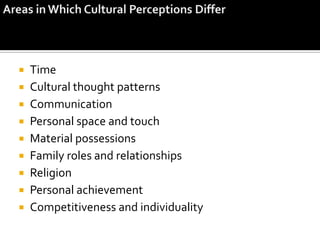
   Time
   Cultural thought patterns
   Communication
   Personal space and touch
   Material possessions
   Family roles and relationships
   Religion
   Personal achievement
   Competitiveness and individuality

Managing Diversity for Competitive Advantage ver2

  • 1.
  • 2.
     What isDiversity?  Negative issues of Diversity  Managing Diversity  Benefits & Risks  Your role….
  • 3.
     Diversity -The variety of experiences and perspectives which arise from differences in race, culture, religion, mental or physical abilities, heritage, age, gender, sexual orientation, gender identity and other characteristics.  Diversity also includes a wide variety of other differences, including class, work experience, parental status, educational background, geographic location, language, citizenship and much more.
  • 4.
    Prejudice An attitude of dislike or hostility towards individuals on the basis of their membership in particular groups  Stereotype A one-sided exaggerated and normally prejudicial view of a group, or class of people. Stereotypes are often resistant to change.  Bias The appreciation or devaluation of another individual, group, characteristic, viewpoint or behavior based on one’s personal world view, beliefs and experiences. It can affect our ability to effectively assess or process information that represents an alternative viewpoint.
  • 5.
    Race In common sense terms, race refers to people’s visible and inherited physical characteristics and differences. Race is a socially constructed category that is used primarily to determine people’s access to social resources  Ethnicity • Similarity of cultural patterns • The need to act to preserve the group • Informs identity • Can be related to a group, clan, family • Is not necessarily race based • There can be multiple ethnic groups within a particular ‘race’  Discrimination The denial of equal treatment or opportunities to social groups. It is also about having the structural power to limit the advantages and opportunities of minoritized groups
  • 6.
    *Internal Dimensions andExternal Dimensions are adapted from Loden M and Rosener J: Workforce America! 1991
  • 7.
    Managing Diversity involves…. 1.Creating a workplace environment that values and utilizes the contributions of people with different backgrounds, experiences and perspectives 2. Recognizing the contribution that diversity of perspectives makes to generating new ideas and ways of doing things 3. Embracing the range of individual skills, educational qualifications, work experience background, languages, etc. that can improve the organization 4. Changing workforce practices to accommodate diverse individual realities eg. parental status, sexual orientation, religion etc
  • 8.
    Benefits of Managing& Including Diversity  Improves personal/interpersonal communications  Improves team functioning and performance  Increases creativity and innovation  Increases the capacity for problem solving  Provides a broader range of ideas and insights to draw on in decision making and policy development  Enhances availability of opportunities  Improves staff health and well being
  • 9.
    Benefits of Managing& Including Diversity  Reduces absenteeism  Improves staff morale  Includes a more varied talent pool  Increases ability to attract and retain valued employees  Improves quality of service and client satisfaction  Can lead to an enhanced community image  Can lead to savings in recruitment and training costs
  • 10.
    Cost of IgnoringDiversity • Time • Money • Efficiency, loss of productivity • Unhealthy tensions • Increased conflict • Inability to attract and retain talented people • Complaints and legal actions • Inability to retain valuable employees • Lost investments in recruitment and training.
  • 11.
    Your Role….  Each person plays a key role in transforming the organizational culture to respect diversity. Some of the skills needed are:  Develop an understanding and acceptance of diversity  Recognition that diversity should be represented in every aspect of the organization  Develop self-awareness, in terms of understanding your own culture, identity, biases, prejudices, and stereotypes  Challenge and change institutional practices that present barriers to different groups
  • 12.
     Show respect Avoid embarrassment  Enhance understanding  Avoid weakened negotiating position
  • 13.
    Latin American: • Business based on friendship • Relaxed atmosphere European: • Belgian—conservative, efficient, impersonal • German—direct, factual • Dutch—little room for debate • French—intellectual approach • Greek—government contacts • Italian—confident, shrewd, competent • British—proper; neither imposing nor offensive Japanese: • Indirect • Rely on trusted go-betweens • Build relationships • Try various strategies • Honor oral commitments
  • 14.
    Jamshedji Tata wasrefused entry to this Watson Hotel as 'Indians and Dogs were not allowed‘. And thanks to that, today we have the world famous Taj Mahal Hotel at Gateway of India, which was built to spite the Britishers.
  • 16.
  • 17.
    Time  Cultural thought patterns  Communication  Personal space and touch  Material possessions  Family roles and relationships  Religion  Personal achievement  Competitiveness and individuality