INTRODUCTION  |  1
Politically adopted in city council, March 2016
SUSTAINABLE
URBAN
MOBILITY PLAN
CREATING A MORE ACCESSIBLE MALMÖ
Project information………………………………………………………………4
PREFACE……………………………………………………………………………5
SUMMARY…………………………………………………………………………6
1 INTRODUCTION………………………………………………………………8
Purpose of the Sustainable Urban Mobility Plan…………………………………9
Background and Challenges…………………………………………………… 12
2  HUMAN BEINGS…………………………………………………………… 18
Access to one’s city – a more equal city………………………………………… 19
Involving people and planning traffic for improved public health…………… 22
Slower pace and higher traffic safety………………………………………… 24
Mobility management………………………………………………………… 25
3  TRAFFIC AND MOVEMENT………………………………………………… 26
Changed travel patterns for greater accessibility……………………………… 27
Prioritising surface efficient transport modes – reorganising streetscapes… 27
Promoting green vehicles, technical innovations and renewable fuels……… 28
Target oriented transport demand…………………………………………… 29
Objective for passenger and freight traffic within, to and from Malmö……… 30
Objective for inhabitants’trips………………………………………………… 30
Strategies for inhabitants’trips………………………………………………… 34
Objective - sustainable commuting…………………………………………… 36
Strategies - sustainable commuting…………………………………………… 38
Objective - sustainable freight traffic and city logistics……………………… 41
Strategies for sustainable freight traffic and city logistics…………………… 42
4  THE CITY…………………………………………………………………… 44
A dense, integrated and green city with short distances
enables sustainable travelling………………………………………………… 46
Democratic division of urban space…………………………………………… 46
Urbanized main roads – streets constituted by movement and urban life…… 47
Urbanized main roads – potential and definition……………………………… 48
How local roads contribute to urban life……………………………………… 56
5 IMPLEMENTATION………………………………………………………… 58
Organisation…………………………………………………………………… 59
Responsibility for actions……………………………………………………… 59
Funding………………………………………………………………………… 60
Cooperation and networks…………………………………………………… 60
Communication………………………………………………………………… 60
ONGOING processes and NEXT STEP actions………………………………… 60
Impact assessment……………………………………………………………… 62
6 FOLLOW-UP………………………………………………………………… 64
Follow-up of the SUMP goals and indicators………………………………… 65
TABLE OF CONTENTS
© Malmö Stad
Design: Garbergs Malmö
Winner of:
PREFACE  |  54  |  PROJECT INFORMATION
More Malmo for more people
More people choose to live in cities and more people choose to stay in Malmö.
Malmö’s population has increased over the past thirty years and the city
continues to grow.
The fact that more people choose to settle in Malmo is positive and increases
the demands on new solutions and approaches to create a sustainable city.
Good solutions to traffic and movements in the city are important due to the
increased population.
Malmö´s first traffic and mobility plan takes a holistic approach to the link
between urban development and sustainable transport based on economic,
social and environmental sustainability.
Malmö needs to become a more accessible city for more people. People should
be able to take part of the city and its schools, leisure facilities, public spaces,
workplaces, parks, range of services and entertainment - regardless of age, gen-
der and income. To link the city together, accessibility is an important key.
Malmö´s traffic and mobility plan is based on the idea of what kind of city we
want to create.
The plan is an important key in the process of creating a sustainable and
well-connected Malmö.
Milan Obradovic
Local Government Commissioner responsible for
technology and environment
Chair of the Technical Committee, the City of Malmö
PREFACE
Politically adopted in citycouncil 3/3 2016.
Steering group, constituted by the heads of service:
Andreas Ekberg (GK), Bo Andersson (GK), Ola Melin (GK), Josephine Nellerup (SBK), Ingmar Gråhamn
(SBK), Johan Emanuelsson (SBK), Per-Arne Nilsson (MF), Dave Borg (MF), Håkan Thulin (FK), Jan Haak
(SK), Pehr Andersson (SK), Benny Thell (SF), Henrik Aspegren (VA SYD), Maya Söndergaard (Rsyd)
Andreas Ekberg (GK) is replacing Stina Nilsson (GK) since January 2014.
Project group
Andreas Nordin, project leader (GK), Peter Håkansson, project leader (GK),
Anna Stjärnkvist (SBK) och Christoffer Hedberg (GK).
Division between women and men
Leading positions (7 women, 19 men)
Project leadership (2 men)
Project group (1 woman, 3 men)
Group leaders thematic project groups (5 women, 2 men)
Thematic work groups (11 women, 21 men)
Workshops/discussion meetings/information meetings (ca 400 women, ca 440 men)
GK = Streets and Parks Department, SK= City Office, SBK = City Planning Office, MF= Environment
Department, FK = Real Estate Office, SF = Department of Internal Services, Rsyd = Räddningstjänsten
Syd (Fire and Rescue Service of Burlöv, Eslöv, Kävlinge, Lund and Malmö), SoF = City District Administra-
tions, GSF = School Administration
PROJECT INFORMATION
SUMMARY  |  76  |  SUMMARY
ABSTRACT / SUMMARY
“Walking, cycling and public transport are the first
choice for all who work, live or visit in Malmö.
These travel choices, together with efficient and
environmentally friendly freight and car traffic,
are the basis of the transport system in our dense
and sustainable city - a transport system designed
for the city, and for its people.”
The City of Malmö’s Traffic and mo-
bility plan describes how a holistic
planning approach can achieve
improved quality of life for more of
Malmö´s residents, visitors and other
stakeholders. Malmö is growing and
the city´s challenge is that traditional
methods require supplementation
with new strategies. Malmö´s Traffic
and mobility plan takes a grasp on
planning and clarifies how the work
should progress towards a more
functionally mixed, dense, green and
short distance city. The fundamental
point of the plan is to achieve the kind
of dense and green city we think that
Malmö can become.
During a long time the City of Malmö
has successfully been working sepa-
rately with each mode of transport.
Malmö´s Traffic and mobility plan has
taken a more holistic approach and
addressed new challenges by crea-
ting a vision and goals for all modes
of transport and has incorporated
social, environmental and economic
sustainability.
The accessibility in the city will
increase by creating conditions for a
more balanced modal split. It is about
creating a city and a transport system
that more people, regardless of age,
gender and socio-economic back-
ground, have access to. This provides
more Malmö to more people who
then create a lively urban space and a
better foundation for commerce and
services. Such a development will also
lead to linking Malmö together and
creating better living conditions for
residents in the city.
These four main areas will summa-
rize the content of the plan:
•	 Holistic approach - with links to
	 all aspects of sustainability,
	 socially, environmentally and
	 economically, and how
	 planning of the city's
	 movements and traffic
	 can contribute to a more
	 accessible and attractive Malmö.
•	 Targeted planning - a change
	 of approach on future traffic that
	 is based on what we want to
	 create in the city.
•	 Commuting - emphasize Malmö's
	 role in the region and how a more
	 robust and sustainable commu
	 ting can be developed in coope
	 ration with regional actors and
	 the neighboring municipalities.
•	 Urbanized Main Roads –
	 discusses how city streets will
	 gather interests, movement and
	 stay and contribute to a good
	 city life.
The ultimate goal is a more acces-
sible and attractive Malmö for more
people.
INTRODUCTION  |  9
PURPOSE OF THE SUSTAINABLE
URBAN MOBILITY PLAN
The purpose of the Sustainable Urban
Mobility Plan (SUMP) is to establish
strategies for sustainable urban deve-
lopment that gather, develop, clarify
and concretize the traffic related aims
of the Comprehensive Plan and other
strategic documents.
The Sustainable Urban Mobility Plan
takes a holistic approach to traffic
and mobility, and clarifies how a
more environmentally, economically
and socially sustainable city can be
created. In Malmö, the SUMP-project
has been carried out under the name
Traffic and Mobility Plan (TROMP).
The Sustainable Urban Mobility Plan
should be guiding in future planning
and budgeting at administrations
responsible for urban development
and sustainable transport. The plan is
addressed to politicians, officials and
professionals at a national, regional
and municipal level as well as to Mal-
mö’s inhabitants, people working in
the city and other stakeholders..
Decision-making bodies
The Management group (see page
3) has constituted a steering group
in the development of the plan. This
steering group made the decision
to dispatch the proposal for the
SUMP on internal as well as external
consultation. The Political Technical
Board will agree to the plan, after
which the City Council will decide on
its adoption.
Validity period for the
Sustainable Urban Mobility Plan
The Sustainable Urban Mobility
Plan should be updated when the
Comprehensive Plan is updated, or
when required due to major changes.
The Sustainable Urban Mobility Plan
should be updated every four years.
The SUMP’s connection to
other policy documents
The figure above illustrates the gui-
ding programmes and strategies for
how the City Administration works
with sustainable transport. The figure
also shows how the Sustainable
Urban Mobility Plan connects the
overarching visions of the Compre-
hensive Plan to sector programmes
for each transport mode and to
thematic action programmes. In each
sector programme and thematic
action programme, planned actions
are described on object level with
specification of costs and time table
for realization.
Overview of strategic policy documents
within the City of Malmö connected to urban
development and sustainable transport.
1	INTRODUCTION
PURPOSE OF THE SUSTAINABLE URBAN MOBILITY PLAN
BACKGROUND AND CHALLENGES
Environment
Programme
Energy Strategy
Exploitation Strategy
COMPREHENSIVE
PLAN
SUSTAINABLE URBAN
MOBILITY PLAN
Traffic Environment Programme
Traffic Safety Strategy
Pedestrian Programme
Bicycle Programme
Public Transport Programme
Freight Traffic Programme
Action Plan Noise Pollution
Action Plan Air Pollution
Action Plan Accessibility
Plan for Malmö’s
green and blue
environments
INTRODUCTION  |  1110  |  INTRODUCTION
Slower pace
Safe and
secure
Healthy
Equal
streetscapes
Movements
and meetings
Well functioning
city logistics
Intimate
Green
BeautifulCultural
More Malmö
for more people –
an accessible city
Malmö’s traffic system and urban
environments should contribute
to creating an accessible city for a
greater number of people. Better ac-
cessibility and increased sustainable
mobility give more people access to
qualitative urban environments whe-
re people meet, and where urban life,
innovation and culture prosper. This
contributes to Malmö’s development
as a city, meeting point and labour
market, which provides a basis for
the SUMP vision.
Malmö’s overall goal is reached...
Malmö’s overall goal is to become a
socially, environmentally and econo-
mically sustainable city to visit, live
and work in. The three sustainability
aspects are interlaced and interde-
pendent. Social sustainability creates
favourable conditions and opportu-
nities for present and future inhabi-
tants to create a good life for them-
selves. Environmental sustainability
creates a framework for a resource
efficient society and ecological
endurance. Economical sustainability
allows the city and its economy to
develop over the long term and to
generate income and provision for
Malmö’s inhabitants.
... through Malmö’s traffic goals
In order to reach Malmö’s
overarching goal, actions leading
to changed modal shares for
inhabitants’trips and commuting,
as well as for freight traffic, must
be taken. For passenger transport,
the modal split is the single most
important indicator of a socially,
environmentally and economically
sustainable traffic system.
AN ATTRACTIVE
AND SUSTAINABLE
CITY
ENVIRONMEN
TALLY
SOCIALLY
EC
ONOMICALLY
Objective for inhabitants’trips*
The major change required in order
to create a more balanced modal
split in a growing city is increased
shares of cycling and public trans-
port at the expense of car traffic.
This creates opportunities for a
development towards a more
socially, environmentally and
economically sustainable city.
Objective for commuting
to Malmö*
Malmö is dependent on functioning
mobility, both within the city and
the region. Freedom of movement
throughout the region functionally
connects cities and enables a regio-
nal labour market. Increased commu-
ting is not a target in itself; the target
is to make commuting more eco-
nomically, socially and environme-
ntally sustainable. Above all, strong
measures targeting public transport
and cycling are necessary in order
to ensure robust, reliable and more
sustainable commuting.
Objective for freight traffic in
Malmö*
Freight traffic in Malmö should
develop so that it works in concor-
dance with the city’s conditions and
generates growth in Malmö and the
Öresund region. Freight traffic should
contribute to turning Malmö into a
more attractive, secure and traffic
safe city. This should be realized with
minimal effect on environment and
health, throughout both the city and
the region, and with reduced effect
on climate on a global scale.
* The objectives for 2030 have been defined departing from a balanced mix of
the Pedestrian Programme, the Bicycle Programme, a listing of the targets in the
Network of Public transport (Koll2020), the Traffic Environment Programme and the
Freight Traffic Programme. The modal split describes the main mode of transport
used with regards to the number of trips made.
40 %
21 %
22 %
15 %
36%
23 %
26 %
15 %
Malmöbornas Resor
Inpendling
2013 2020
62 %
33 %
3 % 4 %
57%
39 %
2013 2020
2013
40 %
21 %
22 %
15 %
36%
23 %
26 %
15 %
Malmöbornas Resor
Inpendling
2013 2020
62 %
33 %
3 % 4 %
57%
39 %
2013 2020
2013
40 %
21 %
22 %
15 %
36%
23 %
26 %
15 %
30 %
25 %
30 %
15 %
Malmöbornas Resor
Inpendling
2013 2020 2030
62 %
33 %
3 % 4 % 5 %
57%
39 % 50 %
45 %
2013 2020 2030
2030
40 %
21 %
22 %
15 %
36%
23 %
26 %
15 %
30 %
25 %
30 %
15 %
Malmöbornas Resor
Inpendling
2013 2020 2030
62 %
33 %
3 % 4 % 5 %
57%
39 % 50 %
45 %
2013 2020 2030
2030
VISION
Walking, cycling and public transport are the first choice for all who work, live or
visit in Malmö. These travel choices, together with efficient and environmentally
friendly freight and car traffic, are the basis of the transport system in our dense
and sustainable city - a transport system designed for the city, and for its people.
INTRODUCTION  |  1312  |  INTRODUCTION
BACKGROUND AND CHALLENGES
A holistic approach – Traffic
contributes to something bigger
A city consists of many different
components, physical as well as
mental, and one of the most impor-
tant components is the people and
the way they move within, to and
from the city. These movements and
transports, constituting the city’s traf-
fic, is a direct requirement for cities to
originate and develop.
The word traffic is defined as“move-
ment of people, goods and information”
– no matter what mode of transport
that is used or how the infrastructure
is organized. Transport of both people
and ideas is a strong motive force for
Malmö’s further development, and
promotes a city more compatible for
networks. In Malmö as a networking
city, it is easy to reach a diversity of
destinations, cultural expressions,
ideas and people.
Traffic for human beings
and environment
The possibility to move within Malmö
opens up for encounters. This means
that children and youths can get to
school, that professionals can get to
their workplaces and that companies
can transport their goods. It also
contributes to populating the city’s
playgrounds, squares, streets and
parks. The way Malmö’s traffic system
and urban environments are desig-
ned influences the accessibility to the
city’s selections. Making the city more
accessible for a greater number of
people contributes to a more demo-
cratic and socially balanced city with
favourable conditions for everyone.
The traffic in Malmö has an impact
on local environment, climate and
the inhabitants’everyday lives. Air
quality, noise levels – both indoors
and outdoors – as well as accident
risk for children and elderly and
everyone in between, are factors
dependent on how the traffic system
and urban environments are planned
and designed. Traffic also produces
visible and invisible barriers, giving
persons of different gender, physical
and mental capability, income and
age different chances to access their
city. On a global scale, the traffic in
Malmö contributes to emissions of
green house gases and exploitation
of non-renewable energy resources.
Within the SUMP project, questions
regarding more accessible urban
spaces and an accessible city for a
greater number of people are raised.
How can the city be designed in order
to reduce environmental impact of
traffic? How can traffic contribute to
improved public health? How can
traffic, and work with traffic, support
the city as a cultural and democratic
arena?
A growing city – a dense, integra-
ted and green city with shorter
distances – an attractive Malmö
Malmö is growing and becoming
denser – this means that more people
live, work and spend time in the city,
which in turn implies more movement
and transport of humans, freight and
waste. Malmö’s aim to mainly grow
inwards, inside of the outer ring road,
and to become a denser city, creates
both possibilities and challenges for
the city and its traffic system. A dense,
green and integrated city with shorter
distances between destinations makes
it possible to create a city and a traffic
system that are more environmentally,
economically and socially sustainable.
A GROWING CITY – INCREASED
DEMAND FOR TRANSPORT
Malmö’s Comprehensive Plan allows
for the city to grow. Through creating
a dense city with shorter distances,
Malmö is estimated to manage
a strong population growth and
an increase in the number of jobs
until 2032. A more attractive Malmö,
with more inhabitants, companies,
employment opportunities, visitors
and tourists, implies an increase in
transport – more people will move
and spend time on the city’s pave-
ments, parks, cycle lanes, streets and
squares. The flow of goods and waste
will also change.
A DENSER CITY – HIGHER CONCENTRA-
TION OF PEOPLE AND FUNCTIONS
Urban development can imply enga-
ging unused or badly used spaces in
ways that create surplus value. New
buildings can make the city denser
and the concentration of people and
interests will increase. How can urban
space be used in a more efficient
way? Can urban space be used in a
more integrated way?
AN INTEGRATED CITY
When urban planning is focused on
condensing the city, it is easier to
supplement with what is missing and
demanded in different parts of the
city. This means that the selection
of various service functions such as
retail, child care etc. can be impro-
ved. Seen in a long term perspective,
a growing service selection makes
it possible for urban life to develop,
due to a growing number of people
moving in the public sphere. A den-
ser and more integrated city impro-
ves accessibility and reduces demand
for person miles travelled (PMT). How
can traffic planning and localisation
of functions, activities and destina-
tions create a more integrated city?
How can the City Administration plan
for more efficient freight traffic and a
denser and more integrated city?
A CITY WITH SHORT DISTANCES –
AN ACCESSIBLE CITY
A denser city is a city where distances
between different urban zones and
destinations decrease, both physical-
ly and perceived. A city with shorter
distances between destinations leads
to a city with better accessibility for
a greater number of inhabitants and
visitors.
In order to create a city that is
perceived as having short distances,
barriers between different urban
zones need to be bridged. This inter-
connects the city, both socially and
physically, and creates new mobility
patterns that open up for encounters
between people from different parts
of the city. How can Malmö become
more interlinked and more accessible
for a greater number of people?
A GREENER CITY
Green environments are important
for recreation and as meeting places
and have great impact on well-being
and health. They also have favou-
rable impact on the ecosystem in
terms of pollination, air quality and
handling of run-off water. Trees and
plantations give shade, increase air
humidity and are important for the
biological diversity in a city. How
can the traffic system and urban
environment become greener? How
can parks be interlinked with green
urbanized main roads in order to cre-
ate a green network for plants, birds
and insects?
Photo: Åsa Svensson
INTRODUCTION  |  1514  |  INTRODUCTION
A regional node for green growth,
occupation and as a destination
Malmö is an attractive destination
in the region, serving as a meeting
point for residents, entrepreneurs,
professionals, cultural practitioners,
tourists and visitors from all over
the world. Every day, 62 000 people
commute to Malmö, and 31 000
people commute from Malmö. Every
year, around 6 million tourists and
visitors come to the city. The more
attractive Malmö becomes for its
residents and companies and as a
city for events and commerce, the
more passenger and freight traffic
will increase.
How can commuting, within as well
as to and from the city, reduce its
influence on human beings and
environment? How can commuting
become more reliable? How can the
collaboration with business and or-
ganisations make both commuting
and freight traffic more sustainable?
The transformation of main roads
into urbanized main roads
Attractive streetscapes and urban
environments are important aspects
of urban life and quality of life in a
city. Existing main roads in Malmö
constitute important cityscapes and
are at the same time important links
for interconnecting the city. The
main part of all person miles travel-
led (PMT) is carried out on our main
roads, and they gather several of the
city’s interests: movement, experien-
ce and commercial trade. In a denser
city, the interest to and amount of
functions will increase along our
main roads, which leads to higher
claims for what should be prioritised,
and thus also on what should not be
prioritised.
HYLLIE
FOSIE
KIRSEBERG
LIMHAMN
BUNKEFLOSTRAND
KÖPENHAMN LUND
YSTAD
KÖPENHAMN
TRELLEBORG
CENTRUM
TYGELSJÖ
OXIE
2016
M
L D
J
G
N
E
L
D
C
B
J
K
K
K
K
E
G
B
C
R
F
P
P
A
Q
O
N
O
F
H
A
M
P
Q
R
S
2000
The Öresund Bridge is trafficked by passenger trains,
freight trains and motor vehicle traffic. The Öresund Line
is connected to the Continental Line, and Yttre
Ringvägen is first trafficked.
2009
The demo bicycle lane between Heleneholmsstigen
and Slottsgatan is opened. Different innovations are
tested and evaluated.
2010
Bike & Ride is opened in Hyllie.
2010
The City Tunnel is opened, connecting Malmö C
to two new stations – Hyllie and Triangeln.
2012
Trafikplats Naffentorp började trafikeras.
2013
40 km/h is expanded in Malmö within Inre Ringvägen
and in Tygelsjö. In 2007, a test is conducted in central
Malmö and in 2010, it is made permanent.
2013
Östra Centralplan is reconstructed with a new public
transport bridge over the canal as well as improved
infrastructure for bicycles.
2014
Bike & Ride is opened at Malmö C.
2014
The city bus traffic starts to traffic Rådmansgatan at
the station Triangeln.
2014
Malmöexpressen starts to traffick the stretch Stenkällan
to Västra Hamnen via Rosengård and Malmö C.
2015
The new traffic interchange Spillepengen is trafficked.
2015
The Trelleborg Line is trafficked with local trains.
30 minutes between Trelleborg and Malmö C.
2015–2025
Expansion of a logistical centre for freight traffic in Norra
Hamnen. New bridges and improved accessibility for all
transport modes.
2016 –
Bike sharing system introduced in Malmö.
2017 –
Trafficking of the Malmö Ring with passenger traffic.
Opening of the stations Persborg, Rosengård and
Östervärn.
2020 –
A new bascule bridge as well as new bridges over
Södra Varvsbassängen for walking, cycling and public
transport.
2020 –
The Lomma Line – Improved capacity in order to
enable passenger trains with new stations in Furulund
and Lomma.
2020 –
Expansion of railway in Flackarp – Arlöv from two to four
rails in order to improve capacity between Malmö and
Lund. In Arlöv, the station should expand into a
commuting station with both local and regional trains.
2020 –
Opening of the Fosie station.
2021 –
First stage of introduction of trams in Malmö.
2030 –
The Öresund metro as a new connection for passenger
traffic between Malmö and Copenhagen.
2030 –
The Simrishamn Line – 60 minutes by train between
Malmö and Simrishamn, new stations in Staffanstorp,
Dalby, Veberöd, Sjöbo, Tomelilla, Simrishamn.
2035 –
Station for high speed trains.
H
S
EXISTING CONNECTIONS
NEW CONNECTIONS
EXPLANATION
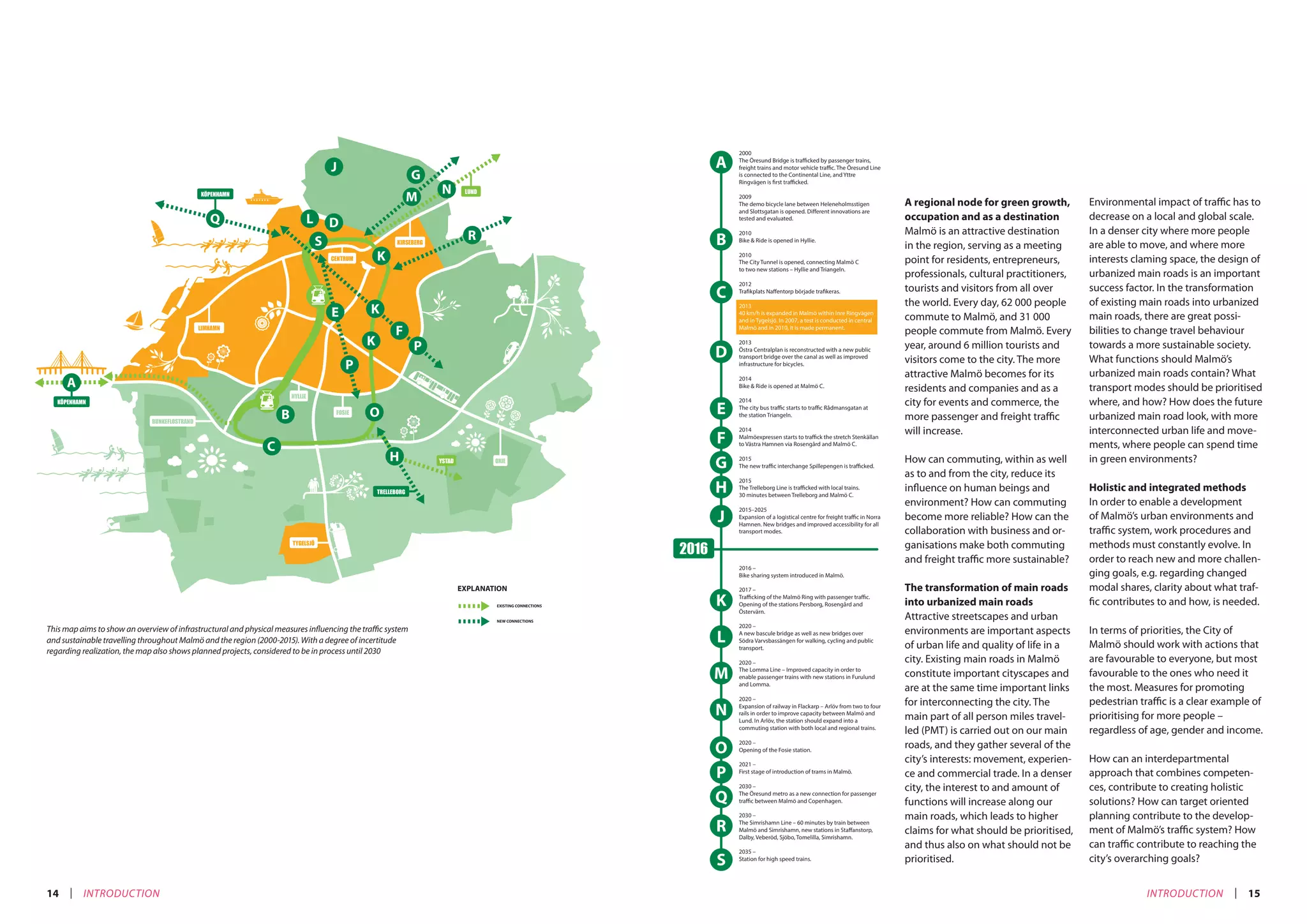
This map aims to show an overview of infrastructural and physical measures influencing the traffic system
and sustainable travelling throughout Malmö and the region (2000-2015). With a degree of incertitude
regarding realization, the map also shows planned projects, considered to be in process until 2030
HYLLIE
FOSIE
KIRSEBERG
LIMHAMN
BUNKEFLOSTRAND
KÖPENHAMN LUND
YSTAD
PENHAMN
TRELLEBORG
CENTRUM
TYGELSJÖ
OXIE
2016
M
L D
J
G
N
E
L
D
C
B
J
K
K
K
K
E
G
B
C
R
F
P
P
A
Q
O
N
O
F
H
A
M
P
Q
R
S
2000
The Öresund Bridge is trafficked by passenger trains,
freight trains and motor vehicle traffic. The Öresund Line
is connected to the Continental Line, and Yttre
Ringvägen is first trafficked.
2009
The demo bicycle lane between Heleneholmsstigen
and Slottsgatan is opened. Different innovations are
tested and evaluated.
2010
Bike & Ride is opened in Hyllie.
2010
The City Tunnel is opened, connecting Malmö C
to two new stations – Hyllie and Triangeln.
2012
Trafikplats Naffentorp började trafikeras.
2013
40 km/h is expanded in Malmö within Inre Ringvägen
and in Tygelsjö. In 2007, a test is conducted in central
Malmö and in 2010, it is made permanent.
2013
Östra Centralplan is reconstructed with a new public
transport bridge over the canal as well as improved
infrastructure for bicycles.
2014
Bike & Ride is opened at Malmö C.
2014
The city bus traffic starts to traffic Rådmansgatan at
the station Triangeln.
2014
Malmöexpressen starts to traffick the stretch Stenkällan
to Västra Hamnen via Rosengård and Malmö C.
2015
The new traffic interchange Spillepengen is trafficked.
2015
The Trelleborg Line is trafficked with local trains.
30 minutes between Trelleborg and Malmö C.
2015–2025
Expansion of a logistical centre for freight traffic in Norra
Hamnen. New bridges and improved accessibility for all
transport modes.
2016 –
Bike sharing system introduced in Malmö.
2017 –
Trafficking of the Malmö Ring with passenger traffic.
Opening of the stations Persborg, Rosengård and
Östervärn.
2020 –
A new bascule bridge as well as new bridges over
Södra Varvsbassängen for walking, cycling and public
transport.
2020 –
The Lomma Line – Improved capacity in order to
enable passenger trains with new stations in Furulund
and Lomma.
2020 –
Expansion of railway in Flackarp – Arlöv from two to four
rails in order to improve capacity between Malmö and
Lund. In Arlöv, the station should expand into a
commuting station with both local and regional trains.
2020 –
Opening of the Fosie station.
2021 –
First stage of introduction of trams in Malmö.
2030 –
The Öresund metro as a new connection for passenger
traffic between Malmö and Copenhagen.
2030 –
The Simrishamn Line – 60 minutes by train between
Malmö and Simrishamn, new stations in Staffanstorp,
Dalby, Veberöd, Sjöbo, Tomelilla, Simrishamn.
2035 –
Station for high speed trains.
H
S
EXISTING CONNECTIONS
NEW CONNECTIONS
EXPLANATION
Environmental impact of traffic has to
decrease on a local and global scale.
In a denser city where more people
are able to move, and where more
interests claming space, the design of
urbanized main roads is an important
success factor. In the transformation
of existing main roads into urbanized
main roads, there are great possi-
bilities to change travel behaviour
towards a more sustainable society.
What functions should Malmö’s
urbanized main roads contain? What
transport modes should be prioritised
where, and how? How does the future
urbanized main road look, with more
interconnected urban life and move-
ments, where people can spend time
in green environments?
Holistic and integrated methods
In order to enable a development
of Malmö’s urban environments and
traffic system, work procedures and
methods must constantly evolve. In
order to reach new and more challen-
ging goals, e.g. regarding changed
modal shares, clarity about what traf-
fic contributes to and how, is needed.
In terms of priorities, the City of
Malmö should work with actions that
are favourable to everyone, but most
favourable to the ones who need it
the most. Measures for promoting
pedestrian traffic is a clear example of
prioritising for more people –
regardless of age, gender and income.
How can an interdepartmental
approach that combines competen-
ces, contribute to creating holistic
solutions? How can target oriented
planning contribute to the develop-
ment of Malmö’s traffic system? How
can traffic contribute to reaching the
city’s overarching goals?
INTRODUCTION  |  1716  |  INTRODUCTION
2001 2003 2004 2005
2030 20322014 2015 2018 2019 2020
2007
2008 2009 2010 2011 2012 2013
2016
Adoption of The Sustainable Urban
Mobility Plan by the Political Technical
Board and the City Council.
Adoption of the
TrafficSafetyStrategy
in the Political
Technical Board.
”Walking, cycling and public transport are the first hand choices for
people living, working or spending time in Malmö. This, together with
efficient freight transport and environmentally adapted car traffic, sets
a framework for the transport system of a dense and sustainable city.
A transport system adapted to human beings and to the city.”
The mobility
management
project is
initiated.
Travel Survey 2003 –
The inhabitants’ trips: Walking 14%,
Bicycle 20%, Public transport 13%, Car 52%,
Commuting to Malmö: Bicycle 1%,
Public transport 32%, Car 67%.
The project Koll2010 is initiated by
SBK, GK and Skånetrafiken. The first
action plan completed in 2004.
Adoption of
the Traffic
Strategy for
Malmö by the
City Council.
Adoption of the
Traffic Environ-
ment Programme
by the Political
Technical Board.
Adoption of the Action Programme for Better Air
by the County Administrative Board.
Travel Survey Skåne 2007 – Commuting to
Malmö: Bicycle 1%, Public transport 32%, Car 67%.
Adoption of the Action Plan Koll2015.
Travel Survey 2008 – The inhabitants’ trips: Walking
20%, Bicycle 23%, Public transport 14%; Car 41%.
Adoption of the Traffic Safety Programme
(2008-2012) in the Political Technical Board. The
goals are based on the national Vision Zero.
Adoption of the report Traffic of the Future by the
City Executive Board.
Adoption of the
Comprehensive Plan
ÖP2012 by the City
Council.
Adoption of the Freight
Traffic Programme by the
Political Technical Board.
Adoption of the Walking
Lane Plan by the Political
Technical Board.
Adoption of the Energy Strategy
by the City Council.
Adoption of the Environment
Programme (2009-2013) by the
City Council.
The City Executive Board decides
on a Strategy for implementation
of a railway in the city.
Adoption of the Parking Policy and
the Parking Norm by the City Council.
The City Council decided to enter the
cooperation project Spårvagnar i
Skåne (Trams in Skåne) with the City
Administrations in Helsingborg and
Lund, as well as Region Skåne.
Adoption of a revised Action
Programme for Better Air in
Malmö by the County
Administrative Board.
Adoption of the Action Plan
Koll2020.
Adoption of the Traffic Environment Programme
(2012-2017) in the Political Technical Board.
Adoption of the Pedestrian Programme
(2012-2018) by the Political Technical Board.
Adoption of the Bicycle Programme (2012-2019)
by the Political Technical Board.
The Commission for a Socially Sustainable Malmö
dispatched a final report to the City Executive
Board, the work was initiated in 2011.
Adoption of the Action Programme against Noise
(2014-2018) by the City Council.
Malmö is elected the best bicycle city in Sweden for the
third time in a row and to the seventh best bicycle city in
the world according to the Copenhagen Index.
Travel Survey 2012 – Inhabitants’ trips: Walking 15%,
Bicycle 22%, Public transport 21%, Car 40%. Commuting
to Malmö: Bicycle 3%, Public transport 33%, Car 62%.
Adoption of a Prestudy and Plan Programme for Railway
stage 1 by the Political Technical Board and the City
Planning Office.
The Pedestrian
Programme
(2012-2018) fulfilled.
The Bicycle Programme
(2012-2019) fulfilled.
The Energy Strategy – 20% reduction of energy use. 50% of all
used energy should be renewable. The energy use of the City of
Malmö’s departments should decrease with 30%, and the share
of renewable energy should be 100%.
The Environment Programme – The City Administration’s
organisation should be neutral in terms of climate. The
emissions of green house gases in Malmö should decrease with
at least 40%, compared to the levels in 1990. People spending
time in Malmö should experience a nice urban environment
with low noise levels and clean air. It should be simple to make
sustainable travel choices for business, organisations,
inhabitants and employees at the City Administration.
The SUMP goals concerning transport modes (intermediate
goals) – The inhabitants’ trips: Walking 15%, Bicycle 26%, Public
transport 23%, Car 36%. Commuting to Malmö: Bicycle 4%,
Public transport 39%, Car 57%.
The Energy Strategy – Malmö
should be supplied renewable
energy to 100%.
The goals in the SUMP and the
Traffic Environment Programme
concerning transport modes
(intermediate goals) – The
inhabitants’ trips: Walking 15%,
Bicycle 30%, Public transport
25%, Car 30%. Commuting to
Malmö: Bicycle 5%, Public
transport 45%, Car 50%.
The Environment Programme -
Malmö should be supplied by
renewable energy to 100%.
Comprehensive Plan 2012 –
A city that dares. An
enterprising city on solid
ground. A city with good
life conditions for everyone.
A city by the water. A dense
and green city.
This timeline (2001-2032) aims to give a historical retrospect of strategic measures, decisions, activities,
documents, programmes and targets that influence sustainable transport in Malmö. It also points out visions
and target years for important policy documents regarding sustainable transport and urban development.
HUMAN BEINGS  |  19
2	HUMAN BEINGS
Movement is an important part of human everyday life and enables Malmö’s citizens, professionals
and visitors to reach important destinations such as school, leisure activities, workplaces, meeting
points and events. The traffic system’s design influences the accessibility to the city’s supply.
This chapter focuses on human beings as a fundamental part of the traffic system. The chapter des-
cribes how traffic influences human beings and environment, and how traffic in turn can be influen-
ced by people living and spending time in a city.
ACCESS TO ONE’S CITY –
A MORE EQUAL CITY
The public space, with its streets,
parks and squares, is made for
everyone. The planning of Malmö’s
future urban environment and traffic
system should strive towards making
the city an attractive environment
to live in. The traffic system enables
people to move and access the supp-
ly existing in different parts of the
city, e.g. school, work, culture, events
and leisure activities. Access to
high standard public transport, and
accessible cycle and walking lanes,
sets a framework for sustainable and
healthy travelling.
Traffic influences the inhabitants’
situation in terms of accessibili-
ty, safety and security. Traffic and
infrastructure also directly influence
public health through, e.g., noise pol-
lution, air quality, barrier effects and
accident risks. Especially children, el-
derly and disabled persons are highly
influenced by the negative effects
of traffic, both in terms of moving
safely in the city and having access
to calm and relaxing environments
without noise pollution or impaired
air quality.
Socioeconomics, income
and travelling
Socioeconomic conditions, mainly
income, is one of many factors that
influence how much and in what
way people travel. The higher the
income per household, the more
trips per day are carried out, and the
more of these trips are carried out by
car. Good accessibility for Malmö’s
inhabitants is desirable, and in order
to create this, measures targeting
walking, cycling and public transport
is an important strategy. These trans-
port modes have lower thresholds
regarding costs for the individual,
and they enable for all inhabitants,
regardless of income, to access the
city’s supply more easily, as well as to
contribute to urban life, the labour
market and economically sustainable
growth.
Definition of traffic
Transport of people, goods and information
regardless of means and infrastructure.
Definition of mobility
The possibility for people and goods to
move from one place to another. In the
Sustainable Urban Mobility Plan, the mobili-
ty notion bear reference to that a growing
population should be given possibilities to
travel sustainably in everyday life and that
goods should can be transported efficiently
on the city’s terms
NEXT STEP
Further develop Malmö departing from the
action plan developed by the Commission
for a socially sustainable Malmö, and more
clearly connect this project to traffic and free-
dom of movement in the city (GK, SBK, SK).
Develop a Safety Strategy for public places
(GK, SBK, SK, SoF
ONGOING
Identifying and bridging physical and mental
barriers in the inter-departmental work
within the project Levande Malmö (Living
Malmö) (SBK, GK).
ACCESS TO ONE’S CITY – A MORE EQUAL CITY
INVOLVING PEOPLE AND PLANNING TRAFFIC FOR IMPROVED PUBLIC HEALTH
SLOWER PACE AND HIGHER TRAFFIC SAFETY
MOBILITY MANAGEMENT
Photo: Åsa Svensson
HUMAN BEINGS  |  2120  |  HUMAN BEINGS
Gender equality leads
to accessibility for a greater
number of people
Women and men should have the
same power to shape society and
their own lives. In order to increase
knowledge about travel conditions
in society, and to create a more equal
transport system, it is important to
incorporate a perspective grounded
in equality in the work with trans-
port. In 2020, Malmö should be a
city with equal activities reaching to
all women and men, girls and boys,
regardless of background and belon-
ging. Design, function and use of the
traffic system and urban environme-
nts should give everyone fundamen-
tal access to their city.
Prioritising certain transport modes
is an important factor for increased
equality. A city and a traffic system
with an imbalanced modal split,
where car traffic is the dominating
mode of transport, limits citizens’
empowerment and their possibili-
ty to move in everyday life. In the
current situation, where men own
cars and drive cars to a greater extent
than women, men’s accessibility to
the city and the region is generally
higher than women’s. The proximity
to high standard public transport
and possibilities to move on foot
and by bicycle can compensate for
this. Planning that strives towards a
denser and more integrated city with
greater accessibility makes travelling
on foot, by bicycle and with public
transport more rational and the city
more equal.
Increased possibilities for children
and youths to move
Malmö’s population is younger than
the average for Swedish cities, and
according to demographic projec-
tions, the 6-15 age group will grow
the most until 2020. The perspective
of children and youths should be
illuminated and taken into conside-
ration in all decisions within urban
planning. Children’s and youths’par-
ticipation and influence in questions
regarding the city, and themselves,
should be seen as a resource in the
planning procedure, and special
forms of participation for children
and youths must be developed.
Traffic planning should always take
the needs of children and other
unprotected road-users into consi-
deration, and a traffic system that
sees to children’s need for movement
and security should be a key priority.
Malmö should work towards a well
developed network of cycle and wal-
king lanes that provides for children’s
need to move throughout the whole
city.
There is a gradual and general
change among children and youths
and their demand for leisure activi-
ties; it moves from organized activity
in clubs to spontaneous activity
without demand for regular practice
or competition. This development
should be taken into consideration
when planning for increased acces-
sibility, in order to offer Malmö’s in-
habitants the possibility to be active
regardless of time or organisation.
Modal split for the inhabitants’
trips, divided between men and
women in 2013.
NEXT STEP
Define an equal traffic system for Malmö.
Clarify measurable targets and indicators
(GK, SBK, SK).
ONGOING
Increasing and spreading knowledge of the
connection between gender equality and
traffic. (GK)
Safe routes to school should be in
focus in order to make it possible
for school children to safely get to
school and leisure activities without
adult company. This increases
children’s empowerment, freedom
of movement and public health; it
strengthens school results, promo-
tes integration and enhances the
environment around schools. The-
reby, traffic planning can contribute
to children’s development as active
and independent citizens.
Big problems with traffic safety, and
safety in general, can occur when
parents drive their children to school
and leisure activities. The size and
localisation of preschools, schools
and other institutions aiming at
children and youths are important
factors for sustainable travelling.
A holistic approach must be the
starting point for school related
traffic topics with the goal to achieve
high traffic safety and a good traffic
environment, both real and experien-
ced. The number of cars outside of
schools should decrease, and aware-
ness and knowledge of public health
and traffic should increase among
children, parents and staff. Further-
more, traffic safety and environmen-
tal impact connected to the delivery
of goods to schools and preschools
must be improved.
Improve accessibility for elderly
and disabled people
The goal of increased accessibility
for more inhabitants places greater
demands on the way urban en-
vironments and streets are laid out.
Everyone should be able to move
safely throughout the city, regardless
of age, gender or physical and men-
tal abilities. The urban environment
must be laid out in a way that makes
it possible for elderly and disabled
people to orientate themselves and
keep an independent mobility for
a better quality of life. Access to
all modes of transport, including
community transport and special
public transport, is important when it
comes to making it possible for disa-
bled people and elderly to take part
of the city and enrich urban life.
NEXT STEP
Develop and try out a concept of car free
schools both regarding parents taking their
children to school and freight traffic (GK,
SBK, FK, MF, FSF, GSF
ONGOING
Developing the work in the Street and
Parks Department’s School Traffic Group
with the aim to increase knowledge of
children’s needs in traffic, and to increase
parents’ awareness of how the traffic situa-
tion around schools can be improved when
more people use alternatives to cars. (GK).
Developing the work on and connection
to sustainable transport within the Plan
for public services’ land need (PLASMA).
(SBK, GK).
NEXT STEP
Develop a concept for coordinated dia-
logue and mobility management measures
in order to create higher participation
among inhabitants, departing from incre-
ased sustainable travelling in each SUMP
area. The visions for each area should serve
as a basis for this project (GK, SoF).
ONGOING
Implement the Accessibility Programme
2008 for Malmö and the Action plan for
easily removed obstacles (GK).
almöbornas Resor
2013 2013
Women Men
34 %
23 %
24 %
17 %
48 %
18%
20 %
12 %
öbornas Resor
2013 2013
Women Men
34 %
23 %
24 %
17 %
48 %
18%
20 %
12 %
almöbornas Resor
2013 2013
Women Men
34 %
23 %
24 %
17 %
48 %
18%
20 %
12 %
öbornas Resor
2013 2013
Women Men
34 %
23 %
24 %
17 %
48 %
18%
20 %
12 %
Definition of community transport
Service function for persons with a non
temporal disability who due to their infirmity
face considerable difficulties when moving
on their own or when using general
public transport.
Definition of
special public transport
A publicly funded traffic that requires a certain
permission to use. The notion contains, among
other things, community transport, national
community transport, some emergency
trips as well as school and special school
transport. Special public transport can be
scheduled or called upon, and should be
carried out with specially adapted vehicles
(normally taxi vehicles).
Photo: Åsa Svensson
HUMAN BEINGS  |  2322  |  HUMAN BEINGS
INVOLVING PEOPLE AND PLAN-
NING TRAFFIC FOR IMPROVED
PUBLIC HEALTH
Enabling people to influence how
the city and traffic system are desig-
ned is a basic requirement in order to
create participation among citizens.
This also leads to improved physical
and mental health. Transparency in
how the City Administration works
with traffic reduces the distance
between the organisation and the
citizens – explaining and simplifying
the complex urban development
process are measures that in them-
selves contribute to increased social
sustainability.
The impression of having good
accessibility, regardless of gender,
age, socioeconomic conditions
or physical and mental ability, is
a democratic right increasing the
citizens’empowerment and mobility.
The possibility to easier being able
to choose between different modes
of transport strengthens the inhabi-
tants’mobility and leads to changed
modal shares.
What do Malmö’s citizens wish for?
In conjunction with the travel survey
conducted in autumn 2013, 2 500
persons from all over Malmö (40%
response rate) were asked what kind
of traffic environment they wished
for in the inner city. The method is
developed by VTI (Swedish Trans-
port Research Institute), and similar
surveys have been carried out in,
e.g., Norrköping and Helsingborg.
The consulted citizens were asked to
consider the three different scenarios
briefly described below.
The result showed that nearly half
(47%) of the respondents consider
the scenario of “an inner city with
more space for walking, cycling and
public transport” most desirable. This
scenario implies that visitors who ar-
rive in cars are directed to car parks,
and that transit traffic is directed to
streets outside of the city centre.
Service vehicles, such as community
transport, taxi, vehicles for disabled,
transport of goods and city logistic,
can use certain streets on pedestri-
ans’and cyclists’terms.
The option of an inner city with “a
slower pace in traffic” was chosen
by more than a third (34%) of the
respondents. In this scenario, cars are
given less space on bigger streets in
the inner city in favour of pedestrians
and cyclists.
Nearly 18% of the respondents find
that the inner city, to a greater extent
than today, should be adapted to car
traffic according to the option “better
level-of-service and more street space
for cars”. In this scenario, streets are
designed mainly with cars in mind:
good accessibility for cars and good
parking possibilities to low costs.
In the report based on the question-
naire survey, the following conclu-
sions were drawn:
“The results show that 80% of the
inhabitants are in favour of an inner city
traffic that is more restrictive towards
car traffic and parking than today. Close
to half of the inhabitants support far-
reaching changes where pedestrians,
cyclists and public transport are high
priorities. The other group, constituting
one third, is in favour of somewhat more
careful actions where restricted space
for cars is used to prioritise pedestrians
and cyclists.”
“An interesting result that follows the
analysis, and that in a clear way is sig-
nalled by the total outcome of the main
question, is that a majority of the inha-
bitants that drive and park in the city
centre prefer a diversion of the inner city
traffic towards more space for walking,
cycling and public transport.”
Regementsgatan, an example of an existing main road with more space for walking, cycling, trees and activities. (Photo: Åsa Svensson).
“A large majority of the inhabitants are
supporters of less car traffic and parking
in the city centre, under the condition
that the decreased accessibility for cars
leads to direct positive consequences for
walking, cycling and public transport in
the same area. Most inhabitants regard
such a traffic diversion as contributing
to a better and more attractive city
centre.”
These results show that a vast ma-
jority of the inhabitants wish for a
development towards a slower pace
in traffic and limitations for car traffic,
which will benefit walking, cycling
and public transport in the inner city.
This supports the Sustainable Urban
Mobility Plan’s goal of a more balan-
ced modal split. How Malmö’s future
urbanized roads can be designed
will be presented in the forthcoming
chapter about urbanized main roads.
Increased physical activity and
public health
There is a strong connection
between physical activity and redu-
ced risk of overweight and obesity.
Overweight and obesity in turn influ-
ence the risk of other diseases such
as diabetes, high blood pressure, car-
diovascular diseases, some forms of
cancer and joint pain. These diseases
bring suffering for the individual as
well as high costs for society.
The way we choose to activate
ourselves in our everyday lives also
influences how happy we are. By
choosing active transport modes,
such as walking and cycling, we
contribute to our own physical and
mental well-being.
When targeting measures on traffic,
it is important to bear in mind who
the effort will reach. Besides the so-
cioeconomic benefits, health effects
for the individual must be valued.
The greatest effect will be reached
when people who otherwise do not
move at all start to go for walks or
use more active ways of travelling.
A higher share of trips on foot and by
bicycle, so called active trips, would
improve the physical and mental
public health for people living in
and commuting to Malmö. The more
people living in Malmö, the greater
impact the goals of changed modal
shares
will have on public health.
An increase in the number and mo-
dal share of public transport trips has
positive impacts on public health,
if the majority of public transport
trips are moved from car traffic
instead of from walking or cycling.
Studies carried out on behalf of the
Swedish Transport Administration
(Trafikverket) have shown that urban
areas with well functioning public
transport have lower levels of chro-
nic illness. BMI (Body Mass Index),
obesity and high blood pressure are
also proved to be lower in cities with
higher population density and well
functioning public transport. The way
travelling changes with developed
public transport is crucial to public
health. Consequently, it is important
that increased travelling with public
transport does not imply reduced
walking and cycling, which would
be negative from a public health
perspective.
Photo: Åsa Svensson
ONGOING
Strengthening and developing the inter-de-
partmental local working group for “Healt-
hy cities” that works with public health in
planning. www.healthycities.se (SBK, GK).
HUMAN BEINGS  |  2524  |  HUMAN BEINGS
W
ALKING 15%
W
ALKING 15%
BI
CYCLE30%
CAR30%
PUBLICTRANSPORT25%
INSPIRING
INTEGRATING
INVOLVI
NG
INFORMING
INVOLVING
CONDITIONS
ACCEPTAN
CE
DEMAND
W
ALKING BICYCL
E
CAR
PUBLICTRANSPORT
EXAMPLE
Public health benefits through increased travelling on foot and by bicycle
In order to throw light upon public health benefits deriving from changed modal shares,
with the objective of more active transport modes (cycling and walking) as a starting point, an
example departing from the World Health Organization’s (WHO) Health Economic
Assessment Tool (HEAT) is presented. This calculation model is based upon established research
results and estimates the socioeconomic value of better public health through increased shares of
trips on foot or by bicycle. For more information about the calculation model, see: http://www.euro.
who.int/
Baseline
Current population:			 310 000 inhabitants
Current modal shares:		 15% walking, 22% cycling (only main mode of transport)
Number of trips per day: 		 2.6 trips/person
Average travel length on foot: 		 1.4 km
Average travel length by bicycle:	 3.0 km
Reduced cycling during 3 months/year:	 20%
Population projection 2030:		 400 000 inhabitants
Objective for modal shares:		 15% walking, 30% cycling (only main mode of transport)
Number of trips per day and average travel length per trip and mode of transport are in this ex-
ample assumed to be the same in 2030.
Public health benefits through increased trips on foot 505 millions/year
Public health benefits through an increased
amount of trips by bicycle and a higher share of cycling: 1,120 millions/year
A greener city and possibility
to recreation
Proximity to parks and green areas,
and the possibility of getting there,
are factors influencing public health.
Spending time in green environme-
nts has a positive impact on physical
as well as mental well-being. Physical
activity increases, the body recovers
and stress levels sink. Green areas
also benefit social participation and
interaction between people. In a
denser city, it is important to take
advantage of and develop green
environments. It is important that
the development of Malmö’s urban
environments and traffic system
embraces green values.
SLOWER PACE AND HIGHER
TRAFFIC SAFETY
A safe traffic environment is a natural
part of sustainable urban develop-
ment. Malmö should be a city where
everyone can travel safely both in
general and in terms of traffic. Traffic
safety and experienced safety go
hand in hand and are important for
the city’s attractiveness and equa-
lity. Malmö works according to the
Swedish Traffic Administration’s
Vision Zero with the goal that no one
should be killed or severely injured
in traffic.
The speed of motor vehicles is the
single most important factor for
traffic safety. Speed influences the
probability for traffic accidents
to occur and their consequences.
Studies on fatal accidents in urban
areas have shown that speed limits,
in many cases, are not adjusted to
the demands of Vision Zero. Correctly
signposted speed limits, physical
actions and behavioural influence
are factors estimated to have great
potential to save lives in urban areas.
Even small changes in actual speed
can have positive effects on traffic
safety. A slower pace on streets leads
to a better environment for the inha-
bitants and to fewer accidents. This
is important in order to reduce the
barriers created by motor traffic.
ONGOING
Implementing recreational cycle lanes
according to the Bicycle programme (GK).
Lifting the perspective of sustainable
transport in the development of a new Plan
for green and blue environments in Malmö
(GK).
ONGOING
A new traffic safety strategy for 2015-2020
have been developed. During the process,
problems have been identified and impor-
tant strategies and measures pointed out
with the goal of reducing the number of
injured and killed in traffic (GK).
In order to design safe, attractive and
vivid urbanized main roads, the pace
along them needs to be slower. Traf-
fic safety regarding traffic collisions
is strengthened when more pedestri-
ans and cyclists are claming space
in traffic. Single accidents, e.g. where
pedestrians stumble on slippery
roads in winter or when cyclists fall
over, is one of the great challenges
that the City of Malmö is facing when
it comes to increased traffic safety.
MOBILITY MANAGEMENT
Traffic consists of human and goods
in movement. Mobility management
is a method aiming to promote sus-
tainable transport through changing
attitudes and behaviours. This is an
important part of creating a sustai-
nable and attractive urban life in an
expanding city. The work with mobili-
ty management includes creating
demand, acceptance and possibilities
for sustainable transport modes. It is
easier to accomplish this if citizens
accept that walking, cycling and
public transport are prioritised at the
expense of reduced level-of-service
for cars, which in turn has a positive
impact on the demand for sustai-
nable solutions. Reversed, the City
Administration must be aware of the
citizens’demands regarding sustaina-
ble transport in everyday life.
Willpower, knowledge and under-
standing are important factors in the
work with changing attitudes and
behaviour. When working with beha-
vioural influence, the consequences
of individuals’and organisations’
conduct is put in focus. When presen-
ting visions and alternative transport
modes and ways to travel, different
possibilities are pointed at. On these
grounds, the City of Malmö can help
to offer solutions and to inspire to
new travel behaviour in everyday life
for both individuals and business.
NEXT STEP
Establish new collaborations where social
sustainability, in a clearer way, is connec-
ted to mobility management measures,
e.g. through framing Bicycle rights for all
citizens (GK, SK, SoF). See p. 25.
Develop a model that enables business to
- through their work with CSR* - take active
part in Malmö as a bicycle friendly city (GK,
SKB, MF, SK). See p. 25.
*Corporate Social Responsibility
ONGOING
Developing forms that to a higher extent
coordinate Mobility management with
implementation of physical and regulated
actions (GK).
Model for mobility management within the City
of Malmö. The inner modal split circle shows
the result of the travel survey from 2013, and
the outer one represents the objective for the
inhabitants’ trips in 2030.
TRAFFIC AND MOVEMENT  |  27
3	TRAFFIC AND
MOVEMENT
The population in Malmö, Skåne and the Öresund region is growing, which increases traffic and
commuting to and from Malmö. This implies a growing demand for transport – more people will
move and spend time on the city’s sidewalks, cycle lanes and streets, at the same time as the flow of
goods, material and waste will increase. In order to meet the growing demand for transport, Malmö
has to continue to invest in high capacity traffic solutions, grounded in a higher share of people wal-
king, cycling and using public transport, as well as in more efficient freight traffic. Malmö also has
to continue its development in line with a clear urban planning strategy centered around a dense,
green and integrated city with short distances, which contributes to reducing person miles travelled
(PMT) and the need for cars. In that way, Malmö becomes more accessible for a greater number of
people. Prioritisation of traffic surfaces and space for buildings, squares, meeting places and parks
must be made departing from a holistic perspective with the city’s best interests in mind. This chapter
clarifies objectives for travelling, commuting and freight traffic and presents strategies for how the
objectives can be reached.
CHANGED TRAVEL PATTERNS FOR GREATER ACCESSIBILITY
PRIORITISING SURFACE EFFICIENT TRANSPORT MODES – REORGANISING STREETSCAPES
PROMOTING GREEN VEHICLES, TECHNICAL INNOVATIONS AND RENEWABLE FUELS
TARGET ORIENTED TRANSPORT DEMAND
OBJECTIVE FOR PASSENGER AND FREIGHT TRAFFIC WITHIN, TO AND FROM MALMÖ
OBJECTIVE FOR INHABITANTS’ TRIPS
STRATEGIES FOR INHABITANTS’ TRIPS
OBJECTIVE - SUSTAINABLE COMMUTING
STRATEGIES - SUSTAINABLE COMMUTING
OBJECTIVE - SUSTAINABLE FREIGHT TRAFFIC AND CITY LOGISTICS
STRATEGIES FOR SUSTAINABLE FREIGHT TRAFFIC AND CITY LOGISTICS
CHANGED TRAVEL PATTERNS
FOR GREATER ACCESSIBILITY
In a growing Malmö, it is important
that the modal share of car traf-
fic decreases. Increased car traffic
leads to increased spatial claims for
infrastructure, noise and air pollution,
congestion, worse level-of-service
and accessibility for citizens and
business, which in turn influence the
city’s attractiveness in many ways.
In order to gain greater understan-
ding for how a more attractive and
accessible city can be created, focus
should lay on traffic as constituted by
humans and goods, not by vehicles.
Through prioritising surface efficient
transport modes, congestion can be
prevented and the accessibility in the
city can improve. More of Malmö’s
inhabitants, workers and commuters
will find it easier to get to work and
school, trade and entertainment,
recreation and leisure activities. An
easy access with different transport
modes within, to and from Malmö
contributes to a stimulation of the
labour market in the region and is fa-
vourable for inhabitants, commuters
and businesses. A changed modal
split creates space for other purposes
than traffic, and is crucial for creating
better level-of-service and accessibili-
ty for a greater number of people.
Confronting increased car traffic and
congestion with more or broader
streets and roads is a short-term
strategy. More road space, to a great
extent, leads to increased car traffic.
Such a strategy is not compatible with
Malmö’s targets of changed modal
shares or the overarching goal of a
more environmentally, socially and
economically sustainable city. In order
to allow Malmö to grow sustainably,
investments must be made in alter-
natives to increased level-of-service
for car traffic: alternatives with better
accessibility and level-of-service for
cycling, walking and public transport.
PRIORITISING SURFACE
EFFICIENT TRANSPORT MODES –
REORGANISING STREETSCAPES
Walking, cycling and public transport
are all more surface efficient trans-
Definition av tillgänglighet
Möjlighet att kunna nå en målpunkt.
Skapar förutsättningar till förflyttningar för
både medborgare och näringsliv avseende
såväl persontrafik som godstransporter.
Definition av framkomlighet
Mått på transportkvalitet med avseende
på restid, d v s hur lång tid det tar att färdas
mellan två målpunkter eller platser.
You are not stuck in
traffic - you are part of it.
General priority model for different
transport modes in urban planning
within the City of Malmö.
NEXT STEP
Define sustainable car traffic. This should be
done within a Programme for Sustainable Car
Traffic (GK, SBK, MF).
port modes than passenger car traffic
– both regarding parking space and
space for movement. If more people
choose to walk, cycle or use public
transport, space for a greater number
of people to move and spend time in
the city is generated – more people
gain access to what Malmö has to offer.
TRAFFIC AND MOVEMENT  |  2928  |  TRAFFIC AND MOVEMENT
5 000
10 000
15 000
20 000
17000
Capacity/hour
Area (m²)/person
0,8
1,2
2,1
9,7
22,1
17000
8000
3000
1800Motorway
900Street
Figure presenting the general flow capacity per hour, and the space required per person, for different transport modes. This shows, among other things, that
pedestrian traffic is more space efficient than public transport and that public transport in turn is more space efficient than passenger car traffic. Space demand per
transport mode includes both space required for movement, streets and carriageways, and for parking. Source: TÖI, Norwegian Centre for Transport Research.
Flow capacity compares how many
trips that can be carried out in one
hour with different transport modes.
This measure of level-of-service can
also be seen as a measure of acces-
sibility in the number of potential
visitors or clients. Measures targe-
ting space efficient passenger trips
and integrated surfaces, including
pedestrian streets and walking speed
areas, can also improve accessibility
for goods delivery.
PROMOTING GREEN VEHICLES,
TECHNICAL INNOVATIONS AND
RENEWABLE FUELS
Parallel to the work towards a chang-
ed and more balanced modal split, the
City Administration works to promote
cleaner, quieter and more efficient
motor vehicle transports. Since a high
share of today’s motor vehicle trips
will be carried out in the future as
well, more measures targeting green
vehicles and renewable fuels must
be taken.The share of motor vehicles
powered by natural gas, gaseous hy-
drogen and electricity must increase
in order to further reduce environ-
mental impact of motor vehicles.
Measures targeting electric city buses
and regional buses have had a large
impact on air quality and noise clima-
te in central Malmö.
The activities within the City of Malmö
generate a significant number of
transports.This implies a big respon-
sibility as well a possibility to urge
development and to demand renewa-
ble and fossil-free fuels.
Increased use of electric bicycles
means that bicycle traffic can become
a larger competitor to car traffic.The
electrifying of public transport, with
electric buses and trams, leads to
quieter, cleaner and more attractive
urban environments. Most environme-
ntal benefits are reached if the public
transport system attracts motorists.
A modern rail system is estimated to
have the best chance to attract these
travellers to public transport. More
environmentally adapted distribution
vehicles can also push the develop-
ment in this direction, which is not
least important in a growing city with
growing flow of goods.
ONGOING
Implementing actions set in the Traffic
Environment Program 2012-2017
about clean, quiet and efficient motor
vehicle transport (GK, MF, SBK).
The energy strategy for 2009 is valid, a
new energy strategy is under prepara-
tion (SBK).
ONGOING
The City of Malmö together with the
regional public transport authority
(Skånetrafiken) investigate possibilities
to implement the use electric buses in
city traffic (GK).
NEXT STEP
Develop a new strategy for green
vehicles - this can be made within a
program for sustainable car traffic.
Monitor technical development within
the field of vehicles and renewable
fuels (GK, MF).
MalmöExpressen – a new, 24 m long, double articulated bus, powered by a hybrid engine (gas and electricity), developed for the City of Malmö together
with the regional public transport authority (Skånetrafiken), Nobina and Van Hool (Photo: Åsa Svensson).
TARGET ORIENTED
TRANSPORT DEMAND
According to demographic projections
carried out by the City Administration,
Malmö is estimated to grow with app-
roximately 100 000 inhabitants and
50 000 workplaces within the outer
ring road until 2030. More inhabitants,
more employment opportunities,
more visitors and tourists, and an
increased population in the region in
general imply increased passenger
traffic and more freight traffic.
In order to predict future demand for
transport, projections of population
growth and traffic increase are carried
out. Traffic projections form a founda-
tion when describing changes in travel
behaviour and traffic quantity for all
traffic modes. Additionally, they are
used to calculate noise and air pollu-
tion deriving from traffic.
On a domestic as well as an inter-
national level, a clear trend towards
reduced car use in benefit of public
transport and cycling can be observed.
In Malmö, this trend is stronger than
in Sweden in general. This can partly
be explained through short distances
to destinations within the city, good
alternatives to cars and changed
values regarding owning and using
passenger cars.
Planning work within the City of
Malmö should depart from the vision
of the desired city and the targets
that have been developed for traffic.
Target oriented traffic projections
should be applied to concretize and
clarify the goals stated in the Sustai-
nable Urban Mobility Plan. To form
a basis for noise calculations and air
quality calculations, different scenari-
os regarding traffic amounts shall be
used. The point of departure should be
to describe and predict different risks
concerning health, environment
and climate.
ONGOING
Developing models for traffic and
projection models for all modes of
transport, including walking, cycling
and freight traffic (GK).
Increasing collaboration with other or-
ganisations in order to gain access to
relevant data throughout the region,
both domestic and international.
NEXT STEP
Gather in-depth knowledge about
subjective factors for travelling choices
within traffic modelling, and develop
scenario modelling to serve as a basis
for prioritisation and decision-making
(GK).
Population
Bicycle
Bus
Train
Car
2007
90
95
100
105
110
115
120
125
130
135
140
2008 2009 2010 2011 2012 2013
Index
Development of the number of trips by car, bi-
cycle, bus and train during the period 2007-2013,
as well as demographic development during the
same years. Walking is not taken into considera-
tion in the comparison due to insufficient data.
For cars, traffic flows for an average weekday
count over all cross sections each year. For
bicycles, the development in central Malmö is
presented. For public transport, all trips per year
for all bus or train lines in Malmö are presented.
In order to be able to compare data for the
different transport modes and the population,
as well as to show a development over time, the
values have been indexed. 2007 is the baseline
(index = 100).
Development of traffic modes and population 2007-2013
(2007=index 100)
TRAFFIC AND MOVEMENT  |  3130  |  TRAFFIC AND MOVEMENT
Number of citizens in Malmö and modal
split 2013, followed by estimations of
population increase and objective for
scenario A and B for 2030. Modal split
with regards to main mode of transport,
travel sections not included. Note that
the modal split for 2030 does not amount
to 100%, since the category “other mode
of transport” (2%) is not displayed.
OBJECTIVE FOR PASSENGER
AND FREIGHT TRAFFIC WITHIN,
TO AND FROM MALMÖ
Cities give rise to both passenger
traffic and freight traffic – two kinds
of transports with different needs,
possibilities and interests. The
objective for these transport modes
has been divided into two in order to
create clarity and to point at differen-
ces in their characters.
Passenger traffic consists of trips car-
ried out by inhabitants, visitors and
commuters to and from school, work,
stores and to run errands. In order to
develop Malmö and its traffic system
in the right direction, a gathered
objective regarding modal shares for
inhabitants’and commuters’trips is
required. The objective for a sustaina-
ble transport system is most conve-
niently described in modal shares.
The adopted objective regarding a
changed and more balanced modal
split is a clear sign of whether a trans-
port system develops to become
more environmentally, economically
and socially sustainable
In order to show what traffic can
contribute to, viewed from a broader
perspective, the objective of changed
modal shares works as a symbol for
how well the city will succeed with
a number of overarching goals. A
traffic system with higher capacity for
sustainable transport modes creates
possibilities for a Malmö that is more
adapted to humans, more equal and
greener. It also opens up for a city
with better public health and better
accessibility for more people – a more
attractive Malmö and a traffic system
where energy use and emissions are
reduced on a local and global scale.
In Malmö, the circulation of freight
traffic is less studied than the circula-
tion of passenger traffic. The work on
gathering knowledge on this topic,
together with private and public
actors, is a priority within the City
of Malmö. The objective for freight
traffic is described in words.
Population growth and
possible scenarios
The future demographic develop-
ment in Malmö and the number of
commute trips to Malmö depends on
many uncertain factors. Therefore,
the Sustainable Urban Mobility Plan
presents two different scenarios
regarding population growth in
Malmö and the region until 2030.
These estimations are based upon
expected population growth accor-
ding to demographic projections car-
ried out by the City Administration.
Scenario A describes a moderate
population growth with an average
of 2 900 more inhabitants per year
until 2030. In scenario A there are 360
000 citizens in Malmö 2030. Scenario
B describes a stronger population
growth with around 5 300 more
inhabitants per year until 3020.
Scenario B should be compared
with the population growth that the
Comprehensive Plan has in readiness,
i.e. that Malmö can grow to 400 000
inhabitants until 2030.
Scenario A and B for commuting are
based upon the same growth percen-
tage as the population growth. This
means that the number of work op-
portunities in Malmö and throughout
the labour market region grows by
the same percentage as the number
of inhabitants. Scenario A describes
a moderate growth in commuting
with an average of 600 more trips to
Malmö per year until 2030. Scenario
B describes a stronger growth in
commuting with an average of 1 100
more trips per year until 2030.
OBJECTIVE FOR
INHABITANTS’ TRIPS
Inhabitants’trips and movements
are meaningful for a dynamic urban
life. The way the traffic system and
urban environments are planned,
designed and used has great im-
pact on the inhabitants’everyday
lives and their possibilities to create
favourable conditions for themsel-
ves. When it comes to reaching the
goals of changed modal shares, it is
the physical conditions in the city
and the inhabitants’travel behaviour
that create a more sustainable and
attractive Malmö.
The modal split for 2013 describes the
result from the travel survey RVU2013.
The objective for 2030 has been
defined departing from a balanced
mix of the Pedestrian Programme
(2012-2018), the Bicycle Programme
(2012-2019), a list of the targets in the
Network of Public transport (Koll2020)
and theTraffic Environment Program-
me (2012-2017).The objective for 2020
shows the modal shares for different
transport modes that at the very least
needs to be fulfilled in order to reach
the combined objective for 2030.
The total amount of the inhabitants’
trips will increase along with the
increasing population. Scenario A and
B describe two potential population
growth rates until 2030 and what each
one would imply for the modal split
as well as for the total amount of trips
carried out by the inhabitants.
Depending on the population growth
according to the two scenarios, the
number of walking trips will increase
by around 15-30%, the number of
Explanation of modal share
percentage allocation describing the main transport mode used regarding the number of trips
with different transport modes. The division is given by the results from travel surveys, where
citizens in Malmö and Skåne during one week’s time state where, how and why they travel. In
2013, a travel survey was carried out where around 70 000 persons all over Skåne were consulted,
of which 12 000 in Malmö. The response rate was 37% in Skåne and 33% in Malmö. Comparable
travel surveys were carried out in 2003 and 2008.
40 %
21 %
22 %
15 %
36%
23 %
26 %
15 %
30 %
25 %
30 %
15 %
Malmöbornas Resor
Inpendling
2013 2020 2030
62 %
33 %
3 % 4 % 5 %
57%
39 % 50 %
45 %
2013 2020 2030
bicycle trips by around 60-75%, the
number of trips with public transport
by around 40-55%, and the number
of car trips will decrease by around
5-15%. Consequently, the most signi-
ficant increase in the number of trips
will take place within bicycle traffic
and public transport.
The height of the bars in the bar
chart on the previous page symboli-
ses the number of trips made by the
inhabitants. The modal split des-
cribes the main mode of transport
used for one trip. How many travel
sections made, and which or what
transport mode used, is not presen-
ted. Experience, together with the
result of the travel survey RVU2013,
indicates that a large part of all travel
sections are carried out by walking.
Travelling usually begins or ends with
movement on foot. A combination
of walking trips and trips with public
transport is most common. Therefo-
re, it is important to aim for a high
increase in walking, although the ob-
jective describes a modest increase.
The decrease in the number of car
trips will mainly be replaced by
cycling and/or public transport, and
in order to enable this change, it is
important to also be able to move
easily on foot. Therefore, major
measures that target these transport
modes should be taken.
Objective for sub areas
In order to make the future goals
for transport modes concrete, and
to show potential to change travel
behaviour, the city has been divided
into fifteen sub areas – so called
SUMP areas. The divide is based upon
how buildings and infrastructure are
differentiated today. The conditions
of and access to different transport
modes vary between the different
sub areas, and the objectives for
transport modes has been adapted
accordingly. If the objectives for the
different sub areas are put together,
the overarching goal for transport
modes is reached.
Modal split for the inhabitants’ trips
regarding main mode of transport, travel
sections not included. From the left:
2013, followed by the objective for 2020
and the objective for 2030. Note that the
modal split for 2013 does not amount to
100%, since the category “other mode of
transport” is not displayed.
ONGOING
Follow-up of travel behaviour and traffic
development through travel surveys
and traffic calculations for all modes of
transport. Working with how traffic deve-
lopment is communicated internally and
externally (GK).
2013 2020 2030
0
50000
100000
150000
200000
250000
300000
350000
400000
2030
Scenario B
2030
Scenario A
2013
15 %
22 %
21%
40 %
15 %
30 %
25 %
30 %
15 %
30 %
25 %
30 %
310 000
inhabitants
360 000
inhabitants
400 000
inhabitants
TRAFFIC AND MOVEMENT  |  3332  |  TRAFFIC AND MOVEMENT
Malmö divided into 15 sub areas,
so called SUMP areas.
Objective 2030 for modal split for each SUMP area. The result from a travel survey, RVU2013,
is displayed within brackets. The modal split regards all trips made by inhabitants within, to/from
and outside of the areas. The area of Norra hamnen almost exclusively consists of business today;
the number of inhabitants is negligible.
Challenges and changes in travel behaviour and number of trips based on estimated population increase in each area. The changes
are not presented in numbers – “+” stands for increase and “-” for decrease, and they symbolize changes in either population or
travelling. The more of the same sign, the bigger the changes in population or travelling. These estimations serve to give a rough
indication of where measures should be taken and travel behaviour change in order to reach the defined goals for travelling until
2030. The areas Norra hamnen and Jägersro almost exclusively consist of business today; the number of inhabitants is negligible.
The increase in the total amount
of trips in Malmö depends on the
population growth both in Malmö
in total and in each sub area. The
change in the number of trips in each
sub area, as described in the chart
above, depends on the population
growth and the goals for changed
travel behaviour. The population
growth in each area is projected, and
the change in traffic is based on the
objective for traffic.
The highest population growth is
estimated to take place in Västra
Hamnen and Hyllie (area 3 and 11).
Along with the population, trips
with all transport modes will increa-
se – although it generally should be
walking, cycling and public transport
that increases the most.
When it comes to walking, there is
great potential for an increase within
sub areas with developed sub area
centres like Limhamn, Hyllie and
Västra Hamnen. Integrated and short
distance sub area centres enable a
higher share of walking trips.
Bicycle traffic has the greatest
potential to increase in central and
semi-central areas, but in general,
a significant increase in all sub areas
is needed. The largest increase in
bicycle traffic should take place in
the City centre, Västra hamnen,
Rosengård/Sorgenfri and Limhamn.
The largest increase in public trans-
port should take place in areas where
it today, or within a near future, exists
well developed and robust public
transport. In this regard, the largest
increase should take place in the sub
areas Hyllie, Fosie, Västra hamnen
and Rosengård/Sorgenfri, followed
by the City centre, Kirseberg and
Limhamn.
The City centre, Slottsstaden, Rosen-
gård/Sorgenfri and Fosie are the sub
areas with the greatest potential, and
where car traffic should decrease.
The objectives for each area regar-
ding modal shares, and the needs for
change that they imply, should be
guiding. The goals for each sub area
must be reached in order to achieve
the overall goal.
ONGOING
Further developing target oriented
projections in order to support urban
planning (GK).
Lifting the perspective of sustainable
transport in the interdepartmental
work on the Exploitation strategy
(GK, SBK).
Further developing the method used
in the work on Sustainable travelling in
Västra hamnen 2013, and keep using
the method in other urban develop-
ment areas (GK, SBK, MF).
NEXT STEP
When developing operational plans,
policy documents and in planning,
the main assumption should be the
goals for sustainable transport for
the 15 geographical SUMP areas. The
objectives of changed travel behaviour
and the Exploitation strategy should
strengthen each other (GK, SBK, FK).
In-depth investigations containing
clear strategies regarding target orien-
ted transport demand will be carried
out in chosen sub areas (GK, SBK).
Implement a pilot project along a road
stretch, with actions departing from
the objective of changed modal shares
and target oriented projections (GK,
SBK, FK, MF).
15Tygelsjö + + +
Delområde
1Centrum
2Slottsstaden
3Västrahamnen
4Norrahamnen 25% 30% 15%
5Kirseberg
6Rosengård/Sorgenfri
7Fosie
8Holma/Kroksbäck
9Limhamn
10Bunkeflostrand
11Hyllie
12Jägersro
13Husie
14Oxie
15Tygelsjö
Summerat
4 200
Målbildfärdmedesandelar2030(2013)
15% (25%) 25% (23%) 35% (25%) 25% (25%)
25% (33%) 20% (16%) 40% (34%) 15% (14%)
20% (30%) 30% (25%) 30% (25%) 20% (17%)
30%
25% (34%) 30% (24%) 30% (24%) 15% (16%)
20% (31%) 30% (25%) 35% (28%) 15% (15%)
30% (49%) 35% (24%) 25% (18%) 10% (6%)
30% (40%) 20% (17%) 30% (22%) 20% (18%)
35% (54%) 20% (14%) 30% (20%) 15% (10%)
45% (62%) 25% (18%) 20% (9%) 10% (8%)
30% (56%) 30% (14%) 20% (12%) 20% (18%)
50% (59%) 15% (12%) 20% (15%) 15% (15%)
50% (63%) 20% (15%) 20% (14%) 10% (8%)
50% (64%) 25% (20%) 15% (6%) 10% (8%)
55% (72%) 20% (12%) 15% (4%) 10% (9%)
30% (40%) 25% (21%) 30% (22%) 15% (15%)
Befolkningsförändringochförändringiantalresortill2030(2013ärbasår)
Delområde
1Centrum ++ --- ++ +++ +
2Slottsstaden + -- + +
3Västrahamnen +++ + +++ +++ ++
4Norrahamnen 0
5Kirseberg ++ ++ ++ +
6Rosengård/Sorgenfri ++ -- +++ +++ +
7Fosie ++ --- +++ ++ +
8Holma/Kroksbäck + - + + +
9Limhamn ++ - ++ +++ ++
10Bunkeflostrand + + + +
11Hyllie +++ ++ +++ ++ ++
12Jägersro 100
13Husie + - + + +
14Oxie + - + + +
15Tygelsjö + + +
Delområde
1Centrum
2Slottsstaden
3Västrahamnen
Antal
invånare
2013
Befolknings-
ökningtill
2030
61 900
32 000
6 700
15 800
51 500
38 600
23 500
25 000
12 900
5 700
21 000
12 300
4 200
Målbildfärdmedesandelar2030(2013)
15% (25%) 25% (23%) 35% (25%) 25% (25%)
25% (33%) 20% (16%) 40% (34%) 15% (14%)
20% (30%) 30% (25%) 30% (25%) 20% (17%)
Sub area
Change in population and number of trips until 2030 (2013 is baseline)
Sub area
Total
Number of
inhabitants
Population
increase until
TRAFFIC AND MOVEMENT  |  3534  |  TRAFFIC AND MOVEMENT
Barrier-breaking and
reliable public transport
Public transport creates accessibility
for large parts of the inhabitants.
It should be reliable, competitive
with cars and easy to use in every-
day life. Further measures targeting
institutions and living environments
in places close to public transport are
essential for creating a sustainable
and attractive city.
City bus traffic constitutes a close
network for public movements
within the city. During the last years,
the number of trips with city buses
has steadily increased. This has re-
sulted in a need for a city bus system
with higher capacity.
MalmöExpressen is a new concept
with 24-meter long bi-articulated
city buses with high level-of-service
and comfort on dedicated bus lanes.
This concept has been implemented
in order to face existing and increa-
sing demand for public transport on
the distance between Stenkällan and
Västra hamnen, via Rosengård and
Malmö Central. A continued increase
in demand for public transport will
require that more of today’s city bu-
ses are replaced by concepts similar
to MalmöExpressen.
To facilitate movement between Eas-
tern and Western Malmö and throug-
hout the region, projects to traffic the
Continental Line (Kontinentalbanan)
with passenger trains in a MalmöRing
are carried out. Along this Malmö-
Ring, passenger trains will stop at
Malmö C, Östervärn, Rosengård, Pers-
borg, Svågertop, Hyllie and Triangeln,
and in the long term, also in Fosieby.
In the longer term, the Öresund trains
can interconnect several of these
stations with Lund and Copenhagen.
In order to create a public transport
system with higher capacity, the
introduction of a tramway is neces-
sary. A tramway would supplement
and strengthen other sorts of public
transport and create a strong increa-
se in capacity for the whole public
transport system. More people would
be given the opportunity to move
fast and comfortably between home,
work, school and leisure activities.
A tramway can transport two to
three times as many passengers as an
articulated bus. Improved capacity
is important in order to meet higher
demands and to increase the modal
share of public transport. Modern
tramways are comfortable, which
has been proved to attract former
car drivers.
Rail traffic leads to robustness and
sustainability in the public transport
system and is a more permanent me-
asure. The introduction of rail traffic
can be seen as a contract between
the municipality and private as well
as public actors who want to esta-
blish business and construct houses.
Rail traffic and urban development
can support each other in construc-
tion of, e.g., complementary housing
and business. The introduction of rail
traffic should be a motor for urban
development and interconnection
of sub areas.
STRATEGIES FOR
INHABITANTS’ TRIPS
The vision of Malmö’s traffic system
is to enable an everyday life where
walking, cycling and public transport
are the natural choices for inhabi-
tants, and where it is easy to change
between these transport modes.
The inhabitants’travel behaviour is
crucial for the city’s development and
attractiveness. In order to influence
travel behaviour, a combination
of different measures is required –
both measures towards behavioural
change and physical actions. To-
gether, these factors create synergy
effects and enable inhabitants to
move with different transport modes
when making different kinds of trips.
Inspiring in order to
influence travel behaviour
Measures to involve, inspire and
inform the citizens are required in
order to enable the physical infra-
structure to reach its full potential.
The City of Malmö works with mobi-
lity management in order to create
opportunities for, and acceptance
of, sustainable transport. In the
long run, this contributes to greater
demand for solutions for sustainable
travelling, which in turn pushes the
development in the right direction.
A number of actions, campaigns and
activities have been carried out over
the years. There is potential in coor-
dinating mobility management and
physical development.
Pedestrian traffic for slow and
fast movements
Pedestrian traffic is in itself an impor-
tant mode of transport. It is also a
mode of transport that starts or ends
essentially all movement, no matter
what other transport mode is used.
Pedestrian traffic enriches urban life
and opens up for encounters, which
will be even more evident in a more
densely populated city.
Attractiveness, comfort and walka-
bility are three fundamental aspects
for increased pedestrian traffic. The
goal is that people experience a walk
in Malmö as something positive: so-
mething that creates surplus value in
addition to the utility of the transport
itself. In combination with accessible
public transport, pedestrian traffic is
an attractive alternative for a growing
number of citizens and visitors.
Bicycle traffic for more freedom
Malmö’s ambition is to become a
world renowned bicycle-friendly
city and, together with the rest of
the Öresund region, a world-leading
bicycle metropolis. In order to reach
the goal of changed modal shares,
the number of trips made by bicycle
needs to increase. To achieve this,
measures for changed travel beha-
viour as well as physical actions for
increased capacity are required. The
objective is to turn Malmö into a city
where it is easy and safe for everyo-
ne to cycle. The ability to move by
bicycle in Malmö increases accessibi-
lity as well as freedom of movement
for large parts of the inhabitants, not
least children and youths, and contri-
butes to urban life and encounters.
ONGOING
Implementing the Pedestrian programme
2012-2018 (GK).
Carrying out the actions described in
the Walking lane plan (GK).
ONGOING
Implementing actions in the Bicycle
programme 2012-2019, according to the
following focus areas: strengthening
Malmö’s profile as a bicycle-friendly city,
actions for increased safety and comfort,
general actions for infrastructure, more
detailed actions for infrastructure, better
parking (GK).
ONGOING
Continuing the development of a long-
term Public Transport Strategy in order to
clarify and coordinate the city’s strategic
work with public transport (GK, SBK, SK).
Practical capacity, i.e. the capacity for different modes of public transport acceptable for travellers in terms of comfort
Normal bus
12 meters
Articulated bus
18 meters
Tram
30 meters
Bi-articulated bus
24 meters
Tram
40 meters
space for 10 people sitting or standing
TRAFFIC AND MOVEMENT  |  3736  |  TRAFFIC AND MOVEMENT
2013 2020 2030
Sustainable car traffic and
increased opportunities for
car-free living
In a growing city investing in better
possibilities to move on foot, by
bicycle and with public transport, the
importance of cars will decrease and
get more balanced. Certain car trips
will, for rational reasons, be replaced
by other transport modes.
Along with the exploitation of new
living environments, possibilities for
more sustainable travelling should
be created. Dialogue with developers
and constructors is, in this regard,
something that needs to be strength-
ened. Car sharing has strongly incre-
ased in Malmö during the last couple
of years. A continued expansion of
car sharing solutions should be pro-
moted in order to enable access to a
modern car park and car-free living.
Malmö’s future car traffic should be
constituted by green vehicles driven
by renewable and fossil free fuels.
The City Administration should
work towards making this possible
through continued collaboration and
coordination with private business,
organisations and civic society.
OBJECTIVE – SUSTAINABLE
COMMUTING
Due to its localisation in Skåne and
its belonging to the Öresund region,
Malmö is clearly connected to Europe
and the rest of the world. In terms of
commuting, this describes Malmö’s
opportunities, impact and potential
for further development in a regional,
national and international context.
The objective for 2030 regarding
commuting to Malmö has been
defined departing from the Traffic
Environment program (2012-2017).
The objective for 2020 shows the
ONGOING
Promoting car sharing solutions in dialogue
with constructors and developers when it
comes to new exploitation of housing and
workplaces (SBK, GK, MF, FK).
NEXT STEP
Expand resources and developing the
method of Mobility management in the
exploitation process (SBK).
challenges for sustainable develop-
ment. An increase in commuting and
regional expansion is not a goal in
itself; the challenge is to make com-
muting more sustainable, in an en-
vironmental, economical and social
sense. It is thus a challenge to secure
sustainable, efficient and reliable
commuting in a growing region.
62% of current commute trips to
Malmö are carried out by car, which
leads to challenges regarding surface
claims, traffic safety, traffic noise,
air pollution and gender equality.
A changed modal split, correspon-
ding to the goals for the inhabitants’
travelling and commuting to Malmö,
enables more sustainable commu-
ting to and from Malmö. In order
to reach the goal for commuting to
Malmö, measures targeting efficient
transport modes, such as bicycle and
public transport, must be taken. This
will make these transport modes
more attractive in relation to cars.
Greater mobility for walking, cycling
and public transport in Malmö can
contribute to developing the local la-
bour market, at the same time as the
negative influence on environment
and human beings decrease.
In order to reach the goals regarding
sustainable commuting, commute
trips carried out with public trans-
port and by bicycle should increase.
Given the two scenarios A and B, this
implies an increase in the number of
public transport trips with 60-75%.
The number of commute trips to
Malmö carried out by car should not
be higher than today. The number
of bicycle trips to Malmö is currently
relatively low, but the implementa-
tion of planned measures targeting
increased bicycle commuting has
potential to double it.
Modal split for commute trips to Malmö. From the left: 2013, objective for 2020 and objective for 2030.
Note that the modal split for 2013 does not amount to 100%, since the category “other transport mode” is not displayed.
Definition of commuting
In the Sustainable Urban Mobility Plan,
commuting only refers to trips taking
persons to work in another municipality.
Commuting for studies in another city is
not included in the notion.
Definition of regional expansion
Increased commuting leads to regional
expansion. When more people commute
and move over geographical areas, muni-
cipalities are interconnected and become
larger labour market regions.
Modal split and number of commute trips to Malmö 2013, followed by estimated growth in
commuting to Malmö and objective in modal shares for scenario A and B 2030.
modal split that at the very least
needs to be attained in order to
reach the objective for 2030.
Malmö is dependent on a functio-
ning mobility both within the city
and throughout the region. Commu-
ting functionally interconnects mu-
nicipalities. Every day, approximately
62 000 persons commute to Malmö
and 31 000 persons commute from
Malmö. Commuting and regional
expansion leads to possibilities and
62 %
33 %
3 % 4 % 5 %
57%
39 % 50 %
45 %
2013 2020 2030
EXPLANATION
The City of Malmö takes part in two ongoing national projects that influence the way metro-
politan cities in Sweden develop, both when it comes to construction and to the opportunity
to create more sustainable transport systems - and doing both simultaneously.
The Sweden Negotiation
“The objective of the Sweden Negotiation (Sverigeförhandlingen) is to give Sweden its first high speed
railway as fast as possible, where trains should be able to travel at a speed of 320 km/h. The trains will travel
from Stockholm to Gothenburg in two hours and from Stockholm to Malmö in two and a half. This measure
should lead to more construction and growth in many municipalities and regions along the new railway.”
“The Sweden Negotiation also looks upon the infrastructure project that is supposed to improve accessibility
and increase construction in our big cities Malmö, Gothenburg and Stockholm. This is a negotiation of part-fi-
nancing where the utilities are in focus and where municipalities, regions, cities and business can contribute to
the result.” (Sverigeförhandlingen. Access: http://sverigeforhandlingen.se/ [2015-05-04])
The City of Malmö works with describing how the city and the region can develop departing from an
invest-
ment in high speed trains, with a high speed train station in Malmö and construction in places close to
public transport. The City Office, the City Planning Office, the Environment Department and the Streets
and Parks Department work together to describe how Malmö can develop departing from the Sweden
Negotiation, and what utilities that can be created.
Urban environment agreements
“Today’s housing deprivation limits people’s life choices and restrains Sweden’s development. Therefore, it is
crucial to promote construction. The goal of the government is that at least 250 000 new homes should be built
until 2020. Through better coordination between expanded public transport and construction, new buildings
can benefit more people. For that reason, the government invests in Urban Environment Agreements (Stadsmil-
jöavtal) that partly finance local and regional public transport projects. Well functioning public transport opens
up for new, attractive locations for construction. Locations that currently are not viewed as profitable for the
construction industry can become attractive thanks to an expanded public transport system. Government Offi-
ces of Sweden - press release 2015-01-08. Access: Http://www.regeringen.se/sb/d/19812/a/252473 [2015-05-04])
2030 MELLAN2020 MELLAN2013
2013
2030 MELLAN2020 MELLAN2013
15 %
22 %
21 %
40 %
15 %
26 %
23 %
36 %
15 %
30 %
25 %
30 %
2030 HÖG2020 HÖG2013
15 %
22 %
21 %
40 %
15 %
26 %
23 %
36 %
15 %
30 %
25 %
30 %
3 %
33 %
62 %
4 %
39 %
57 %
45 %
50 %
3 %
33 %
62 %
4 %
39 %
57 %
5 %
45 %
50 %
310 000
invånare
310 000
invånare
350 000
invånare
400 000
invånare
invånare
62 000
commuters
70 000
commuters
80 000
commuters
Scenario B
2030
Scenario A
2030
TRAFFIC AND MOVEMENT  |  3938  |  TRAFFIC AND MOVEMENT
STRATEGIES – SUSTAINABLE
COMMUTING
In order to reach the objective for
inhabitants’trips and sustainable
commuting, it is important to work
with a combination of different ac-
tions and measures. This strengthens
the actions individually and leads to
positive synergy effects. The focus
areas below describe actions that
should be developed and prioritised
in order to develop more sustainable
commuting.
Cooperation with regional actors
The fact that Skåne is a region with
many cores and short distances
makes it possible to further deve-
lop routes for public transport and
bicycles between municipalities.
Routes for public transport and
bicycles should make up the struc-
tural frame in regional planning
and in urban construction within
cities and urban areas. In order to
open up for sustainable commuting
in the region, it is important that
new buildings are constructed in
close connection to strong routes for
public transport and bicycles.
To achieve this, cooperation with
regional actors (neighbouring muni-
cipalities, the County Administrative
Board (Länsstyrelsen), the Swedish
Traffic Administration (Trafikverket),
Region Skåne, other organisations as
well as the commuters themselves)
is very important.
Exploitation in Malmö
A continued and deepened colla-
boration on sustainable transport is
needed in connection to exploitation
and mark development in Malmö.
Experience of the collaboration
with constructors, developers and
property owners in the development
of Västra Hamnen should be used in
other development areas in the city.
When exploiting, the parking norm
should be used to move towards a
reduced need for cars. In coopera-
tion with constructors, developers
and property owners, principles
for offering tenants car and bicycle
sharing facilities, as well as good
parking facilities for bicycles, should
be developed.
Green travel plans for attractive
workplaces
Companies and workplaces in Malmö
should be encouraged to develop
green travel plans that inspire and
enable their employees to travel more
sustainably. Green travel plans for
workplaces can contain actions like
good parking facilities for bicycles,
changing rooms, bicycle service,
health hours and flex time, as well as
subsidised public transport passes
that will reduce the need to own a car.
A further example of potential actions
in a green travel plan is to reduce the
availability to free or subsidised car
parking. The goal of using a green
travel plan is to make sustainable
transport modes more attractive for
trips to work and business trips.
More employees choosing to walk,
cycle or use public transport imply
lower costs for travelling, fuel and
parking. Furthermore, such a deve-
lopment has an important health
aspect and influences the number of
sick leaves. If a higher share of people
walk, cycle or use public transport
to get to work, urban space can be
used in a more efficient way, which
enables employers to establish in
more attractive locations. A green
travel plan makes a workplace more
attractive, at the same time as the
environmental impact of commuting
and business trips decreases.
Bicycle commuting
Approximately 3% of commute trips
to Malmö are currently carried out
by bicycle. The regional bicycle
commuting can increase if shorter,
more accessible and attractive com-
muting routes are created between,
e.g., Malmö and Lund. In order to
enable an increase in bicycle com-
muting, collaboration with regional
actors, neighbouring municipalities
and employers needs to be further
developed. Along with the increased
use of electric bicycles, it can become
more attractive to commute over lo-
nger distances by bicycle. In that way,
the competitiveness of bicycles in
relation to cars can be strengthened.
Better possibilities to commute
with public transport
Public transport is a system that
interconnects international, national,
regional and municipal destinations.
In order to make public transport
more attractive to commuters, the
difference in travel time between
car and public transport must
decrease, which is also the case for
travel time of public transport in
rush hours. The possibility to work or
do other things during the trip is an
important competitive advantage
in relation to cars. The type of public
transport vehicle is determined
mainly by the capacity demanded.
The regional train traffic connects
Malmö to the rest of Skåne, but also
to Copenhagen and Europe. The City
tunnel in Malmö, and the stations
Hyllie, Triangeln and Malmö C, con-
stitute regionally important nodes
ONGOING
Further developing collaboration with
regional actors and depart from south-
western Skåne as a node (GK, SBK).
ONGOING
A preliminary study on a Öresund metro is
currently carried out. The preliminary study
shows how a metro would contribute to
strengthening the Öresund region’s inter-
national competitiveness, since the short
travel time would make it easier to work,
live, study, experience and meet on both
sides of the strait (GK, SK).
Working with the Sweden Negotiation in
order to describe what a station for high-
speed train in Malmö would mean for the
city and the region (SK, GK, SBK).
NEXT STEP
Increase resources and develop mobility
management in the exploitation process
when establishing major workplaces (SBK).
NEXT STEP
Strengthen cooperation with the regional
public transport authority (Skånetrafiken)
and the Streets and Parks Department’s
mobility management activities in order to
coordinate measures (GK).
for combined trips and transfers to
other transport modes for people
who commute to and from Malmö.
The planned MalmöRing will,
together with the Continental Line,
strengthen mobility by public trans-
port in Malmö. The new stations
along the railway will open up for
urban development in locations
close to public transport.
Through well functioning regional
bus traffic, Malmö is interconnected
with several neighbouring munici-
palities and urban areas throughout
Skåne. Within Malmö, the develop-
ment needs to lead to new bus lanes
in order to improve level-of-service,
reduce travel time and avoid delays
in regional bus traffic. This would
make regional buses more competi-
tive in relation to cars.
In a long term perspective, Malmö
should be further interconnected
with Copenhagen, which will mani-
fest in a metro strengthening inte-
gration and growth in the Öresund
region. Companies and educational
institutions are given better possi-
bilities to establish on both sides of
the strait, which can lead to better
matches between competences
and demand on the labour market.
A stronger connection between
Malmö and Copenhagen would also
strengthen the position of Copen-
hagen Airport as an international
node for Northern Europe, which
in itself is an important factor for
companies to establish and people
to visit the region.
Photo: Åsa Svensson
TRAFFIC AND MOVEMENT  |  4140  |  TRAFFIC AND MOVEMENT
Intermodal transfer points –
throughout the whole trip
The significance of transfer points
increases in a denser city with a hig-
her share of trips carried out on foot,
by bicycle and with public transport
(or a combination of these transport
modes). These transport modes
strengthen each other, and the last
couple of years, Bike  Ride stations
in Hyllie, Triangeln S and Malmö C
enable comfortable combined trips.
The stations offer real time upda-
tes on sustainable travelling in the
Öresund region, supervised parking
facilities for bicycles, bicycle service
and changing rooms. The paying
system for high security parking
facilities is integrated in the regional
public transport debit card. Measures
are needed to promote development
of simple and integrated paying sys-
tems that facilitate the use of public
transport for inhabitants, commuters
and visitors.
Car commuting and access
to parking facilities
Access to free car parking facilities
close to workplaces or other desti-
nations influence what transport
mode people choose. The access to
and cost of car parking facilities are
important instruments for reducing
car traffic. The selection and cost of
car parking facilities close to work-
places in Malmö should be mapped
out. This should later on be the
foundation for a constant develop-
ment of the city’s parking policy and
parking norm, as well as support the
development of green travel plans in
collaboration with employers.
Introducing parking facilities for resi-
dents is an efficient strategy to con-
trol access to free parking on street
ground. This reduces the risk of street
ground being used for commuting
and creates more flexibility when
it comes to parking for residents.
Parking facilities next to residential
buildings situated on public streets
or special parking spaces are regu-
lated with parking fees. Residents
can apply for parking space, which
means that lower parking fees will
be paid per day up to two weeks,
without demands for the car to be
moved (which is the case for general
parking rules).
OBJECTIVE - SUSTAINABLE
FREIGHT TRAFFIC AND
CITY LOGISTICS
Freight traffic in the city influences
us in many ways. Everything that is
bought and consumed has to reach
inhabitants and visitors, either to
their homes or to restaurants, cafés,
stores, etc. that constitute the city’s
supply. After consumption, a func-
tioning return flow, in the shape of
waste management and recycling,
is required. A smart freight traffic
should contribute to a denser, gre-
ener and more integrated city with
shorter distances – a more attractive
and sustainable Malmö.
Freight traffic in Malmö is connected
to a number of challenges within
the coming years, not least because
Malmö is estimated to continue to
growing, which makes the challeng-
es connected to environment and
climate more urgent to deal with.
Establishing a logistical centre for
boat, train and lorry transport in
Norra hamnen is important for
long-distance traffic and enables
a more efficient management and
distribution of goods. This measure
is expected to lead to economic
growth and more efficient freight
traffic, and at the same time create
new jobs within the logistics sector.
It also implies moving heavy freight
traffic further away from the central
parts of the city.
A changed and more balanced mo-
dal split for passenger traffic creates
possibilities for more efficient freight
traffic. The accessibility for freight
traffic improves when the modal sha-
re of car traffic decreases. Widening
infrastructure for bicycles also allows
companies to carry goods by bicycle
throughout the city. The introduc-
tion of walking speed streets both
enriches urban life and opens up for
greater accessibility for freight traffic
to load and unload.
ONGOING
Developing a future bicycle rental system
in Malmö in order to increase mobility,
strengthen the possibility to combine trans-
port modes and the share of sustainable
trips for inhabitants, but especially for
people commuting to and visiting Malmö.
ONGOING
Investigating and implementing enlarged
parking facilities next to residential houses
as reglementing on ground destined for
streets (GK).
ONGOING
Implementing the Freight Traffic Programme
2014-2020 and working with the four direc-
tional goals regarding the city’s attractive-
ness in relation to freight traffic – Malmö
as part of the freight nod Öresund, as well
as influence on environment, security and
safety (GK).
ONGOING
Developing a consequence analysis for
waste management and its transports
in a denser city (GK, SBK).
NEXT STEP
Map out the selection and access to free car
parking facilities close to workplaces and in
constructed ground as well as develop stra-
tegies to control these. This can be carried
out within a Programme for sustainable
car traffic (GK, SBK).
Bike  Ride station with locked parking facility at Malmö C  Photo: Gustaf Johansson
Definition of city logistics
City logistics is a collective notion contai-
ning all freight traffic to, from, through
and within urban areas with heavy or light
vehicles. It also contains service transport
(e.g. for craftsmen) and transport for
construction and waste management.
TRAFFIC AND MOVEMENT  |  4342  |  TRAFFIC AND MOVEMENT
STRATEGIES FOR SUSTAINABLE
FREIGHT TRAFFIC AND
CITY LOGISTICS
In order to maintain good accessi-
bility for freight traffic in a dense,
green and integrated city with short
distances, actions for streamlining
and cooperation are required. These
actions should address sub optimi-
sed solutions for logistics and low
filling ratios. Actions for reducing the
distance covered by freight traffic are
required. It is also important that ve-
hicles used for freight traffic become
more efficient, clean and quiet.
Cooperation for increased know-
ledge of freight traffic
The responsibility for developing
the freight traffic sector is shared
by many actors, including the City
Administration. Through experience
in other cities, it has been made clear
that the best way to work with these
questions and gain in-depth know-
ledge is through cooperation and
networks. The City of Malmö should
work towards improving its coop-
eration with actors within logistics
and deepening its knowledge of
freight traffic.
City logistics for an attractive
urban environment
Smart freight traffic should contribu-
te to a more attractive city. To achieve
this objective, planning that meets
the demands for city logistics is
required, not least along main roads
and future urbanized main roads.
Coordinated distribution and loading
of goods is one way to make freight
traffic more efficient, which leads to
reduced covered distance by heavy
traffic within the city. This has an im-
pact on environment on a local scale
and climate on a global scale.
Measures targeting renewable fuels
and quieter engines reduce the local
and global environmental impact
of freight traffic and lead to better
urban environments.
ONGOING
Continuing cooperation within local,
regional and national networks for freight
traffic and city logistics (GK).
Implementing internal educations within
the City of Malmö in order to increase
knowledge of freight traffic and its chal-
lenges in a denser and more integrated
city (GK).
NEXT STEP
Gather more information about freight
traffic and develop a long-term freight traf-
fic strategy as a complement to the Freight
Traffic Programme (GK).
Photo: Åsa Svensson
THE CITY  |  45
 Fersens väg, an example of an existing main road that gathers many interests. Photo: Åsa Svensson
Localisation of activities and func-
tions that generate much traffic has
great impact on how inhabitants and
visitors choose to travel to different
destinations. This aspect is impor-
tant both from a regional and local
perspective. Preschools and schools
should be localized in a way that pro-
motes transport modes for short trips
– in that way walking, cycling and
public transport can become more
competitive in relation to car traffic,
which creates an accessible city for a
greater number of people.
Malmö’s inner city, in relation to ex-
ternal commercial centres, no longer
has an obvious role as a commercial
destination. In order to keep the
city centre attractive and populated
during all hours of the day, it must be
developed in several ways. Accessi-
bility for walking, cycling and public
transport, as well as for cars and city
logistics, is an important aspect for
an attractive city centre. It is equally
important that the inner city quali-
ties are allowed to develop from an
urban environmental perspective. A
higher share of space between faça-
des should be used for green areas
and meeting places. Together with
commercial trade, this can increase
the amount and variety of destina-
tions in the inner city.
Malmö’s more external areas can
develop when missing functions
are added, which could lead to a
more integrated city with shorter
distances. The traffic system should
develop in connection to this, and
traffic routes and main roads that
today constitute barriers can instead
develop to gain a more integrated
character, interconnecting different
areas, which would have a healing
effect on the city.
4	THE CITY
In order to develop Malmö’s urban environment and traffic system, planning work must depart
from land use that contributes to making the city more attractive. Inhabitants, visitors, business,
organisations and commuters must be given the possibility to travel more sustainably in their every
day lives. In this regard, it is important that Malmö continues to grow and develop in locations with
good accessibility to public transport, infrastructure for bicycles and attractive environments for
pedestrians. Greater mobility allows a greater number of people to access qualitative urban environ-
ments where people meet and where urban life, innovations and culture prosper. This develops
Malmö as a city, meeting place and labour market.
This chapter deals with how urban space and traffic influence the cityscape, and how urban space
and the traffic system in turn are influenced by the city. The urbanized main road is a symbol for
what kind of city, and what kind of traffic system, Malmö wants to create. Guiding principles are
formulated about how urbanized main roads should be designed, and how spaces and functions
should be prioritised in order to reach the goal of a more sustainable and attractive city.
A DENSE, INTEGRATED AND GREEN CITY WITH SHORT DISTANCES ENABLES
SUSTAINABLE TRAVELLING
DEMOCRATIC DIVISION OF URBAN SPACE
URBANIZED MAIN ROADS – STREETS CONSTITUTED BY MOVEMENT AND URBAN LIFE
URBANIZED MAIN ROADS – POTENTIAL AND DEFINITION
HOW LOCAL ROADS CONTRIBUTE TO URBAN LIFE
THE CITY  |  4746  |  THE CITY
URBANIZED MAIN ROADS –
STREETS CONSTITUTED BY MOVE-
MENT AND URBAN LIFE
The greater part of all person miles
travelled (PMT) in Malmö takes place
on main roads. These tie different ur-
ban areas and destinations together,
and people use them to orient
themselves in the urban structure.
The greater part of all traffic accidents,
as well as the most serious ones,
happen along main roads. Main roads
also have the highest proportion of
air pollution and traffic noise. Along
main roads, the challenges regarding
a more sustainable transport system
and a more attractive city meet.
The design of urbanized main roads
carries a strong symbolic value for
the desired traffic system and urban
environments.
A development of today’s main roads
into urbanized main roads would
lead to better accessibility, reduce
perceived and physical barriers, and
interconnect different urban areas.
Redefining main roads into urbanized
main roads marks a paradigm shift in
the view of how main roads should
be designed and used.
Urbanized main roads must be
designed in a way that contributes
to reaching the goals of a changed
modal split for the inhabitants’and
commuters’trips, and to create a more
accessible and attractive city. Taking
a holistic approach, both regarding
whole road stretches and streetscapes
from façade to façade, is crucial for
how well the transformation of exis-
ting main roads into urbanized main
roads will succeed. Urban develop-
ment, through more buildings and
urban environments in streetscapes,
can and should strengthen such
a development.
Vision for Lorensborgsgatan as an urbanized main road. Illustration: Dziugas Lukosevicius
ONGOING
Implementing actions in the Noise
programme 2014-2018 (GK, MF).
Implementing a Modified action program-
me in order to reach the environmental
quality norm for nitrogen dioxide 2011
(GK, MF).
NEXT STEP
Develop a method and strategy for a
holistic approach in the transformation
of main roads into urbanized main roads,
and investigate funding that supports this
approach (GK, SBK, FK, MF).
A DENSE, INTEGRATED AND
GREEN CITY WITH SHORT DIS-
TANCES ENABLES SUSTAINABLE
TRAVELLING
A more sustainable transport system
and a denser city create opportunities
for each other. Walking, cycling and
public transport are more surfa-
ce efficient transport modes than
passenger car traffic – both regarding
parking and street space. This means
that more people are given space to
move and spend time in a city when a
greater number of people choose to
walk, cycle or use public transport.
A more integrated and denser city
is a city with shorter distances. This
implies that demand for travel time
per person decrease, which promo-
tes transport modes for short trips;
walking, cycling and public transport
become the most rational means for
moving throughout the city. Densi-
fication makes it possible to create a
more sustainable transport system,
and a more sustainable transport sys-
tem is made possible by a denser city.
DEMOCRATIC DIVISION OF
URBAN SPACE
When Malmö and the region are
growing, the claim for urban space
grows – a greater number of people
living, working and spending time
in the city implies more movement
and transport of humans, goods
and waste. More people and inte-
rests should be able to gather on
the city’s streets.
Reorganisation of the city’s streets
and cityscapes allows a greater
number of people to move on foot,
by bicycle and with public trans-
port, which implies a more gender
equal transport system with greater
mobility and freedom of movement.
More people, regardless of gender,
age, physical ability or socioecono-
mic conditions, have access to these
transport modes as compared to a
transport system dominated by car
traffic. A development towards a
more balanced modal split leads to
a more equal, democratic and acces-
sible city for more people.
There are examples of how greater
space claims by pedestrians and
cyclists can be combined with better
accessibility for freight traffic. Crea-
ting pedestrian streets and walking
street areas, where loading and un-
loading generally is allowed, is such
an example.
ONGOING
Drawing attention to sustainable transport
in the interdepartmental work on the
Exploitation strategy (GK, SBK).
Drawing attention to sustainable transport
in the interdepartmental work on the Plan
for for public services’ land need (PLASMA)
(SBK, GK).
THE CITY  |  4948  |  THE CITY
Intersections connecting urbanized
main roads and other roads can vary
depending on space, function and
character. At-grade junctions is the
most common type, but circular in-
tersections could be a good alterna-
tive if they are designed on the city’s
terms and do not noticeably impair
level-of-service for pedestrians,
cyclists or public transport.
Defined streetscape – the impor-
tance of street facing storeys,
local claims and façades
The edges of an urbanized main road
influence how the streetscape it ex-
perienced. Varied façades with mixed
content, and entrances that are di-
rected towards the street, strengthen
the image of an urbanized main road.
The variety of stores, offices, residen-
tial buildings and public activities
on the ground floor activates the
streetscape and generates safety
during day and night. Good lighting
and lighting design improves the
way in which a streetscape is appre-
hended and can strengthen func-
tions and create holistic experiences.
The streetscape is further made alive
through stores and cafés with seating
out areas under the trees along the
street. In order to create favourable
living areas along an urbanized main
road, the structure of the block is
important. One possibility is to plan
for apartments that stretch from one
side of the house to the other, and
thus have one side that is quieter.
Connecting local street with speed limited cycle lane  Photo: Åsa Svensson
running along the entirestreet, Nobelvägen, Malmö.
URBANIZED MAIN ROADS –
POTENTIAL AND DEFINITION
All existing main roads in Malmö
should be viewed as potential
urbanized main roads. The different
criteria described below should be
guiding when main roads are re-
organised into urbanized main roads.
The Sustainable Urban Mobility
Plan describes how existing main
roads can be turned into urbanized
main roads according to the SUMP
goals and vision. In order to secure a
holistic approach, a broad attempt is
required where urban development
and potential exploitation are impor-
tant aspects. Existing and planned in-
frastructure for cables underground
is an important aspect to take into
consideration early in the planning
process. There are two potential app-
roaches to implementation.
Transformation in connection to urban
development through exploitation
The Exploitation Strategy, developed
within the City of Malmö, provides
a framework for a reconstruction
project where exploitation, reorgani-
sation of public space and the traffic
system can be coordinated. This can
lead to important gains in coordina-
tion as well as synergy effects.
Transformation in connection to urban
development, without exploitation
Target oriented planning towards
a reorganisation of existing infra-
structure, and development of public
spaces, can spur the transformation.
Through defining clear priorities and
measures for each road, this can be
implemented without exploiting in
existing urban environment.
The components of an urbanized
main road
There is not one kind of urbanized
main road. Every street and cityscape
has its own conditions with destina-
tions, qualities, claims and space limi-
tations. The criteria described below
are all important for creating an att-
ractive urbanized main road. The six
criteria are described under the fol-
lowing headlines: Space for everyone,
Slow pace – higher traffic safety, Short
distances between intersection points,
Defined streetscape – the importance
of street facing storeys, local claims
and façades, Green and blue values,
Distinct disposition of space.
It should be possible to move along
an urbanized main road in multiple
ways. Urbanized main roads should,
through their design, clearly signal a
slow pace in traffic. They should open
up for urban life, and have enough
space for traffic and movements as
well as for people spending time
both in spontaneous and planned
manners. Other important functions
to take into consideration are city
logistics and space for rescue vehic-
les. The main task of an urbanized
main road is to gather movements,
urban life, claims and functions, and,
through that, fight barrier effects.
From this perspective, human beings
will be the most important actors,
and human beings should be in focus
in the design and use of urbanized
main roads.
Space for everyone
There should be space for everyone
to move along an urbanized main
road – regardless of gender, age,
physical ability or socioeconomic
conditions. Surface efficient trans-
port modes (walking, cycling and
public transport) are prioritised on
urbanized main roads, which makes
it possible for people to move in
multiple ways. This creates better
accessibility, higher safety and a
more democratic urban environment.
Slow pace – higher traffic safety
An urbanized main road should
clearly signal to road-users that they
should move calmly. The distances
between intersection points for
pedestrians and cyclists should be
relatively short. The way these inter-
sections are designed should lead
to slow pace and high traffic safety.
Narrower parts, side shiftings and
different kinds of paving are other
principles that create variety and lead
to a slower pace. These measures
are placed next to intersections, on
stretches of roads or on destinations
where many people move on foot or
by bicycle.
Short distances between
intersection points
Short blocks, preferably not longer
than 100 meters, and connecting
streets, create a variety along an
urbanized main road. This variety
opens up the road for light and mo-
vement. The interruptions that occur
by natural means at intersection
points have a softening effect on the
pace in traffic. Along urbanized main
roads and crossing local streets, the
routes for pedestrians and cyclists
run along the entire street and are
speed limited.
THE CITY  |  5150  |  THE CITY
Trees are very important for how
a street is experienced; they frame
and create space. Green environme-
nts give shade and coolness during
warm summer days, generate varie-
ty through the contrast to buildings
and paving, and draw attention to
how the seasons pass. The crowns
of the trees reduce wind and en-
hance atmospheric humidity, which
creates a better micro climate. Trees
have the ability to absorb exhaust
fumes and particles from motor
traffic, but can also have the effect
of closing in air pollution.
Green spaces along streets can work
as deposits for run-off water, clear
run-off water from hard surfaces
and help to handle strong rain
showers. Green streets can contri-
bute to improving the proximity
and accessibility to parks. Additio-
nally, green streets can interconnect
parks and green areas and, through
this process, contribute to a more
robust green structure.
Distinct disposition of space
In order to reduce barrier effects and
create more urbanization, all land use
along an urbanized main road should
be distinct.
Walking traffic and bicycle traffic are
given dedicated lanes that are sepa-
rated from other transport modes
and each other. Public transport and
general motor traffic should have
their own lanes in order to secure
good accessibility.
The main assumption is that an urba-
nized main road should not be laid
out with longitudinal traffic refuges;
these can create mental barriers,
rend crossing movements for unpro-
tected road-users more difficult and
lead to higher speeds.
However, longitudinal traffic refuges
can be used as zones for tree plan-
tations in order to create spatiality;
sometimes it is not possible to plant
trees on the edges of a street. The
longitudinal traffic refuges on an
urbanized main road should not
contain fences or other elements that
create barriers or make it harder to
cross the street.
At specific intersection points for un-
protected road-users, short refuges
can be used in order to ensure traffic
safe movements across urbanized
main roads.
Trees are important for urban life, Fersens Väg  Photo: Åsa SvenssonSketch showing a variety in street and buildings.
An urbanized main road invites
people to move in a slower pace, but
also encourages pedestrians, cyclists
and car-drivers to make stops along
the road. This is enabled through,
among other things, attractive fur-
nishing and organisation of the street
facing storey, i.e. the area between
façade and driving lane.
Urbanized main roads can vary in
character, which improves walkability
and makes movement throughout
the city full of experiences. A variety
in façades, local claims as well as in
size of the street facing storey creates
a varied streetscape which leads to a
pleasurable micro climate and high
quality for visitors. Widening of street
sections at some places along the
road creates space for functions such
as retail, cafés or attractive green
areas. This increases the potential
for enjoyable urban life and sponta-
neous encounters.
Along an urbanized main road, there
is often space for retail (in kiosks),
benches and seating out areas. Bi-
cycle parking facilities, bicycle service
(bicycle pump etc.) and stops for
public transport are also defined de-
stinations in the streetscape. On the
street facing storey, there is always
space for green elements such as
trees and plantations. Artwork and
information boards also belong to
the street facing storey.
Along an urbanized main road,
goods must be delivered and waste
collected. Embarkation and disem-
barkation points for cars and city
logistics can be established between
trees for an efficient land use and
in order to create a distinct and
favourable streetscape. Stops for
public transport contribute to urban
life through their function as focal
points. On urbanized main roads,
there is usually only one lane in each
direction for general vehicle traffic.
Green and blue values
There is great potential for creating
more green and blue (urbanized
main) roads in Malmö. Green and
blue environments are important
for mental and physical well-be-
ing. Bringing more green and blue
values to public space creates more
attractive and more visitor friendly
cityscapes, and upholds the city’s
ability to maintain and produce
eco-system services.
THE CITY  |  5352  |  THE CITY
Illustration schematically displaying important functions along an urbanized main road and where they usually belong. Illustration: Tobias Starck
Holistic solutions for the functions
of an urbanized main road
Future urbanized main roads should
be laid out in a way that can meet a
strong increase in trips on foot, by
bicycle and with public transport.
Their design should also open up for
more urban life through space for
local claims.
Every urbanized main road has its
own conditions with destinations,
claims on functions and limited spa-
ce over and under ground. The am-
bition is that every urbanized main
road should have as rich content as
possible and that holistic solutions
should guide its design. This requires
coordination, and sometimes priori-
tisation of certain functions. In order
to manage and use attractive urban
environments, it is important to emp-
hasize the importance of operational
work and service work at an early
stage in the planning process.
Support for functional planning
along urbanized main roads
In a denser city, the claims on urban
space increases, which in turn
strengthens demand for prioriti-
sation of functions. The criteria for
urbanized main roads, and the model
supporting the planning of urbani-
zed main roads (see page 60) should
simplify the transformation.
The basic principle is that prioriti-
sation of functions and the design
of urbanized main roads should
contribute to reaching the goal of
a changed modal split and the
overarching goals of an attractive
and sustainable city. To reorganize
surfaces in streetscapes so that traffic
is more adjusted to human beings
is thus an important part in urban
development.
The functions A-H describe the
claims that can exist in today’s main
roads or urbanized main roads. The
model on page 60 should be seen
as support in planning for functions
that should be taken in consideration
in the transformation. The classifica-
tion of traffic modes in the model is
based upon planning guidelines for
traffic in the Comprehensive Plan.
The goal of transforming today’s
main roads is to design attractive
urbanized main roads that make sus-
tainable travelling possible. All func-
tions do not come in question for all
urbanized main roads. It is not a tar-
get in itself that all functions should
exist on each urbanized main road;
rather, the goal is to find a holistic so-
lution. This implies making priorities
that support the goals of changed
modal shares and the city’s overar-
ching goal about an attractive city. In
the web-based map tool, integrated
in the Comprehensive Plan, there is
more information about claims and
planning guidelines for today’s main
roads and future urbanized main ro-
ads. These guidelines should be used
as support for planning and/or other
urban development projects.
NEXT STEP
Develop the City Administration’s Technical
Design Manual, that is used for implemen-
tation of construction on public ground,
so that guidelines and measures regarding
traffic space correlates with the goals of
changed modal shares (GK).
Study the potential for eco-system services
along urbanized main roads within the
Plan for Malmö’s Green and Blue environ-
ments (GK).
STREETFACINGSTOREY
STREETFACINGSTOREY
WEATHER
PROTEC-
TION/PUBLIC
TRANSPORT
STOP
P

i
SEATING
OUT AREA
PEDE-
STRIANS
CYCLE
LANE
TREES
P
EMBARKA-
TION POINT
CAR BUS TRAM BICYCLE
PARKING
LIGHTING PLANTA-
TION/GREEN
FAÇADE
SEATING
iINFOR-
MATION
COM-
MERCE
DESTINATION
/MEETING
PLACE
ENTRAN-
CE
CITY
LOGISTICS

ART

i
RUN-OFF
WATER
!#$%'()*$(#+#(
THE CITY  |  5554  |  THE CITY
Regementsgatan in Malmö, an example of multiple functions gathered to a holistic solution. Photo: Åsa Svensson
trams or a corresponding type of ef-
ficient public transport (C) a structu-
ral and competitive transport mode.
For this transport mode, separate
lanes should be built. Short and soft
stretches between destinations and
priorities in intersections are example
of important aspects. In pedestrian
zones and at intersections with main
bicycle lanes, high traffic safety for
unprotected road-users should be
guaranteed.
General vehicle traffic, one lane
in each direction (D) provides for
level-of-service for vehicles along the
existing network of main roads. This
notion contains passenger traffic,
bicycle traffic in mixed traffic (if the
physical form supports slow speeds),
public transport in mixed traffic,
freight traffic, city logistics, communi-
ty transport and taxi vehicles. Space
for rescue vehicles and civil protec-
tion can be an important aspect to
take into consideration in the design
of urbanized main roads. Slow speed
in traffic is important in order to
reduce barrier effects to a minimum,
improve traffic safety and reduce en-
vironmental impact and noise levels.
In order to reach the goals regarding
sustainable commuting, it is impor-
tant to improve accessibility and
level-of-service for regional public
transport along urbanized main
roads. Regional buses (E) could share
driving lanes with city bus traffic.
Main cycle lanes (F) make up the
existing, dense network of cycle
lanes, as well as their supplements
that should improve accessibility
and level-of-service for bicycle traffic.
The main cycle network is, when
possible, arranged on separate lanes
and, in the long run, on both sides of
the main road. The cycle network is
constituted by cycle lanes in the local
street network, along existing main
roads and in a cycle network. There
are also prioritised main cycle lanes,
which are raised classification of
certain lanes in the cycle network. In
order to reach goals about a chang-
ed modal split, these lanes must be
able to meet increased demand for
bicycle trips. Therefore, prioritised
main cycle lanes should offer high
capacity and good level-of-service,
and should always be separated from
other transport modes.
The trunk line buses (Stomlinje-
buss) (G) (city bus lines 1-8) consti-
tute most city bus traffic, and should
therefore be given high priority on
separate lanes – that could be shared
with regional bus traffic or other
public transport. The network made
up by trunk line buses should be
prioritised in order to generate high
capacity, good level-of-service, acces-
sibility and comfort. Plus line buses
(city bus lines 31-35) should also be
prioritised.
The majority of today’s main roads
are designed for general vehicle traf-
fic with two lanes in each direction
(H). The notion‘general vehicle traffic’
contains passenger traffic, public
transport in mixed traffic, freight traf-
fic, city logistics, community trans-
port, taxi vehicles and civil protection
vehicles. A slow pace in traffic is
important in order to reduce barrier
effects to a minimum, improve traffic
safety and reduce environmental
impact and noise levels.
In order to reach the goals of chang-
ed modal shares, existing main
roads for general vehicle traffic with
two lanes in each direction should,
to the greatest extent possible, be
reorganized.
Urban life/local claims (A) can vary
strongly in character along urbanized
main roads, but are always important
aspects of how a street is perceived,
its functions, design and holistic
impression. In a city with shorter
distances, the local claims allow a
favourable urban life to prosper and
should be seen as a basic require-
ment and a target in itself. Example
of local claims are trees, places for
spending time, stops for public trans-
port, cultural expressions, refuges
to enable safe crossings, space for
embarkation and disembarkation
for general vehicle traffic, taxis and
community transport, urban recrea-
tion, zones for city logistics, loading
and waste management, seating out
areas, meeting places, handling of
run-off water and bicycle parking
facilities. Accessibility for rescue
vehicles, waste management vehicles
and operation and service vehicles
should be taken into consideration
and be provided for in the local claim.
Pedestrians (B) is the first trans-
port mode that should have space
provided, both in terms of longitudi-
nal and crossing movements. Space
is put in proportion to existing or
potential urban life and should be
designed for movement and encoun-
ters for everyone, meaning that good
accessibility should be the norm.
Pedestrian zones are described in the
Comprehensive Plan, and planning
guidelines should, together with
the Pedestrian Programme and the
Walking Lane Plan, work in a guiding
manner.
Good level-of-service is important
in order to make MalmöExpressen,
General planning model for urbanized main roads. The overarching goal in the transformation of main roads into urbanized main roads is to create
a holistic solution that helps to reach the goal of changed modal shares and an attractive city. Going through the model more than once opens up
for a favourable process and a holistic outcome.
B.
A.
C.
D.
E.
F.
G.
H.
7
PedestriansB.Urban life/
Local claimsA. Malmöexpress/
RailwayC. General vehicle traffic, including
bicycles in mixed traffic, two lanesD.
Regional busesE. F. G. Trunk line buses H. General vehicle traffic,
four lanes
Main cycle,
separated cycle lane
B.
A.
C.
D.
E.
F.
G.
H.
7
PedestriansB.Urban life/
Local claimsA. Malmöexpress/
RailwayC. General vehicle traffic, including
bicycles in mixed traffic, two lanesD.
Regional busesE. F. G. Trunk line buses H. General vehicle traffic,
four lanes
Main cycle,
separated cycle lane
B.
A.
C.
D.
E.
F.
G.
H.
7
FotgängareB.Stadsliv/
Lokala anspråkA. Malmöexpress/
SpårvägC. Allmän fordonstrafik, inkl.
cykel i blandtrafik, två körfältD.
RegionsbussE. F. G. Stomlinjebuss H. Allmän fordonstrafik,
fyra körfält
Huvudcykel,
separat cykelbana
THE CITY  |  5756  |  THE CITY
Embarkation and disembarkation
for general vehicle traffic along
urbanized main roads
In the development from main roads
into urbanized main roads, lanes for
car traffic should partly be reorgani-
zed in favour of local claims and/or
to give more space to other trans-
port modes. In this development,
more space for embarkation and
disembarkation, short time parking
facilities or loading zones for goods
delivery and waste management
along a street might be required.
Such functions should be provi-
ded for on the street facing storey
for local claims and can be placed
between trees or furnishing.
Today’s main roads are often regu-
lated as main routes. This means
that loading or unloading, as well as
embarkation and disembarkation, is
permitted along the roads. Dedicated
space for embarkation and disembar-
kation, and short time parking facili-
ties, can open up for more stores and
slower pace, which improves traffic
safety. Embarkation and disembar-
kation, short time parking facilities
and delivery of goods can take place
on constructed ground or on side
streets. However, this is not possible
in a denser city, and other measures
might be necessary in order to find a
holistic solution.
Urbanized main roads and
intersections
The way intersections are laid out
is crucial for accessibility and le-
vel-of-service for all traffic modes. A
large increase in the number of trips
on foot, by bicycle and with public
transport should be estimated, which
calls for an approach that works
towards a more integrated traffic
environment and interconnected
prioritisation of the more sustainable
transport modes. Consequently, so-
lutions for intersections could differ
from case to case.
The design of both road stretches
and intersections along urbanized
main roads should lead to slow pace,
not least regarding crossing move-
ments for unprotected road-users. In
these cases, speed limits are recom-
mended. Circular intersections can
be considered in order to secure slow
speeds and high traffic safety.
If public transport is present in
intersections where pedestrians and
cyclists move, the amount of traffic
in different directions must be taken
into consideration. To regulate such
intersections with traffic lights is one
way to prioritise over time and create
interplay in the traffic environment. If
there is public transport on rails, the
demand for traffic lights will increase.
A gathered strategy for traffic lights
can, in the long term, be used in
order to reduce transit traffic by cars
through the inner city. The imple-
mentation of such a strategy can re-
gulate congestion, disperse car traffic
in the traffic system, clarify priorities
of transport modes and enable for
balanced traffic in the central parts of
the city in favour of changed modal
shares according to set goals.
HOW LOCAL ROADS CONTRIBUTE
TO URBAN LIFE
The city’s local roads make up a
dense network that should allow
movements in slow pace. Urban life
and local claims in the form of trees,
seating out areas, loading zones,
meeting places and bicycle parking
facilities should be guiding in the
design of local roads. This opens up
for better accessibility for a greater
number of people, and contributes
to attractive urban environments and
quality of life. On local roads, trans-
port modes can be mixed if the phys-
ical form supports slow pace in traffic.
Local roads and their intersections
can be regulated and designed as
pedestrianized walking speed areas
in order to reduce speed and by those
means increase the possibility for pe-
ople to meet and spend time there.
Such regulations also create more
flexibility for goods delivery; loading
and unloading can be carried out at
a suitable place and time within the
walking speed area.
NEXT STEP
Develop a strategy for traffic lights. This
can be carried out within a Programme for
sustainable Car Traffic (GK).
NEXT STEP
Develop a method for how existing action
plans for different sector programmes
within the Streets and Parks Department
can be integrated and implemented for
each road or according to another geo-
graphical division that facilitates a holistic
approach (GK).
Investigate the proportions of transit traffic
in Malmö’s inner city. This can be carried
out within a Programme for sustainable
car traffic (GK, SBK, MF).
Investigate which main roads that should
have limited car traffic and reorganized
surfaces for car traffic in favour of other
transport modes, urban life and local
claims. Consequences should be formu-
lated, which can be carried out within a
Programme for sustainable car traffic (GK,
SBK, MF).
Develop a strategy for traffic safe urba-
nized main roads within the Strategy for
traffic safety 2015-2020 (GK).
Example of a local road, Fricksgatan in Malmö. Photo: Åsa Svensson
Rundelsgatan, Malmö – an example of a local road. Photo: Åsa Svensson
IMPLEMENTATION  |  59
ORGANISATION
All departments represented in the
Order group share responsibility for
realising the plan’s strategies and
actions. The SUMP goals, planning
conditions and strategies should be
guiding within each department in
planning work, implementation and
follow-up. All aspects of urban plan-
ning are of fundamental importance
in order to create good conditions for
a more sustainable transport system
and a more attractive Malmö.
RESPONSIBILITY FOR ACTIONS
The interdepartmental collaboration
– the foundation in the development
of the plan – is a requirement for im-
plementing its actions and reaching
its goals. The implementation is
based upon continuous cooperation
with the regional water and sewage
company (VA SYD), civil protection
(Räddningstjänsten Syd), the regional
public transport authority (Skåne-
trafiken), Region Skåne, the project
HMSkåne for sustainable mobility,
the Swedish Transport Administra-
tion (Trafikverket), neighbouring
municipalities, national agencies,
universities, business and other
important actors.
The implementation should be coor-
dinated, but different departments
should carry the main responsibility
for different actions. This is deter-
mined for each action. After political
adoption of the SUMP, a new ste-
ering group for implementation
and follow-up should be appointed
by the current steering group. The
steering group for implementa-
tion and follow-up should contain
decision-makers from the City office,
Streets and Parks Department, City
Planning Office, Real Estate Office
and Environment Department.
Project coordinators and the Project
group for implementation and fol-
low-up are appointed by the Steering
group. Implementation of each action
is carried out through projects or
within the hierarchical organisation.
Project coordinators and the Project
group are responsible for coordina-
tion and information.
The Steering group for implementation
and follow-up is responsible for:
•	 Implementation in general,
•	 Integrating actions in operational
plans and budgets,
•	 When needed, lifting actions for
political treatment,
•	 Integrating strategies and actions
in the hierarchical organisation,
•	 Follow-up of actions and goals as
well as of the work process itself,
•	 Taking action if the plan is not
followed, and taking a stand on
whether the plan should be revised,
•	 Yearly reporting the status of the
plan and the development of a
sustainable transport system to
concerned political boards and
managements.
Project coordinators and the
Project group for implementation and
follow-up are responsible for:
•	 Monitoring the implementation of
actions,
•	 Making the steering group awa-
re of potential need for funding,
changed methods or working
routines,
•	 Yearly composing a report with
follow-up of goals, strategies and
actions and reporting the develop-
ment to the Steering group,
•	 Lifting the potential need for revi-
sion to the Steering group,
•	 Advocating the SUMP and its
intentions within their respective
departments.
The Sustainable Urban Mobility Plan
should be updated in relation to an
updated Comprehensive Plan or
when needed due to major changes.
An updated Sustainable Urban
Mobility Plan should be adopted
every four years.
5	IMPLEMENTATION
ORGANISATION
RESPONSIBILITY FOR ACTIONS
FUNDING
COOPERATION AND NETWORKS
COMMUNICATION
ONGOING PROCESSES AND NEXT STEP ACTIONS
IMPACT ASSESSMENT
IMPLEMENTATION  |  6160  |  IMPLEMENTATION
FUNDING
The plan should be funded within
regular budgetary framework, provi-
ded there are no particular reasons
to apply for increased funds from the
City Council. A holistic approach is
important when it comes to ope-
rational planning, and this should
be reflected in future budgeting.
Physical actions should, for example,
be gathered for one whole road
stretch in order to enable a holistic
approach in the transformation from
main roads into urbanized main
roads. For some actions and proces-
ses, external funding can be applied
for from the state, the region and the
EU. During the plan’s validity period,
the local authorities should take part
in different EU projects focusing on
sustainable traffic and mobility, both
in order to increase necessary know-
ledge and to share experience and
knowledge possessed by the City of
Malmö and its employees.
COOPERATION AND NETWORKS
It is important to cooperate with
other municipalities, organisations,
business and civic society, especially
considering that many of the city’s
challenges must be faced with joint
measures stretching over municipa-
lities and competences. Further deve-
lopment of a sustainable transport
system, and Malmö as an attractive
city, is based upon cooperation with
different actors in society. There are
established interfaces, e.g. with the
regional public transport authority
(Skånetrafiken), the Swedish Trans-
port Administration (Trafikverket),
the project HMSkåne for sustainable
mobility, and neighbouring munici-
palities. These must be strengthened.
Additionally, there are potential new
forms of networks and partnerships
and, in this context, private business
and organisations are important
actors. The networks that have been
established as parts of the freight
traffic collaboration should serve as a
model. It is also important to coope-
rate with other cities in Sweden and
Europe in order to gain more know-
ledge and exchange experiences.
COMMUNICATION
During the plan’s validity period,
information and communication
play important roles, e.g. through
workshops, presentations on confe-
rences and other extrovert activities.
A platform for delivering messages
should, together with communica-
tion competence, be developed by
the Project group, subsequently to
the political adoption of the plan. The
platform should be used when the
adopted Sustainable Urban Mobility
Plan is communicated internally with
departments, political boards and
municipal companies, and externally
with inhabitants, media, neigh-
bouring municipalities, cities and
other concerned actors. The Sustai-
nable Urban Mobility Plan should be
accessible on malmo.se.
ONGOING PROCESSES AND
NEXT STEP – ACTIONS
In the SUMP document, there are
bright green and bright blue boxes
with examples of processes and
actions that are ONGOING and sug-
gested as NEXT STEP. Below, actions
for NEXT STEP that should be started
or implemented within the validity
period of this version of the SUMP
are listed. A rough prioritisation of
actions, divided into three groups,
has been developed departing from
an estimation of what effect they
have in reaching the overarching
goals of the Sustainable Urban Mobi-
lity Plan and the City of Malmö. The
NEXT STEP actions are not resource
budgeting or time limited.
ONGOING
Example of ongoing processes.
NEXT STEP
Proposal for new actions.
Greatest effect
1 – When developing operational
plans, policy documents and in plan-
ning, the main assumption should be
the goals for sustainable transport for
the 15 geographical SUMP areas. The
objectives of changed travel beha-
viour and the Exploitation Strategy
should strengthen each other (GK,
SBK, FK). See p. 32.
2 – In-depth investigations contai-
ning clear strategies regarding target
oriented transport demand will be
carried out in chosen sub areas (GK,
SBK). See p. 32.
3 – Develop a method for how exis-
ting action plans for different sector
programmes within the Streets and
Parks Department can be integrated
and implemented for each road or
according to another geographical
division that facilitates a holistic app-
roach (GK). See p. 57.
4 – Develop methods and strategy
for a holistic approach in the trans-
formation of main roads into urba-
nized main roads, and investigating
funding that supports this holistic
approach (GK, SBK, FK, MF). See p. 47.
Great effect
5 – Develop a concept for coordinated
dialogue and mobility management
measures in order to create higher
participation among inhabitants, de-
parting from increased sustainable tra-
velling in each SUMP area.The visions
for each area should serve as a basis
for this project (GK, SoF). See p. 21.
6 – Establish new collaborations
where social sustainability, in a
clearer way, is connected to mobility
management measures, e.g. through
framing Bicycle rights for all citizens
(GK, SK, SoF). See p. 25.
7 – Develop a model that enables
business to - through their work with
CSR* - take active part in Malmö as a
bicycle friendly city (GK, SKB, MF, SK).
See p. 25.
*Corporate Social Responsibility
8 – Further develop Malmö depar-
ting from the action plan developed
by the Commission for a socially
sustainable Malmö, and more clearly
connecting this project to traffic and
freedom of movement in the city (GK,
SBK, SK). See p. 19.
9 – Develop a Safety Strategy for public
places (GK, SBK, SK, SoF). See p.19.
10 – Definine an equal traffic system
for Malmö. Clarifying measurable
targets and indicators (GK, SBK, SK).
See p. 20.
11 – Increase resources and deve-
loping mobility management in the
exploitation process (SBK). See p. 38.
12 – Widen cooperation with the
regional public transport authority
(Skånetrafiken) and mobility mana-
gement within the Streets and Parks
Department in order to coordinate
measures (GK). See p. 38.
13 – Developing a Programme for
sustainable car traffic with, e.g., the
following content:
•	 Definition of sustainable car traffic
(GK, SBK, MF). See p. 27.
•	 Identification of selection of and
access to free car parking facilities
close to workplaces and on ground
destined for housing construction,
as well as developing strategies to
control these (GK, SBK). See p. 40.
•	 ATraffic Light Strategy (GK). See p. 56.
•	 Investigation of proportions of
transit traffic in Malmö’s inner city.
This can be carried out within a
Programme for sustainable car
traffic (GK, SBK, MF). See p. 57.
•	 Investigation of which main roads
that should have limited car traffic
and reorganised space for car
traffic in favour of other transport
modes, urban life and local claims.
Consequences should be descri-
bed. See p. 57.
•	 Development of a new Strategy for
Green Vehicles. Monitoring techni-
cal development within the fields
of vehicles and renewable fuels
(GK, MF). See p. 28.
14 – Increasing knowledge of freight
traffic and developing a long-term
Freight Traffic Strategy as a comple-
ment to the Freight Traffic Program-
me (GK). See p. 42.
15 – Developing the City Administra-
tion’s Technical Design Manual, used
for implementation of construction
on public ground, so that guidelines
and measures regarding traffic space
correlates with the goals of changed
modal shares (GK). See p. 52.
16 – Developing a strategy for traffic
safe urbanized main roads within the
Strategy for traffic safety 2015-2020
(GK). See p. 57.
17 – Implementing a pilot project
along a road stretch, with actions de-
parting from the objective of changed
modal shares and target oriented pro-
jections (Gk, SBK, FK, MF). See p. 32.
18 – Developing and trying out a
concept of a car free school, both
regarding taking children to school
and freight traffic (GK, SBK, FK, MF,
FSF, GSF). See p. 20.
Significant effect
19 – Studying the potential for
opening up for eco-system services
along urbanized main roads within
the Plan for Malmö’s green and blue
environments (GK). See p. 52.
20 – Gathering in-depth knowledge
about subjective factors for travelling
choices within traffic modelling, and
developing scenario modelling to
serve as a basis for prioritisation and
decision-making. See p. 29.
GK	=	Streets and Parks Department
SK	=	City Office
SBK	=	 City Planning Office
MF	=	Environment Office.
FK	=	Real Estate Office
SF	=	Department of Internal Services
SoF	=	 City District Administrations
FSF	=	 Preschool Administration
GSF	=	 School Administration
LIMHAMN
IMPLEMENTATION  |  6362  |  IMPLEMENTATION
IMPACT ASSESSMENT
Connections to strategic
documents on municipal,
regional and national level
One overarching strategy in the
Comprehensive Plan is that the city
mainly should grow inwards, within
the outer ring road, and become a
denser, greener, more integrated city
with shorter distances. This strategy
enables, and is enabled by, changed
travel behaviour where more people
choose to walk, cycle or use public
transport, and less people choose the
car as their main mode of transport.
In that way, the strategies and goals
of the Comprehensive Plan and the
Sustainable Urban Mobility Plan are
clearly connected and strengthen
each other. The work carried out
within the Plan for Malmö’s Green
and Blue Environments, the Exploita-
tion Strategy, the Plan for Public Servi-
ces’Land Need (PLASMA), the projects
“Arkitekturstaden”(the Architectural
City) and“Levande Malmö”(Living
Malmö), as well as the strategies
within the Sustainable Urban Mobility
Plan, will be crucial for Malmö’s urban
development. That these planning
aspects are integrated is important in
order to reach desired synergy effects
and holistic solutions.
Turning Malmö into a regional motor
for green growth and ¬employment is
made possible by the SUMP strategies
for robust, reliable and sustainable
commuting and good accessibility
for private business transport. These
strategies are strengthened through,
e.g., the work carried out within the
Pedestrian Programme, the Bicycle
Programme, Koll2020, the Public
Transport Strategy, The Sweden
Negotiation and the Freight Traffic
Programme. A draft of the Programme
for Sustainable Car Traffic will define
sustainable car traffic and clarify con-
crete actions, not least for anticipating
problems with congestion.
The goal of strengthening Malmö as
a cultural and democratic arena is
supported by the SUMP strategies
that emphasise the importance of
departing from human beings in
urban development. Reorganising
space for transport modes accessible
to more people – girls and boys,
women and men – and rearranging
space to make it easier to spend
time in the city are strategies that
will open up for Malmö’s streets
and squares to be populated and to
constitute cultural and democratic
arenas. The focus on children’s and
youths’movements throughout the
city, and growing influence from
citizens in planning, correspond to
the directives developed departing
from the work by the Commission for
a Socially Sustainable Malmö. Actions
in, mainly, the Pedestrian Programme,
the Bicycle Programme, Koll2020, the
Action Programme for Increased Ac-
cessibility and the Traffic Safety Stra-
tegy, which are further strengthened
by the Sustainable Urban Mobility
Plan, contribute to increased social
sustainability.
The strategies and coordinated
objectives regarding changed modal
shares correspond to goals in the
Traffic Environment Programme, the
Energy Strategy and the Environment
Programme. The objectives regarding
changed modal shares and a gene-
ral decrease in car traffic in Malmö,
will also be significant in order to
reach environmental quality norms
for air quality and guide values for
noise. Goals and actions for this can
be found in the Action Programme
for Better Air as well as the Action
Programme against Noise.
The Sustainable Urban Mobility Plan
correlates with the Regional Develop-
ment Strategy (Strukturbild för Skåne)
and the Regional Plan for Transport
Infrastructure. The objective for mo-
dal shares of public transport in the
Regional Traffic Supply Programme is
higher than the ones formulated in
the Sustainable Urban Mobility Plan.
The overarching national goal for
Swedish transport politics, establis-
hed by the government, is to secure
a transport supply that is efficient in
terms of socioeconomics, and sustai-
nable over the long term for citizens
and business all over the country. The
SUMP vision, objectives and strate-
gies fulfil the overarching transport
policy goal and the two underlying
goals about function and respect.
The national organisations for public
transport have adopted a goal of a
long term duplication of the mar-
ket share of public transport, and a
duplication of the number of public
transport trips, between 2008 and
2020. The SUMP vision corresponds
to the goal regarding a duplication
of the number of public transport
trips until 2020 departing from the
estimated population increase.
The Sustainable Urban Mobility
Plan also corresponds to the pro-
posal for a Strategy for Constructed
Environment by the National Board
of Housing (Boverket) and its target
areas regarding sustainable urban
planning, construction structure and
transports, as well as energy and
resource efficiency.
When formulating Urban Environme-
nt Agreements for Malmö, the SUMP
proposal is lifted as an important and
central document that clearly can
show how Malmö works with sus-
tainable transport as a part of urban
development.
The Sweden Negotiation should
enable for a fast implementation of
constructing infrastructure for high
speed trains between Stockholm
and Gothenburg and Stockholm and
Malmö. An important part of the
negotiation is to strengthen public
transport, improve accessibility and
increase construction in the three
cities. The vision, objectives and
strategies of the Sustainable Urban
Mobility Plan go well along with the
intentions in the Sweden Negotia-
tion. The outcome of the Sweden
Negotiation can, in the long term,
lead to the need for an updated Sus-
tainable Urban Mobility Plan.
Environmental consequences
In the Comprehensive Plan, the com-
bination of increased motor traffic
and denser urban structure is estima-
ted to lead to significant environme-
ntal impact. On a local scale, this can
lead to worse air quality and noise
levels in traffic, which will influence
the inhabitants’health in a negative
way. This emphasises the importance
of following the norms for air quality,
and that guiding values for noise are
taken into consideration in further
planning. It also means that the
decrease in car traffic, both in terms
of modal shares and number of trips
in central Malmö, where the expo-
sure is higher, is utterly important,
and that concrete actions should be
developed within a Programme for
Sustainable Car Traffic.
Social consequences
Malmö’s population is young, and
population projections indicate that
the 6-15 age group will grow the
most until 2020. This leads to greater
demands for how the city and the
traffic system are designed. Traffic sa-
fety, accessibility for walking, cycling
and public transport, localisation
of preschools, schools and leisure
activities are important aspects
in creating a city for children and
youths. These aspects are no less im-
portant for elderly and persons with
reduced mobility, and help to enable
a more equal city. Consequently, it
is important to develop methods for
describing, measuring and evalua-
ting accessibility for different groups
in society.
A city open for movement and
people spending time on streets,
squares and public spaces, enables
richer urban life. This, together with
walkability, the human scale, varied
and interesting urban environments,
leads to trust, understanding, social
contacts and safety. A traffic system
that focuses on human beings –
especially on pedestrians and cyclists
– leads to higher safety.
Economical consequences for
society and municipality
Increased mobility allows a greater
number of people to access quali-
tative urban environments where
people meet and where urban life,
innovations and culture prosper. This
develops Malmö as a city, meeting
place and labour market. Measures
targeting a traffic system with good
access to walking, cycling and public
transport, both in Malmö and the
region, allow more people to reach
education and work, not least those
who stand outside the labour market.
It is necessary to investigate the pos-
sibilities and effects of the temporary
solutions made to reorganise traffic
surfaces in favour of walking, cycling
and public transport, increased urban
life and a greener Malmö.
The proposals in the Sustainable Ur-
ban Mobility Plan concerning transfor-
ming today’s main roads into urbani-
zed main roads should be carried out
along with the city’s other strategies,
in order to open up for holistic solu-
tions and different funding models.
Other important aspects in the
transformation of today’s main roads
are how current and future pipelines
underground will be affected, how
traffic is influenced by the reconstruc-
tion, and how re-regulation during
important operational and service
work is influenced if driving surfaces
for motor traffic is partly limited.
Consequences of
the alternative zero
The so called alternative zero is a mo-
dal split that has not changed since
2013, neither in terms of inhabitants’
trips in the city nor travelling throug-
hout the region.
The proposals for urban developme-
nt according to the Comprehensive
Plan and the Exploitation Strategy
about a denser, greener, more inte-
grated city with shorter distances, is
estimated to be very hard to realise
if the SUMP goal of a changed modal
split is not reached. The visions and
strategies in these documents are
interconnected and enabled through
Malmö’s common direction for urban
development.
If the population, the number of
workplaces and destinations in
Malmö and the region continue to
grow without the goal of a changed
modal split is being reached, it will
lead to worsened possibilities for
inhabitants, visitors, professionals
and commuters to move to, from and
within Malmö. It will become harder
to reach school, work, services, me-
eting places and other destinations
if more efficient transport modes are
not offered.
If no measures targeting more and
safer trips on foot, by bicycle and
public transport are taken, it will be
harder for people, regardless
of gender, age and income, to move
and take part of the city’s schools,
workplaces and services. The social
sustainability would not be
strengthened.
Absence of measures and changed
possibilities for travelling will, above
all, lead to more congestion for car
traffic and public transport, given
that the population in Malmö and the
region grows according to presented
population projections. This influen-
ces travel time and reliability for these
transport modes, which will have
negative socioeconomic effects. An
alternative to a changed modal split
would be expanded infrastructure for
motor traffic, which would make spa-
ce claims, strengthen barrier effects,
require expensive investments and
weaken the possibility to move with
other transport modes.
A population increase and an
unchanged modal split imply an
increase in the number of car travels
in Malmö and the region. This would
lead to negative environmental
effects, both on a local scale in terms
of noise, air pollution and increased
energy use, and on a global scale in
terms of increased climate impact.
FOLLOW-UP  |  65
6	FOLLOW-UP
FOLLOW-UP OF THE SUMP GOALS
AND INDICATORS
The development of Malmö’s traffic,
and its effects, should be evaluated
on a yearly basis. Departing from the
overarching goals set in the Sustaina-
ble Urban Mobility Plan, the person
responsible for follow-up should
each year develop an estimation of
the development for the investiga-
tions, strategies, programmes, action
plans and indicators presented in the
figure below.
The follow-up of the development
for each strategy, programme, action
plan and indicator should consist
of the direction the development is
taking and a qualitative estimation
according to the picture to the right.
This should be carried out by the per-
son responsible for each investiga-
tion, strategy, programme or action
plan and be reported to the person
responsible for follow up, who in turn
will develop a gathered estimation
of the development of sustainable
transport in Malmö.
The gathered estimation should
be reported to the Steering group,
which in turn, or together with the
person responsible for follow-up, re-
port to concerned departments and
political boards.
THE SUSTAINABLE
URBAN MOBILITY
PLAN
SURVEYS AND TRAFFIC CALCULATIONS
Travel survey for Skåne and Malmö, every five years
Traffic calculations for each traffic mode and cut, annually
Road user survey, every two years
Objective accessibility index, annually
Subjective accessibility index, every two years
Malmö area survey (MOMS), annually
Attractiveness and Habitability index, annually
Equality Indicator, under development
Gender Equality Indicator, under development
Public Health Indicator, under development
STRATEGIC DOCUMENTS
Environment Programme, annually
Energy Strategy, annually
Plan for Malmö’s Green and Blue Environments, annually
PROGRAMMES AND ACTION PLANS
Traffic Environment Programme, annually
Traffic Safety Strategy, annually
Pedestrian Programme, annually
Bicycle Programme, annually
Koll2020/Public Transport Strategy, annually
Freight Traffic Programme, annually
Action Programme for Better Air, annually
Action Programme against Noise, annually
Positive progress
Unchanged progress
Negative progress
Kommentarer:
FOLLOW-UP OF THE SUMP GOALS AND INDICATORS
66  |  FOLLOW-UP
EXAMPLE OF INDICATOR
Accessibility Index
More Malmö for more people equals a more accessible Malmö – this is the main assumption in the work towards
a more sustainable city and traffic system. The Accessibility Index below briefly describes today’s accessibility in
Malmö with maps and percentage value. The Accessibility Index can function as support for decisions in planning
and in weighing different investments and actions. It also opens up for comparisons between different areas and
population groups. The Accessibility Index can constitute support for follow-up of how accessibility in the transport
system develops over time and thus be one of several indicators of how well SUMP goals are reached.
The following eight criteria for sustainable accessibility are included in the Accessibility Index.
1	 Travel time by walking to 10 destinations
2	 Travel time by cycling to 10 destinations
3	 Travel time ratio bicycle/car to 10 destinations
4	 Travel time ratio public transport/car to city centre, nearest commercial area/shopping mall,
	 and nearest public transport node
5	 Distance to nearest bus stop (with good headway)
6	 Distance to nearest major public transport node
7	 Distance to nearest car sharing facilty
8	 Range of travel opportunities, i.e. access to several sustainable transport modes
	 with good accessibility (freedom of choice)
In order to analyse today’s accessibility, geographical data with Malmö divided into 225 zones is processed. The
map below shows the 15 sub areas that constitute the SUMP areas. The result of the aggregated Accessibility Index
from 2013 can be seen in the map and its legend below. In total, half of the areas have acceptable accessibility or
better. 59% of Malmö’s population live in these areas. Many of the areas with poor accessibility have relatively few
inhabitants and low population density. For more background information and methods for the development of
the Accessibility Index, see the report“Normative Index for a More Sustainable Accessibility in Malmö”.
Accessibility index
Total score
5 - Good level
4 -
3 - Acceptable level
2 -
1 -
0 - Poor level
(4%)
(22%)
(33%)
(37%)
(3%)
(0%)
Malmö stad, 205 80 Malmö  040-34 10 00  malmostad@malmo.se  www.malmo.se

World sve malmo stad_2016_en_malmo-sustainable urban mobility plan

  • 1.
    INTRODUCTION  |  1 Politicallyadopted in city council, March 2016 SUSTAINABLE URBAN MOBILITY PLAN CREATING A MORE ACCESSIBLE MALMÖ
  • 2.
    Project information………………………………………………………………4 PREFACE……………………………………………………………………………5 SUMMARY…………………………………………………………………………6 1 INTRODUCTION………………………………………………………………8 Purpose ofthe Sustainable Urban Mobility Plan…………………………………9 Background and Challenges…………………………………………………… 12 2  HUMAN BEINGS…………………………………………………………… 18 Access to one’s city – a more equal city………………………………………… 19 Involving people and planning traffic for improved public health…………… 22 Slower pace and higher traffic safety………………………………………… 24 Mobility management………………………………………………………… 25 3  TRAFFIC AND MOVEMENT………………………………………………… 26 Changed travel patterns for greater accessibility……………………………… 27 Prioritising surface efficient transport modes – reorganising streetscapes… 27 Promoting green vehicles, technical innovations and renewable fuels……… 28 Target oriented transport demand…………………………………………… 29 Objective for passenger and freight traffic within, to and from Malmö……… 30 Objective for inhabitants’trips………………………………………………… 30 Strategies for inhabitants’trips………………………………………………… 34 Objective - sustainable commuting…………………………………………… 36 Strategies - sustainable commuting…………………………………………… 38 Objective - sustainable freight traffic and city logistics……………………… 41 Strategies for sustainable freight traffic and city logistics…………………… 42 4  THE CITY…………………………………………………………………… 44 A dense, integrated and green city with short distances enables sustainable travelling………………………………………………… 46 Democratic division of urban space…………………………………………… 46 Urbanized main roads – streets constituted by movement and urban life…… 47 Urbanized main roads – potential and definition……………………………… 48 How local roads contribute to urban life……………………………………… 56 5 IMPLEMENTATION………………………………………………………… 58 Organisation…………………………………………………………………… 59 Responsibility for actions……………………………………………………… 59 Funding………………………………………………………………………… 60 Cooperation and networks…………………………………………………… 60 Communication………………………………………………………………… 60 ONGOING processes and NEXT STEP actions………………………………… 60 Impact assessment……………………………………………………………… 62 6 FOLLOW-UP………………………………………………………………… 64 Follow-up of the SUMP goals and indicators………………………………… 65 TABLE OF CONTENTS © Malmö Stad Design: Garbergs Malmö Winner of:
  • 3.
    PREFACE  |  54 |  PROJECT INFORMATION More Malmo for more people More people choose to live in cities and more people choose to stay in Malmö. Malmö’s population has increased over the past thirty years and the city continues to grow. The fact that more people choose to settle in Malmo is positive and increases the demands on new solutions and approaches to create a sustainable city. Good solutions to traffic and movements in the city are important due to the increased population. Malmö´s first traffic and mobility plan takes a holistic approach to the link between urban development and sustainable transport based on economic, social and environmental sustainability. Malmö needs to become a more accessible city for more people. People should be able to take part of the city and its schools, leisure facilities, public spaces, workplaces, parks, range of services and entertainment - regardless of age, gen- der and income. To link the city together, accessibility is an important key. Malmö´s traffic and mobility plan is based on the idea of what kind of city we want to create. The plan is an important key in the process of creating a sustainable and well-connected Malmö. Milan Obradovic Local Government Commissioner responsible for technology and environment Chair of the Technical Committee, the City of Malmö PREFACE Politically adopted in citycouncil 3/3 2016. Steering group, constituted by the heads of service: Andreas Ekberg (GK), Bo Andersson (GK), Ola Melin (GK), Josephine Nellerup (SBK), Ingmar Gråhamn (SBK), Johan Emanuelsson (SBK), Per-Arne Nilsson (MF), Dave Borg (MF), Håkan Thulin (FK), Jan Haak (SK), Pehr Andersson (SK), Benny Thell (SF), Henrik Aspegren (VA SYD), Maya Söndergaard (Rsyd) Andreas Ekberg (GK) is replacing Stina Nilsson (GK) since January 2014. Project group Andreas Nordin, project leader (GK), Peter Håkansson, project leader (GK), Anna Stjärnkvist (SBK) och Christoffer Hedberg (GK). Division between women and men Leading positions (7 women, 19 men) Project leadership (2 men) Project group (1 woman, 3 men) Group leaders thematic project groups (5 women, 2 men) Thematic work groups (11 women, 21 men) Workshops/discussion meetings/information meetings (ca 400 women, ca 440 men) GK = Streets and Parks Department, SK= City Office, SBK = City Planning Office, MF= Environment Department, FK = Real Estate Office, SF = Department of Internal Services, Rsyd = Räddningstjänsten Syd (Fire and Rescue Service of Burlöv, Eslöv, Kävlinge, Lund and Malmö), SoF = City District Administra- tions, GSF = School Administration PROJECT INFORMATION
  • 4.
    SUMMARY  |  76 |  SUMMARY ABSTRACT / SUMMARY “Walking, cycling and public transport are the first choice for all who work, live or visit in Malmö. These travel choices, together with efficient and environmentally friendly freight and car traffic, are the basis of the transport system in our dense and sustainable city - a transport system designed for the city, and for its people.” The City of Malmö’s Traffic and mo- bility plan describes how a holistic planning approach can achieve improved quality of life for more of Malmö´s residents, visitors and other stakeholders. Malmö is growing and the city´s challenge is that traditional methods require supplementation with new strategies. Malmö´s Traffic and mobility plan takes a grasp on planning and clarifies how the work should progress towards a more functionally mixed, dense, green and short distance city. The fundamental point of the plan is to achieve the kind of dense and green city we think that Malmö can become. During a long time the City of Malmö has successfully been working sepa- rately with each mode of transport. Malmö´s Traffic and mobility plan has taken a more holistic approach and addressed new challenges by crea- ting a vision and goals for all modes of transport and has incorporated social, environmental and economic sustainability. The accessibility in the city will increase by creating conditions for a more balanced modal split. It is about creating a city and a transport system that more people, regardless of age, gender and socio-economic back- ground, have access to. This provides more Malmö to more people who then create a lively urban space and a better foundation for commerce and services. Such a development will also lead to linking Malmö together and creating better living conditions for residents in the city. These four main areas will summa- rize the content of the plan: • Holistic approach - with links to all aspects of sustainability, socially, environmentally and economically, and how planning of the city's movements and traffic can contribute to a more accessible and attractive Malmö. • Targeted planning - a change of approach on future traffic that is based on what we want to create in the city. • Commuting - emphasize Malmö's role in the region and how a more robust and sustainable commu ting can be developed in coope ration with regional actors and the neighboring municipalities. • Urbanized Main Roads – discusses how city streets will gather interests, movement and stay and contribute to a good city life. The ultimate goal is a more acces- sible and attractive Malmö for more people.
  • 5.
    INTRODUCTION  |  9 PURPOSEOF THE SUSTAINABLE URBAN MOBILITY PLAN The purpose of the Sustainable Urban Mobility Plan (SUMP) is to establish strategies for sustainable urban deve- lopment that gather, develop, clarify and concretize the traffic related aims of the Comprehensive Plan and other strategic documents. The Sustainable Urban Mobility Plan takes a holistic approach to traffic and mobility, and clarifies how a more environmentally, economically and socially sustainable city can be created. In Malmö, the SUMP-project has been carried out under the name Traffic and Mobility Plan (TROMP). The Sustainable Urban Mobility Plan should be guiding in future planning and budgeting at administrations responsible for urban development and sustainable transport. The plan is addressed to politicians, officials and professionals at a national, regional and municipal level as well as to Mal- mö’s inhabitants, people working in the city and other stakeholders.. Decision-making bodies The Management group (see page 3) has constituted a steering group in the development of the plan. This steering group made the decision to dispatch the proposal for the SUMP on internal as well as external consultation. The Political Technical Board will agree to the plan, after which the City Council will decide on its adoption. Validity period for the Sustainable Urban Mobility Plan The Sustainable Urban Mobility Plan should be updated when the Comprehensive Plan is updated, or when required due to major changes. The Sustainable Urban Mobility Plan should be updated every four years. The SUMP’s connection to other policy documents The figure above illustrates the gui- ding programmes and strategies for how the City Administration works with sustainable transport. The figure also shows how the Sustainable Urban Mobility Plan connects the overarching visions of the Compre- hensive Plan to sector programmes for each transport mode and to thematic action programmes. In each sector programme and thematic action programme, planned actions are described on object level with specification of costs and time table for realization. Overview of strategic policy documents within the City of Malmö connected to urban development and sustainable transport. 1 INTRODUCTION PURPOSE OF THE SUSTAINABLE URBAN MOBILITY PLAN BACKGROUND AND CHALLENGES Environment Programme Energy Strategy Exploitation Strategy COMPREHENSIVE PLAN SUSTAINABLE URBAN MOBILITY PLAN Traffic Environment Programme Traffic Safety Strategy Pedestrian Programme Bicycle Programme Public Transport Programme Freight Traffic Programme Action Plan Noise Pollution Action Plan Air Pollution Action Plan Accessibility Plan for Malmö’s green and blue environments
  • 6.
    INTRODUCTION  |  1110 |  INTRODUCTION Slower pace Safe and secure Healthy Equal streetscapes Movements and meetings Well functioning city logistics Intimate Green BeautifulCultural More Malmö for more people – an accessible city Malmö’s traffic system and urban environments should contribute to creating an accessible city for a greater number of people. Better ac- cessibility and increased sustainable mobility give more people access to qualitative urban environments whe- re people meet, and where urban life, innovation and culture prosper. This contributes to Malmö’s development as a city, meeting point and labour market, which provides a basis for the SUMP vision. Malmö’s overall goal is reached... Malmö’s overall goal is to become a socially, environmentally and econo- mically sustainable city to visit, live and work in. The three sustainability aspects are interlaced and interde- pendent. Social sustainability creates favourable conditions and opportu- nities for present and future inhabi- tants to create a good life for them- selves. Environmental sustainability creates a framework for a resource efficient society and ecological endurance. Economical sustainability allows the city and its economy to develop over the long term and to generate income and provision for Malmö’s inhabitants. ... through Malmö’s traffic goals In order to reach Malmö’s overarching goal, actions leading to changed modal shares for inhabitants’trips and commuting, as well as for freight traffic, must be taken. For passenger transport, the modal split is the single most important indicator of a socially, environmentally and economically sustainable traffic system. AN ATTRACTIVE AND SUSTAINABLE CITY ENVIRONMEN TALLY SOCIALLY EC ONOMICALLY Objective for inhabitants’trips* The major change required in order to create a more balanced modal split in a growing city is increased shares of cycling and public trans- port at the expense of car traffic. This creates opportunities for a development towards a more socially, environmentally and economically sustainable city. Objective for commuting to Malmö* Malmö is dependent on functioning mobility, both within the city and the region. Freedom of movement throughout the region functionally connects cities and enables a regio- nal labour market. Increased commu- ting is not a target in itself; the target is to make commuting more eco- nomically, socially and environme- ntally sustainable. Above all, strong measures targeting public transport and cycling are necessary in order to ensure robust, reliable and more sustainable commuting. Objective for freight traffic in Malmö* Freight traffic in Malmö should develop so that it works in concor- dance with the city’s conditions and generates growth in Malmö and the Öresund region. Freight traffic should contribute to turning Malmö into a more attractive, secure and traffic safe city. This should be realized with minimal effect on environment and health, throughout both the city and the region, and with reduced effect on climate on a global scale. * The objectives for 2030 have been defined departing from a balanced mix of the Pedestrian Programme, the Bicycle Programme, a listing of the targets in the Network of Public transport (Koll2020), the Traffic Environment Programme and the Freight Traffic Programme. The modal split describes the main mode of transport used with regards to the number of trips made. 40 % 21 % 22 % 15 % 36% 23 % 26 % 15 % Malmöbornas Resor Inpendling 2013 2020 62 % 33 % 3 % 4 % 57% 39 % 2013 2020 2013 40 % 21 % 22 % 15 % 36% 23 % 26 % 15 % Malmöbornas Resor Inpendling 2013 2020 62 % 33 % 3 % 4 % 57% 39 % 2013 2020 2013 40 % 21 % 22 % 15 % 36% 23 % 26 % 15 % 30 % 25 % 30 % 15 % Malmöbornas Resor Inpendling 2013 2020 2030 62 % 33 % 3 % 4 % 5 % 57% 39 % 50 % 45 % 2013 2020 2030 2030 40 % 21 % 22 % 15 % 36% 23 % 26 % 15 % 30 % 25 % 30 % 15 % Malmöbornas Resor Inpendling 2013 2020 2030 62 % 33 % 3 % 4 % 5 % 57% 39 % 50 % 45 % 2013 2020 2030 2030 VISION Walking, cycling and public transport are the first choice for all who work, live or visit in Malmö. These travel choices, together with efficient and environmentally friendly freight and car traffic, are the basis of the transport system in our dense and sustainable city - a transport system designed for the city, and for its people.
  • 7.
    INTRODUCTION  |  1312 |  INTRODUCTION BACKGROUND AND CHALLENGES A holistic approach – Traffic contributes to something bigger A city consists of many different components, physical as well as mental, and one of the most impor- tant components is the people and the way they move within, to and from the city. These movements and transports, constituting the city’s traf- fic, is a direct requirement for cities to originate and develop. The word traffic is defined as“move- ment of people, goods and information” – no matter what mode of transport that is used or how the infrastructure is organized. Transport of both people and ideas is a strong motive force for Malmö’s further development, and promotes a city more compatible for networks. In Malmö as a networking city, it is easy to reach a diversity of destinations, cultural expressions, ideas and people. Traffic for human beings and environment The possibility to move within Malmö opens up for encounters. This means that children and youths can get to school, that professionals can get to their workplaces and that companies can transport their goods. It also contributes to populating the city’s playgrounds, squares, streets and parks. The way Malmö’s traffic system and urban environments are desig- ned influences the accessibility to the city’s selections. Making the city more accessible for a greater number of people contributes to a more demo- cratic and socially balanced city with favourable conditions for everyone. The traffic in Malmö has an impact on local environment, climate and the inhabitants’everyday lives. Air quality, noise levels – both indoors and outdoors – as well as accident risk for children and elderly and everyone in between, are factors dependent on how the traffic system and urban environments are planned and designed. Traffic also produces visible and invisible barriers, giving persons of different gender, physical and mental capability, income and age different chances to access their city. On a global scale, the traffic in Malmö contributes to emissions of green house gases and exploitation of non-renewable energy resources. Within the SUMP project, questions regarding more accessible urban spaces and an accessible city for a greater number of people are raised. How can the city be designed in order to reduce environmental impact of traffic? How can traffic contribute to improved public health? How can traffic, and work with traffic, support the city as a cultural and democratic arena? A growing city – a dense, integra- ted and green city with shorter distances – an attractive Malmö Malmö is growing and becoming denser – this means that more people live, work and spend time in the city, which in turn implies more movement and transport of humans, freight and waste. Malmö’s aim to mainly grow inwards, inside of the outer ring road, and to become a denser city, creates both possibilities and challenges for the city and its traffic system. A dense, green and integrated city with shorter distances between destinations makes it possible to create a city and a traffic system that are more environmentally, economically and socially sustainable. A GROWING CITY – INCREASED DEMAND FOR TRANSPORT Malmö’s Comprehensive Plan allows for the city to grow. Through creating a dense city with shorter distances, Malmö is estimated to manage a strong population growth and an increase in the number of jobs until 2032. A more attractive Malmö, with more inhabitants, companies, employment opportunities, visitors and tourists, implies an increase in transport – more people will move and spend time on the city’s pave- ments, parks, cycle lanes, streets and squares. The flow of goods and waste will also change. A DENSER CITY – HIGHER CONCENTRA- TION OF PEOPLE AND FUNCTIONS Urban development can imply enga- ging unused or badly used spaces in ways that create surplus value. New buildings can make the city denser and the concentration of people and interests will increase. How can urban space be used in a more efficient way? Can urban space be used in a more integrated way? AN INTEGRATED CITY When urban planning is focused on condensing the city, it is easier to supplement with what is missing and demanded in different parts of the city. This means that the selection of various service functions such as retail, child care etc. can be impro- ved. Seen in a long term perspective, a growing service selection makes it possible for urban life to develop, due to a growing number of people moving in the public sphere. A den- ser and more integrated city impro- ves accessibility and reduces demand for person miles travelled (PMT). How can traffic planning and localisation of functions, activities and destina- tions create a more integrated city? How can the City Administration plan for more efficient freight traffic and a denser and more integrated city? A CITY WITH SHORT DISTANCES – AN ACCESSIBLE CITY A denser city is a city where distances between different urban zones and destinations decrease, both physical- ly and perceived. A city with shorter distances between destinations leads to a city with better accessibility for a greater number of inhabitants and visitors. In order to create a city that is perceived as having short distances, barriers between different urban zones need to be bridged. This inter- connects the city, both socially and physically, and creates new mobility patterns that open up for encounters between people from different parts of the city. How can Malmö become more interlinked and more accessible for a greater number of people? A GREENER CITY Green environments are important for recreation and as meeting places and have great impact on well-being and health. They also have favou- rable impact on the ecosystem in terms of pollination, air quality and handling of run-off water. Trees and plantations give shade, increase air humidity and are important for the biological diversity in a city. How can the traffic system and urban environment become greener? How can parks be interlinked with green urbanized main roads in order to cre- ate a green network for plants, birds and insects? Photo: Åsa Svensson
  • 8.
    INTRODUCTION  |  1514 |  INTRODUCTION A regional node for green growth, occupation and as a destination Malmö is an attractive destination in the region, serving as a meeting point for residents, entrepreneurs, professionals, cultural practitioners, tourists and visitors from all over the world. Every day, 62 000 people commute to Malmö, and 31 000 people commute from Malmö. Every year, around 6 million tourists and visitors come to the city. The more attractive Malmö becomes for its residents and companies and as a city for events and commerce, the more passenger and freight traffic will increase. How can commuting, within as well as to and from the city, reduce its influence on human beings and environment? How can commuting become more reliable? How can the collaboration with business and or- ganisations make both commuting and freight traffic more sustainable? The transformation of main roads into urbanized main roads Attractive streetscapes and urban environments are important aspects of urban life and quality of life in a city. Existing main roads in Malmö constitute important cityscapes and are at the same time important links for interconnecting the city. The main part of all person miles travel- led (PMT) is carried out on our main roads, and they gather several of the city’s interests: movement, experien- ce and commercial trade. In a denser city, the interest to and amount of functions will increase along our main roads, which leads to higher claims for what should be prioritised, and thus also on what should not be prioritised. HYLLIE FOSIE KIRSEBERG LIMHAMN BUNKEFLOSTRAND KÖPENHAMN LUND YSTAD KÖPENHAMN TRELLEBORG CENTRUM TYGELSJÖ OXIE 2016 M L D J G N E L D C B J K K K K E G B C R F P P A Q O N O F H A M P Q R S 2000 The Öresund Bridge is trafficked by passenger trains, freight trains and motor vehicle traffic. The Öresund Line is connected to the Continental Line, and Yttre Ringvägen is first trafficked. 2009 The demo bicycle lane between Heleneholmsstigen and Slottsgatan is opened. Different innovations are tested and evaluated. 2010 Bike & Ride is opened in Hyllie. 2010 The City Tunnel is opened, connecting Malmö C to two new stations – Hyllie and Triangeln. 2012 Trafikplats Naffentorp började trafikeras. 2013 40 km/h is expanded in Malmö within Inre Ringvägen and in Tygelsjö. In 2007, a test is conducted in central Malmö and in 2010, it is made permanent. 2013 Östra Centralplan is reconstructed with a new public transport bridge over the canal as well as improved infrastructure for bicycles. 2014 Bike & Ride is opened at Malmö C. 2014 The city bus traffic starts to traffic Rådmansgatan at the station Triangeln. 2014 Malmöexpressen starts to traffick the stretch Stenkällan to Västra Hamnen via Rosengård and Malmö C. 2015 The new traffic interchange Spillepengen is trafficked. 2015 The Trelleborg Line is trafficked with local trains. 30 minutes between Trelleborg and Malmö C. 2015–2025 Expansion of a logistical centre for freight traffic in Norra Hamnen. New bridges and improved accessibility for all transport modes. 2016 – Bike sharing system introduced in Malmö. 2017 – Trafficking of the Malmö Ring with passenger traffic. Opening of the stations Persborg, Rosengård and Östervärn. 2020 – A new bascule bridge as well as new bridges over Södra Varvsbassängen for walking, cycling and public transport. 2020 – The Lomma Line – Improved capacity in order to enable passenger trains with new stations in Furulund and Lomma. 2020 – Expansion of railway in Flackarp – Arlöv from two to four rails in order to improve capacity between Malmö and Lund. In Arlöv, the station should expand into a commuting station with both local and regional trains. 2020 – Opening of the Fosie station. 2021 – First stage of introduction of trams in Malmö. 2030 – The Öresund metro as a new connection for passenger traffic between Malmö and Copenhagen. 2030 – The Simrishamn Line – 60 minutes by train between Malmö and Simrishamn, new stations in Staffanstorp, Dalby, Veberöd, Sjöbo, Tomelilla, Simrishamn. 2035 – Station for high speed trains. H S EXISTING CONNECTIONS NEW CONNECTIONS EXPLANATION This map aims to show an overview of infrastructural and physical measures influencing the traffic system and sustainable travelling throughout Malmö and the region (2000-2015). With a degree of incertitude regarding realization, the map also shows planned projects, considered to be in process until 2030 HYLLIE FOSIE KIRSEBERG LIMHAMN BUNKEFLOSTRAND KÖPENHAMN LUND YSTAD PENHAMN TRELLEBORG CENTRUM TYGELSJÖ OXIE 2016 M L D J G N E L D C B J K K K K E G B C R F P P A Q O N O F H A M P Q R S 2000 The Öresund Bridge is trafficked by passenger trains, freight trains and motor vehicle traffic. The Öresund Line is connected to the Continental Line, and Yttre Ringvägen is first trafficked. 2009 The demo bicycle lane between Heleneholmsstigen and Slottsgatan is opened. Different innovations are tested and evaluated. 2010 Bike & Ride is opened in Hyllie. 2010 The City Tunnel is opened, connecting Malmö C to two new stations – Hyllie and Triangeln. 2012 Trafikplats Naffentorp började trafikeras. 2013 40 km/h is expanded in Malmö within Inre Ringvägen and in Tygelsjö. In 2007, a test is conducted in central Malmö and in 2010, it is made permanent. 2013 Östra Centralplan is reconstructed with a new public transport bridge over the canal as well as improved infrastructure for bicycles. 2014 Bike & Ride is opened at Malmö C. 2014 The city bus traffic starts to traffic Rådmansgatan at the station Triangeln. 2014 Malmöexpressen starts to traffick the stretch Stenkällan to Västra Hamnen via Rosengård and Malmö C. 2015 The new traffic interchange Spillepengen is trafficked. 2015 The Trelleborg Line is trafficked with local trains. 30 minutes between Trelleborg and Malmö C. 2015–2025 Expansion of a logistical centre for freight traffic in Norra Hamnen. New bridges and improved accessibility for all transport modes. 2016 – Bike sharing system introduced in Malmö. 2017 – Trafficking of the Malmö Ring with passenger traffic. Opening of the stations Persborg, Rosengård and Östervärn. 2020 – A new bascule bridge as well as new bridges over Södra Varvsbassängen for walking, cycling and public transport. 2020 – The Lomma Line – Improved capacity in order to enable passenger trains with new stations in Furulund and Lomma. 2020 – Expansion of railway in Flackarp – Arlöv from two to four rails in order to improve capacity between Malmö and Lund. In Arlöv, the station should expand into a commuting station with both local and regional trains. 2020 – Opening of the Fosie station. 2021 – First stage of introduction of trams in Malmö. 2030 – The Öresund metro as a new connection for passenger traffic between Malmö and Copenhagen. 2030 – The Simrishamn Line – 60 minutes by train between Malmö and Simrishamn, new stations in Staffanstorp, Dalby, Veberöd, Sjöbo, Tomelilla, Simrishamn. 2035 – Station for high speed trains. H S EXISTING CONNECTIONS NEW CONNECTIONS EXPLANATION Environmental impact of traffic has to decrease on a local and global scale. In a denser city where more people are able to move, and where more interests claming space, the design of urbanized main roads is an important success factor. In the transformation of existing main roads into urbanized main roads, there are great possi- bilities to change travel behaviour towards a more sustainable society. What functions should Malmö’s urbanized main roads contain? What transport modes should be prioritised where, and how? How does the future urbanized main road look, with more interconnected urban life and move- ments, where people can spend time in green environments? Holistic and integrated methods In order to enable a development of Malmö’s urban environments and traffic system, work procedures and methods must constantly evolve. In order to reach new and more challen- ging goals, e.g. regarding changed modal shares, clarity about what traf- fic contributes to and how, is needed. In terms of priorities, the City of Malmö should work with actions that are favourable to everyone, but most favourable to the ones who need it the most. Measures for promoting pedestrian traffic is a clear example of prioritising for more people – regardless of age, gender and income. How can an interdepartmental approach that combines competen- ces, contribute to creating holistic solutions? How can target oriented planning contribute to the develop- ment of Malmö’s traffic system? How can traffic contribute to reaching the city’s overarching goals?
  • 9.
    INTRODUCTION  |  1716 |  INTRODUCTION 2001 2003 2004 2005 2030 20322014 2015 2018 2019 2020 2007 2008 2009 2010 2011 2012 2013 2016 Adoption of The Sustainable Urban Mobility Plan by the Political Technical Board and the City Council. Adoption of the TrafficSafetyStrategy in the Political Technical Board. ”Walking, cycling and public transport are the first hand choices for people living, working or spending time in Malmö. This, together with efficient freight transport and environmentally adapted car traffic, sets a framework for the transport system of a dense and sustainable city. A transport system adapted to human beings and to the city.” The mobility management project is initiated. Travel Survey 2003 – The inhabitants’ trips: Walking 14%, Bicycle 20%, Public transport 13%, Car 52%, Commuting to Malmö: Bicycle 1%, Public transport 32%, Car 67%. The project Koll2010 is initiated by SBK, GK and Skånetrafiken. The first action plan completed in 2004. Adoption of the Traffic Strategy for Malmö by the City Council. Adoption of the Traffic Environ- ment Programme by the Political Technical Board. Adoption of the Action Programme for Better Air by the County Administrative Board. Travel Survey Skåne 2007 – Commuting to Malmö: Bicycle 1%, Public transport 32%, Car 67%. Adoption of the Action Plan Koll2015. Travel Survey 2008 – The inhabitants’ trips: Walking 20%, Bicycle 23%, Public transport 14%; Car 41%. Adoption of the Traffic Safety Programme (2008-2012) in the Political Technical Board. The goals are based on the national Vision Zero. Adoption of the report Traffic of the Future by the City Executive Board. Adoption of the Comprehensive Plan ÖP2012 by the City Council. Adoption of the Freight Traffic Programme by the Political Technical Board. Adoption of the Walking Lane Plan by the Political Technical Board. Adoption of the Energy Strategy by the City Council. Adoption of the Environment Programme (2009-2013) by the City Council. The City Executive Board decides on a Strategy for implementation of a railway in the city. Adoption of the Parking Policy and the Parking Norm by the City Council. The City Council decided to enter the cooperation project Spårvagnar i Skåne (Trams in Skåne) with the City Administrations in Helsingborg and Lund, as well as Region Skåne. Adoption of a revised Action Programme for Better Air in Malmö by the County Administrative Board. Adoption of the Action Plan Koll2020. Adoption of the Traffic Environment Programme (2012-2017) in the Political Technical Board. Adoption of the Pedestrian Programme (2012-2018) by the Political Technical Board. Adoption of the Bicycle Programme (2012-2019) by the Political Technical Board. The Commission for a Socially Sustainable Malmö dispatched a final report to the City Executive Board, the work was initiated in 2011. Adoption of the Action Programme against Noise (2014-2018) by the City Council. Malmö is elected the best bicycle city in Sweden for the third time in a row and to the seventh best bicycle city in the world according to the Copenhagen Index. Travel Survey 2012 – Inhabitants’ trips: Walking 15%, Bicycle 22%, Public transport 21%, Car 40%. Commuting to Malmö: Bicycle 3%, Public transport 33%, Car 62%. Adoption of a Prestudy and Plan Programme for Railway stage 1 by the Political Technical Board and the City Planning Office. The Pedestrian Programme (2012-2018) fulfilled. The Bicycle Programme (2012-2019) fulfilled. The Energy Strategy – 20% reduction of energy use. 50% of all used energy should be renewable. The energy use of the City of Malmö’s departments should decrease with 30%, and the share of renewable energy should be 100%. The Environment Programme – The City Administration’s organisation should be neutral in terms of climate. The emissions of green house gases in Malmö should decrease with at least 40%, compared to the levels in 1990. People spending time in Malmö should experience a nice urban environment with low noise levels and clean air. It should be simple to make sustainable travel choices for business, organisations, inhabitants and employees at the City Administration. The SUMP goals concerning transport modes (intermediate goals) – The inhabitants’ trips: Walking 15%, Bicycle 26%, Public transport 23%, Car 36%. Commuting to Malmö: Bicycle 4%, Public transport 39%, Car 57%. The Energy Strategy – Malmö should be supplied renewable energy to 100%. The goals in the SUMP and the Traffic Environment Programme concerning transport modes (intermediate goals) – The inhabitants’ trips: Walking 15%, Bicycle 30%, Public transport 25%, Car 30%. Commuting to Malmö: Bicycle 5%, Public transport 45%, Car 50%. The Environment Programme - Malmö should be supplied by renewable energy to 100%. Comprehensive Plan 2012 – A city that dares. An enterprising city on solid ground. A city with good life conditions for everyone. A city by the water. A dense and green city. This timeline (2001-2032) aims to give a historical retrospect of strategic measures, decisions, activities, documents, programmes and targets that influence sustainable transport in Malmö. It also points out visions and target years for important policy documents regarding sustainable transport and urban development.
  • 10.
    HUMAN BEINGS  | 19 2 HUMAN BEINGS Movement is an important part of human everyday life and enables Malmö’s citizens, professionals and visitors to reach important destinations such as school, leisure activities, workplaces, meeting points and events. The traffic system’s design influences the accessibility to the city’s supply. This chapter focuses on human beings as a fundamental part of the traffic system. The chapter des- cribes how traffic influences human beings and environment, and how traffic in turn can be influen- ced by people living and spending time in a city. ACCESS TO ONE’S CITY – A MORE EQUAL CITY The public space, with its streets, parks and squares, is made for everyone. The planning of Malmö’s future urban environment and traffic system should strive towards making the city an attractive environment to live in. The traffic system enables people to move and access the supp- ly existing in different parts of the city, e.g. school, work, culture, events and leisure activities. Access to high standard public transport, and accessible cycle and walking lanes, sets a framework for sustainable and healthy travelling. Traffic influences the inhabitants’ situation in terms of accessibili- ty, safety and security. Traffic and infrastructure also directly influence public health through, e.g., noise pol- lution, air quality, barrier effects and accident risks. Especially children, el- derly and disabled persons are highly influenced by the negative effects of traffic, both in terms of moving safely in the city and having access to calm and relaxing environments without noise pollution or impaired air quality. Socioeconomics, income and travelling Socioeconomic conditions, mainly income, is one of many factors that influence how much and in what way people travel. The higher the income per household, the more trips per day are carried out, and the more of these trips are carried out by car. Good accessibility for Malmö’s inhabitants is desirable, and in order to create this, measures targeting walking, cycling and public transport is an important strategy. These trans- port modes have lower thresholds regarding costs for the individual, and they enable for all inhabitants, regardless of income, to access the city’s supply more easily, as well as to contribute to urban life, the labour market and economically sustainable growth. Definition of traffic Transport of people, goods and information regardless of means and infrastructure. Definition of mobility The possibility for people and goods to move from one place to another. In the Sustainable Urban Mobility Plan, the mobili- ty notion bear reference to that a growing population should be given possibilities to travel sustainably in everyday life and that goods should can be transported efficiently on the city’s terms NEXT STEP Further develop Malmö departing from the action plan developed by the Commission for a socially sustainable Malmö, and more clearly connect this project to traffic and free- dom of movement in the city (GK, SBK, SK). Develop a Safety Strategy for public places (GK, SBK, SK, SoF ONGOING Identifying and bridging physical and mental barriers in the inter-departmental work within the project Levande Malmö (Living Malmö) (SBK, GK). ACCESS TO ONE’S CITY – A MORE EQUAL CITY INVOLVING PEOPLE AND PLANNING TRAFFIC FOR IMPROVED PUBLIC HEALTH SLOWER PACE AND HIGHER TRAFFIC SAFETY MOBILITY MANAGEMENT Photo: Åsa Svensson
  • 11.
    HUMAN BEINGS  | 2120  |  HUMAN BEINGS Gender equality leads to accessibility for a greater number of people Women and men should have the same power to shape society and their own lives. In order to increase knowledge about travel conditions in society, and to create a more equal transport system, it is important to incorporate a perspective grounded in equality in the work with trans- port. In 2020, Malmö should be a city with equal activities reaching to all women and men, girls and boys, regardless of background and belon- ging. Design, function and use of the traffic system and urban environme- nts should give everyone fundamen- tal access to their city. Prioritising certain transport modes is an important factor for increased equality. A city and a traffic system with an imbalanced modal split, where car traffic is the dominating mode of transport, limits citizens’ empowerment and their possibili- ty to move in everyday life. In the current situation, where men own cars and drive cars to a greater extent than women, men’s accessibility to the city and the region is generally higher than women’s. The proximity to high standard public transport and possibilities to move on foot and by bicycle can compensate for this. Planning that strives towards a denser and more integrated city with greater accessibility makes travelling on foot, by bicycle and with public transport more rational and the city more equal. Increased possibilities for children and youths to move Malmö’s population is younger than the average for Swedish cities, and according to demographic projec- tions, the 6-15 age group will grow the most until 2020. The perspective of children and youths should be illuminated and taken into conside- ration in all decisions within urban planning. Children’s and youths’par- ticipation and influence in questions regarding the city, and themselves, should be seen as a resource in the planning procedure, and special forms of participation for children and youths must be developed. Traffic planning should always take the needs of children and other unprotected road-users into consi- deration, and a traffic system that sees to children’s need for movement and security should be a key priority. Malmö should work towards a well developed network of cycle and wal- king lanes that provides for children’s need to move throughout the whole city. There is a gradual and general change among children and youths and their demand for leisure activi- ties; it moves from organized activity in clubs to spontaneous activity without demand for regular practice or competition. This development should be taken into consideration when planning for increased acces- sibility, in order to offer Malmö’s in- habitants the possibility to be active regardless of time or organisation. Modal split for the inhabitants’ trips, divided between men and women in 2013. NEXT STEP Define an equal traffic system for Malmö. Clarify measurable targets and indicators (GK, SBK, SK). ONGOING Increasing and spreading knowledge of the connection between gender equality and traffic. (GK) Safe routes to school should be in focus in order to make it possible for school children to safely get to school and leisure activities without adult company. This increases children’s empowerment, freedom of movement and public health; it strengthens school results, promo- tes integration and enhances the environment around schools. The- reby, traffic planning can contribute to children’s development as active and independent citizens. Big problems with traffic safety, and safety in general, can occur when parents drive their children to school and leisure activities. The size and localisation of preschools, schools and other institutions aiming at children and youths are important factors for sustainable travelling. A holistic approach must be the starting point for school related traffic topics with the goal to achieve high traffic safety and a good traffic environment, both real and experien- ced. The number of cars outside of schools should decrease, and aware- ness and knowledge of public health and traffic should increase among children, parents and staff. Further- more, traffic safety and environmen- tal impact connected to the delivery of goods to schools and preschools must be improved. Improve accessibility for elderly and disabled people The goal of increased accessibility for more inhabitants places greater demands on the way urban en- vironments and streets are laid out. Everyone should be able to move safely throughout the city, regardless of age, gender or physical and men- tal abilities. The urban environment must be laid out in a way that makes it possible for elderly and disabled people to orientate themselves and keep an independent mobility for a better quality of life. Access to all modes of transport, including community transport and special public transport, is important when it comes to making it possible for disa- bled people and elderly to take part of the city and enrich urban life. NEXT STEP Develop and try out a concept of car free schools both regarding parents taking their children to school and freight traffic (GK, SBK, FK, MF, FSF, GSF ONGOING Developing the work in the Street and Parks Department’s School Traffic Group with the aim to increase knowledge of children’s needs in traffic, and to increase parents’ awareness of how the traffic situa- tion around schools can be improved when more people use alternatives to cars. (GK). Developing the work on and connection to sustainable transport within the Plan for public services’ land need (PLASMA). (SBK, GK). NEXT STEP Develop a concept for coordinated dia- logue and mobility management measures in order to create higher participation among inhabitants, departing from incre- ased sustainable travelling in each SUMP area. The visions for each area should serve as a basis for this project (GK, SoF). ONGOING Implement the Accessibility Programme 2008 for Malmö and the Action plan for easily removed obstacles (GK). almöbornas Resor 2013 2013 Women Men 34 % 23 % 24 % 17 % 48 % 18% 20 % 12 % öbornas Resor 2013 2013 Women Men 34 % 23 % 24 % 17 % 48 % 18% 20 % 12 % almöbornas Resor 2013 2013 Women Men 34 % 23 % 24 % 17 % 48 % 18% 20 % 12 % öbornas Resor 2013 2013 Women Men 34 % 23 % 24 % 17 % 48 % 18% 20 % 12 % Definition of community transport Service function for persons with a non temporal disability who due to their infirmity face considerable difficulties when moving on their own or when using general public transport. Definition of special public transport A publicly funded traffic that requires a certain permission to use. The notion contains, among other things, community transport, national community transport, some emergency trips as well as school and special school transport. Special public transport can be scheduled or called upon, and should be carried out with specially adapted vehicles (normally taxi vehicles). Photo: Åsa Svensson
  • 12.
    HUMAN BEINGS  | 2322  |  HUMAN BEINGS INVOLVING PEOPLE AND PLAN- NING TRAFFIC FOR IMPROVED PUBLIC HEALTH Enabling people to influence how the city and traffic system are desig- ned is a basic requirement in order to create participation among citizens. This also leads to improved physical and mental health. Transparency in how the City Administration works with traffic reduces the distance between the organisation and the citizens – explaining and simplifying the complex urban development process are measures that in them- selves contribute to increased social sustainability. The impression of having good accessibility, regardless of gender, age, socioeconomic conditions or physical and mental ability, is a democratic right increasing the citizens’empowerment and mobility. The possibility to easier being able to choose between different modes of transport strengthens the inhabi- tants’mobility and leads to changed modal shares. What do Malmö’s citizens wish for? In conjunction with the travel survey conducted in autumn 2013, 2 500 persons from all over Malmö (40% response rate) were asked what kind of traffic environment they wished for in the inner city. The method is developed by VTI (Swedish Trans- port Research Institute), and similar surveys have been carried out in, e.g., Norrköping and Helsingborg. The consulted citizens were asked to consider the three different scenarios briefly described below. The result showed that nearly half (47%) of the respondents consider the scenario of “an inner city with more space for walking, cycling and public transport” most desirable. This scenario implies that visitors who ar- rive in cars are directed to car parks, and that transit traffic is directed to streets outside of the city centre. Service vehicles, such as community transport, taxi, vehicles for disabled, transport of goods and city logistic, can use certain streets on pedestri- ans’and cyclists’terms. The option of an inner city with “a slower pace in traffic” was chosen by more than a third (34%) of the respondents. In this scenario, cars are given less space on bigger streets in the inner city in favour of pedestrians and cyclists. Nearly 18% of the respondents find that the inner city, to a greater extent than today, should be adapted to car traffic according to the option “better level-of-service and more street space for cars”. In this scenario, streets are designed mainly with cars in mind: good accessibility for cars and good parking possibilities to low costs. In the report based on the question- naire survey, the following conclu- sions were drawn: “The results show that 80% of the inhabitants are in favour of an inner city traffic that is more restrictive towards car traffic and parking than today. Close to half of the inhabitants support far- reaching changes where pedestrians, cyclists and public transport are high priorities. The other group, constituting one third, is in favour of somewhat more careful actions where restricted space for cars is used to prioritise pedestrians and cyclists.” “An interesting result that follows the analysis, and that in a clear way is sig- nalled by the total outcome of the main question, is that a majority of the inha- bitants that drive and park in the city centre prefer a diversion of the inner city traffic towards more space for walking, cycling and public transport.” Regementsgatan, an example of an existing main road with more space for walking, cycling, trees and activities. (Photo: Åsa Svensson). “A large majority of the inhabitants are supporters of less car traffic and parking in the city centre, under the condition that the decreased accessibility for cars leads to direct positive consequences for walking, cycling and public transport in the same area. Most inhabitants regard such a traffic diversion as contributing to a better and more attractive city centre.” These results show that a vast ma- jority of the inhabitants wish for a development towards a slower pace in traffic and limitations for car traffic, which will benefit walking, cycling and public transport in the inner city. This supports the Sustainable Urban Mobility Plan’s goal of a more balan- ced modal split. How Malmö’s future urbanized roads can be designed will be presented in the forthcoming chapter about urbanized main roads. Increased physical activity and public health There is a strong connection between physical activity and redu- ced risk of overweight and obesity. Overweight and obesity in turn influ- ence the risk of other diseases such as diabetes, high blood pressure, car- diovascular diseases, some forms of cancer and joint pain. These diseases bring suffering for the individual as well as high costs for society. The way we choose to activate ourselves in our everyday lives also influences how happy we are. By choosing active transport modes, such as walking and cycling, we contribute to our own physical and mental well-being. When targeting measures on traffic, it is important to bear in mind who the effort will reach. Besides the so- cioeconomic benefits, health effects for the individual must be valued. The greatest effect will be reached when people who otherwise do not move at all start to go for walks or use more active ways of travelling. A higher share of trips on foot and by bicycle, so called active trips, would improve the physical and mental public health for people living in and commuting to Malmö. The more people living in Malmö, the greater impact the goals of changed modal shares will have on public health. An increase in the number and mo- dal share of public transport trips has positive impacts on public health, if the majority of public transport trips are moved from car traffic instead of from walking or cycling. Studies carried out on behalf of the Swedish Transport Administration (Trafikverket) have shown that urban areas with well functioning public transport have lower levels of chro- nic illness. BMI (Body Mass Index), obesity and high blood pressure are also proved to be lower in cities with higher population density and well functioning public transport. The way travelling changes with developed public transport is crucial to public health. Consequently, it is important that increased travelling with public transport does not imply reduced walking and cycling, which would be negative from a public health perspective. Photo: Åsa Svensson ONGOING Strengthening and developing the inter-de- partmental local working group for “Healt- hy cities” that works with public health in planning. www.healthycities.se (SBK, GK).
  • 13.
    HUMAN BEINGS  | 2524  |  HUMAN BEINGS W ALKING 15% W ALKING 15% BI CYCLE30% CAR30% PUBLICTRANSPORT25% INSPIRING INTEGRATING INVOLVI NG INFORMING INVOLVING CONDITIONS ACCEPTAN CE DEMAND W ALKING BICYCL E CAR PUBLICTRANSPORT EXAMPLE Public health benefits through increased travelling on foot and by bicycle In order to throw light upon public health benefits deriving from changed modal shares, with the objective of more active transport modes (cycling and walking) as a starting point, an example departing from the World Health Organization’s (WHO) Health Economic Assessment Tool (HEAT) is presented. This calculation model is based upon established research results and estimates the socioeconomic value of better public health through increased shares of trips on foot or by bicycle. For more information about the calculation model, see: http://www.euro. who.int/ Baseline Current population: 310 000 inhabitants Current modal shares: 15% walking, 22% cycling (only main mode of transport) Number of trips per day: 2.6 trips/person Average travel length on foot: 1.4 km Average travel length by bicycle: 3.0 km Reduced cycling during 3 months/year: 20% Population projection 2030: 400 000 inhabitants Objective for modal shares: 15% walking, 30% cycling (only main mode of transport) Number of trips per day and average travel length per trip and mode of transport are in this ex- ample assumed to be the same in 2030. Public health benefits through increased trips on foot 505 millions/year Public health benefits through an increased amount of trips by bicycle and a higher share of cycling: 1,120 millions/year A greener city and possibility to recreation Proximity to parks and green areas, and the possibility of getting there, are factors influencing public health. Spending time in green environme- nts has a positive impact on physical as well as mental well-being. Physical activity increases, the body recovers and stress levels sink. Green areas also benefit social participation and interaction between people. In a denser city, it is important to take advantage of and develop green environments. It is important that the development of Malmö’s urban environments and traffic system embraces green values. SLOWER PACE AND HIGHER TRAFFIC SAFETY A safe traffic environment is a natural part of sustainable urban develop- ment. Malmö should be a city where everyone can travel safely both in general and in terms of traffic. Traffic safety and experienced safety go hand in hand and are important for the city’s attractiveness and equa- lity. Malmö works according to the Swedish Traffic Administration’s Vision Zero with the goal that no one should be killed or severely injured in traffic. The speed of motor vehicles is the single most important factor for traffic safety. Speed influences the probability for traffic accidents to occur and their consequences. Studies on fatal accidents in urban areas have shown that speed limits, in many cases, are not adjusted to the demands of Vision Zero. Correctly signposted speed limits, physical actions and behavioural influence are factors estimated to have great potential to save lives in urban areas. Even small changes in actual speed can have positive effects on traffic safety. A slower pace on streets leads to a better environment for the inha- bitants and to fewer accidents. This is important in order to reduce the barriers created by motor traffic. ONGOING Implementing recreational cycle lanes according to the Bicycle programme (GK). Lifting the perspective of sustainable transport in the development of a new Plan for green and blue environments in Malmö (GK). ONGOING A new traffic safety strategy for 2015-2020 have been developed. During the process, problems have been identified and impor- tant strategies and measures pointed out with the goal of reducing the number of injured and killed in traffic (GK). In order to design safe, attractive and vivid urbanized main roads, the pace along them needs to be slower. Traf- fic safety regarding traffic collisions is strengthened when more pedestri- ans and cyclists are claming space in traffic. Single accidents, e.g. where pedestrians stumble on slippery roads in winter or when cyclists fall over, is one of the great challenges that the City of Malmö is facing when it comes to increased traffic safety. MOBILITY MANAGEMENT Traffic consists of human and goods in movement. Mobility management is a method aiming to promote sus- tainable transport through changing attitudes and behaviours. This is an important part of creating a sustai- nable and attractive urban life in an expanding city. The work with mobili- ty management includes creating demand, acceptance and possibilities for sustainable transport modes. It is easier to accomplish this if citizens accept that walking, cycling and public transport are prioritised at the expense of reduced level-of-service for cars, which in turn has a positive impact on the demand for sustai- nable solutions. Reversed, the City Administration must be aware of the citizens’demands regarding sustaina- ble transport in everyday life. Willpower, knowledge and under- standing are important factors in the work with changing attitudes and behaviour. When working with beha- vioural influence, the consequences of individuals’and organisations’ conduct is put in focus. When presen- ting visions and alternative transport modes and ways to travel, different possibilities are pointed at. On these grounds, the City of Malmö can help to offer solutions and to inspire to new travel behaviour in everyday life for both individuals and business. NEXT STEP Establish new collaborations where social sustainability, in a clearer way, is connec- ted to mobility management measures, e.g. through framing Bicycle rights for all citizens (GK, SK, SoF). See p. 25. Develop a model that enables business to - through their work with CSR* - take active part in Malmö as a bicycle friendly city (GK, SKB, MF, SK). See p. 25. *Corporate Social Responsibility ONGOING Developing forms that to a higher extent coordinate Mobility management with implementation of physical and regulated actions (GK). Model for mobility management within the City of Malmö. The inner modal split circle shows the result of the travel survey from 2013, and the outer one represents the objective for the inhabitants’ trips in 2030.
  • 14.
    TRAFFIC AND MOVEMENT |  27 3 TRAFFIC AND MOVEMENT The population in Malmö, Skåne and the Öresund region is growing, which increases traffic and commuting to and from Malmö. This implies a growing demand for transport – more people will move and spend time on the city’s sidewalks, cycle lanes and streets, at the same time as the flow of goods, material and waste will increase. In order to meet the growing demand for transport, Malmö has to continue to invest in high capacity traffic solutions, grounded in a higher share of people wal- king, cycling and using public transport, as well as in more efficient freight traffic. Malmö also has to continue its development in line with a clear urban planning strategy centered around a dense, green and integrated city with short distances, which contributes to reducing person miles travelled (PMT) and the need for cars. In that way, Malmö becomes more accessible for a greater number of people. Prioritisation of traffic surfaces and space for buildings, squares, meeting places and parks must be made departing from a holistic perspective with the city’s best interests in mind. This chapter clarifies objectives for travelling, commuting and freight traffic and presents strategies for how the objectives can be reached. CHANGED TRAVEL PATTERNS FOR GREATER ACCESSIBILITY PRIORITISING SURFACE EFFICIENT TRANSPORT MODES – REORGANISING STREETSCAPES PROMOTING GREEN VEHICLES, TECHNICAL INNOVATIONS AND RENEWABLE FUELS TARGET ORIENTED TRANSPORT DEMAND OBJECTIVE FOR PASSENGER AND FREIGHT TRAFFIC WITHIN, TO AND FROM MALMÖ OBJECTIVE FOR INHABITANTS’ TRIPS STRATEGIES FOR INHABITANTS’ TRIPS OBJECTIVE - SUSTAINABLE COMMUTING STRATEGIES - SUSTAINABLE COMMUTING OBJECTIVE - SUSTAINABLE FREIGHT TRAFFIC AND CITY LOGISTICS STRATEGIES FOR SUSTAINABLE FREIGHT TRAFFIC AND CITY LOGISTICS CHANGED TRAVEL PATTERNS FOR GREATER ACCESSIBILITY In a growing Malmö, it is important that the modal share of car traf- fic decreases. Increased car traffic leads to increased spatial claims for infrastructure, noise and air pollution, congestion, worse level-of-service and accessibility for citizens and business, which in turn influence the city’s attractiveness in many ways. In order to gain greater understan- ding for how a more attractive and accessible city can be created, focus should lay on traffic as constituted by humans and goods, not by vehicles. Through prioritising surface efficient transport modes, congestion can be prevented and the accessibility in the city can improve. More of Malmö’s inhabitants, workers and commuters will find it easier to get to work and school, trade and entertainment, recreation and leisure activities. An easy access with different transport modes within, to and from Malmö contributes to a stimulation of the labour market in the region and is fa- vourable for inhabitants, commuters and businesses. A changed modal split creates space for other purposes than traffic, and is crucial for creating better level-of-service and accessibili- ty for a greater number of people. Confronting increased car traffic and congestion with more or broader streets and roads is a short-term strategy. More road space, to a great extent, leads to increased car traffic. Such a strategy is not compatible with Malmö’s targets of changed modal shares or the overarching goal of a more environmentally, socially and economically sustainable city. In order to allow Malmö to grow sustainably, investments must be made in alter- natives to increased level-of-service for car traffic: alternatives with better accessibility and level-of-service for cycling, walking and public transport. PRIORITISING SURFACE EFFICIENT TRANSPORT MODES – REORGANISING STREETSCAPES Walking, cycling and public transport are all more surface efficient trans- Definition av tillgänglighet Möjlighet att kunna nå en målpunkt. Skapar förutsättningar till förflyttningar för både medborgare och näringsliv avseende såväl persontrafik som godstransporter. Definition av framkomlighet Mått på transportkvalitet med avseende på restid, d v s hur lång tid det tar att färdas mellan två målpunkter eller platser. You are not stuck in traffic - you are part of it. General priority model for different transport modes in urban planning within the City of Malmö. NEXT STEP Define sustainable car traffic. This should be done within a Programme for Sustainable Car Traffic (GK, SBK, MF). port modes than passenger car traffic – both regarding parking space and space for movement. If more people choose to walk, cycle or use public transport, space for a greater number of people to move and spend time in the city is generated – more people gain access to what Malmö has to offer.
  • 15.
    TRAFFIC AND MOVEMENT |  2928  |  TRAFFIC AND MOVEMENT 5 000 10 000 15 000 20 000 17000 Capacity/hour Area (m²)/person 0,8 1,2 2,1 9,7 22,1 17000 8000 3000 1800Motorway 900Street Figure presenting the general flow capacity per hour, and the space required per person, for different transport modes. This shows, among other things, that pedestrian traffic is more space efficient than public transport and that public transport in turn is more space efficient than passenger car traffic. Space demand per transport mode includes both space required for movement, streets and carriageways, and for parking. Source: TÖI, Norwegian Centre for Transport Research. Flow capacity compares how many trips that can be carried out in one hour with different transport modes. This measure of level-of-service can also be seen as a measure of acces- sibility in the number of potential visitors or clients. Measures targe- ting space efficient passenger trips and integrated surfaces, including pedestrian streets and walking speed areas, can also improve accessibility for goods delivery. PROMOTING GREEN VEHICLES, TECHNICAL INNOVATIONS AND RENEWABLE FUELS Parallel to the work towards a chang- ed and more balanced modal split, the City Administration works to promote cleaner, quieter and more efficient motor vehicle transports. Since a high share of today’s motor vehicle trips will be carried out in the future as well, more measures targeting green vehicles and renewable fuels must be taken.The share of motor vehicles powered by natural gas, gaseous hy- drogen and electricity must increase in order to further reduce environ- mental impact of motor vehicles. Measures targeting electric city buses and regional buses have had a large impact on air quality and noise clima- te in central Malmö. The activities within the City of Malmö generate a significant number of transports.This implies a big respon- sibility as well a possibility to urge development and to demand renewa- ble and fossil-free fuels. Increased use of electric bicycles means that bicycle traffic can become a larger competitor to car traffic.The electrifying of public transport, with electric buses and trams, leads to quieter, cleaner and more attractive urban environments. Most environme- ntal benefits are reached if the public transport system attracts motorists. A modern rail system is estimated to have the best chance to attract these travellers to public transport. More environmentally adapted distribution vehicles can also push the develop- ment in this direction, which is not least important in a growing city with growing flow of goods. ONGOING Implementing actions set in the Traffic Environment Program 2012-2017 about clean, quiet and efficient motor vehicle transport (GK, MF, SBK). The energy strategy for 2009 is valid, a new energy strategy is under prepara- tion (SBK). ONGOING The City of Malmö together with the regional public transport authority (Skånetrafiken) investigate possibilities to implement the use electric buses in city traffic (GK). NEXT STEP Develop a new strategy for green vehicles - this can be made within a program for sustainable car traffic. Monitor technical development within the field of vehicles and renewable fuels (GK, MF). MalmöExpressen – a new, 24 m long, double articulated bus, powered by a hybrid engine (gas and electricity), developed for the City of Malmö together with the regional public transport authority (Skånetrafiken), Nobina and Van Hool (Photo: Åsa Svensson). TARGET ORIENTED TRANSPORT DEMAND According to demographic projections carried out by the City Administration, Malmö is estimated to grow with app- roximately 100 000 inhabitants and 50 000 workplaces within the outer ring road until 2030. More inhabitants, more employment opportunities, more visitors and tourists, and an increased population in the region in general imply increased passenger traffic and more freight traffic. In order to predict future demand for transport, projections of population growth and traffic increase are carried out. Traffic projections form a founda- tion when describing changes in travel behaviour and traffic quantity for all traffic modes. Additionally, they are used to calculate noise and air pollu- tion deriving from traffic. On a domestic as well as an inter- national level, a clear trend towards reduced car use in benefit of public transport and cycling can be observed. In Malmö, this trend is stronger than in Sweden in general. This can partly be explained through short distances to destinations within the city, good alternatives to cars and changed values regarding owning and using passenger cars. Planning work within the City of Malmö should depart from the vision of the desired city and the targets that have been developed for traffic. Target oriented traffic projections should be applied to concretize and clarify the goals stated in the Sustai- nable Urban Mobility Plan. To form a basis for noise calculations and air quality calculations, different scenari- os regarding traffic amounts shall be used. The point of departure should be to describe and predict different risks concerning health, environment and climate. ONGOING Developing models for traffic and projection models for all modes of transport, including walking, cycling and freight traffic (GK). Increasing collaboration with other or- ganisations in order to gain access to relevant data throughout the region, both domestic and international. NEXT STEP Gather in-depth knowledge about subjective factors for travelling choices within traffic modelling, and develop scenario modelling to serve as a basis for prioritisation and decision-making (GK). Population Bicycle Bus Train Car 2007 90 95 100 105 110 115 120 125 130 135 140 2008 2009 2010 2011 2012 2013 Index Development of the number of trips by car, bi- cycle, bus and train during the period 2007-2013, as well as demographic development during the same years. Walking is not taken into considera- tion in the comparison due to insufficient data. For cars, traffic flows for an average weekday count over all cross sections each year. For bicycles, the development in central Malmö is presented. For public transport, all trips per year for all bus or train lines in Malmö are presented. In order to be able to compare data for the different transport modes and the population, as well as to show a development over time, the values have been indexed. 2007 is the baseline (index = 100). Development of traffic modes and population 2007-2013 (2007=index 100)
  • 16.
    TRAFFIC AND MOVEMENT |  3130  |  TRAFFIC AND MOVEMENT Number of citizens in Malmö and modal split 2013, followed by estimations of population increase and objective for scenario A and B for 2030. Modal split with regards to main mode of transport, travel sections not included. Note that the modal split for 2030 does not amount to 100%, since the category “other mode of transport” (2%) is not displayed. OBJECTIVE FOR PASSENGER AND FREIGHT TRAFFIC WITHIN, TO AND FROM MALMÖ Cities give rise to both passenger traffic and freight traffic – two kinds of transports with different needs, possibilities and interests. The objective for these transport modes has been divided into two in order to create clarity and to point at differen- ces in their characters. Passenger traffic consists of trips car- ried out by inhabitants, visitors and commuters to and from school, work, stores and to run errands. In order to develop Malmö and its traffic system in the right direction, a gathered objective regarding modal shares for inhabitants’and commuters’trips is required. The objective for a sustaina- ble transport system is most conve- niently described in modal shares. The adopted objective regarding a changed and more balanced modal split is a clear sign of whether a trans- port system develops to become more environmentally, economically and socially sustainable In order to show what traffic can contribute to, viewed from a broader perspective, the objective of changed modal shares works as a symbol for how well the city will succeed with a number of overarching goals. A traffic system with higher capacity for sustainable transport modes creates possibilities for a Malmö that is more adapted to humans, more equal and greener. It also opens up for a city with better public health and better accessibility for more people – a more attractive Malmö and a traffic system where energy use and emissions are reduced on a local and global scale. In Malmö, the circulation of freight traffic is less studied than the circula- tion of passenger traffic. The work on gathering knowledge on this topic, together with private and public actors, is a priority within the City of Malmö. The objective for freight traffic is described in words. Population growth and possible scenarios The future demographic develop- ment in Malmö and the number of commute trips to Malmö depends on many uncertain factors. Therefore, the Sustainable Urban Mobility Plan presents two different scenarios regarding population growth in Malmö and the region until 2030. These estimations are based upon expected population growth accor- ding to demographic projections car- ried out by the City Administration. Scenario A describes a moderate population growth with an average of 2 900 more inhabitants per year until 2030. In scenario A there are 360 000 citizens in Malmö 2030. Scenario B describes a stronger population growth with around 5 300 more inhabitants per year until 3020. Scenario B should be compared with the population growth that the Comprehensive Plan has in readiness, i.e. that Malmö can grow to 400 000 inhabitants until 2030. Scenario A and B for commuting are based upon the same growth percen- tage as the population growth. This means that the number of work op- portunities in Malmö and throughout the labour market region grows by the same percentage as the number of inhabitants. Scenario A describes a moderate growth in commuting with an average of 600 more trips to Malmö per year until 2030. Scenario B describes a stronger growth in commuting with an average of 1 100 more trips per year until 2030. OBJECTIVE FOR INHABITANTS’ TRIPS Inhabitants’trips and movements are meaningful for a dynamic urban life. The way the traffic system and urban environments are planned, designed and used has great im- pact on the inhabitants’everyday lives and their possibilities to create favourable conditions for themsel- ves. When it comes to reaching the goals of changed modal shares, it is the physical conditions in the city and the inhabitants’travel behaviour that create a more sustainable and attractive Malmö. The modal split for 2013 describes the result from the travel survey RVU2013. The objective for 2030 has been defined departing from a balanced mix of the Pedestrian Programme (2012-2018), the Bicycle Programme (2012-2019), a list of the targets in the Network of Public transport (Koll2020) and theTraffic Environment Program- me (2012-2017).The objective for 2020 shows the modal shares for different transport modes that at the very least needs to be fulfilled in order to reach the combined objective for 2030. The total amount of the inhabitants’ trips will increase along with the increasing population. Scenario A and B describe two potential population growth rates until 2030 and what each one would imply for the modal split as well as for the total amount of trips carried out by the inhabitants. Depending on the population growth according to the two scenarios, the number of walking trips will increase by around 15-30%, the number of Explanation of modal share percentage allocation describing the main transport mode used regarding the number of trips with different transport modes. The division is given by the results from travel surveys, where citizens in Malmö and Skåne during one week’s time state where, how and why they travel. In 2013, a travel survey was carried out where around 70 000 persons all over Skåne were consulted, of which 12 000 in Malmö. The response rate was 37% in Skåne and 33% in Malmö. Comparable travel surveys were carried out in 2003 and 2008. 40 % 21 % 22 % 15 % 36% 23 % 26 % 15 % 30 % 25 % 30 % 15 % Malmöbornas Resor Inpendling 2013 2020 2030 62 % 33 % 3 % 4 % 5 % 57% 39 % 50 % 45 % 2013 2020 2030 bicycle trips by around 60-75%, the number of trips with public transport by around 40-55%, and the number of car trips will decrease by around 5-15%. Consequently, the most signi- ficant increase in the number of trips will take place within bicycle traffic and public transport. The height of the bars in the bar chart on the previous page symboli- ses the number of trips made by the inhabitants. The modal split des- cribes the main mode of transport used for one trip. How many travel sections made, and which or what transport mode used, is not presen- ted. Experience, together with the result of the travel survey RVU2013, indicates that a large part of all travel sections are carried out by walking. Travelling usually begins or ends with movement on foot. A combination of walking trips and trips with public transport is most common. Therefo- re, it is important to aim for a high increase in walking, although the ob- jective describes a modest increase. The decrease in the number of car trips will mainly be replaced by cycling and/or public transport, and in order to enable this change, it is important to also be able to move easily on foot. Therefore, major measures that target these transport modes should be taken. Objective for sub areas In order to make the future goals for transport modes concrete, and to show potential to change travel behaviour, the city has been divided into fifteen sub areas – so called SUMP areas. The divide is based upon how buildings and infrastructure are differentiated today. The conditions of and access to different transport modes vary between the different sub areas, and the objectives for transport modes has been adapted accordingly. If the objectives for the different sub areas are put together, the overarching goal for transport modes is reached. Modal split for the inhabitants’ trips regarding main mode of transport, travel sections not included. From the left: 2013, followed by the objective for 2020 and the objective for 2030. Note that the modal split for 2013 does not amount to 100%, since the category “other mode of transport” is not displayed. ONGOING Follow-up of travel behaviour and traffic development through travel surveys and traffic calculations for all modes of transport. Working with how traffic deve- lopment is communicated internally and externally (GK). 2013 2020 2030 0 50000 100000 150000 200000 250000 300000 350000 400000 2030 Scenario B 2030 Scenario A 2013 15 % 22 % 21% 40 % 15 % 30 % 25 % 30 % 15 % 30 % 25 % 30 % 310 000 inhabitants 360 000 inhabitants 400 000 inhabitants
  • 17.
    TRAFFIC AND MOVEMENT |  3332  |  TRAFFIC AND MOVEMENT Malmö divided into 15 sub areas, so called SUMP areas. Objective 2030 for modal split for each SUMP area. The result from a travel survey, RVU2013, is displayed within brackets. The modal split regards all trips made by inhabitants within, to/from and outside of the areas. The area of Norra hamnen almost exclusively consists of business today; the number of inhabitants is negligible. Challenges and changes in travel behaviour and number of trips based on estimated population increase in each area. The changes are not presented in numbers – “+” stands for increase and “-” for decrease, and they symbolize changes in either population or travelling. The more of the same sign, the bigger the changes in population or travelling. These estimations serve to give a rough indication of where measures should be taken and travel behaviour change in order to reach the defined goals for travelling until 2030. The areas Norra hamnen and Jägersro almost exclusively consist of business today; the number of inhabitants is negligible. The increase in the total amount of trips in Malmö depends on the population growth both in Malmö in total and in each sub area. The change in the number of trips in each sub area, as described in the chart above, depends on the population growth and the goals for changed travel behaviour. The population growth in each area is projected, and the change in traffic is based on the objective for traffic. The highest population growth is estimated to take place in Västra Hamnen and Hyllie (area 3 and 11). Along with the population, trips with all transport modes will increa- se – although it generally should be walking, cycling and public transport that increases the most. When it comes to walking, there is great potential for an increase within sub areas with developed sub area centres like Limhamn, Hyllie and Västra Hamnen. Integrated and short distance sub area centres enable a higher share of walking trips. Bicycle traffic has the greatest potential to increase in central and semi-central areas, but in general, a significant increase in all sub areas is needed. The largest increase in bicycle traffic should take place in the City centre, Västra hamnen, Rosengård/Sorgenfri and Limhamn. The largest increase in public trans- port should take place in areas where it today, or within a near future, exists well developed and robust public transport. In this regard, the largest increase should take place in the sub areas Hyllie, Fosie, Västra hamnen and Rosengård/Sorgenfri, followed by the City centre, Kirseberg and Limhamn. The City centre, Slottsstaden, Rosen- gård/Sorgenfri and Fosie are the sub areas with the greatest potential, and where car traffic should decrease. The objectives for each area regar- ding modal shares, and the needs for change that they imply, should be guiding. The goals for each sub area must be reached in order to achieve the overall goal. ONGOING Further developing target oriented projections in order to support urban planning (GK). Lifting the perspective of sustainable transport in the interdepartmental work on the Exploitation strategy (GK, SBK). Further developing the method used in the work on Sustainable travelling in Västra hamnen 2013, and keep using the method in other urban develop- ment areas (GK, SBK, MF). NEXT STEP When developing operational plans, policy documents and in planning, the main assumption should be the goals for sustainable transport for the 15 geographical SUMP areas. The objectives of changed travel behaviour and the Exploitation strategy should strengthen each other (GK, SBK, FK). In-depth investigations containing clear strategies regarding target orien- ted transport demand will be carried out in chosen sub areas (GK, SBK). Implement a pilot project along a road stretch, with actions departing from the objective of changed modal shares and target oriented projections (GK, SBK, FK, MF). 15Tygelsjö + + + Delområde 1Centrum 2Slottsstaden 3Västrahamnen 4Norrahamnen 25% 30% 15% 5Kirseberg 6Rosengård/Sorgenfri 7Fosie 8Holma/Kroksbäck 9Limhamn 10Bunkeflostrand 11Hyllie 12Jägersro 13Husie 14Oxie 15Tygelsjö Summerat 4 200 Målbildfärdmedesandelar2030(2013) 15% (25%) 25% (23%) 35% (25%) 25% (25%) 25% (33%) 20% (16%) 40% (34%) 15% (14%) 20% (30%) 30% (25%) 30% (25%) 20% (17%) 30% 25% (34%) 30% (24%) 30% (24%) 15% (16%) 20% (31%) 30% (25%) 35% (28%) 15% (15%) 30% (49%) 35% (24%) 25% (18%) 10% (6%) 30% (40%) 20% (17%) 30% (22%) 20% (18%) 35% (54%) 20% (14%) 30% (20%) 15% (10%) 45% (62%) 25% (18%) 20% (9%) 10% (8%) 30% (56%) 30% (14%) 20% (12%) 20% (18%) 50% (59%) 15% (12%) 20% (15%) 15% (15%) 50% (63%) 20% (15%) 20% (14%) 10% (8%) 50% (64%) 25% (20%) 15% (6%) 10% (8%) 55% (72%) 20% (12%) 15% (4%) 10% (9%) 30% (40%) 25% (21%) 30% (22%) 15% (15%) Befolkningsförändringochförändringiantalresortill2030(2013ärbasår) Delområde 1Centrum ++ --- ++ +++ + 2Slottsstaden + -- + + 3Västrahamnen +++ + +++ +++ ++ 4Norrahamnen 0 5Kirseberg ++ ++ ++ + 6Rosengård/Sorgenfri ++ -- +++ +++ + 7Fosie ++ --- +++ ++ + 8Holma/Kroksbäck + - + + + 9Limhamn ++ - ++ +++ ++ 10Bunkeflostrand + + + + 11Hyllie +++ ++ +++ ++ ++ 12Jägersro 100 13Husie + - + + + 14Oxie + - + + + 15Tygelsjö + + + Delområde 1Centrum 2Slottsstaden 3Västrahamnen Antal invånare 2013 Befolknings- ökningtill 2030 61 900 32 000 6 700 15 800 51 500 38 600 23 500 25 000 12 900 5 700 21 000 12 300 4 200 Målbildfärdmedesandelar2030(2013) 15% (25%) 25% (23%) 35% (25%) 25% (25%) 25% (33%) 20% (16%) 40% (34%) 15% (14%) 20% (30%) 30% (25%) 30% (25%) 20% (17%) Sub area Change in population and number of trips until 2030 (2013 is baseline) Sub area Total Number of inhabitants Population increase until
  • 18.
    TRAFFIC AND MOVEMENT |  3534  |  TRAFFIC AND MOVEMENT Barrier-breaking and reliable public transport Public transport creates accessibility for large parts of the inhabitants. It should be reliable, competitive with cars and easy to use in every- day life. Further measures targeting institutions and living environments in places close to public transport are essential for creating a sustainable and attractive city. City bus traffic constitutes a close network for public movements within the city. During the last years, the number of trips with city buses has steadily increased. This has re- sulted in a need for a city bus system with higher capacity. MalmöExpressen is a new concept with 24-meter long bi-articulated city buses with high level-of-service and comfort on dedicated bus lanes. This concept has been implemented in order to face existing and increa- sing demand for public transport on the distance between Stenkällan and Västra hamnen, via Rosengård and Malmö Central. A continued increase in demand for public transport will require that more of today’s city bu- ses are replaced by concepts similar to MalmöExpressen. To facilitate movement between Eas- tern and Western Malmö and throug- hout the region, projects to traffic the Continental Line (Kontinentalbanan) with passenger trains in a MalmöRing are carried out. Along this Malmö- Ring, passenger trains will stop at Malmö C, Östervärn, Rosengård, Pers- borg, Svågertop, Hyllie and Triangeln, and in the long term, also in Fosieby. In the longer term, the Öresund trains can interconnect several of these stations with Lund and Copenhagen. In order to create a public transport system with higher capacity, the introduction of a tramway is neces- sary. A tramway would supplement and strengthen other sorts of public transport and create a strong increa- se in capacity for the whole public transport system. More people would be given the opportunity to move fast and comfortably between home, work, school and leisure activities. A tramway can transport two to three times as many passengers as an articulated bus. Improved capacity is important in order to meet higher demands and to increase the modal share of public transport. Modern tramways are comfortable, which has been proved to attract former car drivers. Rail traffic leads to robustness and sustainability in the public transport system and is a more permanent me- asure. The introduction of rail traffic can be seen as a contract between the municipality and private as well as public actors who want to esta- blish business and construct houses. Rail traffic and urban development can support each other in construc- tion of, e.g., complementary housing and business. The introduction of rail traffic should be a motor for urban development and interconnection of sub areas. STRATEGIES FOR INHABITANTS’ TRIPS The vision of Malmö’s traffic system is to enable an everyday life where walking, cycling and public transport are the natural choices for inhabi- tants, and where it is easy to change between these transport modes. The inhabitants’travel behaviour is crucial for the city’s development and attractiveness. In order to influence travel behaviour, a combination of different measures is required – both measures towards behavioural change and physical actions. To- gether, these factors create synergy effects and enable inhabitants to move with different transport modes when making different kinds of trips. Inspiring in order to influence travel behaviour Measures to involve, inspire and inform the citizens are required in order to enable the physical infra- structure to reach its full potential. The City of Malmö works with mobi- lity management in order to create opportunities for, and acceptance of, sustainable transport. In the long run, this contributes to greater demand for solutions for sustainable travelling, which in turn pushes the development in the right direction. A number of actions, campaigns and activities have been carried out over the years. There is potential in coor- dinating mobility management and physical development. Pedestrian traffic for slow and fast movements Pedestrian traffic is in itself an impor- tant mode of transport. It is also a mode of transport that starts or ends essentially all movement, no matter what other transport mode is used. Pedestrian traffic enriches urban life and opens up for encounters, which will be even more evident in a more densely populated city. Attractiveness, comfort and walka- bility are three fundamental aspects for increased pedestrian traffic. The goal is that people experience a walk in Malmö as something positive: so- mething that creates surplus value in addition to the utility of the transport itself. In combination with accessible public transport, pedestrian traffic is an attractive alternative for a growing number of citizens and visitors. Bicycle traffic for more freedom Malmö’s ambition is to become a world renowned bicycle-friendly city and, together with the rest of the Öresund region, a world-leading bicycle metropolis. In order to reach the goal of changed modal shares, the number of trips made by bicycle needs to increase. To achieve this, measures for changed travel beha- viour as well as physical actions for increased capacity are required. The objective is to turn Malmö into a city where it is easy and safe for everyo- ne to cycle. The ability to move by bicycle in Malmö increases accessibi- lity as well as freedom of movement for large parts of the inhabitants, not least children and youths, and contri- butes to urban life and encounters. ONGOING Implementing the Pedestrian programme 2012-2018 (GK). Carrying out the actions described in the Walking lane plan (GK). ONGOING Implementing actions in the Bicycle programme 2012-2019, according to the following focus areas: strengthening Malmö’s profile as a bicycle-friendly city, actions for increased safety and comfort, general actions for infrastructure, more detailed actions for infrastructure, better parking (GK). ONGOING Continuing the development of a long- term Public Transport Strategy in order to clarify and coordinate the city’s strategic work with public transport (GK, SBK, SK). Practical capacity, i.e. the capacity for different modes of public transport acceptable for travellers in terms of comfort Normal bus 12 meters Articulated bus 18 meters Tram 30 meters Bi-articulated bus 24 meters Tram 40 meters space for 10 people sitting or standing
  • 19.
    TRAFFIC AND MOVEMENT |  3736  |  TRAFFIC AND MOVEMENT 2013 2020 2030 Sustainable car traffic and increased opportunities for car-free living In a growing city investing in better possibilities to move on foot, by bicycle and with public transport, the importance of cars will decrease and get more balanced. Certain car trips will, for rational reasons, be replaced by other transport modes. Along with the exploitation of new living environments, possibilities for more sustainable travelling should be created. Dialogue with developers and constructors is, in this regard, something that needs to be strength- ened. Car sharing has strongly incre- ased in Malmö during the last couple of years. A continued expansion of car sharing solutions should be pro- moted in order to enable access to a modern car park and car-free living. Malmö’s future car traffic should be constituted by green vehicles driven by renewable and fossil free fuels. The City Administration should work towards making this possible through continued collaboration and coordination with private business, organisations and civic society. OBJECTIVE – SUSTAINABLE COMMUTING Due to its localisation in Skåne and its belonging to the Öresund region, Malmö is clearly connected to Europe and the rest of the world. In terms of commuting, this describes Malmö’s opportunities, impact and potential for further development in a regional, national and international context. The objective for 2030 regarding commuting to Malmö has been defined departing from the Traffic Environment program (2012-2017). The objective for 2020 shows the ONGOING Promoting car sharing solutions in dialogue with constructors and developers when it comes to new exploitation of housing and workplaces (SBK, GK, MF, FK). NEXT STEP Expand resources and developing the method of Mobility management in the exploitation process (SBK). challenges for sustainable develop- ment. An increase in commuting and regional expansion is not a goal in itself; the challenge is to make com- muting more sustainable, in an en- vironmental, economical and social sense. It is thus a challenge to secure sustainable, efficient and reliable commuting in a growing region. 62% of current commute trips to Malmö are carried out by car, which leads to challenges regarding surface claims, traffic safety, traffic noise, air pollution and gender equality. A changed modal split, correspon- ding to the goals for the inhabitants’ travelling and commuting to Malmö, enables more sustainable commu- ting to and from Malmö. In order to reach the goal for commuting to Malmö, measures targeting efficient transport modes, such as bicycle and public transport, must be taken. This will make these transport modes more attractive in relation to cars. Greater mobility for walking, cycling and public transport in Malmö can contribute to developing the local la- bour market, at the same time as the negative influence on environment and human beings decrease. In order to reach the goals regarding sustainable commuting, commute trips carried out with public trans- port and by bicycle should increase. Given the two scenarios A and B, this implies an increase in the number of public transport trips with 60-75%. The number of commute trips to Malmö carried out by car should not be higher than today. The number of bicycle trips to Malmö is currently relatively low, but the implementa- tion of planned measures targeting increased bicycle commuting has potential to double it. Modal split for commute trips to Malmö. From the left: 2013, objective for 2020 and objective for 2030. Note that the modal split for 2013 does not amount to 100%, since the category “other transport mode” is not displayed. Definition of commuting In the Sustainable Urban Mobility Plan, commuting only refers to trips taking persons to work in another municipality. Commuting for studies in another city is not included in the notion. Definition of regional expansion Increased commuting leads to regional expansion. When more people commute and move over geographical areas, muni- cipalities are interconnected and become larger labour market regions. Modal split and number of commute trips to Malmö 2013, followed by estimated growth in commuting to Malmö and objective in modal shares for scenario A and B 2030. modal split that at the very least needs to be attained in order to reach the objective for 2030. Malmö is dependent on a functio- ning mobility both within the city and throughout the region. Commu- ting functionally interconnects mu- nicipalities. Every day, approximately 62 000 persons commute to Malmö and 31 000 persons commute from Malmö. Commuting and regional expansion leads to possibilities and 62 % 33 % 3 % 4 % 5 % 57% 39 % 50 % 45 % 2013 2020 2030 EXPLANATION The City of Malmö takes part in two ongoing national projects that influence the way metro- politan cities in Sweden develop, both when it comes to construction and to the opportunity to create more sustainable transport systems - and doing both simultaneously. The Sweden Negotiation “The objective of the Sweden Negotiation (Sverigeförhandlingen) is to give Sweden its first high speed railway as fast as possible, where trains should be able to travel at a speed of 320 km/h. The trains will travel from Stockholm to Gothenburg in two hours and from Stockholm to Malmö in two and a half. This measure should lead to more construction and growth in many municipalities and regions along the new railway.” “The Sweden Negotiation also looks upon the infrastructure project that is supposed to improve accessibility and increase construction in our big cities Malmö, Gothenburg and Stockholm. This is a negotiation of part-fi- nancing where the utilities are in focus and where municipalities, regions, cities and business can contribute to the result.” (Sverigeförhandlingen. Access: http://sverigeforhandlingen.se/ [2015-05-04]) The City of Malmö works with describing how the city and the region can develop departing from an invest- ment in high speed trains, with a high speed train station in Malmö and construction in places close to public transport. The City Office, the City Planning Office, the Environment Department and the Streets and Parks Department work together to describe how Malmö can develop departing from the Sweden Negotiation, and what utilities that can be created. Urban environment agreements “Today’s housing deprivation limits people’s life choices and restrains Sweden’s development. Therefore, it is crucial to promote construction. The goal of the government is that at least 250 000 new homes should be built until 2020. Through better coordination between expanded public transport and construction, new buildings can benefit more people. For that reason, the government invests in Urban Environment Agreements (Stadsmil- jöavtal) that partly finance local and regional public transport projects. Well functioning public transport opens up for new, attractive locations for construction. Locations that currently are not viewed as profitable for the construction industry can become attractive thanks to an expanded public transport system. Government Offi- ces of Sweden - press release 2015-01-08. Access: Http://www.regeringen.se/sb/d/19812/a/252473 [2015-05-04]) 2030 MELLAN2020 MELLAN2013 2013 2030 MELLAN2020 MELLAN2013 15 % 22 % 21 % 40 % 15 % 26 % 23 % 36 % 15 % 30 % 25 % 30 % 2030 HÖG2020 HÖG2013 15 % 22 % 21 % 40 % 15 % 26 % 23 % 36 % 15 % 30 % 25 % 30 % 3 % 33 % 62 % 4 % 39 % 57 % 45 % 50 % 3 % 33 % 62 % 4 % 39 % 57 % 5 % 45 % 50 % 310 000 invånare 310 000 invånare 350 000 invånare 400 000 invånare invånare 62 000 commuters 70 000 commuters 80 000 commuters Scenario B 2030 Scenario A 2030
  • 20.
    TRAFFIC AND MOVEMENT |  3938  |  TRAFFIC AND MOVEMENT STRATEGIES – SUSTAINABLE COMMUTING In order to reach the objective for inhabitants’trips and sustainable commuting, it is important to work with a combination of different ac- tions and measures. This strengthens the actions individually and leads to positive synergy effects. The focus areas below describe actions that should be developed and prioritised in order to develop more sustainable commuting. Cooperation with regional actors The fact that Skåne is a region with many cores and short distances makes it possible to further deve- lop routes for public transport and bicycles between municipalities. Routes for public transport and bicycles should make up the struc- tural frame in regional planning and in urban construction within cities and urban areas. In order to open up for sustainable commuting in the region, it is important that new buildings are constructed in close connection to strong routes for public transport and bicycles. To achieve this, cooperation with regional actors (neighbouring muni- cipalities, the County Administrative Board (Länsstyrelsen), the Swedish Traffic Administration (Trafikverket), Region Skåne, other organisations as well as the commuters themselves) is very important. Exploitation in Malmö A continued and deepened colla- boration on sustainable transport is needed in connection to exploitation and mark development in Malmö. Experience of the collaboration with constructors, developers and property owners in the development of Västra Hamnen should be used in other development areas in the city. When exploiting, the parking norm should be used to move towards a reduced need for cars. In coopera- tion with constructors, developers and property owners, principles for offering tenants car and bicycle sharing facilities, as well as good parking facilities for bicycles, should be developed. Green travel plans for attractive workplaces Companies and workplaces in Malmö should be encouraged to develop green travel plans that inspire and enable their employees to travel more sustainably. Green travel plans for workplaces can contain actions like good parking facilities for bicycles, changing rooms, bicycle service, health hours and flex time, as well as subsidised public transport passes that will reduce the need to own a car. A further example of potential actions in a green travel plan is to reduce the availability to free or subsidised car parking. The goal of using a green travel plan is to make sustainable transport modes more attractive for trips to work and business trips. More employees choosing to walk, cycle or use public transport imply lower costs for travelling, fuel and parking. Furthermore, such a deve- lopment has an important health aspect and influences the number of sick leaves. If a higher share of people walk, cycle or use public transport to get to work, urban space can be used in a more efficient way, which enables employers to establish in more attractive locations. A green travel plan makes a workplace more attractive, at the same time as the environmental impact of commuting and business trips decreases. Bicycle commuting Approximately 3% of commute trips to Malmö are currently carried out by bicycle. The regional bicycle commuting can increase if shorter, more accessible and attractive com- muting routes are created between, e.g., Malmö and Lund. In order to enable an increase in bicycle com- muting, collaboration with regional actors, neighbouring municipalities and employers needs to be further developed. Along with the increased use of electric bicycles, it can become more attractive to commute over lo- nger distances by bicycle. In that way, the competitiveness of bicycles in relation to cars can be strengthened. Better possibilities to commute with public transport Public transport is a system that interconnects international, national, regional and municipal destinations. In order to make public transport more attractive to commuters, the difference in travel time between car and public transport must decrease, which is also the case for travel time of public transport in rush hours. The possibility to work or do other things during the trip is an important competitive advantage in relation to cars. The type of public transport vehicle is determined mainly by the capacity demanded. The regional train traffic connects Malmö to the rest of Skåne, but also to Copenhagen and Europe. The City tunnel in Malmö, and the stations Hyllie, Triangeln and Malmö C, con- stitute regionally important nodes ONGOING Further developing collaboration with regional actors and depart from south- western Skåne as a node (GK, SBK). ONGOING A preliminary study on a Öresund metro is currently carried out. The preliminary study shows how a metro would contribute to strengthening the Öresund region’s inter- national competitiveness, since the short travel time would make it easier to work, live, study, experience and meet on both sides of the strait (GK, SK). Working with the Sweden Negotiation in order to describe what a station for high- speed train in Malmö would mean for the city and the region (SK, GK, SBK). NEXT STEP Increase resources and develop mobility management in the exploitation process when establishing major workplaces (SBK). NEXT STEP Strengthen cooperation with the regional public transport authority (Skånetrafiken) and the Streets and Parks Department’s mobility management activities in order to coordinate measures (GK). for combined trips and transfers to other transport modes for people who commute to and from Malmö. The planned MalmöRing will, together with the Continental Line, strengthen mobility by public trans- port in Malmö. The new stations along the railway will open up for urban development in locations close to public transport. Through well functioning regional bus traffic, Malmö is interconnected with several neighbouring munici- palities and urban areas throughout Skåne. Within Malmö, the develop- ment needs to lead to new bus lanes in order to improve level-of-service, reduce travel time and avoid delays in regional bus traffic. This would make regional buses more competi- tive in relation to cars. In a long term perspective, Malmö should be further interconnected with Copenhagen, which will mani- fest in a metro strengthening inte- gration and growth in the Öresund region. Companies and educational institutions are given better possi- bilities to establish on both sides of the strait, which can lead to better matches between competences and demand on the labour market. A stronger connection between Malmö and Copenhagen would also strengthen the position of Copen- hagen Airport as an international node for Northern Europe, which in itself is an important factor for companies to establish and people to visit the region. Photo: Åsa Svensson
  • 21.
    TRAFFIC AND MOVEMENT |  4140  |  TRAFFIC AND MOVEMENT Intermodal transfer points – throughout the whole trip The significance of transfer points increases in a denser city with a hig- her share of trips carried out on foot, by bicycle and with public transport (or a combination of these transport modes). These transport modes strengthen each other, and the last couple of years, Bike Ride stations in Hyllie, Triangeln S and Malmö C enable comfortable combined trips. The stations offer real time upda- tes on sustainable travelling in the Öresund region, supervised parking facilities for bicycles, bicycle service and changing rooms. The paying system for high security parking facilities is integrated in the regional public transport debit card. Measures are needed to promote development of simple and integrated paying sys- tems that facilitate the use of public transport for inhabitants, commuters and visitors. Car commuting and access to parking facilities Access to free car parking facilities close to workplaces or other desti- nations influence what transport mode people choose. The access to and cost of car parking facilities are important instruments for reducing car traffic. The selection and cost of car parking facilities close to work- places in Malmö should be mapped out. This should later on be the foundation for a constant develop- ment of the city’s parking policy and parking norm, as well as support the development of green travel plans in collaboration with employers. Introducing parking facilities for resi- dents is an efficient strategy to con- trol access to free parking on street ground. This reduces the risk of street ground being used for commuting and creates more flexibility when it comes to parking for residents. Parking facilities next to residential buildings situated on public streets or special parking spaces are regu- lated with parking fees. Residents can apply for parking space, which means that lower parking fees will be paid per day up to two weeks, without demands for the car to be moved (which is the case for general parking rules). OBJECTIVE - SUSTAINABLE FREIGHT TRAFFIC AND CITY LOGISTICS Freight traffic in the city influences us in many ways. Everything that is bought and consumed has to reach inhabitants and visitors, either to their homes or to restaurants, cafés, stores, etc. that constitute the city’s supply. After consumption, a func- tioning return flow, in the shape of waste management and recycling, is required. A smart freight traffic should contribute to a denser, gre- ener and more integrated city with shorter distances – a more attractive and sustainable Malmö. Freight traffic in Malmö is connected to a number of challenges within the coming years, not least because Malmö is estimated to continue to growing, which makes the challeng- es connected to environment and climate more urgent to deal with. Establishing a logistical centre for boat, train and lorry transport in Norra hamnen is important for long-distance traffic and enables a more efficient management and distribution of goods. This measure is expected to lead to economic growth and more efficient freight traffic, and at the same time create new jobs within the logistics sector. It also implies moving heavy freight traffic further away from the central parts of the city. A changed and more balanced mo- dal split for passenger traffic creates possibilities for more efficient freight traffic. The accessibility for freight traffic improves when the modal sha- re of car traffic decreases. Widening infrastructure for bicycles also allows companies to carry goods by bicycle throughout the city. The introduc- tion of walking speed streets both enriches urban life and opens up for greater accessibility for freight traffic to load and unload. ONGOING Developing a future bicycle rental system in Malmö in order to increase mobility, strengthen the possibility to combine trans- port modes and the share of sustainable trips for inhabitants, but especially for people commuting to and visiting Malmö. ONGOING Investigating and implementing enlarged parking facilities next to residential houses as reglementing on ground destined for streets (GK). ONGOING Implementing the Freight Traffic Programme 2014-2020 and working with the four direc- tional goals regarding the city’s attractive- ness in relation to freight traffic – Malmö as part of the freight nod Öresund, as well as influence on environment, security and safety (GK). ONGOING Developing a consequence analysis for waste management and its transports in a denser city (GK, SBK). NEXT STEP Map out the selection and access to free car parking facilities close to workplaces and in constructed ground as well as develop stra- tegies to control these. This can be carried out within a Programme for sustainable car traffic (GK, SBK). Bike Ride station with locked parking facility at Malmö C Photo: Gustaf Johansson Definition of city logistics City logistics is a collective notion contai- ning all freight traffic to, from, through and within urban areas with heavy or light vehicles. It also contains service transport (e.g. for craftsmen) and transport for construction and waste management.
  • 22.
    TRAFFIC AND MOVEMENT |  4342  |  TRAFFIC AND MOVEMENT STRATEGIES FOR SUSTAINABLE FREIGHT TRAFFIC AND CITY LOGISTICS In order to maintain good accessi- bility for freight traffic in a dense, green and integrated city with short distances, actions for streamlining and cooperation are required. These actions should address sub optimi- sed solutions for logistics and low filling ratios. Actions for reducing the distance covered by freight traffic are required. It is also important that ve- hicles used for freight traffic become more efficient, clean and quiet. Cooperation for increased know- ledge of freight traffic The responsibility for developing the freight traffic sector is shared by many actors, including the City Administration. Through experience in other cities, it has been made clear that the best way to work with these questions and gain in-depth know- ledge is through cooperation and networks. The City of Malmö should work towards improving its coop- eration with actors within logistics and deepening its knowledge of freight traffic. City logistics for an attractive urban environment Smart freight traffic should contribu- te to a more attractive city. To achieve this objective, planning that meets the demands for city logistics is required, not least along main roads and future urbanized main roads. Coordinated distribution and loading of goods is one way to make freight traffic more efficient, which leads to reduced covered distance by heavy traffic within the city. This has an im- pact on environment on a local scale and climate on a global scale. Measures targeting renewable fuels and quieter engines reduce the local and global environmental impact of freight traffic and lead to better urban environments. ONGOING Continuing cooperation within local, regional and national networks for freight traffic and city logistics (GK). Implementing internal educations within the City of Malmö in order to increase knowledge of freight traffic and its chal- lenges in a denser and more integrated city (GK). NEXT STEP Gather more information about freight traffic and develop a long-term freight traf- fic strategy as a complement to the Freight Traffic Programme (GK). Photo: Åsa Svensson
  • 23.
    THE CITY  | 45  Fersens väg, an example of an existing main road that gathers many interests. Photo: Åsa Svensson Localisation of activities and func- tions that generate much traffic has great impact on how inhabitants and visitors choose to travel to different destinations. This aspect is impor- tant both from a regional and local perspective. Preschools and schools should be localized in a way that pro- motes transport modes for short trips – in that way walking, cycling and public transport can become more competitive in relation to car traffic, which creates an accessible city for a greater number of people. Malmö’s inner city, in relation to ex- ternal commercial centres, no longer has an obvious role as a commercial destination. In order to keep the city centre attractive and populated during all hours of the day, it must be developed in several ways. Accessi- bility for walking, cycling and public transport, as well as for cars and city logistics, is an important aspect for an attractive city centre. It is equally important that the inner city quali- ties are allowed to develop from an urban environmental perspective. A higher share of space between faça- des should be used for green areas and meeting places. Together with commercial trade, this can increase the amount and variety of destina- tions in the inner city. Malmö’s more external areas can develop when missing functions are added, which could lead to a more integrated city with shorter distances. The traffic system should develop in connection to this, and traffic routes and main roads that today constitute barriers can instead develop to gain a more integrated character, interconnecting different areas, which would have a healing effect on the city. 4 THE CITY In order to develop Malmö’s urban environment and traffic system, planning work must depart from land use that contributes to making the city more attractive. Inhabitants, visitors, business, organisations and commuters must be given the possibility to travel more sustainably in their every day lives. In this regard, it is important that Malmö continues to grow and develop in locations with good accessibility to public transport, infrastructure for bicycles and attractive environments for pedestrians. Greater mobility allows a greater number of people to access qualitative urban environ- ments where people meet and where urban life, innovations and culture prosper. This develops Malmö as a city, meeting place and labour market. This chapter deals with how urban space and traffic influence the cityscape, and how urban space and the traffic system in turn are influenced by the city. The urbanized main road is a symbol for what kind of city, and what kind of traffic system, Malmö wants to create. Guiding principles are formulated about how urbanized main roads should be designed, and how spaces and functions should be prioritised in order to reach the goal of a more sustainable and attractive city. A DENSE, INTEGRATED AND GREEN CITY WITH SHORT DISTANCES ENABLES SUSTAINABLE TRAVELLING DEMOCRATIC DIVISION OF URBAN SPACE URBANIZED MAIN ROADS – STREETS CONSTITUTED BY MOVEMENT AND URBAN LIFE URBANIZED MAIN ROADS – POTENTIAL AND DEFINITION HOW LOCAL ROADS CONTRIBUTE TO URBAN LIFE
  • 24.
    THE CITY  | 4746  |  THE CITY URBANIZED MAIN ROADS – STREETS CONSTITUTED BY MOVE- MENT AND URBAN LIFE The greater part of all person miles travelled (PMT) in Malmö takes place on main roads. These tie different ur- ban areas and destinations together, and people use them to orient themselves in the urban structure. The greater part of all traffic accidents, as well as the most serious ones, happen along main roads. Main roads also have the highest proportion of air pollution and traffic noise. Along main roads, the challenges regarding a more sustainable transport system and a more attractive city meet. The design of urbanized main roads carries a strong symbolic value for the desired traffic system and urban environments. A development of today’s main roads into urbanized main roads would lead to better accessibility, reduce perceived and physical barriers, and interconnect different urban areas. Redefining main roads into urbanized main roads marks a paradigm shift in the view of how main roads should be designed and used. Urbanized main roads must be designed in a way that contributes to reaching the goals of a changed modal split for the inhabitants’and commuters’trips, and to create a more accessible and attractive city. Taking a holistic approach, both regarding whole road stretches and streetscapes from façade to façade, is crucial for how well the transformation of exis- ting main roads into urbanized main roads will succeed. Urban develop- ment, through more buildings and urban environments in streetscapes, can and should strengthen such a development. Vision for Lorensborgsgatan as an urbanized main road. Illustration: Dziugas Lukosevicius ONGOING Implementing actions in the Noise programme 2014-2018 (GK, MF). Implementing a Modified action program- me in order to reach the environmental quality norm for nitrogen dioxide 2011 (GK, MF). NEXT STEP Develop a method and strategy for a holistic approach in the transformation of main roads into urbanized main roads, and investigate funding that supports this approach (GK, SBK, FK, MF). A DENSE, INTEGRATED AND GREEN CITY WITH SHORT DIS- TANCES ENABLES SUSTAINABLE TRAVELLING A more sustainable transport system and a denser city create opportunities for each other. Walking, cycling and public transport are more surfa- ce efficient transport modes than passenger car traffic – both regarding parking and street space. This means that more people are given space to move and spend time in a city when a greater number of people choose to walk, cycle or use public transport. A more integrated and denser city is a city with shorter distances. This implies that demand for travel time per person decrease, which promo- tes transport modes for short trips; walking, cycling and public transport become the most rational means for moving throughout the city. Densi- fication makes it possible to create a more sustainable transport system, and a more sustainable transport sys- tem is made possible by a denser city. DEMOCRATIC DIVISION OF URBAN SPACE When Malmö and the region are growing, the claim for urban space grows – a greater number of people living, working and spending time in the city implies more movement and transport of humans, goods and waste. More people and inte- rests should be able to gather on the city’s streets. Reorganisation of the city’s streets and cityscapes allows a greater number of people to move on foot, by bicycle and with public trans- port, which implies a more gender equal transport system with greater mobility and freedom of movement. More people, regardless of gender, age, physical ability or socioecono- mic conditions, have access to these transport modes as compared to a transport system dominated by car traffic. A development towards a more balanced modal split leads to a more equal, democratic and acces- sible city for more people. There are examples of how greater space claims by pedestrians and cyclists can be combined with better accessibility for freight traffic. Crea- ting pedestrian streets and walking street areas, where loading and un- loading generally is allowed, is such an example. ONGOING Drawing attention to sustainable transport in the interdepartmental work on the Exploitation strategy (GK, SBK). Drawing attention to sustainable transport in the interdepartmental work on the Plan for for public services’ land need (PLASMA) (SBK, GK).
  • 25.
    THE CITY  | 4948  |  THE CITY Intersections connecting urbanized main roads and other roads can vary depending on space, function and character. At-grade junctions is the most common type, but circular in- tersections could be a good alterna- tive if they are designed on the city’s terms and do not noticeably impair level-of-service for pedestrians, cyclists or public transport. Defined streetscape – the impor- tance of street facing storeys, local claims and façades The edges of an urbanized main road influence how the streetscape it ex- perienced. Varied façades with mixed content, and entrances that are di- rected towards the street, strengthen the image of an urbanized main road. The variety of stores, offices, residen- tial buildings and public activities on the ground floor activates the streetscape and generates safety during day and night. Good lighting and lighting design improves the way in which a streetscape is appre- hended and can strengthen func- tions and create holistic experiences. The streetscape is further made alive through stores and cafés with seating out areas under the trees along the street. In order to create favourable living areas along an urbanized main road, the structure of the block is important. One possibility is to plan for apartments that stretch from one side of the house to the other, and thus have one side that is quieter. Connecting local street with speed limited cycle lane Photo: Åsa Svensson running along the entirestreet, Nobelvägen, Malmö. URBANIZED MAIN ROADS – POTENTIAL AND DEFINITION All existing main roads in Malmö should be viewed as potential urbanized main roads. The different criteria described below should be guiding when main roads are re- organised into urbanized main roads. The Sustainable Urban Mobility Plan describes how existing main roads can be turned into urbanized main roads according to the SUMP goals and vision. In order to secure a holistic approach, a broad attempt is required where urban development and potential exploitation are impor- tant aspects. Existing and planned in- frastructure for cables underground is an important aspect to take into consideration early in the planning process. There are two potential app- roaches to implementation. Transformation in connection to urban development through exploitation The Exploitation Strategy, developed within the City of Malmö, provides a framework for a reconstruction project where exploitation, reorgani- sation of public space and the traffic system can be coordinated. This can lead to important gains in coordina- tion as well as synergy effects. Transformation in connection to urban development, without exploitation Target oriented planning towards a reorganisation of existing infra- structure, and development of public spaces, can spur the transformation. Through defining clear priorities and measures for each road, this can be implemented without exploiting in existing urban environment. The components of an urbanized main road There is not one kind of urbanized main road. Every street and cityscape has its own conditions with destina- tions, qualities, claims and space limi- tations. The criteria described below are all important for creating an att- ractive urbanized main road. The six criteria are described under the fol- lowing headlines: Space for everyone, Slow pace – higher traffic safety, Short distances between intersection points, Defined streetscape – the importance of street facing storeys, local claims and façades, Green and blue values, Distinct disposition of space. It should be possible to move along an urbanized main road in multiple ways. Urbanized main roads should, through their design, clearly signal a slow pace in traffic. They should open up for urban life, and have enough space for traffic and movements as well as for people spending time both in spontaneous and planned manners. Other important functions to take into consideration are city logistics and space for rescue vehic- les. The main task of an urbanized main road is to gather movements, urban life, claims and functions, and, through that, fight barrier effects. From this perspective, human beings will be the most important actors, and human beings should be in focus in the design and use of urbanized main roads. Space for everyone There should be space for everyone to move along an urbanized main road – regardless of gender, age, physical ability or socioeconomic conditions. Surface efficient trans- port modes (walking, cycling and public transport) are prioritised on urbanized main roads, which makes it possible for people to move in multiple ways. This creates better accessibility, higher safety and a more democratic urban environment. Slow pace – higher traffic safety An urbanized main road should clearly signal to road-users that they should move calmly. The distances between intersection points for pedestrians and cyclists should be relatively short. The way these inter- sections are designed should lead to slow pace and high traffic safety. Narrower parts, side shiftings and different kinds of paving are other principles that create variety and lead to a slower pace. These measures are placed next to intersections, on stretches of roads or on destinations where many people move on foot or by bicycle. Short distances between intersection points Short blocks, preferably not longer than 100 meters, and connecting streets, create a variety along an urbanized main road. This variety opens up the road for light and mo- vement. The interruptions that occur by natural means at intersection points have a softening effect on the pace in traffic. Along urbanized main roads and crossing local streets, the routes for pedestrians and cyclists run along the entire street and are speed limited.
  • 26.
    THE CITY  | 5150  |  THE CITY Trees are very important for how a street is experienced; they frame and create space. Green environme- nts give shade and coolness during warm summer days, generate varie- ty through the contrast to buildings and paving, and draw attention to how the seasons pass. The crowns of the trees reduce wind and en- hance atmospheric humidity, which creates a better micro climate. Trees have the ability to absorb exhaust fumes and particles from motor traffic, but can also have the effect of closing in air pollution. Green spaces along streets can work as deposits for run-off water, clear run-off water from hard surfaces and help to handle strong rain showers. Green streets can contri- bute to improving the proximity and accessibility to parks. Additio- nally, green streets can interconnect parks and green areas and, through this process, contribute to a more robust green structure. Distinct disposition of space In order to reduce barrier effects and create more urbanization, all land use along an urbanized main road should be distinct. Walking traffic and bicycle traffic are given dedicated lanes that are sepa- rated from other transport modes and each other. Public transport and general motor traffic should have their own lanes in order to secure good accessibility. The main assumption is that an urba- nized main road should not be laid out with longitudinal traffic refuges; these can create mental barriers, rend crossing movements for unpro- tected road-users more difficult and lead to higher speeds. However, longitudinal traffic refuges can be used as zones for tree plan- tations in order to create spatiality; sometimes it is not possible to plant trees on the edges of a street. The longitudinal traffic refuges on an urbanized main road should not contain fences or other elements that create barriers or make it harder to cross the street. At specific intersection points for un- protected road-users, short refuges can be used in order to ensure traffic safe movements across urbanized main roads. Trees are important for urban life, Fersens Väg Photo: Åsa SvenssonSketch showing a variety in street and buildings. An urbanized main road invites people to move in a slower pace, but also encourages pedestrians, cyclists and car-drivers to make stops along the road. This is enabled through, among other things, attractive fur- nishing and organisation of the street facing storey, i.e. the area between façade and driving lane. Urbanized main roads can vary in character, which improves walkability and makes movement throughout the city full of experiences. A variety in façades, local claims as well as in size of the street facing storey creates a varied streetscape which leads to a pleasurable micro climate and high quality for visitors. Widening of street sections at some places along the road creates space for functions such as retail, cafés or attractive green areas. This increases the potential for enjoyable urban life and sponta- neous encounters. Along an urbanized main road, there is often space for retail (in kiosks), benches and seating out areas. Bi- cycle parking facilities, bicycle service (bicycle pump etc.) and stops for public transport are also defined de- stinations in the streetscape. On the street facing storey, there is always space for green elements such as trees and plantations. Artwork and information boards also belong to the street facing storey. Along an urbanized main road, goods must be delivered and waste collected. Embarkation and disem- barkation points for cars and city logistics can be established between trees for an efficient land use and in order to create a distinct and favourable streetscape. Stops for public transport contribute to urban life through their function as focal points. On urbanized main roads, there is usually only one lane in each direction for general vehicle traffic. Green and blue values There is great potential for creating more green and blue (urbanized main) roads in Malmö. Green and blue environments are important for mental and physical well-be- ing. Bringing more green and blue values to public space creates more attractive and more visitor friendly cityscapes, and upholds the city’s ability to maintain and produce eco-system services.
  • 27.
    THE CITY  | 5352  |  THE CITY Illustration schematically displaying important functions along an urbanized main road and where they usually belong. Illustration: Tobias Starck Holistic solutions for the functions of an urbanized main road Future urbanized main roads should be laid out in a way that can meet a strong increase in trips on foot, by bicycle and with public transport. Their design should also open up for more urban life through space for local claims. Every urbanized main road has its own conditions with destinations, claims on functions and limited spa- ce over and under ground. The am- bition is that every urbanized main road should have as rich content as possible and that holistic solutions should guide its design. This requires coordination, and sometimes priori- tisation of certain functions. In order to manage and use attractive urban environments, it is important to emp- hasize the importance of operational work and service work at an early stage in the planning process. Support for functional planning along urbanized main roads In a denser city, the claims on urban space increases, which in turn strengthens demand for prioriti- sation of functions. The criteria for urbanized main roads, and the model supporting the planning of urbani- zed main roads (see page 60) should simplify the transformation. The basic principle is that prioriti- sation of functions and the design of urbanized main roads should contribute to reaching the goal of a changed modal split and the overarching goals of an attractive and sustainable city. To reorganize surfaces in streetscapes so that traffic is more adjusted to human beings is thus an important part in urban development. The functions A-H describe the claims that can exist in today’s main roads or urbanized main roads. The model on page 60 should be seen as support in planning for functions that should be taken in consideration in the transformation. The classifica- tion of traffic modes in the model is based upon planning guidelines for traffic in the Comprehensive Plan. The goal of transforming today’s main roads is to design attractive urbanized main roads that make sus- tainable travelling possible. All func- tions do not come in question for all urbanized main roads. It is not a tar- get in itself that all functions should exist on each urbanized main road; rather, the goal is to find a holistic so- lution. This implies making priorities that support the goals of changed modal shares and the city’s overar- ching goal about an attractive city. In the web-based map tool, integrated in the Comprehensive Plan, there is more information about claims and planning guidelines for today’s main roads and future urbanized main ro- ads. These guidelines should be used as support for planning and/or other urban development projects. NEXT STEP Develop the City Administration’s Technical Design Manual, that is used for implemen- tation of construction on public ground, so that guidelines and measures regarding traffic space correlates with the goals of changed modal shares (GK). Study the potential for eco-system services along urbanized main roads within the Plan for Malmö’s Green and Blue environ- ments (GK). STREETFACINGSTOREY STREETFACINGSTOREY WEATHER PROTEC- TION/PUBLIC TRANSPORT STOP P  i SEATING OUT AREA PEDE- STRIANS CYCLE LANE TREES P EMBARKA- TION POINT CAR BUS TRAM BICYCLE PARKING LIGHTING PLANTA- TION/GREEN FAÇADE SEATING iINFOR- MATION COM- MERCE DESTINATION /MEETING PLACE ENTRAN- CE CITY LOGISTICS  ART  i RUN-OFF WATER !#$%'()*$(#+#(
  • 28.
    THE CITY  | 5554  |  THE CITY Regementsgatan in Malmö, an example of multiple functions gathered to a holistic solution. Photo: Åsa Svensson trams or a corresponding type of ef- ficient public transport (C) a structu- ral and competitive transport mode. For this transport mode, separate lanes should be built. Short and soft stretches between destinations and priorities in intersections are example of important aspects. In pedestrian zones and at intersections with main bicycle lanes, high traffic safety for unprotected road-users should be guaranteed. General vehicle traffic, one lane in each direction (D) provides for level-of-service for vehicles along the existing network of main roads. This notion contains passenger traffic, bicycle traffic in mixed traffic (if the physical form supports slow speeds), public transport in mixed traffic, freight traffic, city logistics, communi- ty transport and taxi vehicles. Space for rescue vehicles and civil protec- tion can be an important aspect to take into consideration in the design of urbanized main roads. Slow speed in traffic is important in order to reduce barrier effects to a minimum, improve traffic safety and reduce en- vironmental impact and noise levels. In order to reach the goals regarding sustainable commuting, it is impor- tant to improve accessibility and level-of-service for regional public transport along urbanized main roads. Regional buses (E) could share driving lanes with city bus traffic. Main cycle lanes (F) make up the existing, dense network of cycle lanes, as well as their supplements that should improve accessibility and level-of-service for bicycle traffic. The main cycle network is, when possible, arranged on separate lanes and, in the long run, on both sides of the main road. The cycle network is constituted by cycle lanes in the local street network, along existing main roads and in a cycle network. There are also prioritised main cycle lanes, which are raised classification of certain lanes in the cycle network. In order to reach goals about a chang- ed modal split, these lanes must be able to meet increased demand for bicycle trips. Therefore, prioritised main cycle lanes should offer high capacity and good level-of-service, and should always be separated from other transport modes. The trunk line buses (Stomlinje- buss) (G) (city bus lines 1-8) consti- tute most city bus traffic, and should therefore be given high priority on separate lanes – that could be shared with regional bus traffic or other public transport. The network made up by trunk line buses should be prioritised in order to generate high capacity, good level-of-service, acces- sibility and comfort. Plus line buses (city bus lines 31-35) should also be prioritised. The majority of today’s main roads are designed for general vehicle traf- fic with two lanes in each direction (H). The notion‘general vehicle traffic’ contains passenger traffic, public transport in mixed traffic, freight traf- fic, city logistics, community trans- port, taxi vehicles and civil protection vehicles. A slow pace in traffic is important in order to reduce barrier effects to a minimum, improve traffic safety and reduce environmental impact and noise levels. In order to reach the goals of chang- ed modal shares, existing main roads for general vehicle traffic with two lanes in each direction should, to the greatest extent possible, be reorganized. Urban life/local claims (A) can vary strongly in character along urbanized main roads, but are always important aspects of how a street is perceived, its functions, design and holistic impression. In a city with shorter distances, the local claims allow a favourable urban life to prosper and should be seen as a basic require- ment and a target in itself. Example of local claims are trees, places for spending time, stops for public trans- port, cultural expressions, refuges to enable safe crossings, space for embarkation and disembarkation for general vehicle traffic, taxis and community transport, urban recrea- tion, zones for city logistics, loading and waste management, seating out areas, meeting places, handling of run-off water and bicycle parking facilities. Accessibility for rescue vehicles, waste management vehicles and operation and service vehicles should be taken into consideration and be provided for in the local claim. Pedestrians (B) is the first trans- port mode that should have space provided, both in terms of longitudi- nal and crossing movements. Space is put in proportion to existing or potential urban life and should be designed for movement and encoun- ters for everyone, meaning that good accessibility should be the norm. Pedestrian zones are described in the Comprehensive Plan, and planning guidelines should, together with the Pedestrian Programme and the Walking Lane Plan, work in a guiding manner. Good level-of-service is important in order to make MalmöExpressen, General planning model for urbanized main roads. The overarching goal in the transformation of main roads into urbanized main roads is to create a holistic solution that helps to reach the goal of changed modal shares and an attractive city. Going through the model more than once opens up for a favourable process and a holistic outcome. B. A. C. D. E. F. G. H. 7 PedestriansB.Urban life/ Local claimsA. Malmöexpress/ RailwayC. General vehicle traffic, including bicycles in mixed traffic, two lanesD. Regional busesE. F. G. Trunk line buses H. General vehicle traffic, four lanes Main cycle, separated cycle lane B. A. C. D. E. F. G. H. 7 PedestriansB.Urban life/ Local claimsA. Malmöexpress/ RailwayC. General vehicle traffic, including bicycles in mixed traffic, two lanesD. Regional busesE. F. G. Trunk line buses H. General vehicle traffic, four lanes Main cycle, separated cycle lane B. A. C. D. E. F. G. H. 7 FotgängareB.Stadsliv/ Lokala anspråkA. Malmöexpress/ SpårvägC. Allmän fordonstrafik, inkl. cykel i blandtrafik, två körfältD. RegionsbussE. F. G. Stomlinjebuss H. Allmän fordonstrafik, fyra körfält Huvudcykel, separat cykelbana
  • 29.
    THE CITY  | 5756  |  THE CITY Embarkation and disembarkation for general vehicle traffic along urbanized main roads In the development from main roads into urbanized main roads, lanes for car traffic should partly be reorgani- zed in favour of local claims and/or to give more space to other trans- port modes. In this development, more space for embarkation and disembarkation, short time parking facilities or loading zones for goods delivery and waste management along a street might be required. Such functions should be provi- ded for on the street facing storey for local claims and can be placed between trees or furnishing. Today’s main roads are often regu- lated as main routes. This means that loading or unloading, as well as embarkation and disembarkation, is permitted along the roads. Dedicated space for embarkation and disembar- kation, and short time parking facili- ties, can open up for more stores and slower pace, which improves traffic safety. Embarkation and disembar- kation, short time parking facilities and delivery of goods can take place on constructed ground or on side streets. However, this is not possible in a denser city, and other measures might be necessary in order to find a holistic solution. Urbanized main roads and intersections The way intersections are laid out is crucial for accessibility and le- vel-of-service for all traffic modes. A large increase in the number of trips on foot, by bicycle and with public transport should be estimated, which calls for an approach that works towards a more integrated traffic environment and interconnected prioritisation of the more sustainable transport modes. Consequently, so- lutions for intersections could differ from case to case. The design of both road stretches and intersections along urbanized main roads should lead to slow pace, not least regarding crossing move- ments for unprotected road-users. In these cases, speed limits are recom- mended. Circular intersections can be considered in order to secure slow speeds and high traffic safety. If public transport is present in intersections where pedestrians and cyclists move, the amount of traffic in different directions must be taken into consideration. To regulate such intersections with traffic lights is one way to prioritise over time and create interplay in the traffic environment. If there is public transport on rails, the demand for traffic lights will increase. A gathered strategy for traffic lights can, in the long term, be used in order to reduce transit traffic by cars through the inner city. The imple- mentation of such a strategy can re- gulate congestion, disperse car traffic in the traffic system, clarify priorities of transport modes and enable for balanced traffic in the central parts of the city in favour of changed modal shares according to set goals. HOW LOCAL ROADS CONTRIBUTE TO URBAN LIFE The city’s local roads make up a dense network that should allow movements in slow pace. Urban life and local claims in the form of trees, seating out areas, loading zones, meeting places and bicycle parking facilities should be guiding in the design of local roads. This opens up for better accessibility for a greater number of people, and contributes to attractive urban environments and quality of life. On local roads, trans- port modes can be mixed if the phys- ical form supports slow pace in traffic. Local roads and their intersections can be regulated and designed as pedestrianized walking speed areas in order to reduce speed and by those means increase the possibility for pe- ople to meet and spend time there. Such regulations also create more flexibility for goods delivery; loading and unloading can be carried out at a suitable place and time within the walking speed area. NEXT STEP Develop a strategy for traffic lights. This can be carried out within a Programme for sustainable Car Traffic (GK). NEXT STEP Develop a method for how existing action plans for different sector programmes within the Streets and Parks Department can be integrated and implemented for each road or according to another geo- graphical division that facilitates a holistic approach (GK). Investigate the proportions of transit traffic in Malmö’s inner city. This can be carried out within a Programme for sustainable car traffic (GK, SBK, MF). Investigate which main roads that should have limited car traffic and reorganized surfaces for car traffic in favour of other transport modes, urban life and local claims. Consequences should be formu- lated, which can be carried out within a Programme for sustainable car traffic (GK, SBK, MF). Develop a strategy for traffic safe urba- nized main roads within the Strategy for traffic safety 2015-2020 (GK). Example of a local road, Fricksgatan in Malmö. Photo: Åsa Svensson Rundelsgatan, Malmö – an example of a local road. Photo: Åsa Svensson
  • 30.
    IMPLEMENTATION  |  59 ORGANISATION Alldepartments represented in the Order group share responsibility for realising the plan’s strategies and actions. The SUMP goals, planning conditions and strategies should be guiding within each department in planning work, implementation and follow-up. All aspects of urban plan- ning are of fundamental importance in order to create good conditions for a more sustainable transport system and a more attractive Malmö. RESPONSIBILITY FOR ACTIONS The interdepartmental collaboration – the foundation in the development of the plan – is a requirement for im- plementing its actions and reaching its goals. The implementation is based upon continuous cooperation with the regional water and sewage company (VA SYD), civil protection (Räddningstjänsten Syd), the regional public transport authority (Skåne- trafiken), Region Skåne, the project HMSkåne for sustainable mobility, the Swedish Transport Administra- tion (Trafikverket), neighbouring municipalities, national agencies, universities, business and other important actors. The implementation should be coor- dinated, but different departments should carry the main responsibility for different actions. This is deter- mined for each action. After political adoption of the SUMP, a new ste- ering group for implementation and follow-up should be appointed by the current steering group. The steering group for implementa- tion and follow-up should contain decision-makers from the City office, Streets and Parks Department, City Planning Office, Real Estate Office and Environment Department. Project coordinators and the Project group for implementation and fol- low-up are appointed by the Steering group. Implementation of each action is carried out through projects or within the hierarchical organisation. Project coordinators and the Project group are responsible for coordina- tion and information. The Steering group for implementation and follow-up is responsible for: • Implementation in general, • Integrating actions in operational plans and budgets, • When needed, lifting actions for political treatment, • Integrating strategies and actions in the hierarchical organisation, • Follow-up of actions and goals as well as of the work process itself, • Taking action if the plan is not followed, and taking a stand on whether the plan should be revised, • Yearly reporting the status of the plan and the development of a sustainable transport system to concerned political boards and managements. Project coordinators and the Project group for implementation and follow-up are responsible for: • Monitoring the implementation of actions, • Making the steering group awa- re of potential need for funding, changed methods or working routines, • Yearly composing a report with follow-up of goals, strategies and actions and reporting the develop- ment to the Steering group, • Lifting the potential need for revi- sion to the Steering group, • Advocating the SUMP and its intentions within their respective departments. The Sustainable Urban Mobility Plan should be updated in relation to an updated Comprehensive Plan or when needed due to major changes. An updated Sustainable Urban Mobility Plan should be adopted every four years. 5 IMPLEMENTATION ORGANISATION RESPONSIBILITY FOR ACTIONS FUNDING COOPERATION AND NETWORKS COMMUNICATION ONGOING PROCESSES AND NEXT STEP ACTIONS IMPACT ASSESSMENT
  • 31.
    IMPLEMENTATION  |  6160 |  IMPLEMENTATION FUNDING The plan should be funded within regular budgetary framework, provi- ded there are no particular reasons to apply for increased funds from the City Council. A holistic approach is important when it comes to ope- rational planning, and this should be reflected in future budgeting. Physical actions should, for example, be gathered for one whole road stretch in order to enable a holistic approach in the transformation from main roads into urbanized main roads. For some actions and proces- ses, external funding can be applied for from the state, the region and the EU. During the plan’s validity period, the local authorities should take part in different EU projects focusing on sustainable traffic and mobility, both in order to increase necessary know- ledge and to share experience and knowledge possessed by the City of Malmö and its employees. COOPERATION AND NETWORKS It is important to cooperate with other municipalities, organisations, business and civic society, especially considering that many of the city’s challenges must be faced with joint measures stretching over municipa- lities and competences. Further deve- lopment of a sustainable transport system, and Malmö as an attractive city, is based upon cooperation with different actors in society. There are established interfaces, e.g. with the regional public transport authority (Skånetrafiken), the Swedish Trans- port Administration (Trafikverket), the project HMSkåne for sustainable mobility, and neighbouring munici- palities. These must be strengthened. Additionally, there are potential new forms of networks and partnerships and, in this context, private business and organisations are important actors. The networks that have been established as parts of the freight traffic collaboration should serve as a model. It is also important to coope- rate with other cities in Sweden and Europe in order to gain more know- ledge and exchange experiences. COMMUNICATION During the plan’s validity period, information and communication play important roles, e.g. through workshops, presentations on confe- rences and other extrovert activities. A platform for delivering messages should, together with communica- tion competence, be developed by the Project group, subsequently to the political adoption of the plan. The platform should be used when the adopted Sustainable Urban Mobility Plan is communicated internally with departments, political boards and municipal companies, and externally with inhabitants, media, neigh- bouring municipalities, cities and other concerned actors. The Sustai- nable Urban Mobility Plan should be accessible on malmo.se. ONGOING PROCESSES AND NEXT STEP – ACTIONS In the SUMP document, there are bright green and bright blue boxes with examples of processes and actions that are ONGOING and sug- gested as NEXT STEP. Below, actions for NEXT STEP that should be started or implemented within the validity period of this version of the SUMP are listed. A rough prioritisation of actions, divided into three groups, has been developed departing from an estimation of what effect they have in reaching the overarching goals of the Sustainable Urban Mobi- lity Plan and the City of Malmö. The NEXT STEP actions are not resource budgeting or time limited. ONGOING Example of ongoing processes. NEXT STEP Proposal for new actions. Greatest effect 1 – When developing operational plans, policy documents and in plan- ning, the main assumption should be the goals for sustainable transport for the 15 geographical SUMP areas. The objectives of changed travel beha- viour and the Exploitation Strategy should strengthen each other (GK, SBK, FK). See p. 32. 2 – In-depth investigations contai- ning clear strategies regarding target oriented transport demand will be carried out in chosen sub areas (GK, SBK). See p. 32. 3 – Develop a method for how exis- ting action plans for different sector programmes within the Streets and Parks Department can be integrated and implemented for each road or according to another geographical division that facilitates a holistic app- roach (GK). See p. 57. 4 – Develop methods and strategy for a holistic approach in the trans- formation of main roads into urba- nized main roads, and investigating funding that supports this holistic approach (GK, SBK, FK, MF). See p. 47. Great effect 5 – Develop a concept for coordinated dialogue and mobility management measures in order to create higher participation among inhabitants, de- parting from increased sustainable tra- velling in each SUMP area.The visions for each area should serve as a basis for this project (GK, SoF). See p. 21. 6 – Establish new collaborations where social sustainability, in a clearer way, is connected to mobility management measures, e.g. through framing Bicycle rights for all citizens (GK, SK, SoF). See p. 25. 7 – Develop a model that enables business to - through their work with CSR* - take active part in Malmö as a bicycle friendly city (GK, SKB, MF, SK). See p. 25. *Corporate Social Responsibility 8 – Further develop Malmö depar- ting from the action plan developed by the Commission for a socially sustainable Malmö, and more clearly connecting this project to traffic and freedom of movement in the city (GK, SBK, SK). See p. 19. 9 – Develop a Safety Strategy for public places (GK, SBK, SK, SoF). See p.19. 10 – Definine an equal traffic system for Malmö. Clarifying measurable targets and indicators (GK, SBK, SK). See p. 20. 11 – Increase resources and deve- loping mobility management in the exploitation process (SBK). See p. 38. 12 – Widen cooperation with the regional public transport authority (Skånetrafiken) and mobility mana- gement within the Streets and Parks Department in order to coordinate measures (GK). See p. 38. 13 – Developing a Programme for sustainable car traffic with, e.g., the following content: • Definition of sustainable car traffic (GK, SBK, MF). See p. 27. • Identification of selection of and access to free car parking facilities close to workplaces and on ground destined for housing construction, as well as developing strategies to control these (GK, SBK). See p. 40. • ATraffic Light Strategy (GK). See p. 56. • Investigation of proportions of transit traffic in Malmö’s inner city. This can be carried out within a Programme for sustainable car traffic (GK, SBK, MF). See p. 57. • Investigation of which main roads that should have limited car traffic and reorganised space for car traffic in favour of other transport modes, urban life and local claims. Consequences should be descri- bed. See p. 57. • Development of a new Strategy for Green Vehicles. Monitoring techni- cal development within the fields of vehicles and renewable fuels (GK, MF). See p. 28. 14 – Increasing knowledge of freight traffic and developing a long-term Freight Traffic Strategy as a comple- ment to the Freight Traffic Program- me (GK). See p. 42. 15 – Developing the City Administra- tion’s Technical Design Manual, used for implementation of construction on public ground, so that guidelines and measures regarding traffic space correlates with the goals of changed modal shares (GK). See p. 52. 16 – Developing a strategy for traffic safe urbanized main roads within the Strategy for traffic safety 2015-2020 (GK). See p. 57. 17 – Implementing a pilot project along a road stretch, with actions de- parting from the objective of changed modal shares and target oriented pro- jections (Gk, SBK, FK, MF). See p. 32. 18 – Developing and trying out a concept of a car free school, both regarding taking children to school and freight traffic (GK, SBK, FK, MF, FSF, GSF). See p. 20. Significant effect 19 – Studying the potential for opening up for eco-system services along urbanized main roads within the Plan for Malmö’s green and blue environments (GK). See p. 52. 20 – Gathering in-depth knowledge about subjective factors for travelling choices within traffic modelling, and developing scenario modelling to serve as a basis for prioritisation and decision-making. See p. 29. GK = Streets and Parks Department SK = City Office SBK = City Planning Office MF = Environment Office. FK = Real Estate Office SF = Department of Internal Services SoF = City District Administrations FSF = Preschool Administration GSF = School Administration LIMHAMN
  • 32.
    IMPLEMENTATION  |  6362 |  IMPLEMENTATION IMPACT ASSESSMENT Connections to strategic documents on municipal, regional and national level One overarching strategy in the Comprehensive Plan is that the city mainly should grow inwards, within the outer ring road, and become a denser, greener, more integrated city with shorter distances. This strategy enables, and is enabled by, changed travel behaviour where more people choose to walk, cycle or use public transport, and less people choose the car as their main mode of transport. In that way, the strategies and goals of the Comprehensive Plan and the Sustainable Urban Mobility Plan are clearly connected and strengthen each other. The work carried out within the Plan for Malmö’s Green and Blue Environments, the Exploita- tion Strategy, the Plan for Public Servi- ces’Land Need (PLASMA), the projects “Arkitekturstaden”(the Architectural City) and“Levande Malmö”(Living Malmö), as well as the strategies within the Sustainable Urban Mobility Plan, will be crucial for Malmö’s urban development. That these planning aspects are integrated is important in order to reach desired synergy effects and holistic solutions. Turning Malmö into a regional motor for green growth and ¬employment is made possible by the SUMP strategies for robust, reliable and sustainable commuting and good accessibility for private business transport. These strategies are strengthened through, e.g., the work carried out within the Pedestrian Programme, the Bicycle Programme, Koll2020, the Public Transport Strategy, The Sweden Negotiation and the Freight Traffic Programme. A draft of the Programme for Sustainable Car Traffic will define sustainable car traffic and clarify con- crete actions, not least for anticipating problems with congestion. The goal of strengthening Malmö as a cultural and democratic arena is supported by the SUMP strategies that emphasise the importance of departing from human beings in urban development. Reorganising space for transport modes accessible to more people – girls and boys, women and men – and rearranging space to make it easier to spend time in the city are strategies that will open up for Malmö’s streets and squares to be populated and to constitute cultural and democratic arenas. The focus on children’s and youths’movements throughout the city, and growing influence from citizens in planning, correspond to the directives developed departing from the work by the Commission for a Socially Sustainable Malmö. Actions in, mainly, the Pedestrian Programme, the Bicycle Programme, Koll2020, the Action Programme for Increased Ac- cessibility and the Traffic Safety Stra- tegy, which are further strengthened by the Sustainable Urban Mobility Plan, contribute to increased social sustainability. The strategies and coordinated objectives regarding changed modal shares correspond to goals in the Traffic Environment Programme, the Energy Strategy and the Environment Programme. The objectives regarding changed modal shares and a gene- ral decrease in car traffic in Malmö, will also be significant in order to reach environmental quality norms for air quality and guide values for noise. Goals and actions for this can be found in the Action Programme for Better Air as well as the Action Programme against Noise. The Sustainable Urban Mobility Plan correlates with the Regional Develop- ment Strategy (Strukturbild för Skåne) and the Regional Plan for Transport Infrastructure. The objective for mo- dal shares of public transport in the Regional Traffic Supply Programme is higher than the ones formulated in the Sustainable Urban Mobility Plan. The overarching national goal for Swedish transport politics, establis- hed by the government, is to secure a transport supply that is efficient in terms of socioeconomics, and sustai- nable over the long term for citizens and business all over the country. The SUMP vision, objectives and strate- gies fulfil the overarching transport policy goal and the two underlying goals about function and respect. The national organisations for public transport have adopted a goal of a long term duplication of the mar- ket share of public transport, and a duplication of the number of public transport trips, between 2008 and 2020. The SUMP vision corresponds to the goal regarding a duplication of the number of public transport trips until 2020 departing from the estimated population increase. The Sustainable Urban Mobility Plan also corresponds to the pro- posal for a Strategy for Constructed Environment by the National Board of Housing (Boverket) and its target areas regarding sustainable urban planning, construction structure and transports, as well as energy and resource efficiency. When formulating Urban Environme- nt Agreements for Malmö, the SUMP proposal is lifted as an important and central document that clearly can show how Malmö works with sus- tainable transport as a part of urban development. The Sweden Negotiation should enable for a fast implementation of constructing infrastructure for high speed trains between Stockholm and Gothenburg and Stockholm and Malmö. An important part of the negotiation is to strengthen public transport, improve accessibility and increase construction in the three cities. The vision, objectives and strategies of the Sustainable Urban Mobility Plan go well along with the intentions in the Sweden Negotia- tion. The outcome of the Sweden Negotiation can, in the long term, lead to the need for an updated Sus- tainable Urban Mobility Plan. Environmental consequences In the Comprehensive Plan, the com- bination of increased motor traffic and denser urban structure is estima- ted to lead to significant environme- ntal impact. On a local scale, this can lead to worse air quality and noise levels in traffic, which will influence the inhabitants’health in a negative way. This emphasises the importance of following the norms for air quality, and that guiding values for noise are taken into consideration in further planning. It also means that the decrease in car traffic, both in terms of modal shares and number of trips in central Malmö, where the expo- sure is higher, is utterly important, and that concrete actions should be developed within a Programme for Sustainable Car Traffic. Social consequences Malmö’s population is young, and population projections indicate that the 6-15 age group will grow the most until 2020. This leads to greater demands for how the city and the traffic system are designed. Traffic sa- fety, accessibility for walking, cycling and public transport, localisation of preschools, schools and leisure activities are important aspects in creating a city for children and youths. These aspects are no less im- portant for elderly and persons with reduced mobility, and help to enable a more equal city. Consequently, it is important to develop methods for describing, measuring and evalua- ting accessibility for different groups in society. A city open for movement and people spending time on streets, squares and public spaces, enables richer urban life. This, together with walkability, the human scale, varied and interesting urban environments, leads to trust, understanding, social contacts and safety. A traffic system that focuses on human beings – especially on pedestrians and cyclists – leads to higher safety. Economical consequences for society and municipality Increased mobility allows a greater number of people to access quali- tative urban environments where people meet and where urban life, innovations and culture prosper. This develops Malmö as a city, meeting place and labour market. Measures targeting a traffic system with good access to walking, cycling and public transport, both in Malmö and the region, allow more people to reach education and work, not least those who stand outside the labour market. It is necessary to investigate the pos- sibilities and effects of the temporary solutions made to reorganise traffic surfaces in favour of walking, cycling and public transport, increased urban life and a greener Malmö. The proposals in the Sustainable Ur- ban Mobility Plan concerning transfor- ming today’s main roads into urbani- zed main roads should be carried out along with the city’s other strategies, in order to open up for holistic solu- tions and different funding models. Other important aspects in the transformation of today’s main roads are how current and future pipelines underground will be affected, how traffic is influenced by the reconstruc- tion, and how re-regulation during important operational and service work is influenced if driving surfaces for motor traffic is partly limited. Consequences of the alternative zero The so called alternative zero is a mo- dal split that has not changed since 2013, neither in terms of inhabitants’ trips in the city nor travelling throug- hout the region. The proposals for urban developme- nt according to the Comprehensive Plan and the Exploitation Strategy about a denser, greener, more inte- grated city with shorter distances, is estimated to be very hard to realise if the SUMP goal of a changed modal split is not reached. The visions and strategies in these documents are interconnected and enabled through Malmö’s common direction for urban development. If the population, the number of workplaces and destinations in Malmö and the region continue to grow without the goal of a changed modal split is being reached, it will lead to worsened possibilities for inhabitants, visitors, professionals and commuters to move to, from and within Malmö. It will become harder to reach school, work, services, me- eting places and other destinations if more efficient transport modes are not offered. If no measures targeting more and safer trips on foot, by bicycle and public transport are taken, it will be harder for people, regardless of gender, age and income, to move and take part of the city’s schools, workplaces and services. The social sustainability would not be strengthened. Absence of measures and changed possibilities for travelling will, above all, lead to more congestion for car traffic and public transport, given that the population in Malmö and the region grows according to presented population projections. This influen- ces travel time and reliability for these transport modes, which will have negative socioeconomic effects. An alternative to a changed modal split would be expanded infrastructure for motor traffic, which would make spa- ce claims, strengthen barrier effects, require expensive investments and weaken the possibility to move with other transport modes. A population increase and an unchanged modal split imply an increase in the number of car travels in Malmö and the region. This would lead to negative environmental effects, both on a local scale in terms of noise, air pollution and increased energy use, and on a global scale in terms of increased climate impact.
  • 33.
    FOLLOW-UP  |  65 6 FOLLOW-UP FOLLOW-UPOF THE SUMP GOALS AND INDICATORS The development of Malmö’s traffic, and its effects, should be evaluated on a yearly basis. Departing from the overarching goals set in the Sustaina- ble Urban Mobility Plan, the person responsible for follow-up should each year develop an estimation of the development for the investiga- tions, strategies, programmes, action plans and indicators presented in the figure below. The follow-up of the development for each strategy, programme, action plan and indicator should consist of the direction the development is taking and a qualitative estimation according to the picture to the right. This should be carried out by the per- son responsible for each investiga- tion, strategy, programme or action plan and be reported to the person responsible for follow up, who in turn will develop a gathered estimation of the development of sustainable transport in Malmö. The gathered estimation should be reported to the Steering group, which in turn, or together with the person responsible for follow-up, re- port to concerned departments and political boards. THE SUSTAINABLE URBAN MOBILITY PLAN SURVEYS AND TRAFFIC CALCULATIONS Travel survey for Skåne and Malmö, every five years Traffic calculations for each traffic mode and cut, annually Road user survey, every two years Objective accessibility index, annually Subjective accessibility index, every two years Malmö area survey (MOMS), annually Attractiveness and Habitability index, annually Equality Indicator, under development Gender Equality Indicator, under development Public Health Indicator, under development STRATEGIC DOCUMENTS Environment Programme, annually Energy Strategy, annually Plan for Malmö’s Green and Blue Environments, annually PROGRAMMES AND ACTION PLANS Traffic Environment Programme, annually Traffic Safety Strategy, annually Pedestrian Programme, annually Bicycle Programme, annually Koll2020/Public Transport Strategy, annually Freight Traffic Programme, annually Action Programme for Better Air, annually Action Programme against Noise, annually Positive progress Unchanged progress Negative progress Kommentarer: FOLLOW-UP OF THE SUMP GOALS AND INDICATORS
  • 34.
    66  |  FOLLOW-UP EXAMPLEOF INDICATOR Accessibility Index More Malmö for more people equals a more accessible Malmö – this is the main assumption in the work towards a more sustainable city and traffic system. The Accessibility Index below briefly describes today’s accessibility in Malmö with maps and percentage value. The Accessibility Index can function as support for decisions in planning and in weighing different investments and actions. It also opens up for comparisons between different areas and population groups. The Accessibility Index can constitute support for follow-up of how accessibility in the transport system develops over time and thus be one of several indicators of how well SUMP goals are reached. The following eight criteria for sustainable accessibility are included in the Accessibility Index. 1 Travel time by walking to 10 destinations 2 Travel time by cycling to 10 destinations 3 Travel time ratio bicycle/car to 10 destinations 4 Travel time ratio public transport/car to city centre, nearest commercial area/shopping mall, and nearest public transport node 5 Distance to nearest bus stop (with good headway) 6 Distance to nearest major public transport node 7 Distance to nearest car sharing facilty 8 Range of travel opportunities, i.e. access to several sustainable transport modes with good accessibility (freedom of choice) In order to analyse today’s accessibility, geographical data with Malmö divided into 225 zones is processed. The map below shows the 15 sub areas that constitute the SUMP areas. The result of the aggregated Accessibility Index from 2013 can be seen in the map and its legend below. In total, half of the areas have acceptable accessibility or better. 59% of Malmö’s population live in these areas. Many of the areas with poor accessibility have relatively few inhabitants and low population density. For more background information and methods for the development of the Accessibility Index, see the report“Normative Index for a More Sustainable Accessibility in Malmö”. Accessibility index Total score 5 - Good level 4 - 3 - Acceptable level 2 - 1 - 0 - Poor level (4%) (22%) (33%) (37%) (3%) (0%)
  • 35.
    Malmö stad, 20580 Malmö  040-34 10 00  malmostad@malmo.se  www.malmo.se