
INTEGRATED MOBILITY PLAN
halifax.ca/integratedmobility
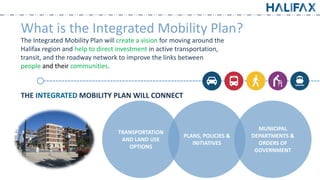
What is the Integrated Mobility Plan?
The Integrated Mobility Plan will create a vision for moving around the
Halifax region and help to direct investment in active transportation,
transit, and the roadway network to improve the links between
people and their communities.
TRANSPORTATION
AND LAND USE
OPTIONS
PLANS, POLICIES &
INITIATIVES
MUNICIPAL
DEPARTMENTS &
ORDERS OF
GOVERNMENT
THE INTEGRATED MOBILITY PLAN WILL CONNECT
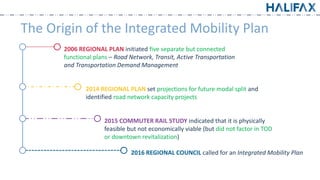
The Origin of the Integrated Mobility Plan
2006 REGIONAL PLAN initiated five separate but connected
functional plans – Road Network, Transit, Active Transportation
and Transportation Demand Management
2014 REGIONAL PLAN set projections for future modal split and
identified road network capacity projects
2015 COMMUTER RAIL STUDY indicated that it is physically
feasible but not economically viable (but did not factor in TOD
or downtown revitalization)
2016 REGIONAL COUNCIL called for an Integrated Mobility Plan
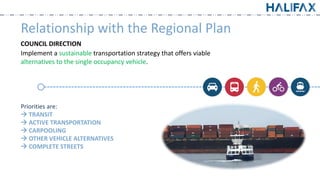
Relationship with the Regional Plan
COUNCIL DIRECTION
Implement a sustainable transportation strategy that offers viable
alternatives to the single occupancy vehicle.
Priorities are:
 TRANSIT
 ACTIVE TRANSPORTATION
 CARPOOLING
 OTHER VEHICLE ALTERNATIVES
 COMPLETE STREETS
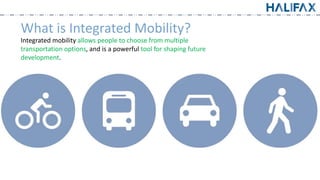
What is Integrated Mobility?
Integrated mobility allows people to choose from multiple
transportation options, and is a powerful tool for shaping future
development.
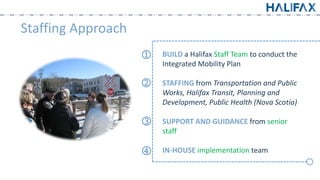
Staffing Approach
BUILD a Halifax Staff Team to conduct the
Integrated Mobility Plan
STAFFING from Transportation and Public
Works, Halifax Transit, Planning and
Development, Public Health (Nova Scotia)
SUPPORT AND GUIDANCE from senior
staff
IN-HOUSE implementation team
k
l
j
m
Key Deliverables
Clear process for making decisions and
setting priorities
Clear staged plan to develop affordable
mobility
Strategies over time to achieve HRM 2031
modal choice targets as stated in the
Regional Plan
Establish base line performance measures
to monitor success over time
Introduce early actions
k
l
j
m
n
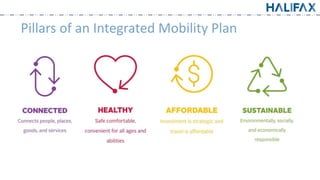
Pillars of an Integrated Mobility Plan
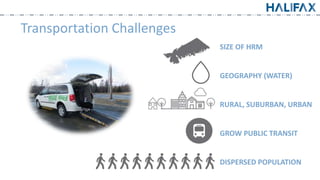
Transportation Challenges
SIZE OF HRM
GEOGRAPHY (WATER)
RURAL, SUBURBAN, URBAN
GROW PUBLIC TRANSIT
DISPERSED POPULATION
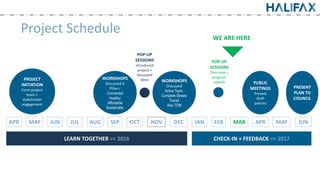
Project Schedule
APR MAY JUN JUL AUG SEP OCT NOV DEC JAN FEB MAR APR MAY JUN
LEARN TOGETHER << 2016 CHECK-IN + FEEDBACK << 2017
PROJECT
INITIATION
Form project
team +
stakeholder
engagement
WORKSHOPS
Discussed 4
Pillars:
Connected
Healthy
Affordable
Sustainable
WORKSHOPS
Discussed
Active Tsptn.
Complete Streets
Transit
Also TDM
PUBLIC
MEETINGS
Present
draft
policies
PRESENT
PLAN TO
COUNCIL
POP-UP
SESSIONS
Introduced
project +
discussed
ideas
POP-UP
SESSIONS
Overview +
progress
update
WE ARE HERE
Round 1 Public Consultation
ONLINE
• 165 people completed part of all of the
survey
IN-PERSON
• Over 130 people attended eight two-
hour workshops
• Over 150 people attended five pop-up
events
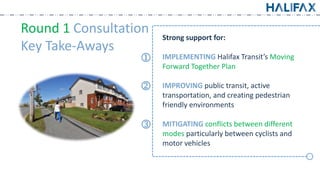
Round 1 Consultation
Key Take-Aways
Strong support for:
IMPLEMENTING Halifax Transit’s Moving
Forward Together Plan
IMPROVING public transit, active
transportation, and creating pedestrian
friendly environments
MITIGATING conflicts between different
modes particularly between cyclists and
motor vehicles
k
l
j
Round 2 Public Consultation
ONLINE
• 74 people completed part, or all, of the
survey
IN-PERSON
• Over the course of eight workshops,
over 70 people committed two hours
out of their day to participate in in-
depth conversations
E-MAILS AND LETTERS
• 9 groups and individuals submitted
emails and letters outlining their
thoughts
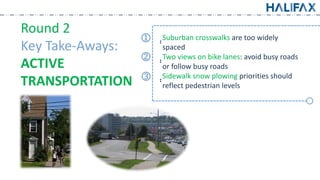
Round 2
Key Take-Aways:
ACTIVE
TRANSPORTATION
͙͙Suburban crosswalks are too widely
spaced
͙͙Two views on bike lanes: avoid busy roads
or follow busy roads
͙͙Sidewalk snow plowing priorities should
reflect pedestrian levels
k
l
j
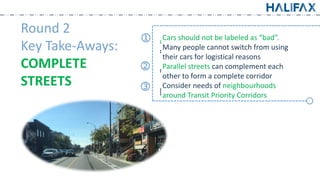
Round 2
Key Take-Aways:
COMPLETE
STREETS
͙͙Cars should not be labeled as “bad”.
͙͙Many people cannot switch from using
their cars for logistical reasons
͙͙Parallel streets can complement each
other to form a complete corridor
͙͙͙͙
Consider needs of neighbourhoods
around Transit Priority Corridors
k
l
j
Round 2
Key Take-Aways:
͙͙TRANSIT
PRIORITY
CORRIDORS
͙͙Transit Priority Corridors should look like a
coherent system and extend further out.
͙͙Support for commuter rail, but some
advocate a busway or optimizing bus
system with rail further into the future.
͙͙Don’t rule out innovative solutions such as
cable cars and small ferries for overcoming
geographic obstacles on key links.
͙͙
k
l
j
Round 2
Key Take-Aways:
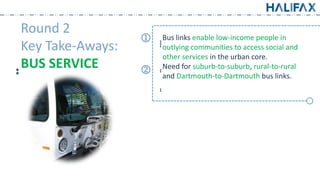
͙͙BUS SERVICE
͙͙͙͙
Bus links enable low-income people in
outlying communities to access social and
other services in the urban core.
͙͙Need for suburb-to-suburb, rural-to-rural
and Dartmouth-to-Dartmouth bus links.
͙͙
k
j
Round 2
Key Take-Aways:
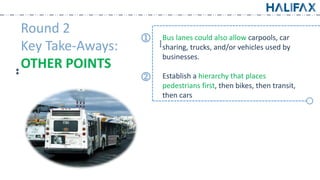
͙͙OTHER POINTS
͙͙͙͙
Bus lanes could also allow carpools, car
sharing, trucks, and/or vehicles used by
businesses.
Establish a hierarchy that places
pedestrians first, then bikes, then transit,
then cars
k
j
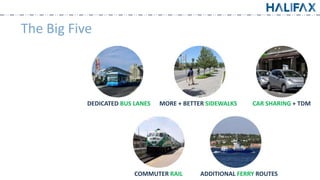
The Big Five
DEDICATED BUS LANES MORE + BETTER SIDEWALKS CAR SHARING + TDM
COMMUTER RAIL ADDITIONAL FERRY ROUTES
Emerging themes…
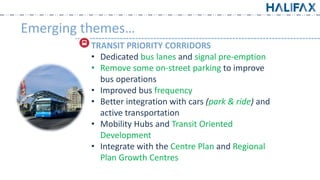
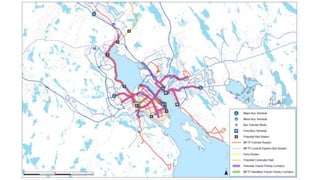
TRANSIT PRIORITY CORRIDORS
• Dedicated bus lanes and signal pre-emption
• Remove some on-street parking to improve
bus operations
• Improved bus frequency
• Better integration with cars (park & ride) and
active transportation
• Mobility Hubs and Transit Oriented
Development
• Integrate with the Centre Plan and Regional
Plan Growth Centres
Emerging themes…
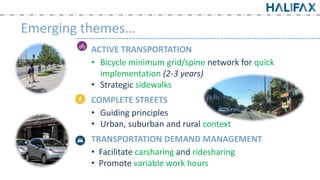
ACTIVE TRANSPORTATION
• Bicycle minimum grid/spine network for quick
implementation (2-3 years)
• Strategic sidewalks
COMPLETE STREETS
• Guiding principles
• Urban, suburban and rural context
TRANSPORTATION DEMAND MANAGEMENT
• Facilitate carsharing and ridesharing
• Promote variable work hours
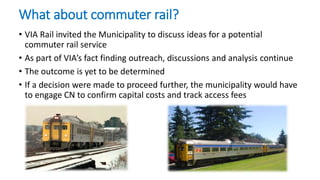
What about commuter rail?
• VIA Rail invited the Municipality to discuss ideas for a potential
commuter rail service
• As part of VIA’s fact finding outreach, discussions and analysis continue
• The outcome is yet to be determined
• If a decision were made to proceed further, the municipality would have
to engage CN to confirm capital costs and track access fees
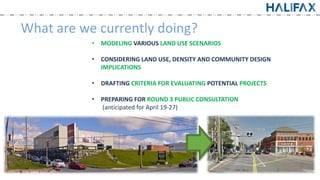
What are we currently doing?
• MODELING VARIOUS LAND USE SCENARIOS
• CONSIDERING LAND USE, DENSITY AND COMMUNITY DESIGN
IMPLICATIONS
• DRAFTING CRITERIA FOR EVALUATING POTENTIAL PROJECTS
• PREPARING FOR ROUND 3 PUBLIC CONSULTATION
(anticipated for April 19-27)
halifax.ca/integratedmobility

SHIFT Halifax Integrated Mobility Plan

  • 1.
  • 2.
    What is theIntegrated Mobility Plan? The Integrated Mobility Plan will create a vision for moving around the Halifax region and help to direct investment in active transportation, transit, and the roadway network to improve the links between people and their communities. TRANSPORTATION AND LAND USE OPTIONS PLANS, POLICIES & INITIATIVES MUNICIPAL DEPARTMENTS & ORDERS OF GOVERNMENT THE INTEGRATED MOBILITY PLAN WILL CONNECT
  • 3.
    The Origin ofthe Integrated Mobility Plan 2006 REGIONAL PLAN initiated five separate but connected functional plans – Road Network, Transit, Active Transportation and Transportation Demand Management 2014 REGIONAL PLAN set projections for future modal split and identified road network capacity projects 2015 COMMUTER RAIL STUDY indicated that it is physically feasible but not economically viable (but did not factor in TOD or downtown revitalization) 2016 REGIONAL COUNCIL called for an Integrated Mobility Plan
  • 4.
    Relationship with theRegional Plan COUNCIL DIRECTION Implement a sustainable transportation strategy that offers viable alternatives to the single occupancy vehicle. Priorities are:  TRANSIT  ACTIVE TRANSPORTATION  CARPOOLING  OTHER VEHICLE ALTERNATIVES  COMPLETE STREETS
  • 5.
    What is IntegratedMobility? Integrated mobility allows people to choose from multiple transportation options, and is a powerful tool for shaping future development.
  • 6.
    Staffing Approach BUILD aHalifax Staff Team to conduct the Integrated Mobility Plan STAFFING from Transportation and Public Works, Halifax Transit, Planning and Development, Public Health (Nova Scotia) SUPPORT AND GUIDANCE from senior staff IN-HOUSE implementation team k l j m
  • 7.
    Key Deliverables Clear processfor making decisions and setting priorities Clear staged plan to develop affordable mobility Strategies over time to achieve HRM 2031 modal choice targets as stated in the Regional Plan Establish base line performance measures to monitor success over time Introduce early actions k l j m n
  • 8.
    Pillars of anIntegrated Mobility Plan
  • 9.
    Transportation Challenges SIZE OFHRM GEOGRAPHY (WATER) RURAL, SUBURBAN, URBAN GROW PUBLIC TRANSIT DISPERSED POPULATION
  • 10.
    Project Schedule APR MAYJUN JUL AUG SEP OCT NOV DEC JAN FEB MAR APR MAY JUN LEARN TOGETHER << 2016 CHECK-IN + FEEDBACK << 2017 PROJECT INITIATION Form project team + stakeholder engagement WORKSHOPS Discussed 4 Pillars: Connected Healthy Affordable Sustainable WORKSHOPS Discussed Active Tsptn. Complete Streets Transit Also TDM PUBLIC MEETINGS Present draft policies PRESENT PLAN TO COUNCIL POP-UP SESSIONS Introduced project + discussed ideas POP-UP SESSIONS Overview + progress update WE ARE HERE
  • 11.
    Round 1 PublicConsultation ONLINE • 165 people completed part of all of the survey IN-PERSON • Over 130 people attended eight two- hour workshops • Over 150 people attended five pop-up events
  • 12.
    Round 1 Consultation KeyTake-Aways Strong support for: IMPLEMENTING Halifax Transit’s Moving Forward Together Plan IMPROVING public transit, active transportation, and creating pedestrian friendly environments MITIGATING conflicts between different modes particularly between cyclists and motor vehicles k l j
  • 13.
    Round 2 PublicConsultation ONLINE • 74 people completed part, or all, of the survey IN-PERSON • Over the course of eight workshops, over 70 people committed two hours out of their day to participate in in- depth conversations E-MAILS AND LETTERS • 9 groups and individuals submitted emails and letters outlining their thoughts
  • 14.
    Round 2 Key Take-Aways: ACTIVE TRANSPORTATION ͙͙Suburbancrosswalks are too widely spaced ͙͙Two views on bike lanes: avoid busy roads or follow busy roads ͙͙Sidewalk snow plowing priorities should reflect pedestrian levels k l j
  • 15.
    Round 2 Key Take-Aways: COMPLETE STREETS ͙͙Carsshould not be labeled as “bad”. ͙͙Many people cannot switch from using their cars for logistical reasons ͙͙Parallel streets can complement each other to form a complete corridor ͙͙͙͙ Consider needs of neighbourhoods around Transit Priority Corridors k l j
  • 16.
    Round 2 Key Take-Aways: ͙͙TRANSIT PRIORITY CORRIDORS ͙͙TransitPriority Corridors should look like a coherent system and extend further out. ͙͙Support for commuter rail, but some advocate a busway or optimizing bus system with rail further into the future. ͙͙Don’t rule out innovative solutions such as cable cars and small ferries for overcoming geographic obstacles on key links. ͙͙ k l j
  • 17.
    Round 2 Key Take-Aways: ͙͙BUSSERVICE ͙͙͙͙ Bus links enable low-income people in outlying communities to access social and other services in the urban core. ͙͙Need for suburb-to-suburb, rural-to-rural and Dartmouth-to-Dartmouth bus links. ͙͙ k j
  • 18.
    Round 2 Key Take-Aways: ͙͙OTHERPOINTS ͙͙͙͙ Bus lanes could also allow carpools, car sharing, trucks, and/or vehicles used by businesses. Establish a hierarchy that places pedestrians first, then bikes, then transit, then cars k j
  • 19.
    The Big Five DEDICATEDBUS LANES MORE + BETTER SIDEWALKS CAR SHARING + TDM COMMUTER RAIL ADDITIONAL FERRY ROUTES
  • 20.
    Emerging themes… TRANSIT PRIORITYCORRIDORS • Dedicated bus lanes and signal pre-emption • Remove some on-street parking to improve bus operations • Improved bus frequency • Better integration with cars (park & ride) and active transportation • Mobility Hubs and Transit Oriented Development • Integrate with the Centre Plan and Regional Plan Growth Centres
  • 22.
    Emerging themes… ACTIVE TRANSPORTATION •Bicycle minimum grid/spine network for quick implementation (2-3 years) • Strategic sidewalks COMPLETE STREETS • Guiding principles • Urban, suburban and rural context TRANSPORTATION DEMAND MANAGEMENT • Facilitate carsharing and ridesharing • Promote variable work hours
  • 23.
    What about commuterrail? • VIA Rail invited the Municipality to discuss ideas for a potential commuter rail service • As part of VIA’s fact finding outreach, discussions and analysis continue • The outcome is yet to be determined • If a decision were made to proceed further, the municipality would have to engage CN to confirm capital costs and track access fees
  • 24.
    What are wecurrently doing? • MODELING VARIOUS LAND USE SCENARIOS • CONSIDERING LAND USE, DENSITY AND COMMUNITY DESIGN IMPLICATIONS • DRAFTING CRITERIA FOR EVALUATING POTENTIAL PROJECTS • PREPARING FOR ROUND 3 PUBLIC CONSULTATION (anticipated for April 19-27)
  • 25.