What is World Literature?
“It is about stepping out of our
neighborhoods, regions,
cultures, and ethnicities, and
placing ourselves in the larger
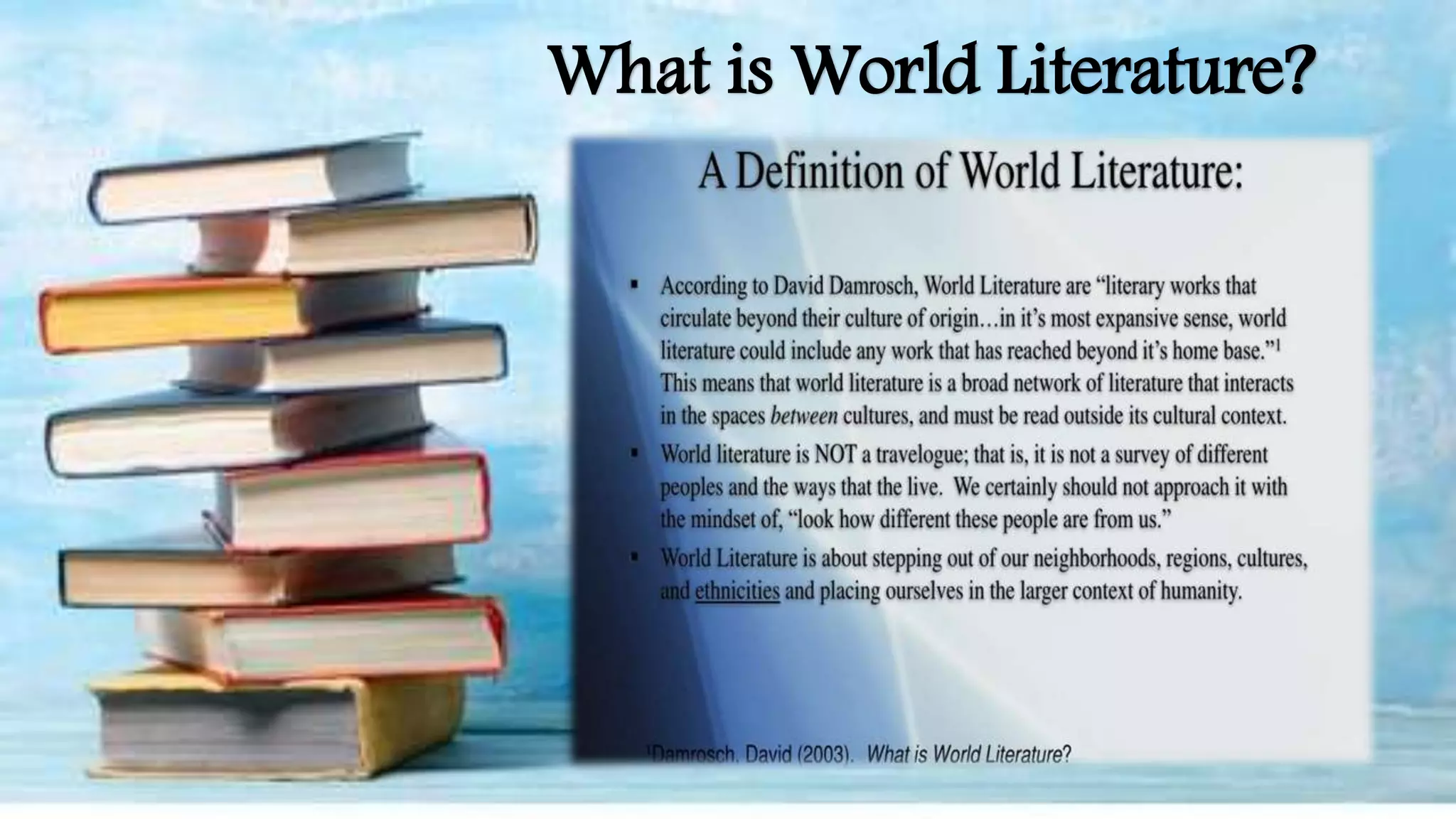
context of humanity.”
What is World Literature?
World Literature is learning about
values, culture, nationalism,
attitudes, thoughts, beliefs, feelings
and experiences
of the continents of the
world their in
different forms like poetry
and prose.
What is Literature?
autobiography, diaries, memoir, letters, and the essay, as
well as in the disciplines of history and philosophy.
Looking back…
What is Literature?
Looking back…
Qualifications of Literature
Looking back…
GENRES of Literature
POETRY
Let’s define…
 It refers to those expressions in verse, with measures, rhymes,
lines, stanzas and melodious tone.
 Function: to embody the deep truths reveal to us the complex
livingorganismcalledhumanbeing.
HORACE: Poetry has a two-fold function: to delight
andto instruct.
* Horace was a Roman writer who lived during
the reign of Augustus Caesar in the 1st century
B.C.
Types of Poetry
Let’s define…
Types of Poetry
Let’s define…
Types of Poetry
Let’s define…
b. NARRATIVE POETRY
– it tells a story that follows an order of events.
- long descriptive poemabout life and events that may
be real or imaginary.
Types of Poetry
Let’s define…
Types of Narrative Poetry:
1. Ballad – a short simple narrative poem composed to be sung, and is
orallytold fromone generation to another.
2. Metrical Romance – written in verse; a long rambling love story
which centers the adventure s of knights and lords and their royal ladies during
the age of chivalry. It is also heavily flavored in romance, fantastic events,
supernaturaloccurrences, magic,and truth, courage, reverenceand justice.
3. Epic – a long, majestic poem that tells the adventures of a
traditional heroand the development of a nation.
Types of Poetry
Let’s define…
c. DRAMATICPOETRY
– it has elements that are closely related to
drama because it is written in dramatic form or makes
use of dramatic technique. It may suggest a story but
more emphasis is placed on the characters rather than
the narration.
Other Forms of Poetry
Let’s define…
• Blank verse – (Italy) written in iambic pentameter, or a line
with ten syllables and five stresses; unrhymed and
traditionallyuses dramaticspeech.
• Haiku – (Japan) a three-line poem which has 5-7-5 syllable
count.
• Free verse – an open form that does not follow a rhyme,
metrical, or musical scheme.
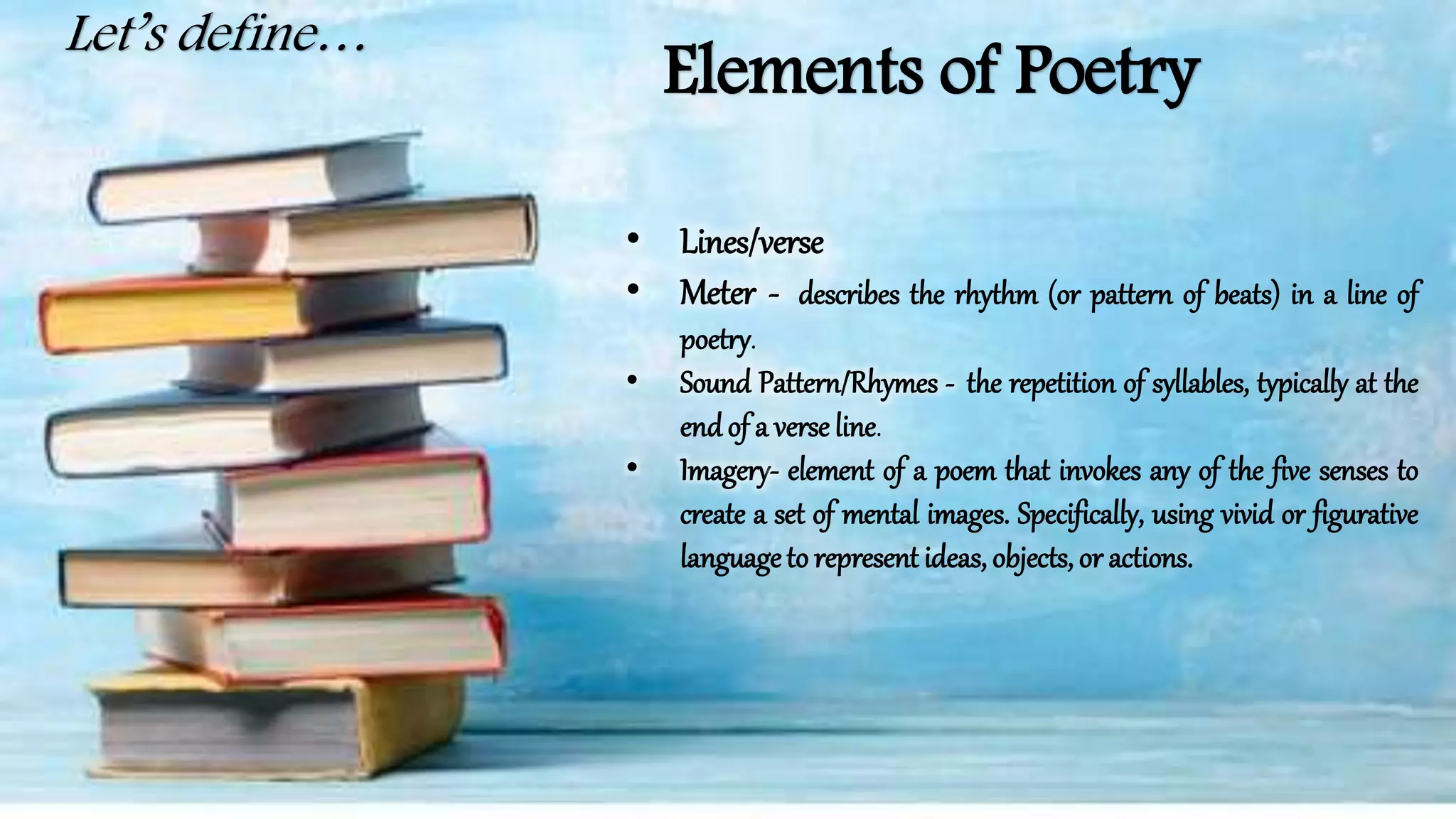
Elements of Poetry
Let’s define…
• Lines/verse
• Meter - describes the rhythm (or pattern of beats) in a line of
poetry.
• Sound Pattern/Rhymes - the repetition of syllables, typically at the
endof a verse line.
• Imagery- element of a poem that invokes any of the five senses to
create a set of mental images. Specifically, using vivid or figurative
languageto represent ideas, objects, or actions.
PROSE
Let’s define…
• In writing, prose refers to any written work that
follows a basic grammatical structure (think
words and phrases arranged into sentences and
paragraphs). This stands out from works of
poetry, which follow a metrical structure Prose
simply means language that follows the natural
patterns found in everyday speech.
PROSE
Let’s define…
• FICTION
• NONFICTION
Let’s define…
FICTION
• a series of imaginative facts about truths in human life;
presents humanlife.
Classifications:
a. Short Story - short narrative artistic in nature involving one or more
characters that focus on a single plot, one single
experience.
b. Novel - a long narrative divided into chapters and may
involve few or more characters with complex theme (plot).
c. Drama - a literary form presented on stage. It involves three
elements : theater, actors, audience. It is an art of imitating human
characters and actions. (Tragedy, Comedy)
Let’s define…
FICTION
Classification Word Count
Flash fiction 100 – 1,000
Short story 1,000 – 10, 000
Novelette 10, 000 – 20, 000
Novella 20, 000 – 30, 000
Novel 30, 000 and
beyond
Let’s define…
Elements of Fiction
PLOT – the sequence of evets in the story;
this includes the conflict of the story and
the resolution.
• Conflict: internal or external
• Man vs. Self
• Man vs. Man
• Man vs. Society
• Man vs. Nature
• Man vs. Supernatural
Let’s define…
Elements of Fiction
CHARACTERS – individuals in a story
 Presence: Major/Minor character
 Position: Protagonist/Antagonist
 Characterization: Round/Flat
 Movement: Dynamic/Static
POINT OF VIEW – the position in which the
story is being told and the manner of its telling
Let’s define…
Elements of Fiction
VOICE and DIALOGUE – how speech is
rendered in a story, either as the narrator
talking to the reader or characters talking
to each other
SETTING– where and when the story take place
THEME – what the story is trying about the
human condition
Let’s define…
Elements of Fiction
Symbols – or an object that represents,
stands for, or suggests an idea, belief,
concept, and abstraction that may not
otherwise be rendered into concrete
images. Symbols take the form of words,
sounds, gestures, or visual images and are
used to convey ideas and beliefs.
Let’s define…
Kinds of symbolism:
• Motif/Leitmotif – a repetition of symbol in a
story. It can be an object, an action, a word or
phrase, or even a description. Motifs are
dependent on the fictional world of the story,
and may not carry any meaning in the real
world.
• Tropes – are common literary devices, motifs,
or figurative language that occur across
several creative works, they can be identified
by the way they are commonly used by the
creators.
Ex. a boy falls in love with a girl who does not
love him back; the monster in the closet; or the ordinary
person becomes the hero.
Let’s define…
Kinds of symbolism:
• Archetypes – usually refer to character
templates in a story that fulfill a certain
function.
• Allegory – also known as extended metaphor
and uses characters and events in literary or
other art forms to represent and symbolize
abstractions. Many mythologies and religious
texts use allegories to concretize an abstract
concept or idea.
Let’s define…
based mainly on facts rather than on imagination
althoughthey may contain fictional elements.
• essays, biography/autobiography, memoir, diary,
and the like
Literature, as compared to any other forms of writing, possesses
distinct qualities that separate it from the rest. These are what we call
literary standards.
What are the literary standards?

World Literature

  • 2.
    What is WorldLiterature?
  • 3.
    What is WorldLiterature? “It is about stepping out of our neighborhoods, regions, cultures, and ethnicities, and placing ourselves in the larger context of humanity.”
  • 4.
    What is WorldLiterature? World Literature is learning about values, culture, nationalism, attitudes, thoughts, beliefs, feelings and experiences of the continents of the world their in different forms like poetry and prose.
  • 5.
    What is Literature? autobiography,diaries, memoir, letters, and the essay, as well as in the disciplines of history and philosophy. Looking back…
  • 6.
  • 7.
    Qualifications of Literature Lookingback… GENRES of Literature
  • 8.
    POETRY Let’s define…  Itrefers to those expressions in verse, with measures, rhymes, lines, stanzas and melodious tone.  Function: to embody the deep truths reveal to us the complex livingorganismcalledhumanbeing. HORACE: Poetry has a two-fold function: to delight andto instruct. * Horace was a Roman writer who lived during the reign of Augustus Caesar in the 1st century B.C.
  • 9.
  • 10.
  • 11.
    Types of Poetry Let’sdefine… b. NARRATIVE POETRY – it tells a story that follows an order of events. - long descriptive poemabout life and events that may be real or imaginary.
  • 12.
    Types of Poetry Let’sdefine… Types of Narrative Poetry: 1. Ballad – a short simple narrative poem composed to be sung, and is orallytold fromone generation to another. 2. Metrical Romance – written in verse; a long rambling love story which centers the adventure s of knights and lords and their royal ladies during the age of chivalry. It is also heavily flavored in romance, fantastic events, supernaturaloccurrences, magic,and truth, courage, reverenceand justice. 3. Epic – a long, majestic poem that tells the adventures of a traditional heroand the development of a nation.
  • 13.
    Types of Poetry Let’sdefine… c. DRAMATICPOETRY – it has elements that are closely related to drama because it is written in dramatic form or makes use of dramatic technique. It may suggest a story but more emphasis is placed on the characters rather than the narration.
  • 14.
    Other Forms ofPoetry Let’s define… • Blank verse – (Italy) written in iambic pentameter, or a line with ten syllables and five stresses; unrhymed and traditionallyuses dramaticspeech. • Haiku – (Japan) a three-line poem which has 5-7-5 syllable count. • Free verse – an open form that does not follow a rhyme, metrical, or musical scheme.
  • 15.
    Elements of Poetry Let’sdefine… • Lines/verse • Meter - describes the rhythm (or pattern of beats) in a line of poetry. • Sound Pattern/Rhymes - the repetition of syllables, typically at the endof a verse line. • Imagery- element of a poem that invokes any of the five senses to create a set of mental images. Specifically, using vivid or figurative languageto represent ideas, objects, or actions.
  • 16.
    PROSE Let’s define… • Inwriting, prose refers to any written work that follows a basic grammatical structure (think words and phrases arranged into sentences and paragraphs). This stands out from works of poetry, which follow a metrical structure Prose simply means language that follows the natural patterns found in everyday speech.
  • 17.
  • 18.
    Let’s define… FICTION • aseries of imaginative facts about truths in human life; presents humanlife. Classifications: a. Short Story - short narrative artistic in nature involving one or more characters that focus on a single plot, one single experience. b. Novel - a long narrative divided into chapters and may involve few or more characters with complex theme (plot). c. Drama - a literary form presented on stage. It involves three elements : theater, actors, audience. It is an art of imitating human characters and actions. (Tragedy, Comedy)
  • 19.
    Let’s define… FICTION Classification WordCount Flash fiction 100 – 1,000 Short story 1,000 – 10, 000 Novelette 10, 000 – 20, 000 Novella 20, 000 – 30, 000 Novel 30, 000 and beyond
  • 20.
    Let’s define… Elements ofFiction PLOT – the sequence of evets in the story; this includes the conflict of the story and the resolution. • Conflict: internal or external • Man vs. Self • Man vs. Man • Man vs. Society • Man vs. Nature • Man vs. Supernatural
  • 21.
    Let’s define… Elements ofFiction CHARACTERS – individuals in a story  Presence: Major/Minor character  Position: Protagonist/Antagonist  Characterization: Round/Flat  Movement: Dynamic/Static POINT OF VIEW – the position in which the story is being told and the manner of its telling
  • 22.
    Let’s define… Elements ofFiction VOICE and DIALOGUE – how speech is rendered in a story, either as the narrator talking to the reader or characters talking to each other SETTING– where and when the story take place THEME – what the story is trying about the human condition
  • 23.
    Let’s define… Elements ofFiction Symbols – or an object that represents, stands for, or suggests an idea, belief, concept, and abstraction that may not otherwise be rendered into concrete images. Symbols take the form of words, sounds, gestures, or visual images and are used to convey ideas and beliefs.
  • 24.
    Let’s define… Kinds ofsymbolism: • Motif/Leitmotif – a repetition of symbol in a story. It can be an object, an action, a word or phrase, or even a description. Motifs are dependent on the fictional world of the story, and may not carry any meaning in the real world. • Tropes – are common literary devices, motifs, or figurative language that occur across several creative works, they can be identified by the way they are commonly used by the creators. Ex. a boy falls in love with a girl who does not love him back; the monster in the closet; or the ordinary person becomes the hero.
  • 25.
    Let’s define… Kinds ofsymbolism: • Archetypes – usually refer to character templates in a story that fulfill a certain function. • Allegory – also known as extended metaphor and uses characters and events in literary or other art forms to represent and symbolize abstractions. Many mythologies and religious texts use allegories to concretize an abstract concept or idea.
  • 26.
    Let’s define… based mainlyon facts rather than on imagination althoughthey may contain fictional elements. • essays, biography/autobiography, memoir, diary, and the like
  • 27.
    Literature, as comparedto any other forms of writing, possesses distinct qualities that separate it from the rest. These are what we call literary standards. What are the literary standards?
  • 28.
    What are theliterary standards?
  • 29.
    What are theliterary standards?