World Literature II
Renaissance to the Present
      Dr. Michael Broder
  University of South Carolina
       March 13, 2012
We have not had a presentation
since February 2, when we were
        reading Othello.
   Let’s catch up on some of the social,
  cultural, and historical background of
  Europe since the time of Shakespeare.
Course Objectives
• By the end of this course, students should be able to
   – Identify major authors and texts from the Renaissance to
     the present
   – Explain how literary texts relate to their social, cultural,
     and historical contexts
   – Apply factual and conceptual knowledge to the analysis of
     literary texts
   – Assess how knowledge of European literature is valuable
     in your own life
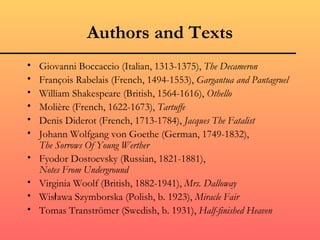
Authors and Texts
•   Giovanni Boccaccio (Italian, 1313-1375), The Decameron
•   François Rabelais (French, 1494-1553), Gargantua and Pantagruel
•   William Shakespeare (British, 1564-1616), Othello
•   Molière (French, 1622-1673), Tartuffe
•   Denis Diderot (French, 1713-1784), Jacques The Fatalist
•   Johann Wolfgang von Goethe (German, 1749-1832),
    The Sorrows Of Young Werther
•   Fyodor Dostoevsky (Russian, 1821-1881),
    Notes From Underground
•   Virginia Woolf (British, 1882-1941), Mrs. Dalloway
•   Wisława Szymborska (Polish, b. 1923), Miracle Fair
•   Tomas Tranströmer (Swedish, b. 1931), Half-finished Heaven
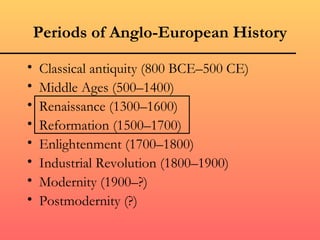
Periods of Anglo-European History

•   Classical antiquity (800 BCE–500 CE)
•   Middle Ages (500–1400)
•   Renaissance (1300–1600)
•   Reformation (1500–1700)
•   Enlightenment (1700–1800)
•   Industrial Revolution (1800–1900)
•   Modernity (1900–?)
•   Postmodernity (?)
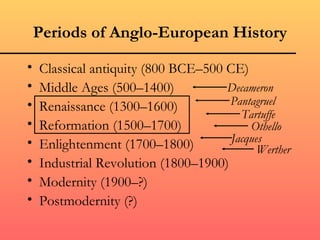
Periods of Anglo-European History

•   Classical antiquity (800 BCE–500 CE)
•   Middle Ages (500–1400)           Decameron
•   Renaissance (1300–1600)           Pantagruel
                                        Tartuffe
•   Reformation (1500–1700)               Othello
•                                     Jacques
    Enlightenment (1700–1800)               Werther
•   Industrial Revolution (1800–1900)
•   Modernity (1900–?)
•   Postmodernity (?)
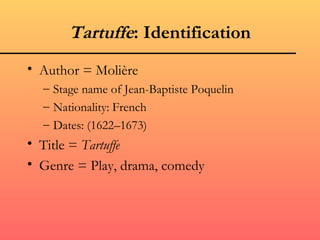
Tartuffe: Identification
• Author = Molière
  – Stage name of Jean-Baptiste Poquelin
  – Nationality: French
  – Dates: (1622–1673)
• Title = Tartuffe
• Genre = Play, drama, comedy
Jacques: Identification
• Author = Denis Diderot
   – Nationality: French
   – Dates: (1713–1784)
• Title = Jacques the Fatalist and His Master
• Genre = Novel
Werther: Identification
• Author = Johann Wolfgang von Goethe
   – Nationality: German
   – Dates: (1749–1832)
• Title = The Sorrows of Young Werther
• Genre = Novel
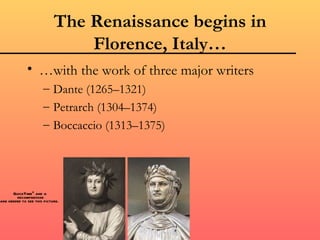
The Renaissance begins in
                                Florence, Italy…
              • …with the work of three major writers
                      – Dante (1265–1321)
                      – Petrarch (1304–1374)
                      – Boccaccio (1313–1375)


      QuickTimeª and a
        decompressor
are needed to see this picture.
Rebirth of Classical Humanism
• Knowledge of Latin continued in Europe
  after the fall of the Roman Empire
• European scholars, however, focused on the
  study of Greek and Arabic works of science,
  philosophy and mathematics (in Latin
  translations)
• 14th-century Italian scholars revived the
  study of Latin poetry, history, and oratory
Rebirth of Classical Humanism


   What is humanism, anyway?
Humanism
• The study of humanity, the human condition,
  human history, and human values
• While humanism is not irreligious or anti-
  religious, its central focus is the human rather
  than the divine
Humanism
• The study of humanity, the human condition,
  human history, and human values
• While humanism is not irreligious or anti-
  religious, its central focus is the human rather
  than the divine

     What does the term “human
         condition” mean?
The Human Condition
• Originally after the French phrase “condition
  humaine” (= human condition)
• “Let us learn, by the great miseries and
  afflictions that God hath sent us, the great
  fragility and misery of our human condition”
                    Pierre Boaistuau (c. 1517–1566)
                                  French humanist
The Human Condition
• The state or condition of being human, especially
  regarded as being inherently problematic or flawed
• The condition of human beings collectively
                               – Oxford English Dictionary


How would you relate Decameron, Pantagruel, Othello,
Tartuffe, Jacques, or Werther to the idea of the human
condition?
The Human Condition
• The positive and negative aspects of existence as a
  human being, especially the inevitable events such as
  birth, childhood, adolescence, love, sex,
  reproduction, aging, and death
                                          – Dictionary.com


How would you relate Decameron, Pantagruel, Othello,
Tartuffe, Jacques, or Werther to the idea of the human
condition?
The Human Condition
• The unique and inescapable features of being human in a
  social, cultural, and personal context
• It includes concerns such as a search for purpose, sense of
  curiosity, the inevitability of isolation, or the fear of death
                                                        – Wikipedia


How would you relate Decameron, Pantagruel, Othello,
Tartuffe, Jacques, or Werther to the idea of the human
condition?
Rediscovery of Ancient Greek
• While ancient Greek was studied in the
  Byzantine Empire, study of ancient Greek
  was very limited in Western Europe
• In 1396, Coluccio Salutati, the chancellor of
  the University of Florence, hired Byzantine
  scholar Manuel Chrysoloras to teach Greek
• Italian scholars became reacquainted with
  ancient Greek poetry, drama, history, oratory,
  and philosophy
The Literary Renaissance
       Spreads Beyond Italy
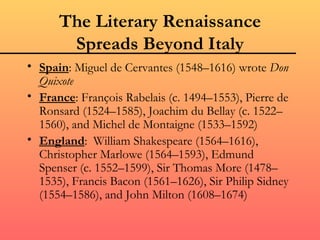
• Spain: Miguel de Cervantes (1548–1616) wrote Don
  Quixote
• France: François Rabelais (c. 1494–1553), Pierre de
  Ronsard (1524–1585), Joachim du Bellay (c. 1522–
  1560), and Michel de Montaigne (1533–1592)
• England: William Shakespeare (1564–1616),
  Christopher Marlowe (1564–1593), Edmund
  Spenser (c. 1552–1599), Sir Thomas More (1478–
  1535), Francis Bacon (1561–1626), Sir Philip Sidney
  (1554–1586), and John Milton (1608–1674)
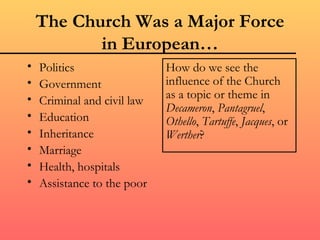
The Church Was a Major Force
           in European…
•   Politics                 How do we see the
•   Government               influence of the Church
•   Criminal and civil law   as a topic or theme in
                             Decameron, Pantagruel,
•   Education                Othello, Tartuffe, Jacques, or
•   Inheritance              Werther?
•   Marriage
•   Health, hospitals
•   Assistance to the poor
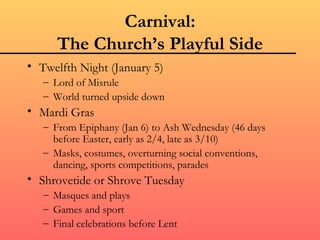
Carnival:
      The Church’s Playful Side
• Twelfth Night (January 5)
   – Lord of Misrule
   – World turned upside down
• Mardi Gras
   – From Epiphany (Jan 6) to Ash Wednesday (46 days
     before Easter, early as 2/4, late as 3/10)
   – Masks, costumes, overturning social conventions,
     dancing, sports competitions, parades
• Shrovetide or Shrove Tuesday
   – Masques and plays
   – Games and sport
   – Final celebrations before Lent
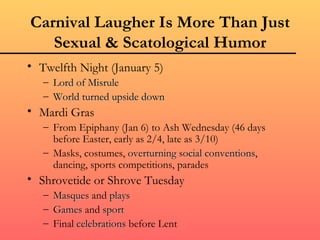
Carnival Laugher Is More Than Just
   Sexual & Scatological Humor
• Twelfth Night (January 5)
   – Lord of Misrule
   – World turned upside down
• Mardi Gras
   – From Epiphany (Jan 6) to Ash Wednesday (46 days
     before Easter, early as 2/4, late as 3/10)
   – Masks, costumes, overturning social conventions,
                                            conventions
     dancing, sports competitions, parades
• Shrovetide or Shrove Tuesday
   – Masques and plays
   – Games and sport
   – Final celebrations before Lent
Carnival & Carnival Laugher
• Twelfth Night (January 5) How do we see Carnival as
   – Lord of Misrule          a topic or theme in
   – World turned upside down Decameron, Pantagruel, Othello,
• Mardi Gras                  Tartuffe, Jacques, or Werther?
   – From Epiphany (Jan 6) to Ash Wednesday (46 days
     before Easter, early as 2/4, late as 3/10)
   – Masks, costumes, overturning social conventions,
                                            conventions
     dancing, sports competitions, parades
• Shrovetide or Shrove Tuesday
   – Masques and plays
   – Games and sport
   – Final celebrations before Lent
Erosion of Church Authority
• The Church struggled to offer meaningful support to its
  members during the Black Death (1348-1350)
• The Church lost respect, influence, and authority
• Some traditional social roles of the Church were taken over
  by secular groups
• Peasant uprisings occurred in parts of Europe
   – Northern France, 1358 (Jacquerie Rebellion)
   – Florence, Italy, 1378 (Ciompi Rebellion)
   – England, 1381 (Peasant’s Revolt)

How do we see the erosion of Church authority as a
topic or theme in Decameron, Pantagruel, Othello, Tartuffe,
Jacques, or Werther?
The Western (Papal) Schism
• Split within the Catholic Church from 1378 to 1417
• The cardinals elected a new pope in 1378, but then had
  “buyer’s remorse” and elected another pope
• Both men claimed the right to hold the office
• Conflict was more political than theological in nature
• Ended by the Council of Constance (1414–1418), who fired
  the successors of both popes and started fresh with Pope
  Martin V
• The schism hurt the reputation of the papacy and diminished
  the respect and authority of the Church
How do we see the erosion of Church authority as a
topic or theme in Decameron, Pantagruel, Othello, Tartuffe,
Jacques, or Werther?
Renaissance & Reformation
• Renaissance Catholic priests such such as Erasmus of
  Rotterdam (1466–1536) and Martin Luther (1483–1546)
  proposed reform to the Church, often based on classical
  humanist principles
• The Ninety-Five Theses, published by Luther in 1517,
  condemned the corruption of the papacy and challenged the
  authority of the Pope, leading to the Protestant Reformation
• Northern Europe, with the exception of Ireland and parts of
  Britain, turned Protestant, while Southern Europe remained
  Roman Catholic
How do we see the Reformation as a topic or theme in
Decameron, Pantagruel, Othello, Tartuffe, Jacques, or Werther?
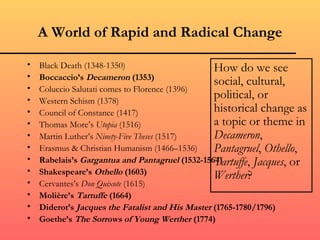
A World of Rapid and Radical Change

•   Black Death (1348-1350)                       How do we see
•   Boccaccio’s Decameron (1353)
•
                                                  social, cultural,
    Coluccio Salutati comes to Florence (1396)
•   Western Schism (1378)
                                                  political, or
•   Council of Constance (1417)                   historical change as
•   Thomas More’s Utopia (1516)                   a topic or theme in
•   Martin Luther’s Ninety-Five Theses (1517)     Decameron,
•   Erasmus & Christian Humanism (1466–1536)      Pantagruel, Othello,
•                                                 Tartuffe, Jacques, or
    Rabelais’s Gargantua and Pantagruel (1532-1564)
•   Shakespeare’s Othello (1603)                  Werther?
•   Cervantes’s Don Quixote (1615)
•   Molière’s Tartuffe (1664)
•   Diderot’s Jacques the Fatalist and His Master (1765-1780/1796)
•   Goethe’s The Sorrows of Young Werther (1774)
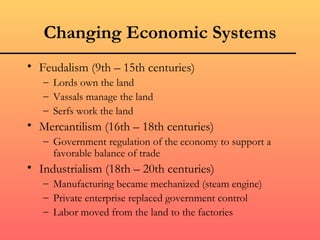
Changing Economic Systems
• Feudalism (9th – 15th centuries)
   – Lords own the land
   – Vassals manage the land
   – Serfs work the land
• Mercantilism (16th – 18th centuries)
   – Government regulation of the economy to support a
     favorable balance of trade
• Industrialism (18th – 20th centuries)
   – Manufacturing became mechanized (steam engine)
   – Private enterprise replaced government control
   – Labor moved from the land to the factories
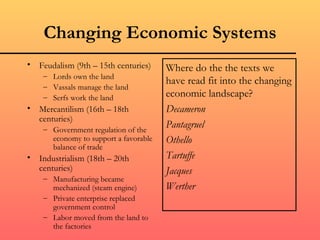
Changing Economic Systems
• Feudalism (9th – 15th centuries)     Where do the the texts we
    – Lords own the land
    – Vassals manage the land
                                       have read fit into the changing
    – Serfs work the land              economic landscape?
• Mercantilism (16th – 18th            Decameron
  centuries)
    – Government regulation of the     Pantagruel
      economy to support a favorable   Othello
      balance of trade
• Industrialism (18th – 20th           Tartuffe
  centuries)                           Jacques
    – Manufacturing became
      mechanized (steam engine)        Werther
    – Private enterprise replaced
      government control
    – Labor moved from the land to
      the factories
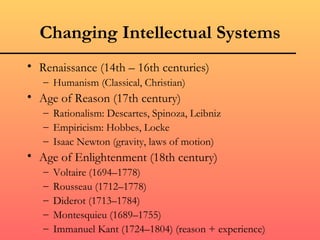
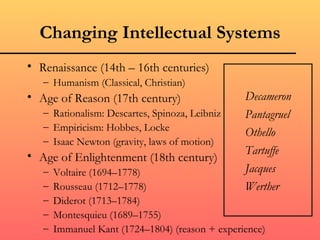
Changing Intellectual Systems
• Renaissance (14th – 16th centuries)
   – Humanism (Classical, Christian)
• Age of Reason (17th century)
   – Rationalism: Descartes, Spinoza, Leibniz
   – Empiricism: Hobbes, Locke
   – Isaac Newton (gravity, laws of motion)
• Age of Enlightenment (18th century)
   –   Voltaire (1694–1778)
   –   Rousseau (1712–1778)
   –   Diderot (1713–1784)
   –   Montesquieu (1689–1755)
   –   Immanuel Kant (1724–1804) (reason + experience)
Changing Intellectual Systems
• Renaissance (14th – 16th centuries)
   – Humanism (Classical, Christian)
• Age of Reason (17th century)                   Decameron
   – Rationalism: Descartes, Spinoza, Leibniz    Pantagruel
   – Empiricism: Hobbes, Locke
                                                 Othello
   – Isaac Newton (gravity, laws of motion)
• Age of Enlightenment (18th century)            Tartuffe
   –   Voltaire (1694–1778)                      Jacques
   –   Rousseau (1712–1778)                      Werther
   –   Diderot (1713–1784)
   –   Montesquieu (1689–1755)
   –   Immanuel Kant (1724–1804) (reason + experience)
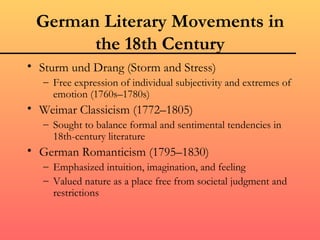
German Literary Movements in
       the 18th Century
• Sturm und Drang (Storm and Stress)
   – Free expression of individual subjectivity and extremes of
     emotion (1760s–1780s)
• Weimar Classicism (1772–1805)
   – Sought to balance formal and sentimental tendencies in
     18th-century literature
• German Romanticism (1795–1830)
   – Emphasized intuition, imagination, and feeling
   – Valued nature as a place free from societal judgment and
     restrictions
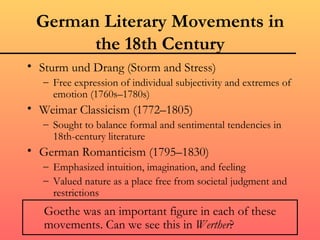
German Literary Movements in
       the 18th Century
• Sturm und Drang (Storm and Stress)
   – Free expression of individual subjectivity and extremes of
     emotion (1760s–1780s)
• Weimar Classicism (1772–1805)
   – Sought to balance formal and sentimental tendencies in
     18th-century literature
• German Romanticism (1795–1830)
   – Emphasized intuition, imagination, and feeling
   – Valued nature as a place free from societal judgment and
     restrictions
   Goethe was an important figure in each of these
   movements. Can we see this in Werther?
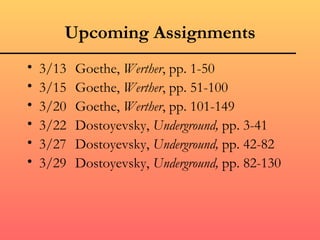
Upcoming Assignments
•   3/13   Goethe, Werther, pp. 1-50
•   3/15   Goethe, Werther, pp. 51-100
•   3/20   Goethe, Werther, pp. 101-149
•   3/22   Dostoyevsky, Underground, pp. 3-41
•   3/27   Dostoyevsky, Underground, pp. 42-82
•   3/29   Dostoyevsky, Underground, pp. 82-130
World Literature II
Renaissance to the Present
      Dr. Michael Broder
  University of South Carolina
       March 13, 2012

World Lit II - Class Notes for March 13, 2012

  • 1.
    World Literature II Renaissanceto the Present Dr. Michael Broder University of South Carolina March 13, 2012
  • 2.
    We have nothad a presentation since February 2, when we were reading Othello. Let’s catch up on some of the social, cultural, and historical background of Europe since the time of Shakespeare.
  • 3.
    Course Objectives • Bythe end of this course, students should be able to – Identify major authors and texts from the Renaissance to the present – Explain how literary texts relate to their social, cultural, and historical contexts – Apply factual and conceptual knowledge to the analysis of literary texts – Assess how knowledge of European literature is valuable in your own life
  • 4.
    Authors and Texts • Giovanni Boccaccio (Italian, 1313-1375), The Decameron • François Rabelais (French, 1494-1553), Gargantua and Pantagruel • William Shakespeare (British, 1564-1616), Othello • Molière (French, 1622-1673), Tartuffe • Denis Diderot (French, 1713-1784), Jacques The Fatalist • Johann Wolfgang von Goethe (German, 1749-1832), The Sorrows Of Young Werther • Fyodor Dostoevsky (Russian, 1821-1881), Notes From Underground • Virginia Woolf (British, 1882-1941), Mrs. Dalloway • Wisława Szymborska (Polish, b. 1923), Miracle Fair • Tomas Tranströmer (Swedish, b. 1931), Half-finished Heaven
  • 5.
    Periods of Anglo-EuropeanHistory • Classical antiquity (800 BCE–500 CE) • Middle Ages (500–1400) • Renaissance (1300–1600) • Reformation (1500–1700) • Enlightenment (1700–1800) • Industrial Revolution (1800–1900) • Modernity (1900–?) • Postmodernity (?)
  • 6.
    Periods of Anglo-EuropeanHistory • Classical antiquity (800 BCE–500 CE) • Middle Ages (500–1400) Decameron • Renaissance (1300–1600) Pantagruel Tartuffe • Reformation (1500–1700) Othello • Jacques Enlightenment (1700–1800) Werther • Industrial Revolution (1800–1900) • Modernity (1900–?) • Postmodernity (?)
  • 7.
    Tartuffe: Identification • Author= Molière – Stage name of Jean-Baptiste Poquelin – Nationality: French – Dates: (1622–1673) • Title = Tartuffe • Genre = Play, drama, comedy
  • 8.
    Jacques: Identification • Author= Denis Diderot – Nationality: French – Dates: (1713–1784) • Title = Jacques the Fatalist and His Master • Genre = Novel
  • 9.
    Werther: Identification • Author= Johann Wolfgang von Goethe – Nationality: German – Dates: (1749–1832) • Title = The Sorrows of Young Werther • Genre = Novel
  • 10.
    The Renaissance beginsin Florence, Italy… • …with the work of three major writers – Dante (1265–1321) – Petrarch (1304–1374) – Boccaccio (1313–1375) QuickTimeª and a decompressor are needed to see this picture.
  • 11.
    Rebirth of ClassicalHumanism • Knowledge of Latin continued in Europe after the fall of the Roman Empire • European scholars, however, focused on the study of Greek and Arabic works of science, philosophy and mathematics (in Latin translations) • 14th-century Italian scholars revived the study of Latin poetry, history, and oratory
  • 12.
    Rebirth of ClassicalHumanism What is humanism, anyway?
  • 13.
    Humanism • The studyof humanity, the human condition, human history, and human values • While humanism is not irreligious or anti- religious, its central focus is the human rather than the divine
  • 14.
    Humanism • The studyof humanity, the human condition, human history, and human values • While humanism is not irreligious or anti- religious, its central focus is the human rather than the divine What does the term “human condition” mean?
  • 15.
    The Human Condition •Originally after the French phrase “condition humaine” (= human condition) • “Let us learn, by the great miseries and afflictions that God hath sent us, the great fragility and misery of our human condition” Pierre Boaistuau (c. 1517–1566) French humanist
  • 16.
    The Human Condition •The state or condition of being human, especially regarded as being inherently problematic or flawed • The condition of human beings collectively – Oxford English Dictionary How would you relate Decameron, Pantagruel, Othello, Tartuffe, Jacques, or Werther to the idea of the human condition?
  • 17.
    The Human Condition •The positive and negative aspects of existence as a human being, especially the inevitable events such as birth, childhood, adolescence, love, sex, reproduction, aging, and death – Dictionary.com How would you relate Decameron, Pantagruel, Othello, Tartuffe, Jacques, or Werther to the idea of the human condition?
  • 18.
    The Human Condition •The unique and inescapable features of being human in a social, cultural, and personal context • It includes concerns such as a search for purpose, sense of curiosity, the inevitability of isolation, or the fear of death – Wikipedia How would you relate Decameron, Pantagruel, Othello, Tartuffe, Jacques, or Werther to the idea of the human condition?
  • 19.
    Rediscovery of AncientGreek • While ancient Greek was studied in the Byzantine Empire, study of ancient Greek was very limited in Western Europe • In 1396, Coluccio Salutati, the chancellor of the University of Florence, hired Byzantine scholar Manuel Chrysoloras to teach Greek • Italian scholars became reacquainted with ancient Greek poetry, drama, history, oratory, and philosophy
  • 20.
    The Literary Renaissance Spreads Beyond Italy • Spain: Miguel de Cervantes (1548–1616) wrote Don Quixote • France: François Rabelais (c. 1494–1553), Pierre de Ronsard (1524–1585), Joachim du Bellay (c. 1522– 1560), and Michel de Montaigne (1533–1592) • England: William Shakespeare (1564–1616), Christopher Marlowe (1564–1593), Edmund Spenser (c. 1552–1599), Sir Thomas More (1478– 1535), Francis Bacon (1561–1626), Sir Philip Sidney (1554–1586), and John Milton (1608–1674)
  • 21.
    The Church Wasa Major Force in European… • Politics How do we see the • Government influence of the Church • Criminal and civil law as a topic or theme in Decameron, Pantagruel, • Education Othello, Tartuffe, Jacques, or • Inheritance Werther? • Marriage • Health, hospitals • Assistance to the poor
  • 22.
    Carnival: The Church’s Playful Side • Twelfth Night (January 5) – Lord of Misrule – World turned upside down • Mardi Gras – From Epiphany (Jan 6) to Ash Wednesday (46 days before Easter, early as 2/4, late as 3/10) – Masks, costumes, overturning social conventions, dancing, sports competitions, parades • Shrovetide or Shrove Tuesday – Masques and plays – Games and sport – Final celebrations before Lent
  • 23.
    Carnival Laugher IsMore Than Just Sexual & Scatological Humor • Twelfth Night (January 5) – Lord of Misrule – World turned upside down • Mardi Gras – From Epiphany (Jan 6) to Ash Wednesday (46 days before Easter, early as 2/4, late as 3/10) – Masks, costumes, overturning social conventions, conventions dancing, sports competitions, parades • Shrovetide or Shrove Tuesday – Masques and plays – Games and sport – Final celebrations before Lent
  • 24.
    Carnival & CarnivalLaugher • Twelfth Night (January 5) How do we see Carnival as – Lord of Misrule a topic or theme in – World turned upside down Decameron, Pantagruel, Othello, • Mardi Gras Tartuffe, Jacques, or Werther? – From Epiphany (Jan 6) to Ash Wednesday (46 days before Easter, early as 2/4, late as 3/10) – Masks, costumes, overturning social conventions, conventions dancing, sports competitions, parades • Shrovetide or Shrove Tuesday – Masques and plays – Games and sport – Final celebrations before Lent
  • 25.
    Erosion of ChurchAuthority • The Church struggled to offer meaningful support to its members during the Black Death (1348-1350) • The Church lost respect, influence, and authority • Some traditional social roles of the Church were taken over by secular groups • Peasant uprisings occurred in parts of Europe – Northern France, 1358 (Jacquerie Rebellion) – Florence, Italy, 1378 (Ciompi Rebellion) – England, 1381 (Peasant’s Revolt) How do we see the erosion of Church authority as a topic or theme in Decameron, Pantagruel, Othello, Tartuffe, Jacques, or Werther?
  • 26.
    The Western (Papal)Schism • Split within the Catholic Church from 1378 to 1417 • The cardinals elected a new pope in 1378, but then had “buyer’s remorse” and elected another pope • Both men claimed the right to hold the office • Conflict was more political than theological in nature • Ended by the Council of Constance (1414–1418), who fired the successors of both popes and started fresh with Pope Martin V • The schism hurt the reputation of the papacy and diminished the respect and authority of the Church How do we see the erosion of Church authority as a topic or theme in Decameron, Pantagruel, Othello, Tartuffe, Jacques, or Werther?
  • 27.
    Renaissance & Reformation •Renaissance Catholic priests such such as Erasmus of Rotterdam (1466–1536) and Martin Luther (1483–1546) proposed reform to the Church, often based on classical humanist principles • The Ninety-Five Theses, published by Luther in 1517, condemned the corruption of the papacy and challenged the authority of the Pope, leading to the Protestant Reformation • Northern Europe, with the exception of Ireland and parts of Britain, turned Protestant, while Southern Europe remained Roman Catholic How do we see the Reformation as a topic or theme in Decameron, Pantagruel, Othello, Tartuffe, Jacques, or Werther?
  • 28.
    A World ofRapid and Radical Change • Black Death (1348-1350) How do we see • Boccaccio’s Decameron (1353) • social, cultural, Coluccio Salutati comes to Florence (1396) • Western Schism (1378) political, or • Council of Constance (1417) historical change as • Thomas More’s Utopia (1516) a topic or theme in • Martin Luther’s Ninety-Five Theses (1517) Decameron, • Erasmus & Christian Humanism (1466–1536) Pantagruel, Othello, • Tartuffe, Jacques, or Rabelais’s Gargantua and Pantagruel (1532-1564) • Shakespeare’s Othello (1603) Werther? • Cervantes’s Don Quixote (1615) • Molière’s Tartuffe (1664) • Diderot’s Jacques the Fatalist and His Master (1765-1780/1796) • Goethe’s The Sorrows of Young Werther (1774)
  • 29.
    Changing Economic Systems •Feudalism (9th – 15th centuries) – Lords own the land – Vassals manage the land – Serfs work the land • Mercantilism (16th – 18th centuries) – Government regulation of the economy to support a favorable balance of trade • Industrialism (18th – 20th centuries) – Manufacturing became mechanized (steam engine) – Private enterprise replaced government control – Labor moved from the land to the factories
  • 30.
    Changing Economic Systems •Feudalism (9th – 15th centuries) Where do the the texts we – Lords own the land – Vassals manage the land have read fit into the changing – Serfs work the land economic landscape? • Mercantilism (16th – 18th Decameron centuries) – Government regulation of the Pantagruel economy to support a favorable Othello balance of trade • Industrialism (18th – 20th Tartuffe centuries) Jacques – Manufacturing became mechanized (steam engine) Werther – Private enterprise replaced government control – Labor moved from the land to the factories
  • 31.
    Changing Intellectual Systems •Renaissance (14th – 16th centuries) – Humanism (Classical, Christian) • Age of Reason (17th century) – Rationalism: Descartes, Spinoza, Leibniz – Empiricism: Hobbes, Locke – Isaac Newton (gravity, laws of motion) • Age of Enlightenment (18th century) – Voltaire (1694–1778) – Rousseau (1712–1778) – Diderot (1713–1784) – Montesquieu (1689–1755) – Immanuel Kant (1724–1804) (reason + experience)
  • 32.
    Changing Intellectual Systems •Renaissance (14th – 16th centuries) – Humanism (Classical, Christian) • Age of Reason (17th century) Decameron – Rationalism: Descartes, Spinoza, Leibniz Pantagruel – Empiricism: Hobbes, Locke Othello – Isaac Newton (gravity, laws of motion) • Age of Enlightenment (18th century) Tartuffe – Voltaire (1694–1778) Jacques – Rousseau (1712–1778) Werther – Diderot (1713–1784) – Montesquieu (1689–1755) – Immanuel Kant (1724–1804) (reason + experience)
  • 33.
    German Literary Movementsin the 18th Century • Sturm und Drang (Storm and Stress) – Free expression of individual subjectivity and extremes of emotion (1760s–1780s) • Weimar Classicism (1772–1805) – Sought to balance formal and sentimental tendencies in 18th-century literature • German Romanticism (1795–1830) – Emphasized intuition, imagination, and feeling – Valued nature as a place free from societal judgment and restrictions
  • 34.
    German Literary Movementsin the 18th Century • Sturm und Drang (Storm and Stress) – Free expression of individual subjectivity and extremes of emotion (1760s–1780s) • Weimar Classicism (1772–1805) – Sought to balance formal and sentimental tendencies in 18th-century literature • German Romanticism (1795–1830) – Emphasized intuition, imagination, and feeling – Valued nature as a place free from societal judgment and restrictions Goethe was an important figure in each of these movements. Can we see this in Werther?
  • 35.
    Upcoming Assignments • 3/13 Goethe, Werther, pp. 1-50 • 3/15 Goethe, Werther, pp. 51-100 • 3/20 Goethe, Werther, pp. 101-149 • 3/22 Dostoyevsky, Underground, pp. 3-41 • 3/27 Dostoyevsky, Underground, pp. 42-82 • 3/29 Dostoyevsky, Underground, pp. 82-130
  • 36.
    World Literature II Renaissanceto the Present Dr. Michael Broder University of South Carolina March 13, 2012