Classical Cultures

  Dr. Michael Broder
  Brooklyn College
   August 30, 2012
Identifying a Text
• For every text that we study, I want us to
  identify it by three main categories
  – Author
     • Nationality         Five pieces of
     • Dates               information in
  – Title                  total
  – Genre
Some Literary Genres
•   Poem
•   Story
•   Play
•   Novel
•   Essay
Text Identification
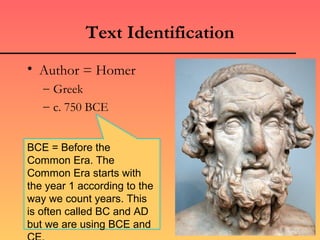
• Author = Homer
   – Greek
   – c. 750 BCE


BCE = Before the
Common Era. The
Common Era starts with
the year 1 according to the
way we count years. This
is often called BC and AD
but we are using BCE and
Text Identification
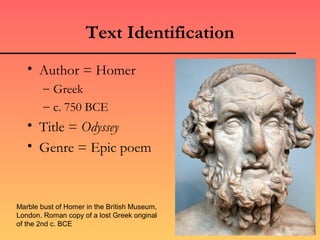
   • Author = Homer
        – Greek
        – c. 750 BCE
   • Title = Odyssey
   • Genre = Epic poem


Marble bust of Homer in the British Museum,
London. Roman copy of a lost Greek original
of the 2nd c. BCE
Words: Epic
• Epic = long, narrative poem
  – From Greek (G) epos, word, story, poem
Words: Narrative
• Narrative = tells a story about characters and
  events
  – From Latin (L) narrare, to tell a story or give an
    account
Words: Poem
• Verbal composition like speech in some ways
  and like song in other ways, often with a
  distinctive rhythm
  – From L poema, poem
  – From G poiēma, poem or any other result of
    creative activity
     • From G verb poiein, to make
Trojan War: Fact or Fiction?
• Is it a historical event that really took place,
  or is it an imaginary event made up by Homer
  and other ancient Greek poets?
Trojan War: Fact or Fiction?
• Ancient Greeks believed the war was real and took
  place about 1200 BCE
• By modern times, most historians believed there had
  never been a Trojan War or even a city of Troy
Trojan War: Fact or Fiction?
• However, in 1870, German archaeologist Heinrich
  Schliemann excavated a site in Turkey that he
  identified as Troy
• Most scholars now accept that Schliemann’s Troy is
  the Troy that we read about Homer
• Many scholars now also believe there is a historical
  basis to the story of the Trojan War
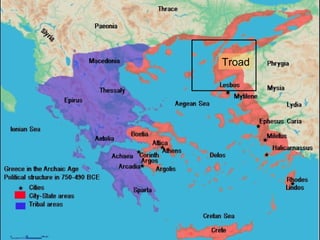
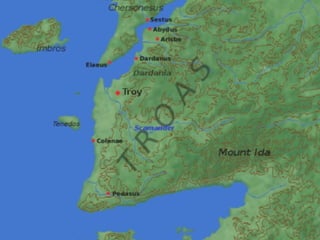
Troad
Odyssey Book 1 Overview
•   Homer invokes the Muse
•   Assembly of the gods
•   Athena visits Telemachus
•   Penelope comes down to the great hall
•   Telemachus confronts the suitors
•   Telemachus goes to bed alone in his bedroom
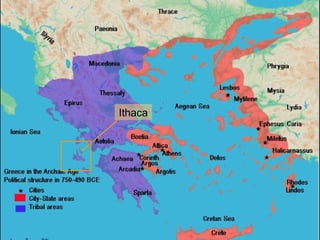
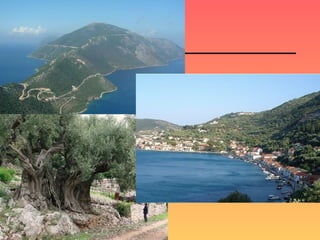
Ithaca
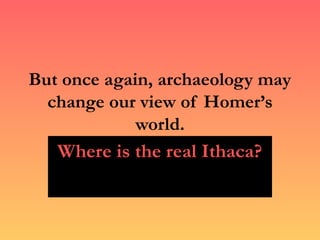
But once again, archaeology may
  change our view of Homer’s
             world.
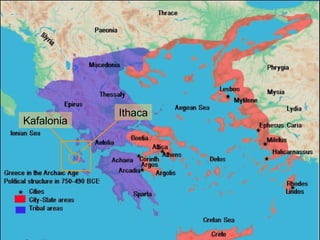
   Where is the real Ithaca?
Ithaca
Kafalonia
Odyssey Book 2 Overview
• Telemachus summons the men of Ithaca to
  an assembly
• Zeus sends an omen
• Telemachus prays to Athena
• Athena answers his prayer
• Telemachus return to the palace and prepares
  for his journey
• Telemachus takes command and sets sail
Odyssey Book 3 Overview
•   Telemachus and his crew arrive at Pylos
•   Nestor recounts the fate of Agamemnon
•   Athena reveals herself
•   Nestor prays
•   Going to bed
    – Telemachus + Pisistratus
    – Nestor + his wife
• Nestor leads a feast in honor of Athena
• Nestor sends Telemachus and Pisistratus off to
  Sparta
Assembly of the gods (1.12-112)
• What do we learn about how mortals view
  gods and gods view mortals?
• Why do you think Homer tells us about
  Aegisthus, Agamemnon, and Orestes here?
Athena visits Telemachus (1.112-376)

• What do we learn about the situation in
  Odysseus’ household?
• Who are the suitors?
• Why can’t Telemachus get rid of them?
• Why does Penelope refuse to choose a new
  husband?
What do we learn about the
         treatment of strangers?
•    xenia = Reciprocal relationship of hospitality
     between guests and hosts
    –    Enforced by respect for Zeus, who is the protector of
         stranger (Zeus Xenios)
•    The word xenos (pl. xenoi) can mean
      1. Guest
      2. Host
      3. Stranger
      4. Friend
      5. Foreigner
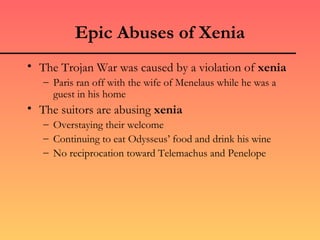
Epic Abuses of Xenia
• The Trojan War was caused by a violation of xenia
   – Paris ran off with the wife of Menelaus while he was a
     guest in his home
• The suitors are abusing xenia
   – Overstaying their welcome
   – Continuing to eat Odysseus’ food and drink his wine
   – No reciprocation toward Telemachus and Penelope
Penelope comes down
    to the great hall (1.376-419)
• What do we learn about cultural expectations
  for women?
Telemachus summons the men
 of Ithaca to an assembly (2.1-14)
• What do we learn about the way government
  works?
• What do we learn about the role of public
  speaking in male society?
Zeus sends an omen (2.164-179)
• What do we learn about religious beliefs and
  practices?
  – Halitherses interprets the omen (2.180-198)
  – Eurymachus scorns his prophecy (2.199-230)
  – So we see Homer representing conflicting
    opinions about prophecy
For Next Time
• Homer, Odyssey, Books 4-6, pp. 124-178
Classical Cultures

  Dr. Michael Broder
  Brooklyn College
   August 30, 2012

Corc1110 presentation 02

  • 1.
    Classical Cultures Dr. Michael Broder Brooklyn College August 30, 2012
  • 2.
    Identifying a Text •For every text that we study, I want us to identify it by three main categories – Author • Nationality Five pieces of • Dates information in – Title total – Genre
  • 3.
    Some Literary Genres • Poem • Story • Play • Novel • Essay
  • 4.
    Text Identification • Author= Homer – Greek – c. 750 BCE BCE = Before the Common Era. The Common Era starts with the year 1 according to the way we count years. This is often called BC and AD but we are using BCE and
  • 5.
    Text Identification • Author = Homer – Greek – c. 750 BCE • Title = Odyssey • Genre = Epic poem Marble bust of Homer in the British Museum, London. Roman copy of a lost Greek original of the 2nd c. BCE
  • 6.
    Words: Epic • Epic= long, narrative poem – From Greek (G) epos, word, story, poem
  • 7.
    Words: Narrative • Narrative= tells a story about characters and events – From Latin (L) narrare, to tell a story or give an account
  • 8.
    Words: Poem • Verbalcomposition like speech in some ways and like song in other ways, often with a distinctive rhythm – From L poema, poem – From G poiēma, poem or any other result of creative activity • From G verb poiein, to make
  • 9.
    Trojan War: Factor Fiction? • Is it a historical event that really took place, or is it an imaginary event made up by Homer and other ancient Greek poets?
  • 10.
    Trojan War: Factor Fiction? • Ancient Greeks believed the war was real and took place about 1200 BCE • By modern times, most historians believed there had never been a Trojan War or even a city of Troy
  • 11.
    Trojan War: Factor Fiction? • However, in 1870, German archaeologist Heinrich Schliemann excavated a site in Turkey that he identified as Troy • Most scholars now accept that Schliemann’s Troy is the Troy that we read about Homer • Many scholars now also believe there is a historical basis to the story of the Trojan War
  • 12.
  • 14.
    Odyssey Book 1Overview • Homer invokes the Muse • Assembly of the gods • Athena visits Telemachus • Penelope comes down to the great hall • Telemachus confronts the suitors • Telemachus goes to bed alone in his bedroom
  • 15.
  • 17.
    But once again,archaeology may change our view of Homer’s world. Where is the real Ithaca?
  • 18.
  • 19.
    Odyssey Book 2Overview • Telemachus summons the men of Ithaca to an assembly • Zeus sends an omen • Telemachus prays to Athena • Athena answers his prayer • Telemachus return to the palace and prepares for his journey • Telemachus takes command and sets sail
  • 20.
    Odyssey Book 3Overview • Telemachus and his crew arrive at Pylos • Nestor recounts the fate of Agamemnon • Athena reveals herself • Nestor prays • Going to bed – Telemachus + Pisistratus – Nestor + his wife • Nestor leads a feast in honor of Athena • Nestor sends Telemachus and Pisistratus off to Sparta
  • 21.
    Assembly of thegods (1.12-112) • What do we learn about how mortals view gods and gods view mortals? • Why do you think Homer tells us about Aegisthus, Agamemnon, and Orestes here?
  • 22.
    Athena visits Telemachus(1.112-376) • What do we learn about the situation in Odysseus’ household? • Who are the suitors? • Why can’t Telemachus get rid of them? • Why does Penelope refuse to choose a new husband?
  • 23.
    What do welearn about the treatment of strangers? • xenia = Reciprocal relationship of hospitality between guests and hosts – Enforced by respect for Zeus, who is the protector of stranger (Zeus Xenios) • The word xenos (pl. xenoi) can mean 1. Guest 2. Host 3. Stranger 4. Friend 5. Foreigner
  • 24.
    Epic Abuses ofXenia • The Trojan War was caused by a violation of xenia – Paris ran off with the wife of Menelaus while he was a guest in his home • The suitors are abusing xenia – Overstaying their welcome – Continuing to eat Odysseus’ food and drink his wine – No reciprocation toward Telemachus and Penelope
  • 25.
    Penelope comes down to the great hall (1.376-419) • What do we learn about cultural expectations for women?
  • 26.
    Telemachus summons themen of Ithaca to an assembly (2.1-14) • What do we learn about the way government works? • What do we learn about the role of public speaking in male society?
  • 27.
    Zeus sends anomen (2.164-179) • What do we learn about religious beliefs and practices? – Halitherses interprets the omen (2.180-198) – Eurymachus scorns his prophecy (2.199-230) – So we see Homer representing conflicting opinions about prophecy
  • 28.
    For Next Time •Homer, Odyssey, Books 4-6, pp. 124-178
  • 29.
    Classical Cultures Dr. Michael Broder Brooklyn College August 30, 2012