

Introduction to
Classical Mythology
    Dr. Michael Broder
University of South Carolina
      April 12, 2012
Extra Credit Opportunity
               TODAY
• Dr. Joy Connolly, Professor of Classics at New York
  University, delivers the Annual Classics Lecture:
     Telephonic Politics: the Case of the Roman Republic
                     Thursday, April 12
                           4:00 PM
                        Wardlaw 126
              A reception will follow the lecture
• A 2-page report gets you credit for up to 2 Daily
  Writes, depending on how complete and
  comprehensive the report is
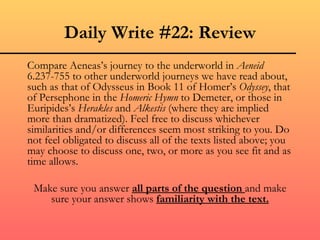
Daily Write #22: Review
Compare Aeneas’s journey to the underworld in Aeneid
6.237-755 to other underworld journeys we have read about,
such as that of Odysseus in Book 11 of Homer’s Odyssey, that
of Persephone in the Homeric Hymn to Demeter, or those in
Euripides’s Herakles and Alkestis (where they are implied
more than dramatized). Feel free to discuss whichever
similarities and/or differences seem most striking to you. Do
not feel obligated to discuss all of the texts listed above; you
may choose to discuss one, two, or more as you see fit and as
time allows.

 Make sure you answer all parts of the question and make
    sure your answer shows familiarity with the text.
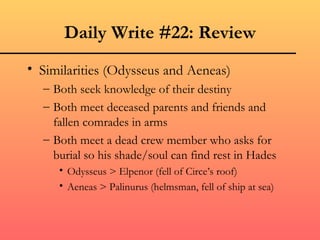
Daily Write #22: Review
• Similarities (Odysseus and Aeneas)
  – Both seek knowledge of their destiny
  – Both meet deceased parents and friends and
    fallen comrades in arms
  – Both meet a dead crew member who asks for
    burial so his shade/soul can find rest in Hades
     • Odysseus > Elpenor (fell of Circe’s roof)
     • Aeneas > Palinurus (helmsman, fell of ship at sea)
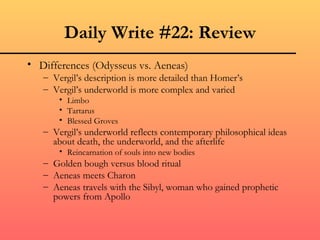
Daily Write #22: Review
• Differences (Odysseus vs. Aeneas)
   – Vergil’s description is more detailed than Homer’s
   – Vergil’s underworld is more complex and varied
       • Limbo
       • Tartarus
       • Blessed Groves
   – Vergil’s underworld reflects contemporary philosophical ideas
     about death, the underworld, and the afterlife
       • Reincarnation of souls into new bodies
   – Golden bough versus blood ritual
   – Aeneas meets Charon
   – Aeneas travels with the Sibyl, woman who gained prophetic
     powers from Apollo
Daily Write #23
• In Heroides 1, “Penelope to Ulysses,” the
  Roman poet Ovid shows Penelope caught
  between fear and anger about the long
  absence of Odysseus. How does Ovid’s
  portrayal of Penelope compare to that of
  Homer in the Odyssey? How is Ovid’s
  Penelope similar to that of Homer? How is
  she different? Why do you think Ovid chose
  to portray Penelope the way that he does?
Definition of “Empire”
• A nation-state (like Rome) having military,
  political, and economic control over other
  nations, territories, or peoples beyond its
  borders
• The territory of such a political unit (like the
  Roman provinces in Europe, North African, and
  the Middle East)
• Empire is not a form of government
   – It describes the relationship between a sovereign
     nation-state and its subject territories
Forms of Government in the
     Roman Empire
   Principate versus Dominate
Definition of “Principate”
• Form of government in the Roman Empire
  from 27 BCE to 284 CE
• Rule by a leading citizen: the princeps or emperor
• The Roman Principate retained the outward
  form of republican government, including the
  senate and respect for individual rights
• In practice, however, the Roman Principate was
  an authoritarian form of government, with the
  princeps / emperor as sole ruler
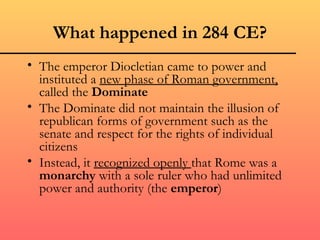
What happened in 284 CE?
• The emperor Diocletian came to power and
  instituted a new phase of Roman government,
  called the Dominate
• The Dominate did not maintain the illusion of
  republican forms of government such as the
  senate and respect for the rights of individual
  citizens
• Instead, it recognized openly that Rome was a
  monarchy with a sole ruler who had unlimited
  power and authority (the emperor)
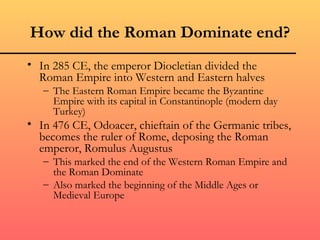
How did the Roman Dominate end?
• In 285 CE, the emperor Diocletian divided the
  Roman Empire into Western and Eastern halves
   – The Eastern Roman Empire became the Byzantine
     Empire with its capital in Constantinople (modern day
     Turkey)
• In 476 CE, Odoacer, chieftain of the Germanic tribes,
  becomes the ruler of Rome, deposing the Roman
  emperor, Romulus Augustus
   – This marked the end of the Western Roman Empire and
     the Roman Dominate
   – Also marked the beginning of the Middle Ages or
     Medieval Europe
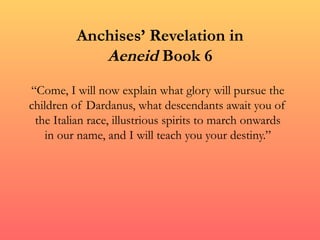
Anchises’ Revelation in
             Aeneid Book 6
“Come, I will now explain what glory will pursue the
children of Dardanus, what descendants await you of
 the Italian race, illustrious spirits to march onwards
    in our name, and I will teach you your destiny.”
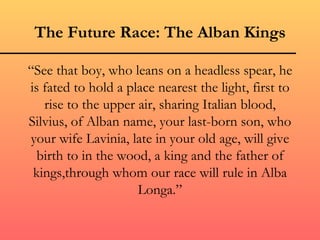
The Future Race: The Alban Kings

“See that boy, who leans on a headless spear, he
is fated to hold a place nearest the light, first to
   rise to the upper air, sharing Italian blood,
Silvius, of Alban name, your last-born son, who
your wife Lavinia, late in your old age, will give
  birth to in the wood, a king and the father of
 kings,through whom our race will rule in Alba
                     Longa.”
The Future Race:
       Romulus and the Caesars
“Yes, and a child of Mars will join his grandfather
 to accompany him, Romulus, whom his mother
  Ilia will bear, of Assaracus’s line…. Now direct
   your eyes here, gaze at this people, your own
 Romans. Here is Caesar, and all the offspring of
 Iulus destined to live under the pole of heaven.
 This is the man, this is him, whom you so often
 hear promised you, Augustus Caesar, son of the
Deified, who will make a Golden Age again in the
fields where Saturn once reigned, and extend the
   empire beyond the Libyans and the Indians.”
Nine Muses: Daughters of Zeus and
     Mnemosyne (Memory)
• Hellenistic scholars and poets assigned specific areas of creativity
  to each of the nine muses:
    –   Calliope: Epic Poetry
    –   Clio: History
    –   Erato: Lyric poetry, love poetry, erotic poetry
    –   Euterpe: Song and Elegiac Poetry
    –   Melpomene: Tragedy
    –   Polyhymnia: Hymns
    –   Terpsichore: Dance
    –   Thalia: Comedy
    –   Urania: Astronomy

 Thanks to your fellow student, Kelli Kemmerer, for suggesting
  we cover the nine muses in class and providing the list above.
Heroides 1: Identification
• Author = Ovid
  – Roman
  – 43 BCE – 18 CE
• Title = Heroides 1 (Penelope to Ulysses)
• Genre
  – Elegiac poem = verse form: elegiac couplets
  – Epistolary poem = narrative form: letter
Extra Credit Opportunity
               TODAY
• Dr. Joy Connolly, Professor of Classics at New York
  University, delivers the Annual Classics Lecture:
     Telephonic Politics: the Case of the Roman Republic
                     Thursday, April 12
                           4:00 PM
                        Wardlaw 126
              A reception will follow the lecture
• A 2-page report gets you credit for up to 2 Daily
  Writes, depending on how complete and
  comprehensive the report is
Upcoming Assigments
• 4/12—Ovid, Heroides 1 (Penelope to Ulysses),
  in ACM, pp. 306-9
• 4/17—The Tale of Cupid and Psyche, 3-28
• 4/19—The Tale of Cupid and Psyche, 28-54
Introduction to
Classical Mythology
    Dr. Michael Broder
University of South Carolina
      April 12, 2012

CLAS220 - Lecture Notes for April 12, 2012

  • 1.
    Introduction to Classical Mythology Dr. Michael Broder University of South Carolina April 12, 2012
  • 2.
    Extra Credit Opportunity TODAY • Dr. Joy Connolly, Professor of Classics at New York University, delivers the Annual Classics Lecture: Telephonic Politics: the Case of the Roman Republic Thursday, April 12 4:00 PM Wardlaw 126 A reception will follow the lecture • A 2-page report gets you credit for up to 2 Daily Writes, depending on how complete and comprehensive the report is
  • 3.
    Daily Write #22:Review Compare Aeneas’s journey to the underworld in Aeneid 6.237-755 to other underworld journeys we have read about, such as that of Odysseus in Book 11 of Homer’s Odyssey, that of Persephone in the Homeric Hymn to Demeter, or those in Euripides’s Herakles and Alkestis (where they are implied more than dramatized). Feel free to discuss whichever similarities and/or differences seem most striking to you. Do not feel obligated to discuss all of the texts listed above; you may choose to discuss one, two, or more as you see fit and as time allows. Make sure you answer all parts of the question and make sure your answer shows familiarity with the text.
  • 4.
    Daily Write #22:Review • Similarities (Odysseus and Aeneas) – Both seek knowledge of their destiny – Both meet deceased parents and friends and fallen comrades in arms – Both meet a dead crew member who asks for burial so his shade/soul can find rest in Hades • Odysseus > Elpenor (fell of Circe’s roof) • Aeneas > Palinurus (helmsman, fell of ship at sea)
  • 5.
    Daily Write #22:Review • Differences (Odysseus vs. Aeneas) – Vergil’s description is more detailed than Homer’s – Vergil’s underworld is more complex and varied • Limbo • Tartarus • Blessed Groves – Vergil’s underworld reflects contemporary philosophical ideas about death, the underworld, and the afterlife • Reincarnation of souls into new bodies – Golden bough versus blood ritual – Aeneas meets Charon – Aeneas travels with the Sibyl, woman who gained prophetic powers from Apollo
  • 6.
    Daily Write #23 •In Heroides 1, “Penelope to Ulysses,” the Roman poet Ovid shows Penelope caught between fear and anger about the long absence of Odysseus. How does Ovid’s portrayal of Penelope compare to that of Homer in the Odyssey? How is Ovid’s Penelope similar to that of Homer? How is she different? Why do you think Ovid chose to portray Penelope the way that he does?
  • 7.
    Definition of “Empire” •A nation-state (like Rome) having military, political, and economic control over other nations, territories, or peoples beyond its borders • The territory of such a political unit (like the Roman provinces in Europe, North African, and the Middle East) • Empire is not a form of government – It describes the relationship between a sovereign nation-state and its subject territories
  • 8.
    Forms of Governmentin the Roman Empire Principate versus Dominate
  • 9.
    Definition of “Principate” •Form of government in the Roman Empire from 27 BCE to 284 CE • Rule by a leading citizen: the princeps or emperor • The Roman Principate retained the outward form of republican government, including the senate and respect for individual rights • In practice, however, the Roman Principate was an authoritarian form of government, with the princeps / emperor as sole ruler
  • 10.
    What happened in284 CE? • The emperor Diocletian came to power and instituted a new phase of Roman government, called the Dominate • The Dominate did not maintain the illusion of republican forms of government such as the senate and respect for the rights of individual citizens • Instead, it recognized openly that Rome was a monarchy with a sole ruler who had unlimited power and authority (the emperor)
  • 11.
    How did theRoman Dominate end? • In 285 CE, the emperor Diocletian divided the Roman Empire into Western and Eastern halves – The Eastern Roman Empire became the Byzantine Empire with its capital in Constantinople (modern day Turkey) • In 476 CE, Odoacer, chieftain of the Germanic tribes, becomes the ruler of Rome, deposing the Roman emperor, Romulus Augustus – This marked the end of the Western Roman Empire and the Roman Dominate – Also marked the beginning of the Middle Ages or Medieval Europe
  • 12.
    Anchises’ Revelation in Aeneid Book 6 “Come, I will now explain what glory will pursue the children of Dardanus, what descendants await you of the Italian race, illustrious spirits to march onwards in our name, and I will teach you your destiny.”
  • 13.
    The Future Race:The Alban Kings “See that boy, who leans on a headless spear, he is fated to hold a place nearest the light, first to rise to the upper air, sharing Italian blood, Silvius, of Alban name, your last-born son, who your wife Lavinia, late in your old age, will give birth to in the wood, a king and the father of kings,through whom our race will rule in Alba Longa.”
  • 14.
    The Future Race: Romulus and the Caesars “Yes, and a child of Mars will join his grandfather to accompany him, Romulus, whom his mother Ilia will bear, of Assaracus’s line…. Now direct your eyes here, gaze at this people, your own Romans. Here is Caesar, and all the offspring of Iulus destined to live under the pole of heaven. This is the man, this is him, whom you so often hear promised you, Augustus Caesar, son of the Deified, who will make a Golden Age again in the fields where Saturn once reigned, and extend the empire beyond the Libyans and the Indians.”
  • 15.
    Nine Muses: Daughtersof Zeus and Mnemosyne (Memory) • Hellenistic scholars and poets assigned specific areas of creativity to each of the nine muses: – Calliope: Epic Poetry – Clio: History – Erato: Lyric poetry, love poetry, erotic poetry – Euterpe: Song and Elegiac Poetry – Melpomene: Tragedy – Polyhymnia: Hymns – Terpsichore: Dance – Thalia: Comedy – Urania: Astronomy Thanks to your fellow student, Kelli Kemmerer, for suggesting we cover the nine muses in class and providing the list above.
  • 16.
    Heroides 1: Identification •Author = Ovid – Roman – 43 BCE – 18 CE • Title = Heroides 1 (Penelope to Ulysses) • Genre – Elegiac poem = verse form: elegiac couplets – Epistolary poem = narrative form: letter
  • 17.
    Extra Credit Opportunity TODAY • Dr. Joy Connolly, Professor of Classics at New York University, delivers the Annual Classics Lecture: Telephonic Politics: the Case of the Roman Republic Thursday, April 12 4:00 PM Wardlaw 126 A reception will follow the lecture • A 2-page report gets you credit for up to 2 Daily Writes, depending on how complete and comprehensive the report is
  • 18.
    Upcoming Assigments • 4/12—Ovid,Heroides 1 (Penelope to Ulysses), in ACM, pp. 306-9 • 4/17—The Tale of Cupid and Psyche, 3-28 • 4/19—The Tale of Cupid and Psyche, 28-54
  • 19.
    Introduction to Classical Mythology Dr. Michael Broder University of South Carolina April 12, 2012