Introduction to
Classical Mythology
    Dr. Michael Broder
University of South Carolina
      April 17, 2012
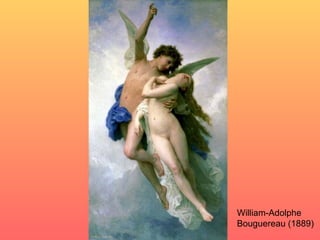
William-Adolphe
Bouguereau (1889)
Extra Credit Opportunity
‱ If you attended Dr. Connolly’s lecture on
  April 12 and wish to receive extra credit, be
  sure to submit your report by the time of the
  final exam (Wed, 5/2, 9:00 am – 12:00 noon)
‱ A 2-page report gets you credit for up to 2
  Daily Writes (up to 8 points), depending on
  how complete and comprehensive the report
  is
Daily Write #23: Review
‱ In Heroides 1, “Penelope to Ulysses,” the
  Roman poet Ovid shows Penelope caught
  between fear and anger about the long
  absence of Odysseus. How does Ovid’s
  portrayal of Penelope compare to that of
  Homer in the Odyssey? How is Ovid’s
  Penelope similar to that of Homer? How is
  she different? Why do you think Ovid chose
  to portray Penelope the way that he does?
Daily Write #23: Review
‱ How is Ovid’s Penelope similar to that of Homer?
   – She continues to wait for Odysseus
   – She expresses concern for his welfare
   – She mentions many of the actions and events that we recognize from
     the Odyssey, like questioning strangers
‱ How is she different?
   – Less sure of Odysseus’ return
   – Less sure of his loyalty and love
   – Angry about his long absence
‱ Why do you think Ovid chose to portray Penelope the way that he
  does?
   – Shows us a more human side of Penelope
   – More realistic, more emotionally true
   – Dramatizes the woman’s perspective
Daily Write #24
‱ In his poem On the Nature of the Universe, Lucretius calls
  Venus “mother” of the Romans and “nourishing
  Venus” who “makes the sea and land throng with
  life.” In The Tale of Cupid and Psyche, Apuleius calls
  Venus “mother of the nature of the universe” and
  “nourishing Venus” who “feeds and fosters the whole
  of this great globe.” Why do you think Apuleius chose
  to describe Venus in language that reminds us of
  Lucretius’s poem? Do you think Apuleius’s intentions
  towards Lucretius are serious, playful, mocking,
  respectful, disrespectful, or something else? Explain
  your answer as completely as you can.
Nine Muses: Daughters of Zeus and
     Mnemosyne (Memory)
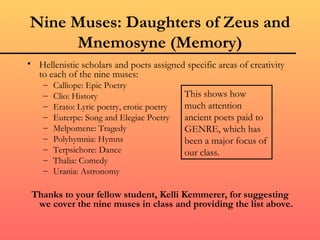
‱ Hellenistic scholars and poets assigned specific areas of creativity
  to each of the nine muses:
    –   Calliope: Epic Poetry
    –   Clio: History                        This shows how
    –   Erato: Lyric poetry, erotic poetry   much attention
    –   Euterpe: Song and Elegiac Poetry     ancient poets paid to
    –   Melpomene: Tragedy                   GENRE, which has
    –   Polyhymnia: Hymns                    been a major focus of
    –   Terpsichore: Dance                   our class.
    –   Thalia: Comedy
    –   Urania: Astronomy

 Thanks to your fellow student, Kelli Kemmerer, for suggesting
  we cover the nine muses in class and providing the list above.
Tale of Cupid and Psyche:
              Identification
‱ Author =Apuleius
   – Roman
   – c. 125 – c. 170 CE
‱ Title = The Tale of Cupid and Psyche
   – Excerpt from the Metamorphoses (Golden Ass)
‱ Genre = Ancient novel
Summary of Books 1-4 of Apuleius’s
 Metamorphoses (The Golden Ass)
‱ We meet Lucius, an affluent Roman citizen
  who is on a journey to the Greek region of
  Thessaly for business
‱ Lucius goes to the Greek town of Hypata,
  where he stays with Milo, a family friend
‱ Milo has a wife named Pamphile and a
  beautiful young slave girl named Photis (her
  name means “light”)
Echoes of the Odyssey in
         The Golden Ass
‱ Apuleius’ novel often deals with subjects which
  do not accord with epic propriety, particularly
  the pleasures of the flesh
‱ The prime example of this in the opening books
  is the liaison between Lucius and the maid
  Photis
‱ The two find themselves alone for the first time
  in the low-life situation of the kitchen
‱ Photis is stirring a saucepan and swinging her
  behind, which arouses Lucius


                              Stephe J. Harrison (1990)
Lucius and Photis
Rooted to the spot by her appearance, I stood
astounded and amazed, and the limb dangling
in front of me stood up, too. Finally I said to
her, “How beautiful and pleasing, my dear
Photis, is the motion of your hips when you stir
that pot of meat. What a sweet dish you are
making. Happy and blessed is he whom you
allow to dip his finger in your dish.”

                             Stephe J. Harrison (1990)
Odysseus and Nausicaa
‱ “If you are one of mortals who dwell upon the
  earth, blessed then are your father, mother, and
  brothers, whose hearts are warmed with joy
  when they see you entering the dance, a flower
  so young and fair. But he is blessed above all
  others, who shall prevail with his gifts of wooing
  and lead you to his home. For never yet have my
  eyes looked upon a mortal such as you, whether
  man or woman. Amazement holds me as I look
  at you.”

                               Stephe J. Harrison (1990)
Apuleius’ version of the meeting of
  hero and girl is a parody of Homer
‱ Homer’s Nausicaa is the model maiden, the virginal
  princess, childlike, yet royal in courage and dignity
‱ Photis is the opposite, a slave of low origins, low activities
  and low desires, knowing and cunning, a sexual athlete of
  a high order
‱ Between Odysseus and Nausicaa marriage is mentioned
  but never really envisaged, and their encounter has a
  distant romanticism
‱ Between Lucius and Photis the carnal relations follow
  immediately and easily
‱ Apuleius and his readers would no doubt have enjoyed
  this contrast between epic and novel


                                       Stephe J. Harrison (1990)
Summary of Books 1-4 of Apuleius’s
 Metamorphoses (The Golden Ass)
‱ The day after he arrives in Hypata, Lucius
  finds out that Pamphile is witch
‱ This information fills him with curiosity
‱ Later that day, Lucius and Photis watch
  Pamphile mix a magic potion that she uses to
  turn herself into a bird
Summary of Books 1-4 of Apuleius’s
 Metamorphoses (The Golden Ass)
‱ Later that night, Lucius sneaks into
  Pamphile’s workshop and tries to mix the
  same potion, but instead he turns himself into
  a donkey
‱ Photis tells him that the only way for him to
  return to his human state is to eat a rose, so
  Lucius goes on a quest for the rose that will
  return him to human form
Summary of Books 1-4 of Apuleius’s
 Metamorphoses (The Golden Ass)
‱ He is then stolen from Milo’s house by thieves
‱ The thieves then kidnap a young woman,
  Charite, who is trapped in a cave with Lucius
  (who is still a donkey)
‱ Charite starts crying about the fact that she is
  going to miss her own wedding, so an elderly
  woman who is a servant of the thieves tries to
  comfort her by telling her the story of Cupid and
  Psyche
Summary of The Tale of Cupid and
             Psyche
‱ Psyche, the most beautiful woman in the world
  is envied by her family as well as by Venus
‱ An oracle of Venus demands she be sent to a
  mountaintop and wed to a murderous beast
‱ Sent by Venus to destroy her, Cupid falls in love
  and flies her away to his castle
‱ There she is directed to never seek to see the
  face of her husband, who visits and makes love
  to her in the dark of night
Summary of The Tale of Cupid and
             Psyche
‱ Eventually, Psyche wishes to see her sisters,
  who jealously demand she seek to discover
  the identity of her husband
‱ That night, Psyche discovers her husband is
  Cupid while he is sleeping, but wakes and
  scars him with her candle
‱ Infuriated, he flies to heaven and leaves her
  banished from her castle
Summary of The Tale of Cupid and
             Psyche
‱ In attempted atonement, Psyche seeks the
  temple of Venus and offers herself as a slave
‱ Venus assigns Psyche four impossible tasks
‱ First, she is commanded to sort through a great
  hill of mixed grains
‱ In pity, many ants aid her in completing the task
‱ Next, she is commanded to retrieve wool of the
  dangerous golden sheep
Summary of The Tale of Cupid and
             Psyche
‱ A river god aids Psyche and tells her to gather
  clumps of wool from thorn bushes nearby
‱ Venus next requests water from a cleft high
  beyond mortal reach
‱ An eagle gathers the water for Psyche
‱ Next, Psyche is demanded to seek some
  beauty from Persephone, Queen of the
  Underworld
Summary of The Tale of Cupid and
             Psyche
‱ Attempting to kill herself to reach the
  underworld, Psyche ascends a great tower and
  prepares to throw herself down
‱ The tower speaks, and teaches Psyche the
  way of the underworld
‱ Psyche retrieves the beauty in a box, and,
  hoping to gain the approval of her husband,
  opens the box to use a little
‱ She is put into a coma
Summary of The Tale of Cupid and
             Psyche
‱ Cupid rescues her, and begs Zeus that she
  may become immortal
‱ Psyche is granted Ambrosia, and the two are
  forever united
‱ They have a child named Delight (Voluptas
  in Latin, also means “pleasure” or
  “happiness”)
Extra Credit Opportunity
‱ If you attended Dr. Connolly’s lecture on
  April 12 and wish to receive extra credit, be
  sure to submit your report by the time of the
  final exam (Wed, 5/2, 9:00 am – 12:00 noon)
‱ A 2-page report gets you credit for up to 2
  Daily Writes (up to 8 points), depending on
  how complete and comprehensive the report
  is
Upcoming Assigments
‱ 4/19—The Tale of Cupid and Psyche, 28-54
Introduction to
Classical Mythology
    Dr. Michael Broder
University of South Carolina
      April 17, 2012

CLAS220 - Lecture Notes for April 17, 2012

  • 1.
    Introduction to Classical Mythology Dr. Michael Broder University of South Carolina April 17, 2012
  • 2.
  • 3.
    Extra Credit Opportunity ‱If you attended Dr. Connolly’s lecture on April 12 and wish to receive extra credit, be sure to submit your report by the time of the final exam (Wed, 5/2, 9:00 am – 12:00 noon) ‱ A 2-page report gets you credit for up to 2 Daily Writes (up to 8 points), depending on how complete and comprehensive the report is
  • 4.
    Daily Write #23:Review ‱ In Heroides 1, “Penelope to Ulysses,” the Roman poet Ovid shows Penelope caught between fear and anger about the long absence of Odysseus. How does Ovid’s portrayal of Penelope compare to that of Homer in the Odyssey? How is Ovid’s Penelope similar to that of Homer? How is she different? Why do you think Ovid chose to portray Penelope the way that he does?
  • 5.
    Daily Write #23:Review ‱ How is Ovid’s Penelope similar to that of Homer? – She continues to wait for Odysseus – She expresses concern for his welfare – She mentions many of the actions and events that we recognize from the Odyssey, like questioning strangers ‱ How is she different? – Less sure of Odysseus’ return – Less sure of his loyalty and love – Angry about his long absence ‱ Why do you think Ovid chose to portray Penelope the way that he does? – Shows us a more human side of Penelope – More realistic, more emotionally true – Dramatizes the woman’s perspective
  • 6.
    Daily Write #24 ‱In his poem On the Nature of the Universe, Lucretius calls Venus “mother” of the Romans and “nourishing Venus” who “makes the sea and land throng with life.” In The Tale of Cupid and Psyche, Apuleius calls Venus “mother of the nature of the universe” and “nourishing Venus” who “feeds and fosters the whole of this great globe.” Why do you think Apuleius chose to describe Venus in language that reminds us of Lucretius’s poem? Do you think Apuleius’s intentions towards Lucretius are serious, playful, mocking, respectful, disrespectful, or something else? Explain your answer as completely as you can.
  • 7.
    Nine Muses: Daughtersof Zeus and Mnemosyne (Memory) ‱ Hellenistic scholars and poets assigned specific areas of creativity to each of the nine muses: – Calliope: Epic Poetry – Clio: History This shows how – Erato: Lyric poetry, erotic poetry much attention – Euterpe: Song and Elegiac Poetry ancient poets paid to – Melpomene: Tragedy GENRE, which has – Polyhymnia: Hymns been a major focus of – Terpsichore: Dance our class. – Thalia: Comedy – Urania: Astronomy Thanks to your fellow student, Kelli Kemmerer, for suggesting we cover the nine muses in class and providing the list above.
  • 8.
    Tale of Cupidand Psyche: Identification ‱ Author =Apuleius – Roman – c. 125 – c. 170 CE ‱ Title = The Tale of Cupid and Psyche – Excerpt from the Metamorphoses (Golden Ass) ‱ Genre = Ancient novel
  • 9.
    Summary of Books1-4 of Apuleius’s Metamorphoses (The Golden Ass) ‱ We meet Lucius, an affluent Roman citizen who is on a journey to the Greek region of Thessaly for business ‱ Lucius goes to the Greek town of Hypata, where he stays with Milo, a family friend ‱ Milo has a wife named Pamphile and a beautiful young slave girl named Photis (her name means “light”)
  • 10.
    Echoes of theOdyssey in The Golden Ass ‱ Apuleius’ novel often deals with subjects which do not accord with epic propriety, particularly the pleasures of the flesh ‱ The prime example of this in the opening books is the liaison between Lucius and the maid Photis ‱ The two find themselves alone for the first time in the low-life situation of the kitchen ‱ Photis is stirring a saucepan and swinging her behind, which arouses Lucius
 Stephe J. Harrison (1990)
  • 11.
    Lucius and Photis Rootedto the spot by her appearance, I stood astounded and amazed, and the limb dangling in front of me stood up, too. Finally I said to her, “How beautiful and pleasing, my dear Photis, is the motion of your hips when you stir that pot of meat. What a sweet dish you are making. Happy and blessed is he whom you allow to dip his finger in your dish.” Stephe J. Harrison (1990)
  • 12.
    Odysseus and Nausicaa ‱“If you are one of mortals who dwell upon the earth, blessed then are your father, mother, and brothers, whose hearts are warmed with joy when they see you entering the dance, a flower so young and fair. But he is blessed above all others, who shall prevail with his gifts of wooing and lead you to his home. For never yet have my eyes looked upon a mortal such as you, whether man or woman. Amazement holds me as I look at you.” Stephe J. Harrison (1990)
  • 13.
    Apuleius’ version ofthe meeting of hero and girl is a parody of Homer ‱ Homer’s Nausicaa is the model maiden, the virginal princess, childlike, yet royal in courage and dignity ‱ Photis is the opposite, a slave of low origins, low activities and low desires, knowing and cunning, a sexual athlete of a high order ‱ Between Odysseus and Nausicaa marriage is mentioned but never really envisaged, and their encounter has a distant romanticism ‱ Between Lucius and Photis the carnal relations follow immediately and easily ‱ Apuleius and his readers would no doubt have enjoyed this contrast between epic and novel Stephe J. Harrison (1990)
  • 14.
    Summary of Books1-4 of Apuleius’s Metamorphoses (The Golden Ass) ‱ The day after he arrives in Hypata, Lucius finds out that Pamphile is witch ‱ This information fills him with curiosity ‱ Later that day, Lucius and Photis watch Pamphile mix a magic potion that she uses to turn herself into a bird
  • 15.
    Summary of Books1-4 of Apuleius’s Metamorphoses (The Golden Ass) ‱ Later that night, Lucius sneaks into Pamphile’s workshop and tries to mix the same potion, but instead he turns himself into a donkey ‱ Photis tells him that the only way for him to return to his human state is to eat a rose, so Lucius goes on a quest for the rose that will return him to human form
  • 16.
    Summary of Books1-4 of Apuleius’s Metamorphoses (The Golden Ass) ‱ He is then stolen from Milo’s house by thieves ‱ The thieves then kidnap a young woman, Charite, who is trapped in a cave with Lucius (who is still a donkey) ‱ Charite starts crying about the fact that she is going to miss her own wedding, so an elderly woman who is a servant of the thieves tries to comfort her by telling her the story of Cupid and Psyche
  • 17.
    Summary of TheTale of Cupid and Psyche ‱ Psyche, the most beautiful woman in the world is envied by her family as well as by Venus ‱ An oracle of Venus demands she be sent to a mountaintop and wed to a murderous beast ‱ Sent by Venus to destroy her, Cupid falls in love and flies her away to his castle ‱ There she is directed to never seek to see the face of her husband, who visits and makes love to her in the dark of night
  • 18.
    Summary of TheTale of Cupid and Psyche ‱ Eventually, Psyche wishes to see her sisters, who jealously demand she seek to discover the identity of her husband ‱ That night, Psyche discovers her husband is Cupid while he is sleeping, but wakes and scars him with her candle ‱ Infuriated, he flies to heaven and leaves her banished from her castle
  • 19.
    Summary of TheTale of Cupid and Psyche ‱ In attempted atonement, Psyche seeks the temple of Venus and offers herself as a slave ‱ Venus assigns Psyche four impossible tasks ‱ First, she is commanded to sort through a great hill of mixed grains ‱ In pity, many ants aid her in completing the task ‱ Next, she is commanded to retrieve wool of the dangerous golden sheep
  • 20.
    Summary of TheTale of Cupid and Psyche ‱ A river god aids Psyche and tells her to gather clumps of wool from thorn bushes nearby ‱ Venus next requests water from a cleft high beyond mortal reach ‱ An eagle gathers the water for Psyche ‱ Next, Psyche is demanded to seek some beauty from Persephone, Queen of the Underworld
  • 21.
    Summary of TheTale of Cupid and Psyche ‱ Attempting to kill herself to reach the underworld, Psyche ascends a great tower and prepares to throw herself down ‱ The tower speaks, and teaches Psyche the way of the underworld ‱ Psyche retrieves the beauty in a box, and, hoping to gain the approval of her husband, opens the box to use a little ‱ She is put into a coma
  • 22.
    Summary of TheTale of Cupid and Psyche ‱ Cupid rescues her, and begs Zeus that she may become immortal ‱ Psyche is granted Ambrosia, and the two are forever united ‱ They have a child named Delight (Voluptas in Latin, also means “pleasure” or “happiness”)
  • 23.
    Extra Credit Opportunity ‱If you attended Dr. Connolly’s lecture on April 12 and wish to receive extra credit, be sure to submit your report by the time of the final exam (Wed, 5/2, 9:00 am – 12:00 noon) ‱ A 2-page report gets you credit for up to 2 Daily Writes (up to 8 points), depending on how complete and comprehensive the report is
  • 24.
    Upcoming Assigments ‱ 4/19—TheTale of Cupid and Psyche, 28-54
  • 25.
    Introduction to Classical Mythology Dr. Michael Broder University of South Carolina April 17, 2012