
Introduction to
Classical Mythology
    Dr. Michael Broder
University of South Carolina
      April 19, 2012
William-Adolphe
Bouguereau (1889)
Extra Credit Opportunity
• If you attended Dr. Connolly’s lecture on
  April 12 and wish to receive extra credit, be
  sure to submit your report by the time of the
  final exam (Wed, 5/2, 9:00 am – 12:00 noon)
• A 2-page report gets you credit for up to 2
  Daily Writes (up to 8 points), depending on
  how complete and comprehensive the report
  is
Daily Write #24: Review
In his poem On the Nature of the Universe, Lucretius calls
Venus “mother” of the Romans and “nourishing Venus”
who “makes the sea and land throng with life.” In The
Tale of Cupid and Psyche, Apuleius calls Venus “mother of
the nature of the universe” and “nourishing Venus” who
“feeds and fosters the whole of this great globe.” Why
do you think Apuleius chose to describe Venus in
language that reminds us of Lucretius’s poem? Do you
think Apuleius’s intentions towards Lucretius are
serious, playful, mocking, respectful, disrespectful, or
something else? Explain your answer as completely as
you can.
Daily Write #24: Review
Sample student response:
I think Apuleius is alluding to Lucretius’ Venus
in a playful yet respectful manner. Lucretius
made a very serious use of Venus. Apuleius is
not mocking Venus or Lucretius; he is paying
homage to what has come before. He assumes
that his readers have a knowledge of Lucretius’
writings and can understand both the humor
and the respect in Apuleius’ parody.
Mythological Parody
• Parody
  – A literary or musical work in which the style of an
    author or work is closely imitated for comic effect
• Origin of the word “parody”
  – Par (para) = alongside, not “straight”
  – Ody (ode) = song
  – Thus, parody is a kind of “counter-song,” a playful
    imitation that goes against the serious grain of the
    original
Mythological Parody
• Aristotle (Poetics, ii. 5) wrote that the comic poet
  Hegemon of Thasos (c. 430 BCE) invented a
  kind of parody by altering the wording of well-
  known poems to transform the sublime into the
  ridiculous
• In ancient Greek literature, a parodia was a
  narrative poem imitating the style and rhythm
  (dactylic hexameter) of epics but dealing with
  light, satirical or mock-heroic characters and
  events
Mythological Parody
• Lucius is on a (mock) heroic journey
• Lucius seeks hospitality / xenia from Milo
• Milo’s wife Pamphile engages in witchcraft
  and magic, like Helen, Circe, or Medea
• Lucius is curious, like Odysseus, but foolish
  where Odysseus is clever and cunning
Mythological Parody
• Lucius’ (mock) heroic quest for a rose to
  regain his human form reminds us of other
  heroic quests
  –   Odysseus’ journey home
  –   The labors of Herakles
  –   Jason’s quest for the Golden Fleece
  –   Aeneas’ quest for the Golden Bough
Mythological Parody
• Charite, the maiden kidnapped from her
  wedding by thieves, is like the kidnapped
  maidens of mythology listed by Herodotus
  – Io
  – Medea
  – Helen
Mythological Parody
• The old woman who is a servant to the
  thieves and tells the tale of Cupid and Psyche
  is like Eurycleia, the nurse in the Odyssey who
  tells the story of how Odysseus received his
  scar and his name
Mythological Parody
• Traditional epic maintains a high tone
  – Odysseus’ relationship with Nausicaa
• Apuleius’ novel often assumes a low tone
  – Lucius’ relationship with Photis
Epic Poet Becomes
          Romantic Storyteller
• Romance
  – A medieval tale based on legend, love, adventure,
    or the supernatural
  – A prose narrative about imaginary characters
    involved in events remote in time or place and
    usually heroic, adventurous, or mysterious
  – A love story especially in the form of a novel
Epic Poet Becomes
           Romantic Storyteller
• When Lucius (as a donkey) is stolen from Milo’s
  house by thieves, he becomes an eyewitness
  and an eavesdropper
• Instead of receiving the gift of song from the
  Muses, he picks up stories along his journey by
  seeing them firsthand or hearing them from
  others
• The romantic storyteller is thus analogous to a
  historian
  – Hower, his stories are understood to be entertaining
    fictions, not historial facts
How different is the romantic
     storyteller from the epic poet?
• Remember what Hesiod’s Muses say:
  “We know how to tell many believable lies, but also,
  when we want to, how to speak the plain truth.”
• The romantic storyteller (fiction writer,
  novelist), while divorced from the idea of
  divine inspiration (the Muses), retains the idea
  of fictional tales (“lies”) that have some kind
  of intellectual, emotional, or spiritual
  truth
The Tale of Cupid and Psyche
     Both Parody and Allegory
• Parody
  – A literary or musical work in which the style of
    an author or work is closely imitated for comic
    effect
• Allegory
  – Use of symbolic fictional figures and actions to
    express truths or generalizations about human
    existence, human nature, or the human condition
The Tale of Cupid and Psyche is
   both a parody and an allegory
• Mythological parody
• Philosophical allegory
The Tale of Cupid and Psyche
        Mythological Parody
• Psyche is a beautiful maiden, like many
  beautiful maidens in mythology such as
  Pandora or Helen
• Most beautiful maidens are said to receive
  their beauty as a gift from Venus, but
  Psyche’s beauty is not credited to Venus
• Instead, Psyche becomes a rival to Venus,
  and is worshipped as a goddess
• This makes Venus angry, and she retaliates
The Tale of Cupid and Psyche
        Mythological Parody
• Apuleius’ Venus is a multiple mythological
  parody
  – Demeter from the Homeric Hymn to Demeter
     • Demeter, grieving for her kidnapped daughter,
       withholds the grain from humanity
     • Venus, grieving for her abandoned temples, deprives
       humanity of Psyche
     • Thus, Venus takes on the role of kidnapper, like
       Hades in the Homeric Hymn
The Tale of Cupid and Psyche
        Mythological Parody
• Apuleius’ Venus is a multiple mythological
  parody
  – Venus from Lucretius’ On the Workings of the
    Universe
  – Juno from Vergil’s Aeneid (with Psyche, in this
    parody, becoming a parody of Aeneas)
Aeneid Book I, Lines 1-11
Of arms and a man I sing, that famous fugitive from fate
who first tried to escape the shores of Troy
only to find himself here in Italy on Lavinian shores,
tossed on land and sea by powers above
(because cruel Juno’s anger doesn’t forget)
and suffering many casualties in war as well,
until he could finally found a city and bring his gods to Latium;
whence the Latin race, our Alban ancestors, and the lofty walls of Rome.
Oh Muse, recount for me the reasons—
which insult, what injury was she nursing,
when the queen of the gods contrived so many mishaps
for a man so marked by his piety, forced him to undergo so many labors.
Do the gods above really experience such intense anger?
                                                  Translated by…Dr. Broder!
The Tale of Cupid and Psyche
       Mythological Parody
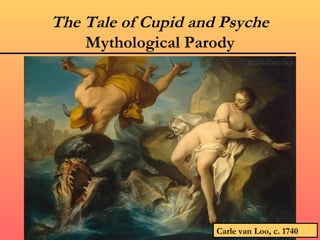
• Venus demands that Psyche be sent to a
  mountaintop and wed to a murderous beast
  – Reminds us of the plight of Andromeda,
    chained to a rocky cliff to be wed to a sea
    monster
  – She is rescued by Perseus
  – In this scenario, Venus = Poseidon, who
    demanded the sacrifice of Andromeda (Hades
    is only in Clash of the Titans)
The Tale of Cupid and Psyche
    Mythological Parody


                     Carle van Loo, c. 1740
The Tale of Cupid and Psyche
        Mythological Parody
• Sent by Venus to destroy Psyche, Cupid falls
  in love with her and flies her away to his
  castle
• Apuleius’ Cupid, too, is a multiple
  mythological parody
  – If Psyche = Andromeda, then Cupid =
    Perseus
  – If Venus = Demeter, then Psyche =
    Persephone and Cupid = Hades
The Tale of Cupid and Psyche
        Mythological Parody
• After Cupid abandons Psyche for revealing
  his identity, she seeks help from Venus, who
  assigns her four impossible tasks
• Of course, this makes
  – Venus = Juno (Hera)
  – Psyche = Hercules (Herakles)
The Tale of Cupid and Psyche
        Mythological Parody
• When Psyche must retrieve a jar of beauty from
  Persephone, things get REALLY FREAKY
  – Since she is making an underworld journy, Psyche
    now = Odysseus, Aeneas, Herakles, Eurydice
    (wife of Orpheus), and Alcestis (you remember her)
  – But remember, Psyche herself is already a
    mythological parody of Persephone, so she she going
    to visit HERSELF!
  – But since the beauty comes in a jar, Psyche =
    Pandora (especially when she opens the box)
The Tale of Cupid and Psyche
        Mythological Parody
• After Cupid rescues her, he begs Zeus to let
  Psyche become immortal
  – Like Helen and Herakles and Zeus’ own
    boyfriend (“cupbearer”), Ganymede (who, btw,
    is an ancestor of Aeneas)
• Psyche is given ambrosia (like Demophoon in
  the Homeric Hymn to Demeter…so Psyche is
  both Persephone and Demophoon…again,
  FREAKY!)
The Tale of Cupid and Psyche
       Philosophical Allegory
• Psyche = soul is joined with her heavenly
  desire = Cupid
• Remember Uranian Eros from the speech
  of Pausanias in Plato’s Symposium?
The Tale of Cupid and Psyche
       Philosophical Allegory
• Psyche = soul believes that her desire =
  Cupid is an ugly monster = wealth and
  power, but instead he turns out to be a
  beautiful god = wisdom and virtue
The Tale of Cupid and Psyche
       Philosophical Allegory
• But because Psyche = soul does not remain
  true to her desire = Cupid, she loses him
• Psyche = soul must then go on a long
  journey with many labors to regain her desire
  = Cupid
The Tale of Cupid and Psyche
       Philosophical Allegory
• Once Psyche = soul is reunited with her
  desire = Cupid, she becomes immortal
  – Remember the immortality of the soul in
    Socrates’ speech in Plato’s Symposium?
  – Remember the immortal souls that are reborn
    into new bodies in Vergil’s Aeneid?
The Tale of Cupid and Psyche
       Philosophical Allegory
• Once Psyche = soul is reunited with her
  desire = Cupid and becomes immortal,
  they have a child named Voluptas = Joy,
  Delight, Pleasure, HAPPINESS!
• Thus, the immortal soul achieves happiness
  when it is united with its true desire, which is
  beauty and goodness (Socrates much???)
Mythological Parody
        AND
Philosophical Allegory


    It’s a floor wax
          AND
  a dessert topping!
Extra Credit Opportunity
• If you attended Dr. Connolly’s lecture on
  April 12 and wish to receive extra credit, be
  sure to submit your report by the time of the
  final exam (Wed, 5/2, 9:00 am – 12:00 noon)
• A 2-page report gets you credit for up to 2
  Daily Writes (up to 8 points), depending on
  how complete and comprehensive the report
  is
Introduction to
Classical Mythology
    Dr. Michael Broder
University of South Carolina
      April 19, 2012

CLAS220 - Lecture Notes for April 19, 2012

  • 1.
    Introduction to Classical Mythology Dr. Michael Broder University of South Carolina April 19, 2012
  • 2.
  • 3.
    Extra Credit Opportunity •If you attended Dr. Connolly’s lecture on April 12 and wish to receive extra credit, be sure to submit your report by the time of the final exam (Wed, 5/2, 9:00 am – 12:00 noon) • A 2-page report gets you credit for up to 2 Daily Writes (up to 8 points), depending on how complete and comprehensive the report is
  • 4.
    Daily Write #24:Review In his poem On the Nature of the Universe, Lucretius calls Venus “mother” of the Romans and “nourishing Venus” who “makes the sea and land throng with life.” In The Tale of Cupid and Psyche, Apuleius calls Venus “mother of the nature of the universe” and “nourishing Venus” who “feeds and fosters the whole of this great globe.” Why do you think Apuleius chose to describe Venus in language that reminds us of Lucretius’s poem? Do you think Apuleius’s intentions towards Lucretius are serious, playful, mocking, respectful, disrespectful, or something else? Explain your answer as completely as you can.
  • 5.
    Daily Write #24:Review Sample student response: I think Apuleius is alluding to Lucretius’ Venus in a playful yet respectful manner. Lucretius made a very serious use of Venus. Apuleius is not mocking Venus or Lucretius; he is paying homage to what has come before. He assumes that his readers have a knowledge of Lucretius’ writings and can understand both the humor and the respect in Apuleius’ parody.
  • 6.
    Mythological Parody • Parody – A literary or musical work in which the style of an author or work is closely imitated for comic effect • Origin of the word “parody” – Par (para) = alongside, not “straight” – Ody (ode) = song – Thus, parody is a kind of “counter-song,” a playful imitation that goes against the serious grain of the original
  • 7.
    Mythological Parody • Aristotle(Poetics, ii. 5) wrote that the comic poet Hegemon of Thasos (c. 430 BCE) invented a kind of parody by altering the wording of well- known poems to transform the sublime into the ridiculous • In ancient Greek literature, a parodia was a narrative poem imitating the style and rhythm (dactylic hexameter) of epics but dealing with light, satirical or mock-heroic characters and events
  • 8.
    Mythological Parody • Luciusis on a (mock) heroic journey • Lucius seeks hospitality / xenia from Milo • Milo’s wife Pamphile engages in witchcraft and magic, like Helen, Circe, or Medea • Lucius is curious, like Odysseus, but foolish where Odysseus is clever and cunning
  • 9.
    Mythological Parody • Lucius’(mock) heroic quest for a rose to regain his human form reminds us of other heroic quests – Odysseus’ journey home – The labors of Herakles – Jason’s quest for the Golden Fleece – Aeneas’ quest for the Golden Bough
  • 10.
    Mythological Parody • Charite,the maiden kidnapped from her wedding by thieves, is like the kidnapped maidens of mythology listed by Herodotus – Io – Medea – Helen
  • 11.
    Mythological Parody • Theold woman who is a servant to the thieves and tells the tale of Cupid and Psyche is like Eurycleia, the nurse in the Odyssey who tells the story of how Odysseus received his scar and his name
  • 12.
    Mythological Parody • Traditionalepic maintains a high tone – Odysseus’ relationship with Nausicaa • Apuleius’ novel often assumes a low tone – Lucius’ relationship with Photis
  • 13.
    Epic Poet Becomes Romantic Storyteller • Romance – A medieval tale based on legend, love, adventure, or the supernatural – A prose narrative about imaginary characters involved in events remote in time or place and usually heroic, adventurous, or mysterious – A love story especially in the form of a novel
  • 14.
    Epic Poet Becomes Romantic Storyteller • When Lucius (as a donkey) is stolen from Milo’s house by thieves, he becomes an eyewitness and an eavesdropper • Instead of receiving the gift of song from the Muses, he picks up stories along his journey by seeing them firsthand or hearing them from others • The romantic storyteller is thus analogous to a historian – Hower, his stories are understood to be entertaining fictions, not historial facts
  • 15.
    How different isthe romantic storyteller from the epic poet? • Remember what Hesiod’s Muses say: “We know how to tell many believable lies, but also, when we want to, how to speak the plain truth.” • The romantic storyteller (fiction writer, novelist), while divorced from the idea of divine inspiration (the Muses), retains the idea of fictional tales (“lies”) that have some kind of intellectual, emotional, or spiritual truth
  • 16.
    The Tale ofCupid and Psyche Both Parody and Allegory • Parody – A literary or musical work in which the style of an author or work is closely imitated for comic effect • Allegory – Use of symbolic fictional figures and actions to express truths or generalizations about human existence, human nature, or the human condition
  • 17.
    The Tale ofCupid and Psyche is both a parody and an allegory • Mythological parody • Philosophical allegory
  • 18.
    The Tale ofCupid and Psyche Mythological Parody • Psyche is a beautiful maiden, like many beautiful maidens in mythology such as Pandora or Helen • Most beautiful maidens are said to receive their beauty as a gift from Venus, but Psyche’s beauty is not credited to Venus • Instead, Psyche becomes a rival to Venus, and is worshipped as a goddess • This makes Venus angry, and she retaliates
  • 19.
    The Tale ofCupid and Psyche Mythological Parody • Apuleius’ Venus is a multiple mythological parody – Demeter from the Homeric Hymn to Demeter • Demeter, grieving for her kidnapped daughter, withholds the grain from humanity • Venus, grieving for her abandoned temples, deprives humanity of Psyche • Thus, Venus takes on the role of kidnapper, like Hades in the Homeric Hymn
  • 20.
    The Tale ofCupid and Psyche Mythological Parody • Apuleius’ Venus is a multiple mythological parody – Venus from Lucretius’ On the Workings of the Universe – Juno from Vergil’s Aeneid (with Psyche, in this parody, becoming a parody of Aeneas)
  • 21.
    Aeneid Book I,Lines 1-11 Of arms and a man I sing, that famous fugitive from fate who first tried to escape the shores of Troy only to find himself here in Italy on Lavinian shores, tossed on land and sea by powers above (because cruel Juno’s anger doesn’t forget) and suffering many casualties in war as well, until he could finally found a city and bring his gods to Latium; whence the Latin race, our Alban ancestors, and the lofty walls of Rome. Oh Muse, recount for me the reasons— which insult, what injury was she nursing, when the queen of the gods contrived so many mishaps for a man so marked by his piety, forced him to undergo so many labors. Do the gods above really experience such intense anger? Translated by…Dr. Broder!
  • 22.
    The Tale ofCupid and Psyche Mythological Parody • Venus demands that Psyche be sent to a mountaintop and wed to a murderous beast – Reminds us of the plight of Andromeda, chained to a rocky cliff to be wed to a sea monster – She is rescued by Perseus – In this scenario, Venus = Poseidon, who demanded the sacrifice of Andromeda (Hades is only in Clash of the Titans)
  • 23.
    The Tale ofCupid and Psyche Mythological Parody Carle van Loo, c. 1740
  • 24.
    The Tale ofCupid and Psyche Mythological Parody • Sent by Venus to destroy Psyche, Cupid falls in love with her and flies her away to his castle • Apuleius’ Cupid, too, is a multiple mythological parody – If Psyche = Andromeda, then Cupid = Perseus – If Venus = Demeter, then Psyche = Persephone and Cupid = Hades
  • 25.
    The Tale ofCupid and Psyche Mythological Parody • After Cupid abandons Psyche for revealing his identity, she seeks help from Venus, who assigns her four impossible tasks • Of course, this makes – Venus = Juno (Hera) – Psyche = Hercules (Herakles)
  • 26.
    The Tale ofCupid and Psyche Mythological Parody • When Psyche must retrieve a jar of beauty from Persephone, things get REALLY FREAKY – Since she is making an underworld journy, Psyche now = Odysseus, Aeneas, Herakles, Eurydice (wife of Orpheus), and Alcestis (you remember her) – But remember, Psyche herself is already a mythological parody of Persephone, so she she going to visit HERSELF! – But since the beauty comes in a jar, Psyche = Pandora (especially when she opens the box)
  • 27.
    The Tale ofCupid and Psyche Mythological Parody • After Cupid rescues her, he begs Zeus to let Psyche become immortal – Like Helen and Herakles and Zeus’ own boyfriend (“cupbearer”), Ganymede (who, btw, is an ancestor of Aeneas) • Psyche is given ambrosia (like Demophoon in the Homeric Hymn to Demeter…so Psyche is both Persephone and Demophoon…again, FREAKY!)
  • 28.
    The Tale ofCupid and Psyche Philosophical Allegory • Psyche = soul is joined with her heavenly desire = Cupid • Remember Uranian Eros from the speech of Pausanias in Plato’s Symposium?
  • 29.
    The Tale ofCupid and Psyche Philosophical Allegory • Psyche = soul believes that her desire = Cupid is an ugly monster = wealth and power, but instead he turns out to be a beautiful god = wisdom and virtue
  • 30.
    The Tale ofCupid and Psyche Philosophical Allegory • But because Psyche = soul does not remain true to her desire = Cupid, she loses him • Psyche = soul must then go on a long journey with many labors to regain her desire = Cupid
  • 31.
    The Tale ofCupid and Psyche Philosophical Allegory • Once Psyche = soul is reunited with her desire = Cupid, she becomes immortal – Remember the immortality of the soul in Socrates’ speech in Plato’s Symposium? – Remember the immortal souls that are reborn into new bodies in Vergil’s Aeneid?
  • 32.
    The Tale ofCupid and Psyche Philosophical Allegory • Once Psyche = soul is reunited with her desire = Cupid and becomes immortal, they have a child named Voluptas = Joy, Delight, Pleasure, HAPPINESS! • Thus, the immortal soul achieves happiness when it is united with its true desire, which is beauty and goodness (Socrates much???)
  • 33.
    Mythological Parody AND Philosophical Allegory It’s a floor wax AND a dessert topping!
  • 34.
    Extra Credit Opportunity •If you attended Dr. Connolly’s lecture on April 12 and wish to receive extra credit, be sure to submit your report by the time of the final exam (Wed, 5/2, 9:00 am – 12:00 noon) • A 2-page report gets you credit for up to 2 Daily Writes (up to 8 points), depending on how complete and comprehensive the report is
  • 35.
    Introduction to Classical Mythology Dr. Michael Broder University of South Carolina April 19, 2012