Production & Industrial Management II (TE Prod S/W) Unit V
Deming’s Approach
Quality Principles and
Philosophies
Production Engg. Dept., AISSMS COE, PUNE By: N. G. Shekapure
Production & Industrial Management II (TE Prod S/W) Unit V
Deming’s Approach
Dr. W. E. Deming
• Born 1900
• Graduated in Electrical Engineering
• PhD in mathematical physics
• Main architect for introducing Total Quality into Japan
• Became statistician for US govt.
• Sent by US govt. to Japan after WWII to advise on
Japanese survey.
Production Engg. Dept., AISSMS COE, PUNE
• Born 1900
• Graduated in Electrical Engineering
• PhD in mathematical physics
• Main architect for introducing Total Quality into Japan
• Became statistician for US govt.
• Sent by US govt. to Japan after WWII to advise on
Japanese survey.
By: N. G. Shekapure
Production & Industrial Management II (TE Prod S/W) Unit V
Deming’s Approach
Deming’s Philosophy
• Quality is about people, not products
• Suggested quality concept for designing product
• Management need to understand nature of variation
and how to interpret statistical data
• Promoted importance of leadership
• 85% of production faults responsibility of management,
not workers
• Specified 14-point management philosophy
Production Engg. Dept., AISSMS COE, PUNE
• Quality is about people, not products
• Suggested quality concept for designing product
• Management need to understand nature of variation
and how to interpret statistical data
• Promoted importance of leadership
• 85% of production faults responsibility of management,
not workers
• Specified 14-point management philosophy
By: N. G. Shekapure
Production & Industrial Management II (TE Prod S/W) Unit V
Deming’s Approach
Product Development Cycle
1. Design the product.
2. Make it.
3. Try to sell it.
4. Do consumer research and test the product’s uses.
5. Redesign – start the cycle all over again.
Production Engg. Dept., AISSMS COE, PUNE
1. Design the product.
2. Make it.
3. Try to sell it.
4. Do consumer research and test the product’s uses.
5. Redesign – start the cycle all over again.
By: N. G. Shekapure
Production & Industrial Management II (TE Prod S/W) Unit V
Deming’s Approach
Quality
Costs Productivity
Quality Approach in Context
Production Engg. Dept., AISSMS COE, PUNE
Prices Market Share
Stay in business
By: N. G. Shekapure
Production & Industrial Management II (TE Prod S/W) Unit V
Deming’s Approach
Deming’s 14-point Management
Philosophy
Production Engg. Dept., AISSMS COE, PUNE By: N. G. Shekapure
Production & Industrial Management II (TE Prod S/W) Unit V
Deming’s Approach
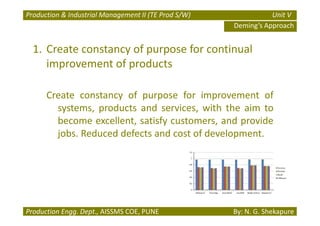
1. Create constancy of purpose for continual
improvement of products
Create constancy of purpose for improvement of
systems, products and services, with the aim to
become excellent, satisfy customers, and provide
jobs. Reduced defects and cost of development.
Production Engg. Dept., AISSMS COE, PUNE
1. Create constancy of purpose for continual
improvement of products
Create constancy of purpose for improvement of
systems, products and services, with the aim to
become excellent, satisfy customers, and provide
jobs. Reduced defects and cost of development.
By: N. G. Shekapure
Production & Industrial Management II (TE Prod S/W) Unit V
Deming’s Approach
2. Adopt a commitment to seek continual
improvements
Constantly and forever improve the system development
processes, to improve quality and productivity, and thus
constantly decrease the time and cost of systems.
Improving quality is not a one time effort.
Production Engg. Dept., AISSMS COE, PUNE
2. Adopt a commitment to seek continual
improvements
Constantly and forever improve the system development
processes, to improve quality and productivity, and thus
constantly decrease the time and cost of systems.
Improving quality is not a one time effort.
By: N. G. Shekapure
Production & Industrial Management II (TE Prod S/W) Unit V
Deming’s Approach
3. Switch from defect detection to defect
prevention
Close down dependencies on mass inspection (especially
testing) to achieve quality. Reduce the need for
inspection on a mass basis by building quality into the
system in the first place. Inspection is not the answer. It
is too late and unreliable – it does not produce quality.
Production Engg. Dept., AISSMS COE, PUNE
Close down dependencies on mass inspection (especially
testing) to achieve quality. Reduce the need for
inspection on a mass basis by building quality into the
system in the first place. Inspection is not the answer. It
is too late and unreliable – it does not produce quality.
By: N. G. Shekapure
Production & Industrial Management II (TE Prod S/W) Unit V
Deming’s Approach
4. In dealing with suppliers one should end the
practice of awarding business on price. Move
towards quality of product, reliability of
delivery and willingness to cooperate and
improve. Build partnerships.
Minimize total cost. Move towards a single supplier for any
one item or service, making them a partner in a long-
term relationship of loyalty and trust.
Production Engg. Dept., AISSMS COE, PUNE
4. In dealing with suppliers one should end the
practice of awarding business on price. Move
towards quality of product, reliability of
delivery and willingness to cooperate and
improve. Build partnerships.
Minimize total cost. Move towards a single supplier for any
one item or service, making them a partner in a long-
term relationship of loyalty and trust.
By: N. G. Shekapure
Production & Industrial Management II (TE Prod S/W) Unit V
Deming’s Approach
5. Improvement is not confined to products and
their direct processes but to all supporting
services and activities
All functions in an organization need to become quality
conscious to deliver a quality product.
Production Engg. Dept., AISSMS COE, PUNE
5. Improvement is not confined to products and
their direct processes but to all supporting
services and activities
All functions in an organization need to become quality
conscious to deliver a quality product.
By: N. G. Shekapure
Production & Industrial Management II (TE Prod S/W) Unit V
Deming’s Approach
6. Train a modern way.
Institute training on the job. Everyone must be trained, as
knowledge is essential for improvement.
Production Engg. Dept., AISSMS COE, PUNE
6. Train a modern way.
Institute training on the job. Everyone must be trained, as
knowledge is essential for improvement.
By: N. G. Shekapure
Production & Industrial Management II (TE Prod S/W) Unit V
Deming’s Approach
7. Supervision must change from chasing, to
coaching and support.
Institute leadership. It is a manger’s job to help their people
and their systems to do a better job.
Production Engg. Dept., AISSMS COE, PUNE
7. Supervision must change from chasing, to
coaching and support.
Institute leadership. It is a manger’s job to help their people
and their systems to do a better job.
By: N. G. Shekapure
Production & Industrial Management II (TE Prod S/W) Unit V
Deming’s Approach
8. Drive out fear and encourage two-way
communication.
Drive out fear, so that everyone may work effectively.
Management should be held responsible for the faults of
the organization and environment.
Production Engg. Dept., AISSMS COE, PUNE By: N. G. Shekapure
Production & Industrial Management II (TE Prod S/W) Unit V
Deming’s Approach
9. Remove barriers between departments
Break down barriers between areas. People must work as a
team. They must foresee and prevent problems during
systems development and use.
Production Engg. Dept., AISSMS COE, PUNE
9. Remove barriers between departments
Break down barriers between areas. People must work as a
team. They must foresee and prevent problems during
systems development and use.
By: N. G. Shekapure
Production & Industrial Management II (TE Prod S/W) Unit V
Deming’s Approach
10. Do not have unrealistic targets
Set realistic targets. Do not place people under unnecessary
pressure by asking them to do things which are not
achievable. Eliminate slogans, exhortations, and targets that
ask for zero defects, and new levels of productivity. Slogans
do not build quality systems.
Production Engg. Dept., AISSMS COE, PUNE
10. Do not have unrealistic targets
Set realistic targets. Do not place people under unnecessary
pressure by asking them to do things which are not
achievable. Eliminate slogans, exhortations, and targets that
ask for zero defects, and new levels of productivity. Slogans
do not build quality systems.
By: N. G. Shekapure
Production & Industrial Management II (TE Prod S/W) Unit V
Deming’s Approach
11. Eliminate quotas and numerical targets
Eliminate numerical quotas and goals. Substitute it with leadership.
Quotas and goals (such as schedule) address numbers - not
quality and methods.
Production Engg. Dept., AISSMS COE, PUNE By: N. G. Shekapure
Production & Industrial Management II (TE Prod S/W) Unit V
Deming’s Approach
12. Remove barriers that prevent employees
having pride in the work that they perform
Remove barriers to pride of workmanship. The responsibility of
project managers must change from schedules to quality.
Production Engg. Dept., AISSMS COE, PUNE
12. Remove barriers that prevent employees
having pride in the work that they perform
Remove barriers to pride of workmanship. The responsibility of
project managers must change from schedules to quality.
By: N. G. Shekapure
Production & Industrial Management II (TE Prod S/W) Unit V
Deming’s Approach
13. Encourage education and self-improvement for
everyone[
Institute and vigorous program of education and self-
improvement for everyone. There must be a continuing
commitment to training and educating software managers and
professional staff.
Production Engg. Dept., AISSMS COE, PUNE
13. Encourage education and self-improvement for
everyone[
Institute and vigorous program of education and self-
improvement for everyone. There must be a continuing
commitment to training and educating software managers and
professional staff.
By: N. G. Shekapure
Production & Industrial Management II (TE Prod S/W) Unit V
Deming’s Approach
14. Publish top management’s permanent
commitment to continuous improvement
of quality and productivity
Production Engg. Dept., AISSMS COE, PUNE By: N. G. Shekapure
Production & Industrial Management II (TE Prod S/W) Unit V
Deming’s Approach
PDCA / PDSA cycle
The PDCA cycle is also known as the Deming Cycle,
or as the Deming Wheel or as the Continuous
Improvement Spiral.
Production Engg. Dept., AISSMS COE, PUNE By: N. G. Shekapure
Production & Industrial Management II (TE Prod S/W) Unit V
Deming’s Approach
The Plan stage is where it all
begins. It is where you design
or revise business process
components to improve
results. Prior to implementing
a change you must
understand both the nature of
your current problem and
how your process failed to
meet a customer
requirement.
The Do stage is the
implementation of the
change. Identify the people
affected by the change and
inform them that you’re
adapting their process due to
customer complaints,
multiple failures, continual
improvement opportunity,
whatever the reason, it is
important to let them know
about the change.
The Study stage is where
you’ll perform analysis of
the data you collected
during the Do stage.
Assess the measurements
and report the results to
decision makers
Although act has the same
meaning with do, in this
stage 'Act' is meant to
apply actions to the
outcome for necessary
improvement, in other
words 'Act' means
'Improve'.
Production Engg. Dept., AISSMS COE, PUNE
The Plan stage is where it all
begins. It is where you design
or revise business process
components to improve
results. Prior to implementing
a change you must
understand both the nature of
your current problem and
how your process failed to
meet a customer
requirement.
The Do stage is the
implementation of the
change. Identify the people
affected by the change and
inform them that you’re
adapting their process due to
customer complaints,
multiple failures, continual
improvement opportunity,
whatever the reason, it is
important to let them know
about the change.
The Study stage is where
you’ll perform analysis of
the data you collected
during the Do stage.
Assess the measurements
and report the results to
decision makers
Although act has the same
meaning with do, in this
stage 'Act' is meant to
apply actions to the
outcome for necessary
improvement, in other
words 'Act' means
'Improve'.
By: N. G. Shekapure
Not in Syllabus
Chitale Approach
Approach :
Great Lines ----
“Change cannot be created for you every time.
You must strive & Bring the change Yourself”
Chitale Mithaiwale, Pune
“Change cannot be created for you every time.
You must strive & Bring the change Yourself”
Said By: - Tukaram of Chitale Mithaiwale, Pune
Meaning – Kripaya Sutte Paise Dya
By: N. G. Shekapure
Production & Industrial Management II (TE Prod S/W) Unit V
Juran’s Approach
Joseph M. Juran
Joseph Moses Juran was a
Romanian - born American
management consultant and
engineer. He is principally
remembered as an
evangelist for quality and
quality management, having
written several influential
books on those subjects.
Production Engg. Dept., AISSMS COE, PUNE
Joseph Moses Juran was a
Romanian - born American
management consultant and
engineer. He is principally
remembered as an
evangelist for quality and
quality management, having
written several influential
books on those subjects.
By: N. G. Shekapure
Production & Industrial Management II (TE Prod S/W) Unit V
Juran’s 10-point Program
1. Identify customers
2. Determine customer needs
3. Translate
4. Establishment units of measurement
5. Establish measurements
6. Develop product
7. Optimize product design
8. Develop process
9. Optimize process capability
10. Transfer
Juran’s Approach
Production Engg. Dept., AISSMS COE, PUNE
1. Identify customers
2. Determine customer needs
3. Translate
4. Establishment units of measurement
5. Establish measurements
6. Develop product
7. Optimize product design
8. Develop process
9. Optimize process capability
10. Transfer
By: N. G. Shekapure
Society to conserve water.
Water
My Seven Year old Daughter Decided not to play Holi
with water because………Thousands of people have no
water to drink. Farmer suicides are rampant due to
the drought conditions.
Even without water the festival can be
great fun…………………….
By: N. G. Shekapure
Production & Industrial Management II (TE Prod S/W) Unit V
7 QC Tools
7 Quality Control Tools
• Paroto Chart
• Histrogram
• Process Flow Diagram
• Check Sheet
Production Engg. Dept., AISSMS COE, PUNE
• Check Sheet
• Scatter Diagram
• Control Chart
• Cause & Effect diagram
By: N. G. Shekapure
Production & Industrial Management II (TE Prod S/W) Unit V
Pareto Chart Defined
Pareto charts are used to identify and prioritize
problems to be solved.
They are actually histograms aided by the 80/20
rule adapted by Joseph Juran.
Remember the 80/20 rule states that approximately
80% of the problems are created by approximately 20%
of the causes.
7 QC Tools
• Paroto Chart
Production Engg. Dept., AISSMS COE, PUNE
Pareto Chart Defined
Pareto charts are used to identify and prioritize
problems to be solved.
They are actually histograms aided by the 80/20
rule adapted by Joseph Juran.
Remember the 80/20 rule states that approximately
80% of the problems are created by approximately 20%
of the causes.
By: N. G. Shekapure
Production & Industrial Management II (TE Prod S/W) Unit V
First, information must be selected based on
types or classifications of defects that occur as a
result of a process.
The data must be collected and classified into
categories.
Then a histogram or frequency chart is
constructed showing the number of occurrences.
7 QC Tools
Constructing a Pareto Chart
Production Engg. Dept., AISSMS COE, PUNE
First, information must be selected based on
types or classifications of defects that occur as a
result of a process.
The data must be collected and classified into
categories.
Then a histogram or frequency chart is
constructed showing the number of occurrences.
By: N. G. Shekapure
Production & Industrial Management II (TE Prod S/W) Unit V
7 QC Tools
An Example of How a Pareto Chart Can Be Used
Pareto Charts are used when products are suffering
from different defects but the defects are occurring at
a different frequency, or only a few account for most
of the defects present, or different defects incur
different costs. What we see from that is a product
line may experience a range of defects. The
manufacturer could concentrate on reducing the
defects which make up a bigger percentage of all the
defects or focus on eliminating the defect that causes
monetary loss.
Production Engg. Dept., AISSMS COE, PUNE
Pareto Charts are used when products are suffering
from different defects but the defects are occurring at
a different frequency, or only a few account for most
of the defects present, or different defects incur
different costs. What we see from that is a product
line may experience a range of defects. The
manufacturer could concentrate on reducing the
defects which make up a bigger percentage of all the
defects or focus on eliminating the defect that causes
monetary loss.
By: N. G. Shekapure
Production & Industrial Management II (TE Prod S/W) Unit V
7 QC Tools
• Paroto Chart
Production Engg. Dept., AISSMS COE, PUNE By: N. G. Shekapure
Production & Industrial Management II (TE Prod S/W) Unit V
7 QC Tools
• Histrogram
Histogram Defined
A histogram is a bar graph that shows frequency
data.
Histograms provide the easiest way to evaluate
the distribution of data.
Production Engg. Dept., AISSMS COE, PUNE
Histogram Defined
A histogram is a bar graph that shows frequency
data.
Histograms provide the easiest way to evaluate
the distribution of data.
By: N. G. Shekapure
Production & Industrial Management II (TE Prod S/W) Unit V
7 QC Tools
Collect data and sort it into categories.
Then label the data as the independent set or the dependent
set.
The characteristic you grouped the data by would be the
independent variable.
The frequency of that set would be the dependent variable.
Each mark on either axis should be in equal increments.
For each category, find the related frequency and make the
horizontal marks to show that frequency.
Creating a Histogram
Production Engg. Dept., AISSMS COE, PUNE
Collect data and sort it into categories.
Then label the data as the independent set or the dependent
set.
The characteristic you grouped the data by would be the
independent variable.
The frequency of that set would be the dependent variable.
Each mark on either axis should be in equal increments.
For each category, find the related frequency and make the
horizontal marks to show that frequency.
By: N. G. Shekapure
Production & Industrial Management II (TE Prod S/W) Unit V
7 QC Tools
Histograms can be used to determine distribution
of sales.
Say for instance a company wanted to measure
the revenues of other companies and wanted to
compare numbers.
Examples of How Histograms Can Be Used
Production Engg. Dept., AISSMS COE, PUNE
Histograms can be used to determine distribution
of sales.
Say for instance a company wanted to measure
the revenues of other companies and wanted to
compare numbers.
By: N. G. Shekapure
Production & Industrial Management II (TE Prod S/W) Unit V
7 QC Tools
Percentfromeachcause 20
30
40
50
60
70
(64)
Histrogram
Production Engg. Dept., AISSMS COE, PUNE
Percentfromeachcause
Causes of poor quality
0
10
20
(13)
(10)
(6)
(3) (2) (2)
By: N. G. Shekapure
Production & Industrial Management II (TE Prod S/W) Unit V
7 QC Tools
Histrogram
Production Engg. Dept., AISSMS COE, PUNE By: N. G. Shekapure
Production & Industrial Management II (TE Prod S/W) Unit V
7 QC Tools
• Process Flow Diagram
Flow Charts
Graphical description of how work is done.
Used to describe processes that are to be improved.
Production Engg. Dept., AISSMS COE, PUNE
Graphical description of how work is done.
Used to describe processes that are to be improved.
By: N. G. Shekapure
Production & Industrial Management II (TE Prod S/W) Unit V
7 QC Tools
Flow Chart
Production Engg. Dept., AISSMS COE, PUNE By: N. G. Shekapure
Production & Industrial Management II (TE Prod S/W) Unit V
7 QC Tools
Flow Chart
Production Engg. Dept., AISSMS COE, PUNE By: N. G. Shekapure
Production & Industrial Management II (TE Prod S/W) Unit V
7 QC Tools
Process Chart Symbols
Operations
Inspection
Transportation
Production Engg. Dept., AISSMS COE, PUNE
Transportation
Delay
Storage
Production & Industrial Management II (TE Prod S/W) Unit V
7 QC Tools
Production Engg. Dept., AISSMS COE, PUNE By: N. G. Shekapure
Production & Industrial Management II (TE Prod S/W) Unit V
7 QC Tools
Flow Diagram
Production Engg. Dept., AISSMS COE, PUNE By: N. G. Shekapure
Production & Industrial Management II (TE Prod S/W) Unit V
7 QC Tools
Flow Diagram
Production Engg. Dept., AISSMS COE, PUNE By: N. G. Shekapure
Production & Industrial Management II (TE Prod S/W) Unit V
7 QC Tools
Flow Diagram
Production Engg. Dept., AISSMS COE, PUNE By: N. G. Shekapure
Production & Industrial Management II (TE Prod S/W) Unit V
7 QC Tools
Check Sheet
Production Engg. Dept., AISSMS COE, PUNE By: N. G. Shekapure
Production & Industrial Management II (TE Prod S/W) Unit V
7 QC Tools
Check List
Production Engg. Dept., AISSMS COE, PUNE By: N. G. Shekapure
Production & Industrial Management II (TE Prod S/W) Unit V
7 QC Tools
Scatter Diagram
What it is:
A scatter diagram is a tool for analyzing relationships between two
variables. One variable is plotted on the horizontal axis and the
other is plotted on the vertical axis.
The pattern of their intersecting points can graphically show
relationship patterns.
Most often a scatter diagram is used to prove or disprove cause-
and-effect relationships. While the diagram shows relationships, it
does not by itself prove that one variable causes the other. In
addition to showing possible causeand- effect relationships, a
scatter diagram can show that two variables are from a common
cause that is unknown or that one variable can be used as a
surrogate for the other.
Production Engg. Dept., AISSMS COE, PUNE
What it is:
A scatter diagram is a tool for analyzing relationships between two
variables. One variable is plotted on the horizontal axis and the
other is plotted on the vertical axis.
The pattern of their intersecting points can graphically show
relationship patterns.
Most often a scatter diagram is used to prove or disprove cause-
and-effect relationships. While the diagram shows relationships, it
does not by itself prove that one variable causes the other. In
addition to showing possible causeand- effect relationships, a
scatter diagram can show that two variables are from a common
cause that is unknown or that one variable can be used as a
surrogate for the other.
By: N. G. Shekapure
Production & Industrial Management II (TE Prod S/W) Unit V
7 QC ToolsScatter Diagram
Interpret the data.
Scatter diagrams will generally show one of six possible correlations between the variables:
Strong Positive Correlation
The value of Y clearly increases as the value of X increases.
Strong Negative Correlation
The value of Y clearly decreases as the value of X increases.
Weak Positive Correlation
The value of Y increases slightly as the value of X increases.
Weak Negative Correlation
The value of Y decreases slightly as the value of X increases.
Complex Correlation
The Y seems to be related to X, but the relationship is not
easily determined.
No Correlation
There is no connection between the two variables.
Production Engg. Dept., AISSMS COE, PUNE
Interpret the data.
Scatter diagrams will generally show one of six possible correlations between the variables:
Strong Positive Correlation
The value of Y clearly increases as the value of X increases.
Strong Negative Correlation
The value of Y clearly decreases as the value of X increases.
Weak Positive Correlation
The value of Y increases slightly as the value of X increases.
Weak Negative Correlation
The value of Y decreases slightly as the value of X increases.
Complex Correlation
The Y seems to be related to X, but the relationship is not
easily determined.
No Correlation
There is no connection between the two variables.
By: N. G. Shekapure
Production & Industrial Management II (TE Prod S/W) Unit V
7 QC Tools
Scatter Diagram
Production Engg. Dept., AISSMS COE, PUNE By: N. G. Shekapure
Production & Industrial Management II (TE Prod S/W) Unit V
7 QC Tools
Control Chart
The control chart is a graph used to study how a process changes
over time with data plotted in time order.
Production Engg. Dept., AISSMS COE, PUNE By: N. G. Shekapure
Production & Industrial Management II (TE Prod S/W) Unit V
7 QC Tools
Basic Conceptions
What is a control chart?
The control chart is a graph used to study how a process changes over time.
Data are plotted in time order.
A control chart always has a central line for the average, an upper line for the
upper control limit and a lower line for the lower control limit.
Lines are determined from historical data. By comparing current data to these
lines, you can draw conclusions about whether the process variation is
consistent (in control) or is unpredictable (out of control, affected by special
causes of variation).
Production Engg. Dept., AISSMS COE, PUNE
What is a control chart?
The control chart is a graph used to study how a process changes over time.
Data are plotted in time order.
A control chart always has a central line for the average, an upper line for the
upper control limit and a lower line for the lower control limit.
Lines are determined from historical data. By comparing current data to these
lines, you can draw conclusions about whether the process variation is
consistent (in control) or is unpredictable (out of control, affected by special
causes of variation).
By: N. G. Shekapure
Production & Industrial Management II (TE Prod S/W) Unit V
7 QC Tools
When to use a control chart?
Controlling ongoing processes by finding and correcting
problems as they occur.
Predicting the expected range of outcomes from a process.
Determining whether a process is stable (in statistical
control).
Analyzing patterns of process variation from special causes
(non-routine events) or common causes (built into the
process).
Determining whether the quality improvement project
should aim to prevent specific problems or to make
fundamental changes to the process.
Production Engg. Dept., AISSMS COE, PUNE
When to use a control chart?
Controlling ongoing processes by finding and correcting
problems as they occur.
Predicting the expected range of outcomes from a process.
Determining whether a process is stable (in statistical
control).
Analyzing patterns of process variation from special causes
(non-routine events) or common causes (built into the
process).
Determining whether the quality improvement project
should aim to prevent specific problems or to make
fundamental changes to the process.
By: N. G. Shekapure
Production & Industrial Management II (TE Prod S/W) Unit V
7 QC Tools
Control Chart Basic Procedure
Choose the appropriate control chart for the data.
Determine the appropriate time period for collecting and
plotting data.
Collect data, construct the chart and analyze the data.
Look for “out-of-control signals” on the control chart. When
one is identified, mark it on the chart and investigate the
cause. Document how you investigated, what you learned,
the cause and how it was corrected.
Continue to plot data as they are generated. As each new
data point is plotted, check for new out-of-control signals.
Production Engg. Dept., AISSMS COE, PUNE
Control Chart Basic Procedure
Choose the appropriate control chart for the data.
Determine the appropriate time period for collecting and
plotting data.
Collect data, construct the chart and analyze the data.
Look for “out-of-control signals” on the control chart. When
one is identified, mark it on the chart and investigate the
cause. Document how you investigated, what you learned,
the cause and how it was corrected.
Continue to plot data as they are generated. As each new
data point is plotted, check for new out-of-control signals.
By: N. G. Shekapure
Production & Industrial Management II (TE Prod S/W) Unit V
7 QC Tools
Basic components of control charts
A centerline, usually the mathematical average of all
the samples plotted;
Lower and upper control limits defining the
constraints of common cause variations;
Performance data plotted over time.
Production Engg. Dept., AISSMS COE, PUNE
Basic components of control charts
A centerline, usually the mathematical average of all
the samples plotted;
Lower and upper control limits defining the
constraints of common cause variations;
Performance data plotted over time.
By: N. G. Shekapure
Production & Industrial Management II (TE Prod S/W) Unit V
7 QC Tools
General model for a control chart
UCL = Ẍ + kσ
CL = Ẍ
LCL = Ẍ – kσ
where Ẍ is the mean of the variable, and σ is the standard deviation of the
variable.
UCL=upper control limit; LCL = lower control limit;
CL = center line.
where k is the distance of the control limits from the center line, expressed in
terms of standard deviation units. When k
is set to 3, we speak of 3-sigma control charts. Historically, k = 3 has become an
accepted standard in industry.
Production Engg. Dept., AISSMS COE, PUNE
General model for a control chart
UCL = Ẍ + kσ
CL = Ẍ
LCL = Ẍ – kσ
where Ẍ is the mean of the variable, and σ is the standard deviation of the
variable.
UCL=upper control limit; LCL = lower control limit;
CL = center line.
where k is the distance of the control limits from the center line, expressed in
terms of standard deviation units. When k
is set to 3, we speak of 3-sigma control charts. Historically, k = 3 has become an
accepted standard in industry.
By: N. G. Shekapure
Production & Industrial Management II (TE Prod S/W) Unit V
7 QC Tools
Types of the control charts
Variables control charts
Variable data are measured on a continuous scale.
For example: time, weight, distance or temperature can be
measured in fractions or decimals.
Applied to data with continuous distribution
Attributes control charts
Attribute data are counted and cannot have fractions or
decimals. Attribute data arise when you are determining only the
presence or absence of something: success or failure, accept or
reject, correct or not correct.
For example, a report can have four errors or five errors, but it
cannot have four and a half errors.
Applied to data following discrete distribution
Production Engg. Dept., AISSMS COE, PUNE
Types of the control charts
Variables control charts
Variable data are measured on a continuous scale.
For example: time, weight, distance or temperature can be
measured in fractions or decimals.
Applied to data with continuous distribution
Attributes control charts
Attribute data are counted and cannot have fractions or
decimals. Attribute data arise when you are determining only the
presence or absence of something: success or failure, accept or
reject, correct or not correct.
For example, a report can have four errors or five errors, but it
cannot have four and a half errors.
Applied to data following discrete distribution
By: N. G. Shekapure
Production & Industrial Management II (TE Prod S/W) Unit V
7 QC Tools
Variables control charts
• X-bar and R chart (also called averages and range chart)
• X-bar and s chart
• Moving average–Moving range chart (also called MA–MR chart)
• Target charts (also called difference charts, deviation charts and
nominal charts)
• CUSUM (cumulative sum chart)
• EWMA (exponentially weighted moving average chart)
multivariate chart
Production Engg. Dept., AISSMS COE, PUNE
Variables control charts
• X-bar and R chart (also called averages and range chart)
• X-bar and s chart
• Moving average–Moving range chart (also called MA–MR chart)
• Target charts (also called difference charts, deviation charts and
nominal charts)
• CUSUM (cumulative sum chart)
• EWMA (exponentially weighted moving average chart)
multivariate chart
By: N. G. Shekapure
Production & Industrial Management II (TE Prod S/W) Unit V
7 QC Tools
Attributes control charts
p chart (Proportion chart)
np chart
c chart (Count chart)
u chart
Production Engg. Dept., AISSMS COE, PUNE
Attributes control charts
p chart (Proportion chart)
np chart
c chart (Count chart)
u chart
By: N. G. Shekapure
Production & Industrial Management II (TE Prod S/W) Unit V
7 QC Tools
Example: R Control Chart
In the manufacturing of a certain machine part, the percentage of aluminum in the finished part is
especially critical. For each production day, the aluminum percentage of five parts is measured. The
table below consists of the average aluminum percentage of ten consecutive production days, along
with the minimum and maximum sample values (aluminum percentage) for each day. The sum of the
10 samples means (below) is 258.8.
Day 1 2 3 4 5 6 7 8 9 10
Production Engg. Dept., AISSMS COE, PUNE
Sample Mean 25.2 26.0 25.2 25.2 26.0 25.6 26.0 26.0 24.6 29.0
Maximum Value 26.6 27.6 27.7 27.4 27.6 27.4 27.5 27.9 26.8 31.6
Minimum Value 23.5 24.4 24.6 23.2 23.3 23.3 24.1 23.8 23.5 27.4
By: N. G. Shekapure
Production & Industrial Management II (TE Prod S/W) Unit V
7 QC Tools
Show the relationships between a problem and its
possible causes.
Developed by Kaoru Ishikawa (1953)
Also known as …
 Fishbone diagrams
 Ishikawa diagrams
Cause & Effect diagram
Production Engg. Dept., AISSMS COE, PUNE
Show the relationships between a problem and its
possible causes.
Developed by Kaoru Ishikawa (1953)
Also known as …
 Fishbone diagrams
 Ishikawa diagrams
By: N. G. Shekapure
Production & Industrial Management II (TE Prod S/W) Unit V
7 QC Tools
Problem/
Desired
Improvement
Main Category
Cause & Effect Diagram
Production Engg. Dept., AISSMS COE, PUNE
Problem/
Desired
Improvement
Cause
Root Cause
By: N. G. Shekapure
Production & Industrial Management II (TE Prod S/W) Unit V
7 QC Tools
What is a Cause and Effect Diagram?
• A visual tool to identify, explore and graphically
display, in increasing detail, all of the suspected
possible causes related to a problem or condition to
discover its root causes.
• Not a quantitative tool
Production Engg. Dept., AISSMS COE, PUNE
• A visual tool to identify, explore and graphically
display, in increasing detail, all of the suspected
possible causes related to a problem or condition to
discover its root causes.
• Not a quantitative tool
By: N. G. Shekapure
Production & Industrial Management II (TE Prod S/W) Unit V
7 QC Tools
Why Use Cause & Effect Diagrams?
• Focuses team on the content of the problem
• Creates a snapshot of the collective knowledge of team
• Creates consensus of the causes of a problem
• Builds support for resulting solutions
• Focuses the team on causes not symptoms
• To discover the most probable causes for further analysis
• To visualize possible relationships between causes for any
problem current or future
• To pinpoint conditions causing customer complaints, process
errors or non-conforming products
• To provide focus for discussion
Production Engg. Dept., AISSMS COE, PUNE
• Focuses team on the content of the problem
• Creates a snapshot of the collective knowledge of team
• Creates consensus of the causes of a problem
• Builds support for resulting solutions
• Focuses the team on causes not symptoms
• To discover the most probable causes for further analysis
• To visualize possible relationships between causes for any
problem current or future
• To pinpoint conditions causing customer complaints, process
errors or non-conforming products
• To provide focus for discussion
By: N. G. Shekapure
Production & Industrial Management II (TE Prod S/W) Unit V
7 QC Tools
ManMan
MethodsMethodsMachineMachine
Five Key
Sources of
Variation
EnvironmentEnvironment+
Product/Manufacturing
Production Engg. Dept., AISSMS COE, PUNE
MaterialsMaterials MeasurementMeasurement
Five Key
Sources of
Variation
EnvironmentEnvironment+
Use cause and effect diagram to single out variation sources
within the “5M’s + E”
Use cause and effect diagram to single out variation sources
within the “5M’s + E”
By: N. G. Shekapure
Production & Industrial Management II (TE Prod S/W) Unit V
7 QC Tools
Causes Effect
Main Category
Fishbone - Cause and Effect Diagram
Production Engg. Dept., AISSMS COE, PUNE
Shows various influences on a process to identify most likely root
causes of problem
Shows various influences on a process to identify most likely root
causes of problem
Problem
Cause
Root
Cause
By: N. G. Shekapure
Production & Industrial Management II (TE Prod S/W) Unit V
7 QC Tools
Quality
Problem
Quality
Problem
MachinesMachinesMeasurementMeasurement HumanHuman
Faulty testing equipment
Incorrect specifications
Improper methods
Poor supervision
Lack of concentration
Inadequate training
Out of adjustment
Tooling problems
Old / worn
Production Engg. Dept., AISSMS COE, PUNE
Quality
Problem
Quality
Problem
ProcessProcessEnvironmentEnvironment MaterialsMaterials
Defective from vendor
Not to specifications
Material-
handling problems
Deficiencies in
product design
Ineffective quality
management
Poor process design
Inaccurate
temperature
control
Dust and
Dirt
By: N. G. Shekapure
Production & Industrial Management II (TE Prod S/W) Unit V
7 QC Tools
Late Pizza
deliveries on
Fridays &
Saturdays
Late Pizza
deliveries on
Fridays &
Saturdays
Machinery / Equipment'sMachinery / Equipment's PeoplePeople
Production Engg. Dept., AISSMS COE, PUNE
Late Pizza
deliveries on
Fridays &
Saturdays
Late Pizza
deliveries on
Fridays &
Saturdays
MethodsMethods MaterialsMaterials
By: N. G. Shekapure
Production & Industrial Management II (TE Prod S/W) Unit V
7 QC Tools
Production Engg. Dept., AISSMS COE, PUNE By: N. G. Shekapure
Production & Industrial Management II (TE Prod S/W) Unit V
5 S
5S
Production Engg. Dept., AISSMS COE, PUNE By: N. G. Shekapure
Production & Industrial Management II (TE Prod S/W) Unit V
5 S
The 5S
Seiri – Sort (housekeeping)
Seiton – Set in order (workplace organization)
Seiso – Shine (Cleanup)
Seiketsu – Standardize (Cleanliness)
Shitsuke – Sustain (Discipline)
Production Engg. Dept., AISSMS COE, PUNE
Seiri – Sort (housekeeping)
Seiton – Set in order (workplace organization)
Seiso – Shine (Cleanup)
Seiketsu – Standardize (Cleanliness)
Shitsuke – Sustain (Discipline)
By: N. G. Shekapure
Production & Industrial Management II (TE Prod S/W) Unit V
5 S
Benefits of 5S
 Reduce waste hidden in the plant
 Improve quality and safety
 Reduce lead time and cost
 Increase profit
Production Engg. Dept., AISSMS COE, PUNE
 Reduce waste hidden in the plant
 Improve quality and safety
 Reduce lead time and cost
 Increase profit
By: N. G. Shekapure
Production & Industrial Management II (TE Prod S/W) Unit V
5 S
Seiri – Sort
• Ensuring each item in a workplace is in its proper place
or identified as unnecessary and removed.
• Sort items by frequency of use
• Get rid of unnecessary stuff
 Bare essentials for the job
 Red Tag system
 Can tasks be simplified?
 Do we label items, and dispose of waste frequently?
Production Engg. Dept., AISSMS COE, PUNE
• Ensuring each item in a workplace is in its proper place
or identified as unnecessary and removed.
• Sort items by frequency of use
• Get rid of unnecessary stuff
 Bare essentials for the job
 Red Tag system
 Can tasks be simplified?
 Do we label items, and dispose of waste frequently?
By: N. G. Shekapure
Production & Industrial Management II (TE Prod S/W) Unit V
5 S
Seiton – Set in order
• Time spent looking for things, putting away
• Arrange materials and equipment so that they
are easy to find and use
 Prepare and label storage areas
 Use paint, outlines, color-coded
 Consider ergonomics of reaching items
 Frequent, infrequent users
Production Engg. Dept., AISSMS COE, PUNE
• Time spent looking for things, putting away
• Arrange materials and equipment so that they
are easy to find and use
 Prepare and label storage areas
 Use paint, outlines, color-coded
 Consider ergonomics of reaching items
 Frequent, infrequent users
By: N. G. Shekapure
Production & Industrial Management II (TE Prod S/W) Unit V
5 S
Seiso – Shine
• Repair, clean & shine work area
• Important for safety
• Maintenance problems such as oil leaks can
identified before they cause problems.
• Schedule for cleaning, sweeping, wiping off
• Cleaning inspection checklists
• Workspace always ready to work
• See workspace through customers’ eyes
Production Engg. Dept., AISSMS COE, PUNE
• Repair, clean & shine work area
• Important for safety
• Maintenance problems such as oil leaks can
identified before they cause problems.
• Schedule for cleaning, sweeping, wiping off
• Cleaning inspection checklists
• Workspace always ready to work
• See workspace through customers’ eyes
By: N. G. Shekapure
Production & Industrial Management II (TE Prod S/W) Unit V
5 S
Seiketsu – Standardize
• Formalize procedures and practices to create
consistency and ensure all steps are performed
correctly.
• Prevention steps for clutter
• Otherwise improvements from first 3 lost
• Everyone knows what they are responsible for
doing, when and how
• Visual 5S – see status at a glance
• Safe wear, no wasted resources
Production Engg. Dept., AISSMS COE, PUNE
• Formalize procedures and practices to create
consistency and ensure all steps are performed
correctly.
• Prevention steps for clutter
• Otherwise improvements from first 3 lost
• Everyone knows what they are responsible for
doing, when and how
• Visual 5S – see status at a glance
• Safe wear, no wasted resources
By: N. G. Shekapure
Production & Industrial Management II (TE Prod S/W) Unit V
5 S
Shitsuke – Sustain
• Keep the processes going through training,
communication, and organization structures
• Allocate time for maintaining
• Create awareness of improvements
• Management support for maintaining
• Training, rewards
Production Engg. Dept., AISSMS COE, PUNE
• Keep the processes going through training,
communication, and organization structures
• Allocate time for maintaining
• Create awareness of improvements
• Management support for maintaining
• Training, rewards
By: N. G. Shekapure
Production & Industrial Management II (TE Prod S/W) Unit V
5 S
What is 5S ?
Production Engg. Dept., AISSMS COE, PUNE By: N. G. Shekapure
Production & Industrial Management II (TE Prod S/W) Unit V
5 S
Production Engg. Dept., AISSMS COE, PUNE By: N. G. Shekapure
Production & Industrial Management II (TE Prod S/W) Unit V
5 S
Implementation
• Gradually – too fast unsustainable
• During slow time
• Importance of training, Management commitment
• Before & After photos
• Change of mentality, not campaigns and slogans.
Old way no longer OK
• MBWA
• Patrols
Production Engg. Dept., AISSMS COE, PUNE
• Gradually – too fast unsustainable
• During slow time
• Importance of training, Management commitment
• Before & After photos
• Change of mentality, not campaigns and slogans.
Old way no longer OK
• MBWA
• Patrols
(Management By Wandering Around)
By: N. G. Shekapure
Production & Industrial Management II (TE Prod S/W) Unit V
TPM
Total Productive Maintenance
Production Engg. Dept., AISSMS COE, PUNE By: N. G. Shekapure
Production & Industrial Management II (TE Prod S/W) Unit V
TPM
Total Productive Maintenance
Production Engg. Dept., AISSMS COE, PUNE By: N. G. Shekapure
Production & Industrial Management II (TE Prod S/W) Unit V
TPM
FOCUSED
IMPROVEMENT
AUTONOMOUS MAINTENANCE
PLANNED
MAINTENANCE
TRAINING AND
SKILLS DEVELOPMENT
RESET BASE LEVEL, INSPECTION STANDARDS
5S, SETTING STANDARDS.
MEASUREMENT OF LOSSES, PROBLEM SOLVING,
RELIABILITY IMPROVEMENT, SMED.
DOWNTIME REDUCTION
INITIALIZATION OF CONDITION BASED MAINTENANCE
TECHNICAL SKILLS REQUIREMENTS
KNOW- HOW
The 8 Pillars of TPM
PI
PII
PIII
PIV
Production Engg. Dept., AISSMS COE, PUNE
TRAINING AND
SKILLS DEVELOPMENT
INITIAL PHASE
MANAGEMENT
ADMINISTRATIVE WORK
IMPROVEMENT
QUALITY IMPROVEMENT
TECHNICAL SKILLS REQUIREMENTS
KNOW- HOW
CHECK OF SPECIFICATIONS
TECHNICAL EVOLUTIONS
5S IN OFFICES
5S IN WAREHOUSES
IMPROVE EFFICIENCY OF ADMINISTRATIVE TASKS
MANAGEMENT FOR ZERO ACCIDENT
AND ZERO POLLUTION
REDUCTION OF DEFECTS
OPERATING STANDARDS
SAFETY &
ENVIRONMENT
QUALITY
MAINTENANCE
PIV
PV
PVI
PVII
PVIII
By: N. G. Shekapure
Production & Industrial Management II (TE Prod S/W) Unit V
TPM
• Breakdown maintenance
 Waits until equipment fails and repair it
• Preventive maintenance
 Regular maintenance (cleaning, inspection, oiling and retightening)
 Retains the healthy condition of equipment and prevents failure
 Periodic maintenance (time based maintenance - TBM)
 Predictive maintenance (condition based maintenance)
• Corrective maintenance
 Improves equipment and its components so that preventive
maintenance can be carried out reliably
• Maintenance prevention
 Improves the design of new equipment
Production Engg. Dept., AISSMS COE, PUNE
• Breakdown maintenance
 Waits until equipment fails and repair it
• Preventive maintenance
 Regular maintenance (cleaning, inspection, oiling and retightening)
 Retains the healthy condition of equipment and prevents failure
 Periodic maintenance (time based maintenance - TBM)
 Predictive maintenance (condition based maintenance)
• Corrective maintenance
 Improves equipment and its components so that preventive
maintenance can be carried out reliably
• Maintenance prevention
 Improves the design of new equipment
By: N. G. Shekapure
Production & Industrial Management II (TE Prod S/W) Unit V
TPM
Think of productive equipment as we think of our cars or
telephones
They are ready to go when we need them
They need not run all the time to be productive
For this concept to function properly
The machines must be ready when we need them
They must be shut down in such a fashion as to be
ready the next time
Why do you change the oil in your car?
Production Engg. Dept., AISSMS COE, PUNE
Think of productive equipment as we think of our cars or
telephones
They are ready to go when we need them
They need not run all the time to be productive
For this concept to function properly
The machines must be ready when we need them
They must be shut down in such a fashion as to be
ready the next time
Why do you change the oil in your car?
By: N. G. Shekapure
Production & Industrial Management II (TE Prod S/W) Unit V
TPM
 To maintain quality
 To maintain production volume
 To maintain efficiency
 To protect investment in equipment
“If machine uptime is not predictable, if process capability is
not sustained, we cannot satisfy the customer, and we
cannot stay in business.”
Production Engg. Dept., AISSMS COE, PUNE
 To maintain quality
 To maintain production volume
 To maintain efficiency
 To protect investment in equipment
“If machine uptime is not predictable, if process capability is
not sustained, we cannot satisfy the customer, and we
cannot stay in business.”
By: N. G. Shekapure
Production & Industrial Management II (TE Prod S/W) Unit V
TPM
Total
• All employees are involved
• It aims to eliminate all accidents, defects and breakdowns
Productive
• Actions are performed while production goes on
• Troubles for production are minimized
Maintenance
• Keep in good condition
• Repair, clean, lubricate
Production Engg. Dept., AISSMS COE, PUNE
Total
• All employees are involved
• It aims to eliminate all accidents, defects and breakdowns
Productive
• Actions are performed while production goes on
• Troubles for production are minimized
Maintenance
• Keep in good condition
• Repair, clean, lubricate
By: N. G. Shekapure
Production & Industrial Management II (TE Prod S/W) Unit V
TPM
TPM Targets:
PQCDSM
P : Obtain Minimum 80% OPE.
Obtain Minimum 90% OEE ( Overall Equipment Effectiveness )
Run the machines even during lunch. ( Lunch is for operators and not for
machines ! )
Q : Operate in a manner, so that there are no customer complaints.
C : Reduce the manufacturing cost by 30%.
D : Achieve 100% success in delivering the goods as required by the customer.
S : Maintain a accident free environment.
M : Increase the suggestions by 3 times. Develop Multi-skilled and flexible
workers.
Production Engg. Dept., AISSMS COE, PUNE
TPM Targets:
PQCDSM
P : Obtain Minimum 80% OPE.
Obtain Minimum 90% OEE ( Overall Equipment Effectiveness )
Run the machines even during lunch. ( Lunch is for operators and not for
machines ! )
Q : Operate in a manner, so that there are no customer complaints.
C : Reduce the manufacturing cost by 30%.
D : Achieve 100% success in delivering the goods as required by the customer.
S : Maintain a accident free environment.
M : Increase the suggestions by 3 times. Develop Multi-skilled and flexible
workers.
By: N. G. Shekapure
Production & Industrial Management II (TE Prod S/W) Unit V
TPM
PQCDSM
Production Engg. Dept., AISSMS COE, PUNE By: N. G. Shekapure
Production & Industrial Management II (TE Prod S/W) Unit V
TPM
Preparation
Announcement to introduce TPM
Introductory education campaign for the workforce
TPM Promotion (special committees)
Establish basic TPM policies and goals
Preparation and Formulation of a master plan
Production Engg. Dept., AISSMS COE, PUNE
Kick-off
Implementation
Preparation and Formulation of a master plan
Develop an equipment management program
Develop a planned maintenance program
Develop an autonomous maintenance program
Increase skills of production and maintenance personnel
Perfect TPM implementation and raise TPM levelsStabilization
Develop early equipment management program
Invite customers, affiliated companies and subcontractors
By: N. G. Shekapure
Production & Industrial Management II (TE Prod S/W) Unit V
KAIZEN
KAIZEN
Production Engg. Dept., AISSMS COE, PUNE By: N. G. Shekapure
Production & Industrial Management II (TE Prod S/W) Unit V
KAIZEN
KAIZEN
Production Engg. Dept., AISSMS COE, PUNE By: N. G. Shekapure
Production & Industrial Management II (TE Prod S/W) Unit V
KAIZEN
Kaizen was first implemented in several Japanese
businesses during the country's recovery after World War
II, including Toyota, and has since spread out to
businesses throughout the world.
This method became famous by the book of Masaaki
Imai “Kaizen: The Key to Japan's Competitive Success.”
Production Engg. Dept., AISSMS COE, PUNE
Kaizen was first implemented in several Japanese
businesses during the country's recovery after World War
II, including Toyota, and has since spread out to
businesses throughout the world.
This method became famous by the book of Masaaki
Imai “Kaizen: The Key to Japan's Competitive Success.”
By: N. G. Shekapure
Production & Industrial Management II (TE Prod S/W) Unit V
KAIZEN
 Improvements are based on many, small changes rather than the
radial changes that might arise from Research and Development.
 As the ideas come from the workers themselves, they are less
likely to be radically different, & therefore easier to implement.
 Small improvements are less likely to required major capital
investment than major process changes.
Production Engg. Dept., AISSMS COE, PUNE
 Small improvements are less likely to required major capital
investment than major process changes.
 The ideas come from the talents of the existing workforce, as
opposed to using R&D, consultants or equipment – any of which
could be very expensive
 All employees should continually be seeking ways to improve
their own performance.
 It helps encourage workers to take ownership of their work and
thereby improving worker motivation, team working .
By: N. G. Shekapure
Production & Industrial Management II (TE Prod S/W) Unit V
KAIZEN
The quick and easy kaizen process works as follows:
1. The employee identifies a problem, waste, or an opportunity for
improvement and writes it down.
2. The employee develops an improvement idea and discusses it
with his or her supervisor.
3. The supervisor reviews the idea within 24 hours and encourages
immediate action.
4. The employee implements the idea. If a larger improvement
idea is approved, the employee should take leadership to
implement the idea.
5. The idea is written up on a simple form in less than three
minutes.
6. Supervisor posts the form to share with and stimulate others
and recognizes the accomplishment.
Production Engg. Dept., AISSMS COE, PUNE
The quick and easy kaizen process works as follows:
1. The employee identifies a problem, waste, or an opportunity for
improvement and writes it down.
2. The employee develops an improvement idea and discusses it
with his or her supervisor.
3. The supervisor reviews the idea within 24 hours and encourages
immediate action.
4. The employee implements the idea. If a larger improvement
idea is approved, the employee should take leadership to
implement the idea.
5. The idea is written up on a simple form in less than three
minutes.
6. Supervisor posts the form to share with and stimulate others
and recognizes the accomplishment.
By: N. G. Shekapure
Production & Industrial Management II (TE Prod S/W) Unit V
Quality Circle
Production Engg. Dept., AISSMS COE, PUNE By: N. G. Shekapure
Production & Industrial Management II (TE Prod S/W) Unit V
Quality Circle
Voluntary groups of employees who work on similar tasks
or share an area of responsibility
They agree to meet on a regular basis to discuss & solve
problems related to work.
They operate on the principle that employee participation
in decision-making and problem-solving improves the
quality of work
Production Engg. Dept., AISSMS COE, PUNE
Voluntary groups of employees who work on similar tasks
or share an area of responsibility
They agree to meet on a regular basis to discuss & solve
problems related to work.
They operate on the principle that employee participation
in decision-making and problem-solving improves the
quality of work
By: N. G. Shekapure
Production & Industrial Management II (TE Prod S/W) Unit V
Quality Circle
Characteristics
Volunteers
Set Rules and Priorities
Decisions made by agreement
Use of organized approaches to Problem-Solving
Production Engg. Dept., AISSMS COE, PUNE
Characteristics
Volunteers
Set Rules and Priorities
Decisions made by agreement
Use of organized approaches to Problem-Solving
By: N. G. Shekapure
Production & Industrial Management II (TE Prod S/W) Unit V
Quality Circle
 All members of a Circle need to receive training
 Members need to be empowered
 Members need to have the support of Senior
Management
Production Engg. Dept., AISSMS COE, PUNE
 All members of a Circle need to receive training
 Members need to be empowered
 Members need to have the support of Senior
Management
By: N. G. Shekapure
Production & Industrial Management II (TE Prod S/W) Unit V
KAIZEN
 Increase Productivity
 Improve Quality
 Boost Employee Morale
Production Engg. Dept., AISSMS COE, PUNE By: N. G. Shekapure
Production & Industrial Management II (TE Prod S/W) Unit V
KAIZEN
• Inadequate Training
• Unsure of Purpose
• Not truly Voluntary
• Lack of Management Interest
• Quality Circles are not really empowered to
make decisions.
Production Engg. Dept., AISSMS COE, PUNE
• Inadequate Training
• Unsure of Purpose
• Not truly Voluntary
• Lack of Management Interest
• Quality Circles are not really empowered to
make decisions.
By: N. G. Shekapure
Production & Industrial Management II (TE Prod S/W) Unit V
Concurrent Engineering
Production Engg. Dept., AISSMS COE, PUNE By: N. G. Shekapure
Production & Industrial Management II (TE Prod S/W) Unit V
Concurrent Engineering
1st Definition
“The simultaneous performance of product design and
process design. Typically, concurrent engineering involves
the formation of cross-functional teams. This allows
engineers and managers of different disciplines to work
together simultaneously in developing product and
process design.”
Foster, S. Thomas. Managing Quality: An Integrative Approach. Upper Saddle
River New Jersey: Prentice Hall, 2001.
Production Engg. Dept., AISSMS COE, PUNE
“The simultaneous performance of product design and
process design. Typically, concurrent engineering involves
the formation of cross-functional teams. This allows
engineers and managers of different disciplines to work
together simultaneously in developing product and
process design.”
Foster, S. Thomas. Managing Quality: An Integrative Approach. Upper Saddle
River New Jersey: Prentice Hall, 2001.
By: N. G. Shekapure
Production & Industrial Management II (TE Prod S/W) Unit V
Concurrent Engineering
2nd Definition
“Concurrent engineering methodologies permit the separate
tasks of the product development process to be carried out
simultaneously rather than sequentially. Product design,
testing, manufacturing and process planning through
logistics, for example, are done side-by-side and interactively.
Potential problems in fabrication, assembly, support and
quality are identified and resolved early in the design
process.”
Izuchukwu, John. “Architecture and Process :The Role of Integrated Systems in
Concurrent Engineering.” Industrial Management Mar/Apr 1992: p. 19-23.
Production Engg. Dept., AISSMS COE, PUNE
“Concurrent engineering methodologies permit the separate
tasks of the product development process to be carried out
simultaneously rather than sequentially. Product design,
testing, manufacturing and process planning through
logistics, for example, are done side-by-side and interactively.
Potential problems in fabrication, assembly, support and
quality are identified and resolved early in the design
process.”
Izuchukwu, John. “Architecture and Process :The Role of Integrated Systems in
Concurrent Engineering.” Industrial Management Mar/Apr 1992: p. 19-23.
By: N. G. Shekapure
Production & Industrial Management II (TE Prod S/W) Unit V
Concurrent Engineering
Basic view of Concurrent Engineering
- Doing things simultaneously
- Focusing on the Process
- Converting hierarchical organizations into teams
Basic Goals of Concurrent Engineering
- Dramatic improvements in time to market and costs
- Improvements to product quality and performance
- Do more with less
Production Engg. Dept., AISSMS COE, PUNE
Basic Goals of Concurrent Engineering
- Dramatic improvements in time to market and costs
- Improvements to product quality and performance
- Do more with less
By: N. G. Shekapure
Production & Industrial Management II (TE Prod S/W) Unit V
Concurrent Engineering = Teamwork
- The more communication exists, the better the product.
Balances Needs
- Customer, Supplier, Engineers, Marketing, & Manuf. needs.
Concurrent Engineering
Production Engg. Dept., AISSMS COE, PUNE
Management
- Good management is vitally important
- Encourage communication
- Strong management support
By: N. G. Shekapure
Production & Industrial Management II (TE Prod S/W) Unit V
3 Main Areas to Concurrent Engineering
1) People (Formation of teams, Training)
2) Process (Changes in your processes, Be open to change)
3) Technology (Software. Hardware, and Networking)
Concurrent Engineering
Production Engg. Dept., AISSMS COE, PUNE
3 Main Areas to Concurrent Engineering
1) People (Formation of teams, Training)
2) Process (Changes in your processes, Be open to change)
3) Technology (Software. Hardware, and Networking)
By: N. G. Shekapure
Production & Industrial Management II (TE Prod S/W) Unit V
JIT
Just in Time (JIT)
Overview of Japanese Manufacturing
System
Production Engg. Dept., AISSMS COE, PUNE By: N. G. Shekapure
Production & Industrial Management II (TE Prod S/W) Unit V
JIT
Japanese Manufacturing Techniques
• Emerged in the post-World War II era
• Reached the height of their prominence in the 1980s
• An emphasis on designing processes to optimize
efficiency and A strong commitment to quality.
• Toyota Production System (TPS), the core of which is
just-in-time (JIT) production or so-called lean
manufacturing.
• Taiichi Ohno, a former Toyota executive, and
Shigeo Shingo, an eminent engineer and consultant
Production Engg. Dept., AISSMS COE, PUNE
• Emerged in the post-World War II era
• Reached the height of their prominence in the 1980s
• An emphasis on designing processes to optimize
efficiency and A strong commitment to quality.
• Toyota Production System (TPS), the core of which is
just-in-time (JIT) production or so-called lean
manufacturing.
• Taiichi Ohno, a former Toyota executive, and
Shigeo Shingo, an eminent engineer and consultant
By: N. G. Shekapure
Production & Industrial Management II (TE Prod S/W) Unit V
JIT
Toyota’s Production system
Production Engg. Dept., AISSMS COE, PUNE By: N. G. Shekapure
Production & Industrial Management II (TE Prod S/W) Unit V
JIT
History of JIT Manufacturing
Evolved in Japan after World War II, as a result of their
diminishing market share in the auto industry.
Toyota Motor Company- Birthplace of the JIT
Philosophy Under Taiichi Ohno.
•W. Edwards Deming
•14 points for Management
JIT is now on the rise in American Industries.
Production Engg. Dept., AISSMS COE, PUNE
Evolved in Japan after World War II, as a result of their
diminishing market share in the auto industry.
Toyota Motor Company- Birthplace of the JIT
Philosophy Under Taiichi Ohno.
•W. Edwards Deming
•14 points for Management
JIT is now on the rise in American Industries.
By: N. G. Shekapure
Production & Industrial Management II (TE Prod S/W) Unit V
JIT
Developments of JIT and Lean Operations
1960’s: Developed as Toyota Production System by
Taiichi Ohno and his colleagues
1970’s: U.S. and European auto makers began to
apply JIT to improve quality and productivity
1990’s and beyond: Expanded the JIT concept to
streamline all types of operations
Production Engg. Dept., AISSMS COE, PUNE
1960’s: Developed as Toyota Production System by
Taiichi Ohno and his colleagues
1970’s: U.S. and European auto makers began to
apply JIT to improve quality and productivity
1990’s and beyond: Expanded the JIT concept to
streamline all types of operations
By: N. G. Shekapure
Production & Industrial Management II (TE Prod S/W) Unit V
JIT
Elimination of Waste
• Knew they wouldn’t beat U.S. with product innovation,
concentrated on licensing patents, and producing
more efficiently
• Costs prevented mass-production, volume strategy of
American firms.
• Find ways to reduce waste, cost
Production Engg. Dept., AISSMS COE, PUNE
• Knew they wouldn’t beat U.S. with product innovation,
concentrated on licensing patents, and producing
more efficiently
• Costs prevented mass-production, volume strategy of
American firms.
• Find ways to reduce waste, cost
Shigeo Shingo
By: N. G. Shekapure
Production & Industrial Management II (TE Prod S/W) Unit V
JIT
-- the early years
First two Toyotas imported to U.S. 1957
Production Engg. Dept., AISSMS COE, PUNE By: N. G. Shekapure
Production & Industrial Management II (TE Prod S/W) Unit V
JIT
Eliminating Waste
Maximizing process efficiency and the returns
on resources
Identifying unnecessary uses of human, capital,
or physical resources
Production Engg. Dept., AISSMS COE, PUNE
Maximizing process efficiency and the returns
on resources
Identifying unnecessary uses of human, capital,
or physical resources
By: N. G. Shekapure
Production & Industrial Management II (TE Prod S/W) Unit V
JIT
Waste
Waste is ‘anything other than the minimum amount
of equipment, materials, parts, space, and workers’
time which are absolutely essential to add value to
the product.
--Shoichiro Toyoda President, Toyota Motor Co.
If you put your mind to it, you can squeeze water
from a dry towel.
-- Eiji Toyoda, President 1967-1982
Production Engg. Dept., AISSMS COE, PUNE
Waste is ‘anything other than the minimum amount
of equipment, materials, parts, space, and workers’
time which are absolutely essential to add value to
the product.
--Shoichiro Toyoda President, Toyota Motor Co.
If you put your mind to it, you can squeeze water
from a dry towel.
-- Eiji Toyoda, President 1967-1982
By: N. G. Shekapure
Production & Industrial Management II (TE Prod S/W) Unit V
JIT
7 Types of Waste (Ohno 1988)
Overproduction
Time on Hand (waiting time)
Transportation
Stock on Hand - Inventory
Waste of Processing itself
Movement
Making Defective Products
Production Engg. Dept., AISSMS COE, PUNE
Overproduction
Time on Hand (waiting time)
Transportation
Stock on Hand - Inventory
Waste of Processing itself
Movement
Making Defective Products
By: N. G. Shekapure
Production & Industrial Management II (TE Prod S/W) Unit V
JIT
Process Improvement
Toyota system heavy emphasis was placed on lowering the time
and complexity required to change a die in a manufacturing
process.
Occur through a series of smaller initiatives kaizen.
In 1970 it took the company four hours to change a die for a 1,000-
ton stamping press. Six months later, the changing time had been
cut to one and a half hours
1971 Toyota had indeed achieved its goal of a three-minute die
change.
Western firms focused on training workers to master increasingly
complicated tasks
Selectively redesign the tasks so they could be more easily and
reliably mastered (poka-yoke)
Production Engg. Dept., AISSMS COE, PUNE
Toyota system heavy emphasis was placed on lowering the time
and complexity required to change a die in a manufacturing
process.
Occur through a series of smaller initiatives kaizen.
In 1970 it took the company four hours to change a die for a 1,000-
ton stamping press. Six months later, the changing time had been
cut to one and a half hours
1971 Toyota had indeed achieved its goal of a three-minute die
change.
Western firms focused on training workers to master increasingly
complicated tasks
Selectively redesign the tasks so they could be more easily and
reliably mastered (poka-yoke)
By: N. G. Shekapure
Production & Industrial Management II (TE Prod S/W) Unit V
JIT
Value Added
• Distinguish between activities that add value to a
product and those that are logistical but add no
value
• Production process itself, where materials are being
transformed into progressively functional work
pieces.
• Non Value Adding such as transporting materials,
inspecting finished work, and most of all, idle time
and delays
Production Engg. Dept., AISSMS COE, PUNE
• Distinguish between activities that add value to a
product and those that are logistical but add no
value
• Production process itself, where materials are being
transformed into progressively functional work
pieces.
• Non Value Adding such as transporting materials,
inspecting finished work, and most of all, idle time
and delays
By: N. G. Shekapure
Production & Industrial Management II (TE Prod S/W) Unit V
JIT
Overproduction And Excess Inventory
• To produce more than customers actually need—or
sooner than they need it
• Carrying inventory is wasteful
• Systems like the Japanese kanban established a set
of often simple visual cues in the factory
• Company can reduce both the direct costs of
holding/handling inventory as well as the indirect
costs of tying up capital in the form of excess
inventory
Production Engg. Dept., AISSMS COE, PUNE
• To produce more than customers actually need—or
sooner than they need it
• Carrying inventory is wasteful
• Systems like the Japanese kanban established a set
of often simple visual cues in the factory
• Company can reduce both the direct costs of
holding/handling inventory as well as the indirect
costs of tying up capital in the form of excess
inventory
By: N. G. Shekapure
Production & Industrial Management II (TE Prod S/W) Unit V
JIT
Order-based Production
• Customer information to drive their production
decisions.
• Effective market research/forecasting and
communication with customers.
• Guided by actual orders, rather than anticipated
demand
• “Pull" from the actual market, as opposed to “Push"
that stems only from the manufacturer's conjecture.
Production Engg. Dept., AISSMS COE, PUNE
• Customer information to drive their production
decisions.
• Effective market research/forecasting and
communication with customers.
• Guided by actual orders, rather than anticipated
demand
• “Pull" from the actual market, as opposed to “Push"
that stems only from the manufacturer's conjecture.
By: N. G. Shekapure
Production & Industrial Management II (TE Prod S/W) Unit V
JIT
Transportation
• Excess movement of items or materials.
• Changing the layout of a factory, its geographic
location relative to its customers
• Mitigated through automation, ideal under the
Japanese system is to minimize it altogether
• Cell and flexible manufacturing layouts
• Negatively affects small-lot, order-based production
Production Engg. Dept., AISSMS COE, PUNE
• Excess movement of items or materials.
• Changing the layout of a factory, its geographic
location relative to its customers
• Mitigated through automation, ideal under the
Japanese system is to minimize it altogether
• Cell and flexible manufacturing layouts
• Negatively affects small-lot, order-based production
By: N. G. Shekapure
Production & Industrial Management II (TE Prod S/W) Unit V
JIT
Quality By Design
• Marked attention to quality throughout the
production process.
• W. Edwards Deming and Joseph M. Juran
• Designing it into the production process
• Inform—and improve—the manufacturing process,
not just to describe it.
Production Engg. Dept., AISSMS COE, PUNE
• Marked attention to quality throughout the
production process.
• W. Edwards Deming and Joseph M. Juran
• Designing it into the production process
• Inform—and improve—the manufacturing process,
not just to describe it.
By: N. G. Shekapure
Production & Industrial Management II (TE Prod S/W) Unit V
JIT
Market-driven Pricing
• Market-determined price for a good and then engineer
the manufacturing process to produce at this price
profitably
• Increases in costs are not passed on to the consumer
in the form of higher prices
• Lowering costs - practice central to the rise of the
Japanese auto manufacturers in the U.S. market
Production Engg. Dept., AISSMS COE, PUNE
• Market-determined price for a good and then engineer
the manufacturing process to produce at this price
profitably
• Increases in costs are not passed on to the consumer
in the form of higher prices
• Lowering costs - practice central to the rise of the
Japanese auto manufacturers in the U.S. market
By: N. G. Shekapure
Production & Industrial Management II (TE Prod S/W) Unit V
JIT
Worker Flexibility
• Maximizing returns on human capital - human time is
more valuable than machine time
• Skills and Scheduling
• Individual workers running several machines
simultaneously, a practice called jidoka.
• Multi-machine worker system reportedly achieved 20
to 30 percent gains in worker productivity.
• Scheduling under just-in-time basis
Production Engg. Dept., AISSMS COE, PUNE
• Maximizing returns on human capital - human time is
more valuable than machine time
• Skills and Scheduling
• Individual workers running several machines
simultaneously, a practice called jidoka.
• Multi-machine worker system reportedly achieved 20
to 30 percent gains in worker productivity.
• Scheduling under just-in-time basis
By: N. G. Shekapure
Production & Industrial Management II (TE Prod S/W) Unit V
JIT
Building Blocks for Just-in-Time
Production Engg. Dept., AISSMS COE, PUNE By: N. G. Shekapure
Production & Industrial Management II (TE Prod S/W) Unit V
JIT
Manufacturing Planning and Control System and JIT
Production Engg. Dept., AISSMS COE, PUNE By: N. G. Shekapure
Production & Industrial Management II (TE Prod S/W) Unit V
JIT
Why JIT
• There is steep rise in customer’s base and unexpected
due to spread of business on International platform.
• Global Competition is increasing as customer has
various options of choosing the different company’s
product.
• Just-in-time approach provides better business
strategy to combat the challenge of meeting customer’s
demand.
Production Engg. Dept., AISSMS COE, PUNE
• There is steep rise in customer’s base and unexpected
due to spread of business on International platform.
• Global Competition is increasing as customer has
various options of choosing the different company’s
product.
• Just-in-time approach provides better business
strategy to combat the challenge of meeting customer’s
demand.
By: N. G. Shekapure
Production & Industrial Management II (TE Prod S/W) Unit V
Kanban
Production Engg. Dept., AISSMS COE, PUNE By: N. G. Shekapure
Production & Industrial Management II (TE Prod S/W) Unit V
QFD
Quality Function Deployment
(QFD)
The Voice of the Customer
Production Engg. Dept., AISSMS COE, PUNE
The Voice of the Customer
By: N. G. Shekapure
Production & Industrial Management II (TE Prod S/W) Unit V
QFD
What is QFD?
"Time was when a man could order a pair of shoes directly from the
cobbler. By measuring the foot himself and personally handling
all aspects of manufacturing, the cobbler could assure the
customer would be satisfied,"
Quality Function Deployment (QFD) was developed to
bring this personal interface to modern manufacturing
and business. In today's industrial society, where the
growing distance between producers and users is a
concern, QFD links the needs of the customer (end user)
with design, development, engineering, manufacturing,
and service functions.
Production Engg. Dept., AISSMS COE, PUNE
Quality Function Deployment (QFD) was developed to
bring this personal interface to modern manufacturing
and business. In today's industrial society, where the
growing distance between producers and users is a
concern, QFD links the needs of the customer (end user)
with design, development, engineering, manufacturing,
and service functions.
By: N. G. Shekapure
Production & Industrial Management II (TE Prod S/W) Unit V
QFD
QFD is….
• Understanding Customer Requirements
• Quality Systems Thinking + Psychology +
Knowledge/Epistemology
• Maximizing Positive Quality That Adds Value
• Comprehensive Quality System for Customer Satisfaction
• Strategy to Stay Ahead of The Game
Production Engg. Dept., AISSMS COE, PUNE
• Understanding Customer Requirements
• Quality Systems Thinking + Psychology +
Knowledge/Epistemology
• Maximizing Positive Quality That Adds Value
• Comprehensive Quality System for Customer Satisfaction
• Strategy to Stay Ahead of The Game
By: N. G. Shekapure
Production & Industrial Management II (TE Prod S/W) Unit V
QFD
What is QFD?
Quality Function Deployment is a design planning
process driven by customer requirements.
1. QFD deploys “The Voice of the
Customer” throughout the
organization.
2. QFD uses planning matrices --
each called “The House of
Quality”.
Production Engg. Dept., AISSMS COE, PUNE
1. QFD deploys “The Voice of the
Customer” throughout the
organization.
2. QFD uses planning matrices --
each called “The House of
Quality”.
By: N. G. Shekapure
Production & Industrial Management II (TE Prod S/W) Unit V
QFD
The House of Quality
Production Engg. Dept., AISSMS COE, PUNE
QFD-Tutorial
By: N. G. Shekapure
Production & Industrial Management II (TE Prod S/W) Unit V
QFD
The House of Quality
Production Engg. Dept., AISSMS COE, PUNE By: N. G. Shekapure
Production & Industrial Management II (TE Prod S/W) Unit V
QFD
The House of Quality
Production Engg. Dept., AISSMS COE, PUNE By: N. G. Shekapure
Production & Industrial Management II (TE Prod S/W) Unit VI
ISO
International Organization for
Standardization
Production Engg. Dept., AISSMS COE, PUNE By: N. G. Shekapure
Overview of ISO 9001 and ISO 14001
Production & Industrial Management II (TE Prod S/W) Unit VI
ISO
ISO 9001 and ISO 14001 in Brief
• ISO 9001 and ISO 14001 are among ISO's most well
known standards ever.
• They are implemented by more than a million
organizations in some 175 countries.
• ISO 9001 helps organizations to implement quality
management.
• ISO 14001 helps organizations to implement
environmental management.
Production Engg. Dept., AISSMS COE, PUNE By: N. G. Shekapure
• ISO 9001 and ISO 14001 are among ISO's most well
known standards ever.
• They are implemented by more than a million
organizations in some 175 countries.
• ISO 9001 helps organizations to implement quality
management.
• ISO 14001 helps organizations to implement
environmental management.
Production & Industrial Management II (TE Prod S/W) Unit VI
ISO
Quality Management
• ISO 9001 is for quality management.
• Quality refers to all those features of a product (or
service) which are required by the customer.
• Quality management means what the organization
does to ensure that its products or services satisfy the
customer's quality requirements and comply with any
regulations applicable to those products or services.
• Quality management also means what the organization
does to enhance customer satisfaction, and achieve
continual improvement of its performance.
Production Engg. Dept., AISSMS COE, PUNE By: N. G. Shekapure
• ISO 9001 is for quality management.
• Quality refers to all those features of a product (or
service) which are required by the customer.
• Quality management means what the organization
does to ensure that its products or services satisfy the
customer's quality requirements and comply with any
regulations applicable to those products or services.
• Quality management also means what the organization
does to enhance customer satisfaction, and achieve
continual improvement of its performance.
Production & Industrial Management II (TE Prod S/W) Unit VI
ISO
Environmental Management
• ISO 14001 is for environmental management. This
means what the organization does to:
• Minimize harmful effects on the environment
caused by its activities,
• To conform to applicable regulatory requirements,
and to…
• Achieve continual improvement of its environmental
performance.
Production Engg. Dept., AISSMS COE, PUNE By: N. G. Shekapure
• ISO 14001 is for environmental management. This
means what the organization does to:
• Minimize harmful effects on the environment
caused by its activities,
• To conform to applicable regulatory requirements,
and to…
• Achieve continual improvement of its environmental
performance.
Production & Industrial Management II (TE Prod S/W) Unit VI
ISO
• ISO 9001 and ISO 14001 are generic standards.
• Generic means that the same standards can be
applied: to any organization, large or small, whatever
its product or service, in any sector of activity, and
whether it is a business enterprise, a public
administration, or a government department.
Generic Standards
Production Engg. Dept., AISSMS COE, PUNE By: N. G. Shekapure
• ISO 9001 and ISO 14001 are generic standards.
• Generic means that the same standards can be
applied: to any organization, large or small, whatever
its product or service, in any sector of activity, and
whether it is a business enterprise, a public
administration, or a government department.
Production & Industrial Management II (TE Prod S/W) Unit VI
ISO
• Generic also signifies that
• no matter what the organization's scope of activity
• if it wants to establish a quality management system,
ISO 9001 gives the essential features
• or if it wants to establish an environmental
management system, ISO 14001 gives the essential
features.
Generic Standards (Cont.)
Production Engg. Dept., AISSMS COE, PUNE By: N. G. Shekapure
• Generic also signifies that
• no matter what the organization's scope of activity
• if it wants to establish a quality management system,
ISO 9001 gives the essential features
• or if it wants to establish an environmental
management system, ISO 14001 gives the essential
features.
Production & Industrial Management II (TE Prod S/W) Unit VI
ISO
• To be really efficient and effective, the organization
can manage its way of doing things by systemizing it.
• Nothing important is left out.
• Everyone is clear about who is responsible for doing
what, when, how, why and where.
• Management system standards provide the
organization with an international, state-of-the-art
model to follow.
Manangement Systems
Production Engg. Dept., AISSMS COE, PUNE By: N. G. Shekapure
• To be really efficient and effective, the organization
can manage its way of doing things by systemizing it.
• Nothing important is left out.
• Everyone is clear about who is responsible for doing
what, when, how, why and where.
• Management system standards provide the
organization with an international, state-of-the-art
model to follow.
Production & Industrial Management II (TE Prod S/W) Unit VI
ISO
• Large organizations, or ones with complicated processes,
could not function well without management systems.
• Companies in such fields as aerospace, automobiles,
defence, or health care devices have been operating
management systems for years.
• The ISO 9001 and ISO 14001 management system standards
now make these successful practices available for all
organizations.
Manangement Systems (Cont.)
Production Engg. Dept., AISSMS COE, PUNE By: N. G. Shekapure
• Large organizations, or ones with complicated processes,
could not function well without management systems.
• Companies in such fields as aerospace, automobiles,
defence, or health care devices have been operating
management systems for years.
• The ISO 9001 and ISO 14001 management system standards
now make these successful practices available for all
organizations.
Production & Industrial Management II (TE Prod S/W) Unit VI
ISO
• Both ISO 9001 and ISO 14001 concern the way an
organization goes about its work.
• They are not product standards.
• They are not service standards.
• They are process standards.
• They can be used by product manufacturers and service
providers.
Processes, not products
Production Engg. Dept., AISSMS COE, PUNE By: N. G. Shekapure
• Both ISO 9001 and ISO 14001 concern the way an
organization goes about its work.
• They are not product standards.
• They are not service standards.
• They are process standards.
• They can be used by product manufacturers and service
providers.
Production & Industrial Management II (TE Prod S/W) Unit VI
ISO
• Processes affect final products or services.
• ISO 9001 gives the requirements for what the organization
must do to manage processes affecting quality of its products
and services.
• ISO 14001 gives the requirements for what the organization
must do to manage processes affecting the impact of its
activities on the environment.
Processes, not products (Cont.)
Production Engg. Dept., AISSMS COE, PUNE By: N. G. Shekapure
• Processes affect final products or services.
• ISO 9001 gives the requirements for what the organization
must do to manage processes affecting quality of its products
and services.
• ISO 14001 gives the requirements for what the organization
must do to manage processes affecting the impact of its
activities on the environment.
Production & Industrial Management II (TE Prod S/W) Unit VI
ISO
Certification and registration
• Certification is known in some countries as registration.
• It means that an independent, external body has
audited an organization's management system and
verified that it conforms to the requirements specified
in the standard (ISO 9001 or ISO 14001).
• ISO does not carry out certification and does not issue
or approve certificates
Production Engg. Dept., AISSMS COE, PUNE By: N. G. Shekapure
• Certification is known in some countries as registration.
• It means that an independent, external body has
audited an organization's management system and
verified that it conforms to the requirements specified
in the standard (ISO 9001 or ISO 14001).
• ISO does not carry out certification and does not issue
or approve certificates
Production & Industrial Management II (TE Prod S/W) Unit VI
ISO
• Accreditation is like certification of the certification body.
• It means the formal approval by a specialized body - an
accreditation body - that a certification body is competent to
carry out ISO 9001:2008 or ISO 14001:2004 certification in
specified business sectors.
• Certificates issued by accredited certification bodies - and known
as accredited certificates - may be perceived on the market as
having increased credibility.
• ISO does not carry out or approve accreditations.
Accreditation
Production Engg. Dept., AISSMS COE, PUNE By: N. G. Shekapure
• Accreditation is like certification of the certification body.
• It means the formal approval by a specialized body - an
accreditation body - that a certification body is competent to
carry out ISO 9001:2008 or ISO 14001:2004 certification in
specified business sectors.
• Certificates issued by accredited certification bodies - and known
as accredited certificates - may be perceived on the market as
having increased credibility.
• ISO does not carry out or approve accreditations.
Production & Industrial Management II (TE Prod S/W) Unit VI
ISO
• Certification is not a requirement of ISO 9001 or ISO
14001.
• The organization can implement and benefit from an ISO
9001 or ISO 14001 system without having it certified.
• The organization can implement them for the internal
benefits without spending money on a certification
programme.
Certification not a requirement
Production Engg. Dept., AISSMS COE, PUNE By: N. G. Shekapure
• Certification is not a requirement of ISO 9001 or ISO
14001.
• The organization can implement and benefit from an ISO
9001 or ISO 14001 system without having it certified.
• The organization can implement them for the internal
benefits without spending money on a certification
programme.
Production & Industrial Management II (TE Prod S/W) Unit VI
ISO
• ISO does not carry out ISO 9001 or ISO 14001
certification.
• ISO does not issue certificates.
• ISO does not accredit, approve or control the
certification bodies.
• ISO develops standards and guides to encourage
good practice in accreditation and certification.
ISO does not certify
Production Engg. Dept., AISSMS COE, PUNE By: N. G. Shekapure
• ISO does not carry out ISO 9001 or ISO 14001
certification.
• ISO does not issue certificates.
• ISO does not accredit, approve or control the
certification bodies.
• ISO develops standards and guides to encourage
good practice in accreditation and certification.
Production & Industrial Management II (TE Prod S/W) Unit VI
ISO
• ISO 9001 is the standard that gives the requirements for a
quality management system.
• ISO 9001:2008 is the latest, improved version.
• It is the only standard in the ISO 9000 family that can be
used for certification.
• There are 16 other standards in the family that can help
an organization on specific aspects such as performance
improvement, auditing, training…
The ISO 9000 Family
Production Engg. Dept., AISSMS COE, PUNE By: N. G. Shekapure
• ISO 9001 is the standard that gives the requirements for a
quality management system.
• ISO 9001:2008 is the latest, improved version.
• It is the only standard in the ISO 9000 family that can be
used for certification.
• There are 16 other standards in the family that can help
an organization on specific aspects such as performance
improvement, auditing, training…
Production & Industrial Management II (TE Prod S/W) Unit VI
ISO
• ISO 14001 is the standard that gives the requirements for an
environmental management system.
• ISO 14001:2004 is the latest, improved version.
• It is the only standard in the ISO 14000 family that can be used for
certification.
• The ISO 14000 family includes 21 other standards that can help an
organization specific aspects such as auditing, environmental
labelling, life cycle analysis…
The ISO 9000 Family
Production Engg. Dept., AISSMS COE, PUNE By: N. G. Shekapure
• ISO 14001 is the standard that gives the requirements for an
environmental management system.
• ISO 14001:2004 is the latest, improved version.
• It is the only standard in the ISO 14000 family that can be used for
certification.
• The ISO 14000 family includes 21 other standards that can help an
organization specific aspects such as auditing, environmental
labelling, life cycle analysis…
Production & Industrial Management II (TE Prod S/W) Unit VI
ISO
The ISO Survey
Production Engg. Dept., AISSMS COE, PUNE By: N. G. Shekapure
Production & Industrial Management II (TE Prod S/W) Unit VI
ISO
Benefits of ISO 9001 and ISO 14001
• International, expert consensus on state-of-the-art
practices for quality and environmental management.
• Common language for dealing with customers and
suppliers worldwide in B2B.
• Increase efficiency and effectiveness.
• Model for continual improvement.
Production Engg. Dept., AISSMS COE, PUNE By: N. G. Shekapure
• International, expert consensus on state-of-the-art
practices for quality and environmental management.
• Common language for dealing with customers and
suppliers worldwide in B2B.
• Increase efficiency and effectiveness.
• Model for continual improvement.
Production & Industrial Management II (TE Prod S/W) Unit VI
ISO
Benefits of ISO 9001 and ISO 14001 (Cont.)
• Model for satisfying customers and other stakeholders.
• Build quality into products and services from design
onwards.
• Address environmental concerns of customers and public,
and comply with government regulations.
• Integrate with global economy.
Production Engg. Dept., AISSMS COE, PUNE By: N. G. Shekapure
• Model for satisfying customers and other stakeholders.
• Build quality into products and services from design
onwards.
• Address environmental concerns of customers and public,
and comply with government regulations.
• Integrate with global economy.
Production & Industrial Management II (TE Prod S/W) Unit VI
ISO
Benefits of ISO 9001 and ISO 14001 (Cont.)
• Sustainable business
• Unifying base for industry sectors
• Qualify suppliers for global supply chains
• Technical support for regulations
Production Engg. Dept., AISSMS COE, PUNE By: N. G. Shekapure
• Sustainable business
• Unifying base for industry sectors
• Qualify suppliers for global supply chains
• Technical support for regulations
Production & Industrial Management II (TE Prod S/W) Unit VI
ISO
• Transfer of good practice to developing countries
• Tools for new economic players
• Regional integration
• Facilitate rise of services
Benefits of ISO 9001 and ISO 14001 (Cont.)
Production Engg. Dept., AISSMS COE, PUNE By: N. G. Shekapure
• Transfer of good practice to developing countries
• Tools for new economic players
• Regional integration
• Facilitate rise of services
Production & Industrial Management II (TE Prod S/W) Unit VI
FMEA
Failure Mode & Effects Analysis (FMEA)
• FMEA is a systematic method of identifying and preventing
system, product and process problems before they occur
• FMEA is focused on preventing problems, enhancing safety,
and increasing customer satisfaction
• Ideally, FMEA’s are conducted in the product design or
process development stages, although conducting an FMEA
on existing products or processes may also yield benefits
Production Engg. Dept., AISSMS COE, PUNE By: N. G. Shekapure
• FMEA is a systematic method of identifying and preventing
system, product and process problems before they occur
• FMEA is focused on preventing problems, enhancing safety,
and increasing customer satisfaction
• Ideally, FMEA’s are conducted in the product design or
process development stages, although conducting an FMEA
on existing products or processes may also yield benefits
Production & Industrial Management II (TE Prod S/W) Unit VI
FMEA
FMEA History
• The history of FMEA/FMECA goes back to the early
1950s and 1960s.
• U.S. Navy Bureau of Aeronautics, followed by the
Bureau of Naval Weapons:
• National Aeronautics and Space Administration (NASA):
• Department of Defense developed and revised the
MIL-STD-1629A guidelines during the 1970s.
Production Engg. Dept., AISSMS COE, PUNE By: N. G. Shekapure
• The history of FMEA/FMECA goes back to the early
1950s and 1960s.
• U.S. Navy Bureau of Aeronautics, followed by the
Bureau of Naval Weapons:
• National Aeronautics and Space Administration (NASA):
• Department of Defense developed and revised the
MIL-STD-1629A guidelines during the 1970s.
Production & Industrial Management II (TE Prod S/W) Unit VI
FMEA
FMEA is a Tool
• FMEA is a tool that allows you to:
• Prevent System, Product and Process problems before
they occur
• reduce costs by identifying system, product and process
improvements early in the development cycle
• Create more robust processes
• Prioritize actions that decrease risk of failure
• Evaluate the system,design and processes from a new
vantage point
Production Engg. Dept., AISSMS COE, PUNE By: N. G. Shekapure
• FMEA is a tool that allows you to:
• Prevent System, Product and Process problems before
they occur
• reduce costs by identifying system, product and process
improvements early in the development cycle
• Create more robust processes
• Prioritize actions that decrease risk of failure
• Evaluate the system,design and processes from a new
vantage point
Production & Industrial Management II (TE Prod S/W) Unit VI
FMEA
A Systematic Process
• FMEA provides a systematic process to:
• Identify and evaluate
• potential failure modes
• potential causes of the failure mode
• Identify and quantify the impact of potential failures
• Identify and prioritize actions to reduce or eliminate the
potential failure
• Implement action plan based on assigned responsibilities and
completion dates
• Document the associated activities
Production Engg. Dept., AISSMS COE, PUNE By: N. G. Shekapure
• FMEA provides a systematic process to:
• Identify and evaluate
• potential failure modes
• potential causes of the failure mode
• Identify and quantify the impact of potential failures
• Identify and prioritize actions to reduce or eliminate the
potential failure
• Implement action plan based on assigned responsibilities and
completion dates
• Document the associated activities
Production & Industrial Management II (TE Prod S/W) Unit VI
FMEA
Purpose/Benefit
• Cost effective tool for maximizing and documenting
the collective knowledge, experience, and insights of
the engineering and manufacturing community
• Format for communication across the disciplines
• Provides logical, sequential steps for specifying
product and process areas of concern
Production Engg. Dept., AISSMS COE, PUNE By: N. G. Shekapure
• Cost effective tool for maximizing and documenting
the collective knowledge, experience, and insights of
the engineering and manufacturing community
• Format for communication across the disciplines
• Provides logical, sequential steps for specifying
product and process areas of concern
Production & Industrial Management II (TE Prod S/W) Unit VI
FMEA
Benefits of FMEA
• Contributes to improved designs for products and processes.
• Higher reliability
• Better quality
• Increased safety
• Enhanced customer satisfaction
• Contributes to cost savings.
• Decreases development time and re-design costs
• Decreases warranty costs
• Decreases waste, non-value added operations
• Contributes to continuous improvement
Production Engg. Dept., AISSMS COE, PUNE By: N. G. Shekapure
• Contributes to improved designs for products and processes.
• Higher reliability
• Better quality
• Increased safety
• Enhanced customer satisfaction
• Contributes to cost savings.
• Decreases development time and re-design costs
• Decreases warranty costs
• Decreases waste, non-value added operations
• Contributes to continuous improvement
Production & Industrial Management II (TE Prod S/W) Unit VI
FMEA
Benefits….Example
Cost benefits associated with FMEA are usually expected to come
from the ability to identify failure modes earlier in the process, when
they are less expensive to address.
 “rule of ten”
 If the issue costs $100 when it is discovered in the field, then…
 It may cost $10 if discovered during the final test…
 But it may cost $1 if discovered during an incoming inspection.
 Even better it may cost $0.10 if discovered during the design or process
engineering phase.
Production Engg. Dept., AISSMS COE, PUNE By: N. G. Shekapure
Cost benefits associated with FMEA are usually expected to come
from the ability to identify failure modes earlier in the process, when
they are less expensive to address.
 “rule of ten”
 If the issue costs $100 when it is discovered in the field, then…
 It may cost $10 if discovered during the final test…
 But it may cost $1 if discovered during an incoming inspection.
 Even better it may cost $0.10 if discovered during the design or process
engineering phase.
Production & Industrial Management II (TE Prod S/W) Unit VI
FMEA
Why do FMEA’s?
• Examine the system for failures.
• Ensure the specs are clear and assure the product works
correctly
• ISO requirement-Quality Planning
“ensuring the compatibility of the design, the production
process, installation, servicing, inspection and test procedures,
and the applicable documentation”
Production Engg. Dept., AISSMS COE, PUNE By: N. G. Shekapure
• Examine the system for failures.
• Ensure the specs are clear and assure the product works
correctly
• ISO requirement-Quality Planning
“ensuring the compatibility of the design, the production
process, installation, servicing, inspection and test procedures,
and the applicable documentation”
Production & Industrial Management II (TE Prod S/W) Unit VI
FMEA
What is the objective of FMEA?
• Uncover problems with the product that will result in
safety hazards, product malfunctions, or shortened
product life, etc..
• Ask ourselves “how the product will fail”?
• How can we achieve our objective?
• Respectful communication
• Make the best of our time, it’s limited; Agree for ties to rank
on side of caution as appropriate
Production Engg. Dept., AISSMS COE, PUNE By: N. G. Shekapure
• Uncover problems with the product that will result in
safety hazards, product malfunctions, or shortened
product life, etc..
• Ask ourselves “how the product will fail”?
• How can we achieve our objective?
• Respectful communication
• Make the best of our time, it’s limited; Agree for ties to rank
on side of caution as appropriate
Production & Industrial Management II (TE Prod S/W) Unit VI
FMEA
Potential Applications for FMEA
• Component Proving Process
• Outsourcing / Resourcing of product
• Develop Suppliers to achieve Quality
• Renaissance / Scorecard Targets
• Major Process / Equipment / Technology
• Changes
• Cost Reductions
• New Product / Design Analysis
• Assist in analysis of a flat pareto chart
Production Engg. Dept., AISSMS COE, PUNE By: N. G. Shekapure
• Component Proving Process
• Outsourcing / Resourcing of product
• Develop Suppliers to achieve Quality
• Renaissance / Scorecard Targets
• Major Process / Equipment / Technology
• Changes
• Cost Reductions
• New Product / Design Analysis
• Assist in analysis of a flat pareto chart
Production & Industrial Management II (TE Prod S/W) Unit VI
FMEA
What tools are available to meet our objective?
• Benchmarking
• customer warranty reports
• design checklist or guidelines
• field complaints
• internal failure analysis
• internal test standards
• lessons learned
• returned material reports
• Expert knowledge
Production Engg. Dept., AISSMS COE, PUNE By: N. G. Shekapure
• Benchmarking
• customer warranty reports
• design checklist or guidelines
• field complaints
• internal failure analysis
• internal test standards
• lessons learned
• returned material reports
• Expert knowledge
Production & Industrial Management II (TE Prod S/W) Unit VI
FMEA
What are possible outcomes?
• Actual/potential failure modes
• Customer and legal design requirements
• Duty cycle requirements
• Product functions
• Key product characteristics
• Product Verification and Validation
Production Engg. Dept., AISSMS COE, PUNE By: N. G. Shekapure
• Actual/potential failure modes
• Customer and legal design requirements
• Duty cycle requirements
• Product functions
• Key product characteristics
• Product Verification and Validation
Production & Industrial Management II (TE Prod S/W) Unit VI
FMEA
Design FMEA Format
DetectPrevent
R
P
N
D
E
T
O
C
C
S
E
V
Action
Taken
Action Results
Response &
Target
Complete
Date
Recommended
Actions
R
P
N
D
e
t
e
c
Current
Design
Controls
O
c
c
u
r
Potential
Cause(s)/
Mechanism(s)
Of Failure
C
l
a
s
s
S
e
v
Potential
Effect(s) of
Failure
Potential
Failure
Mode
Item
DetectPrevent
R
P
N
D
E
T
O
C
C
S
E
V
Action
Taken
Action Results
Response &
Target
Complete
Date
Recommended
Actions
R
P
N
D
e
t
e
c
Current
Controls
O
c
c
u
r
Potential
Cause(s)/
Mechanism(s)
Of Failure
C
l
a
s
s
S
e
v
Potential
Effect(s) of
Failure
Potential
Failure
Mode
Function
Production Engg. Dept., AISSMS COE, PUNE By: N. G. Shekapure
Production & Industrial Management II (TE Prod S/W) Unit VI
FMEA
Potential Failure mode
• Definition: the manner in which a system, subsystem,
or component could potentially fail to meet design
intent
• Ask yourself- ”How could this design fail to meet each
customer requirement?”
• Remember to consider:
— absolute failure
— partial failure
— intermittent failure
— over function
— degraded function
— unintended function
Production Engg. Dept., AISSMS COE, PUNE By: N. G. Shekapure
• Definition: the manner in which a system, subsystem,
or component could potentially fail to meet design
intent
• Ask yourself- ”How could this design fail to meet each
customer requirement?”
• Remember to consider:
— absolute failure
— partial failure
— intermittent failure
— over function
— degraded function
— unintended function
General
• Every FMEA should have an assumptions document
attached (electronically if possible) or the first line of the
FMEA should detail the assumptions and ratings used for the
FMEA.
• Product/part names and numbers must be detailed in the
FMEA header
• All team members must be listed in the FMEA header
• Revision date, as appropriate, must be documented in the FMEA
header
DetectPrevent
R
P
N
D
E
T
O
C
C
S
E
V
Action
Taken
Action Results
Response &
Target
Complete
Date
Recommended
Actions
R
P
N
D
e
t
e
c
Current
Design
Controls
O
c
c
u
r
Potential
Cause(s)/
Mechanism(s)
Of Failure
C
l
a
s
s
S
e
v
Potential
Effect(s) of
Failure
Potential
Failure
Mode
Item
DetectPrevent
R
P
N
D
E
T
O
C
C
S
E
V
Action
Taken
Action Results
Response &
Complete
Date
Recommended
Actions
R
P
N
D
e
t
e
c
Current
Controls
O
c
c
u
r
Potential
Cause(s)/
Mechanism(s)
Of Failure
C
l
a
s
s
S
e
v
Potential
Effect(s) of
Failure
Function
Production & Industrial Management II (TE Prod S/W) Unit VI
FMEA
• Every FMEA should have an assumptions document
attached (electronically if possible) or the first line of the
FMEA should detail the assumptions and ratings used for the
FMEA.
• Product/part names and numbers must be detailed in the
FMEA header
• All team members must be listed in the FMEA header
• Revision date, as appropriate, must be documented in the FMEA
header
Production Engg. Dept., AISSMS COE, PUNE By: N. G. Shekapure
Function-What is the part supposed to do in
view of customer requirements?
• Describe what the system or component is
designed to do
– Include information regarding the environment in which
the system operates
• define temperature, pressure, and humidity ranges
• List all functions
• Remember to consider unintended functions
– position/locate, support/reinforce, seal in/out, lubricate,
or retain, latch secure
Production & Industrial Management II (TE Prod S/W) Unit VI
FMEA
• Describe what the system or component is
designed to do
– Include information regarding the environment in which
the system operates
• define temperature, pressure, and humidity ranges
• List all functions
• Remember to consider unintended functions
– position/locate, support/reinforce, seal in/out, lubricate,
or retain, latch secure
Production Engg. Dept., AISSMS COE, PUNE By: N. G. Shekapure
Function
• EXAMPLE:
• HVAC system must defog windows and heat or cool cabin to 70
degrees in all operating conditions (-40 degrees to 100
degrees)
• - within 3 to 5 minutes
• or
• - As specified in functional spec #_______; rev. date_________
DetectPrevent
R
P
N
D
E
T
O
C
C
S
E
V
Action
Taken
Action Results
Response &
Target
Complete
Date
Recommended
Actions
R
P
N
D
e
t
e
c
Current
Design
Controls
O
c
c
u
r
Potential
Cause(s)/
Mechanism(s)
Of Failure
C
l
a
s
s
S
e
v
Potential
Effect(s) of
Failure
Potential
Failure
Mode
Item
DetectPrevent
R
P
N
D
E
T
O
C
C
S
E
V
Action
Taken
Action Results
Response &
Complete
Date
Recommended
Actions
R
P
N
D
e
t
e
c
Current
Controls
O
c
c
u
r
Potential
Cause(s)/
Mechanism(s)
Of Failure
C
l
a
s
s
S
e
v
Potential
Effect(s) of
Failure
Function
Production & Industrial Management II (TE Prod S/W) Unit VI
FMEA
• EXAMPLE:
• HVAC system must defog windows and heat or cool cabin to 70
degrees in all operating conditions (-40 degrees to 100
degrees)
• - within 3 to 5 minutes
• or
• - As specified in functional spec #_______; rev. date_________
Production Engg. Dept., AISSMS COE, PUNE By: N. G. Shekapure
Potential Failure mode
• Definition: the manner in which a system,
subsystem, or component could potentially fail to
meet design intent
• Ask yourself- ”How could this design fail to meet
each customer requirement?”
• Remember to consider:
– absolute failure
– partial failure
– intermittent failure
– over function
– degraded function
– unintended function
Production & Industrial Management II (TE Prod S/W) Unit VI
FMEA
• Definition: the manner in which a system,
subsystem, or component could potentially fail to
meet design intent
• Ask yourself- ”How could this design fail to meet
each customer requirement?”
• Remember to consider:
– absolute failure
– partial failure
– intermittent failure
– over function
– degraded function
– unintended function
Production Engg. Dept., AISSMS COE, PUNE By: N. G. Shekapure
Failure Mode
• EXAMPLES:
• HVAC system does not heat vehicle or defog windows
• HVAC system takes more than 5 minutes to heat vehicle
• HVAC system does not heat cabin to 70 degrees in below
zero temperatures
• HVAC system cools cabin to 50 degrees
• HVAC system activates rear window defogger
DetectPrevent
R
P
N
D
E
T
O
C
C
S
E
V
Action
Taken
Action Results
Response &
Target
Complete
Date
Recommended
Actions
R
P
N
D
e
t
e
c
Current
Design
Controls
O
c
c
u
r
Potential
Cause(s)/
Mechanism(s)
Of Failure
C
l
a
s
s
S
e
v
Potential
Effect(s) of
Failure
Potential
Failure
Mode
Item
DetectPrevent
R
P
N
D
E
T
O
C
C
S
E
V
Action
Taken
Action Results
Response &
Complete
Date
Recommended
Actions
R
P
N
D
e
t
e
c
Current
Controls
O
c
c
u
r
Potential
Cause(s)/
Mechanism(s)
Of Failure
C
l
a
s
s
S
e
v
Potential
Effect(s) of
Failure
Function
Production & Industrial Management II (TE Prod S/W) Unit VI
FMEA
• EXAMPLES:
• HVAC system does not heat vehicle or defog windows
• HVAC system takes more than 5 minutes to heat vehicle
• HVAC system does not heat cabin to 70 degrees in below
zero temperatures
• HVAC system cools cabin to 50 degrees
• HVAC system activates rear window defogger
Production Engg. Dept., AISSMS COE, PUNE By: N. G. Shekapure
Consider Potential failure modes
under:
• Operating Conditions
– hot and cold
– wet and dry
– dusty and dirty
• Usage
– Above average life cycle
– Harsh environment
– below average life cycle
Production & Industrial Management II (TE Prod S/W) Unit VI
FMEA
• Operating Conditions
– hot and cold
– wet and dry
– dusty and dirty
• Usage
– Above average life cycle
– Harsh environment
– below average life cycle
Production Engg. Dept., AISSMS COE, PUNE By: N. G. Shekapure
Consider Potential failure modes
under:
• Incorrect service operations
– Can the wrong part be substituted inadvertently?
– Can the part be serviced wrong? E.g. upside down,
backwards, end to end
– Can the part be omitted?
– Is the part difficult to assemble?
• Describe or record in physical or technical terms, not
as symptoms noticeable by the customer.
Production & Industrial Management II (TE Prod S/W) Unit VI
FMEA
• Incorrect service operations
– Can the wrong part be substituted inadvertently?
– Can the part be serviced wrong? E.g. upside down,
backwards, end to end
– Can the part be omitted?
– Is the part difficult to assemble?
• Describe or record in physical or technical terms, not
as symptoms noticeable by the customer.
Production Engg. Dept., AISSMS COE, PUNE By: N. G. Shekapure
Potential Effect(s) of Failure
• Definition: effects of the failure mode on the function as
perceived by the customer
• Ask yourself- ”What would be the result of this failure?” or
“If the failure occurs then what are the consequences”
• Describe the effects in terms of what the customer might
experience or notice
• State clearly if the function could impact safety or
noncompliance to regulations
• Identify all potential customers. The customer may be an
internal customer, a distributor as well as an end user
• Describe in terms of product performance
Production & Industrial Management II (TE Prod S/W) Unit VI
FMEA
• Definition: effects of the failure mode on the function as
perceived by the customer
• Ask yourself- ”What would be the result of this failure?” or
“If the failure occurs then what are the consequences”
• Describe the effects in terms of what the customer might
experience or notice
• State clearly if the function could impact safety or
noncompliance to regulations
• Identify all potential customers. The customer may be an
internal customer, a distributor as well as an end user
• Describe in terms of product performance
Production Engg. Dept., AISSMS COE, PUNE By: N. G. Shekapure
Effect(s) of Failure
• EXAMPLE:
• Cannot see out of front window
• Air conditioner makes cab too cold
• Does not get warm enough
• Takes too long to heat up
DetectPrevent
R
P
N
D
E
T
O
C
C
S
E
V
Action
Taken
Action Results
Response &
Target
Complete
Date
Recommended
Actions
R
P
N
D
e
t
e
c
Current
Design
Controls
O
c
c
u
r
Potential
Cause(s)/
Mechanism(s)
Of Failure
C
l
a
s
s
S
e
v
Potential
Effect(s) of
Failure
Potential
Failure
Mode
Item
DetectPrevent
R
P
N
D
E
T
O
C
C
S
E
V
Action
Taken
Action Results
Response &
Complete
Date
Recommended
Actions
R
P
N
D
e
t
e
c
Current
Controls
O
c
c
u
r
Potential
Cause(s)/
Mechanism(s)
Of Failure
C
l
a
s
s
S
e
v
Potential
Effect(s) of
Failure
Function
Production & Industrial Management II (TE Prod S/W) Unit VI
FMEA
• EXAMPLE:
• Cannot see out of front window
• Air conditioner makes cab too cold
• Does not get warm enough
• Takes too long to heat up
Production Engg. Dept., AISSMS COE, PUNE By: N. G. Shekapure
Examples of Potential Effects
• Noise
• loss of fluid
• seizure of adjacent
surfaces
• loss of function
• no/low output
• loss of system
• Intermittent operations
• rough surface
• unpleasant odor
• poor appearance
• potential safety hazard
• Customer dissatisfied
Production & Industrial Management II (TE Prod S/W) Unit VI
FMEA
• Noise
• loss of fluid
• seizure of adjacent
surfaces
• loss of function
• no/low output
• loss of system
• Intermittent operations
• rough surface
• unpleasant odor
• poor appearance
• potential safety hazard
• Customer dissatisfied
Production Engg. Dept., AISSMS COE, PUNE By: N. G. Shekapure
Severity
• Definition: assessment of the seriousness of
the effect(s) of the potential failure mode on
the next component, subsystem, or customer
if it occurs
• Severity applies to effects
• For failure modes with multiple effects, rate
each effect and select the highest rating as
severity for failure mode
Production & Industrial Management II (TE Prod S/W) Unit VI
FMEA
• Definition: assessment of the seriousness of
the effect(s) of the potential failure mode on
the next component, subsystem, or customer
if it occurs
• Severity applies to effects
• For failure modes with multiple effects, rate
each effect and select the highest rating as
severity for failure mode
Production Engg. Dept., AISSMS COE, PUNE By: N. G. Shekapure
Severity
• EXAMPLE:
• Cannot see out of front window – severity 9
• Air conditioner makes cab too cold – severity 5
• Does not get warm enough – severity 5
• Takes too long to heat up – severity 4
DetectPrevent
R
P
N
D
E
T
O
C
C
S
E
V
Action
Taken
Action Results
Response &
Target
Complete
Date
Recommended
Actions
R
P
N
D
e
t
e
c
Current
Design
Controls
O
c
c
u
r
Potential
Cause(s)/
Mechanism(s)
Of Failure
C
l
a
s
s
S
e
v
Potential
Effect(s) of
Failure
Potential
Failure
Mode
Item
DetectPrevent
R
P
N
D
E
T
O
C
C
S
E
V
Action
Taken
Action Results
Response &
Complete
Date
Recommended
Actions
R
P
N
D
e
t
e
c
Current
Controls
O
c
c
u
r
Potential
Cause(s)/
Mechanism(s)
Of Failure
C
l
a
s
s
S
e
v
Potential
Effect(s) of
Failure
Function
Production & Industrial Management II (TE Prod S/W) Unit VI
FMEA
• EXAMPLE:
• Cannot see out of front window – severity 9
• Air conditioner makes cab too cold – severity 5
• Does not get warm enough – severity 5
• Takes too long to heat up – severity 4
Production Engg. Dept., AISSMS COE, PUNE By: N. G. Shekapure
Classification
• Classification should be used to define potential critical and significant
characteristics
• Critical characteristics (9 or 10 in severity with 2 or more in occurrence-suggested)
must have associated recommended actions
• Significant characteristics (4 thru 8 in severity with 4 or more in occurrence -
suggested) should have associated recommended actions
• Classification should have defined criteria for application
• EXAMPLE:
• Cannot see out of front window – severity 9 – incorrect vent location –
occurrence 2
• Air conditioner makes cab too cold – severity 5 - Incorrect routing of vent hoses
(too close to heat source) – occurrence 6
DetectPrevent
R
P
N
D
E
T
O
C
C
S
E
V
Action
Taken
Action Results
Response &
Target
Complete
Date
Recommended
Actions
R
P
N
D
e
t
e
c
Current
Design
Controls
O
c
c
u
r
Potential
Cause(s)/
Mechanism(s)
Of Failure
C
l
a
s
s
S
e
v
Potential
Effect(s) of
Failure
Potential
Failure
Mode
Item
DetectPrevent
R
P
N
D
E
T
O
C
C
S
E
V
Action
Taken
Action Results
Response &
Complete
Date
Recommended
Actions
R
P
N
D
e
t
e
c
Current
Controls
O
c
c
u
r
Potential
Cause(s)/
Mechanism(s)
Of Failure
C
l
a
s
s
S
e
v
Potential
Effect(s) of
Failure
Function
Production & Industrial Management II (TE Prod S/W) Unit VI
FMEA
• Classification should be used to define potential critical and significant
characteristics
• Critical characteristics (9 or 10 in severity with 2 or more in occurrence-suggested)
must have associated recommended actions
• Significant characteristics (4 thru 8 in severity with 4 or more in occurrence -
suggested) should have associated recommended actions
• Classification should have defined criteria for application
• EXAMPLE:
• Cannot see out of front window – severity 9 – incorrect vent location –
occurrence 2
• Air conditioner makes cab too cold – severity 5 - Incorrect routing of vent hoses
(too close to heat source) – occurrence 6
Production Engg. Dept., AISSMS COE, PUNE By: N. G. Shekapure
Potential Cause(s)/Mechanism(s) of failure
• Definition: an indication of a design weakness,
the consequence of which is the failure mode
• Every conceivable failure cause or mechanism
should be listed
• Each cause or mechanism should be listed as
concisely and completely as possible so efforts
can be aimed at pertinent causes
Production & Industrial Management II (TE Prod S/W) Unit VI
FMEA
• Definition: an indication of a design weakness,
the consequence of which is the failure mode
• Every conceivable failure cause or mechanism
should be listed
• Each cause or mechanism should be listed as
concisely and completely as possible so efforts
can be aimed at pertinent causes
Production Engg. Dept., AISSMS COE, PUNE By: N. G. Shekapure
Cause(s) of Failure
• EXAMPLE:
• Incorrect location of vents
• Incorrect routing of vent hoses (too close to heat
source)
• Inadequate coolant capacity for application
DetectPrevent
R
P
N
D
E
T
O
C
C
S
E
V
Action
Taken
Action Results
Response &
Target
Complete
Date
Recommended
Actions
R
P
N
D
e
t
e
c
Current
Design
Controls
O
c
c
u
r
Potential
Cause(s)/
Mechanism(s)
Of Failure
C
l
a
s
s
S
e
v
Potential
Effect(s) of
Failure
Potential
Failure
Mode
Item
DetectPrevent
R
P
N
D
E
T
O
C
C
S
E
V
Action
Taken
Action Results
Response &
Complete
Date
Recommended
Actions
R
P
N
D
e
t
e
c
Current
Controls
O
c
c
u
r
Potential
Cause(s)/
Mechanism(s)
Of Failure
C
l
a
s
s
Potential
Effect(s) of
Failure
Function
Production & Industrial Management II (TE Prod S/W) Unit VI
FMEA
• EXAMPLE:
• Incorrect location of vents
• Incorrect routing of vent hoses (too close to heat
source)
• Inadequate coolant capacity for application
Production Engg. Dept., AISSMS COE, PUNE By: N. G. Shekapure
Potential Cause Mechanism
• Tolerance build up
• insufficient material
• insufficient lubrication capacity
• Vibration
• Foreign Material
• Interference
• Incorrect Material thickness specified
• exposed location
• temperature expansion
• inadequate diameter
• Inadequate maintenance instruction
• Over-stressing
• Over-load
• Imbalance
• Inadequate tolerance
•Yield
•Fatigue
•Material instability
•Creep
•Wear
•Corrosion
Production & Industrial Management II (TE Prod S/W) Unit VI
FMEA
• Tolerance build up
• insufficient material
• insufficient lubrication capacity
• Vibration
• Foreign Material
• Interference
• Incorrect Material thickness specified
• exposed location
• temperature expansion
• inadequate diameter
• Inadequate maintenance instruction
• Over-stressing
• Over-load
• Imbalance
• Inadequate tolerance
•Yield
•Fatigue
•Material instability
•Creep
•Wear
•Corrosion
Production Engg. Dept., AISSMS COE, PUNE By: N. G. Shekapure
Occurrence
• Definition: likelihood that a specific
cause/mechanism will occur
• Be consistent when assigning occurrence
• Removing or controlling the cause/mechanism
though a design change is only way to reduce
the occurrence rating
Production & Industrial Management II (TE Prod S/W) Unit VI
FMEA
• Definition: likelihood that a specific
cause/mechanism will occur
• Be consistent when assigning occurrence
• Removing or controlling the cause/mechanism
though a design change is only way to reduce
the occurrence rating
Production Engg. Dept., AISSMS COE, PUNE By: N. G. Shekapure
Occurrence
• EXAMPLE:
• Incorrect location of vents – occurrence 3
• Incorrect routing of vent hoses (too close to
heat source) – occurrence 6
• Inadequate coolant capacity for application –
occurrence 2
DetectPrevent
R
P
N
D
E
T
O
C
C
S
E
V
Action
Taken
Action Results
Response &
Target
Complete
Date
Recommended
Actions
R
P
N
D
e
t
e
c
Current
Design
Controls
O
c
c
u
r
Potential
Cause(s)/
Mechanism(s)
Of Failure
C
l
a
s
s
S
e
v
Potential
Effect(s) of
Failure
Potential
Failure
Mode
Item
DetectPrevent
R
P
N
D
E
T
O
C
C
S
E
V
Action
Taken
Action Results
Response &
Complete
Date
Recommended
Actions
R
P
N
D
e
t
e
c
CurrentO
c
c
u
r
Potential
Cause(s)/
Mechanism(s)
Of Failure
C
l
a
s
s
S
e
v
Potential
Effect(s) of
Failure
Function
Production & Industrial Management II (TE Prod S/W) Unit VI
FMEA
• EXAMPLE:
• Incorrect location of vents – occurrence 3
• Incorrect routing of vent hoses (too close to
heat source) – occurrence 6
• Inadequate coolant capacity for application –
occurrence 2
Production Engg. Dept., AISSMS COE, PUNE By: N. G. Shekapure
Current Design Controls
• Definition: activities which will assure the design adequacy for
the failure cause/mechanism under consideration
• Confidence Current Design Controls will detect cause and
subsequent failure mode prior to production, and/or will
prevent the cause from occurring
– If there are more than one control, rate each and select the lowest for
the detection rating
• Control must be allocated in the plan to be listed, otherwise
it’s a recommended action
• 3 types of Controls
– 1. Prevention from occurring or reduction of rate
– 2. Detect cause mechanism and lead to corrective actions
– 3. Detect the failure mode, leading to corrective actions
Production & Industrial Management II (TE Prod S/W) Unit VI
FMEA
• Definition: activities which will assure the design adequacy for
the failure cause/mechanism under consideration
• Confidence Current Design Controls will detect cause and
subsequent failure mode prior to production, and/or will
prevent the cause from occurring
– If there are more than one control, rate each and select the lowest for
the detection rating
• Control must be allocated in the plan to be listed, otherwise
it’s a recommended action
• 3 types of Controls
– 1. Prevention from occurring or reduction of rate
– 2. Detect cause mechanism and lead to corrective actions
– 3. Detect the failure mode, leading to corrective actions
Production Engg. Dept., AISSMS COE, PUNE By: N. G. Shekapure
Current Design Controls
• EXAMPLE:
• Engineering specifications (P) – preventive control
• Historical data (P) – preventive control
• Functional testing (D) – detective control
• General vehicle durability (D) – detective control
DetectPrevent
R
P
N
D
E
T
O
C
C
S
E
V
Action
Taken
Action Results
Response &
Target
Complete
Date
Recommended
Actions
R
P
N
D
e
t
e
c
Current
Design
Controls
O
c
c
u
r
Potential
Cause(s)/
Mechanism(s)
Of Failure
C
l
a
s
s
S
e
v
Potential
Effect(s) of
Failure
Potential
Failure
Mode
Item
DetectPrevent
R
P
N
D
E
T
O
C
C
S
E
V
Action
Taken
Action Results
Response &
Complete
Date
Recommended
Actions
R
P
N
D
e
t
e
c
Current
Controls
O
c
c
u
r
Potential
Cause(s)/
Mechanism(s)
Of Failure
C
l
a
s
s
S
e
v
Potential
Effect(s) of
Failure
Function
Production & Industrial Management II (TE Prod S/W) Unit VI
FMEA
• EXAMPLE:
• Engineering specifications (P) – preventive control
• Historical data (P) – preventive control
• Functional testing (D) – detective control
• General vehicle durability (D) – detective control
Production Engg. Dept., AISSMS COE, PUNE By: N. G. Shekapure
Examples of Controls
• Type 1 control
– Warnings which alert
product user to
impending failure
– Fail/safe features
– Design
procedures/guidelines/
specifications
• Type 2 and 3 controls
– Road test
– Design Review
– Environmental test
– fleet test
– lab test
– field test
– life cycle test
– load test
Production & Industrial Management II (TE Prod S/W) Unit VI
FMEA
• Type 1 control
– Warnings which alert
product user to
impending failure
– Fail/safe features
– Design
procedures/guidelines/
specifications
• Type 2 and 3 controls
– Road test
– Design Review
– Environmental test
– fleet test
– lab test
– field test
– life cycle test
– load test
Production Engg. Dept., AISSMS COE, PUNE By: N. G. Shekapure
Detection
• Detection values should correspond with AIAG, SAE
• If detection values are based upon internally defined criteria, a reference
must be included in FMEA to rating table with explanation for use
• Detection is the value assigned to each of the detective controls
• Detection values of 1 must eliminate the potential for failures due to design
deficiency
• EXAMPLE:
• Engineering specifications – no detection value
• Historical data – no detection value
• Functional testing – detection 3
• General vehicle durability – detection 5
DetectPrevent
R
P
N
D
E
T
O
C
C
S
E
V
Action
Taken
Action Results
Response &
Target
Complete
Date
Recommended
Actions
R
P
N
D
e
t
e
c
Current
Design
Controls
O
c
c
u
r
Potential
Cause(s)/
Mechanism(s)
Of Failure
C
l
a
s
s
S
e
v
Potential
Effect(s) of
Failure
Potential
Failure
Mode
Item
DetectPrevent
R
P
N
D
E
T
O
C
C
S
E
V
Action
Taken
Action Results
Response &
Complete
Date
Recommended
Actions
R
P
N
D
e
t
e
c
Current
Controls
O
c
c
u
r
Potential
Cause(s)/
Mechanism(s)
Of Failure
C
l
a
s
s
S
e
v
Potential
Effect(s) of
Failure
Function
Production & Industrial Management II (TE Prod S/W) Unit VI
FMEA
• Detection values should correspond with AIAG, SAE
• If detection values are based upon internally defined criteria, a reference
must be included in FMEA to rating table with explanation for use
• Detection is the value assigned to each of the detective controls
• Detection values of 1 must eliminate the potential for failures due to design
deficiency
• EXAMPLE:
• Engineering specifications – no detection value
• Historical data – no detection value
• Functional testing – detection 3
• General vehicle durability – detection 5
Production Engg. Dept., AISSMS COE, PUNE By: N. G. Shekapure
RPN (Risk Priority Number)
• Risk Priority Number is a multiplication of the severity, occurrence
and detection ratings
• Lowest detection rating is used to determine RPN
• RPN threshold should not be used as the primary trigger for
definition of recommended actions
• EXAMPLE:
• Cannot see out of front window – severity 9, – incorrect vent
location – 2, Functional testing – detection 3, RPN - 54
DetectPrevent
R
P
N
D
E
T
O
C
C
S
E
V
Action
Taken
Action Results
Response &
Target
Complete
Date
Recommended
Actions
R
P
N
D
e
t
e
c
Current
Design
Controls
O
c
c
u
r
Potential
Cause(s)/
Mechanism(s)
Of Failure
C
l
a
s
s
S
e
v
Potential
Effect(s) of
Failure
Potential
Failure
Mode
Item
DetectPrevent
R
P
N
D
E
T
O
C
C
S
E
V
Action
Taken
Action Results
Response &
Complete
Date
Recommended
Actions
R
P
N
D
e
t
e
c
Current
Controls
O
c
c
u
r
Potential
Cause(s)/
Mechanism(s)
Of Failure
C
l
a
s
s
S
e
v
Potential
Effect(s) of
Failure
Function
Production & Industrial Management II (TE Prod S/W) Unit VI
FMEA
• Risk Priority Number is a multiplication of the severity, occurrence
and detection ratings
• Lowest detection rating is used to determine RPN
• RPN threshold should not be used as the primary trigger for
definition of recommended actions
• EXAMPLE:
• Cannot see out of front window – severity 9, – incorrect vent
location – 2, Functional testing – detection 3, RPN - 54
Production Engg. Dept., AISSMS COE, PUNE By: N. G. Shekapure
Risk Priority Number(RPN)
• Severity x Occurrence x Detection
• RPN is used to prioritize concerns/actions
• The greater the value of the RPN the greater the
concern
• RPN ranges from 1-1000
• The team must make efforts to reduce higher RPNs
through corrective action
• General guideline is over 100 = recommended action
Production & Industrial Management II (TE Prod S/W) Unit VI
FMEA
• Severity x Occurrence x Detection
• RPN is used to prioritize concerns/actions
• The greater the value of the RPN the greater the
concern
• RPN ranges from 1-1000
• The team must make efforts to reduce higher RPNs
through corrective action
• General guideline is over 100 = recommended action
Production Engg. Dept., AISSMS COE, PUNE By: N. G. Shekapure
Risk Priority Numbers (RPN's)
• Severity
– Rates the severity of the potential effect of the failure.
• Occurrence
– Rates the likelihood that the failure will occur.
• Detection
– Rates the likelihood that the problem will be detected
before it reaches the end-user/customer.
• RPN rating scales usually range from 1 to 5 or
from 1 to 10, with the higher number
representing the higher seriousness or risk.
Production & Industrial Management II (TE Prod S/W) Unit VI
FMEA
• Severity
– Rates the severity of the potential effect of the failure.
• Occurrence
– Rates the likelihood that the failure will occur.
• Detection
– Rates the likelihood that the problem will be detected
before it reaches the end-user/customer.
• RPN rating scales usually range from 1 to 5 or
from 1 to 10, with the higher number
representing the higher seriousness or risk.
Production Engg. Dept., AISSMS COE, PUNE By: N. G. Shekapure
RPN Considerations
• Rating scale example:
– Severity = 10 indicates that the effect is very
serious and is “worse” than Severity = 1.
– Occurrence = 10 indicates that the likelihood of
occurrence is very high and is “worse” than
Occurrence = 1.
– Detection = 10 indicates that the failure is not
likely to be detected before it reaches the end
user and is “worse” than Detection = 1.
Production & Industrial Management II (TE Prod S/W) Unit VI
FMEA
• Rating scale example:
– Severity = 10 indicates that the effect is very
serious and is “worse” than Severity = 1.
– Occurrence = 10 indicates that the likelihood of
occurrence is very high and is “worse” than
Occurrence = 1.
– Detection = 10 indicates that the failure is not
likely to be detected before it reaches the end
user and is “worse” than Detection = 1.
1 5 10
Production Engg. Dept., AISSMS COE, PUNE By: N. G. Shekapure
RPN Considerations (continued)
• RPN ratings are relative to a particular
analysis.
– An RPN in one analysis is comparable to other
RPNs in the same analysis …
– … but an RPN may NOT be comparable to RPNs
in another analysis.
Production & Industrial Management II (TE Prod S/W) Unit VI
FMEA
• RPN ratings are relative to a particular
analysis.
– An RPN in one analysis is comparable to other
RPNs in the same analysis …
– … but an RPN may NOT be comparable to RPNs
in another analysis.
1 5 10
Production Engg. Dept., AISSMS COE, PUNE By: N. G. Shekapure
RPN Considerations (continued)
• Because similar RPN's can result in several
different ways (and represent different types
of risk), analysts often look at the ratings in
other ways, such as:
– Occurrence/Severity Matrix (Severity and
Occurrence).
– Individual ratings and various ranking tables.
Production & Industrial Management II (TE Prod S/W) Unit VI
FMEA
• Because similar RPN's can result in several
different ways (and represent different types
of risk), analysts often look at the ratings in
other ways, such as:
– Occurrence/Severity Matrix (Severity and
Occurrence).
– Individual ratings and various ranking tables.
1 5 10
Production Engg. Dept., AISSMS COE, PUNE By: N. G. Shekapure
Recommended Actions
• Definition: tasks recommended for the purpose of
reducing any or all of the rankings
• Only design revision can bring about a reduction in
the severity ranking
• Examples of Recommended actions
– Perform:
• Designed experiments
• reliability testing
• finite element analysis
– Revise design
– Revise test plan
– Revise material specification
Production & Industrial Management II (TE Prod S/W) Unit VI
FMEA
• Definition: tasks recommended for the purpose of
reducing any or all of the rankings
• Only design revision can bring about a reduction in
the severity ranking
• Examples of Recommended actions
– Perform:
• Designed experiments
• reliability testing
• finite element analysis
– Revise design
– Revise test plan
– Revise material specification
Production Engg. Dept., AISSMS COE, PUNE By: N. G. Shekapure
Recommended Actions
• All critical or significant characteristics must have recommended
actions associated with them
• Recommended actions should be focused on design, and
directed toward mitigating the cause of failure, or eliminating the
failure mode
• If recommended actions cannot mitigate or eliminate the
potential for failure, recommended actions must force
characteristics to be forwarded to process FMEA for process
mitigation
DetectPrevent
R
P
N
D
E
T
O
C
C
S
E
V
Action
Taken
Action Results
Response &
Target
Complete
Date
Recommended
Actions
R
P
N
D
e
t
e
c
Current
Design
Controls
O
c
c
u
r
Potential
Cause(s)/
Mechanism(s)
Of Failure
C
l
a
s
s
S
e
v
Potential
Effect(s) of
Failure
Potential
Failure
Mode
Item
DetectPrevent
R
P
N
D
E
T
O
C
C
S
E
V
Action
Taken
Action Results
Response &
Complete
Date
Recommended
Actions
R
P
N
D
e
t
e
c
Current
Controls
O
c
c
u
r
Potential
Cause(s)/
Mechanism(s)
Of Failure
C
l
a
s
s
S
e
v
Potential
Effect(s) of
Failure
Function
Production & Industrial Management II (TE Prod S/W) Unit VI
FMEA
• All critical or significant characteristics must have recommended
actions associated with them
• Recommended actions should be focused on design, and
directed toward mitigating the cause of failure, or eliminating the
failure mode
• If recommended actions cannot mitigate or eliminate the
potential for failure, recommended actions must force
characteristics to be forwarded to process FMEA for process
mitigation
Production Engg. Dept., AISSMS COE, PUNE By: N. G. Shekapure
Responsibility & Target Completion Date
• All recommended actions must have a person
assigned responsibility for completion of the action
• Responsibility should be a name, not a title
• Person listed as responsible for an action must also be
listed as a team member
• There must be a completion date accompanying each
recommended action
DetectPrevent
R
P
N
D
E
T
O
C
C
S
E
V
Action
Taken
Action Results
Response &
Target
Complete
Date
Recommended
Actions
R
P
N
D
e
t
e
c
Current
Design
Controls
O
c
c
u
r
Potential
Cause(s)/
Mechanism(s)
Of Failure
C
l
a
s
s
S
e
v
Potential
Effect(s) of
Failure
Potential
Failure
Mode
Item
DetectPrevent
R
P
N
D
E
T
O
C
C
S
E
V
Action
Taken
Action Results
Response &
Complete
Date
Recommended
Actions
R
P
N
D
e
t
e
c
Current
Controls
O
c
c
u
r
Potential
Cause(s)/
Mechanism(s)
Of Failure
C
l
a
s
s
S
e
v
Potential
Effect(s) of
Failure
Function
Production & Industrial Management II (TE Prod S/W) Unit VI
FMEA
• All recommended actions must have a person
assigned responsibility for completion of the action
• Responsibility should be a name, not a title
• Person listed as responsible for an action must also be
listed as a team member
• There must be a completion date accompanying each
recommended action
Production Engg. Dept., AISSMS COE, PUNE By: N. G. Shekapure
Action Results
• Unless the failure mode has been eliminated, severity
should not change
• Occurrence may or may not be lowered based upon the
results of actions
• Detection may or may not be lowered based upon the
results of actions
• If severity, occurrence or detection ratings are not
improved, additional recommended actions must to be
defined
DetectPrevent
R
P
N
D
E
T
O
C
C
S
E
V
Action
Taken
Action Results
Response &
Target
Complete
Date
Recommended
Actions
R
P
N
D
e
t
e
c
Current
Design
Controls
O
c
c
u
r
Potential
Cause(s)/
Mechanism(s)
Of Failure
C
l
a
s
s
S
e
v
Potential
Effect(s) of
Failure
Potential
Failure
Mode
Item
DetectPrevent
R
P
N
D
E
T
O
C
C
S
E
V
Action
Taken
Action Results
Response &
Complete
Date
Recommended
Actions
R
P
N
D
e
t
e
c
Current
Controls
O
c
c
u
r
Potential
Cause(s)/
Mechanism(s)
Of Failure
C
l
a
s
s
S
e
v
Potential
Effect(s) of
Failure
Function
Production & Industrial Management II (TE Prod S/W) Unit VI
FMEA
• Unless the failure mode has been eliminated, severity
should not change
• Occurrence may or may not be lowered based upon the
results of actions
• Detection may or may not be lowered based upon the
results of actions
• If severity, occurrence or detection ratings are not
improved, additional recommended actions must to be
defined
Production Engg. Dept., AISSMS COE, PUNE By: N. G. Shekapure
Exercise Design FMEA
• Perform A DFMEA on a pressure cooker
Production & Industrial Management II (TE Prod S/W) Unit VI
FMEA
Production Engg. Dept., AISSMS COE, PUNE By: N. G. Shekapure
Production & Industrial Management II (TE Prod S/W) Unit VI
FMEA
Production Engg. Dept., AISSMS COE, PUNE By: N. G. Shekapure
Pressure Cooker Safety Features
• 1. Safety valve relieves pressure before it
reaches dangerous levels.
• 2. Thermostat opens circuit through heating
coil when the temperature rises above 250° C.
• 3. Pressure gage is divided into green and red
sections. "Danger" is indicated when the
pointer is in the red section.
Production & Industrial Management II (TE Prod S/W) Unit VI
FMEA
• 1. Safety valve relieves pressure before it
reaches dangerous levels.
• 2. Thermostat opens circuit through heating
coil when the temperature rises above 250° C.
• 3. Pressure gage is divided into green and red
sections. "Danger" is indicated when the
pointer is in the red section.
Production Engg. Dept., AISSMS COE, PUNE By: N. G. Shekapure
Pressure Cooker FMEA
• Define Scope:
• 1. Resolution - The analysis will be restricted
to the four major subsystems (electrical
system, safety valve, thermostat, and pressure
gage).
• 2. Focus - Safety
Production & Industrial Management II (TE Prod S/W) Unit VI
FMEA
• Define Scope:
• 1. Resolution - The analysis will be restricted
to the four major subsystems (electrical
system, safety valve, thermostat, and pressure
gage).
• 2. Focus - Safety
Production Engg. Dept., AISSMS COE, PUNE By: N. G. Shekapure
Pressure cooker block diagram
Production & Industrial Management II (TE Prod S/W) Unit VI
FMEA
Production Engg. Dept., AISSMS COE, PUNE By: N. G. Shekapure
Process FMEA
• Definition:
– A documented analysis which begins with a teams
thoughts concerning requirements that could go
wrong and ending with defined actions which
should be implemented to help prevent and/or
detect problems and their causes.
– A proactive tool to identify concerns with the
sources of variation and then define and take
corrective action.
Production & Industrial Management II (TE Prod S/W) Unit VI
FMEA
• Definition:
– A documented analysis which begins with a teams
thoughts concerning requirements that could go
wrong and ending with defined actions which
should be implemented to help prevent and/or
detect problems and their causes.
– A proactive tool to identify concerns with the
sources of variation and then define and take
corrective action.
Production Engg. Dept., AISSMS COE, PUNE By: N. G. Shekapure
PFMEA as a tool…
• To access risk or the likelihood of significant
problem
• Trouble shoot problems
• Guide improvement aid in determining where
to spend time and money
• Capture learning to retain and share
knowledge and experience
Production & Industrial Management II (TE Prod S/W) Unit VI
FMEA
• To access risk or the likelihood of significant
problem
• Trouble shoot problems
• Guide improvement aid in determining where
to spend time and money
• Capture learning to retain and share
knowledge and experience
Production Engg. Dept., AISSMS COE, PUNE By: N. G. Shekapure
Customer Requirements
Deign Specifications
Key Product Characteristics
Machine Process Capability
Process
Flow
Diagram
Process FMEA
Process
Control
Plan
Operator
Job
Instructions
Production & Industrial Management II (TE Prod S/W) Unit VI
FMEA
Process
Flow
Diagram
Process FMEA
Process
Control
Plan
Operator
Job
Instructions
Conforming Product
Reduced Variation
Customer Satisfaction
Production Engg. Dept., AISSMS COE, PUNE By: N. G. Shekapure
Inputs for PMEA
• Process flow diagram
• Assembly instructions
• Design FMEA
• Current engineering drawings and specifications
• Data from similar processes
– Scrap
– Rework
– Downtime
– Warranty
Production & Industrial Management II (TE Prod S/W) Unit VI
FMEA
• Process flow diagram
• Assembly instructions
• Design FMEA
• Current engineering drawings and specifications
• Data from similar processes
– Scrap
– Rework
– Downtime
– Warranty
Production Engg. Dept., AISSMS COE, PUNE By: N. G. Shekapure
Process Function Requirement
• Brief description of the manufacturing process
or operation
• The PFMEA should follow the actual work
process or sequence, same as the process flow
diagram
• Begin with a verb
Production & Industrial Management II (TE Prod S/W) Unit VI
FMEA
• Brief description of the manufacturing process
or operation
• The PFMEA should follow the actual work
process or sequence, same as the process flow
diagram
• Begin with a verb
Production Engg. Dept., AISSMS COE, PUNE By: N. G. Shekapure
Team Members for a PFMEA
• Process engineer
• Manufacturing supervisor
• Operators
• Quality
• Safety
• Product engineer
• Customers
• Suppliers
Production & Industrial Management II (TE Prod S/W) Unit VI
FMEA
• Process engineer
• Manufacturing supervisor
• Operators
• Quality
• Safety
• Product engineer
• Customers
• Suppliers
Production Engg. Dept., AISSMS COE, PUNE By: N. G. Shekapure
PFMEA Assumptions
• The design is valid
• All incoming product is to design specifications
• Failures can but will not necessarily occur
• Design failures are not covered in a PFMEA,
they should have been part of the design
FMEA
Production & Industrial Management II (TE Prod S/W) Unit VI
FMEA
• The design is valid
• All incoming product is to design specifications
• Failures can but will not necessarily occur
• Design failures are not covered in a PFMEA,
they should have been part of the design
FMEA
Production Engg. Dept., AISSMS COE, PUNE By: N. G. Shekapure
Potentional Failure Mode
• How the process or product may fail to meet
design or quality requirements
• Many process steps or operations will have
multiple failure modes
• Think about what has gone wrong from past
experience and what could go wrong
Production & Industrial Management II (TE Prod S/W) Unit VI
FMEA
• How the process or product may fail to meet
design or quality requirements
• Many process steps or operations will have
multiple failure modes
• Think about what has gone wrong from past
experience and what could go wrong
Production Engg. Dept., AISSMS COE, PUNE By: N. G. Shekapure
Common Failure Modes
• Assembly
– Missing parts
– Damaged
– Orientation
– Contamination
– Off location
• Torque
– Loose or over torque
– Missing fastener
– Cross threaded
• Machining
– Too narrow
– Too deep
– Angle incorrect
– Finish not to
specification
– Flash or not cleaned
Production & Industrial Management II (TE Prod S/W) Unit VI
FMEA
• Assembly
– Missing parts
– Damaged
– Orientation
– Contamination
– Off location
• Torque
– Loose or over torque
– Missing fastener
– Cross threaded
• Machining
– Too narrow
– Too deep
– Angle incorrect
– Finish not to
specification
– Flash or not cleaned
Production Engg. Dept., AISSMS COE, PUNE By: N. G. Shekapure
Potentional failure modes
• Sealant
– Missing
– Wrong material applied
– Insufficient or excessive
material
– dry
• Drilling holes
– Missing
– Location
– Deep or shallow
– Over/under size
– Concentricity
– angle
Production & Industrial Management II (TE Prod S/W) Unit VI
FMEA
• Sealant
– Missing
– Wrong material applied
– Insufficient or excessive
material
– dry
• Drilling holes
– Missing
– Location
– Deep or shallow
– Over/under size
– Concentricity
– angle
Production Engg. Dept., AISSMS COE, PUNE By: N. G. Shekapure
Potential effects
• Think of what the customer will experience
– End customer
– Next user-consequences due to failure mode
• May have several effects but list them in same
cell
• The worst case impact should be documented
and rated in severity of effect
Production & Industrial Management II (TE Prod S/W) Unit VI
FMEA
• Think of what the customer will experience
– End customer
– Next user-consequences due to failure mode
• May have several effects but list them in same
cell
• The worst case impact should be documented
and rated in severity of effect
Production Engg. Dept., AISSMS COE, PUNE By: N. G. Shekapure
Potential Effects
• End user
– Noise
– Leakage
– Odor
– Poor appearance
– Endangers safety
– Loss of a primary
function
– performance
• Next operation
– Cannot assemble
– Cannot tap or bore
– Cannot connect
– Cannot fasten
– Damages equipment
– Does not fit
– Does not match
– Endangers operator
Production & Industrial Management II (TE Prod S/W) Unit VI
FMEA
• End user
– Noise
– Leakage
– Odor
– Poor appearance
– Endangers safety
– Loss of a primary
function
– performance
• Next operation
– Cannot assemble
– Cannot tap or bore
– Cannot connect
– Cannot fasten
– Damages equipment
– Does not fit
– Does not match
– Endangers operator
Production Engg. Dept., AISSMS COE, PUNE By: N. G. Shekapure
Severity Ranking
• How the effects of a potential failure mode may
impact the customer
• Only applies to the effect and is assigned with
regard to any other rating
Potential effects of
failure
Severity
Production & Industrial Management II (TE Prod S/W) Unit VI
FMEA
Potential effects of
failure
Severity
Cannot assemble
bolt(5)
Endangers
operator(10)
Vibration (6)
10
Take the highest effect
ranking
Production Engg. Dept., AISSMS COE, PUNE By: N. G. Shekapure
Classification
• Use this column to identify any requirement
that may require additional process control
– ∙KC∙ - key characteristic
– ∙F∙ – fit or function
– ∙S∙ - safety
– Your company may have a different symbol
Production & Industrial Management II (TE Prod S/W) Unit VI
FMEA
• Use this column to identify any requirement
that may require additional process control
– ∙KC∙ - key characteristic
– ∙F∙ – fit or function
– ∙S∙ - safety
– Your company may have a different symbol
Production Engg. Dept., AISSMS COE, PUNE By: N. G. Shekapure
Potential Causes
• Cause indicates all the things that may be
responsible for a failure mode.
• Causes should items that can have action completed
at the root cause level (controllable in the process)
• Every failure mode may have multiple causes which
creates a new row on the FMEA
• Avoid using operator dependent statements i.e.
“operator error” use the specific error such as
“operator incorrectly located part” or “operator cross
threaded part”
Production & Industrial Management II (TE Prod S/W) Unit VI
FMEA
• Cause indicates all the things that may be
responsible for a failure mode.
• Causes should items that can have action completed
at the root cause level (controllable in the process)
• Every failure mode may have multiple causes which
creates a new row on the FMEA
• Avoid using operator dependent statements i.e.
“operator error” use the specific error such as
“operator incorrectly located part” or “operator cross
threaded part”
Production Engg. Dept., AISSMS COE, PUNE By: N. G. Shekapure
Potential Causes
• Equipment
– Tool wear
– Inadequate pressure
– Worn locator
– Broken tool
– Gauging out of
calibration
– Inadequate fluid levels
• Operator
– Improper torque
– Selected wrong part
– Incorrect tooling
– Incorrect feed or speed
rate
– Mishandling
– Assembled upside down
– Assembled backwards
Production & Industrial Management II (TE Prod S/W) Unit VI
FMEA
• Equipment
– Tool wear
– Inadequate pressure
– Worn locator
– Broken tool
– Gauging out of
calibration
– Inadequate fluid levels
• Operator
– Improper torque
– Selected wrong part
– Incorrect tooling
– Incorrect feed or speed
rate
– Mishandling
– Assembled upside down
– Assembled backwards
Production Engg. Dept., AISSMS COE, PUNE By: N. G. Shekapure
Occurrence Ranking
• How frequent the cause is likely to occur
• Use other data available
– Past assembly processes
– SPC
– Warranty
• Each cause should be ranked according to the
guideline
Production & Industrial Management II (TE Prod S/W) Unit VI
FMEA
• How frequent the cause is likely to occur
• Use other data available
– Past assembly processes
– SPC
– Warranty
• Each cause should be ranked according to the
guideline
Production Engg. Dept., AISSMS COE, PUNE By: N. G. Shekapure
Current Process Controls
• All controls should be listed, but ranking should
occur on detection controls only
• List the controls chronologically
– Don not include controls that are outside of your plant
• Document both types of process controls
– Preventative- before the part is made
• Prevent the cause, use error proofing at the source
– Detection- after the part is made
• Detect the cause (mistake proof)
• Detect the failure mode by inspection
Production & Industrial Management II (TE Prod S/W) Unit VI
FMEA
• All controls should be listed, but ranking should
occur on detection controls only
• List the controls chronologically
– Don not include controls that are outside of your plant
• Document both types of process controls
– Preventative- before the part is made
• Prevent the cause, use error proofing at the source
– Detection- after the part is made
• Detect the cause (mistake proof)
• Detect the failure mode by inspection
Production Engg. Dept., AISSMS COE, PUNE By: N. G. Shekapure
Process Controls
• Preventative
– SPC
– Inspection verification
– Work instructions
– Maintenance
– Error proof by design
– Method sheets
– Set up verification
– Operator training
• Detection
– Functional test
– Visual inspection
– Touch for quality
– Gauging
– Final test
Production & Industrial Management II (TE Prod S/W) Unit VI
FMEA
• Preventative
– SPC
– Inspection verification
– Work instructions
– Maintenance
– Error proof by design
– Method sheets
– Set up verification
– Operator training
• Detection
– Functional test
– Visual inspection
– Touch for quality
– Gauging
– Final test
Production Engg. Dept., AISSMS COE, PUNE By: N. G. Shekapure
Detection
• Probability the defect will be detected by
process controls before next or subsequent
process, or before the part or component
leaves the manufacturing or assembly location
• Likely hood the defect will escape the
manufacturing location
• Each control receives its own detection
ranking, use the lowest rating for detection
Production & Industrial Management II (TE Prod S/W) Unit VI
FMEA
• Probability the defect will be detected by
process controls before next or subsequent
process, or before the part or component
leaves the manufacturing or assembly location
• Likely hood the defect will escape the
manufacturing location
• Each control receives its own detection
ranking, use the lowest rating for detection
Production Engg. Dept., AISSMS COE, PUNE By: N. G. Shekapure
Risk Priority Number (RPN)
• RPN provides a method for a prioritizing
process concerns
• High RPN’s warrant corrective actions
• Despite of RPN, special consideration should
be given when severity is high especially in
regards to safety
Production & Industrial Management II (TE Prod S/W) Unit VI
FMEA
• RPN provides a method for a prioritizing
process concerns
• High RPN’s warrant corrective actions
• Despite of RPN, special consideration should
be given when severity is high especially in
regards to safety
Production Engg. Dept., AISSMS COE, PUNE By: N. G. Shekapure
RPN as a measure of risk
• An RPN is like a medical diagnostic, predicting
the health of the patient
• At times a persons temperature, blood
pressure, or an EKG can indicate potential
concerns which could have severe impacts or
implications
Production & Industrial Management II (TE Prod S/W) Unit VI
FMEA
• An RPN is like a medical diagnostic, predicting
the health of the patient
• At times a persons temperature, blood
pressure, or an EKG can indicate potential
concerns which could have severe impacts or
implications
Production Engg. Dept., AISSMS COE, PUNE By: N. G. Shekapure
Recommended Action
• Definition: tasks recommended for the
purpose of reducing any or all of the rankings
• Examples of Recommended actions
– Perform:
• Process instructions (P)
• Training (P)
• Can’t assemble at next station (D)
• Visual Inspection (D)
• Torque Audit (D)
Production & Industrial Management II (TE Prod S/W) Unit VI
FMEA
• Definition: tasks recommended for the
purpose of reducing any or all of the rankings
• Examples of Recommended actions
– Perform:
• Process instructions (P)
• Training (P)
• Can’t assemble at next station (D)
• Visual Inspection (D)
• Torque Audit (D)
Production Engg. Dept., AISSMS COE, PUNE By: N. G. Shekapure
Process FMEA document
Process
Flow
Diagram
Process
Changes
Current or
Expected
quality
performance
Customer
Design
requirements
Implementation
and verification
Recommended
Corrective actions
i.e.
Error proofing
PMEA as a Info Hub
Production & Industrial Management II (TE Prod S/W) Unit VI
FMEA
Process
Control
Plan
Operator
Job
Instructions
Continuous Improvement Efforts
And RPN reduction loop
Communication of standard
of work to operators
Production Engg. Dept., AISSMS COE, PUNE By: N. G. Shekapure
FMEA process flow
Process FMEA exercise
• Task: Produce and mail sets of contribution
requests for Breast Cancer research
• Outcome: Professional looking requests to
support research for a cure, 50 sets of
information, contribution request, and return
envelope
Production & Industrial Management II (TE Prod S/W) Unit VI
FMEA
• Task: Produce and mail sets of contribution
requests for Breast Cancer research
• Outcome: Professional looking requests to
support research for a cure, 50 sets of
information, contribution request, and return
envelope
Production Engg. Dept., AISSMS COE, PUNE By: N. G. Shekapure
Requirements
• No injury to operators or users
• Finished dimension fits into envelope
• All items present (info sheet, contribution form, and return envelope)
{KEY}
• All pages in proper order (info sheet, contribution form, return envelope)
{KEY}
• No tattered edges
• No dog eared sheets
• Items put together in order (info sheet [folded to fit in legal envelope],
contribution sheet, return envelope) {KEY}
• General overall neat and professional appearance
• Proper first class postage on envelopes
• Breast cancer seal on every envelope sealing the envelope on the back
• Mailing label, stamp and seal on placed squarely on envelope {KEY}
• Rubber band sets of 25
Production & Industrial Management II (TE Prod S/W) Unit VI
FMEA
• No injury to operators or users
• Finished dimension fits into envelope
• All items present (info sheet, contribution form, and return envelope)
{KEY}
• All pages in proper order (info sheet, contribution form, return envelope)
{KEY}
• No tattered edges
• No dog eared sheets
• Items put together in order (info sheet [folded to fit in legal envelope],
contribution sheet, return envelope) {KEY}
• General overall neat and professional appearance
• Proper first class postage on envelopes
• Breast cancer seal on every envelope sealing the envelope on the back
• Mailing label, stamp and seal on placed squarely on envelope {KEY}
• Rubber band sets of 25
Production Engg. Dept., AISSMS COE, PUNE By: N. G. Shekapure
Process steps
• Fold information sheet to fit in legal envelope
• Collate so each group includes all components
• Stuff envelopes
• Affix address, postage, and seal
• Rubber bands sets of 25
• Deliver to post office for mail today by 5 pm
Production & Industrial Management II (TE Prod S/W) Unit VI
FMEA
• Fold information sheet to fit in legal envelope
• Collate so each group includes all components
• Stuff envelopes
• Affix address, postage, and seal
• Rubber bands sets of 25
• Deliver to post office for mail today by 5 pm
Production Engg. Dept., AISSMS COE, PUNE By: N. G. Shekapure
Hints for a successful FMEA
• Take your time in defining functions
• Ask a lot of questions:
– Can this happen…..
– What would happen if the user….
• Make sure everyone is clear on Function
• Be careful when modifying other FMEAs
Production & Industrial Management II (TE Prod S/W) Unit VI
FMEA
• Take your time in defining functions
• Ask a lot of questions:
– Can this happen…..
– What would happen if the user….
• Make sure everyone is clear on Function
• Be careful when modifying other FMEAs
Production Engg. Dept., AISSMS COE, PUNE By: N. G. Shekapure
10 steps to conduct a FMEA
1. Review the design or process
2. Brainstorm potential failure modes
3. List potential failure effects
4. Assign Severity ratings
5. Assign Occurrence ratings
6. Assign detection rating
7. Calculate RPN
8. Develop an action plan to address high RPN’s
9. Take action
10. Reevaluate the RPN after the actions are completed
Production & Industrial Management II (TE Prod S/W) Unit VI
FMEA
1. Review the design or process
2. Brainstorm potential failure modes
3. List potential failure effects
4. Assign Severity ratings
5. Assign Occurrence ratings
6. Assign detection rating
7. Calculate RPN
8. Develop an action plan to address high RPN’s
9. Take action
10. Reevaluate the RPN after the actions are completed
Production Engg. Dept., AISSMS COE, PUNE By: N. G. Shekapure
Reasons FMEA’s fail
1. One person is assigned to complete the FMEA.
2. Not customizing the rating scales with company specific
data, so they are meaningful to your company
3. The design or process expert is not included in the FMEA or
is allowed to dominate the FMEA team
4. Members of the FMEA team are not trained in the use of
FMEA, and become frustrated with the process
5. FMEA team becomes bogged down with minute details of
design or process, losing sight of the overall objective
Production & Industrial Management II (TE Prod S/W) Unit VI
FMEA
1. One person is assigned to complete the FMEA.
2. Not customizing the rating scales with company specific
data, so they are meaningful to your company
3. The design or process expert is not included in the FMEA or
is allowed to dominate the FMEA team
4. Members of the FMEA team are not trained in the use of
FMEA, and become frustrated with the process
5. FMEA team becomes bogged down with minute details of
design or process, losing sight of the overall objective
Production Engg. Dept., AISSMS COE, PUNE By: N. G. Shekapure
Reasons FMEA’s fail
6. Rushing through identifying the failure modes to
move onto the next step of the FMEA
7. Listing the same potential effect for every failure i.e.
customer dissatisfied.
8. Stopping the FMEA process when the RPN’s are
calculated and not continuing with the
recommended actions.
9. Not reevaluating the high RPN’s after the corrective
actions have been completed.
Production & Industrial Management II (TE Prod S/W) Unit VI
FMEA
6. Rushing through identifying the failure modes to
move onto the next step of the FMEA
7. Listing the same potential effect for every failure i.e.
customer dissatisfied.
8. Stopping the FMEA process when the RPN’s are
calculated and not continuing with the
recommended actions.
9. Not reevaluating the high RPN’s after the corrective
actions have been completed.
Production Engg. Dept., AISSMS COE, PUNE By: N. G. Shekapure

World Class Management Techniques

  • 1.
    Production & IndustrialManagement II (TE Prod S/W) Unit V Deming’s Approach Quality Principles and Philosophies Production Engg. Dept., AISSMS COE, PUNE By: N. G. Shekapure
  • 2.
    Production & IndustrialManagement II (TE Prod S/W) Unit V Deming’s Approach Dr. W. E. Deming • Born 1900 • Graduated in Electrical Engineering • PhD in mathematical physics • Main architect for introducing Total Quality into Japan • Became statistician for US govt. • Sent by US govt. to Japan after WWII to advise on Japanese survey. Production Engg. Dept., AISSMS COE, PUNE • Born 1900 • Graduated in Electrical Engineering • PhD in mathematical physics • Main architect for introducing Total Quality into Japan • Became statistician for US govt. • Sent by US govt. to Japan after WWII to advise on Japanese survey. By: N. G. Shekapure
  • 3.
    Production & IndustrialManagement II (TE Prod S/W) Unit V Deming’s Approach Deming’s Philosophy • Quality is about people, not products • Suggested quality concept for designing product • Management need to understand nature of variation and how to interpret statistical data • Promoted importance of leadership • 85% of production faults responsibility of management, not workers • Specified 14-point management philosophy Production Engg. Dept., AISSMS COE, PUNE • Quality is about people, not products • Suggested quality concept for designing product • Management need to understand nature of variation and how to interpret statistical data • Promoted importance of leadership • 85% of production faults responsibility of management, not workers • Specified 14-point management philosophy By: N. G. Shekapure
  • 4.
    Production & IndustrialManagement II (TE Prod S/W) Unit V Deming’s Approach Product Development Cycle 1. Design the product. 2. Make it. 3. Try to sell it. 4. Do consumer research and test the product’s uses. 5. Redesign – start the cycle all over again. Production Engg. Dept., AISSMS COE, PUNE 1. Design the product. 2. Make it. 3. Try to sell it. 4. Do consumer research and test the product’s uses. 5. Redesign – start the cycle all over again. By: N. G. Shekapure
  • 5.
    Production & IndustrialManagement II (TE Prod S/W) Unit V Deming’s Approach Quality Costs Productivity Quality Approach in Context Production Engg. Dept., AISSMS COE, PUNE Prices Market Share Stay in business By: N. G. Shekapure
  • 6.
    Production & IndustrialManagement II (TE Prod S/W) Unit V Deming’s Approach Deming’s 14-point Management Philosophy Production Engg. Dept., AISSMS COE, PUNE By: N. G. Shekapure
  • 7.
    Production & IndustrialManagement II (TE Prod S/W) Unit V Deming’s Approach 1. Create constancy of purpose for continual improvement of products Create constancy of purpose for improvement of systems, products and services, with the aim to become excellent, satisfy customers, and provide jobs. Reduced defects and cost of development. Production Engg. Dept., AISSMS COE, PUNE 1. Create constancy of purpose for continual improvement of products Create constancy of purpose for improvement of systems, products and services, with the aim to become excellent, satisfy customers, and provide jobs. Reduced defects and cost of development. By: N. G. Shekapure
  • 8.
    Production & IndustrialManagement II (TE Prod S/W) Unit V Deming’s Approach 2. Adopt a commitment to seek continual improvements Constantly and forever improve the system development processes, to improve quality and productivity, and thus constantly decrease the time and cost of systems. Improving quality is not a one time effort. Production Engg. Dept., AISSMS COE, PUNE 2. Adopt a commitment to seek continual improvements Constantly and forever improve the system development processes, to improve quality and productivity, and thus constantly decrease the time and cost of systems. Improving quality is not a one time effort. By: N. G. Shekapure
  • 9.
    Production & IndustrialManagement II (TE Prod S/W) Unit V Deming’s Approach 3. Switch from defect detection to defect prevention Close down dependencies on mass inspection (especially testing) to achieve quality. Reduce the need for inspection on a mass basis by building quality into the system in the first place. Inspection is not the answer. It is too late and unreliable – it does not produce quality. Production Engg. Dept., AISSMS COE, PUNE Close down dependencies on mass inspection (especially testing) to achieve quality. Reduce the need for inspection on a mass basis by building quality into the system in the first place. Inspection is not the answer. It is too late and unreliable – it does not produce quality. By: N. G. Shekapure
  • 10.
    Production & IndustrialManagement II (TE Prod S/W) Unit V Deming’s Approach 4. In dealing with suppliers one should end the practice of awarding business on price. Move towards quality of product, reliability of delivery and willingness to cooperate and improve. Build partnerships. Minimize total cost. Move towards a single supplier for any one item or service, making them a partner in a long- term relationship of loyalty and trust. Production Engg. Dept., AISSMS COE, PUNE 4. In dealing with suppliers one should end the practice of awarding business on price. Move towards quality of product, reliability of delivery and willingness to cooperate and improve. Build partnerships. Minimize total cost. Move towards a single supplier for any one item or service, making them a partner in a long- term relationship of loyalty and trust. By: N. G. Shekapure
  • 11.
    Production & IndustrialManagement II (TE Prod S/W) Unit V Deming’s Approach 5. Improvement is not confined to products and their direct processes but to all supporting services and activities All functions in an organization need to become quality conscious to deliver a quality product. Production Engg. Dept., AISSMS COE, PUNE 5. Improvement is not confined to products and their direct processes but to all supporting services and activities All functions in an organization need to become quality conscious to deliver a quality product. By: N. G. Shekapure
  • 12.
    Production & IndustrialManagement II (TE Prod S/W) Unit V Deming’s Approach 6. Train a modern way. Institute training on the job. Everyone must be trained, as knowledge is essential for improvement. Production Engg. Dept., AISSMS COE, PUNE 6. Train a modern way. Institute training on the job. Everyone must be trained, as knowledge is essential for improvement. By: N. G. Shekapure
  • 13.
    Production & IndustrialManagement II (TE Prod S/W) Unit V Deming’s Approach 7. Supervision must change from chasing, to coaching and support. Institute leadership. It is a manger’s job to help their people and their systems to do a better job. Production Engg. Dept., AISSMS COE, PUNE 7. Supervision must change from chasing, to coaching and support. Institute leadership. It is a manger’s job to help their people and their systems to do a better job. By: N. G. Shekapure
  • 14.
    Production & IndustrialManagement II (TE Prod S/W) Unit V Deming’s Approach 8. Drive out fear and encourage two-way communication. Drive out fear, so that everyone may work effectively. Management should be held responsible for the faults of the organization and environment. Production Engg. Dept., AISSMS COE, PUNE By: N. G. Shekapure
  • 15.
    Production & IndustrialManagement II (TE Prod S/W) Unit V Deming’s Approach 9. Remove barriers between departments Break down barriers between areas. People must work as a team. They must foresee and prevent problems during systems development and use. Production Engg. Dept., AISSMS COE, PUNE 9. Remove barriers between departments Break down barriers between areas. People must work as a team. They must foresee and prevent problems during systems development and use. By: N. G. Shekapure
  • 16.
    Production & IndustrialManagement II (TE Prod S/W) Unit V Deming’s Approach 10. Do not have unrealistic targets Set realistic targets. Do not place people under unnecessary pressure by asking them to do things which are not achievable. Eliminate slogans, exhortations, and targets that ask for zero defects, and new levels of productivity. Slogans do not build quality systems. Production Engg. Dept., AISSMS COE, PUNE 10. Do not have unrealistic targets Set realistic targets. Do not place people under unnecessary pressure by asking them to do things which are not achievable. Eliminate slogans, exhortations, and targets that ask for zero defects, and new levels of productivity. Slogans do not build quality systems. By: N. G. Shekapure
  • 17.
    Production & IndustrialManagement II (TE Prod S/W) Unit V Deming’s Approach 11. Eliminate quotas and numerical targets Eliminate numerical quotas and goals. Substitute it with leadership. Quotas and goals (such as schedule) address numbers - not quality and methods. Production Engg. Dept., AISSMS COE, PUNE By: N. G. Shekapure
  • 18.
    Production & IndustrialManagement II (TE Prod S/W) Unit V Deming’s Approach 12. Remove barriers that prevent employees having pride in the work that they perform Remove barriers to pride of workmanship. The responsibility of project managers must change from schedules to quality. Production Engg. Dept., AISSMS COE, PUNE 12. Remove barriers that prevent employees having pride in the work that they perform Remove barriers to pride of workmanship. The responsibility of project managers must change from schedules to quality. By: N. G. Shekapure
  • 19.
    Production & IndustrialManagement II (TE Prod S/W) Unit V Deming’s Approach 13. Encourage education and self-improvement for everyone[ Institute and vigorous program of education and self- improvement for everyone. There must be a continuing commitment to training and educating software managers and professional staff. Production Engg. Dept., AISSMS COE, PUNE 13. Encourage education and self-improvement for everyone[ Institute and vigorous program of education and self- improvement for everyone. There must be a continuing commitment to training and educating software managers and professional staff. By: N. G. Shekapure
  • 20.
    Production & IndustrialManagement II (TE Prod S/W) Unit V Deming’s Approach 14. Publish top management’s permanent commitment to continuous improvement of quality and productivity Production Engg. Dept., AISSMS COE, PUNE By: N. G. Shekapure
  • 21.
    Production & IndustrialManagement II (TE Prod S/W) Unit V Deming’s Approach PDCA / PDSA cycle The PDCA cycle is also known as the Deming Cycle, or as the Deming Wheel or as the Continuous Improvement Spiral. Production Engg. Dept., AISSMS COE, PUNE By: N. G. Shekapure
  • 22.
    Production & IndustrialManagement II (TE Prod S/W) Unit V Deming’s Approach The Plan stage is where it all begins. It is where you design or revise business process components to improve results. Prior to implementing a change you must understand both the nature of your current problem and how your process failed to meet a customer requirement. The Do stage is the implementation of the change. Identify the people affected by the change and inform them that you’re adapting their process due to customer complaints, multiple failures, continual improvement opportunity, whatever the reason, it is important to let them know about the change. The Study stage is where you’ll perform analysis of the data you collected during the Do stage. Assess the measurements and report the results to decision makers Although act has the same meaning with do, in this stage 'Act' is meant to apply actions to the outcome for necessary improvement, in other words 'Act' means 'Improve'. Production Engg. Dept., AISSMS COE, PUNE The Plan stage is where it all begins. It is where you design or revise business process components to improve results. Prior to implementing a change you must understand both the nature of your current problem and how your process failed to meet a customer requirement. The Do stage is the implementation of the change. Identify the people affected by the change and inform them that you’re adapting their process due to customer complaints, multiple failures, continual improvement opportunity, whatever the reason, it is important to let them know about the change. The Study stage is where you’ll perform analysis of the data you collected during the Do stage. Assess the measurements and report the results to decision makers Although act has the same meaning with do, in this stage 'Act' is meant to apply actions to the outcome for necessary improvement, in other words 'Act' means 'Improve'. By: N. G. Shekapure
  • 23.
    Not in Syllabus ChitaleApproach Approach : Great Lines ---- “Change cannot be created for you every time. You must strive & Bring the change Yourself” Chitale Mithaiwale, Pune “Change cannot be created for you every time. You must strive & Bring the change Yourself” Said By: - Tukaram of Chitale Mithaiwale, Pune Meaning – Kripaya Sutte Paise Dya By: N. G. Shekapure
  • 24.
    Production & IndustrialManagement II (TE Prod S/W) Unit V Juran’s Approach Joseph M. Juran Joseph Moses Juran was a Romanian - born American management consultant and engineer. He is principally remembered as an evangelist for quality and quality management, having written several influential books on those subjects. Production Engg. Dept., AISSMS COE, PUNE Joseph Moses Juran was a Romanian - born American management consultant and engineer. He is principally remembered as an evangelist for quality and quality management, having written several influential books on those subjects. By: N. G. Shekapure
  • 25.
    Production & IndustrialManagement II (TE Prod S/W) Unit V Juran’s 10-point Program 1. Identify customers 2. Determine customer needs 3. Translate 4. Establishment units of measurement 5. Establish measurements 6. Develop product 7. Optimize product design 8. Develop process 9. Optimize process capability 10. Transfer Juran’s Approach Production Engg. Dept., AISSMS COE, PUNE 1. Identify customers 2. Determine customer needs 3. Translate 4. Establishment units of measurement 5. Establish measurements 6. Develop product 7. Optimize product design 8. Develop process 9. Optimize process capability 10. Transfer By: N. G. Shekapure
  • 26.
    Society to conservewater. Water My Seven Year old Daughter Decided not to play Holi with water because………Thousands of people have no water to drink. Farmer suicides are rampant due to the drought conditions. Even without water the festival can be great fun……………………. By: N. G. Shekapure
  • 27.
    Production & IndustrialManagement II (TE Prod S/W) Unit V 7 QC Tools 7 Quality Control Tools • Paroto Chart • Histrogram • Process Flow Diagram • Check Sheet Production Engg. Dept., AISSMS COE, PUNE • Check Sheet • Scatter Diagram • Control Chart • Cause & Effect diagram By: N. G. Shekapure
  • 28.
    Production & IndustrialManagement II (TE Prod S/W) Unit V Pareto Chart Defined Pareto charts are used to identify and prioritize problems to be solved. They are actually histograms aided by the 80/20 rule adapted by Joseph Juran. Remember the 80/20 rule states that approximately 80% of the problems are created by approximately 20% of the causes. 7 QC Tools • Paroto Chart Production Engg. Dept., AISSMS COE, PUNE Pareto Chart Defined Pareto charts are used to identify and prioritize problems to be solved. They are actually histograms aided by the 80/20 rule adapted by Joseph Juran. Remember the 80/20 rule states that approximately 80% of the problems are created by approximately 20% of the causes. By: N. G. Shekapure
  • 29.
    Production & IndustrialManagement II (TE Prod S/W) Unit V First, information must be selected based on types or classifications of defects that occur as a result of a process. The data must be collected and classified into categories. Then a histogram or frequency chart is constructed showing the number of occurrences. 7 QC Tools Constructing a Pareto Chart Production Engg. Dept., AISSMS COE, PUNE First, information must be selected based on types or classifications of defects that occur as a result of a process. The data must be collected and classified into categories. Then a histogram or frequency chart is constructed showing the number of occurrences. By: N. G. Shekapure
  • 30.
    Production & IndustrialManagement II (TE Prod S/W) Unit V 7 QC Tools An Example of How a Pareto Chart Can Be Used Pareto Charts are used when products are suffering from different defects but the defects are occurring at a different frequency, or only a few account for most of the defects present, or different defects incur different costs. What we see from that is a product line may experience a range of defects. The manufacturer could concentrate on reducing the defects which make up a bigger percentage of all the defects or focus on eliminating the defect that causes monetary loss. Production Engg. Dept., AISSMS COE, PUNE Pareto Charts are used when products are suffering from different defects but the defects are occurring at a different frequency, or only a few account for most of the defects present, or different defects incur different costs. What we see from that is a product line may experience a range of defects. The manufacturer could concentrate on reducing the defects which make up a bigger percentage of all the defects or focus on eliminating the defect that causes monetary loss. By: N. G. Shekapure
  • 31.
    Production & IndustrialManagement II (TE Prod S/W) Unit V 7 QC Tools • Paroto Chart Production Engg. Dept., AISSMS COE, PUNE By: N. G. Shekapure
  • 32.
    Production & IndustrialManagement II (TE Prod S/W) Unit V 7 QC Tools • Histrogram Histogram Defined A histogram is a bar graph that shows frequency data. Histograms provide the easiest way to evaluate the distribution of data. Production Engg. Dept., AISSMS COE, PUNE Histogram Defined A histogram is a bar graph that shows frequency data. Histograms provide the easiest way to evaluate the distribution of data. By: N. G. Shekapure
  • 33.
    Production & IndustrialManagement II (TE Prod S/W) Unit V 7 QC Tools Collect data and sort it into categories. Then label the data as the independent set or the dependent set. The characteristic you grouped the data by would be the independent variable. The frequency of that set would be the dependent variable. Each mark on either axis should be in equal increments. For each category, find the related frequency and make the horizontal marks to show that frequency. Creating a Histogram Production Engg. Dept., AISSMS COE, PUNE Collect data and sort it into categories. Then label the data as the independent set or the dependent set. The characteristic you grouped the data by would be the independent variable. The frequency of that set would be the dependent variable. Each mark on either axis should be in equal increments. For each category, find the related frequency and make the horizontal marks to show that frequency. By: N. G. Shekapure
  • 34.
    Production & IndustrialManagement II (TE Prod S/W) Unit V 7 QC Tools Histograms can be used to determine distribution of sales. Say for instance a company wanted to measure the revenues of other companies and wanted to compare numbers. Examples of How Histograms Can Be Used Production Engg. Dept., AISSMS COE, PUNE Histograms can be used to determine distribution of sales. Say for instance a company wanted to measure the revenues of other companies and wanted to compare numbers. By: N. G. Shekapure
  • 35.
    Production & IndustrialManagement II (TE Prod S/W) Unit V 7 QC Tools Percentfromeachcause 20 30 40 50 60 70 (64) Histrogram Production Engg. Dept., AISSMS COE, PUNE Percentfromeachcause Causes of poor quality 0 10 20 (13) (10) (6) (3) (2) (2) By: N. G. Shekapure
  • 36.
    Production & IndustrialManagement II (TE Prod S/W) Unit V 7 QC Tools Histrogram Production Engg. Dept., AISSMS COE, PUNE By: N. G. Shekapure
  • 37.
    Production & IndustrialManagement II (TE Prod S/W) Unit V 7 QC Tools • Process Flow Diagram Flow Charts Graphical description of how work is done. Used to describe processes that are to be improved. Production Engg. Dept., AISSMS COE, PUNE Graphical description of how work is done. Used to describe processes that are to be improved. By: N. G. Shekapure
  • 38.
    Production & IndustrialManagement II (TE Prod S/W) Unit V 7 QC Tools Flow Chart Production Engg. Dept., AISSMS COE, PUNE By: N. G. Shekapure
  • 39.
    Production & IndustrialManagement II (TE Prod S/W) Unit V 7 QC Tools Flow Chart Production Engg. Dept., AISSMS COE, PUNE By: N. G. Shekapure
  • 40.
    Production & IndustrialManagement II (TE Prod S/W) Unit V 7 QC Tools Process Chart Symbols Operations Inspection Transportation Production Engg. Dept., AISSMS COE, PUNE Transportation Delay Storage
  • 41.
    Production & IndustrialManagement II (TE Prod S/W) Unit V 7 QC Tools Production Engg. Dept., AISSMS COE, PUNE By: N. G. Shekapure
  • 42.
    Production & IndustrialManagement II (TE Prod S/W) Unit V 7 QC Tools Flow Diagram Production Engg. Dept., AISSMS COE, PUNE By: N. G. Shekapure
  • 43.
    Production & IndustrialManagement II (TE Prod S/W) Unit V 7 QC Tools Flow Diagram Production Engg. Dept., AISSMS COE, PUNE By: N. G. Shekapure
  • 44.
    Production & IndustrialManagement II (TE Prod S/W) Unit V 7 QC Tools Flow Diagram Production Engg. Dept., AISSMS COE, PUNE By: N. G. Shekapure
  • 45.
    Production & IndustrialManagement II (TE Prod S/W) Unit V 7 QC Tools Check Sheet Production Engg. Dept., AISSMS COE, PUNE By: N. G. Shekapure
  • 46.
    Production & IndustrialManagement II (TE Prod S/W) Unit V 7 QC Tools Check List Production Engg. Dept., AISSMS COE, PUNE By: N. G. Shekapure
  • 47.
    Production & IndustrialManagement II (TE Prod S/W) Unit V 7 QC Tools Scatter Diagram What it is: A scatter diagram is a tool for analyzing relationships between two variables. One variable is plotted on the horizontal axis and the other is plotted on the vertical axis. The pattern of their intersecting points can graphically show relationship patterns. Most often a scatter diagram is used to prove or disprove cause- and-effect relationships. While the diagram shows relationships, it does not by itself prove that one variable causes the other. In addition to showing possible causeand- effect relationships, a scatter diagram can show that two variables are from a common cause that is unknown or that one variable can be used as a surrogate for the other. Production Engg. Dept., AISSMS COE, PUNE What it is: A scatter diagram is a tool for analyzing relationships between two variables. One variable is plotted on the horizontal axis and the other is plotted on the vertical axis. The pattern of their intersecting points can graphically show relationship patterns. Most often a scatter diagram is used to prove or disprove cause- and-effect relationships. While the diagram shows relationships, it does not by itself prove that one variable causes the other. In addition to showing possible causeand- effect relationships, a scatter diagram can show that two variables are from a common cause that is unknown or that one variable can be used as a surrogate for the other. By: N. G. Shekapure
  • 48.
    Production & IndustrialManagement II (TE Prod S/W) Unit V 7 QC ToolsScatter Diagram Interpret the data. Scatter diagrams will generally show one of six possible correlations between the variables: Strong Positive Correlation The value of Y clearly increases as the value of X increases. Strong Negative Correlation The value of Y clearly decreases as the value of X increases. Weak Positive Correlation The value of Y increases slightly as the value of X increases. Weak Negative Correlation The value of Y decreases slightly as the value of X increases. Complex Correlation The Y seems to be related to X, but the relationship is not easily determined. No Correlation There is no connection between the two variables. Production Engg. Dept., AISSMS COE, PUNE Interpret the data. Scatter diagrams will generally show one of six possible correlations between the variables: Strong Positive Correlation The value of Y clearly increases as the value of X increases. Strong Negative Correlation The value of Y clearly decreases as the value of X increases. Weak Positive Correlation The value of Y increases slightly as the value of X increases. Weak Negative Correlation The value of Y decreases slightly as the value of X increases. Complex Correlation The Y seems to be related to X, but the relationship is not easily determined. No Correlation There is no connection between the two variables. By: N. G. Shekapure
  • 49.
    Production & IndustrialManagement II (TE Prod S/W) Unit V 7 QC Tools Scatter Diagram Production Engg. Dept., AISSMS COE, PUNE By: N. G. Shekapure
  • 50.
    Production & IndustrialManagement II (TE Prod S/W) Unit V 7 QC Tools Control Chart The control chart is a graph used to study how a process changes over time with data plotted in time order. Production Engg. Dept., AISSMS COE, PUNE By: N. G. Shekapure
  • 51.
    Production & IndustrialManagement II (TE Prod S/W) Unit V 7 QC Tools Basic Conceptions What is a control chart? The control chart is a graph used to study how a process changes over time. Data are plotted in time order. A control chart always has a central line for the average, an upper line for the upper control limit and a lower line for the lower control limit. Lines are determined from historical data. By comparing current data to these lines, you can draw conclusions about whether the process variation is consistent (in control) or is unpredictable (out of control, affected by special causes of variation). Production Engg. Dept., AISSMS COE, PUNE What is a control chart? The control chart is a graph used to study how a process changes over time. Data are plotted in time order. A control chart always has a central line for the average, an upper line for the upper control limit and a lower line for the lower control limit. Lines are determined from historical data. By comparing current data to these lines, you can draw conclusions about whether the process variation is consistent (in control) or is unpredictable (out of control, affected by special causes of variation). By: N. G. Shekapure
  • 52.
    Production & IndustrialManagement II (TE Prod S/W) Unit V 7 QC Tools When to use a control chart? Controlling ongoing processes by finding and correcting problems as they occur. Predicting the expected range of outcomes from a process. Determining whether a process is stable (in statistical control). Analyzing patterns of process variation from special causes (non-routine events) or common causes (built into the process). Determining whether the quality improvement project should aim to prevent specific problems or to make fundamental changes to the process. Production Engg. Dept., AISSMS COE, PUNE When to use a control chart? Controlling ongoing processes by finding and correcting problems as they occur. Predicting the expected range of outcomes from a process. Determining whether a process is stable (in statistical control). Analyzing patterns of process variation from special causes (non-routine events) or common causes (built into the process). Determining whether the quality improvement project should aim to prevent specific problems or to make fundamental changes to the process. By: N. G. Shekapure
  • 53.
    Production & IndustrialManagement II (TE Prod S/W) Unit V 7 QC Tools Control Chart Basic Procedure Choose the appropriate control chart for the data. Determine the appropriate time period for collecting and plotting data. Collect data, construct the chart and analyze the data. Look for “out-of-control signals” on the control chart. When one is identified, mark it on the chart and investigate the cause. Document how you investigated, what you learned, the cause and how it was corrected. Continue to plot data as they are generated. As each new data point is plotted, check for new out-of-control signals. Production Engg. Dept., AISSMS COE, PUNE Control Chart Basic Procedure Choose the appropriate control chart for the data. Determine the appropriate time period for collecting and plotting data. Collect data, construct the chart and analyze the data. Look for “out-of-control signals” on the control chart. When one is identified, mark it on the chart and investigate the cause. Document how you investigated, what you learned, the cause and how it was corrected. Continue to plot data as they are generated. As each new data point is plotted, check for new out-of-control signals. By: N. G. Shekapure
  • 54.
    Production & IndustrialManagement II (TE Prod S/W) Unit V 7 QC Tools Basic components of control charts A centerline, usually the mathematical average of all the samples plotted; Lower and upper control limits defining the constraints of common cause variations; Performance data plotted over time. Production Engg. Dept., AISSMS COE, PUNE Basic components of control charts A centerline, usually the mathematical average of all the samples plotted; Lower and upper control limits defining the constraints of common cause variations; Performance data plotted over time. By: N. G. Shekapure
  • 55.
    Production & IndustrialManagement II (TE Prod S/W) Unit V 7 QC Tools General model for a control chart UCL = Ẍ + kσ CL = Ẍ LCL = Ẍ – kσ where Ẍ is the mean of the variable, and σ is the standard deviation of the variable. UCL=upper control limit; LCL = lower control limit; CL = center line. where k is the distance of the control limits from the center line, expressed in terms of standard deviation units. When k is set to 3, we speak of 3-sigma control charts. Historically, k = 3 has become an accepted standard in industry. Production Engg. Dept., AISSMS COE, PUNE General model for a control chart UCL = Ẍ + kσ CL = Ẍ LCL = Ẍ – kσ where Ẍ is the mean of the variable, and σ is the standard deviation of the variable. UCL=upper control limit; LCL = lower control limit; CL = center line. where k is the distance of the control limits from the center line, expressed in terms of standard deviation units. When k is set to 3, we speak of 3-sigma control charts. Historically, k = 3 has become an accepted standard in industry. By: N. G. Shekapure
  • 56.
    Production & IndustrialManagement II (TE Prod S/W) Unit V 7 QC Tools Types of the control charts Variables control charts Variable data are measured on a continuous scale. For example: time, weight, distance or temperature can be measured in fractions or decimals. Applied to data with continuous distribution Attributes control charts Attribute data are counted and cannot have fractions or decimals. Attribute data arise when you are determining only the presence or absence of something: success or failure, accept or reject, correct or not correct. For example, a report can have four errors or five errors, but it cannot have four and a half errors. Applied to data following discrete distribution Production Engg. Dept., AISSMS COE, PUNE Types of the control charts Variables control charts Variable data are measured on a continuous scale. For example: time, weight, distance or temperature can be measured in fractions or decimals. Applied to data with continuous distribution Attributes control charts Attribute data are counted and cannot have fractions or decimals. Attribute data arise when you are determining only the presence or absence of something: success or failure, accept or reject, correct or not correct. For example, a report can have four errors or five errors, but it cannot have four and a half errors. Applied to data following discrete distribution By: N. G. Shekapure
  • 57.
    Production & IndustrialManagement II (TE Prod S/W) Unit V 7 QC Tools Variables control charts • X-bar and R chart (also called averages and range chart) • X-bar and s chart • Moving average–Moving range chart (also called MA–MR chart) • Target charts (also called difference charts, deviation charts and nominal charts) • CUSUM (cumulative sum chart) • EWMA (exponentially weighted moving average chart) multivariate chart Production Engg. Dept., AISSMS COE, PUNE Variables control charts • X-bar and R chart (also called averages and range chart) • X-bar and s chart • Moving average–Moving range chart (also called MA–MR chart) • Target charts (also called difference charts, deviation charts and nominal charts) • CUSUM (cumulative sum chart) • EWMA (exponentially weighted moving average chart) multivariate chart By: N. G. Shekapure
  • 58.
    Production & IndustrialManagement II (TE Prod S/W) Unit V 7 QC Tools Attributes control charts p chart (Proportion chart) np chart c chart (Count chart) u chart Production Engg. Dept., AISSMS COE, PUNE Attributes control charts p chart (Proportion chart) np chart c chart (Count chart) u chart By: N. G. Shekapure
  • 59.
    Production & IndustrialManagement II (TE Prod S/W) Unit V 7 QC Tools Example: R Control Chart In the manufacturing of a certain machine part, the percentage of aluminum in the finished part is especially critical. For each production day, the aluminum percentage of five parts is measured. The table below consists of the average aluminum percentage of ten consecutive production days, along with the minimum and maximum sample values (aluminum percentage) for each day. The sum of the 10 samples means (below) is 258.8. Day 1 2 3 4 5 6 7 8 9 10 Production Engg. Dept., AISSMS COE, PUNE Sample Mean 25.2 26.0 25.2 25.2 26.0 25.6 26.0 26.0 24.6 29.0 Maximum Value 26.6 27.6 27.7 27.4 27.6 27.4 27.5 27.9 26.8 31.6 Minimum Value 23.5 24.4 24.6 23.2 23.3 23.3 24.1 23.8 23.5 27.4 By: N. G. Shekapure
  • 60.
    Production & IndustrialManagement II (TE Prod S/W) Unit V 7 QC Tools Show the relationships between a problem and its possible causes. Developed by Kaoru Ishikawa (1953) Also known as …  Fishbone diagrams  Ishikawa diagrams Cause & Effect diagram Production Engg. Dept., AISSMS COE, PUNE Show the relationships between a problem and its possible causes. Developed by Kaoru Ishikawa (1953) Also known as …  Fishbone diagrams  Ishikawa diagrams By: N. G. Shekapure
  • 61.
    Production & IndustrialManagement II (TE Prod S/W) Unit V 7 QC Tools Problem/ Desired Improvement Main Category Cause & Effect Diagram Production Engg. Dept., AISSMS COE, PUNE Problem/ Desired Improvement Cause Root Cause By: N. G. Shekapure
  • 62.
    Production & IndustrialManagement II (TE Prod S/W) Unit V 7 QC Tools What is a Cause and Effect Diagram? • A visual tool to identify, explore and graphically display, in increasing detail, all of the suspected possible causes related to a problem or condition to discover its root causes. • Not a quantitative tool Production Engg. Dept., AISSMS COE, PUNE • A visual tool to identify, explore and graphically display, in increasing detail, all of the suspected possible causes related to a problem or condition to discover its root causes. • Not a quantitative tool By: N. G. Shekapure
  • 63.
    Production & IndustrialManagement II (TE Prod S/W) Unit V 7 QC Tools Why Use Cause & Effect Diagrams? • Focuses team on the content of the problem • Creates a snapshot of the collective knowledge of team • Creates consensus of the causes of a problem • Builds support for resulting solutions • Focuses the team on causes not symptoms • To discover the most probable causes for further analysis • To visualize possible relationships between causes for any problem current or future • To pinpoint conditions causing customer complaints, process errors or non-conforming products • To provide focus for discussion Production Engg. Dept., AISSMS COE, PUNE • Focuses team on the content of the problem • Creates a snapshot of the collective knowledge of team • Creates consensus of the causes of a problem • Builds support for resulting solutions • Focuses the team on causes not symptoms • To discover the most probable causes for further analysis • To visualize possible relationships between causes for any problem current or future • To pinpoint conditions causing customer complaints, process errors or non-conforming products • To provide focus for discussion By: N. G. Shekapure
  • 64.
    Production & IndustrialManagement II (TE Prod S/W) Unit V 7 QC Tools ManMan MethodsMethodsMachineMachine Five Key Sources of Variation EnvironmentEnvironment+ Product/Manufacturing Production Engg. Dept., AISSMS COE, PUNE MaterialsMaterials MeasurementMeasurement Five Key Sources of Variation EnvironmentEnvironment+ Use cause and effect diagram to single out variation sources within the “5M’s + E” Use cause and effect diagram to single out variation sources within the “5M’s + E” By: N. G. Shekapure
  • 65.
    Production & IndustrialManagement II (TE Prod S/W) Unit V 7 QC Tools Causes Effect Main Category Fishbone - Cause and Effect Diagram Production Engg. Dept., AISSMS COE, PUNE Shows various influences on a process to identify most likely root causes of problem Shows various influences on a process to identify most likely root causes of problem Problem Cause Root Cause By: N. G. Shekapure
  • 66.
    Production & IndustrialManagement II (TE Prod S/W) Unit V 7 QC Tools Quality Problem Quality Problem MachinesMachinesMeasurementMeasurement HumanHuman Faulty testing equipment Incorrect specifications Improper methods Poor supervision Lack of concentration Inadequate training Out of adjustment Tooling problems Old / worn Production Engg. Dept., AISSMS COE, PUNE Quality Problem Quality Problem ProcessProcessEnvironmentEnvironment MaterialsMaterials Defective from vendor Not to specifications Material- handling problems Deficiencies in product design Ineffective quality management Poor process design Inaccurate temperature control Dust and Dirt By: N. G. Shekapure
  • 67.
    Production & IndustrialManagement II (TE Prod S/W) Unit V 7 QC Tools Late Pizza deliveries on Fridays & Saturdays Late Pizza deliveries on Fridays & Saturdays Machinery / Equipment'sMachinery / Equipment's PeoplePeople Production Engg. Dept., AISSMS COE, PUNE Late Pizza deliveries on Fridays & Saturdays Late Pizza deliveries on Fridays & Saturdays MethodsMethods MaterialsMaterials By: N. G. Shekapure
  • 68.
    Production & IndustrialManagement II (TE Prod S/W) Unit V 7 QC Tools Production Engg. Dept., AISSMS COE, PUNE By: N. G. Shekapure
  • 69.
    Production & IndustrialManagement II (TE Prod S/W) Unit V 5 S 5S Production Engg. Dept., AISSMS COE, PUNE By: N. G. Shekapure
  • 70.
    Production & IndustrialManagement II (TE Prod S/W) Unit V 5 S The 5S Seiri – Sort (housekeeping) Seiton – Set in order (workplace organization) Seiso – Shine (Cleanup) Seiketsu – Standardize (Cleanliness) Shitsuke – Sustain (Discipline) Production Engg. Dept., AISSMS COE, PUNE Seiri – Sort (housekeeping) Seiton – Set in order (workplace organization) Seiso – Shine (Cleanup) Seiketsu – Standardize (Cleanliness) Shitsuke – Sustain (Discipline) By: N. G. Shekapure
  • 71.
    Production & IndustrialManagement II (TE Prod S/W) Unit V 5 S Benefits of 5S  Reduce waste hidden in the plant  Improve quality and safety  Reduce lead time and cost  Increase profit Production Engg. Dept., AISSMS COE, PUNE  Reduce waste hidden in the plant  Improve quality and safety  Reduce lead time and cost  Increase profit By: N. G. Shekapure
  • 72.
    Production & IndustrialManagement II (TE Prod S/W) Unit V 5 S Seiri – Sort • Ensuring each item in a workplace is in its proper place or identified as unnecessary and removed. • Sort items by frequency of use • Get rid of unnecessary stuff  Bare essentials for the job  Red Tag system  Can tasks be simplified?  Do we label items, and dispose of waste frequently? Production Engg. Dept., AISSMS COE, PUNE • Ensuring each item in a workplace is in its proper place or identified as unnecessary and removed. • Sort items by frequency of use • Get rid of unnecessary stuff  Bare essentials for the job  Red Tag system  Can tasks be simplified?  Do we label items, and dispose of waste frequently? By: N. G. Shekapure
  • 73.
    Production & IndustrialManagement II (TE Prod S/W) Unit V 5 S Seiton – Set in order • Time spent looking for things, putting away • Arrange materials and equipment so that they are easy to find and use  Prepare and label storage areas  Use paint, outlines, color-coded  Consider ergonomics of reaching items  Frequent, infrequent users Production Engg. Dept., AISSMS COE, PUNE • Time spent looking for things, putting away • Arrange materials and equipment so that they are easy to find and use  Prepare and label storage areas  Use paint, outlines, color-coded  Consider ergonomics of reaching items  Frequent, infrequent users By: N. G. Shekapure
  • 74.
    Production & IndustrialManagement II (TE Prod S/W) Unit V 5 S Seiso – Shine • Repair, clean & shine work area • Important for safety • Maintenance problems such as oil leaks can identified before they cause problems. • Schedule for cleaning, sweeping, wiping off • Cleaning inspection checklists • Workspace always ready to work • See workspace through customers’ eyes Production Engg. Dept., AISSMS COE, PUNE • Repair, clean & shine work area • Important for safety • Maintenance problems such as oil leaks can identified before they cause problems. • Schedule for cleaning, sweeping, wiping off • Cleaning inspection checklists • Workspace always ready to work • See workspace through customers’ eyes By: N. G. Shekapure
  • 75.
    Production & IndustrialManagement II (TE Prod S/W) Unit V 5 S Seiketsu – Standardize • Formalize procedures and practices to create consistency and ensure all steps are performed correctly. • Prevention steps for clutter • Otherwise improvements from first 3 lost • Everyone knows what they are responsible for doing, when and how • Visual 5S – see status at a glance • Safe wear, no wasted resources Production Engg. Dept., AISSMS COE, PUNE • Formalize procedures and practices to create consistency and ensure all steps are performed correctly. • Prevention steps for clutter • Otherwise improvements from first 3 lost • Everyone knows what they are responsible for doing, when and how • Visual 5S – see status at a glance • Safe wear, no wasted resources By: N. G. Shekapure
  • 76.
    Production & IndustrialManagement II (TE Prod S/W) Unit V 5 S Shitsuke – Sustain • Keep the processes going through training, communication, and organization structures • Allocate time for maintaining • Create awareness of improvements • Management support for maintaining • Training, rewards Production Engg. Dept., AISSMS COE, PUNE • Keep the processes going through training, communication, and organization structures • Allocate time for maintaining • Create awareness of improvements • Management support for maintaining • Training, rewards By: N. G. Shekapure
  • 77.
    Production & IndustrialManagement II (TE Prod S/W) Unit V 5 S What is 5S ? Production Engg. Dept., AISSMS COE, PUNE By: N. G. Shekapure
  • 78.
    Production & IndustrialManagement II (TE Prod S/W) Unit V 5 S Production Engg. Dept., AISSMS COE, PUNE By: N. G. Shekapure
  • 79.
    Production & IndustrialManagement II (TE Prod S/W) Unit V 5 S Implementation • Gradually – too fast unsustainable • During slow time • Importance of training, Management commitment • Before & After photos • Change of mentality, not campaigns and slogans. Old way no longer OK • MBWA • Patrols Production Engg. Dept., AISSMS COE, PUNE • Gradually – too fast unsustainable • During slow time • Importance of training, Management commitment • Before & After photos • Change of mentality, not campaigns and slogans. Old way no longer OK • MBWA • Patrols (Management By Wandering Around) By: N. G. Shekapure
  • 80.
    Production & IndustrialManagement II (TE Prod S/W) Unit V TPM Total Productive Maintenance Production Engg. Dept., AISSMS COE, PUNE By: N. G. Shekapure
  • 81.
    Production & IndustrialManagement II (TE Prod S/W) Unit V TPM Total Productive Maintenance Production Engg. Dept., AISSMS COE, PUNE By: N. G. Shekapure
  • 82.
    Production & IndustrialManagement II (TE Prod S/W) Unit V TPM FOCUSED IMPROVEMENT AUTONOMOUS MAINTENANCE PLANNED MAINTENANCE TRAINING AND SKILLS DEVELOPMENT RESET BASE LEVEL, INSPECTION STANDARDS 5S, SETTING STANDARDS. MEASUREMENT OF LOSSES, PROBLEM SOLVING, RELIABILITY IMPROVEMENT, SMED. DOWNTIME REDUCTION INITIALIZATION OF CONDITION BASED MAINTENANCE TECHNICAL SKILLS REQUIREMENTS KNOW- HOW The 8 Pillars of TPM PI PII PIII PIV Production Engg. Dept., AISSMS COE, PUNE TRAINING AND SKILLS DEVELOPMENT INITIAL PHASE MANAGEMENT ADMINISTRATIVE WORK IMPROVEMENT QUALITY IMPROVEMENT TECHNICAL SKILLS REQUIREMENTS KNOW- HOW CHECK OF SPECIFICATIONS TECHNICAL EVOLUTIONS 5S IN OFFICES 5S IN WAREHOUSES IMPROVE EFFICIENCY OF ADMINISTRATIVE TASKS MANAGEMENT FOR ZERO ACCIDENT AND ZERO POLLUTION REDUCTION OF DEFECTS OPERATING STANDARDS SAFETY & ENVIRONMENT QUALITY MAINTENANCE PIV PV PVI PVII PVIII By: N. G. Shekapure
  • 83.
    Production & IndustrialManagement II (TE Prod S/W) Unit V TPM • Breakdown maintenance  Waits until equipment fails and repair it • Preventive maintenance  Regular maintenance (cleaning, inspection, oiling and retightening)  Retains the healthy condition of equipment and prevents failure  Periodic maintenance (time based maintenance - TBM)  Predictive maintenance (condition based maintenance) • Corrective maintenance  Improves equipment and its components so that preventive maintenance can be carried out reliably • Maintenance prevention  Improves the design of new equipment Production Engg. Dept., AISSMS COE, PUNE • Breakdown maintenance  Waits until equipment fails and repair it • Preventive maintenance  Regular maintenance (cleaning, inspection, oiling and retightening)  Retains the healthy condition of equipment and prevents failure  Periodic maintenance (time based maintenance - TBM)  Predictive maintenance (condition based maintenance) • Corrective maintenance  Improves equipment and its components so that preventive maintenance can be carried out reliably • Maintenance prevention  Improves the design of new equipment By: N. G. Shekapure
  • 84.
    Production & IndustrialManagement II (TE Prod S/W) Unit V TPM Think of productive equipment as we think of our cars or telephones They are ready to go when we need them They need not run all the time to be productive For this concept to function properly The machines must be ready when we need them They must be shut down in such a fashion as to be ready the next time Why do you change the oil in your car? Production Engg. Dept., AISSMS COE, PUNE Think of productive equipment as we think of our cars or telephones They are ready to go when we need them They need not run all the time to be productive For this concept to function properly The machines must be ready when we need them They must be shut down in such a fashion as to be ready the next time Why do you change the oil in your car? By: N. G. Shekapure
  • 85.
    Production & IndustrialManagement II (TE Prod S/W) Unit V TPM  To maintain quality  To maintain production volume  To maintain efficiency  To protect investment in equipment “If machine uptime is not predictable, if process capability is not sustained, we cannot satisfy the customer, and we cannot stay in business.” Production Engg. Dept., AISSMS COE, PUNE  To maintain quality  To maintain production volume  To maintain efficiency  To protect investment in equipment “If machine uptime is not predictable, if process capability is not sustained, we cannot satisfy the customer, and we cannot stay in business.” By: N. G. Shekapure
  • 86.
    Production & IndustrialManagement II (TE Prod S/W) Unit V TPM Total • All employees are involved • It aims to eliminate all accidents, defects and breakdowns Productive • Actions are performed while production goes on • Troubles for production are minimized Maintenance • Keep in good condition • Repair, clean, lubricate Production Engg. Dept., AISSMS COE, PUNE Total • All employees are involved • It aims to eliminate all accidents, defects and breakdowns Productive • Actions are performed while production goes on • Troubles for production are minimized Maintenance • Keep in good condition • Repair, clean, lubricate By: N. G. Shekapure
  • 87.
    Production & IndustrialManagement II (TE Prod S/W) Unit V TPM TPM Targets: PQCDSM P : Obtain Minimum 80% OPE. Obtain Minimum 90% OEE ( Overall Equipment Effectiveness ) Run the machines even during lunch. ( Lunch is for operators and not for machines ! ) Q : Operate in a manner, so that there are no customer complaints. C : Reduce the manufacturing cost by 30%. D : Achieve 100% success in delivering the goods as required by the customer. S : Maintain a accident free environment. M : Increase the suggestions by 3 times. Develop Multi-skilled and flexible workers. Production Engg. Dept., AISSMS COE, PUNE TPM Targets: PQCDSM P : Obtain Minimum 80% OPE. Obtain Minimum 90% OEE ( Overall Equipment Effectiveness ) Run the machines even during lunch. ( Lunch is for operators and not for machines ! ) Q : Operate in a manner, so that there are no customer complaints. C : Reduce the manufacturing cost by 30%. D : Achieve 100% success in delivering the goods as required by the customer. S : Maintain a accident free environment. M : Increase the suggestions by 3 times. Develop Multi-skilled and flexible workers. By: N. G. Shekapure
  • 88.
    Production & IndustrialManagement II (TE Prod S/W) Unit V TPM PQCDSM Production Engg. Dept., AISSMS COE, PUNE By: N. G. Shekapure
  • 89.
    Production & IndustrialManagement II (TE Prod S/W) Unit V TPM Preparation Announcement to introduce TPM Introductory education campaign for the workforce TPM Promotion (special committees) Establish basic TPM policies and goals Preparation and Formulation of a master plan Production Engg. Dept., AISSMS COE, PUNE Kick-off Implementation Preparation and Formulation of a master plan Develop an equipment management program Develop a planned maintenance program Develop an autonomous maintenance program Increase skills of production and maintenance personnel Perfect TPM implementation and raise TPM levelsStabilization Develop early equipment management program Invite customers, affiliated companies and subcontractors By: N. G. Shekapure
  • 90.
    Production & IndustrialManagement II (TE Prod S/W) Unit V KAIZEN KAIZEN Production Engg. Dept., AISSMS COE, PUNE By: N. G. Shekapure
  • 91.
    Production & IndustrialManagement II (TE Prod S/W) Unit V KAIZEN KAIZEN Production Engg. Dept., AISSMS COE, PUNE By: N. G. Shekapure
  • 92.
    Production & IndustrialManagement II (TE Prod S/W) Unit V KAIZEN Kaizen was first implemented in several Japanese businesses during the country's recovery after World War II, including Toyota, and has since spread out to businesses throughout the world. This method became famous by the book of Masaaki Imai “Kaizen: The Key to Japan's Competitive Success.” Production Engg. Dept., AISSMS COE, PUNE Kaizen was first implemented in several Japanese businesses during the country's recovery after World War II, including Toyota, and has since spread out to businesses throughout the world. This method became famous by the book of Masaaki Imai “Kaizen: The Key to Japan's Competitive Success.” By: N. G. Shekapure
  • 93.
    Production & IndustrialManagement II (TE Prod S/W) Unit V KAIZEN  Improvements are based on many, small changes rather than the radial changes that might arise from Research and Development.  As the ideas come from the workers themselves, they are less likely to be radically different, & therefore easier to implement.  Small improvements are less likely to required major capital investment than major process changes. Production Engg. Dept., AISSMS COE, PUNE  Small improvements are less likely to required major capital investment than major process changes.  The ideas come from the talents of the existing workforce, as opposed to using R&D, consultants or equipment – any of which could be very expensive  All employees should continually be seeking ways to improve their own performance.  It helps encourage workers to take ownership of their work and thereby improving worker motivation, team working . By: N. G. Shekapure
  • 94.
    Production & IndustrialManagement II (TE Prod S/W) Unit V KAIZEN The quick and easy kaizen process works as follows: 1. The employee identifies a problem, waste, or an opportunity for improvement and writes it down. 2. The employee develops an improvement idea and discusses it with his or her supervisor. 3. The supervisor reviews the idea within 24 hours and encourages immediate action. 4. The employee implements the idea. If a larger improvement idea is approved, the employee should take leadership to implement the idea. 5. The idea is written up on a simple form in less than three minutes. 6. Supervisor posts the form to share with and stimulate others and recognizes the accomplishment. Production Engg. Dept., AISSMS COE, PUNE The quick and easy kaizen process works as follows: 1. The employee identifies a problem, waste, or an opportunity for improvement and writes it down. 2. The employee develops an improvement idea and discusses it with his or her supervisor. 3. The supervisor reviews the idea within 24 hours and encourages immediate action. 4. The employee implements the idea. If a larger improvement idea is approved, the employee should take leadership to implement the idea. 5. The idea is written up on a simple form in less than three minutes. 6. Supervisor posts the form to share with and stimulate others and recognizes the accomplishment. By: N. G. Shekapure
  • 95.
    Production & IndustrialManagement II (TE Prod S/W) Unit V Quality Circle Production Engg. Dept., AISSMS COE, PUNE By: N. G. Shekapure
  • 96.
    Production & IndustrialManagement II (TE Prod S/W) Unit V Quality Circle Voluntary groups of employees who work on similar tasks or share an area of responsibility They agree to meet on a regular basis to discuss & solve problems related to work. They operate on the principle that employee participation in decision-making and problem-solving improves the quality of work Production Engg. Dept., AISSMS COE, PUNE Voluntary groups of employees who work on similar tasks or share an area of responsibility They agree to meet on a regular basis to discuss & solve problems related to work. They operate on the principle that employee participation in decision-making and problem-solving improves the quality of work By: N. G. Shekapure
  • 97.
    Production & IndustrialManagement II (TE Prod S/W) Unit V Quality Circle Characteristics Volunteers Set Rules and Priorities Decisions made by agreement Use of organized approaches to Problem-Solving Production Engg. Dept., AISSMS COE, PUNE Characteristics Volunteers Set Rules and Priorities Decisions made by agreement Use of organized approaches to Problem-Solving By: N. G. Shekapure
  • 98.
    Production & IndustrialManagement II (TE Prod S/W) Unit V Quality Circle  All members of a Circle need to receive training  Members need to be empowered  Members need to have the support of Senior Management Production Engg. Dept., AISSMS COE, PUNE  All members of a Circle need to receive training  Members need to be empowered  Members need to have the support of Senior Management By: N. G. Shekapure
  • 99.
    Production & IndustrialManagement II (TE Prod S/W) Unit V KAIZEN  Increase Productivity  Improve Quality  Boost Employee Morale Production Engg. Dept., AISSMS COE, PUNE By: N. G. Shekapure
  • 100.
    Production & IndustrialManagement II (TE Prod S/W) Unit V KAIZEN • Inadequate Training • Unsure of Purpose • Not truly Voluntary • Lack of Management Interest • Quality Circles are not really empowered to make decisions. Production Engg. Dept., AISSMS COE, PUNE • Inadequate Training • Unsure of Purpose • Not truly Voluntary • Lack of Management Interest • Quality Circles are not really empowered to make decisions. By: N. G. Shekapure
  • 101.
    Production & IndustrialManagement II (TE Prod S/W) Unit V Concurrent Engineering Concurrent Engineering Production Engg. Dept., AISSMS COE, PUNE By: N. G. Shekapure
  • 102.
    Production & IndustrialManagement II (TE Prod S/W) Unit V Concurrent Engineering Concurrent Engineering 1st Definition “The simultaneous performance of product design and process design. Typically, concurrent engineering involves the formation of cross-functional teams. This allows engineers and managers of different disciplines to work together simultaneously in developing product and process design.” Foster, S. Thomas. Managing Quality: An Integrative Approach. Upper Saddle River New Jersey: Prentice Hall, 2001. Production Engg. Dept., AISSMS COE, PUNE “The simultaneous performance of product design and process design. Typically, concurrent engineering involves the formation of cross-functional teams. This allows engineers and managers of different disciplines to work together simultaneously in developing product and process design.” Foster, S. Thomas. Managing Quality: An Integrative Approach. Upper Saddle River New Jersey: Prentice Hall, 2001. By: N. G. Shekapure
  • 103.
    Production & IndustrialManagement II (TE Prod S/W) Unit V Concurrent Engineering Concurrent Engineering 2nd Definition “Concurrent engineering methodologies permit the separate tasks of the product development process to be carried out simultaneously rather than sequentially. Product design, testing, manufacturing and process planning through logistics, for example, are done side-by-side and interactively. Potential problems in fabrication, assembly, support and quality are identified and resolved early in the design process.” Izuchukwu, John. “Architecture and Process :The Role of Integrated Systems in Concurrent Engineering.” Industrial Management Mar/Apr 1992: p. 19-23. Production Engg. Dept., AISSMS COE, PUNE “Concurrent engineering methodologies permit the separate tasks of the product development process to be carried out simultaneously rather than sequentially. Product design, testing, manufacturing and process planning through logistics, for example, are done side-by-side and interactively. Potential problems in fabrication, assembly, support and quality are identified and resolved early in the design process.” Izuchukwu, John. “Architecture and Process :The Role of Integrated Systems in Concurrent Engineering.” Industrial Management Mar/Apr 1992: p. 19-23. By: N. G. Shekapure
  • 104.
    Production & IndustrialManagement II (TE Prod S/W) Unit V Concurrent Engineering Basic view of Concurrent Engineering - Doing things simultaneously - Focusing on the Process - Converting hierarchical organizations into teams Basic Goals of Concurrent Engineering - Dramatic improvements in time to market and costs - Improvements to product quality and performance - Do more with less Production Engg. Dept., AISSMS COE, PUNE Basic Goals of Concurrent Engineering - Dramatic improvements in time to market and costs - Improvements to product quality and performance - Do more with less By: N. G. Shekapure
  • 105.
    Production & IndustrialManagement II (TE Prod S/W) Unit V Concurrent Engineering = Teamwork - The more communication exists, the better the product. Balances Needs - Customer, Supplier, Engineers, Marketing, & Manuf. needs. Concurrent Engineering Production Engg. Dept., AISSMS COE, PUNE Management - Good management is vitally important - Encourage communication - Strong management support By: N. G. Shekapure
  • 106.
    Production & IndustrialManagement II (TE Prod S/W) Unit V 3 Main Areas to Concurrent Engineering 1) People (Formation of teams, Training) 2) Process (Changes in your processes, Be open to change) 3) Technology (Software. Hardware, and Networking) Concurrent Engineering Production Engg. Dept., AISSMS COE, PUNE 3 Main Areas to Concurrent Engineering 1) People (Formation of teams, Training) 2) Process (Changes in your processes, Be open to change) 3) Technology (Software. Hardware, and Networking) By: N. G. Shekapure
  • 107.
    Production & IndustrialManagement II (TE Prod S/W) Unit V JIT Just in Time (JIT) Overview of Japanese Manufacturing System Production Engg. Dept., AISSMS COE, PUNE By: N. G. Shekapure
  • 108.
    Production & IndustrialManagement II (TE Prod S/W) Unit V JIT Japanese Manufacturing Techniques • Emerged in the post-World War II era • Reached the height of their prominence in the 1980s • An emphasis on designing processes to optimize efficiency and A strong commitment to quality. • Toyota Production System (TPS), the core of which is just-in-time (JIT) production or so-called lean manufacturing. • Taiichi Ohno, a former Toyota executive, and Shigeo Shingo, an eminent engineer and consultant Production Engg. Dept., AISSMS COE, PUNE • Emerged in the post-World War II era • Reached the height of their prominence in the 1980s • An emphasis on designing processes to optimize efficiency and A strong commitment to quality. • Toyota Production System (TPS), the core of which is just-in-time (JIT) production or so-called lean manufacturing. • Taiichi Ohno, a former Toyota executive, and Shigeo Shingo, an eminent engineer and consultant By: N. G. Shekapure
  • 109.
    Production & IndustrialManagement II (TE Prod S/W) Unit V JIT Toyota’s Production system Production Engg. Dept., AISSMS COE, PUNE By: N. G. Shekapure
  • 110.
    Production & IndustrialManagement II (TE Prod S/W) Unit V JIT History of JIT Manufacturing Evolved in Japan after World War II, as a result of their diminishing market share in the auto industry. Toyota Motor Company- Birthplace of the JIT Philosophy Under Taiichi Ohno. •W. Edwards Deming •14 points for Management JIT is now on the rise in American Industries. Production Engg. Dept., AISSMS COE, PUNE Evolved in Japan after World War II, as a result of their diminishing market share in the auto industry. Toyota Motor Company- Birthplace of the JIT Philosophy Under Taiichi Ohno. •W. Edwards Deming •14 points for Management JIT is now on the rise in American Industries. By: N. G. Shekapure
  • 111.
    Production & IndustrialManagement II (TE Prod S/W) Unit V JIT Developments of JIT and Lean Operations 1960’s: Developed as Toyota Production System by Taiichi Ohno and his colleagues 1970’s: U.S. and European auto makers began to apply JIT to improve quality and productivity 1990’s and beyond: Expanded the JIT concept to streamline all types of operations Production Engg. Dept., AISSMS COE, PUNE 1960’s: Developed as Toyota Production System by Taiichi Ohno and his colleagues 1970’s: U.S. and European auto makers began to apply JIT to improve quality and productivity 1990’s and beyond: Expanded the JIT concept to streamline all types of operations By: N. G. Shekapure
  • 112.
    Production & IndustrialManagement II (TE Prod S/W) Unit V JIT Elimination of Waste • Knew they wouldn’t beat U.S. with product innovation, concentrated on licensing patents, and producing more efficiently • Costs prevented mass-production, volume strategy of American firms. • Find ways to reduce waste, cost Production Engg. Dept., AISSMS COE, PUNE • Knew they wouldn’t beat U.S. with product innovation, concentrated on licensing patents, and producing more efficiently • Costs prevented mass-production, volume strategy of American firms. • Find ways to reduce waste, cost Shigeo Shingo By: N. G. Shekapure
  • 113.
    Production & IndustrialManagement II (TE Prod S/W) Unit V JIT -- the early years First two Toyotas imported to U.S. 1957 Production Engg. Dept., AISSMS COE, PUNE By: N. G. Shekapure
  • 114.
    Production & IndustrialManagement II (TE Prod S/W) Unit V JIT Eliminating Waste Maximizing process efficiency and the returns on resources Identifying unnecessary uses of human, capital, or physical resources Production Engg. Dept., AISSMS COE, PUNE Maximizing process efficiency and the returns on resources Identifying unnecessary uses of human, capital, or physical resources By: N. G. Shekapure
  • 115.
    Production & IndustrialManagement II (TE Prod S/W) Unit V JIT Waste Waste is ‘anything other than the minimum amount of equipment, materials, parts, space, and workers’ time which are absolutely essential to add value to the product. --Shoichiro Toyoda President, Toyota Motor Co. If you put your mind to it, you can squeeze water from a dry towel. -- Eiji Toyoda, President 1967-1982 Production Engg. Dept., AISSMS COE, PUNE Waste is ‘anything other than the minimum amount of equipment, materials, parts, space, and workers’ time which are absolutely essential to add value to the product. --Shoichiro Toyoda President, Toyota Motor Co. If you put your mind to it, you can squeeze water from a dry towel. -- Eiji Toyoda, President 1967-1982 By: N. G. Shekapure
  • 116.
    Production & IndustrialManagement II (TE Prod S/W) Unit V JIT 7 Types of Waste (Ohno 1988) Overproduction Time on Hand (waiting time) Transportation Stock on Hand - Inventory Waste of Processing itself Movement Making Defective Products Production Engg. Dept., AISSMS COE, PUNE Overproduction Time on Hand (waiting time) Transportation Stock on Hand - Inventory Waste of Processing itself Movement Making Defective Products By: N. G. Shekapure
  • 117.
    Production & IndustrialManagement II (TE Prod S/W) Unit V JIT Process Improvement Toyota system heavy emphasis was placed on lowering the time and complexity required to change a die in a manufacturing process. Occur through a series of smaller initiatives kaizen. In 1970 it took the company four hours to change a die for a 1,000- ton stamping press. Six months later, the changing time had been cut to one and a half hours 1971 Toyota had indeed achieved its goal of a three-minute die change. Western firms focused on training workers to master increasingly complicated tasks Selectively redesign the tasks so they could be more easily and reliably mastered (poka-yoke) Production Engg. Dept., AISSMS COE, PUNE Toyota system heavy emphasis was placed on lowering the time and complexity required to change a die in a manufacturing process. Occur through a series of smaller initiatives kaizen. In 1970 it took the company four hours to change a die for a 1,000- ton stamping press. Six months later, the changing time had been cut to one and a half hours 1971 Toyota had indeed achieved its goal of a three-minute die change. Western firms focused on training workers to master increasingly complicated tasks Selectively redesign the tasks so they could be more easily and reliably mastered (poka-yoke) By: N. G. Shekapure
  • 118.
    Production & IndustrialManagement II (TE Prod S/W) Unit V JIT Value Added • Distinguish between activities that add value to a product and those that are logistical but add no value • Production process itself, where materials are being transformed into progressively functional work pieces. • Non Value Adding such as transporting materials, inspecting finished work, and most of all, idle time and delays Production Engg. Dept., AISSMS COE, PUNE • Distinguish between activities that add value to a product and those that are logistical but add no value • Production process itself, where materials are being transformed into progressively functional work pieces. • Non Value Adding such as transporting materials, inspecting finished work, and most of all, idle time and delays By: N. G. Shekapure
  • 119.
    Production & IndustrialManagement II (TE Prod S/W) Unit V JIT Overproduction And Excess Inventory • To produce more than customers actually need—or sooner than they need it • Carrying inventory is wasteful • Systems like the Japanese kanban established a set of often simple visual cues in the factory • Company can reduce both the direct costs of holding/handling inventory as well as the indirect costs of tying up capital in the form of excess inventory Production Engg. Dept., AISSMS COE, PUNE • To produce more than customers actually need—or sooner than they need it • Carrying inventory is wasteful • Systems like the Japanese kanban established a set of often simple visual cues in the factory • Company can reduce both the direct costs of holding/handling inventory as well as the indirect costs of tying up capital in the form of excess inventory By: N. G. Shekapure
  • 120.
    Production & IndustrialManagement II (TE Prod S/W) Unit V JIT Order-based Production • Customer information to drive their production decisions. • Effective market research/forecasting and communication with customers. • Guided by actual orders, rather than anticipated demand • “Pull" from the actual market, as opposed to “Push" that stems only from the manufacturer's conjecture. Production Engg. Dept., AISSMS COE, PUNE • Customer information to drive their production decisions. • Effective market research/forecasting and communication with customers. • Guided by actual orders, rather than anticipated demand • “Pull" from the actual market, as opposed to “Push" that stems only from the manufacturer's conjecture. By: N. G. Shekapure
  • 121.
    Production & IndustrialManagement II (TE Prod S/W) Unit V JIT Transportation • Excess movement of items or materials. • Changing the layout of a factory, its geographic location relative to its customers • Mitigated through automation, ideal under the Japanese system is to minimize it altogether • Cell and flexible manufacturing layouts • Negatively affects small-lot, order-based production Production Engg. Dept., AISSMS COE, PUNE • Excess movement of items or materials. • Changing the layout of a factory, its geographic location relative to its customers • Mitigated through automation, ideal under the Japanese system is to minimize it altogether • Cell and flexible manufacturing layouts • Negatively affects small-lot, order-based production By: N. G. Shekapure
  • 122.
    Production & IndustrialManagement II (TE Prod S/W) Unit V JIT Quality By Design • Marked attention to quality throughout the production process. • W. Edwards Deming and Joseph M. Juran • Designing it into the production process • Inform—and improve—the manufacturing process, not just to describe it. Production Engg. Dept., AISSMS COE, PUNE • Marked attention to quality throughout the production process. • W. Edwards Deming and Joseph M. Juran • Designing it into the production process • Inform—and improve—the manufacturing process, not just to describe it. By: N. G. Shekapure
  • 123.
    Production & IndustrialManagement II (TE Prod S/W) Unit V JIT Market-driven Pricing • Market-determined price for a good and then engineer the manufacturing process to produce at this price profitably • Increases in costs are not passed on to the consumer in the form of higher prices • Lowering costs - practice central to the rise of the Japanese auto manufacturers in the U.S. market Production Engg. Dept., AISSMS COE, PUNE • Market-determined price for a good and then engineer the manufacturing process to produce at this price profitably • Increases in costs are not passed on to the consumer in the form of higher prices • Lowering costs - practice central to the rise of the Japanese auto manufacturers in the U.S. market By: N. G. Shekapure
  • 124.
    Production & IndustrialManagement II (TE Prod S/W) Unit V JIT Worker Flexibility • Maximizing returns on human capital - human time is more valuable than machine time • Skills and Scheduling • Individual workers running several machines simultaneously, a practice called jidoka. • Multi-machine worker system reportedly achieved 20 to 30 percent gains in worker productivity. • Scheduling under just-in-time basis Production Engg. Dept., AISSMS COE, PUNE • Maximizing returns on human capital - human time is more valuable than machine time • Skills and Scheduling • Individual workers running several machines simultaneously, a practice called jidoka. • Multi-machine worker system reportedly achieved 20 to 30 percent gains in worker productivity. • Scheduling under just-in-time basis By: N. G. Shekapure
  • 125.
    Production & IndustrialManagement II (TE Prod S/W) Unit V JIT Building Blocks for Just-in-Time Production Engg. Dept., AISSMS COE, PUNE By: N. G. Shekapure
  • 126.
    Production & IndustrialManagement II (TE Prod S/W) Unit V JIT Manufacturing Planning and Control System and JIT Production Engg. Dept., AISSMS COE, PUNE By: N. G. Shekapure
  • 127.
    Production & IndustrialManagement II (TE Prod S/W) Unit V JIT Why JIT • There is steep rise in customer’s base and unexpected due to spread of business on International platform. • Global Competition is increasing as customer has various options of choosing the different company’s product. • Just-in-time approach provides better business strategy to combat the challenge of meeting customer’s demand. Production Engg. Dept., AISSMS COE, PUNE • There is steep rise in customer’s base and unexpected due to spread of business on International platform. • Global Competition is increasing as customer has various options of choosing the different company’s product. • Just-in-time approach provides better business strategy to combat the challenge of meeting customer’s demand. By: N. G. Shekapure
  • 128.
    Production & IndustrialManagement II (TE Prod S/W) Unit V Kanban Production Engg. Dept., AISSMS COE, PUNE By: N. G. Shekapure
  • 129.
    Production & IndustrialManagement II (TE Prod S/W) Unit V QFD Quality Function Deployment (QFD) The Voice of the Customer Production Engg. Dept., AISSMS COE, PUNE The Voice of the Customer By: N. G. Shekapure
  • 130.
    Production & IndustrialManagement II (TE Prod S/W) Unit V QFD What is QFD? "Time was when a man could order a pair of shoes directly from the cobbler. By measuring the foot himself and personally handling all aspects of manufacturing, the cobbler could assure the customer would be satisfied," Quality Function Deployment (QFD) was developed to bring this personal interface to modern manufacturing and business. In today's industrial society, where the growing distance between producers and users is a concern, QFD links the needs of the customer (end user) with design, development, engineering, manufacturing, and service functions. Production Engg. Dept., AISSMS COE, PUNE Quality Function Deployment (QFD) was developed to bring this personal interface to modern manufacturing and business. In today's industrial society, where the growing distance between producers and users is a concern, QFD links the needs of the customer (end user) with design, development, engineering, manufacturing, and service functions. By: N. G. Shekapure
  • 131.
    Production & IndustrialManagement II (TE Prod S/W) Unit V QFD QFD is…. • Understanding Customer Requirements • Quality Systems Thinking + Psychology + Knowledge/Epistemology • Maximizing Positive Quality That Adds Value • Comprehensive Quality System for Customer Satisfaction • Strategy to Stay Ahead of The Game Production Engg. Dept., AISSMS COE, PUNE • Understanding Customer Requirements • Quality Systems Thinking + Psychology + Knowledge/Epistemology • Maximizing Positive Quality That Adds Value • Comprehensive Quality System for Customer Satisfaction • Strategy to Stay Ahead of The Game By: N. G. Shekapure
  • 132.
    Production & IndustrialManagement II (TE Prod S/W) Unit V QFD What is QFD? Quality Function Deployment is a design planning process driven by customer requirements. 1. QFD deploys “The Voice of the Customer” throughout the organization. 2. QFD uses planning matrices -- each called “The House of Quality”. Production Engg. Dept., AISSMS COE, PUNE 1. QFD deploys “The Voice of the Customer” throughout the organization. 2. QFD uses planning matrices -- each called “The House of Quality”. By: N. G. Shekapure
  • 133.
    Production & IndustrialManagement II (TE Prod S/W) Unit V QFD The House of Quality Production Engg. Dept., AISSMS COE, PUNE QFD-Tutorial By: N. G. Shekapure
  • 134.
    Production & IndustrialManagement II (TE Prod S/W) Unit V QFD The House of Quality Production Engg. Dept., AISSMS COE, PUNE By: N. G. Shekapure
  • 135.
    Production & IndustrialManagement II (TE Prod S/W) Unit V QFD The House of Quality Production Engg. Dept., AISSMS COE, PUNE By: N. G. Shekapure
  • 136.
    Production & IndustrialManagement II (TE Prod S/W) Unit VI ISO International Organization for Standardization Production Engg. Dept., AISSMS COE, PUNE By: N. G. Shekapure Overview of ISO 9001 and ISO 14001
  • 137.
    Production & IndustrialManagement II (TE Prod S/W) Unit VI ISO ISO 9001 and ISO 14001 in Brief • ISO 9001 and ISO 14001 are among ISO's most well known standards ever. • They are implemented by more than a million organizations in some 175 countries. • ISO 9001 helps organizations to implement quality management. • ISO 14001 helps organizations to implement environmental management. Production Engg. Dept., AISSMS COE, PUNE By: N. G. Shekapure • ISO 9001 and ISO 14001 are among ISO's most well known standards ever. • They are implemented by more than a million organizations in some 175 countries. • ISO 9001 helps organizations to implement quality management. • ISO 14001 helps organizations to implement environmental management.
  • 138.
    Production & IndustrialManagement II (TE Prod S/W) Unit VI ISO Quality Management • ISO 9001 is for quality management. • Quality refers to all those features of a product (or service) which are required by the customer. • Quality management means what the organization does to ensure that its products or services satisfy the customer's quality requirements and comply with any regulations applicable to those products or services. • Quality management also means what the organization does to enhance customer satisfaction, and achieve continual improvement of its performance. Production Engg. Dept., AISSMS COE, PUNE By: N. G. Shekapure • ISO 9001 is for quality management. • Quality refers to all those features of a product (or service) which are required by the customer. • Quality management means what the organization does to ensure that its products or services satisfy the customer's quality requirements and comply with any regulations applicable to those products or services. • Quality management also means what the organization does to enhance customer satisfaction, and achieve continual improvement of its performance.
  • 139.
    Production & IndustrialManagement II (TE Prod S/W) Unit VI ISO Environmental Management • ISO 14001 is for environmental management. This means what the organization does to: • Minimize harmful effects on the environment caused by its activities, • To conform to applicable regulatory requirements, and to… • Achieve continual improvement of its environmental performance. Production Engg. Dept., AISSMS COE, PUNE By: N. G. Shekapure • ISO 14001 is for environmental management. This means what the organization does to: • Minimize harmful effects on the environment caused by its activities, • To conform to applicable regulatory requirements, and to… • Achieve continual improvement of its environmental performance.
  • 140.
    Production & IndustrialManagement II (TE Prod S/W) Unit VI ISO • ISO 9001 and ISO 14001 are generic standards. • Generic means that the same standards can be applied: to any organization, large or small, whatever its product or service, in any sector of activity, and whether it is a business enterprise, a public administration, or a government department. Generic Standards Production Engg. Dept., AISSMS COE, PUNE By: N. G. Shekapure • ISO 9001 and ISO 14001 are generic standards. • Generic means that the same standards can be applied: to any organization, large or small, whatever its product or service, in any sector of activity, and whether it is a business enterprise, a public administration, or a government department.
  • 141.
    Production & IndustrialManagement II (TE Prod S/W) Unit VI ISO • Generic also signifies that • no matter what the organization's scope of activity • if it wants to establish a quality management system, ISO 9001 gives the essential features • or if it wants to establish an environmental management system, ISO 14001 gives the essential features. Generic Standards (Cont.) Production Engg. Dept., AISSMS COE, PUNE By: N. G. Shekapure • Generic also signifies that • no matter what the organization's scope of activity • if it wants to establish a quality management system, ISO 9001 gives the essential features • or if it wants to establish an environmental management system, ISO 14001 gives the essential features.
  • 142.
    Production & IndustrialManagement II (TE Prod S/W) Unit VI ISO • To be really efficient and effective, the organization can manage its way of doing things by systemizing it. • Nothing important is left out. • Everyone is clear about who is responsible for doing what, when, how, why and where. • Management system standards provide the organization with an international, state-of-the-art model to follow. Manangement Systems Production Engg. Dept., AISSMS COE, PUNE By: N. G. Shekapure • To be really efficient and effective, the organization can manage its way of doing things by systemizing it. • Nothing important is left out. • Everyone is clear about who is responsible for doing what, when, how, why and where. • Management system standards provide the organization with an international, state-of-the-art model to follow.
  • 143.
    Production & IndustrialManagement II (TE Prod S/W) Unit VI ISO • Large organizations, or ones with complicated processes, could not function well without management systems. • Companies in such fields as aerospace, automobiles, defence, or health care devices have been operating management systems for years. • The ISO 9001 and ISO 14001 management system standards now make these successful practices available for all organizations. Manangement Systems (Cont.) Production Engg. Dept., AISSMS COE, PUNE By: N. G. Shekapure • Large organizations, or ones with complicated processes, could not function well without management systems. • Companies in such fields as aerospace, automobiles, defence, or health care devices have been operating management systems for years. • The ISO 9001 and ISO 14001 management system standards now make these successful practices available for all organizations.
  • 144.
    Production & IndustrialManagement II (TE Prod S/W) Unit VI ISO • Both ISO 9001 and ISO 14001 concern the way an organization goes about its work. • They are not product standards. • They are not service standards. • They are process standards. • They can be used by product manufacturers and service providers. Processes, not products Production Engg. Dept., AISSMS COE, PUNE By: N. G. Shekapure • Both ISO 9001 and ISO 14001 concern the way an organization goes about its work. • They are not product standards. • They are not service standards. • They are process standards. • They can be used by product manufacturers and service providers.
  • 145.
    Production & IndustrialManagement II (TE Prod S/W) Unit VI ISO • Processes affect final products or services. • ISO 9001 gives the requirements for what the organization must do to manage processes affecting quality of its products and services. • ISO 14001 gives the requirements for what the organization must do to manage processes affecting the impact of its activities on the environment. Processes, not products (Cont.) Production Engg. Dept., AISSMS COE, PUNE By: N. G. Shekapure • Processes affect final products or services. • ISO 9001 gives the requirements for what the organization must do to manage processes affecting quality of its products and services. • ISO 14001 gives the requirements for what the organization must do to manage processes affecting the impact of its activities on the environment.
  • 146.
    Production & IndustrialManagement II (TE Prod S/W) Unit VI ISO Certification and registration • Certification is known in some countries as registration. • It means that an independent, external body has audited an organization's management system and verified that it conforms to the requirements specified in the standard (ISO 9001 or ISO 14001). • ISO does not carry out certification and does not issue or approve certificates Production Engg. Dept., AISSMS COE, PUNE By: N. G. Shekapure • Certification is known in some countries as registration. • It means that an independent, external body has audited an organization's management system and verified that it conforms to the requirements specified in the standard (ISO 9001 or ISO 14001). • ISO does not carry out certification and does not issue or approve certificates
  • 147.
    Production & IndustrialManagement II (TE Prod S/W) Unit VI ISO • Accreditation is like certification of the certification body. • It means the formal approval by a specialized body - an accreditation body - that a certification body is competent to carry out ISO 9001:2008 or ISO 14001:2004 certification in specified business sectors. • Certificates issued by accredited certification bodies - and known as accredited certificates - may be perceived on the market as having increased credibility. • ISO does not carry out or approve accreditations. Accreditation Production Engg. Dept., AISSMS COE, PUNE By: N. G. Shekapure • Accreditation is like certification of the certification body. • It means the formal approval by a specialized body - an accreditation body - that a certification body is competent to carry out ISO 9001:2008 or ISO 14001:2004 certification in specified business sectors. • Certificates issued by accredited certification bodies - and known as accredited certificates - may be perceived on the market as having increased credibility. • ISO does not carry out or approve accreditations.
  • 148.
    Production & IndustrialManagement II (TE Prod S/W) Unit VI ISO • Certification is not a requirement of ISO 9001 or ISO 14001. • The organization can implement and benefit from an ISO 9001 or ISO 14001 system without having it certified. • The organization can implement them for the internal benefits without spending money on a certification programme. Certification not a requirement Production Engg. Dept., AISSMS COE, PUNE By: N. G. Shekapure • Certification is not a requirement of ISO 9001 or ISO 14001. • The organization can implement and benefit from an ISO 9001 or ISO 14001 system without having it certified. • The organization can implement them for the internal benefits without spending money on a certification programme.
  • 149.
    Production & IndustrialManagement II (TE Prod S/W) Unit VI ISO • ISO does not carry out ISO 9001 or ISO 14001 certification. • ISO does not issue certificates. • ISO does not accredit, approve or control the certification bodies. • ISO develops standards and guides to encourage good practice in accreditation and certification. ISO does not certify Production Engg. Dept., AISSMS COE, PUNE By: N. G. Shekapure • ISO does not carry out ISO 9001 or ISO 14001 certification. • ISO does not issue certificates. • ISO does not accredit, approve or control the certification bodies. • ISO develops standards and guides to encourage good practice in accreditation and certification.
  • 150.
    Production & IndustrialManagement II (TE Prod S/W) Unit VI ISO • ISO 9001 is the standard that gives the requirements for a quality management system. • ISO 9001:2008 is the latest, improved version. • It is the only standard in the ISO 9000 family that can be used for certification. • There are 16 other standards in the family that can help an organization on specific aspects such as performance improvement, auditing, training… The ISO 9000 Family Production Engg. Dept., AISSMS COE, PUNE By: N. G. Shekapure • ISO 9001 is the standard that gives the requirements for a quality management system. • ISO 9001:2008 is the latest, improved version. • It is the only standard in the ISO 9000 family that can be used for certification. • There are 16 other standards in the family that can help an organization on specific aspects such as performance improvement, auditing, training…
  • 151.
    Production & IndustrialManagement II (TE Prod S/W) Unit VI ISO • ISO 14001 is the standard that gives the requirements for an environmental management system. • ISO 14001:2004 is the latest, improved version. • It is the only standard in the ISO 14000 family that can be used for certification. • The ISO 14000 family includes 21 other standards that can help an organization specific aspects such as auditing, environmental labelling, life cycle analysis… The ISO 9000 Family Production Engg. Dept., AISSMS COE, PUNE By: N. G. Shekapure • ISO 14001 is the standard that gives the requirements for an environmental management system. • ISO 14001:2004 is the latest, improved version. • It is the only standard in the ISO 14000 family that can be used for certification. • The ISO 14000 family includes 21 other standards that can help an organization specific aspects such as auditing, environmental labelling, life cycle analysis…
  • 152.
    Production & IndustrialManagement II (TE Prod S/W) Unit VI ISO The ISO Survey Production Engg. Dept., AISSMS COE, PUNE By: N. G. Shekapure
  • 153.
    Production & IndustrialManagement II (TE Prod S/W) Unit VI ISO Benefits of ISO 9001 and ISO 14001 • International, expert consensus on state-of-the-art practices for quality and environmental management. • Common language for dealing with customers and suppliers worldwide in B2B. • Increase efficiency and effectiveness. • Model for continual improvement. Production Engg. Dept., AISSMS COE, PUNE By: N. G. Shekapure • International, expert consensus on state-of-the-art practices for quality and environmental management. • Common language for dealing with customers and suppliers worldwide in B2B. • Increase efficiency and effectiveness. • Model for continual improvement.
  • 154.
    Production & IndustrialManagement II (TE Prod S/W) Unit VI ISO Benefits of ISO 9001 and ISO 14001 (Cont.) • Model for satisfying customers and other stakeholders. • Build quality into products and services from design onwards. • Address environmental concerns of customers and public, and comply with government regulations. • Integrate with global economy. Production Engg. Dept., AISSMS COE, PUNE By: N. G. Shekapure • Model for satisfying customers and other stakeholders. • Build quality into products and services from design onwards. • Address environmental concerns of customers and public, and comply with government regulations. • Integrate with global economy.
  • 155.
    Production & IndustrialManagement II (TE Prod S/W) Unit VI ISO Benefits of ISO 9001 and ISO 14001 (Cont.) • Sustainable business • Unifying base for industry sectors • Qualify suppliers for global supply chains • Technical support for regulations Production Engg. Dept., AISSMS COE, PUNE By: N. G. Shekapure • Sustainable business • Unifying base for industry sectors • Qualify suppliers for global supply chains • Technical support for regulations
  • 156.
    Production & IndustrialManagement II (TE Prod S/W) Unit VI ISO • Transfer of good practice to developing countries • Tools for new economic players • Regional integration • Facilitate rise of services Benefits of ISO 9001 and ISO 14001 (Cont.) Production Engg. Dept., AISSMS COE, PUNE By: N. G. Shekapure • Transfer of good practice to developing countries • Tools for new economic players • Regional integration • Facilitate rise of services
  • 157.
    Production & IndustrialManagement II (TE Prod S/W) Unit VI FMEA Failure Mode & Effects Analysis (FMEA) • FMEA is a systematic method of identifying and preventing system, product and process problems before they occur • FMEA is focused on preventing problems, enhancing safety, and increasing customer satisfaction • Ideally, FMEA’s are conducted in the product design or process development stages, although conducting an FMEA on existing products or processes may also yield benefits Production Engg. Dept., AISSMS COE, PUNE By: N. G. Shekapure • FMEA is a systematic method of identifying and preventing system, product and process problems before they occur • FMEA is focused on preventing problems, enhancing safety, and increasing customer satisfaction • Ideally, FMEA’s are conducted in the product design or process development stages, although conducting an FMEA on existing products or processes may also yield benefits
  • 158.
    Production & IndustrialManagement II (TE Prod S/W) Unit VI FMEA FMEA History • The history of FMEA/FMECA goes back to the early 1950s and 1960s. • U.S. Navy Bureau of Aeronautics, followed by the Bureau of Naval Weapons: • National Aeronautics and Space Administration (NASA): • Department of Defense developed and revised the MIL-STD-1629A guidelines during the 1970s. Production Engg. Dept., AISSMS COE, PUNE By: N. G. Shekapure • The history of FMEA/FMECA goes back to the early 1950s and 1960s. • U.S. Navy Bureau of Aeronautics, followed by the Bureau of Naval Weapons: • National Aeronautics and Space Administration (NASA): • Department of Defense developed and revised the MIL-STD-1629A guidelines during the 1970s.
  • 159.
    Production & IndustrialManagement II (TE Prod S/W) Unit VI FMEA FMEA is a Tool • FMEA is a tool that allows you to: • Prevent System, Product and Process problems before they occur • reduce costs by identifying system, product and process improvements early in the development cycle • Create more robust processes • Prioritize actions that decrease risk of failure • Evaluate the system,design and processes from a new vantage point Production Engg. Dept., AISSMS COE, PUNE By: N. G. Shekapure • FMEA is a tool that allows you to: • Prevent System, Product and Process problems before they occur • reduce costs by identifying system, product and process improvements early in the development cycle • Create more robust processes • Prioritize actions that decrease risk of failure • Evaluate the system,design and processes from a new vantage point
  • 160.
    Production & IndustrialManagement II (TE Prod S/W) Unit VI FMEA A Systematic Process • FMEA provides a systematic process to: • Identify and evaluate • potential failure modes • potential causes of the failure mode • Identify and quantify the impact of potential failures • Identify and prioritize actions to reduce or eliminate the potential failure • Implement action plan based on assigned responsibilities and completion dates • Document the associated activities Production Engg. Dept., AISSMS COE, PUNE By: N. G. Shekapure • FMEA provides a systematic process to: • Identify and evaluate • potential failure modes • potential causes of the failure mode • Identify and quantify the impact of potential failures • Identify and prioritize actions to reduce or eliminate the potential failure • Implement action plan based on assigned responsibilities and completion dates • Document the associated activities
  • 161.
    Production & IndustrialManagement II (TE Prod S/W) Unit VI FMEA Purpose/Benefit • Cost effective tool for maximizing and documenting the collective knowledge, experience, and insights of the engineering and manufacturing community • Format for communication across the disciplines • Provides logical, sequential steps for specifying product and process areas of concern Production Engg. Dept., AISSMS COE, PUNE By: N. G. Shekapure • Cost effective tool for maximizing and documenting the collective knowledge, experience, and insights of the engineering and manufacturing community • Format for communication across the disciplines • Provides logical, sequential steps for specifying product and process areas of concern
  • 162.
    Production & IndustrialManagement II (TE Prod S/W) Unit VI FMEA Benefits of FMEA • Contributes to improved designs for products and processes. • Higher reliability • Better quality • Increased safety • Enhanced customer satisfaction • Contributes to cost savings. • Decreases development time and re-design costs • Decreases warranty costs • Decreases waste, non-value added operations • Contributes to continuous improvement Production Engg. Dept., AISSMS COE, PUNE By: N. G. Shekapure • Contributes to improved designs for products and processes. • Higher reliability • Better quality • Increased safety • Enhanced customer satisfaction • Contributes to cost savings. • Decreases development time and re-design costs • Decreases warranty costs • Decreases waste, non-value added operations • Contributes to continuous improvement
  • 163.
    Production & IndustrialManagement II (TE Prod S/W) Unit VI FMEA Benefits….Example Cost benefits associated with FMEA are usually expected to come from the ability to identify failure modes earlier in the process, when they are less expensive to address.  “rule of ten”  If the issue costs $100 when it is discovered in the field, then…  It may cost $10 if discovered during the final test…  But it may cost $1 if discovered during an incoming inspection.  Even better it may cost $0.10 if discovered during the design or process engineering phase. Production Engg. Dept., AISSMS COE, PUNE By: N. G. Shekapure Cost benefits associated with FMEA are usually expected to come from the ability to identify failure modes earlier in the process, when they are less expensive to address.  “rule of ten”  If the issue costs $100 when it is discovered in the field, then…  It may cost $10 if discovered during the final test…  But it may cost $1 if discovered during an incoming inspection.  Even better it may cost $0.10 if discovered during the design or process engineering phase.
  • 164.
    Production & IndustrialManagement II (TE Prod S/W) Unit VI FMEA Why do FMEA’s? • Examine the system for failures. • Ensure the specs are clear and assure the product works correctly • ISO requirement-Quality Planning “ensuring the compatibility of the design, the production process, installation, servicing, inspection and test procedures, and the applicable documentation” Production Engg. Dept., AISSMS COE, PUNE By: N. G. Shekapure • Examine the system for failures. • Ensure the specs are clear and assure the product works correctly • ISO requirement-Quality Planning “ensuring the compatibility of the design, the production process, installation, servicing, inspection and test procedures, and the applicable documentation”
  • 165.
    Production & IndustrialManagement II (TE Prod S/W) Unit VI FMEA What is the objective of FMEA? • Uncover problems with the product that will result in safety hazards, product malfunctions, or shortened product life, etc.. • Ask ourselves “how the product will fail”? • How can we achieve our objective? • Respectful communication • Make the best of our time, it’s limited; Agree for ties to rank on side of caution as appropriate Production Engg. Dept., AISSMS COE, PUNE By: N. G. Shekapure • Uncover problems with the product that will result in safety hazards, product malfunctions, or shortened product life, etc.. • Ask ourselves “how the product will fail”? • How can we achieve our objective? • Respectful communication • Make the best of our time, it’s limited; Agree for ties to rank on side of caution as appropriate
  • 166.
    Production & IndustrialManagement II (TE Prod S/W) Unit VI FMEA Potential Applications for FMEA • Component Proving Process • Outsourcing / Resourcing of product • Develop Suppliers to achieve Quality • Renaissance / Scorecard Targets • Major Process / Equipment / Technology • Changes • Cost Reductions • New Product / Design Analysis • Assist in analysis of a flat pareto chart Production Engg. Dept., AISSMS COE, PUNE By: N. G. Shekapure • Component Proving Process • Outsourcing / Resourcing of product • Develop Suppliers to achieve Quality • Renaissance / Scorecard Targets • Major Process / Equipment / Technology • Changes • Cost Reductions • New Product / Design Analysis • Assist in analysis of a flat pareto chart
  • 167.
    Production & IndustrialManagement II (TE Prod S/W) Unit VI FMEA What tools are available to meet our objective? • Benchmarking • customer warranty reports • design checklist or guidelines • field complaints • internal failure analysis • internal test standards • lessons learned • returned material reports • Expert knowledge Production Engg. Dept., AISSMS COE, PUNE By: N. G. Shekapure • Benchmarking • customer warranty reports • design checklist or guidelines • field complaints • internal failure analysis • internal test standards • lessons learned • returned material reports • Expert knowledge
  • 168.
    Production & IndustrialManagement II (TE Prod S/W) Unit VI FMEA What are possible outcomes? • Actual/potential failure modes • Customer and legal design requirements • Duty cycle requirements • Product functions • Key product characteristics • Product Verification and Validation Production Engg. Dept., AISSMS COE, PUNE By: N. G. Shekapure • Actual/potential failure modes • Customer and legal design requirements • Duty cycle requirements • Product functions • Key product characteristics • Product Verification and Validation
  • 169.
    Production & IndustrialManagement II (TE Prod S/W) Unit VI FMEA Design FMEA Format DetectPrevent R P N D E T O C C S E V Action Taken Action Results Response & Target Complete Date Recommended Actions R P N D e t e c Current Design Controls O c c u r Potential Cause(s)/ Mechanism(s) Of Failure C l a s s S e v Potential Effect(s) of Failure Potential Failure Mode Item DetectPrevent R P N D E T O C C S E V Action Taken Action Results Response & Target Complete Date Recommended Actions R P N D e t e c Current Controls O c c u r Potential Cause(s)/ Mechanism(s) Of Failure C l a s s S e v Potential Effect(s) of Failure Potential Failure Mode Function Production Engg. Dept., AISSMS COE, PUNE By: N. G. Shekapure
  • 170.
    Production & IndustrialManagement II (TE Prod S/W) Unit VI FMEA Potential Failure mode • Definition: the manner in which a system, subsystem, or component could potentially fail to meet design intent • Ask yourself- ”How could this design fail to meet each customer requirement?” • Remember to consider: — absolute failure — partial failure — intermittent failure — over function — degraded function — unintended function Production Engg. Dept., AISSMS COE, PUNE By: N. G. Shekapure • Definition: the manner in which a system, subsystem, or component could potentially fail to meet design intent • Ask yourself- ”How could this design fail to meet each customer requirement?” • Remember to consider: — absolute failure — partial failure — intermittent failure — over function — degraded function — unintended function
  • 171.
    General • Every FMEAshould have an assumptions document attached (electronically if possible) or the first line of the FMEA should detail the assumptions and ratings used for the FMEA. • Product/part names and numbers must be detailed in the FMEA header • All team members must be listed in the FMEA header • Revision date, as appropriate, must be documented in the FMEA header DetectPrevent R P N D E T O C C S E V Action Taken Action Results Response & Target Complete Date Recommended Actions R P N D e t e c Current Design Controls O c c u r Potential Cause(s)/ Mechanism(s) Of Failure C l a s s S e v Potential Effect(s) of Failure Potential Failure Mode Item DetectPrevent R P N D E T O C C S E V Action Taken Action Results Response & Complete Date Recommended Actions R P N D e t e c Current Controls O c c u r Potential Cause(s)/ Mechanism(s) Of Failure C l a s s S e v Potential Effect(s) of Failure Function Production & Industrial Management II (TE Prod S/W) Unit VI FMEA • Every FMEA should have an assumptions document attached (electronically if possible) or the first line of the FMEA should detail the assumptions and ratings used for the FMEA. • Product/part names and numbers must be detailed in the FMEA header • All team members must be listed in the FMEA header • Revision date, as appropriate, must be documented in the FMEA header Production Engg. Dept., AISSMS COE, PUNE By: N. G. Shekapure
  • 172.
    Function-What is thepart supposed to do in view of customer requirements? • Describe what the system or component is designed to do – Include information regarding the environment in which the system operates • define temperature, pressure, and humidity ranges • List all functions • Remember to consider unintended functions – position/locate, support/reinforce, seal in/out, lubricate, or retain, latch secure Production & Industrial Management II (TE Prod S/W) Unit VI FMEA • Describe what the system or component is designed to do – Include information regarding the environment in which the system operates • define temperature, pressure, and humidity ranges • List all functions • Remember to consider unintended functions – position/locate, support/reinforce, seal in/out, lubricate, or retain, latch secure Production Engg. Dept., AISSMS COE, PUNE By: N. G. Shekapure
  • 173.
    Function • EXAMPLE: • HVACsystem must defog windows and heat or cool cabin to 70 degrees in all operating conditions (-40 degrees to 100 degrees) • - within 3 to 5 minutes • or • - As specified in functional spec #_______; rev. date_________ DetectPrevent R P N D E T O C C S E V Action Taken Action Results Response & Target Complete Date Recommended Actions R P N D e t e c Current Design Controls O c c u r Potential Cause(s)/ Mechanism(s) Of Failure C l a s s S e v Potential Effect(s) of Failure Potential Failure Mode Item DetectPrevent R P N D E T O C C S E V Action Taken Action Results Response & Complete Date Recommended Actions R P N D e t e c Current Controls O c c u r Potential Cause(s)/ Mechanism(s) Of Failure C l a s s S e v Potential Effect(s) of Failure Function Production & Industrial Management II (TE Prod S/W) Unit VI FMEA • EXAMPLE: • HVAC system must defog windows and heat or cool cabin to 70 degrees in all operating conditions (-40 degrees to 100 degrees) • - within 3 to 5 minutes • or • - As specified in functional spec #_______; rev. date_________ Production Engg. Dept., AISSMS COE, PUNE By: N. G. Shekapure
  • 174.
    Potential Failure mode •Definition: the manner in which a system, subsystem, or component could potentially fail to meet design intent • Ask yourself- ”How could this design fail to meet each customer requirement?” • Remember to consider: – absolute failure – partial failure – intermittent failure – over function – degraded function – unintended function Production & Industrial Management II (TE Prod S/W) Unit VI FMEA • Definition: the manner in which a system, subsystem, or component could potentially fail to meet design intent • Ask yourself- ”How could this design fail to meet each customer requirement?” • Remember to consider: – absolute failure – partial failure – intermittent failure – over function – degraded function – unintended function Production Engg. Dept., AISSMS COE, PUNE By: N. G. Shekapure
  • 175.
    Failure Mode • EXAMPLES: •HVAC system does not heat vehicle or defog windows • HVAC system takes more than 5 minutes to heat vehicle • HVAC system does not heat cabin to 70 degrees in below zero temperatures • HVAC system cools cabin to 50 degrees • HVAC system activates rear window defogger DetectPrevent R P N D E T O C C S E V Action Taken Action Results Response & Target Complete Date Recommended Actions R P N D e t e c Current Design Controls O c c u r Potential Cause(s)/ Mechanism(s) Of Failure C l a s s S e v Potential Effect(s) of Failure Potential Failure Mode Item DetectPrevent R P N D E T O C C S E V Action Taken Action Results Response & Complete Date Recommended Actions R P N D e t e c Current Controls O c c u r Potential Cause(s)/ Mechanism(s) Of Failure C l a s s S e v Potential Effect(s) of Failure Function Production & Industrial Management II (TE Prod S/W) Unit VI FMEA • EXAMPLES: • HVAC system does not heat vehicle or defog windows • HVAC system takes more than 5 minutes to heat vehicle • HVAC system does not heat cabin to 70 degrees in below zero temperatures • HVAC system cools cabin to 50 degrees • HVAC system activates rear window defogger Production Engg. Dept., AISSMS COE, PUNE By: N. G. Shekapure
  • 176.
    Consider Potential failuremodes under: • Operating Conditions – hot and cold – wet and dry – dusty and dirty • Usage – Above average life cycle – Harsh environment – below average life cycle Production & Industrial Management II (TE Prod S/W) Unit VI FMEA • Operating Conditions – hot and cold – wet and dry – dusty and dirty • Usage – Above average life cycle – Harsh environment – below average life cycle Production Engg. Dept., AISSMS COE, PUNE By: N. G. Shekapure
  • 177.
    Consider Potential failuremodes under: • Incorrect service operations – Can the wrong part be substituted inadvertently? – Can the part be serviced wrong? E.g. upside down, backwards, end to end – Can the part be omitted? – Is the part difficult to assemble? • Describe or record in physical or technical terms, not as symptoms noticeable by the customer. Production & Industrial Management II (TE Prod S/W) Unit VI FMEA • Incorrect service operations – Can the wrong part be substituted inadvertently? – Can the part be serviced wrong? E.g. upside down, backwards, end to end – Can the part be omitted? – Is the part difficult to assemble? • Describe or record in physical or technical terms, not as symptoms noticeable by the customer. Production Engg. Dept., AISSMS COE, PUNE By: N. G. Shekapure
  • 178.
    Potential Effect(s) ofFailure • Definition: effects of the failure mode on the function as perceived by the customer • Ask yourself- ”What would be the result of this failure?” or “If the failure occurs then what are the consequences” • Describe the effects in terms of what the customer might experience or notice • State clearly if the function could impact safety or noncompliance to regulations • Identify all potential customers. The customer may be an internal customer, a distributor as well as an end user • Describe in terms of product performance Production & Industrial Management II (TE Prod S/W) Unit VI FMEA • Definition: effects of the failure mode on the function as perceived by the customer • Ask yourself- ”What would be the result of this failure?” or “If the failure occurs then what are the consequences” • Describe the effects in terms of what the customer might experience or notice • State clearly if the function could impact safety or noncompliance to regulations • Identify all potential customers. The customer may be an internal customer, a distributor as well as an end user • Describe in terms of product performance Production Engg. Dept., AISSMS COE, PUNE By: N. G. Shekapure
  • 179.
    Effect(s) of Failure •EXAMPLE: • Cannot see out of front window • Air conditioner makes cab too cold • Does not get warm enough • Takes too long to heat up DetectPrevent R P N D E T O C C S E V Action Taken Action Results Response & Target Complete Date Recommended Actions R P N D e t e c Current Design Controls O c c u r Potential Cause(s)/ Mechanism(s) Of Failure C l a s s S e v Potential Effect(s) of Failure Potential Failure Mode Item DetectPrevent R P N D E T O C C S E V Action Taken Action Results Response & Complete Date Recommended Actions R P N D e t e c Current Controls O c c u r Potential Cause(s)/ Mechanism(s) Of Failure C l a s s S e v Potential Effect(s) of Failure Function Production & Industrial Management II (TE Prod S/W) Unit VI FMEA • EXAMPLE: • Cannot see out of front window • Air conditioner makes cab too cold • Does not get warm enough • Takes too long to heat up Production Engg. Dept., AISSMS COE, PUNE By: N. G. Shekapure
  • 180.
    Examples of PotentialEffects • Noise • loss of fluid • seizure of adjacent surfaces • loss of function • no/low output • loss of system • Intermittent operations • rough surface • unpleasant odor • poor appearance • potential safety hazard • Customer dissatisfied Production & Industrial Management II (TE Prod S/W) Unit VI FMEA • Noise • loss of fluid • seizure of adjacent surfaces • loss of function • no/low output • loss of system • Intermittent operations • rough surface • unpleasant odor • poor appearance • potential safety hazard • Customer dissatisfied Production Engg. Dept., AISSMS COE, PUNE By: N. G. Shekapure
  • 181.
    Severity • Definition: assessmentof the seriousness of the effect(s) of the potential failure mode on the next component, subsystem, or customer if it occurs • Severity applies to effects • For failure modes with multiple effects, rate each effect and select the highest rating as severity for failure mode Production & Industrial Management II (TE Prod S/W) Unit VI FMEA • Definition: assessment of the seriousness of the effect(s) of the potential failure mode on the next component, subsystem, or customer if it occurs • Severity applies to effects • For failure modes with multiple effects, rate each effect and select the highest rating as severity for failure mode Production Engg. Dept., AISSMS COE, PUNE By: N. G. Shekapure
  • 182.
    Severity • EXAMPLE: • Cannotsee out of front window – severity 9 • Air conditioner makes cab too cold – severity 5 • Does not get warm enough – severity 5 • Takes too long to heat up – severity 4 DetectPrevent R P N D E T O C C S E V Action Taken Action Results Response & Target Complete Date Recommended Actions R P N D e t e c Current Design Controls O c c u r Potential Cause(s)/ Mechanism(s) Of Failure C l a s s S e v Potential Effect(s) of Failure Potential Failure Mode Item DetectPrevent R P N D E T O C C S E V Action Taken Action Results Response & Complete Date Recommended Actions R P N D e t e c Current Controls O c c u r Potential Cause(s)/ Mechanism(s) Of Failure C l a s s S e v Potential Effect(s) of Failure Function Production & Industrial Management II (TE Prod S/W) Unit VI FMEA • EXAMPLE: • Cannot see out of front window – severity 9 • Air conditioner makes cab too cold – severity 5 • Does not get warm enough – severity 5 • Takes too long to heat up – severity 4 Production Engg. Dept., AISSMS COE, PUNE By: N. G. Shekapure
  • 183.
    Classification • Classification shouldbe used to define potential critical and significant characteristics • Critical characteristics (9 or 10 in severity with 2 or more in occurrence-suggested) must have associated recommended actions • Significant characteristics (4 thru 8 in severity with 4 or more in occurrence - suggested) should have associated recommended actions • Classification should have defined criteria for application • EXAMPLE: • Cannot see out of front window – severity 9 – incorrect vent location – occurrence 2 • Air conditioner makes cab too cold – severity 5 - Incorrect routing of vent hoses (too close to heat source) – occurrence 6 DetectPrevent R P N D E T O C C S E V Action Taken Action Results Response & Target Complete Date Recommended Actions R P N D e t e c Current Design Controls O c c u r Potential Cause(s)/ Mechanism(s) Of Failure C l a s s S e v Potential Effect(s) of Failure Potential Failure Mode Item DetectPrevent R P N D E T O C C S E V Action Taken Action Results Response & Complete Date Recommended Actions R P N D e t e c Current Controls O c c u r Potential Cause(s)/ Mechanism(s) Of Failure C l a s s S e v Potential Effect(s) of Failure Function Production & Industrial Management II (TE Prod S/W) Unit VI FMEA • Classification should be used to define potential critical and significant characteristics • Critical characteristics (9 or 10 in severity with 2 or more in occurrence-suggested) must have associated recommended actions • Significant characteristics (4 thru 8 in severity with 4 or more in occurrence - suggested) should have associated recommended actions • Classification should have defined criteria for application • EXAMPLE: • Cannot see out of front window – severity 9 – incorrect vent location – occurrence 2 • Air conditioner makes cab too cold – severity 5 - Incorrect routing of vent hoses (too close to heat source) – occurrence 6 Production Engg. Dept., AISSMS COE, PUNE By: N. G. Shekapure
  • 184.
    Potential Cause(s)/Mechanism(s) offailure • Definition: an indication of a design weakness, the consequence of which is the failure mode • Every conceivable failure cause or mechanism should be listed • Each cause or mechanism should be listed as concisely and completely as possible so efforts can be aimed at pertinent causes Production & Industrial Management II (TE Prod S/W) Unit VI FMEA • Definition: an indication of a design weakness, the consequence of which is the failure mode • Every conceivable failure cause or mechanism should be listed • Each cause or mechanism should be listed as concisely and completely as possible so efforts can be aimed at pertinent causes Production Engg. Dept., AISSMS COE, PUNE By: N. G. Shekapure
  • 185.
    Cause(s) of Failure •EXAMPLE: • Incorrect location of vents • Incorrect routing of vent hoses (too close to heat source) • Inadequate coolant capacity for application DetectPrevent R P N D E T O C C S E V Action Taken Action Results Response & Target Complete Date Recommended Actions R P N D e t e c Current Design Controls O c c u r Potential Cause(s)/ Mechanism(s) Of Failure C l a s s S e v Potential Effect(s) of Failure Potential Failure Mode Item DetectPrevent R P N D E T O C C S E V Action Taken Action Results Response & Complete Date Recommended Actions R P N D e t e c Current Controls O c c u r Potential Cause(s)/ Mechanism(s) Of Failure C l a s s Potential Effect(s) of Failure Function Production & Industrial Management II (TE Prod S/W) Unit VI FMEA • EXAMPLE: • Incorrect location of vents • Incorrect routing of vent hoses (too close to heat source) • Inadequate coolant capacity for application Production Engg. Dept., AISSMS COE, PUNE By: N. G. Shekapure
  • 186.
    Potential Cause Mechanism •Tolerance build up • insufficient material • insufficient lubrication capacity • Vibration • Foreign Material • Interference • Incorrect Material thickness specified • exposed location • temperature expansion • inadequate diameter • Inadequate maintenance instruction • Over-stressing • Over-load • Imbalance • Inadequate tolerance •Yield •Fatigue •Material instability •Creep •Wear •Corrosion Production & Industrial Management II (TE Prod S/W) Unit VI FMEA • Tolerance build up • insufficient material • insufficient lubrication capacity • Vibration • Foreign Material • Interference • Incorrect Material thickness specified • exposed location • temperature expansion • inadequate diameter • Inadequate maintenance instruction • Over-stressing • Over-load • Imbalance • Inadequate tolerance •Yield •Fatigue •Material instability •Creep •Wear •Corrosion Production Engg. Dept., AISSMS COE, PUNE By: N. G. Shekapure
  • 187.
    Occurrence • Definition: likelihoodthat a specific cause/mechanism will occur • Be consistent when assigning occurrence • Removing or controlling the cause/mechanism though a design change is only way to reduce the occurrence rating Production & Industrial Management II (TE Prod S/W) Unit VI FMEA • Definition: likelihood that a specific cause/mechanism will occur • Be consistent when assigning occurrence • Removing or controlling the cause/mechanism though a design change is only way to reduce the occurrence rating Production Engg. Dept., AISSMS COE, PUNE By: N. G. Shekapure
  • 188.
    Occurrence • EXAMPLE: • Incorrectlocation of vents – occurrence 3 • Incorrect routing of vent hoses (too close to heat source) – occurrence 6 • Inadequate coolant capacity for application – occurrence 2 DetectPrevent R P N D E T O C C S E V Action Taken Action Results Response & Target Complete Date Recommended Actions R P N D e t e c Current Design Controls O c c u r Potential Cause(s)/ Mechanism(s) Of Failure C l a s s S e v Potential Effect(s) of Failure Potential Failure Mode Item DetectPrevent R P N D E T O C C S E V Action Taken Action Results Response & Complete Date Recommended Actions R P N D e t e c CurrentO c c u r Potential Cause(s)/ Mechanism(s) Of Failure C l a s s S e v Potential Effect(s) of Failure Function Production & Industrial Management II (TE Prod S/W) Unit VI FMEA • EXAMPLE: • Incorrect location of vents – occurrence 3 • Incorrect routing of vent hoses (too close to heat source) – occurrence 6 • Inadequate coolant capacity for application – occurrence 2 Production Engg. Dept., AISSMS COE, PUNE By: N. G. Shekapure
  • 189.
    Current Design Controls •Definition: activities which will assure the design adequacy for the failure cause/mechanism under consideration • Confidence Current Design Controls will detect cause and subsequent failure mode prior to production, and/or will prevent the cause from occurring – If there are more than one control, rate each and select the lowest for the detection rating • Control must be allocated in the plan to be listed, otherwise it’s a recommended action • 3 types of Controls – 1. Prevention from occurring or reduction of rate – 2. Detect cause mechanism and lead to corrective actions – 3. Detect the failure mode, leading to corrective actions Production & Industrial Management II (TE Prod S/W) Unit VI FMEA • Definition: activities which will assure the design adequacy for the failure cause/mechanism under consideration • Confidence Current Design Controls will detect cause and subsequent failure mode prior to production, and/or will prevent the cause from occurring – If there are more than one control, rate each and select the lowest for the detection rating • Control must be allocated in the plan to be listed, otherwise it’s a recommended action • 3 types of Controls – 1. Prevention from occurring or reduction of rate – 2. Detect cause mechanism and lead to corrective actions – 3. Detect the failure mode, leading to corrective actions Production Engg. Dept., AISSMS COE, PUNE By: N. G. Shekapure
  • 190.
    Current Design Controls •EXAMPLE: • Engineering specifications (P) – preventive control • Historical data (P) – preventive control • Functional testing (D) – detective control • General vehicle durability (D) – detective control DetectPrevent R P N D E T O C C S E V Action Taken Action Results Response & Target Complete Date Recommended Actions R P N D e t e c Current Design Controls O c c u r Potential Cause(s)/ Mechanism(s) Of Failure C l a s s S e v Potential Effect(s) of Failure Potential Failure Mode Item DetectPrevent R P N D E T O C C S E V Action Taken Action Results Response & Complete Date Recommended Actions R P N D e t e c Current Controls O c c u r Potential Cause(s)/ Mechanism(s) Of Failure C l a s s S e v Potential Effect(s) of Failure Function Production & Industrial Management II (TE Prod S/W) Unit VI FMEA • EXAMPLE: • Engineering specifications (P) – preventive control • Historical data (P) – preventive control • Functional testing (D) – detective control • General vehicle durability (D) – detective control Production Engg. Dept., AISSMS COE, PUNE By: N. G. Shekapure
  • 191.
    Examples of Controls •Type 1 control – Warnings which alert product user to impending failure – Fail/safe features – Design procedures/guidelines/ specifications • Type 2 and 3 controls – Road test – Design Review – Environmental test – fleet test – lab test – field test – life cycle test – load test Production & Industrial Management II (TE Prod S/W) Unit VI FMEA • Type 1 control – Warnings which alert product user to impending failure – Fail/safe features – Design procedures/guidelines/ specifications • Type 2 and 3 controls – Road test – Design Review – Environmental test – fleet test – lab test – field test – life cycle test – load test Production Engg. Dept., AISSMS COE, PUNE By: N. G. Shekapure
  • 192.
    Detection • Detection valuesshould correspond with AIAG, SAE • If detection values are based upon internally defined criteria, a reference must be included in FMEA to rating table with explanation for use • Detection is the value assigned to each of the detective controls • Detection values of 1 must eliminate the potential for failures due to design deficiency • EXAMPLE: • Engineering specifications – no detection value • Historical data – no detection value • Functional testing – detection 3 • General vehicle durability – detection 5 DetectPrevent R P N D E T O C C S E V Action Taken Action Results Response & Target Complete Date Recommended Actions R P N D e t e c Current Design Controls O c c u r Potential Cause(s)/ Mechanism(s) Of Failure C l a s s S e v Potential Effect(s) of Failure Potential Failure Mode Item DetectPrevent R P N D E T O C C S E V Action Taken Action Results Response & Complete Date Recommended Actions R P N D e t e c Current Controls O c c u r Potential Cause(s)/ Mechanism(s) Of Failure C l a s s S e v Potential Effect(s) of Failure Function Production & Industrial Management II (TE Prod S/W) Unit VI FMEA • Detection values should correspond with AIAG, SAE • If detection values are based upon internally defined criteria, a reference must be included in FMEA to rating table with explanation for use • Detection is the value assigned to each of the detective controls • Detection values of 1 must eliminate the potential for failures due to design deficiency • EXAMPLE: • Engineering specifications – no detection value • Historical data – no detection value • Functional testing – detection 3 • General vehicle durability – detection 5 Production Engg. Dept., AISSMS COE, PUNE By: N. G. Shekapure
  • 193.
    RPN (Risk PriorityNumber) • Risk Priority Number is a multiplication of the severity, occurrence and detection ratings • Lowest detection rating is used to determine RPN • RPN threshold should not be used as the primary trigger for definition of recommended actions • EXAMPLE: • Cannot see out of front window – severity 9, – incorrect vent location – 2, Functional testing – detection 3, RPN - 54 DetectPrevent R P N D E T O C C S E V Action Taken Action Results Response & Target Complete Date Recommended Actions R P N D e t e c Current Design Controls O c c u r Potential Cause(s)/ Mechanism(s) Of Failure C l a s s S e v Potential Effect(s) of Failure Potential Failure Mode Item DetectPrevent R P N D E T O C C S E V Action Taken Action Results Response & Complete Date Recommended Actions R P N D e t e c Current Controls O c c u r Potential Cause(s)/ Mechanism(s) Of Failure C l a s s S e v Potential Effect(s) of Failure Function Production & Industrial Management II (TE Prod S/W) Unit VI FMEA • Risk Priority Number is a multiplication of the severity, occurrence and detection ratings • Lowest detection rating is used to determine RPN • RPN threshold should not be used as the primary trigger for definition of recommended actions • EXAMPLE: • Cannot see out of front window – severity 9, – incorrect vent location – 2, Functional testing – detection 3, RPN - 54 Production Engg. Dept., AISSMS COE, PUNE By: N. G. Shekapure
  • 194.
    Risk Priority Number(RPN) •Severity x Occurrence x Detection • RPN is used to prioritize concerns/actions • The greater the value of the RPN the greater the concern • RPN ranges from 1-1000 • The team must make efforts to reduce higher RPNs through corrective action • General guideline is over 100 = recommended action Production & Industrial Management II (TE Prod S/W) Unit VI FMEA • Severity x Occurrence x Detection • RPN is used to prioritize concerns/actions • The greater the value of the RPN the greater the concern • RPN ranges from 1-1000 • The team must make efforts to reduce higher RPNs through corrective action • General guideline is over 100 = recommended action Production Engg. Dept., AISSMS COE, PUNE By: N. G. Shekapure
  • 195.
    Risk Priority Numbers(RPN's) • Severity – Rates the severity of the potential effect of the failure. • Occurrence – Rates the likelihood that the failure will occur. • Detection – Rates the likelihood that the problem will be detected before it reaches the end-user/customer. • RPN rating scales usually range from 1 to 5 or from 1 to 10, with the higher number representing the higher seriousness or risk. Production & Industrial Management II (TE Prod S/W) Unit VI FMEA • Severity – Rates the severity of the potential effect of the failure. • Occurrence – Rates the likelihood that the failure will occur. • Detection – Rates the likelihood that the problem will be detected before it reaches the end-user/customer. • RPN rating scales usually range from 1 to 5 or from 1 to 10, with the higher number representing the higher seriousness or risk. Production Engg. Dept., AISSMS COE, PUNE By: N. G. Shekapure
  • 196.
    RPN Considerations • Ratingscale example: – Severity = 10 indicates that the effect is very serious and is “worse” than Severity = 1. – Occurrence = 10 indicates that the likelihood of occurrence is very high and is “worse” than Occurrence = 1. – Detection = 10 indicates that the failure is not likely to be detected before it reaches the end user and is “worse” than Detection = 1. Production & Industrial Management II (TE Prod S/W) Unit VI FMEA • Rating scale example: – Severity = 10 indicates that the effect is very serious and is “worse” than Severity = 1. – Occurrence = 10 indicates that the likelihood of occurrence is very high and is “worse” than Occurrence = 1. – Detection = 10 indicates that the failure is not likely to be detected before it reaches the end user and is “worse” than Detection = 1. 1 5 10 Production Engg. Dept., AISSMS COE, PUNE By: N. G. Shekapure
  • 197.
    RPN Considerations (continued) •RPN ratings are relative to a particular analysis. – An RPN in one analysis is comparable to other RPNs in the same analysis … – … but an RPN may NOT be comparable to RPNs in another analysis. Production & Industrial Management II (TE Prod S/W) Unit VI FMEA • RPN ratings are relative to a particular analysis. – An RPN in one analysis is comparable to other RPNs in the same analysis … – … but an RPN may NOT be comparable to RPNs in another analysis. 1 5 10 Production Engg. Dept., AISSMS COE, PUNE By: N. G. Shekapure
  • 198.
    RPN Considerations (continued) •Because similar RPN's can result in several different ways (and represent different types of risk), analysts often look at the ratings in other ways, such as: – Occurrence/Severity Matrix (Severity and Occurrence). – Individual ratings and various ranking tables. Production & Industrial Management II (TE Prod S/W) Unit VI FMEA • Because similar RPN's can result in several different ways (and represent different types of risk), analysts often look at the ratings in other ways, such as: – Occurrence/Severity Matrix (Severity and Occurrence). – Individual ratings and various ranking tables. 1 5 10 Production Engg. Dept., AISSMS COE, PUNE By: N. G. Shekapure
  • 199.
    Recommended Actions • Definition:tasks recommended for the purpose of reducing any or all of the rankings • Only design revision can bring about a reduction in the severity ranking • Examples of Recommended actions – Perform: • Designed experiments • reliability testing • finite element analysis – Revise design – Revise test plan – Revise material specification Production & Industrial Management II (TE Prod S/W) Unit VI FMEA • Definition: tasks recommended for the purpose of reducing any or all of the rankings • Only design revision can bring about a reduction in the severity ranking • Examples of Recommended actions – Perform: • Designed experiments • reliability testing • finite element analysis – Revise design – Revise test plan – Revise material specification Production Engg. Dept., AISSMS COE, PUNE By: N. G. Shekapure
  • 200.
    Recommended Actions • Allcritical or significant characteristics must have recommended actions associated with them • Recommended actions should be focused on design, and directed toward mitigating the cause of failure, or eliminating the failure mode • If recommended actions cannot mitigate or eliminate the potential for failure, recommended actions must force characteristics to be forwarded to process FMEA for process mitigation DetectPrevent R P N D E T O C C S E V Action Taken Action Results Response & Target Complete Date Recommended Actions R P N D e t e c Current Design Controls O c c u r Potential Cause(s)/ Mechanism(s) Of Failure C l a s s S e v Potential Effect(s) of Failure Potential Failure Mode Item DetectPrevent R P N D E T O C C S E V Action Taken Action Results Response & Complete Date Recommended Actions R P N D e t e c Current Controls O c c u r Potential Cause(s)/ Mechanism(s) Of Failure C l a s s S e v Potential Effect(s) of Failure Function Production & Industrial Management II (TE Prod S/W) Unit VI FMEA • All critical or significant characteristics must have recommended actions associated with them • Recommended actions should be focused on design, and directed toward mitigating the cause of failure, or eliminating the failure mode • If recommended actions cannot mitigate or eliminate the potential for failure, recommended actions must force characteristics to be forwarded to process FMEA for process mitigation Production Engg. Dept., AISSMS COE, PUNE By: N. G. Shekapure
  • 201.
    Responsibility & TargetCompletion Date • All recommended actions must have a person assigned responsibility for completion of the action • Responsibility should be a name, not a title • Person listed as responsible for an action must also be listed as a team member • There must be a completion date accompanying each recommended action DetectPrevent R P N D E T O C C S E V Action Taken Action Results Response & Target Complete Date Recommended Actions R P N D e t e c Current Design Controls O c c u r Potential Cause(s)/ Mechanism(s) Of Failure C l a s s S e v Potential Effect(s) of Failure Potential Failure Mode Item DetectPrevent R P N D E T O C C S E V Action Taken Action Results Response & Complete Date Recommended Actions R P N D e t e c Current Controls O c c u r Potential Cause(s)/ Mechanism(s) Of Failure C l a s s S e v Potential Effect(s) of Failure Function Production & Industrial Management II (TE Prod S/W) Unit VI FMEA • All recommended actions must have a person assigned responsibility for completion of the action • Responsibility should be a name, not a title • Person listed as responsible for an action must also be listed as a team member • There must be a completion date accompanying each recommended action Production Engg. Dept., AISSMS COE, PUNE By: N. G. Shekapure
  • 202.
    Action Results • Unlessthe failure mode has been eliminated, severity should not change • Occurrence may or may not be lowered based upon the results of actions • Detection may or may not be lowered based upon the results of actions • If severity, occurrence or detection ratings are not improved, additional recommended actions must to be defined DetectPrevent R P N D E T O C C S E V Action Taken Action Results Response & Target Complete Date Recommended Actions R P N D e t e c Current Design Controls O c c u r Potential Cause(s)/ Mechanism(s) Of Failure C l a s s S e v Potential Effect(s) of Failure Potential Failure Mode Item DetectPrevent R P N D E T O C C S E V Action Taken Action Results Response & Complete Date Recommended Actions R P N D e t e c Current Controls O c c u r Potential Cause(s)/ Mechanism(s) Of Failure C l a s s S e v Potential Effect(s) of Failure Function Production & Industrial Management II (TE Prod S/W) Unit VI FMEA • Unless the failure mode has been eliminated, severity should not change • Occurrence may or may not be lowered based upon the results of actions • Detection may or may not be lowered based upon the results of actions • If severity, occurrence or detection ratings are not improved, additional recommended actions must to be defined Production Engg. Dept., AISSMS COE, PUNE By: N. G. Shekapure
  • 203.
    Exercise Design FMEA •Perform A DFMEA on a pressure cooker Production & Industrial Management II (TE Prod S/W) Unit VI FMEA Production Engg. Dept., AISSMS COE, PUNE By: N. G. Shekapure
  • 204.
    Production & IndustrialManagement II (TE Prod S/W) Unit VI FMEA Production Engg. Dept., AISSMS COE, PUNE By: N. G. Shekapure
  • 205.
    Pressure Cooker SafetyFeatures • 1. Safety valve relieves pressure before it reaches dangerous levels. • 2. Thermostat opens circuit through heating coil when the temperature rises above 250° C. • 3. Pressure gage is divided into green and red sections. "Danger" is indicated when the pointer is in the red section. Production & Industrial Management II (TE Prod S/W) Unit VI FMEA • 1. Safety valve relieves pressure before it reaches dangerous levels. • 2. Thermostat opens circuit through heating coil when the temperature rises above 250° C. • 3. Pressure gage is divided into green and red sections. "Danger" is indicated when the pointer is in the red section. Production Engg. Dept., AISSMS COE, PUNE By: N. G. Shekapure
  • 206.
    Pressure Cooker FMEA •Define Scope: • 1. Resolution - The analysis will be restricted to the four major subsystems (electrical system, safety valve, thermostat, and pressure gage). • 2. Focus - Safety Production & Industrial Management II (TE Prod S/W) Unit VI FMEA • Define Scope: • 1. Resolution - The analysis will be restricted to the four major subsystems (electrical system, safety valve, thermostat, and pressure gage). • 2. Focus - Safety Production Engg. Dept., AISSMS COE, PUNE By: N. G. Shekapure
  • 207.
    Pressure cooker blockdiagram Production & Industrial Management II (TE Prod S/W) Unit VI FMEA Production Engg. Dept., AISSMS COE, PUNE By: N. G. Shekapure
  • 208.
    Process FMEA • Definition: –A documented analysis which begins with a teams thoughts concerning requirements that could go wrong and ending with defined actions which should be implemented to help prevent and/or detect problems and their causes. – A proactive tool to identify concerns with the sources of variation and then define and take corrective action. Production & Industrial Management II (TE Prod S/W) Unit VI FMEA • Definition: – A documented analysis which begins with a teams thoughts concerning requirements that could go wrong and ending with defined actions which should be implemented to help prevent and/or detect problems and their causes. – A proactive tool to identify concerns with the sources of variation and then define and take corrective action. Production Engg. Dept., AISSMS COE, PUNE By: N. G. Shekapure
  • 209.
    PFMEA as atool… • To access risk or the likelihood of significant problem • Trouble shoot problems • Guide improvement aid in determining where to spend time and money • Capture learning to retain and share knowledge and experience Production & Industrial Management II (TE Prod S/W) Unit VI FMEA • To access risk or the likelihood of significant problem • Trouble shoot problems • Guide improvement aid in determining where to spend time and money • Capture learning to retain and share knowledge and experience Production Engg. Dept., AISSMS COE, PUNE By: N. G. Shekapure
  • 210.
    Customer Requirements Deign Specifications KeyProduct Characteristics Machine Process Capability Process Flow Diagram Process FMEA Process Control Plan Operator Job Instructions Production & Industrial Management II (TE Prod S/W) Unit VI FMEA Process Flow Diagram Process FMEA Process Control Plan Operator Job Instructions Conforming Product Reduced Variation Customer Satisfaction Production Engg. Dept., AISSMS COE, PUNE By: N. G. Shekapure
  • 211.
    Inputs for PMEA •Process flow diagram • Assembly instructions • Design FMEA • Current engineering drawings and specifications • Data from similar processes – Scrap – Rework – Downtime – Warranty Production & Industrial Management II (TE Prod S/W) Unit VI FMEA • Process flow diagram • Assembly instructions • Design FMEA • Current engineering drawings and specifications • Data from similar processes – Scrap – Rework – Downtime – Warranty Production Engg. Dept., AISSMS COE, PUNE By: N. G. Shekapure
  • 212.
    Process Function Requirement •Brief description of the manufacturing process or operation • The PFMEA should follow the actual work process or sequence, same as the process flow diagram • Begin with a verb Production & Industrial Management II (TE Prod S/W) Unit VI FMEA • Brief description of the manufacturing process or operation • The PFMEA should follow the actual work process or sequence, same as the process flow diagram • Begin with a verb Production Engg. Dept., AISSMS COE, PUNE By: N. G. Shekapure
  • 213.
    Team Members fora PFMEA • Process engineer • Manufacturing supervisor • Operators • Quality • Safety • Product engineer • Customers • Suppliers Production & Industrial Management II (TE Prod S/W) Unit VI FMEA • Process engineer • Manufacturing supervisor • Operators • Quality • Safety • Product engineer • Customers • Suppliers Production Engg. Dept., AISSMS COE, PUNE By: N. G. Shekapure
  • 214.
    PFMEA Assumptions • Thedesign is valid • All incoming product is to design specifications • Failures can but will not necessarily occur • Design failures are not covered in a PFMEA, they should have been part of the design FMEA Production & Industrial Management II (TE Prod S/W) Unit VI FMEA • The design is valid • All incoming product is to design specifications • Failures can but will not necessarily occur • Design failures are not covered in a PFMEA, they should have been part of the design FMEA Production Engg. Dept., AISSMS COE, PUNE By: N. G. Shekapure
  • 215.
    Potentional Failure Mode •How the process or product may fail to meet design or quality requirements • Many process steps or operations will have multiple failure modes • Think about what has gone wrong from past experience and what could go wrong Production & Industrial Management II (TE Prod S/W) Unit VI FMEA • How the process or product may fail to meet design or quality requirements • Many process steps or operations will have multiple failure modes • Think about what has gone wrong from past experience and what could go wrong Production Engg. Dept., AISSMS COE, PUNE By: N. G. Shekapure
  • 216.
    Common Failure Modes •Assembly – Missing parts – Damaged – Orientation – Contamination – Off location • Torque – Loose or over torque – Missing fastener – Cross threaded • Machining – Too narrow – Too deep – Angle incorrect – Finish not to specification – Flash or not cleaned Production & Industrial Management II (TE Prod S/W) Unit VI FMEA • Assembly – Missing parts – Damaged – Orientation – Contamination – Off location • Torque – Loose or over torque – Missing fastener – Cross threaded • Machining – Too narrow – Too deep – Angle incorrect – Finish not to specification – Flash or not cleaned Production Engg. Dept., AISSMS COE, PUNE By: N. G. Shekapure
  • 217.
    Potentional failure modes •Sealant – Missing – Wrong material applied – Insufficient or excessive material – dry • Drilling holes – Missing – Location – Deep or shallow – Over/under size – Concentricity – angle Production & Industrial Management II (TE Prod S/W) Unit VI FMEA • Sealant – Missing – Wrong material applied – Insufficient or excessive material – dry • Drilling holes – Missing – Location – Deep or shallow – Over/under size – Concentricity – angle Production Engg. Dept., AISSMS COE, PUNE By: N. G. Shekapure
  • 218.
    Potential effects • Thinkof what the customer will experience – End customer – Next user-consequences due to failure mode • May have several effects but list them in same cell • The worst case impact should be documented and rated in severity of effect Production & Industrial Management II (TE Prod S/W) Unit VI FMEA • Think of what the customer will experience – End customer – Next user-consequences due to failure mode • May have several effects but list them in same cell • The worst case impact should be documented and rated in severity of effect Production Engg. Dept., AISSMS COE, PUNE By: N. G. Shekapure
  • 219.
    Potential Effects • Enduser – Noise – Leakage – Odor – Poor appearance – Endangers safety – Loss of a primary function – performance • Next operation – Cannot assemble – Cannot tap or bore – Cannot connect – Cannot fasten – Damages equipment – Does not fit – Does not match – Endangers operator Production & Industrial Management II (TE Prod S/W) Unit VI FMEA • End user – Noise – Leakage – Odor – Poor appearance – Endangers safety – Loss of a primary function – performance • Next operation – Cannot assemble – Cannot tap or bore – Cannot connect – Cannot fasten – Damages equipment – Does not fit – Does not match – Endangers operator Production Engg. Dept., AISSMS COE, PUNE By: N. G. Shekapure
  • 220.
    Severity Ranking • Howthe effects of a potential failure mode may impact the customer • Only applies to the effect and is assigned with regard to any other rating Potential effects of failure Severity Production & Industrial Management II (TE Prod S/W) Unit VI FMEA Potential effects of failure Severity Cannot assemble bolt(5) Endangers operator(10) Vibration (6) 10 Take the highest effect ranking Production Engg. Dept., AISSMS COE, PUNE By: N. G. Shekapure
  • 221.
    Classification • Use thiscolumn to identify any requirement that may require additional process control – ∙KC∙ - key characteristic – ∙F∙ – fit or function – ∙S∙ - safety – Your company may have a different symbol Production & Industrial Management II (TE Prod S/W) Unit VI FMEA • Use this column to identify any requirement that may require additional process control – ∙KC∙ - key characteristic – ∙F∙ – fit or function – ∙S∙ - safety – Your company may have a different symbol Production Engg. Dept., AISSMS COE, PUNE By: N. G. Shekapure
  • 222.
    Potential Causes • Causeindicates all the things that may be responsible for a failure mode. • Causes should items that can have action completed at the root cause level (controllable in the process) • Every failure mode may have multiple causes which creates a new row on the FMEA • Avoid using operator dependent statements i.e. “operator error” use the specific error such as “operator incorrectly located part” or “operator cross threaded part” Production & Industrial Management II (TE Prod S/W) Unit VI FMEA • Cause indicates all the things that may be responsible for a failure mode. • Causes should items that can have action completed at the root cause level (controllable in the process) • Every failure mode may have multiple causes which creates a new row on the FMEA • Avoid using operator dependent statements i.e. “operator error” use the specific error such as “operator incorrectly located part” or “operator cross threaded part” Production Engg. Dept., AISSMS COE, PUNE By: N. G. Shekapure
  • 223.
    Potential Causes • Equipment –Tool wear – Inadequate pressure – Worn locator – Broken tool – Gauging out of calibration – Inadequate fluid levels • Operator – Improper torque – Selected wrong part – Incorrect tooling – Incorrect feed or speed rate – Mishandling – Assembled upside down – Assembled backwards Production & Industrial Management II (TE Prod S/W) Unit VI FMEA • Equipment – Tool wear – Inadequate pressure – Worn locator – Broken tool – Gauging out of calibration – Inadequate fluid levels • Operator – Improper torque – Selected wrong part – Incorrect tooling – Incorrect feed or speed rate – Mishandling – Assembled upside down – Assembled backwards Production Engg. Dept., AISSMS COE, PUNE By: N. G. Shekapure
  • 224.
    Occurrence Ranking • Howfrequent the cause is likely to occur • Use other data available – Past assembly processes – SPC – Warranty • Each cause should be ranked according to the guideline Production & Industrial Management II (TE Prod S/W) Unit VI FMEA • How frequent the cause is likely to occur • Use other data available – Past assembly processes – SPC – Warranty • Each cause should be ranked according to the guideline Production Engg. Dept., AISSMS COE, PUNE By: N. G. Shekapure
  • 225.
    Current Process Controls •All controls should be listed, but ranking should occur on detection controls only • List the controls chronologically – Don not include controls that are outside of your plant • Document both types of process controls – Preventative- before the part is made • Prevent the cause, use error proofing at the source – Detection- after the part is made • Detect the cause (mistake proof) • Detect the failure mode by inspection Production & Industrial Management II (TE Prod S/W) Unit VI FMEA • All controls should be listed, but ranking should occur on detection controls only • List the controls chronologically – Don not include controls that are outside of your plant • Document both types of process controls – Preventative- before the part is made • Prevent the cause, use error proofing at the source – Detection- after the part is made • Detect the cause (mistake proof) • Detect the failure mode by inspection Production Engg. Dept., AISSMS COE, PUNE By: N. G. Shekapure
  • 226.
    Process Controls • Preventative –SPC – Inspection verification – Work instructions – Maintenance – Error proof by design – Method sheets – Set up verification – Operator training • Detection – Functional test – Visual inspection – Touch for quality – Gauging – Final test Production & Industrial Management II (TE Prod S/W) Unit VI FMEA • Preventative – SPC – Inspection verification – Work instructions – Maintenance – Error proof by design – Method sheets – Set up verification – Operator training • Detection – Functional test – Visual inspection – Touch for quality – Gauging – Final test Production Engg. Dept., AISSMS COE, PUNE By: N. G. Shekapure
  • 227.
    Detection • Probability thedefect will be detected by process controls before next or subsequent process, or before the part or component leaves the manufacturing or assembly location • Likely hood the defect will escape the manufacturing location • Each control receives its own detection ranking, use the lowest rating for detection Production & Industrial Management II (TE Prod S/W) Unit VI FMEA • Probability the defect will be detected by process controls before next or subsequent process, or before the part or component leaves the manufacturing or assembly location • Likely hood the defect will escape the manufacturing location • Each control receives its own detection ranking, use the lowest rating for detection Production Engg. Dept., AISSMS COE, PUNE By: N. G. Shekapure
  • 228.
    Risk Priority Number(RPN) • RPN provides a method for a prioritizing process concerns • High RPN’s warrant corrective actions • Despite of RPN, special consideration should be given when severity is high especially in regards to safety Production & Industrial Management II (TE Prod S/W) Unit VI FMEA • RPN provides a method for a prioritizing process concerns • High RPN’s warrant corrective actions • Despite of RPN, special consideration should be given when severity is high especially in regards to safety Production Engg. Dept., AISSMS COE, PUNE By: N. G. Shekapure
  • 229.
    RPN as ameasure of risk • An RPN is like a medical diagnostic, predicting the health of the patient • At times a persons temperature, blood pressure, or an EKG can indicate potential concerns which could have severe impacts or implications Production & Industrial Management II (TE Prod S/W) Unit VI FMEA • An RPN is like a medical diagnostic, predicting the health of the patient • At times a persons temperature, blood pressure, or an EKG can indicate potential concerns which could have severe impacts or implications Production Engg. Dept., AISSMS COE, PUNE By: N. G. Shekapure
  • 230.
    Recommended Action • Definition:tasks recommended for the purpose of reducing any or all of the rankings • Examples of Recommended actions – Perform: • Process instructions (P) • Training (P) • Can’t assemble at next station (D) • Visual Inspection (D) • Torque Audit (D) Production & Industrial Management II (TE Prod S/W) Unit VI FMEA • Definition: tasks recommended for the purpose of reducing any or all of the rankings • Examples of Recommended actions – Perform: • Process instructions (P) • Training (P) • Can’t assemble at next station (D) • Visual Inspection (D) • Torque Audit (D) Production Engg. Dept., AISSMS COE, PUNE By: N. G. Shekapure
  • 231.
    Process FMEA document Process Flow Diagram Process Changes Currentor Expected quality performance Customer Design requirements Implementation and verification Recommended Corrective actions i.e. Error proofing PMEA as a Info Hub Production & Industrial Management II (TE Prod S/W) Unit VI FMEA Process Control Plan Operator Job Instructions Continuous Improvement Efforts And RPN reduction loop Communication of standard of work to operators Production Engg. Dept., AISSMS COE, PUNE By: N. G. Shekapure
  • 232.
  • 233.
    Process FMEA exercise •Task: Produce and mail sets of contribution requests for Breast Cancer research • Outcome: Professional looking requests to support research for a cure, 50 sets of information, contribution request, and return envelope Production & Industrial Management II (TE Prod S/W) Unit VI FMEA • Task: Produce and mail sets of contribution requests for Breast Cancer research • Outcome: Professional looking requests to support research for a cure, 50 sets of information, contribution request, and return envelope Production Engg. Dept., AISSMS COE, PUNE By: N. G. Shekapure
  • 234.
    Requirements • No injuryto operators or users • Finished dimension fits into envelope • All items present (info sheet, contribution form, and return envelope) {KEY} • All pages in proper order (info sheet, contribution form, return envelope) {KEY} • No tattered edges • No dog eared sheets • Items put together in order (info sheet [folded to fit in legal envelope], contribution sheet, return envelope) {KEY} • General overall neat and professional appearance • Proper first class postage on envelopes • Breast cancer seal on every envelope sealing the envelope on the back • Mailing label, stamp and seal on placed squarely on envelope {KEY} • Rubber band sets of 25 Production & Industrial Management II (TE Prod S/W) Unit VI FMEA • No injury to operators or users • Finished dimension fits into envelope • All items present (info sheet, contribution form, and return envelope) {KEY} • All pages in proper order (info sheet, contribution form, return envelope) {KEY} • No tattered edges • No dog eared sheets • Items put together in order (info sheet [folded to fit in legal envelope], contribution sheet, return envelope) {KEY} • General overall neat and professional appearance • Proper first class postage on envelopes • Breast cancer seal on every envelope sealing the envelope on the back • Mailing label, stamp and seal on placed squarely on envelope {KEY} • Rubber band sets of 25 Production Engg. Dept., AISSMS COE, PUNE By: N. G. Shekapure
  • 235.
    Process steps • Foldinformation sheet to fit in legal envelope • Collate so each group includes all components • Stuff envelopes • Affix address, postage, and seal • Rubber bands sets of 25 • Deliver to post office for mail today by 5 pm Production & Industrial Management II (TE Prod S/W) Unit VI FMEA • Fold information sheet to fit in legal envelope • Collate so each group includes all components • Stuff envelopes • Affix address, postage, and seal • Rubber bands sets of 25 • Deliver to post office for mail today by 5 pm Production Engg. Dept., AISSMS COE, PUNE By: N. G. Shekapure
  • 236.
    Hints for asuccessful FMEA • Take your time in defining functions • Ask a lot of questions: – Can this happen….. – What would happen if the user…. • Make sure everyone is clear on Function • Be careful when modifying other FMEAs Production & Industrial Management II (TE Prod S/W) Unit VI FMEA • Take your time in defining functions • Ask a lot of questions: – Can this happen….. – What would happen if the user…. • Make sure everyone is clear on Function • Be careful when modifying other FMEAs Production Engg. Dept., AISSMS COE, PUNE By: N. G. Shekapure
  • 237.
    10 steps toconduct a FMEA 1. Review the design or process 2. Brainstorm potential failure modes 3. List potential failure effects 4. Assign Severity ratings 5. Assign Occurrence ratings 6. Assign detection rating 7. Calculate RPN 8. Develop an action plan to address high RPN’s 9. Take action 10. Reevaluate the RPN after the actions are completed Production & Industrial Management II (TE Prod S/W) Unit VI FMEA 1. Review the design or process 2. Brainstorm potential failure modes 3. List potential failure effects 4. Assign Severity ratings 5. Assign Occurrence ratings 6. Assign detection rating 7. Calculate RPN 8. Develop an action plan to address high RPN’s 9. Take action 10. Reevaluate the RPN after the actions are completed Production Engg. Dept., AISSMS COE, PUNE By: N. G. Shekapure
  • 238.
    Reasons FMEA’s fail 1.One person is assigned to complete the FMEA. 2. Not customizing the rating scales with company specific data, so they are meaningful to your company 3. The design or process expert is not included in the FMEA or is allowed to dominate the FMEA team 4. Members of the FMEA team are not trained in the use of FMEA, and become frustrated with the process 5. FMEA team becomes bogged down with minute details of design or process, losing sight of the overall objective Production & Industrial Management II (TE Prod S/W) Unit VI FMEA 1. One person is assigned to complete the FMEA. 2. Not customizing the rating scales with company specific data, so they are meaningful to your company 3. The design or process expert is not included in the FMEA or is allowed to dominate the FMEA team 4. Members of the FMEA team are not trained in the use of FMEA, and become frustrated with the process 5. FMEA team becomes bogged down with minute details of design or process, losing sight of the overall objective Production Engg. Dept., AISSMS COE, PUNE By: N. G. Shekapure
  • 239.
    Reasons FMEA’s fail 6.Rushing through identifying the failure modes to move onto the next step of the FMEA 7. Listing the same potential effect for every failure i.e. customer dissatisfied. 8. Stopping the FMEA process when the RPN’s are calculated and not continuing with the recommended actions. 9. Not reevaluating the high RPN’s after the corrective actions have been completed. Production & Industrial Management II (TE Prod S/W) Unit VI FMEA 6. Rushing through identifying the failure modes to move onto the next step of the FMEA 7. Listing the same potential effect for every failure i.e. customer dissatisfied. 8. Stopping the FMEA process when the RPN’s are calculated and not continuing with the recommended actions. 9. Not reevaluating the high RPN’s after the corrective actions have been completed. Production Engg. Dept., AISSMS COE, PUNE By: N. G. Shekapure