Fujitsu
Education
Ambassador
Program
Leslie Wilson
CEO
January 30, 2018
Sunnyvale, CA
© One-to-One Institute 2017 www.one-to-oneinstitute.org
Who Are We?
Leslie Wilson
lesliew@1two1.org
@OTOInstitiute
@leslieawilson
© One-to-One Institute 2017 www.one-to-oneinstitute.org
It’s All About Learners
One-to-one technology is
only a tool!
It’s about:
 Personalizing learning
 Creating systems for
continuous improvement
© One-to-One Institute 2017 www.one-to-oneinstitute.org
Personalized Learning
 Revolves around the learner, not just the learning.
 Learners and teachers are partners
 Define pathways
 Collaborate benchmarks, timelines, strategies
 Demonstration of achievement
 Embedded
 Learner identifies goals, has voice and choice:
 how and when they will access and acquire information,
 how they will engage with content,
 how they will express their understanding.
© One-to-One Institute 2017 www.one-to-oneinstitute.org
Power of Practitioners
• Network – Ambassador Event
• Sharing
• Risk-taking
• Best practices
• Research-based
• Focus on learners
• Vendor relationship - Fujitsu
© One-to-One Institute 2017 www.one-to-oneinstitute.org
Successful, Sustainable 1:1
Personalized Learning Programs
© One-to-One Institute 2017 www.one-to-oneinstitute.org
Get Ready!
© One-to-One Institute 2017 www.one-to-oneinstitute.org
Questions
1. What are your desired outcomes from one-to-one
computing? Why?
2. How does this relate to your district’s strategic
goals?
3. Where is your district or school on the continuum?
© One-to-One Institute 2017 www.one-to-oneinstitute.org
The Research
• 997 schools, representative of the U.S. school
universe
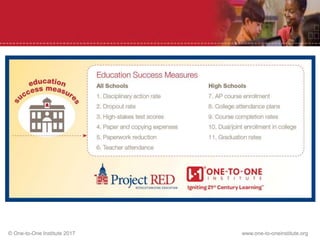
• 11 diverse Education Success Measures (ESMs)
• 136 independent variables in 22 categories
• Comparison of findings by student/computer
ratios (1:1, 2:1, 3:1, 4:1, or more)
• Comprehensive demographic data correlated to
survey results
© One-to-One Institute 2017 www.one-to-oneinstitute.org
The Research
Project RED:
Research on Two Major Issues
• Project RED seeks to define
technology models that lead to
improved student achievement.
Improving student
achievement
• Project RED identifies cost savings,
cost avoidance, and revenue
enhancements.
Evaluating the
financial impact of
technology on
budgets
© One-to-One Institute 2017 www.one-to-oneinstitute.org
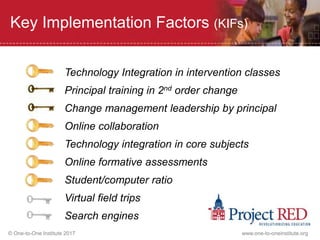
Technology Integration in intervention classes
Principal training in 2nd order change
Change management leadership by principal
Online collaboration
Technology integration in core subjects
Online formative assessments
Student/computer ratio
Virtual field trips
Search engines
Key Implementation Factors (KIFs)
© One-to-One Institute 2017 www.one-to-oneinstitute.org
Where do you rank?
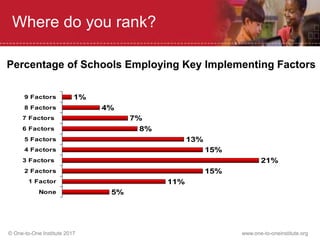
5%
11%
15%
21%
15%
13%
8%
7%
4%
1%
None
1 Factor
2 Factors
3 Factors
4 Factors
5 Factors
6 Factors
7 Factors
8 Factors
9 Factors
Percentage of Schools Employing Key Implementing Factors
© One-to-One Institute 2017 www.one-to-oneinstitute.org
1:1 Personalizes Learning Success When
Properly Implemented
0%
20%
40%
60%
80%
100%
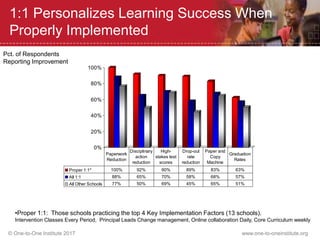
Proper 1:1* 100% 92% 90% 89% 83% 63%
All 1:1 88% 65% 70% 58% 68% 57%
All Other Schools 77% 50% 69% 45% 65% 51%
Paperwork
Reduction
Disciplinary
action
reduction
High-
stakes test
scores
Drop-out
rate
reduction
Paper and
Copy
Machine
Graduation
Rates
Pct. of Respondents
Reporting Improvement
•Proper 1:1: Those schools practicing the top 4 Key Implementation Factors (13 schools).
Intervention Classes Every Period, Principal Leads Change management, Online collaboration Daily, Core Curriculum weekly
© One-to-One Institute 2017 www.one-to-oneinstitute.org
RED III Findings: Leadership
1. Substantiated initial findings about change
management and principal leadership
2. Importance of Distributed Leadership
3. Importance of creating a culture of learning and
creating systems of continuous improvement at
all levels
4. Fidelity of implementation one of the most
important elements, but also one of the biggest
challenges
© One-to-One Institute 2017 www.one-to-oneinstitute.org
RED III Findings: Instruction
• Matching the appropriate pedagogy to the desired
learning yields better outcomes
– Student voice, choice, engagement, demonstration
– Effective digital content scope and sequence
• The most important factor in improving student
outcomes seems to be the effective use of ongoing
formative assessment data
– Professional learning communities reflect, debrief, plan,
shift practice
© One-to-One Institute 2017 www.one-to-oneinstitute.org
RED III Findings: Professional Learning
• Ongoing, consistent, job-embedded
• Culture matters
• Organic usage vs mandated usage
• Data collection and usage drives effective
professional growth efforts
© One-to-One Institute 2017 www.one-to-oneinstitute.org
RED III Findings: Finance
Project RED financial modeling revolves around three
seminal areas:
• Understanding the total cost of implementation and
how to maximize a district’s current situation
• Capturing savings through digital efficiency that can
be redeployed to offset technology expenses
• Identifying the long-term financial benefits of improved
student outcomes (e.g., lowering costs associated
with course repetition, disciplinary actions, dropout
rates, etc.)
© One-to-One Institute 2017 www.one-to-oneinstitute.org
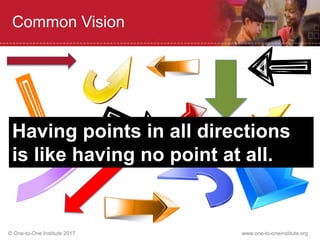
Common Vision
Having points in all directions
is like having no point at all..
© One-to-One Institute 2017 www.one-to-oneinstitute.org
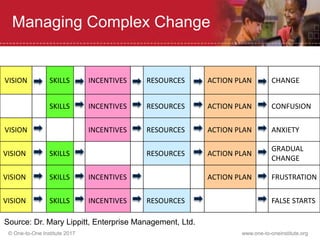
Managing Complex Change
VISION SKILLS INCENTIVES RESOURCES ACTION PLAN CHANGE
SKILLS INCENTIVES RESOURCES ACTION PLAN CONFUSION
VISION INCENTIVES RESOURCES ACTION PLAN ANXIETY
VISION SKILLS RESOURCES ACTION PLAN
GRADUAL
CHANGE
VISION SKILLS INCENTIVES ACTION PLAN FRUSTRATION
VISION SKILLS INCENTIVES RESOURCES FALSE STARTS
Source: Dr. Mary Lippitt, Enterprise Management, Ltd.
© One-to-One Institute 2017 www.one-to-oneinstitute.org
Vision
Essential Questions:
1. What do you believe your stakeholders
think is the reason you are committed to
education technology?
2. Has your district defined digitally
transformed teaching & learning?
3. What is the district vision?
4. Who makes up the team for ‘change’
leadership?
5. Is there an overarching project plan?
© One-to-One Institute 2017 www.one-to-oneinstitute.org
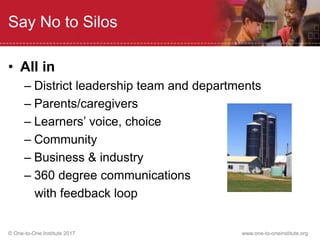
Say No to Silos
• All in
– District leadership team and departments
– Parents/caregivers
– Learners’ voice, choice
– Community
– Business & industry
– 360 degree communications
with feedback loop
© One-to-One Institute 2017 www.one-to-oneinstitute.org
Get Set!
© One-to-One Institute 2017 www.one-to-oneinstitute.org
23
© One-to-One Institute 2017 www.one-to-oneinstitute.org
24
© One-to-One Institute 2017 www.one-to-oneinstitute.org
Traditional practice isn’t
effective today
“Studies over a span of two decades have
documented low levels of engagement”
Helen M. Marks
American Educational Research Journal
Vol. 37, No. 1 (Spring, 2000), pp. 153-184
© One-to-One Institute 2017 www.one-to-oneinstitute.org
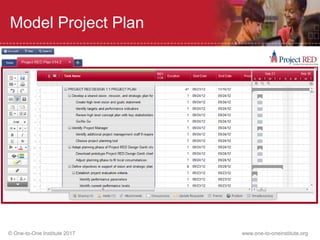
Model Project Plan
© One-to-One Institute 2017 www.one-to-oneinstitute.org
Financial Planning
© One-to-One Institute 2017 www.one-to-oneinstitute.org
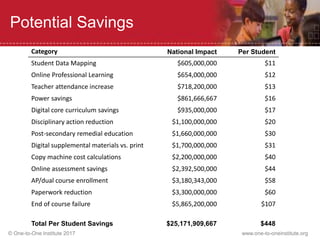
Potential Savings
Category National Impact Per Student
Student Data Mapping $605,000,000 $11
Online Professional Learning $654,000,000 $12
Teacher attendance increase $718,200,000 $13
Power savings $861,666,667 $16
Digital core curriculum savings $935,000,000 $17
Disciplinary action reduction $1,100,000,000 $20
Post-secondary remedial education $1,660,000,000 $30
Digital supplemental materials vs. print $1,700,000,000 $31
Copy machine cost calculations $2,200,000,000 $40
Online assessment savings $2,392,500,000 $44
AP/dual course enrollment $3,180,343,000 $58
Paperwork reduction $3,300,000,000 $60
End of course failure $5,865,200,000 $107
Total Per Student Savings $25,171,909,667 $448
© One-to-One Institute 2017 www.one-to-oneinstitute.org
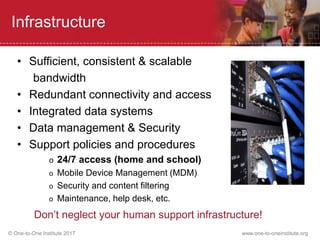
Infrastructure
• Sufficient, consistent & scalable
bandwidth
• Redundant connectivity and access
• Integrated data systems
• Data management & Security
• Support policies and procedures
o 24/7 access (home and school)
o Mobile Device Management (MDM)
o Security and content filtering
o Maintenance, help desk, etc.
Don’t neglect your human support infrastructure!
© One-to-One Institute 2017 www.one-to-oneinstitute.org
Software Tools
Integrated Data Systems
• Learning Management System
• Digital Content and Production
• Systems for Formative and Summative
Assessment
• Other Administrative Systems
Do you have or are you working toward a single sign-on
environment?
© One-to-One Institute 2017 www.one-to-oneinstitute.org
Digital Content &
Production
• Important characteristics
– Dynamic and engaging content
– Artificial intelligence
– Allows for self pacing and direction
– Provides opportunity for student questioning and
creation
– Provides formative and summative data
– Provides collaborative space
What content is the district considering, or has already been purchased?
© One-to-One Institute 2017 www.one-to-oneinstitute.org
Professional Learning
Ongoing growth model needed for administrators,
teachers and tech personnel
• Embedded in their work in an ongoing way
• Dedicated time on a regular basis for reflection
• Focused on student outcomes-personalizing
learning
– Formative student data
– Deep and meaningful student engagement and ownership
– Maximizing each student’s potential (personalization)
© One-to-One Institute 2017 www.one-to-oneinstitute.org
Go!
© One-to-One Institute 2017 www.one-to-oneinstitute.org
Cycle of Improvement
Create teacher and administrator cohorts
(PLCs). Cohorts meet on a regular basis (every
2 weeks).
1. Each member commit to trying something
2. Each member takes action and collects data
regarding the outcomes of his/her actions
3. Cohorts meet to debrief
4. Repeat every few weeks for the rest of your career
© One-to-One Institute 2017 www.one-to-oneinstitute.org
District Measures
What measures are used to assess learner
progress?
How often are these assessments reviewed by
teacher and principal teams?
Is this data used to drive learner activities and
instruction?
© One-to-One Institute 2017 www.one-to-oneinstitute.org
Data Driven Decisions
• Ongoing Formative Assessments
• Periodic Summative Assessments
• Benchmarking personalized learning & 1-1
program progress
What digital systems will you
use for:
© One-to-One Institute 2017 www.one-to-oneinstitute.org
Quality Tools
Guide and Measure Practices
© One-to-One Institute 2017 www.one-to-oneinstitute.org
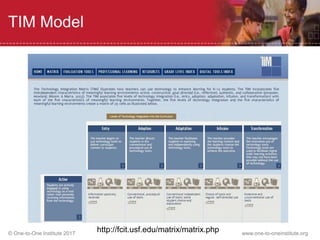
TIM Model
http://fcit.usf.edu/matrix/matrix.php
© One-to-One Institute 2017 www.one-to-oneinstitute.org
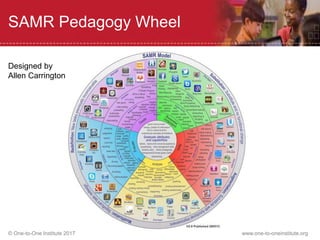
SAMR Pedagogy Wheel
Designed by
Allen Carrington
© One-to-One Institute 2017 www.one-to-oneinstitute.org
What do you
need?
What resources are available to
support those needs?
© One-to-One Institute 2017 www.one-to-oneinstitute.org
Integration of Systems
• Communications
• Long-term Funding
• Infrastructure
• Implementation
• Curriculum & Instruction
• Professional Learning
• Assessment & Evaluation
Leadership and management of systems are
needed for these processes. Are those in place and
well communicated among stakeholders?
© One-to-One Institute 2017 www.one-to-oneinstitute.org
Underlying Structures for
Academic Improvement
Technology is
only a tool!
 Understanding Human
Motivation
 Personalization
 Mastery
 Demonstration of
Competency
 Understanding the
Learning Process
 Systems for Continuous
Improvement
 Adult Professional Growth
© One-to-One Institute 2017 www.one-to-oneinstitute.org
Thank You
Thank you to our sponsors and supporters!
© One-to-One Institute 2017 www.one-to-oneinstitute.org
Follow US
www.One-to-oneinstitute.org
www.projectred.org
lesliew@1two1.org
@Project_RED
Facebook.com/ProjectRED.org

2018 Education Ambassador Program: One-to-One Institute

  • 1.
  • 2.
    © One-to-One Institute2017 www.one-to-oneinstitute.org Who Are We? Leslie Wilson lesliew@1two1.org @OTOInstitiute @leslieawilson
  • 3.
    © One-to-One Institute2017 www.one-to-oneinstitute.org It’s All About Learners One-to-one technology is only a tool! It’s about:  Personalizing learning  Creating systems for continuous improvement
  • 4.
    © One-to-One Institute2017 www.one-to-oneinstitute.org Personalized Learning  Revolves around the learner, not just the learning.  Learners and teachers are partners  Define pathways  Collaborate benchmarks, timelines, strategies  Demonstration of achievement  Embedded  Learner identifies goals, has voice and choice:  how and when they will access and acquire information,  how they will engage with content,  how they will express their understanding.
  • 5.
    © One-to-One Institute2017 www.one-to-oneinstitute.org Power of Practitioners • Network – Ambassador Event • Sharing • Risk-taking • Best practices • Research-based • Focus on learners • Vendor relationship - Fujitsu
  • 6.
    © One-to-One Institute2017 www.one-to-oneinstitute.org Successful, Sustainable 1:1 Personalized Learning Programs
  • 7.
    © One-to-One Institute2017 www.one-to-oneinstitute.org Get Ready!
  • 8.
    © One-to-One Institute2017 www.one-to-oneinstitute.org Questions 1. What are your desired outcomes from one-to-one computing? Why? 2. How does this relate to your district’s strategic goals? 3. Where is your district or school on the continuum?
  • 9.
    © One-to-One Institute2017 www.one-to-oneinstitute.org The Research • 997 schools, representative of the U.S. school universe • 11 diverse Education Success Measures (ESMs) • 136 independent variables in 22 categories • Comparison of findings by student/computer ratios (1:1, 2:1, 3:1, 4:1, or more) • Comprehensive demographic data correlated to survey results
  • 10.
    © One-to-One Institute2017 www.one-to-oneinstitute.org The Research Project RED: Research on Two Major Issues • Project RED seeks to define technology models that lead to improved student achievement. Improving student achievement • Project RED identifies cost savings, cost avoidance, and revenue enhancements. Evaluating the financial impact of technology on budgets
  • 11.
    © One-to-One Institute2017 www.one-to-oneinstitute.org
  • 12.
    © One-to-One Institute2017 www.one-to-oneinstitute.org Technology Integration in intervention classes Principal training in 2nd order change Change management leadership by principal Online collaboration Technology integration in core subjects Online formative assessments Student/computer ratio Virtual field trips Search engines Key Implementation Factors (KIFs)
  • 13.
    © One-to-One Institute2017 www.one-to-oneinstitute.org Where do you rank? 5% 11% 15% 21% 15% 13% 8% 7% 4% 1% None 1 Factor 2 Factors 3 Factors 4 Factors 5 Factors 6 Factors 7 Factors 8 Factors 9 Factors Percentage of Schools Employing Key Implementing Factors
  • 14.
    © One-to-One Institute2017 www.one-to-oneinstitute.org 1:1 Personalizes Learning Success When Properly Implemented 0% 20% 40% 60% 80% 100% Proper 1:1* 100% 92% 90% 89% 83% 63% All 1:1 88% 65% 70% 58% 68% 57% All Other Schools 77% 50% 69% 45% 65% 51% Paperwork Reduction Disciplinary action reduction High- stakes test scores Drop-out rate reduction Paper and Copy Machine Graduation Rates Pct. of Respondents Reporting Improvement •Proper 1:1: Those schools practicing the top 4 Key Implementation Factors (13 schools). Intervention Classes Every Period, Principal Leads Change management, Online collaboration Daily, Core Curriculum weekly
  • 15.
    © One-to-One Institute2017 www.one-to-oneinstitute.org RED III Findings: Leadership 1. Substantiated initial findings about change management and principal leadership 2. Importance of Distributed Leadership 3. Importance of creating a culture of learning and creating systems of continuous improvement at all levels 4. Fidelity of implementation one of the most important elements, but also one of the biggest challenges
  • 16.
    © One-to-One Institute2017 www.one-to-oneinstitute.org RED III Findings: Instruction • Matching the appropriate pedagogy to the desired learning yields better outcomes – Student voice, choice, engagement, demonstration – Effective digital content scope and sequence • The most important factor in improving student outcomes seems to be the effective use of ongoing formative assessment data – Professional learning communities reflect, debrief, plan, shift practice
  • 17.
    © One-to-One Institute2017 www.one-to-oneinstitute.org RED III Findings: Professional Learning • Ongoing, consistent, job-embedded • Culture matters • Organic usage vs mandated usage • Data collection and usage drives effective professional growth efforts
  • 18.
    © One-to-One Institute2017 www.one-to-oneinstitute.org RED III Findings: Finance Project RED financial modeling revolves around three seminal areas: • Understanding the total cost of implementation and how to maximize a district’s current situation • Capturing savings through digital efficiency that can be redeployed to offset technology expenses • Identifying the long-term financial benefits of improved student outcomes (e.g., lowering costs associated with course repetition, disciplinary actions, dropout rates, etc.)
  • 19.
    © One-to-One Institute2017 www.one-to-oneinstitute.org Common Vision Having points in all directions is like having no point at all..
  • 20.
    © One-to-One Institute2017 www.one-to-oneinstitute.org Managing Complex Change VISION SKILLS INCENTIVES RESOURCES ACTION PLAN CHANGE SKILLS INCENTIVES RESOURCES ACTION PLAN CONFUSION VISION INCENTIVES RESOURCES ACTION PLAN ANXIETY VISION SKILLS RESOURCES ACTION PLAN GRADUAL CHANGE VISION SKILLS INCENTIVES ACTION PLAN FRUSTRATION VISION SKILLS INCENTIVES RESOURCES FALSE STARTS Source: Dr. Mary Lippitt, Enterprise Management, Ltd.
  • 21.
    © One-to-One Institute2017 www.one-to-oneinstitute.org Vision Essential Questions: 1. What do you believe your stakeholders think is the reason you are committed to education technology? 2. Has your district defined digitally transformed teaching & learning? 3. What is the district vision? 4. Who makes up the team for ‘change’ leadership? 5. Is there an overarching project plan?
  • 22.
    © One-to-One Institute2017 www.one-to-oneinstitute.org Say No to Silos • All in – District leadership team and departments – Parents/caregivers – Learners’ voice, choice – Community – Business & industry – 360 degree communications with feedback loop
  • 23.
    © One-to-One Institute2017 www.one-to-oneinstitute.org Get Set!
  • 24.
    © One-to-One Institute2017 www.one-to-oneinstitute.org 23
  • 25.
    © One-to-One Institute2017 www.one-to-oneinstitute.org 24
  • 26.
    © One-to-One Institute2017 www.one-to-oneinstitute.org Traditional practice isn’t effective today “Studies over a span of two decades have documented low levels of engagement” Helen M. Marks American Educational Research Journal Vol. 37, No. 1 (Spring, 2000), pp. 153-184
  • 27.
    © One-to-One Institute2017 www.one-to-oneinstitute.org Model Project Plan
  • 28.
    © One-to-One Institute2017 www.one-to-oneinstitute.org Financial Planning
  • 29.
    © One-to-One Institute2017 www.one-to-oneinstitute.org Potential Savings Category National Impact Per Student Student Data Mapping $605,000,000 $11 Online Professional Learning $654,000,000 $12 Teacher attendance increase $718,200,000 $13 Power savings $861,666,667 $16 Digital core curriculum savings $935,000,000 $17 Disciplinary action reduction $1,100,000,000 $20 Post-secondary remedial education $1,660,000,000 $30 Digital supplemental materials vs. print $1,700,000,000 $31 Copy machine cost calculations $2,200,000,000 $40 Online assessment savings $2,392,500,000 $44 AP/dual course enrollment $3,180,343,000 $58 Paperwork reduction $3,300,000,000 $60 End of course failure $5,865,200,000 $107 Total Per Student Savings $25,171,909,667 $448
  • 30.
    © One-to-One Institute2017 www.one-to-oneinstitute.org Infrastructure • Sufficient, consistent & scalable bandwidth • Redundant connectivity and access • Integrated data systems • Data management & Security • Support policies and procedures o 24/7 access (home and school) o Mobile Device Management (MDM) o Security and content filtering o Maintenance, help desk, etc. Don’t neglect your human support infrastructure!
  • 31.
    © One-to-One Institute2017 www.one-to-oneinstitute.org Software Tools Integrated Data Systems • Learning Management System • Digital Content and Production • Systems for Formative and Summative Assessment • Other Administrative Systems Do you have or are you working toward a single sign-on environment?
  • 32.
    © One-to-One Institute2017 www.one-to-oneinstitute.org Digital Content & Production • Important characteristics – Dynamic and engaging content – Artificial intelligence – Allows for self pacing and direction – Provides opportunity for student questioning and creation – Provides formative and summative data – Provides collaborative space What content is the district considering, or has already been purchased?
  • 33.
    © One-to-One Institute2017 www.one-to-oneinstitute.org Professional Learning Ongoing growth model needed for administrators, teachers and tech personnel • Embedded in their work in an ongoing way • Dedicated time on a regular basis for reflection • Focused on student outcomes-personalizing learning – Formative student data – Deep and meaningful student engagement and ownership – Maximizing each student’s potential (personalization)
  • 34.
    © One-to-One Institute2017 www.one-to-oneinstitute.org Go!
  • 35.
    © One-to-One Institute2017 www.one-to-oneinstitute.org Cycle of Improvement Create teacher and administrator cohorts (PLCs). Cohorts meet on a regular basis (every 2 weeks). 1. Each member commit to trying something 2. Each member takes action and collects data regarding the outcomes of his/her actions 3. Cohorts meet to debrief 4. Repeat every few weeks for the rest of your career
  • 36.
    © One-to-One Institute2017 www.one-to-oneinstitute.org District Measures What measures are used to assess learner progress? How often are these assessments reviewed by teacher and principal teams? Is this data used to drive learner activities and instruction?
  • 37.
    © One-to-One Institute2017 www.one-to-oneinstitute.org Data Driven Decisions • Ongoing Formative Assessments • Periodic Summative Assessments • Benchmarking personalized learning & 1-1 program progress What digital systems will you use for:
  • 38.
    © One-to-One Institute2017 www.one-to-oneinstitute.org Quality Tools Guide and Measure Practices
  • 39.
    © One-to-One Institute2017 www.one-to-oneinstitute.org
  • 40.
    © One-to-One Institute2017 www.one-to-oneinstitute.org TIM Model http://fcit.usf.edu/matrix/matrix.php
  • 41.
    © One-to-One Institute2017 www.one-to-oneinstitute.org SAMR Pedagogy Wheel Designed by Allen Carrington
  • 42.
    © One-to-One Institute2017 www.one-to-oneinstitute.org What do you need? What resources are available to support those needs?
  • 43.
    © One-to-One Institute2017 www.one-to-oneinstitute.org Integration of Systems • Communications • Long-term Funding • Infrastructure • Implementation • Curriculum & Instruction • Professional Learning • Assessment & Evaluation Leadership and management of systems are needed for these processes. Are those in place and well communicated among stakeholders?
  • 44.
    © One-to-One Institute2017 www.one-to-oneinstitute.org Underlying Structures for Academic Improvement Technology is only a tool!  Understanding Human Motivation  Personalization  Mastery  Demonstration of Competency  Understanding the Learning Process  Systems for Continuous Improvement  Adult Professional Growth
  • 45.
    © One-to-One Institute2017 www.one-to-oneinstitute.org Thank You Thank you to our sponsors and supporters!
  • 46.
    © One-to-One Institute2017 www.one-to-oneinstitute.org Follow US www.One-to-oneinstitute.org www.projectred.org lesliew@1two1.org @Project_RED Facebook.com/ProjectRED.org