Data Collection and Accessibility
for Inclusive Excellence
Lindsay Murdock
Kayley Robsham
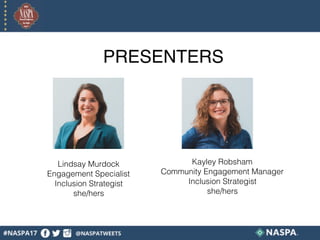
PRESENTERS
Lindsay Murdock

Engagement Specialist
Inclusion Strategist
she/hers
Kayley Robsham
Community Engagement Manager
Inclusion Strategist
she/hers
Starting Point
• Rigid, less inclusive demographic markers
• Census style data can:
• Create gender binaries
• Confuse gender & sex
• Confuse race & ethnicity
• Fail to provide comprehensive racial & ethnic breakdowns
Benefits from Inclusive Practices
• Provides strategic direction forward as campuses make
inclusion mission critical
• Supplements current accountability measures to improve
experiences of at-risk students
• Serves as a starting point for the interpretation of campus
climate
• Helps inform and align campus policies to reflect inclusive
student experiences
Important Considerations
• Implicit Bias
• Trainings to accompany data
accessibility
• Data Negligence
• Top Down Approach
• Rigidity of Student Information
Systems (SIS)
• Functional areas & different softwares
Challenges to gathering &
Sharing data
Theoretical Framework
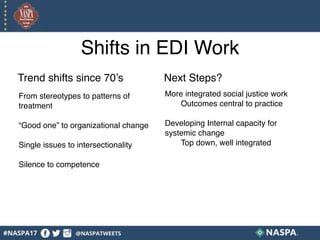
Shifts in EDI Work
Trend shifts since 70’s Next Steps?
From stereotypes to patterns of
treatment
“Good one” to organizational change
Single issues to intersectionality
Silence to competence
More integrated social justice work
Outcomes central to practice
Developing Internal capacity for
systemic change
Top down, well integrated
• Broadened data = more nuanced
understanding
• Implications of self report
• Expressions of fear
• Role of Faculty
• Students data use expectations
Moving Forward
• Proximity to differences
• Demonstrated Action
• Appreciation
• Collective consciousness
• Make efforts more visible to students
Student Expectations
• ADA & Disabilities
• Accommodations
• Culture, norms & practices
• LGBTQ Identities
• Multiracial students in a mono-racial world
IN PRACTICE
In Practice | Gender Identity
• Campuses using Presence
• Utilizing Gender identity
• Tracked involvement based on these
demographics
• Tailored engagement for marginalized LGBTQ
population
• Identified needs, improved retention
In Practice | Campus Climate Surveys
• Effectiveness of outcomes improves
with inclusive data as starting point
• Intersection of race, gender &
class
• Intersection of LGBTQ identities
and sexual violence
In Practice | Preferred Name Policies
• Following State of Oregon HEC lobby
- preferred names in Banner
• Several states have followed suite
• See example policies in handout
In Practice | Campus Inclusion Plan
• Tie data collection goals to
overarching inclusion plan,
• Metrics
• Accountability measures
OVERARCHING STRATEGIES
FOR SUCCESS
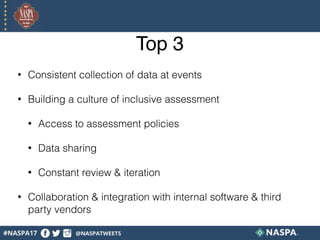
Top 3
• Consistent collection of data at events
• Building a culture of inclusive assessment
• Access to assessment policies
• Data sharing
• Constant review & iteration
• Collaboration & integration with internal software & third
party vendors
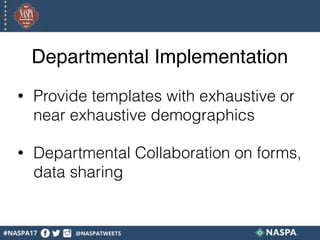
Departmental Implementation
• Provide templates with exhaustive or
near exhaustive demographics
• Departmental Collaboration on forms,
data sharing
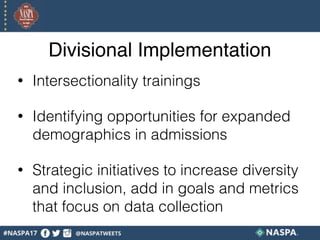
Divisional Implementation
• Intersectionality trainings
• Identifying opportunities for expanded
demographics in admissions
• Strategic initiatives to increase diversity
and inclusion, add in goals and metrics
that focus on data collection
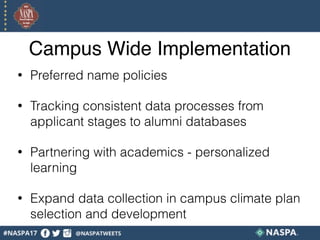
Campus Wide Implementation
• Preferred name policies
• Tracking consistent data processes from
applicant stages to alumni databases
• Partnering with academics - personalized
learning
• Expand data collection in campus climate plan
selection and development
ETHICAL DATA USE
Discussion Prompts
• Ethics surrounding practitioner use of data
• In what ways do you raise awareness around the importance of these
policies or practices on your campus?
• What trainings have you found effective around EDI and data usage
and analyzation? What gaps in training can you identify on your
campus?
• Integrity and responsibility of data utilization and reporting
• What are some of the effective ways your department trains employees
on effective data utilization and reporting?
• How can these trainings be improved?
References
• Astin, A. W. (1984). Student involvement: a developmental theory. Journal of College Student Personnel, 25,
297-308.
• Barton, D. (2015). The most important factor in a college student’s success. blogs.wsj.com/experts/2015/09/16/the-
most-important-factor-in-a-college-students-success/
• Kuh, et al. (2006). What matters most to student success: a review of the literature.
• Tinto, V. (1987). Leaving college: rethinking the causes and cures of student attrition. Chicago: University of
Chicago Press.
• Milem, et al. (2005) Making diversity work on campus: A research-based perspective. https://www.aacu.org/sites/
default/files/files/mei/milem_et_al.pdf
• 2016-17 DLE Survey Changes http://www.heri.ucla.edu/PDFs/surveyAdmin/dle/2017/DLE-2017-Survey-
Changes.pdf
• Elliot, et. al. (2013) Institutional barriers to diversity change work in higher education. http://journals.sagepub.com/
doi/pdf/10.1177/2158244013489686
• Johnston, Sara (2015) Unequal Treatment or Uneven Consequence: A Content Analysis of Americans with
Disabilities Act Title I Disparate Impact Cases from 1992 – 2012 http://dsq-sds.org/article/view/4938
• Obear, K (2012) Reflections on our practice as social justice educators: How far we have come, how far we need to
go http://lib.dr.iastate.edu/cgi/viewcontent.cgi?article=1015&context=jctp
For More Information
• Handout URL for more copies:
• Inclusive Data Blogs/ Inclusivity
Page 

Kayley Robsham 

kayley@presence.io

@kayleyrobsham
Lindsay Murdock 

lindsay@presence.io

@linds_murdock

Data Collection and Accessibility for Inclusive Excellence

  • 1.
    Data Collection andAccessibility for Inclusive Excellence Lindsay Murdock Kayley Robsham
  • 2.
    PRESENTERS Lindsay Murdock
 Engagement Specialist InclusionStrategist she/hers Kayley Robsham Community Engagement Manager Inclusion Strategist she/hers
  • 3.
    Starting Point • Rigid,less inclusive demographic markers • Census style data can: • Create gender binaries • Confuse gender & sex • Confuse race & ethnicity • Fail to provide comprehensive racial & ethnic breakdowns
  • 4.
    Benefits from InclusivePractices • Provides strategic direction forward as campuses make inclusion mission critical • Supplements current accountability measures to improve experiences of at-risk students • Serves as a starting point for the interpretation of campus climate • Helps inform and align campus policies to reflect inclusive student experiences
  • 5.
    Important Considerations • ImplicitBias • Trainings to accompany data accessibility • Data Negligence
  • 6.
    • Top DownApproach • Rigidity of Student Information Systems (SIS) • Functional areas & different softwares Challenges to gathering & Sharing data
  • 7.
  • 8.
    Shifts in EDIWork Trend shifts since 70’s Next Steps? From stereotypes to patterns of treatment “Good one” to organizational change Single issues to intersectionality Silence to competence More integrated social justice work Outcomes central to practice Developing Internal capacity for systemic change Top down, well integrated
  • 9.
    • Broadened data= more nuanced understanding • Implications of self report • Expressions of fear • Role of Faculty • Students data use expectations Moving Forward
  • 10.
    • Proximity todifferences • Demonstrated Action • Appreciation • Collective consciousness • Make efforts more visible to students Student Expectations
  • 11.
    • ADA &Disabilities • Accommodations • Culture, norms & practices • LGBTQ Identities • Multiracial students in a mono-racial world
  • 12.
  • 13.
    In Practice |Gender Identity • Campuses using Presence • Utilizing Gender identity • Tracked involvement based on these demographics • Tailored engagement for marginalized LGBTQ population • Identified needs, improved retention
  • 14.
    In Practice |Campus Climate Surveys • Effectiveness of outcomes improves with inclusive data as starting point • Intersection of race, gender & class • Intersection of LGBTQ identities and sexual violence
  • 15.
    In Practice |Preferred Name Policies • Following State of Oregon HEC lobby - preferred names in Banner • Several states have followed suite • See example policies in handout
  • 16.
    In Practice |Campus Inclusion Plan • Tie data collection goals to overarching inclusion plan, • Metrics • Accountability measures
  • 17.
  • 18.
    Top 3 • Consistentcollection of data at events • Building a culture of inclusive assessment • Access to assessment policies • Data sharing • Constant review & iteration • Collaboration & integration with internal software & third party vendors
  • 19.
    Departmental Implementation • Providetemplates with exhaustive or near exhaustive demographics • Departmental Collaboration on forms, data sharing
  • 20.
    Divisional Implementation • Intersectionalitytrainings • Identifying opportunities for expanded demographics in admissions • Strategic initiatives to increase diversity and inclusion, add in goals and metrics that focus on data collection
  • 21.
    Campus Wide Implementation •Preferred name policies • Tracking consistent data processes from applicant stages to alumni databases • Partnering with academics - personalized learning • Expand data collection in campus climate plan selection and development
  • 22.
  • 23.
    Discussion Prompts • Ethicssurrounding practitioner use of data • In what ways do you raise awareness around the importance of these policies or practices on your campus? • What trainings have you found effective around EDI and data usage and analyzation? What gaps in training can you identify on your campus? • Integrity and responsibility of data utilization and reporting • What are some of the effective ways your department trains employees on effective data utilization and reporting? • How can these trainings be improved?
  • 24.
    References • Astin, A.W. (1984). Student involvement: a developmental theory. Journal of College Student Personnel, 25, 297-308. • Barton, D. (2015). The most important factor in a college student’s success. blogs.wsj.com/experts/2015/09/16/the- most-important-factor-in-a-college-students-success/ • Kuh, et al. (2006). What matters most to student success: a review of the literature. • Tinto, V. (1987). Leaving college: rethinking the causes and cures of student attrition. Chicago: University of Chicago Press. • Milem, et al. (2005) Making diversity work on campus: A research-based perspective. https://www.aacu.org/sites/ default/files/files/mei/milem_et_al.pdf • 2016-17 DLE Survey Changes http://www.heri.ucla.edu/PDFs/surveyAdmin/dle/2017/DLE-2017-Survey- Changes.pdf • Elliot, et. al. (2013) Institutional barriers to diversity change work in higher education. http://journals.sagepub.com/ doi/pdf/10.1177/2158244013489686 • Johnston, Sara (2015) Unequal Treatment or Uneven Consequence: A Content Analysis of Americans with Disabilities Act Title I Disparate Impact Cases from 1992 – 2012 http://dsq-sds.org/article/view/4938 • Obear, K (2012) Reflections on our practice as social justice educators: How far we have come, how far we need to go http://lib.dr.iastate.edu/cgi/viewcontent.cgi?article=1015&context=jctp
  • 25.
    For More Information •Handout URL for more copies: • Inclusive Data Blogs/ Inclusivity Page 
 Kayley Robsham 
 kayley@presence.io
 @kayleyrobsham Lindsay Murdock 
 lindsay@presence.io
 @linds_murdock