Quantitative Finance: stochastic volatility market models
Closed Solution for Heston PDE by
Geometrical Transformations
XIV WorkShop of Quantitative Finance
Mario Dell’Era
Pisa University
June 24, 2014
Mario Dell’Era Closed Solution for Heston PDE by Geometrical Transformations
Quantitative Finance: stochastic volatility market models
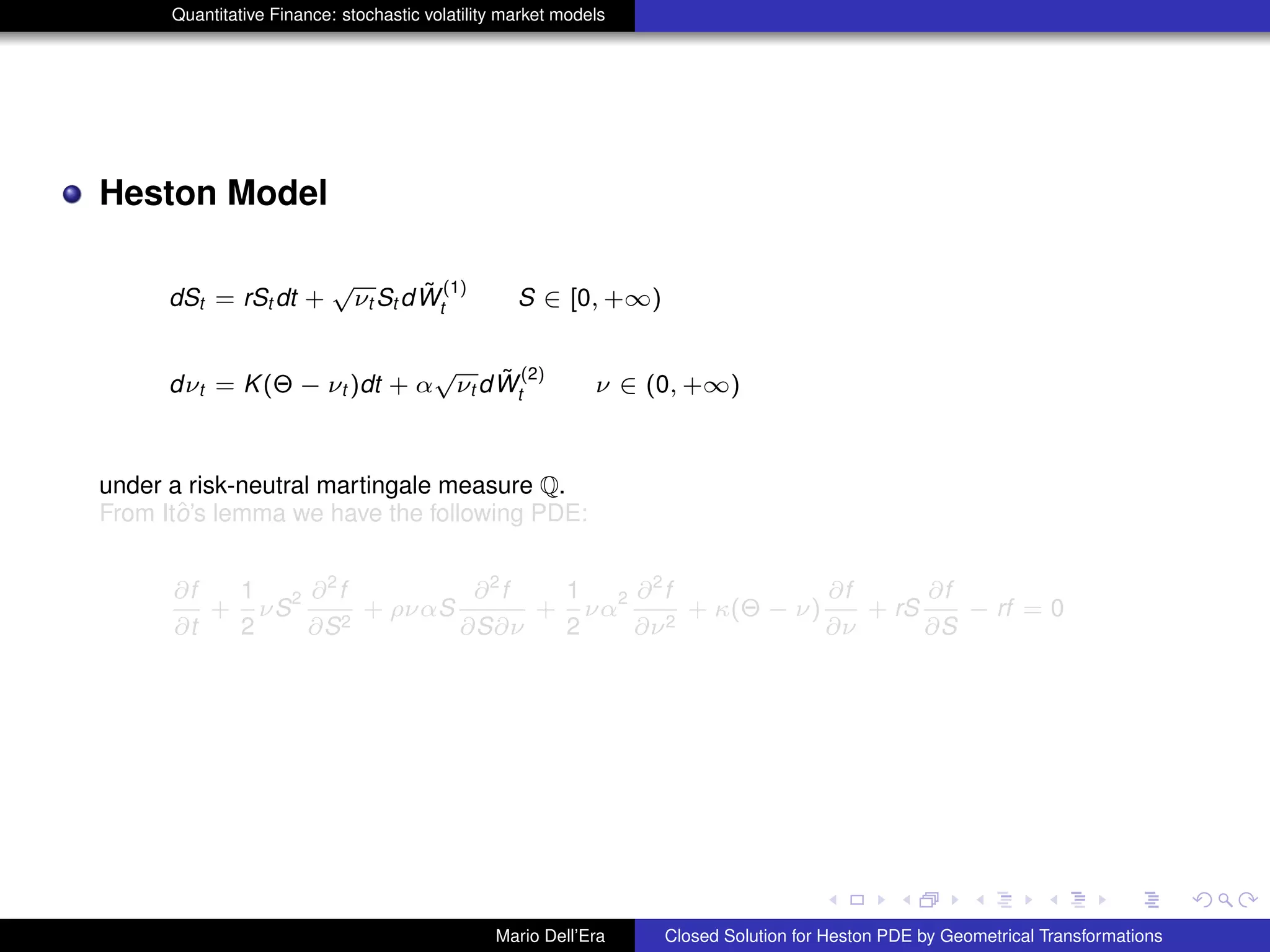
Heston Model
dSt = rSt dt +
√
νt St d ˜W
(1)
t S ∈ [0, +∞)
dνt = K(Θ − νt )dt + α
√
νt d ˜W
(2)
t ν ∈ (0, +∞)
under a risk-neutral martingale measure Q.
From Itˆo’s lemma we have the following PDE:
∂f
∂t
+
1
2
νS
2 ∂2
f
∂S2
+ ρναS
∂2
f
∂S∂ν
+
1
2
να
2 ∂2
f
∂ν2
+ κ(Θ − ν)
∂f
∂ν
+ rS
∂f
∂S
− rf = 0
Mario Dell’Era Closed Solution for Heston PDE by Geometrical Transformations
Quantitative Finance: stochastic volatility market models
Heston Model
dSt = rSt dt +
√
νt St d ˜W
(1)
t S ∈ [0, +∞)
dνt = K(Θ − νt )dt + α
√
νt d ˜W
(2)
t ν ∈ (0, +∞)
under a risk-neutral martingale measure Q.
From Itˆo’s lemma we have the following PDE:
∂f
∂t
+
1
2
νS
2 ∂2
f
∂S2
+ ρναS
∂2
f
∂S∂ν
+
1
2
να
2 ∂2
f
∂ν2
+ κ(Θ − ν)
∂f
∂ν
+ rS
∂f
∂S
− rf = 0
Mario Dell’Era Closed Solution for Heston PDE by Geometrical Transformations
Quantitative Finance: stochastic volatility market models
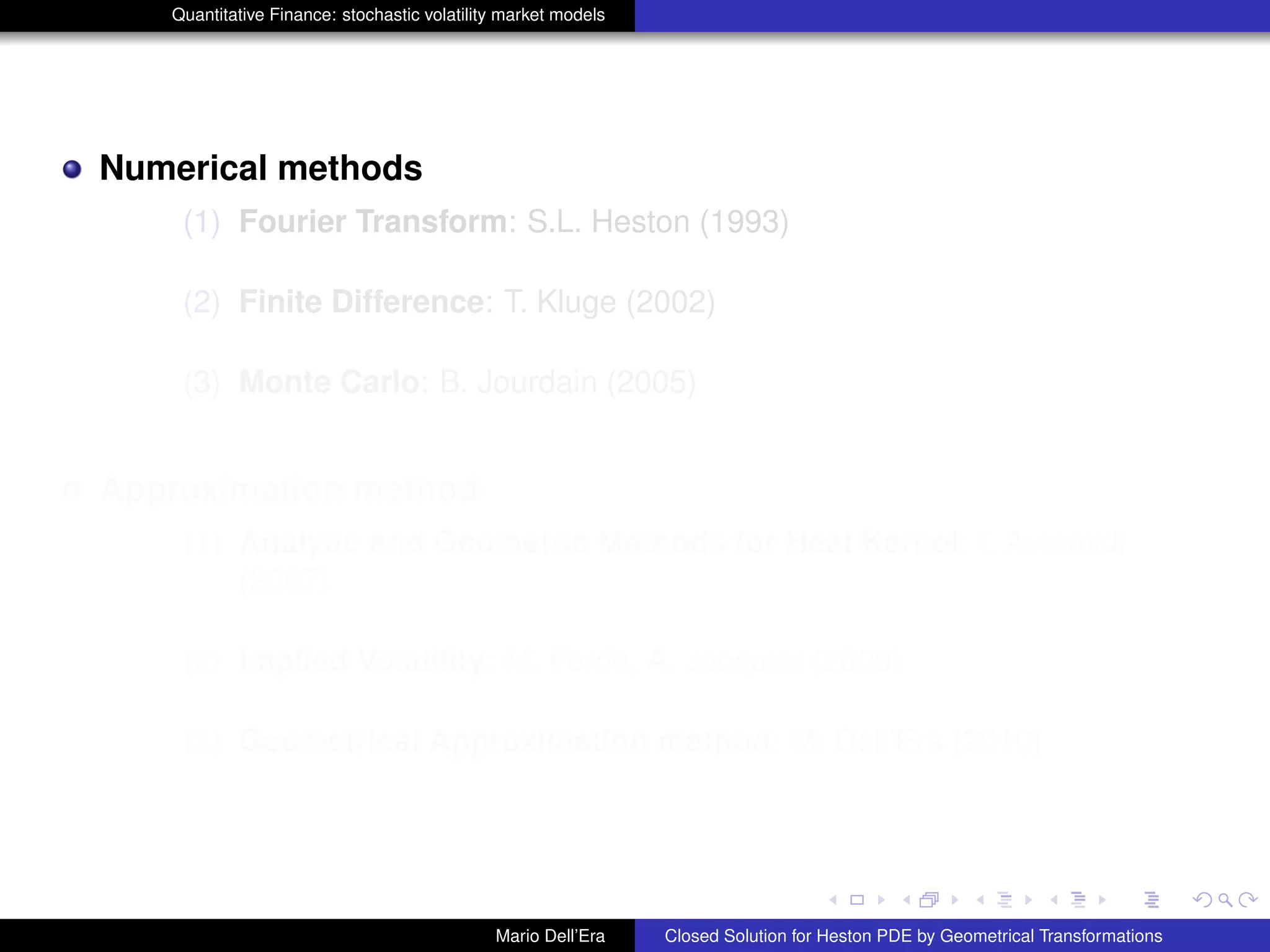
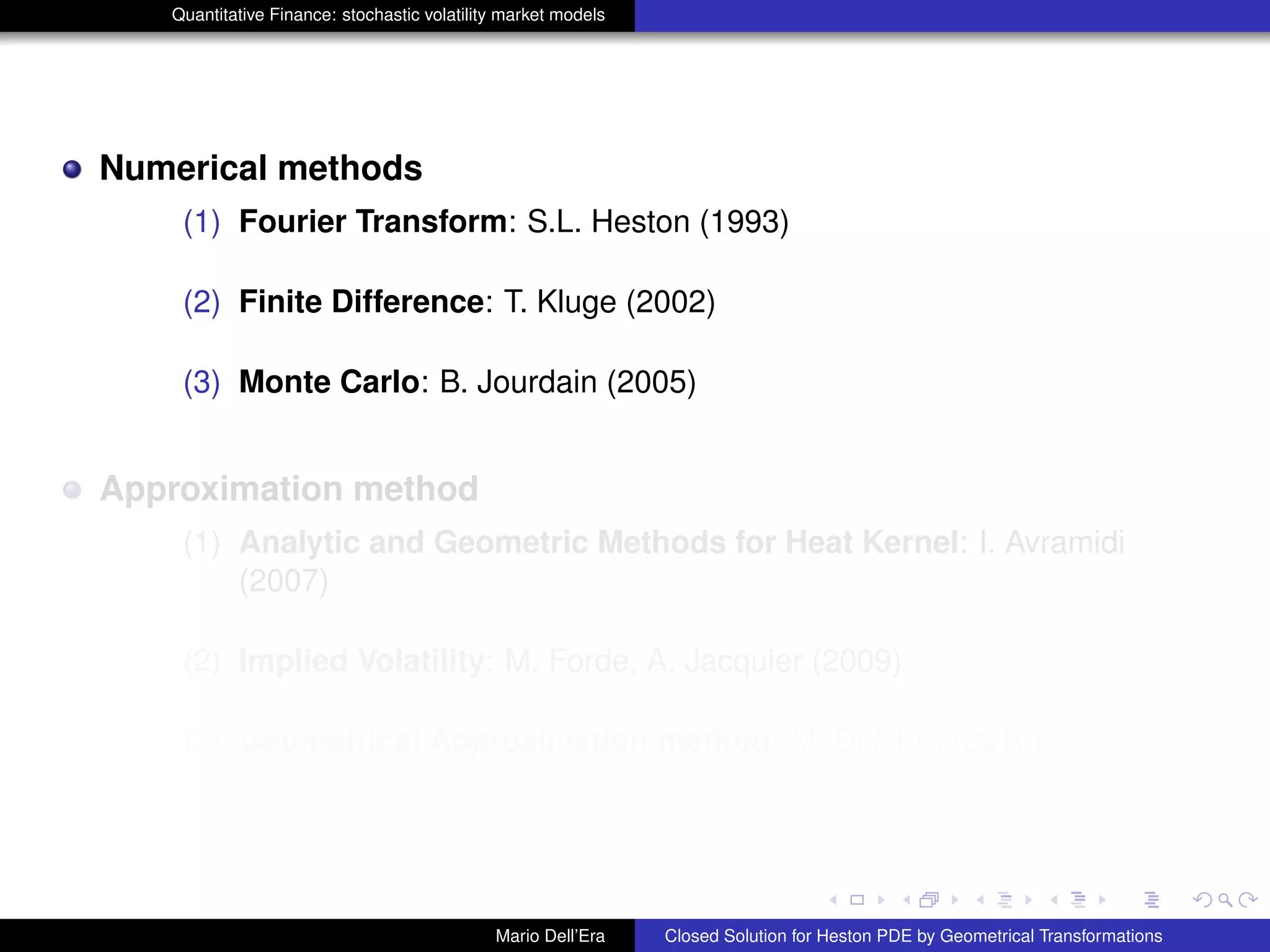
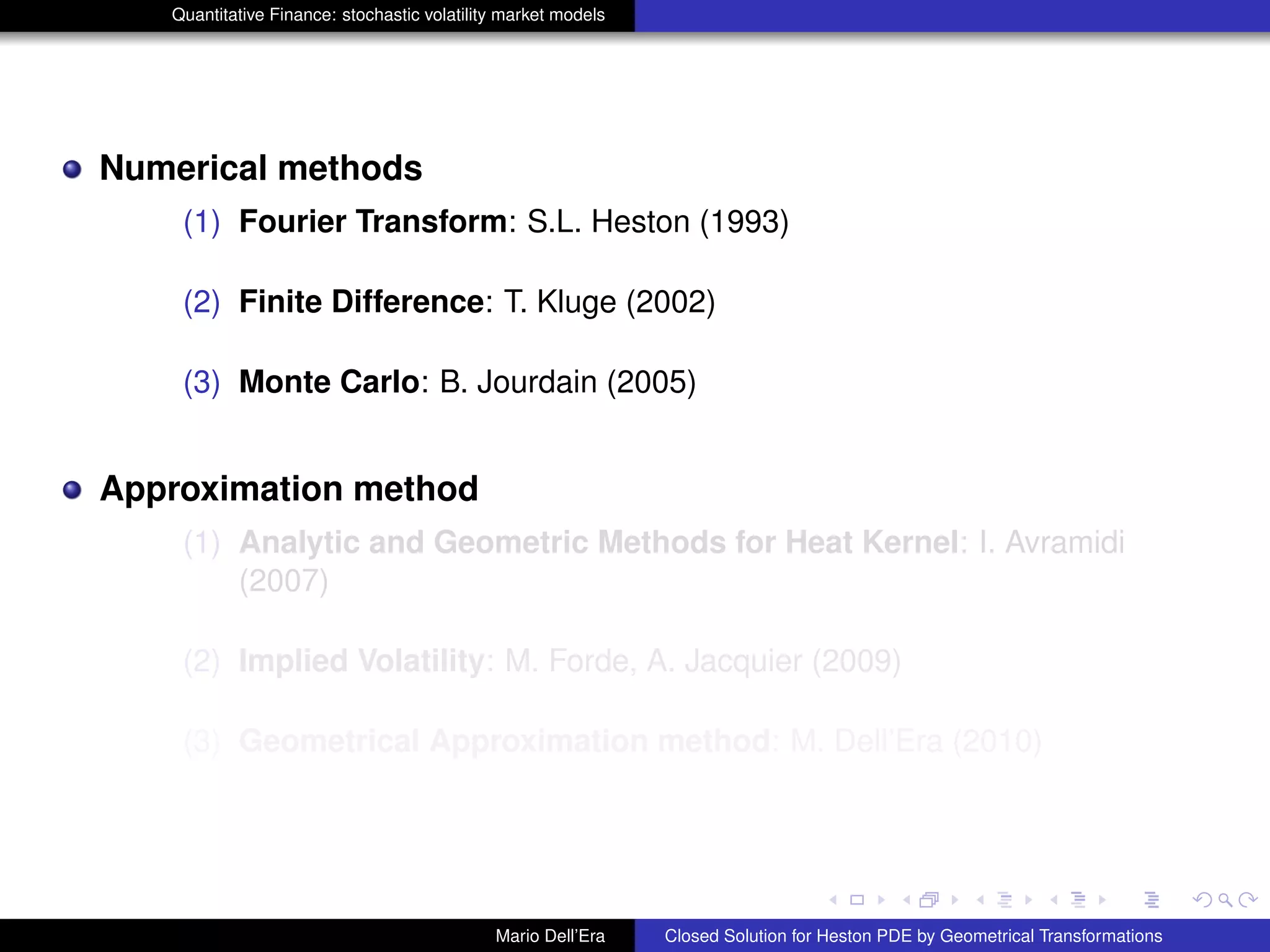
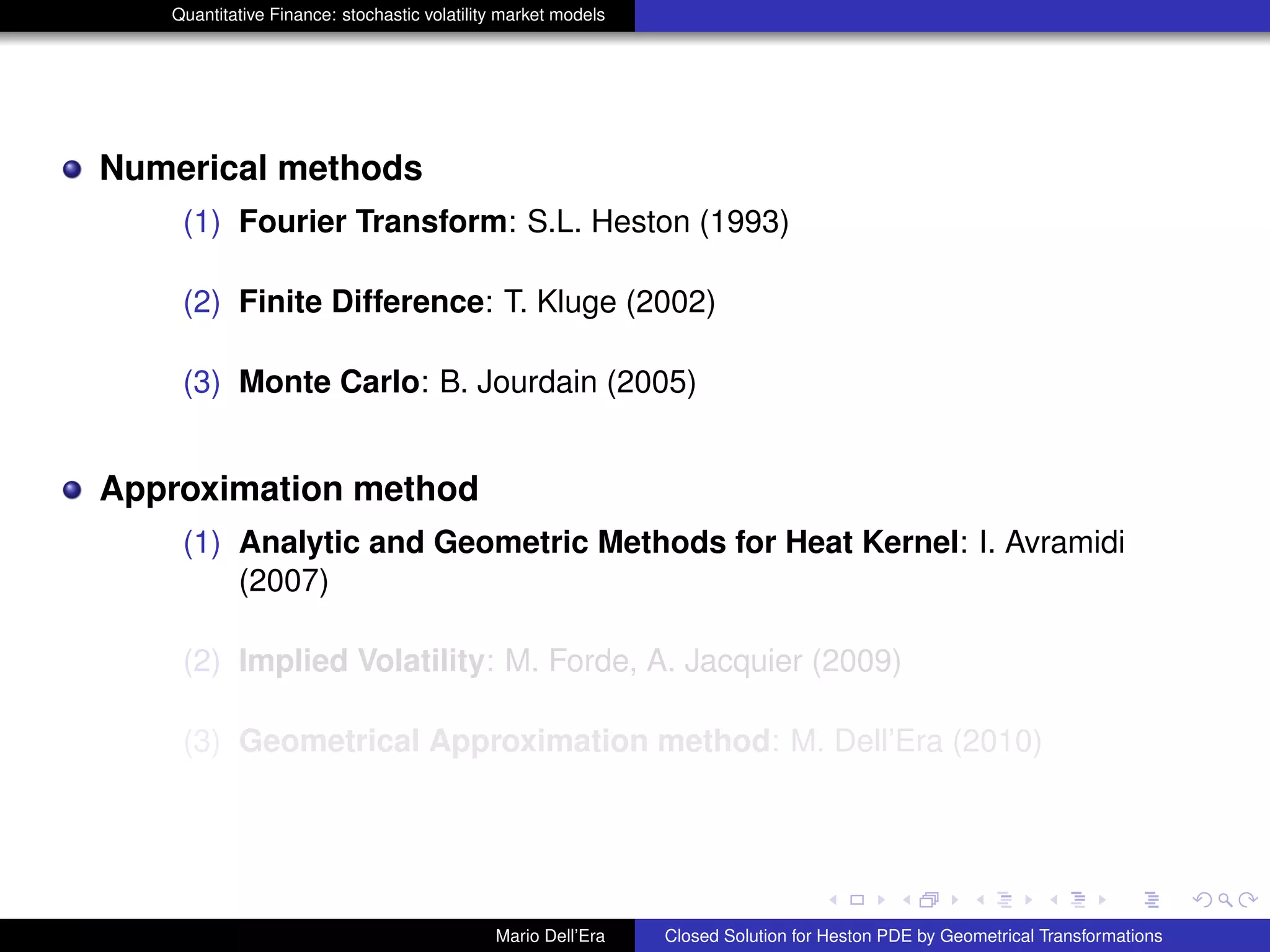
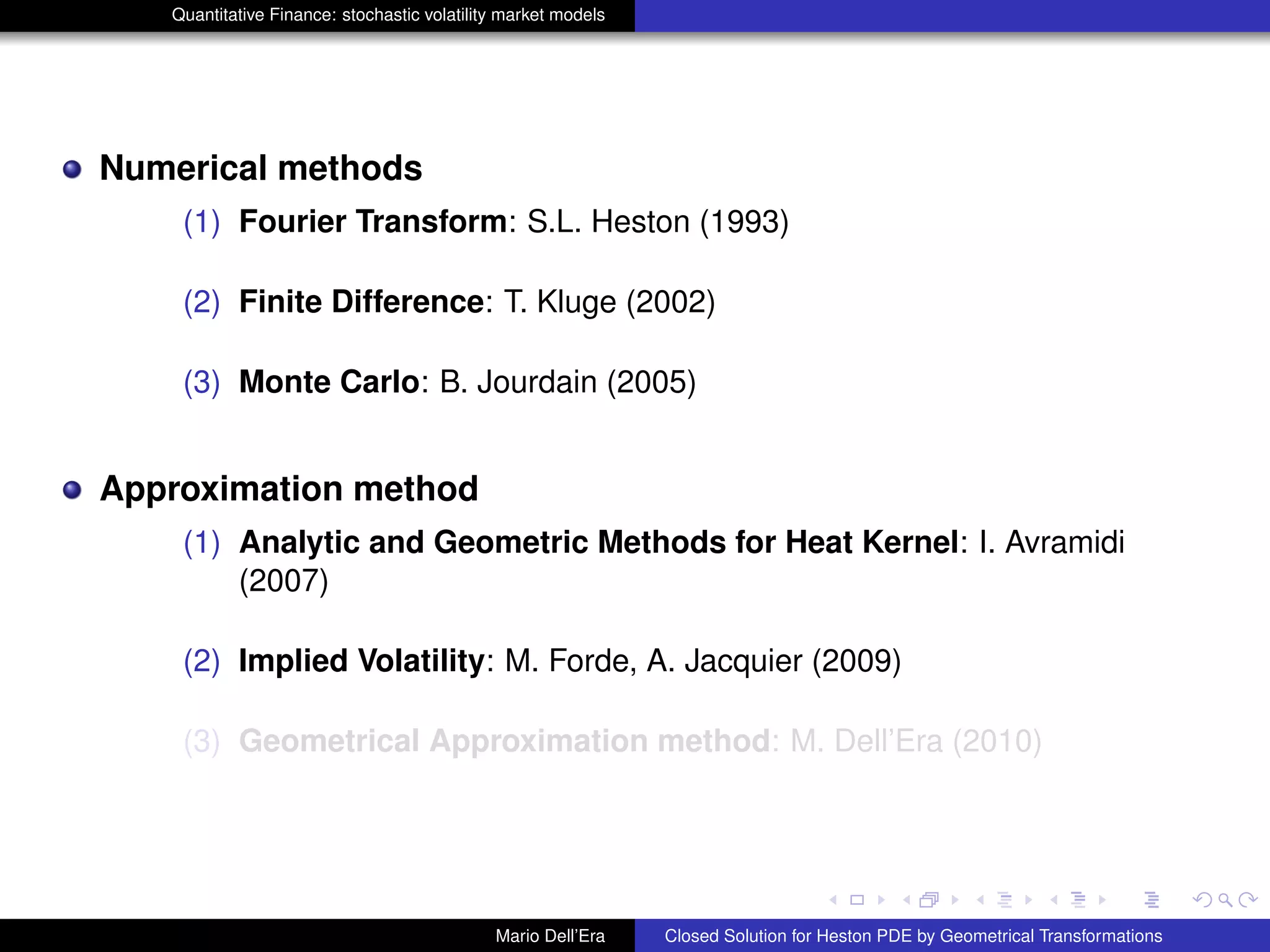
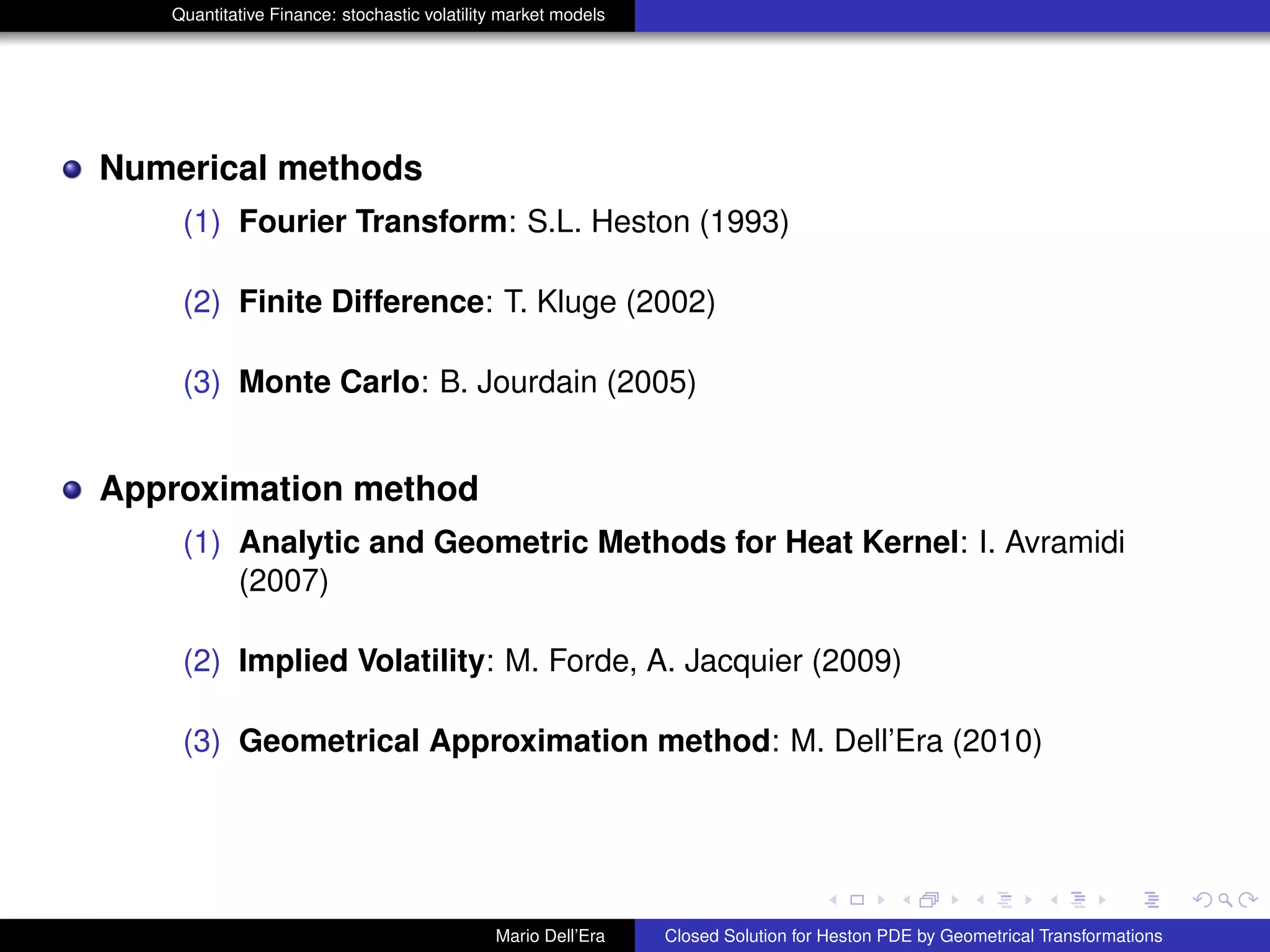
Numerical methods
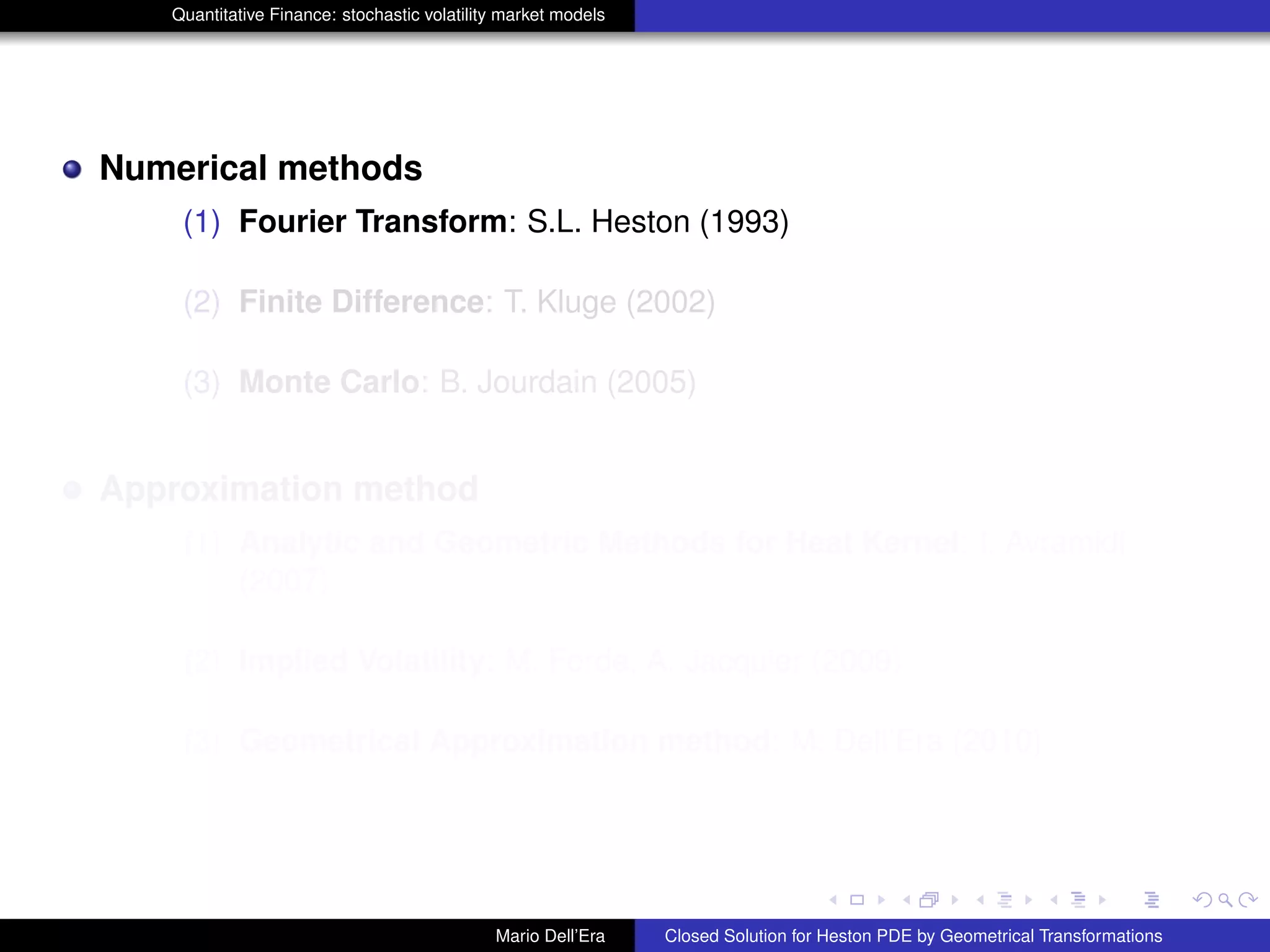
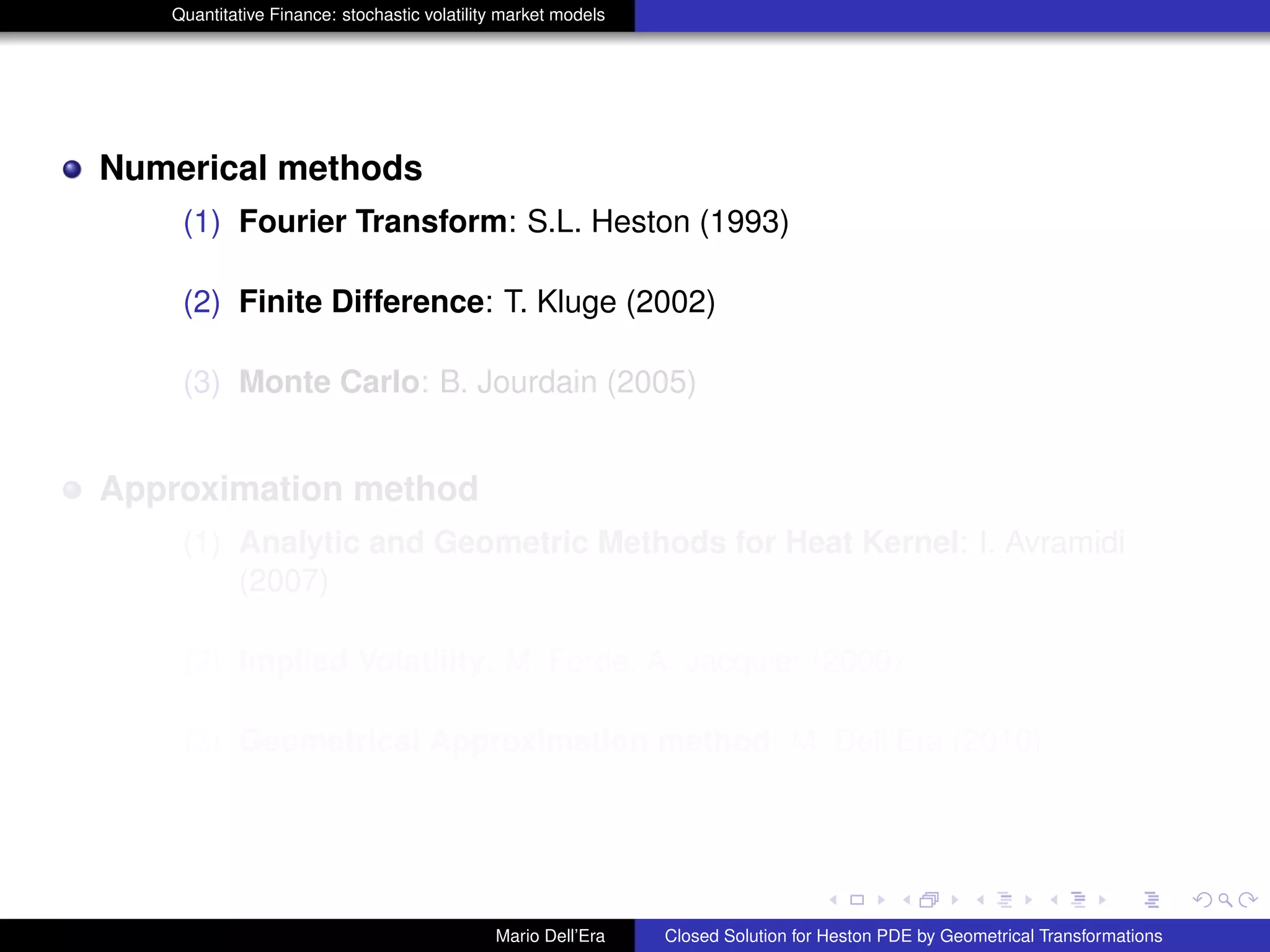
(1) Fourier Transform: S.L. Heston (1993)
(2) Finite Difference: T. Kluge (2002)
(3) Monte Carlo: B. Jourdain (2005)
Approximation method
(1) Analytic and Geometric Methods for Heat Kernel: I. Avramidi
(2007)
(2) Implied Volatility: M. Forde, A. Jacquier (2009)
(3) Geometrical Approximation method: M. Dell’Era (2010)
Mario Dell’Era Closed Solution for Heston PDE by Geometrical Transformations
Quantitative Finance: stochastic volatility market models
Numerical methods
(1) Fourier Transform: S.L. Heston (1993)
(2) Finite Difference: T. Kluge (2002)
(3) Monte Carlo: B. Jourdain (2005)
Approximation method
(1) Analytic and Geometric Methods for Heat Kernel: I. Avramidi
(2007)
(2) Implied Volatility: M. Forde, A. Jacquier (2009)
(3) Geometrical Approximation method: M. Dell’Era (2010)
Mario Dell’Era Closed Solution for Heston PDE by Geometrical Transformations
Quantitative Finance: stochastic volatility market models
Numerical methods
(1) Fourier Transform: S.L. Heston (1993)
(2) Finite Difference: T. Kluge (2002)
(3) Monte Carlo: B. Jourdain (2005)
Approximation method
(1) Analytic and Geometric Methods for Heat Kernel: I. Avramidi
(2007)
(2) Implied Volatility: M. Forde, A. Jacquier (2009)
(3) Geometrical Approximation method: M. Dell’Era (2010)
Mario Dell’Era Closed Solution for Heston PDE by Geometrical Transformations
Quantitative Finance: stochastic volatility market models
Numerical methods
(1) Fourier Transform: S.L. Heston (1993)
(2) Finite Difference: T. Kluge (2002)
(3) Monte Carlo: B. Jourdain (2005)
Approximation method
(1) Analytic and Geometric Methods for Heat Kernel: I. Avramidi
(2007)
(2) Implied Volatility: M. Forde, A. Jacquier (2009)
(3) Geometrical Approximation method: M. Dell’Era (2010)
Mario Dell’Era Closed Solution for Heston PDE by Geometrical Transformations
Quantitative Finance: stochastic volatility market models
Numerical methods
(1) Fourier Transform: S.L. Heston (1993)
(2) Finite Difference: T. Kluge (2002)
(3) Monte Carlo: B. Jourdain (2005)
Approximation method
(1) Analytic and Geometric Methods for Heat Kernel: I. Avramidi
(2007)
(2) Implied Volatility: M. Forde, A. Jacquier (2009)
(3) Geometrical Approximation method: M. Dell’Era (2010)
Mario Dell’Era Closed Solution for Heston PDE by Geometrical Transformations
Quantitative Finance: stochastic volatility market models
Numerical methods
(1) Fourier Transform: S.L. Heston (1993)
(2) Finite Difference: T. Kluge (2002)
(3) Monte Carlo: B. Jourdain (2005)
Approximation method
(1) Analytic and Geometric Methods for Heat Kernel: I. Avramidi
(2007)
(2) Implied Volatility: M. Forde, A. Jacquier (2009)
(3) Geometrical Approximation method: M. Dell’Era (2010)
Mario Dell’Era Closed Solution for Heston PDE by Geometrical Transformations
Quantitative Finance: stochastic volatility market models
Numerical methods
(1) Fourier Transform: S.L. Heston (1993)
(2) Finite Difference: T. Kluge (2002)
(3) Monte Carlo: B. Jourdain (2005)
Approximation method
(1) Analytic and Geometric Methods for Heat Kernel: I. Avramidi
(2007)
(2) Implied Volatility: M. Forde, A. Jacquier (2009)
(3) Geometrical Approximation method: M. Dell’Era (2010)
Mario Dell’Era Closed Solution for Heston PDE by Geometrical Transformations
Quantitative Finance: stochastic volatility market models
Numerical methods
(1) Fourier Transform: S.L. Heston (1993)
(2) Finite Difference: T. Kluge (2002)
(3) Monte Carlo: B. Jourdain (2005)
Approximation method
(1) Analytic and Geometric Methods for Heat Kernel: I. Avramidi
(2007)
(2) Implied Volatility: M. Forde, A. Jacquier (2009)
(3) Geometrical Approximation method: M. Dell’Era (2010)
Mario Dell’Era Closed Solution for Heston PDE by Geometrical Transformations
Quantitative Finance: stochastic volatility market models
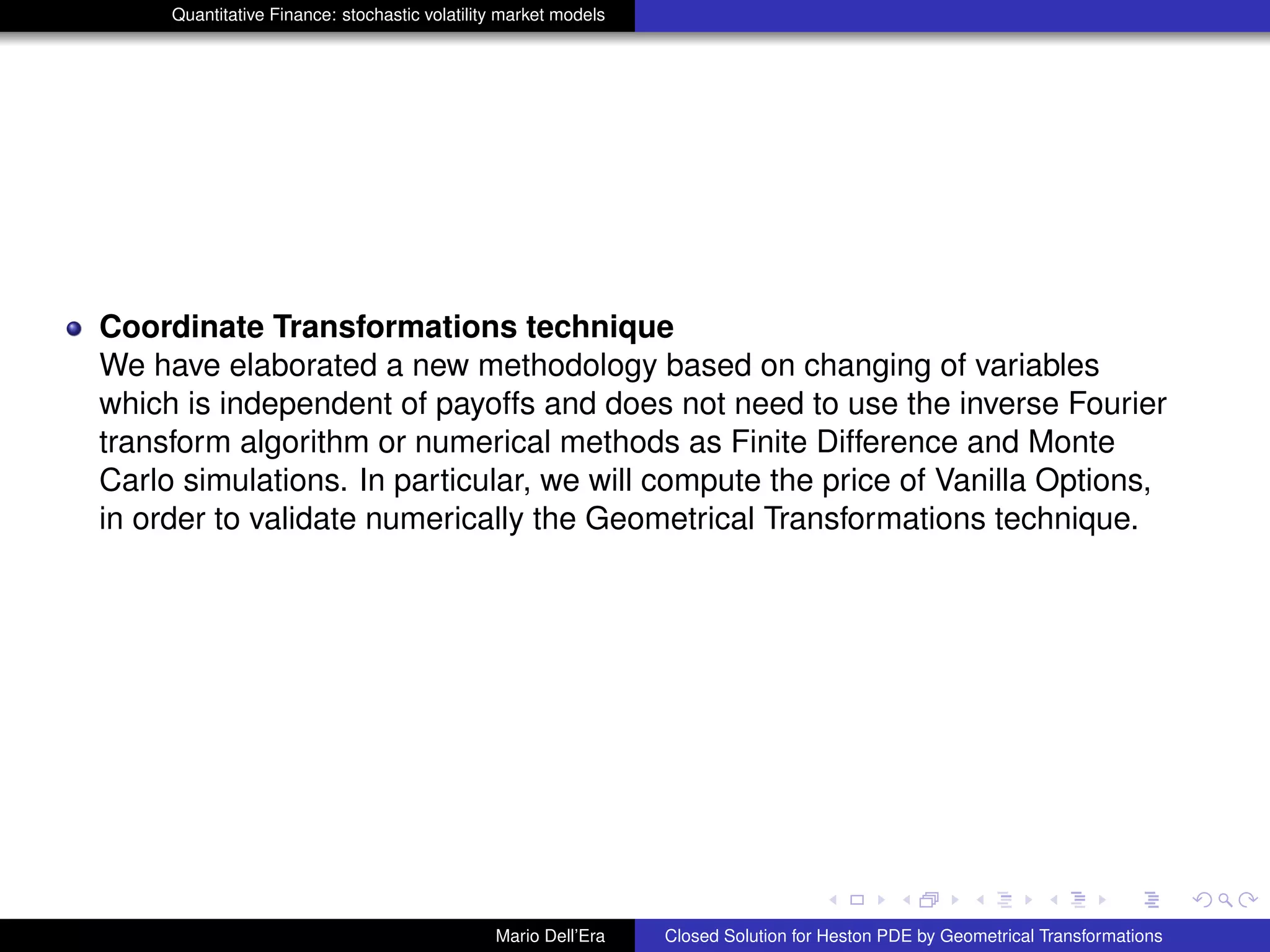
Coordinate Transformations technique
We have elaborated a new methodology based on changing of variables
which is independent of payoffs and does not need to use the inverse Fourier
transform algorithm or numerical methods as Finite Difference and Monte
Carlo simulations. In particular, we will compute the price of Vanilla Options,
in order to validate numerically the Geometrical Transformations technique.
Mario Dell’Era Closed Solution for Heston PDE by Geometrical Transformations
Quantitative Finance: stochastic volatility market models
1st
Transformations:
8
><
>:
x = ln S, x ∈ (−∞, +∞)
˜ν = ν/α, ˜ν ∈ [0, +∞)
f(t, S, ν) = f1(t, x, ˜ν)e−r(T−t)
(1)
thus one has:
∂f1
∂t
+
1
2
˜ν
∂2
f1
∂x2
+ 2ρ
∂2
f1
∂x∂˜ν
+
∂2
f1
∂˜ν2
!
+
„
r −
1
2
α˜ν
«
∂f1
∂x
+
κ
α
(θ − α˜ν)
∂f1
∂˜ν
= 0
f1(T, x, ˜ν) = Φ1(x) ρ ∈ (−1, +1), α ∈ R
+
x ∈ (−∞, +∞) ˜ν ∈ [0, +∞) t ∈ [0, T]
Mario Dell’Era Closed Solution for Heston PDE by Geometrical Transformations
Quantitative Finance: stochastic volatility market models
1st
Transformations:
8
><
>:
x = ln S, x ∈ (−∞, +∞)
˜ν = ν/α, ˜ν ∈ [0, +∞)
f(t, S, ν) = f1(t, x, ˜ν)e−r(T−t)
(1)
thus one has:
∂f1
∂t
+
1
2
˜ν
∂2
f1
∂x2
+ 2ρ
∂2
f1
∂x∂˜ν
+
∂2
f1
∂˜ν2
!
+
„
r −
1
2
α˜ν
«
∂f1
∂x
+
κ
α
(θ − α˜ν)
∂f1
∂˜ν
= 0
f1(T, x, ˜ν) = Φ1(x) ρ ∈ (−1, +1), α ∈ R
+
x ∈ (−∞, +∞) ˜ν ∈ [0, +∞) t ∈ [0, T]
Mario Dell’Era Closed Solution for Heston PDE by Geometrical Transformations
Quantitative Finance: stochastic volatility market models
2nd
Transformations:
8
><
>:
ξ = x − ρ˜ν ξ ∈ (−∞, +∞)
η = −˜ν
p
1 − ρ2 η ∈ (−∞, 0]
f1(t, x, ˜ν) = f2(t, ξ, η)
(2)
Again we have:
∂f2
∂t
−
αη
2
p
1 − ρ2
(1 − ρ
2
)
∂2
f2
∂ξ2
+
∂2
f2
∂η2
!
+
αη
2
p
1 − ρ2
„
1 −
2κρ
α
«
∂f2
∂ξ
−
αη
2
p
1 − ρ2
„
2κ
α
p
1 − ρ2
«
∂f2
∂η
+
„
r −
κρθ
α
«
∂f2
∂ξ
−
θκ
α
p
1 − ρ2
∂f2
∂η
= 0
f2(T, ξ, η) = Φ2(ξ, η), ρ ∈ (−1, +1), α ∈ R
+
.
ξ ∈ (−∞, +∞), η ∈ (−∞, 0], t ∈ [0, T].
Mario Dell’Era Closed Solution for Heston PDE by Geometrical Transformations
Quantitative Finance: stochastic volatility market models
2nd
Transformations:
8
><
>:
ξ = x − ρ˜ν ξ ∈ (−∞, +∞)
η = −˜ν
p
1 − ρ2 η ∈ (−∞, 0]
f1(t, x, ˜ν) = f2(t, ξ, η)
(2)
Again we have:
∂f2
∂t
−
αη
2
p
1 − ρ2
(1 − ρ
2
)
∂2
f2
∂ξ2
+
∂2
f2
∂η2
!
+
αη
2
p
1 − ρ2
„
1 −
2κρ
α
«
∂f2
∂ξ
−
αη
2
p
1 − ρ2
„
2κ
α
p
1 − ρ2
«
∂f2
∂η
+
„
r −
κρθ
α
«
∂f2
∂ξ
−
θκ
α
p
1 − ρ2
∂f2
∂η
= 0
f2(T, ξ, η) = Φ2(ξ, η), ρ ∈ (−1, +1), α ∈ R
+
.
ξ ∈ (−∞, +∞), η ∈ (−∞, 0], t ∈ [0, T].
Mario Dell’Era Closed Solution for Heston PDE by Geometrical Transformations
Quantitative Finance: stochastic volatility market models
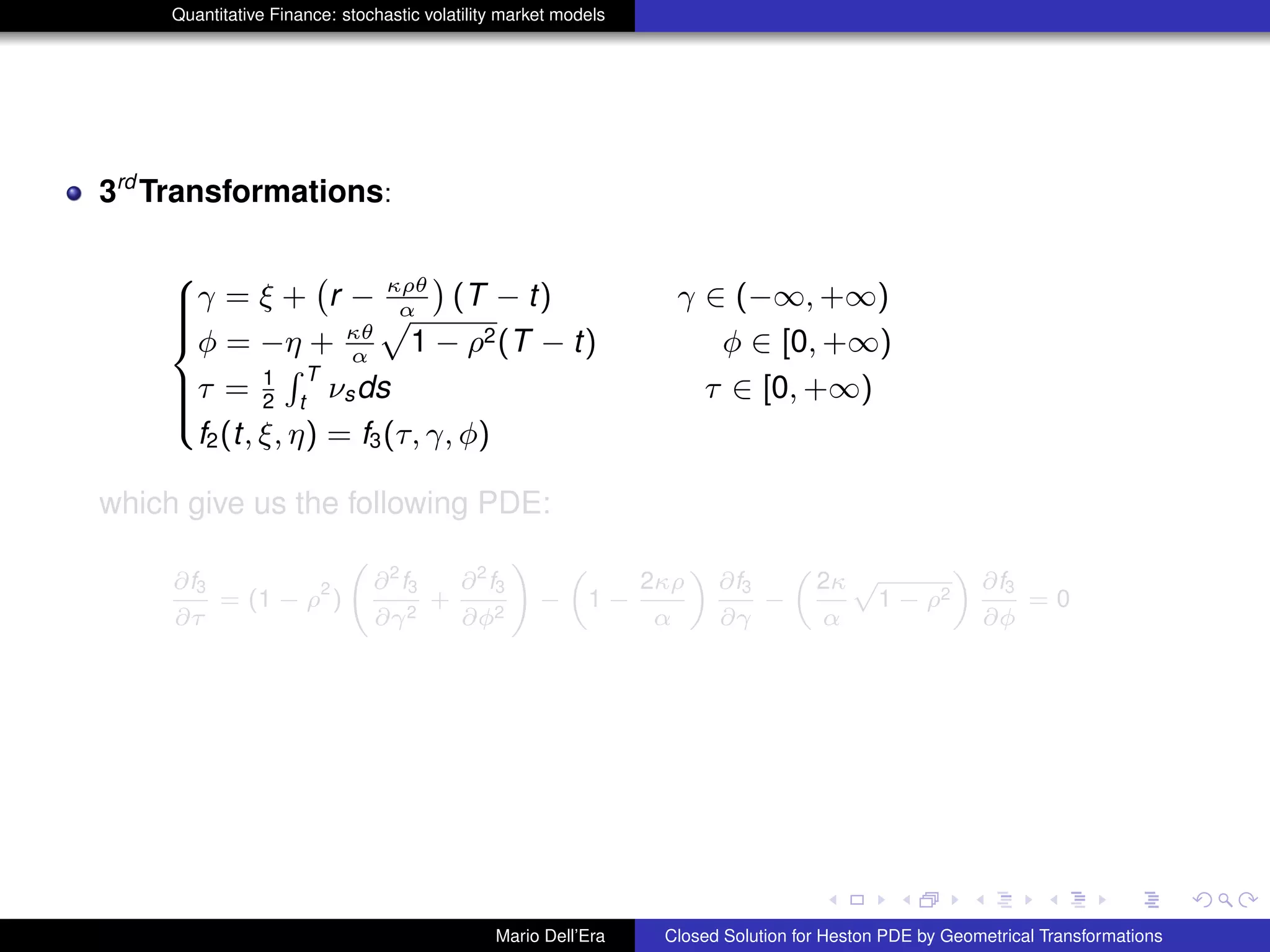
3rd
Transformations:
8
>>><
>>>:
γ = ξ +
`
r − κρθ
α
´
(T − t) γ ∈ (−∞, +∞)
φ = −η + κθ
α
p
1 − ρ2(T − t) φ ∈ [0, +∞)
τ = 1
2
R T
t
νsds τ ∈ [0, +∞)
f2(t, ξ, η) = f3(τ, γ, φ)
which give us the following PDE:
∂f3
∂τ
= (1 − ρ
2
)
∂2
f3
∂γ2
+
∂2
f3
∂φ2
!
−
„
1 −
2κρ
α
«
∂f3
∂γ
−
„
2κ
α
p
1 − ρ2
«
∂f3
∂φ
= 0
Mario Dell’Era Closed Solution for Heston PDE by Geometrical Transformations
Quantitative Finance: stochastic volatility market models
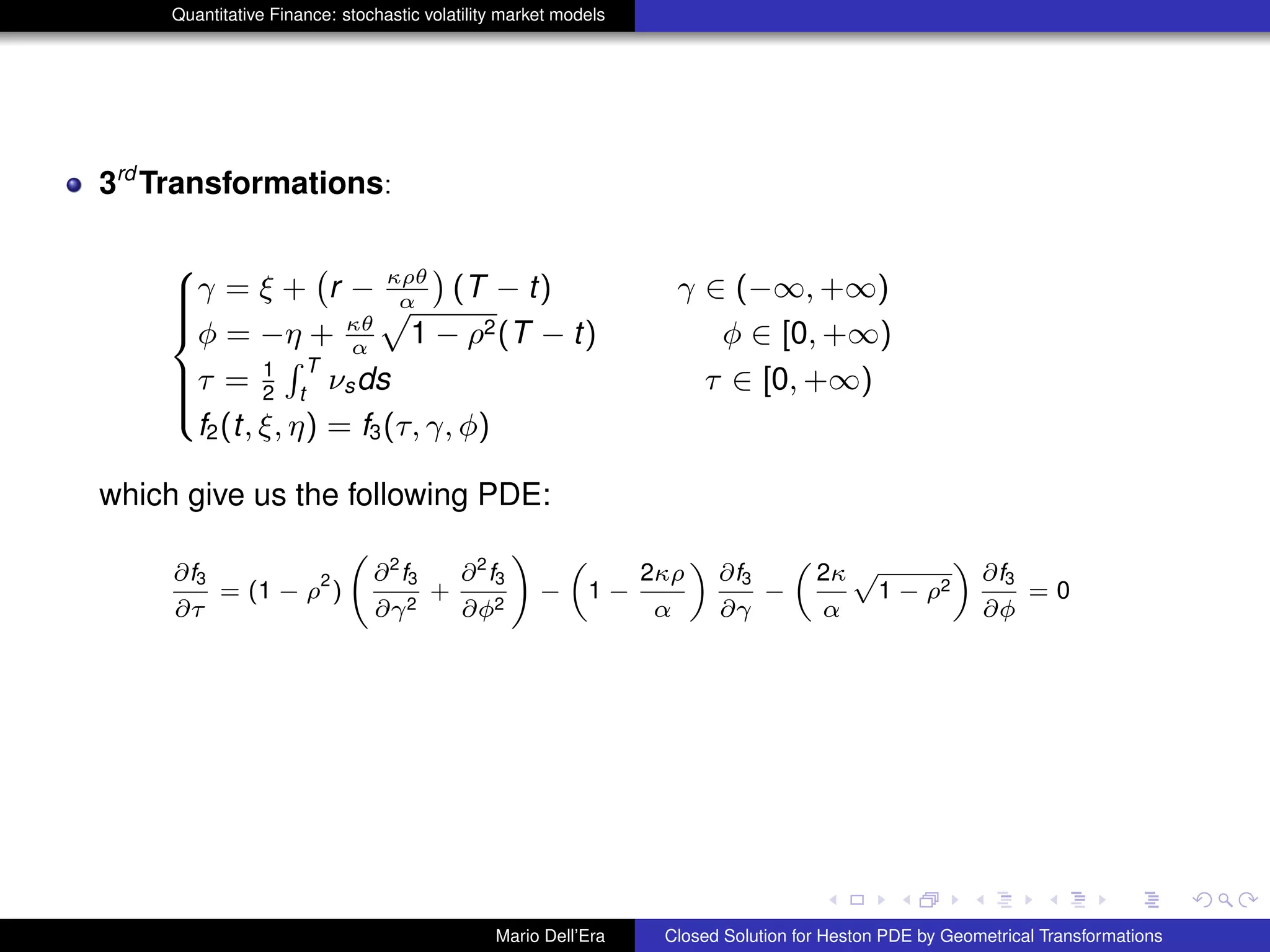
3rd
Transformations:
8
>>><
>>>:
γ = ξ +
`
r − κρθ
α
´
(T − t) γ ∈ (−∞, +∞)
φ = −η + κθ
α
p
1 − ρ2(T − t) φ ∈ [0, +∞)
τ = 1
2
R T
t
νsds τ ∈ [0, +∞)
f2(t, ξ, η) = f3(τ, γ, φ)
which give us the following PDE:
∂f3
∂τ
= (1 − ρ
2
)
∂2
f3
∂γ2
+
∂2
f3
∂φ2
!
−
„
1 −
2κρ
α
«
∂f3
∂γ
−
„
2κ
α
p
1 − ρ2
«
∂f3
∂φ
= 0
Mario Dell’Era Closed Solution for Heston PDE by Geometrical Transformations
Quantitative Finance: stochastic volatility market models
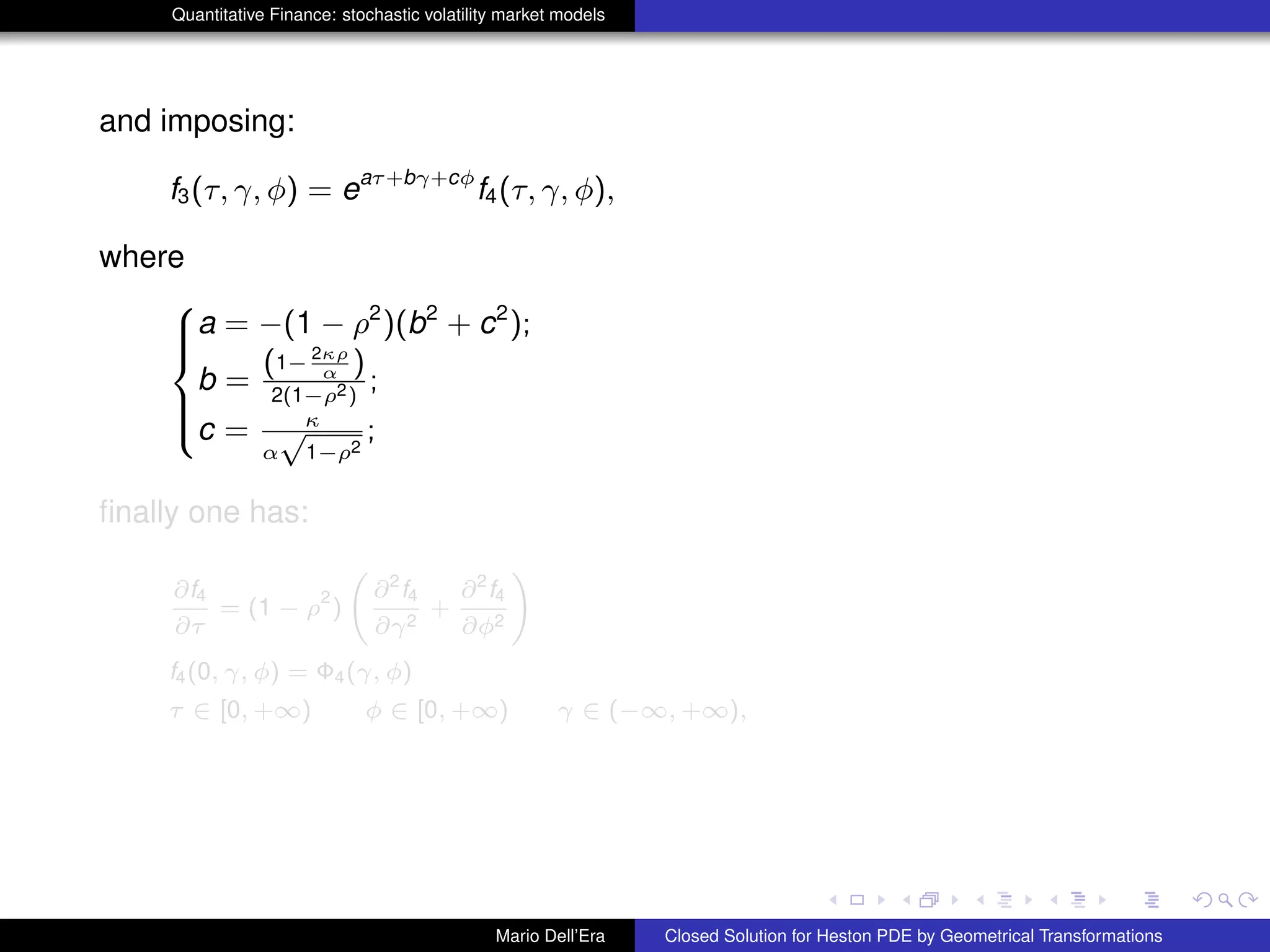
and imposing:
f3(τ, γ, φ) = eaτ+bγ+cφ
f4(τ, γ, φ),
where
8
>><
>>:
a = −(1 − ρ2
)(b2
+ c2
);
b =
(1− 2κρ
α )
2(1−ρ2)
;
c = κ
α
√
1−ρ2
;
finally one has:
∂f4
∂τ
= (1 − ρ
2
)
∂2
f4
∂γ2
+
∂2
f4
∂φ2
!
f4(0, γ, φ) = Φ4(γ, φ)
τ ∈ [0, +∞) φ ∈ [0, +∞) γ ∈ (−∞, +∞),
Mario Dell’Era Closed Solution for Heston PDE by Geometrical Transformations
Quantitative Finance: stochastic volatility market models
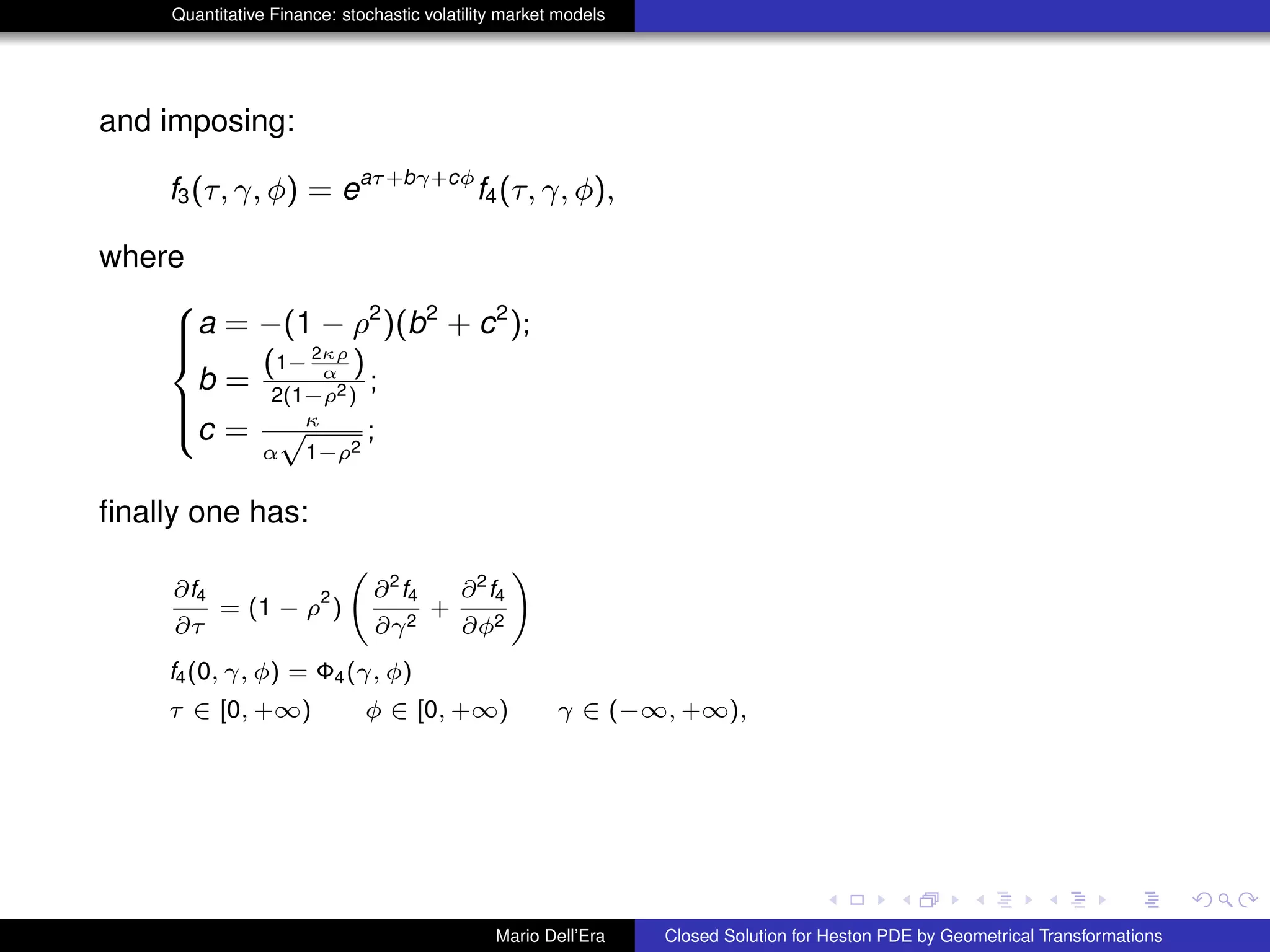
and imposing:
f3(τ, γ, φ) = eaτ+bγ+cφ
f4(τ, γ, φ),
where
8
>><
>>:
a = −(1 − ρ2
)(b2
+ c2
);
b =
(1− 2κρ
α )
2(1−ρ2)
;
c = κ
α
√
1−ρ2
;
finally one has:
∂f4
∂τ
= (1 − ρ
2
)
∂2
f4
∂γ2
+
∂2
f4
∂φ2
!
f4(0, γ, φ) = Φ4(γ, φ)
τ ∈ [0, +∞) φ ∈ [0, +∞) γ ∈ (−∞, +∞),
Mario Dell’Era Closed Solution for Heston PDE by Geometrical Transformations
Quantitative Finance: stochastic volatility market models
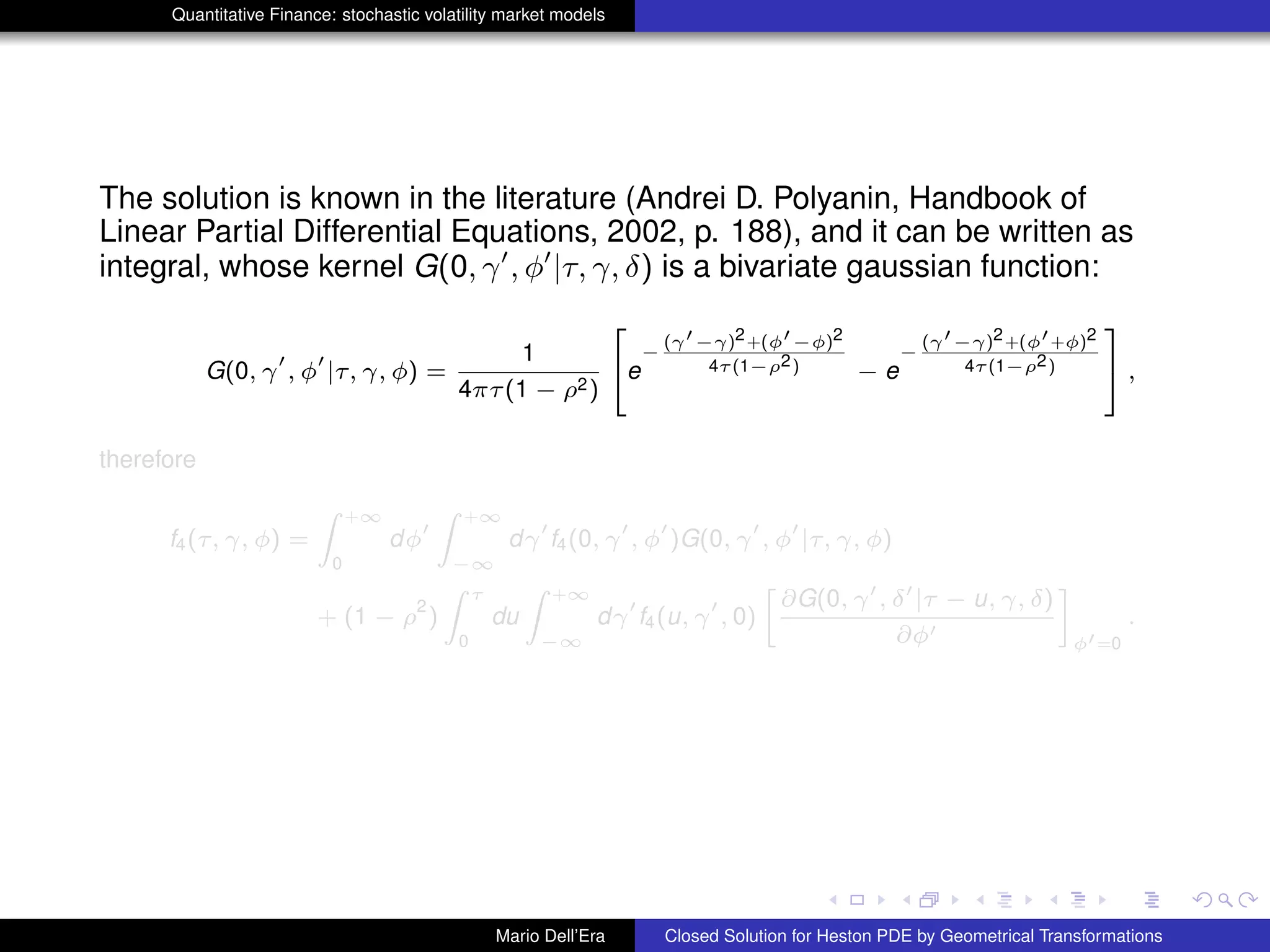
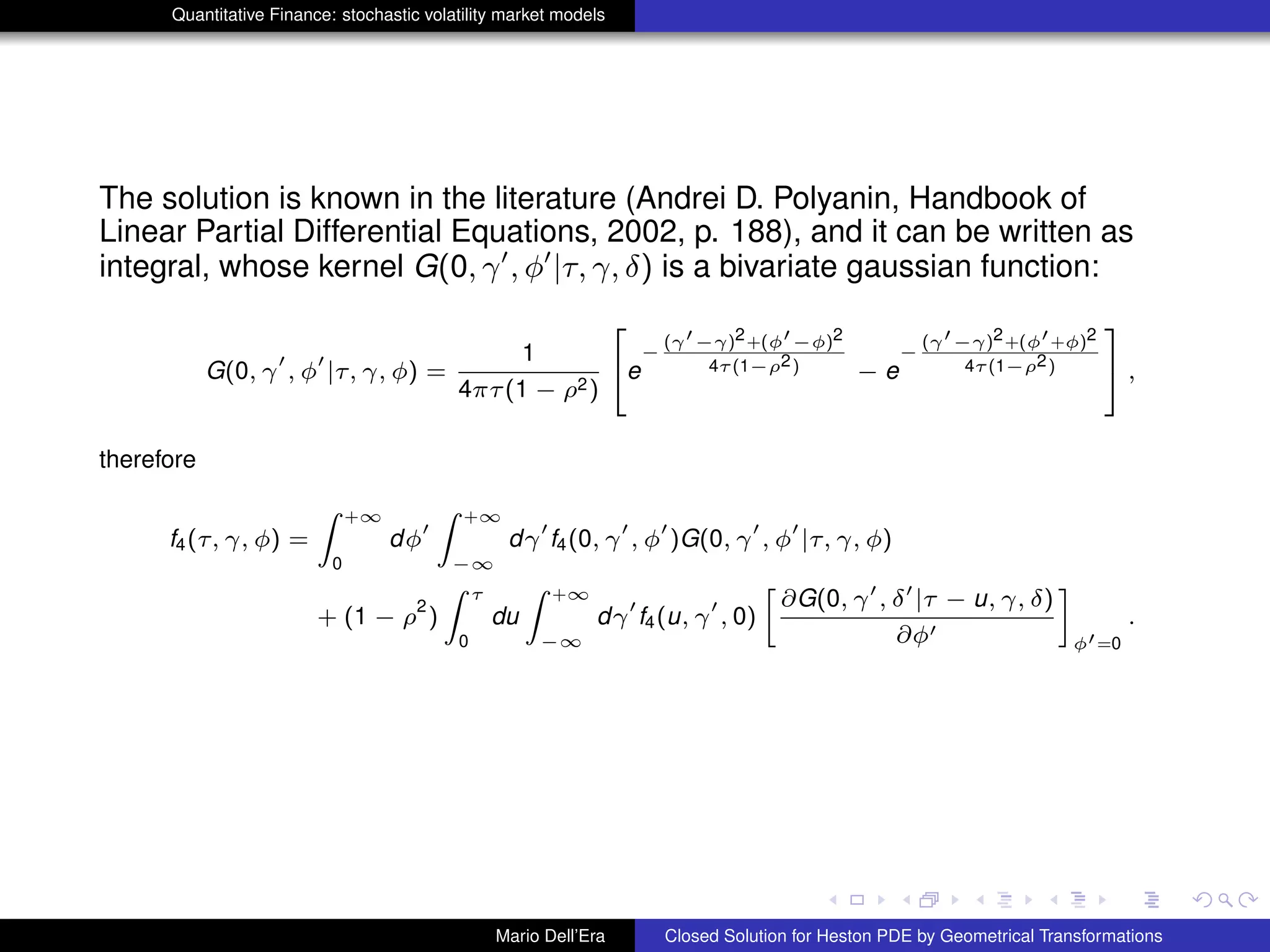
The solution is known in the literature (Andrei D. Polyanin, Handbook of
Linear Partial Differential Equations, 2002, p. 188), and it can be written as
integral, whose kernel G(0, γ , φ |τ, γ, δ) is a bivariate gaussian function:
G(0, γ , φ |τ, γ, φ) =
1
4πτ(1 − ρ2)
2
4e
−
(γ −γ)2+(φ −φ)2
4τ(1−ρ2) − e
−
(γ −γ)2+(φ +φ)2
4τ(1−ρ2)
3
5 ,
therefore
f4(τ, γ, φ) =
Z +∞
0
dφ
Z +∞
−∞
dγ f4(0, γ , φ )G(0, γ , φ |τ, γ, φ)
+ (1 − ρ
2
)
Z τ
0
du
Z +∞
−∞
dγ f4(u, γ , 0)
»
∂G(0, γ , δ |τ − u, γ, δ)
∂φ
–
φ =0
.
Mario Dell’Era Closed Solution for Heston PDE by Geometrical Transformations
Quantitative Finance: stochastic volatility market models
The solution is known in the literature (Andrei D. Polyanin, Handbook of
Linear Partial Differential Equations, 2002, p. 188), and it can be written as
integral, whose kernel G(0, γ , φ |τ, γ, δ) is a bivariate gaussian function:
G(0, γ , φ |τ, γ, φ) =
1
4πτ(1 − ρ2)
2
4e
−
(γ −γ)2+(φ −φ)2
4τ(1−ρ2) − e
−
(γ −γ)2+(φ +φ)2
4τ(1−ρ2)
3
5 ,
therefore
f4(τ, γ, φ) =
Z +∞
0
dφ
Z +∞
−∞
dγ f4(0, γ , φ )G(0, γ , φ |τ, γ, φ)
+ (1 − ρ
2
)
Z τ
0
du
Z +∞
−∞
dγ f4(u, γ , 0)
»
∂G(0, γ , δ |τ − u, γ, δ)
∂φ
–
φ =0
.
Mario Dell’Era Closed Solution for Heston PDE by Geometrical Transformations
Quantitative Finance: stochastic volatility market models
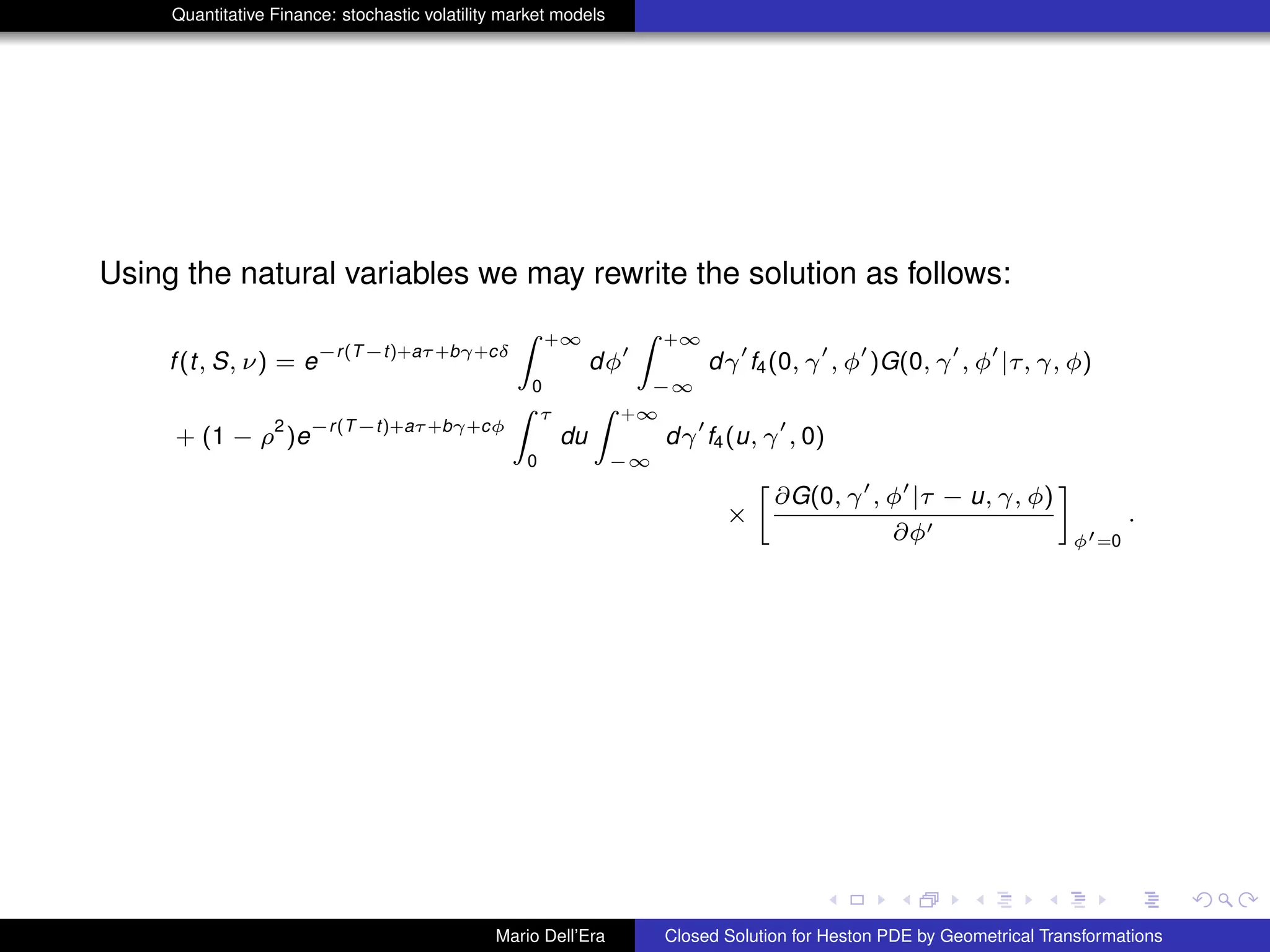
Using the natural variables we may rewrite the solution as follows:
f(t, S, ν) = e
−r(T−t)+aτ+bγ+cδ
Z +∞
0
dφ
Z +∞
−∞
dγ f4(0, γ , φ )G(0, γ , φ |τ, γ, φ)
+ (1 − ρ
2
)e
−r(T−t)+aτ+bγ+cφ
Z τ
0
du
Z +∞
−∞
dγ f4(u, γ , 0)
×
»
∂G(0, γ , φ |τ − u, γ, φ)
∂φ
–
φ =0
.
Mario Dell’Era Closed Solution for Heston PDE by Geometrical Transformations
Quantitative Finance: stochastic volatility market models
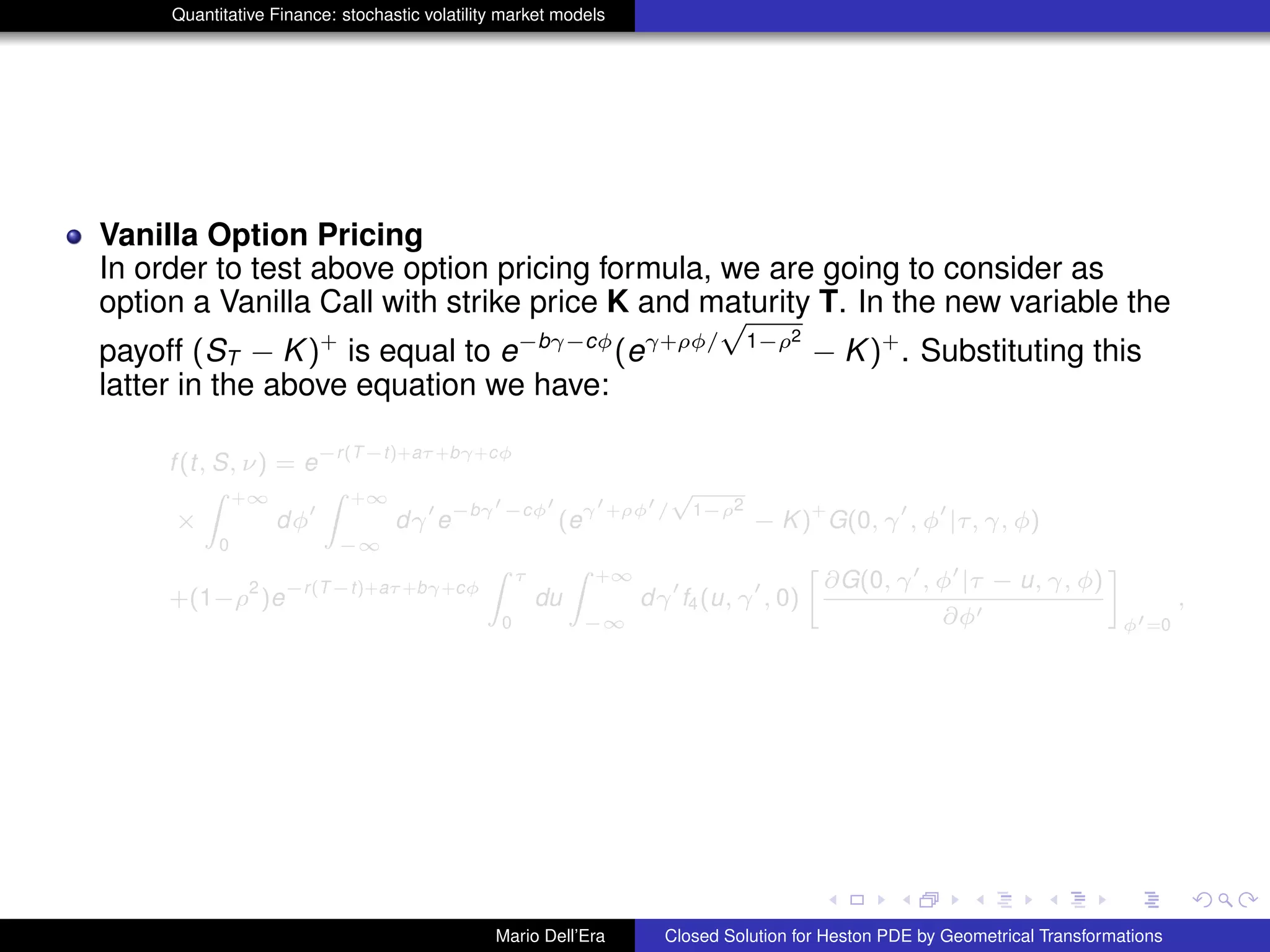
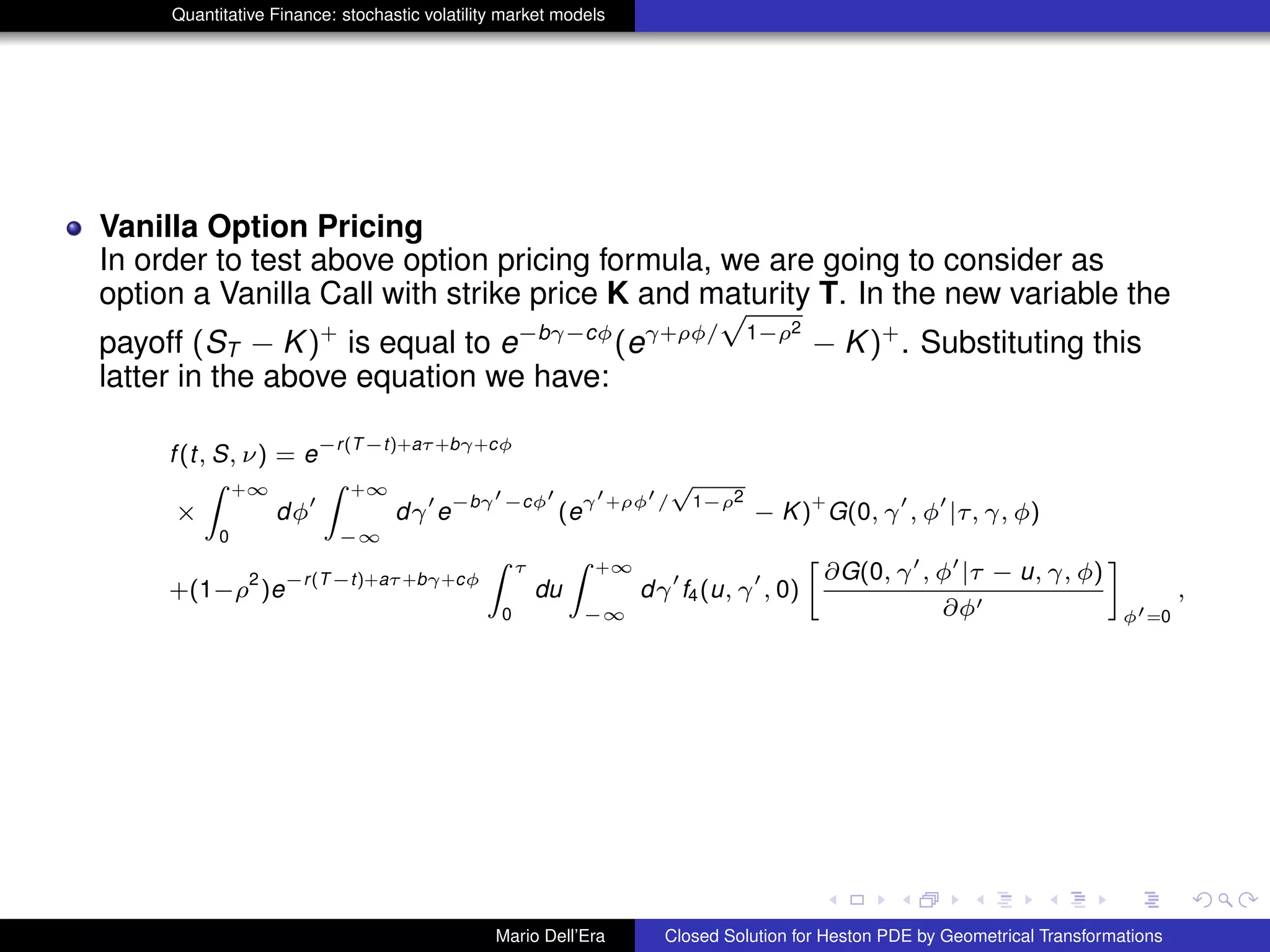
Vanilla Option Pricing
In order to test above option pricing formula, we are going to consider as
option a Vanilla Call with strike price K and maturity T. In the new variable the
payoff (ST − K)+
is equal to e−bγ−cφ
(eγ+ρφ/
√
1−ρ2
− K)+
. Substituting this
latter in the above equation we have:
f(t, S, ν) = e
−r(T−t)+aτ+bγ+cφ
×
Z +∞
0
dφ
Z +∞
−∞
dγ e
−bγ −cφ
(e
γ +ρφ /
√
1−ρ2
− K)
+
G(0, γ , φ |τ, γ, φ)
+(1−ρ
2
)e
−r(T−t)+aτ+bγ+cφ
Z τ
0
du
Z +∞
−∞
dγ f4(u, γ , 0)
»
∂G(0, γ , φ |τ − u, γ, φ)
∂φ
–
φ =0
,
Mario Dell’Era Closed Solution for Heston PDE by Geometrical Transformations
Quantitative Finance: stochastic volatility market models
Vanilla Option Pricing
In order to test above option pricing formula, we are going to consider as
option a Vanilla Call with strike price K and maturity T. In the new variable the
payoff (ST − K)+
is equal to e−bγ−cφ
(eγ+ρφ/
√
1−ρ2
− K)+
. Substituting this
latter in the above equation we have:
f(t, S, ν) = e
−r(T−t)+aτ+bγ+cφ
×
Z +∞
0
dφ
Z +∞
−∞
dγ e
−bγ −cφ
(e
γ +ρφ /
√
1−ρ2
− K)
+
G(0, γ , φ |τ, γ, φ)
+(1−ρ
2
)e
−r(T−t)+aτ+bγ+cφ
Z τ
0
du
Z +∞
−∞
dγ f4(u, γ , 0)
»
∂G(0, γ , φ |τ − u, γ, φ)
∂φ
–
φ =0
,
Mario Dell’Era Closed Solution for Heston PDE by Geometrical Transformations
Quantitative Finance: stochastic volatility market models
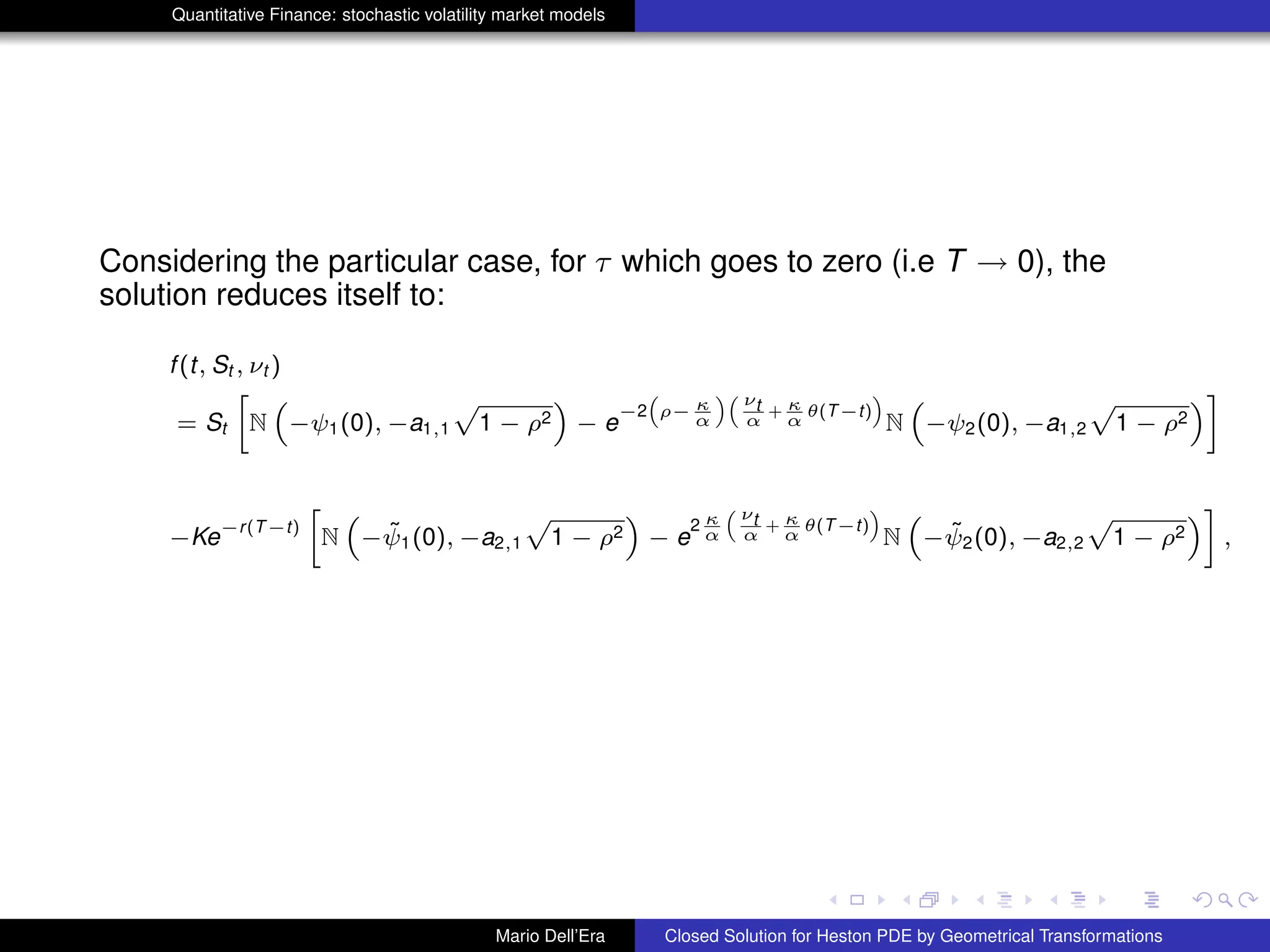
Considering the particular case, for τ which goes to zero (i.e T → 0), the
solution reduces itself to:
f(t, St , νt )
= St
»
N
“
−ψ1(0), −a1,1
p
1 − ρ2
”
− e
−2
“
ρ− κ
α
”“ νt
α
+ κ
α
θ(T−t)
”
N
“
−ψ2(0), −a1,2
p
1 − ρ2
”–
−Ke
−r(T−t)
»
N
“
− ˜ψ1(0), −a2,1
p
1 − ρ2
”
− e
2 κ
α
“ νt
α
+ κ
α
θ(T−t)
”
N
“
− ˜ψ2(0), −a2,2
p
1 − ρ2
”–
,
Mario Dell’Era Closed Solution for Heston PDE by Geometrical Transformations
Quantitative Finance: stochastic volatility market models
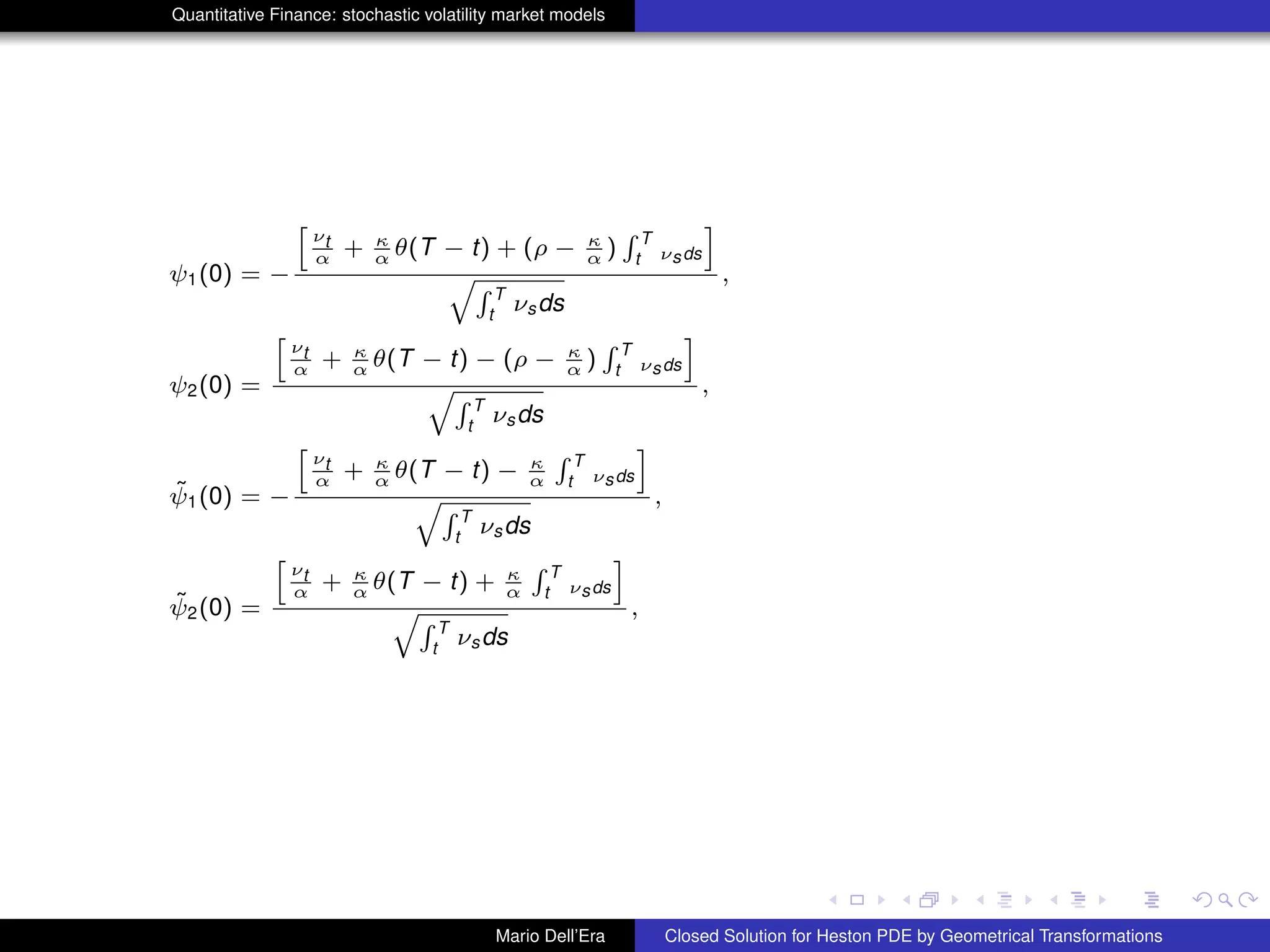
ψ1(0) = −
h
νt
α + κ
α θ(T − t) + (ρ − κ
α )
R T
t νsds
i
qR T
t
νsds
,
ψ2(0) =
h
νt
α + κ
α θ(T − t) − (ρ − κ
α )
R T
t νsds
i
qR T
t
νsds
,
˜ψ1(0) = −
h
νt
α + κ
α θ(T − t) − κ
α
R T
t νsds
i
qR T
t
νsds
,
˜ψ2(0) =
h
νt
α + κ
α θ(T − t) + κ
α
R T
t νsds
i
qR T
t
νsds
,
Mario Dell’Era Closed Solution for Heston PDE by Geometrical Transformations
Quantitative Finance: stochastic volatility market models
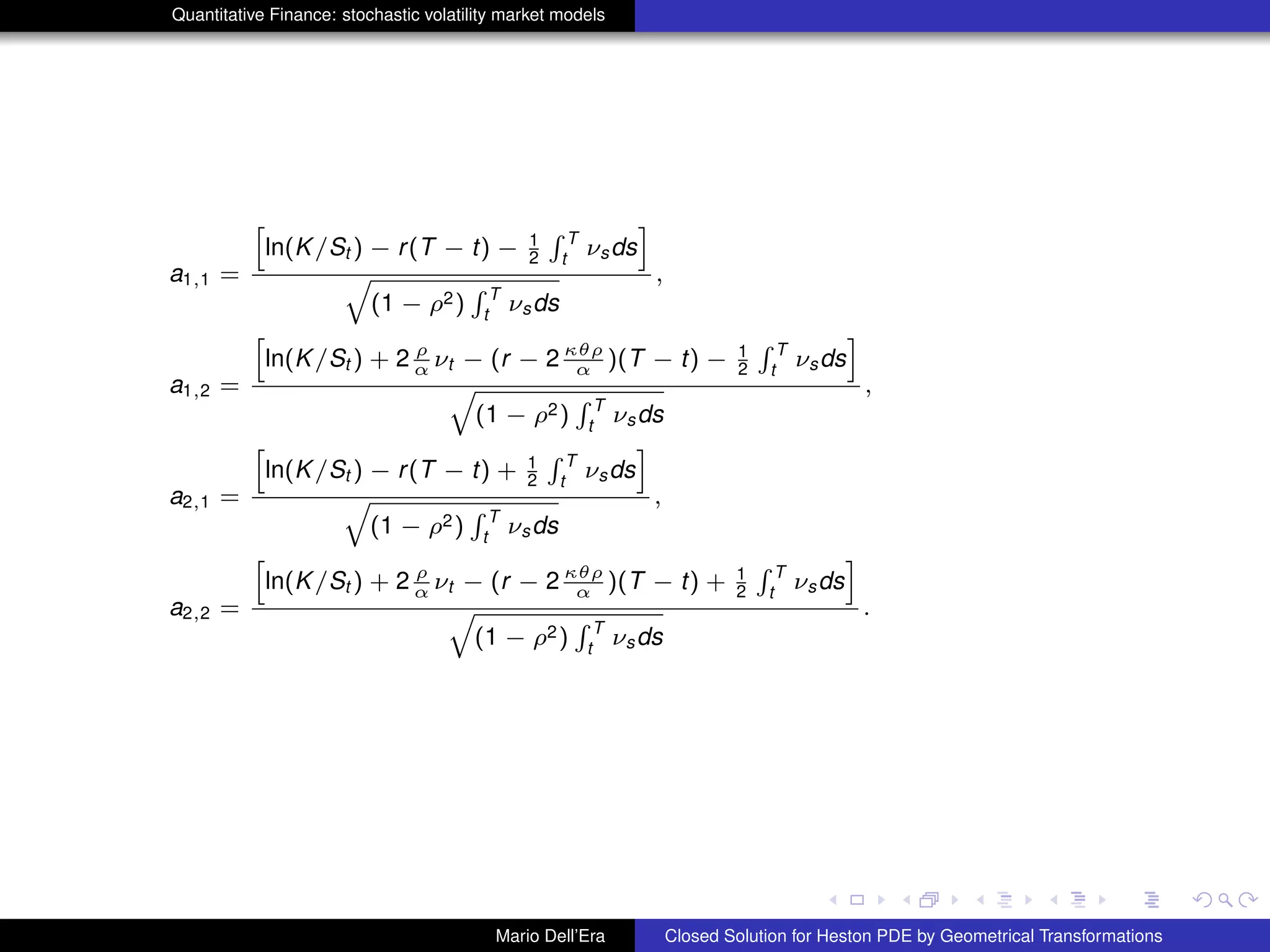
a1,1 =
h
ln(K/St ) − r(T − t) − 1
2
R T
t
νsds
i
q
(1 − ρ2)
R T
t
νsds
,
a1,2 =
h
ln(K/St ) + 2 ρ
α νt − (r − 2 κθρ
α )(T − t) − 1
2
R T
t
νsds
i
q
(1 − ρ2)
R T
t
νsds
,
a2,1 =
h
ln(K/St ) − r(T − t) + 1
2
R T
t
νsds
i
q
(1 − ρ2)
R T
t
νsds
,
a2,2 =
h
ln(K/St ) + 2 ρ
α νt − (r − 2 κθρ
α )(T − t) + 1
2
R T
t
νsds
i
q
(1 − ρ2)
R T
t
νsds
.
Mario Dell’Era Closed Solution for Heston PDE by Geometrical Transformations
Quantitative Finance: stochastic volatility market models
Numerical Validation
The approximation τ → 0 will be here interpreted as option pricing for few
days. From 1 day up to 10 days are suitable maturities to prove our validation
hypothesis, at varying of volatility. Parameter values are those in Bakshi, Cao
and Chen (1997) namely κ = 1.15, Θ = 0.04, α = 0.39 and ρ = −0.64. We
have chosen r = 10% K = 100, and three different maturities T. In what
follows we use the expected value of the variance process EP[νs] instead of
νs in the term
R T
t
νsds. In the tables hereafter one can see the results of
numerical experiments:
Mario Dell’Era Closed Solution for Heston PDE by Geometrical Transformations
Quantitative Finance: stochastic volatility market models
Numerical Validation
The approximation τ → 0 will be here interpreted as option pricing for few
days. From 1 day up to 10 days are suitable maturities to prove our validation
hypothesis, at varying of volatility. Parameter values are those in Bakshi, Cao
and Chen (1997) namely κ = 1.15, Θ = 0.04, α = 0.39 and ρ = −0.64. We
have chosen r = 10% K = 100, and three different maturities T. In what
follows we use the expected value of the variance process EP[νs] instead of
νs in the term
R T
t
νsds. In the tables hereafter one can see the results of
numerical experiments:
Mario Dell’Era Closed Solution for Heston PDE by Geometrical Transformations
Quantitative Finance: stochastic volatility market models
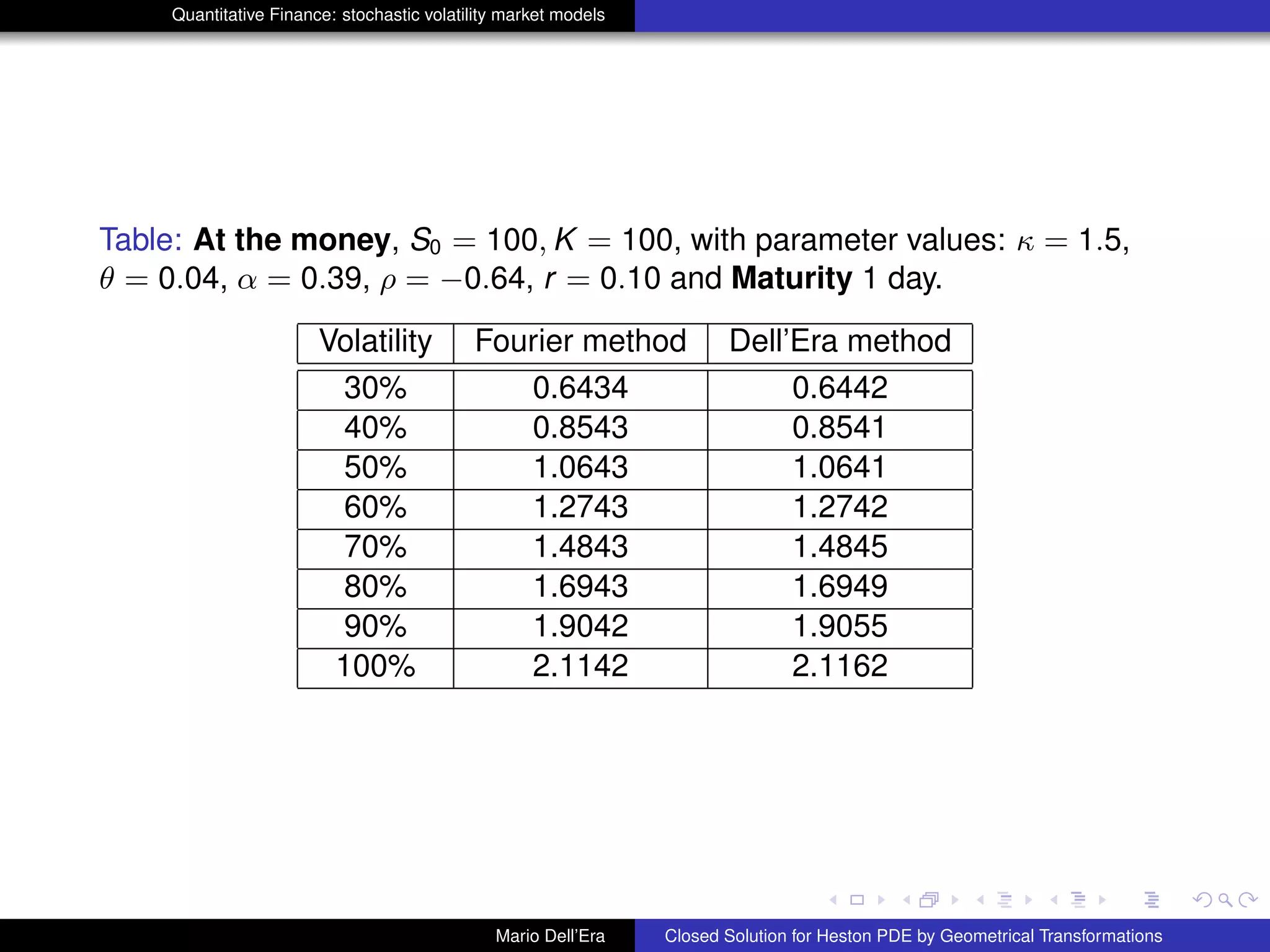
Table: At the money, S0 = 100, K = 100, with parameter values: κ = 1.5,
θ = 0.04, α = 0.39, ρ = −0.64, r = 0.10 and Maturity 1 day.
Volatility Fourier method Dell’Era method
30% 0.6434 0.6442
40% 0.8543 0.8541
50% 1.0643 1.0641
60% 1.2743 1.2742
70% 1.4843 1.4845
80% 1.6943 1.6949
90% 1.9042 1.9055
100% 2.1142 2.1162
Mario Dell’Era Closed Solution for Heston PDE by Geometrical Transformations
Quantitative Finance: stochastic volatility market models
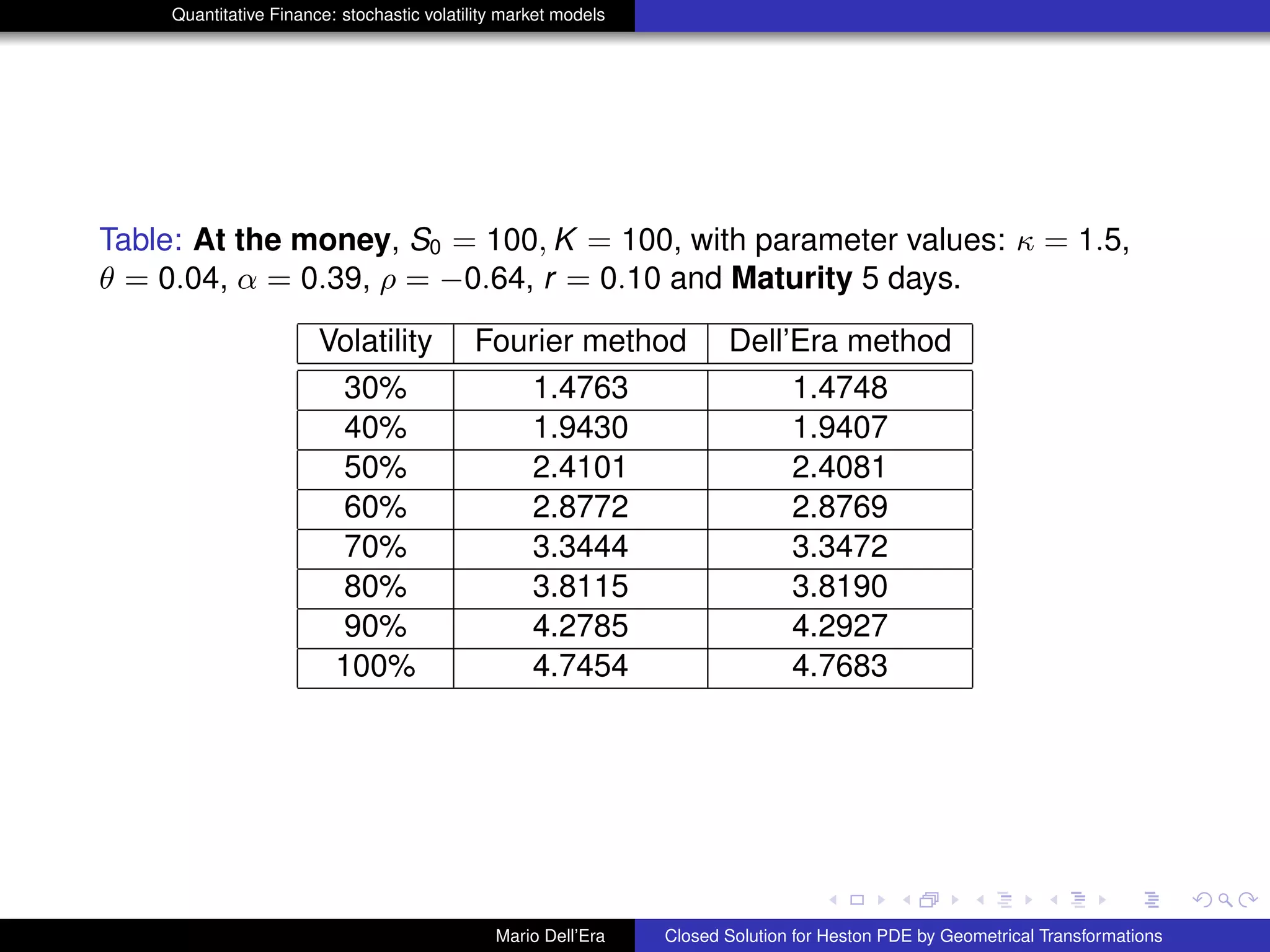
Table: At the money, S0 = 100, K = 100, with parameter values: κ = 1.5,
θ = 0.04, α = 0.39, ρ = −0.64, r = 0.10 and Maturity 5 days.
Volatility Fourier method Dell’Era method
30% 1.4763 1.4748
40% 1.9430 1.9407
50% 2.4101 2.4081
60% 2.8772 2.8769
70% 3.3444 3.3472
80% 3.8115 3.8190
90% 4.2785 4.2927
100% 4.7454 4.7683
Mario Dell’Era Closed Solution for Heston PDE by Geometrical Transformations
Quantitative Finance: stochastic volatility market models
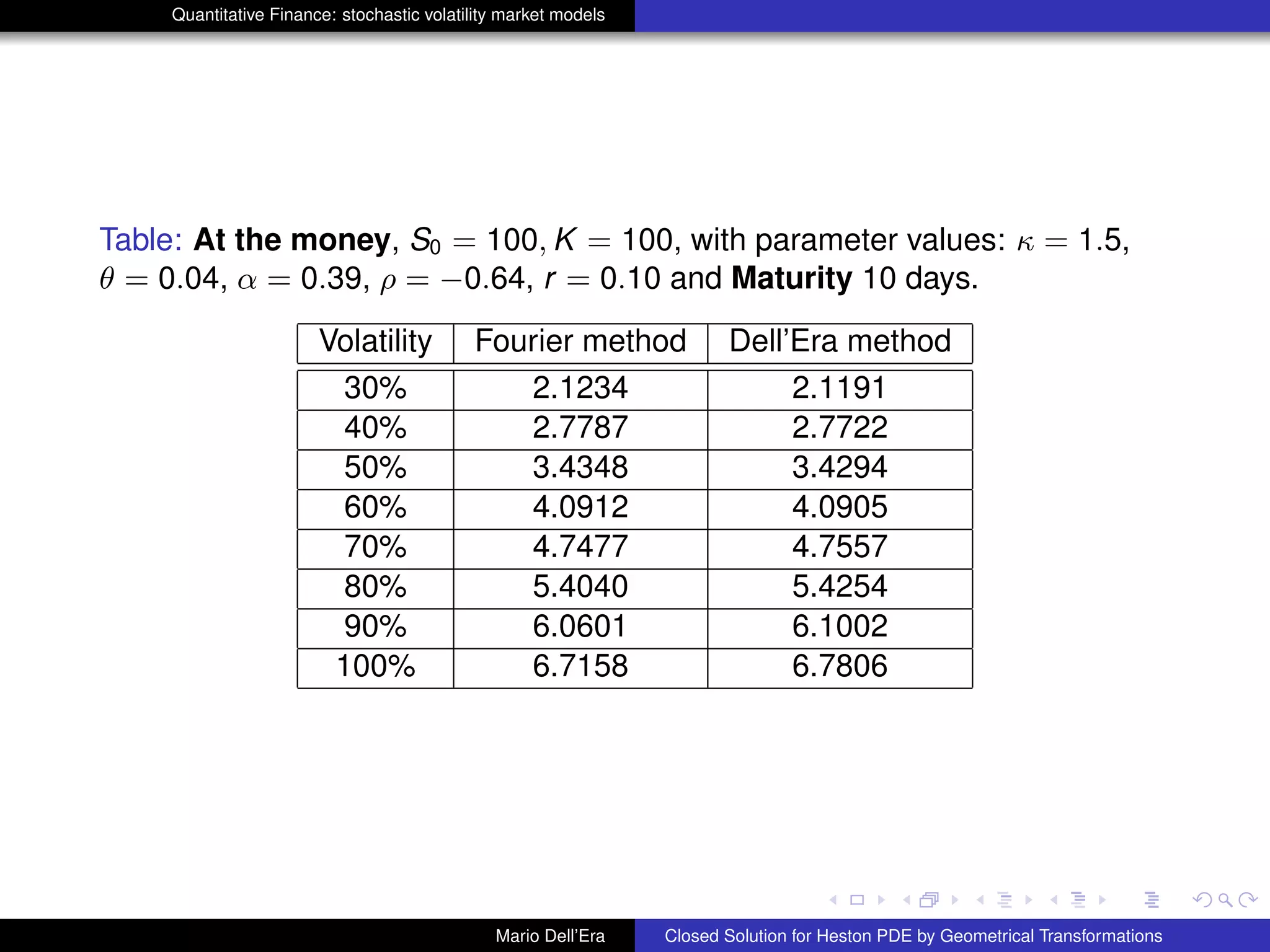
Table: At the money, S0 = 100, K = 100, with parameter values: κ = 1.5,
θ = 0.04, α = 0.39, ρ = −0.64, r = 0.10 and Maturity 10 days.
Volatility Fourier method Dell’Era method
30% 2.1234 2.1191
40% 2.7787 2.7722
50% 3.4348 3.4294
60% 4.0912 4.0905
70% 4.7477 4.7557
80% 5.4040 5.4254
90% 6.0601 6.1002
100% 6.7158 6.7806
Mario Dell’Era Closed Solution for Heston PDE by Geometrical Transformations
Quantitative Finance: stochastic volatility market models
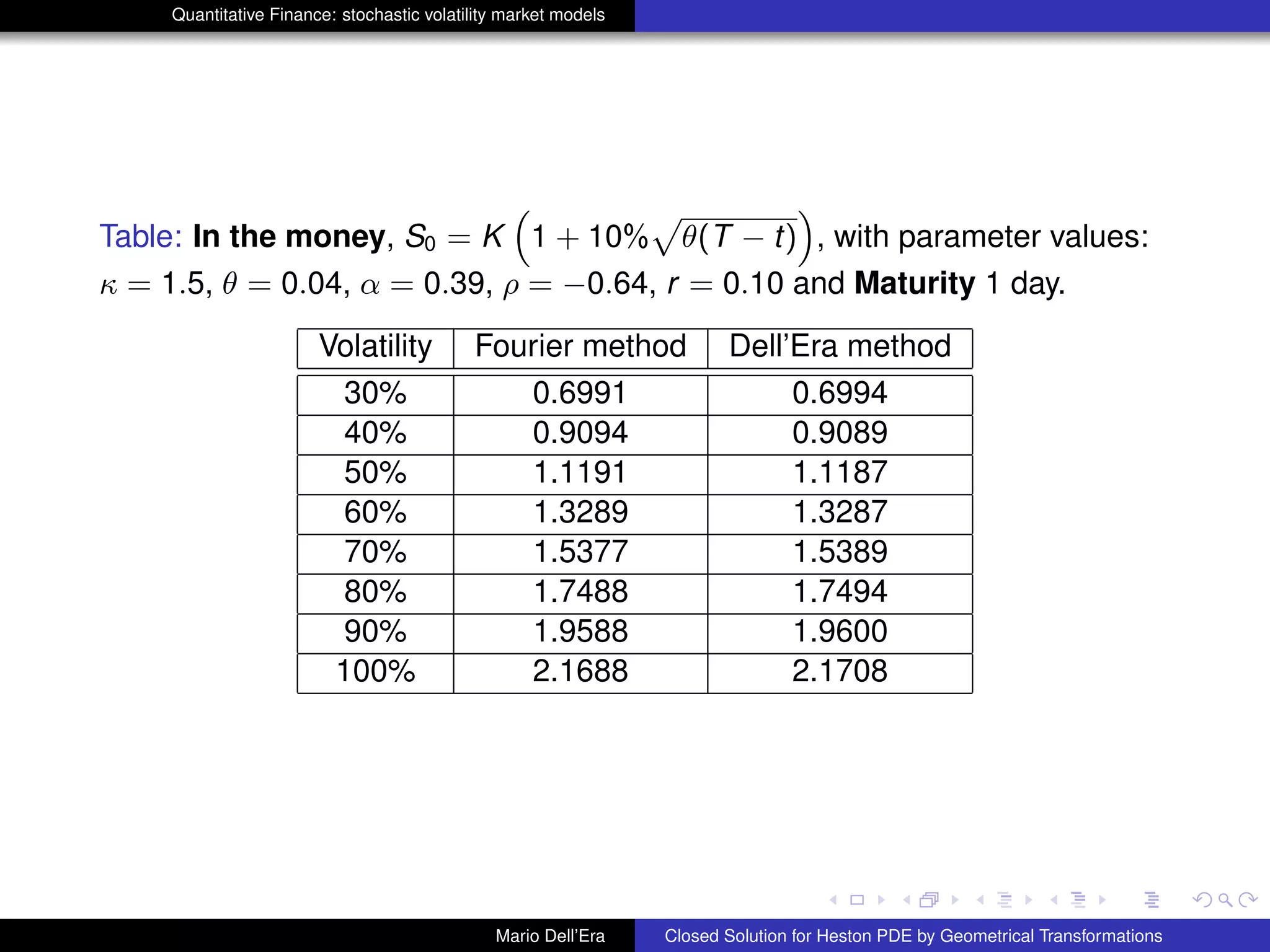
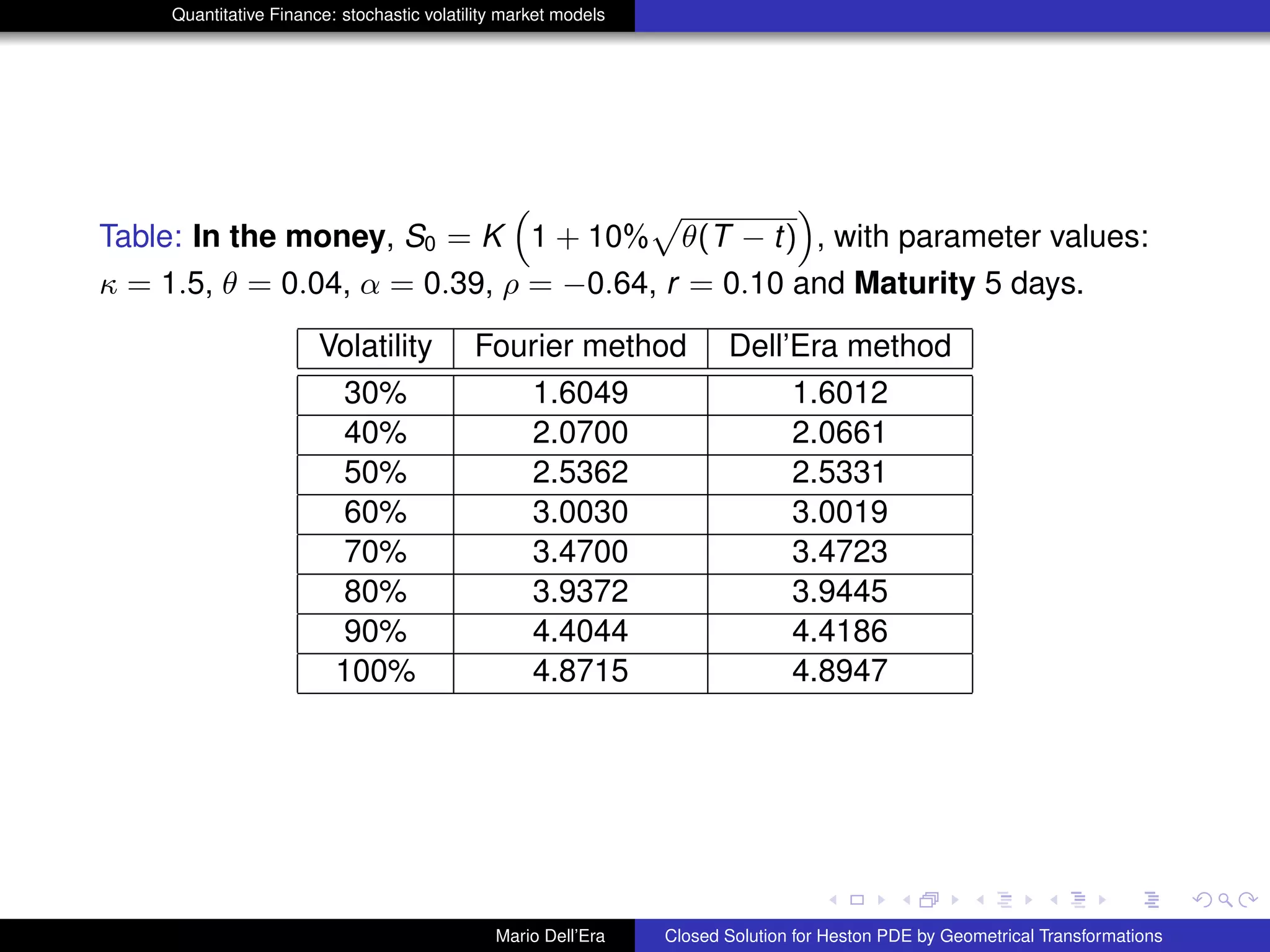
Table: In the money, S0 = K
“
1 + 10%
p
θ(T − t)
”
, with parameter values:
κ = 1.5, θ = 0.04, α = 0.39, ρ = −0.64, r = 0.10 and Maturity 1 day.
Volatility Fourier method Dell’Era method
30% 0.6991 0.6994
40% 0.9094 0.9089
50% 1.1191 1.1187
60% 1.3289 1.3287
70% 1.5377 1.5389
80% 1.7488 1.7494
90% 1.9588 1.9600
100% 2.1688 2.1708
Mario Dell’Era Closed Solution for Heston PDE by Geometrical Transformations
Quantitative Finance: stochastic volatility market models
Table: In the money, S0 = K
“
1 + 10%
p
θ(T − t)
”
, with parameter values:
κ = 1.5, θ = 0.04, α = 0.39, ρ = −0.64, r = 0.10 and Maturity 5 days.
Volatility Fourier method Dell’Era method
30% 1.6049 1.6012
40% 2.0700 2.0661
50% 2.5362 2.5331
60% 3.0030 3.0019
70% 3.4700 3.4723
80% 3.9372 3.9445
90% 4.4044 4.4186
100% 4.8715 4.8947
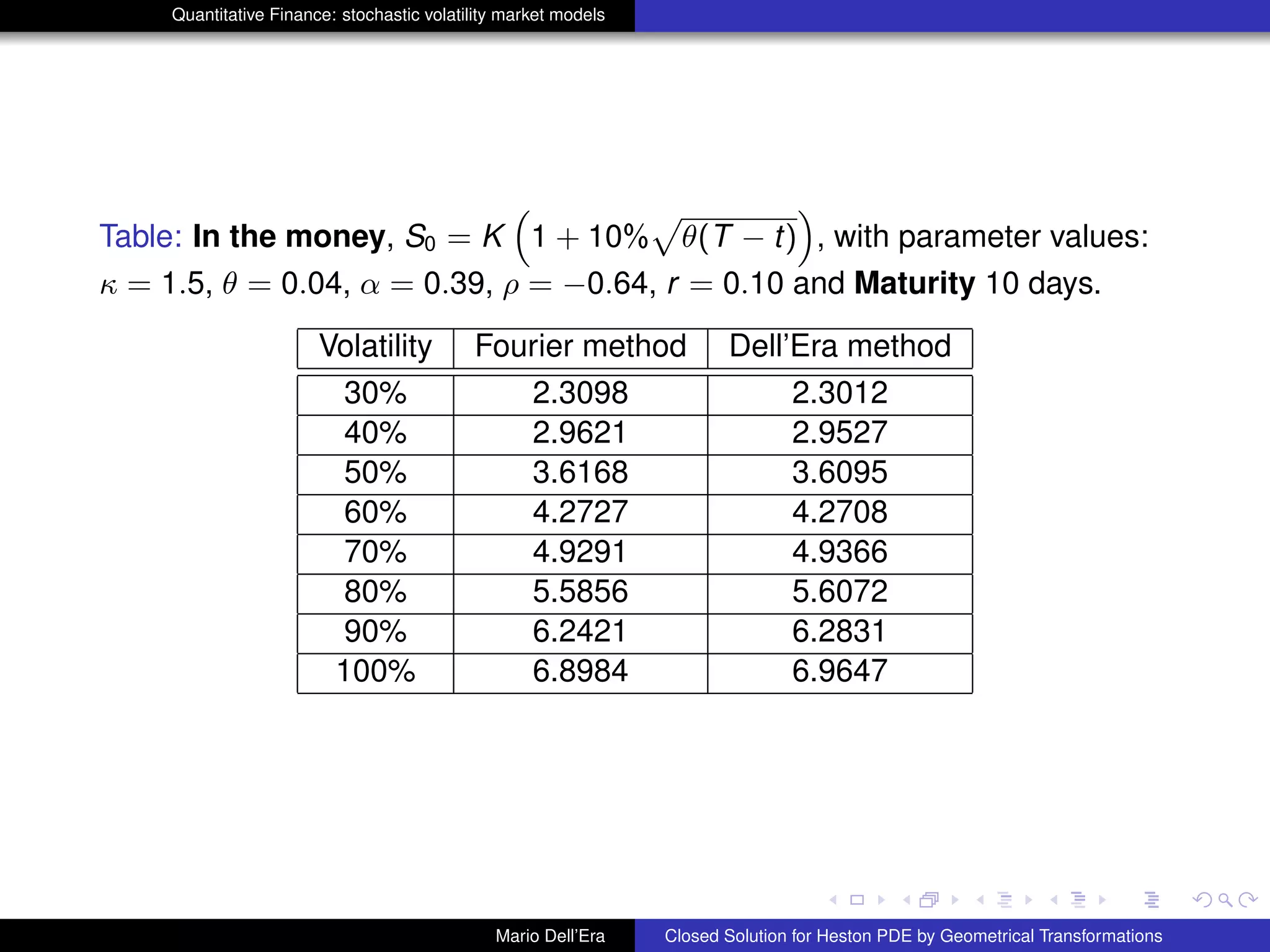
Mario Dell’Era Closed Solution for Heston PDE by Geometrical Transformations
Quantitative Finance: stochastic volatility market models
Table: In the money, S0 = K
“
1 + 10%
p
θ(T − t)
”
, with parameter values:
κ = 1.5, θ = 0.04, α = 0.39, ρ = −0.64, r = 0.10 and Maturity 10 days.
Volatility Fourier method Dell’Era method
30% 2.3098 2.3012
40% 2.9621 2.9527
50% 3.6168 3.6095
60% 4.2727 4.2708
70% 4.9291 4.9366
80% 5.5856 5.6072
90% 6.2421 6.2831
100% 6.8984 6.9647
Mario Dell’Era Closed Solution for Heston PDE by Geometrical Transformations
Quantitative Finance: stochastic volatility market models
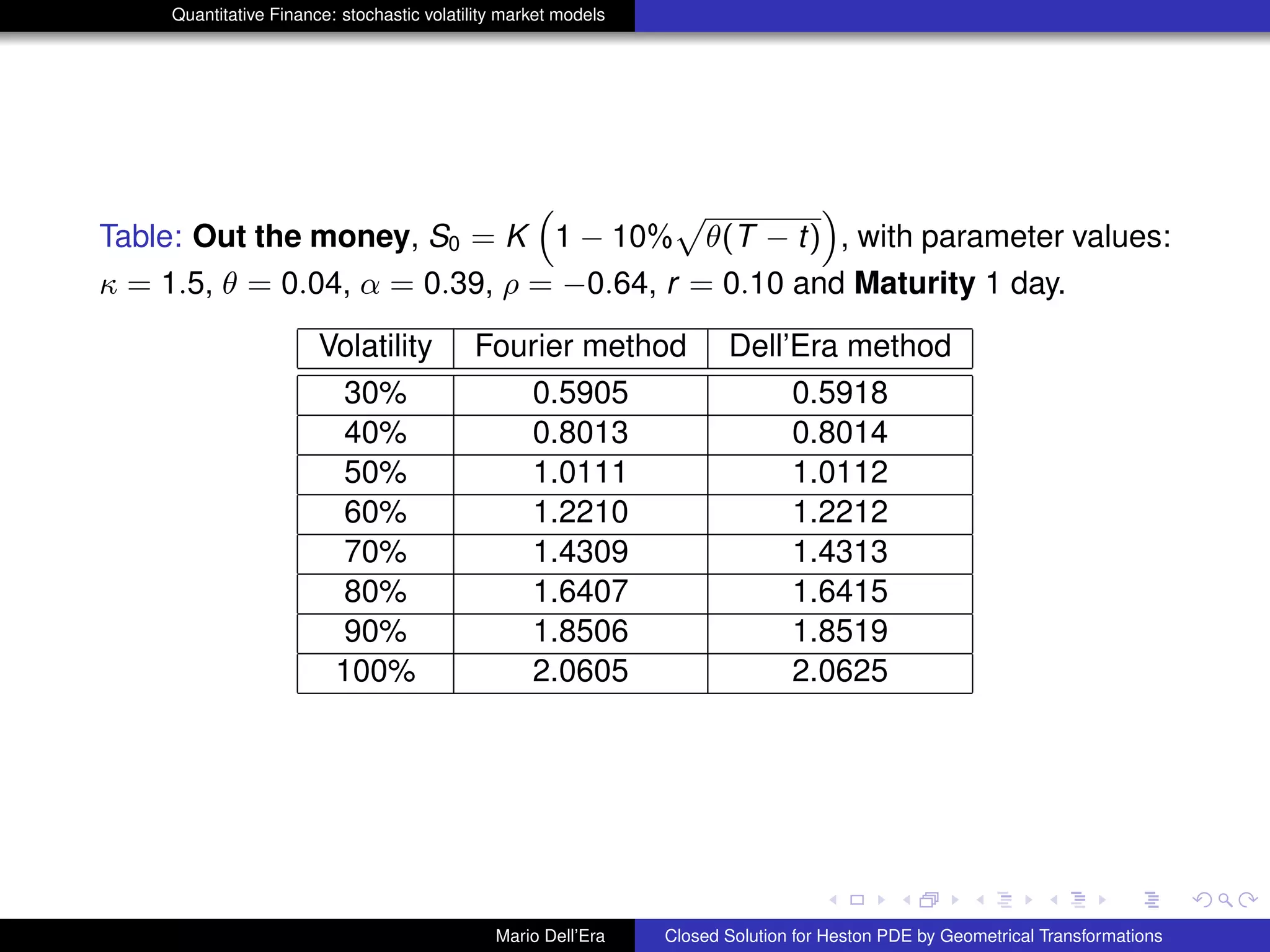
Table: Out the money, S0 = K
“
1 − 10%
p
θ(T − t)
”
, with parameter values:
κ = 1.5, θ = 0.04, α = 0.39, ρ = −0.64, r = 0.10 and Maturity 1 day.
Volatility Fourier method Dell’Era method
30% 0.5905 0.5918
40% 0.8013 0.8014
50% 1.0111 1.0112
60% 1.2210 1.2212
70% 1.4309 1.4313
80% 1.6407 1.6415
90% 1.8506 1.8519
100% 2.0605 2.0625
Mario Dell’Era Closed Solution for Heston PDE by Geometrical Transformations
Quantitative Finance: stochastic volatility market models
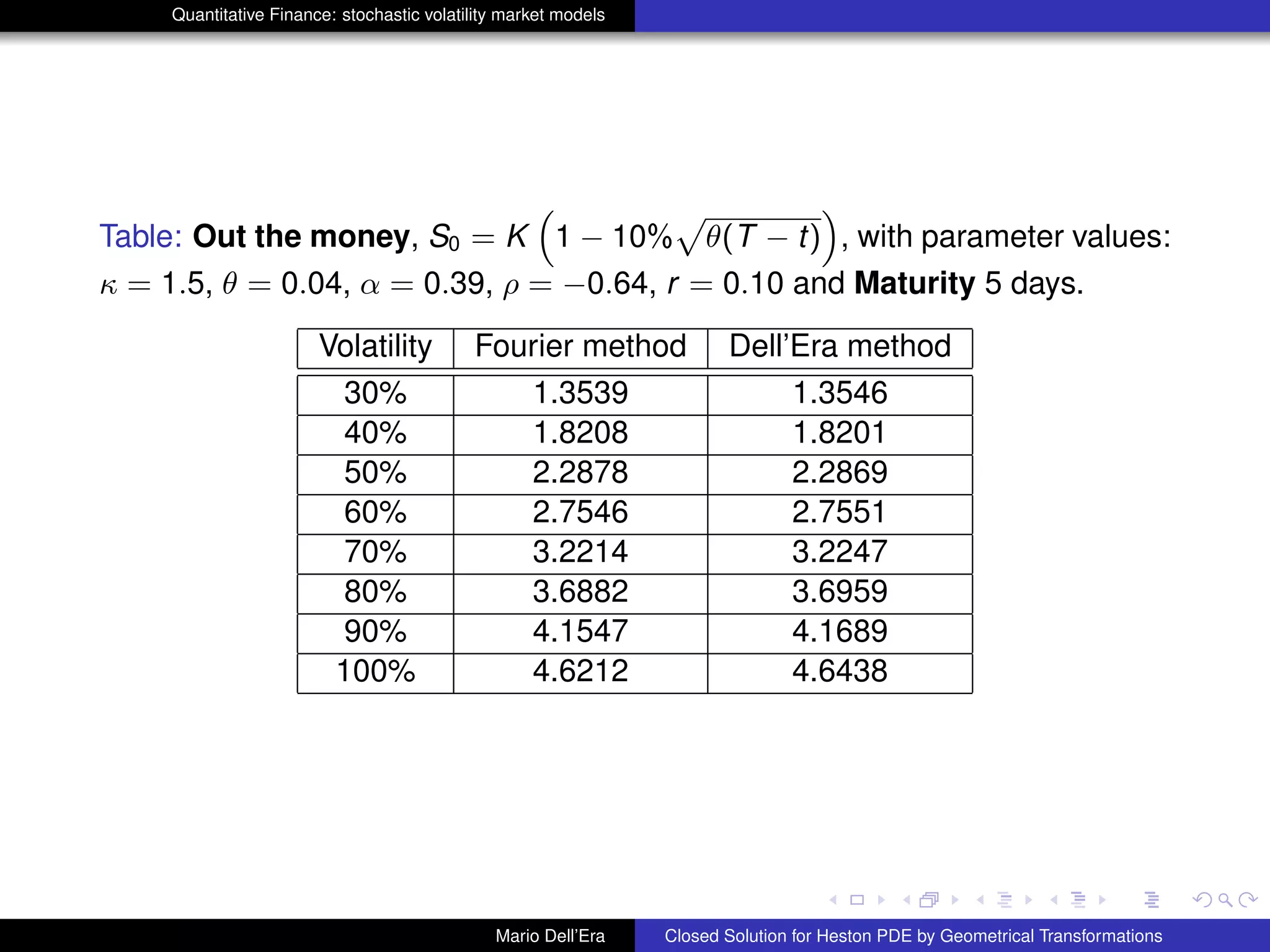
Table: Out the money, S0 = K
“
1 − 10%
p
θ(T − t)
”
, with parameter values:
κ = 1.5, θ = 0.04, α = 0.39, ρ = −0.64, r = 0.10 and Maturity 5 days.
Volatility Fourier method Dell’Era method
30% 1.3539 1.3546
40% 1.8208 1.8201
50% 2.2878 2.2869
60% 2.7546 2.7551
70% 3.2214 3.2247
80% 3.6882 3.6959
90% 4.1547 4.1689
100% 4.6212 4.6438
Mario Dell’Era Closed Solution for Heston PDE by Geometrical Transformations
Quantitative Finance: stochastic volatility market models
Table: Out the money, S0 = K
“
1 − 10%
p
θ(T − t)
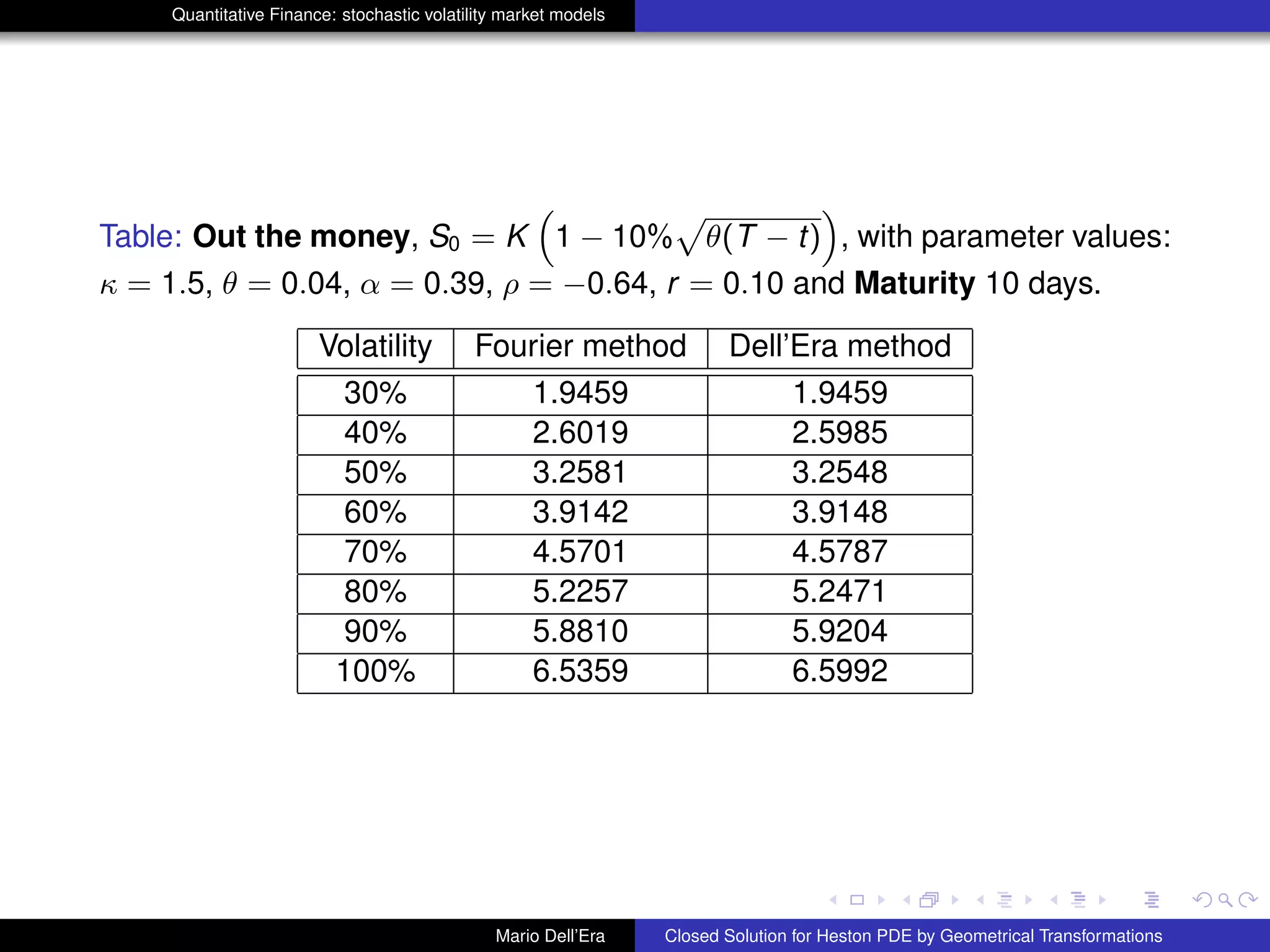
”
, with parameter values:
κ = 1.5, θ = 0.04, α = 0.39, ρ = −0.64, r = 0.10 and Maturity 10 days.
Volatility Fourier method Dell’Era method
30% 1.9459 1.9459
40% 2.6019 2.5985
50% 3.2581 3.2548
60% 3.9142 3.9148
70% 4.5701 4.5787
80% 5.2257 5.2471
90% 5.8810 5.9204
100% 6.5359 6.5992
Mario Dell’Era Closed Solution for Heston PDE by Geometrical Transformations
Quantitative Finance: stochastic volatility market models
Conclusions
The proposed method is straightforward from theoretical viewpoint and
seems to be promising from that numerical. We reduce the Heston’s PDE in
a simpler, using , in a right order, suitable changing of variables, whose
Jacobian has not singularity points, unless for ρ = ±1. This evidence gives
us the safety that the variables chosen are well defined.
Besides, the idea to use the expected value of the variance process EP[νs],
instead of νt , provides us, in concrete, a closed solution very easy to
compute; and so, we are also able to know what is the error using the
geometric transformation technique; which is equal to the variance of the
variance process νt : Err = EP[(νt − EP[νt ])2
]. While, using Fourier technique
we are not able to know the numeric error directly, but we need to compare
Fourier prices with Monte Carlo prices, for which one can manage the
variance.
We want to remark that the shown technique is independent to the payoff and
therefore, the pricing activities have the same algorithmic complexity for
every derivatives, unlike using Fourier Transform method, for which the
complexity is tied to the payoff.
Mario Dell’Era Closed Solution for Heston PDE by Geometrical Transformations
Quantitative Finance: stochastic volatility market models
Conclusions
The proposed method is straightforward from theoretical viewpoint and
seems to be promising from that numerical. We reduce the Heston’s PDE in
a simpler, using , in a right order, suitable changing of variables, whose
Jacobian has not singularity points, unless for ρ = ±1. This evidence gives
us the safety that the variables chosen are well defined.
Besides, the idea to use the expected value of the variance process EP[νs],
instead of νt , provides us, in concrete, a closed solution very easy to
compute; and so, we are also able to know what is the error using the
geometric transformation technique; which is equal to the variance of the
variance process νt : Err = EP[(νt − EP[νt ])2
]. While, using Fourier technique
we are not able to know the numeric error directly, but we need to compare
Fourier prices with Monte Carlo prices, for which one can manage the
variance.
We want to remark that the shown technique is independent to the payoff and
therefore, the pricing activities have the same algorithmic complexity for
every derivatives, unlike using Fourier Transform method, for which the
complexity is tied to the payoff.
Mario Dell’Era Closed Solution for Heston PDE by Geometrical Transformations
Quantitative Finance: stochastic volatility market models
Conclusions
The proposed method is straightforward from theoretical viewpoint and
seems to be promising from that numerical. We reduce the Heston’s PDE in
a simpler, using , in a right order, suitable changing of variables, whose
Jacobian has not singularity points, unless for ρ = ±1. This evidence gives
us the safety that the variables chosen are well defined.
Besides, the idea to use the expected value of the variance process EP[νs],
instead of νt , provides us, in concrete, a closed solution very easy to
compute; and so, we are also able to know what is the error using the
geometric transformation technique; which is equal to the variance of the
variance process νt : Err = EP[(νt − EP[νt ])2
]. While, using Fourier technique
we are not able to know the numeric error directly, but we need to compare
Fourier prices with Monte Carlo prices, for which one can manage the
variance.
We want to remark that the shown technique is independent to the payoff and
therefore, the pricing activities have the same algorithmic complexity for
every derivatives, unlike using Fourier Transform method, for which the
complexity is tied to the payoff.
Mario Dell’Era Closed Solution for Heston PDE by Geometrical Transformations

Workshop 2013 of Quantitative Finance

  • 1.
    Quantitative Finance: stochasticvolatility market models Closed Solution for Heston PDE by Geometrical Transformations XIV WorkShop of Quantitative Finance Mario Dell’Era Pisa University June 24, 2014 Mario Dell’Era Closed Solution for Heston PDE by Geometrical Transformations
  • 2.
    Quantitative Finance: stochasticvolatility market models Heston Model dSt = rSt dt + √ νt St d ˜W (1) t S ∈ [0, +∞) dνt = K(Θ − νt )dt + α √ νt d ˜W (2) t ν ∈ (0, +∞) under a risk-neutral martingale measure Q. From Itˆo’s lemma we have the following PDE: ∂f ∂t + 1 2 νS 2 ∂2 f ∂S2 + ρναS ∂2 f ∂S∂ν + 1 2 να 2 ∂2 f ∂ν2 + κ(Θ − ν) ∂f ∂ν + rS ∂f ∂S − rf = 0 Mario Dell’Era Closed Solution for Heston PDE by Geometrical Transformations
  • 3.
    Quantitative Finance: stochasticvolatility market models Heston Model dSt = rSt dt + √ νt St d ˜W (1) t S ∈ [0, +∞) dνt = K(Θ − νt )dt + α √ νt d ˜W (2) t ν ∈ (0, +∞) under a risk-neutral martingale measure Q. From Itˆo’s lemma we have the following PDE: ∂f ∂t + 1 2 νS 2 ∂2 f ∂S2 + ρναS ∂2 f ∂S∂ν + 1 2 να 2 ∂2 f ∂ν2 + κ(Θ − ν) ∂f ∂ν + rS ∂f ∂S − rf = 0 Mario Dell’Era Closed Solution for Heston PDE by Geometrical Transformations
  • 4.
    Quantitative Finance: stochasticvolatility market models Numerical methods (1) Fourier Transform: S.L. Heston (1993) (2) Finite Difference: T. Kluge (2002) (3) Monte Carlo: B. Jourdain (2005) Approximation method (1) Analytic and Geometric Methods for Heat Kernel: I. Avramidi (2007) (2) Implied Volatility: M. Forde, A. Jacquier (2009) (3) Geometrical Approximation method: M. Dell’Era (2010) Mario Dell’Era Closed Solution for Heston PDE by Geometrical Transformations
  • 5.
    Quantitative Finance: stochasticvolatility market models Numerical methods (1) Fourier Transform: S.L. Heston (1993) (2) Finite Difference: T. Kluge (2002) (3) Monte Carlo: B. Jourdain (2005) Approximation method (1) Analytic and Geometric Methods for Heat Kernel: I. Avramidi (2007) (2) Implied Volatility: M. Forde, A. Jacquier (2009) (3) Geometrical Approximation method: M. Dell’Era (2010) Mario Dell’Era Closed Solution for Heston PDE by Geometrical Transformations
  • 6.
    Quantitative Finance: stochasticvolatility market models Numerical methods (1) Fourier Transform: S.L. Heston (1993) (2) Finite Difference: T. Kluge (2002) (3) Monte Carlo: B. Jourdain (2005) Approximation method (1) Analytic and Geometric Methods for Heat Kernel: I. Avramidi (2007) (2) Implied Volatility: M. Forde, A. Jacquier (2009) (3) Geometrical Approximation method: M. Dell’Era (2010) Mario Dell’Era Closed Solution for Heston PDE by Geometrical Transformations
  • 7.
    Quantitative Finance: stochasticvolatility market models Numerical methods (1) Fourier Transform: S.L. Heston (1993) (2) Finite Difference: T. Kluge (2002) (3) Monte Carlo: B. Jourdain (2005) Approximation method (1) Analytic and Geometric Methods for Heat Kernel: I. Avramidi (2007) (2) Implied Volatility: M. Forde, A. Jacquier (2009) (3) Geometrical Approximation method: M. Dell’Era (2010) Mario Dell’Era Closed Solution for Heston PDE by Geometrical Transformations
  • 8.
    Quantitative Finance: stochasticvolatility market models Numerical methods (1) Fourier Transform: S.L. Heston (1993) (2) Finite Difference: T. Kluge (2002) (3) Monte Carlo: B. Jourdain (2005) Approximation method (1) Analytic and Geometric Methods for Heat Kernel: I. Avramidi (2007) (2) Implied Volatility: M. Forde, A. Jacquier (2009) (3) Geometrical Approximation method: M. Dell’Era (2010) Mario Dell’Era Closed Solution for Heston PDE by Geometrical Transformations
  • 9.
    Quantitative Finance: stochasticvolatility market models Numerical methods (1) Fourier Transform: S.L. Heston (1993) (2) Finite Difference: T. Kluge (2002) (3) Monte Carlo: B. Jourdain (2005) Approximation method (1) Analytic and Geometric Methods for Heat Kernel: I. Avramidi (2007) (2) Implied Volatility: M. Forde, A. Jacquier (2009) (3) Geometrical Approximation method: M. Dell’Era (2010) Mario Dell’Era Closed Solution for Heston PDE by Geometrical Transformations
  • 10.
    Quantitative Finance: stochasticvolatility market models Numerical methods (1) Fourier Transform: S.L. Heston (1993) (2) Finite Difference: T. Kluge (2002) (3) Monte Carlo: B. Jourdain (2005) Approximation method (1) Analytic and Geometric Methods for Heat Kernel: I. Avramidi (2007) (2) Implied Volatility: M. Forde, A. Jacquier (2009) (3) Geometrical Approximation method: M. Dell’Era (2010) Mario Dell’Era Closed Solution for Heston PDE by Geometrical Transformations
  • 11.
    Quantitative Finance: stochasticvolatility market models Numerical methods (1) Fourier Transform: S.L. Heston (1993) (2) Finite Difference: T. Kluge (2002) (3) Monte Carlo: B. Jourdain (2005) Approximation method (1) Analytic and Geometric Methods for Heat Kernel: I. Avramidi (2007) (2) Implied Volatility: M. Forde, A. Jacquier (2009) (3) Geometrical Approximation method: M. Dell’Era (2010) Mario Dell’Era Closed Solution for Heston PDE by Geometrical Transformations
  • 12.
    Quantitative Finance: stochasticvolatility market models Coordinate Transformations technique We have elaborated a new methodology based on changing of variables which is independent of payoffs and does not need to use the inverse Fourier transform algorithm or numerical methods as Finite Difference and Monte Carlo simulations. In particular, we will compute the price of Vanilla Options, in order to validate numerically the Geometrical Transformations technique. Mario Dell’Era Closed Solution for Heston PDE by Geometrical Transformations
  • 13.
    Quantitative Finance: stochasticvolatility market models 1st Transformations: 8 >< >: x = ln S, x ∈ (−∞, +∞) ˜ν = ν/α, ˜ν ∈ [0, +∞) f(t, S, ν) = f1(t, x, ˜ν)e−r(T−t) (1) thus one has: ∂f1 ∂t + 1 2 ˜ν ∂2 f1 ∂x2 + 2ρ ∂2 f1 ∂x∂˜ν + ∂2 f1 ∂˜ν2 ! + „ r − 1 2 α˜ν « ∂f1 ∂x + κ α (θ − α˜ν) ∂f1 ∂˜ν = 0 f1(T, x, ˜ν) = Φ1(x) ρ ∈ (−1, +1), α ∈ R + x ∈ (−∞, +∞) ˜ν ∈ [0, +∞) t ∈ [0, T] Mario Dell’Era Closed Solution for Heston PDE by Geometrical Transformations
  • 14.
    Quantitative Finance: stochasticvolatility market models 1st Transformations: 8 >< >: x = ln S, x ∈ (−∞, +∞) ˜ν = ν/α, ˜ν ∈ [0, +∞) f(t, S, ν) = f1(t, x, ˜ν)e−r(T−t) (1) thus one has: ∂f1 ∂t + 1 2 ˜ν ∂2 f1 ∂x2 + 2ρ ∂2 f1 ∂x∂˜ν + ∂2 f1 ∂˜ν2 ! + „ r − 1 2 α˜ν « ∂f1 ∂x + κ α (θ − α˜ν) ∂f1 ∂˜ν = 0 f1(T, x, ˜ν) = Φ1(x) ρ ∈ (−1, +1), α ∈ R + x ∈ (−∞, +∞) ˜ν ∈ [0, +∞) t ∈ [0, T] Mario Dell’Era Closed Solution for Heston PDE by Geometrical Transformations
  • 15.
    Quantitative Finance: stochasticvolatility market models 2nd Transformations: 8 >< >: ξ = x − ρ˜ν ξ ∈ (−∞, +∞) η = −˜ν p 1 − ρ2 η ∈ (−∞, 0] f1(t, x, ˜ν) = f2(t, ξ, η) (2) Again we have: ∂f2 ∂t − αη 2 p 1 − ρ2 (1 − ρ 2 ) ∂2 f2 ∂ξ2 + ∂2 f2 ∂η2 ! + αη 2 p 1 − ρ2 „ 1 − 2κρ α « ∂f2 ∂ξ − αη 2 p 1 − ρ2 „ 2κ α p 1 − ρ2 « ∂f2 ∂η + „ r − κρθ α « ∂f2 ∂ξ − θκ α p 1 − ρ2 ∂f2 ∂η = 0 f2(T, ξ, η) = Φ2(ξ, η), ρ ∈ (−1, +1), α ∈ R + . ξ ∈ (−∞, +∞), η ∈ (−∞, 0], t ∈ [0, T]. Mario Dell’Era Closed Solution for Heston PDE by Geometrical Transformations
  • 16.
    Quantitative Finance: stochasticvolatility market models 2nd Transformations: 8 >< >: ξ = x − ρ˜ν ξ ∈ (−∞, +∞) η = −˜ν p 1 − ρ2 η ∈ (−∞, 0] f1(t, x, ˜ν) = f2(t, ξ, η) (2) Again we have: ∂f2 ∂t − αη 2 p 1 − ρ2 (1 − ρ 2 ) ∂2 f2 ∂ξ2 + ∂2 f2 ∂η2 ! + αη 2 p 1 − ρ2 „ 1 − 2κρ α « ∂f2 ∂ξ − αη 2 p 1 − ρ2 „ 2κ α p 1 − ρ2 « ∂f2 ∂η + „ r − κρθ α « ∂f2 ∂ξ − θκ α p 1 − ρ2 ∂f2 ∂η = 0 f2(T, ξ, η) = Φ2(ξ, η), ρ ∈ (−1, +1), α ∈ R + . ξ ∈ (−∞, +∞), η ∈ (−∞, 0], t ∈ [0, T]. Mario Dell’Era Closed Solution for Heston PDE by Geometrical Transformations
  • 17.
    Quantitative Finance: stochasticvolatility market models 3rd Transformations: 8 >>>< >>>: γ = ξ + ` r − κρθ α ´ (T − t) γ ∈ (−∞, +∞) φ = −η + κθ α p 1 − ρ2(T − t) φ ∈ [0, +∞) τ = 1 2 R T t νsds τ ∈ [0, +∞) f2(t, ξ, η) = f3(τ, γ, φ) which give us the following PDE: ∂f3 ∂τ = (1 − ρ 2 ) ∂2 f3 ∂γ2 + ∂2 f3 ∂φ2 ! − „ 1 − 2κρ α « ∂f3 ∂γ − „ 2κ α p 1 − ρ2 « ∂f3 ∂φ = 0 Mario Dell’Era Closed Solution for Heston PDE by Geometrical Transformations
  • 18.
    Quantitative Finance: stochasticvolatility market models 3rd Transformations: 8 >>>< >>>: γ = ξ + ` r − κρθ α ´ (T − t) γ ∈ (−∞, +∞) φ = −η + κθ α p 1 − ρ2(T − t) φ ∈ [0, +∞) τ = 1 2 R T t νsds τ ∈ [0, +∞) f2(t, ξ, η) = f3(τ, γ, φ) which give us the following PDE: ∂f3 ∂τ = (1 − ρ 2 ) ∂2 f3 ∂γ2 + ∂2 f3 ∂φ2 ! − „ 1 − 2κρ α « ∂f3 ∂γ − „ 2κ α p 1 − ρ2 « ∂f3 ∂φ = 0 Mario Dell’Era Closed Solution for Heston PDE by Geometrical Transformations
  • 19.
    Quantitative Finance: stochasticvolatility market models and imposing: f3(τ, γ, φ) = eaτ+bγ+cφ f4(τ, γ, φ), where 8 >>< >>: a = −(1 − ρ2 )(b2 + c2 ); b = (1− 2κρ α ) 2(1−ρ2) ; c = κ α √ 1−ρ2 ; finally one has: ∂f4 ∂τ = (1 − ρ 2 ) ∂2 f4 ∂γ2 + ∂2 f4 ∂φ2 ! f4(0, γ, φ) = Φ4(γ, φ) τ ∈ [0, +∞) φ ∈ [0, +∞) γ ∈ (−∞, +∞), Mario Dell’Era Closed Solution for Heston PDE by Geometrical Transformations
  • 20.
    Quantitative Finance: stochasticvolatility market models and imposing: f3(τ, γ, φ) = eaτ+bγ+cφ f4(τ, γ, φ), where 8 >>< >>: a = −(1 − ρ2 )(b2 + c2 ); b = (1− 2κρ α ) 2(1−ρ2) ; c = κ α √ 1−ρ2 ; finally one has: ∂f4 ∂τ = (1 − ρ 2 ) ∂2 f4 ∂γ2 + ∂2 f4 ∂φ2 ! f4(0, γ, φ) = Φ4(γ, φ) τ ∈ [0, +∞) φ ∈ [0, +∞) γ ∈ (−∞, +∞), Mario Dell’Era Closed Solution for Heston PDE by Geometrical Transformations
  • 21.
    Quantitative Finance: stochasticvolatility market models The solution is known in the literature (Andrei D. Polyanin, Handbook of Linear Partial Differential Equations, 2002, p. 188), and it can be written as integral, whose kernel G(0, γ , φ |τ, γ, δ) is a bivariate gaussian function: G(0, γ , φ |τ, γ, φ) = 1 4πτ(1 − ρ2) 2 4e − (γ −γ)2+(φ −φ)2 4τ(1−ρ2) − e − (γ −γ)2+(φ +φ)2 4τ(1−ρ2) 3 5 , therefore f4(τ, γ, φ) = Z +∞ 0 dφ Z +∞ −∞ dγ f4(0, γ , φ )G(0, γ , φ |τ, γ, φ) + (1 − ρ 2 ) Z τ 0 du Z +∞ −∞ dγ f4(u, γ , 0) » ∂G(0, γ , δ |τ − u, γ, δ) ∂φ – φ =0 . Mario Dell’Era Closed Solution for Heston PDE by Geometrical Transformations
  • 22.
    Quantitative Finance: stochasticvolatility market models The solution is known in the literature (Andrei D. Polyanin, Handbook of Linear Partial Differential Equations, 2002, p. 188), and it can be written as integral, whose kernel G(0, γ , φ |τ, γ, δ) is a bivariate gaussian function: G(0, γ , φ |τ, γ, φ) = 1 4πτ(1 − ρ2) 2 4e − (γ −γ)2+(φ −φ)2 4τ(1−ρ2) − e − (γ −γ)2+(φ +φ)2 4τ(1−ρ2) 3 5 , therefore f4(τ, γ, φ) = Z +∞ 0 dφ Z +∞ −∞ dγ f4(0, γ , φ )G(0, γ , φ |τ, γ, φ) + (1 − ρ 2 ) Z τ 0 du Z +∞ −∞ dγ f4(u, γ , 0) » ∂G(0, γ , δ |τ − u, γ, δ) ∂φ – φ =0 . Mario Dell’Era Closed Solution for Heston PDE by Geometrical Transformations
  • 23.
    Quantitative Finance: stochasticvolatility market models Using the natural variables we may rewrite the solution as follows: f(t, S, ν) = e −r(T−t)+aτ+bγ+cδ Z +∞ 0 dφ Z +∞ −∞ dγ f4(0, γ , φ )G(0, γ , φ |τ, γ, φ) + (1 − ρ 2 )e −r(T−t)+aτ+bγ+cφ Z τ 0 du Z +∞ −∞ dγ f4(u, γ , 0) × » ∂G(0, γ , φ |τ − u, γ, φ) ∂φ – φ =0 . Mario Dell’Era Closed Solution for Heston PDE by Geometrical Transformations
  • 24.
    Quantitative Finance: stochasticvolatility market models Vanilla Option Pricing In order to test above option pricing formula, we are going to consider as option a Vanilla Call with strike price K and maturity T. In the new variable the payoff (ST − K)+ is equal to e−bγ−cφ (eγ+ρφ/ √ 1−ρ2 − K)+ . Substituting this latter in the above equation we have: f(t, S, ν) = e −r(T−t)+aτ+bγ+cφ × Z +∞ 0 dφ Z +∞ −∞ dγ e −bγ −cφ (e γ +ρφ / √ 1−ρ2 − K) + G(0, γ , φ |τ, γ, φ) +(1−ρ 2 )e −r(T−t)+aτ+bγ+cφ Z τ 0 du Z +∞ −∞ dγ f4(u, γ , 0) » ∂G(0, γ , φ |τ − u, γ, φ) ∂φ – φ =0 , Mario Dell’Era Closed Solution for Heston PDE by Geometrical Transformations
  • 25.
    Quantitative Finance: stochasticvolatility market models Vanilla Option Pricing In order to test above option pricing formula, we are going to consider as option a Vanilla Call with strike price K and maturity T. In the new variable the payoff (ST − K)+ is equal to e−bγ−cφ (eγ+ρφ/ √ 1−ρ2 − K)+ . Substituting this latter in the above equation we have: f(t, S, ν) = e −r(T−t)+aτ+bγ+cφ × Z +∞ 0 dφ Z +∞ −∞ dγ e −bγ −cφ (e γ +ρφ / √ 1−ρ2 − K) + G(0, γ , φ |τ, γ, φ) +(1−ρ 2 )e −r(T−t)+aτ+bγ+cφ Z τ 0 du Z +∞ −∞ dγ f4(u, γ , 0) » ∂G(0, γ , φ |τ − u, γ, φ) ∂φ – φ =0 , Mario Dell’Era Closed Solution for Heston PDE by Geometrical Transformations
  • 26.
    Quantitative Finance: stochasticvolatility market models Considering the particular case, for τ which goes to zero (i.e T → 0), the solution reduces itself to: f(t, St , νt ) = St » N “ −ψ1(0), −a1,1 p 1 − ρ2 ” − e −2 “ ρ− κ α ”“ νt α + κ α θ(T−t) ” N “ −ψ2(0), −a1,2 p 1 − ρ2 ”– −Ke −r(T−t) » N “ − ˜ψ1(0), −a2,1 p 1 − ρ2 ” − e 2 κ α “ νt α + κ α θ(T−t) ” N “ − ˜ψ2(0), −a2,2 p 1 − ρ2 ”– , Mario Dell’Era Closed Solution for Heston PDE by Geometrical Transformations
  • 27.
    Quantitative Finance: stochasticvolatility market models ψ1(0) = − h νt α + κ α θ(T − t) + (ρ − κ α ) R T t νsds i qR T t νsds , ψ2(0) = h νt α + κ α θ(T − t) − (ρ − κ α ) R T t νsds i qR T t νsds , ˜ψ1(0) = − h νt α + κ α θ(T − t) − κ α R T t νsds i qR T t νsds , ˜ψ2(0) = h νt α + κ α θ(T − t) + κ α R T t νsds i qR T t νsds , Mario Dell’Era Closed Solution for Heston PDE by Geometrical Transformations
  • 28.
    Quantitative Finance: stochasticvolatility market models a1,1 = h ln(K/St ) − r(T − t) − 1 2 R T t νsds i q (1 − ρ2) R T t νsds , a1,2 = h ln(K/St ) + 2 ρ α νt − (r − 2 κθρ α )(T − t) − 1 2 R T t νsds i q (1 − ρ2) R T t νsds , a2,1 = h ln(K/St ) − r(T − t) + 1 2 R T t νsds i q (1 − ρ2) R T t νsds , a2,2 = h ln(K/St ) + 2 ρ α νt − (r − 2 κθρ α )(T − t) + 1 2 R T t νsds i q (1 − ρ2) R T t νsds . Mario Dell’Era Closed Solution for Heston PDE by Geometrical Transformations
  • 29.
    Quantitative Finance: stochasticvolatility market models Numerical Validation The approximation τ → 0 will be here interpreted as option pricing for few days. From 1 day up to 10 days are suitable maturities to prove our validation hypothesis, at varying of volatility. Parameter values are those in Bakshi, Cao and Chen (1997) namely κ = 1.15, Θ = 0.04, α = 0.39 and ρ = −0.64. We have chosen r = 10% K = 100, and three different maturities T. In what follows we use the expected value of the variance process EP[νs] instead of νs in the term R T t νsds. In the tables hereafter one can see the results of numerical experiments: Mario Dell’Era Closed Solution for Heston PDE by Geometrical Transformations
  • 30.
    Quantitative Finance: stochasticvolatility market models Numerical Validation The approximation τ → 0 will be here interpreted as option pricing for few days. From 1 day up to 10 days are suitable maturities to prove our validation hypothesis, at varying of volatility. Parameter values are those in Bakshi, Cao and Chen (1997) namely κ = 1.15, Θ = 0.04, α = 0.39 and ρ = −0.64. We have chosen r = 10% K = 100, and three different maturities T. In what follows we use the expected value of the variance process EP[νs] instead of νs in the term R T t νsds. In the tables hereafter one can see the results of numerical experiments: Mario Dell’Era Closed Solution for Heston PDE by Geometrical Transformations
  • 31.
    Quantitative Finance: stochasticvolatility market models Table: At the money, S0 = 100, K = 100, with parameter values: κ = 1.5, θ = 0.04, α = 0.39, ρ = −0.64, r = 0.10 and Maturity 1 day. Volatility Fourier method Dell’Era method 30% 0.6434 0.6442 40% 0.8543 0.8541 50% 1.0643 1.0641 60% 1.2743 1.2742 70% 1.4843 1.4845 80% 1.6943 1.6949 90% 1.9042 1.9055 100% 2.1142 2.1162 Mario Dell’Era Closed Solution for Heston PDE by Geometrical Transformations
  • 32.
    Quantitative Finance: stochasticvolatility market models Table: At the money, S0 = 100, K = 100, with parameter values: κ = 1.5, θ = 0.04, α = 0.39, ρ = −0.64, r = 0.10 and Maturity 5 days. Volatility Fourier method Dell’Era method 30% 1.4763 1.4748 40% 1.9430 1.9407 50% 2.4101 2.4081 60% 2.8772 2.8769 70% 3.3444 3.3472 80% 3.8115 3.8190 90% 4.2785 4.2927 100% 4.7454 4.7683 Mario Dell’Era Closed Solution for Heston PDE by Geometrical Transformations
  • 33.
    Quantitative Finance: stochasticvolatility market models Table: At the money, S0 = 100, K = 100, with parameter values: κ = 1.5, θ = 0.04, α = 0.39, ρ = −0.64, r = 0.10 and Maturity 10 days. Volatility Fourier method Dell’Era method 30% 2.1234 2.1191 40% 2.7787 2.7722 50% 3.4348 3.4294 60% 4.0912 4.0905 70% 4.7477 4.7557 80% 5.4040 5.4254 90% 6.0601 6.1002 100% 6.7158 6.7806 Mario Dell’Era Closed Solution for Heston PDE by Geometrical Transformations
  • 34.
    Quantitative Finance: stochasticvolatility market models Table: In the money, S0 = K “ 1 + 10% p θ(T − t) ” , with parameter values: κ = 1.5, θ = 0.04, α = 0.39, ρ = −0.64, r = 0.10 and Maturity 1 day. Volatility Fourier method Dell’Era method 30% 0.6991 0.6994 40% 0.9094 0.9089 50% 1.1191 1.1187 60% 1.3289 1.3287 70% 1.5377 1.5389 80% 1.7488 1.7494 90% 1.9588 1.9600 100% 2.1688 2.1708 Mario Dell’Era Closed Solution for Heston PDE by Geometrical Transformations
  • 35.
    Quantitative Finance: stochasticvolatility market models Table: In the money, S0 = K “ 1 + 10% p θ(T − t) ” , with parameter values: κ = 1.5, θ = 0.04, α = 0.39, ρ = −0.64, r = 0.10 and Maturity 5 days. Volatility Fourier method Dell’Era method 30% 1.6049 1.6012 40% 2.0700 2.0661 50% 2.5362 2.5331 60% 3.0030 3.0019 70% 3.4700 3.4723 80% 3.9372 3.9445 90% 4.4044 4.4186 100% 4.8715 4.8947 Mario Dell’Era Closed Solution for Heston PDE by Geometrical Transformations
  • 36.
    Quantitative Finance: stochasticvolatility market models Table: In the money, S0 = K “ 1 + 10% p θ(T − t) ” , with parameter values: κ = 1.5, θ = 0.04, α = 0.39, ρ = −0.64, r = 0.10 and Maturity 10 days. Volatility Fourier method Dell’Era method 30% 2.3098 2.3012 40% 2.9621 2.9527 50% 3.6168 3.6095 60% 4.2727 4.2708 70% 4.9291 4.9366 80% 5.5856 5.6072 90% 6.2421 6.2831 100% 6.8984 6.9647 Mario Dell’Era Closed Solution for Heston PDE by Geometrical Transformations
  • 37.
    Quantitative Finance: stochasticvolatility market models Table: Out the money, S0 = K “ 1 − 10% p θ(T − t) ” , with parameter values: κ = 1.5, θ = 0.04, α = 0.39, ρ = −0.64, r = 0.10 and Maturity 1 day. Volatility Fourier method Dell’Era method 30% 0.5905 0.5918 40% 0.8013 0.8014 50% 1.0111 1.0112 60% 1.2210 1.2212 70% 1.4309 1.4313 80% 1.6407 1.6415 90% 1.8506 1.8519 100% 2.0605 2.0625 Mario Dell’Era Closed Solution for Heston PDE by Geometrical Transformations
  • 38.
    Quantitative Finance: stochasticvolatility market models Table: Out the money, S0 = K “ 1 − 10% p θ(T − t) ” , with parameter values: κ = 1.5, θ = 0.04, α = 0.39, ρ = −0.64, r = 0.10 and Maturity 5 days. Volatility Fourier method Dell’Era method 30% 1.3539 1.3546 40% 1.8208 1.8201 50% 2.2878 2.2869 60% 2.7546 2.7551 70% 3.2214 3.2247 80% 3.6882 3.6959 90% 4.1547 4.1689 100% 4.6212 4.6438 Mario Dell’Era Closed Solution for Heston PDE by Geometrical Transformations
  • 39.
    Quantitative Finance: stochasticvolatility market models Table: Out the money, S0 = K “ 1 − 10% p θ(T − t) ” , with parameter values: κ = 1.5, θ = 0.04, α = 0.39, ρ = −0.64, r = 0.10 and Maturity 10 days. Volatility Fourier method Dell’Era method 30% 1.9459 1.9459 40% 2.6019 2.5985 50% 3.2581 3.2548 60% 3.9142 3.9148 70% 4.5701 4.5787 80% 5.2257 5.2471 90% 5.8810 5.9204 100% 6.5359 6.5992 Mario Dell’Era Closed Solution for Heston PDE by Geometrical Transformations
  • 40.
    Quantitative Finance: stochasticvolatility market models Conclusions The proposed method is straightforward from theoretical viewpoint and seems to be promising from that numerical. We reduce the Heston’s PDE in a simpler, using , in a right order, suitable changing of variables, whose Jacobian has not singularity points, unless for ρ = ±1. This evidence gives us the safety that the variables chosen are well defined. Besides, the idea to use the expected value of the variance process EP[νs], instead of νt , provides us, in concrete, a closed solution very easy to compute; and so, we are also able to know what is the error using the geometric transformation technique; which is equal to the variance of the variance process νt : Err = EP[(νt − EP[νt ])2 ]. While, using Fourier technique we are not able to know the numeric error directly, but we need to compare Fourier prices with Monte Carlo prices, for which one can manage the variance. We want to remark that the shown technique is independent to the payoff and therefore, the pricing activities have the same algorithmic complexity for every derivatives, unlike using Fourier Transform method, for which the complexity is tied to the payoff. Mario Dell’Era Closed Solution for Heston PDE by Geometrical Transformations
  • 41.
    Quantitative Finance: stochasticvolatility market models Conclusions The proposed method is straightforward from theoretical viewpoint and seems to be promising from that numerical. We reduce the Heston’s PDE in a simpler, using , in a right order, suitable changing of variables, whose Jacobian has not singularity points, unless for ρ = ±1. This evidence gives us the safety that the variables chosen are well defined. Besides, the idea to use the expected value of the variance process EP[νs], instead of νt , provides us, in concrete, a closed solution very easy to compute; and so, we are also able to know what is the error using the geometric transformation technique; which is equal to the variance of the variance process νt : Err = EP[(νt − EP[νt ])2 ]. While, using Fourier technique we are not able to know the numeric error directly, but we need to compare Fourier prices with Monte Carlo prices, for which one can manage the variance. We want to remark that the shown technique is independent to the payoff and therefore, the pricing activities have the same algorithmic complexity for every derivatives, unlike using Fourier Transform method, for which the complexity is tied to the payoff. Mario Dell’Era Closed Solution for Heston PDE by Geometrical Transformations
  • 42.
    Quantitative Finance: stochasticvolatility market models Conclusions The proposed method is straightforward from theoretical viewpoint and seems to be promising from that numerical. We reduce the Heston’s PDE in a simpler, using , in a right order, suitable changing of variables, whose Jacobian has not singularity points, unless for ρ = ±1. This evidence gives us the safety that the variables chosen are well defined. Besides, the idea to use the expected value of the variance process EP[νs], instead of νt , provides us, in concrete, a closed solution very easy to compute; and so, we are also able to know what is the error using the geometric transformation technique; which is equal to the variance of the variance process νt : Err = EP[(νt − EP[νt ])2 ]. While, using Fourier technique we are not able to know the numeric error directly, but we need to compare Fourier prices with Monte Carlo prices, for which one can manage the variance. We want to remark that the shown technique is independent to the payoff and therefore, the pricing activities have the same algorithmic complexity for every derivatives, unlike using Fourier Transform method, for which the complexity is tied to the payoff. Mario Dell’Era Closed Solution for Heston PDE by Geometrical Transformations