Workplace learning practices
in crowdwork
Anoush Margaryan
Alexander von Humboldt Senior Fellow and Visiting Professor, University
of Frankfurt (2016-2018)
Professor, University of West London (from Apr 2018)
Twitter: @anoush
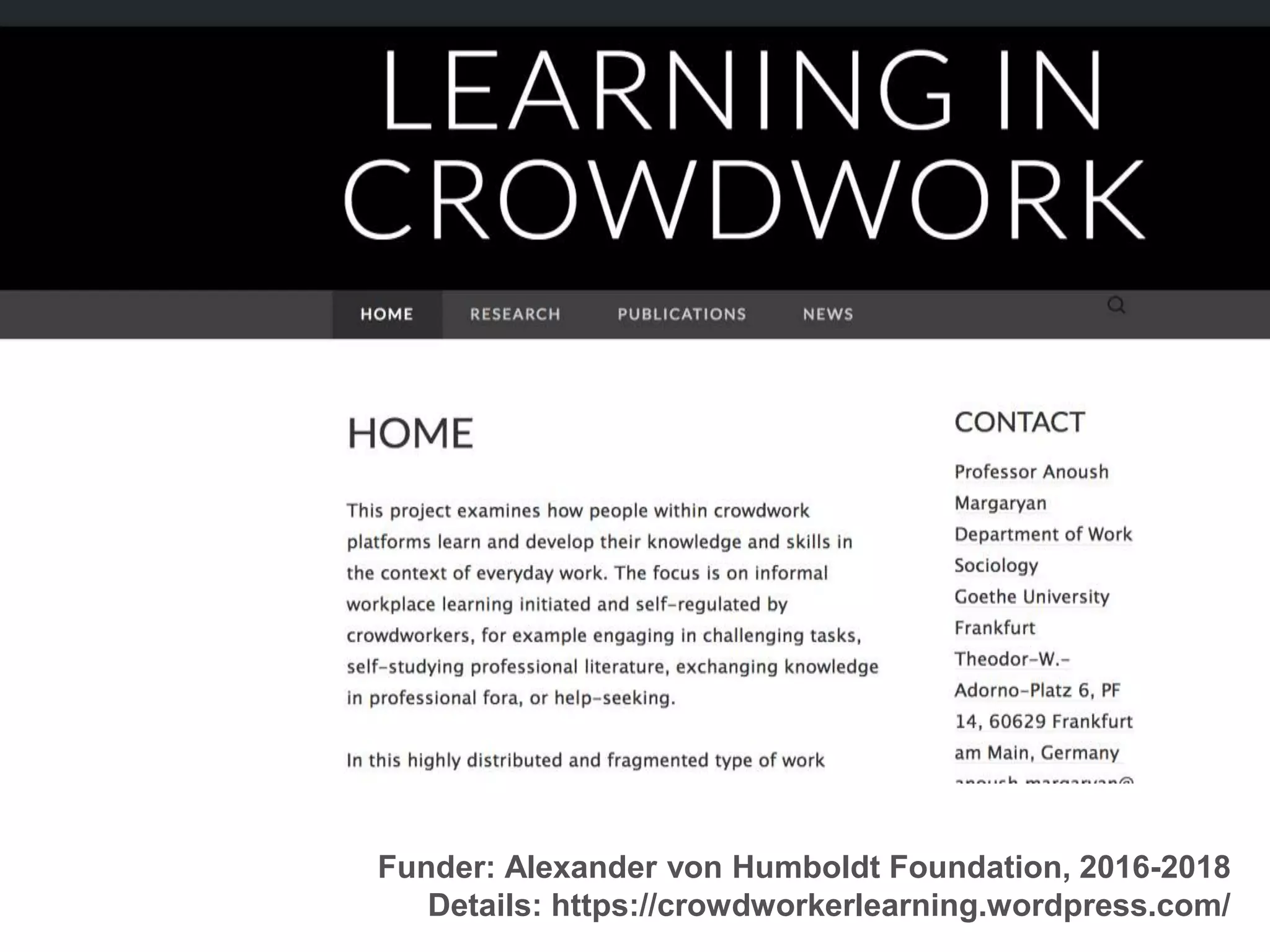
Funder: Alexander von Humboldt Foundation, 2016-2018
Details: https://crowdworkerlearning.wordpress.com/
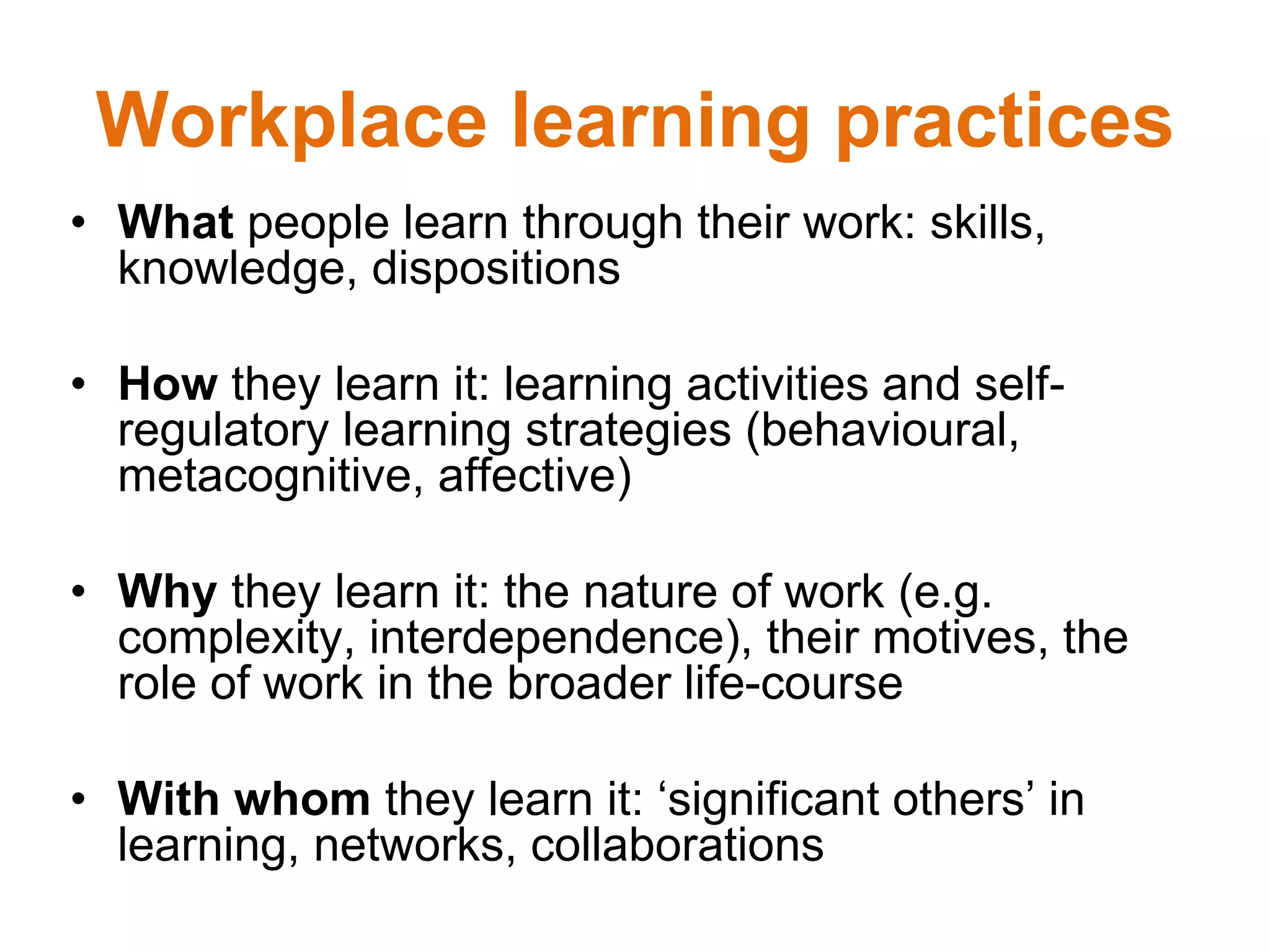
Workplace learning practices
• What people learn through their work: skills,
knowledge, dispositions
• How they learn it: learning activities and self-
regulatory learning strategies (behavioural,
metacognitive, affective)
• Why they learn it: the nature of work (e.g.
complexity, interdependence), their motives, the
role of work in the broader life-course
• With whom they learn it: ‘significant others’ in
learning, networks, collaborations
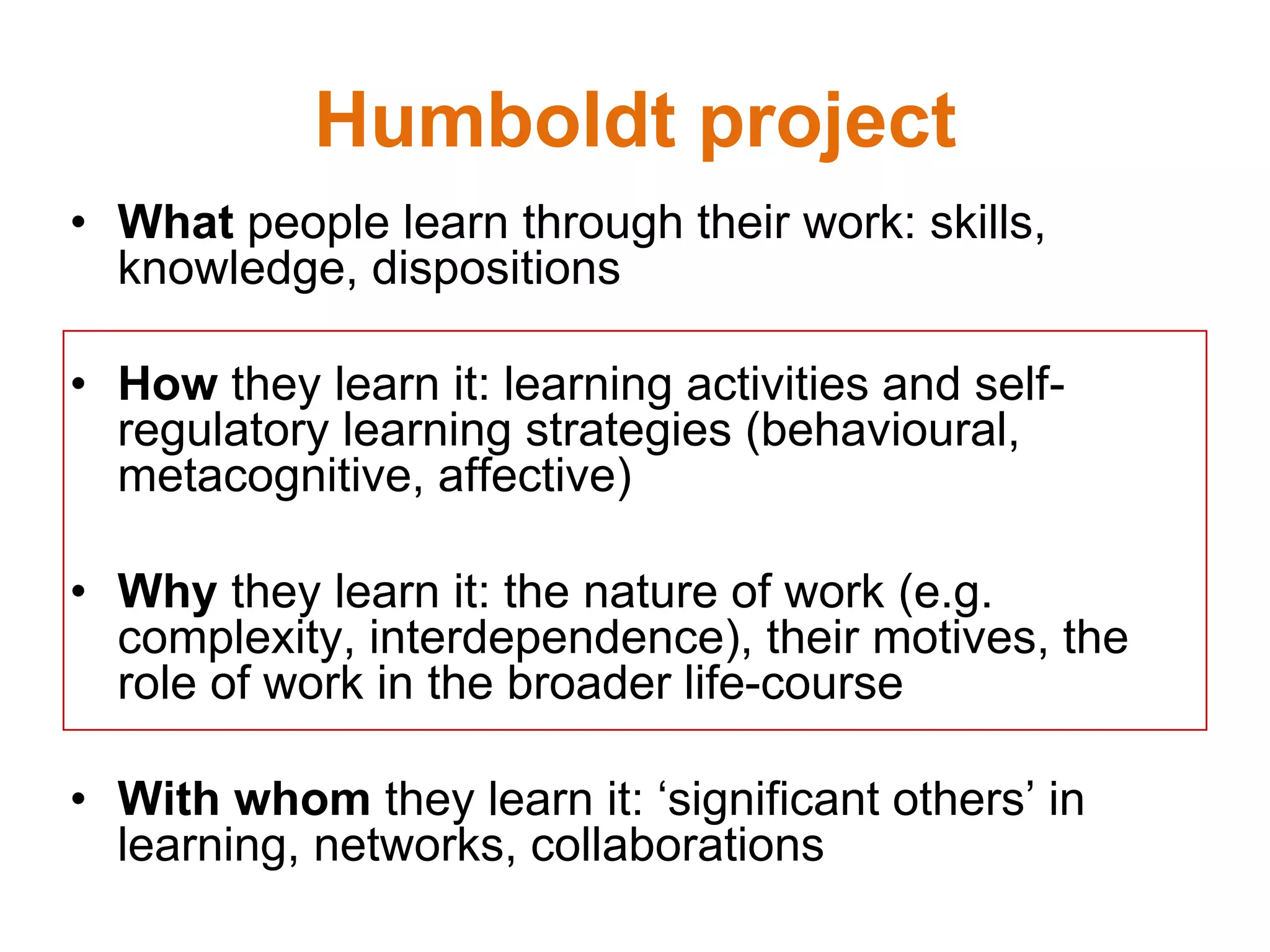
Humboldt project
• What people learn through their work: skills,
knowledge, dispositions
• How they learn it: learning activities and self-
regulatory learning strategies (behavioural,
metacognitive, affective)
• Why they learn it: the nature of work (e.g.
complexity, interdependence), their motives, the
role of work in the broader life-course
• With whom they learn it: ‘significant others’ in
learning, networks, collaborations
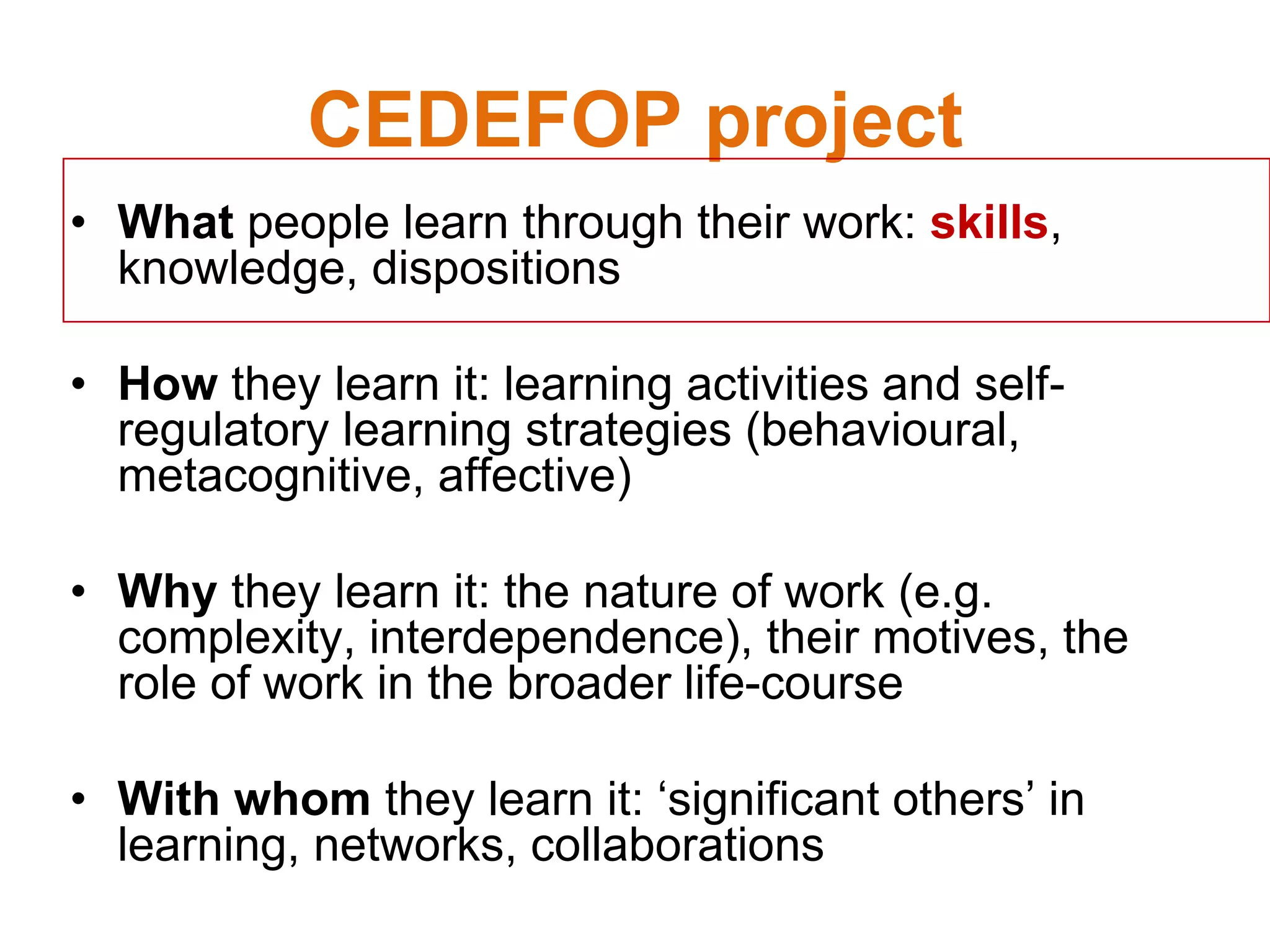
CEDEFOP project
• What people learn through their work: skills,
knowledge, dispositions
• How they learn it: learning activities and self-
regulatory learning strategies (behavioural,
metacognitive, affective)
• Why they learn it: the nature of work (e.g.
complexity, interdependence), their motives, the
role of work in the broader life-course
• With whom they learn it: ‘significant others’ in
learning, networks, collaborations
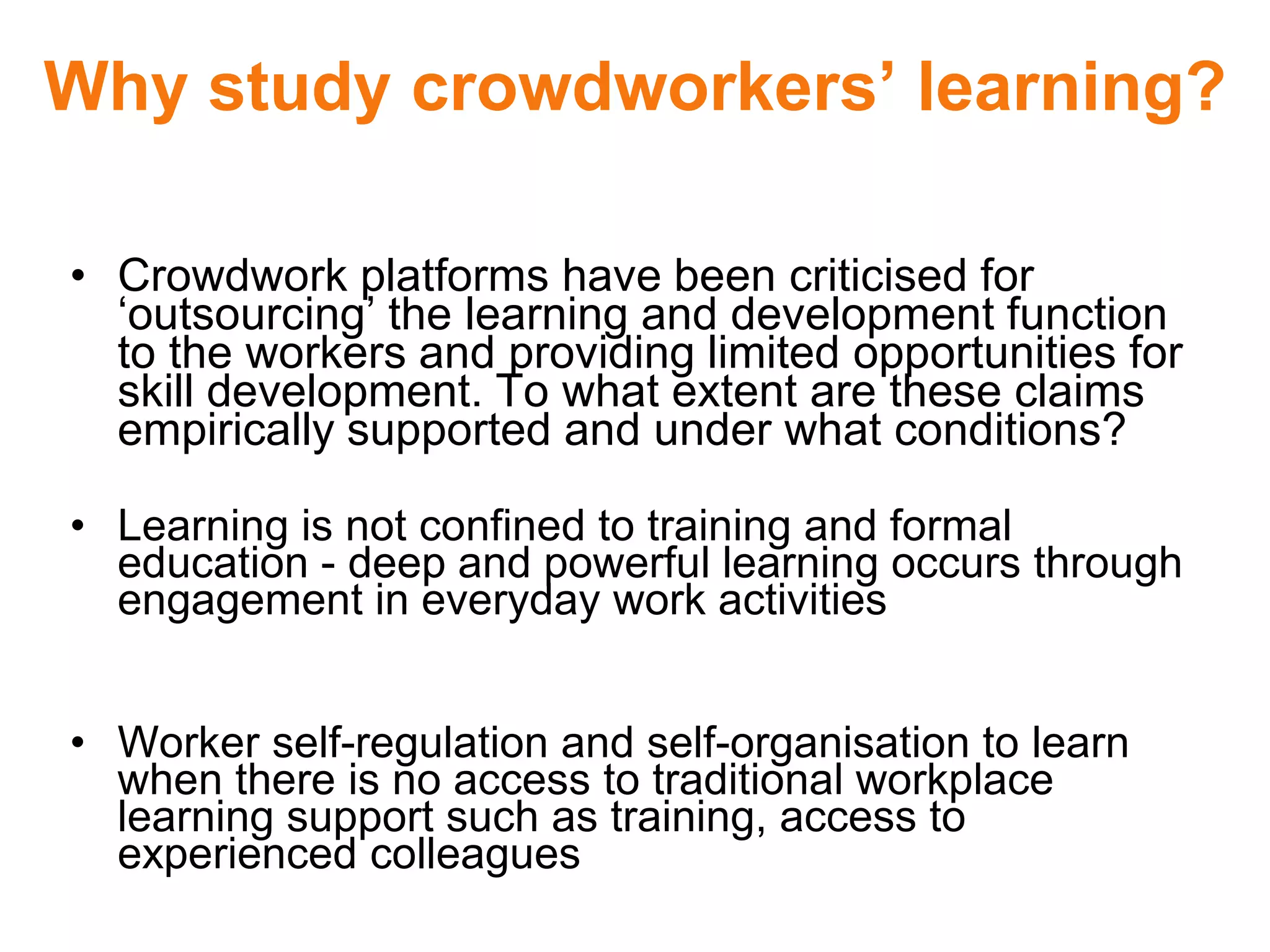
Why study crowdworkers’ learning?
• Crowdwork platforms have been criticised for
‘outsourcing’ the learning and development function
to the workers and providing limited opportunities for
skill development. To what extent are these claims
empirically supported and under what conditions?
• Learning is not confined to training and formal
education - deep and powerful learning occurs through
engagement in everyday work activities
• Worker self-regulation and self-organisation to learn
when there is no access to traditional workplace
learning support such as training, access to
experienced colleagues
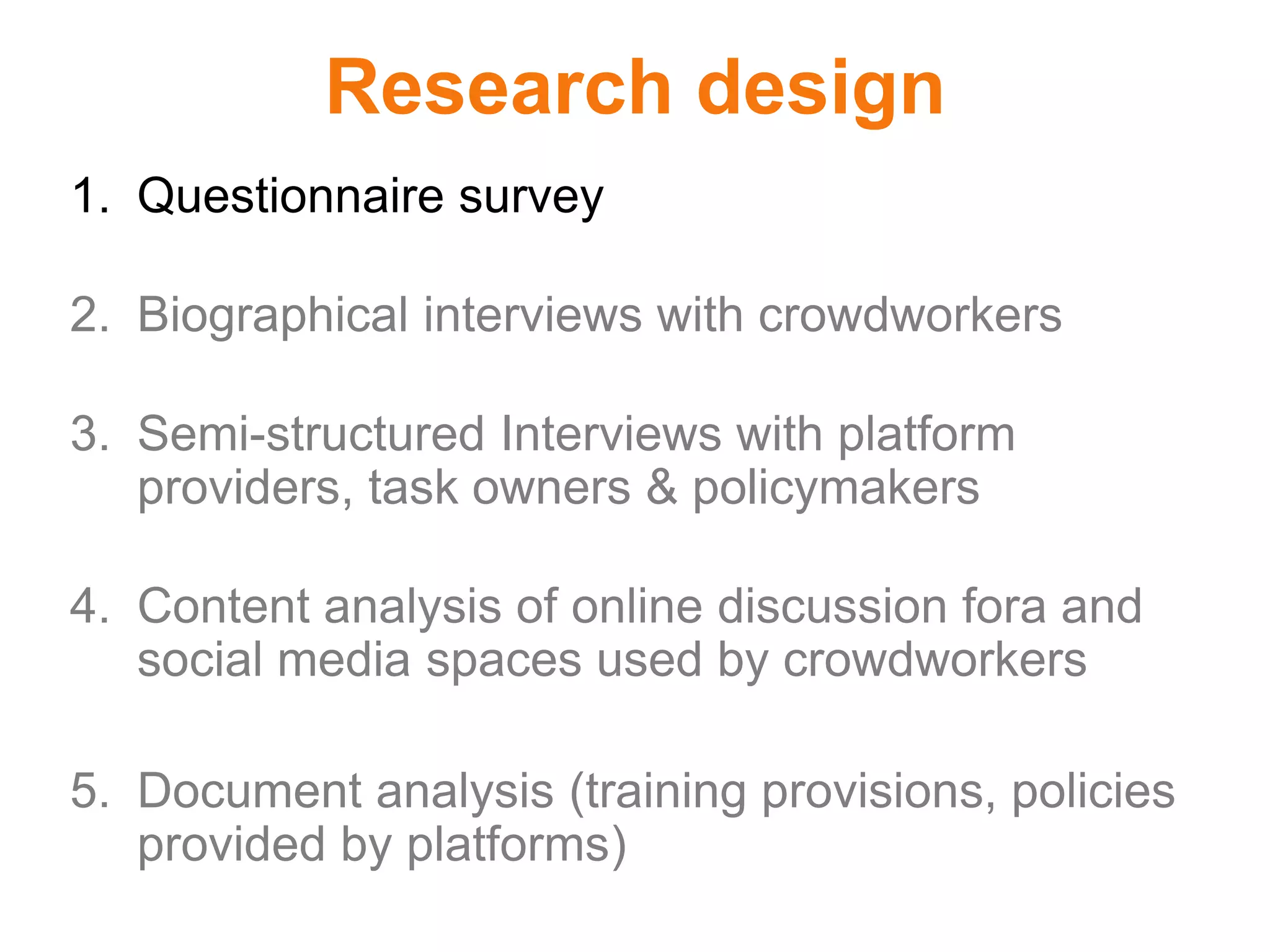
Research design
1. Questionnaire survey
2. Biographical interviews with crowdworkers
3. Semi-structured Interviews with platform
providers, task owners & policymakers
4. Content analysis of online discussion fora and
social media spaces used by crowdworkers
5. Document analysis (training provisions, policies
provided by platforms)
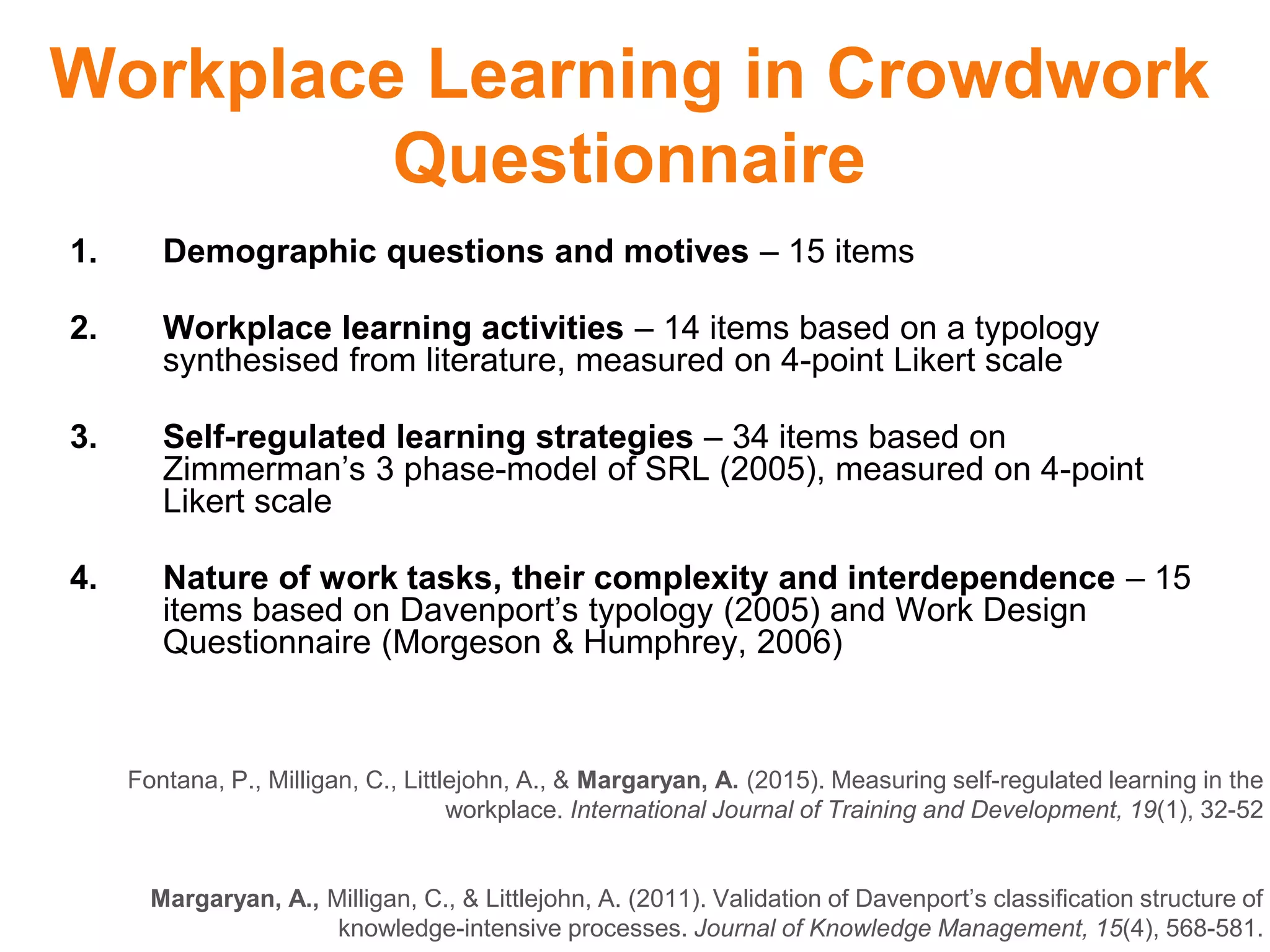
Workplace Learning in Crowdwork
Questionnaire
Fontana, P., Milligan, C., Littlejohn, A., & Margaryan, A. (2015). Measuring self-regulated learning in the
workplace. International Journal of Training and Development, 19(1), 32-52
Margaryan, A., Milligan, C., & Littlejohn, A. (2011). Validation of Davenport’s classification structure of
knowledge-intensive processes. Journal of Knowledge Management, 15(4), 568-581.
1. Demographic questions and motives – 15 items
2. Workplace learning activities – 14 items based on a typology
synthesised from literature, measured on 4-point Likert scale
3. Self-regulated learning strategies – 34 items based on
Zimmerman’s 3 phase-model of SRL (2005), measured on 4-point
Likert scale
4. Nature of work tasks, their complexity and interdependence – 15
items based on Davenport’s typology (2005) and Work Design
Questionnaire (Morgeson & Humphrey, 2006)
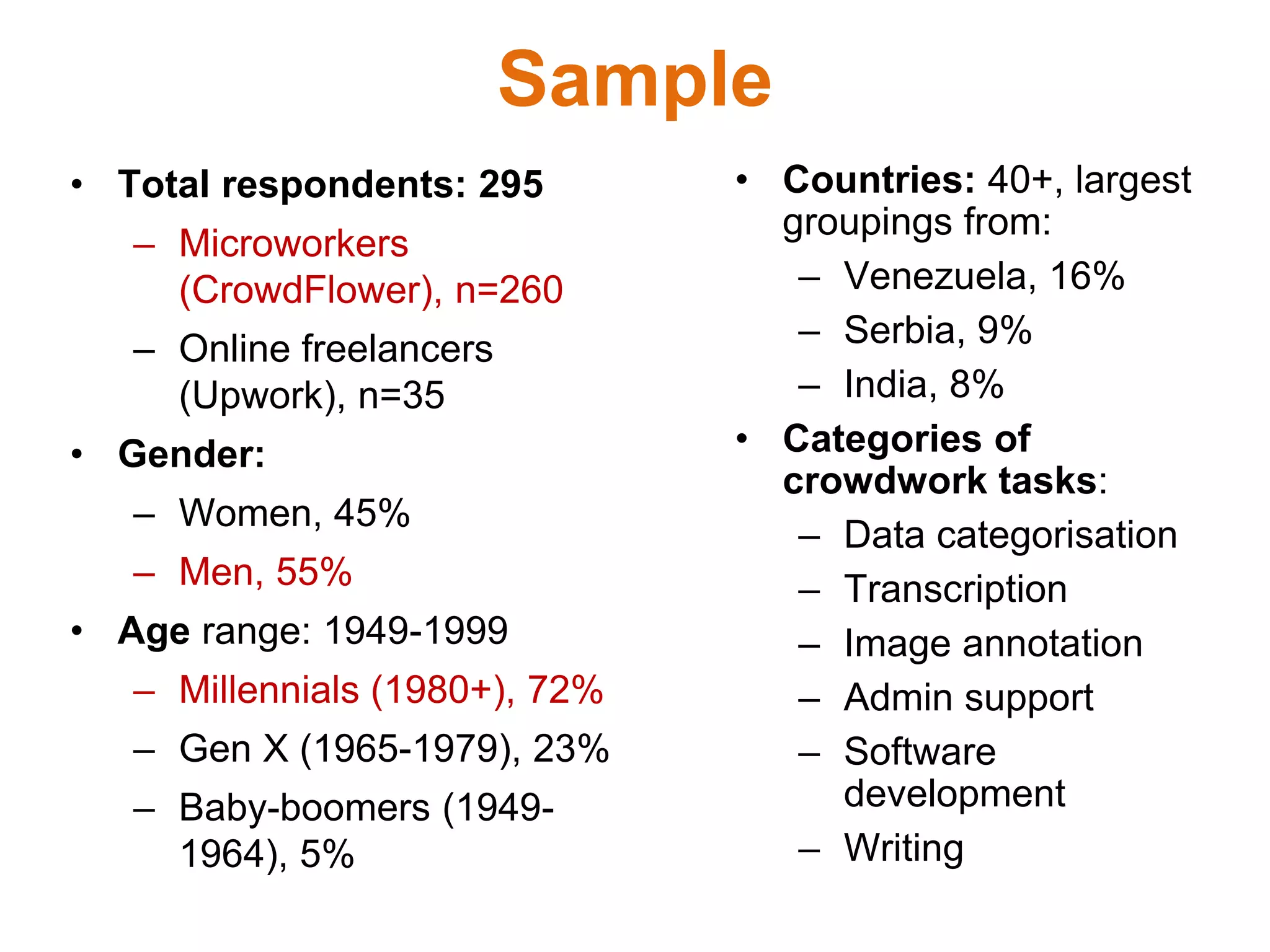
Sample
• Total respondents: 295
– Microworkers
(CrowdFlower), n=260
– Online freelancers
(Upwork), n=35
• Gender:
– Women, 45%
– Men, 55%
• Age range: 1949-1999
– Millennials (1980+), 72%
– Gen X (1965-1979), 23%
– Baby-boomers (1949-
1964), 5%
• Countries: 40+, largest
groupings from:
– Venezuela, 16%
– Serbia, 9%
– India, 8%
• Categories of
crowdwork tasks:
– Data categorisation
– Transcription
– Image annotation
– Admin support
– Software
development
– Writing
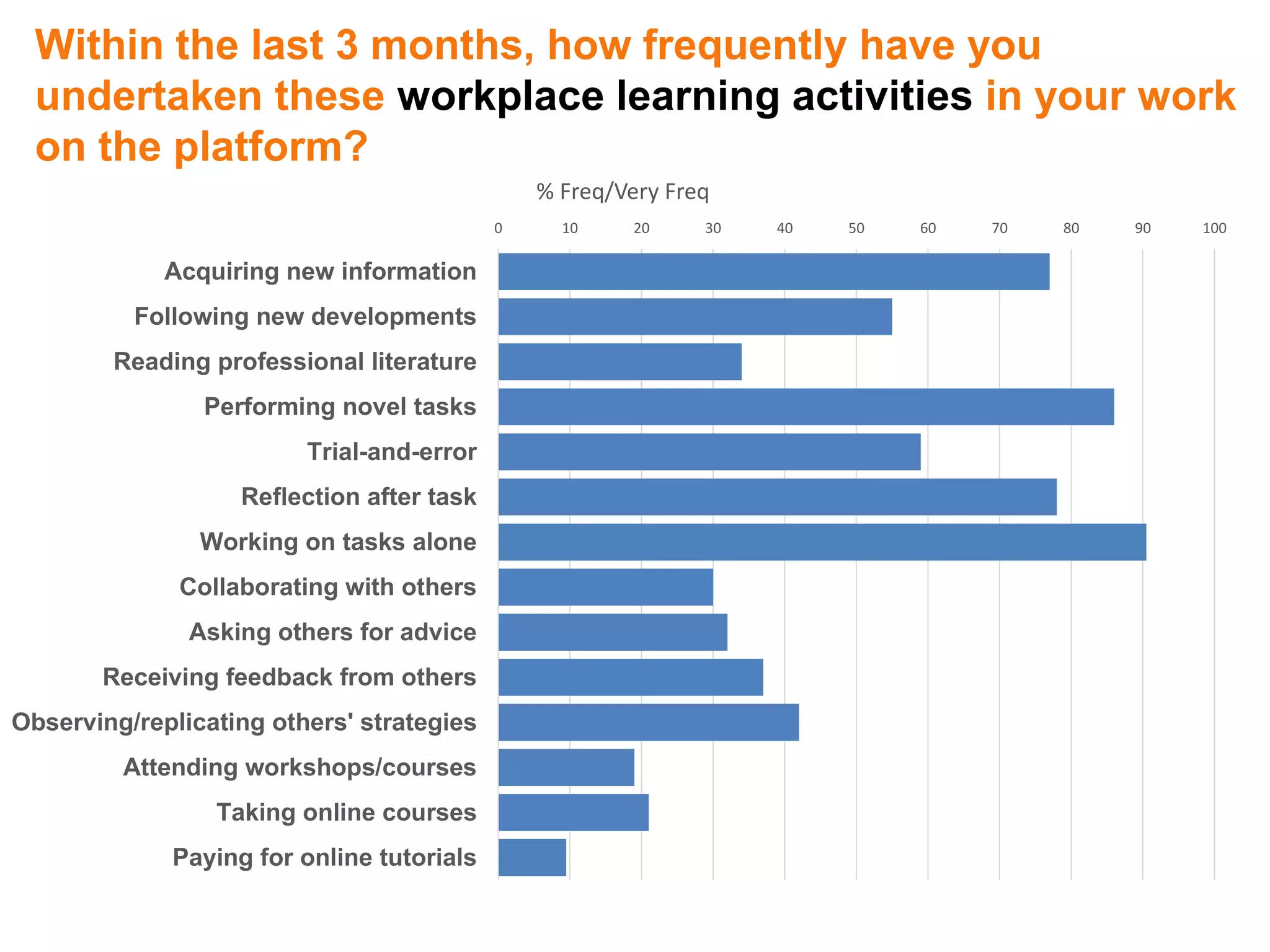
Within the last 3 months, how frequently have you
undertaken these workplace learning activities in your work
on the platform?
0 10 20 30 40 50 60 70 80 90 100
Acquiring new information
Following new developments
Reading professional literature
Performing novel tasks
Trial-and-error
Reflection after task
Working on tasks alone
Collaborating with others
Asking others for advice
Receiving feedback from others
Observing/replicating others' strategies
Attending workshops/courses
Taking online courses
Paying for online tutorials
% Freq/Very Freq
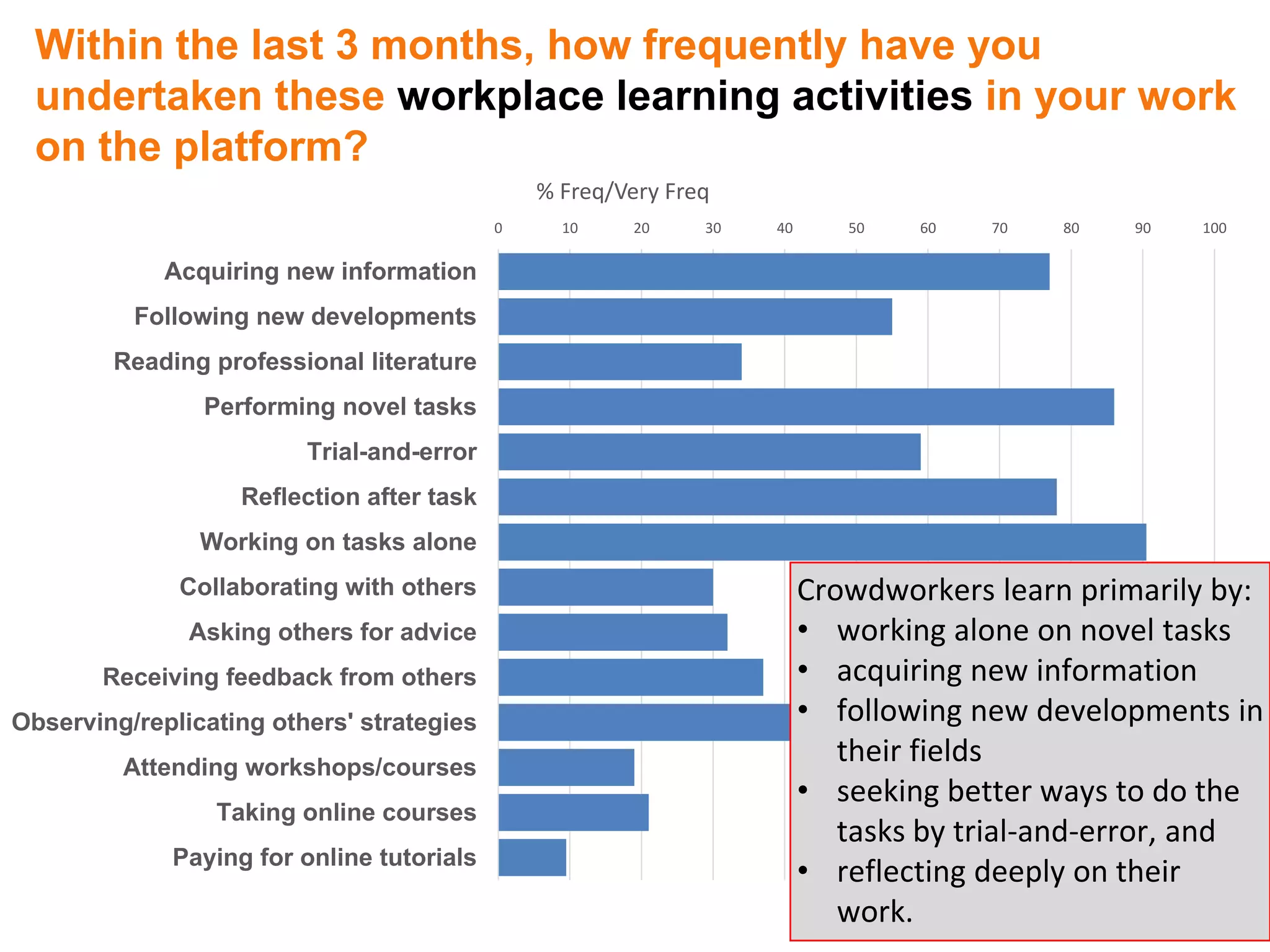
Within the last 3 months, how frequently have you
undertaken these workplace learning activities in your work
on the platform?
0 10 20 30 40 50 60 70 80 90 100
Acquiring new information
Following new developments
Reading professional literature
Performing novel tasks
Trial-and-error
Reflection after task
Working on tasks alone
Collaborating with others
Asking others for advice
Receiving feedback from others
Observing/replicating others' strategies
Attending workshops/courses
Taking online courses
Paying for online tutorials
% Freq/Very Freq
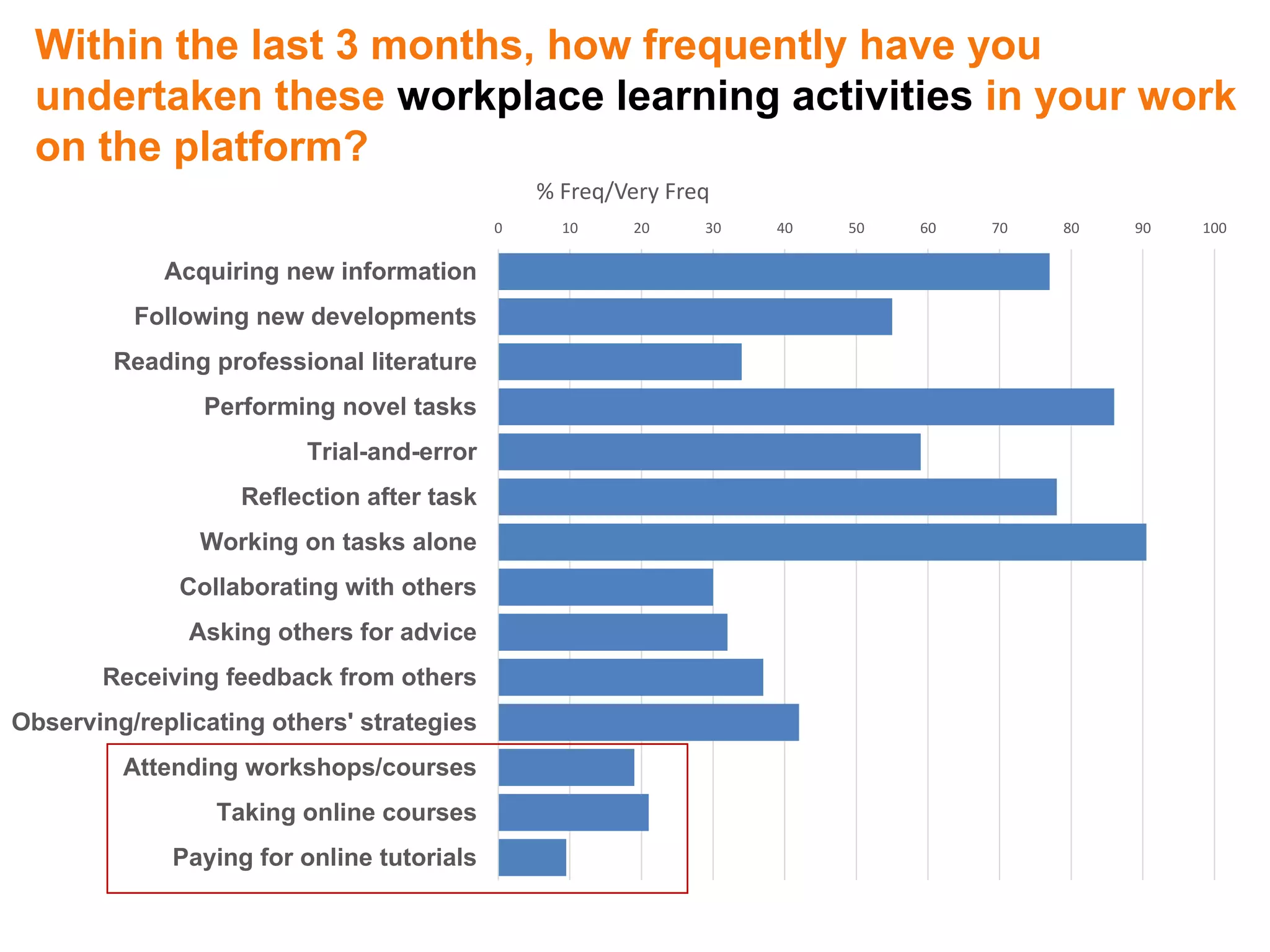
Crowdworkers learn primarily by:
• working alone on novel tasks
• acquiring new information
• following new developments in
their fields
• seeking better ways to do the
tasks by trial-and-error, and
• reflecting deeply on their
work.
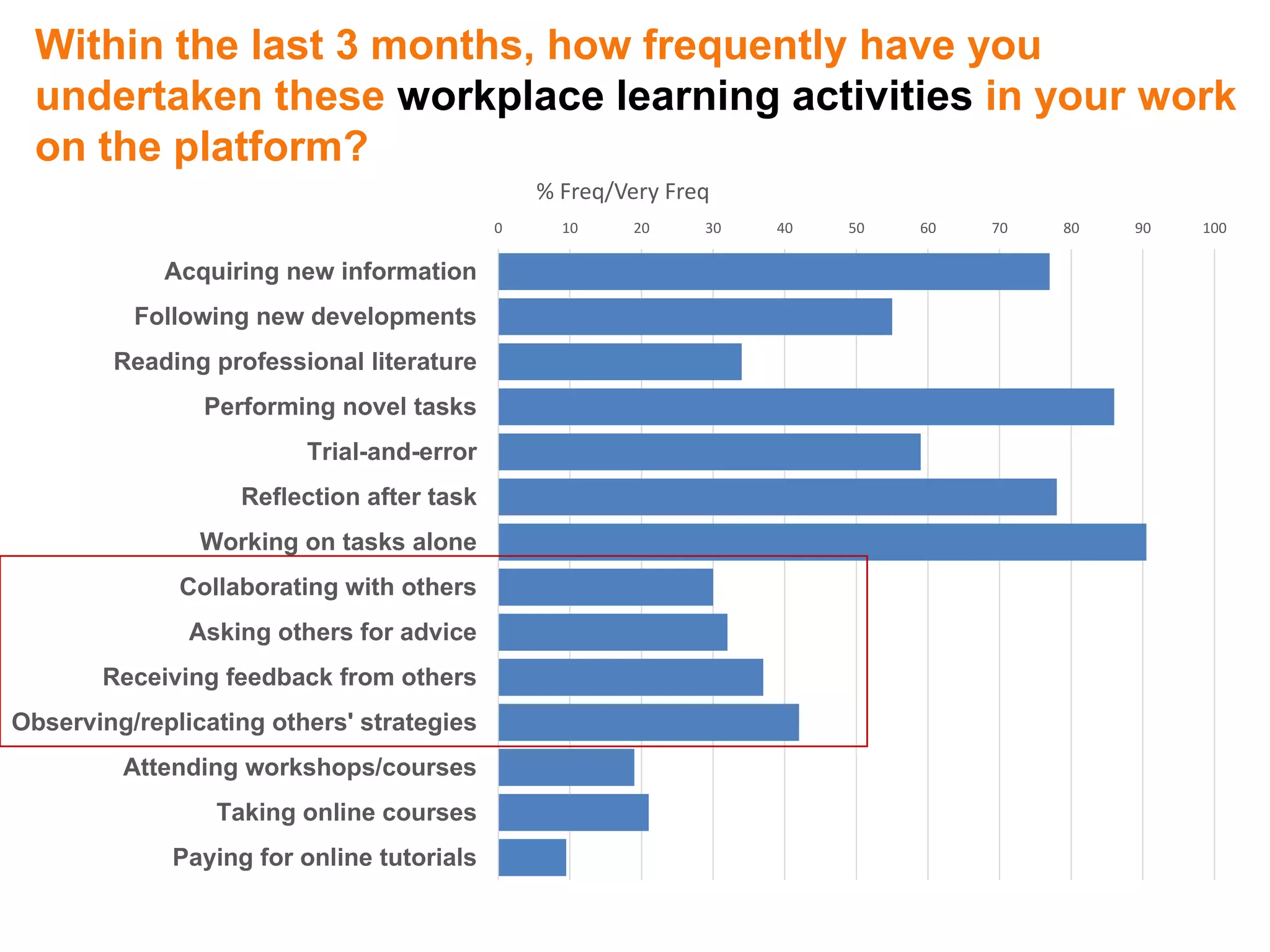
Within the last 3 months, how frequently have you
undertaken these workplace learning activities in your work
on the platform?
0 10 20 30 40 50 60 70 80 90 100
Acquiring new information
Following new developments
Reading professional literature
Performing novel tasks
Trial-and-error
Reflection after task
Working on tasks alone
Collaborating with others
Asking others for advice
Receiving feedback from others
Observing/replicating others' strategies
Attending workshops/courses
Taking online courses
Paying for online tutorials
% Freq/Very Freq
Within the last 3 months, how frequently have you
undertaken these workplace learning activities in your work
on the platform?
0 10 20 30 40 50 60 70 80 90 100
Acquiring new information
Following new developments
Reading professional literature
Performing novel tasks
Trial-and-error
Reflection after task
Working on tasks alone
Collaborating with others
Asking others for advice
Receiving feedback from others
Observing/replicating others' strategies
Attending workshops/courses
Taking online courses
Paying for online tutorials
% Freq/Very Freq
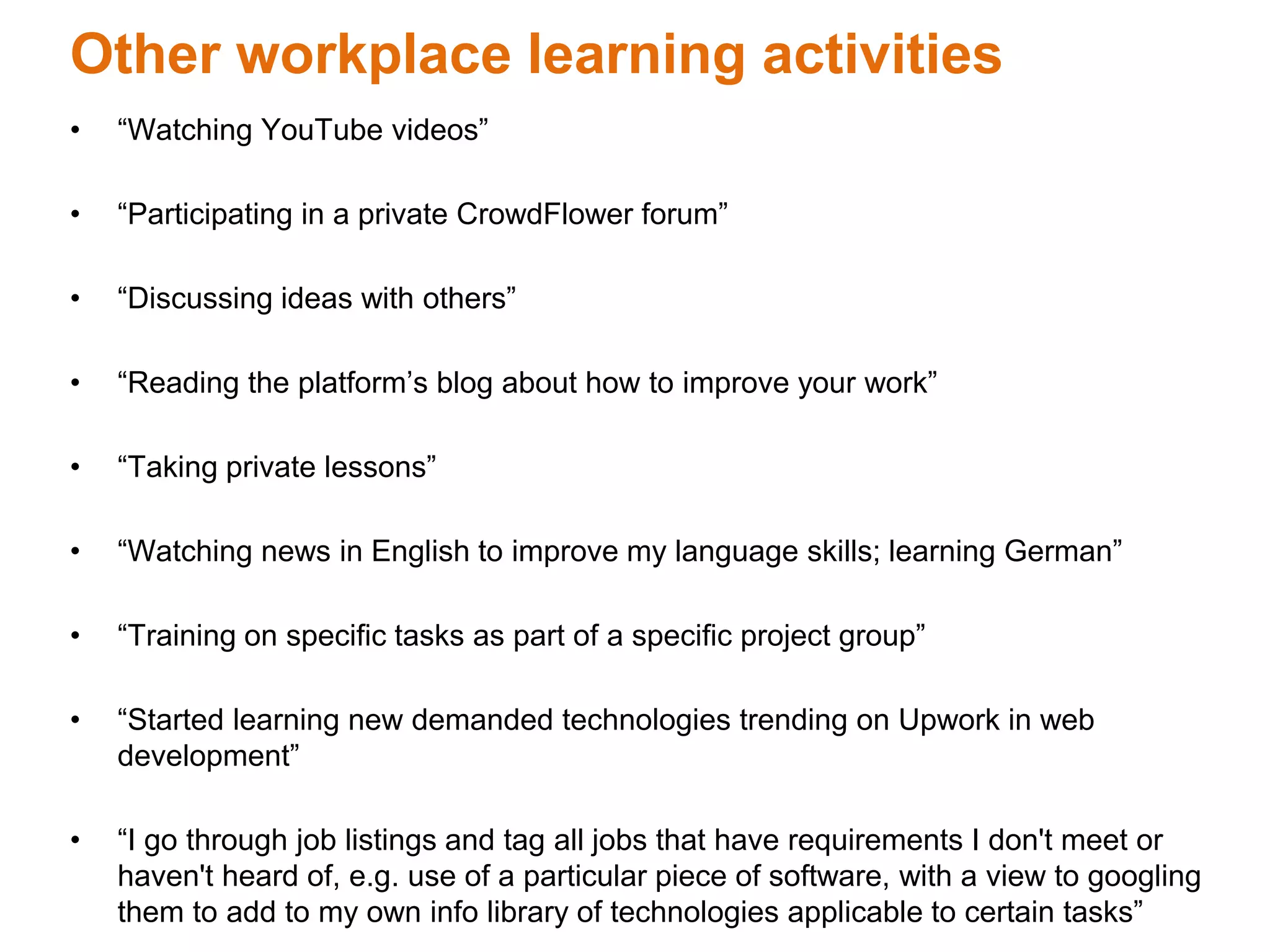
Other workplace learning activities
• “Watching YouTube videos”
• “Participating in a private CrowdFlower forum”
• “Discussing ideas with others”
• “Reading the platform’s blog about how to improve your work”
• “Taking private lessons”
• “Watching news in English to improve my language skills; learning German”
• “Training on specific tasks as part of a specific project group”
• “Started learning new demanded technologies trending on Upwork in web
development”
• “I go through job listings and tag all jobs that have requirements I don't meet or
haven't heard of, e.g. use of a particular piece of software, with a view to googling
them to add to my own info library of technologies applicable to certain tasks”
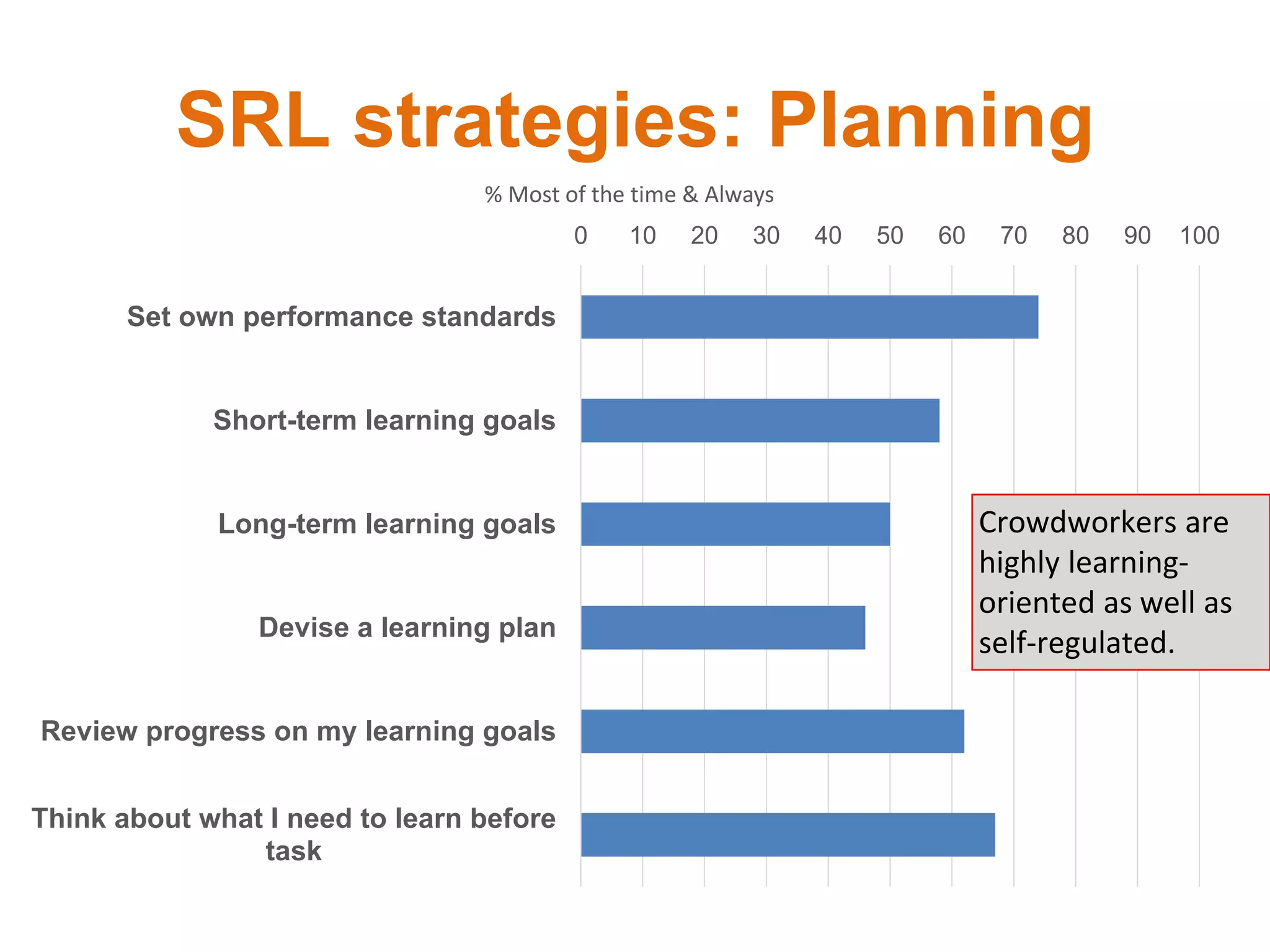
SRL strategies: Planning
0 10 20 30 40 50 60 70 80 90 100
Set own performance standards
Short-term learning goals
Long-term learning goals
Devise a learning plan
Review progress on my learning goals
Think about what I need to learn before
task
% Most of the time & Always
Crowdworkers are
highly learning-
oriented as well as
self-regulated.
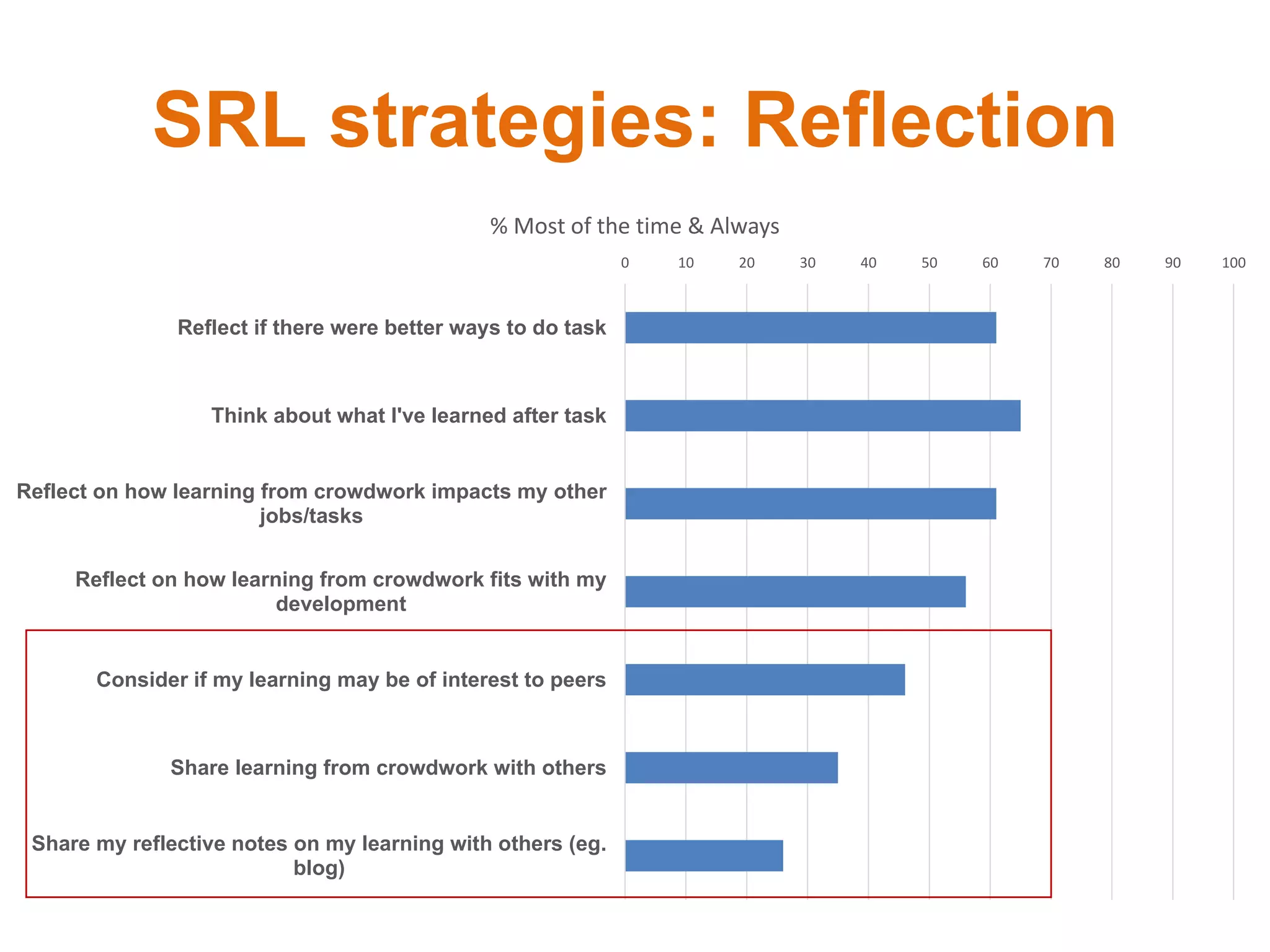
SRL strategies: Reflection
0 10 20 30 40 50 60 70 80 90 100
Reflect if there were better ways to do task
Think about what I've learned after task
Reflect on how learning from crowdwork impacts my other
jobs/tasks
Reflect on how learning from crowdwork fits with my
development
Consider if my learning may be of interest to peers
Share learning from crowdwork with others
Share my reflective notes on my learning with others (eg.
blog)
% Most of the time & Always
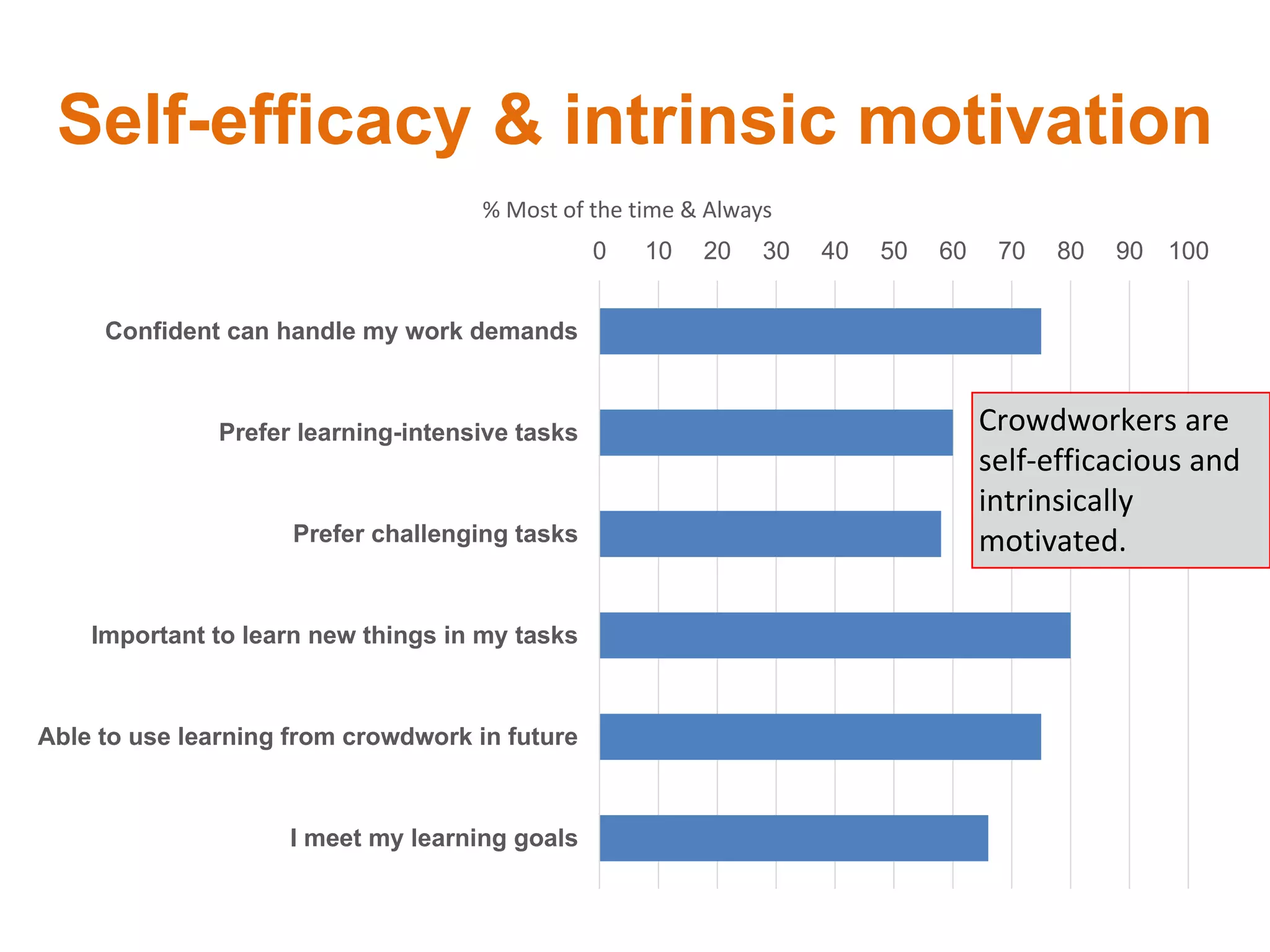
Self-efficacy & intrinsic motivation
0 10 20 30 40 50 60 70 80 90 100
Confident can handle my work demands
Prefer learning-intensive tasks
Prefer challenging tasks
Important to learn new things in my tasks
Able to use learning from crowdwork in future
I meet my learning goals
% Most of the time & Always
Crowdworkers are
self-efficacious and
intrinsically
motivated.
Conclusions
• Crowdwork is learning-intensive
• Crowdworkers are highly self-regulated and learning-oriented
• Crowdworkers’ learning incorporates a notable social dimension
• Crowdwork settings may not provide the support mechanisms for
learning that the traditional workplace do, yet crowdworkers are
proactively seeking and finding opportunities to develop their skills
and to learn individually and with others.
• Whilst some crowdwork tasks may not require advanced skills to
complete, it is misleading to suggest that workers performing these
tasks are low-skilled or have no opportunities to apply their own
skills, know-how or experiences when working on the platforms.

Workplace learningincrowdwork140218

  • 1.
    Workplace learning practices incrowdwork Anoush Margaryan Alexander von Humboldt Senior Fellow and Visiting Professor, University of Frankfurt (2016-2018) Professor, University of West London (from Apr 2018) Twitter: @anoush
  • 2.
    Funder: Alexander vonHumboldt Foundation, 2016-2018 Details: https://crowdworkerlearning.wordpress.com/
  • 3.
    Workplace learning practices •What people learn through their work: skills, knowledge, dispositions • How they learn it: learning activities and self- regulatory learning strategies (behavioural, metacognitive, affective) • Why they learn it: the nature of work (e.g. complexity, interdependence), their motives, the role of work in the broader life-course • With whom they learn it: ‘significant others’ in learning, networks, collaborations
  • 4.
    Humboldt project • Whatpeople learn through their work: skills, knowledge, dispositions • How they learn it: learning activities and self- regulatory learning strategies (behavioural, metacognitive, affective) • Why they learn it: the nature of work (e.g. complexity, interdependence), their motives, the role of work in the broader life-course • With whom they learn it: ‘significant others’ in learning, networks, collaborations
  • 5.
    CEDEFOP project • Whatpeople learn through their work: skills, knowledge, dispositions • How they learn it: learning activities and self- regulatory learning strategies (behavioural, metacognitive, affective) • Why they learn it: the nature of work (e.g. complexity, interdependence), their motives, the role of work in the broader life-course • With whom they learn it: ‘significant others’ in learning, networks, collaborations
  • 6.
    Why study crowdworkers’learning? • Crowdwork platforms have been criticised for ‘outsourcing’ the learning and development function to the workers and providing limited opportunities for skill development. To what extent are these claims empirically supported and under what conditions? • Learning is not confined to training and formal education - deep and powerful learning occurs through engagement in everyday work activities • Worker self-regulation and self-organisation to learn when there is no access to traditional workplace learning support such as training, access to experienced colleagues
  • 7.
    Research design 1. Questionnairesurvey 2. Biographical interviews with crowdworkers 3. Semi-structured Interviews with platform providers, task owners & policymakers 4. Content analysis of online discussion fora and social media spaces used by crowdworkers 5. Document analysis (training provisions, policies provided by platforms)
  • 8.
    Workplace Learning inCrowdwork Questionnaire Fontana, P., Milligan, C., Littlejohn, A., & Margaryan, A. (2015). Measuring self-regulated learning in the workplace. International Journal of Training and Development, 19(1), 32-52 Margaryan, A., Milligan, C., & Littlejohn, A. (2011). Validation of Davenport’s classification structure of knowledge-intensive processes. Journal of Knowledge Management, 15(4), 568-581. 1. Demographic questions and motives – 15 items 2. Workplace learning activities – 14 items based on a typology synthesised from literature, measured on 4-point Likert scale 3. Self-regulated learning strategies – 34 items based on Zimmerman’s 3 phase-model of SRL (2005), measured on 4-point Likert scale 4. Nature of work tasks, their complexity and interdependence – 15 items based on Davenport’s typology (2005) and Work Design Questionnaire (Morgeson & Humphrey, 2006)
  • 9.
    Sample • Total respondents:295 – Microworkers (CrowdFlower), n=260 – Online freelancers (Upwork), n=35 • Gender: – Women, 45% – Men, 55% • Age range: 1949-1999 – Millennials (1980+), 72% – Gen X (1965-1979), 23% – Baby-boomers (1949- 1964), 5% • Countries: 40+, largest groupings from: – Venezuela, 16% – Serbia, 9% – India, 8% • Categories of crowdwork tasks: – Data categorisation – Transcription – Image annotation – Admin support – Software development – Writing
  • 10.
    Within the last3 months, how frequently have you undertaken these workplace learning activities in your work on the platform? 0 10 20 30 40 50 60 70 80 90 100 Acquiring new information Following new developments Reading professional literature Performing novel tasks Trial-and-error Reflection after task Working on tasks alone Collaborating with others Asking others for advice Receiving feedback from others Observing/replicating others' strategies Attending workshops/courses Taking online courses Paying for online tutorials % Freq/Very Freq
  • 11.
    Within the last3 months, how frequently have you undertaken these workplace learning activities in your work on the platform? 0 10 20 30 40 50 60 70 80 90 100 Acquiring new information Following new developments Reading professional literature Performing novel tasks Trial-and-error Reflection after task Working on tasks alone Collaborating with others Asking others for advice Receiving feedback from others Observing/replicating others' strategies Attending workshops/courses Taking online courses Paying for online tutorials % Freq/Very Freq Crowdworkers learn primarily by: • working alone on novel tasks • acquiring new information • following new developments in their fields • seeking better ways to do the tasks by trial-and-error, and • reflecting deeply on their work.
  • 12.
    Within the last3 months, how frequently have you undertaken these workplace learning activities in your work on the platform? 0 10 20 30 40 50 60 70 80 90 100 Acquiring new information Following new developments Reading professional literature Performing novel tasks Trial-and-error Reflection after task Working on tasks alone Collaborating with others Asking others for advice Receiving feedback from others Observing/replicating others' strategies Attending workshops/courses Taking online courses Paying for online tutorials % Freq/Very Freq
  • 13.
    Within the last3 months, how frequently have you undertaken these workplace learning activities in your work on the platform? 0 10 20 30 40 50 60 70 80 90 100 Acquiring new information Following new developments Reading professional literature Performing novel tasks Trial-and-error Reflection after task Working on tasks alone Collaborating with others Asking others for advice Receiving feedback from others Observing/replicating others' strategies Attending workshops/courses Taking online courses Paying for online tutorials % Freq/Very Freq
  • 14.
    Other workplace learningactivities • “Watching YouTube videos” • “Participating in a private CrowdFlower forum” • “Discussing ideas with others” • “Reading the platform’s blog about how to improve your work” • “Taking private lessons” • “Watching news in English to improve my language skills; learning German” • “Training on specific tasks as part of a specific project group” • “Started learning new demanded technologies trending on Upwork in web development” • “I go through job listings and tag all jobs that have requirements I don't meet or haven't heard of, e.g. use of a particular piece of software, with a view to googling them to add to my own info library of technologies applicable to certain tasks”
  • 15.
    SRL strategies: Planning 010 20 30 40 50 60 70 80 90 100 Set own performance standards Short-term learning goals Long-term learning goals Devise a learning plan Review progress on my learning goals Think about what I need to learn before task % Most of the time & Always Crowdworkers are highly learning- oriented as well as self-regulated.
  • 16.
    SRL strategies: Reflection 010 20 30 40 50 60 70 80 90 100 Reflect if there were better ways to do task Think about what I've learned after task Reflect on how learning from crowdwork impacts my other jobs/tasks Reflect on how learning from crowdwork fits with my development Consider if my learning may be of interest to peers Share learning from crowdwork with others Share my reflective notes on my learning with others (eg. blog) % Most of the time & Always
  • 17.
    Self-efficacy & intrinsicmotivation 0 10 20 30 40 50 60 70 80 90 100 Confident can handle my work demands Prefer learning-intensive tasks Prefer challenging tasks Important to learn new things in my tasks Able to use learning from crowdwork in future I meet my learning goals % Most of the time & Always Crowdworkers are self-efficacious and intrinsically motivated.
  • 18.
    Conclusions • Crowdwork islearning-intensive • Crowdworkers are highly self-regulated and learning-oriented • Crowdworkers’ learning incorporates a notable social dimension • Crowdwork settings may not provide the support mechanisms for learning that the traditional workplace do, yet crowdworkers are proactively seeking and finding opportunities to develop their skills and to learn individually and with others. • Whilst some crowdwork tasks may not require advanced skills to complete, it is misleading to suggest that workers performing these tasks are low-skilled or have no opportunities to apply their own skills, know-how or experiences when working on the platforms.

Editor's Notes

  • #6 https://www.oii.ox.ac.uk/research/projects/skills-formation-and-skills-matching-in-online-platform-work-practices-and-policies-for-promoting-crowdworkers-continuous-learning/