Using the Life Course Perspective
to analyse learning practices
within crowdwork
Prof. Anoush Margaryan and Prof. Heather Hofmeister
Sociology, specialty Sociology of Work
• What is crowdwork?
• Research gaps
• The Life Course
• Examples from empirical research
• Issues and questions
2 Margaryan and Hofmeister, 25 May 2017
Outline
Sociology, specialty Sociology of Work3 Margaryan and Hofmeister, 25 May 2017
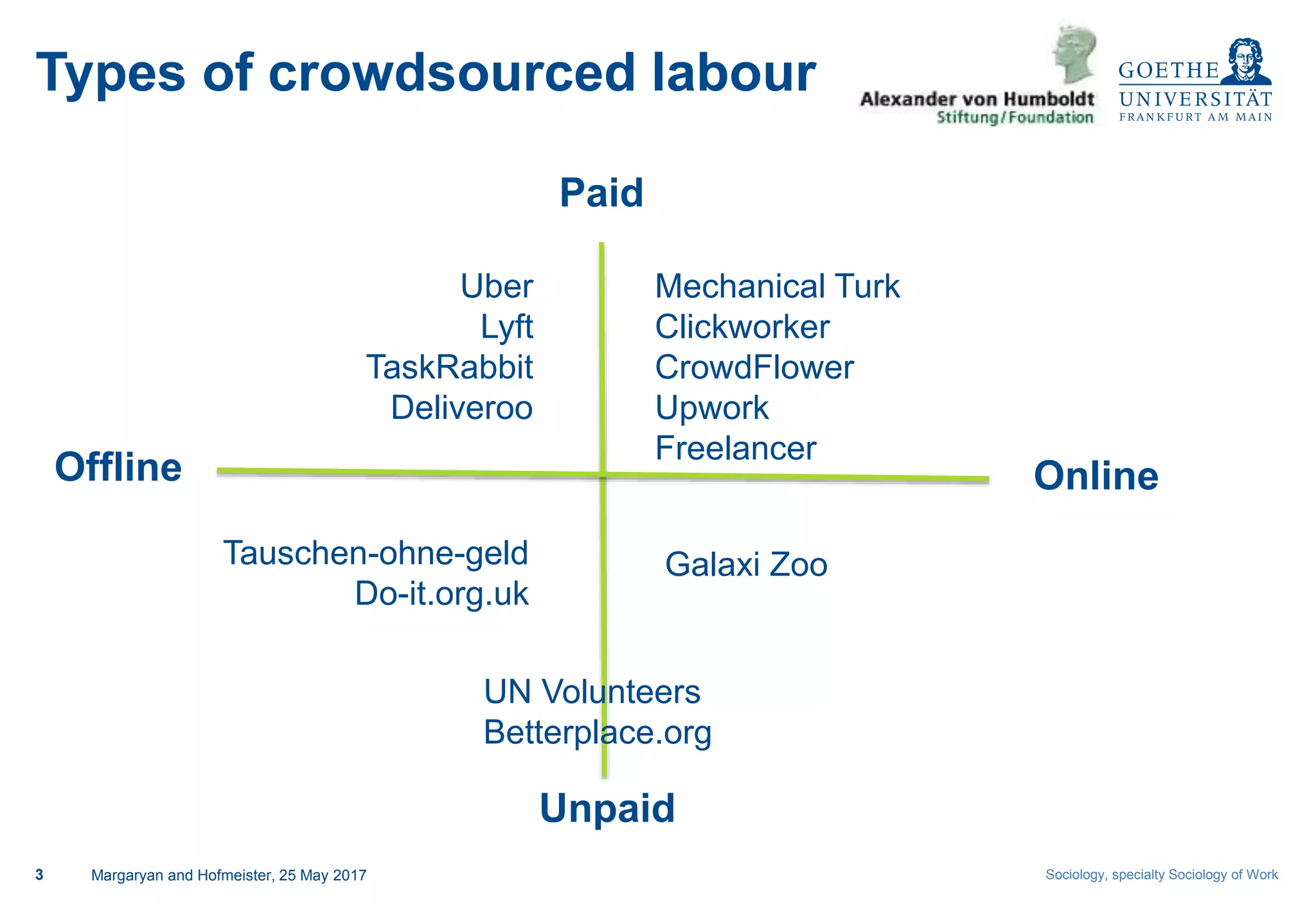
Types of crowdsourced labour
Paid
Unpaid
OnlineOffline
Mechanical Turk
Clickworker
CrowdFlower
Upwork
Freelancer
Galaxi Zoo
Uber
Lyft
TaskRabbit
Deliveroo
Tauschen-ohne-geld
Do-it.org.uk
UN Volunteers
Betterplace.org
Sociology, specialty Sociology of Work4 Margaryan and Hofmeister, 25 May 2017
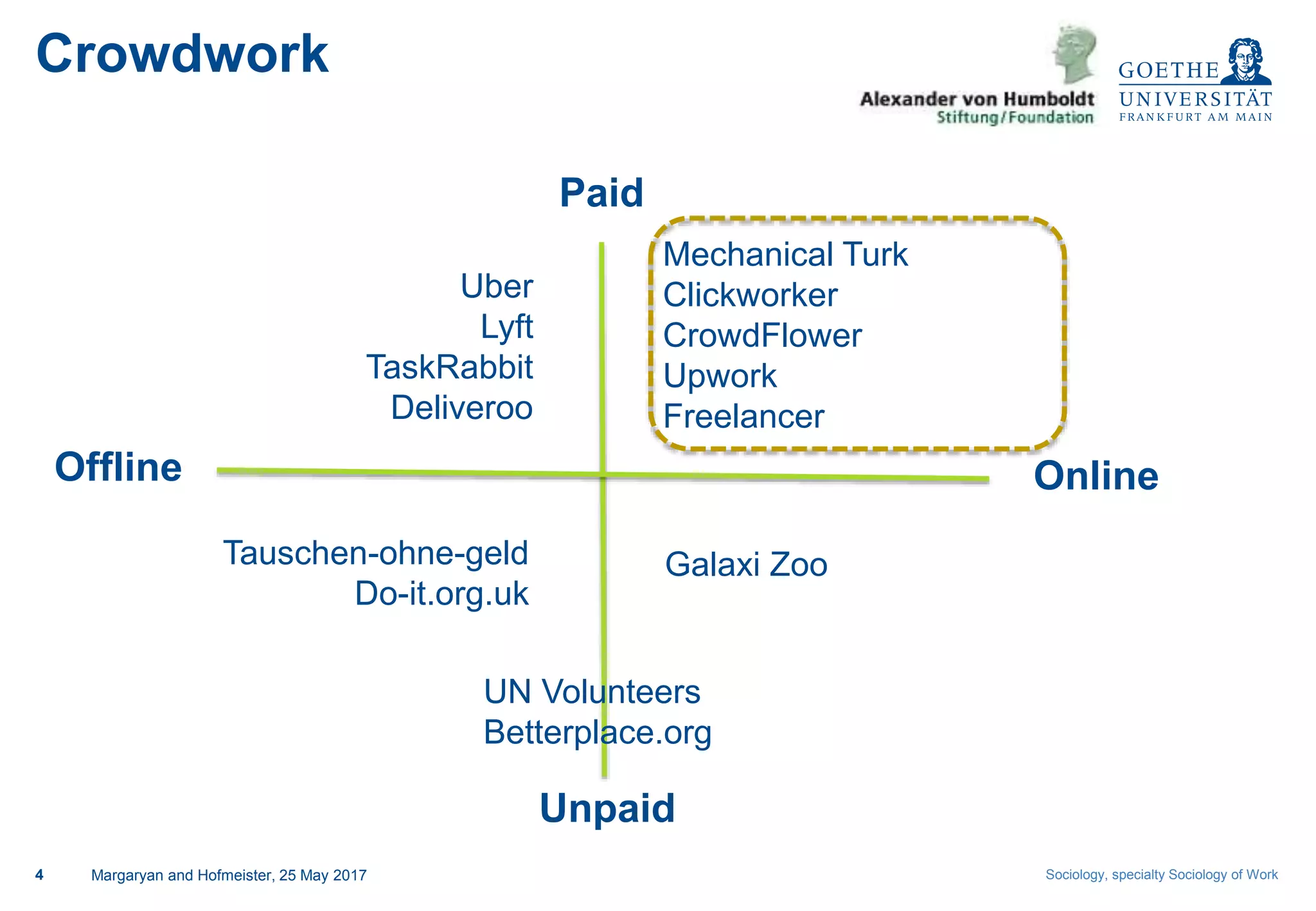
Crowdwork
Paid
Unpaid
OnlineOffline
Mechanical Turk
Clickworker
CrowdFlower
Upwork
Freelancer
Uber
Lyft
TaskRabbit
Deliveroo
Galaxi ZooTauschen-ohne-geld
Do-it.org.uk
UN Volunteers
Betterplace.org
Sociology, specialty Sociology of Work5 Margaryan and Hofmeister, 25 May 2017
Two types of crowdwork
Paid
Unpaid
OnlineOffline
Mechanical Turk
Clickworker
CrowdFlower
Upwork
Freelancer
Microwork
Online
Freelancing
Kuek, Siou Chew, et al. (2015). The global opportunity in online outsourcing. Washington, DC: World Bank.
Sociology, specialty Sociology of Work
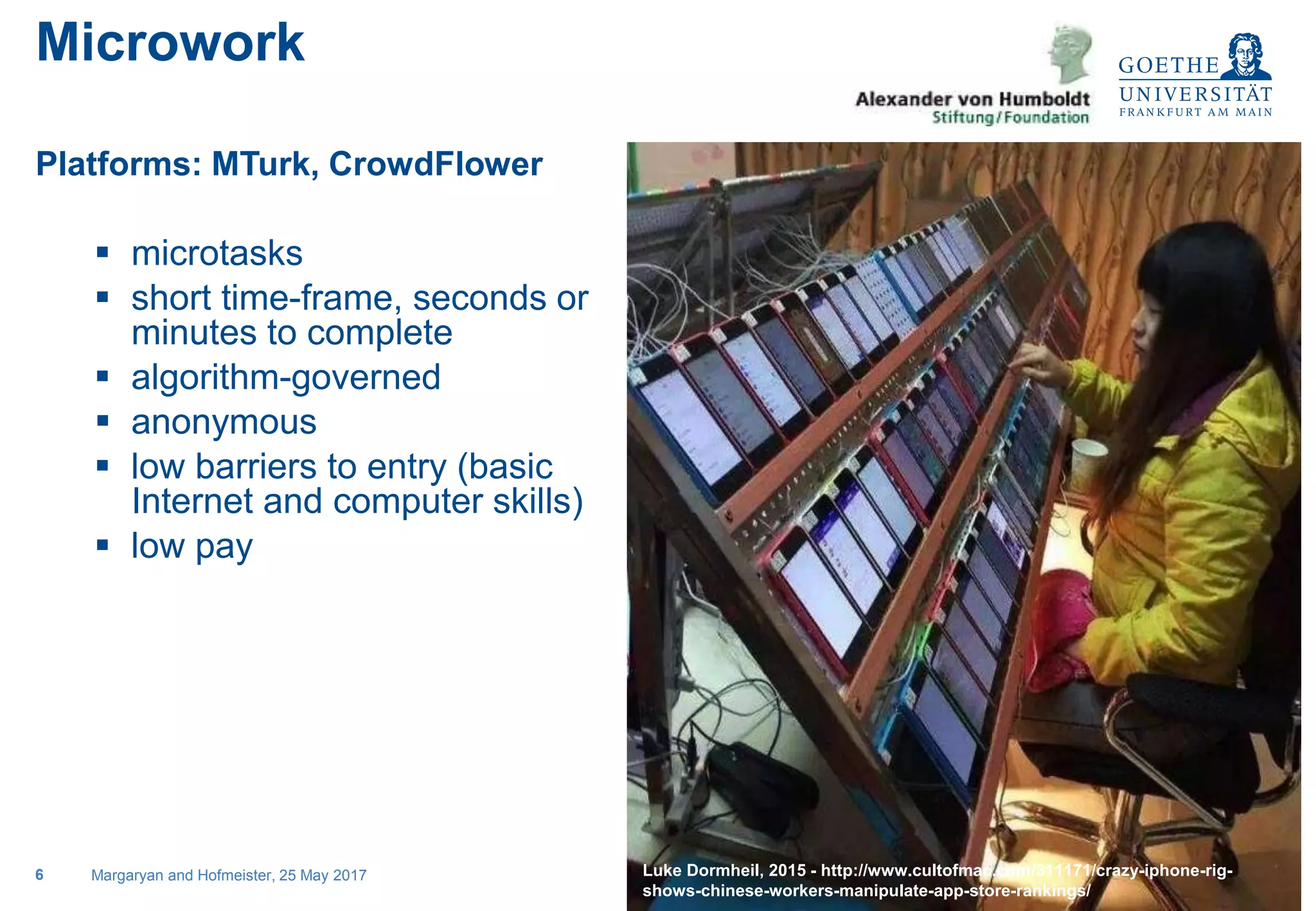
Platforms: MTurk, CrowdFlower
 microtasks
 short time-frame, seconds or
minutes to complete
 algorithm-governed
 anonymous
 low barriers to entry (basic
Internet and computer skills)
 low pay
Margaryan and Hofmeister, 25 May 20176
Microwork
Insert the clickfarm pic here
Luke Dormheil, 2015 - http://www.cultofmac.com/311171/crazy-iphone-rig-
shows-chinese-workers-manipulate-app-store-rankings/
Sociology, specialty Sociology of Work
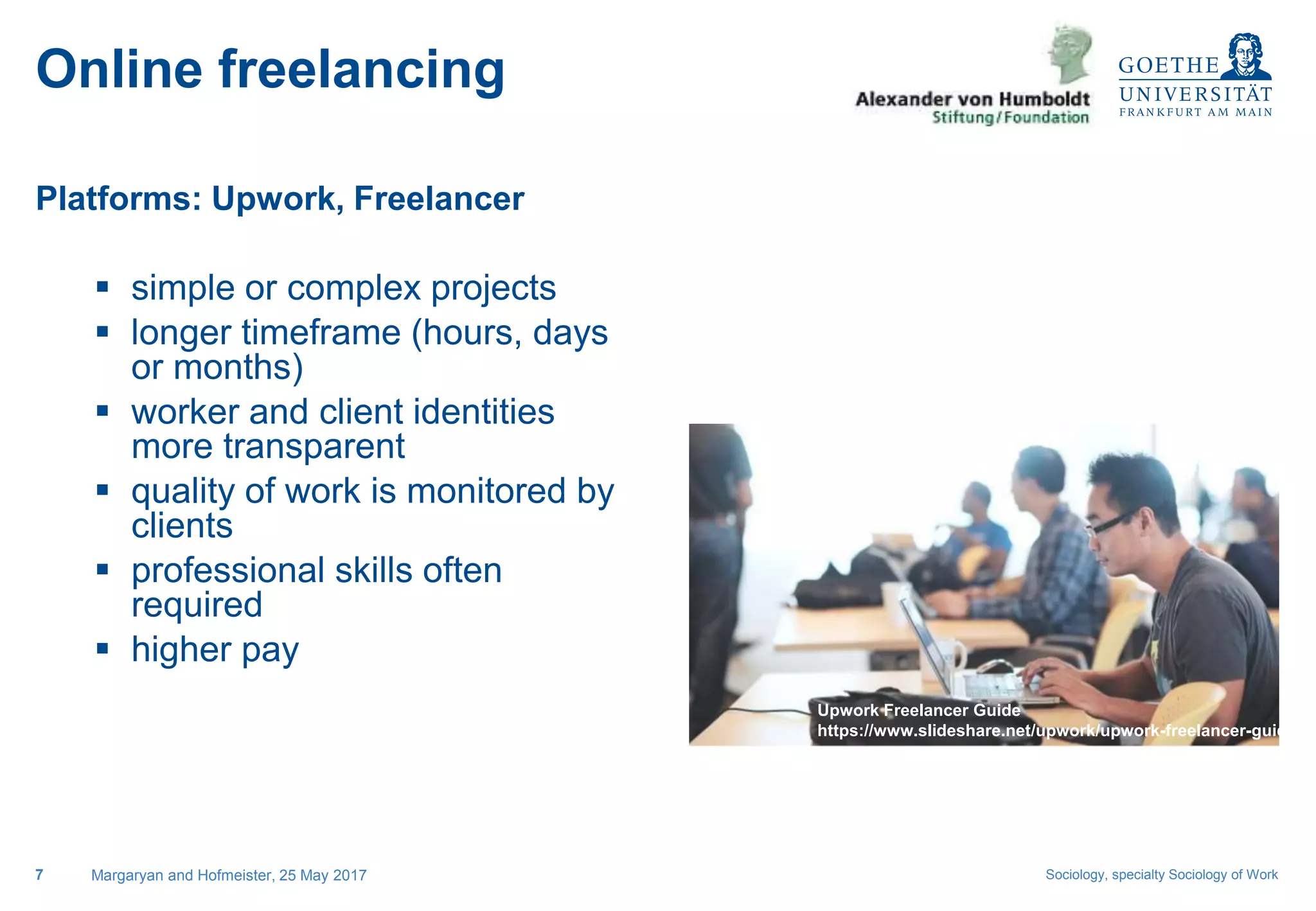
Platforms: Upwork, Freelancer
 simple or complex projects
 longer timeframe (hours, days
or months)
 worker and client identities
more transparent
 quality of work is monitored by
clients
 professional skills often
required
 higher pay
Margaryan and Hofmeister, 25 May 20177
Online freelancing
Upwork Freelancer Guide
https://www.slideshare.net/upwork/upwork-freelancer-guide
Sociology, specialty Sociology of Work
• Lack of stats on crowdwork market – no representative
sampling possible
8 Margaryan and Hofmeister, 25 May 2017
Research gaps
Sociology, specialty Sociology of Work
• Lack of stats on crowdwork market – no representative
sampling possible
• Mostly surveys, online experiments or
interventions/tech development; limited qualitative/in
situ understanding of crowdwork
9 Margaryan and Hofmeister, 25 May 2017
Research gaps
Sociology, specialty Sociology of Work
• Lack of stats on crowdwork market – no representative
sampling possible
• Mostly surveys, online experiments or
interventions/tech development; limited qualitative/in
situ understanding of crowdwork
• Lack of integrative analytical-methodological
approaches, much of research is piecemeal
10 Margaryan and Hofmeister, 25 May 2017
Research gaps
Sociology, specialty Sociology of Work
• Lack of stats on crowdwork market – no representative
sampling possible
• Mostly surveys, online experiments or
interventions/tech development; limited qualitative/in
situ understanding of crowdwork
• Lack of integrative analytical-methodological
approaches, much of research is piecemeal
• Crowdworkers’ experiences are decontextualised
11 Margaryan and Hofmeister, 25 May 2017
Research gaps
Sociology, specialty Sociology of Work12
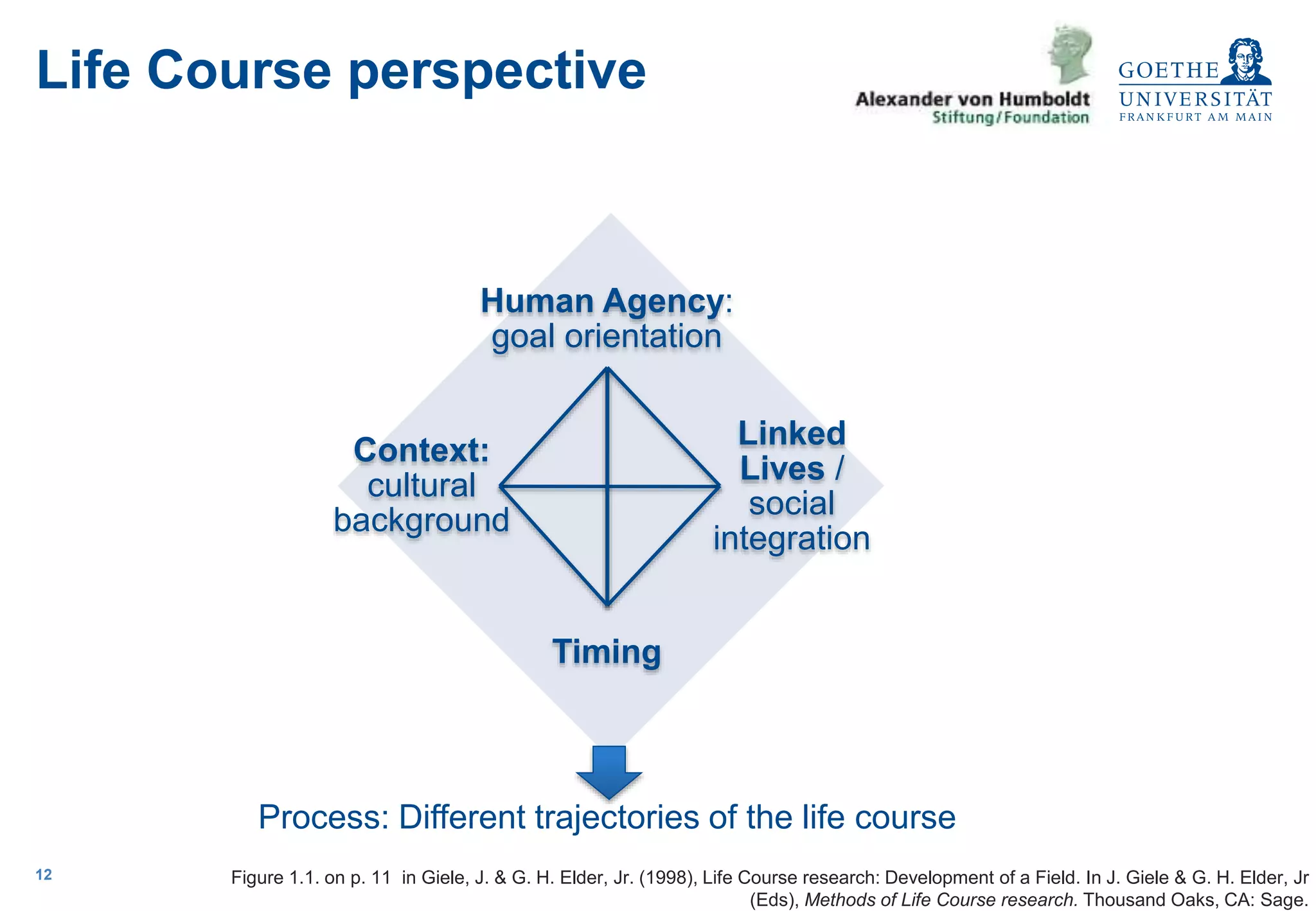
Life Course perspective
Context:
cultural
background
Linked
Lives /
social
integration
Human Agency:
goal orientation
Timing
Process: Different trajectories of the life course
Figure 1.1. on p. 11 in Giele, J. & G. H. Elder, Jr. (1998), Life Course research: Development of a Field. In J. Giele & G. H. Elder, Jr
(Eds), Methods of Life Course research. Thousand Oaks, CA: Sage.
Sociology, specialty Sociology of Work13
Life Course perspective
Context Linked
Lives
Human
Agency
Timing
Process: Different trajectories and experiences of crowdwork learning
Self-regulation, self-direction, self-
efficacy, powers of concentration.
Setting plans and goals for learning.
Taking on additional training.
Figure 1.1. on p. 11 in Giele, J. & G. H. Elder, Jr. (1998), Life Course research: Development of a Field. In J. Giele & G. H. Elder, Jr
(Eds), Methods of Life Course research. Thousand Oaks, CA: Sage.
Sociology, specialty Sociology of Work14
Life Course perspective
Context Linked
Lives
Human
Agency
Timing
Process: Different trajectories and experiences of crowdwork learning
Self-regulation, self-direction, self-
efficacy, powers of concentration.
Setting plans and goals for learning.
Taking on additional training.
Networks online and
offline, i.e. discussion
groups, colleagues in co-
working spaces.
‘Significant others’ &
‘passage-helpers.’
Family, friends, teachers.
Figure 1.1. on p. 11 in Giele, J. & G. H. Elder, Jr. (1998), Life Course research: Development of a Field. In J. Giele & G. H. Elder, Jr
(Eds), Methods of Life Course research. Thousand Oaks, CA: Sage.
Sociology, specialty Sociology of Work15
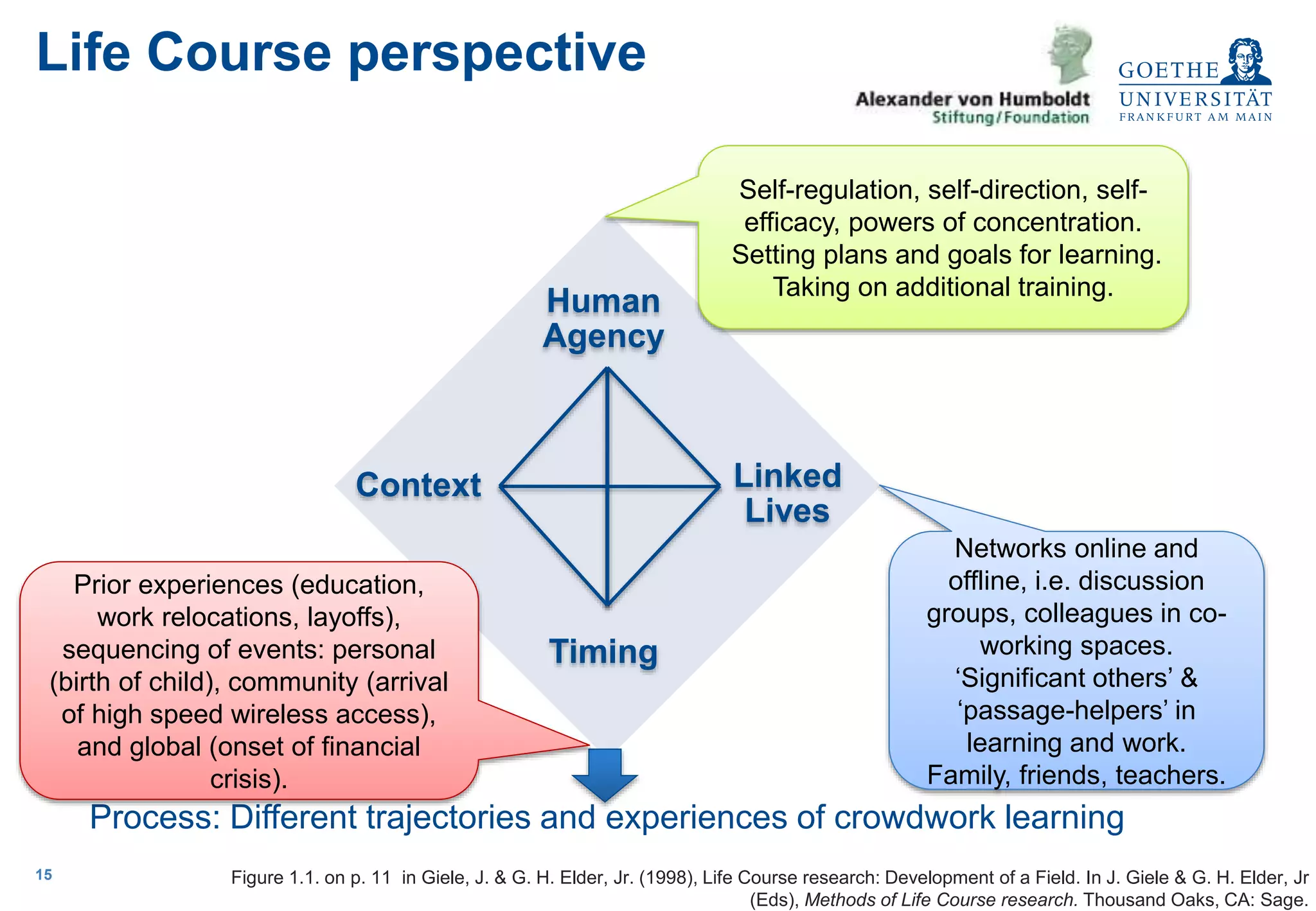
Life Course perspective
Context Linked
Lives
Human
Agency
Timing
Process: Different trajectories and experiences of crowdwork learning
Self-regulation, self-direction, self-
efficacy, powers of concentration.
Setting plans and goals for learning.
Taking on additional training.
Networks online and
offline, i.e. discussion
groups, colleagues in co-
working spaces.
‘Significant others’ &
‘passage-helpers’ in
learning and work.
Family, friends, teachers.
Prior experiences (education,
work relocations, layoffs),
sequencing of events: personal
(birth of child), community (arrival
of high speed wireless access),
and global (onset of financial
crisis).
Figure 1.1. on p. 11 in Giele, J. & G. H. Elder, Jr. (1998), Life Course research: Development of a Field. In J. Giele & G. H. Elder, Jr
(Eds), Methods of Life Course research. Thousand Oaks, CA: Sage.
Sociology, specialty Sociology of Work16
Life Course perspective
Context Linked
Lives
Human
Agency
Timing
Process: Different trajectories and experiences of crowdwork learning
Self-regulation, self-direction, self-
efficacy, powers of concentration.
Setting plans and goals for learning.
Taking on additional training.
Networks online and
offline, i.e. discussion
groups, colleagues in co-
working spaces.
‘Significant others’ &
‘passage-helpers’ in
learning and work.
Family, friends, teachers.
Prior experiences (education,
work relocations, layoffs),
sequencing of events: personal
(birth of child), community (arrival
of high speed wireless access),
and global (onset of financial
crisis).
Family values &
circumstances, local
context, laws, &
infrastructure, local
attitudes, i.e. toward
entrepreneurship,
platform design &
learning opportunities
Figure 1.1. on p. 11 in Giele, J. & G. H. Elder, Jr. (1998), Life Course research: Development of a Field. In J. Giele & G. H. Elder, Jr
(Eds), Methods of Life Course research. Thousand Oaks, CA: Sage.
Sociology, specialty Sociology of Work17
Agency: Self-regulated learning
70%
90%
70%
55%
75%
100%
68%
87%
81%
59%
64%
76%
0% 25% 50% 75% 100%
Devise learning plans
Modify learning goals
Monitor & modify strategies
Set long-term learning goals
Set short-term learning goals
Set performance standards
OF MW
Margaryan, A. (under review). Learning practices within crowdwork. Draft available from the author.
Margaryan, A. (2016). Understanding crowdworkers’ learning practices. In Proceedings of Internet, Policy and Politics 2016
Conference, Oxford Internet Institute, University of Oxford, UK.
Sociology, specialty Sociology of Work18
Linked Lives: Social learning
75%
80%
100%
80%
80%
82%
77%
74%
74%
62%
0% 25% 50% 75% 100%
Share learning wth peers
Observe/replicate others' strategies
Receive feedback from others
Seek advice from others
Collaborate with others
OF MW
Margaryan, A. (under review). Learning practices within crowdwork. Draft available from the author.
Margaryan, A. (2016). Understanding crowdworkers’ learning practices. In Proceedings of Internet, Policy and Politics 2016
Conference, Oxford Internet Institute, University of Oxford, UK.
Sociology, specialty Sociology of Work19
Linked Lives: Networks
Gray, M. et al 2(016). The communication network within the crowd. In Proceedings of WWW 2016 Conference, pp. 1293-1303.
Montreal, Canada, ACM..
Amazon Mechanical Turk
Figure: The communication network among Amazon Mechanical Turk workers. Subnetworks MTurkGrind (red; 392
workers, 1331 edges) and Facebook (blue, 133 workers, 357 edges).
FacebookMTurkGrind
Sociology, specialty Sociology of Work
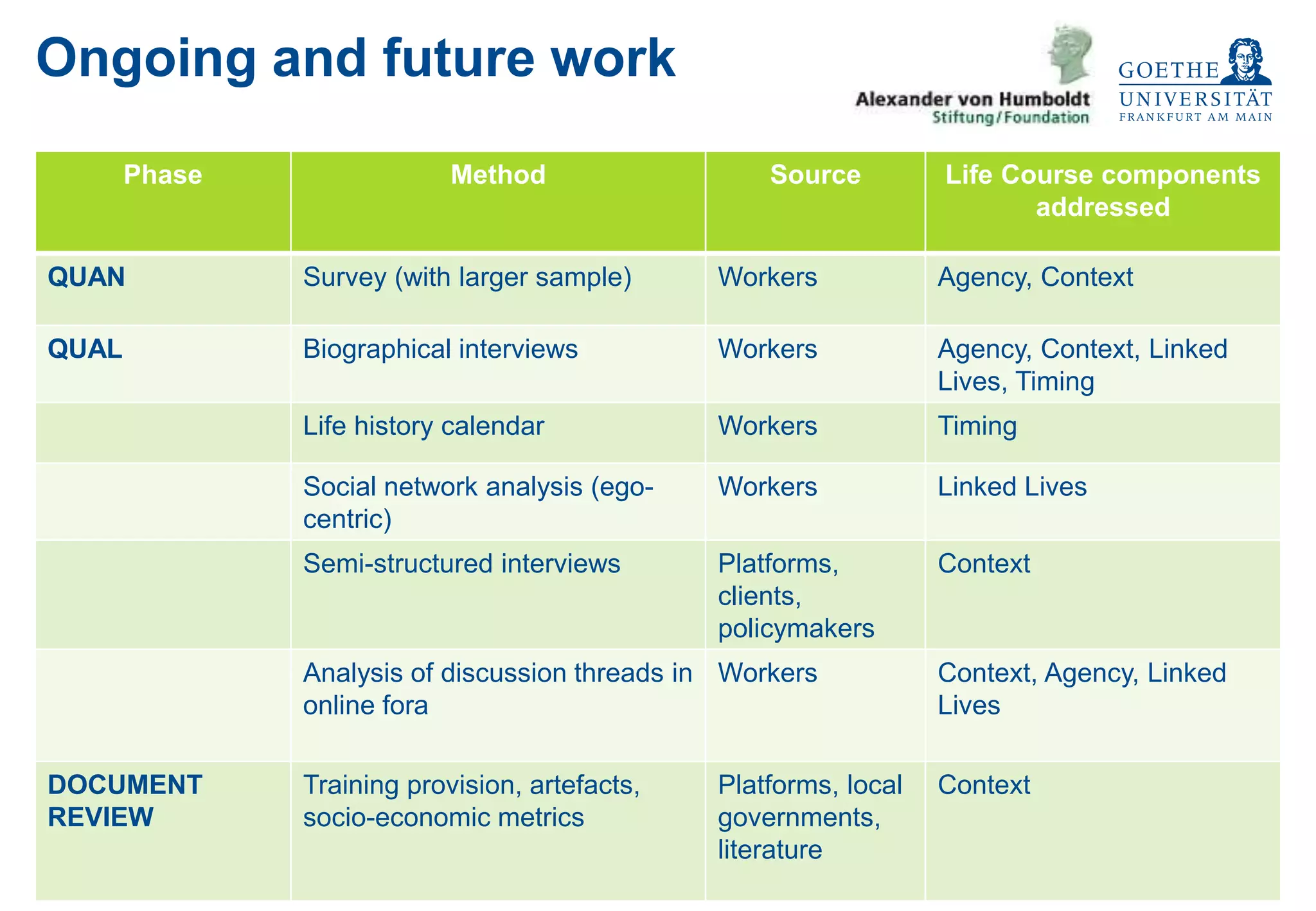
Phase Method Source Life Course components
addressed
QUAN Survey (with larger sample) Workers Agency, Context
QUAL Biographical interviews Workers Agency, Context, Linked
Lives, Timing
Life history calendar Workers Timing
Social network analysis (ego-
centric)
Workers Linked Lives
Semi-structured interviews Platforms,
clients,
policymakers
Context
Analysis of discussion threads in
online fora
Workers Context, Agency, Linked
Lives
DOCUMENT
REVIEW
Training provision, artefacts,
socio-economic metrics
Platforms, local
governments,
literature
Context
Ongoing and future work
Sociology, specialty Sociology of Work
• OUTSIDE IN:
In-depth and multi-source data spanning the sociological and the psychological, the
individual and the collective, the digital and the analogue are needed – how can these
best be captured?
• INSIDE OUT:
Viewing the whole person – adding important and potentially powerful explanatory
variables for understanding the situation – life course contributes many – how do we
think our way into her shoes?
• PAST:
Understanding how timing and sequencing of life events may influence the choice of
learning practice – what has happened so far and how to capture it?
• PRESENT & FUTURE:
Better causal understanding of crowdworkers’ present conditions and future
expectations – what is happening now, what is anticipated and how to measure it?
21 Margaryan and Hofmeister, 25 May 2017
Advancing research design

Crowdwork and the Life Course

  • 1.
    Using the LifeCourse Perspective to analyse learning practices within crowdwork Prof. Anoush Margaryan and Prof. Heather Hofmeister
  • 2.
    Sociology, specialty Sociologyof Work • What is crowdwork? • Research gaps • The Life Course • Examples from empirical research • Issues and questions 2 Margaryan and Hofmeister, 25 May 2017 Outline
  • 3.
    Sociology, specialty Sociologyof Work3 Margaryan and Hofmeister, 25 May 2017 Types of crowdsourced labour Paid Unpaid OnlineOffline Mechanical Turk Clickworker CrowdFlower Upwork Freelancer Galaxi Zoo Uber Lyft TaskRabbit Deliveroo Tauschen-ohne-geld Do-it.org.uk UN Volunteers Betterplace.org
  • 4.
    Sociology, specialty Sociologyof Work4 Margaryan and Hofmeister, 25 May 2017 Crowdwork Paid Unpaid OnlineOffline Mechanical Turk Clickworker CrowdFlower Upwork Freelancer Uber Lyft TaskRabbit Deliveroo Galaxi ZooTauschen-ohne-geld Do-it.org.uk UN Volunteers Betterplace.org
  • 5.
    Sociology, specialty Sociologyof Work5 Margaryan and Hofmeister, 25 May 2017 Two types of crowdwork Paid Unpaid OnlineOffline Mechanical Turk Clickworker CrowdFlower Upwork Freelancer Microwork Online Freelancing Kuek, Siou Chew, et al. (2015). The global opportunity in online outsourcing. Washington, DC: World Bank.
  • 6.
    Sociology, specialty Sociologyof Work Platforms: MTurk, CrowdFlower  microtasks  short time-frame, seconds or minutes to complete  algorithm-governed  anonymous  low barriers to entry (basic Internet and computer skills)  low pay Margaryan and Hofmeister, 25 May 20176 Microwork Insert the clickfarm pic here Luke Dormheil, 2015 - http://www.cultofmac.com/311171/crazy-iphone-rig- shows-chinese-workers-manipulate-app-store-rankings/
  • 7.
    Sociology, specialty Sociologyof Work Platforms: Upwork, Freelancer  simple or complex projects  longer timeframe (hours, days or months)  worker and client identities more transparent  quality of work is monitored by clients  professional skills often required  higher pay Margaryan and Hofmeister, 25 May 20177 Online freelancing Upwork Freelancer Guide https://www.slideshare.net/upwork/upwork-freelancer-guide
  • 8.
    Sociology, specialty Sociologyof Work • Lack of stats on crowdwork market – no representative sampling possible 8 Margaryan and Hofmeister, 25 May 2017 Research gaps
  • 9.
    Sociology, specialty Sociologyof Work • Lack of stats on crowdwork market – no representative sampling possible • Mostly surveys, online experiments or interventions/tech development; limited qualitative/in situ understanding of crowdwork 9 Margaryan and Hofmeister, 25 May 2017 Research gaps
  • 10.
    Sociology, specialty Sociologyof Work • Lack of stats on crowdwork market – no representative sampling possible • Mostly surveys, online experiments or interventions/tech development; limited qualitative/in situ understanding of crowdwork • Lack of integrative analytical-methodological approaches, much of research is piecemeal 10 Margaryan and Hofmeister, 25 May 2017 Research gaps
  • 11.
    Sociology, specialty Sociologyof Work • Lack of stats on crowdwork market – no representative sampling possible • Mostly surveys, online experiments or interventions/tech development; limited qualitative/in situ understanding of crowdwork • Lack of integrative analytical-methodological approaches, much of research is piecemeal • Crowdworkers’ experiences are decontextualised 11 Margaryan and Hofmeister, 25 May 2017 Research gaps
  • 12.
    Sociology, specialty Sociologyof Work12 Life Course perspective Context: cultural background Linked Lives / social integration Human Agency: goal orientation Timing Process: Different trajectories of the life course Figure 1.1. on p. 11 in Giele, J. & G. H. Elder, Jr. (1998), Life Course research: Development of a Field. In J. Giele & G. H. Elder, Jr (Eds), Methods of Life Course research. Thousand Oaks, CA: Sage.
  • 13.
    Sociology, specialty Sociologyof Work13 Life Course perspective Context Linked Lives Human Agency Timing Process: Different trajectories and experiences of crowdwork learning Self-regulation, self-direction, self- efficacy, powers of concentration. Setting plans and goals for learning. Taking on additional training. Figure 1.1. on p. 11 in Giele, J. & G. H. Elder, Jr. (1998), Life Course research: Development of a Field. In J. Giele & G. H. Elder, Jr (Eds), Methods of Life Course research. Thousand Oaks, CA: Sage.
  • 14.
    Sociology, specialty Sociologyof Work14 Life Course perspective Context Linked Lives Human Agency Timing Process: Different trajectories and experiences of crowdwork learning Self-regulation, self-direction, self- efficacy, powers of concentration. Setting plans and goals for learning. Taking on additional training. Networks online and offline, i.e. discussion groups, colleagues in co- working spaces. ‘Significant others’ & ‘passage-helpers.’ Family, friends, teachers. Figure 1.1. on p. 11 in Giele, J. & G. H. Elder, Jr. (1998), Life Course research: Development of a Field. In J. Giele & G. H. Elder, Jr (Eds), Methods of Life Course research. Thousand Oaks, CA: Sage.
  • 15.
    Sociology, specialty Sociologyof Work15 Life Course perspective Context Linked Lives Human Agency Timing Process: Different trajectories and experiences of crowdwork learning Self-regulation, self-direction, self- efficacy, powers of concentration. Setting plans and goals for learning. Taking on additional training. Networks online and offline, i.e. discussion groups, colleagues in co- working spaces. ‘Significant others’ & ‘passage-helpers’ in learning and work. Family, friends, teachers. Prior experiences (education, work relocations, layoffs), sequencing of events: personal (birth of child), community (arrival of high speed wireless access), and global (onset of financial crisis). Figure 1.1. on p. 11 in Giele, J. & G. H. Elder, Jr. (1998), Life Course research: Development of a Field. In J. Giele & G. H. Elder, Jr (Eds), Methods of Life Course research. Thousand Oaks, CA: Sage.
  • 16.
    Sociology, specialty Sociologyof Work16 Life Course perspective Context Linked Lives Human Agency Timing Process: Different trajectories and experiences of crowdwork learning Self-regulation, self-direction, self- efficacy, powers of concentration. Setting plans and goals for learning. Taking on additional training. Networks online and offline, i.e. discussion groups, colleagues in co- working spaces. ‘Significant others’ & ‘passage-helpers’ in learning and work. Family, friends, teachers. Prior experiences (education, work relocations, layoffs), sequencing of events: personal (birth of child), community (arrival of high speed wireless access), and global (onset of financial crisis). Family values & circumstances, local context, laws, & infrastructure, local attitudes, i.e. toward entrepreneurship, platform design & learning opportunities Figure 1.1. on p. 11 in Giele, J. & G. H. Elder, Jr. (1998), Life Course research: Development of a Field. In J. Giele & G. H. Elder, Jr (Eds), Methods of Life Course research. Thousand Oaks, CA: Sage.
  • 17.
    Sociology, specialty Sociologyof Work17 Agency: Self-regulated learning 70% 90% 70% 55% 75% 100% 68% 87% 81% 59% 64% 76% 0% 25% 50% 75% 100% Devise learning plans Modify learning goals Monitor & modify strategies Set long-term learning goals Set short-term learning goals Set performance standards OF MW Margaryan, A. (under review). Learning practices within crowdwork. Draft available from the author. Margaryan, A. (2016). Understanding crowdworkers’ learning practices. In Proceedings of Internet, Policy and Politics 2016 Conference, Oxford Internet Institute, University of Oxford, UK.
  • 18.
    Sociology, specialty Sociologyof Work18 Linked Lives: Social learning 75% 80% 100% 80% 80% 82% 77% 74% 74% 62% 0% 25% 50% 75% 100% Share learning wth peers Observe/replicate others' strategies Receive feedback from others Seek advice from others Collaborate with others OF MW Margaryan, A. (under review). Learning practices within crowdwork. Draft available from the author. Margaryan, A. (2016). Understanding crowdworkers’ learning practices. In Proceedings of Internet, Policy and Politics 2016 Conference, Oxford Internet Institute, University of Oxford, UK.
  • 19.
    Sociology, specialty Sociologyof Work19 Linked Lives: Networks Gray, M. et al 2(016). The communication network within the crowd. In Proceedings of WWW 2016 Conference, pp. 1293-1303. Montreal, Canada, ACM.. Amazon Mechanical Turk Figure: The communication network among Amazon Mechanical Turk workers. Subnetworks MTurkGrind (red; 392 workers, 1331 edges) and Facebook (blue, 133 workers, 357 edges). FacebookMTurkGrind
  • 20.
    Sociology, specialty Sociologyof Work Phase Method Source Life Course components addressed QUAN Survey (with larger sample) Workers Agency, Context QUAL Biographical interviews Workers Agency, Context, Linked Lives, Timing Life history calendar Workers Timing Social network analysis (ego- centric) Workers Linked Lives Semi-structured interviews Platforms, clients, policymakers Context Analysis of discussion threads in online fora Workers Context, Agency, Linked Lives DOCUMENT REVIEW Training provision, artefacts, socio-economic metrics Platforms, local governments, literature Context Ongoing and future work
  • 21.
    Sociology, specialty Sociologyof Work • OUTSIDE IN: In-depth and multi-source data spanning the sociological and the psychological, the individual and the collective, the digital and the analogue are needed – how can these best be captured? • INSIDE OUT: Viewing the whole person – adding important and potentially powerful explanatory variables for understanding the situation – life course contributes many – how do we think our way into her shoes? • PAST: Understanding how timing and sequencing of life events may influence the choice of learning practice – what has happened so far and how to capture it? • PRESENT & FUTURE: Better causal understanding of crowdworkers’ present conditions and future expectations – what is happening now, what is anticipated and how to measure it? 21 Margaryan and Hofmeister, 25 May 2017 Advancing research design

Editor's Notes

  • #13 The Life course perspective as a lens for looking deeper into lives of crowdworkers