Workmanship Standard Template
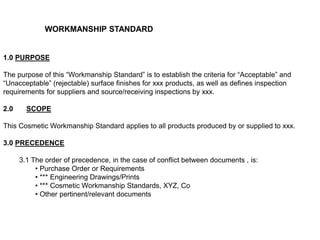
WORKMANSHIP STANDARD
1.0 PURPOSE
The purpose of this “Workmanship Standard” is to establish the criteria for “Acceptable” and
“Unacceptable” (rejectable) surface finishes for xxx products, as well as defines inspection
requirements for suppliers and source/receiving inspections by xxx.
2.0 SCOPE
This Cosmetic Workmanship Standard applies to all products produced by or supplied to xxx.
3.0 PRECEDENCE
3.1 The order of precedence, in the case of conflict between documents , is:
• Purchase Order or Requirements
• *** Engineering Drawings/Prints
• *** Cosmetic Workmanship Standards, XYZ, Co
• Other pertinent/relevant documents
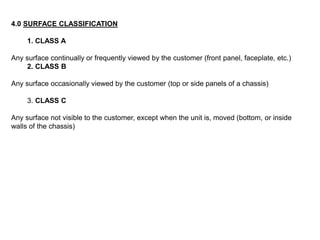
4.0 SURFACE CLASSIFICATION
1. CLASS A
Any surface continually or frequently viewed by the customer (front panel, faceplate, etc.)
2. CLASS B
Any surface occasionally viewed by the customer (top or side panels of a chassis)
3. CLASS C
Any surface not visible to the customer, except when the unit is, moved (bottom, or inside
walls of the chassis)
Surface Class Viewing Distance Viewing Time
A 18 inches ( 45 cm) 10 seconds
B 24 inches ( 61 cm) 5 seconds
C 34 inches ( 86 cm) 3 seconds
5.0 INSPECTION REQUIREMENTS
1.Lighting Requirements:
The “source” light shall be at least 500 lux on the inspection work surface/workplace. Cool
fluorescent or day light fluorescent is preferred.
• Parts shall be inspected without magnification, at an angle within 0 to 45 of the
inspected surface.
• Inspection Time and Distance:
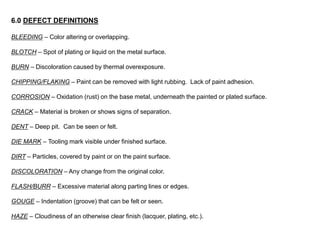
6.0 DEFECT DEFINITIONS
BLEEDING – Color altering or overlapping.
BLOTCH – Spot of plating or liquid on the metal surface.
BURN – Discoloration caused by thermal overexposure.
CHIPPING/FLAKING – Paint can be removed with light rubbing. Lack of paint adhesion.
CORROSION – Oxidation (rust) on the base metal, underneath the painted or plated surface.
CRACK – Material is broken or shows signs of separation.
DENT – Deep pit. Can be seen or felt.
DIE MARK – Tooling mark visible under finished surface.
DIRT – Particles, covered by paint or on the paint surface.
DISCOLORATION – Any change from the original color.
FLASH/BURR – Excessive material along parting lines or edges.
GOUGE – Indentation (groove) that can be felt or seen.
HAZE – Cloudiness of an otherwise clear finish (lacquer, plating, etc.).
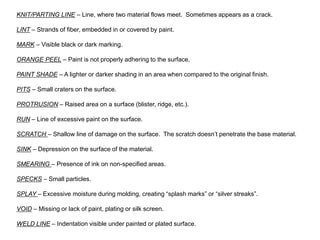
KNIT/PARTING LINE – Line, where two material flows meet. Sometimes appears as a crack.
LINT – Strands of fiber, embedded in or covered by paint.
MARK – Visible black or dark marking.
ORANGE PEEL – Paint is not properly adhering to the surface.
PAINT SHADE – A lighter or darker shading in an area when compared to the original finish.
PITS – Small craters on the surface.
PROTRUSION – Raised area on a surface (blister, ridge, etc.).
RUN – Line of excessive paint on the surface.
SCRATCH – Shallow line of damage on the surface. The scratch doesn’t penetrate the base material.
SINK – Depression on the surface of the material.
SMEARING – Presence of ink on non-specified areas.
SPECKS – Small particles.
SPLAY – Excessive moisture during molding, creating “splash marks” or “silver streaks”.
VOID – Missing or lack of paint, plating or silk screen.
WELD LINE – Indentation visible under painted or plated surface.
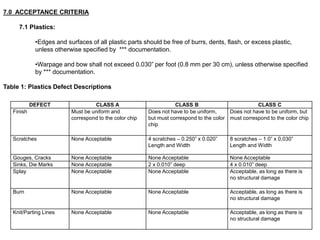
DEFECT CLASS A CLASS B CLASS C
Finish Must be uniform and
correspond to the color chip
Does not have to be uniform,
but must correspond to the color
chip
Does not have to be uniform, but
must correspond to the color chip
Scratches None Acceptable 4 scratches – 0.250” x 0.020”
Length and Width
8 scratches – 1.0” x 0,030”
Length and Width
Gouges, Cracks None Acceptable None Acceptable None Acceptable
Sinks, Die Marks None Acceptable 2 x 0.010” deep 4 x 0.010” deep
Splay None Acceptable None Acceptable Acceptable, as long as there is
no structural damage
Burn None Acceptable None Acceptable Acceptable, as long as there is
no structural damage
Knit/Parting Lines None Acceptable None Acceptable Acceptable, as long as there is
no structural damage
7.0 ACCEPTANCE CRITERIA
7.1 Plastics:
•Edges and surfaces of all plastic parts should be free of burrs, dents, flash, or excess plastic,
unless otherwise specified by *** documentation.
•Warpage and bow shall not exceed 0.030” per foot (0.8 mm per 30 cm), unless otherwise specified
by *** documentation.
Table 1: Plastics Defect Descriptions
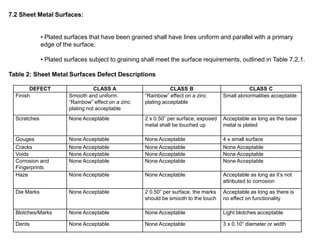
DEFECT CLASS A CLASS B CLASS C
Finish Smooth and uniform.
“Rainbow” effect on a zinc
plating not acceptable
“Rainbow” effect on a zinc
plating acceptable
Small abnormalities acceptable
Scratches None Acceptable 2 x 0.50” per surface, exposed
metal shall be touched up
Acceptable as long as the base
metal is plated
Gouges None Acceptable None Acceptable 4 x small surface
Cracks None Acceptable None Acceptable None Acceptable
Voids None Acceptable None Acceptable None Acceptable
Corrosion and
Fingerprints
None Acceptable None Acceptable None Acceptable
Haze None Acceptable None Acceptable Acceptable as long as it’s not
attributed to corrosion
Die Marks None Acceptable 2 0.50” per surface, the marks
should be smooth to the touch
Acceptable as long as there is
no effect on functionality
Blotches/Marks None Acceptable None Acceptable Light blotches acceptable
Dents None Acceptable None Acceptable 3 x 0.10” diameter or width
7.2 Sheet Metal Surfaces:
• Plated surfaces that have been grained shall have lines uniform and parallel with a primary
edge of the surface.
• Plated surfaces subject to graining shall meet the surface requirements, outlined in Table 7.2.1.
Table 2: Sheet Metal Surfaces Defect Descriptions
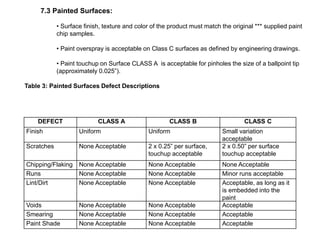
DEFECT CLASS A CLASS B CLASS C
Finish Uniform Uniform Small variation
acceptable
Scratches None Acceptable 2 x 0.25” per surface,
touchup acceptable
2 x 0.50” per surface
touchup acceptable
Chipping/Flaking None Acceptable None Acceptable None Acceptable
Runs None Acceptable None Acceptable Minor runs acceptable
Lint/Dirt None Acceptable None Acceptable Acceptable, as long as it
is embedded into the
paint
Voids None Acceptable None Acceptable Acceptable
Smearing None Acceptable None Acceptable Acceptable
Paint Shade None Acceptable None Acceptable Acceptable
7.3 Painted Surfaces:
• Surface finish, texture and color of the product must match the original *** supplied paint
chip samples.
• Paint overspray is acceptable on Class C surfaces as defined by engineering drawings.
• Paint touchup on Surface CLASS A is acceptable for pinholes the size of a ballpoint tip
(approximately 0.025”).
Table 3: Painted Surfaces Defect Descriptions
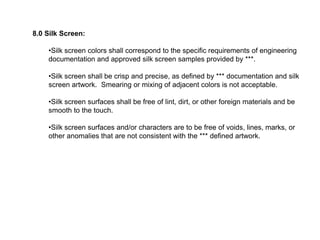
8.0 Silk Screen:
•Silk screen colors shall correspond to the specific requirements of engineering
documentation and approved silk screen samples provided by ***.
•Silk screen shall be crisp and precise, as defined by *** documentation and silk
screen artwork. Smearing or mixing of adjacent colors is not acceptable.
•Silk screen surfaces shall be free of lint, dirt, or other foreign materials and be
smooth to the touch.
•Silk screen surfaces and/or characters are to be free of voids, lines, marks, or
other anomalies that are not consistent with the *** defined artwork.

Workmanship Standard Template

  • 1.
  • 2.
    WORKMANSHIP STANDARD 1.0 PURPOSE Thepurpose of this “Workmanship Standard” is to establish the criteria for “Acceptable” and “Unacceptable” (rejectable) surface finishes for xxx products, as well as defines inspection requirements for suppliers and source/receiving inspections by xxx. 2.0 SCOPE This Cosmetic Workmanship Standard applies to all products produced by or supplied to xxx. 3.0 PRECEDENCE 3.1 The order of precedence, in the case of conflict between documents , is: • Purchase Order or Requirements • *** Engineering Drawings/Prints • *** Cosmetic Workmanship Standards, XYZ, Co • Other pertinent/relevant documents
  • 3.
    4.0 SURFACE CLASSIFICATION 1.CLASS A Any surface continually or frequently viewed by the customer (front panel, faceplate, etc.) 2. CLASS B Any surface occasionally viewed by the customer (top or side panels of a chassis) 3. CLASS C Any surface not visible to the customer, except when the unit is, moved (bottom, or inside walls of the chassis)
  • 4.
    Surface Class ViewingDistance Viewing Time A 18 inches ( 45 cm) 10 seconds B 24 inches ( 61 cm) 5 seconds C 34 inches ( 86 cm) 3 seconds 5.0 INSPECTION REQUIREMENTS 1.Lighting Requirements: The “source” light shall be at least 500 lux on the inspection work surface/workplace. Cool fluorescent or day light fluorescent is preferred. • Parts shall be inspected without magnification, at an angle within 0 to 45 of the inspected surface. • Inspection Time and Distance:
  • 5.
    6.0 DEFECT DEFINITIONS BLEEDING– Color altering or overlapping. BLOTCH – Spot of plating or liquid on the metal surface. BURN – Discoloration caused by thermal overexposure. CHIPPING/FLAKING – Paint can be removed with light rubbing. Lack of paint adhesion. CORROSION – Oxidation (rust) on the base metal, underneath the painted or plated surface. CRACK – Material is broken or shows signs of separation. DENT – Deep pit. Can be seen or felt. DIE MARK – Tooling mark visible under finished surface. DIRT – Particles, covered by paint or on the paint surface. DISCOLORATION – Any change from the original color. FLASH/BURR – Excessive material along parting lines or edges. GOUGE – Indentation (groove) that can be felt or seen. HAZE – Cloudiness of an otherwise clear finish (lacquer, plating, etc.).
  • 6.
    KNIT/PARTING LINE –Line, where two material flows meet. Sometimes appears as a crack. LINT – Strands of fiber, embedded in or covered by paint. MARK – Visible black or dark marking. ORANGE PEEL – Paint is not properly adhering to the surface. PAINT SHADE – A lighter or darker shading in an area when compared to the original finish. PITS – Small craters on the surface. PROTRUSION – Raised area on a surface (blister, ridge, etc.). RUN – Line of excessive paint on the surface. SCRATCH – Shallow line of damage on the surface. The scratch doesn’t penetrate the base material. SINK – Depression on the surface of the material. SMEARING – Presence of ink on non-specified areas. SPECKS – Small particles. SPLAY – Excessive moisture during molding, creating “splash marks” or “silver streaks”. VOID – Missing or lack of paint, plating or silk screen. WELD LINE – Indentation visible under painted or plated surface.
  • 7.
    DEFECT CLASS ACLASS B CLASS C Finish Must be uniform and correspond to the color chip Does not have to be uniform, but must correspond to the color chip Does not have to be uniform, but must correspond to the color chip Scratches None Acceptable 4 scratches – 0.250” x 0.020” Length and Width 8 scratches – 1.0” x 0,030” Length and Width Gouges, Cracks None Acceptable None Acceptable None Acceptable Sinks, Die Marks None Acceptable 2 x 0.010” deep 4 x 0.010” deep Splay None Acceptable None Acceptable Acceptable, as long as there is no structural damage Burn None Acceptable None Acceptable Acceptable, as long as there is no structural damage Knit/Parting Lines None Acceptable None Acceptable Acceptable, as long as there is no structural damage 7.0 ACCEPTANCE CRITERIA 7.1 Plastics: •Edges and surfaces of all plastic parts should be free of burrs, dents, flash, or excess plastic, unless otherwise specified by *** documentation. •Warpage and bow shall not exceed 0.030” per foot (0.8 mm per 30 cm), unless otherwise specified by *** documentation. Table 1: Plastics Defect Descriptions
  • 8.
    DEFECT CLASS ACLASS B CLASS C Finish Smooth and uniform. “Rainbow” effect on a zinc plating not acceptable “Rainbow” effect on a zinc plating acceptable Small abnormalities acceptable Scratches None Acceptable 2 x 0.50” per surface, exposed metal shall be touched up Acceptable as long as the base metal is plated Gouges None Acceptable None Acceptable 4 x small surface Cracks None Acceptable None Acceptable None Acceptable Voids None Acceptable None Acceptable None Acceptable Corrosion and Fingerprints None Acceptable None Acceptable None Acceptable Haze None Acceptable None Acceptable Acceptable as long as it’s not attributed to corrosion Die Marks None Acceptable 2 0.50” per surface, the marks should be smooth to the touch Acceptable as long as there is no effect on functionality Blotches/Marks None Acceptable None Acceptable Light blotches acceptable Dents None Acceptable None Acceptable 3 x 0.10” diameter or width 7.2 Sheet Metal Surfaces: • Plated surfaces that have been grained shall have lines uniform and parallel with a primary edge of the surface. • Plated surfaces subject to graining shall meet the surface requirements, outlined in Table 7.2.1. Table 2: Sheet Metal Surfaces Defect Descriptions
  • 9.
    DEFECT CLASS ACLASS B CLASS C Finish Uniform Uniform Small variation acceptable Scratches None Acceptable 2 x 0.25” per surface, touchup acceptable 2 x 0.50” per surface touchup acceptable Chipping/Flaking None Acceptable None Acceptable None Acceptable Runs None Acceptable None Acceptable Minor runs acceptable Lint/Dirt None Acceptable None Acceptable Acceptable, as long as it is embedded into the paint Voids None Acceptable None Acceptable Acceptable Smearing None Acceptable None Acceptable Acceptable Paint Shade None Acceptable None Acceptable Acceptable 7.3 Painted Surfaces: • Surface finish, texture and color of the product must match the original *** supplied paint chip samples. • Paint overspray is acceptable on Class C surfaces as defined by engineering drawings. • Paint touchup on Surface CLASS A is acceptable for pinholes the size of a ballpoint tip (approximately 0.025”). Table 3: Painted Surfaces Defect Descriptions
  • 10.
    8.0 Silk Screen: •Silkscreen colors shall correspond to the specific requirements of engineering documentation and approved silk screen samples provided by ***. •Silk screen shall be crisp and precise, as defined by *** documentation and silk screen artwork. Smearing or mixing of adjacent colors is not acceptable. •Silk screen surfaces shall be free of lint, dirt, or other foreign materials and be smooth to the touch. •Silk screen surfaces and/or characters are to be free of voids, lines, marks, or other anomalies that are not consistent with the *** defined artwork.