Performing Arts Safety Primer
Working at
Heights
Contents
Introduction.......................................................1
Quick-start questions........................................3
Types of fall protection.....................................6
Fall protection plans.......................................10
Worker instruction and training.......................14
General safety................................................17
Rehearsal.......................................................21
Developing production components...............25
Unguarded edges...........................................29
Ladders..........................................................32
Scaffolds.........................................................34
Lifts.................................................................38
Communication protocols...............................43
WorkSafeBC requirements.............................45
Organizations.................................................46
Resources......................................................48
Note: The material in this publication is intended as
educational information only. This publication does not
replace the Occupational Health and Safety Regulation
administered by WorkSafeBC. Employers and workers
should always refer to the Regulation for specific
requirements that apply to their activities.
©2012 Actsafe. All rights reserved. Actsafe encourages the
copying, reproduction and distribution of this document to
promote health & safety in the workplace, provided Actsafe
is acknowledged. However, no part of this publication may
be copied, reproduced or distributed for profit or other
commercial enterprise, nor may any part be incorporated
into any other publications, without written permission from
Actsafe.
First printing. December 2012. Printed in Canada.
Introduction
This primer is for employers, performers,
and technicians in British Columbia’s live
performance industry. It describes health and
safety requirements and safe work practices for
working at heights.
You may find the information in this primer useful
if you are involved with:
•	 An established performing arts organization,
such as a dance or theatre company
•	 An organization that produces concerts,
cooperative shows, or corporate or special
events (including festivals)
•	 A volunteer or educational organization
Aim of this primer
•	 Help employers comply with their legal
responsibility to take every reasonable
precaution to protect workers from falls
•	 Provide information about fall protection
issues so cast and crew members can work
safely
This primer does not replace the
Occupational Health and Safety Regulation
or the Workers Compensation Act. It explains
many of the health and safety requirements that
apply to live performance in B.C., but employers
and workers should always refer to the
Regulation for specific requirements that apply
to their production activities.
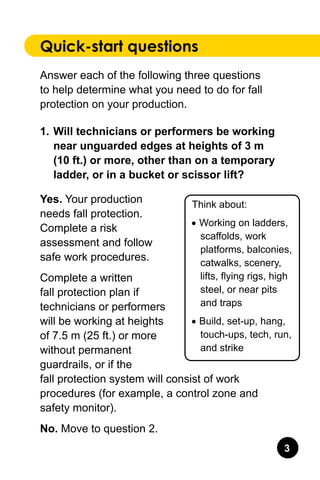
Quick-start questions
Answer each of the following three questions
to help determine what you need to do for fall
protection on your production.
1.	Will technicians or performers be working
near unguarded edges at heights of 3 m
(10 ft.) or more, other than on a temporary
ladder, or in a bucket or scissor lift?
Yes. Your production
needs fall protection.
Complete a risk
assessment and follow
safe work procedures.
Complete a written
fall protection plan if
technicians or performers
will be working at heights
of 7.5 m (25 ft.) or more
without permanent
guardrails, or if the
fall protection system will consist of work
procedures (for example, a control zone and
safety monitor).
No. Move to question 2.
Think about:
•	Working on ladders,
scaffolds, work
platforms, balconies,
catwalks, scenery,
lifts, flying rigs, high
steel, or near pits
and traps
•	Build, set-up, hang,
touch-ups, tech, run,
and strike
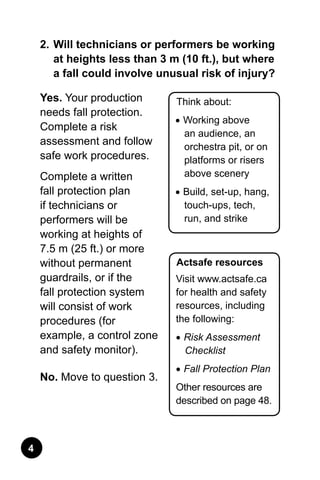
Think about:
•	Working above
an audience, an
orchestra pit, or on
platforms or risers
above scenery
•	Build, set-up, hang,
touch-ups, tech,
run, and strike
Actsafe resources
Visit www.actsafe.ca
for health and safety
resources, including
the following:
•	Risk Assessment
Checklist
•	Fall Protection Plan
Other resources are
described on page 48.
2.	Will technicians or performers be working
at heights less than 3 m (10 ft.), but where
a fall could involve unusual risk of injury?
Yes. Your production
needs fall protection.
Complete a risk
assessment and follow
safe work procedures.
Complete a written
fall protection plan
if technicians or
performers will be
working at heights of
7.5 m (25 ft.) or more
without permanent
guardrails, or if the
fall protection system
will consist of work
procedures (for
example, a control zone
and safety monitor).
No. Move to question 3.
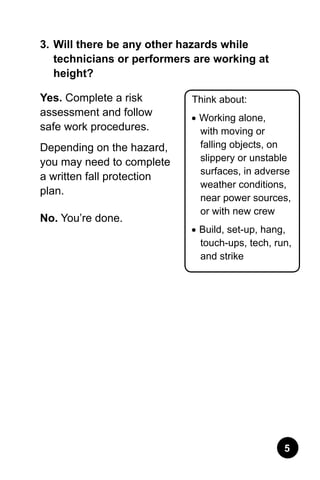
3.	Will there be any other hazards while
technicians or performers are working at
height?
Yes. Complete a risk
assessment and follow
safe work procedures.
Depending on the hazard,
you may need to complete
a written fall protection
plan.
No. You’re done.
Think about:
•	Working alone,
with moving or
falling objects, on
slippery or unstable
surfaces, in adverse
weather conditions,
near power sources,
or with new crew
•	Build, set-up, hang,
touch-ups, tech, run,
and strike
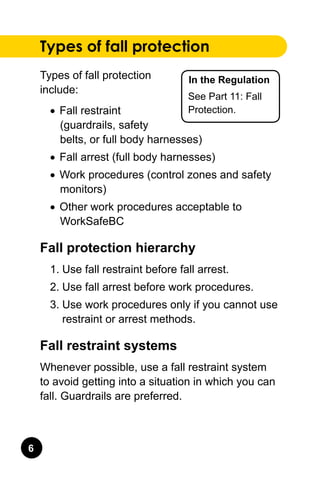
In the Regulation
See Part 11: Fall
Protection.
Types of fall protection
include:
•	 Fall restraint
(guardrails, safety
belts, or full body harnesses)
•	 Fall arrest (full body harnesses)
•	 Work procedures (control zones and safety
monitors)
•	 Other work procedures acceptable to
WorkSafeBC
Fall protection hierarchy
1.	Use fall restraint before fall arrest.
2.	Use fall arrest before work procedures.
3.	Use work procedures only if you cannot use
restraint or arrest methods.
Fall restraint systems
Whenever possible, use a fall restraint system
to avoid getting into a situation in which you can
fall. Guardrails are preferred.
If guardrails are not practicable, use a safety
belt or full body harness attached to a securely
anchored lanyard or lifeline. Adjust the lanyard
or lifeline to limit your ability to travel and keep
you away from the unguarded edge.
Fall arrest systems
If a fall restraint system is not practicable, use
a fall arrest system. A fall arrest system will not
prevent a fall from occurring, but it will stop the
fall after a short distance.
A fall arrest system consists of a full body
harness attached to a securely anchored lanyard
that will limit the fall to a safe distance. Full body
harnesses are specially designed to help protect
against internal injuries. Don’t use safety belts in
fall arrest systems.
A fall protection plan is required for work at
heights of 7.5 m (25 ft.) or more in locations
that don’t have permanent guardrails. (See “Fall
protection plans,” pages 10–13.)
In the Regulation
See sections 4.56,
4.59, 4.60, and 8.22.
Work procedures
If fall restraint and fall arrest systems are not
practicable, use a work procedure, such as a
control zone and safety monitoring system.
A control zone is an off-limits area between an
unguarded edge and a safe zone where workers
can move about. If you need to enter the control
zone, a safety monitor keeps an eye on you.
Work procedures can also include other
procedures acceptable to WorkSafeBC.
Exceptions for live performance
Live performance
presents unique
difficulties when it comes
to working at heights.
Guardrails are often not
practicable on scenic units that will be visible to
an audience. Full body harnesses and safety
lines on performers are often not practical during
performance.
WorkSafeBC recognizes this and allows some
exceptions to the use of standard protective
equipment and clothing in performance
situations “provided that effective measures are
taken to protect performers and other workers
from injury.”
Effective measures may include procedures
described in “Rehearsal” (see pages 21–24)
and “Developing Production Components” (see
pages 25–28).
Fall protection equipment
Employers are responsible for providing workers
with any necessary fall protection equipment.
However, if employers and workers both agree,
workers may use their own equipment as long
as it meets WorkSafeBC
requirements and is
appropriate for the
specific task.
If you are inexperienced
or unsure of what
fall protection to use,
consult the specialist
on your production who
is most qualified for the
intended task.
What does qualified
mean?
In the Regulation,
qualified means “being
knowledgeable of the
work, the hazards
involved and the means
to control the hazards,
by reason of education,
training, experience or a
combination thereof.”
10
Fall protection plans
When are fall protection plans
required?
Employers must ensure that decisions are
documented in a written fall protection plan in
any of the following cases:
•	 When technicians or performers will be
working at heights of 7.5 m (25 ft.) or more
without permanent guardrails
•	 When a fall from a lower height could involve
unusual risk of injury
•	 When the fall protection system will consist
of work procedures, such as control zones
or nets
Even if you are not required to complete a plan,
briefly documenting your decisions can be
useful for future reference and can establish due
diligence.
11
What should the fall protection plan
include?
Include detailed rehearsal and performance
plans. All fall protection plans must specify:
•	 Fall hazards expected during each
production phase
•	 Methods to prevent or mitigate the hazards
•	 Procedures to assemble, maintain, inspect,
use, and disassemble fall protection
systems
•	 A rescue plan for aiding workers who fall and
are left suspended at height
Rescue plans
The rescue plan should answer these questions:
•	 If workers at risk fell, what would likely
happen?
•	 Would self-rescue be possible?
•	 If not, could rescuers get to the workers?
•	 What equipment and techniques (including
qualified experts) would you need, and how
will you provide them?
12
Safety measures for customized
equipment
If a performer will be using customized
equipment — including harnesses and fly
hardware (rated equipment made into a
customized system) — describe safety measures
the production will take.
Examples of safety measures
•	 Write a detailed rehearsal and choreography
plan.
•	 Use equipment designed for the forces that
will be exerted on it.
•	 Appoint a qualified person to inspect the
equipment before each use.
Review and update the fall protection
plan	
•	 Review the fall protection plan before
implementing it.
•	 Review the fall protection plan regularly
as the production develops and conditions
change.
13
•	 Make and document any necessary
additions or changes.
•	 If you change things on the fly, make sure
there is enough time to reassess risks
and to test and rehearse the system. Note
changes on the risk assessment checklist
and fall protection plan.
Make changes as required by the venue
If you did not see the venue before completing
the risk assessment checklist and fall protection
plan, you may need to review and update them.
This applies particularly to touring shows or new
locations, where you need to reassess hazards
for the new venue or worksite. Even if you
have been there before, reassess the venue or
location when you arrive.
Formalize continual risk assessment
The risk assessment should be on the agenda
at production meetings. Briefly document each
reassessment (for example, add to the risk
assessment checklist and fall protection plan).
14
Worker instruction and training
Employers must provide workers with
information, instruction, training, and supervision
so they can carry out their work safely.
•	 When hiring, specify the requirements of the
job if it will involve working at heights.
•	 Inform workers of relevant hazards.
•	 Post your risk assessment checklist and
fall protection plan, and any subsequent
amendments.
•	 Instruct and train workers in rescue
procedures, fall protection methods, and
equipment use.
•	 Document crew talks, training programs, and
rehearsals, including attendance.
Crew meetings
Supervisors or crew chiefs must discuss fall
protection at the first crew meeting.
•	 Inform workers where the risk assessment
(and fall protection plan, if there is one) is
posted before working at heights begins.
•	 Address the safety aspects of the work
and the technical requirements, particularly
15
when the task involves unusual or unwieldy
equipment.
With new crew, discuss fall protection and other
health and safety issues in an orientation before
they begin work. Introduce them to their worker
health and safety representative.
Young and new workers
Employers must ensure that
young and new workers
are given health and safety
orientation and training
specific to their workplace before beginning work.
Definitions
Young worker — “Any worker who is under
25 years of age.”
New worker — “Any worker who is new to the
workplace, returning to a workplace where the
hazards in that workplace have changed during
the worker’s absence, affected by a change in
the hazards of a workplace, or relocated to a
new workplace if the hazards in that workplace
are different from the hazards in the worker’s
previous workplace.”
In the Regulation
See sections
3.22–3.25.
16
Actsafe resources
•	New and Young
Worker Orientation
infosheet
•	New and Young
Worker Orientation
series (three videos)
Employers must document orientation and
training of new and young workers. Actsafe
has a sample form available in the publication
Orientation for Young and New Workers.
Tips for effective orientation and training
•	 Set the tone
by providing a
clean, safe work
environment.
•	 Stress safety
over productivity.
Productivity will
come as new
employees learn.
•	 Encourage questions.
•	 Don’t assume anything is common sense.
•	 Evaluate and assess the safety of
equipment that young or new workers might
be required to operate.
•	 Ensure that young and new workers are
appropriately supervised.
•	 Involve supervisors and experienced
workers in orientation and training.
17
General safety
Falling objects
Wear a hard hat if there is a risk of head injury
from falling or thrown objects (for example, flown
scenery, lighting equipment, tools, or tail ends of
cable). Although some companies provide hard
hats, workers are responsible for providing their
own approved hard hat, if necessary.
Hard hat requirements
•	 Keep your hard hat clean. Don’t use
solvents to clean it; they weaken the plastic.
•	 Don’t drill holes in your hard hat.
•	 Don’t paint it or apply stickers to it.
•	 Inspect it regularly. If it is cracked or
damaged, replace it.
•	 Warn anyone not wearing a hard hat in an
area where hard hats are required to keep
clear of that area.
Working at heights
•	 Empty your pockets.
•	 Strap loose tools to your body.
•	 If you are using a hard hat, fasten the chin
strap.
18
In the Regulation
See sections
4.21–4.23.
•	 If you need to work with loose tools,
materials, or equipment (for example,
when loading a
counterweight arbor),
make sure the area
below is cleared of
people and marked as
a danger zone.
•	 Position objects as securely as possible so
nothing gets accidentally knocked overboard.
•	 Avoid working alone at heights.
Low light levels
•	 Install running lights backstage.
•	 Mark unguarded edges, if possible, with
conspicuous warning markers such as
white tape, glow tape, LED lights, or laser
markers. Don’t rely entirely on electrical
illumination in case of a power failure.
•	 Make portable lights (such as trouble lights,
forehead flashlights, and mag lights) easily
available to technicians working near
unguarded edges.
•	 Include the running crew and technicians
in technical rehearsals so they can orient
themselves to the conditions.
19
Slippery or unstable surfaces
Performers and technicians
must wear footwear that
protects against existing
hazards. If it is not practicable
for a performer to wear
standard safety footwear, the employer must
take other measures to protect them from
injury — for example, fit costume shoes with non-
slip soles, change the floor surface, or remove
the hazard.
High voltage
Don’t violate the limits of
approach when working
near energized high-voltage
electrical equipment. In the
Regulation, high voltage
“means a potential difference (voltage) of more
than 750 volts between conductors or between a
conductor and ground.”
Strike
When assessing risks, include the work that will
be done at heights when striking. Circumstances
can be more hazardous during strike: there is
In the Regulation
See sections
8.22–8.23.
In the Regulation
See sections
19.24–19.29.
20
often a sense of urgency, crew sizes may have
changed, all departments may be working at the
same time, and fatigue is often a factor.
If the install required special equipment, make
sure you have it for the strike. Ensure that
stairways and other access methods are left
intact until workers do not need access to the
areas they serve.
21
Rehearsal
Rehearsal is a fundamental safe work practice
for live performance. If a falling hazard cannot
be eliminated during the design and construction
phases of production, use rehearsal to introduce
workers to the hazard and train them to deal
with it. Proceed gradually from no risk to
performance-level risk. Complicated sequences
and hazardous parts of the action may require
far more rehearsal time.
Pre-rehearsal planning
•	 Consider fall protection and general safety
when discussing how the artistic concept will
be staged. Include fall protection strategies
in the budget.
•	 Assess risks, and eliminate or control
hazards and unsafe work practices.
Reassess risks as the production develops
and conditions change.
•	 Complete a fall protection plan that includes
information on hazards, prevention methods,
safe work procedures, and rescue plans.
(See “Fall Protection Plans,” pages 10–13.)
22
Actsafe resources
•	New and Young
Worker Orientation
infosheet
•	New and Young
Worker Orientation
series (three videos)
•	 Make fall protection a part of all pre-
production planning and communication.
Allow enough lead time for adjustments to
be made for each venue.
•	 Hire performers and technicians who
are sufficiently trained, experienced, and
comfortable performing the tasks required.
•	 Schedule enough rehearsal time to deal with
hazards. Allow time for additional rehearsals
throughout the run, if necessary.
•	 Make sure understudies and replacements
have enough rehearsal time to perform
safely.
Orientation
•	 Orient performers
and technicians at
the beginning of
production or when
arriving at a new
venue.
•	 Point out hazards
such as traps and
other unguarded
edges.
23
•	 Discuss the risk assessment and fall
protection plan. Focus on risks and how to
mitigate them. Give workers an opportunity
for feedback.
•	 Update workers about changing set
conditions — for example, draw attention
to an open orchestra pit or a new floor
opening.
Rehearsal guidelines
•	 Develop blocking or choreography that
eliminates or mitigates risks; or alter the
technical parameters of the hazardous
sequence.
•	 Ask the stage manager to document fall
protection issues and solutions in the daily
production notes.
•	 Ensure that production notes are on the
agenda and discussed at weekly production
meetings, and with appropriate technicians
and performers.
•	 Inspect fall protection
equipment before and
after each use.
Actsafe resource
•	Stunt Harness
Inspection video
24
•	 Make sure that technicians checking a
performer’s safety arrangements are
protected from injury while doing so.
•	 Upon arriving at the venue, conduct a
spacing or orientation rehearsal.
•	 Dry-run sequences that involve special
effects, pyrotechnics, stage machinery, or
other technical hazards.
•	 Do a full run-through of any sequence
believed to be hazardous.
25
Developing production
components
The safe development process is a part of
production design that can be initiated at
any time. Use this process to identify and
resolve health and safety issues for potentially
hazardous production components, such as
scenery used to fly performers or a costume
with stilts. Document the process in your fall
protection plan to establish due diligence.
The safe development process consists of three
steps: development, testing, and rehearsal.
Note: Before developing production
components, make sure the production and
creative teams complete a risk assessment.
Development
Use research and design to
resolve health and safety
concerns. Consult with
performers, production
team members, and the health and safety
representative, if there is one.
Actsafe resource
•	Sample Safe
Development
Process
26
In the Regulation
See Guideline 11.2-6,
Fall Protection During
Stunt Work.
Testing
Test production
components that
interact or might
interact with performers
or technicians.
•	 For initial tests, use non-live loads such as
sand bags.
•	 For secondary tests, use controlled live
loads with appropriate safety measures
such as fall arrest harnesses to simulate
and exaggerate performer movement and
interactions.
•	 Carry out final tests with all other production
components that could affect the component
under development (for example, adjacent
performer or scenery movements, lighting
conditions, or sound levels).
Rehearsal
Provide all performers working on or with
potentially hazardous components with enough
orientation and rehearsals to eliminate or mitigate
the risks. (See “Rehearsal,” pages 21–24.)
27
Components visible to the audience
Generally, structures and components must
meet the standards described in the Regulation.
However, WorkSafeBC allows exceptions for
props, scenic units, and effects components
that will be visible to the audience, as long as
effective measures are taken to ensure that
workers are protected from injury.
This means that in situations where
WorkSafeBC requirements are not practicable,
you can use the safe development process
(in conjunction with the rehearsal process) to
identify and resolve health and safety issues.
You must still use professional engineering when
necessary.
Entering new territory
When trying something for the first time, ask
a trusted and respected colleague who has
done something similar how to approach the
component design, or consider hiring a specialist
or engineer.
28
In the Regulation
See sections
3.12–3.13.
Consult or hire an engineer to help develop
production components when:
•	 The development process does not
adequately address the engineering
principles involved
•	 You want to ensure that you are providing a
safe work environment and doing your due
diligence
Refusing unsafe work
At any point, anyone
involved can and must
speak up if he or she
feels the process is
inadequate and the
resulting production component will not mitigate
the hazard. If there is a concern, work toward
a solution that satisfies everyone involved. For
example:
•	 Provide additional rehearsal time for the
performer to increase their comfort level.
•	 Change the sequence.
•	 Cut the sequence from the production.
29
Unguarded edges
You are working at height if
you are working near a vertical
drop that is:
•	 3 m (10 ft.) or higher
•	 Less than 3 m (10 ft.) but where a fall could
cause unusual injury
Note: Section 4.55 of the Regulation mentions a
requirement for guardrails at heights of 122 cm
(4 ft.) or more. This requirement is only intended
for structures such as loading docks and does
not apply to performance stages and scenic
units visible to audiences.
When working near edges
such as stages, balconies,
catwalks, and traps, look
out for others — especially if
you are a director blocking
performers or a stage
performer working above pit
musicians.
In the Regulation
See sections
4.54–4.63.
Actsafe resource
•	Health and Safety
Overview of
Orchestra Pits
(Performing Arts
Safety Bulletin #11)
30
Notify all workers of changes to their work
environment. For example, tell them if the pit is
open and the drop has significantly increased, or
if unguarded edges are hidden by drapery.
Technical setting vs. rehearsal or
performance setting
•	 Establish when work zones will change
between the technical setting and the
rehearsal or performance setting so
protective measures can be implemented.
Example: When shifting from a focus call
to a technical rehearsal, technicians may
need to replace guardrails with alternative
fall protection intended for rehearsal and
performance.
•	 If practicable, leave standard fall protection
measures used to protect technicians during
work calls in place to protect performers (for
example, during technical rehearsals).
•	 If reassembling protective devices is
impractical between shows or during
maintenance, protect workers by using the
systems in place for performers, but only
if these measures are safe given the risk
31
involved and you reorient the technicians to
the altered risk.
•	 If the running crew will be working near
edges during the performance (for example,
follow-spot operators), provide them with fall
protection and include them in rehearsals.
Traps
•	 When not in use, cover
traps or surround them
with guardrails.
•	 If practicable, mark trap
perimeters with glow tape, LED lights, white
tape, or laser markers.
•	 Don’t rely exclusively on electrically powered
systems, in case of a power failure.
In the Regulation
See section 4.59.
32
In the Regulation
See sections
13.2–13.6.
Note: The use of
wheeled A-frame
ladders is not
recommended.
Ladders
Two types of ladders are
used in live performance:
•	 Portable ladders
(straight ladders,
extension ladders,
A-frame ladders, and
stepladders)
•	 Permanent ladders
(access ladders and
escape ladders)
Use ladders that meet CSA or ANSI standards.
You can work without fall protection for short,
light-duty tasks only. If the job will take longer,
use another method such as a lift.
Raising and lowering items
Don’t climb ladders while carrying heavy or bulky
objects. Either position yourself securely on the
ladder and rope the item up or down, or attach a
pulley block to a rated overhead grid or rigging
point, and have ground crew raise or lower the
object.
33
If you are roping the item by hand, make sure
the ladder is secure (for example, tie off the
ladder at the top and secure it at the bottom or
have ladder assistants foot the ladder).
Ladder assistants
When necessary, use ladder
assistants to:
•	 Foot the ladder
•	 Keep people out of the area
•	 Hook up and raise or lower equipment or
materials on a rope
Portable ladders as scenic units or
props
A portable ladder constructed at the job site must
meet WorkSafeBC requirements unless it will be
used as a scenic unit or prop that will be visible
to the audience. If a ladder is designed and
constructed for use as a visible scenic unit or prop:
•	 Inform all technicians that the ladder is for
performance only
•	 Mark the ladder “for performance only”
when it is not being used in performance or
rehearsal
Note: The use of
ladder assistants
is not considered
fall protection.
34
In the Regulation
See sections
13.13–13.19.
Scaffolds
In the Regulation, scaffold
“means any temporary
work platform and its
supporting structure used
for supporting workers, or
materials, or both.”
Scaffolds must meet the safety standards in
section 13.17. The only exceptions are scenic
units or props that will be visible to the audience.
Erecting scaffolds
•	 A qualified worker must supervise scaffold
erection and dismantling.
•	 Follow the manufacturer’s and supplier’s
instructions, and meet WorkSafeBC
requirements.
•	 Erect scaffolds on solid footings. If
necessary, use screw jacks to level
scaffolds.
•	 Secure and rigidly brace the uprights to
prevent swaying and movement.
•	 If a scaffold is higher than three times
its minimum base dimension, secure the
35
scaffold to the adjacent structure or use
guylines and outriggers.
•	Don’t erect scaffolds near power lines or
other energized high-voltage electrical
conductors. If necessary, contact the local
power company.
•	 Install required guardrails and toeboards on
platforms that are 3 m (10 ft.) or higher.
•	 Don’t mix and match components.
•	 Keep erection drawings on site.
•	 Use fall protection when erecting or
dismantling scaffolds that are 3 m (10 ft.) or
higher.
Inspecting scaffolds
Inspect scaffolds daily before use and after
any modification. Follow the manufacturer’s
and supplier’s instructions, and replace any
damaged components.
Using scaffolds
•	 If guardrails are not practicable, use
personal fall protection.
•	 Use a ladder, stairway, or other safe means
to access scaffold landings. Don’t climb the
outside of scaffold frames between landings.
36
•	 Don’t use ladders or makeshift devices on
top of scaffolds to increase the height.
•	 Don’t overload scaffolds with materials or
people. Stay within the manufacturer’s and
supplier’s load specifications.
•	 Secure and belay equipment when hoisting
it. When lifting materials more than three
frames high from the ground, use a well
wheel and davit. Secure equipment on top to
the main framework.
•	 Don’t remain on a rolling scaffold while
others are moving it if the scaffold is higher
than twice its minimum base dimension.
•	 Don’t remain on a rolling scaffold if you are
moving it and the platform is higher than
one and a half times the scaffold’s minimum
base dimension.
•	 Don’t work on a draped scaffold in outdoor
conditions unless a professional engineer
has determined that it is safe to do so in
those conditions at that particular venue.
•	 Objects mounted on scaffolds can make it
unstable. Use counterweights or bracing if
necessary.
37
Scaffolds as scenic units or props
A scaffold must meet all WorkSafeBC
requirements unless it will be used as a scenic
unit that will be visible to the audience. If a
scaffold is designed and constructed for use
as a visible scenic unit and it does not meet
WorkSafeBC requirements, you must include it
in your fall protection plan.
•	 Inform all technicians that the scaffold is for
performance only.
•	 Mark the scaffold “for performance only”
when it is not being used in rehearsal or
performance.
•	 Provide an effective means of fall protection
for workers (see “Rehearsal,” pages 21–24).
38
In the Regulation
See sections
13.20–13.33.
Lifts
Lifts (usually bucket or
scissor lifts) are ideal for
live production because
they:
•	 Have built-in guardrails
•	 Usually do not require full body harnesses
(except for boom lifts)
•	 Are easy to move around for minor
adjustments
•	 Leave both hands free for work
Types of lifts
Bucket lifts are single-person telescopic vertical
lifts. Some bucket lifts are self-propelled.
Scissor lifts are vertical lifts that are scissored
rather than telescopic. They can hold more than
one person.
Boom lifts are mounted on an arm that can be
articulated (above) or telescopic.
In the Regulation:
•	 Boom-supported elevating work platforms
include boom lifts.
39
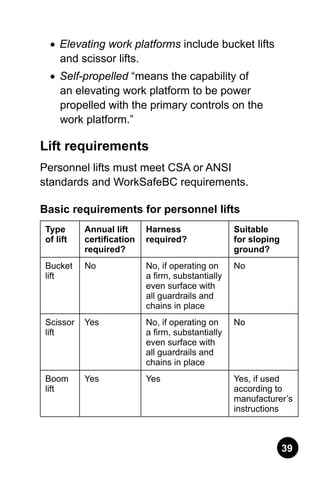
•	 Elevating work platforms include bucket lifts
and scissor lifts.
•	 Self-propelled “means the capability of
an elevating work platform to be power
propelled with the primary controls on the
work platform.”
Lift requirements
Personnel lifts must meet CSA or ANSI
standards and WorkSafeBC requirements.
Basic requirements for personnel lifts
Type
of lift
Annual lift
certification
required?
Harness
required?
Suitable
for sloping
ground?
Bucket
lift
No No, if operating on
a firm, substantially
even surface with
all guardrails and
chains in place
No
Scissor
lift
Yes No, if operating on
a firm, substantially
even surface with
all guardrails and
chains in place
No
Boom
lift
Yes Yes Yes, if used
according to
manufacturer’s
instructions
40
In the Regulation
See sections
19.24–19.29.
Inspecting lifts
•	 Inspect lifts before each use.
•	 If you find any defects, repair the lift
immediately or tag it and remove it from
service.
•	 Keep inspection and maintenance records.
•	 Check the equipment decal to ensure the
certification has not expired.
Operating lifts
•	 Lifts must be operated
by trained, qualified
crew members.
•	 Follow the manufacturer’s instructions
and WorkSafeBC requirements. Keep the
operating manual on site.
•	 Before operating the lift, check for potential
hazards, including traffic, power sources,
floor openings, and slopes.
•	 Level and plumb the lift base and supporting
ground. Use wheel chocks and blocking on
inclines.
•	 Look out for overhead power lines and high-
voltage devices. When working near power
lines, stay outside the limits of approach.
41
•	 Don’t exceed the manufacturer’s specified
load limit.
•	 Don’t try to increase lift height by placing
ladders, planks, or other objects on top of
the platform.
•	 Set the braking system before elevating
crew members.
•	 Don’t sit or climb on the railings.
•	 Lock out unattended personnel lifts.
•	 Establish clear communication protocols
between workers on the platform and those
on the ground.
•	 Don’t use lifts in extreme weather conditions
such as thunderstorms, heavy rain, or high
winds, unless safety measures are in place.
•	 In electrical storms, workers must get off the
lift.
Moving workers on lifts
•	 Most lifts, with the exception of scissor lifts,
must be lowered before they are moved with
workers on them.
•	 Follow the manufacturer’s or supplier’s
specifications.
42
•	 Ensure that all guardrails and chains are in
place.
•	 Watch the rate of travel and communicate
with the worker on the platform according to
pre-set protocols.
43
Communication protocols
Generally, workers at height should dictate any
movement of themselves or the equipment in
their immediate area. Workers below should
never make such moves unless asked to by the
person at height.
If you need to move a counterweight or other fly
pipe that is near a worker on a ladder or lift, or
the worker is on the grid or loading gallery, ask
the worker before moving the item.
If you drop an object from a height, immediately
yell “Heads!” If you hear someone yell “Heads!”
duck and cover; don’t look up.
Moving workers on scaffolds or
bucket lifts
1.	Worker at height: Make sure your head is
clear of the grid and the space is clear of
cables. Initiate the move by saying “Ready
to move” and indicating the location or
direction (for example, “Stage left, one foot”).
44
2.	Assistant below: Before moving the ladder
or lift, make sure the path is clear, then say
“Moving.”
3.	Worker at height: When you reach the new
location, say “Stop.”
Assistants should pay close attention to the
worker above. Designate one assistant as the
operator. The operator should:
•	 Communicate with the worker above
•	 Make sure the path is clear
•	 Make sure others know there is someone
working overhead
45
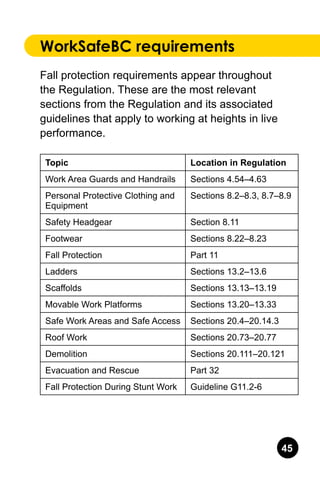
WorkSafeBC requirements
Fall protection requirements appear throughout
the Regulation. These are the most relevant
sections from the Regulation and its associated
guidelines that apply to working at heights in live
performance.
Topic Location in Regulation
Work Area Guards and Handrails Sections 4.54–4.63
Personal Protective Clothing and
Equipment
Sections 8.2–8.3, 8.7–8.9
Safety Headgear Section 8.11
Footwear Sections 8.22–8.23
Fall Protection Part 11
Ladders Sections 13.2–13.6
Scaffolds Sections 13.13–13.19
Movable Work Platforms Sections 13.20–13.33
Safe Work Areas and Safe Access Sections 20.4–20.14.3
Roof Work Sections 20.73–20.77
Demolition Sections 20.111–20.121
Evacuation and Rescue Part 32
Fall Protection During Stunt Work Guideline G11.2-6
46
Organizations
Actsafe
Tel: 	 604 733-4682 in the Lower Mainland.
	 1 888 229-1455, toll-free in B.C..
Fax: 	 604 733-4692.
Web: 	 www.actsafe.ca
Collaborating with B.C.’s motion picture and
performing arts industries to provide innovative,
accessible health and safety training and
resources.
WorkSafeBC
Tel: 	 604 276-3100 in the Lower Mainland.
	 1 888 621-SAFE (621-7233), .
	 toll-free in B.C..
Email: 	workpub@worksafebc.com
The Occupational Health and Safety Regulation
and many other publications are available at
WorkSafeBC.com.
47
Canadian Institute for Theatre Technology
Tel: 	 1 888 271-3383.
Fax: 	 613 482-1212.
Email:	info@citt.org.
Web: 	 www.citt.org
Entertainment Technician Certification
Program
Tel: 	 212 244-1505.
Fax: 	 212 244-1502.
Email:	etcp@plasa.org.
Web: 	 http://etcp.plasa.org
North American Association of Flying Effects
Directors (NAAFED)
Tel: 	 1 888 359-4255, ext. 103.
Email:	louh@flyingfx.com.
Web: 	 www.naafed.com
United States Institute for Theatre
Technology (USITT)
Tel: 	 1 800 938-7488.
Fax: 	 1 866 398-7488.
Email:	info@office.usitt.org.
Web: 	 www.usitt.org
48
Resources
Actsafe
Visit www.actsafe.ca for health and safety
resources, including the following:
•	 Risk Assessment Checklist
•	 Fall Protection Plan
•	 Sample Safe Development Process
•	 New and Young Worker Orientation
infosheet
•	 New and Young Worker Orientation series
(three videos)
•	 Stunt Harness Inspection video
•	 Health and Safety Overview of Orchestra
Pits (Performing Arts Safety Bulletin #11)
•	 Play it Safe online manual
Other
WorkSafeBC Ladder Safety web page:.
www2.worksafebc.com/Topics/EquipmentSafety/
LadderSafety.asp
What is Actsafe?
Actsafe partners with B.C.’s entertainment industries
to keep workers safe. Actsafe is where people in the
industry connect with others who share their safety
concerns, and set the stage to work safely.
Mission
Collaborating with B.C.’s motion picture and
performing arts industries to provide innovative,
accessible health and safety training and resources.
Values
Accessibility, Collaboration, Innovation.
Structure
Actsafe is governed by the industries it represents.
We operate through two standing committees that
represent the motion picture and performing arts
communities. Membership on these committees
includes both employer and worker representatives.
Office hours: 9:00 am – 5:00 pm, Monday to Friday.
Contact us:
Suite 215 – 750 Hamilton Street .
Vancouver, B.C.  V6B 2R5
Tel: 	 604.733.4682
Fax:	 604.733.4692
Toll-free: 	888.229.1455
Email: 	 info@actsafe.ca
www.actsafe.ca
Performing Arts Safety Primer
Working at
Heights
This primer is for employers, performers, and
technicians in British Columbia’s live performance
industry. It describes health and safety requirements
and safe work practices for working at heights.
This primer is intended as a tool to help cast and crew
members work safely. It will also help employers comply
with their legal responsibility to take every reasonable
precaution to protect workers from falls.
www.actsafe.ca

Working at-heights

  • 1.
    Performing Arts SafetyPrimer Working at Heights
  • 2.
    Contents Introduction.......................................................1 Quick-start questions........................................3 Types offall protection.....................................6 Fall protection plans.......................................10 Worker instruction and training.......................14 General safety................................................17 Rehearsal.......................................................21 Developing production components...............25 Unguarded edges...........................................29 Ladders..........................................................32 Scaffolds.........................................................34 Lifts.................................................................38 Communication protocols...............................43 WorkSafeBC requirements.............................45 Organizations.................................................46 Resources......................................................48 Note: The material in this publication is intended as educational information only. This publication does not replace the Occupational Health and Safety Regulation administered by WorkSafeBC. Employers and workers should always refer to the Regulation for specific requirements that apply to their activities. ©2012 Actsafe. All rights reserved. Actsafe encourages the copying, reproduction and distribution of this document to promote health & safety in the workplace, provided Actsafe is acknowledged. However, no part of this publication may be copied, reproduced or distributed for profit or other commercial enterprise, nor may any part be incorporated into any other publications, without written permission from Actsafe. First printing. December 2012. Printed in Canada.
  • 3.
    Introduction This primer isfor employers, performers, and technicians in British Columbia’s live performance industry. It describes health and safety requirements and safe work practices for working at heights. You may find the information in this primer useful if you are involved with: • An established performing arts organization, such as a dance or theatre company • An organization that produces concerts, cooperative shows, or corporate or special events (including festivals) • A volunteer or educational organization Aim of this primer • Help employers comply with their legal responsibility to take every reasonable precaution to protect workers from falls • Provide information about fall protection issues so cast and crew members can work safely
  • 4.
    This primer doesnot replace the Occupational Health and Safety Regulation or the Workers Compensation Act. It explains many of the health and safety requirements that apply to live performance in B.C., but employers and workers should always refer to the Regulation for specific requirements that apply to their production activities.
  • 5.
    Quick-start questions Answer eachof the following three questions to help determine what you need to do for fall protection on your production. 1. Will technicians or performers be working near unguarded edges at heights of 3 m (10 ft.) or more, other than on a temporary ladder, or in a bucket or scissor lift? Yes. Your production needs fall protection. Complete a risk assessment and follow safe work procedures. Complete a written fall protection plan if technicians or performers will be working at heights of 7.5 m (25 ft.) or more without permanent guardrails, or if the fall protection system will consist of work procedures (for example, a control zone and safety monitor). No. Move to question 2. Think about: • Working on ladders, scaffolds, work platforms, balconies, catwalks, scenery, lifts, flying rigs, high steel, or near pits and traps • Build, set-up, hang, touch-ups, tech, run, and strike
  • 6.
    Think about: • Working above anaudience, an orchestra pit, or on platforms or risers above scenery • Build, set-up, hang, touch-ups, tech, run, and strike Actsafe resources Visit www.actsafe.ca for health and safety resources, including the following: • Risk Assessment Checklist • Fall Protection Plan Other resources are described on page 48. 2. Will technicians or performers be working at heights less than 3 m (10 ft.), but where a fall could involve unusual risk of injury? Yes. Your production needs fall protection. Complete a risk assessment and follow safe work procedures. Complete a written fall protection plan if technicians or performers will be working at heights of 7.5 m (25 ft.) or more without permanent guardrails, or if the fall protection system will consist of work procedures (for example, a control zone and safety monitor). No. Move to question 3.
  • 7.
    3. Will there beany other hazards while technicians or performers are working at height? Yes. Complete a risk assessment and follow safe work procedures. Depending on the hazard, you may need to complete a written fall protection plan. No. You’re done. Think about: • Working alone, with moving or falling objects, on slippery or unstable surfaces, in adverse weather conditions, near power sources, or with new crew • Build, set-up, hang, touch-ups, tech, run, and strike
  • 8.
    In the Regulation SeePart 11: Fall Protection. Types of fall protection Types of fall protection include: • Fall restraint (guardrails, safety belts, or full body harnesses) • Fall arrest (full body harnesses) • Work procedures (control zones and safety monitors) • Other work procedures acceptable to WorkSafeBC Fall protection hierarchy 1. Use fall restraint before fall arrest. 2. Use fall arrest before work procedures. 3. Use work procedures only if you cannot use restraint or arrest methods. Fall restraint systems Whenever possible, use a fall restraint system to avoid getting into a situation in which you can fall. Guardrails are preferred.
  • 9.
    If guardrails arenot practicable, use a safety belt or full body harness attached to a securely anchored lanyard or lifeline. Adjust the lanyard or lifeline to limit your ability to travel and keep you away from the unguarded edge. Fall arrest systems If a fall restraint system is not practicable, use a fall arrest system. A fall arrest system will not prevent a fall from occurring, but it will stop the fall after a short distance. A fall arrest system consists of a full body harness attached to a securely anchored lanyard that will limit the fall to a safe distance. Full body harnesses are specially designed to help protect against internal injuries. Don’t use safety belts in fall arrest systems. A fall protection plan is required for work at heights of 7.5 m (25 ft.) or more in locations that don’t have permanent guardrails. (See “Fall protection plans,” pages 10–13.)
  • 10.
    In the Regulation Seesections 4.56, 4.59, 4.60, and 8.22. Work procedures If fall restraint and fall arrest systems are not practicable, use a work procedure, such as a control zone and safety monitoring system. A control zone is an off-limits area between an unguarded edge and a safe zone where workers can move about. If you need to enter the control zone, a safety monitor keeps an eye on you. Work procedures can also include other procedures acceptable to WorkSafeBC. Exceptions for live performance Live performance presents unique difficulties when it comes to working at heights. Guardrails are often not practicable on scenic units that will be visible to an audience. Full body harnesses and safety lines on performers are often not practical during performance. WorkSafeBC recognizes this and allows some exceptions to the use of standard protective
  • 11.
    equipment and clothingin performance situations “provided that effective measures are taken to protect performers and other workers from injury.” Effective measures may include procedures described in “Rehearsal” (see pages 21–24) and “Developing Production Components” (see pages 25–28). Fall protection equipment Employers are responsible for providing workers with any necessary fall protection equipment. However, if employers and workers both agree, workers may use their own equipment as long as it meets WorkSafeBC requirements and is appropriate for the specific task. If you are inexperienced or unsure of what fall protection to use, consult the specialist on your production who is most qualified for the intended task. What does qualified mean? In the Regulation, qualified means “being knowledgeable of the work, the hazards involved and the means to control the hazards, by reason of education, training, experience or a combination thereof.”
  • 12.
    10 Fall protection plans Whenare fall protection plans required? Employers must ensure that decisions are documented in a written fall protection plan in any of the following cases: • When technicians or performers will be working at heights of 7.5 m (25 ft.) or more without permanent guardrails • When a fall from a lower height could involve unusual risk of injury • When the fall protection system will consist of work procedures, such as control zones or nets Even if you are not required to complete a plan, briefly documenting your decisions can be useful for future reference and can establish due diligence.
  • 13.
    11 What should thefall protection plan include? Include detailed rehearsal and performance plans. All fall protection plans must specify: • Fall hazards expected during each production phase • Methods to prevent or mitigate the hazards • Procedures to assemble, maintain, inspect, use, and disassemble fall protection systems • A rescue plan for aiding workers who fall and are left suspended at height Rescue plans The rescue plan should answer these questions: • If workers at risk fell, what would likely happen? • Would self-rescue be possible? • If not, could rescuers get to the workers? • What equipment and techniques (including qualified experts) would you need, and how will you provide them?
  • 14.
    12 Safety measures forcustomized equipment If a performer will be using customized equipment — including harnesses and fly hardware (rated equipment made into a customized system) — describe safety measures the production will take. Examples of safety measures • Write a detailed rehearsal and choreography plan. • Use equipment designed for the forces that will be exerted on it. • Appoint a qualified person to inspect the equipment before each use. Review and update the fall protection plan • Review the fall protection plan before implementing it. • Review the fall protection plan regularly as the production develops and conditions change.
  • 15.
    13 • Make anddocument any necessary additions or changes. • If you change things on the fly, make sure there is enough time to reassess risks and to test and rehearse the system. Note changes on the risk assessment checklist and fall protection plan. Make changes as required by the venue If you did not see the venue before completing the risk assessment checklist and fall protection plan, you may need to review and update them. This applies particularly to touring shows or new locations, where you need to reassess hazards for the new venue or worksite. Even if you have been there before, reassess the venue or location when you arrive. Formalize continual risk assessment The risk assessment should be on the agenda at production meetings. Briefly document each reassessment (for example, add to the risk assessment checklist and fall protection plan).
  • 16.
    14 Worker instruction andtraining Employers must provide workers with information, instruction, training, and supervision so they can carry out their work safely. • When hiring, specify the requirements of the job if it will involve working at heights. • Inform workers of relevant hazards. • Post your risk assessment checklist and fall protection plan, and any subsequent amendments. • Instruct and train workers in rescue procedures, fall protection methods, and equipment use. • Document crew talks, training programs, and rehearsals, including attendance. Crew meetings Supervisors or crew chiefs must discuss fall protection at the first crew meeting. • Inform workers where the risk assessment (and fall protection plan, if there is one) is posted before working at heights begins. • Address the safety aspects of the work and the technical requirements, particularly
  • 17.
    15 when the taskinvolves unusual or unwieldy equipment. With new crew, discuss fall protection and other health and safety issues in an orientation before they begin work. Introduce them to their worker health and safety representative. Young and new workers Employers must ensure that young and new workers are given health and safety orientation and training specific to their workplace before beginning work. Definitions Young worker — “Any worker who is under 25 years of age.” New worker — “Any worker who is new to the workplace, returning to a workplace where the hazards in that workplace have changed during the worker’s absence, affected by a change in the hazards of a workplace, or relocated to a new workplace if the hazards in that workplace are different from the hazards in the worker’s previous workplace.” In the Regulation See sections 3.22–3.25.
  • 18.
    16 Actsafe resources • New andYoung Worker Orientation infosheet • New and Young Worker Orientation series (three videos) Employers must document orientation and training of new and young workers. Actsafe has a sample form available in the publication Orientation for Young and New Workers. Tips for effective orientation and training • Set the tone by providing a clean, safe work environment. • Stress safety over productivity. Productivity will come as new employees learn. • Encourage questions. • Don’t assume anything is common sense. • Evaluate and assess the safety of equipment that young or new workers might be required to operate. • Ensure that young and new workers are appropriately supervised. • Involve supervisors and experienced workers in orientation and training.
  • 19.
    17 General safety Falling objects Weara hard hat if there is a risk of head injury from falling or thrown objects (for example, flown scenery, lighting equipment, tools, or tail ends of cable). Although some companies provide hard hats, workers are responsible for providing their own approved hard hat, if necessary. Hard hat requirements • Keep your hard hat clean. Don’t use solvents to clean it; they weaken the plastic. • Don’t drill holes in your hard hat. • Don’t paint it or apply stickers to it. • Inspect it regularly. If it is cracked or damaged, replace it. • Warn anyone not wearing a hard hat in an area where hard hats are required to keep clear of that area. Working at heights • Empty your pockets. • Strap loose tools to your body. • If you are using a hard hat, fasten the chin strap.
  • 20.
    18 In the Regulation Seesections 4.21–4.23. • If you need to work with loose tools, materials, or equipment (for example, when loading a counterweight arbor), make sure the area below is cleared of people and marked as a danger zone. • Position objects as securely as possible so nothing gets accidentally knocked overboard. • Avoid working alone at heights. Low light levels • Install running lights backstage. • Mark unguarded edges, if possible, with conspicuous warning markers such as white tape, glow tape, LED lights, or laser markers. Don’t rely entirely on electrical illumination in case of a power failure. • Make portable lights (such as trouble lights, forehead flashlights, and mag lights) easily available to technicians working near unguarded edges. • Include the running crew and technicians in technical rehearsals so they can orient themselves to the conditions.
  • 21.
    19 Slippery or unstablesurfaces Performers and technicians must wear footwear that protects against existing hazards. If it is not practicable for a performer to wear standard safety footwear, the employer must take other measures to protect them from injury — for example, fit costume shoes with non- slip soles, change the floor surface, or remove the hazard. High voltage Don’t violate the limits of approach when working near energized high-voltage electrical equipment. In the Regulation, high voltage “means a potential difference (voltage) of more than 750 volts between conductors or between a conductor and ground.” Strike When assessing risks, include the work that will be done at heights when striking. Circumstances can be more hazardous during strike: there is In the Regulation See sections 8.22–8.23. In the Regulation See sections 19.24–19.29.
  • 22.
    20 often a senseof urgency, crew sizes may have changed, all departments may be working at the same time, and fatigue is often a factor. If the install required special equipment, make sure you have it for the strike. Ensure that stairways and other access methods are left intact until workers do not need access to the areas they serve.
  • 23.
    21 Rehearsal Rehearsal is afundamental safe work practice for live performance. If a falling hazard cannot be eliminated during the design and construction phases of production, use rehearsal to introduce workers to the hazard and train them to deal with it. Proceed gradually from no risk to performance-level risk. Complicated sequences and hazardous parts of the action may require far more rehearsal time. Pre-rehearsal planning • Consider fall protection and general safety when discussing how the artistic concept will be staged. Include fall protection strategies in the budget. • Assess risks, and eliminate or control hazards and unsafe work practices. Reassess risks as the production develops and conditions change. • Complete a fall protection plan that includes information on hazards, prevention methods, safe work procedures, and rescue plans. (See “Fall Protection Plans,” pages 10–13.)
  • 24.
    22 Actsafe resources • New andYoung Worker Orientation infosheet • New and Young Worker Orientation series (three videos) • Make fall protection a part of all pre- production planning and communication. Allow enough lead time for adjustments to be made for each venue. • Hire performers and technicians who are sufficiently trained, experienced, and comfortable performing the tasks required. • Schedule enough rehearsal time to deal with hazards. Allow time for additional rehearsals throughout the run, if necessary. • Make sure understudies and replacements have enough rehearsal time to perform safely. Orientation • Orient performers and technicians at the beginning of production or when arriving at a new venue. • Point out hazards such as traps and other unguarded edges.
  • 25.
    23 • Discuss therisk assessment and fall protection plan. Focus on risks and how to mitigate them. Give workers an opportunity for feedback. • Update workers about changing set conditions — for example, draw attention to an open orchestra pit or a new floor opening. Rehearsal guidelines • Develop blocking or choreography that eliminates or mitigates risks; or alter the technical parameters of the hazardous sequence. • Ask the stage manager to document fall protection issues and solutions in the daily production notes. • Ensure that production notes are on the agenda and discussed at weekly production meetings, and with appropriate technicians and performers. • Inspect fall protection equipment before and after each use. Actsafe resource • Stunt Harness Inspection video
  • 26.
    24 • Make surethat technicians checking a performer’s safety arrangements are protected from injury while doing so. • Upon arriving at the venue, conduct a spacing or orientation rehearsal. • Dry-run sequences that involve special effects, pyrotechnics, stage machinery, or other technical hazards. • Do a full run-through of any sequence believed to be hazardous.
  • 27.
    25 Developing production components The safedevelopment process is a part of production design that can be initiated at any time. Use this process to identify and resolve health and safety issues for potentially hazardous production components, such as scenery used to fly performers or a costume with stilts. Document the process in your fall protection plan to establish due diligence. The safe development process consists of three steps: development, testing, and rehearsal. Note: Before developing production components, make sure the production and creative teams complete a risk assessment. Development Use research and design to resolve health and safety concerns. Consult with performers, production team members, and the health and safety representative, if there is one. Actsafe resource • Sample Safe Development Process
  • 28.
    26 In the Regulation SeeGuideline 11.2-6, Fall Protection During Stunt Work. Testing Test production components that interact or might interact with performers or technicians. • For initial tests, use non-live loads such as sand bags. • For secondary tests, use controlled live loads with appropriate safety measures such as fall arrest harnesses to simulate and exaggerate performer movement and interactions. • Carry out final tests with all other production components that could affect the component under development (for example, adjacent performer or scenery movements, lighting conditions, or sound levels). Rehearsal Provide all performers working on or with potentially hazardous components with enough orientation and rehearsals to eliminate or mitigate the risks. (See “Rehearsal,” pages 21–24.)
  • 29.
    27 Components visible tothe audience Generally, structures and components must meet the standards described in the Regulation. However, WorkSafeBC allows exceptions for props, scenic units, and effects components that will be visible to the audience, as long as effective measures are taken to ensure that workers are protected from injury. This means that in situations where WorkSafeBC requirements are not practicable, you can use the safe development process (in conjunction with the rehearsal process) to identify and resolve health and safety issues. You must still use professional engineering when necessary. Entering new territory When trying something for the first time, ask a trusted and respected colleague who has done something similar how to approach the component design, or consider hiring a specialist or engineer.
  • 30.
    28 In the Regulation Seesections 3.12–3.13. Consult or hire an engineer to help develop production components when: • The development process does not adequately address the engineering principles involved • You want to ensure that you are providing a safe work environment and doing your due diligence Refusing unsafe work At any point, anyone involved can and must speak up if he or she feels the process is inadequate and the resulting production component will not mitigate the hazard. If there is a concern, work toward a solution that satisfies everyone involved. For example: • Provide additional rehearsal time for the performer to increase their comfort level. • Change the sequence. • Cut the sequence from the production.
  • 31.
    29 Unguarded edges You areworking at height if you are working near a vertical drop that is: • 3 m (10 ft.) or higher • Less than 3 m (10 ft.) but where a fall could cause unusual injury Note: Section 4.55 of the Regulation mentions a requirement for guardrails at heights of 122 cm (4 ft.) or more. This requirement is only intended for structures such as loading docks and does not apply to performance stages and scenic units visible to audiences. When working near edges such as stages, balconies, catwalks, and traps, look out for others — especially if you are a director blocking performers or a stage performer working above pit musicians. In the Regulation See sections 4.54–4.63. Actsafe resource • Health and Safety Overview of Orchestra Pits (Performing Arts Safety Bulletin #11)
  • 32.
    30 Notify all workersof changes to their work environment. For example, tell them if the pit is open and the drop has significantly increased, or if unguarded edges are hidden by drapery. Technical setting vs. rehearsal or performance setting • Establish when work zones will change between the technical setting and the rehearsal or performance setting so protective measures can be implemented. Example: When shifting from a focus call to a technical rehearsal, technicians may need to replace guardrails with alternative fall protection intended for rehearsal and performance. • If practicable, leave standard fall protection measures used to protect technicians during work calls in place to protect performers (for example, during technical rehearsals). • If reassembling protective devices is impractical between shows or during maintenance, protect workers by using the systems in place for performers, but only if these measures are safe given the risk
  • 33.
    31 involved and youreorient the technicians to the altered risk. • If the running crew will be working near edges during the performance (for example, follow-spot operators), provide them with fall protection and include them in rehearsals. Traps • When not in use, cover traps or surround them with guardrails. • If practicable, mark trap perimeters with glow tape, LED lights, white tape, or laser markers. • Don’t rely exclusively on electrically powered systems, in case of a power failure. In the Regulation See section 4.59.
  • 34.
    32 In the Regulation Seesections 13.2–13.6. Note: The use of wheeled A-frame ladders is not recommended. Ladders Two types of ladders are used in live performance: • Portable ladders (straight ladders, extension ladders, A-frame ladders, and stepladders) • Permanent ladders (access ladders and escape ladders) Use ladders that meet CSA or ANSI standards. You can work without fall protection for short, light-duty tasks only. If the job will take longer, use another method such as a lift. Raising and lowering items Don’t climb ladders while carrying heavy or bulky objects. Either position yourself securely on the ladder and rope the item up or down, or attach a pulley block to a rated overhead grid or rigging point, and have ground crew raise or lower the object.
  • 35.
    33 If you areroping the item by hand, make sure the ladder is secure (for example, tie off the ladder at the top and secure it at the bottom or have ladder assistants foot the ladder). Ladder assistants When necessary, use ladder assistants to: • Foot the ladder • Keep people out of the area • Hook up and raise or lower equipment or materials on a rope Portable ladders as scenic units or props A portable ladder constructed at the job site must meet WorkSafeBC requirements unless it will be used as a scenic unit or prop that will be visible to the audience. If a ladder is designed and constructed for use as a visible scenic unit or prop: • Inform all technicians that the ladder is for performance only • Mark the ladder “for performance only” when it is not being used in performance or rehearsal Note: The use of ladder assistants is not considered fall protection.
  • 36.
    34 In the Regulation Seesections 13.13–13.19. Scaffolds In the Regulation, scaffold “means any temporary work platform and its supporting structure used for supporting workers, or materials, or both.” Scaffolds must meet the safety standards in section 13.17. The only exceptions are scenic units or props that will be visible to the audience. Erecting scaffolds • A qualified worker must supervise scaffold erection and dismantling. • Follow the manufacturer’s and supplier’s instructions, and meet WorkSafeBC requirements. • Erect scaffolds on solid footings. If necessary, use screw jacks to level scaffolds. • Secure and rigidly brace the uprights to prevent swaying and movement. • If a scaffold is higher than three times its minimum base dimension, secure the
  • 37.
    35 scaffold to theadjacent structure or use guylines and outriggers. • Don’t erect scaffolds near power lines or other energized high-voltage electrical conductors. If necessary, contact the local power company. • Install required guardrails and toeboards on platforms that are 3 m (10 ft.) or higher. • Don’t mix and match components. • Keep erection drawings on site. • Use fall protection when erecting or dismantling scaffolds that are 3 m (10 ft.) or higher. Inspecting scaffolds Inspect scaffolds daily before use and after any modification. Follow the manufacturer’s and supplier’s instructions, and replace any damaged components. Using scaffolds • If guardrails are not practicable, use personal fall protection. • Use a ladder, stairway, or other safe means to access scaffold landings. Don’t climb the outside of scaffold frames between landings.
  • 38.
    36 • Don’t useladders or makeshift devices on top of scaffolds to increase the height. • Don’t overload scaffolds with materials or people. Stay within the manufacturer’s and supplier’s load specifications. • Secure and belay equipment when hoisting it. When lifting materials more than three frames high from the ground, use a well wheel and davit. Secure equipment on top to the main framework. • Don’t remain on a rolling scaffold while others are moving it if the scaffold is higher than twice its minimum base dimension. • Don’t remain on a rolling scaffold if you are moving it and the platform is higher than one and a half times the scaffold’s minimum base dimension. • Don’t work on a draped scaffold in outdoor conditions unless a professional engineer has determined that it is safe to do so in those conditions at that particular venue. • Objects mounted on scaffolds can make it unstable. Use counterweights or bracing if necessary.
  • 39.
    37 Scaffolds as scenicunits or props A scaffold must meet all WorkSafeBC requirements unless it will be used as a scenic unit that will be visible to the audience. If a scaffold is designed and constructed for use as a visible scenic unit and it does not meet WorkSafeBC requirements, you must include it in your fall protection plan. • Inform all technicians that the scaffold is for performance only. • Mark the scaffold “for performance only” when it is not being used in rehearsal or performance. • Provide an effective means of fall protection for workers (see “Rehearsal,” pages 21–24).
  • 40.
    38 In the Regulation Seesections 13.20–13.33. Lifts Lifts (usually bucket or scissor lifts) are ideal for live production because they: • Have built-in guardrails • Usually do not require full body harnesses (except for boom lifts) • Are easy to move around for minor adjustments • Leave both hands free for work Types of lifts Bucket lifts are single-person telescopic vertical lifts. Some bucket lifts are self-propelled. Scissor lifts are vertical lifts that are scissored rather than telescopic. They can hold more than one person. Boom lifts are mounted on an arm that can be articulated (above) or telescopic. In the Regulation: • Boom-supported elevating work platforms include boom lifts.
  • 41.
    39 • Elevating workplatforms include bucket lifts and scissor lifts. • Self-propelled “means the capability of an elevating work platform to be power propelled with the primary controls on the work platform.” Lift requirements Personnel lifts must meet CSA or ANSI standards and WorkSafeBC requirements. Basic requirements for personnel lifts Type of lift Annual lift certification required? Harness required? Suitable for sloping ground? Bucket lift No No, if operating on a firm, substantially even surface with all guardrails and chains in place No Scissor lift Yes No, if operating on a firm, substantially even surface with all guardrails and chains in place No Boom lift Yes Yes Yes, if used according to manufacturer’s instructions
  • 42.
    40 In the Regulation Seesections 19.24–19.29. Inspecting lifts • Inspect lifts before each use. • If you find any defects, repair the lift immediately or tag it and remove it from service. • Keep inspection and maintenance records. • Check the equipment decal to ensure the certification has not expired. Operating lifts • Lifts must be operated by trained, qualified crew members. • Follow the manufacturer’s instructions and WorkSafeBC requirements. Keep the operating manual on site. • Before operating the lift, check for potential hazards, including traffic, power sources, floor openings, and slopes. • Level and plumb the lift base and supporting ground. Use wheel chocks and blocking on inclines. • Look out for overhead power lines and high- voltage devices. When working near power lines, stay outside the limits of approach.
  • 43.
    41 • Don’t exceedthe manufacturer’s specified load limit. • Don’t try to increase lift height by placing ladders, planks, or other objects on top of the platform. • Set the braking system before elevating crew members. • Don’t sit or climb on the railings. • Lock out unattended personnel lifts. • Establish clear communication protocols between workers on the platform and those on the ground. • Don’t use lifts in extreme weather conditions such as thunderstorms, heavy rain, or high winds, unless safety measures are in place. • In electrical storms, workers must get off the lift. Moving workers on lifts • Most lifts, with the exception of scissor lifts, must be lowered before they are moved with workers on them. • Follow the manufacturer’s or supplier’s specifications.
  • 44.
    42 • Ensure thatall guardrails and chains are in place. • Watch the rate of travel and communicate with the worker on the platform according to pre-set protocols.
  • 45.
    43 Communication protocols Generally, workersat height should dictate any movement of themselves or the equipment in their immediate area. Workers below should never make such moves unless asked to by the person at height. If you need to move a counterweight or other fly pipe that is near a worker on a ladder or lift, or the worker is on the grid or loading gallery, ask the worker before moving the item. If you drop an object from a height, immediately yell “Heads!” If you hear someone yell “Heads!” duck and cover; don’t look up. Moving workers on scaffolds or bucket lifts 1. Worker at height: Make sure your head is clear of the grid and the space is clear of cables. Initiate the move by saying “Ready to move” and indicating the location or direction (for example, “Stage left, one foot”).
  • 46.
    44 2. Assistant below: Beforemoving the ladder or lift, make sure the path is clear, then say “Moving.” 3. Worker at height: When you reach the new location, say “Stop.” Assistants should pay close attention to the worker above. Designate one assistant as the operator. The operator should: • Communicate with the worker above • Make sure the path is clear • Make sure others know there is someone working overhead
  • 47.
    45 WorkSafeBC requirements Fall protectionrequirements appear throughout the Regulation. These are the most relevant sections from the Regulation and its associated guidelines that apply to working at heights in live performance. Topic Location in Regulation Work Area Guards and Handrails Sections 4.54–4.63 Personal Protective Clothing and Equipment Sections 8.2–8.3, 8.7–8.9 Safety Headgear Section 8.11 Footwear Sections 8.22–8.23 Fall Protection Part 11 Ladders Sections 13.2–13.6 Scaffolds Sections 13.13–13.19 Movable Work Platforms Sections 13.20–13.33 Safe Work Areas and Safe Access Sections 20.4–20.14.3 Roof Work Sections 20.73–20.77 Demolition Sections 20.111–20.121 Evacuation and Rescue Part 32 Fall Protection During Stunt Work Guideline G11.2-6
  • 48.
    46 Organizations Actsafe Tel: 604733-4682 in the Lower Mainland. 1 888 229-1455, toll-free in B.C.. Fax: 604 733-4692. Web: www.actsafe.ca Collaborating with B.C.’s motion picture and performing arts industries to provide innovative, accessible health and safety training and resources. WorkSafeBC Tel: 604 276-3100 in the Lower Mainland. 1 888 621-SAFE (621-7233), . toll-free in B.C.. Email: workpub@worksafebc.com The Occupational Health and Safety Regulation and many other publications are available at WorkSafeBC.com.
  • 49.
    47 Canadian Institute forTheatre Technology Tel: 1 888 271-3383. Fax: 613 482-1212. Email: info@citt.org. Web: www.citt.org Entertainment Technician Certification Program Tel: 212 244-1505. Fax: 212 244-1502. Email: etcp@plasa.org. Web: http://etcp.plasa.org North American Association of Flying Effects Directors (NAAFED) Tel: 1 888 359-4255, ext. 103. Email: louh@flyingfx.com. Web: www.naafed.com United States Institute for Theatre Technology (USITT) Tel: 1 800 938-7488. Fax: 1 866 398-7488. Email: info@office.usitt.org. Web: www.usitt.org
  • 50.
    48 Resources Actsafe Visit www.actsafe.ca forhealth and safety resources, including the following: • Risk Assessment Checklist • Fall Protection Plan • Sample Safe Development Process • New and Young Worker Orientation infosheet • New and Young Worker Orientation series (three videos) • Stunt Harness Inspection video • Health and Safety Overview of Orchestra Pits (Performing Arts Safety Bulletin #11) • Play it Safe online manual Other WorkSafeBC Ladder Safety web page:. www2.worksafebc.com/Topics/EquipmentSafety/ LadderSafety.asp
  • 51.
    What is Actsafe? Actsafepartners with B.C.’s entertainment industries to keep workers safe. Actsafe is where people in the industry connect with others who share their safety concerns, and set the stage to work safely. Mission Collaborating with B.C.’s motion picture and performing arts industries to provide innovative, accessible health and safety training and resources. Values Accessibility, Collaboration, Innovation. Structure Actsafe is governed by the industries it represents. We operate through two standing committees that represent the motion picture and performing arts communities. Membership on these committees includes both employer and worker representatives. Office hours: 9:00 am – 5:00 pm, Monday to Friday. Contact us: Suite 215 – 750 Hamilton Street . Vancouver, B.C. V6B 2R5 Tel: 604.733.4682 Fax: 604.733.4692 Toll-free: 888.229.1455 Email: info@actsafe.ca www.actsafe.ca
  • 52.
    Performing Arts SafetyPrimer Working at Heights This primer is for employers, performers, and technicians in British Columbia’s live performance industry. It describes health and safety requirements and safe work practices for working at heights. This primer is intended as a tool to help cast and crew members work safely. It will also help employers comply with their legal responsibility to take every reasonable precaution to protect workers from falls. www.actsafe.ca