1
Presented by
• A.Z.M Humayon Kabir (Zahid)
Head of Inspection & Training
BESI Private Limited
• Md. Salah Uddin ( Lovelu)
Senior Safety Trainer
BESI Private Limited
Learning partners:
2
Unit Objectives:
Awareness of the hazards and controls for Work At Height.
• Fall Prevention ( Scaffolding , Ladders)
• Fall Protection (Safety Harness)
• Falling Objects
Course outcomes:
Recognize the importance of all height safety controls and
guidelines.
Determines the serious consequences of not following the rules:
• Potential serious Injury/Death
• Failure to comply and appropriate Disciplinary action
3
Work at Height
Work at Height: “Work performed where there is potential for a
person to cause harm by falling from one level to another level
which is not the same level”
Fall protection must be in place where there is a fall potential of 1.8
meters or more.
4
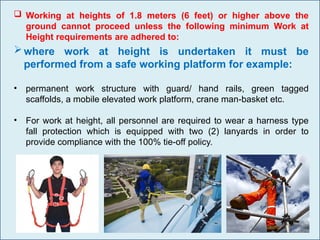
 Working at heights of 1.8 meters (6 feet) or higher above the
ground cannot proceed unless the following minimum Work at
Height requirements are adhered to:
where work at height is undertaken it must be
performed from a safe working platform for example:
• permanent work structure with guard/ hand rails, green tagged
scaffolds, a mobile elevated work platform, crane man-basket etc.
• For work at height, all personnel are required to wear a harness type
fall protection which is equipped with two (2) lanyards in order to
provide compliance with the 100% tie-off policy.
5
 Many work activities involve working at heights when using platforms such as
scaffolds, tower scaffolds, mobile elevated work platforms (MEWPS) or working
on a ladder.
• Work on roofs (buildings, tanks, vessels)
• At the edge of unguarded elevated structures
• At the edge of unguarded excavations
• Walkways and ramps
• Floor Openings
• Erecting formworks
• On the top of vehicles or trailers
• When ascending/descending tower cranes
6
Falls from Height 55
Being Hit by Moving Objects 53
Vehicle Accidents 51
Being Hit by Falling Objects 49
Contact with Electricity 30
Being Trapped by Moving Machinery 26
Drowning/Immersion 16
Other Mechanisms 39
Why focus on “Safety at Height”?
Australian Safety and Compensation Council in 2018
7
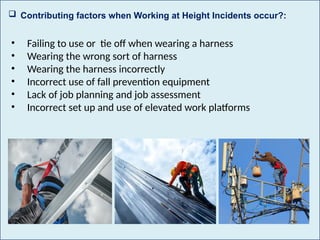
 Contributing factors when Working at Height Incidents occur?:
• Failing to use or tie off when wearing a harness
• Wearing the wrong sort of harness
• Wearing the harness incorrectly
• Incorrect use of fall prevention equipment
• Lack of job planning and job assessment
• Incorrect set up and use of elevated work platforms
8
 Were these really the good old days?
9
 What is really Wrong ?
 Fall protection must be in place where there is a fall potential of
1.8 meters or more.
10
 Rules for Working at Height
All personnel performing work at elevated positions shall meet
the following requirements:
• Understand the hazards of working at height
• Be trained in the use, inspection and maintenance of
fall arrest systems
• Demonstrate Practical competency in initial training
• Undergo refresher training as require by changes in the
workplace and/or equipment or as other events
indicating that refresher training is required.
• Where practicable a work platform with guard /
handrails shall be used
11
 Rules for Working at Height
• Where practicable a work platform with guard / handrails shall be used
• All fall prevention equipment in use shall be fit for purpose and in good
condition (inspected by a competent person)
• An approved fall protection system shall be used for all work where there is
a potential to fall 1.8 metres or more
• Use the correct arrester systems to minimise how far you could fall
12
2 mtr length of
lanyard
1.2 mtr
deceleration
distance
1.8 mtr height of
person
1 mtr safety
margin
Total 6 meters
from anchorage
 Rules for Working at Height
13
 Rules for Working at Height.
• Clip on to strong anchor points. (capable of supporting a
load of 2250kg)
• Ensure you are tied off 100% of the time when you are required to
use a fall arrest system
• Protect all from dropped objects.
• Do not take short cuts
14
 Rules for Working at Height.
• Know how you will be recovered if you fall and are suspended.
• Always check the integrity of ladders used to access a ‘working at
height’ area.
• Prevent other people from entering the ‘working at height’ area unless
they are authorised to do so.
• Use hand line to raise tools and materials if required.
• All materials/tools must be 100% fall protected.
• Maintain good housekeeping.
15
 moving from one surface to
another at heights
 uncovered holes and
openings
 open edges not barricaded
 uneven surfaces
 moving surfaces
 poor lighting
 unsuitable foot wear
 slippery surfaces
 dust, wind and rain
 being struck by falling
objects
 incorrectly using a ladder
 incorrectly using fall
arresting equipment
Factors that Could Cause a Fall
16
Components of Fall Protection System
Full body harness
Lanyards
Slings for beams
Rope Grabs
Roof anchors
Retracting and recoil or
rewind device (Yo-Yo);
17
Life Lines
Ropes
Connectors Tripod
Components of Fall Protection System
18
Connectors
 A device that is used to couple (connect)
parts of the personal fall arrest systems and
positioning device together.
 Snap-hooks attached to lanyards shall be of
double action, self-closing and self-locking
type.
 Simple spring resistant snap hooks or screw
gate carabiners shall not be used for fall
protection.
 Only self-locking snap hooks are to be used
with positioning devices.

19
Choosing Fall Protection Equipment
• the height of the work area
• if you will be in a confined space
• the length of time you will need to perform
the task
• the flexibility of movement required to
perform the task
• the proximity of the task to the anchor
points
• the number of people required to perform
the task.
20
Personal Fall Arrest System
• Full body harness
• Shock absorbing double lanyard
• Double action/self locking
connectors
• In good working condition -
inspected quarterly and color coded.
No safety belts are allowed on the project,
only approved FULL BODY HARNESS with
2 shock absorbing lanyards are to be used !
21
Lifeline Systems
• Lifeline systems are points of attachment for fall protection lanyards and
harnesses.
• Lifelines shall not be used for any other purpose than fall protection.
• Lifelines shall be protected against being cut or abraded.
• Lifelines shall be inspected by a competent person weekly following the
same inspection procedure for scaffolds inspection.
• Only engineered lifeline systems approved by JGSK will be used on the
project and must be installed and used under the supervision of a
designated qualified person.
22
Personnel Cages (Man-Basket)
• The use of personnel cages should be
viewed as a last resort.
• All lifts involving Man Baskets shall
require a valid Cold Work Permit to
work including completion of a pre-lift
checklist.
• The SWL of the crane shall be down
rated by 50% of the load chart at the
operating radius when being used to
lift a man basket.
23
Donning the Safety Harness
 Visually check the harness to ensure all
components are in good condition.
 Fit the harness and tighten the straps so
they are firm, but comfortable.
 Make sure none of the straps are twisted
and that they lay flat against your body.
 The harness attachment for a full body
unit should sit between your shoulder
blades.
 Check that your movements are not
restricted.
24
• Double shock absorbing lanyards required.
• At least one lanyard is hooked or tied off on an anchor
point all the time.
Double Lanyard
25
Anchor Points
• You must use suitable anchor points
• Directly above the shoulders as much as possible.
26

Wrong use of fall arrest system
27
 There a four basic components that require inspection.
Mechanical
Devices
daily check
+
monthly
colour code
Harness &
Connectors
daily check
+
monthly
colour code
Flexible Life
Lines
Life Lines
New tag each week
by
Authorized Person
NO/WRONG TAG
NO USE
Inspection
28
• All fall protection equipment must be inspected by the user before each use.
Defective or damaged fall protection equipment must be removed from use.
• All fall protection equipment must be inspected on a quarterly basis
and the relevant monthly inspection color applied.
Inspection
29
Inspection Record
30
•All Scaffold operatives erecting, modifying or dismantling scaffold structures
will be required to wear a harness type fall protection equipped with two (2)
lanyards and remain 100% tied-off until the structure is complete or
dismantled.
•All fall protection equipment must be inspected by the user before each use.
•All fall protection equipment must be inspected on a quarterly basis and the
relevant monthly inspection color applied.
•100% tie-off is required when performing any work at height that is not
completely enclosed by guardrails and mid rails.
•Anchorage points for fall protection equipment should be as high as possible
above the feet of the user (preferably above the head, wherever possible) to
limit the distance of the fall (anchors and anchor points should be above the
user so that the anchor line or lanyard is taut or has as little slack as possible).
Remember
31
The place where work at height is undertaken must be safe i.e. a fixed
permanent platform with guard/ hand rails, a mobile elevated work platform,
crane man-basket or green tagged scaffold etc.
Scaffold with Double
Hand Rails & Toe
Boards
Mobile Elevated Working
Platform with Double
Handrails & Toe Boards
Mobile Elevated Working
Platform with Double
Handrails & Toe Boards
Remember
32

• For work at height, all personnel are required to wear a harness type fall
protection which is equipped with two (2) lanyards
Remember
33

 What is wrong …?
34
Suspension Trauma
• When a person is suspended in a full body harness
for any length of time there is the potential for that
person to suffer suspension trauma otherwise
referred to as Orthostatic intolerance.
• The harness leg straps apply a lot of pressure to the
insides of the legs of the patient reducing blood
flow back to the heart.
• Prolonged suspension from fall arrest systems can
cause orthostatic intolerance, which, in turn, can
result in serious physical injury, or potentially,
death.
• Research indicates that suspension in a fall arrest
device can result in unconsciousness, followed by
death, in less than 30 minutes.
35
Suspension Trauma
Suspended person should be encouraged to “pump” his/her legs
frequently to activate the muscles and reduce the risk of venous
pooling and the onset of orthostatic intolerance.
36
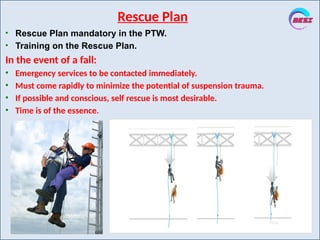
• Rescue Plan mandatory in the PTW.
• Training on the Rescue Plan.
In the event of a fall:
• Emergency services to be contacted immediately.
• Must come rapidly to minimize the potential of suspension trauma.
• If possible and conscious, self rescue is most desirable.
• Time is of the essence.
Rescue Plan
37
Rescue Plan
Planning for working at height must include planning for
emergencies and rescue.
• Should not be difficult.
• Need to cover all reasonably foreseeable
events.
• Should be simple & easily achievable.
• Should be practiced.
• Should be understood by all parties involved
in the plan.
• Should ideally be non-committal.
• Efficient.
38
Safety Harness Used in a Fall
 What to do if the fall arrest system
has been used to arrest a fall?
 Harness & lanyard must be withdrawn
from service and destroyed.
39
Working at Heights Violations!
X X
40
Unsafe Acts/Conditions
X X
41
Unsafe Conditions
X
X
42
Unsafe Acts
X X X
43
Unsafe Acts
X
X
44
Fall Protection - Equipment
 Anchor Point
 Lanyard – Twin tail
 Shock Absorber
 Harness
 Lifeline
 Inertia Real (Yoyo)
 Guard rails
 Stirrups
45
• Anchor point should be capable of supporting a load of 2250kg Where
there is a risk of falling 1.8 meters.
• Personal fall protective equipment shall be visually inspected prior use
every time.
• Quarterly inspections by a competent person and a inspection tag to be
attached and registered
• Always attach as high as you can.
Remember
Life Lines
• Must be Engineered
• Must be installed according Engineered requirements
• Cable must be under tension (No Sagging)
• Minimum Rated capacity – 5,000 lb (2,268 kg)
• You must be connected at all times
• Must be installed to prevent potential for pendulum effect
46
Pendulum Effect
• Lateral swaying  injury by hitting obstacle on side
• Anchorage point above the workstation.
47
Mobile Elevated Work Platforms (MEWP)
Scissor Lift
A scissor lift is a motorized
vehicle that has a railed
platform which can be
raised straight up in order
to gain access and perform
work on areas that are
difficult to reach.
Cherry Picker/Man Lift
A cherry picker (also known as
a boom lift, man lift or basket
crane), is a type of aerial work
platform that consists of a
platform or bucket at the end of
a hydraulic lifting system.
48
Remember when you are on MEWP
• Only personnel with Working at Heights training
allowed to use MEWP.
• Only authorized trained operators can use the
controls.
• Only two persons, allowed inside the basket. Both
must have hard hat with chin strap.
• Both must observe 100% tie-off all the time, stay
inside the basket and not climb on the guardrails.
• Inside the MEWP a short lanyard to be used as per
requirements of the MEWP Risk Assessment.
49
Remember when you are on MEWP
• Tools must be tethered to the worker or man-lift.
• Debris nettings must be fitted to the basket.
• Barricading/exclusion zones and warning signs must
be in-place around the planned working radius.
• The ground must be even, stable and level, and well
compacted.
• Look out for overhead obstructions.
• Two man lifts must not operate within close
proximity of each other.
• Know what to do if machine fails with platform in
raised position.
50
The following specific safety measures Need to complied
• Daily checks including Testing lift controls each shift prior to use
• Only trained /competent persons shall operate mechanical
elevating work platforms.
• Safety harness must be worn with lanyard attached to basket
at all times. Must be secured-off to MEWP only.
• Stand firmly on the floor of the basket at all times
51
Remember During Work On Elevated Work Platforms
• Boom and basket load limits specified by the manufacturer shall not be
exceeded.
• The brakes shall be set, and when outriggers are used, they shall be positioned
on pads or a solid surface.
• Wheel chocks shall be installed before using an aerial lift on an incline provided
they can be safely installed.
• A mechanical elevated work platform shall not be moved when the boom is
elevated in a working position with someone in the basket.
52
Remember During Work On Elevated Work Platforms
• Boom shall be properly cradled and outriggers completely
stowed before movement for travel.
• Articulating boom and extendible boom platforms, primarily
designed as personnel carriers, shall have both platform
(Upper) and lower controls.
• Operators must be deemed competent an each individual
type of EWP they are to operate.
53
Dropped Object?
What is a Dropped Object: Any object that falls from its previous
static position under its own weight
54
Consequences of a Dropped Object
1 kg tool
dropped from Consequences
1 – 3 metres First Aid
3 – 10 metres Recordable Injury
>11 metres Fatality
The table is only a guide: assumes blunt objects and the wearing of standard
PPE
Even a small object falling from a height can be fatal.
55
Consequences of a Dropped Object
A scaffold transom fell 50m
and landed in this gang box
56
Falling Objects
Objects falling from a height are capable of causing
considerable injury to people and damage to equipment.
Examples of falling objects include, but not limited to:
• Nuts & bolts, loose grating, fittings, tools, waste materials,
wood off cuts, scaffold materials.
How can we prevent accident?
• Follow all requirements of the Permit to Work.
• Good housekeeping and good storage practices.
• Cover holes and floor openings.
• Carry tools in a ‘hands free’ approved tool bag.
• Inspect area - consider simultaneous operations.
57
How can we prevent accident? (Cont’d)
• For installation, maintenance and removal of
equipment, ensure it is tied off, tied back,
restrained &/or secure.
• Use of matting and tool lanyards.
• Materials not stored above kick rail height.
• Erect Drop Zone barriers, provide barricade
(warning tape, scaffold railing).
• Provide an observer when required.
CHIN STRAP
TOOL BAG
TOOL LANYARD
Falling Objects
58
Dropped Objects - Where do they occur?
• Cranes
• Platforms
• Working at Height,
• Overhead Work
• Lifting Operations
• Stacking / Storing
• Just about anywhere
59
Dropped Objects - Why do they occur?
• Poor Safety Culture
• Poor Safety Behaviours :
• Complacency,
• Attitude,
• Neglect,
• Blindness to Hazards,
• Blindness to Change
• Insufficient Controls put in
place
• Inadequate Maintenance
• Redundant / Neglected
Equipment
60
Dropped Objects - Prevention
Identifying the Hazard
• Checking for potentials
• Above and below
• Every time there is a lift
• Every time there is multiple levels
• Follow procedures
• Good communication with those above/below us
• Good housekeeping
• Scheduled Maintenance checks
• Planning
• Where practical, tie off all portable tools with lanyard to prevent
them falling
• Enforce exclusion zones below work at height
• Signage warning of work overhead
• Ensure no gaps in decks or toe boards
• Ensure tools/materials are not higher than the toe board
• Install drop sheets to catch anything that may drop
61
Thank you so much

Work at Height, project presentation.pptx

  • 1.
    1 Presented by • A.Z.MHumayon Kabir (Zahid) Head of Inspection & Training BESI Private Limited • Md. Salah Uddin ( Lovelu) Senior Safety Trainer BESI Private Limited Learning partners:
  • 2.
    2 Unit Objectives: Awareness ofthe hazards and controls for Work At Height. • Fall Prevention ( Scaffolding , Ladders) • Fall Protection (Safety Harness) • Falling Objects Course outcomes: Recognize the importance of all height safety controls and guidelines. Determines the serious consequences of not following the rules: • Potential serious Injury/Death • Failure to comply and appropriate Disciplinary action
  • 3.
    3 Work at Height Workat Height: “Work performed where there is potential for a person to cause harm by falling from one level to another level which is not the same level” Fall protection must be in place where there is a fall potential of 1.8 meters or more.
  • 4.
    4  Working atheights of 1.8 meters (6 feet) or higher above the ground cannot proceed unless the following minimum Work at Height requirements are adhered to: where work at height is undertaken it must be performed from a safe working platform for example: • permanent work structure with guard/ hand rails, green tagged scaffolds, a mobile elevated work platform, crane man-basket etc. • For work at height, all personnel are required to wear a harness type fall protection which is equipped with two (2) lanyards in order to provide compliance with the 100% tie-off policy.
  • 5.
    5  Many workactivities involve working at heights when using platforms such as scaffolds, tower scaffolds, mobile elevated work platforms (MEWPS) or working on a ladder. • Work on roofs (buildings, tanks, vessels) • At the edge of unguarded elevated structures • At the edge of unguarded excavations • Walkways and ramps • Floor Openings • Erecting formworks • On the top of vehicles or trailers • When ascending/descending tower cranes
  • 6.
    6 Falls from Height55 Being Hit by Moving Objects 53 Vehicle Accidents 51 Being Hit by Falling Objects 49 Contact with Electricity 30 Being Trapped by Moving Machinery 26 Drowning/Immersion 16 Other Mechanisms 39 Why focus on “Safety at Height”? Australian Safety and Compensation Council in 2018
  • 7.
    7  Contributing factorswhen Working at Height Incidents occur?: • Failing to use or tie off when wearing a harness • Wearing the wrong sort of harness • Wearing the harness incorrectly • Incorrect use of fall prevention equipment • Lack of job planning and job assessment • Incorrect set up and use of elevated work platforms
  • 8.
    8  Were thesereally the good old days?
  • 9.
    9  What isreally Wrong ?  Fall protection must be in place where there is a fall potential of 1.8 meters or more.
  • 10.
    10  Rules forWorking at Height All personnel performing work at elevated positions shall meet the following requirements: • Understand the hazards of working at height • Be trained in the use, inspection and maintenance of fall arrest systems • Demonstrate Practical competency in initial training • Undergo refresher training as require by changes in the workplace and/or equipment or as other events indicating that refresher training is required. • Where practicable a work platform with guard / handrails shall be used
  • 11.
    11  Rules forWorking at Height • Where practicable a work platform with guard / handrails shall be used • All fall prevention equipment in use shall be fit for purpose and in good condition (inspected by a competent person) • An approved fall protection system shall be used for all work where there is a potential to fall 1.8 metres or more • Use the correct arrester systems to minimise how far you could fall
  • 12.
    12 2 mtr lengthof lanyard 1.2 mtr deceleration distance 1.8 mtr height of person 1 mtr safety margin Total 6 meters from anchorage  Rules for Working at Height
  • 13.
    13  Rules forWorking at Height. • Clip on to strong anchor points. (capable of supporting a load of 2250kg) • Ensure you are tied off 100% of the time when you are required to use a fall arrest system • Protect all from dropped objects. • Do not take short cuts
  • 14.
    14  Rules forWorking at Height. • Know how you will be recovered if you fall and are suspended. • Always check the integrity of ladders used to access a ‘working at height’ area. • Prevent other people from entering the ‘working at height’ area unless they are authorised to do so. • Use hand line to raise tools and materials if required. • All materials/tools must be 100% fall protected. • Maintain good housekeeping.
  • 15.
    15  moving fromone surface to another at heights  uncovered holes and openings  open edges not barricaded  uneven surfaces  moving surfaces  poor lighting  unsuitable foot wear  slippery surfaces  dust, wind and rain  being struck by falling objects  incorrectly using a ladder  incorrectly using fall arresting equipment Factors that Could Cause a Fall
  • 16.
    16 Components of FallProtection System Full body harness Lanyards Slings for beams Rope Grabs Roof anchors Retracting and recoil or rewind device (Yo-Yo);
  • 17.
  • 18.
    18 Connectors  A devicethat is used to couple (connect) parts of the personal fall arrest systems and positioning device together.  Snap-hooks attached to lanyards shall be of double action, self-closing and self-locking type.  Simple spring resistant snap hooks or screw gate carabiners shall not be used for fall protection.  Only self-locking snap hooks are to be used with positioning devices. 
  • 19.
    19 Choosing Fall ProtectionEquipment • the height of the work area • if you will be in a confined space • the length of time you will need to perform the task • the flexibility of movement required to perform the task • the proximity of the task to the anchor points • the number of people required to perform the task.
  • 20.
    20 Personal Fall ArrestSystem • Full body harness • Shock absorbing double lanyard • Double action/self locking connectors • In good working condition - inspected quarterly and color coded. No safety belts are allowed on the project, only approved FULL BODY HARNESS with 2 shock absorbing lanyards are to be used !
  • 21.
    21 Lifeline Systems • Lifelinesystems are points of attachment for fall protection lanyards and harnesses. • Lifelines shall not be used for any other purpose than fall protection. • Lifelines shall be protected against being cut or abraded. • Lifelines shall be inspected by a competent person weekly following the same inspection procedure for scaffolds inspection. • Only engineered lifeline systems approved by JGSK will be used on the project and must be installed and used under the supervision of a designated qualified person.
  • 22.
    22 Personnel Cages (Man-Basket) •The use of personnel cages should be viewed as a last resort. • All lifts involving Man Baskets shall require a valid Cold Work Permit to work including completion of a pre-lift checklist. • The SWL of the crane shall be down rated by 50% of the load chart at the operating radius when being used to lift a man basket.
  • 23.
    23 Donning the SafetyHarness  Visually check the harness to ensure all components are in good condition.  Fit the harness and tighten the straps so they are firm, but comfortable.  Make sure none of the straps are twisted and that they lay flat against your body.  The harness attachment for a full body unit should sit between your shoulder blades.  Check that your movements are not restricted.
  • 24.
    24 • Double shockabsorbing lanyards required. • At least one lanyard is hooked or tied off on an anchor point all the time. Double Lanyard
  • 25.
    25 Anchor Points • Youmust use suitable anchor points • Directly above the shoulders as much as possible.
  • 26.
    26  Wrong use offall arrest system
  • 27.
    27  There afour basic components that require inspection. Mechanical Devices daily check + monthly colour code Harness & Connectors daily check + monthly colour code Flexible Life Lines Life Lines New tag each week by Authorized Person NO/WRONG TAG NO USE Inspection
  • 28.
    28 • All fallprotection equipment must be inspected by the user before each use. Defective or damaged fall protection equipment must be removed from use. • All fall protection equipment must be inspected on a quarterly basis and the relevant monthly inspection color applied. Inspection
  • 29.
  • 30.
    30 •All Scaffold operativeserecting, modifying or dismantling scaffold structures will be required to wear a harness type fall protection equipped with two (2) lanyards and remain 100% tied-off until the structure is complete or dismantled. •All fall protection equipment must be inspected by the user before each use. •All fall protection equipment must be inspected on a quarterly basis and the relevant monthly inspection color applied. •100% tie-off is required when performing any work at height that is not completely enclosed by guardrails and mid rails. •Anchorage points for fall protection equipment should be as high as possible above the feet of the user (preferably above the head, wherever possible) to limit the distance of the fall (anchors and anchor points should be above the user so that the anchor line or lanyard is taut or has as little slack as possible). Remember
  • 31.
    31 The place wherework at height is undertaken must be safe i.e. a fixed permanent platform with guard/ hand rails, a mobile elevated work platform, crane man-basket or green tagged scaffold etc. Scaffold with Double Hand Rails & Toe Boards Mobile Elevated Working Platform with Double Handrails & Toe Boards Mobile Elevated Working Platform with Double Handrails & Toe Boards Remember
  • 32.
    32  • For workat height, all personnel are required to wear a harness type fall protection which is equipped with two (2) lanyards Remember
  • 33.
  • 34.
    34 Suspension Trauma • Whena person is suspended in a full body harness for any length of time there is the potential for that person to suffer suspension trauma otherwise referred to as Orthostatic intolerance. • The harness leg straps apply a lot of pressure to the insides of the legs of the patient reducing blood flow back to the heart. • Prolonged suspension from fall arrest systems can cause orthostatic intolerance, which, in turn, can result in serious physical injury, or potentially, death. • Research indicates that suspension in a fall arrest device can result in unconsciousness, followed by death, in less than 30 minutes.
  • 35.
    35 Suspension Trauma Suspended personshould be encouraged to “pump” his/her legs frequently to activate the muscles and reduce the risk of venous pooling and the onset of orthostatic intolerance.
  • 36.
    36 • Rescue Planmandatory in the PTW. • Training on the Rescue Plan. In the event of a fall: • Emergency services to be contacted immediately. • Must come rapidly to minimize the potential of suspension trauma. • If possible and conscious, self rescue is most desirable. • Time is of the essence. Rescue Plan
  • 37.
    37 Rescue Plan Planning forworking at height must include planning for emergencies and rescue. • Should not be difficult. • Need to cover all reasonably foreseeable events. • Should be simple & easily achievable. • Should be practiced. • Should be understood by all parties involved in the plan. • Should ideally be non-committal. • Efficient.
  • 38.
    38 Safety Harness Usedin a Fall  What to do if the fall arrest system has been used to arrest a fall?  Harness & lanyard must be withdrawn from service and destroyed.
  • 39.
    39 Working at HeightsViolations! X X
  • 40.
  • 41.
  • 42.
  • 43.
  • 44.
    44 Fall Protection -Equipment  Anchor Point  Lanyard – Twin tail  Shock Absorber  Harness  Lifeline  Inertia Real (Yoyo)  Guard rails  Stirrups
  • 45.
    45 • Anchor pointshould be capable of supporting a load of 2250kg Where there is a risk of falling 1.8 meters. • Personal fall protective equipment shall be visually inspected prior use every time. • Quarterly inspections by a competent person and a inspection tag to be attached and registered • Always attach as high as you can. Remember Life Lines • Must be Engineered • Must be installed according Engineered requirements • Cable must be under tension (No Sagging) • Minimum Rated capacity – 5,000 lb (2,268 kg) • You must be connected at all times • Must be installed to prevent potential for pendulum effect
  • 46.
    46 Pendulum Effect • Lateralswaying  injury by hitting obstacle on side • Anchorage point above the workstation.
  • 47.
    47 Mobile Elevated WorkPlatforms (MEWP) Scissor Lift A scissor lift is a motorized vehicle that has a railed platform which can be raised straight up in order to gain access and perform work on areas that are difficult to reach. Cherry Picker/Man Lift A cherry picker (also known as a boom lift, man lift or basket crane), is a type of aerial work platform that consists of a platform or bucket at the end of a hydraulic lifting system.
  • 48.
    48 Remember when youare on MEWP • Only personnel with Working at Heights training allowed to use MEWP. • Only authorized trained operators can use the controls. • Only two persons, allowed inside the basket. Both must have hard hat with chin strap. • Both must observe 100% tie-off all the time, stay inside the basket and not climb on the guardrails. • Inside the MEWP a short lanyard to be used as per requirements of the MEWP Risk Assessment.
  • 49.
    49 Remember when youare on MEWP • Tools must be tethered to the worker or man-lift. • Debris nettings must be fitted to the basket. • Barricading/exclusion zones and warning signs must be in-place around the planned working radius. • The ground must be even, stable and level, and well compacted. • Look out for overhead obstructions. • Two man lifts must not operate within close proximity of each other. • Know what to do if machine fails with platform in raised position.
  • 50.
    50 The following specificsafety measures Need to complied • Daily checks including Testing lift controls each shift prior to use • Only trained /competent persons shall operate mechanical elevating work platforms. • Safety harness must be worn with lanyard attached to basket at all times. Must be secured-off to MEWP only. • Stand firmly on the floor of the basket at all times
  • 51.
    51 Remember During WorkOn Elevated Work Platforms • Boom and basket load limits specified by the manufacturer shall not be exceeded. • The brakes shall be set, and when outriggers are used, they shall be positioned on pads or a solid surface. • Wheel chocks shall be installed before using an aerial lift on an incline provided they can be safely installed. • A mechanical elevated work platform shall not be moved when the boom is elevated in a working position with someone in the basket.
  • 52.
    52 Remember During WorkOn Elevated Work Platforms • Boom shall be properly cradled and outriggers completely stowed before movement for travel. • Articulating boom and extendible boom platforms, primarily designed as personnel carriers, shall have both platform (Upper) and lower controls. • Operators must be deemed competent an each individual type of EWP they are to operate.
  • 53.
    53 Dropped Object? What isa Dropped Object: Any object that falls from its previous static position under its own weight
  • 54.
    54 Consequences of aDropped Object 1 kg tool dropped from Consequences 1 – 3 metres First Aid 3 – 10 metres Recordable Injury >11 metres Fatality The table is only a guide: assumes blunt objects and the wearing of standard PPE Even a small object falling from a height can be fatal.
  • 55.
    55 Consequences of aDropped Object A scaffold transom fell 50m and landed in this gang box
  • 56.
    56 Falling Objects Objects fallingfrom a height are capable of causing considerable injury to people and damage to equipment. Examples of falling objects include, but not limited to: • Nuts & bolts, loose grating, fittings, tools, waste materials, wood off cuts, scaffold materials. How can we prevent accident? • Follow all requirements of the Permit to Work. • Good housekeeping and good storage practices. • Cover holes and floor openings. • Carry tools in a ‘hands free’ approved tool bag. • Inspect area - consider simultaneous operations.
  • 57.
    57 How can weprevent accident? (Cont’d) • For installation, maintenance and removal of equipment, ensure it is tied off, tied back, restrained &/or secure. • Use of matting and tool lanyards. • Materials not stored above kick rail height. • Erect Drop Zone barriers, provide barricade (warning tape, scaffold railing). • Provide an observer when required. CHIN STRAP TOOL BAG TOOL LANYARD Falling Objects
  • 58.
    58 Dropped Objects -Where do they occur? • Cranes • Platforms • Working at Height, • Overhead Work • Lifting Operations • Stacking / Storing • Just about anywhere
  • 59.
    59 Dropped Objects -Why do they occur? • Poor Safety Culture • Poor Safety Behaviours : • Complacency, • Attitude, • Neglect, • Blindness to Hazards, • Blindness to Change • Insufficient Controls put in place • Inadequate Maintenance • Redundant / Neglected Equipment
  • 60.
    60 Dropped Objects -Prevention Identifying the Hazard • Checking for potentials • Above and below • Every time there is a lift • Every time there is multiple levels • Follow procedures • Good communication with those above/below us • Good housekeeping • Scheduled Maintenance checks • Planning • Where practical, tie off all portable tools with lanyard to prevent them falling • Enforce exclusion zones below work at height • Signage warning of work overhead • Ensure no gaps in decks or toe boards • Ensure tools/materials are not higher than the toe board • Install drop sheets to catch anything that may drop
  • 61.