UNDERSTANDING
 WORK TEAMS
UNDERSTANDING WORK TEAMS

• Team consists of employees from diverse
  managerial and professional backgrounds
  working for a specific period of time on
  certain projects.
• According to Stephen Robbins a work team is
  a collection of people whose individual efforts
  result in a level of performance which is
  greater than the sum of their individual
  contributions.
• Teams generate synergy by coordinating the
  efforts of the individual members.
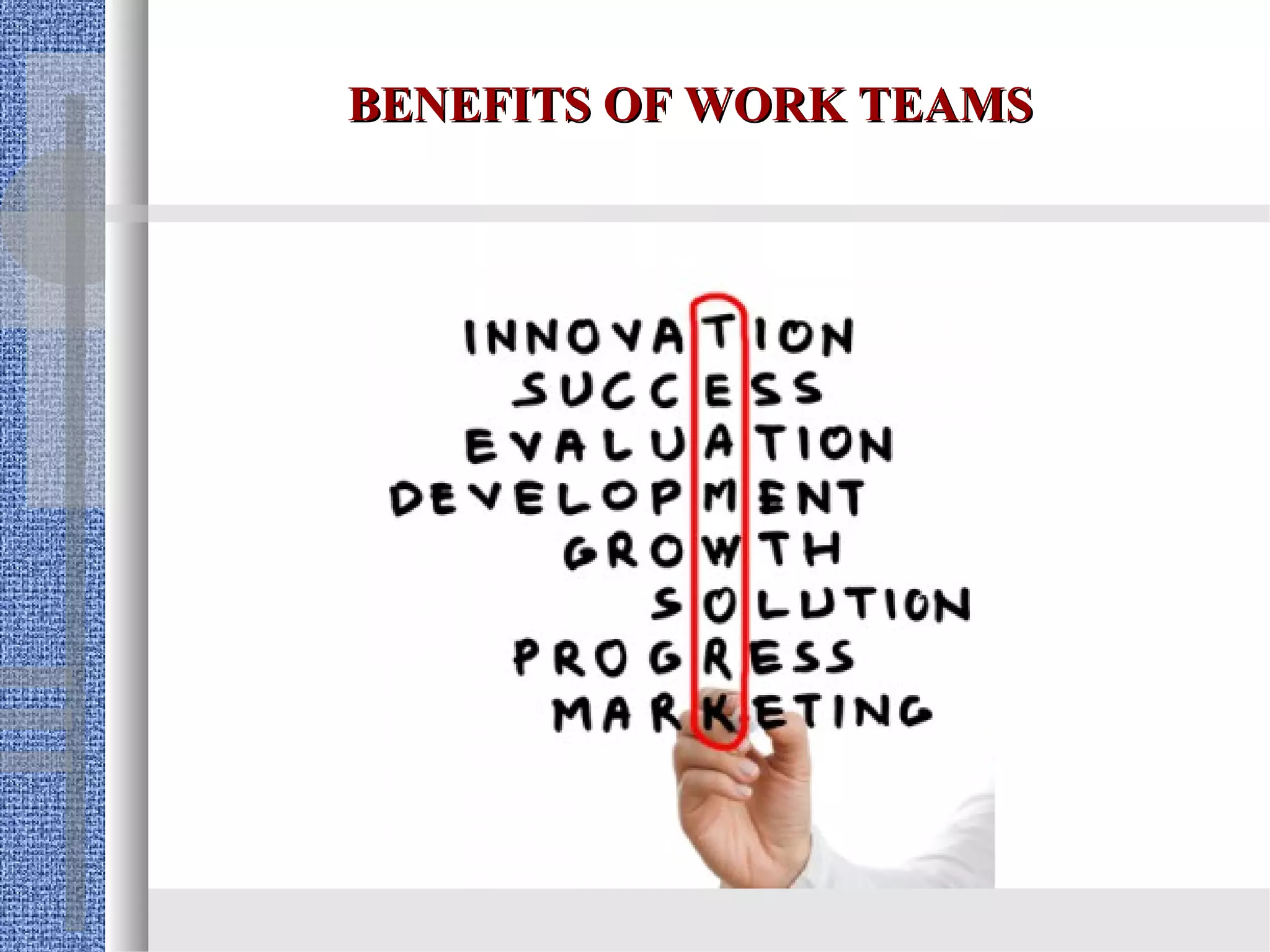
BENEFITS OF WORK TEAMS
•   Improved Organizational Performance
•   Reduces wastage, minimizes errors
•   Innovative solutions
•   Improves quality, productivity & customer
    service

•   Employee Benefits
•   Quality of work life
•   Reduces stress
•   Work satisfaction
•   Less use of employee assistance programs
BENEFITS OF WORK TEAMS


•   Reduced cost
•   Reduces wastage's
•   Lower turnover & absenteeism
•   Fewer injuries

• Organizational enhancement
• Innovation & flexibility
• Quick adaptation to face the competition
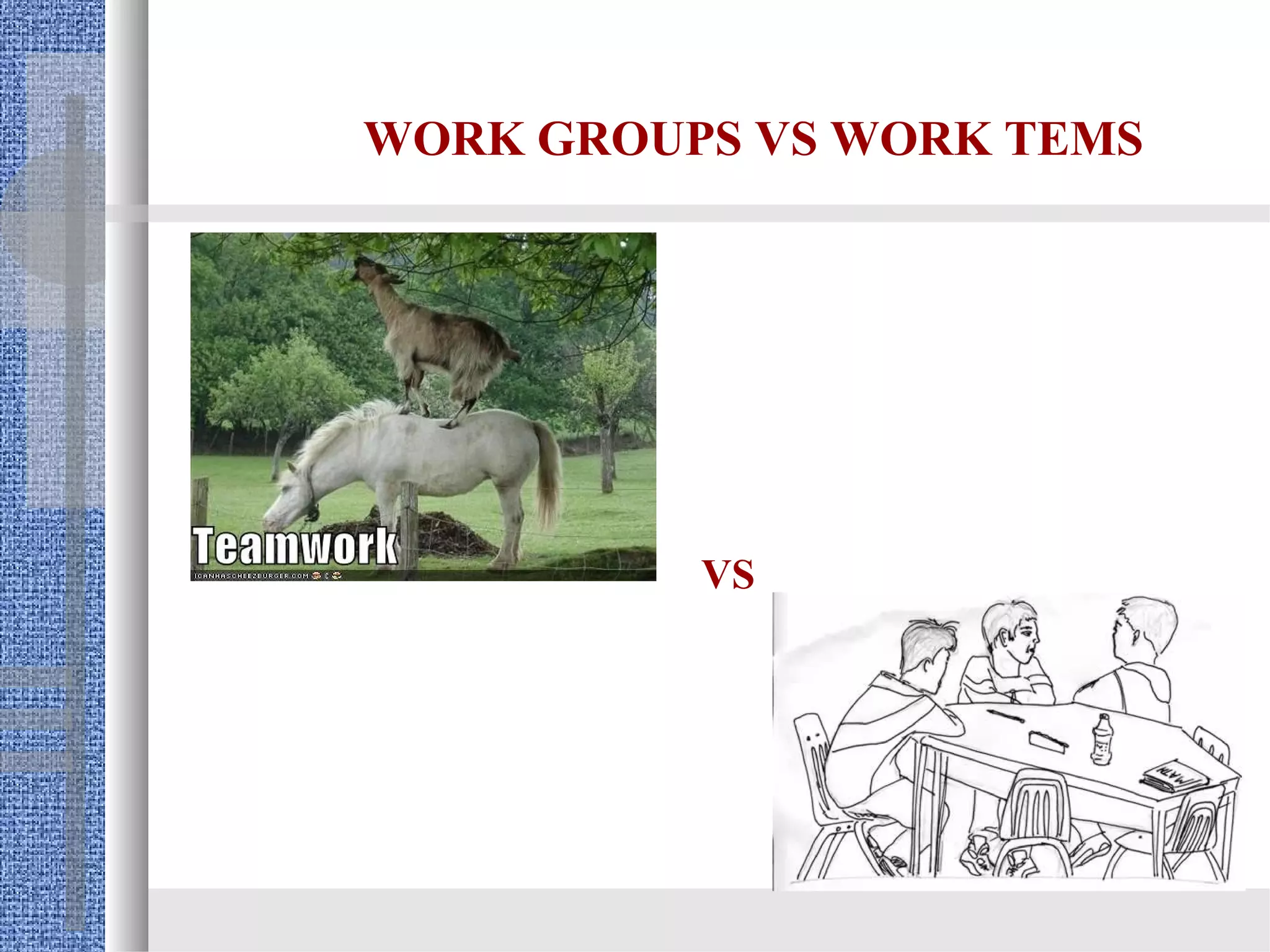
WORK GROUPS VS WORK TEMS


          VS
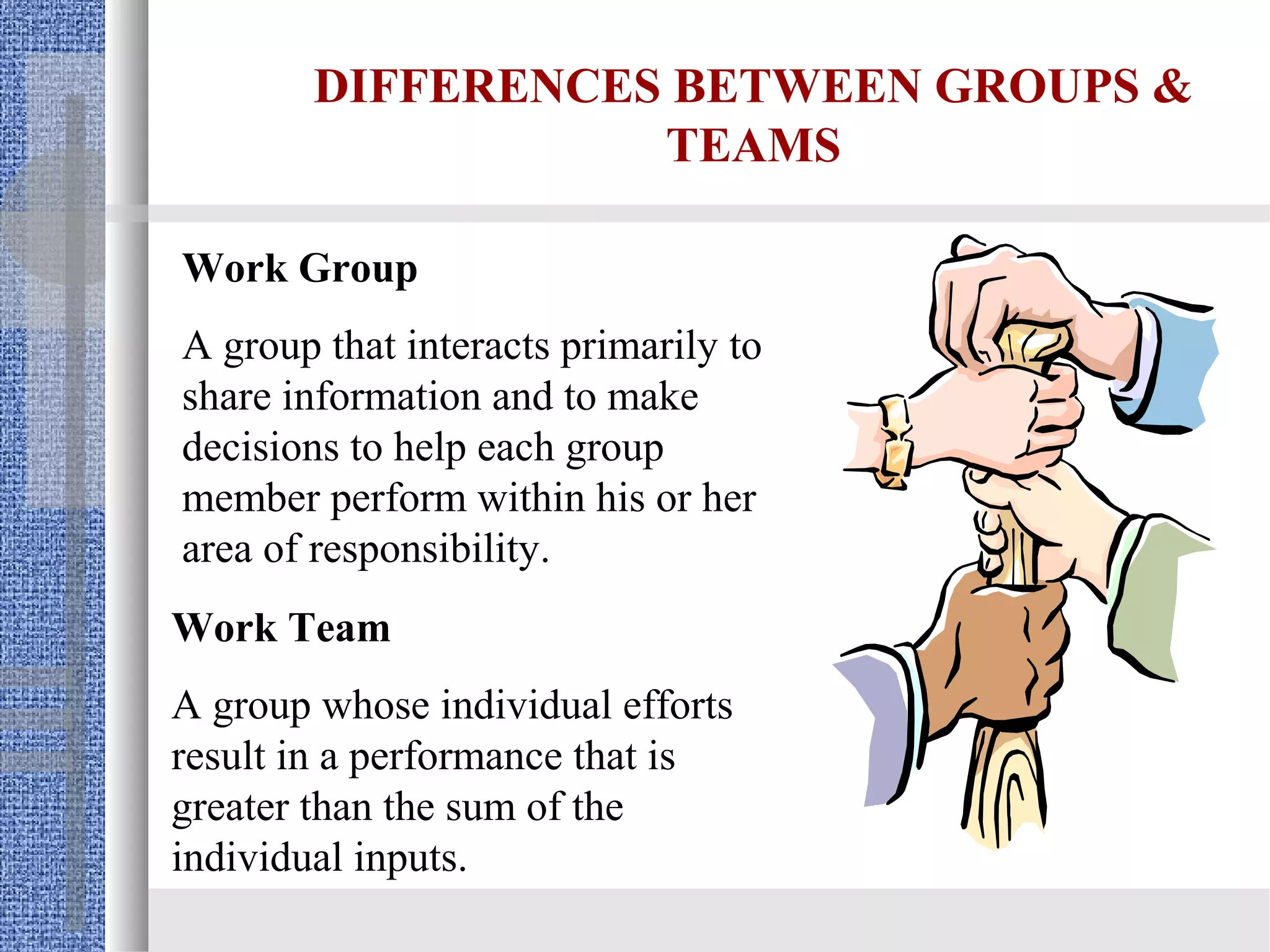
DIFFERENCES BETWEEN GROUPS &
                   TEAMS

Work Group
A group that interacts primarily to
share information and to make
decisions to help each group
member perform within his or her
area of responsibility.
Work Team
A group whose individual efforts
result in a performance that is
greater than the sum of the
individual inputs.
REWARD SYSTEM
REWARD SYSTEM


• Team members are rewarded for learning a set of
  skills essential for achieving the goals.
• Sometimes performance of the team is considered.
  Reward systems used in team based organization
  Skill based pay system
• Mastery in some important skills
• Employees can increase their pay up to certain
  level by learning additional skills
REWARD SYSTEM

  Gain- sharing systems
• Reward all the team members on the basis of the
  performance of the organization,division or plant.
• Requires the team to exceed baseline performance
• May disappoint employees in poor business
  conditions.

  Team bonus plan
  Each team should achieve certain specific
  performance targets.
TYPES OF WORK TEAMS

• On the basis of objectives teams can be classified into
  Problem solving Teams
• One of the earliest forms of teams
• Consist of 5-12 employees from the same departments
• Members meet for specific number of hours per week to
  discuss about improving quality,efficiency & work
  environment
• Temporary teams to solve a specific problem
• Authority to implement their suggestions is not given
• Established to make recommendations for others
• Ex American companies
TYPES OF WORK TEAMS

• Commonly used problem solving team is Quality circles
• QC is a small group of employees in the same work area
  where employees meet voluntarily & regularly about an
  hour every week to identify,analyze & resolve work
  related problems.
• First formed in Japan
  The objective of QC are
• Improving quality of work life, change in attitude
• Developing employees & utilizing their maximum
  potential
• Involving people at different levels
• Motivating employees & providing conducive
  environment
SELF- MANAGED WORK TEAMS

• These teams can give solutions to problems,
  implement them & be held responsible for the
  results
• Autonomous teams
• Consists of 10-15 employees & to them
  supervisors responsibilities are assigned
• They select their own members & evaluate their
  performance by themselves
• The supervisor plays a role of facilitator
• HP,Xerox,GE, PepsiCo
CROSS FUNCTIONAL TEAMS


• Consists of employees from same hierarchical
  level,but from different functional areas.
• A task force & committee is also considered as a
  cross functional team.
• Ex Toyota, Honda ,General motors
• The teams consists of members from the cross
  section of the organizations
• The teams efficiently manage operational activity
  & programs for new product development
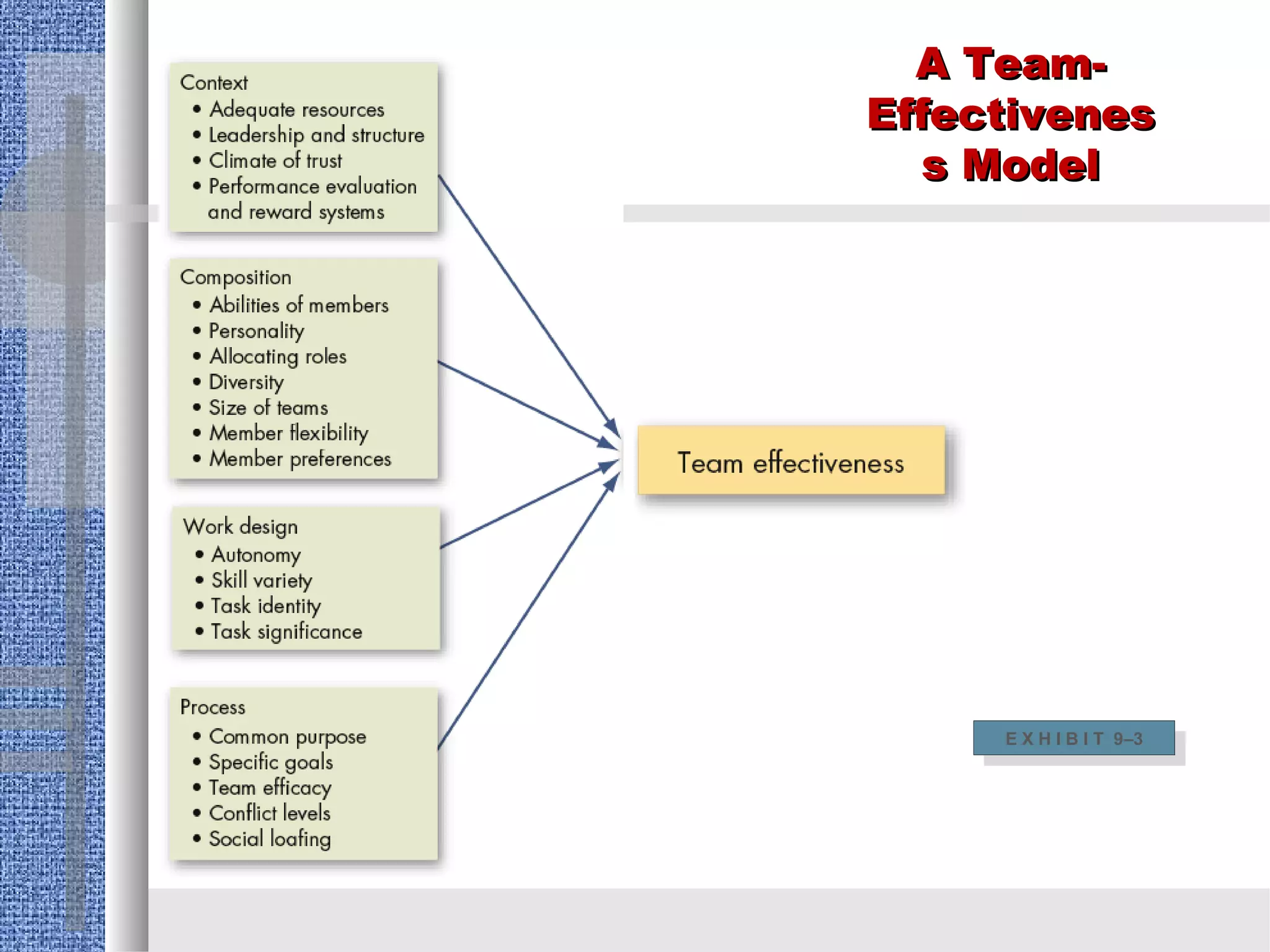
A Team-
Effectivenes
  s Model


     E X H I B I T 9–3
      E X H I B I T 9–3
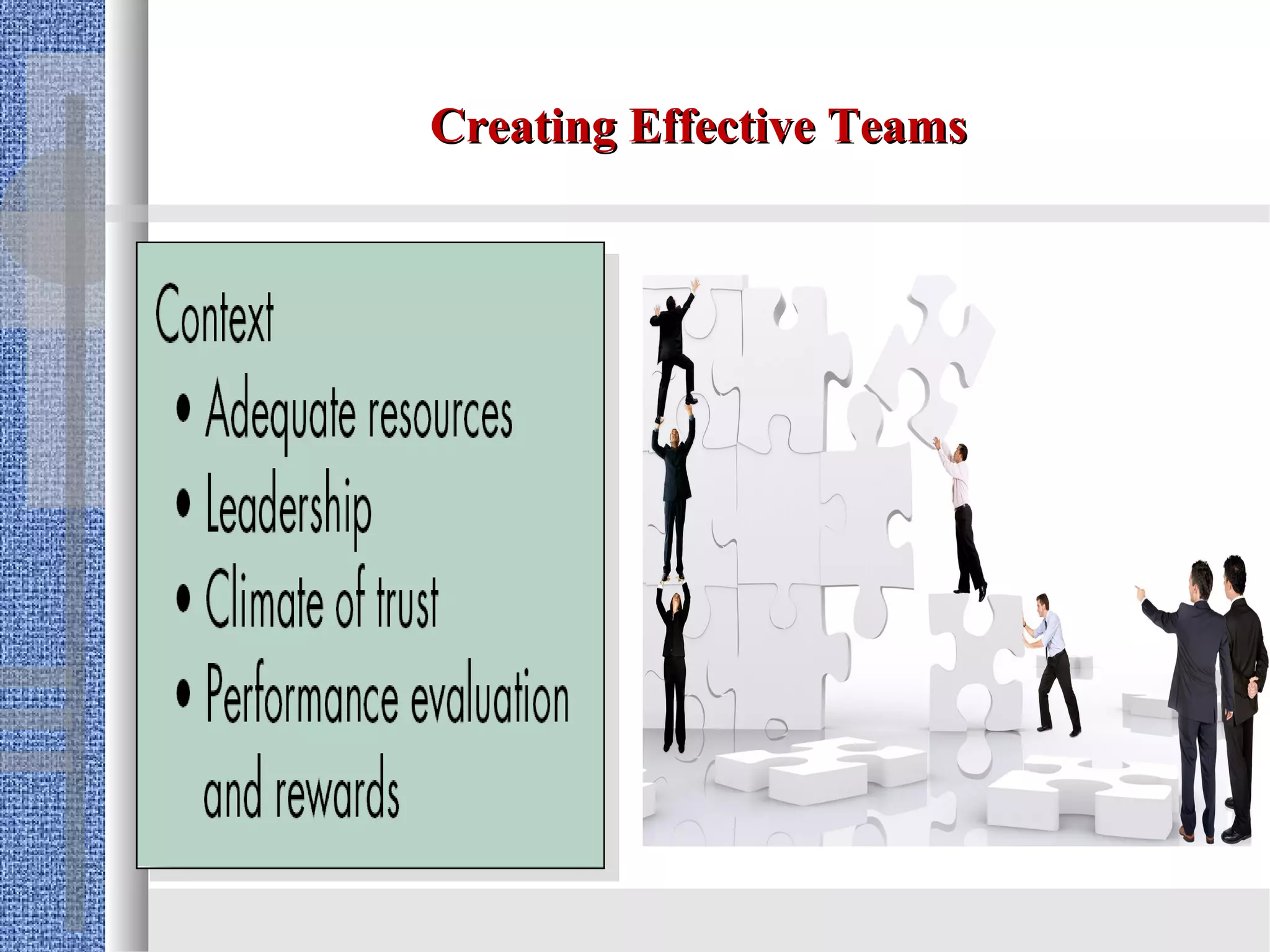
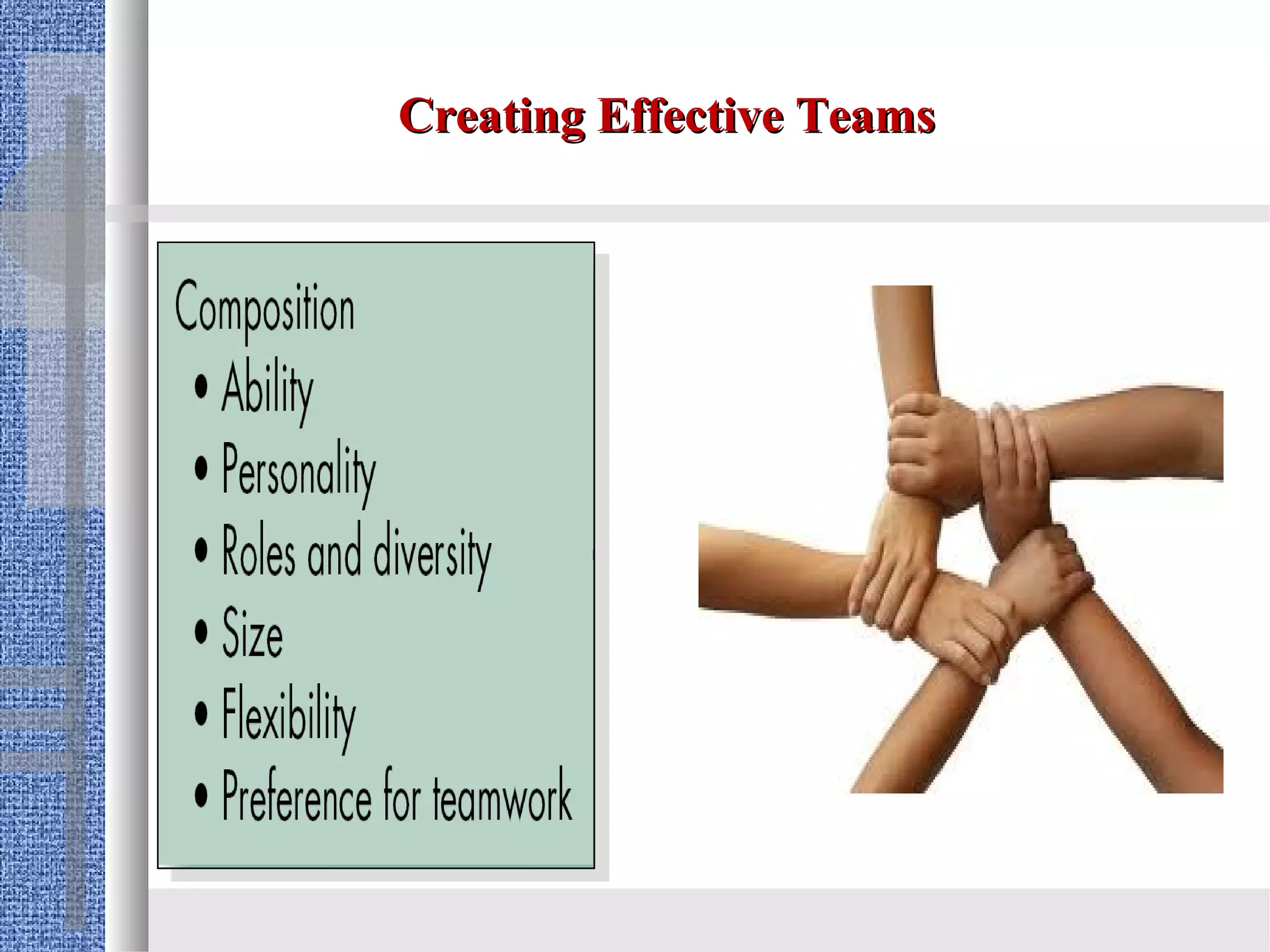
Creating Effective Teams
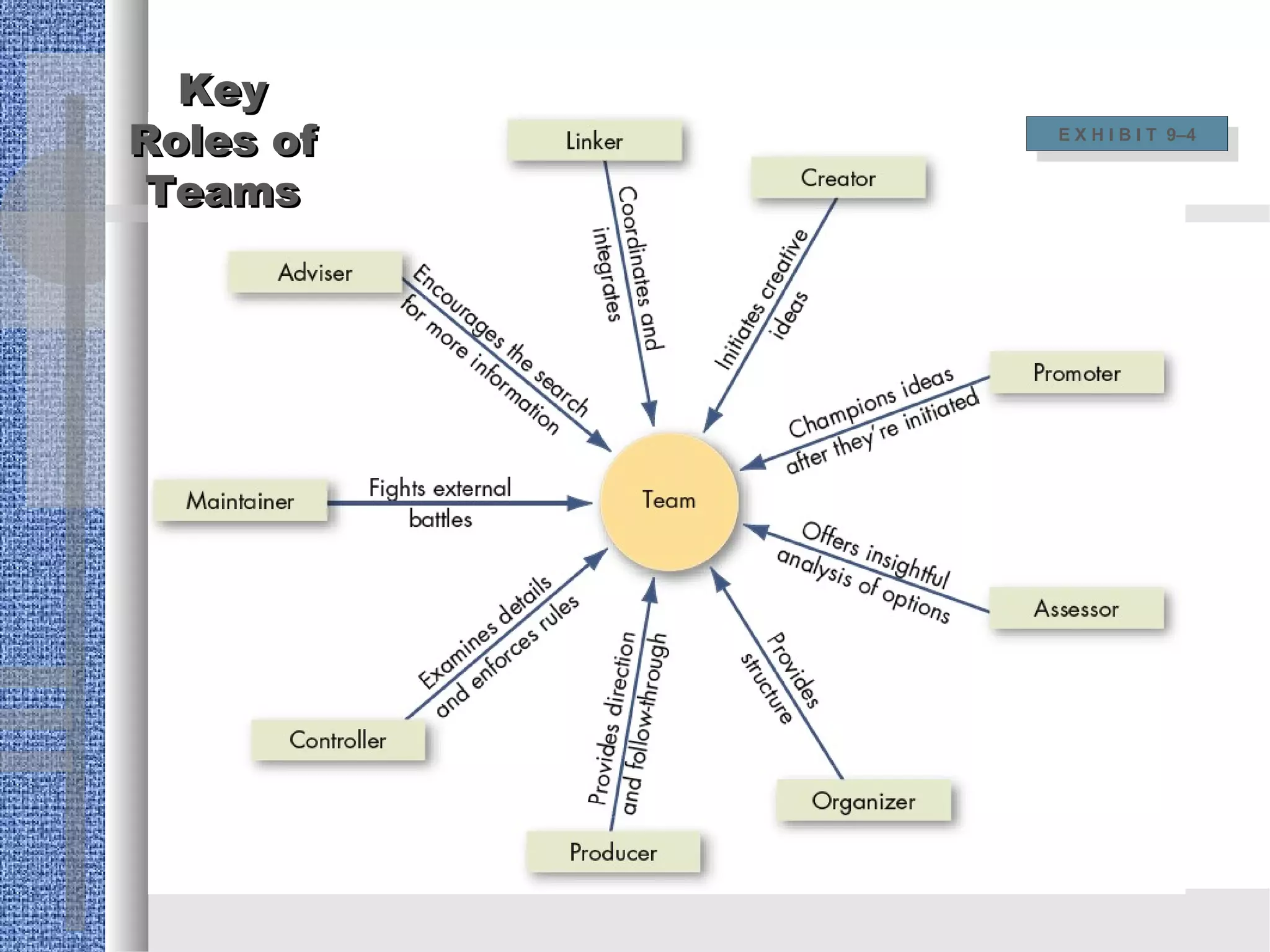
Key
Roles of   E X H I B I T 9–4
            E X H I B I T 9–4


 Teams
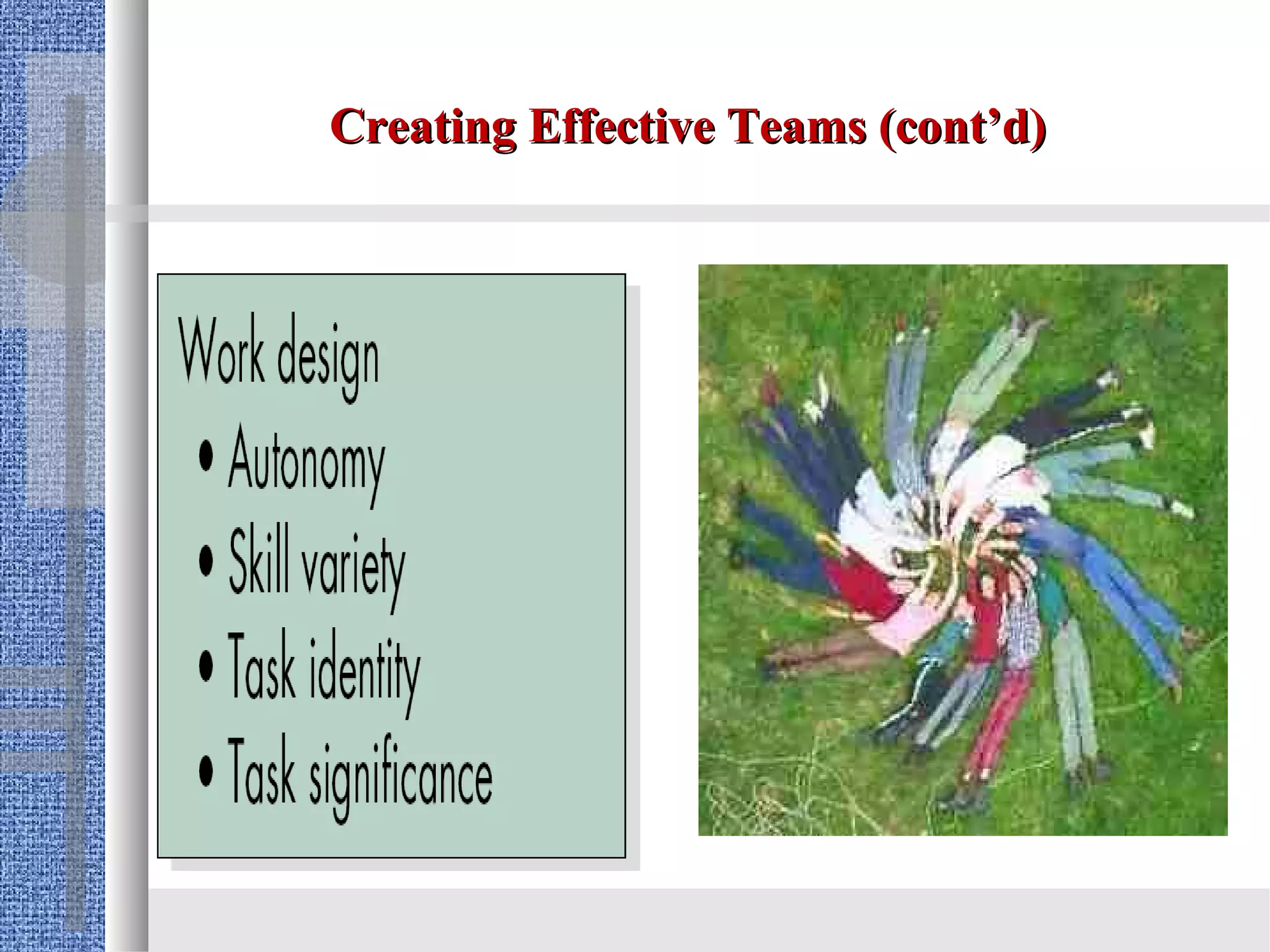
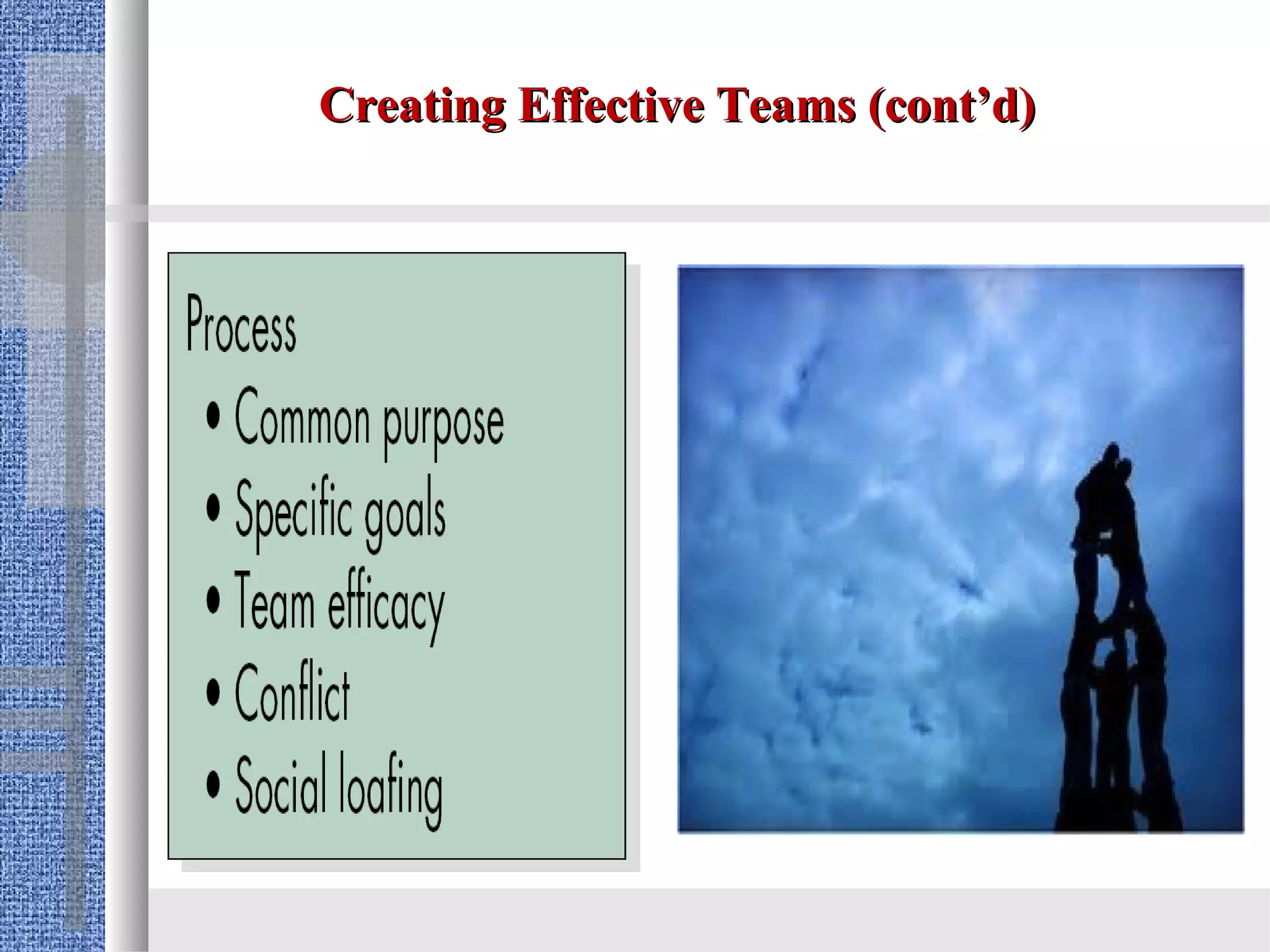
Creating Effective Teams (cont’d)
TEAMS & TOTAL QUALITY
               MANAGEMENT


• TQM focuses on customer relationship & build an
  environment of trust & openness.
• Requires high level of communication,adaptation,
  coordination & sequencing.
• Ford company initiated TQM to deal with the
  problems faced by the organization & accordingly
  worked out certain norms
• Small size teams,trained members, Authority to
  study the problem,champion of the team were the
  important features
TEAMS & WORKFORCE DIVERSITY


• Diversity is helpful in solving problems or in
  decision making
• Development of variety of creative & innovative
  solutions to problems
• Whereas sometimes diversity may lead to
  behavioral problems, & unfavorable impact on
  employeesatisfaction,absenteeism productivity &
  turnover rates
Work teams10
Work teams10

Work teams10

  • 1.
  • 2.
    UNDERSTANDING WORK TEAMS •Team consists of employees from diverse managerial and professional backgrounds working for a specific period of time on certain projects. • According to Stephen Robbins a work team is a collection of people whose individual efforts result in a level of performance which is greater than the sum of their individual contributions. • Teams generate synergy by coordinating the efforts of the individual members.
  • 3.
  • 4.
    Improved Organizational Performance • Reduces wastage, minimizes errors • Innovative solutions • Improves quality, productivity & customer service • Employee Benefits • Quality of work life • Reduces stress • Work satisfaction • Less use of employee assistance programs
  • 5.
    BENEFITS OF WORKTEAMS • Reduced cost • Reduces wastage's • Lower turnover & absenteeism • Fewer injuries • Organizational enhancement • Innovation & flexibility • Quick adaptation to face the competition
  • 6.
    WORK GROUPS VSWORK TEMS VS
  • 7.
    DIFFERENCES BETWEEN GROUPS& TEAMS Work Group A group that interacts primarily to share information and to make decisions to help each group member perform within his or her area of responsibility. Work Team A group whose individual efforts result in a performance that is greater than the sum of the individual inputs.
  • 8.
  • 9.
    REWARD SYSTEM • Teammembers are rewarded for learning a set of skills essential for achieving the goals. • Sometimes performance of the team is considered. Reward systems used in team based organization Skill based pay system • Mastery in some important skills • Employees can increase their pay up to certain level by learning additional skills
  • 10.
    REWARD SYSTEM Gain- sharing systems • Reward all the team members on the basis of the performance of the organization,division or plant. • Requires the team to exceed baseline performance • May disappoint employees in poor business conditions. Team bonus plan Each team should achieve certain specific performance targets.
  • 11.
    TYPES OF WORKTEAMS • On the basis of objectives teams can be classified into Problem solving Teams • One of the earliest forms of teams • Consist of 5-12 employees from the same departments • Members meet for specific number of hours per week to discuss about improving quality,efficiency & work environment • Temporary teams to solve a specific problem • Authority to implement their suggestions is not given • Established to make recommendations for others • Ex American companies
  • 12.
    TYPES OF WORKTEAMS • Commonly used problem solving team is Quality circles • QC is a small group of employees in the same work area where employees meet voluntarily & regularly about an hour every week to identify,analyze & resolve work related problems. • First formed in Japan The objective of QC are • Improving quality of work life, change in attitude • Developing employees & utilizing their maximum potential • Involving people at different levels • Motivating employees & providing conducive environment
  • 13.
    SELF- MANAGED WORKTEAMS • These teams can give solutions to problems, implement them & be held responsible for the results • Autonomous teams • Consists of 10-15 employees & to them supervisors responsibilities are assigned • They select their own members & evaluate their performance by themselves • The supervisor plays a role of facilitator • HP,Xerox,GE, PepsiCo
  • 14.
    CROSS FUNCTIONAL TEAMS •Consists of employees from same hierarchical level,but from different functional areas. • A task force & committee is also considered as a cross functional team. • Ex Toyota, Honda ,General motors • The teams consists of members from the cross section of the organizations • The teams efficiently manage operational activity & programs for new product development
  • 15.
    A Team- Effectivenes s Model E X H I B I T 9–3 E X H I B I T 9–3
  • 16.
  • 17.
  • 18.
    Key Roles of E X H I B I T 9–4 E X H I B I T 9–4 Teams
  • 19.
  • 20.
  • 21.
    TEAMS & TOTALQUALITY MANAGEMENT • TQM focuses on customer relationship & build an environment of trust & openness. • Requires high level of communication,adaptation, coordination & sequencing. • Ford company initiated TQM to deal with the problems faced by the organization & accordingly worked out certain norms • Small size teams,trained members, Authority to study the problem,champion of the team were the important features
  • 22.
    TEAMS & WORKFORCEDIVERSITY • Diversity is helpful in solving problems or in decision making • Development of variety of creative & innovative solutions to problems • Whereas sometimes diversity may lead to behavioral problems, & unfavorable impact on employeesatisfaction,absenteeism productivity & turnover rates