
WORKFORCE FOCUS
CHAPTER 4
WORKFORCE
• Refers to everyone who is actively involved of
accomplishing the work in organization.
- paid employees
- volunteers
- contract employees
- team leaders
- supervisors
- managers at all levels
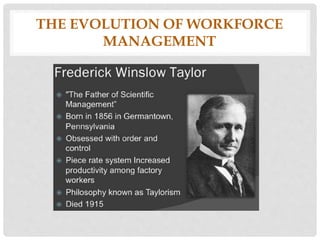
THE EVOLUTION OF WORKFORCE
MANAGEMENT
THE EVOLUTION OF WORKFORCE
MANAGEMENT
Taylorism/Taylor System
• In Taylor’s view, the task of factory management
was to determine the best way for the worker to
do the job, to provide the proper tools and
training, and to provide incentives for good
performance.
THE EVOLUTION OF WORKFORCE
MANAGEMENT
Taylorism/Taylor System
• He broke each job down into its individual
motions, analyzed these to determine which
were essential, and timed the workers with a
stopwatch. With unnecessary motion eliminated,
the worker, following a machinelike routine,
became far more productive.
THE EVOLUTION OF WORKFORCE
MANAGEMENT
• A.K.A. Human Resource Management (HRM)
• Is the function performed in organizations that
facilitates the most effective use of people
(employees) to achieve organizational and
individual goals.
Objectives of an Effective Workforce Management
System
• Build a higher performance workplace
• Maintain an environment for quality excellence to allow
enable employees and the organizations to achieve
strategic objectives and adapt to change.
THE EVOLUTION OF WORKFORCE
MANAGEMENT
Strategic Human Resource Management
• Is concerned with the contributions HR strategies make
to organizational effectiveness, and how these
contributions are accomplished.
THE EVOLUTION OF WORKFORCE
MANAGEMENT
-END

Chapter 4 WORKFORCE

  • 1.
  • 2.
    WORKFORCE • Refers toeveryone who is actively involved of accomplishing the work in organization. - paid employees - volunteers - contract employees - team leaders - supervisors - managers at all levels
  • 3.
    THE EVOLUTION OFWORKFORCE MANAGEMENT
  • 4.
    THE EVOLUTION OFWORKFORCE MANAGEMENT Taylorism/Taylor System • In Taylor’s view, the task of factory management was to determine the best way for the worker to do the job, to provide the proper tools and training, and to provide incentives for good performance.
  • 5.
    THE EVOLUTION OFWORKFORCE MANAGEMENT Taylorism/Taylor System • He broke each job down into its individual motions, analyzed these to determine which were essential, and timed the workers with a stopwatch. With unnecessary motion eliminated, the worker, following a machinelike routine, became far more productive.
  • 6.
    THE EVOLUTION OFWORKFORCE MANAGEMENT • A.K.A. Human Resource Management (HRM) • Is the function performed in organizations that facilitates the most effective use of people (employees) to achieve organizational and individual goals.
  • 7.
    Objectives of anEffective Workforce Management System • Build a higher performance workplace • Maintain an environment for quality excellence to allow enable employees and the organizations to achieve strategic objectives and adapt to change. THE EVOLUTION OF WORKFORCE MANAGEMENT
  • 8.
    Strategic Human ResourceManagement • Is concerned with the contributions HR strategies make to organizational effectiveness, and how these contributions are accomplished. THE EVOLUTION OF WORKFORCE MANAGEMENT
  • 9.