Work related
musculoskeletal disorders
elbow
Dr.Rajeshwari Jindal
Professor(Department of PMR)
SMS Medical College Jaipur
Definition
 Musculoskeletal disorder (MSD) is an injury or disorder of the
muscles, nerves, tendons, joints, cartilage, and spinal disc.
 Chronic disease related to manual tasks
 Source of significant pain, disability and disadvantage for the
injured person and a substantial burden on modern societies.
 Statistics suggest that more than 30% of all occupational
injuries are musculoskeletal injuries associated with manual
tasks (Straker et. al. 2004).
 Globally, musculoskeletal conditions are one of the leading causes of
morbidity and disability, giving rise to enormous healthcare expenditures and
loss of work (WHO 2003), and reducing the quality of life of affected
employees and their families.
Work related musculoskeletal
disorders (WMSD)
Various synonyms of WMSD –
 Repeated strain injury
 Cumulative trauma disorder
 Over use syndrome
Due to repeated straining body tissue and not allowing enough time to heal are
believed to cause progressive discomfort, pain, and ultimately disability to
continue regular work.
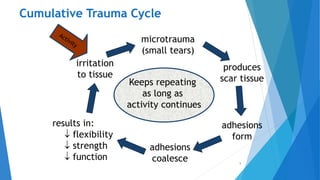
Cumulative Trauma Cycle
5
irritation
to tissue
microtrauma
(small tears)
produces
scar tissueKeeps repeating
as long as
activity continues
results in:
 flexibility
 strength
 function
adhesions
form
adhesions
coalesce
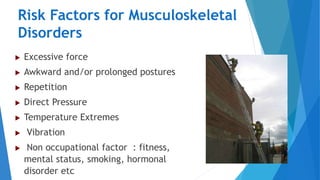
Risk Factors for Musculoskeletal
Disorders
 Excessive force
 Awkward and/or prolonged postures
 Repetition
 Direct Pressure
 Temperature Extremes
 Vibration
 Non occupational factor : fitness,
mental status, smoking, hormonal
disorder etc 6
7
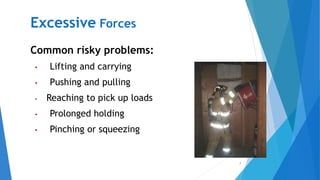
Excessive Forces
Common risky problems:
• Lifting and carrying
• Pushing and pulling
• Reaching to pick up loads
• Prolonged holding
• Pinching or squeezing
8
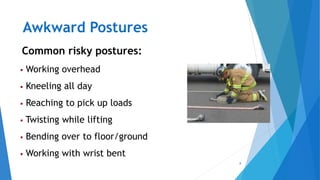
Awkward Postures
Common risky postures:
 Working overhead
 Kneeling all day
 Reaching to pick up loads
 Twisting while lifting
 Bending over to floor/ground
 Working with wrist bent
9
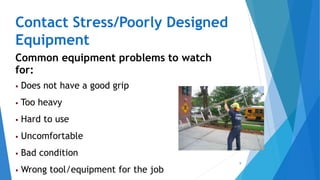
Contact Stress/Poorly Designed
Equipment
Common equipment problems to watch
for:
 Does not have a good grip
 Too heavy
 Hard to use
 Uncomfortable
 Bad condition
 Wrong tool/equipment for the job
10
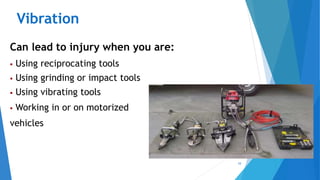
Vibration
Can lead to injury when you are:
 Using reciprocating tools
 Using grinding or impact tools
 Using vibrating tools
 Working in or on motorized
vehicles
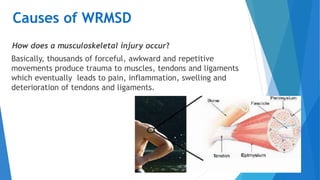
Causes of WRMSD
How does a musculoskeletal injury occur?
Basically, thousands of forceful, awkward and repetitive
movements produce trauma to muscles, tendons and ligaments
which eventually leads to pain, inflammation, swelling and
deterioration of tendons and ligaments.
An Activity is Likely to Become an
Injury
When:
You perform the activity frequently
You do the activity a long time
The work intensity is high
There are a combination of factors
12
Symptoms of WMSDs?
Discomfort
Pain
Numbness
Burning
Swelling
Change in color
.
Tingling
Tightness, loss
of flexibility.
Elbow
 Tennis elbow – Lateral epicondylitis
 Golfer’s elbow – Medial epicondylitis
 Cubital tunnel syndrome.
 Bursitis – inflammation of bursa (fluid filled sacs)
 Distal bicep tendinitis , tricep tendinitis
 Pronater teres syndrome
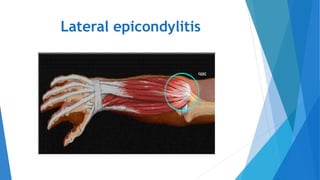
Lateral epicondylitis
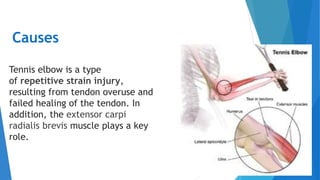
Causes
Tennis elbow is a type
of repetitive strain injury,
resulting from tendon overuse and
failed healing of the tendon. In
addition, the extensor carpi
radialis brevis muscle plays a key
role.
Occupational classification Lateral epicondylitis may
be provoked by an exercise involving repeated and
forcible extension movements at the wrist. The
following three types of occupational group are
classified respect to elbow stress
 Type 1: No or little stress on the elbows ( Driver.
Instructor, Office worker, clerk, security guard).
 Type 2: Moderate stress on the elbows (e.g.
inspectors, electricians. repairmen, unpacker,
toolmaker).
 Type 3: Heavy stress on the elbows (e.g. Blaster,
driller, polishers, welders, carpenter)
Signs and symptoms
 Pain tenderness on the outer part of the elbow
(lateral epicondyle)
 Pain from gripping and movements of the wrist,
especially wrist extension and lifting movements
 e.g. pouring a container of liquid, lifting with the
palm down, sweeping, especially where wrist
movement is required
Diagnosis
 With the elbow fully extended, the patient feels points of
tenderness over the elbow pain with passive wrist flexion and
resistive wrist extension (Cozen's test).
 Pain with Resisted middle finger extension might indicate the
involvement of Extensor Digitorum also.
Treatment
Conservative.
 Rest, Ice, compression and elevation
 NSAID
 Physical therapy, occupational therapy,
orthotics or braces may also be useful.
 Steroid injections
 Laser therapy,prolotherapy,us
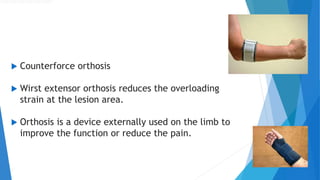
 Counterforce orthosis
 Wirst extensor orthosis reduces the overloading
strain at the lesion area.
 Orthosis is a device externally used on the limb to
improve the function or reduce the pain.
 Both eccentric loading and extracorporeal
shockwave therapy are currently being
researched as possible treatments for tendinosis.
 Other treatments for which research is on-going
includes Platlet Rich Plasma (PRP), and stem
cell injections.
 Operative treatment
Golfer's elbow
tendinosis of the medial epicondyle of the elbow.
 Tenderness over the origin of the flexor pronator mass
 Resisted pronation and/or wrist flexion will reproduce
symptoms in most affected patients
 Grip strength is decreased in patients with medial
epicondylitis compared with control subjects, although
the magnitude of impairment is less than that seen in
patients with lateral epicondylitis
 The pathogenesis of medial epicondylitis parallels
that of lateral epicondylitis, beginning with
repetitive microtrauma to the wrist flexors
originating at their origin on the medial
epicondyle.
 The muscles most commonly involved include the
pronator teres and flexor carpi radialis but can
include any of the other flexor.
 Seen in overhead throwing sports,or in
occupations requiring repetitive forearm
pronation and wrist flexion eg carpenters
Non-specific palliative treatments include:
 Non-steroidal anti-inflammatory drugs
 Heat or ice
 A counter-force brace or "elbow strap" .
 Therapy for muscle/tendon reconditioning,
starting with stretching and gradual strengthening
of the flexor-pronator muscles.
 Strengthening slowly begin with isometrics and
progresses to eccentric exercises helping to
extend the range of motion back to where it once
was.
Distal biceps tendonitis
Diagnosis:
 sudden and unexpected forceful extension against
a flexed elbow, or a pop is felt during heavy lifting.
Complete ruptures commonly result in Popeye
deformity in the upper arm.
 Flexion and supination of the elbow are painful
and strength is noticed to be decreased in the
affected extremity
 Magnetic resonance imaging (MRI) helpful
diagnostic tool for the diagnosis of a partial tendon
rupture
Risk factor
 More common in male, dominant limb
 Smoker,chronic steroid use.
 Occupations with repetitive forearm
motion(plumbers,laborers and athletes)
Treatment
 Partial ruptures and tendinosis can be managed
with nonoperative options and physical therapy,
but early surgical repair is recommended for
complete ruptures with postoperative physical
therapy.
Triceps Tendonitis
 Triceps tendinosis is a chronic condition stemming
from overuse and repetitive heavy lifting.
Patients routinely describe pain and/or weakness
with activities of elbow extension.
 Tenderness to palpation occurs at the triceps
insertion on the olecranon.
 In the setting of chronic repetitive injury, plain
radiographs may reveal a traction osteophyte on
the olecranon.
Treatment
 Nonoperative activity modification, nonsteroidal
anti-inflammatory medications, and physical
therapy for stretching and ROM ex
 Operative management, consisting of olecranon
osteophyte excision and triceps repair, is reserved
for refractory cases that fail conservative
management.
 There are several recommendations regarding
prevention, treatment, and avoidance of
recurrence that are largely speculative including
stretches and progressive strengthening exercises
to prevent re-irritation of the tendon.
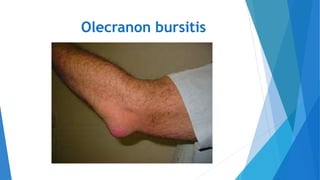
Olecranon bursitis
Olecranon bursitis ( "Smiles' elbow", "elbow
bump", "student's elbow", "Popeye elbow",
"baker's elbow" or "gamer's elbow"),
 Characterized by pain, redness and swelling
around the olecranon, caused by inflammation of
the elbow's bursa. This bursa is located just over
the extensor aspect of the extreme proximal end
of the ulna.
 Bursitis normally develops as a result either of a
single injury to the elbow (e.g., a hard blow to
the tip of the elbow)
 Repeated minor injuries, such as repeated leaning
on the point of the elbow on a hard surface.
 Job or hobby involves a repetitive movement
(e.g., tennis, golf, or even repetitive computer
work involving leaning on one's elbow)
`
Non-surgical treatments
 Icing, a firm compression bandage, and avoidance
of the aggravating activity,NSAIDs .
 Treatment for more severe cases may
include aspiration of the excess bursa fluid
hydrocortisone injection .
 In case of infection, the bursitis should be treated
with an antibiotic.
Surgical treatments
Pronator syndrome
 Compression of the median nerve in the region of
the elbow or proximal part of the forearm
 Pain and/or numbness in the distribution of the
distal median nerve
 weakness of the muscles innervated by the
anterior interosseous nerve: the flexor pollicis
longus the flexor digitorum profundus of the
index finger and the pronator quadratus.
Causes
 The most common cause is entrapment of the
median nerve between the two heads of the
pronator teres muscle. Other causes are
compression of the nerve from the fibrous arch of
the flexor superficialis, or the thickening of
the bicipital aponeurosis.
 Jobs requiring repeated pronation or
supination,lifting, carrying,or placing heavy
objects.
Clinical signs
 Tenderness over the proximal median nerve,
which is aggravated by resisted pronation of the
forearm and resisted middle finger flexion.
 The flexor pollicis longus and FDP of the index
finger are weak.
 Sensory changes may be found in the first three
fingers as well as in the palm, indicating
impairment of the median nerve proximal to
the flexor retinaculum.
Treatment
 Anti-infammatory medication
 Injection of corticosteroids into the pronator
teres muscle.
 Stretching and strengthing ex
 Massage therapy
 Surgical decompression can provide benefit in
selected cases.
Diagnosis
 Conduction velocity of the median nerve in the
proximal forearm may be slow but the distal
latency and sensory nerve action potential at the
wrist are normal.
 MRI may show denervation atrophy of the
affected muscles
 EMG or the MRI are abnormal for the pronator
teres muscle and the flexor carpi radialis, this
implies that the problem is at or proximal to the
elbow
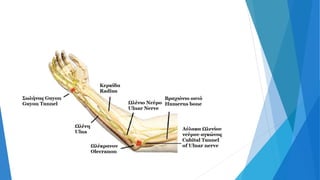
Cubital tunnel Syndrome
 The cubital tunnel is a channel which allows
the ulnar nerve to travel over the elbow. It is
bordered by the medial epicondyle of the
humerus, the olecranon process of the ulna and
the tendinous arch joining the humeral and ulnar
heads of the flexor carpi ulnaris.
 Chronic compression of this nerve is known
as cubital tunnel syndrome, a form of repetitive
strain injury akin to carpal tunnel syndrome.
chronic compression or repetitive trauma
 Sleeping with the arm folded behind neck, elbows
bent.
 Pressing the elbows upon the arms of a chair
while typing.
 Resting or bracing the elbow on the arm rest of a
vehicle.
 Bench pressing.
 Intense exercising and strain involving the elbow.
 Ulnar nerve entrapment at the medial aspect of
the elbow, causing medial elbow pain and
paresthesias in the ring and little finger.
 This occurs through repetitive activity requiring
flexion or extension of the elbow against
resistance.
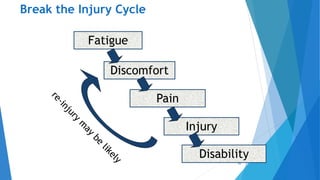
Break the Injury Cycle
45
Fatigue
Discomfort
Pain
Injury
Disability
Definition of ergonomics
“Ergonomics is the science and practice of
designing jobs and workplaces to match
the capabilities and limitations of the
human body.”
Simply put:
“fitting the job to the worker”
The goal of ergonomics is to create jobs, tools,
equipment and workplaces that fit people,
rather than making people adapt to fit them.
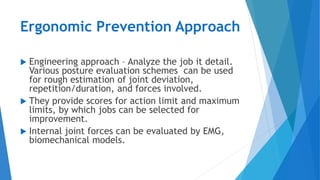
Ergonomic Prevention Approach
 Engineering approach – Analyze the job it detail.
Various posture evaluation schemes can be used
for rough estimation of joint deviation,
repetition/duration, and forces involved.
 They provide scores for action limit and maximum
limits, by which jobs can be selected for
improvement.
 Internal joint forces can be evaluated by EMG,
biomechanical models.
 Solution approaches are mechanization, job
enlargement, redesign the workstation for
adjustability and better working posture, better
method to do the work to reduce force, duration,
repetition.
 Administrative approach – Job rotation, use of
part time workers, exercises, stress reduction.
Examples of engineering solutions
 Counter balance and suspend hand tools - reduce
static load of holding the tool.
 Tilt the work surface - facilitate better posture,
viewing, reach.
 Provide hand tools with correct grip
style/diameter/texture – reduce gripping force,
improve wrist posture
 Maintain sharpness of the knives – reduce force
required to cut Hand tools are properly
maintained - reduce vibration
More of engineering solutions
 Use correct work height – better upper body and
hand-arm posture ,Limit reaching motions to
minimum
 Lower the work area if shoulders needed to be
lifted
 Provide arm rest if elbows are needed to be raised –
reduce static load at shoulder
 Consider sitting/standing/sit-stand work posture –
reduce static load in lower back
 Arrange workplace to minimize twisting, forward or
lateral bending – reduce harmful posture of torso
 Correct viewing angle - minimize static load on
neck muscles, eye strain.
 Arrange work to avoid unnecessary motions.
 Let power tools and machinery do the work.
 Spread repetitive work out during the day.
 Take stretch pauses
 Rotate task with co-workers if possible
 Change hands or motions frequently
Reducing repetition
Benefits of ergonomics
Ergonomics helps to prevent injuries
Ergonomics has other benefits
Reduced fatigue and discomfort
Increased productivity
Improved quality of work
Improved quality of life
Conclusions
 Cumulative trauma occurs over time
 Applying ergonomics = injury prevention
 Understand injury risk factors
 Some situations may have little room for improvement, but with
others you have the control to improve:
equipment
work practices
bodymechanics
53
THANK YOU!
work related elbow disorders

work related elbow disorders

  • 1.
    Work related musculoskeletal disorders elbow Dr.RajeshwariJindal Professor(Department of PMR) SMS Medical College Jaipur
  • 2.
    Definition  Musculoskeletal disorder(MSD) is an injury or disorder of the muscles, nerves, tendons, joints, cartilage, and spinal disc.  Chronic disease related to manual tasks  Source of significant pain, disability and disadvantage for the injured person and a substantial burden on modern societies.  Statistics suggest that more than 30% of all occupational injuries are musculoskeletal injuries associated with manual tasks (Straker et. al. 2004).
  • 3.
     Globally, musculoskeletalconditions are one of the leading causes of morbidity and disability, giving rise to enormous healthcare expenditures and loss of work (WHO 2003), and reducing the quality of life of affected employees and their families.
  • 4.
    Work related musculoskeletal disorders(WMSD) Various synonyms of WMSD –  Repeated strain injury  Cumulative trauma disorder  Over use syndrome Due to repeated straining body tissue and not allowing enough time to heal are believed to cause progressive discomfort, pain, and ultimately disability to continue regular work.
  • 5.
    Cumulative Trauma Cycle 5 irritation totissue microtrauma (small tears) produces scar tissueKeeps repeating as long as activity continues results in:  flexibility  strength  function adhesions form adhesions coalesce
  • 6.
    Risk Factors forMusculoskeletal Disorders  Excessive force  Awkward and/or prolonged postures  Repetition  Direct Pressure  Temperature Extremes  Vibration  Non occupational factor : fitness, mental status, smoking, hormonal disorder etc 6
  • 7.
    7 Excessive Forces Common riskyproblems: • Lifting and carrying • Pushing and pulling • Reaching to pick up loads • Prolonged holding • Pinching or squeezing
  • 8.
    8 Awkward Postures Common riskypostures:  Working overhead  Kneeling all day  Reaching to pick up loads  Twisting while lifting  Bending over to floor/ground  Working with wrist bent
  • 9.
    9 Contact Stress/Poorly Designed Equipment Commonequipment problems to watch for:  Does not have a good grip  Too heavy  Hard to use  Uncomfortable  Bad condition  Wrong tool/equipment for the job
  • 10.
    10 Vibration Can lead toinjury when you are:  Using reciprocating tools  Using grinding or impact tools  Using vibrating tools  Working in or on motorized vehicles
  • 11.
    Causes of WRMSD Howdoes a musculoskeletal injury occur? Basically, thousands of forceful, awkward and repetitive movements produce trauma to muscles, tendons and ligaments which eventually leads to pain, inflammation, swelling and deterioration of tendons and ligaments.
  • 12.
    An Activity isLikely to Become an Injury When: You perform the activity frequently You do the activity a long time The work intensity is high There are a combination of factors 12
  • 13.
    Symptoms of WMSDs? Discomfort Pain Numbness Burning Swelling Changein color . Tingling Tightness, loss of flexibility.
  • 14.
    Elbow  Tennis elbow– Lateral epicondylitis  Golfer’s elbow – Medial epicondylitis  Cubital tunnel syndrome.  Bursitis – inflammation of bursa (fluid filled sacs)  Distal bicep tendinitis , tricep tendinitis  Pronater teres syndrome
  • 15.
  • 16.
    Causes Tennis elbow isa type of repetitive strain injury, resulting from tendon overuse and failed healing of the tendon. In addition, the extensor carpi radialis brevis muscle plays a key role.
  • 17.
    Occupational classification Lateralepicondylitis may be provoked by an exercise involving repeated and forcible extension movements at the wrist. The following three types of occupational group are classified respect to elbow stress  Type 1: No or little stress on the elbows ( Driver. Instructor, Office worker, clerk, security guard).  Type 2: Moderate stress on the elbows (e.g. inspectors, electricians. repairmen, unpacker, toolmaker).  Type 3: Heavy stress on the elbows (e.g. Blaster, driller, polishers, welders, carpenter)
  • 18.
    Signs and symptoms Pain tenderness on the outer part of the elbow (lateral epicondyle)  Pain from gripping and movements of the wrist, especially wrist extension and lifting movements  e.g. pouring a container of liquid, lifting with the palm down, sweeping, especially where wrist movement is required
  • 19.
    Diagnosis  With theelbow fully extended, the patient feels points of tenderness over the elbow pain with passive wrist flexion and resistive wrist extension (Cozen's test).  Pain with Resisted middle finger extension might indicate the involvement of Extensor Digitorum also.
  • 20.
    Treatment Conservative.  Rest, Ice,compression and elevation  NSAID  Physical therapy, occupational therapy, orthotics or braces may also be useful.  Steroid injections  Laser therapy,prolotherapy,us
  • 21.
     Counterforce orthosis Wirst extensor orthosis reduces the overloading strain at the lesion area.  Orthosis is a device externally used on the limb to improve the function or reduce the pain.
  • 22.
     Both eccentricloading and extracorporeal shockwave therapy are currently being researched as possible treatments for tendinosis.  Other treatments for which research is on-going includes Platlet Rich Plasma (PRP), and stem cell injections.  Operative treatment
  • 23.
    Golfer's elbow tendinosis ofthe medial epicondyle of the elbow.  Tenderness over the origin of the flexor pronator mass  Resisted pronation and/or wrist flexion will reproduce symptoms in most affected patients  Grip strength is decreased in patients with medial epicondylitis compared with control subjects, although the magnitude of impairment is less than that seen in patients with lateral epicondylitis
  • 24.
     The pathogenesisof medial epicondylitis parallels that of lateral epicondylitis, beginning with repetitive microtrauma to the wrist flexors originating at their origin on the medial epicondyle.  The muscles most commonly involved include the pronator teres and flexor carpi radialis but can include any of the other flexor.  Seen in overhead throwing sports,or in occupations requiring repetitive forearm pronation and wrist flexion eg carpenters
  • 25.
    Non-specific palliative treatmentsinclude:  Non-steroidal anti-inflammatory drugs  Heat or ice  A counter-force brace or "elbow strap" .  Therapy for muscle/tendon reconditioning, starting with stretching and gradual strengthening of the flexor-pronator muscles.  Strengthening slowly begin with isometrics and progresses to eccentric exercises helping to extend the range of motion back to where it once was.
  • 26.
    Distal biceps tendonitis Diagnosis: sudden and unexpected forceful extension against a flexed elbow, or a pop is felt during heavy lifting. Complete ruptures commonly result in Popeye deformity in the upper arm.  Flexion and supination of the elbow are painful and strength is noticed to be decreased in the affected extremity  Magnetic resonance imaging (MRI) helpful diagnostic tool for the diagnosis of a partial tendon rupture
  • 27.
    Risk factor  Morecommon in male, dominant limb  Smoker,chronic steroid use.  Occupations with repetitive forearm motion(plumbers,laborers and athletes)
  • 28.
    Treatment  Partial rupturesand tendinosis can be managed with nonoperative options and physical therapy, but early surgical repair is recommended for complete ruptures with postoperative physical therapy.
  • 29.
    Triceps Tendonitis  Tricepstendinosis is a chronic condition stemming from overuse and repetitive heavy lifting. Patients routinely describe pain and/or weakness with activities of elbow extension.  Tenderness to palpation occurs at the triceps insertion on the olecranon.  In the setting of chronic repetitive injury, plain radiographs may reveal a traction osteophyte on the olecranon.
  • 30.
    Treatment  Nonoperative activitymodification, nonsteroidal anti-inflammatory medications, and physical therapy for stretching and ROM ex  Operative management, consisting of olecranon osteophyte excision and triceps repair, is reserved for refractory cases that fail conservative management.
  • 31.
     There areseveral recommendations regarding prevention, treatment, and avoidance of recurrence that are largely speculative including stretches and progressive strengthening exercises to prevent re-irritation of the tendon.
  • 32.
  • 33.
    Olecranon bursitis ("Smiles' elbow", "elbow bump", "student's elbow", "Popeye elbow", "baker's elbow" or "gamer's elbow"),  Characterized by pain, redness and swelling around the olecranon, caused by inflammation of the elbow's bursa. This bursa is located just over the extensor aspect of the extreme proximal end of the ulna.
  • 34.
     Bursitis normallydevelops as a result either of a single injury to the elbow (e.g., a hard blow to the tip of the elbow)  Repeated minor injuries, such as repeated leaning on the point of the elbow on a hard surface.  Job or hobby involves a repetitive movement (e.g., tennis, golf, or even repetitive computer work involving leaning on one's elbow)
  • 35.
    ` Non-surgical treatments  Icing,a firm compression bandage, and avoidance of the aggravating activity,NSAIDs .  Treatment for more severe cases may include aspiration of the excess bursa fluid hydrocortisone injection .  In case of infection, the bursitis should be treated with an antibiotic. Surgical treatments
  • 36.
    Pronator syndrome  Compressionof the median nerve in the region of the elbow or proximal part of the forearm  Pain and/or numbness in the distribution of the distal median nerve  weakness of the muscles innervated by the anterior interosseous nerve: the flexor pollicis longus the flexor digitorum profundus of the index finger and the pronator quadratus.
  • 37.
    Causes  The mostcommon cause is entrapment of the median nerve between the two heads of the pronator teres muscle. Other causes are compression of the nerve from the fibrous arch of the flexor superficialis, or the thickening of the bicipital aponeurosis.  Jobs requiring repeated pronation or supination,lifting, carrying,or placing heavy objects.
  • 38.
    Clinical signs  Tendernessover the proximal median nerve, which is aggravated by resisted pronation of the forearm and resisted middle finger flexion.  The flexor pollicis longus and FDP of the index finger are weak.  Sensory changes may be found in the first three fingers as well as in the palm, indicating impairment of the median nerve proximal to the flexor retinaculum.
  • 39.
    Treatment  Anti-infammatory medication Injection of corticosteroids into the pronator teres muscle.  Stretching and strengthing ex  Massage therapy  Surgical decompression can provide benefit in selected cases.
  • 40.
    Diagnosis  Conduction velocityof the median nerve in the proximal forearm may be slow but the distal latency and sensory nerve action potential at the wrist are normal.  MRI may show denervation atrophy of the affected muscles  EMG or the MRI are abnormal for the pronator teres muscle and the flexor carpi radialis, this implies that the problem is at or proximal to the elbow
  • 41.
    Cubital tunnel Syndrome The cubital tunnel is a channel which allows the ulnar nerve to travel over the elbow. It is bordered by the medial epicondyle of the humerus, the olecranon process of the ulna and the tendinous arch joining the humeral and ulnar heads of the flexor carpi ulnaris.  Chronic compression of this nerve is known as cubital tunnel syndrome, a form of repetitive strain injury akin to carpal tunnel syndrome.
  • 43.
    chronic compression orrepetitive trauma  Sleeping with the arm folded behind neck, elbows bent.  Pressing the elbows upon the arms of a chair while typing.  Resting or bracing the elbow on the arm rest of a vehicle.  Bench pressing.  Intense exercising and strain involving the elbow.
  • 44.
     Ulnar nerveentrapment at the medial aspect of the elbow, causing medial elbow pain and paresthesias in the ring and little finger.  This occurs through repetitive activity requiring flexion or extension of the elbow against resistance.
  • 45.
    Break the InjuryCycle 45 Fatigue Discomfort Pain Injury Disability
  • 46.
    Definition of ergonomics “Ergonomicsis the science and practice of designing jobs and workplaces to match the capabilities and limitations of the human body.” Simply put: “fitting the job to the worker” The goal of ergonomics is to create jobs, tools, equipment and workplaces that fit people, rather than making people adapt to fit them.
  • 47.
    Ergonomic Prevention Approach Engineering approach – Analyze the job it detail. Various posture evaluation schemes can be used for rough estimation of joint deviation, repetition/duration, and forces involved.  They provide scores for action limit and maximum limits, by which jobs can be selected for improvement.  Internal joint forces can be evaluated by EMG, biomechanical models.
  • 48.
     Solution approachesare mechanization, job enlargement, redesign the workstation for adjustability and better working posture, better method to do the work to reduce force, duration, repetition.  Administrative approach – Job rotation, use of part time workers, exercises, stress reduction.
  • 49.
    Examples of engineeringsolutions  Counter balance and suspend hand tools - reduce static load of holding the tool.  Tilt the work surface - facilitate better posture, viewing, reach.  Provide hand tools with correct grip style/diameter/texture – reduce gripping force, improve wrist posture  Maintain sharpness of the knives – reduce force required to cut Hand tools are properly maintained - reduce vibration
  • 50.
    More of engineeringsolutions  Use correct work height – better upper body and hand-arm posture ,Limit reaching motions to minimum  Lower the work area if shoulders needed to be lifted  Provide arm rest if elbows are needed to be raised – reduce static load at shoulder  Consider sitting/standing/sit-stand work posture – reduce static load in lower back  Arrange workplace to minimize twisting, forward or lateral bending – reduce harmful posture of torso  Correct viewing angle - minimize static load on neck muscles, eye strain.
  • 51.
     Arrange workto avoid unnecessary motions.  Let power tools and machinery do the work.  Spread repetitive work out during the day.  Take stretch pauses  Rotate task with co-workers if possible  Change hands or motions frequently Reducing repetition
  • 52.
    Benefits of ergonomics Ergonomicshelps to prevent injuries Ergonomics has other benefits Reduced fatigue and discomfort Increased productivity Improved quality of work Improved quality of life
  • 53.
    Conclusions  Cumulative traumaoccurs over time  Applying ergonomics = injury prevention  Understand injury risk factors  Some situations may have little room for improvement, but with others you have the control to improve: equipment work practices bodymechanics 53
  • 54.