Martin gonzalez
       Andrés Rivas
English composition
INTRODUCTION


• What word choice means:
THE DICTIONARY AND THE
            THESAURUS
 dictionary


 an unabridged:


 An adbridged:
THE THESAURUS

• A thesaurus lists synonyms for each entry. Many
 thesauruses list antonyms as well.
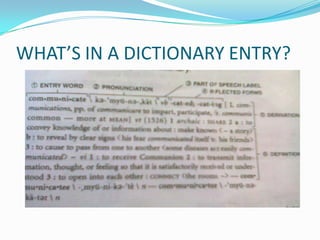
WHAT’S IN A DICTIONARY ENTRY?
• The entry word
• Pronunciation
• Parts of speech labels
• Inflected forms
• The derivation
• Definitions
• Synonyms and antonyms
• Usage labels
• Usage notes
WORDS AND THEIR MEANINGS
• ROOTS, PREFIXES, AND SUFFIXES: Roots, prefixes
 and suffixes provide substancial clues to a word’s
 meaning. A root is a base word, or part of a word, from
 which other words are formed: mile in the word
 mileage.
 A prefix is a group of letters attached to the
 beggining of a root that changes its meaning: un- in
 unfinished.
 A suffix is a group of letters attached to the end of a
 root: -age in mileage.
WORDS AND THEIR MEANINGS
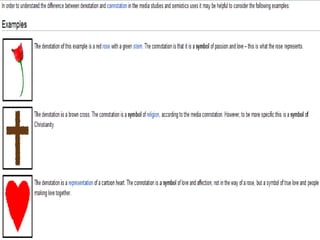
 Denotations and connotations: the denotation
  of a word is its direct, literal meaning. Fragance,
  odor, and smell denote the same thing: a
  perception detected by your olfatory sense. But the
 associations the words bring to mind differ. “You
 have a ´distinct fragance” is quite different
 from“You have a distinct odor”. Fragance suggests a
 pleasant smell; odor suggets an unpleasant one.
 The associated or indirect meaning of a word is its
 connotation.
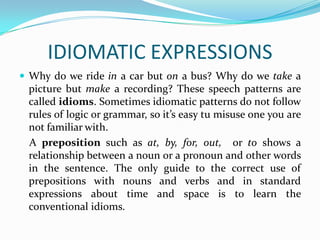
IDIOMATIC EXPRESSIONS
 Why do we ride in a car but on a bus? Why do we take a
 picture but make a recording? These speech patterns are
 called idioms. Sometimes idiomatic patterns do not follow
 rules of logic or grammar, so it’s easy tu misuse one you are
 not familiar with.
 A preposition such as at, by, for, out, or to shows a
 relationship between a noun or a pronoun and other words
 in the sentence. The only guide to the correct use of
 prepositions with nouns and verbs and in standard
 expressions about time and space is to learn the
 conventional idioms.
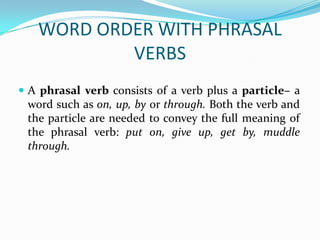
WORD ORDER WITH PHRASAL
           VERBS
 A phrasal verb consists of a verb plus a particle– a
 word such as on, up, by or through. Both the verb and
 the particle are needed to convey the full meaning of
 the phrasal verb: put on, give up, get by, muddle
 through.
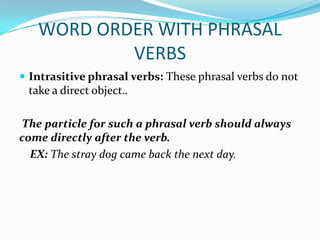
WORD ORDER WITH PHRASAL
           VERBS
 Intrasitive phrasal verbs: These phrasal verbs do not
 take a direct object..

The particle for such a phrasal verb should always
come directly after the verb.
  EX: The stray dog came back the next day.
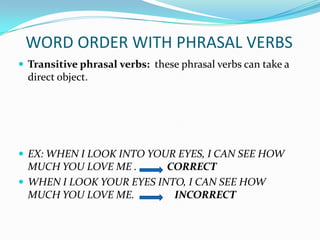
WORD ORDER WITH PHRASAL VERBS
 Transitive phrasal verbs: these phrasal verbs can take a
  direct object.


 EX: WHEN I LOOK INTO YOUR EYES, I CAN SEE HOW
  MUCH YOU LOVE ME .      CORRECT
 WHEN I LOOK YOUR EYES INTO, I CAN SEE HOW
  MUCH YOU LOVE ME.        INCORRECT
SLANGS, REGIONALISMS, AND
         COLLOQUIALISMS
 Slangs: very informal language that is usually spoken
  rather than written, used especially by particular
  groups of people.
 Slang is the use of informal words and expressions
  that are not considered standard in the
  speaker's language or dialect but are considered more
  acceptable when used socially.
SLANGS, REGIONALISMS, AND
        COLLOQUIALISMS
 Regionalisms are expressions in one part of the
  country, but not common elsewhere. The name for a
  carbonated beverage for example varies from pop to
  soda to soda drink to seltzer.
 Colloquialisms are expression common to spoken
  language but seldom used in formal writing.
JARGONS
 Jargon is terminology which is especially defined
  in relationship to a specific activity, profession,
  group, or event.

Examples: RAM, bit, byte, CPU, and hexadecimal ar
e jargon terms related to computing.
Figurative Language

 figurative language is a distinction in traditional
  systems for analyzing language.
CLICHÉS
 A cliché is an expression, idea, or element of an
 artistic work which has been overused to the point of
 losing its original meaning or effect, especially when at
 some earlier time it was considered meaningful or
 novel.
 EX: I've taken everything but nothing seems to do
 me any good.
 Live and learn.
Word choice

Word choice

  • 1.
    Martin gonzalez Andrés Rivas English composition
  • 2.
  • 3.
    THE DICTIONARY ANDTHE THESAURUS  dictionary  an unabridged:  An adbridged:
  • 4.
    THE THESAURUS • Athesaurus lists synonyms for each entry. Many thesauruses list antonyms as well.
  • 5.
    WHAT’S IN ADICTIONARY ENTRY?
  • 6.
    WHAT’S IN ADICTIONARY ENTRY? • The entry word • Pronunciation • Parts of speech labels • Inflected forms • The derivation • Definitions • Synonyms and antonyms • Usage labels • Usage notes
  • 7.
    WORDS AND THEIRMEANINGS • ROOTS, PREFIXES, AND SUFFIXES: Roots, prefixes and suffixes provide substancial clues to a word’s meaning. A root is a base word, or part of a word, from which other words are formed: mile in the word mileage. A prefix is a group of letters attached to the beggining of a root that changes its meaning: un- in unfinished. A suffix is a group of letters attached to the end of a root: -age in mileage.
  • 8.
    WORDS AND THEIRMEANINGS  Denotations and connotations: the denotation of a word is its direct, literal meaning. Fragance, odor, and smell denote the same thing: a perception detected by your olfatory sense. But the associations the words bring to mind differ. “You have a ´distinct fragance” is quite different from“You have a distinct odor”. Fragance suggests a pleasant smell; odor suggets an unpleasant one. The associated or indirect meaning of a word is its connotation.
  • 10.
    IDIOMATIC EXPRESSIONS  Whydo we ride in a car but on a bus? Why do we take a picture but make a recording? These speech patterns are called idioms. Sometimes idiomatic patterns do not follow rules of logic or grammar, so it’s easy tu misuse one you are not familiar with. A preposition such as at, by, for, out, or to shows a relationship between a noun or a pronoun and other words in the sentence. The only guide to the correct use of prepositions with nouns and verbs and in standard expressions about time and space is to learn the conventional idioms.
  • 11.
    WORD ORDER WITHPHRASAL VERBS  A phrasal verb consists of a verb plus a particle– a word such as on, up, by or through. Both the verb and the particle are needed to convey the full meaning of the phrasal verb: put on, give up, get by, muddle through.
  • 12.
    WORD ORDER WITHPHRASAL VERBS  Intrasitive phrasal verbs: These phrasal verbs do not take a direct object.. The particle for such a phrasal verb should always come directly after the verb. EX: The stray dog came back the next day.
  • 13.
    WORD ORDER WITHPHRASAL VERBS  Transitive phrasal verbs: these phrasal verbs can take a direct object.  EX: WHEN I LOOK INTO YOUR EYES, I CAN SEE HOW MUCH YOU LOVE ME . CORRECT  WHEN I LOOK YOUR EYES INTO, I CAN SEE HOW MUCH YOU LOVE ME. INCORRECT
  • 14.
    SLANGS, REGIONALISMS, AND COLLOQUIALISMS  Slangs: very informal language that is usually spoken rather than written, used especially by particular groups of people.  Slang is the use of informal words and expressions that are not considered standard in the speaker's language or dialect but are considered more acceptable when used socially.
  • 15.
    SLANGS, REGIONALISMS, AND COLLOQUIALISMS  Regionalisms are expressions in one part of the country, but not common elsewhere. The name for a carbonated beverage for example varies from pop to soda to soda drink to seltzer.  Colloquialisms are expression common to spoken language but seldom used in formal writing.
  • 16.
    JARGONS  Jargon isterminology which is especially defined in relationship to a specific activity, profession, group, or event. Examples: RAM, bit, byte, CPU, and hexadecimal ar e jargon terms related to computing.
  • 17.
    Figurative Language  figurativelanguage is a distinction in traditional systems for analyzing language.
  • 18.
    CLICHÉS  A clichéis an expression, idea, or element of an artistic work which has been overused to the point of losing its original meaning or effect, especially when at some earlier time it was considered meaningful or novel.  EX: I've taken everything but nothing seems to do me any good.  Live and learn.