B COM 2ND SEM
KSAWU SYLLABUS
WOMEN
ENTREPRENEURSHIP
Smt. Uma Minajigi Reur
Head, Dept. of Commerce &
Management
Smt. V G Degree College for Women,
Kalaburagi
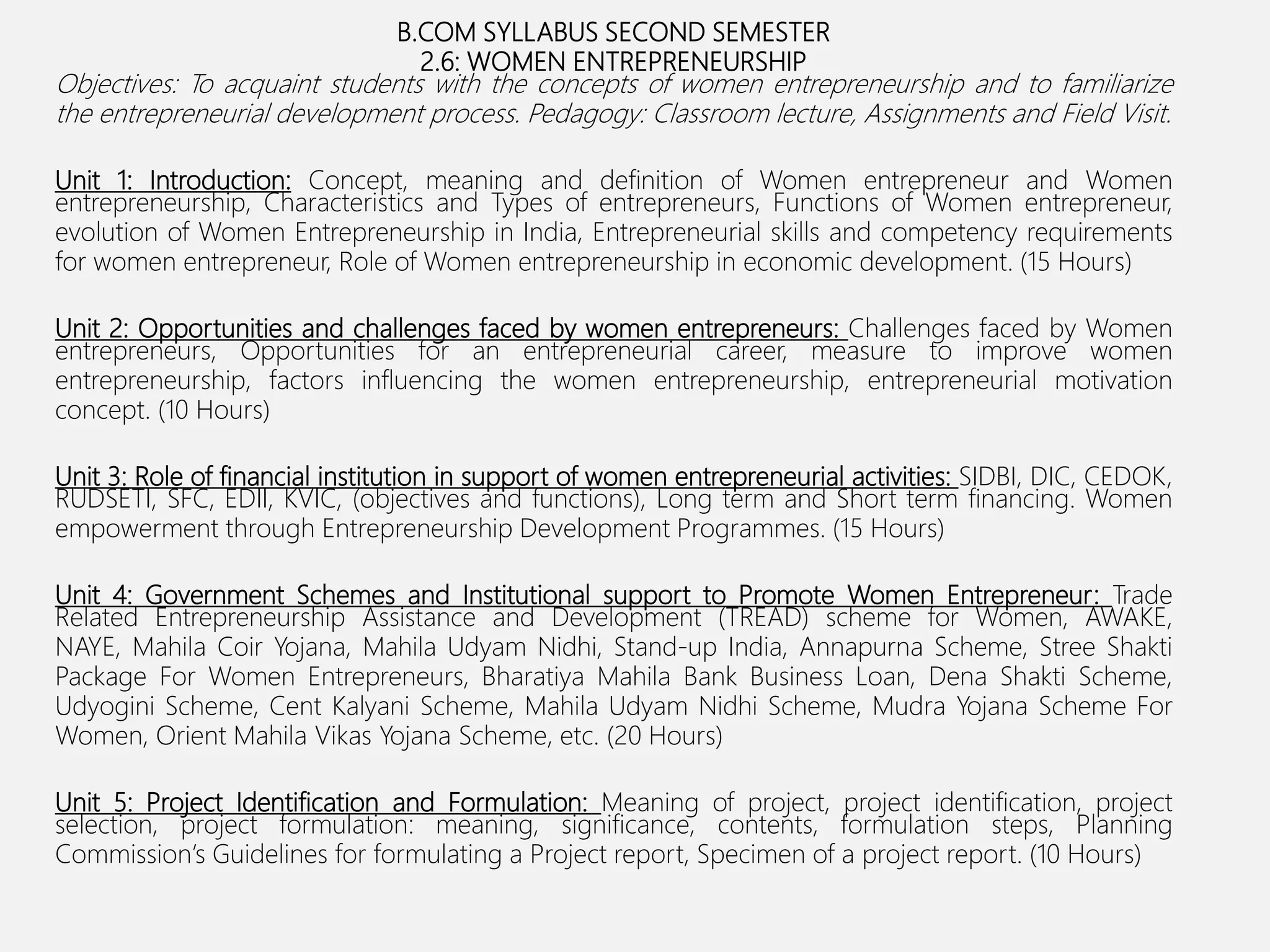
B.COM SYLLABUS SECOND SEMESTER
2.6: WOMEN ENTREPRENEURSHIP
Objectives: To acquaint students with the concepts of women entrepreneurship and to familiarize
the entrepreneurial development process. Pedagogy: Classroom lecture, Assignments and Field Visit.
Unit 1: Introduction: Concept, meaning and definition of Women entrepreneur and Women
entrepreneurship, Characteristics and Types of entrepreneurs, Functions of Women entrepreneur,
evolution of Women Entrepreneurship in India, Entrepreneurial skills and competency requirements
for women entrepreneur, Role of Women entrepreneurship in economic development. (15 Hours)
Unit 2: Opportunities and challenges faced by women entrepreneurs: Challenges faced by Women
entrepreneurs, Opportunities for an entrepreneurial career, measure to improve women
entrepreneurship, factors influencing the women entrepreneurship, entrepreneurial motivation
concept. (10 Hours)
Unit 3: Role of financial institution in support of women entrepreneurial activities: SIDBI, DIC, CEDOK,
RUDSETI, SFC, EDII, KVIC, (objectives and functions), Long term and Short term financing. Women
empowerment through Entrepreneurship Development Programmes. (15 Hours)
Unit 4: Government Schemes and Institutional support to Promote Women Entrepreneur: Trade
Related Entrepreneurship Assistance and Development (TREAD) scheme for Women, AWAKE,
NAYE, Mahila Coir Yojana, Mahila Udyam Nidhi, Stand-up India, Annapurna Scheme, Stree Shakti
Package For Women Entrepreneurs, Bharatiya Mahila Bank Business Loan, Dena Shakti Scheme,
Udyogini Scheme, Cent Kalyani Scheme, Mahila Udyam Nidhi Scheme, Mudra Yojana Scheme For
Women, Orient Mahila Vikas Yojana Scheme, etc. (20 Hours)
Unit 5: Project Identification and Formulation: Meaning of project, project identification, project
selection, project formulation: meaning, significance, contents, formulation steps, Planning
Commission’s Guidelines for formulating a Project report, Specimen of a project report. (10 Hours)
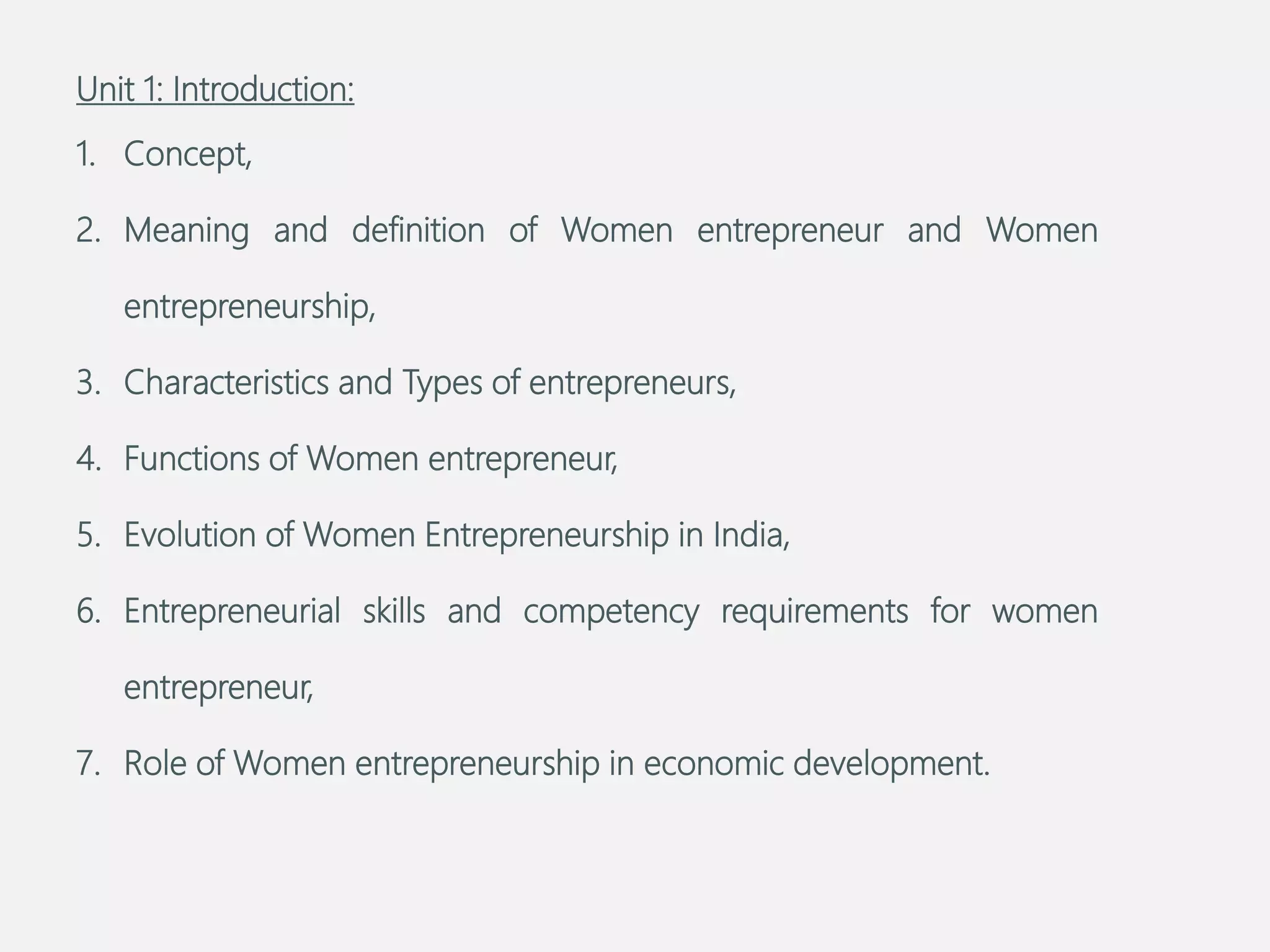
Unit 1: Introduction:
1. Concept,
2. Meaning and definition of Women entrepreneur and Women
entrepreneurship,
3. Characteristics and Types of entrepreneurs,
4. Functions of Women entrepreneur,
5. Evolution of Women Entrepreneurship in India,
6. Entrepreneurial skills and competency requirements for women
entrepreneur,
7. Role of Women entrepreneurship in economic development.
What Is an Entrepreneur?
An entrepreneur is an individual who creates a new business, bearing most
of the risks and enjoying most of the rewards. The process of setting up a
business is known as entrepreneurship. The entrepreneur is commonly
seen as an innovator, a source of new ideas, goods, services, and
business/or procedures.
Entrepreneurs play a key role in any economy, using the skills and
initiative necessary to anticipate needs and bringing good new ideas to
market. Entrepreneurship that proves to be successful in taking on the
risks of creating a startup is rewarded with profits, fame, and continued
growth opportunities. Entrepreneurship that fails results in losses and
less prevalence in the markets for those involved.
•A person who undertakes the risk of starting a new business
venture is called an Entrepreneur.
•An Entrepreneur creates a firm to realize their idea, known as
entrepreneurship, which aggregates capital and labor in order to
produce goods or services for profit.
•Entrepreneurship is highly risky but also can be highly
rewarding, as it serves to generate economic wealth, growth, and
innovation.
•Ensuring funding is key for entrepreneurs: Financing resources
include SBA loans and crowdfunding.
•The way entrepreneurs file and pay taxes will depend on how the
business is set up in terms of structure.
DEFINITION:
WOMEN
ENTREPRENEURS MAY BE
DEFINED AS “A WOMEN OR
GROUP OF WOMEN WHO
INITIATE , ORGANIZE AND RUN
THE BUSINESS ENTERPRISE.”
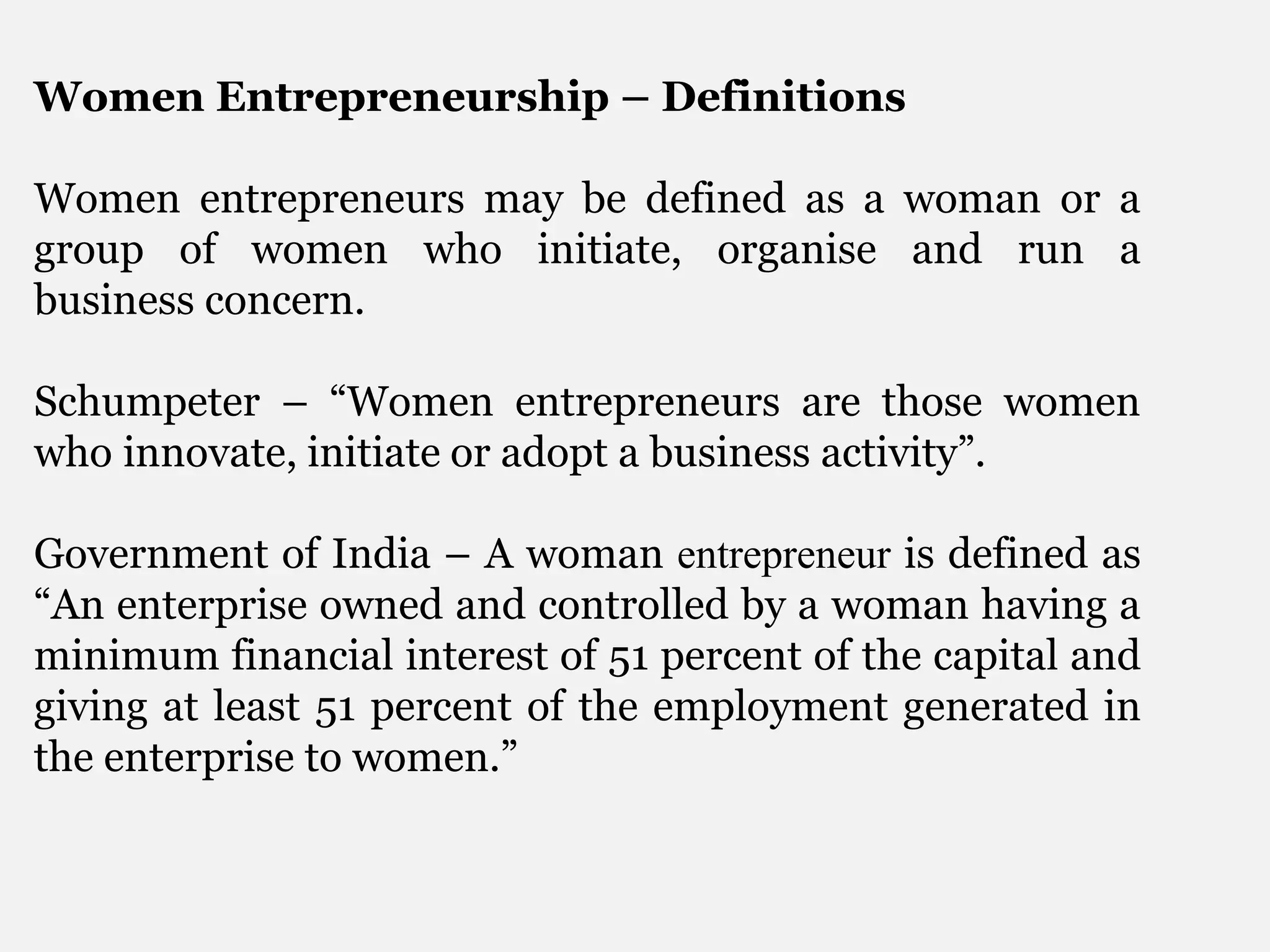
Women Entrepreneurship – Definitions
Women entrepreneurs may be defined as a woman or a
group of women who initiate, organise and run a
business concern.
Schumpeter – “Women entrepreneurs are those women
who innovate, initiate or adopt a business activity”.
Government of India – A woman entrepreneur is defined as
“An enterprise owned and controlled by a woman having a
minimum financial interest of 51 percent of the capital and
giving at least 51 percent of the employment generated in
the enterprise to women.”
TYPES OF
ENTREPRENEUR:-
1.Chance Entrepreneurs
2.Created Entrepreneurs
3.Benami Entrepreneurs
4.Natural Entrepreneurs
5. Forced Entrepreneurs
Women entrepreneurs in India are broadly divided into the
following categories:
6. Affluent entrepreneurs
7. Pull factors
8. Self-employed entrepreneurs
9. Rural entrepreneurs
A women who went into business by luck or accident
without any preparation, clear goals or plans such
entrepreneurs are called Chance Entrepreneurs.
2. Created Entrepreneurs
Government and some agencies that specifically identify,
motivate, train, equip and develop as entrepreneur such
entrepreneurs are called as Created Entrepreneurs.
1. Chance Entrepreneurs
3. Benami Entrepreneurs
A women who act as façade for business of their
husband or brother, such entrepreneurs are called
Benami Entrepreneurs.
4. Natural Entrepreneurs
The entrepreneurs take business as the profession on their
own by self planning or motivated through profit factor and
also keeping themselves busy. Such entrepreneurs are called
as Natural Entrepreneurs.
There are some women entrepreneurs who accepts
entrepreneurial activities to overcome financial
difficulties. The family situation forces them either
to develop the existing family business or to start
new ventures to improve the economic conditions
of the family. Such categories of entrepreneurs are
termed as Forced Entrepreneurs or push factors.
5. Forced Entrepreneurs or Push Factors
6. Affluent Entrepreneurs:
Affluent women entrepreneurs are those women
entrepreneurs who hails from rich business families.
They are the daughters, daughter-in laws, sisters, sister-
in-laws and wives of affluent people in the society. Many
of them are engaged in beauty parlour, interior
decoration, book publishing, film distribution and the
like. The family supports the above type of entrepreneur
in carrying out their responsibilities
7. Pull Factors:
Women in towns and cities take up entrepreneurship as a challenge to
do something new and to be economically independent. These are
coming under the category of pull factors. They belong to educated
women who generally take up small and medium industries where
risk is low. Under this category, women usually start service centres
schools, food catering centres, restaurants, grocery shops etc.
8. Self-employed Entrepreneur:
Poor and very poor women in villages and town rely heavily on their
own efforts for sustenance. They start tiny and Small enterprises like
brooms making, wax candle making, providing tea and coffee to offices,
ironing of clothes knitting work, tailoring firm etc. Such women are
called self-employed entrepreneurs.
9. Rural Entrepreneurs:
Women in rural areas/villages start enterprises which needs least
organising skill and less risk. Dairy products, pickles, fruit juices,
pappads and jagger making are coming under this category of Rural
entrepreneur.
FUNCTIONS OF
WOMEN ENTREPRENEUR
Women Entrepreneur is not different from the concept of Entrepreneur, all
the concept characteristics & functions are applicable to Women
Entrepreneur. The role of women in family & society is changing very fast.
Those days are gone where typically women are expected to look after
household activities change in various social aspect like equal treatment to
women, no discrimination among male & females availability of equal
opportunities to work in any field slowly these changes have forced her to
become more competitive & also encouraged into business operations.
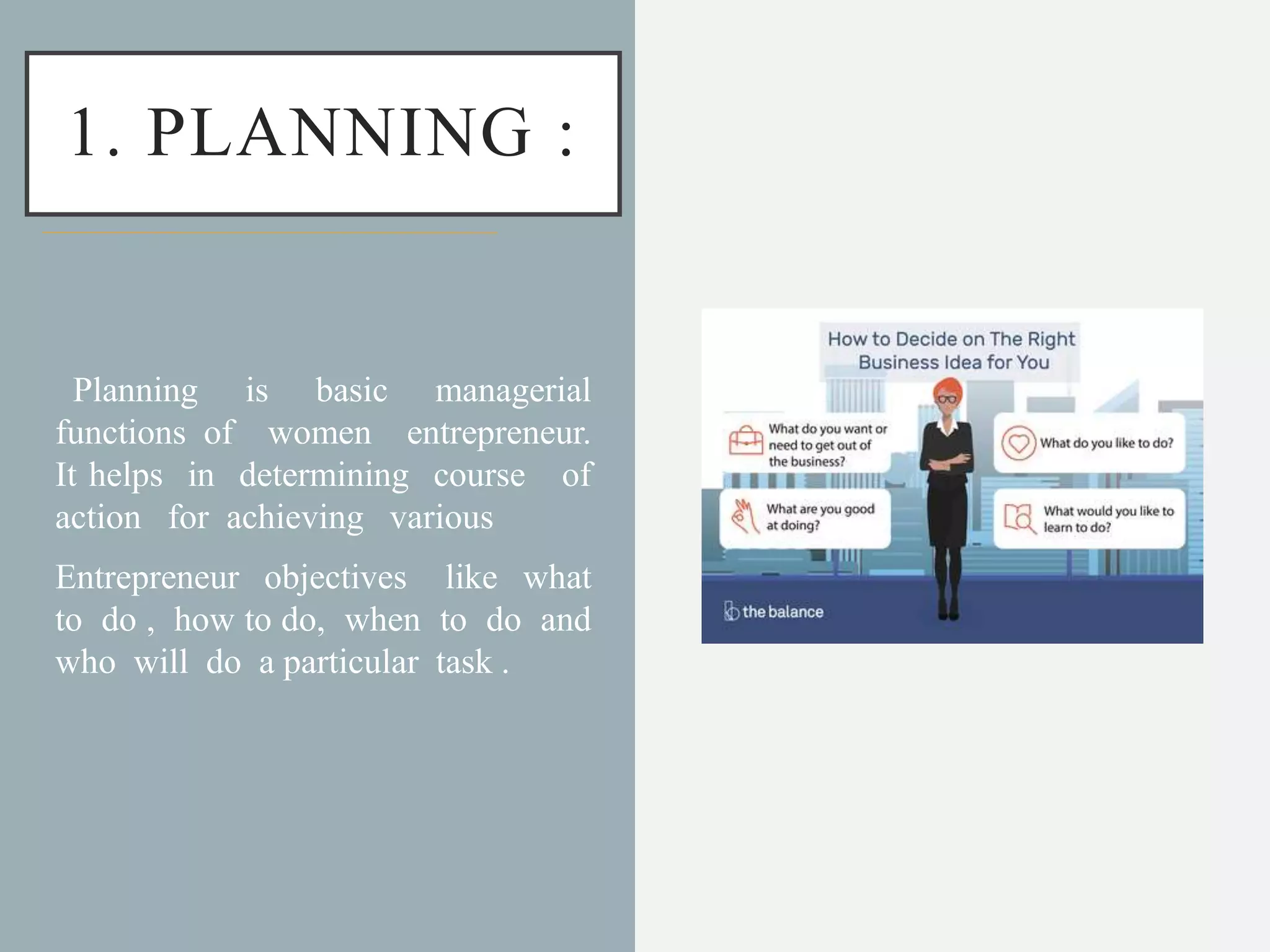
1. PLANNING :
Planning is basic managerial
functions of women entrepreneur.
It helps in determining course of
action for achieving various
Entrepreneur objectives like what
to do , how to do, when to do and
who will do a particular task .
2.ORGANSING:
Every women
entrepreneur needs personnel to
look at the different aspects of the
Enterprise . She sets up the
objectives, goals, to be achieved by
it’s personnel. The function of
organizing is to arrange, guide,
coordination direct and control the
activities of the other factors of
production.
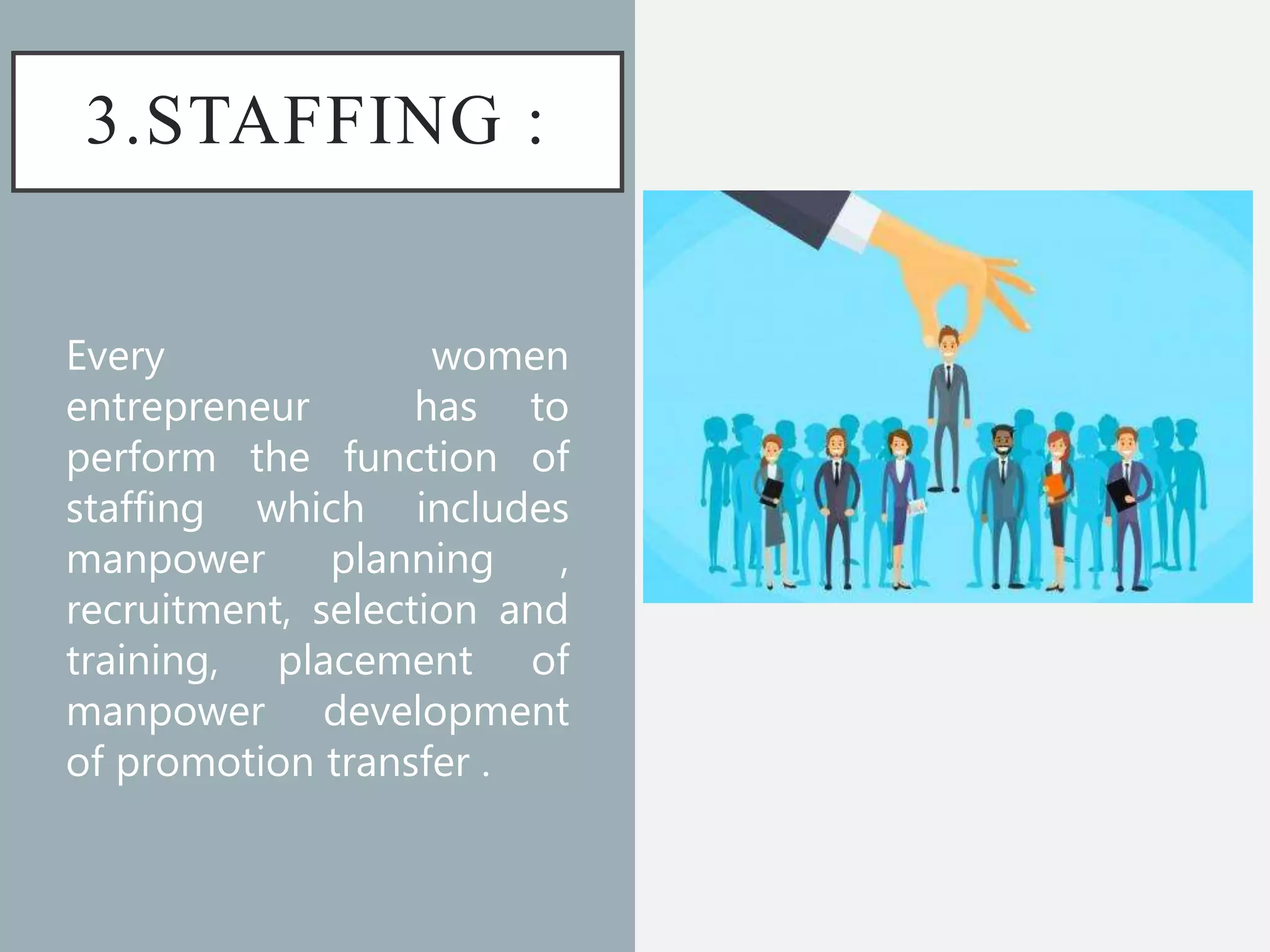
3.STAFFING :
Every women
entrepreneur has to
perform the function of
staffing which includes
manpower planning ,
recruitment, selection and
training, placement of
manpower development
of promotion transfer .
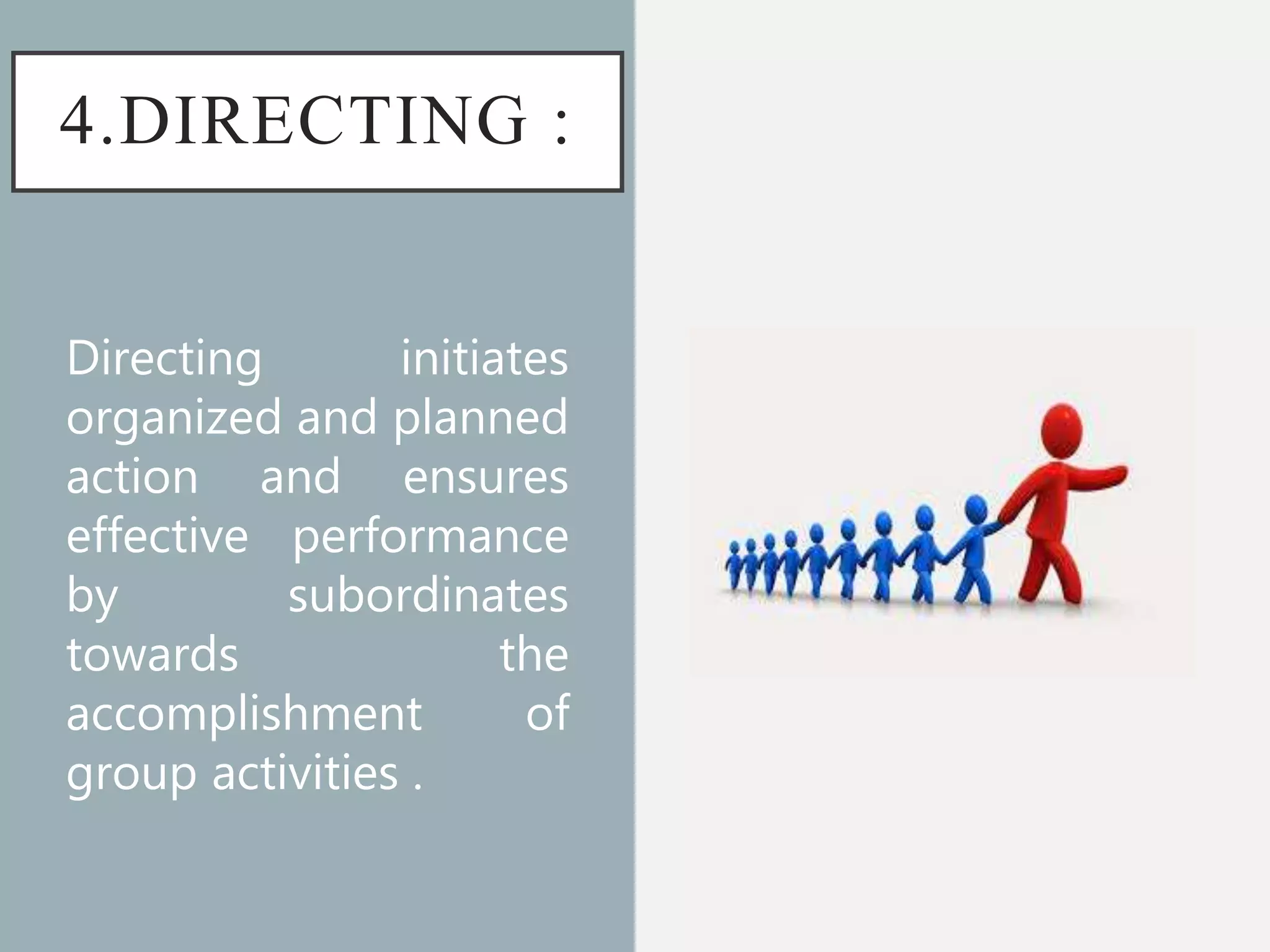
4.DIRECTING :
Directing initiates
organized and planned
action and ensures
effective performance
by subordinates
towards the
accomplishment of
group activities .
5.LEADERSHIP :
A woman entrepreneur has to
issue various orders, instructions
and guide her subordinates in their
work to improve their performance
and achieve enterprise objectives.
It is the ability to build up
confidence and zeal among
people and to create an urge in
them to be a successful leader,
she must possess the qualities of
foresight, drive, initiative, self-
confidence, and personal integrity.
6.MOTIVATION :
A woman entrepreneur has to
provide some personal
incentive to the subordinates to
motivate, persuade and inspire
them for contributing their best
towards the achievement of
enterprise objectives.
7. SUPERVISION:
After giving instructions, the
woman entrepreneur has to see
that the given instructions are
carried by subordinates at work
to get the required and directed
work done and to correct the
subordinates whenever they go
wrong.
8. COORDINATION:
Coordination is one of the
most important functions.
It creates a team spirit and
helps in achieving goals
through collective efforts
to provide unity of action
in the pursuit of common
objectives.
9. CONTROLLING:
Controlling is the process
that enables to get its
policies implemented and
take corrective actions if
the performance is not
according to the pre-
determined standards.
THANK YOU

Women Entrepreneurship - Types & Functions

  • 1.
    B COM 2NDSEM KSAWU SYLLABUS WOMEN ENTREPRENEURSHIP Smt. Uma Minajigi Reur Head, Dept. of Commerce & Management Smt. V G Degree College for Women, Kalaburagi
  • 2.
    B.COM SYLLABUS SECONDSEMESTER 2.6: WOMEN ENTREPRENEURSHIP Objectives: To acquaint students with the concepts of women entrepreneurship and to familiarize the entrepreneurial development process. Pedagogy: Classroom lecture, Assignments and Field Visit. Unit 1: Introduction: Concept, meaning and definition of Women entrepreneur and Women entrepreneurship, Characteristics and Types of entrepreneurs, Functions of Women entrepreneur, evolution of Women Entrepreneurship in India, Entrepreneurial skills and competency requirements for women entrepreneur, Role of Women entrepreneurship in economic development. (15 Hours) Unit 2: Opportunities and challenges faced by women entrepreneurs: Challenges faced by Women entrepreneurs, Opportunities for an entrepreneurial career, measure to improve women entrepreneurship, factors influencing the women entrepreneurship, entrepreneurial motivation concept. (10 Hours) Unit 3: Role of financial institution in support of women entrepreneurial activities: SIDBI, DIC, CEDOK, RUDSETI, SFC, EDII, KVIC, (objectives and functions), Long term and Short term financing. Women empowerment through Entrepreneurship Development Programmes. (15 Hours) Unit 4: Government Schemes and Institutional support to Promote Women Entrepreneur: Trade Related Entrepreneurship Assistance and Development (TREAD) scheme for Women, AWAKE, NAYE, Mahila Coir Yojana, Mahila Udyam Nidhi, Stand-up India, Annapurna Scheme, Stree Shakti Package For Women Entrepreneurs, Bharatiya Mahila Bank Business Loan, Dena Shakti Scheme, Udyogini Scheme, Cent Kalyani Scheme, Mahila Udyam Nidhi Scheme, Mudra Yojana Scheme For Women, Orient Mahila Vikas Yojana Scheme, etc. (20 Hours) Unit 5: Project Identification and Formulation: Meaning of project, project identification, project selection, project formulation: meaning, significance, contents, formulation steps, Planning Commission’s Guidelines for formulating a Project report, Specimen of a project report. (10 Hours)
  • 3.
    Unit 1: Introduction: 1.Concept, 2. Meaning and definition of Women entrepreneur and Women entrepreneurship, 3. Characteristics and Types of entrepreneurs, 4. Functions of Women entrepreneur, 5. Evolution of Women Entrepreneurship in India, 6. Entrepreneurial skills and competency requirements for women entrepreneur, 7. Role of Women entrepreneurship in economic development.
  • 4.
    What Is anEntrepreneur? An entrepreneur is an individual who creates a new business, bearing most of the risks and enjoying most of the rewards. The process of setting up a business is known as entrepreneurship. The entrepreneur is commonly seen as an innovator, a source of new ideas, goods, services, and business/or procedures. Entrepreneurs play a key role in any economy, using the skills and initiative necessary to anticipate needs and bringing good new ideas to market. Entrepreneurship that proves to be successful in taking on the risks of creating a startup is rewarded with profits, fame, and continued growth opportunities. Entrepreneurship that fails results in losses and less prevalence in the markets for those involved.
  • 5.
    •A person whoundertakes the risk of starting a new business venture is called an Entrepreneur. •An Entrepreneur creates a firm to realize their idea, known as entrepreneurship, which aggregates capital and labor in order to produce goods or services for profit. •Entrepreneurship is highly risky but also can be highly rewarding, as it serves to generate economic wealth, growth, and innovation. •Ensuring funding is key for entrepreneurs: Financing resources include SBA loans and crowdfunding. •The way entrepreneurs file and pay taxes will depend on how the business is set up in terms of structure.
  • 6.
    DEFINITION: WOMEN ENTREPRENEURS MAY BE DEFINEDAS “A WOMEN OR GROUP OF WOMEN WHO INITIATE , ORGANIZE AND RUN THE BUSINESS ENTERPRISE.”
  • 7.
    Women Entrepreneurship –Definitions Women entrepreneurs may be defined as a woman or a group of women who initiate, organise and run a business concern. Schumpeter – “Women entrepreneurs are those women who innovate, initiate or adopt a business activity”. Government of India – A woman entrepreneur is defined as “An enterprise owned and controlled by a woman having a minimum financial interest of 51 percent of the capital and giving at least 51 percent of the employment generated in the enterprise to women.”
  • 8.
    TYPES OF ENTREPRENEUR:- 1.Chance Entrepreneurs 2.CreatedEntrepreneurs 3.Benami Entrepreneurs 4.Natural Entrepreneurs 5. Forced Entrepreneurs
  • 9.
    Women entrepreneurs inIndia are broadly divided into the following categories: 6. Affluent entrepreneurs 7. Pull factors 8. Self-employed entrepreneurs 9. Rural entrepreneurs
  • 10.
    A women whowent into business by luck or accident without any preparation, clear goals or plans such entrepreneurs are called Chance Entrepreneurs. 2. Created Entrepreneurs Government and some agencies that specifically identify, motivate, train, equip and develop as entrepreneur such entrepreneurs are called as Created Entrepreneurs. 1. Chance Entrepreneurs
  • 11.
    3. Benami Entrepreneurs Awomen who act as façade for business of their husband or brother, such entrepreneurs are called Benami Entrepreneurs. 4. Natural Entrepreneurs The entrepreneurs take business as the profession on their own by self planning or motivated through profit factor and also keeping themselves busy. Such entrepreneurs are called as Natural Entrepreneurs.
  • 12.
    There are somewomen entrepreneurs who accepts entrepreneurial activities to overcome financial difficulties. The family situation forces them either to develop the existing family business or to start new ventures to improve the economic conditions of the family. Such categories of entrepreneurs are termed as Forced Entrepreneurs or push factors. 5. Forced Entrepreneurs or Push Factors
  • 13.
    6. Affluent Entrepreneurs: Affluentwomen entrepreneurs are those women entrepreneurs who hails from rich business families. They are the daughters, daughter-in laws, sisters, sister- in-laws and wives of affluent people in the society. Many of them are engaged in beauty parlour, interior decoration, book publishing, film distribution and the like. The family supports the above type of entrepreneur in carrying out their responsibilities
  • 14.
    7. Pull Factors: Womenin towns and cities take up entrepreneurship as a challenge to do something new and to be economically independent. These are coming under the category of pull factors. They belong to educated women who generally take up small and medium industries where risk is low. Under this category, women usually start service centres schools, food catering centres, restaurants, grocery shops etc.
  • 15.
    8. Self-employed Entrepreneur: Poorand very poor women in villages and town rely heavily on their own efforts for sustenance. They start tiny and Small enterprises like brooms making, wax candle making, providing tea and coffee to offices, ironing of clothes knitting work, tailoring firm etc. Such women are called self-employed entrepreneurs. 9. Rural Entrepreneurs: Women in rural areas/villages start enterprises which needs least organising skill and less risk. Dairy products, pickles, fruit juices, pappads and jagger making are coming under this category of Rural entrepreneur.
  • 17.
    FUNCTIONS OF WOMEN ENTREPRENEUR WomenEntrepreneur is not different from the concept of Entrepreneur, all the concept characteristics & functions are applicable to Women Entrepreneur. The role of women in family & society is changing very fast. Those days are gone where typically women are expected to look after household activities change in various social aspect like equal treatment to women, no discrimination among male & females availability of equal opportunities to work in any field slowly these changes have forced her to become more competitive & also encouraged into business operations.
  • 19.
    1. PLANNING : Planningis basic managerial functions of women entrepreneur. It helps in determining course of action for achieving various Entrepreneur objectives like what to do , how to do, when to do and who will do a particular task .
  • 20.
    2.ORGANSING: Every women entrepreneur needspersonnel to look at the different aspects of the Enterprise . She sets up the objectives, goals, to be achieved by it’s personnel. The function of organizing is to arrange, guide, coordination direct and control the activities of the other factors of production.
  • 21.
    3.STAFFING : Every women entrepreneurhas to perform the function of staffing which includes manpower planning , recruitment, selection and training, placement of manpower development of promotion transfer .
  • 22.
    4.DIRECTING : Directing initiates organizedand planned action and ensures effective performance by subordinates towards the accomplishment of group activities .
  • 23.
    5.LEADERSHIP : A womanentrepreneur has to issue various orders, instructions and guide her subordinates in their work to improve their performance and achieve enterprise objectives. It is the ability to build up confidence and zeal among people and to create an urge in them to be a successful leader, she must possess the qualities of foresight, drive, initiative, self- confidence, and personal integrity.
  • 24.
    6.MOTIVATION : A womanentrepreneur has to provide some personal incentive to the subordinates to motivate, persuade and inspire them for contributing their best towards the achievement of enterprise objectives.
  • 25.
    7. SUPERVISION: After givinginstructions, the woman entrepreneur has to see that the given instructions are carried by subordinates at work to get the required and directed work done and to correct the subordinates whenever they go wrong.
  • 26.
    8. COORDINATION: Coordination isone of the most important functions. It creates a team spirit and helps in achieving goals through collective efforts to provide unity of action in the pursuit of common objectives.
  • 27.
    9. CONTROLLING: Controlling isthe process that enables to get its policies implemented and take corrective actions if the performance is not according to the pre- determined standards.
  • 28.