Weight Management: Overweight,Weight Management: Overweight,
Obesity, & UnderweightObesity, & Underweight
Overweight and ObesityOverweight and Obesity
• Major health problem in the U.S.
• Growing concern worldwide
• Prevalence continues to increase
• Women, poor, blacks, and Hispanics
• Children
• BMI of 25 or greater
• Epidemic is worldwide
• Not merely among industrialized countries
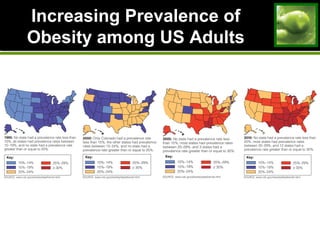
Increasing Prevalence ofIncreasing Prevalence of
Obesity among US AdultsObesity among US Adults
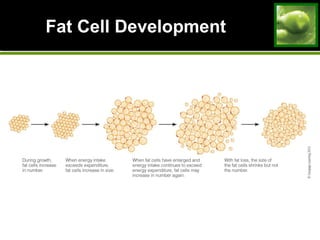
Fat Cell DevelopmentFat Cell Development
• Energy in exceeds energy out
• Stored in fat cells of adipose tissue
• Body fat
• Number and size of fat cells
• Periods in life when fat cell numbers increase
• Cell proliferation
• Energy out exceeds energy in
• Fat cell size decreases; no change in number
Fat Cell DevelopmentFat Cell Development
Fat Cell MetabolismFat Cell Metabolism
• Lipoprotein lipase (LPL) activity
• Storage of triglycerides
• Obese people vs. lean people
• Activity in varying body regions
• Men vs. women
• Enzyme activity releasing and breaking
down fat
• Fat oxidation is not efficient
• Set point theory
Causes of Overweight & ObesityCauses of Overweight & Obesity
– Genetics & Epigenetics– Genetics & Epigenetics
• Causative role of genetics
• Genetic influences do seem to be involved
• Genetics may determine predisposition to
obesity
• Genes interact with:
• Diet and physical activity
• Satiety and energy balance
• Human genome
Causes of Overweight & ObesityCauses of Overweight & Obesity
– Genetics & Epigenetics– Genetics & Epigenetics
• Obesity gene
• Codes for the protein leptin
• Acts as a hormone in hypothalamus
• Promotes negative energy balance
• Suppresses appetite
• Increases energy expenditure
• Locations of leptin secretion
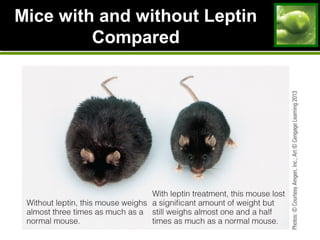
Mice with and without Leptin
Compared
Causes of Overweight & ObesityCauses of Overweight & Obesity
– Genetics & Epigenetics– Genetics & Epigenetics
• Obesity gene
• Genetic deficiency of leptin or genetic
mutation
• Rare
• Leptin resistance
• Fructose consumption
• Roles in the body
• Energy regulation
• Others
Causes of Overweight & ObesityCauses of Overweight & Obesity
– Genetics & Epigenetics– Genetics & Epigenetics
• Ghrelin
• Promotes positive energy balance
• Inverse correlation with body weight
• Roles in the body beyond energy regulation
• Uncoupling proteins
• Types of body fat
• Brown adipose tissue
• White adipose tissue
Causes of Overweight &Causes of Overweight &
Obesity – EnvironmentObesity – Environment
• Encountered daily circumstances
• Interaction between environment and
genetics
• Overeating
• Present and past eating and activity patterns
influence current body weight
• Availability
• Serving sizes
• Restaurant food
Causes of Overweight &Causes of Overweight &
Obesity – EnvironmentObesity – Environment
• Physical inactivity
• Life requires little exertion
• Modern technology
• Inactivity contributes to weight gain and poor
health
• Sedentary activities and weight gain
• DRI for prevention of weight gain
• 60 minutes of moderate activity every day
Problems of Overweight andProblems of Overweight and
Obesity – Health RisksObesity – Health Risks
• Three indicators
• BMI
• Waist circumference
• Disease risk profile
• Factors taken into account
• Beneficial weight loss
• Health status
• Motivation
Problems of Overweight andProblems of Overweight and
Obesity – Health RisksObesity – Health Risks
• Overweight in good health
• Sometimes health is not the motivation for
weight loss
• Obese or overweight with risk factors
• Two or more risk factors
• Obese or overweight with life-threatening
condition
• Recommendation to lose weight
Problems of Overweight & ObesityProblems of Overweight & Obesity
– Perceptions & Prejudices– Perceptions & Prejudices
• Most obese people do not successfully lose
weight and maintain the loss
• Social consequences
• Jobs, school, and in social situations
• Psychological problems
• Embarrassment
• Other feelings
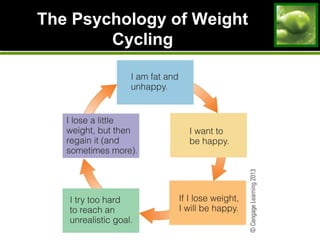
The Psychology of WeightThe Psychology of Weight
CyclingCycling
Problems of Overweight andProblems of Overweight and
Obesity – Dangerous InterventionsObesity – Dangerous Interventions
• Intervention dangers
• Diet books and weight-loss programs
• Little success with weight loss maintenance
• Fad diets
• Weight-loss products
• Herbal products
• Laws for dietary supplements
• Other gimmicks
Aggressive Treatments forAggressive Treatments for
Obesity – DrugsObesity – Drugs
• Strategies for weight reduction depend on:
• Degree of obesity
• Risk of disease
• Use drugs as part of long-term
comprehensive weight-loss programs
• Assist with modest weight loss
• FDA approval
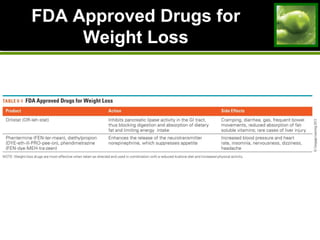
FDA Approved Drugs for
Weight Loss
Aggressive Treatments forAggressive Treatments for
Obesity – SurgeryObesity – Surgery
• Clinically severe obesity
• 200,000 surgeries performed each year
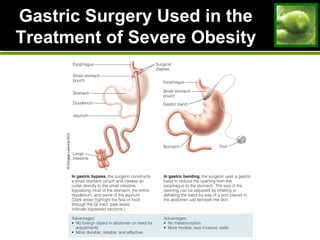
• Reduces food capacity of stomach
• Effectively limits food intake
• Reduce production of ghrelin
• Health-related benefits
• Long-term safety and effectiveness
• Liposuction
Gastric Surgery Used in theGastric Surgery Used in the
Treatment of Severe ObesityTreatment of Severe Obesity
Weight Loss StrategiesWeight Loss Strategies
• Successful strategies
• Small changes
• Moderate losses
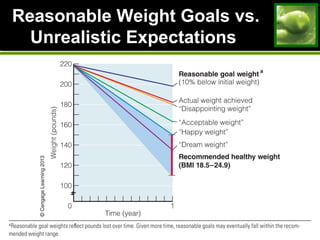
• Reasonable goals
• Reasonable rate of weight loss
• Benefits of modest weight loss
• Incorporation of healthy eating and physical
activity
Reasonable Weight Goals vs.Reasonable Weight Goals vs.
Unrealistic ExpectationsUnrealistic Expectations
Weight Loss Strategies –Weight Loss Strategies –
Eating PatternsEating Patterns
• Be realistic about energy intake
• Provide less energy than is needed
• Avoid restrictive eating
• Avoid rapid weight loss
• Goal: nutritional adequacy without excess
• Deficit of 500 to 1000 kcalories per day
• Breakfast frequency
• Inversely related to obesity
Weight Loss Strategies –Weight Loss Strategies –
Eating PatternsEating Patterns
• Nutritional adequacy
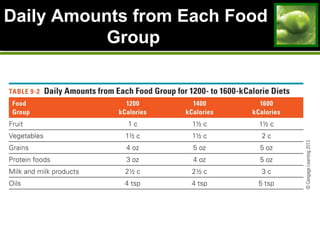
• Minimum of 1200 kcalories a day
• Eat small portions
• Eat less food at each meal
• Feel satisfied, not stuffed
• Structured meal replacement plans
• Lower energy density
• Cost
Daily Amounts from Each FoodDaily Amounts from Each Food
GroupGroup
Weight Loss Strategies –Weight Loss Strategies –
Eating PatternsEating Patterns
• Remember water
• Assistance with weight management
• Focus on fiber
• Low in energy and high in nutrients
• Require effort to eat
• Speed of food consumption
• Choose fats sensibly
• Energy density and satiation
Weight Loss Strategies –Weight Loss Strategies –
Eating PatternsEating Patterns
• Select carbohydrates carefully
• Artificial sweeteners
• Impact on energy intake
• Watch for empty kcalories
• Fat, sugar, and alcohol
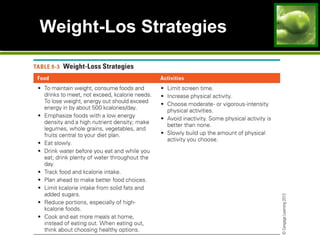
Weight-Los Strategies
Weight Loss Strategies –Weight Loss Strategies –
Physical ActivityPhysical Activity
• Best approach to weight management
• Moderate physical activity plus activities of
daily life
• Combination of diet and physical activity
• Lose more fat
• Retain more muscle
• Regain less weight
• Reduction of abdominal fat
Weight Loss Strategies –Weight Loss Strategies –
Physical ActivityPhysical Activity
• kCalorie expenditure
• Body weight, intensity, and duration
• Greater the energy deficit, greater the fat
loss
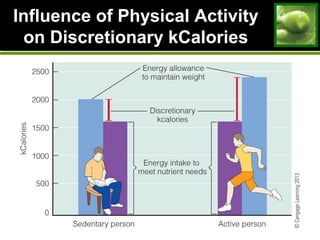
• Discretionary kcalorie allowance
• Metabolism
• Speeds up with activity
• Immediate and long-term benefits
Influence of Physical ActivityInfluence of Physical Activity
on Discretionary kCalorieson Discretionary kCalories
Weight Loss Strategies –Weight Loss Strategies –
Physical ActivityPhysical Activity
• Body composition
• Fat decreases and lean body mass increases
• Strength-training exercises
• Abdominal fat
• Appetite control
• Delayed appetite
• Inappropriate appetite
Weight Loss Strategies –Weight Loss Strategies –
Physical ActivityPhysical Activity
• Psychological benefits
• Self-esteem
• Choosing activities
• Ones you enjoy & are willing to do regularly
• Low-to-moderate intensity
• 2000 calories per week
• Energy-expending daily activities
• Spot reducing
Weight Loss Strategies –Weight Loss Strategies –
Environmental InfluencesEnvironmental Influences
• Factors surrounding eating experience and
the food itself
• Atmosphere
• Pleasant and comfortable equals more food
• Accessibility
• Less effort needed to obtain food, more food
eaten
Weight Loss Strategies –Weight Loss Strategies –
Environmental InfluencesEnvironmental Influences
• Socializing
• Duration of meal
• Visual cues
• Distraction
• Distractions
• Initiating eating
• Interfering with internal controls
• Extending duration of eating
Weight Loss Strategies –Weight Loss Strategies –
Environmental InfluencesEnvironmental Influences
• Multiple choice
• Large assortments of foods increase
consumption
• Package and portion sizes
• Serving containers
Weight Loss Strategies –Weight Loss Strategies –
Behavior & AttitudeBehavior & Attitude
• Behavior modification
• Positive, matter-of-fact attitude
• Become aware of behaviors
• Keep record
• Change behaviors
• Set small, specific goals
• Practice
• Reward
Weight Loss Strategies –Weight Loss Strategies –
Behavior & AttitudeBehavior & Attitude
• Cognitive skills
• Problem solving
• Cognitive restructuring
• Replace negative thoughts
• Personal attitude
• Understand personal relationship with food
• Sound emotional health
• Support groups
Weight Loss Strategies –Weight Loss Strategies –
Weight MaintenanceWeight Maintenance
• Successful weight loss
• Plateau
• Appropriate goal at this point
• Prevalence of successful weight loss
• Difficult to determine
• Weight loss
• Without formal program
• Maintained for at least a year
Weight Loss Strategies –Weight Loss Strategies –
Weight MaintenanceWeight Maintenance
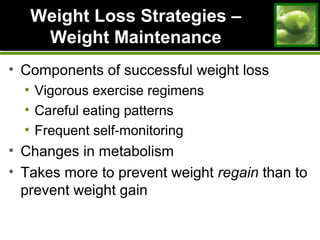
• Components of successful weight loss
• Vigorous exercise regimens
• Careful eating patterns
• Frequent self-monitoring
• Changes in metabolism
• Takes more to prevent weight regain than to
prevent weight gain
Preventing Weight GainPreventing Weight Gain
• Preventing weight gain would benefit many
people
• Strategies are similar to losing weight
• Start earlier
Community ProgramsCommunity Programs
• Possibly change environment through public
health law
• Stretch beyond individual
• Social networks
• Community institutions
• Government policies
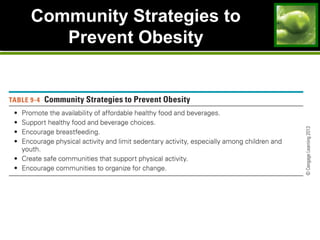
Community Strategies toCommunity Strategies to
Prevent ObesityPrevent Obesity
UnderweightUnderweight
• Affects no more than 2% of U.S. adults
• Weight gain is a matter of health
• Individual matter
• Weight gain may be difficult
• Physical conditioning combined with high
energy intakes
Problems of UnderweightProblems of Underweight
• Demand for energy contributes to
underweight
• Physical activity
• Growth and development
• Difficult to gain weight
• Adaptive thermogenesis
• Learn new habits and like new foods
• Underweight vs. anorexia nervosa
Weight-Gain StrategiesWeight-Gain Strategies
• Key diet planning strategies
• Adequacy and balance
• Energy-dense foods
• Regular meals daily
• Large portions
• Extra snacks
• Juice and milk
• Exercise to build muscles
The Latest andThe Latest and
Greatest Weight-Greatest Weight-
Loss Diet – AgainLoss Diet – Again
Highlight 9Highlight 9
Fad DietsFad Diets
• Outrageous claims
• No requirements to prove the claims
• Do not have to support with credible research
• Distorted research
• Numerous fad diet plans
Fad DietsFad Diets’ Appeal’ Appeal
• Market for weight-loss products is huge
• Greatest appeal
• Tend to ignore dietary recommendations
• Sophisticated and often erroneous
explanations
• Tend to work for short time
• Fail to produce long-lasting results
DonDon’t Count kCalories’t Count kCalories
• Claim to disregard kcalories
• Designed to have low energy intake
• Tend to lack variety
• Monotonous
• Often recommend dietary supplement
• Follow a plan
• Most fad diets cannot support optimal health
over time
The Real DealThe Real Deal
• Fad diet “magical powers”
• Tipping the energy balance equation to
greater energy expenditure
• Weight loss
• Long-term lifestyle changes
• Healthy plan
• Flexibility and variety

Wk5ch9

  • 1.
    Weight Management: Overweight,WeightManagement: Overweight, Obesity, & UnderweightObesity, & Underweight
  • 2.
    Overweight and ObesityOverweightand Obesity • Major health problem in the U.S. • Growing concern worldwide • Prevalence continues to increase • Women, poor, blacks, and Hispanics • Children • BMI of 25 or greater • Epidemic is worldwide • Not merely among industrialized countries
  • 3.
    Increasing Prevalence ofIncreasingPrevalence of Obesity among US AdultsObesity among US Adults
  • 4.
    Fat Cell DevelopmentFatCell Development • Energy in exceeds energy out • Stored in fat cells of adipose tissue • Body fat • Number and size of fat cells • Periods in life when fat cell numbers increase • Cell proliferation • Energy out exceeds energy in • Fat cell size decreases; no change in number
  • 5.
    Fat Cell DevelopmentFatCell Development
  • 6.
    Fat Cell MetabolismFatCell Metabolism • Lipoprotein lipase (LPL) activity • Storage of triglycerides • Obese people vs. lean people • Activity in varying body regions • Men vs. women • Enzyme activity releasing and breaking down fat • Fat oxidation is not efficient • Set point theory
  • 7.
    Causes of Overweight& ObesityCauses of Overweight & Obesity – Genetics & Epigenetics– Genetics & Epigenetics • Causative role of genetics • Genetic influences do seem to be involved • Genetics may determine predisposition to obesity • Genes interact with: • Diet and physical activity • Satiety and energy balance • Human genome
  • 8.
    Causes of Overweight& ObesityCauses of Overweight & Obesity – Genetics & Epigenetics– Genetics & Epigenetics • Obesity gene • Codes for the protein leptin • Acts as a hormone in hypothalamus • Promotes negative energy balance • Suppresses appetite • Increases energy expenditure • Locations of leptin secretion
  • 9.
    Mice with andwithout Leptin Compared
  • 10.
    Causes of Overweight& ObesityCauses of Overweight & Obesity – Genetics & Epigenetics– Genetics & Epigenetics • Obesity gene • Genetic deficiency of leptin or genetic mutation • Rare • Leptin resistance • Fructose consumption • Roles in the body • Energy regulation • Others
  • 11.
    Causes of Overweight& ObesityCauses of Overweight & Obesity – Genetics & Epigenetics– Genetics & Epigenetics • Ghrelin • Promotes positive energy balance • Inverse correlation with body weight • Roles in the body beyond energy regulation • Uncoupling proteins • Types of body fat • Brown adipose tissue • White adipose tissue
  • 12.
    Causes of Overweight&Causes of Overweight & Obesity – EnvironmentObesity – Environment • Encountered daily circumstances • Interaction between environment and genetics • Overeating • Present and past eating and activity patterns influence current body weight • Availability • Serving sizes • Restaurant food
  • 13.
    Causes of Overweight&Causes of Overweight & Obesity – EnvironmentObesity – Environment • Physical inactivity • Life requires little exertion • Modern technology • Inactivity contributes to weight gain and poor health • Sedentary activities and weight gain • DRI for prevention of weight gain • 60 minutes of moderate activity every day
  • 14.
    Problems of OverweightandProblems of Overweight and Obesity – Health RisksObesity – Health Risks • Three indicators • BMI • Waist circumference • Disease risk profile • Factors taken into account • Beneficial weight loss • Health status • Motivation
  • 15.
    Problems of OverweightandProblems of Overweight and Obesity – Health RisksObesity – Health Risks • Overweight in good health • Sometimes health is not the motivation for weight loss • Obese or overweight with risk factors • Two or more risk factors • Obese or overweight with life-threatening condition • Recommendation to lose weight
  • 16.
    Problems of Overweight& ObesityProblems of Overweight & Obesity – Perceptions & Prejudices– Perceptions & Prejudices • Most obese people do not successfully lose weight and maintain the loss • Social consequences • Jobs, school, and in social situations • Psychological problems • Embarrassment • Other feelings
  • 17.
    The Psychology ofWeightThe Psychology of Weight CyclingCycling
  • 18.
    Problems of OverweightandProblems of Overweight and Obesity – Dangerous InterventionsObesity – Dangerous Interventions • Intervention dangers • Diet books and weight-loss programs • Little success with weight loss maintenance • Fad diets • Weight-loss products • Herbal products • Laws for dietary supplements • Other gimmicks
  • 19.
    Aggressive Treatments forAggressiveTreatments for Obesity – DrugsObesity – Drugs • Strategies for weight reduction depend on: • Degree of obesity • Risk of disease • Use drugs as part of long-term comprehensive weight-loss programs • Assist with modest weight loss • FDA approval
  • 20.
    FDA Approved Drugsfor Weight Loss
  • 21.
    Aggressive Treatments forAggressiveTreatments for Obesity – SurgeryObesity – Surgery • Clinically severe obesity • 200,000 surgeries performed each year • Reduces food capacity of stomach • Effectively limits food intake • Reduce production of ghrelin • Health-related benefits • Long-term safety and effectiveness • Liposuction
  • 22.
    Gastric Surgery Usedin theGastric Surgery Used in the Treatment of Severe ObesityTreatment of Severe Obesity
  • 23.
    Weight Loss StrategiesWeightLoss Strategies • Successful strategies • Small changes • Moderate losses • Reasonable goals • Reasonable rate of weight loss • Benefits of modest weight loss • Incorporation of healthy eating and physical activity
  • 24.
    Reasonable Weight Goalsvs.Reasonable Weight Goals vs. Unrealistic ExpectationsUnrealistic Expectations
  • 25.
    Weight Loss Strategies–Weight Loss Strategies – Eating PatternsEating Patterns • Be realistic about energy intake • Provide less energy than is needed • Avoid restrictive eating • Avoid rapid weight loss • Goal: nutritional adequacy without excess • Deficit of 500 to 1000 kcalories per day • Breakfast frequency • Inversely related to obesity
  • 26.
    Weight Loss Strategies–Weight Loss Strategies – Eating PatternsEating Patterns • Nutritional adequacy • Minimum of 1200 kcalories a day • Eat small portions • Eat less food at each meal • Feel satisfied, not stuffed • Structured meal replacement plans • Lower energy density • Cost
  • 27.
    Daily Amounts fromEach FoodDaily Amounts from Each Food GroupGroup
  • 28.
    Weight Loss Strategies–Weight Loss Strategies – Eating PatternsEating Patterns • Remember water • Assistance with weight management • Focus on fiber • Low in energy and high in nutrients • Require effort to eat • Speed of food consumption • Choose fats sensibly • Energy density and satiation
  • 29.
    Weight Loss Strategies–Weight Loss Strategies – Eating PatternsEating Patterns • Select carbohydrates carefully • Artificial sweeteners • Impact on energy intake • Watch for empty kcalories • Fat, sugar, and alcohol
  • 30.
  • 31.
    Weight Loss Strategies–Weight Loss Strategies – Physical ActivityPhysical Activity • Best approach to weight management • Moderate physical activity plus activities of daily life • Combination of diet and physical activity • Lose more fat • Retain more muscle • Regain less weight • Reduction of abdominal fat
  • 32.
    Weight Loss Strategies–Weight Loss Strategies – Physical ActivityPhysical Activity • kCalorie expenditure • Body weight, intensity, and duration • Greater the energy deficit, greater the fat loss • Discretionary kcalorie allowance • Metabolism • Speeds up with activity • Immediate and long-term benefits
  • 33.
    Influence of PhysicalActivityInfluence of Physical Activity on Discretionary kCalorieson Discretionary kCalories
  • 34.
    Weight Loss Strategies–Weight Loss Strategies – Physical ActivityPhysical Activity • Body composition • Fat decreases and lean body mass increases • Strength-training exercises • Abdominal fat • Appetite control • Delayed appetite • Inappropriate appetite
  • 35.
    Weight Loss Strategies–Weight Loss Strategies – Physical ActivityPhysical Activity • Psychological benefits • Self-esteem • Choosing activities • Ones you enjoy & are willing to do regularly • Low-to-moderate intensity • 2000 calories per week • Energy-expending daily activities • Spot reducing
  • 36.
    Weight Loss Strategies–Weight Loss Strategies – Environmental InfluencesEnvironmental Influences • Factors surrounding eating experience and the food itself • Atmosphere • Pleasant and comfortable equals more food • Accessibility • Less effort needed to obtain food, more food eaten
  • 37.
    Weight Loss Strategies–Weight Loss Strategies – Environmental InfluencesEnvironmental Influences • Socializing • Duration of meal • Visual cues • Distraction • Distractions • Initiating eating • Interfering with internal controls • Extending duration of eating
  • 38.
    Weight Loss Strategies–Weight Loss Strategies – Environmental InfluencesEnvironmental Influences • Multiple choice • Large assortments of foods increase consumption • Package and portion sizes • Serving containers
  • 39.
    Weight Loss Strategies–Weight Loss Strategies – Behavior & AttitudeBehavior & Attitude • Behavior modification • Positive, matter-of-fact attitude • Become aware of behaviors • Keep record • Change behaviors • Set small, specific goals • Practice • Reward
  • 40.
    Weight Loss Strategies–Weight Loss Strategies – Behavior & AttitudeBehavior & Attitude • Cognitive skills • Problem solving • Cognitive restructuring • Replace negative thoughts • Personal attitude • Understand personal relationship with food • Sound emotional health • Support groups
  • 41.
    Weight Loss Strategies–Weight Loss Strategies – Weight MaintenanceWeight Maintenance • Successful weight loss • Plateau • Appropriate goal at this point • Prevalence of successful weight loss • Difficult to determine • Weight loss • Without formal program • Maintained for at least a year
  • 42.
    Weight Loss Strategies–Weight Loss Strategies – Weight MaintenanceWeight Maintenance • Components of successful weight loss • Vigorous exercise regimens • Careful eating patterns • Frequent self-monitoring • Changes in metabolism • Takes more to prevent weight regain than to prevent weight gain
  • 43.
    Preventing Weight GainPreventingWeight Gain • Preventing weight gain would benefit many people • Strategies are similar to losing weight • Start earlier
  • 44.
    Community ProgramsCommunity Programs •Possibly change environment through public health law • Stretch beyond individual • Social networks • Community institutions • Government policies
  • 45.
    Community Strategies toCommunityStrategies to Prevent ObesityPrevent Obesity
  • 46.
    UnderweightUnderweight • Affects nomore than 2% of U.S. adults • Weight gain is a matter of health • Individual matter • Weight gain may be difficult • Physical conditioning combined with high energy intakes
  • 47.
    Problems of UnderweightProblemsof Underweight • Demand for energy contributes to underweight • Physical activity • Growth and development • Difficult to gain weight • Adaptive thermogenesis • Learn new habits and like new foods • Underweight vs. anorexia nervosa
  • 48.
    Weight-Gain StrategiesWeight-Gain Strategies •Key diet planning strategies • Adequacy and balance • Energy-dense foods • Regular meals daily • Large portions • Extra snacks • Juice and milk • Exercise to build muscles
  • 49.
    The Latest andTheLatest and Greatest Weight-Greatest Weight- Loss Diet – AgainLoss Diet – Again Highlight 9Highlight 9
  • 50.
    Fad DietsFad Diets •Outrageous claims • No requirements to prove the claims • Do not have to support with credible research • Distorted research • Numerous fad diet plans
  • 51.
    Fad DietsFad Diets’Appeal’ Appeal • Market for weight-loss products is huge • Greatest appeal • Tend to ignore dietary recommendations • Sophisticated and often erroneous explanations • Tend to work for short time • Fail to produce long-lasting results
  • 52.
    DonDon’t Count kCalories’tCount kCalories • Claim to disregard kcalories • Designed to have low energy intake • Tend to lack variety • Monotonous • Often recommend dietary supplement • Follow a plan • Most fad diets cannot support optimal health over time
  • 53.
    The Real DealTheReal Deal • Fad diet “magical powers” • Tipping the energy balance equation to greater energy expenditure • Weight loss • Long-term lifestyle changes • Healthy plan • Flexibility and variety