SARDAR PATEL INSTITUTE OF TECHNOLOGY, PILUDARA
• Rakholiya bhavdip : [130680106039]
• Gevariya balkrushn : [130680106008]
• Patel parth : [130680106029]
(Branch: Civil Engineering)
Guided by : Vaishali .D Patel
Wiring introduction & system
Introduction of wiring.
Types of wiring as using.
1. Domestic Wiring.
2. Commercial Wiring.
3. Industrial wiring.
Wiring System
1. Tree System.
2. Looping System.
(a) Switch and two plate ceiling rose or
switch and batten holder lopping.
(b) Three plate ceiling rose looping.
(c) In junction box looping
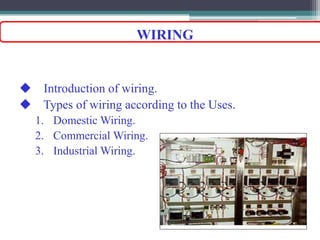
 Introduction of wiring.
 Types of wiring according to the Uses.
1. Domestic Wiring.
2. Commercial Wiring.
3. Industrial Wiring.
WIRING
 Factors Affecting choice of wiring
 Safety
 Duration
 Appearance
 Accessibility
 Maintenance
 Cost
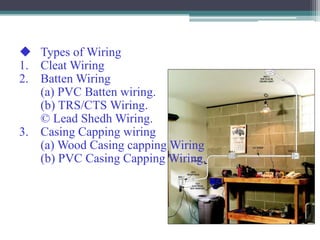
 Types of Wiring
1. Cleat Wiring
2. Batten Wiring
(a) PVC Batten wiring.
(b) TRS/CTS Wiring.
© Lead Shedh Wiring.
3. Casing Capping wiring
(a) Wood Casing capping Wiring
(b) PVC Casing Capping Wiring.
4. Conduit Wiring
(a) Surface conduit wiring
Metal Conduit Wiring
PVC conduit wiring
(b) Consiled Conduit Wiring
Metal Conduit Wiring.
PVC Conduit wiring.
• Introduction
The types of wiring to be adopted is dependent on
various factors, viz, durability, safety, appearance,
cost, consumer’s budget etc.
• Cleat wiring
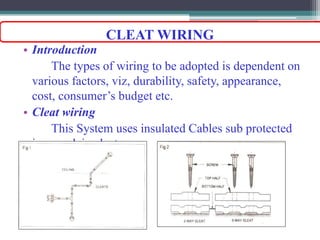
This System uses insulated Cables sub protected
in porcelain cleats.
CLEAT WIRING
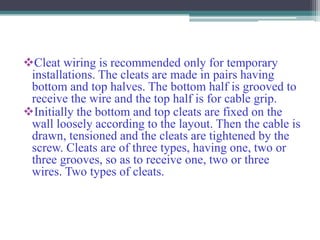
Cleat wiring is recommended only for temporary
installations. The cleats are made in pairs having
bottom and top halves. The bottom half is grooved to
receive the wire and the top half is for cable grip.
Initially the bottom and top cleats are fixed on the
wall loosely according to the layout. Then the cable is
drawn, tensioned and the cleats are tightened by the
screw. Cleats are of three types, having one, two or
three grooves, so as to receive one, two or three
wires. Two types of cleats.
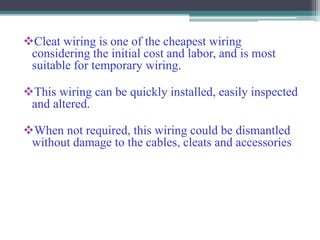
Cleat wiring is one of the cheapest wiring
considering the initial cost and labor, and is most
suitable for temporary wiring.
This wiring can be quickly installed, easily inspected
and altered.
When not required, this wiring could be dismantled
without damage to the cables, cleats and accessories
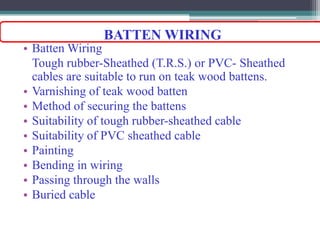
• Batten Wiring
Tough rubber-Sheathed (T.R.S.) or PVC- Sheathed
cables are suitable to run on teak wood battens.
• Varnishing of teak wood batten
• Method of securing the battens
• Suitability of tough rubber-sheathed cable
• Suitability of PVC sheathed cable
• Painting
• Bending in wiring
• Passing through the walls
• Buried cable
BATTEN WIRING
• Link Clips
Link clips are used for family clipping the cables in
position.
Link clips are of two types.
• Link clip which has separate linking eye.
• Joint link clip which has combined linking eye.
Link clip are available in the following size.
25mm, 32mm, 40mm, 50mm, 63mm, 80mm, out of
which up to 40mm clips have one hole, while above
that they have two holes for fixing.
 Fig2 shows the joint link clips. These are available
in the sizes 16mm, 25mm, 32mm, 40mm, 50mm,
63mm, 80mm with a thickness of 0.32mm and have
one hole up to 40mm while above that they have two
hole for fixing.
Link clips are made of tin or brass- coated tin or
aluminum.
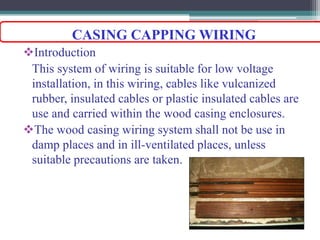
Introduction
This system of wiring is suitable for low voltage
installation, in this wiring, cables like vulcanized
rubber, insulated cables or plastic insulated cables are
use and carried within the wood casing enclosures.
The wood casing wiring system shall not be use in
damp places and in ill-ventilated places, unless
suitable precautions are taken.
CASING CAPPING WIRING
• Dimensions of casing.
The size of casing and capping to be used for various
sizes of 250 volts grade insulated cables in a groove
shall be in accordance with those specified in table 1.
• Bunching of circuits.
• Attachment of casing to wall and ceiling.
• Attachment of capping.
• Passing over the floors.
• Joints in casing and capping.
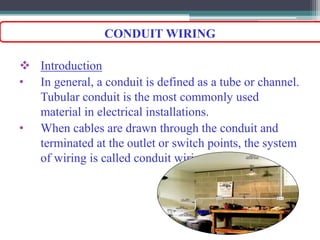
 Introduction
• In general, a conduit is defined as a tube or channel.
Tubular conduit is the most commonly used
material in electrical installations.
• When cables are drawn through the conduit and
terminated at the outlet or switch points, the system
of wiring is called conduit wiring.
CONDUIT WIRING
• Types of conduits.
There are four types of conduits used for wiring.
1.Rigid steel conduit
2.Rigid non-metallic conduit
3.Flexible steel conduit
4.Flexible non metallic conduit.
Wiring_Con.ppt

Wiring_Con.ppt

  • 1.
    SARDAR PATEL INSTITUTEOF TECHNOLOGY, PILUDARA • Rakholiya bhavdip : [130680106039] • Gevariya balkrushn : [130680106008] • Patel parth : [130680106029] (Branch: Civil Engineering) Guided by : Vaishali .D Patel
  • 2.
    Wiring introduction &system Introduction of wiring. Types of wiring as using. 1. Domestic Wiring. 2. Commercial Wiring. 3. Industrial wiring. Wiring System 1. Tree System. 2. Looping System. (a) Switch and two plate ceiling rose or switch and batten holder lopping. (b) Three plate ceiling rose looping. (c) In junction box looping
  • 3.
     Introduction ofwiring.  Types of wiring according to the Uses. 1. Domestic Wiring. 2. Commercial Wiring. 3. Industrial Wiring. WIRING
  • 4.
     Factors Affectingchoice of wiring  Safety  Duration  Appearance  Accessibility  Maintenance  Cost
  • 5.
     Types ofWiring 1. Cleat Wiring 2. Batten Wiring (a) PVC Batten wiring. (b) TRS/CTS Wiring. © Lead Shedh Wiring. 3. Casing Capping wiring (a) Wood Casing capping Wiring (b) PVC Casing Capping Wiring.
  • 6.
    4. Conduit Wiring (a)Surface conduit wiring Metal Conduit Wiring PVC conduit wiring (b) Consiled Conduit Wiring Metal Conduit Wiring. PVC Conduit wiring.
  • 7.
    • Introduction The typesof wiring to be adopted is dependent on various factors, viz, durability, safety, appearance, cost, consumer’s budget etc. • Cleat wiring This System uses insulated Cables sub protected in porcelain cleats. CLEAT WIRING
  • 8.
    Cleat wiring isrecommended only for temporary installations. The cleats are made in pairs having bottom and top halves. The bottom half is grooved to receive the wire and the top half is for cable grip. Initially the bottom and top cleats are fixed on the wall loosely according to the layout. Then the cable is drawn, tensioned and the cleats are tightened by the screw. Cleats are of three types, having one, two or three grooves, so as to receive one, two or three wires. Two types of cleats.
  • 9.
    Cleat wiring isone of the cheapest wiring considering the initial cost and labor, and is most suitable for temporary wiring. This wiring can be quickly installed, easily inspected and altered. When not required, this wiring could be dismantled without damage to the cables, cleats and accessories
  • 10.
    • Batten Wiring Toughrubber-Sheathed (T.R.S.) or PVC- Sheathed cables are suitable to run on teak wood battens. • Varnishing of teak wood batten • Method of securing the battens • Suitability of tough rubber-sheathed cable • Suitability of PVC sheathed cable • Painting • Bending in wiring • Passing through the walls • Buried cable BATTEN WIRING
  • 11.
    • Link Clips Linkclips are used for family clipping the cables in position. Link clips are of two types. • Link clip which has separate linking eye. • Joint link clip which has combined linking eye. Link clip are available in the following size.
  • 12.
    25mm, 32mm, 40mm,50mm, 63mm, 80mm, out of which up to 40mm clips have one hole, while above that they have two holes for fixing.  Fig2 shows the joint link clips. These are available in the sizes 16mm, 25mm, 32mm, 40mm, 50mm, 63mm, 80mm with a thickness of 0.32mm and have one hole up to 40mm while above that they have two hole for fixing. Link clips are made of tin or brass- coated tin or aluminum.
  • 13.
    Introduction This system ofwiring is suitable for low voltage installation, in this wiring, cables like vulcanized rubber, insulated cables or plastic insulated cables are use and carried within the wood casing enclosures. The wood casing wiring system shall not be use in damp places and in ill-ventilated places, unless suitable precautions are taken. CASING CAPPING WIRING
  • 14.
    • Dimensions ofcasing. The size of casing and capping to be used for various sizes of 250 volts grade insulated cables in a groove shall be in accordance with those specified in table 1. • Bunching of circuits. • Attachment of casing to wall and ceiling. • Attachment of capping. • Passing over the floors. • Joints in casing and capping.
  • 15.
     Introduction • Ingeneral, a conduit is defined as a tube or channel. Tubular conduit is the most commonly used material in electrical installations. • When cables are drawn through the conduit and terminated at the outlet or switch points, the system of wiring is called conduit wiring. CONDUIT WIRING
  • 16.
    • Types ofconduits. There are four types of conduits used for wiring. 1.Rigid steel conduit 2.Rigid non-metallic conduit 3.Flexible steel conduit 4.Flexible non metallic conduit.