Presented by
Aishwary erma
ROLL NO:-0902011
BRANCH:-ELECTRICAL ENGINEERING.
 INTRODUCTION
 DEFINITION
 HISTORY
 TYPES OF WPT
 Atmospheric conduction method
 Electrodynamic induction method
 Advantages and disadvantage
 Applications
 Conclusion
 References
8/18/2014 2Wireless Power Transmission
• One of the major issues in power system is the losses
occurring during the transmission and distribution of
electrical power.
• The percentage of loss of power during transmission and
distribution is approximated as 26%.
• The main reason for power loss during transmission and
distribution is the resistance of wires used in grid.
• According to the World Resources Institute (WRI), India’s
electricity grid has the highest transmission and
distribution losses in the world – a whopping 27-40%.
• Tesla has proposed methods of transmission of electricity
using electromagnetic induction.
• As the word wireless means “without wire”.
• Wireless energy transfer or wireless power is the
transmission of electrical energy from a power source to an
electric load without interconnecting man made
conductors.
• Wireless transmission is useful in cases where
interconnecting wires are inconvenient, hazardous or
impossible.
Sir NICOLAI TESLA was the first one to propose and research the idea of
wireless transmission in 1899, since than many scholars and scientists
have been working to make his dream a reality.
• 1899: Tesla continues wireless power transmission research in Colorado
Springs and writes, "the inferiority of the induction method would appear
immense as compared with the disturbed charge of ground and air
method
• 1961: William C. Brown publishes an article exploring
possibilities of microwave power transmission
• 2009: Sony shows a wireless electrodynamics-induction powered TV
set, 60 W over 50 cm
Different methods of transmission proposed by different
scientist and scholars are:
1. Atmospheric conduction method of Tesla
2. Electrodynamic induction method:
 Microwave method
 Laser method
In 1899 Sir NICOLAI TESLA and HEINRICH HERTZ powered a
fluorescent lamp keeping it 25 miles away from source without
using wire. Wireless power transmission experiments at
WARDEN CLYFFE High frequency current, of a Tesla coil, could
light lamps filled with gas (like neon). In this method a closed
circuit is made using transmitter, ionized path between upper
atmosphere and transmitter, second ionized path connecting
receiver. The circuit back to the transmitter is completed
through the earth .
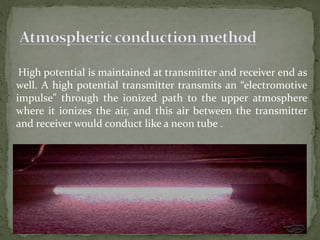
High potential is maintained at transmitter and receiver end as
well. A high potential transmitter transmits an “electromotive
impulse” through the ionized path to the upper atmosphere
where it ionizes the air, and this air between the transmitter
and receiver would conduct like a neon tube .
• Economically challenging.
• Periodic changes in atmospheric condition.
• Maintaining high tower potential every time.
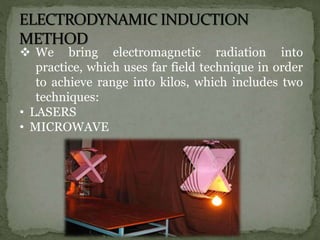
 We bring electromagnetic radiation into
practice, which uses far field technique in order
to achieve range into kilos, which includes two
techniques:
• LASERS
• MICROWAVE
 LASER is highly directional, coherent
 Not dispersed for very long
 But, gets attenuated when it propagates through
atmosphere
 Simple receiver
 Photovoltaic cell
 Cost-efficient
8/18/2014 11Wireless Power Transmission
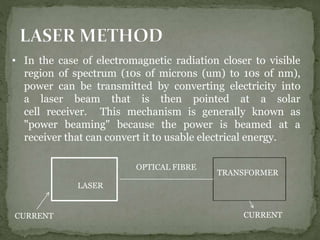
• In the case of electromagnetic radiation closer to visible
region of spectrum (10s of microns (um) to 10s of nm),
power can be transmitted by converting electricity into
a laser beam that is then pointed at a solar
cell receiver. This mechanism is generally known as
"power beaming" because the power is beamed at a
receiver that can convert it to usable electrical energy.
CURRENT CURRENT
LASER
TRANSFORMER
OPTICAL FIBRE
• Power transmission via radio waves can be made more
directional, allowing longer distance power beaming, with
shorter wavelengths of electromagnetic radiation, typically
in the microwave range. A rectenna may be used to convert
the microwave energy back into electricity. Rectenna
conversion efficiencies exceeding 95% have been realized.
Power beaming using microwaves has been proposed for
the transmission of energy from orbiting solar power
satellites to Earth.
• The principle of Evanescent
principle of Electromagnetic
Wave Coupling extends the
induction.
 Near-field energy transfer
 Electric automobile charging
 Static and moving
 Consumer electronics
 Industrial purposes
 Harsh environment
 Far-field energy transfer
 Solar Power Satellites
 Energy to remote areas
 Can broadcast energy globally (in future)
8/18/2014 14Wireless Power Transmission
 Efficient
 Easy
 Need for grids, substations etc are eliminated
 Low maintenance cost
 More effective when the transmitting and receiving
points are along a line-of-sight
 Can reach the places which are remote
8/18/2014 15Wireless Power Transmission
• When microwaves are used, interference may arise
• When LASERS are used, conversion is inefficient due to
absorption losses.
• It is radioactive in nature
• Distance constraint , initial cost is high.
• Field strength has to be under safety levels
• High frequency signals should be supplied for air
ionization which is not feasible.
 Transmission without wires- a reality
 Efficient
 Low maintenance cost. But, high initial cost
 Better than conventional wired transfer
 Energy crisis can be decreased
 Low loss
 In near future, world will be completely wireless
8/18/2014 17Wireless Power Transmission
 S. Sheik Mohammed, K. Ramasamy, T. Shanmuganantham,” Wireless
power transmission – a next generation power transmission system”,
International Journal of Computer Applications (0975 – 8887) (Volume
1 – No. 13)
 Peter Vaessen,” Wireless Power Transmission”, Leonardo Energy,
September 2009
 C.C. Leung, T.P. Chan, K.C. Lit, K.W. Tam and Lee Yi Chow, “Wireless
Power Transmission and Charging Pad”
 David Schneider, “Electrons unplugged”, IEEE Spectrum, May 2010
 Shahrzad Jalali Mazlouman, Alireza Mahanfar, Bozena Kaminska,
“Mid-range Wireless Energy Transfer Using Inductive Resonance for
Wireless Sensors”
 Chunbo Zhu, Kai Liu, Chunlai Yu, Rui Ma, Hexiao Cheng, “Simulation
and Experimental Analysis on Wireless Energy Transfer Based on
Magnetic Resonances”, IEEE Vehicle Power and Propulsion Conference
(VPPC), September 3-5, 2008
8/18/2014 18Wireless Power Transmission
Wirelesspowertransmissionppt

Wirelesspowertransmissionppt

  • 1.
    Presented by Aishwary erma ROLLNO:-0902011 BRANCH:-ELECTRICAL ENGINEERING.
  • 2.
     INTRODUCTION  DEFINITION HISTORY  TYPES OF WPT  Atmospheric conduction method  Electrodynamic induction method  Advantages and disadvantage  Applications  Conclusion  References 8/18/2014 2Wireless Power Transmission
  • 3.
    • One ofthe major issues in power system is the losses occurring during the transmission and distribution of electrical power. • The percentage of loss of power during transmission and distribution is approximated as 26%. • The main reason for power loss during transmission and distribution is the resistance of wires used in grid. • According to the World Resources Institute (WRI), India’s electricity grid has the highest transmission and distribution losses in the world – a whopping 27-40%. • Tesla has proposed methods of transmission of electricity using electromagnetic induction.
  • 4.
    • As theword wireless means “without wire”. • Wireless energy transfer or wireless power is the transmission of electrical energy from a power source to an electric load without interconnecting man made conductors. • Wireless transmission is useful in cases where interconnecting wires are inconvenient, hazardous or impossible.
  • 5.
    Sir NICOLAI TESLAwas the first one to propose and research the idea of wireless transmission in 1899, since than many scholars and scientists have been working to make his dream a reality. • 1899: Tesla continues wireless power transmission research in Colorado Springs and writes, "the inferiority of the induction method would appear immense as compared with the disturbed charge of ground and air method • 1961: William C. Brown publishes an article exploring possibilities of microwave power transmission • 2009: Sony shows a wireless electrodynamics-induction powered TV set, 60 W over 50 cm
  • 6.
    Different methods oftransmission proposed by different scientist and scholars are: 1. Atmospheric conduction method of Tesla 2. Electrodynamic induction method:  Microwave method  Laser method
  • 7.
    In 1899 SirNICOLAI TESLA and HEINRICH HERTZ powered a fluorescent lamp keeping it 25 miles away from source without using wire. Wireless power transmission experiments at WARDEN CLYFFE High frequency current, of a Tesla coil, could light lamps filled with gas (like neon). In this method a closed circuit is made using transmitter, ionized path between upper atmosphere and transmitter, second ionized path connecting receiver. The circuit back to the transmitter is completed through the earth .
  • 8.
    High potential ismaintained at transmitter and receiver end as well. A high potential transmitter transmits an “electromotive impulse” through the ionized path to the upper atmosphere where it ionizes the air, and this air between the transmitter and receiver would conduct like a neon tube .
  • 9.
    • Economically challenging. •Periodic changes in atmospheric condition. • Maintaining high tower potential every time.
  • 10.
     We bringelectromagnetic radiation into practice, which uses far field technique in order to achieve range into kilos, which includes two techniques: • LASERS • MICROWAVE
  • 11.
     LASER ishighly directional, coherent  Not dispersed for very long  But, gets attenuated when it propagates through atmosphere  Simple receiver  Photovoltaic cell  Cost-efficient 8/18/2014 11Wireless Power Transmission
  • 12.
    • In thecase of electromagnetic radiation closer to visible region of spectrum (10s of microns (um) to 10s of nm), power can be transmitted by converting electricity into a laser beam that is then pointed at a solar cell receiver. This mechanism is generally known as "power beaming" because the power is beamed at a receiver that can convert it to usable electrical energy. CURRENT CURRENT LASER TRANSFORMER OPTICAL FIBRE
  • 13.
    • Power transmissionvia radio waves can be made more directional, allowing longer distance power beaming, with shorter wavelengths of electromagnetic radiation, typically in the microwave range. A rectenna may be used to convert the microwave energy back into electricity. Rectenna conversion efficiencies exceeding 95% have been realized. Power beaming using microwaves has been proposed for the transmission of energy from orbiting solar power satellites to Earth. • The principle of Evanescent principle of Electromagnetic Wave Coupling extends the induction.
  • 14.
     Near-field energytransfer  Electric automobile charging  Static and moving  Consumer electronics  Industrial purposes  Harsh environment  Far-field energy transfer  Solar Power Satellites  Energy to remote areas  Can broadcast energy globally (in future) 8/18/2014 14Wireless Power Transmission
  • 15.
     Efficient  Easy Need for grids, substations etc are eliminated  Low maintenance cost  More effective when the transmitting and receiving points are along a line-of-sight  Can reach the places which are remote 8/18/2014 15Wireless Power Transmission
  • 16.
    • When microwavesare used, interference may arise • When LASERS are used, conversion is inefficient due to absorption losses. • It is radioactive in nature • Distance constraint , initial cost is high. • Field strength has to be under safety levels • High frequency signals should be supplied for air ionization which is not feasible.
  • 17.
     Transmission withoutwires- a reality  Efficient  Low maintenance cost. But, high initial cost  Better than conventional wired transfer  Energy crisis can be decreased  Low loss  In near future, world will be completely wireless 8/18/2014 17Wireless Power Transmission
  • 18.
     S. SheikMohammed, K. Ramasamy, T. Shanmuganantham,” Wireless power transmission – a next generation power transmission system”, International Journal of Computer Applications (0975 – 8887) (Volume 1 – No. 13)  Peter Vaessen,” Wireless Power Transmission”, Leonardo Energy, September 2009  C.C. Leung, T.P. Chan, K.C. Lit, K.W. Tam and Lee Yi Chow, “Wireless Power Transmission and Charging Pad”  David Schneider, “Electrons unplugged”, IEEE Spectrum, May 2010  Shahrzad Jalali Mazlouman, Alireza Mahanfar, Bozena Kaminska, “Mid-range Wireless Energy Transfer Using Inductive Resonance for Wireless Sensors”  Chunbo Zhu, Kai Liu, Chunlai Yu, Rui Ma, Hexiao Cheng, “Simulation and Experimental Analysis on Wireless Energy Transfer Based on Magnetic Resonances”, IEEE Vehicle Power and Propulsion Conference (VPPC), September 3-5, 2008 8/18/2014 18Wireless Power Transmission