Wireless
Presented by,
T.Hari Shiyam Prakash
(922015105009)
M.Anandha Kumar
(922015105002)
Dept. of EEE (SVCET)
Overview
 Objective
 Abstract
 Definition and common view
 Wireless power transmission(WPT)
 Need of WPT
 History of WPT
 Basic concept of WPT
 Methods of WPT
 Merits and demerits
 Applications
Objective
 The main objective of my presentation is to
learn about the ways to transmit the power
from the source to the destination in the basis
of modern world.
Abstract
 The abstract of my presentation is to learn
and to explain a clear view in the concept of
power transmission in wire less manner.
Wireless
 Wireless is generally defined as the
electrical or electronic device that are
able to operate without any additional
cable
 In the other hand ,wireless means a
process which is done with the help of
two devices
 Transmitter
 Receiver
View of common man
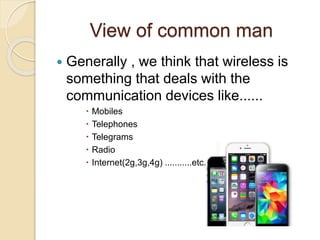
 Generally , we think that wireless is
something that deals with the
communication devices like......
 Mobiles
 Telephones
 Telegrams
 Radio
 Internet(2g,3g,4g) ...........etc.
Wireless power
transmission(WPT)
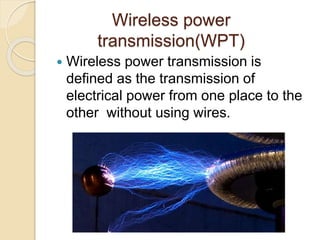
 Wireless power transmission is
defined as the transmission of
electrical power from one place to the
other without using wires.
Need of elimination of wire
 As per the electrical studies most of
the power transmission is done
through the wires.
 Most of the losses take place in the
time of transmission
 An average transmission losses in the
world is 30% to 45%
Need for WPT
 Highly reliable.
 Low cost of maintenance.
 Fast and easy.
 Efficiency level is high.
 Efficient.
 Used for short and long range of
transmission.
History of WPT
 The idea for the alternative of
transmission line was started in the late
19th century.
 This was started by heinrich hertz and
Nikola Tesla.
 Tesla made a theoretical explanation for
WPT and it was practically demonstrated
in 1899, by powering a fluorescent lamp
25 miles away from the source.
 His ultimate aim was to create a “World
Wireless System”
History(cont…)
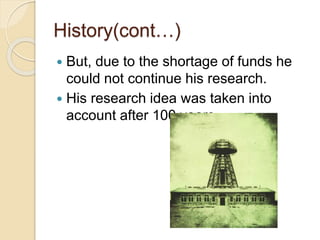
 But, due to the shortage of funds he
could not continue his research.
 His research idea was taken into
account after 100 years.
Basic concept of WPT
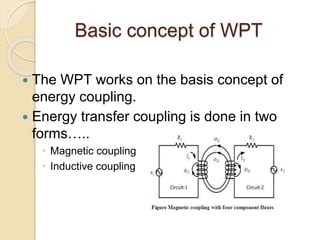
 The WPT works on the basis concept of
energy coupling.
 Energy transfer coupling is done in two
forms…..
 Magnetic coupling
 Inductive coupling
Methods of WPT
 There are two methods of power
transmission.
◦ Atmospheric conduction
◦ Electrodynamics induction method
 Microwave
 Laser method
Atmospheric conduction method
 The high power transmission is done
through “WARDEN CLYFFE”
 Warden clyffe is also known as tesla
tower.
 In this method ,the upper path of the
circuit acts as transmitter.
 The lower path of the circuit is acts as
reciver.
 An electromotive impulse is passed
and the circuit is ionized.
Limitation of atmospheric
conduction
 Economically challenging.
 Change in atmosphere.
 High tower potential should be
maintained.
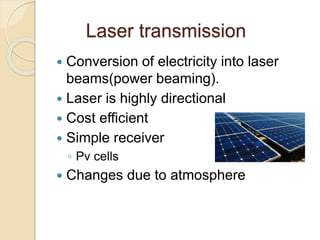
Laser transmission
 Conversion of electricity into laser
beams(power beaming).
 Laser is highly directional
 Cost efficient
 Simple receiver
◦ Pv cells
 Changes due to atmosphere
Micro wave technique
 Power transmission via radio waves
is more effective for long
transmission.
 It allows longer distance power
beaming with the electromagnetic
radiation.
 The efficiency level in this technique
exceeds to 95%
 This method can also be implemented
directly from the solar power satellite.
Applications
 Near –field energy transfer
◦ Electric automobile charging
◦ Consumer
electronics(mobiles,laptops,…etc)
◦ Industrial purpose
 Far field energy transfer
◦ Solar power satellites
◦ Energy to remote areas
◦ Global energy
Advantages of WPT
 Efficient
 Easy and fast processing
 Grid, substation can be eliminated
 Low maintenance cost
 More effective during the time of
transmitting and receiving.
 Can be used even in remote areas.
Disadvantages of WPT
 Interference may occur in the usage of
microwaves.
 Absorption losses occurs in the laser
technique
 Radioactive in nature
 Initial cost is very high
 High frequency signals should be
supplied with safety measures.
Wireless

Wireless

  • 1.
    Wireless Presented by, T.Hari ShiyamPrakash (922015105009) M.Anandha Kumar (922015105002) Dept. of EEE (SVCET)
  • 2.
    Overview  Objective  Abstract Definition and common view  Wireless power transmission(WPT)  Need of WPT  History of WPT  Basic concept of WPT  Methods of WPT  Merits and demerits  Applications
  • 3.
    Objective  The mainobjective of my presentation is to learn about the ways to transmit the power from the source to the destination in the basis of modern world. Abstract  The abstract of my presentation is to learn and to explain a clear view in the concept of power transmission in wire less manner.
  • 4.
    Wireless  Wireless isgenerally defined as the electrical or electronic device that are able to operate without any additional cable  In the other hand ,wireless means a process which is done with the help of two devices  Transmitter  Receiver
  • 5.
    View of commonman  Generally , we think that wireless is something that deals with the communication devices like......  Mobiles  Telephones  Telegrams  Radio  Internet(2g,3g,4g) ...........etc.
  • 6.
    Wireless power transmission(WPT)  Wirelesspower transmission is defined as the transmission of electrical power from one place to the other without using wires.
  • 7.
    Need of eliminationof wire  As per the electrical studies most of the power transmission is done through the wires.  Most of the losses take place in the time of transmission  An average transmission losses in the world is 30% to 45%
  • 8.
    Need for WPT Highly reliable.  Low cost of maintenance.  Fast and easy.  Efficiency level is high.  Efficient.  Used for short and long range of transmission.
  • 9.
    History of WPT The idea for the alternative of transmission line was started in the late 19th century.  This was started by heinrich hertz and Nikola Tesla.  Tesla made a theoretical explanation for WPT and it was practically demonstrated in 1899, by powering a fluorescent lamp 25 miles away from the source.  His ultimate aim was to create a “World Wireless System”
  • 10.
    History(cont…)  But, dueto the shortage of funds he could not continue his research.  His research idea was taken into account after 100 years.
  • 11.
    Basic concept ofWPT  The WPT works on the basis concept of energy coupling.  Energy transfer coupling is done in two forms…..  Magnetic coupling  Inductive coupling
  • 12.
    Methods of WPT There are two methods of power transmission. ◦ Atmospheric conduction ◦ Electrodynamics induction method  Microwave  Laser method
  • 13.
    Atmospheric conduction method The high power transmission is done through “WARDEN CLYFFE”  Warden clyffe is also known as tesla tower.  In this method ,the upper path of the circuit acts as transmitter.  The lower path of the circuit is acts as reciver.  An electromotive impulse is passed and the circuit is ionized.
  • 14.
    Limitation of atmospheric conduction Economically challenging.  Change in atmosphere.  High tower potential should be maintained.
  • 15.
    Laser transmission  Conversionof electricity into laser beams(power beaming).  Laser is highly directional  Cost efficient  Simple receiver ◦ Pv cells  Changes due to atmosphere
  • 16.
    Micro wave technique Power transmission via radio waves is more effective for long transmission.  It allows longer distance power beaming with the electromagnetic radiation.  The efficiency level in this technique exceeds to 95%  This method can also be implemented directly from the solar power satellite.
  • 17.
    Applications  Near –fieldenergy transfer ◦ Electric automobile charging ◦ Consumer electronics(mobiles,laptops,…etc) ◦ Industrial purpose  Far field energy transfer ◦ Solar power satellites ◦ Energy to remote areas ◦ Global energy
  • 18.
    Advantages of WPT Efficient  Easy and fast processing  Grid, substation can be eliminated  Low maintenance cost  More effective during the time of transmitting and receiving.  Can be used even in remote areas.
  • 19.
    Disadvantages of WPT Interference may occur in the usage of microwaves.  Absorption losses occurs in the laser technique  Radioactive in nature  Initial cost is very high  High frequency signals should be supplied with safety measures.