PRESENTED BY-
SHASHANK KAMAL
SHUBHAM JAIN
 About topic
 What does wireless mean
 History
 Types of W.P.T
 Atmospheric conduction method
 Electrodynamic induction method
 Positive points and Negative Points
 Applications
 Conclusion
 References
2Wireless Power Transmission
• Major Issue is loss of Energy during Transmission and
Distribution.
• Approximately 26% power is lost during transmission and
distribution.
• The main reason of loss is Resistance of Wires.
• According to the World Resources Institute (WRI), India
has maximum loss of power i.e. about 27-40%.
• Tesla had proposed methods of transmission of electricity
using electromagnetic induction.
• The word wireless means “without wire”.
• Wireless energy transfer or wireless power is the
transmission of electrical energy from a power source to an
electric load without interconnecting man made
conductors.
• Wireless transmission is useful in cases where
interconnecting wires are inconvenient, hazardous or
impossible.
Different methods of transmission proposed by different
scientist and scholars are:
1. Atmospheric conduction method of Tesla
2. Electrodynamic induction method:
 Microwave method
 Laser method
• In 1899 Sir NICOLAI TESLA and HEINRICH HERTZ powered
a fluorescent lamp keeping it 25 miles away from source
without using wire.
• Wireless power transmission experiments at WARDEN
CLYFFE High frequency current, of a Tesla coil, could light
lamps filled with gas (like neon).
• In this method a closed circuit is made using transmitter,
ionized path between upper atmosphere and transmitter,
second ionized path connecting receiver.
• The circuit back to the transmitter is completed through the
earth .
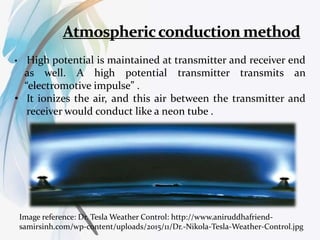
• High potential is maintained at transmitter and receiver end
as well. A high potential transmitter transmits an
“electromotive impulse” .
• It ionizes the air, and this air between the transmitter and
receiver would conduct like a neon tube .
Image reference: Dr. Tesla Weather Control: http://www.aniruddhafriend-
samirsinh.com/wp-content/uploads/2015/11/Dr.-Nikola-Tesla-Weather-Control.jpg
• Economically challenging.
• Periodic changes in atmospheric condition.
• Maintaining high tower potential every time.
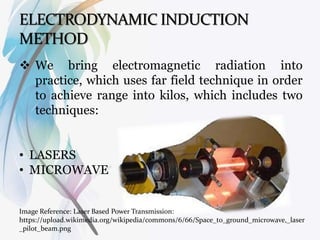
 We bring electromagnetic radiation into
practice, which uses far field technique in order
to achieve range into kilos, which includes two
techniques:
• LASERS
• MICROWAVE
Image Reference: Laser Based Power Transmission:
https://upload.wikimedia.org/wikipedia/commons/6/66/Space_to_ground_microwave,_laser
_pilot_beam.png
 LASER is highly directional, coherent
 Not dispersed for very long distance
 But, gets attenuated when it propagates through
atmosphere
 Simple receiver
 Photovoltaic cell
 Cost-efficient
10Wireless Power Transmission
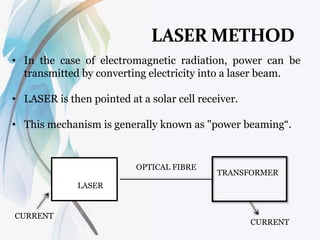
• In the case of electromagnetic radiation, power can be
transmitted by converting electricity into a laser beam.
• LASER is then pointed at a solar cell receiver.
• This mechanism is generally known as "power beaming“.
CURRENT
CURRENT
LASER
TRANSFORMER
OPTICAL FIBRE
• Power transmission via radio waves can be made more
directional, allowing :
 longer distance power beaming, with shorter wavelengths
of electromagnetic radiation.
 A Rectenna may be used to convert the microwave energy
back into electricity.
 Rectenna conversion efficiencies exceeding 95% have been
realized.
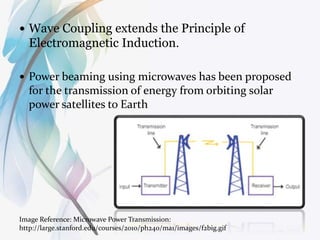
 Wave Coupling extends the Principle of
Electromagnetic Induction.
 Power beaming using microwaves has been proposed
for the transmission of energy from orbiting solar
power satellites to Earth
3/14/2016 13Wireless Power Transmission
Image Reference: Microwave Power Transmission:
http://large.stanford.edu/courses/2010/ph240/ma1/images/f2big.gif
 Near field energy transfer
 Electric Automobile charging
 Consumer Electronics
 Industrial Purposes
 Far field energy transfer
 Energy to remote areas
3/14/2016 14Wireless Power Transmission
 Efficient
 Easy
 Need for grids, substations etc. are eliminated
 Low maintenance cost
 More effective when the transmitting and receiving
points are along a line-of-sight
 Can reach the places which are remote
3/14/2016 15Wireless Power Transmission
 When microwaves are used, interference may arise.
 When LASERs are used there is a lot of absorption
loss.
 Its radioactive in nature.
 Distance constraint: initial cost is high.
 Field strength has to be under safety levels.
3/14/2016 16Wireless Power Transmission
 Transmission without wires will become a reality.
 Efficient.
 Low maintenance cost.
 Better than conventional wired transfer.
 Energy charges can be decreased.
 Low loss.
 In near future, world will be completely wireless.
3/14/2016 17Wireless Power Transmission
 Wireless Power Transmission- Wikipedia
https://en.wikipedia.org/wiki/Wireless_power_transfer
 WiTricity- Wikipedia
https://en.wikipedia.org/wiki/WiTricity
 Feasibility of Wireless Power Transmission : Biswa, Rajen
http://www.academia.edu/1561057/Feasibility_of_Wireless_P
ower_Transmission
• Wireless Power-Robokid249
http://www.instructables.com/id/Wireless-Power-
Transmission-Over-Short-Distances-U/3/14/2016 18Wireless Power Transmission
WIRELESS ENERGY TRANSMISSION

WIRELESS ENERGY TRANSMISSION

  • 1.
  • 2.
     About topic What does wireless mean  History  Types of W.P.T  Atmospheric conduction method  Electrodynamic induction method  Positive points and Negative Points  Applications  Conclusion  References 2Wireless Power Transmission
  • 3.
    • Major Issueis loss of Energy during Transmission and Distribution. • Approximately 26% power is lost during transmission and distribution. • The main reason of loss is Resistance of Wires. • According to the World Resources Institute (WRI), India has maximum loss of power i.e. about 27-40%. • Tesla had proposed methods of transmission of electricity using electromagnetic induction.
  • 4.
    • The wordwireless means “without wire”. • Wireless energy transfer or wireless power is the transmission of electrical energy from a power source to an electric load without interconnecting man made conductors. • Wireless transmission is useful in cases where interconnecting wires are inconvenient, hazardous or impossible.
  • 5.
    Different methods oftransmission proposed by different scientist and scholars are: 1. Atmospheric conduction method of Tesla 2. Electrodynamic induction method:  Microwave method  Laser method
  • 6.
    • In 1899Sir NICOLAI TESLA and HEINRICH HERTZ powered a fluorescent lamp keeping it 25 miles away from source without using wire. • Wireless power transmission experiments at WARDEN CLYFFE High frequency current, of a Tesla coil, could light lamps filled with gas (like neon). • In this method a closed circuit is made using transmitter, ionized path between upper atmosphere and transmitter, second ionized path connecting receiver. • The circuit back to the transmitter is completed through the earth .
  • 7.
    • High potentialis maintained at transmitter and receiver end as well. A high potential transmitter transmits an “electromotive impulse” . • It ionizes the air, and this air between the transmitter and receiver would conduct like a neon tube . Image reference: Dr. Tesla Weather Control: http://www.aniruddhafriend- samirsinh.com/wp-content/uploads/2015/11/Dr.-Nikola-Tesla-Weather-Control.jpg
  • 8.
    • Economically challenging. •Periodic changes in atmospheric condition. • Maintaining high tower potential every time.
  • 9.
     We bringelectromagnetic radiation into practice, which uses far field technique in order to achieve range into kilos, which includes two techniques: • LASERS • MICROWAVE Image Reference: Laser Based Power Transmission: https://upload.wikimedia.org/wikipedia/commons/6/66/Space_to_ground_microwave,_laser _pilot_beam.png
  • 10.
     LASER ishighly directional, coherent  Not dispersed for very long distance  But, gets attenuated when it propagates through atmosphere  Simple receiver  Photovoltaic cell  Cost-efficient 10Wireless Power Transmission
  • 11.
    • In thecase of electromagnetic radiation, power can be transmitted by converting electricity into a laser beam. • LASER is then pointed at a solar cell receiver. • This mechanism is generally known as "power beaming“. CURRENT CURRENT LASER TRANSFORMER OPTICAL FIBRE
  • 12.
    • Power transmissionvia radio waves can be made more directional, allowing :  longer distance power beaming, with shorter wavelengths of electromagnetic radiation.  A Rectenna may be used to convert the microwave energy back into electricity.  Rectenna conversion efficiencies exceeding 95% have been realized.
  • 13.
     Wave Couplingextends the Principle of Electromagnetic Induction.  Power beaming using microwaves has been proposed for the transmission of energy from orbiting solar power satellites to Earth 3/14/2016 13Wireless Power Transmission Image Reference: Microwave Power Transmission: http://large.stanford.edu/courses/2010/ph240/ma1/images/f2big.gif
  • 14.
     Near fieldenergy transfer  Electric Automobile charging  Consumer Electronics  Industrial Purposes  Far field energy transfer  Energy to remote areas 3/14/2016 14Wireless Power Transmission
  • 15.
     Efficient  Easy Need for grids, substations etc. are eliminated  Low maintenance cost  More effective when the transmitting and receiving points are along a line-of-sight  Can reach the places which are remote 3/14/2016 15Wireless Power Transmission
  • 16.
     When microwavesare used, interference may arise.  When LASERs are used there is a lot of absorption loss.  Its radioactive in nature.  Distance constraint: initial cost is high.  Field strength has to be under safety levels. 3/14/2016 16Wireless Power Transmission
  • 17.
     Transmission withoutwires will become a reality.  Efficient.  Low maintenance cost.  Better than conventional wired transfer.  Energy charges can be decreased.  Low loss.  In near future, world will be completely wireless. 3/14/2016 17Wireless Power Transmission
  • 18.
     Wireless PowerTransmission- Wikipedia https://en.wikipedia.org/wiki/Wireless_power_transfer  WiTricity- Wikipedia https://en.wikipedia.org/wiki/WiTricity  Feasibility of Wireless Power Transmission : Biswa, Rajen http://www.academia.edu/1561057/Feasibility_of_Wireless_P ower_Transmission • Wireless Power-Robokid249 http://www.instructables.com/id/Wireless-Power- Transmission-Over-Short-Distances-U/3/14/2016 18Wireless Power Transmission