Wireless Local Area Network
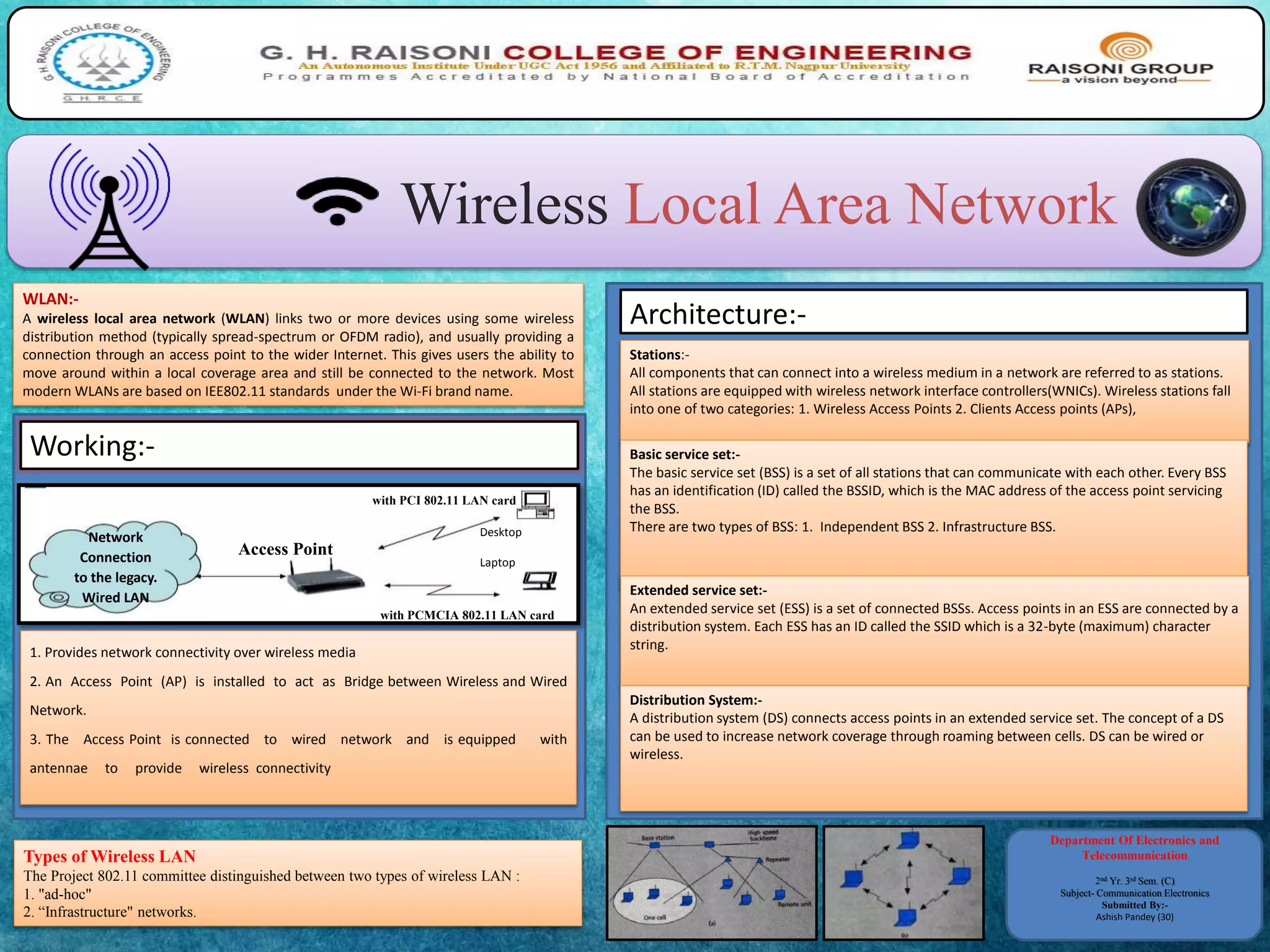
1. Provides network connectivity over wireless media
2. An Access Point (AP) is installed to act as Bridge between Wireless and Wired
Network.
3. The Access Point is connected to wired network and is equipped with
antennae to provide wireless connectivity
Network
Connection
to the legacy.
Wired LAN
Access Point
Desktop
Laptop
with PCI 802.11 LAN card
with PCMCIA 802.11 LAN card
WLAN:-
A wireless local area network (WLAN) links two or more devices using some wireless
distribution method (typically spread-spectrum or OFDM radio), and usually providing a
connection through an access point to the wider Internet. This gives users the ability to
move around within a local coverage area and still be connected to the network. Most
modern WLANs are based on IEE802.11 standards under the Wi-Fi brand name.
Architecture:-
Stations:-
All components that can connect into a wireless medium in a network are referred to as stations.
All stations are equipped with wireless network interface controllers(WNICs). Wireless stations fall
into one of two categories: 1. Wireless Access Points 2. Clients Access points (APs),
Basic service set:-
The basic service set (BSS) is a set of all stations that can communicate with each other. Every BSS
has an identification (ID) called the BSSID, which is the MAC address of the access point servicing
the BSS.
There are two types of BSS: 1. Independent BSS 2. Infrastructure BSS.
Extended service set:-
An extended service set (ESS) is a set of connected BSSs. Access points in an ESS are connected by a
distribution system. Each ESS has an ID called the SSID which is a 32-byte (maximum) character
string.
Distribution System:-
A distribution system (DS) connects access points in an extended service set. The concept of a DS
can be used to increase network coverage through roaming between cells. DS can be wired or
wireless.
Working:-
Types of Wireless LAN
The Project 802.11 committee distinguished between two types of wireless LAN :
1. "ad-hoc"
2. “Infrastructure" networks.
Department Of Electronics and
Telecommunication
2nd Yr. 3rd Sem. (C)
Subject- Communication Electronics
Submitted By:-
Ashish Pandey (30)

Wireless LAN Poster

  • 1.
    Wireless Local AreaNetwork 1. Provides network connectivity over wireless media 2. An Access Point (AP) is installed to act as Bridge between Wireless and Wired Network. 3. The Access Point is connected to wired network and is equipped with antennae to provide wireless connectivity Network Connection to the legacy. Wired LAN Access Point Desktop Laptop with PCI 802.11 LAN card with PCMCIA 802.11 LAN card WLAN:- A wireless local area network (WLAN) links two or more devices using some wireless distribution method (typically spread-spectrum or OFDM radio), and usually providing a connection through an access point to the wider Internet. This gives users the ability to move around within a local coverage area and still be connected to the network. Most modern WLANs are based on IEE802.11 standards under the Wi-Fi brand name. Architecture:- Stations:- All components that can connect into a wireless medium in a network are referred to as stations. All stations are equipped with wireless network interface controllers(WNICs). Wireless stations fall into one of two categories: 1. Wireless Access Points 2. Clients Access points (APs), Basic service set:- The basic service set (BSS) is a set of all stations that can communicate with each other. Every BSS has an identification (ID) called the BSSID, which is the MAC address of the access point servicing the BSS. There are two types of BSS: 1. Independent BSS 2. Infrastructure BSS. Extended service set:- An extended service set (ESS) is a set of connected BSSs. Access points in an ESS are connected by a distribution system. Each ESS has an ID called the SSID which is a 32-byte (maximum) character string. Distribution System:- A distribution system (DS) connects access points in an extended service set. The concept of a DS can be used to increase network coverage through roaming between cells. DS can be wired or wireless. Working:- Types of Wireless LAN The Project 802.11 committee distinguished between two types of wireless LAN : 1. "ad-hoc" 2. “Infrastructure" networks. Department Of Electronics and Telecommunication 2nd Yr. 3rd Sem. (C) Subject- Communication Electronics Submitted By:- Ashish Pandey (30)