Subcontinent Before Bin Qasim
Invasion
Presented by
Sanaan Umar Khan
Sanaan Zia
Faraz Qamar
Before Advent Of Islam
• , Before islam came, India was liberal in its views. But there
was no outright promiscuity out there. But now even after
hundreds of years of islamic rule, India still stands for ideals
like Freedom, democracy. All these liberal views in our
constitution are because of hindu outlook, as we know
hindism and budism are very ancient religions these two
religions are very similar as hindism is derived from budism,
these two religion has been ruling over these areas for
centuries they have a long history so sub-continent has a
very rich and intresting history. There are many famous
sites here and many famous ruins here related to these two
religion. And except for this there was a very modern
civilization here called the indus civilization and that’s the
most intresting part of this area’s history.
Indus
Civilization
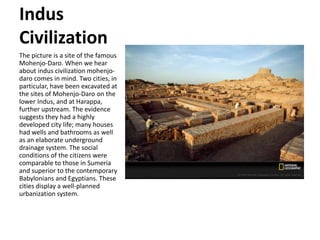
The picture is a site of the famous
Mohenjo-Daro. When we hear
about indus civilization mohenjo-
daro comes in mind. Two cities, in
particular, have been excavated at
the sites of Mohenjo-Daro on the
lower Indus, and at Harappa,
further upstream. The evidence
suggests they had a highly
developed city life; many houses
had wells and bathrooms as well
as an elaborate underground
drainage system. The social
conditions of the citizens were
comparable to those in Sumeria
and superior to the contemporary
Babylonians and Egyptians. These
cities display a well-planned
urbanization system.
Relation Of Indus Civilization with
other communities.
• There is evidence of some level of contact
between the Indus Valley Civilization and the
Near East. Commercial, religious, and artistic
connections have been recorded in Sumerian
documents, where the Indus valley people are
referred to as Meluhhaites and the Indus
valley is called Meluhha. The following
account has been dated to about 2000 BCE:
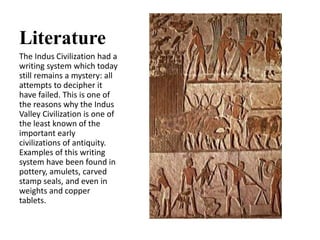
Literature
The Indus Civilization had a
writing system which today
still remains a mystery: all
attempts to decipher it
have failed. This is one of
the reasons why the Indus
Valley Civilization is one of
the least known of the
important early
civilizations of antiquity.
Examples of this writing
system have been found in
pottery, amulets, carved
stamp seals, and even in
weights and copper
tablets.
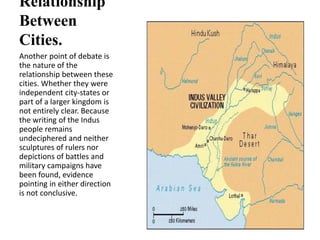
Relationship
Between
Cities.
Another point of debate is
the nature of the
relationship between these
cities. Whether they were
independent city-states or
part of a larger kingdom is
not entirely clear. Because
the writing of the Indus
people remains
undeciphered and neither
sculptures of rulers nor
depictions of battles and
military campaigns have
been found, evidence
pointing in either direction
is not conclusive.
DECLINE OF THE INDUS VALLEY
CIVILIZATION
• By 1800 BCE, the Indus Valley Civilization saw the
beginning of their decline: Writing started to disappear,
standardized weights and measures used for trade and
taxation purposes fell out of use, the connection with
the Near East was interrupted, and some cities were
gradually abandoned. The reasons for this decline are
not entirely clear, but it is believed that the drying up
of the Saraswati River, a process which had begun
around 1900 BCE, was the main cause. Other experts
speak of a great flood in the area. Either event would
have had catastrophic effects on agricultural activity,
making the economy no longer sustainable and
breaking the civic order of the cities.
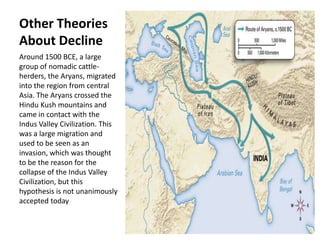
Other Theories
About Decline
Around 1500 BCE, a large
group of nomadic cattle-
herders, the Aryans, migrated
into the region from central
Asia. The Aryans crossed the
Hindu Kush mountains and
came in contact with the
Indus Valley Civilization. This
was a large migration and
used to be seen as an
invasion, which was thought
to be the reason for the
collapse of the Indus Valley
Civilization, but this
hypothesis is not unanimously
accepted today
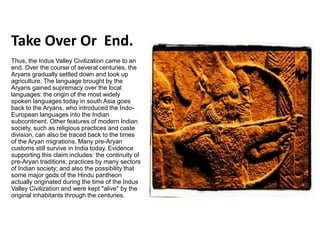
Take Over Or End.
Thus, the Indus Valley Civilization came to an
end. Over the course of several centuries, the
Aryans gradually settled down and took up
agriculture. The language brought by the
Aryans gained supremacy over the local
languages: the origin of the most widely
spoken languages today in south Asia goes
back to the Aryans, who introduced the Indo-
European languages into the Indian
subcontinent. Other features of modern Indian
society, such as religious practices and caste
division, can also be traced back to the times
of the Aryan migrations. Many pre-Aryan
customs still survive in India today. Evidence
supporting this claim includes: the continuity of
pre-Aryan traditions; practices by many sectors
of Indian society; and also the possibility that
some major gods of the Hindu pantheon
actually originated during the time of the Indus
Valley Civilization and were kept "alive" by the
original inhabitants through the centuries.
Subcontinent before bin qasim invasion

Subcontinent before bin qasim invasion

  • 1.
    Subcontinent Before BinQasim Invasion Presented by Sanaan Umar Khan Sanaan Zia Faraz Qamar
  • 2.
    Before Advent OfIslam • , Before islam came, India was liberal in its views. But there was no outright promiscuity out there. But now even after hundreds of years of islamic rule, India still stands for ideals like Freedom, democracy. All these liberal views in our constitution are because of hindu outlook, as we know hindism and budism are very ancient religions these two religions are very similar as hindism is derived from budism, these two religion has been ruling over these areas for centuries they have a long history so sub-continent has a very rich and intresting history. There are many famous sites here and many famous ruins here related to these two religion. And except for this there was a very modern civilization here called the indus civilization and that’s the most intresting part of this area’s history.
  • 3.
    Indus Civilization The picture isa site of the famous Mohenjo-Daro. When we hear about indus civilization mohenjo- daro comes in mind. Two cities, in particular, have been excavated at the sites of Mohenjo-Daro on the lower Indus, and at Harappa, further upstream. The evidence suggests they had a highly developed city life; many houses had wells and bathrooms as well as an elaborate underground drainage system. The social conditions of the citizens were comparable to those in Sumeria and superior to the contemporary Babylonians and Egyptians. These cities display a well-planned urbanization system.
  • 4.
    Relation Of IndusCivilization with other communities. • There is evidence of some level of contact between the Indus Valley Civilization and the Near East. Commercial, religious, and artistic connections have been recorded in Sumerian documents, where the Indus valley people are referred to as Meluhhaites and the Indus valley is called Meluhha. The following account has been dated to about 2000 BCE:
  • 5.
    Literature The Indus Civilizationhad a writing system which today still remains a mystery: all attempts to decipher it have failed. This is one of the reasons why the Indus Valley Civilization is one of the least known of the important early civilizations of antiquity. Examples of this writing system have been found in pottery, amulets, carved stamp seals, and even in weights and copper tablets.
  • 6.
    Relationship Between Cities. Another point ofdebate is the nature of the relationship between these cities. Whether they were independent city-states or part of a larger kingdom is not entirely clear. Because the writing of the Indus people remains undeciphered and neither sculptures of rulers nor depictions of battles and military campaigns have been found, evidence pointing in either direction is not conclusive.
  • 7.
    DECLINE OF THEINDUS VALLEY CIVILIZATION • By 1800 BCE, the Indus Valley Civilization saw the beginning of their decline: Writing started to disappear, standardized weights and measures used for trade and taxation purposes fell out of use, the connection with the Near East was interrupted, and some cities were gradually abandoned. The reasons for this decline are not entirely clear, but it is believed that the drying up of the Saraswati River, a process which had begun around 1900 BCE, was the main cause. Other experts speak of a great flood in the area. Either event would have had catastrophic effects on agricultural activity, making the economy no longer sustainable and breaking the civic order of the cities.
  • 8.
    Other Theories About Decline Around1500 BCE, a large group of nomadic cattle- herders, the Aryans, migrated into the region from central Asia. The Aryans crossed the Hindu Kush mountains and came in contact with the Indus Valley Civilization. This was a large migration and used to be seen as an invasion, which was thought to be the reason for the collapse of the Indus Valley Civilization, but this hypothesis is not unanimously accepted today
  • 9.
    Take Over OrEnd. Thus, the Indus Valley Civilization came to an end. Over the course of several centuries, the Aryans gradually settled down and took up agriculture. The language brought by the Aryans gained supremacy over the local languages: the origin of the most widely spoken languages today in south Asia goes back to the Aryans, who introduced the Indo- European languages into the Indian subcontinent. Other features of modern Indian society, such as religious practices and caste division, can also be traced back to the times of the Aryan migrations. Many pre-Aryan customs still survive in India today. Evidence supporting this claim includes: the continuity of pre-Aryan traditions; practices by many sectors of Indian society; and also the possibility that some major gods of the Hindu pantheon actually originated during the time of the Indus Valley Civilization and were kept "alive" by the original inhabitants through the centuries.