October 26, 2022
By: Wissam Geahchan, Applications Engineer
Cable Manufacturing 101
WEBINAR
ATTENTION
AUDIENCE PARTICIPATION
• Questions can be asked at any time using the chat function on
the webinar screen
• Any unanswered questions will be followed up through email
• This presentation, a recording of the webinar and a brief survey
will be emailed to all registrants
ABOUT ME
Wissam Geahchan
Applications Engineer, Nexans Canada
• Active member on several industry standards
committees
• Experience applying the Canadian Electrical
Code in a variety of applications
• Licensed soccer coach
Agenda
• Introduction
• A Brief History
• Manufacturing Process
• Materials
• Metallurgy and Compounds
• Process
• Drawing
• Stranding
• Extrusion
• Cabling
• Finishing
• Testing and Quality Assurance
• Nexans Products
• Key Takeaways
• Q&A
Nexans Canada is proud to be a cable
manufacturer for over 110 years!
Copper Rod Mill
Montreal, QC
Residential,
Commercial &
Industrial
Fergus, ON
Utility -
Distribution &
Transmission
Weyburn, SK
3 Manufacturing Plants
Our past, present and future
converge to electrification
Our Purpose:
ELECTRIFY
THE FUTURE
• Raw Material → Finished Cable
• Materials matter!
• The processes and materials that we will describe here are common in all wire and
cable plants.
Introduction
→
[Learn all you can about the
history of the past, for how else
can one even guess what is
going to happen in the future.]
Winston Churchill
A Brief History (1)
Wire and cable have been used for over 200 years dating back to the early 1800s when electricity
began to be studied.
Humphry Davy, Hans Christian Oersted, George Simon Ohm, Joseph Henry, Michael Faraday,
Thomas Edison, to name a few.
A Brief History (2)
1844 – Charles Goodyear Patent
Vulcanized natural rubber
telegraph cable
Main Cable Components - A Refresh*
Outer Jacket
Armour
Inner Jacket
Conductor
Insulation
*Refer to our “Cables 101” webinar, available on our website, if you are interested in learning more.
Drawing Stranding Extrusion Cabling Finishing
Compounds
Metallurgy
“Pre-processes” Processes
Manufacturing Processes
Drawing Stranding Extrusion Cabling Finishing
Compounds
Metallurgy
Cu 1 mm
Ag 0.97 mm
Au 1.2 mm
Al 1.3 mm
Conductor material selection
Below is a comparison of the 4 best conductors of electricity.
Metallurgy
Advantages and disadvantages also include price, weight, and processing.
1 km
Drawing Stranding Extrusion Cabling Finishing
Compounds
Metallurgy
Metallurgy (2)
More Comparisons
Costs
Metal Metallurgy
Weight Durability Conductivity
Ag
Cu
Au
Al
Drawing Stranding Extrusion Cabling Finishing
Compounds
Metallurgy
Metallurgy (3)
From CATHODE to ROD
• The raw materials for conductors are electro-refined cathodes of ultrapure metals. Resistivity
increases with the impurity content.
• From CATHODE to ROD in Rod Mills or Continuous Casting Units.
Drawing Stranding Extrusion Cabling Finishing
Compounds
Metallurgy
Compounding is the operation
where different raw materials like
polymers, fillers and additives are
mixed to manufacture the granules
which will be used as a raw
material in the production of cables
(… or compounds).
Additives: a few %
Fillers: up to 60 %
Compounding
Drawing Stranding Extrusion Cabling Finishing
Compounds
Metallurgy
Compounding (2)
Drawing Stranding Extrusion Cabling Finishing
Compounds
Metallurgy
Polymer Compounds are materials composed of repeating chains of molecules and can have
varying properties.
Required for insulation and protection from both mechanical abuse and electrical stress.
Can be received ready-for-use OR produced in-house.
Masterbatching is the addition and mixing of ingredients on the extrusion line with the aim to
improve flexibility, lifetime, flame spread behavior, costs, etc.
Honourable mentions:
Air is the cheapest insulating material.
Paper insulation is still in use after more than 100 years but has two drawbacks…
• Very poor insulator when wet.
• Many paper layers needed, which makes the process slow and expensive.
Polymer Compounds (1)
Drawing Stranding Extrusion Cabling Finishing
Compounds
Metallurgy
The four types of materials are:
1. Polyethylene – Electrical properties
2. PVC – Limited Flame Spread Properties
3. Elastomers (Rubbers) – Flexibility
4. Other Polymers – For different properties
Polymer Compounds (2)
Drawing Stranding Extrusion Cabling Finishing
Compounds
Metallurgy
Crosslinking is an operation which
allows us to modify the properties of
materials.
Not all materials can be crosslinked.
The best-known example is vulcanization
of rubber, invented by Charles Goodyear
in 1839 and patented in 1844.
Polymer Compounds (3)
→
Drawing Stranding Extrusion Cabling Finishing
Compounds
Metallurgy
Thermoplastic material (not crosslinked)
The polymers are made of a chain of molecules which can slide with respect to each other.
Relatively soft, softens at a relatively low temperature (90C).
Thermosetting material (crosslinked)
After crosslinking, the polymer can no longer be melt-processed, making it a thermosetting material.
Polymer Compounds (4)
Drawing Stranding Extrusion Cabling Finishing
Compounds
Metallurgy
PE XLPE
Polymer Compounds (5)
Drawing Stranding Extrusion Cabling Finishing
Compounds
Metallurgy
Paper
Insulation paper or filling paper - craft paper
Wires, Strings and Yarns
Identification string, binding string, water swellable
yarns, jacket opening string, reinforcement/protection
yarns, or steel wires for armoring
Filling compounds
Grease, special compounds for certain performance,
chalk to avoid wire sticking with the jacket, tar for
submarine cables, swellable powder.
Other Materials
Other Materials
Processes
Drawing Stranding Extrusion Cabling Finishing
Overview
Drawing Stranding Extrusion Cabling Finishing
Compounds
Metallurgy
Pay-Off
Reel
Take-Up
Reel
Operation
Capstans
Capstans
The basic set up is as follows:
Drawing (1)
Drawing is the plastic deformation of a metal wire by pulling it thru calibrated dies, of even smaller diameter.
- Copper rod is commonly 5/16” (8mm) diameter
- Aluminum rod is commonly 3/8” (10mm) diameter
- Larger rod may be used when making solid conductors with a diameter larger or only slightly smaller than
the common rod size.
Drawing Stranding Extrusion Cabling Finishing
Compounds
Metallurgy
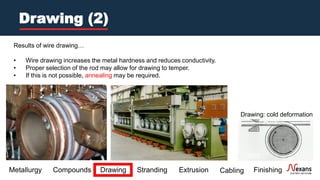
Results of wire drawing…
• Wire drawing increases the metal hardness and reduces conductivity.
• Proper selection of the rod may allow for drawing to temper.
• If this is not possible, annealing may be required.
Drawing: cold deformation
Drawing Stranding Extrusion Cabling Finishing
Compounds
Metallurgy
Drawing (2)
Annealing is a heat treatment that alters the physical and
mechanical properties of a material to increase its ductility and
reduce its hardness (making it more workable)
Softens the metal temper and raises the conductivity.
The product returns its flexibility + elongation properties.
Annealing can be done in batch ovens or in-line heating “on the
fly” for small conductors.
Drawing Stranding Extrusion Cabling Finishing
Compounds
Metallurgy
Annealing
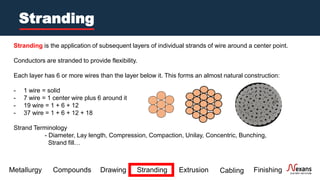
Stranding is the application of subsequent layers of individual strands of wire around a center point.
Conductors are stranded to provide flexibility.
Each layer has 6 or more wires than the layer below it. This forms an almost natural construction:
- 1 wire = solid
- 7 wire = 1 center wire plus 6 around it
- 19 wire = 1 + 6 + 12
- 37 wire = 1 + 6 + 12 + 18
Strand Terminology
- Diameter, Lay length, Compression, Compaction, Unilay, Concentric, Bunching,
Strand fill…
Drawing Stranding Extrusion Cabling Finishing
Compounds
Metallurgy
Stranding
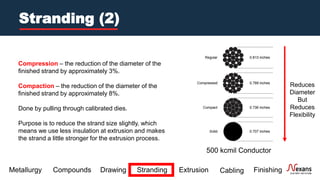
Compression – the reduction of the diameter of the
finished strand by approximately 3%.
Compaction – the reduction of the diameter of the
finished strand by approximately 8%.
Done by pulling through calibrated dies.
Purpose is to reduce the strand size slightly, which
means we use less insulation at extrusion and makes
the strand a little stronger for the extrusion process.
Drawing Stranding Extrusion Cabling Finishing
Compounds
Metallurgy
Reduces
Diameter
But
Reduces
Flexibility
500 kcmil Conductor
Stranding (2)
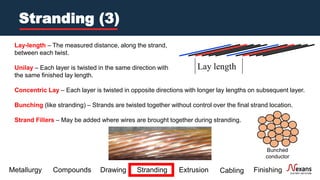
Lay-length – The measured distance, along the strand,
between each twist.
Unilay – Each layer is twisted in the same direction with
the same finished lay length.
Concentric Lay – Each layer is twisted in opposite directions with longer lay lengths on subsequent layer.
Bunching (like stranding) – Strands are twisted together without control over the final strand location.
Strand Fillers – May be added where wires are brought together during stranding.
Drawing Stranding Extrusion Cabling Finishing
Compounds
Metallurgy
Stranding (3)
Bunched
conductor
Tubular stranders are common for
making 7 and 19-strand conductors.
- Bobbins (small reels) are placed inside
a long tube that rotates, laying wires
along side each other.
Drawing Stranding Extrusion Cabling Finishing
Compounds
Metallurgy
Stranding (4)
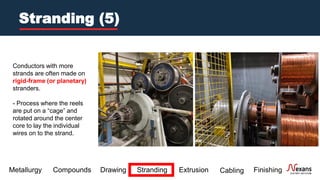
Conductors with more
strands are often made on
rigid-frame (or planetary)
stranders.
- Process where the reels
are put on a “cage” and
rotated around the center
core to lay the individual
wires on to the strand.
Drawing Stranding Extrusion Cabling Finishing
Compounds
Metallurgy
Stranding (5)
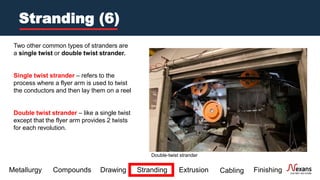
Two other common types of stranders are
a single twist or double twist strander.
Single twist strander – refers to the
process where a flyer arm is used to twist
the conductors and then lay them on a reel
Double twist strander – like a single twist
except that the flyer arm provides 2 twists
for each revolution.
Drawing Stranding Extrusion Cabling Finishing
Compounds
Metallurgy
Stranding (6)
Double-twist strander
Extrusion is the operation which puts material around the conductor or the cable core.
Drawing Stranding Extrusion Cabling Finishing
Compounds
Metallurgy
Extrusion
Outer Jacket
Inner Jacket
Insulation
Drawing Stranding Extrusion Cabling Finishing
Compounds
Metallurgy
Conductor and compound meet at the extruder.
The basic principles of extrusion are unaffected by the material
extruded.
Below is a diagram showing the basic single-screw extruder and
its elementary components.
Extrusion (2)
Extrusion Heads (3)
Drawing Stranding Extrusion Cabling Finishing
Compounds
Metallurgy
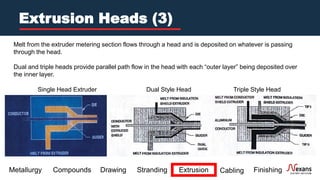
Melt from the extruder metering section flows through a head and is deposited on whatever is passing
through the head.
Dual and triple heads provide parallel path flow in the head with each “outer layer” being deposited over
the inner layer.
Single Head Extruder Dual Style Head Triple Style Head
Drawing Stranding Extrusion Cabling Finishing
Compounds
Metallurgy
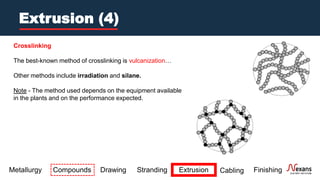
Crosslinking
The best-known method of crosslinking is vulcanization…
Other methods include irradiation and silane.
Note - The method used depends on the equipment available
in the plants and on the performance expected.
Extrusion (4)
Drawing Stranding Extrusion Cabling Finishing
Compounds
Metallurgy
In Vulcanization, peroxide is added to the polymer to break the chemical bonds.
Even stronger bonds re-assemble between the polymer chains while the polymer is “cooked” at a given
temperature and for a given time as it goes through a continuous vulcanization (CV) line.
Extrusion (5)
Drawing Stranding Extrusion Cabling Finishing
Compounds
Metallurgy
When the cable insulation gets very large,
gravity may deform the insulation before
crosslinking, which means the cable would no
longer be perfectly round.
One way to overcome this is to use a Vertical
CV line rather than a catenary.
To the right is a highly simplified view of the
installation.
Extrusion (6)
Extrusion – Common Lines (7)
Drawing Stranding Extrusion Cabling Finishing
Compounds
Metallurgy
Single Layer Extrusion Line for Plastic
Cooling Trough (Commonly Water)
Pay-Off
Extruder with
Single Head
Take-up
Spark Tester
is Common
Curing Zone
Take-up
Cooling Zone
Three extruders
feeding a triple head
Take-up
Curing Zone Cooling Zone
Single Layer Extrusion Line for Continuous Vulcanization
Extruder with
Single Head
Pay-Off
True-Triple-Extrusion Line for Continuous Vulcanization
Pay-Off
Cabling (1)
Drawing Stranding Extrusion Cabling Finishing
Compounds
Metallurgy
Once the basic components
of the cable are prepared,
we assemble the cable in
what is called the Cabling
step.
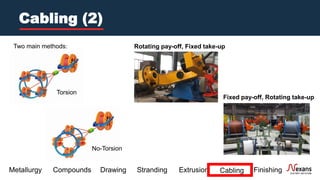
Cabling (2)
Drawing Stranding Extrusion Cabling Finishing
Compounds
Metallurgy
Fixed pay-off, Rotating take-up
Rotating pay-off, Fixed take-up
Two main methods:
Torsion
No-Torsion
Finishing
Drawing Stranding Extrusion Cabling Finishing
Compounds
Metallurgy
Some Finishing operations include adding:
Metallic and/or fabric braid
Corrugated or
folded metal tape
A sheath
and/or
armour
Concentric wires or metallic tape
Testing & Quality Assurance (QA) (1)
The different types of testing include:
1. Design qualification tests
2. Material tests
3. In-process tests
4. Finished product tests
Testing & QA (2)
Design Qualification Tests:
To ensure a cable is suitable for production
- Electrical/Physical measurements
- Load cycling
- Deformation and Strippability tests
- and others…
Incoming Material Tests:
To produce in-house materials, input materials are
subjected to appropriate published and
unpublished tests.
In-process Tests:
At every stage of manufacturing, tests are
done frequently to avoid the generation of
scrap material.
Finished Product Tests:
To ensure final product is compliant
- AC or DC spark tests
- Optional insulation resistance tests
- Conductor resistance tests
- And others…
Nexans Canada Products
Bare
Copper
Process:
1. Drawing
2. Stranding
Applications:
Suitable for bonding and grounding electrical circuits
and systems
ASC &
ACSR
Process:
1. Drawing
2. Stranding
3. Extra - strand filling
Applications:
Suitable for overhead installations
INSTAGLIDE® RW90, RWU90 & T90
Process:
1. Drawing
2. Stranding
3. Extrusion
Applications:
For open wiring and raceways in dry or wet locations.
AC90 & AC90 ISO-BX
Process:
1. Drawing
2. Stranding
3. Extrusion
4. Cabling / Assembling
5. Armouring
Applications:
Armoured cable for commercial, industrial, and apartment use.
CANADEX® NMD90 & SUPERVEX® NMWU
Process:
1. Drawing
2. Stranding (or not, for solid wires)
3. Extrusion – 1st pass
4. Extrusion – 2nd pass
Applications:
Non-metallic sheathed cable for residential applications
including lights, outlets, kitchens, washing machines, etc.
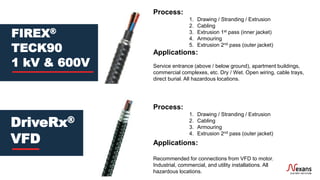
FIREX®
TECK90
1 kV & 600V
Process:
1. Drawing / Stranding / Extrusion
2. Cabling
3. Extrusion 1st pass (inner jacket)
4. Armouring
5. Extrusion 2nd pass (outer jacket)
Applications:
Service entrance (above / below ground), apartment buildings,
commercial complexes, etc. Dry / Wet. Open wiring, cable trays,
direct burial. All hazardous locations.
Process:
1. Drawing / Stranding / Extrusion
2. Cabling
3. Armouring
4. Extrusion 2nd pass (outer jacket)
Applications:
Recommended for connections from VFD to motor.
Industrial, commercial, and utility installations. All
hazardous locations.
DriveRx®
VFD
ENERGEX® Medium Voltage
Process:
1. Drawing
2. Stranding
3. Extrusion (CV)
4. Metallic shield application (as concentric wires)
5. Extrusion (jacket)
Applications:
Predominantly used for three-phase primary underground distribution 5-
46 kV. Can be direct buried, buried in ducts, and/or exposed to sunlight.
Concentric
Neutral (CN)
Shielded
Power (SP)
Process:
1. Drawing
2. Stranding
3. Extrusion (CV)
4. Metallic shield application (as helically applied tape
or longitudinally applied corrugated tape)
5. Extrusion (jacket)
Applications:
Predominantly used for three-phase primary underground distribution 5-
46 kV. Can be direct buried, buried in ducts, and/or exposed to sunlight.
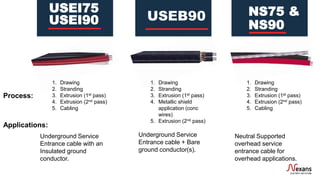
USEI75
USEI90
Process:
Applications:
NS75 &
NS90
USEB90
1. Drawing
2. Stranding
3. Extrusion (1st pass)
4. Extrusion (2nd pass)
5. Cabling
1. Drawing
2. Stranding
3. Extrusion (1st pass)
4. Metallic shield
application (conc
wires)
5. Extrusion (2nd pass)
1. Drawing
2. Stranding
3. Extrusion (1st pass)
4. Extrusion (2nd pass)
5. Cabling
Underground Service
Entrance cable with an
Insulated ground
conductor.
Underground Service
Entrance cable + Bare
ground conductor(s).
Neutral Supported
overhead service
entrance cable for
overhead applications.
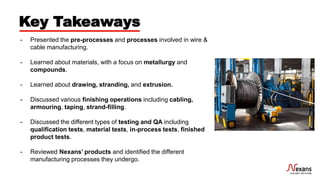
Key Takeaways
- Presented the pre-processes and processes involved in wire &
cable manufacturing.
- Learned about materials, with a focus on metallurgy and
compounds.
- Learned about drawing, stranding, and extrusion.
- Discussed various finishing operations including cabling,
armouring, taping, strand-filling.
- Discussed the different types of testing and QA including
qualification tests, material tests, in-process tests, finished
product tests.
- Reviewed Nexans’ products and identified the different
manufacturing processes they undergo.
Q & A
www.nexans.ca
Thank you for your attention!
Contact:
Wissam Geahchan
Applications Engineer, Nexans Canada
wissam.geahchan@nexans.com

Cable Manufacturing 101.pdf

  • 1.
    October 26, 2022 By:Wissam Geahchan, Applications Engineer Cable Manufacturing 101 WEBINAR
  • 2.
    ATTENTION AUDIENCE PARTICIPATION • Questionscan be asked at any time using the chat function on the webinar screen • Any unanswered questions will be followed up through email • This presentation, a recording of the webinar and a brief survey will be emailed to all registrants
  • 3.
    ABOUT ME Wissam Geahchan ApplicationsEngineer, Nexans Canada • Active member on several industry standards committees • Experience applying the Canadian Electrical Code in a variety of applications • Licensed soccer coach
  • 4.
    Agenda • Introduction • ABrief History • Manufacturing Process • Materials • Metallurgy and Compounds • Process • Drawing • Stranding • Extrusion • Cabling • Finishing • Testing and Quality Assurance • Nexans Products • Key Takeaways • Q&A
  • 5.
    Nexans Canada isproud to be a cable manufacturer for over 110 years! Copper Rod Mill Montreal, QC Residential, Commercial & Industrial Fergus, ON Utility - Distribution & Transmission Weyburn, SK 3 Manufacturing Plants
  • 6.
    Our past, presentand future converge to electrification Our Purpose: ELECTRIFY THE FUTURE
  • 7.
    • Raw Material→ Finished Cable • Materials matter! • The processes and materials that we will describe here are common in all wire and cable plants. Introduction →
  • 8.
    [Learn all youcan about the history of the past, for how else can one even guess what is going to happen in the future.] Winston Churchill A Brief History (1)
  • 9.
    Wire and cablehave been used for over 200 years dating back to the early 1800s when electricity began to be studied. Humphry Davy, Hans Christian Oersted, George Simon Ohm, Joseph Henry, Michael Faraday, Thomas Edison, to name a few. A Brief History (2) 1844 – Charles Goodyear Patent Vulcanized natural rubber telegraph cable
  • 10.
    Main Cable Components- A Refresh* Outer Jacket Armour Inner Jacket Conductor Insulation *Refer to our “Cables 101” webinar, available on our website, if you are interested in learning more.
  • 11.
    Drawing Stranding ExtrusionCabling Finishing Compounds Metallurgy “Pre-processes” Processes Manufacturing Processes
  • 12.
    Drawing Stranding ExtrusionCabling Finishing Compounds Metallurgy Cu 1 mm Ag 0.97 mm Au 1.2 mm Al 1.3 mm Conductor material selection Below is a comparison of the 4 best conductors of electricity. Metallurgy Advantages and disadvantages also include price, weight, and processing. 1 km
  • 13.
    Drawing Stranding ExtrusionCabling Finishing Compounds Metallurgy Metallurgy (2) More Comparisons Costs Metal Metallurgy Weight Durability Conductivity Ag Cu Au Al
  • 14.
    Drawing Stranding ExtrusionCabling Finishing Compounds Metallurgy Metallurgy (3) From CATHODE to ROD • The raw materials for conductors are electro-refined cathodes of ultrapure metals. Resistivity increases with the impurity content. • From CATHODE to ROD in Rod Mills or Continuous Casting Units.
  • 15.
    Drawing Stranding ExtrusionCabling Finishing Compounds Metallurgy Compounding is the operation where different raw materials like polymers, fillers and additives are mixed to manufacture the granules which will be used as a raw material in the production of cables (… or compounds). Additives: a few % Fillers: up to 60 % Compounding
  • 16.
    Drawing Stranding ExtrusionCabling Finishing Compounds Metallurgy Compounding (2)
  • 17.
    Drawing Stranding ExtrusionCabling Finishing Compounds Metallurgy Polymer Compounds are materials composed of repeating chains of molecules and can have varying properties. Required for insulation and protection from both mechanical abuse and electrical stress. Can be received ready-for-use OR produced in-house. Masterbatching is the addition and mixing of ingredients on the extrusion line with the aim to improve flexibility, lifetime, flame spread behavior, costs, etc. Honourable mentions: Air is the cheapest insulating material. Paper insulation is still in use after more than 100 years but has two drawbacks… • Very poor insulator when wet. • Many paper layers needed, which makes the process slow and expensive. Polymer Compounds (1)
  • 18.
    Drawing Stranding ExtrusionCabling Finishing Compounds Metallurgy The four types of materials are: 1. Polyethylene – Electrical properties 2. PVC – Limited Flame Spread Properties 3. Elastomers (Rubbers) – Flexibility 4. Other Polymers – For different properties Polymer Compounds (2)
  • 19.
    Drawing Stranding ExtrusionCabling Finishing Compounds Metallurgy Crosslinking is an operation which allows us to modify the properties of materials. Not all materials can be crosslinked. The best-known example is vulcanization of rubber, invented by Charles Goodyear in 1839 and patented in 1844. Polymer Compounds (3) →
  • 20.
    Drawing Stranding ExtrusionCabling Finishing Compounds Metallurgy Thermoplastic material (not crosslinked) The polymers are made of a chain of molecules which can slide with respect to each other. Relatively soft, softens at a relatively low temperature (90C). Thermosetting material (crosslinked) After crosslinking, the polymer can no longer be melt-processed, making it a thermosetting material. Polymer Compounds (4)
  • 21.
    Drawing Stranding ExtrusionCabling Finishing Compounds Metallurgy PE XLPE Polymer Compounds (5)
  • 22.
    Drawing Stranding ExtrusionCabling Finishing Compounds Metallurgy Paper Insulation paper or filling paper - craft paper Wires, Strings and Yarns Identification string, binding string, water swellable yarns, jacket opening string, reinforcement/protection yarns, or steel wires for armoring Filling compounds Grease, special compounds for certain performance, chalk to avoid wire sticking with the jacket, tar for submarine cables, swellable powder. Other Materials Other Materials
  • 23.
  • 24.
    Overview Drawing Stranding ExtrusionCabling Finishing Compounds Metallurgy Pay-Off Reel Take-Up Reel Operation Capstans Capstans The basic set up is as follows:
  • 25.
    Drawing (1) Drawing isthe plastic deformation of a metal wire by pulling it thru calibrated dies, of even smaller diameter. - Copper rod is commonly 5/16” (8mm) diameter - Aluminum rod is commonly 3/8” (10mm) diameter - Larger rod may be used when making solid conductors with a diameter larger or only slightly smaller than the common rod size. Drawing Stranding Extrusion Cabling Finishing Compounds Metallurgy
  • 26.
    Results of wiredrawing… • Wire drawing increases the metal hardness and reduces conductivity. • Proper selection of the rod may allow for drawing to temper. • If this is not possible, annealing may be required. Drawing: cold deformation Drawing Stranding Extrusion Cabling Finishing Compounds Metallurgy Drawing (2)
  • 27.
    Annealing is aheat treatment that alters the physical and mechanical properties of a material to increase its ductility and reduce its hardness (making it more workable) Softens the metal temper and raises the conductivity. The product returns its flexibility + elongation properties. Annealing can be done in batch ovens or in-line heating “on the fly” for small conductors. Drawing Stranding Extrusion Cabling Finishing Compounds Metallurgy Annealing
  • 28.
    Stranding is theapplication of subsequent layers of individual strands of wire around a center point. Conductors are stranded to provide flexibility. Each layer has 6 or more wires than the layer below it. This forms an almost natural construction: - 1 wire = solid - 7 wire = 1 center wire plus 6 around it - 19 wire = 1 + 6 + 12 - 37 wire = 1 + 6 + 12 + 18 Strand Terminology - Diameter, Lay length, Compression, Compaction, Unilay, Concentric, Bunching, Strand fill… Drawing Stranding Extrusion Cabling Finishing Compounds Metallurgy Stranding
  • 29.
    Compression – thereduction of the diameter of the finished strand by approximately 3%. Compaction – the reduction of the diameter of the finished strand by approximately 8%. Done by pulling through calibrated dies. Purpose is to reduce the strand size slightly, which means we use less insulation at extrusion and makes the strand a little stronger for the extrusion process. Drawing Stranding Extrusion Cabling Finishing Compounds Metallurgy Reduces Diameter But Reduces Flexibility 500 kcmil Conductor Stranding (2)
  • 30.
    Lay-length – Themeasured distance, along the strand, between each twist. Unilay – Each layer is twisted in the same direction with the same finished lay length. Concentric Lay – Each layer is twisted in opposite directions with longer lay lengths on subsequent layer. Bunching (like stranding) – Strands are twisted together without control over the final strand location. Strand Fillers – May be added where wires are brought together during stranding. Drawing Stranding Extrusion Cabling Finishing Compounds Metallurgy Stranding (3) Bunched conductor
  • 31.
    Tubular stranders arecommon for making 7 and 19-strand conductors. - Bobbins (small reels) are placed inside a long tube that rotates, laying wires along side each other. Drawing Stranding Extrusion Cabling Finishing Compounds Metallurgy Stranding (4)
  • 32.
    Conductors with more strandsare often made on rigid-frame (or planetary) stranders. - Process where the reels are put on a “cage” and rotated around the center core to lay the individual wires on to the strand. Drawing Stranding Extrusion Cabling Finishing Compounds Metallurgy Stranding (5)
  • 33.
    Two other commontypes of stranders are a single twist or double twist strander. Single twist strander – refers to the process where a flyer arm is used to twist the conductors and then lay them on a reel Double twist strander – like a single twist except that the flyer arm provides 2 twists for each revolution. Drawing Stranding Extrusion Cabling Finishing Compounds Metallurgy Stranding (6) Double-twist strander
  • 34.
    Extrusion is theoperation which puts material around the conductor or the cable core. Drawing Stranding Extrusion Cabling Finishing Compounds Metallurgy Extrusion Outer Jacket Inner Jacket Insulation
  • 35.
    Drawing Stranding ExtrusionCabling Finishing Compounds Metallurgy Conductor and compound meet at the extruder. The basic principles of extrusion are unaffected by the material extruded. Below is a diagram showing the basic single-screw extruder and its elementary components. Extrusion (2)
  • 36.
    Extrusion Heads (3) DrawingStranding Extrusion Cabling Finishing Compounds Metallurgy Melt from the extruder metering section flows through a head and is deposited on whatever is passing through the head. Dual and triple heads provide parallel path flow in the head with each “outer layer” being deposited over the inner layer. Single Head Extruder Dual Style Head Triple Style Head
  • 37.
    Drawing Stranding ExtrusionCabling Finishing Compounds Metallurgy Crosslinking The best-known method of crosslinking is vulcanization… Other methods include irradiation and silane. Note - The method used depends on the equipment available in the plants and on the performance expected. Extrusion (4)
  • 38.
    Drawing Stranding ExtrusionCabling Finishing Compounds Metallurgy In Vulcanization, peroxide is added to the polymer to break the chemical bonds. Even stronger bonds re-assemble between the polymer chains while the polymer is “cooked” at a given temperature and for a given time as it goes through a continuous vulcanization (CV) line. Extrusion (5)
  • 39.
    Drawing Stranding ExtrusionCabling Finishing Compounds Metallurgy When the cable insulation gets very large, gravity may deform the insulation before crosslinking, which means the cable would no longer be perfectly round. One way to overcome this is to use a Vertical CV line rather than a catenary. To the right is a highly simplified view of the installation. Extrusion (6)
  • 40.
    Extrusion – CommonLines (7) Drawing Stranding Extrusion Cabling Finishing Compounds Metallurgy Single Layer Extrusion Line for Plastic Cooling Trough (Commonly Water) Pay-Off Extruder with Single Head Take-up Spark Tester is Common Curing Zone Take-up Cooling Zone Three extruders feeding a triple head Take-up Curing Zone Cooling Zone Single Layer Extrusion Line for Continuous Vulcanization Extruder with Single Head Pay-Off True-Triple-Extrusion Line for Continuous Vulcanization Pay-Off
  • 41.
    Cabling (1) Drawing StrandingExtrusion Cabling Finishing Compounds Metallurgy Once the basic components of the cable are prepared, we assemble the cable in what is called the Cabling step.
  • 42.
    Cabling (2) Drawing StrandingExtrusion Cabling Finishing Compounds Metallurgy Fixed pay-off, Rotating take-up Rotating pay-off, Fixed take-up Two main methods: Torsion No-Torsion
  • 43.
    Finishing Drawing Stranding ExtrusionCabling Finishing Compounds Metallurgy Some Finishing operations include adding: Metallic and/or fabric braid Corrugated or folded metal tape A sheath and/or armour Concentric wires or metallic tape
  • 44.
    Testing & QualityAssurance (QA) (1) The different types of testing include: 1. Design qualification tests 2. Material tests 3. In-process tests 4. Finished product tests
  • 45.
    Testing & QA(2) Design Qualification Tests: To ensure a cable is suitable for production - Electrical/Physical measurements - Load cycling - Deformation and Strippability tests - and others… Incoming Material Tests: To produce in-house materials, input materials are subjected to appropriate published and unpublished tests. In-process Tests: At every stage of manufacturing, tests are done frequently to avoid the generation of scrap material. Finished Product Tests: To ensure final product is compliant - AC or DC spark tests - Optional insulation resistance tests - Conductor resistance tests - And others…
  • 46.
  • 47.
    Bare Copper Process: 1. Drawing 2. Stranding Applications: Suitablefor bonding and grounding electrical circuits and systems ASC & ACSR Process: 1. Drawing 2. Stranding 3. Extra - strand filling Applications: Suitable for overhead installations
  • 48.
    INSTAGLIDE® RW90, RWU90& T90 Process: 1. Drawing 2. Stranding 3. Extrusion Applications: For open wiring and raceways in dry or wet locations.
  • 49.
    AC90 & AC90ISO-BX Process: 1. Drawing 2. Stranding 3. Extrusion 4. Cabling / Assembling 5. Armouring Applications: Armoured cable for commercial, industrial, and apartment use.
  • 50.
    CANADEX® NMD90 &SUPERVEX® NMWU Process: 1. Drawing 2. Stranding (or not, for solid wires) 3. Extrusion – 1st pass 4. Extrusion – 2nd pass Applications: Non-metallic sheathed cable for residential applications including lights, outlets, kitchens, washing machines, etc.
  • 51.
    FIREX® TECK90 1 kV &600V Process: 1. Drawing / Stranding / Extrusion 2. Cabling 3. Extrusion 1st pass (inner jacket) 4. Armouring 5. Extrusion 2nd pass (outer jacket) Applications: Service entrance (above / below ground), apartment buildings, commercial complexes, etc. Dry / Wet. Open wiring, cable trays, direct burial. All hazardous locations. Process: 1. Drawing / Stranding / Extrusion 2. Cabling 3. Armouring 4. Extrusion 2nd pass (outer jacket) Applications: Recommended for connections from VFD to motor. Industrial, commercial, and utility installations. All hazardous locations. DriveRx® VFD
  • 52.
    ENERGEX® Medium Voltage Process: 1.Drawing 2. Stranding 3. Extrusion (CV) 4. Metallic shield application (as concentric wires) 5. Extrusion (jacket) Applications: Predominantly used for three-phase primary underground distribution 5- 46 kV. Can be direct buried, buried in ducts, and/or exposed to sunlight. Concentric Neutral (CN) Shielded Power (SP) Process: 1. Drawing 2. Stranding 3. Extrusion (CV) 4. Metallic shield application (as helically applied tape or longitudinally applied corrugated tape) 5. Extrusion (jacket) Applications: Predominantly used for three-phase primary underground distribution 5- 46 kV. Can be direct buried, buried in ducts, and/or exposed to sunlight.
  • 53.
    USEI75 USEI90 Process: Applications: NS75 & NS90 USEB90 1. Drawing 2.Stranding 3. Extrusion (1st pass) 4. Extrusion (2nd pass) 5. Cabling 1. Drawing 2. Stranding 3. Extrusion (1st pass) 4. Metallic shield application (conc wires) 5. Extrusion (2nd pass) 1. Drawing 2. Stranding 3. Extrusion (1st pass) 4. Extrusion (2nd pass) 5. Cabling Underground Service Entrance cable with an Insulated ground conductor. Underground Service Entrance cable + Bare ground conductor(s). Neutral Supported overhead service entrance cable for overhead applications.
  • 54.
    Key Takeaways - Presentedthe pre-processes and processes involved in wire & cable manufacturing. - Learned about materials, with a focus on metallurgy and compounds. - Learned about drawing, stranding, and extrusion. - Discussed various finishing operations including cabling, armouring, taping, strand-filling. - Discussed the different types of testing and QA including qualification tests, material tests, in-process tests, finished product tests. - Reviewed Nexans’ products and identified the different manufacturing processes they undergo.
  • 55.
  • 56.
    www.nexans.ca Thank you foryour attention! Contact: Wissam Geahchan Applications Engineer, Nexans Canada wissam.geahchan@nexans.com