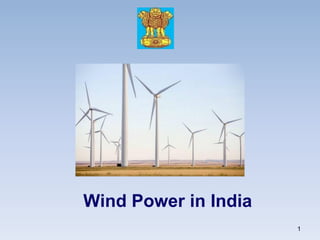
Wind Power in India
1
3
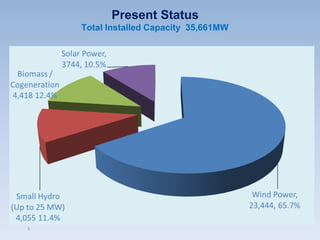
Present Status
Total Installed Capacity 35,661MW
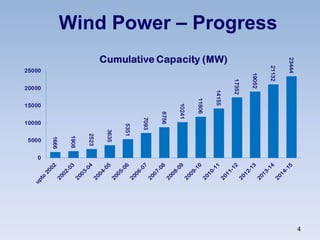
Wind Power – Progress
4
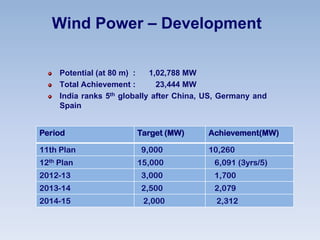
Wind Power – Development
Potential (at 80 m) : 1,02,788 MW
Total Achievement : 23,444 MW
India ranks 5th globally after China, US, Germany and
Spain
Period Target (MW) Achievement(MW)
11th Plan 9,000 10,260
12th Plan 15,000 6,091 (3yrs/5)
2012-13 3,000 1,700
2013-14 2,500 2,079
2014-15 2,000 2,312
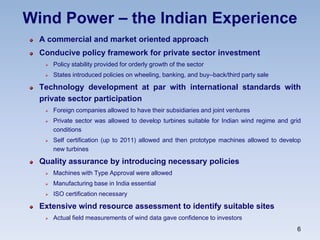
Wind Power – the Indian Experience
A commercial and market oriented approach
Conducive policy framework for private sector investment
 Policy stability provided for orderly growth of the sector
 States introduced policies on wheeling, banking, and buy–back/third party sale
Technology development at par with international standards with
private sector participation
 Foreign companies allowed to have their subsidiaries and joint ventures
 Private sector was allowed to develop turbines suitable for Indian wind regime and grid
conditions
 Self certification (up to 2011) allowed and then prototype machines allowed to develop
new turbines
Quality assurance by introducing necessary policies
 Machines with Type Approval were allowed
 Manufacturing base in India essential
 ISO certification necessary
Extensive wind resource assessment to identify suitable sites
 Actual field measurements of wind data gave confidence to investors
6
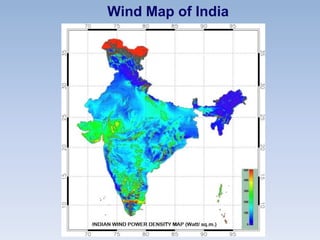
Wind Map of India
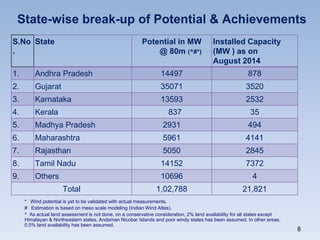
State-wise break-up of Potential & Achievements
S.No
.
State Potential in MW
@ 80m (^#*)
Installed Capacity
(MW ) as on
August 2014
1. Andhra Pradesh 14497 878
2. Gujarat 35071 3520
3. Karnataka 13593 2532
4. Kerala 837 35
5. Madhya Pradesh 2931 494
6. Maharashtra 5961 4141
7. Rajasthan 5050 2845
8. Tamil Nadu 14152 7372
9. Others 10696 4
Total 1,02,788 21,821
* Wind potential is yet to be validated with actual measurements.
# Estimation is based on meso scale modeling (Indian Wind Atlas).
^ As actual land assessment is not done, on a conservative consideration, 2% land availability for all states except
Himalayan & Northeastern states, Andaman Nicobar Islands and poor windy states has been assumed. In other areas,
0.5% land availability has been assumed.
8
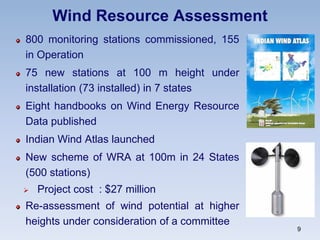
Wind Resource Assessment
800 monitoring stations commissioned, 155
in Operation
75 new stations at 100 m height under
installation (73 installed) in 7 states
Eight handbooks on Wind Energy Resource
Data published
Indian Wind Atlas launched
New scheme of WRA at 100m in 24 States
(500 stations)
 Project cost : $27 million
Re-assessment of wind potential at higher
heights under consideration of a committee
9
India – IEA vs GWEO Scenarios
IEA New Policies Scenario (2011): 32 GW (2020)
GWEO (2012) Moderate Scenario: 31.4 GW (2015) and
59 GW (2020)
GWEO Advanced Scenario: 89 GW (2020) and 124 GW
(2030)
Target of Government: 60 GW by 2022
10
Technology Status in India
Capacity: 250 – 2500 kW
Hub heights: 41– 110 m
Rotor Diameter: 28 – 120 m
Gear and gearless type turbines
State-of-the-art technology available through 20
manufacturers with 58 models of turbines
Export to USA, Europe, South America and Asian
countries
Indigenization: about 70% (in machines up to 500 kW)
Vendor development – parts and components, including
rotor blades, gear boxes, yaw components, nacelle cover,
raw material for blades, being manufactured
Cost of Indian wind turbines lowest in the world
RE Incentives
TAX
 Investment Tax Credits
 Investment Allowances
 Accelerated Depreciation
 Tax Holidays
 Exemptions/Deductions
NON TAX
 Feed in Tariff
 Capital Grants
 Production Linked
Incentives
 R&D Funding Support
 Rebates on Equipment
 Land Facilitation
 Low Cost Financing
12
Generation Based Incentive
GBI over and above the Feed-in Tariff
GBI and AD available in mutually
exclusive manner
GBI - Rs.0.50/kWh subject to max Rs.
1.00 crore/MW
Duration: > 4 years and < 10 years
Captive producers allowed but open
access (merchant power) not allowed.
Effective retrospectively from 01.04.2012
4,900 MW installed through GBI
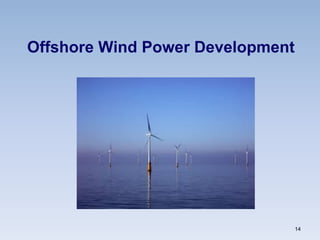
Offshore Wind Power Development
14
Background
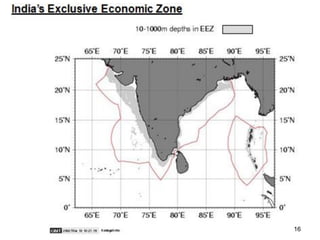
India’s coastline of 7600 KM and Exclusive Economic Zone of over
2.3 million sq. km provides good potential for offshore wind power
development.
Off-shore Wind Energy Steering Committee (OWESC) was
constituted in 2012 to suggest policy frame work and inter-agency
coordination.
National Consultation to discuss draft policy and its provisions with
investors, manufacturers, PSUs and related Ministries & Agencies
from Union and State Governments organized by MNRE on 14th
August 2013.
Ministry of New & Renewable Energy (MNRE) has prepared and
issued draft National Offshore Wind Energy Policy.
15
16
Main Features of Proposed Policy
National Institute of Wind Energy (NIWE)- single window agency
NIWE to coordinate with CERC and SERCs for tariff setting and
regulatory issues
EIA study of proposed offshore wind farms regarding aquatic life,
fisheries, avian life, archaeological remains, etc. to be conducted
by the developer
Oceanographic studies to determine construction costs for special
foundations, special vessels for construction and O&M
requirements.
Sea Bed Lease Arrangements.
Fiscal and Financial Incentives 17
Key Initiatives
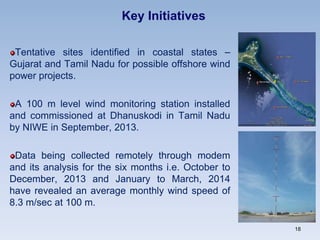
Tentative sites identified in coastal states –
Gujarat and Tamil Nadu for possible offshore wind
power projects.
A 100 m level wind monitoring station installed
and commissioned at Dhanuskodi in Tamil Nadu
by NIWE in September, 2013.
Data being collected remotely through modem
and its analysis for the six months i.e. October to
December, 2013 and January to March, 2014
have revealed an average monthly wind speed of
8.3 m/sec at 100 m.
18
Demonstration Offshore Wind Power Project - proposed
Potential sites, i.e., Porbander & Cambay Basin (Gujarat) and
Rameswaram & Kanyakumari (Tamil Nadu) are being considered for
demonstration project.
Parameters being considered are
 Within 20 km from sea coast/port
 Average water depth < 25 m
 Average wind speed > 6.5 m/sec at 50 m height
 Outside oil and gas activity zone, marine protected areas, submarine
power and communication channels, air traffic, free from security
considerations, cyclone zone and in low risk earthquake zone.
 Within 20 km from onshore substation
MoU for setting up of Joint Venture Company for first demonstration wind
power project signed with NTPC, POWERGRID, PFC, PTC, GPCL, NIWE
and IREDA on 01.10.2014
19
National Wind Energy Mission
TARGET: 60 GW by 2022
• Utility Scale On-shore Wind: 58000 MW
• Offshore Wind: 1500 MW
• Distributed Power: 500 MW
Need an additional 37 GW in next 7 years
20
Investment and Financing Scenario
• 100% FDI
• $12.3 billion invested in India in 2011-12
• Highest in wind - $4.6 billion in 2011 (though solar is
catching up)
• Financing available through diverse mix of debt and
equity options; asset financing
• Also through IREDA, PFC, REC
• Advent of IPPs helping establish project financing as an
avenue
• Domestic banks considering non-recourse financing
21
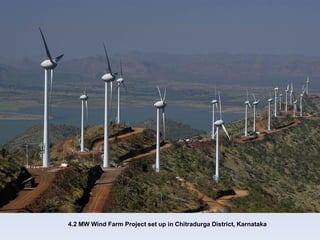
4.2 MW Wind Farm Project set up in Chitradurga District, Karnataka
Thank you
I invite you to
“Make in India”
- Prime Minister Narendra Modi
23

Wind Energy - Make In India, 2015

  • 1.
  • 3.
  • 4.
    Wind Power –Progress 4
  • 5.
    Wind Power –Development Potential (at 80 m) : 1,02,788 MW Total Achievement : 23,444 MW India ranks 5th globally after China, US, Germany and Spain Period Target (MW) Achievement(MW) 11th Plan 9,000 10,260 12th Plan 15,000 6,091 (3yrs/5) 2012-13 3,000 1,700 2013-14 2,500 2,079 2014-15 2,000 2,312
  • 6.
    Wind Power –the Indian Experience A commercial and market oriented approach Conducive policy framework for private sector investment  Policy stability provided for orderly growth of the sector  States introduced policies on wheeling, banking, and buy–back/third party sale Technology development at par with international standards with private sector participation  Foreign companies allowed to have their subsidiaries and joint ventures  Private sector was allowed to develop turbines suitable for Indian wind regime and grid conditions  Self certification (up to 2011) allowed and then prototype machines allowed to develop new turbines Quality assurance by introducing necessary policies  Machines with Type Approval were allowed  Manufacturing base in India essential  ISO certification necessary Extensive wind resource assessment to identify suitable sites  Actual field measurements of wind data gave confidence to investors 6
  • 7.
  • 8.
    State-wise break-up ofPotential & Achievements S.No . State Potential in MW @ 80m (^#*) Installed Capacity (MW ) as on August 2014 1. Andhra Pradesh 14497 878 2. Gujarat 35071 3520 3. Karnataka 13593 2532 4. Kerala 837 35 5. Madhya Pradesh 2931 494 6. Maharashtra 5961 4141 7. Rajasthan 5050 2845 8. Tamil Nadu 14152 7372 9. Others 10696 4 Total 1,02,788 21,821 * Wind potential is yet to be validated with actual measurements. # Estimation is based on meso scale modeling (Indian Wind Atlas). ^ As actual land assessment is not done, on a conservative consideration, 2% land availability for all states except Himalayan & Northeastern states, Andaman Nicobar Islands and poor windy states has been assumed. In other areas, 0.5% land availability has been assumed. 8
  • 9.
    Wind Resource Assessment 800monitoring stations commissioned, 155 in Operation 75 new stations at 100 m height under installation (73 installed) in 7 states Eight handbooks on Wind Energy Resource Data published Indian Wind Atlas launched New scheme of WRA at 100m in 24 States (500 stations)  Project cost : $27 million Re-assessment of wind potential at higher heights under consideration of a committee 9
  • 10.
    India – IEAvs GWEO Scenarios IEA New Policies Scenario (2011): 32 GW (2020) GWEO (2012) Moderate Scenario: 31.4 GW (2015) and 59 GW (2020) GWEO Advanced Scenario: 89 GW (2020) and 124 GW (2030) Target of Government: 60 GW by 2022 10
  • 11.
    Technology Status inIndia Capacity: 250 – 2500 kW Hub heights: 41– 110 m Rotor Diameter: 28 – 120 m Gear and gearless type turbines State-of-the-art technology available through 20 manufacturers with 58 models of turbines Export to USA, Europe, South America and Asian countries Indigenization: about 70% (in machines up to 500 kW) Vendor development – parts and components, including rotor blades, gear boxes, yaw components, nacelle cover, raw material for blades, being manufactured Cost of Indian wind turbines lowest in the world
  • 12.
    RE Incentives TAX  InvestmentTax Credits  Investment Allowances  Accelerated Depreciation  Tax Holidays  Exemptions/Deductions NON TAX  Feed in Tariff  Capital Grants  Production Linked Incentives  R&D Funding Support  Rebates on Equipment  Land Facilitation  Low Cost Financing 12
  • 13.
    Generation Based Incentive GBIover and above the Feed-in Tariff GBI and AD available in mutually exclusive manner GBI - Rs.0.50/kWh subject to max Rs. 1.00 crore/MW Duration: > 4 years and < 10 years Captive producers allowed but open access (merchant power) not allowed. Effective retrospectively from 01.04.2012 4,900 MW installed through GBI
  • 14.
    Offshore Wind PowerDevelopment 14
  • 15.
    Background India’s coastline of7600 KM and Exclusive Economic Zone of over 2.3 million sq. km provides good potential for offshore wind power development. Off-shore Wind Energy Steering Committee (OWESC) was constituted in 2012 to suggest policy frame work and inter-agency coordination. National Consultation to discuss draft policy and its provisions with investors, manufacturers, PSUs and related Ministries & Agencies from Union and State Governments organized by MNRE on 14th August 2013. Ministry of New & Renewable Energy (MNRE) has prepared and issued draft National Offshore Wind Energy Policy. 15
  • 16.
  • 17.
    Main Features ofProposed Policy National Institute of Wind Energy (NIWE)- single window agency NIWE to coordinate with CERC and SERCs for tariff setting and regulatory issues EIA study of proposed offshore wind farms regarding aquatic life, fisheries, avian life, archaeological remains, etc. to be conducted by the developer Oceanographic studies to determine construction costs for special foundations, special vessels for construction and O&M requirements. Sea Bed Lease Arrangements. Fiscal and Financial Incentives 17
  • 18.
    Key Initiatives Tentative sitesidentified in coastal states – Gujarat and Tamil Nadu for possible offshore wind power projects. A 100 m level wind monitoring station installed and commissioned at Dhanuskodi in Tamil Nadu by NIWE in September, 2013. Data being collected remotely through modem and its analysis for the six months i.e. October to December, 2013 and January to March, 2014 have revealed an average monthly wind speed of 8.3 m/sec at 100 m. 18
  • 19.
    Demonstration Offshore WindPower Project - proposed Potential sites, i.e., Porbander & Cambay Basin (Gujarat) and Rameswaram & Kanyakumari (Tamil Nadu) are being considered for demonstration project. Parameters being considered are  Within 20 km from sea coast/port  Average water depth < 25 m  Average wind speed > 6.5 m/sec at 50 m height  Outside oil and gas activity zone, marine protected areas, submarine power and communication channels, air traffic, free from security considerations, cyclone zone and in low risk earthquake zone.  Within 20 km from onshore substation MoU for setting up of Joint Venture Company for first demonstration wind power project signed with NTPC, POWERGRID, PFC, PTC, GPCL, NIWE and IREDA on 01.10.2014 19
  • 20.
    National Wind EnergyMission TARGET: 60 GW by 2022 • Utility Scale On-shore Wind: 58000 MW • Offshore Wind: 1500 MW • Distributed Power: 500 MW Need an additional 37 GW in next 7 years 20
  • 21.
    Investment and FinancingScenario • 100% FDI • $12.3 billion invested in India in 2011-12 • Highest in wind - $4.6 billion in 2011 (though solar is catching up) • Financing available through diverse mix of debt and equity options; asset financing • Also through IREDA, PFC, REC • Advent of IPPs helping establish project financing as an avenue • Domestic banks considering non-recourse financing 21
  • 22.
    4.2 MW WindFarm Project set up in Chitradurga District, Karnataka
  • 23.
    Thank you I inviteyou to “Make in India” - Prime Minister Narendra Modi 23