VISION FOR EUROPEAN ELECTRICITY MARKETS IN 2030–Vision for the marketmodel of integratedEuropeanelectricitymarkets–
Researchproject
Background:
Electricitymarkets
Energy policy of the EU
Developmentpatterns of electricitymarkets
Market models
Wholesale electricitymarkets
Retailelectricitymarkets
Scanning for the future
Forming the vision
Description of the vision
ConclusionsContents
Vision for European Electricity Markets in 2030 – research projectCarried out between April 2010 and April 2011 at Lappeenranta University of Technology
Commissioned by the Finnish Energy Industries (ET), the Finnish Electricity Research Pool, SuomenElFiOy, the Finnish Forest Industries Federation, the Federation of Finnish Technology Industries and Nord Pool Spot AS
The objective of the research project was to establish a vision of the future electricity market model in Europe
Efficient, responds to the climate challenge and guarantees the security supply of electricity in sustainable and economic way
In this research project
In the literary research, the international electricity market models were studied
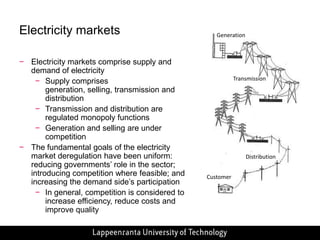
Different interest group meetings, workshops and surveys were organized to establish the prospects of electricity marketsElectricitymarketsGenerationTransmissionDistributionCustomerElectricity markets comprise supply and demand of electricitySupply comprises generation, selling, transmission and distributionTransmission and distribution are regulated monopoly functionsGeneration and selling are under competitionThe fundamental goals of the electricity market deregulation have been uniform: reducing governments’ role in the sector; introducing competition where feasible; and increasing the demand side’s participationIn general, competition is considered to increase efficiency, reduce costs and improve quality
ElectricitymarketsSpecial features of electricity markets:Generation and consumption must be balanced all the timeStoring of electricity economically in large quantities is not yet possibleTransmission networks define market modelTransmission networks enbale the transmission of electricity from lower price area to higher price areaIf electricity can be transmitted almost always like desired, it can be said, that ”the electric power networks provides a market place for electricity”If transmission connections are repeatedly congested and prevent the flow of power in desired direction in the market area, the need to find tools to control the system congestions starts to dictate the design of the market model
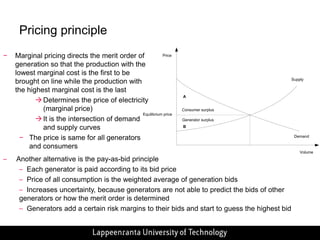
PricingprincipleMarginal pricing directs the merit order of generation so that the production with the lowest marginal cost is the first to be brought on line while the production with the highest marginal cost is the lastDetermines the price of electricity (marginal price)
It is the intersection of demand and supply curvesThe price is same for all generators and consumers     Another alternative is the pay-as-bid principle
  Each generator is paid according to its bid price
  Price of all consumption is the weighted average of generation bids
  Increases uncertainty, because generators are not able to predict the bids of other   generators or how the merit order is determined
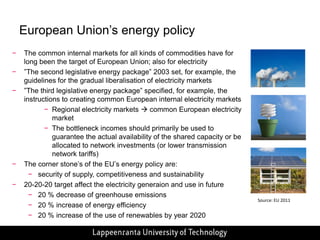
  Generators add a certain risk margins to their bids and start to guess the highest bid European Union’s energy policyThe common internal markets for all kinds of commodities have for long been the target of European Union; also for electricity ”The second legislative energy package” 2003 set, for example, the guidelines for the gradual liberalisation of electricity markets ”The third legislative energy package” specified, for example, the instructions to creating common European internal electricity marketsRegional electricity markets  common European electricity marketThe bottleneck incomes should primarily be used to guarantee the actual availability of the shared capacity or be allocated to network investments (or lower transmission network tariffs)The corner stone’s of the EU’s energy policy are: security of supply, competitiveness and sustainability20-20-20 target affect the electricity generaion and use in future20 % decrease of greenhouse emissions20 % increase of energy efficiency20 % increase of the use of renewables by year 2020Source: EU 2011
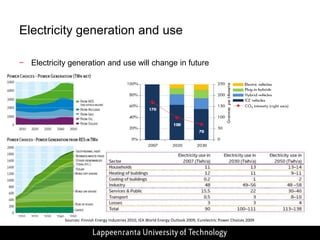
Electricitygeneration and useElectricitygeneration and usewillchange in futureSources: Finnish Energy Industries 2010, IEA World Energy Outlook 2009, Eurelectric Power Choices 2009
Developmentpatterns of electricitymarkets
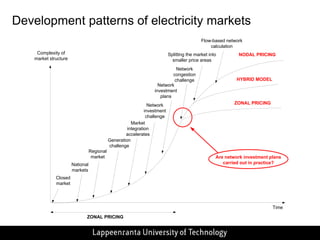
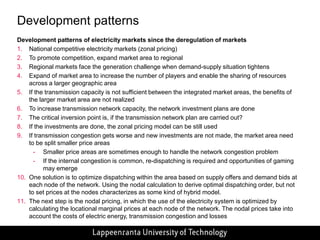
DevelopmentpatternsDevelopmentpatterns of electricitymarketssince the deregulation of marketsNational competitiveelectricitymarkets (zonalpricing)To promotecompetition, expandmarketarea to regionalRegionalmarketsface the generationchallengewhendemand-supplysituationtightensExpand of marketarea to increase the number of players and enable the sharing of resourcesacross a largergeographicareaIf the transmission capacity is notsufficientbetween the integratedmarketareas, the benefits of the largermarketareaarenotrealizedTo increase transmission networkcapacity, the networkinvestmentplansaredoneThe critical inversion point is, if the transmission networkplanarecarried out? If the investmentsaredone, the zonalpricingmodelcanbestillusedIf transmission congestiongetsworse and new investmentsarenot made, the marketareaneed to besplitsmallerpriceareasSmallerpriceareasaresometimesenough to handle the networkcongestionproblem
If the internalcongestion is common, re-dispatching is required and opportunities of gamingmayemergeOne solution is to optimize dispatching within the area based on supply offers and demand bids at each node of the network. Using the nodal calculation to derive optimal dispatching order, but not to set prices at the nodes characterizes as some kind of hybrid model.The nextstep is the nodalpricing, in which the use of the electricity system is optimized by calculating the locational marginal prices at each node of the network. The nodal prices take into account the costs of electric energy, transmission congestion and losses
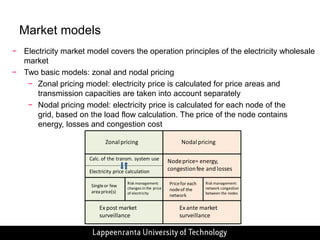
Market modelsElectricity market model covers the operation principles of the electricity wholesale marketTwo basic models: zonal and nodal pricingZonal pricing model: electricity price is calculated for price areas and transmission capacities are taken into account separatelyNodal pricing model: electricity price is calculated for each node of the grid, based on the load flow calculation. The price of the node contains energy, losses and congestion cost
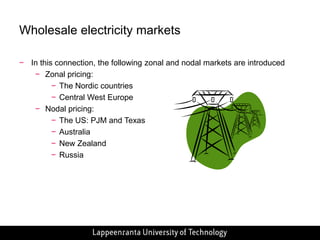
Wholesale electricitymarketsIn thisconnection, the followingzonal and nodalmarketsareintroducedZonalpricing:The NordiccountriesCentral West EuropeNodalpricing:The US: PJM and TexasAustraliaNew ZealandRussia
The Nordiccountries and CWEIn this connection, the Nordic countries refers Finland, Sweden, Norway and DenmarkCentral West Europe refers France, the Netherlands, Belgium and Germany (CWE area)EU legislation guides the development of the regional markets and common market modelBoth regions uses the zonal pricing model; In the Nordic countries market splitting mechanism (one power exchange; one system price and when cross-border transmissions capacity is congested splitting to price areas)
In the CWE area market coupling mechanism (couple exchanges; first calculating area prices and if transmission capacity allows unifying the price areas)Betweeen the Nordic countries and CWE area there are market based tradingPrimary forms of generation in the Nordic countries: hydro, nuclear, coal, gas and wind Electricity consumption is about 400 TWh in year and average system price 53 €/MWh (2010)Primary forms of generation in the CWE area: coal, nuclear, renewables and oilElectricity consumption is about 1267 TWh in year and average spot price 50-70 €/MWh
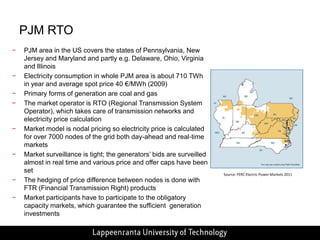
PJM RTOPJM area in the US covers the states of Pennsylvania, New Jersey and Maryland and partly e.g. Delaware, Ohio, Virginia and IllinoisElectricity consumption in whole PJM area is about 710 TWh in year and average spot price 40 €/MWh (2009)Primary forms of generation are coal and gasThe market operator is RTO (Regional Transmission System Operator), which takes care of transmission networks and electricity price calculationMarket model is nodal pricing so electricity price is calculated for over 7000 nodes of the grid both day-ahead and real-time marketsMarket surveillance is tight; the generators’ bids are surveilled almost in real time and various price and offer caps have been setThe hedging of price difference between nodes is done with FTR (Financial Transmission Right) productsMarket participants have to participate to the obligatory capacity markets, which guarantee the sufficient  generation investments Source: FERC Electric Power Markets 2011
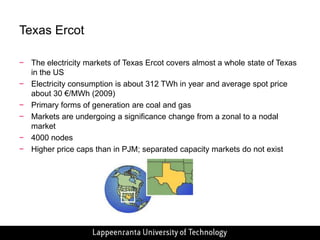
Texas ErcotThe electricitymarkets of Texas Ercotcoversalmost a wholestate of Texas in the USElectricityconsumption is about 312 TWh in year and averagespotpriceabout 30 €/MWh (2009)Primaryforms of generationarecoal and gasMarkets areundergoing a significancechangefrom a zonal to a nodalmarket4000 nodesHigherpricecapsthanin PJM; separatedcapacitymarketsdonotexist
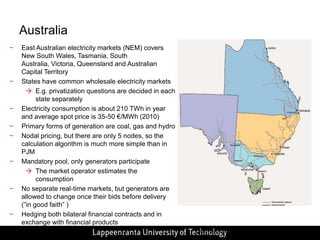
AustraliaEast Australian electricity markets (NEM) covers New South Wales, Tasmania, South Australia, Victoria, Queensland and Australian Capital TerritoryStates have common wholesale electricity marketsE.g. privatization questions are decided in each state separatelyElectricity consumption is about 210 TWh in year and average spot price is 35-50 €/MWh (2010)Primary forms of generation are coal, gas and hydroNodal pricing, but there are only 5 nodes, so the calculation algorithm is much more simple than in PJMMandatory pool, only generators participate The market operator estimates the consumptionNo separate real-time markets, but generators are allowed to change once their bids before delivery (”in good faith” )Hedging both bilateral financial contracts and in exchange with financial productsLähde: AER 2009

Electricity market 2030_presentation_long_new

  • 2.
    VISION FOR EUROPEANELECTRICITY MARKETS IN 2030–Vision for the marketmodel of integratedEuropeanelectricitymarkets–
  • 3.
  • 4.
  • 5.
  • 6.
  • 7.
  • 8.
  • 9.
  • 10.
  • 11.
  • 12.
  • 13.
  • 14.
  • 15.
    Vision for EuropeanElectricity Markets in 2030 – research projectCarried out between April 2010 and April 2011 at Lappeenranta University of Technology
  • 16.
    Commissioned by theFinnish Energy Industries (ET), the Finnish Electricity Research Pool, SuomenElFiOy, the Finnish Forest Industries Federation, the Federation of Finnish Technology Industries and Nord Pool Spot AS
  • 17.
    The objective ofthe research project was to establish a vision of the future electricity market model in Europe
  • 18.
    Efficient, responds tothe climate challenge and guarantees the security supply of electricity in sustainable and economic way
  • 19.
  • 20.
    In the literaryresearch, the international electricity market models were studied
  • 21.
    Different interest groupmeetings, workshops and surveys were organized to establish the prospects of electricity marketsElectricitymarketsGenerationTransmissionDistributionCustomerElectricity markets comprise supply and demand of electricitySupply comprises generation, selling, transmission and distributionTransmission and distribution are regulated monopoly functionsGeneration and selling are under competitionThe fundamental goals of the electricity market deregulation have been uniform: reducing governments’ role in the sector; introducing competition where feasible; and increasing the demand side’s participationIn general, competition is considered to increase efficiency, reduce costs and improve quality
  • 22.
    ElectricitymarketsSpecial features ofelectricity markets:Generation and consumption must be balanced all the timeStoring of electricity economically in large quantities is not yet possibleTransmission networks define market modelTransmission networks enbale the transmission of electricity from lower price area to higher price areaIf electricity can be transmitted almost always like desired, it can be said, that ”the electric power networks provides a market place for electricity”If transmission connections are repeatedly congested and prevent the flow of power in desired direction in the market area, the need to find tools to control the system congestions starts to dictate the design of the market model
  • 23.
    PricingprincipleMarginal pricing directsthe merit order of generation so that the production with the lowest marginal cost is the first to be brought on line while the production with the highest marginal cost is the lastDetermines the price of electricity (marginal price)
  • 24.
    It is theintersection of demand and supply curvesThe price is same for all generators and consumers Another alternative is the pay-as-bid principle
  • 25.
    Eachgenerator is paid according to its bid price
  • 26.
    Priceof all consumption is the weighted average of generation bids
  • 27.
    Increasesuncertainty, because generators are not able to predict the bids of other generators or how the merit order is determined
  • 28.
    Generatorsadd a certain risk margins to their bids and start to guess the highest bid European Union’s energy policyThe common internal markets for all kinds of commodities have for long been the target of European Union; also for electricity ”The second legislative energy package” 2003 set, for example, the guidelines for the gradual liberalisation of electricity markets ”The third legislative energy package” specified, for example, the instructions to creating common European internal electricity marketsRegional electricity markets  common European electricity marketThe bottleneck incomes should primarily be used to guarantee the actual availability of the shared capacity or be allocated to network investments (or lower transmission network tariffs)The corner stone’s of the EU’s energy policy are: security of supply, competitiveness and sustainability20-20-20 target affect the electricity generaion and use in future20 % decrease of greenhouse emissions20 % increase of energy efficiency20 % increase of the use of renewables by year 2020Source: EU 2011
  • 29.
    Electricitygeneration and useElectricitygenerationand usewillchange in futureSources: Finnish Energy Industries 2010, IEA World Energy Outlook 2009, Eurelectric Power Choices 2009
  • 30.
  • 31.
    DevelopmentpatternsDevelopmentpatterns of electricitymarketssincethe deregulation of marketsNational competitiveelectricitymarkets (zonalpricing)To promotecompetition, expandmarketarea to regionalRegionalmarketsface the generationchallengewhendemand-supplysituationtightensExpand of marketarea to increase the number of players and enable the sharing of resourcesacross a largergeographicareaIf the transmission capacity is notsufficientbetween the integratedmarketareas, the benefits of the largermarketareaarenotrealizedTo increase transmission networkcapacity, the networkinvestmentplansaredoneThe critical inversion point is, if the transmission networkplanarecarried out? If the investmentsaredone, the zonalpricingmodelcanbestillusedIf transmission congestiongetsworse and new investmentsarenot made, the marketareaneed to besplitsmallerpriceareasSmallerpriceareasaresometimesenough to handle the networkcongestionproblem
  • 32.
    If the internalcongestionis common, re-dispatching is required and opportunities of gamingmayemergeOne solution is to optimize dispatching within the area based on supply offers and demand bids at each node of the network. Using the nodal calculation to derive optimal dispatching order, but not to set prices at the nodes characterizes as some kind of hybrid model.The nextstep is the nodalpricing, in which the use of the electricity system is optimized by calculating the locational marginal prices at each node of the network. The nodal prices take into account the costs of electric energy, transmission congestion and losses
  • 33.
    Market modelsElectricity marketmodel covers the operation principles of the electricity wholesale marketTwo basic models: zonal and nodal pricingZonal pricing model: electricity price is calculated for price areas and transmission capacities are taken into account separatelyNodal pricing model: electricity price is calculated for each node of the grid, based on the load flow calculation. The price of the node contains energy, losses and congestion cost
  • 34.
    Wholesale electricitymarketsIn thisconnection,the followingzonal and nodalmarketsareintroducedZonalpricing:The NordiccountriesCentral West EuropeNodalpricing:The US: PJM and TexasAustraliaNew ZealandRussia
  • 35.
    The Nordiccountries andCWEIn this connection, the Nordic countries refers Finland, Sweden, Norway and DenmarkCentral West Europe refers France, the Netherlands, Belgium and Germany (CWE area)EU legislation guides the development of the regional markets and common market modelBoth regions uses the zonal pricing model; In the Nordic countries market splitting mechanism (one power exchange; one system price and when cross-border transmissions capacity is congested splitting to price areas)
  • 36.
    In the CWEarea market coupling mechanism (couple exchanges; first calculating area prices and if transmission capacity allows unifying the price areas)Betweeen the Nordic countries and CWE area there are market based tradingPrimary forms of generation in the Nordic countries: hydro, nuclear, coal, gas and wind Electricity consumption is about 400 TWh in year and average system price 53 €/MWh (2010)Primary forms of generation in the CWE area: coal, nuclear, renewables and oilElectricity consumption is about 1267 TWh in year and average spot price 50-70 €/MWh
  • 37.
    PJM RTOPJM areain the US covers the states of Pennsylvania, New Jersey and Maryland and partly e.g. Delaware, Ohio, Virginia and IllinoisElectricity consumption in whole PJM area is about 710 TWh in year and average spot price 40 €/MWh (2009)Primary forms of generation are coal and gasThe market operator is RTO (Regional Transmission System Operator), which takes care of transmission networks and electricity price calculationMarket model is nodal pricing so electricity price is calculated for over 7000 nodes of the grid both day-ahead and real-time marketsMarket surveillance is tight; the generators’ bids are surveilled almost in real time and various price and offer caps have been setThe hedging of price difference between nodes is done with FTR (Financial Transmission Right) productsMarket participants have to participate to the obligatory capacity markets, which guarantee the sufficient generation investments Source: FERC Electric Power Markets 2011
  • 38.
    Texas ErcotThe electricitymarketsof Texas Ercotcoversalmost a wholestate of Texas in the USElectricityconsumption is about 312 TWh in year and averagespotpriceabout 30 €/MWh (2009)Primaryforms of generationarecoal and gasMarkets areundergoing a significancechangefrom a zonal to a nodalmarket4000 nodesHigherpricecapsthanin PJM; separatedcapacitymarketsdonotexist
  • 39.
    AustraliaEast Australian electricitymarkets (NEM) covers New South Wales, Tasmania, South Australia, Victoria, Queensland and Australian Capital TerritoryStates have common wholesale electricity marketsE.g. privatization questions are decided in each state separatelyElectricity consumption is about 210 TWh in year and average spot price is 35-50 €/MWh (2010)Primary forms of generation are coal, gas and hydroNodal pricing, but there are only 5 nodes, so the calculation algorithm is much more simple than in PJMMandatory pool, only generators participate The market operator estimates the consumptionNo separate real-time markets, but generators are allowed to change once their bids before delivery (”in good faith” )Hedging both bilateral financial contracts and in exchange with financial productsLähde: AER 2009