Yearbook of Global
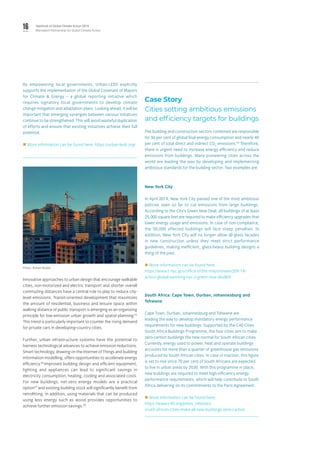
Climate Action 2019
Marrakech Partnership for Global Climate Action
Global
Climate
Action Global Climate Action
© 2019 United Nations Climate Change Secretariat
All rights reserved.
This publication is issued for public information purposes and
is not an official text of the Convention in any legal or technical
sense. Unless otherwise noted in captions or graphics all matter
may be freely reproduced in part or in full, provided the source
is acknowledged.
For further information contact
United Nations Climate Change Secretariat
Platz der Vereinten Nationen 1
53113 Bonn, Germany
Telephone +49 228 815 10 00
Telefax +49 228 815 19 99
For more information, please visit:
<climateaction2020.unfccc.int>
ISBN 978-92-9219-186-3
Designed by Phoenix Design Aid A/S
Yearbook of Global
Climate Action 2019
Marrakech Partnership for Global Climate Action
ii Yearbook of Global Climate Action 2019
Marrakech Partnership for Global Climate Action
Patricia Espinosa
Executive Secretary of the UNFCCC
Foreword
The Paris Agreement was an unprecedented turning point in the
global struggle against climate change. It was a commitment
by nations of the world that, for the first time, they would
work together to combat climate change, adapt to its effects
and assist developing countries in doing the same. It was a
multilateral success, charted a new course, and offered both
hope and action to people of the world.
Parties to the Agreement recognized, however, that
governments alone could not solve the climate crisis. They
recognized that overcoming this struggle, the defining challenge
of our generation, needed the broad engagement of civil society;
of businesses, investors, regions, cities, local governments
and everyday people. The Marrakech Partnership was created
to bring together the work of these groups—strengthening
collaboration between governments and key stakeholders to
immediately lower emissions and increase resilience against
climate impacts.
Since that first step, global climate action throughout the world
has increased exponentially. There have been examples of
practical action, stories of captured opportunity and lessons
learned that are adaptable throughout the planet. They are also
often inspiring, acting as beacons guiding other businesses and
groups to follow.
The 2019 Yearbook of Global Climate Action, like editions
preceding it, brings this knowledge and these success
stories together to inform policymakers as they prepare for
the upcoming global climate negotiations in Madrid. This is,
however, more than a compendium of examples and inspiring
stories—it’s a valuable source of information and a tool for
policymakers looking for ways to incentivize climate-friendly
action and draw economies and people away from climate-
harming activities.
While the lessons contained within the Yearbook are numerous,
the importance of coordination is paramount. On one level,
coordination is about avoiding duplication of efforts—ensuring
time and resources are not wasted by two or more groups doing
the same work. On another level, coordination is about aligning
policies, programs and services in a climate-positive direction.
This could mean, in some cases, aligning business goals with
the Paris Agreement, or ensuring government policies related to
climate change are not restricted to one department or ministry
alone; that they are truly cross-cutting and, ultimately, effective.
Another lesson that stands out in this Yearbook is related to
incentives. It underlines what should already be clear—we need
to rapidly begin making the transition away from subsidies and
incentives for fossil fuel-related areas and towards renewable
and sustainable solutions. At the same time, while this transition
is both necessary and urgent, we must also recognize that this
must be a just transition, that takes into consideration those
people—their jobs and their families—who will ultimately be
affected.
iii
Yet another critical ingredient is finance. While coordination,
aspiration and personal action are vital to our collective success
in addressing climate change, global large-scale efforts to
address it often requires the proper financing to do so. While
Parties must dedicate the proper resources both domestically
and internationally to address climate change, Non-Party
stakeholders need clear signals, access to finance, and a
receptive home for their innovative approaches to finance.
Finally, the Yearbook highlights, as well, the role that each of
us can and needs to play in reducing emissions. Our choices
matter. Climate-thoughtful choices add up to meaningful
levels of ambition, especially when markets and policymakers
recognize these actions and reflect them in products, policy and
programmes.
The bottom line is that active participation by all of us—
governments, businesses, investors, regions and more—is
needed if we are to face and overcome the climate emergency
we currently face. We have an extremely short window remaining
to make the changes that can ultimately change our current
trajectory. Together, we must reach a climate-neutral economy
by 2050, stabilize global temperatures at 1.5C by the end of the
century and provide for sustainable development.
We will not get there alone. I call upon all Parties and non-Party
Stakeholders to utilize the valuable information contained
within this Yearbook to not only inform their deliberations at
COP25, but to apply it at home following the conclusion of the
negotiations. We have no more time to waste.
Let us never forget that the Paris Agreement was more than
a good idea, it was a covenant of hope with the people of the
world. It is our ultimate responsibility to unleash its potential,
fulfil its promise, and build a cleaner and greener and more
prosperous future for us all.
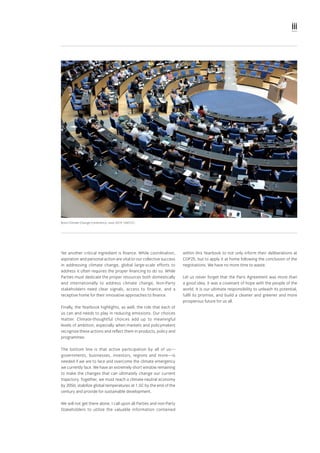
Bonn Climate Change Conference, June 2019: UNFCCC.
iv Yearbook of Global Climate Action 2019
Marrakech Partnership for Global Climate Action
In their historic agreement in Paris in 2015, Parties recognized
the urgent need to scale up the global response to climate
change and support greater ambition from governments.
They also recognized the role and ongoing efforts of non-Party
stakeholders.
In 2018, with the Intergovernmental Panel on Climate Change
Special Report on Global Warming of 1.5°C providing further
scientific evidence backing the need for urgency, and countries
adopting the bulk of the decisions implementing the Paris
Agreement, we entered a new era of ambition and action.
The focus now must be on systems change—environmental,
economic and social—to collectively strive to create a climate-
neutral and resilient world. The Marrakech Partnership for Global
Climate Action is playing an important role in catalyzing action
by both Parties and non-Party stakeholders, working together in
the pre-2020 period, to move towards this safer future.
The climate crisis upon us now requires that countries and
non-Party stakeholders, everyone, step up their climate action.
We are all part of the solution. We must unite behind the
science, working together in the spirt and practice of inclusive
multilateralism, with an intergovernmental process led by Parties
involving all non-party stakeholders in the quest for solutions to
climate change.
The Yearbook reflects work of the High-Level Champions together
with the Marrakech Partnership stakeholders in 2019 to create
Climate Action Pathways that set out clear visions for sectors to
Tomasz Chruszczow
High-Level Climate Champion for Climate Action (Poland)
Foreword
reach the Paris goal. All thematic areas, guided by science, are
working together towards the 1.5-degree goal and creation of a
climate-resilient world. The Yearbook contains synergies, gaps
and opportunities that have been identified, which in turn can be
shared in the newly evolved Global Climate Action Portal.
The Yearbook is a valuable assessment of where we stand with
respect to non-Party action and points to areas where success
might be gained. Thus, it is a valuable resource for policymakers.
Indeed, the Yearbook shows that progress is being made
and that it can be further accelerated with leadership, clarity
and ambition from national governments. If countries in their
nationally determined contributions and national adaptation
plans set ambitious targets and express them clearly, we can
expect further ambitious and effective action from non-Party
stakeholders.
The Yearbook also reminds us again of the importance of
individual behavior—climate-friendly action by each of us could
add up to world-saving trends towards climate neutrality. What
must exist to help this along is smart policy incentives, and the
avoidance and removal of unhelpful policies, such as subsidies
for fossil fuel exploration and production, as difficult as that can
be.
The goals are set, the science is clear, tools are there, and
needed actions are defined—let’s all work together in a holistic
and integrated manner to make the required changes happen.
Gonzalo Muñoz Abogabir
High-Level Climate Champion for Climate Action (Chile)
v
Acknowledgements
This third edition of the Global Climate Action Yearbook was
made possible by contributions from many organizations and
individuals. Special thanks go to the Marrakech Partnership
Thematic Areas who provided insights in to the state of play of
each of their respective areas as well as case stories.
Special thanks to the team who helped prepare the analysis
in Chapter V. The analysis was jointly led by Dr. Sander
Chan (German Development Institute/Deutsches Institut für
Entwicklungspolitik [DIE]; Copernicus Institute of Sustainable
Development at Utrecht University); Dr. Thomas Hale (Blavatnik
School of Government [BSG] at the University of Oxford). Team
members who contributed to the data collection included Malin
Gütschow (DIE), Miriam Lia Cangussu Tomaz Garcia (DIE), Jung
Kian Ng (BSG), Andrew Miner (BSG), Benedetta Nimshani Khawe
Thanthrige (DIE), Sara Posa (DIE), Eugene Tingwey (DIE), James
Tops (DIE). The Analysis was supported by the ClimateSouth
Project (a collaboration between Blavatnik School of Government
at the University of Oxford, the German Development Institute/
Deutsches Institut für Entwicklungspolitik [DIE], The Energy
and Resources Institute [TERI], and the African Centre for
Technology Studies [ACTS]) also made contributions. Data on
output performance of cooperative initiatives was collected with
assistance from the German Development Institute/Deutsches
IRENA's 2016 photo competition: Doran Talmi / Location: Bjørnfjell, Narvik, Norway.
Institut für Entwicklungspolitik (DIE)’s “Klimalog” project,
generously funded by the German Federal Ministry of Economic
Cooperation and Development (BMZ).
The High-Level Champions would also like to thank the UNFCCC
secretariat for their steady support throughout the process of
developing the Yearbook.
vi Yearbook of Global Climate Action 2019
Marrakech Partnership for Global Climate Action
Photo: Ivan Bandura.
vii
Executive summary
Time is running out to keep the global temperature rise below
1.5 degrees Celsius and adapt to the impacts of climate change.
While this reality has been widely acknowledged, global ambition
is still not strong enough and the pace of action is too slow to
achieve the objectives of the Paris Agreement. The Marrakech
Partnership for Global Climate Action was launched at the 22nd
session of the Conference of Parties (COP 22) to bring the power
of non-Party action to the forefront to help increase the pace and
ambition of climate action in the pre-2020 period. In 2019, the
High-Level Champions of the Marrakech Partnership for Global
Climate Action – Tomasz Chruszczow (Poland) and Gonzalo
Muñoz Abogabir (Chile) – built on the collaborative experience
of the Talanoa Dialogue process to promote higher levels of
ambition and innovation, scale up transformational solutions and
support the implementation efforts of a diverse range of actors.
This third Yearbook reflects the state of global climate action
by non-Party stakeholders – defined as businesses, cities and
regions, and civil society – and brings key messages to the
international community to encourage bold and courageous
climate action by Parties and non-Party stakeholders alike.
The Yearbook was produced by the United Nations Framework
Convention on Climate Change (UNFCCC) Secretariat under the
guidance of the High-Level Champions, with the support of the
Marrakech Partnership for Global Climate Action.
Where are we? Delivering action and
building momentum
A multitude of cities, regions, businesses and civil society are
delivering climate action globally. Within this broader context,
the Marrakech Partnership acts to create synergies and links
between its seven thematic areas, which represent areas of
urgent climate action as well as important cross-cutting themes
such as finance and resilience. While each thematic area
has specific opportunities and challenges, successful action
generally advances a range of Sustainable Development Goals
(SDGs). Examples of action highlighted in the Yearbook include
Climate Action 100+, in which 370 investors with over USD 35
trillion in assets collectively ask major corporate emitters to
reduce emissions and address climate risks; the Seacology
initiative to restore mangroves which has cultivated over
800,000 mangrove seedlings and replanted approximately 480
hectares in Sri Lanka to build resilience to the impacts of climate
change, provide carbon storage and protect livelihoods; and
RE100, in which 200 companies have committed to 100 per cent
renewable energy, sending financial signals to the energy sector
to develop renewable energy.
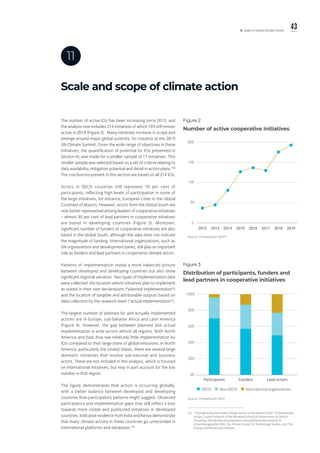
Since 2013, a growing number of international cooperative
initiatives (ICIs) have delivered action that, taken together,
increases the likelihood of achieving desired environmental and
social impacts. Between 2013 and 2019, initiatives (often with
Parties and non-Party actors working together) that achieved
high to medium-high output performance increased from just
over 30 per cent to nearly 70 per cent.
This year, momentum for climate action was built through a
series of regional meetings – the Africa Climate Week in Ghana,
Asia-Pacific Climate Week in Thailand, and Latin America and
Caribbean Climate Week in Brazil. These Climate Weeks served
as critical stepping-stones on the road to the UN Climate Action
Summit in September and provided platforms for grassroots-
level discussions on the SDGs, Global Climate Action, and the
implementation of Nationally Determined Contributions (NDCs).
The Africa Climate Week demonstrated the strong commitment
of African countries to support the implementation of the
Paris Agreement in line with national development priorities,
with appropriate finance being key. Transport was identified
in the Latin America and the Caribbean Week as a significant
emission source to be urgently addressed. Further, the role of
cities as key drivers of climate action was recognized, as was
the need to enable urban development stakeholders (e.g. real
estate developers, financial institutions) to meaningfully engage
with each other. The Asia-Pacific Climate Week sent a message
that the Asia-Pacific region can lead the global transformation
that is needed to achieve the goals of the Paris Agreement.
Participants agreed on the potential of innovative approaches,
including circular economy and nature-based solutions, as
well as data-driven and smart technologies to help the region
reconcile development and growth with climate mitigation and
adaptation goals.
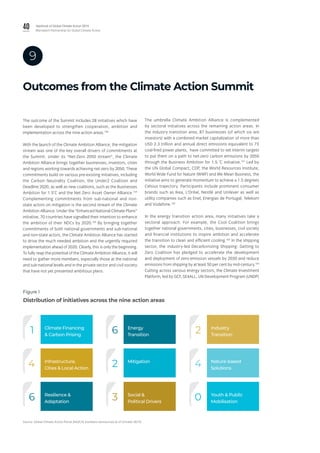
The momentum for increasing ambition continued at the UN
Climate Action Summit in September 2019, with announcements
on 28 initiatives across nine action areas.1
The Climate Ambition Alliance was launched at the summit
with the aim to drive increasing ambition and action through
two streams: “Net-Zero 2050”, bringing together businesses,
investors, cities and regions working towards achieving net-zero
by 2050; and the “Enhanced National Climate Plans” initiative,
in which 70 countries signalled their intention to enhance by
2020 the ambition of their NDCs. The Net-Zero 2050 stream
builds on various initiatives, including the Carbon Neutrality
Coalition, the Under2 Coalition and Deadline 2020, as well as
new coalitions, such as the Businesses Ambition for 1.5˚C and
viii Yearbook of Global Climate Action 2019
Marrakech Partnership for Global Climate Action
the Net-Zero Asset Owner Alliance. To fully reap the potential of
the Climate Ambition Alliance, it will be important to reach out to
those that have not yet presented ambitious commitments. Key
moments for such outreach include COP 25 and events leading
to COP 26. It will also be important to present more concrete and
monitorable plans to achieve the commitments.
Throughout the summit, emphasis was given to the voice of
youth, who called on the world’s leaders to act. Two days ahead
of the political summit, the UN Secretary-General hosted the
Youth Climate Summit, a one-day event that served as a platform
for more than 500 young activists, entrepreneurs and change-
agents to engage with international decision-makers.
What is needed to go further? Support
for implementation, collaboration and
enhanced ambition
It is clear from the analysis of ICIs that they are making progress
towards achieving their goals, including specific targets for
emission reductions. Prior to the UN Climate Action Summit, an
analysis was undertaken of the potential for emission reductions
from a selection of ICIs with high mitigation potential. The
analysis showed that if they deliver on their goals and do not
displace action elsewhere,i
they could close the global emissions
gap to the emissions pathway to 2 degrees Celsius of warming in
2030, although a significant gap would remain for reaching 1.5
degrees Celsius. The new commitments made at the UN Summit
by Parties and non-Party actors increase this potential. The key
now is to act quickly to deliver both the quantitative emission
reductions and the other types of commitments from initiatives.
Despite the increasing scope of action, challenges still exist
to raise ambition sufficiently. The priorities to address these
challenges are as follows:
»» Step up implementation across all thematic areas
to realize multiple benefits.
This Yearbook highlights many practical opportunities and
provides guidance on what is needed to realize these benefits.
Climate action needs to be viewed holistically to realize the
benefits from increased cooperation across sectors and between
actors.
»» Create the conditions needed for non-Party action.
In the short term, governments can remove barriers to
implementation and set incentives for sustainable consumption.
They also have an important role in setting the long-term
direction that drives transformation.
»» Continue and strengthen the Global Climate
Action agenda within the UNFCCC process
post- 2020.
This agenda has helped catalyse climate action at both the local
and global levels and bring the benefits of coordination and
cooperation in terms of increased ambition and action.
»» Align finance flows with finance needs.
Finance is needed to fund the transformation of the economy –
not only additional finance in some areas but also using existing
funds in a smarter way to allow non-Party actors to access the
finance they need.
»» Strengthen the completeness and robustness of
the reporting of results from climate action.
By providing more concrete examples of climate action delivery
and results, others can be inspired to act and governments can
be inspired to greater ambition.
i.	 For example, rather than a country overachieving targets through ambitious actions in one city, another city might take less ambitious action.
ix
Table of Contents
Foreword
Patricia Espinosa, Executive Secretary of the UNFCCC
ii
Foreword
Tomasz Chruszczow, High-Level Climate Champion for Climate Action (Poland)
Gonzalo Muñoz Abogabir, High-Level Climate Champion for Climate Action (Chile)
iv
Acknowledgements v
Executive Summary vii
I. Introduction 1
II. The Thematic and Cross-cutting Areas of the Marrakech
Partnership for Global Climate Action
2
1 Land Use 3
2 Oceans and Coastal Zones 7
3 Water 10
4 Human Settlements 15
5 Transport 19
6 Energy 23
7 Industry 27
8 Climate Finance 32
III. Building Momentum: Regional Engagement on the Road to the
UN Climate Action Summit and Recognition of Achievement
36
Regional Engagements 36
Recognizing achievement 38
IV. The UN Climate Action Summit 39
9 Outcomes from the Climate Action Summit 40
10 Increased ambition 41
V. State of Global Climate Action 42
11 Scale and scope of climate action 43
12 Progress of cooperative initiatives 44
VI. Main Messages from this Yearbook 46
References 48
x Yearbook of Global Climate Action 2019
Marrakech Partnership for Global Climate Action
Photo: Ivan Bandura.
1l. Introduction
Introduction
I.
While momentum for global climate action is rising, we need
much more ambition and implementation of action.2
Following
the publication of the International Panel on Climate Change
(IPCC) Special Report on Global Warming of 1.5 degrees Celsius,
the urgency of action to limit the global average temperature
rise to 1.5 degrees Celsius has been widely recognized. This
urgency has led to the declaration of climate emergencies in a
growing number of countries and cities. Even more countries
have committed to reach net-zero emissions by 2050, as was
announced during the United Nations (UN) Climate Action
Summit.3
The Marrakech Partnership for Global Climate Action,
launched at the 22nd
session of the Conference of Parties
(COP 22), strengthens collaboration between governments
and key stakeholders to immediately lower emissions and
increase resilience against climate impacts. In 2019, the
High-Level Champions of the Marrakech Partnership –Tomasz
Chruszczow (Poland) and Gonzalo Muñoz Abogabir (Chile) –
acted to strengthen interactions between Parties and non-Party
stakeholders – defined as businesses, cities and regions, and
civil society – and catalyse further climate action. They built on
the collaborative experience of the Talanoa Dialogue process to
scale up transformational solutions to support implementation
and higher ambition of action.
Three complementary tools focus on showcasing and promoting
visibility of the diverse and collaborative work of the Marrakech
Partnership: this Yearbook of Global Climate Action; the Global
Climate Action Portal (NAZCA); and the Climate Action Pathways.
This Yearbook, the third from the High-Level Champions and
supported by the Marrakech Partnership for Global Climate
Action, reflects the range of global climate action from non-
Party stakeholders and assesses progress and opportunities for
increased action. The Global Climate Action Portal presents a
clear and comprehensive view of commitments and progress
of action for the diverse range of climate actors. The Climate
Action Pathways aim to demonstrate sectoral visions of the 1.5
degrees Celsius climate-resilient world and to present a set of
concrete cooperative actions that need to take place pre-2020
and beyond to achieve those visions.
The work of the Marrakech Partnership is grounded in a culture
of cooperation and communication designed to reap the benefits
that come through partnership and coordination. Opportunities
for strategic engagement in this spirit came through in 2019
during the Regional Climate Weeks in Africa, Latin America
and the Caribbean, and Asia-Pacific, and during the UN Climate
Action Summit.
The Yearbook also has an important role in tracking progress,
impacts and results from action involving non-Party stakeholders
to identify best practice and lessons learned and the conditions
needed to accelerate action. The analysis presented builds on
the 2017 and 2018 Yearbooks.
The Yearbook identifies opportunities and challenges for
mitigation and resilience in the seven thematic areas of the
Marrakech Partnership (land use, oceans and coastal zones,
water, human settlements, transport, energy and industry) and
the cross-cutting area of finance. The ways in which non-Party
actors are addressing these opportunities and challenges are
illustrated in this Yearbook by on-the-ground examples. In
addition, building on the analysis presented in the previous
Yearbooks, this publication illustrates the growing scale and
scope of global climate action and the progress achieved by
international cooperative initiatives. The Yearbook concludes
with key messages to Parties.
2 Yearbook of Global Climate Action 2019
Marrakech Partnership for Global Climate Action
The Thematic and Cross-cutting
Areas of the Marrakech Partnership
for Global Climate Action
II.
The strength of the Marrakech Partnership for Global
Climate Action is in bringing together seven areas (the
thematic areas) that represent zones requiring urgent
climate action. Although the thematic areas have been
set up as separate workstreams, their real strength lies
in their linkages and cross-cutting solutions.
In this Chapter, we describe the challenges and
opportunities in each thematic area, as well as in
finance as a cross-cutting solution. We also highlight
the linkages between the areas and the SDGs. While
climate action has the potential to be positive for
broader sustainable development, as described in
each section, climate action needs to be framed in
the wider development context, or it runs the risk of
having negative impacts – for example using land for
carbon sequestration without considering the impacts
on food production or biodiversity. The broader view
taken through this approach can help maximize
synergies, facilitate cooperation and manage conflict.
In each thematic area, actions are illustrated with
case studies drawn from the many initiatives taking
place globally. Most importantly, recommendations to
enhance climate action are provided for each thematic
area.
Photo: cloudvisual.co.uk
3ll. The Thematic and Cross-cutting Areas of the Marrakech Partnership for Global Climate Action
Land Use
1
Introduction to the thematic area
The land-use thematic area covers terrestrial ecosystems and all
forms of land management, including agriculture and forestry.
The use of land provides livelihoods, food and other ecosystem
services, including fibre (such as cotton), fuel and water to
communities worldwide. Land is also essential in supporting
production of goods and provides recreational spaces which
are key for human health and well-being.
Today, the impact of human activity on terrestrial ecosystems
is unprecedented. Over 70 per cent of the Earth’s ice-free land
surface is now directly used or influenced by humans,4
and
nature across the world has been significantly altered by multiple
human drivers.5
In addition, humans are heavily dependent
on land-use systems: almost 20 per cent of the world’s
population directly relies on forests to provide some or all of
their livelihoods,6
and more than 28 per cent of employment
globally takes place in the agriculture sector.7
As has been seen
in 2019, events such as forest fires, floods and droughts, which
will become more likely with climate change, are increasingly
affecting natural ecosystems. High mountain areas and polar
regions have been affected through the appearance of land
previously covered by ice, changes in snow cover, and thawing
permafrost. These changes have contributed to a shift in the
availability and distribution of plant and animal species that are
important ecologically culturally and economically.8
Climate change impacts
The land-use sector is a significant emitter of greenhouse
gases. Annual global direct emissions from agriculture, forestry
and other land uses account for roughly 23 per cent of current
global emissions.9
The key emission drivers are livestock and
crop cultivation, forest conversion, desertification and land
degradation. Given the scale of emissions, the land-use sector
must urgently cut emissions.
Conversely, the land-use sector has the potential to store carbon
dioxide (CO2
) emissions and thus has a central role to play in
achieving net-zero emission levels. Currently, land absorbs
approximately 29 per cent of all anthropogenic CO2
emissions.10
The land-use sector has the potential to provide one-third of the
climate mitigation needed to stabilize warming below 2 degrees
Celsius,11
or about one-fourth of the mitigation to meet the 1.5
degrees Celsius goal formulated in the Paris Agreement.12
This
use must be balanced with the need for land to provide food and
maintain ecosystems and economic services.
Land-use systems can also play a significant role in increasing
local resilience in the context of nature-based solutions (NbS)
and community-based adaptation projects such as the Climate-
Smart Villages highlighted below.
Case Story
Climate-Smart Villages help to
spread climate-smart agriculture
Climate-Smart Villages enable agricultural stakeholders to
address agro-climatic risks and improve rural livelihoods through
a collaborative planning and implementation process. The
CGIAR Research Program on Climate Change, Agriculture and
Food Security, supported by local partners, is currently testing
this approach to community-based adaptation in Colombia,
Guatemala and Honduras.
Climate-Smart Villages are living laboratories where scientific
evidence on climate-smart agriculture is generated in a
cooperative process between farmers, researchers, government,
private sector stakeholders and civil society. Partners jointly
develop, test, adopt and evaluate options aimed at making rural
communities more resilient.
Specifically, Climate-Smart Villages take local agro-ecological
characteristics, the level of development, and the interests
of farmers into consideration. A vulnerability analysis based
on these characteristics and interests is developed by the
programme for a farm, followed by an adaptation plan which is
used to assess options for increasing resilience. Climate-smart
agriculture practices are then integrated into the farmers’ plans,
depending on the analysis. Some of these practices include
drought-resistant and biofortified crops, organic fertilizers,
climate-smart vegetable gardens that can produce crops
throughout the year (even in dry seasons), local weather station
networks, and use of weather forecasts for crop planning and
management.
 More information can be found here:
https://www.cgiar.org/research/program-platform/
climate-change-agriculture-and-food-security/
4 Yearbook of Global Climate Action 2019
Marrakech Partnership for Global Climate Action
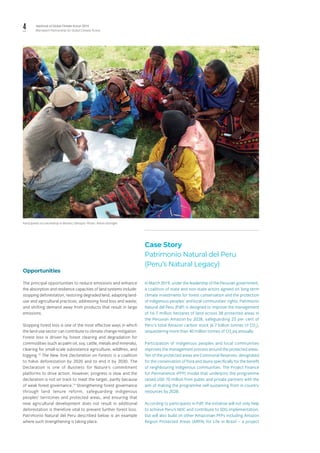
Participants of a workshop in Borana, Ethiopia. Photo: Anton Eitzinger.
Opportunities
The principal opportunities to reduce emissions and enhance
the absorption and resilience capacities of land systems include:
stopping deforestation; restoring degraded land; adapting land-
use and agricultural practices; addressing food loss and waste;
and shifting demand away from products that result in large
emissions.
Stopping forest loss is one of the most effective ways in which
the land-use sector can contribute to climate change mitigation.
Forest loss is driven by forest clearing and degradation for
commodities (such as palm oil, soy, cattle, metals and minerals),
clearing for small-scale subsistence agriculture, wildfires, and
logging.13
The New York Declaration on Forests is a coalition
to halve deforestation by 2020 and to end it by 2030. The
Declaration is one of Business for Nature’s commitment
platforms to drive action. However, progress is slow and the
declaration is not on track to meet the target, partly because
of weak forest governance.14
Strengthening forest governance
through land tenure reform, safeguarding indigenous
peoples’ territories and protected areas, and ensuring that
new agricultural development does not result in additional
deforestation is therefore vital to prevent further forest loss.
Patrimonio Natural del Peru described below is an example
where such strengthening is taking place.
Case Story
Patrimonio Natural del Peru
(Peru’s Natural Legacy)
In March 2019, under the leadership of the Peruvian government,
a coalition of state and non-state actors agreed on long-term
climate investments for forest conservation and the protection
of indigenous peoples’ and local communities’ rights. Patrimonio
Natural del Peru (PdP) is designed to improve the management
of 16.7 million hectares of land across 38 protected areas in
the Peruvian Amazon by 2028, safeguarding 23 per cent of
Peru's total Amazon carbon stock (6.7 billion tonnes of CO2
),
sequestering more than 40 million tonnes of CO2
eq annually.
Participation of indigenous peoples and local communities
improves the management process around the protected areas.
Ten of the protected areas are Communal Reserves, designated
for the conservation of flora and fauna specifically for the benefit
of neighbouring indigenous communities. The Project Finance
for Permanence (PFP) model that underpins the programme
raised USD 70 million from public and private partners with the
aim of making the programme self-sustaining from in-country
resources by 2028.
According to participants in PdP, the initiative will not only help
to achieve Peru’s NDC and contribute to SDG implementation,
but will also build on other Amazonian PFPs including Amazon
Region Protected Areas (ARPA) for Life in Brazil – a project
5ll. The Thematic and Cross-cutting Areas of the Marrakech Partnership for Global Climate Action
that secured 60 million hectares of the Brazilian Amazon –
and Heritage Colombia, which aims to secure over 30 million
hectares in Colombia. In combination, the three initiatives
protect an estimated 12 per cent of the entire Amazon biome.
 More information on PdP and other PFP initiatives can be
found here: www.worldwildlife.org/initiatives/earth-for-life
Reforesting previously deforested areas and restoring and
enhancing the ecological functionality of forests and land
systems (e.g. through increasing biodiversity) are key to reap
the mitigation and absorption potential of the land-use sector.
Reforesting previously deforested areas and restoring within
forests could contribute 1.5-10.1 gigatonnes CO2
eq mitigation
per year (equivalent at the high end to the emissions from
China).15
The Bonn Challenge, first launched in 2011 with a goal of
restoring 150 million hectares of deforested and degraded land
by 2020, is an indicator of this commitment from governments,
non-governmental organizations (NGOs) and corporate actors.
As of September 2019, 59 voluntary pledges are aiming to
bring 170.63 million hectares of land under restoration by
2020 or 2030. According to the Bonn Challenge Barometer
2018 report,16
Bonn Challenge countries have brought 43.7
million hectares of land into restoration since 2010, leading to
significant emission sequestration and co-benefits (including
employment and investment).
Finally, emissions from agriculture can be reduced on the
production side by adopting smarter, integrated farming
systems (for both crops and livestock) and better forest
governance and land-use planning, shifting to approaches that
safeguard biodiversity and use natural resources sustainably
while protecting ecosystem services and building resilience to
the effects of climate change (see the Summary for Policymakers
for more discussion of opportunities in agriculture). In addition,
improved cropland and grassland management can increase soil
organic carbon sequestration.17
Challenges
One of the challenges in the land-use sector is insufficient
funding for sustainable practices. For example, smallholder
farmers, especially in developing countries, are not prepared
to cope with the impacts of climate change and do not have
the funds to access the equipment and expertise required to
transition to climate-smart practices. To address these issues,
innovative financing and insurance mechanisms suited for
farmers of different scales need to be mainstreamed. Examples
include blockchain-based crop insurance schemes18
and
subsidized-rate loans and guarantees which are currently being
rolled out in West and sub-Saharan Africa.19
Importantly, while
increasing resilience levels of local communities, these financial
products can also encourage climate-smart practices, e.g. by
incorporating relevant conditionalities in loan products.20
Further, the lack of integrated policymaking and institutional
coordination is hindering progress in the land-use sector. For
example, gaps between policies on forest and agriculture and
other sectors such as industry and infrastructure make it difficult
to achieve efficient governance for sustainable landscape
management. Other challenges specific to the agri-food sector
are discussed in the Summary for Policy Makers.
Despite their importance to climate stability and human health,
forest-related climate solutions receive just 1 per cent of climate
mitigation funding, which is dwarfed by the USD 1 trillion
production value of the four largest deforestation-producing
commodities (soy, beef, timber and palm oil).21
Effective implementation of land-use programmes requires
fine-tuned, inter-institutional coordination and know-how.
Specifically, implementation efforts must take a holistic system-
level approach, which pays attention to complexities, while
managing the interests of diverse stakeholder groups, including
sub-national and national governments, agricultural and forestry
companies, research institutions, NGOs, indigenous and local
communities, and landowners.22
Links and synergies
Existing initiatives convened in the land-use thematic area
cover a broad range of land-use practices, including forestry,
agriculture and ecosystems, across various regions globally.
For many countries, especially less industrialized developing
countries, the land-use sector will play a pivotal role in achieving
national climate mitigation and adaptation targets as well
as contributing to disaster risk reduction and protection of
biodiversity. Importantly, climate action in the land-use sector
will need to be integrated with actions across other thematic
areas. Specifically, land-use practices intersect with mitigation
and adaptation efforts in the water, energy and industry sectors.
Opportunities also exist to realize multiple benefits by taking a
holistic view across climate action and action on biodiversity.
Further, with regard to the resilience cross-cutting area, the
land-use sector has the potential to make major contributions,
including through increased reliance on NbS and circular
economy approaches.
Sustainable land-use practices will also play a key role in
achieving the goals of the 2030 Sustainable Development
Agenda, including implementing a new deal for nature and
people (e.g. through the Business for Nature coalition).
Mitigation and adaptation actions in the land-use sector can
directly contribute to the achievement of several SDGs in
addition to climate action (SDG 13) and life on land (SDG 15).
Healthy forests, terrestrial ecosystems and sustainably managed
land-systems play a critical role in delivering many of the other
SDGs, including food security (SDG 2), industry innovation
and infrastructure (SDG9) and responsible consumption and
production (SDG 12).
6 Yearbook of Global Climate Action 2019
Marrakech Partnership for Global Climate Action
Recommendations to policymakers
To achieve the scale of net-negative emissions needed from
the land-use sector and to meet the 1.5C goal of the Paris
Agreement, governments must take the following steps:
»» Introduce adequate incentives.
End subsidies and fiscal measures that incentivize forest
clearance and unsustainable agricultural practices, replacing
them with smart subsidies and tax incentives to conserve and
restore forests, soils, watersheds and landscapes.
»» Adopt land-based priorities into NDCs.
Address land-use priorities for climate adaptation and mitigation
as part of NDCs, including options to use carbon markets
to mobilize public and private sector finance to incentivize
improvements in land-use and agricultural practices.
»» Improve forest governance.
Strengthen institutions and processes to ensure participatory
and equitable land-use planning; enhance law enforcement
capacities to stop illegal deforestation; and accelerate and
increase the recognition of land rights of indigenous peoples
and local communities.
»» Introduce demand-side measures.
Countries need to introduce measures to shift consumer
demand away from agricultural and forestry-related products
and commodities that undermine the mitigation and adaptation
potential of the land-use sector.
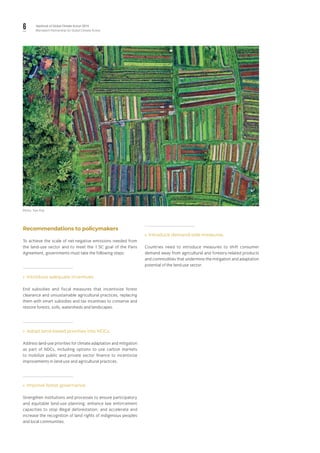
Photo: Tom Fisk.
7ll. The Thematic and Cross-cutting Areas of the Marrakech Partnership for Global Climate Action
Oceans and Coastal Zones
2
Introduction to the thematic area
Oceans and coastal zones provide ecosystem services as well
as social and economic services globally, including fisheries,
transport, tourism and habitat. Moreover, fisheries and
aquaculture are critical to global food security. The goal of the
oceans and coastal zones thematic area is to ensure that action
is taken to reduce the impacts of anthropogenic greenhouse
gas emissions and climate change on oceans and coastal
zones. Since COP 22, the ocean community, supported by the
Marrakech Partnership team and the High-Level Champions,
has raised awareness of the importance of the interactions
between oceans and climate. Success stories at both local
and global levels were showcased during the Marrakech
Partnership Oceans Climate Action Days at COP 23 and COP
24. Lessons learned and best practices were also shared, and
recommendations delivered to build on successful initiatives.
There was particular emphasis on sharing knowledge and
science on the need for urgent adaptation, the usefulness of
ecosystem-based approaches and NbS with climate co-benefits.
Climate change impacts
Oceans play a central role in regulating the climate. Since the
1980s, oceans have absorbed up to 20-30 per cent of total
anthropogenic CO2
emissions, and since the 1970s they have
taken up more than 90 per cent of excess heat in the climate
system.23
While ocean ecosystems have been key to mitigating
climate change, a warming planet also places them, and the
services they provide, at risk.
The IPCC Special Report “Ocean and Cryosphere in a Changing
Climate”, released in September 2019, confirmed that the ocean
is warmer, more acidic and less productive now and that melting
glaciers and ice sheets have caused sea level rise.24
Coastal
extreme events are also becoming more frequent.
Impacts include risks to food security from warming and
acidification.25
Under all emission scenarios, decreases in global
biomass of marine animal communities, their production, and
fisheries catch potential, and a shift in species composition are
projected over the 21st
century in ocean ecosystems from the
surface to the deep seafloor.26
Small-scale fisheries in tropical
regions, which are heavily dependent on habitats provided by
coastal ecosystems such as coral reefs, mangroves, seagrass
and kelp forests, are at a high risk even if temperature increases
are limited to 1.5 degrees Celsius.27
Coastal systems and low-
lying areas are projected to increasingly experience adverse
impacts such as submergence, coastal flooding and coastal
erosion due to sea level rise. This is a partial consequence of the
thermal expansion of the ocean waters, as well as the increasing
frequency and intensity of extreme meteorological events.28
Scientific and empirical evidence demonstrates the need for
further action to address the impacts of climate change on
oceans and marine coastal zones.29
Enabling climate resilience
and sustainable development depends critically on urgent
and ambitious emission reductions coupled with coordinated,
sustained and increasingly ambitious adaptation actions.30
Opportunities
There are a number of opportunities for actions on oceans and
coastal zones to support and accelerate the global mitigation
effort. These include reducing emissions from shipping, such
as the IMO (International Maritime Organization) Strategy,
deploying marine renewable energy and implementing
blue carbon schemes (see, for example, The Blue Carbon
Initiative).31, ii
Deploying a wide variety of adaptation measures will help to
safeguard people, economies and infrastructure in coastal,
low-lying and island areas. These measures are especially
effective when they are based on ecosystem approaches,
integrate coastal and ocean management institutions and are
in collaboration with disaster risk agencies. Other actions that
build resilience include fostering low-carbon blue economies
where there are systems of payment to restore or protect
coastal ecosystems that sequester and store significant amounts
of carbon. These ecosystems include mangroves, tidal marshes
and seagrass meadows. A successful initiative to safeguard both
mangroves and people’s livelihoods in Sri Lanka is described
below.
Case Story
Seacology
Seacology, a non-profit environmental conservation organization
and one of the 2018 Momentum for Change Lighthouse
activities, is helping Sri Lanka become the first nation in history
to preserve and replant all of its mangrove forests.
ii.	 Blue carbon refers to the conservation and restoration of coastal and marine ecosystem.
8 Yearbook of Global Climate Action 2019
Marrakech Partnership for Global Climate Action
Niranjala Fernando, a CBO member, runs a cage-fishing business supported by
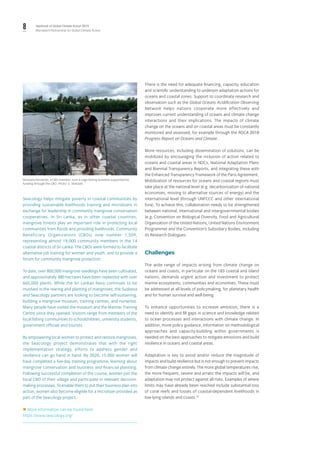
funding through the CBO. Photo: S. Verkaart.
Seacology helps mitigate poverty in coastal communities by
providing sustainable livelihoods training and microloans in
exchange for leadership in community mangrove conservation
cooperatives. In Sri Lanka, as in other coastal countries,
mangrove forests play an important role in protecting local
communities from floods and providing livelihoods. Community
Beneficiary Organizations (CBOs) now number 1,509,
representing almost 19,000 community members in the 14
coastal districts of Sri Lanka. The CBOs were formed to facilitate
alternative job training for women and youth, and to provide a
forum for community mangrove protection.
To date, over 800,000 mangrove seedlings have been cultivated,
and approximately 480 hectares have been replanted with over
660,000 plants. While the Sri Lankan Navy continues to be
involved in the rearing and planting of mangroves, the Sudeesa
and Seacology partners are looking to become self-sustaining,
building a mangrove museum, training centres, and nurseries.
Many people have visited the museum and the Mannar Training
Centre since they opened. Visitors range from members of the
local fishing communities to schoolchildren, university students,
government officials and tourists.
By empowering local women to protect and restore mangroves,
the Seacology project demonstrates that with the right
implementation strategy, efforts to address gender and
resilience can go hand in hand. By 2020, 15,000 women will
have completed a five-day training programme, learning about
mangrove conservation and business and financial planning.
Following successful completion of the course, women join the
local CBO of their village and participate in relevant decision-
making processes. To enable them to put their business plan into
action, women also become eligible for a microloan provided as
part of the Seacology project.
 More information can be found here:
https://www.seacology.org/
There is the need for adequate financing, capacity, education
and scientific understanding to underpin adaptation actions for
oceans and coastal zones. Support to coordinate research and
observation such as the Global Oceans Acidification Observing
Network helps nations cooperate more effectively and
improves current understanding of oceans and climate change
interactions and their implications. The impacts of climate
change on the oceans and on coastal areas must be constantly
monitored and assessed, for example through the ROCA 2018
Progress Report on Oceans and Climate.
More resources, including dissemination of solutions, can be
mobilized by encouraging the inclusion of action related to
oceans and coastal areas in NDCs, National Adaptation Plans
and Biennial Transparency Reports, and integrating these with
the Enhanced Transparency Framework of the Paris Agreement.
Mobilization of resources for oceans and coastal regions must
take place at the national level (e.g. decarbonization of national
economies, moving to alternative sources of energy) and the
international level (through UNFCCC and other international
fora). To achieve this, collaboration needs to be strengthened
between national, international and intergovernmental bodies
(e.g. Convention on Biological Diversity, Food and Agricultural
Organization of the United Nations, United Nations Environment
Programme) and the Convention’s Subsidiary Bodies, including
its Research Dialogues.
Challenges
The wide range of impacts arising from climate change on
oceans and coasts, in particular on the 183 coastal and island
nations, demands urgent action and investment to protect
marine ecosystems, communities and economies. These must
be addressed at all levels of policymaking, for planetary health
and for human survival and well-being.
To enhance opportunities to increase ambition, there is a
need to identify and fill gaps in science and knowledge related
to ocean processes and interactions with climate change. In
addition, more policy guidance, information on methodological
approaches and capacity-building within governments is
needed on the best approaches to mitigate emissions and build
resilience in oceans and coastal areas.
Adaptation is key to avoid and/or reduce the magnitude of
impacts and build resilience but is not enough to prevent impacts
from climate change entirely. The more global temperatures rise,
the more frequent, severe and erratic the impacts will be, and
adaptation may not protect against all risks. Examples of where
limits may have already been reached include substantial loss
of coral reefs and losses of coastal-dependent livelihoods in
low-lying islands and coasts.32
9ll. The Thematic and Cross-cutting Areas of the Marrakech Partnership for Global Climate Action
There are several challenges in planning for adaptation, including
uncoordinated, top-down approaches, a lack of political will
and insufficient resources and access to information.33
In some
countries, despite improvements in knowledge at the local
government level from investments in research and science,
implementation of adaptation actions in coastal areas has been
impeded by budget cuts and lack of national-level political
support.34
Links and synergies
Increasing ambition calls for broader inclusion of oceans and
coastal zones in global climate action. The activities of the
oceans and coastal zones thematic area contribute to the
exchange of best-available knowledge, science and governance
experiences regarding ocean mitigation and adaptation action.
Ocean climate action intersects with the transport, energy, land-
use and industry thematic areas – for example through marine
transport and the food system. In addition, NbS, including
blue carbon and ecosystem-based adaptation, can contribute
to the resilience cross-cutting workstream. In so doing, ocean
and coastal zone climate action have significant co-benefits,
including securing livelihoods and protecting local ecosystems.
Acting to enhance the contribution of oceans and coastal zones
to mitigation of greenhouse gases and to build resilience to the
impacts of climate change has the potential to contribute to a
number of SDGs. SDG 14 is particularly relevant – protecting
coastal areas (14.5), reducing the impacts of ocean acidification
(14.3) and support to scientific capacity (14.a). In addition,
action on oceans and coastal zones can help contribute to
food security (SDG 2) by protecting fisheries and aquaculture,
to SDG 11 by protecting coastal communities, and to SDG 6 by
reducing salination of freshwater supplies from flooding. The
activities under the Marrakech Partnership have contributed
to the exchange of accurate best-available knowledge, science
and governance experiences towards enhanced context-based
adaptation processes in oceans and coastal zones, bringing both
climate and SDG benefits.
Recommendations to policymakers
»» Develop and implement a research agenda
specific to 1.5 degrees Celsius on adaptation in
oceans and coastal zones.
This agenda should include specifying costs and needs;
quantifying avoided adaptation investments associated with
limiting warming to 1.5 degrees Celsius compared to 2 degrees
Celsius, or business as usual and identifying what overshoot
means for adaptation.
»» Give equal priority to adaptation and mitigation
investments for oceans and coastal areas.
Blue economy investments that help oceans and coastal areas
adapt to and mitigate climate change can bring climate and
sustainable development benefits.
»» Develop disaster risk response strategies under
the Sendai Framework in synergy with adaptation
measures.
Oceans and coastal zones also have an important role to play in
reducing the risk of disasters – for example coastal protection
can decrease the risk of flooding in cities. Using options such
as eco-system based adaptation, for example mangrove
restoration, can deliver both adaptation and disaster risk
reduction benefits
»» Ensure national financial streams in support of
forward-looking adaptation programmes.
The multiple benefits of adaptation in oceans and coastal zones
can only be realised with the right level of finance. Ensuring
that there are national finance streams available signals the
importance of action.
10 Yearbook of Global Climate Action 2019
Marrakech Partnership for Global Climate Action
Water
3
Introduction to the thematic area
The water thematic area is inclusive of all freshwater ecosystems
– from forested headwater streams to coastal estuaries and
below-ground aquifers. As water is essential to life on earth, the
scope is inherently cross-cutting, covering activities in sectors
such as forest and land management, agriculture, industry,
transportation, energy and urban systems.
Over the past year, members of the thematic area have worked
with over 100 countries to provide adaptation capacity-building
workshops that will be turned into formalized UNFCCC-
sponsored training courses starting in 2020. For example,
innovative urban water resilience programmes have been piloted
in cities as diverse as Amman and Mexico City,35
and principles
and guidelines for incorporating water into the 2020 NDCs36
have been developed. In addition, members authored criteria for
standards for bonds for both grey and green water infrastructure
and hydropower, which have been used to issue over USD 9
billion in certified green and blue bonds as of June 2019.37
Work
has continued on promoting NbS alongside partners including
the Asian Development Bank, with which internal investment
guidelines for the Bank and its regional development partners
have been developed around climate-resilient infrastructure,
NbS and proactive disaster risk reduction.
Climate change impacts
Energy use for water is a function of multiple variables, including
water source, treatment, intended end-use, distribution,
amount of water loss in the system, and level of wastewater
treatment. Likewise, the intensity of energy use of water
depends on local characteristics such as topography, climate,
seasonal temperature, and rainfall. Energy consumption by
public drinking-water and wastewater utilities account for a
significant proportion of their overall costs. Water losses lead to
even higher energy consumption. In addition, the wastewater
treatment process can produce large amounts of methane and
nitrous oxide, which further increase the carbon footprint of the
water sector.38
Typically, countries report varying emissions from water
and wastewater utilities ranging from 3 to 7 per cent of total
greenhouse gas emissions.39
However, these calculations
are quite limited, excluding water-related emissions from the
agri-food sectors, rural supply, and emissions associated with
discharging untreated sewage in rivers, among others. In 2010,
the United States calculated that direct water-related energy
consumption was 12.6 per cent of national primary energy
consumption,40
but even this number is far lower than the likely
total.
The carbon footprint of water use is likely to grow for several
reasons. Climate change is having numerous adverse effects on
freshwater resources, rendering many currently available water
supplies far less reliable. With water demand growing, water
providers are increasingly looking to more remote or alternative
water sources that often carry a far greater energy and carbon
cost than existing supplies. The demand for pumped irrigation
is also likely to increase further with higher temperatures and
greater variability of precipitation.41
Furthermore, the adoption
of higher water treatment standards at the local and national
levels will increase the energy costs of treating water and
wastewater.
Opportunities
The approach to water and climate change must ensure future
water security for people, ecosystems and economies while
also contributing to the global reduction of greenhouse gas
emissions. Climate-resilient water management can provide
important co-benefits by protecting natural carbon sinks such
as forests and peatlands while improving the resilience of
communities facing increasingly severe and frequent floods,
droughts and storms. A growing number of cities and rural
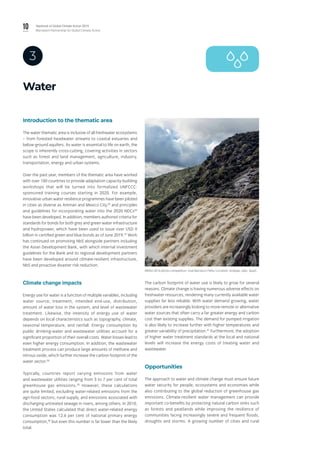
IRENA 2016 photo competition: José Barranco Peña / Location: Andújar, Jaén, Spain.
11ll. The Thematic and Cross-cutting Areas of the Marrakech Partnership for Global Climate Action
areas already face the prospect that piped water supply will fail,
emphasizing the urgency of climate-resilient water management
practices. Initiatives such as the International Network of
River Basins aim to help implement integrated water resource
management globally by promoting cooperation and sharing of
resources.
There is potential to reduce carbon emissions in the water
sector significantly, particularly when it comes to urban water
and wastewater treatments. For example, retrofitting existing
systems to more energy-efficient designs is often an investment
with a 15-20 year economic return.42
Additional measures
include directing treated effluent to agriculture or other
secondary uses rather than rivers, and converting carbon energy
from biosolids into biogas, heat and electricity. Cities such as
those participating in the Megacities Alliance for Water and
Climate enable low-impact solutions by integrating them into
urban planning and development and by convening water, urban
planning, and transportation authorities to discuss integrated
solutions.
There is also great potential for improved water management
in the private sector. The Business Alliance for Water and
Climate (BAfWAC) provides a platform for businesses on water
and climate issues, particularly on the cross-cutting topics
of climate-resilient agriculture, circular water management,
and natural infrastructure. BAFWAC now counts 53 corporate
signatories with USD 870 billion in annual revenues. This year,
BAFWAC expects to launch its first report43
to help the private
sector build the business case for acting on water and climate
issues in a holistic manner. The report will highlight case studies
of companies conducting robust climate and water vulnerability
assessments, and showcase companies that engage responsibly
in local and international policy-planning.
In addition, preserving and expanding natural carbon sinks
such as forests and wetlands, as discussed in the land-use and
ocean sections, along with improved land and soil management
can help store carbon and manage water and also increase
resilience.
For adaptation strategies, water is a key element since clean,
reliable freshwater is essential to a resilient society. Climate
change implies more variability and uncertainty in local and
regional water cycles. Therefore, infrastructure must be both
robust, meaning it can withstand a range of future conditions,
and flexible, meaning that it can be modified or successfully
adapted to change. When it comes to adapting to shifting
climate, blended engineered/natural infrastructure can be
more cost-effective, offer mitigation co-benefits and provide
better service and protection over its lifetime than conventional
engineered solutions alone.44
The need for increased flexibility
also extends to institutions – for example, flexible operating rules
for dam/reservoir systems to manage electricity generation,
irrigation and flood storage requirements in a changing climate.
An example of such flexibility is discussed in the case study
below.
Case Story
Climate-resilient water
management: the Climate
Risk-Informed Decision Analysis
approach
Water managers and policymakers rely on governance systems
and infrastructure that are relatively fixed and designed to
remain in place for decades. Given this inflexibility, how do
we plan for a future that is deeply uncertain and increasingly
variable? And how can we institutionalize planning methods into
consistent, replicable, and accessible outcomes? Climate
Risk-Informed Decision Analysis, or CRIDA, provides stepwise
planning guidance for water resource planners, managers and
engineers to implement robust water management, particularly
for managers working in the developing world. 
CRIDA is a means for implementing holistic climate-resilient
water resource solutions, providing a structured process for
technical professionals to navigate the decision-making spaces
between senior decision makers and stakeholders. While building
on existing “bottom up”, risk-based methods, CRIDA helps
planners address deep uncertainties associated with climatic,
demographic and land-use change and other potential causes
of system failure. Based on the level of future uncertainty, CRIDA
supports the development of robust and/or flexible solutions.
CRIDA also explicitly acknowledges the critical significance of
governance and eco-hydrological systems to achieving holistic,
sustainable and resilient solutions. The goal is to mainstream
robust and flexible approaches to water management by
institutionalizing these methods into consistent, replicable and
accessible outcomes — especially in data-poor regions.
Issued by the United Nations Educational, Scientific and Cultural
Organization Integrated Hydological Programme, CRIDA was
developed through the sustained efforts of the International
Center for Integrated Water Resources Management, the
Dutch Water and Infrastructure Ministry, Deltares, the Alliance
for Global Water Adaptation (AGWA), and the National Socio-
Environmental Synthesis Center. The CRIDA approach was
published in October 2018, but the methodology has been in
development for many years and has already been applied in
over 20 countries. An international community of practice is
growing and, beginning in 2020, CRIDA will be used in a new
in-depth adaptation training course for national adaptation
professionals, sponsored by UNFCCC’s Consultative Group of
Experts.
 More information can be found here:
https://agwaguide.org/about/CRIDA/
12 Yearbook of Global Climate Action 2019
Marrakech Partnership for Global Climate Action
Photo: Ivan Bandura.
13ll. The Thematic and Cross-cutting Areas of the Marrakech Partnership for Global Climate Action
iii.	 It is important to note that all of these solutions are context-specific, as climate impacts to the hydrologic cycle vary widely by location and timing. For this reason, any project
designed to reduce emissions from the water sector, or capture and store carbon in natural systems such as coastal mangrove forests or peatlands or flood- or drought-prone
areas, must be undertaken with the full participation and inclusion of local knowledge and stakeholders, in particular women and indigenous peoples, as traditional water
managers must be included. For more examples of water solutions for climate change, see UN Water 2019, Climate Change and Water: UN-Water Policy Brief, https://www.
unwater.org/publications/un-water-policy-brief-on-climate-change-and-water/.
The preservation and protection of aquifers is an important
adaptation strategy. Aquifers comprise the world’s largest
source of freshwater available for human use and are often less
vulnerable than surface water to the direct impacts of climate
change because they exist deep underground. Thus, aquifers
represent an essential component in reducing the risk of short-
term water shortage and can increase water security through
climate adaptation measures such as intentionally recharging
aquifers (called Managed Aquifer Recharge).45
Human exposure to climate-related risks include natural
disasters, 90 per cent of which are directly water-related.46
Policy interventions that reduce the exposure of cities to flood
and drought risk include: for urban areas, increased integration
of planning processes and the promotion of inclusive and
participatory collaboration with local communities; and for
rural populations, securing land tenure, increasing access to
agricultural extension services and expanding crop insurance
programmes and access to increased credit. In addition,
investment in improved hydrological data, early warning
systems, hydro-meteorological networks, institutional capacity,
education and knowledge-sharing can help reduce the risk to
communities.iii
Challenges
One of the key challenges to improving water management
is the lack of integration and coordination across sectors and
ministries. National-level mechanisms to foster greater inter-
ministerial planning in the development and implementation of
national climate plans is essential to ensure that water allocated
to one area does not compromise the availability of water for
other uses. River basin organizations can help address climate
mitigation and adaptation activities for water resources that
cross international borders. Examples of cross-border water
cooperation include the International Commission for the
Protection of the Danube River and the Okavango River Basin
Water Commission.
A more physical challenge, particularly for urban and peri-
urban areas, is finding enough space to handle peak flows
during (extreme) storm events and reserving enough clean
water for use during drier periods. Possible solutions include:
making room for rivers in terms of restoring natural floodplains;
increasing the extent of permeable surfaces that can absorb
stormwater in cities; and establishing zoning regulations and
insurance premiums that deter development in flood-prone
areas and along fragile coastlines.
Finally, access to climate finance for water-related mitigation
and adaptation activities remains a concern. Climate finance
entities can play a part in recognizing the importance of water
by assessing the water needs of proposed projects – regardless
of sector – prior to awarding grants or financing. This will help
ensure that the water needed is actually available for project
activities and will not inadvertently increase water stress or
insecurity for local people and water-dependent ecosystems.
Case Study:
Water Infrastructure Climate
Bonds Standards: Mobilizing the
debt capital market for climate
change solutions
Water-related investments account for an enormous part of
the capital assets of developed countries and are a huge part
of investments being undertaken in developing economies.
Substantial infrastructure will be required to ensure clean and
secure water supplies as the climate changes, while at the same
time supporting a low-carbon, climate-resilient economy. Having
a clear understanding of what sorts of investments are consistent
with improving the climate resilience of water assets helps bond
investors quickly determine the environmental credentials of
water-related green bonds. The Water Infrastructure Criteria, an
effort of the Climate Bonds Initiative (CBI), ensures that labelled
green bonds for a wide variety of water-related projects and
assets are held to common standards of robust, low-carbon and
climate-resilient water management. All water-related projects
and assets that are certified under the Criteria should continue
to bring environmental and climate benefits over the operational
lifetime of the project. 
The Criteria have been developed in two phases: Phase 1
Criteria cover engineered water infrastructure; and Phase 2
Criteria cover nature-based and hybrid water infrastructure
for such purposes as water collection, storage, treatment and
distribution, flood protection and drought resilience. In 2019,
CBI will release its third water standard for climate-smart
hydropower. These Criteria are in use to certify bond issuances
– for example by San Francisco and Cape Town.
 More information can be found here:
https://www.climatebonds.net/standard/water
14 Yearbook of Global Climate Action 2019
Marrakech Partnership for Global Climate Action
Links and synergies
Increased ambition means working across sectors to identify
co-benefits that can improve outcomes and scale up actions.
Water is the great connector; adopting climate-resilient water
management practices such as risk-informed decision-making
(see case study on CRIDA) can help countries reach their targets
under the Paris Agreement. By addressing water holistically
throughout their NDCs, countries can improve outcomes for
both mitigation and resilience of local communities.
Improved water management has multiple co-benefits. For
example, it can: increase the resilience of cities and human
settlements; provide multiple benefits for land use and oceans
in terms of habitat, biodiversity and soil health; sustain river
transportation networks; provide clean electricity; and help
prevent, withstand and recover from natural disasters. In
addition, water is essential to achieving all of the SDGs, not just
SDG 6. For example, SDG 1: Ending Poverty, cannot be achieved
without sustainable, clean water resources. Therefore, investing
in climate-resilient water supply and sanitation infrastructure
now can help to ensure basic clean water supplies, reduce the
spread of water-borne disease, and support local economies
regardless of future climate conditions.
Recommendations to policymakers
»» Adopt risk-based water management strategies.
These strategies are to ensure that today’s management
decisions do not lock us into unsustainable development
pathways or contribute to poorly designed adaptation.
»» Climate-proof new and existing water
infrastructure while increasing investment
in natural infrastructure such as aquifers and
wetlands.
Protecting new and existing water infrastructure against the
impacts of climate change is important to ensure water supply
in the future. Additional investment in natural infrastructure can
also help reduce the impact of climate change and contribute to
mitigating greenhouse gas emissions.
»» Promote the expanded usage of water-efficient
renewable energy such as solar photovoltaics and
wind energy.
The use of water-efficient renewable energy contributes to the
transformation needed in both the energy and water sectors.
»» Develop regional and basin-wide climate
adaptation strategies.
These strategies can help to maximize the effectiveness of
adaptation actions, promote cross-border cooperation and
prevent the negative effects of unilateral measures.
»» Embrace innovative finance solutions – such as
green bonds and blended public-private finance
instruments – and enhance funding modalities
within existing and new climate funds.
Financing solutions that are conducive to financing integrated
approaches to building climate resilience will be crucial to
overcome challenges to implementation.
15ll. The Thematic and Cross-cutting Areas of the Marrakech Partnership for Global Climate Action
Human Settlements
4
Introduction to the thematic area
Cities provide habitation, work and recreation facilities to
large numbers of people. They are also infrastructure hubs for
transport, energy, health and other essential services. Today,
more than 50 per cent of the world’s population already lives in
cities. Projections estimate that by 2050 two-thirds of the global
population will live in urban areas.47
Cities are at the forefront of climate change. They are responsible
for nearly three-quarters of global greenhouse gas emissions and
are already experiencing the adverse effects of climate change.
Therefore, it is essential that cities be central to the global
response to climate. At the same time, urban-rural linkages can
be a strong component of national urban policies. Governments
at all levels need to work together to strengthen these linkages
and implement integrated territorial development.48
Climate change impacts
Cities and urban populations are significant drivers of climate
change. By 2050, infrastructure construction in fast-growing
cities in developing countries alone could release 226
gigatonnes of CO2,
cumulatively more than four times the
emissions that have occurred during the construction of existing
infrastructure in the developed world.49
In addition to energy
use and buildings, urban transport systems remain a significant
source of greenhouse gas emissions.50
Cities are on the front
line of climate change impacts. Heatwaves and flooding, and
associated risks such as adverse impacts on health, biodiversity
and water security, are already affecting cities around the
globe.51
At present, over 200 million people living in cities are
exposed to extreme heat. By 2050, up to 2.5 billion people
living in cities may be exposed to food shortages. Other climate
impacts in cities include risk to water availability and risk from
sea level rise.52
Population growth, rampant urbanization and
growing social inequalities further exacerbate the vulnerability
of city dwellers.
Opportunities
Local and regional governments are working to reduce
emissions and provide their constituencies with safe living
environments. To date, over 9,400 cities and more than 270
regions have registered their climate commitments/actions on
NAZCA,53
with some cities taking bold steps to achieve carbon
neutrality by 2050 (see the Carbon Neutral Cities Alliance) and
regions committing to reduce emissions by up to 95 per cent
by 2050 (see the Under2 Coalition). Many of them are switching
to zero-emission urban transport, (see the Green and Healthy
Streets Declaration), net-zero carbon buildings (see the Net Zero
Carbon Buildings Declaration), 100 per cent renewable energy
(see the 100% Renewable Energy Cities and Regions Network),
and zero waste (see the C40 Towards Zero Waste Declaration)
by 2030, while ensuring that these transformations are
equitable and leave no one behind (see the C40 Equity pledge).
Importantly, city-level climate action is no longer confined to a
few front-running mega cities. Smaller and medium-sized urban
areas with fewer than one million inhabitants will account for half
of all urban emission reduction potential by 2030.54
These cities
require adequate support through partnerships and networks,
including from national governments, the financial sector, and
the research and business communities. An example of such a
partnership is the LEDS partnership described in the case study
below. Regional governments can also enable greater ambition
at city level, enhancing vertical integration and cooperation
while ensuring long-term policy certainty.
Case Story
Urban-Low Emission
Development Strategies
The Urban-Low Emission Development Strategies (Urban-LEDS)
initiative supports local governments in Brazil, Colombia, India,
Indonesia, Lao People’s Democratic Republic, Rwanda and South
Africa to develop robust climate strategies. Now in its second
phase, the initiative is funded by the European Commission and
implemented jointly by UN-Habitat and Local Governments for
Sustainability (ICLEI), an alliance of more than 1,750 local and
regional governments. Its aim is to enable local governments
in the Global South to develop or update greenhouse gas
inventories, conduct climate vulnerability assessments, develop
action plans and access funding to implement these plans.
In addition to providing direct technical assistance to local
administrations, the initiative has set up a network of more than
60 local governments to foster peer-to-peer learning. Network
members had the opportunity to participate in a study tour to
learn best practices from leading cities in Europe. Importantly,
the second phase of Urban-LEDS recognizes that multi-level
governance is essential. In this respect it works with national
governments to establish links between the national and the
local level. For example, in Rwanda the initiative is helping to
design and implement a national climate budget annex which
will cover all government entities.
16 Yearbook of Global Climate Action 2019
Marrakech Partnership for Global Climate Action
By empowering local governments, Urban-LEDS explicitly
supports the implementation of the Global Covenant of Mayors
for Climate & Energy – a global reporting initiative which
requires signatory local governments to develop climate
change mitigation and adaptation plans. Looking ahead, it will be
important that emerging synergies between various initiatives
continue to be strengthened. This will avoid wasteful duplication
of efforts and ensure that existing initiatives achieve their full
potential.
 More information can be found here: https://urban-leds.org/
Innovative approaches to urban design that encourage walkable
cities, non-motorized and electric transport and shorter overall
commuting distances have a central role to play to reduce city-
level emissions. Transit-oriented development that maximizes
the amount of residential, business and leisure space within
walking distance of public transport is emerging as an organizing
principle for low-emission urban growth and spatial planning.55
This trend is particularly important to counter the rising demand
for private cars in developing-country cities.
Further, urban infrastructure systems have the potential to
harness technological advances to achieve emission reductions.
Smart technology, drawing on the Internet of Things and building
information modelling, offers opportunities to accelerate energy
efficiency.56
Improved building design and efficient equipment,
lighting and appliances can lead to significant savings in
electricity consumption, heating, cooling and associated costs.
For new buildings, net-zero energy models are a practical
option57
and existing building stock will significantly benefit from
retrofitting. In addition, using materials that can be produced
using less energy such as wood provides opportunities to
achieve further emission savings.58
Case Story
Cities setting ambitious emissions
and efficiency targets for buildings
The building and construction sectors combined are responsible
for 36 per cent of global final energy consumption and nearly 40
per cent of total direct and indirect CO2
emissions.59
Therefore,
there is urgent need to increase energy efficiency and reduce
emissions from buildings. Many pioneering cities across the
world are leading the way by developing and implementing
ambitious standards for the building sector. Two examples are:
New York City
In April 2019, New York City passed one of the most ambitious
policies seen so far to cut emissions from large buildings.
According to the City’s Green New Deal, all buildings of at least
25,000 square feet are required to make efficiency upgrades that
lower energy usage and emissions. In case of non-compliance,
the 50,000 affected buildings will face steep penalties. In
addition, New York City will no longer allow all-glass facades
in new construction unless they meet strict performance
guidelines, making inefficient, glass-heavy building designs a
thing of the past.
 More information can be found here:
https://www1.nyc.gov/office-of-the-mayor/news/209-19/
action-global-warming-nyc-s-green-new-deal#/0
South Africa: Cape Town, Durban, Johannesburg and
Tshwane
Cape Town, Durban, Johannesburg and Tshwane are
leading the way to develop mandatory energy performance
requirements for new buildings. Supported by the C40 Cities
South Africa Buildings Programme, the four cities aim to make
zero-carbon buildings the new normal for South African cities.
Currently, energy used to power, heat and operate buildings
accounts for more than a quarter of greenhouse gas emissions
produced by South African cities. In case of inaction, this figure
is set to rise since 70 per cent of South Africans are expected
to live in urban areas by 2030. With this programme in place,
new buildings are required to meet high-efficiency energy
performance requirements, which will help contribute to South
Africa delivering on its commitments to the Paris Agreement.
 More information can be found here:
https://www.c40.org/press_releases/
south-african-cities-make-all-new-buildings-zero-carbon
Photo: Rohan Reddy.
17ll. The Thematic and Cross-cutting Areas of the Marrakech Partnership for Global Climate Action
Urban areas, specifically in developing countries, can benefit
from the installation of community-based distributed renewable
energy infrastructure (also referred to as “citizens’ utilities”),
such as roof-based solar panels combined with battery
storage systems.60
While the costs for community-based
energy infrastructures have fallen significantly, it is key that
local planning processes be adapted to enable construction
of such infrastructure to ensure successful uptake. Similarly,
opportunities exist to operationalize less emission-intensive
and circular-economy approaches to urban waste management,
provided that appropriate infrastructures and support processes
are set up.
Transnational urban networks have a central role to play in
enabling cities and regions to identify challenges and develop
common responses through enhanced cooperation.61
These
networks can leverage the climate action potential of the
governments concerned. The Global Covenant of Mayors,
a global network of 9,149 cities, estimates that members’
commitments, if fully implemented, could avoid 2.8 billion tons
of CO2
eq in 2050 compared to business as usual.62
Networks
also play an important role in enabling local and regional
governments to address climate change. For example, in
September 2019, ICLEI released the call for applications under
the 2019 Transformative Actions Programme. The programme
will assist local governments to develop bankable, low-risk
high-impact sustainable infrastructure projects. Specifically,
increased visibility and improved connections to investors and
project preparation facilities as well as access to technical tools
will help cities and regions to move beyond the planning and
preparation phase towards project implementation.63
This is
crucial to address the shortage of Paris-aligned local investment
opportunities identified in a recent report authored by the Cities
Climate Finance Leadership Alliance.64
Challenges
There are several inhibitors to city-level action on climate
change.
First, local administrations operate within policy and regulatory
frameworks set at the regional or national level. These
frameworks must be designed in a way to enable city-level and
regional climate action, including direct access to finance for
cities.
Second, cities require accurate and decision-useful data and
information at the right geographical and temporal scales
to respond to current climate impacts, as well as to plan and
prepare for the future.
Third, progress in various sectors relevant to city-level
climate action is lagging because of insufficient finance and
inappropriate policy and regulatory frameworks. For example,
the buildings and construction sector is showing insufficient
progress toward 2020 milestones consistent with a 1.5 degrees
Celsius scenario.65
Urban consumption, especially in the
food, clothing, vehicles, aviation and electronics sectors, is
responsible for high and growing levels of consumption-based
emissions. Consumption represents as much as 10 per cent
of global emissions in just 94 of the world’s largest cities and
could nearly double by 2050 if left unchecked.66
The design of
cities is important in helping make the lifestyles of urban citizens
more sustainable – for example by offering choices in transport,
food and services that can lower emissions both within a city
and beyond. Policymakers must focus their attention on sectors
which to date have shown insufficient progress. Where relevant,
these sectors must be supported, including through financial
and capacity-building measures.
Links and synergies
Issues regarding water, transport, energy and industry are all
brought together in cities and regions. In addition to helping
make cities and human settlements inclusive, safe, resilient
and sustainable (SDG 11), coordinated action at the city level
can bring increased ambition on climate change as well as
benefits in other areas. Zero-carbon and resilient cities do not
rely on fossil fuels for energy generation, heating and road
transport. This results in better air quality, increased thermal
and acoustic comfort (specifically at road level) and more
room for outdoor spaces that encourage physical activity
(e.g. bike lanes and green spaces), bringing benefits for good
health and well-being (SDG 3). They can also function as testing
laboratories for circular economy approaches and have the
potential to create spaces for urban agriculture. Opportunities
to focus on responsible consumption and production (SDG 12)
include setting up “repair cafés” – where household appliances
can be brought for repair – and urban gardens and increasing
reliance on shared applications and infrastructures. Climate-
friendly buildings rely on renewable energy and result in better
energy performance. Efficiency gains and increased reliance on
renewable technologies, including “citizens’ utilities”, reduce
emissions and can decrease energy costs (SDG 7).
Climate action in cities can also significantly contribute to
reducing inequalities (SDG 10), especially if inclusive action is
fully integrated in climate action planning for mutual benefits.67
Without that integration, climate action could create benefits
that are not shared equitably among city dwellers – for
example, if access to low-carbon transportation or efficient
waste management services is only accessible to central or
high-income areas of the city. Overall, there is growing evidence
that climate action in cities can yield benefits far greater than
only emission reduction and resilience. It contributes to a wide
array of other socio-economic and health-related benefits,68
which is why cities like Barcelona, Buenos Aires, Cape Town and
Los Angeles have developed Inclusive Climate Action Plans that
include both climate and social action.
18 Yearbook of Global Climate Action 2019
Marrakech Partnership for Global Climate Action
Recommendations to policymakers
»» Update NDCs and track progress.
National governments must update their NDCs by 2020 with
the objective of more than halving their emissions, in line with
the long-term objective of reaching net-zero emissions by 2050.
Updated NDCs should explicitly consider and integrate the
climate action potential of local and regional governments. To
ensure that NDCs are implemented, it will be important to set
specific targets and timelines that enable progress to be tracked.
When possible, relevant targets should relate to sub-national
greenhouse gas emissions and energy-efficiency achievements
in buildings.
»» Establish structures and processes that connect
national, regional and local levels.
Without adequate national policies, planning processes and
funding, local governments will not be able to achieve further
and faster emission reductions and resilience. Conversely,
national ministries and agencies can benefit from feedback and
contributions from local and regional authorities who are closely
involved in the implementation of climate action. To achieve
effective multilevel governance, competence barriers, resource
allocation and the siloed approach to policymaking will need to
be overcome.
»» Use law and regulation to introduce mandatory,
performance-based building codes and
certification schemes for both new constructions
and existing building stock.
These codes should cover resource efficiency and carbon
emissions for the construction and use phases. The minimum
goal should be to ensure that new buildings operate at net-zero
carbon by 2030, and all buildings by 2050. In addition, tenders
for public buildings (such as schools, hospitals and administrative
buildings) and tenders for social housing should include resource
efficiency and emission targets. Public buildings should lead by
example, with the goal of owning, occupying and developing
only assets that are net-zero carbon in operation by 2030.
Photo: Guilherme Cunha.
19ll. The Thematic and Cross-cutting Areas of the Marrakech Partnership for Global Climate Action
Transport
5
iv.	 The Airport Carbon Accreditation is an independent global carbon management programme supporting airport operators in reducing emissions, led by the Airports Council
International (see www.airportco2.org).
Introduction to the thematic area
Transport infrastructure contributes to economic growth
at all levels of gross domestic product (GDP) and supports
personal well-being, and social and economic development. In
developing countries, transport accounts for between 6 and 12
per cent of GDP, while the value of all transport assets, including
infrastructure and vehicles, accounts for half of GDP in developed
economies.69
Transport also accounts for between 10 and 15 per
cent of household expenditures on average, with higher-income
households spending more on transport in general. Transport
infrastructure is also crucial to connect countries and help
increase trade, economic growth and regional integration. Over
the past year, progress in climate mitigation has been made in
the areas of new targets for fuel economy standards,70
and an
increase in the commitment to electric vehicles.71
In the fields of
aviation and maritime, 275 airports have been certified under
the “Airport Carbon Accreditation”iv
and, as mentioned in the
oceans and coastal area section, the IMO adopted a strategy
to reduce greenhouse gas emissions by at least 50 percent by
2050 compared to 2008 levels.72
City and national decarbonizing
transport plans have also been adopted with the commencement
of initiatives led by the Deutsche Gesellschaft für Internationale
Zusammenarbeit,73
the International Transport Forum74
and Paris
Process on Mobility and Climate (PPMC),75
and even globally as
seen in the Global Roadmap of Action launched by the World
Bank in October 2019.76
In addition, cooperation within the
business sector has accelerated towards the transformation
of transport to sustainable mobility, as reflected in Movin’On.77
Stakeholders in the transport thematic area are working towards
the common goal of achieving carbon neutrality by 2050.
Climate change impacts
The transport sector will continue to significantly contribute
to climate change and will remain challenging to decarbonize,
as it is still 93 per cent dependent on oil.78
Even with the
implementation of current policy ambitions, the growth in
transport demand is projected to lead to an increase of 60 per
cent in transport CO2
emissions, resulting in a total of nearly 10
gigatonnes of CO2
in 2050 (more than double the emissions of
the EU).79
This growth is driven mainly by an increased demand
for freight and non-urban passenger transport, both of which
are projected to grow by 225 per cent by 2050. Emissions
from urban passenger transport, in contrast, are projected to
decrease by 19 per cent, reflecting the strong focus of current
policies on urban transport.80
The implementation of more ambitious decarbonization policies
will alter the projected pathways for transport demand and
related CO2
emissions. In the International Transport Forum’s
high-ambition scenario, global passenger transport demand will
be 20 per cent lower in 2050, with up to a 70 per cent reduction
in CO2
emissions compared to the scenario where current and
announced mitigation policies are implemented.81
Although
global demand for freight transport would remain relatively
stable in both scenarios, carbon emissions from freight transport
would be 45 per cent lower in 2050 relative to a current ambition
scenario. Yet even this would fail to deliver the reductions
required to achieve the Paris Agreement objective of maintaining
the average global temperature increase to well-below 2 degrees
Celsius above the pre-industrial era.82
Opportunities
It is clear that more ambitious measures need to be implemented
in the transport sector to regulate growing demand and rapidly
reduce CO2
emissions to achieve carbon neutrality by 2050.
Currently, 81 per cent of NDCs mention transport as relevant
for CO2
mitigation, yet only 60 per cent evoke transport-related
measures.83
Less than 10 per cent of NDCs set a transport CO2
emission reduction target.84
The transport policy challenges in
the context of climate change are complex and they require
cooperation and collaboration among and within different
sectors, including industries and civil society, and among
countries across different levels of government and ministries.
Opportunities exist in mitigating urban transport emissions.
However, freight, non-urban and maritime transport and aviation
remain challenging as demand for these services continues to
grow while limited opportunities for decarbonization exist.
Case Study
Maersk partnership with global
companies to trial biofuels
Shipping accounts for around 90 per cent of transported goods
and 2-3 per cent of total global CO2
emissions, and is set to
rise to 15 per cent by 2050 if left unchecked. To accelerate the
transition to carbon-neutral shipping, in 2018 Maersk set an
ambitious target of achieving net-zero CO2
emissions by 2050. As
part of the effort to achieve this target, Maersk initiated a pilot
20 Yearbook of Global Climate Action 2019
Marrakech Partnership for Global Climate Action
programme between March and June 2019. The pilot involved
a Triple-E vessel, a very large type of container ship, sailing
25,000 nautical miles from Rotterdam to Shanghai and back on
biofuel blends alone, using up to 20 per cent sustainable second-
generation biofuels – a world’s first at this scale. The CO2
savings
of this journey alone equate to the annual CO2
emitted by over
200 households in a year or 12 million kilometres travelled in an
average car, which is 300 times around the world.
Sustainably sourced second-generation biofuels are just one
possible solution for the decarbonization of ocean shipping.
Longer-term breakthroughs in fuel and technical development
(e.g. e-fuels) and investments in commercial supply chains are
needed to achieve significant emission reductions.
This initiative comprised a group of Dutch multinationals –
FrieslandCampina, Heineken, Philips, DSM, Shell and Unilever
(all members of the Dutch Sustainable Growth Coalition) – that
wanted to take tangible steps towards the decarbonization
of ocean shipping and pursue efforts towards net-zero CO2
emissions. The pilot programme set the foundation for how
cross-industry partners can work together to take steps towards
a more sustainable future.
The pilot represents a significant step towards proving
the technical, sustainable and commercial validation for
decarbonized ocean transport, and Maersk is seeing a strong
demand for sustainable shipping from its customers. The
company plans to invite and collaborate with more customers
to take active part in the decarbonization of shipping over the
coming years to create commercial availability for its wider
customer base.
 More information can be found here: https://
www.maersk.com/news/articles/2019/03/22/
maersk-partners-with-global-companies-to-trial-biofuel
Affordable and cost-effective measures that will reduce
greenhouse gas emissions from transport are available and
have been successfully implemented at scale for certain
modes. To achieve emission reductions compatible with the
Paris Agreement, a comprehensive and balanced package of
decarbonization strategies is necessary. This includes three
elements:
»» Avoid (alternatives to motorized transport, e.g. local facilities
and services)
»» Shift (e.g. increase use of public transport)
»» Improve (e.g. new fuels, smaller/lighter vehicles)
“Avoid, Shift and Improve” strategies are available for all types
of economies and geographies. They have not been widely
implemented due to constraints such as inadequate legal and
fiscal frameworks for change and lack of political will. Long-haul
aviation for passengers still remains a particular challenge as
there are limited “avoid” and “shift” opportunities; suitable
and improved aircraft designs and low-carbon fuels are not yet
available at scale. Similar challenges also exist in the maritime
transport sector.
Specific opportunities are available in urban mobility, where
growing urban areas can be developed into compact and mixed-
use cities that facilitate efficient low-carbon mobility solutions,
as was discussed in the human settlements section. Urban
access regulations are an effective measure to prioritize access
to urban areas for efficient, low-emission transport modes,
while simultaneously reducing emissions and increasing urban
access. New, affordable and low-carbon modes of transport (e.g.
electric scooters, cargo tricycles, ride- and car-sharing) can be
rapidly implemented and can increase accessibility and reduce
costs and greenhouse gas emissions. When combined with
Photo: Kyle Ryan.
21ll. The Thematic and Cross-cutting Areas of the Marrakech Partnership for Global Climate Action
public transport, they can support low-carbon lifestyles. The
Mobilize Your City Partnership brings together 100 cities and
20 countries to transform urban mobility and unlock finance.
Lastly, freight transport policies are often neglected but supply
chain optimization, mode shift and the use of alternative fuel and
vehicle technology offer viable solutions for the vast majority of
freight movements.
Regarding adaptation to climate change in transport, there is an
opportunity to scale up targets and measures in climate action.
Transport adaptation appears in just 16 per cent of NDCs, and
only 4 per cent identify specific transport measures to adapt
to climate change (e.g. infrastructure resilience projects).85
Countries are in the process of developing national adaptation
plans and they will need to include a comprehensive set of
measures for resilient infrastructure and transport adaptation.
In March 2018, the World Ports Sustainability Program (WPSP)

was launched by the International Association of Ports and
Harbors, a partner in the Navigating a Changing Climate
Marrakech Partnership initiative. The WPSP is intended to
implement the SDGs through five workstreams. Climate-change
related adaptation and mitigation for ports and harbours is
addressed through the “resilient infrastructure” and “climate
and energy” themes, respectively. It provides a platform to
enhance and coordinate efforts of ports worldwide and foster
international cooperation with partners in the supply chain.86
Challenges
To design and implement an appropriate and balanced selection
of Avoid, Shift and Improve strategies for mitigation and
adaptation on the national level that cover all transport modes
and types of trips requires meaningful cooperation between
multiple ministries with responsibilities such as transport,
energy, environment, tourism, urban development and planning,
housing, taxation, health and education. This cooperation helps
in the move towards decarbonization and in promoting an
appropriate mix of interim and long-term structural, operational
and institutional adaptation measures for critical transport
infrastructure.87
National and local transport policies, measures and investments
must give clear priority to efficient low- carbon solutions for
passengers (e.g. low-carbon public transport and cycling) and
freight (e.g. rail freight facilities, low-carbon freight vehicles). In
general, existing policy portfolios on passenger transport are
stronger than those on freight transport. Transport pricing, fuel
taxes, transport and track access charges, and subsidies need to
prioritize efficient, resilient low-carbon solutions so that market
forces can contribute to the low-carbon transport transition.
Through behaviour change and procurement, users also have
a key role to play in signalling their preferences for low-carbon
solutions to stimulate their deployment and long-term success.
This includes both mode and vehicle choices.
Developing and implementing low-carbon transport solutions
effectively requires coordination and cooperation between
public and private sector actors. The decarbonization of the
transport sector requires commitment and active involvement
of the private sector, as illustrated by the case study below.
Case Story
Accelerating the transition to
electric vehicles through EV100
EV100 is a global initiative of 50 companies88
that are committed
to accelerating the transition to electric vehicles (EVs). Members
commit to achieving at least one of the following: integrating
electric vehicles into their owned or leased corporate fleets;
replacing requirements in service contracts for EV usage (e.g. for
contracted taxi providers and car-sharing schemes); or installing
charging infrastructure at all corporate or customer premises.89
The aim of the initiative is to enable businesses to lead by
example by making EVs the “new normal” by 2030. Businesses
own more than half of all registered vehicles on the road and
through their investment choices they can influence staff and
customers worldwide.
To date, more than 2 million vehicles are committed under the
initiative. Together, members influence 66 markets and 2 million
employees globally. In so doing, members credibly demonstrate
that, in the long term, EV uptake makes business sense. By 2024,
EVs are expected to reach price parity with combustion engine
vehicles.90
Further, by improving air quality, especially in urban
areas, the uptake of EVs has significant co-benefits for health
and the environment. While private sector engagement is vital to
accelerating the EV transition, companies alone cannot achieve
the goals of the initiative. Adequate support from policymakers
to the initiatives across all levels is needed – from national
governments to regions and cities.
 More information can be found here:
https://www.theclimategroup.org/project/ev100
Links and synergies
The existing 22 transport initiatives convened under the
Marrakech Partnership91
cover all modes of transport and are
ready and willing to support NDCs and their implementation
in more countries. However, initiatives need introductions to
relevant actors and financial support to dramatically scale up
implementation. Transport actions are directly relevant to other
thematic areas, such as energy, oceans, industry, land use and
human settlements, and would need to work across sectors to
rapidly achieve mitigation goals.
22 Yearbook of Global Climate Action 2019
Marrakech Partnership for Global Climate Action
Sustainable low-carbon transport solutions bring a wide range
of sustainable development co-benefits such as more active
lifestyles, cleaner air, improved road safety, increased urban
access and lower transport costs. This brings the potential
to contribute to meeting a wide range of SDGs, including, but
not limited to: SDG 3 as it brings the benefits of reduced local
air pollution and safer transport; and SDG 9 since low-carbon
transport is crucial to the development of sustainable and
resilient infrastructure, especially in the context of changing and
uncertain climate variables. An integrated land use and transport
planning approach in cities will encourage the expansion of
compact and mixed-use developments that can reduce transport
demand and facilitate the deployment of efficient low-carbon
transport solutions. Efficient low carbon transport can increase
accessibility to urban areas, thus contributing to SDG 11.
Recommendations to policymakers
»» Increase collaboration to raise ambitions and spur
strong action.
Enhanced collaboration across sectors and stakeholders will
increase awareness of effective measures to decarbonize
transport among the Parties. Broader policy dialogues also
provide the space to reflect on the efficacy of existing measures
and facilitate the inclusion of new initiatives in the NDCs. Parties
need to engage with non-Party actors from the transport sector
to facilitate the development, implementation and maintenance
of transport aspects of NDCs. In addition to the collaboration
between the Transport and Environment Ministries, the
Transport and Urban Development Ministries need to be
meaningfully engaged in the development, implementation and
maintenance of transport aspects of NDCs.
»» Promote affordable low-carbon transport solutions
among low-income countries.
Low-income countries should seize the opportunity to
leapfrog directly to efficient, affordable low-carbon transport
solutions and resilient infrastructure, such as public transport,
zero-emission vehicles, electrified rail services and cycling
infrastructures.
»» Include transport measures in NDCs.
All NDCs need to include: (i) an appropriate and balanced
selection of Avoid, Shift and Improve strategies for mitigation
and adaptation of all types of transport (including aviation and
maritime transport); (ii) transport climate sub-targets; and (iii)
clear responsibilities for monitoring and implementation.
Photo: Ferdinand Stohr.
23ll. The Thematic and Cross-cutting Areas of the Marrakech Partnership for Global Climate Action
Energy
6
v.	 A just transition seeks to ensure that workers’ rights and livelihoods are protected in the shift to a sustainable economy, including through the provision of retraining and economic
support.
vi.	 A carbon budget is the total cumulative CO2
emissions linked to a particular warming of the atmosphere.
Introduction to the thematic area
In recent years, the share of renewable energy has grown
significantly and the prices of most technologies for renewable
electricity have decreased markedly. Energy-efficiency
improvements have also increased steadily in recent years,
thanks to concerted policy efforts in major economies. While
these trends are promising, the transformation of the energy
sector still lags behind what is necessary to achieve the Paris
Agreement and sustainable development objectives. The latest
global tracking report on SDG 7 on energy notes that the global
population without access to electricity stood at about 840
million in 2017.92
Renewable energy accounted for 17.5 per
cent of global total energy consumption in 2016,93
but IPCC
scenarios suggest that it needs to increase to up to 80 per cent
by 2050.94
Furthermore, limited progress has been made in the
use of renewable energy for heat and transport. In addition,
while there have been improvements in energy efficiency, the
global rate of improvement in primary energy intensity remains
inadequate, and estimates suggest that improvements slowed
in 2017 and 2018.95
Over the past year, members of the Marrakech Partnership
energy community have worked worldwide to accelerate
progress on the global energy transition, build human and
institutional capacity, and engage new stakeholders in the
transition process. Responding to changing needs, new
partnerships have been forged to drive progress in hard-to-
abate sectors. The partners used the opportunity of the Climate
Action Summit to create coalitions on energy efficiency, clean-
energy finance, cooling and energy transition, and Small Island
Developing States (SIDS), among others. Given the increasingly
nuanced energy situation, stronger linkages are being made with
just transition,v
which includes a coalition on job creation within
the SDG 7 partner network.
Climate change impacts
To successfully address climate change, it is critical to transition
to a low-carbon energy sector as soon as possible. At present,
the energy sector, accounts for two-thirds of global emissions.
The International Energy Agency (IEA) estimates that global
energy-related CO2
emissions rose 1.7 per cent to a historic high
of 33.1 gigatonnes of CO2
in 2018 as a result of increasing energy
consumption.96
Global energy consumption grew by 2.3 per cent
in 2018 due to increasing energy demand and higher heating
and cooling needs. It is also noted that renewables, which grew
by over 4 per cent, met around one-quarter of the growth in total
primary energy demand.97
The International Renewable Energy Agency (IRENA) estimates
that the global carbon budgetvi
is set to run out by 2030 based
on current and planned policies. Global energy-related emissions
would need to peak around 2020 and fall by 3.5 per cent per
year until 2050 to meet the aims of the Paris Agreement.98
There
is consensus on the need for high levels of energy efficiency
and renewable power generation, and of electrification in final
energy consumption to limit emissions and the rapid phasing out
of fossil fuels, particularly coal. However, with current policies
and business as usual, the IEA projects that energy-related CO2
emissions will continue to increase through 2040, with coal-fired
power plants representing more than one-third of cumulative
locked-in emissions.99
The Powering Past Coal Alliance is a
coalition of Parties and non-Party actors working to accelerate
the transition from unabated coal to clean energy.
Energy infrastructure is also vulnerable to the impacts of climate
change. For example, hot weather and water shortages have
affected cooling water for nuclear plants,100
and storms have
damaged power cables. With climate change, the frequency of
these events is likely to increase.
Opportunities
Technology is transforming the energy sector. The confluence
of smart-energy networks, digital solutions that better allow
for controlling energy demand and trade, electrification, and
ample, low-cost renewable power has the potential to transform
the energy sector in ways which, just a few years ago, seemed
improbable. Yet, current efforts must be accelerated, relying
principally on renewable energy, electrification and energy
efficiency.
In recent years, renewable energy capacity has continued to
grow, underpinned by improvements in energy efficiency. In
2018, this trend continued with a global addition of around 171
gigawatts101
and 25 per cent of global power is now based on
renewables.102
Increased use of renewables in 2018 avoided
215 million tonnes of emissions, the vast majority of which is
due to the transition to renewables in the power sector.103
24 Yearbook of Global Climate Action 2019
Marrakech Partnership for Global Climate Action
This transition is happening globally – for example, the SIDS
Lighthouse Initiative has helped scale up renewable energy in
SIDS, which already met their 2020 targets in 2018.
Electrification is emerging as a key solution for reducing emissions
but only if paired with clean electricity, which increasingly can be
sourced at the lowest cost from renewable energy. Renewable
electricity paired with significant electrification could reduce CO2
emissions by 60 per cent, representing the largest share of the
reductions necessary in the energy sector.104
This shift is also a
path of opportunity given the economic opportunities that can
be realized with renewable energy.
Case Story
Catalysing business action on
smart, clean energy use
(The Climate Group)
Corporate leadership on the energy transition is spreading
across companies around the world. To date, 200 companies
with USD 5.4 trillion combined revenue in 140 markets have
committed to 100 per cent renewable electricity through
RE100.105
In addition, 57 companies have committed to use
energy more productively through the EP100 initiative.106
The RE100 Progress and Insights Annual Report published in
November 2018 shows that RE100 members were sourcing 38
per cent of their electricity from renewables in 2017, totalling
72 terrawatt hours (TWh) of renewable electricity consumption
– enough to power Bangladesh and Sri Lanka. RE100 members
had a total electricity demand of over 188 TWh, equivalent to the
23rd
largest country in terms of electricity use, and a combined
revenue of over USD 4.5 trillion.
The launch of a new EP100 commitment pathway and the Net
Zero Carbon Buildings Commitment led by the World Green
Building Council in September 2018 created a new leadership
area for companies, helping to decarbonize a sector that
represents close to 40 per cent of global CO2
emissions.
Beyond their RE100 and EP100 commitments, companies are
participating in peer-to-peer learning to share best practices on
how to reach their targets further and faster.
For the first time in almost a decade, 2018 saw an increase in
plans to develop large-scale carbon capture, utilization and
storage (CCUS) facilities. The IEA reports that there are 19 large-
scale CCUS facilities operating globally which provide important
lessons and experience.107
The expansion of tax credits for CO2
use and storage in the United States is also expected to support
a new wave of investment in CCUS in the coming years.108
However, current plans fall well short of the estimated need
for the nearly 80-fold increase in global deployment of CCUS
technologies in the IEA Sustainable Development Scenario.109
Challenges
The clean energy transition is not on track to achieve the
SDGs or the decarbonization of the energy sector, and IEA
and IRENA provide an overview of the technology and sector
trajectories.110
Realizing the opportunities requires a shifting of
energy targets and policy frameworks that will enable market
changes and major shifts in investments. Initiatives such as the
multi-stakeholder platform described in the case study below are
helping to enable these shifts.
Case Story
Unlocking the potential for
corporate sourcing of renewable
energy through the RE-Source
Platform
Corporate renewable energy sourcing offers a win-win-win
situation: energy users can decrease their environmental
footprint and often lower energy costs; energy suppliers secure
new revenue streams and can ease access to project financing;
and governments can cost-effectively work towards reaching
their renewable energy targets. The RE-Source Platform, a
European alliance of stakeholders representing clean-energy
buyers and suppliers for corporate renewable energy sourcing,
was founded in 2017 by RE100, SolarPower Europe, WindEurope
and the World Business Council for Sustainable Development
(WBCSD). The platform pools resources and coordinates
activities to enable corporate buyers to source and invest in
renewable energy at EU and national levels. Between 2013
and 2018, 5.6 gigawatt (GW) of new renewable energy sources
were contracted in Europe through corporate renewable power
purchase agreements (PPAs)111
and at least another 10 GW were
installed onsite. There were 2.4 GW of corporate renewable PPAs
in Europe in 2018, growing 70 per cent from 2017 and 80 per
cent year-on-year since 2013.112
The RE-Source Platform has coordinated over 400 matchmaking
meetings between energy buyers and suppliers over the past
25ll. The Thematic and Cross-cutting Areas of the Marrakech Partnership for Global Climate Action
two years and has grown its private sector community to over
1,000 experts. The potential for growth of corporate sourcing of
renewable energy in Europe is still significant, and RE-Source will
continue to grow and build this community to support private
sector leadership in the deployment of renewable energy.
 More information can be found here:
http://resource-platform.eu/
Systemic innovation is a key enabler of the energy transition.
Countries need to devote more attention to enabling smarter
energy systems through digitalization and coupling of sectors
via greater electrification, and by embracing decentralization
trends. Innovation also needs to be expanded beyond
technology and into markets, regulations and new operational
practices. Governments should implement more aggressive
climate and clean-energy policies and targets, aligned with
respective economic and social priorities. They should value
these plans beyond just the effect on the energy sector and
take a more holistic, socio-economic approach.
Decarbonization of end-use remains a major problem. For
example, renewable energy targets are in place in nearly all
countries, and several jurisdictions made their existing targets
more ambitious in 2018, but mostly for renewable electricity.
The number of countries with mandates for renewable heat in
buildings is far smaller, while policy examples for renewable
energy support in industry remained scarce. No new countries
added regulatory incentives or mandates for renewable
transport, although some countries that already had mandates
added new ones or strengthened existing ones. Only one
country had enacted a policy directly linking renewables and
electric vehicles.113
Links and synergies
Water is a critical input for fuel extraction and processing as well
as for power generation. Energy, in turn, is a key requirement
to access, process, clean, desalinate and transport water to its
users. Renewable energy requires less water than fossil fuel or
nuclear sources per generated kilowatt hour. The exact level of
intensity varies by type of resource and technology; for instance,
Gulf countries can cut water withdrawal in the power sector by
17 per cent if the renewable energy targets already in place are
realized.114
Additional effort will be essential to ensure progress toward
not only SDG 7 but also the broader Sustainable Development
Agenda and climate objectives. According to scenarios put
forward by both the IEA and IRENA, energy sector investment
related to all SDG 7 targets will need to more than double to
achieve these targets. Between 2018 and 2030, annual average
investment will need to reach approximately USD 55 billion
to expand energy access, about USD 700 billion to increase
renewable energy, and USD 600 billion to improve energy
efficiency.115
 
The transition touches on topics beyond energy and is enshrined
in the wider aims of the SDGs, including SDG 3 (good health
and well-being), SDG 6 (clean water and sanitation) and SDG 8
(decent work and economic growth). The reduction in the use
of fossil fuels would reduce air pollution, improve health and
Photo: http://resource-platform.eu/
26 Yearbook of Global Climate Action 2019
Marrakech Partnership for Global Climate Action
cut healthcare costs. In fact, IRENA estimates that doubling the
global share of renewables by 2030 would dramatically decrease
emissions harmful to human health, thus saving up to 4 million
lives per year by 2030 due to improved air quality. It would also
result in 24.4 million jobs in the renewable energy sector by
2030, boosting global GDP by up to USD 1.3 trillion.116
Employment opportunities are a key consideration in planning
for low-carbon economic growth. The widespread adoption
of renewable energy technologies creates employment
opportunities throughout the supply chain. Worldwide, the
renewable energy sector employed 11 million people at the end
of 2018, compared to 10.3 million in 2017.117
Of the 11 million
employed in the renewable energy sector, 32 per cent are
women, compared to 22 per cent in the conventional energy
sector.118
Recommendations to policymakers
»» Adopt a systemic and long-term approach to the
energy transition.
Long-term planning, enabling policy frameworks and innovation
in market design and business models are needed to facilitate
the energy transition. Specifically, long-term energy scenarios
need to be further improved to inform strategy development
and policymaking.
»» Establish long-term targets and policy stability.
To accelerate deployment of low-carbon power technologies,
long-term and consistent signals are required to provide
assurance to investors and markets.
»» Adapt market design to the low-carbon energy
world.
Designing the markets for low-carbon energy systems is crucial
to enabling value creation and adequate revenue streams.
Innovation in both wholesale and retail markets is needed to
fully unlock the flexibility potential in the power system. Carbon
pricing and appropriate regulation will have a key role to play in
driving the energy transition.
»» Align the energy transition with resilience and
adaptation needs.
Decentralized renewable energy and efficiency measures open
new possibilities for resilient systems that can be sustained
under changing weather patterns and extreme environmental
conditions
IRENA's 2016 photo competition: Debdatta Chakraborty / Location: Hemis Monastery, Ladakh, India.
27ll. The Thematic and Cross-cutting Areas of the Marrakech Partnership for Global Climate Action
Industry
7
Introduction to the thematic area
The industry thematic area considers industrial activities over
the entire supply chain, from extraction, through manufacturing
to the final demand for products and their respective services.
Through these activities, industry and business have an
essential role to play in reducing greenhouse gas emissions
and are also highly vulnerable to the impacts of climate change.
This vulnerability extends across financial and physical assets,
operations and supply chains. The industry thematic area covers
initiatives across a wide cross-section of business aimed at both
mitigation and adaptation.
Some of the biggest challenges in meeting the Paris Agreement
lie in the major harder-to-abate sectors, such as cement, steel,
chemicals, plastics and heavy-goods transport. The transition
towards achieving the 1.5 degrees Celsius goal of the Paris
Agreement requires industrial sectors to achieve net-zero CO2
emissions within themselves by mid-century.119
Members of the
industry thematic area have worked over the past year to place
the topic of industry transition at the forefront of international
and multilateral conversations. These conversations have
provided the opportunity to address key topics relating to
deep decarbonization of industrial sectors, carbon-pricing,
electrification and circular economy, as well as other cross-
cutting topics.
Climate change impacts
Industry represents the largest end-use sector, in terms of
both final energy demand and greenhouse gas emissions. In
2017, direct CO2
emissions accounted for 24 per cent of global
emissions, a rebound from the 1.5 per cent annual decline
during 2014‑16.120
With industry being responsible for a large percentage of global
greenhouse emissions, the need to decarbonize high-emitting
sectors is gaining increasing urgency. The transformation of our
economies must accelerate to deliver on the goals of the Paris
Agreement – and industrial transformation lies at the core of
driving this change across markets.
Action over the next decade will be vital to deliver the early
emission reductions needed to limit the growing stock of CO2
in the atmosphere, and to make it possible to reach net-zero
emissions from the energy and industrial systems by mid-
century. This will require rapid improvements in energy efficiency
combined with the rapid decarbonization of power and the
gradual electrification of as much of the economy as possible.121
Research indicates that it is technically and economically
possible for hard-to-abate industrial sectors to reach net-zero
emissions by mid-century at a cost to the economy of less than
0.5 per cent of global GDP, and with a minor impact on consumer
living standards. A more circular economy can cut emissions
from harder-to abate industrial sectors by 40 per cent.122
Opportunities
As the demand for materials, products and services continues to
grow, the private sector is increasingly realizing that taking more
ambitious climate commitments makes business sense, reduces
climate risks and ensures long-term stability of their operations.
Over 950 companies, representing nearly USD 19.3 trillion – or
one-quarter of global GDP – are taking bold climate action
through the We Mean Business Coalition’s Take Action campaign.
This includes over 590 companies committed to setting science-
based emission reduction targets that are in line with what the
latest climate science indicates is necessary to meet the goals
of the Paris Agreement. These commitments include from
companies from heavy-emitting industries, which are the first in
their sector to commit to reaching net-zero emissions by 2050 at
the latest – the world’s largest shipping company Maersk, India’s
Mahindra Sanyo Special Steel, and Dalmia Cement, to name a
few. An example of such action is given in the case study below
Case Story
Vattenfall partnerships for industry
decarbonization
Vattenfall, a Swedish power company, has initiated a suite of
partnership initiatives to address climate change and achieve
its climate commitments to make fossil-free living possible within
one generation. The company believes that partnerships with
industry are an effective way to develop new solutions that can
help eliminate some of the major sources of CO2
emission and
reach climate goals.
HYBRIT manufacturing fossil-free steel
Vattenfall has launched a new joint venture named HYBRIT and
joined forces with mining company LKAB and steel manufacturer
SSAB to reduce the impact the Swedish steel industry has on the
28 Yearbook of Global Climate Action 2019
Marrakech Partnership for Global Climate Action
climate. The three companies set up a joint venture company,
HYBRIT, in 2017. The aim is to have a fossil-free process for steel
manufacturing by 2035. The initiative can cut Sweden's total
CO2
emissions by 10 per cent and Finland's by 7 per cent. It has
been described as a crucial project to enable Sweden to meet
the targets in the Paris Climate Agreement.
Vattenfall and Cementa targeting zero emissions
Cement production that is electrified and supplied by an
almost fossil-free Swedish energy system is the future vision
of the CemZero collaborative project between Vattenfall and
Cementa. In this project, they have have conducted a pilot study
on electrified cement production with the objective of zero-CO2
emissions by 2030. Electrification of cement production makes it
easier to capture the process emissions for use or storage and to
use renewable energy. Implementing this at scale could amount
to a reduction of about 5 per cent of Sweden's total emissions.
Vattenfall and Preem designing a hydrogen gas plant
Vattenfall and Preem have a shared goal of using hydrogen gas
in large-scale production of renewable fuels. The Swedish Energy
Agency will contribute to the preliminary planning of a new
fossil-free hydrogen gas plant. With a capacity of 18 megawatts,
it is expected to become larger than any similar plant in Europe
today.
Preem and Vattenfall are moving ahead with plans to design a
plant to produce hydrogen gas for biofuel manufacture based
on residues from the Swedish pulp industry. Hydrogen gas is
currently generated mainly from natural gas, which leads to CO2
emissions. Producing hydrogen gas from fossil-free electricity
can eliminate these emissions
The World Business Council for Sustainable Development’s
Low Carbon Technology Partnership initiative offers proof that
business is moving beyond talk to implement real solutions at
scale by bringing different sectors together to sharply reduce
emissions. Since 2015 the initiative has brought together 235
cross-sectoral companies to develop and implement climate
solutions at a global scale.
 More information can be found here:
https://group.vattenfall.com/what-we-do/
roadmap-to-fossil-freedom/industry-decarbonisation
The quest to reduce emissions through energy and material
efficiency provides new market and job opportunities that can
be leveraged to further drive the transition. The Climate Group
has also rolled out a new Industry Transition Platform to support
10 state and regional governments from highly industrialized
regions to develop strategies that will support growth and job
creation, while cutting emissions from heavy industry.123, 124
Additionally, the International Chamber of Commerce (ICC) has
unveiled a historic Chamber Climate Coalition – already signed
by more than 500 chambers – to mobilize the chambers of
commerce around the world to take climate action. ICC is also
establishing partnerships with UN agencies to roll out capacity-
building and training on sustainability for small and medium
companies around the world, and with NDC Partnerships for
in-country implementation of NDCs.
So far, about 1,300 companies, including more than 100 Fortune
Global 500 companies with collective annual revenues of about
USD 7 trillion, have disclosed the use of internal carbon-pricing,
or plans to implement internal carbon pricing within two years.125
Carbon-pricing offers the lowest cost pathway for reducing
emissions and drives efforts to accelerate ambitious climate
action.126
Rules for market-based instruments for emission
reductions, expected to be operationalized under Article 6 of the
Paris Agreement, can further facilitate and scale up international
cooperation.
NbS such as reforestation provide unique opportunities for
industry to accelerate climate action. Nature is a proven,
scalable carbon removal technology that has been refined
over millennia. Businesses, governments and other actors can
implement natural climate solutions across the globe at massive
scale to reduce atmospheric CO2
emissions. Research shows
that these solutions could deliver 37 per cent of cost-effective
emission reductions needed for a >66 per cent chance to limit
global warming to 2 degrees Celsius up to 2030.127
To address climate change at the core of business, companies
are implementing the Committee of Sponsoring Organizations
of the Treadway Commission’s new and robust guidance for
applying enterprise risk management to environmental, social
and governance (ESG) risks. The guidance helps companies make
more informed decisions about business models and corporate
strategy with respect to new and emerging ESG-related risks,
such as those related to climate change.
In addition, the Task Force on Climate-related Financial
Disclosure recommendations help companies to deliver better
financial information on their risk opportunity management
processes to drive corporate change and financial reporting on
climate risks/opportunities. Better information will help investors
engage with companies on the resilience of their strategies and
capital spending, which should help promote a smooth transition
to a lower-carbon economy.128
To support the implementation
of the recommendations, the WBCSD and the Task Force have
convened Preparer Forums for priority sectors and industries: oil
and gas; electric utilities; chemicals; construction; automobiles
and food; and agriculture and forest products.
29ll. The Thematic and Cross-cutting Areas of the Marrakech Partnership for Global Climate Action
Photo: Dion Beetson.
30 Yearbook of Global Climate Action 2019
Marrakech Partnership for Global Climate Action
Challenges
While several industry leaders are embarking on ambitious
journeys to address the issue of climate change and
incorporating principles of circular economy within their
operations, industry is still experiencing technical, economic
and institutional challenges within its various subsectors. An
enabling policy environment for reducing industry emissions will
be necessary to provide clear, long-term direction and incentives
for companies to strengthen their markets in a low-carbon future
while avoiding stranded assets.
Case Story
The Mission Possible Platform –
heavy industry, low carbon
The Mission Possible Platform is a collaborative initiative
between businesses and governments to drive down heavy
industry greenhouse gas emissions by creating and delivering
technology, policy and financing solutions. The Platform
leverages a network of experts and business and policy partners
to deliver a suite of emission reduction measures across a
range of carbon-intensive sectors that include steel, aluminium,
cement, chemicals, trucking, shipping and aviation. Launched
in September 2019, the platform supports the ongoing delivery
of commitments made under the Industry Transition track of the
UN Climate Action Summit.
Responsible for almost a third of global energy emissions, heavy
industry represents one of the toughest areas for global climate
action. The goal of the Platform is to create tipping points across
the hard-to-abate sectors and set the industry on a pathway
to net-zero by 2050 through public-private collaboration,
innovation partnerships, and industry alliances. The platform
will collaborate with existing innovation partnerships and
country-specific innovation labs to foster investments in new
technologies and pilots. Sector-specific roadmaps towards
net-zero emissions by 2050 will be produced as a technical
underpinning to the alliances.
In 2018, the Energy Transitions Commission published the
“Mission Possible” report, which outlines the technical and
economic feasibility for the hard-to-abate industrial sectors
to reach net-zero emissions by mid-century at a cost to the
economy of less than 0.5 per cent of global GDP and with minor
impact on consumer living standards. The report formed the
starting point of the analysis of, and public-private partnerships
for, heavy industry climate action developed in 2019 under the
new Mission Possible Platform.
 More information can be found here:
https://www.weforum.org/mission-possible
Through innovation and the development of new technologies,
industry will be able to increasingly reduce energy intensity
before reaching technological limits in some energy-intensive
industries. However, many of the relevant technologies are not
yet commercially viable. Development of new technologies
requires large up-front investment. Without the right incentives
for early asset write-offs, very long asset lives will continue to
delay the deployment of new technologies.
Ensuring a just transition for workers is one of the major
challenges that must be addressed as economies shift towards
low-carbon solutions. The transition towards low-emission
business models within industrial sectors will unavoidably affect
existing employment models, which means that the existing
workforce will need to be included in a just manner, taking into
consideration their rights with respect to work and employment.
Links and synergies
Ambitious climate action that makes significant strides towards
reducing emissions from industry will be crucial to support
countries to navigate low-emission pathways and towards the
implementation and achievement of NDCs. Reducing emissions
from industry can increase savings and profits due to reduced
energy consumption, increased efficiency, and productivity
and innovation. Linked to SDG 7, efforts by industry leaders for
more ambitious climate action can ensure access to affordable,
reliable, sustainable and modern energy for all.
As part of the transition, industry will need to ensure sustainable
production and consumption patterns that promote sustained,
inclusive and sustainable economic growth, full and productive
employment, and decent work for all. Many industries also have
the potential to bring about wider behavioural change through
their impact on consumers as well as their own supply chains.
The sports and fashion initiatives, described in the case study
below, are examples of this.
Case Story
Fashion Industry Charter for
Climate Action and Sports for
Climate Action
Two initiatives convened by UN Climate Change are
demonstrating the increase in momentum that can be realized
by taking a sectoral approach: Fashion Industry Charter for
Climate Action and Sports for Climate Action.
The Fashion industry, as the largest consumer-facing industry,
has been brought together by the UN Climate Change to design
and drive its climate action agenda aligned with the goals of the
31ll. The Thematic and Cross-cutting Areas of the Marrakech Partnership for Global Climate Action
Paris Agreement. Guided by their mission “to drive the fashion
industry to net-zero emissions no later than 2050 in line with
keeping global warming below 1.5 degrees,” 100+ stakeholders
are working together to find opportunities to reduce not only
their own impact on the climate but also influence others to
take action. Once the impact of its supply chains are taken into
account, the fashion sector has a substantial and ever growing
footprint. The Fashion Industry Charter for Climate Action, is a
CEO level commitment to a set of principles that will drive the
entire sector towards fulfilling its mission through measures
such as phasing out coal fired boilers, developing low carbon
pathways, prioritizing climate friendly materials and switching to
sustainable energy options.  Participation in the initiative is wide
ranging and includes industry associations, NGOs, global brands,
suppliers, and retailers. At her recent Paris Fashion Show where
sustainability was at the fore, Stella McCartney said “It’s been
an incredible fashion week for me, seeing how the climate crisis
has become so explosive in this industry. Suddenly everyone is
talking about it.”129
Sports for Climate Action sets out a cooperative framework
to both catalyze new and enhance existing environmental
commitment in sports. The initiative is supported by sports
organizations, governing bodies, leagues, clubs and teams
who commit to “walk the talk” and use sports as a unifying tool
to drive climate awareness and action among global citizens.
Participants commit to adhere to a set of five principles and
incorporate them into strategies, policies and procedures.
Participants in the initiative include most major international
and regional sporting organizations covering for example the
Olympics, football, golf, basketball, rugby, tennis and sailing.
Individual teams from around the world also participate, for
example New York Yankees (US), Eisbären Berlin (Germany),
Erakor Golden Star F.C (Vanuatu) and Melbourne Cricket Club
(Australia).
 More information can be found here:
https://unfccc.int/climate-action/
sectoral-engagement-for-climate-action
The potential impacts of climate change on business pose
significant risks. Ambitious climate action from industry will lead
to the building of resilient infrastructure, promote inclusive and
sustainable industrialization, and foster innovation.
Recommendations to policymakers
»» Increase climate action.
This can be achieved by: putting a price on carbon and
advocating for pricing mechanisms that deliver meaningful
emission reductions, ensure environmental integrity, maintain
competitiveness, encourage innovation, enable investment, and
minimize social costs; and advocating for the right policies that
promote the mainstreaming of the Task Force on Climate-related
Financial Disclosure (TCFD) implementation by 2020.
»» Enhance partnerships.
Partnerships between governments and business communities
need to create Ambition Loops and ensure that the private
sector and industry have a role to play in accelerating climate
action and NDC implementation. The private sector needs to
be supported to deliver a just transition for employees; and
businesses need to build trust and confidence between workers,
governments and employers.
Photo: Goh Rhy Yan.
32 Yearbook of Global Climate Action 2019
Marrakech Partnership for Global Climate Action
Climate Finance
8
Introduction to the cross-cutting area
The transition to a net zero-carbon economy requires an
unprecedented redirection of financial flows towards sustainable
development. In this context, climate finance includes all public
and private monies which are used to help reduce emissions and
increase resilience. Climate finance thus is an umbrella term and
includes various actors – such as governments, development
and commercial banks, insurance providers, investors and
pension funds – as well as a range of financial product types, e.g.
development finance, public and private loans, and green bonds.
Climate finance flows reached a record high of USD 612 billion in
2017. This was followed by an 11 per cent drop in 2018 to USD
546 billion.130
Climate change impacts
Finance plays multiple roles in addressing climate change.
First, finance is essential to enable climate action. Without
appropriate funding, mitigation and adaptation projects cannot
be implemented. The Organisation for Economic Cooperation
and Development (OECD) estimates that investments of USD
6.3 trillion annually are needed across the energy, transport
and infrastructure sectors to meet development needs between
2016 and 2030; an additional USD 0.6 trillion annually would
make these investments compatible with the Paris Agreement.131
Meanwhile, annual adaptation costs in developing countries are
estimated to significantly exceed initial global estimates of USD
70-100 billion, potentially becoming four to five times higher until
2050.132
Second, beyond direct financial support, finance is a means to
steer the economy towards taking action on climate change.
This can be achieved by incentivizing the uptake of low-carbon
technologies and practices – for example, through governments
adopting appropriate fiscal policies or implementing effective
carbon pricing instruments. Further, financial institutions –
primarily as lenders and investors – have the means to push
projects and operations away from high-emission activities
towards climate-friendly solutions (e.g. by incorporating relevant
conditions in loan agreements or by adopting green investment
strategies). The Climate Action 100+ initiative (see case study
below) is part of this move to shift investment.
Third, the finance sector itself is affected by climate change
through physical impacts and from political and social responses
to the issue. Changing natural environments and increasingly
unstable weather patterns (extreme heat, drought, floods
and winds) pose risks for physical assets which are included
in financial institutions’ portfolios. These risks could cause the
value of assets to fall and result in increased insurance costs,
thus potentially leading to increased levels of instability in
the financial sector. Moreover, regulatory and litigation risks,
changes in public opinion, technology and market shifts also
bring risks to financial portfolios by potentially undermining
some business models.
Case Story
Climate Action 100+
Launched in 2017, Climate Action 100+ is a global investor
initiative that aims to move the largest corporate greenhouse
gas emitters to reduce emissions along value chains, improve
corporate governance frameworks to articulate executive
accountability and oversight of climate risks and opportunities,
and strengthen corporate climate-related financial
disclosures.133
 Targeted companies include 100 “systemically
important emitters”, together accounting for two-thirds of
annual global industrial emissions, as well as more than 60
additional corporations with significant potential to drive the
clean energy transition.134
Building on a number of pre-existing
investor-led engagement initiatives, Climate Action 100+ is
supported by 370 investors with over USD 35 trillion in assets
collectively under management.135
To move targeted companies towards acting on climate change,
Climate Action 100+ investors engage with company executives
and board members. A central message is that if companies
refuse to act following engagement then investors will take
further action. In so doing, investors make explicit that they
are expecting companies to respond to climate change. The
initiative demonstrates that as equity investors and universal
owners, investors have the capacity to address climate risks and
seek greater disclosure on how systemically significant emitters
are aligning with transition pathways, specifically including
well below 2 degrees Celsius and 1.5 degree Celsius scenarios
anchored in the goals of the Paris Agreement.136
 More information can be found here:
http://www.climateaction100.org/
33ll. The Thematic and Cross-cutting Areas of the Marrakech Partnership for Global Climate Action
Opportunities
While to date the scale and types of available climate finance
do not match what is required, financial institutions have
been taking steps to align their operations and strategies
with the goals of the Paris Agreement. For example, the
multilateral development institutions have pledged to align
their operations with mitigation and adaptation goals and to
scale up the provision of climate finance to support countries
in implementing their NDCs.137
A joint working group has been
set up to develop relevant methods and tools, and an update is
expected at COP 25.
In addition to these efforts in the public sector, private financial
institutions have been piloting schemes that are designed to
channel private funds to climate- and sustainability-related
spaces. An example is the Catalytic Finance Initiative launched
by Bank of America, which together with 12 partners collectively
mobilized approximately USD 10 billion across more than 25
innovative mitigation and sustainability projects.138
Innovative
schemes like these demonstrate that there is a business case to
be made in support of climate finance. The message is clear: it
makes sense, from a climate as well as a business perspective,
to shift investments towards zero-carbon and sustainable
projects. Another example are green bonds. These are debt
instruments, the proceeds of which are used to fund
climate and sustainability projects. The Climate Bonds
Initiative reported that during the first half of 2019 the
green bonds market continued to grow, with a 48 per
cent increase year-on-year reaching a total of USD 11.8
billion.139
In addition, financial regulators are now taking seriously
the risks that climate change poses to the stability of
the financial systems. While central banks are starting to
develop regulatory frameworks,140
forty-two regulators
and eight observer organizations have formed the
Network for Greening the Financial System with the
aim to exchange experiences, share best practices
and contribute to the development of environment
and climate risk management in the financial sector.
The Network released a report in July 2019 on the
macroeconomic and financial stability implications of
climate change.141
This report presents evidence on
these implications and identifies key areas for further
research. It also sets out a menu of options for central
banks and supervisors to assess the risks.
Challenges
Monitoring the flows of climate finance is difficult. There
is no agreed definition of what “counts” as climate
finance, accounting rules are not consistent, and the
plethora of instruments and mechanisms available
continues to challenge coordination. As such, there is an
urgent need to strengthen efforts to develop tools that
can help navigate the complex climate finance landscape
and increase the complementary of available sources. In
this respect, the EU is currently developing a taxonomy
which is intended to enable capital markets to identify
and respond to investment opportunities in climate and
sustainability projects.142
Cost reductions in many renewable technologies and
innovative approaches to combining public and private
funds have resulted in climate finance increasingly
attracting private investment. However, while the
business case for investing in climate and sustainability
projects is growing stronger, there is still money to be
made in fossil fuel investments, not least because carbon
is often not priced adequately and fossil fuels and high-
emitting sectors continue to receive subsidies.
Photo: Dan Schiumarini.
34 Yearbook of Global Climate Action 2019
Marrakech Partnership for Global Climate Action
Photo: Bryan Minear.
35ll. The Thematic and Cross-cutting Areas of the Marrakech Partnership for Global Climate Action
To scale up and mainstream climate finance, it is key to shift
practices and perceptions and to disseminate knowledge and
information on financing options on both the demand and the
supply sides. To do so, it is essential that accurate and decision-
useful information on climate finance is available. However,
data uncertainties and data gaps persist. To address these
shortcomings, a number of initiatives are currently working to
provide better access to relevant data.vii
In addition, it is key
for investors and lenders to have a clear picture of how climate
change will affect businesses and sectors that they operate
in. As discussed in the industry section, the Task Force on
Climate-related Financial Disclosure developed guidelines143
to
provide a framework for more effective climate-related financial
disclosures. While the most recent status report of the Task
Force indicates that the number of disclosures has increased,
it emphasizes that disclosures must become clearer to enable
informed decision-making. Specifically, the status report finds
that three out of five companies using scenario analysis do not
disclose information on the resilience of their strategies, even
though they view climate risks as material. In this respect, more
work is needed to develop best practices and expertise and to
integrate scenario-planning into corporate strategy formulation
processes.144
Links to other thematic areas or SDGs
As a cross-cutting issue that intersects with all other thematic
areas of the Marrakech Partnership, finance has the potential to
function as a catalytic enabler of climate action. It also intersects
with many of the SDGs. For example:
SDG 11: Sustainable Cities and Communities. Research
indicates that there is substantial demand for financing of urban
climate projects, estimating that more than USD 57 billion in
capital investment is required for already identified projects in
381 cities.145
In this respect, global city networks can function
as facilitators and have been exploring ways to enable city-level
administrations to raise funds for urban climate projects.146
SDG 14: Life below Water and SDG 15: Life on Land.
Specialist funds and intermediaries focus on projects that can
help protect natural resources and biodiversity. For example,
the International Climate Initiative (IKI) of the German Federal
Ministry for the Environment, Nature Conservation and Nuclear
Safety has been investing USD 2.6 billion in climate mitigation
and adaptation projects which protect natural carbon sinks and
biological diversity across Asia, Africa and Latin America.147
Recommendations to policymakers
»» Increase coordination of financing at the
international level.
Policymakers must work with international funds (such as
the Green Climate Fund (GCF)), international and regional
development banks and donor countries to ensure that available
public climate finance matches finance needs in terms of scale,
timing and project requirements.
»» Governments set appropriate policy and
regulatory frameworks.
Policymakers must step up and incentivize green investments
by aligning policy, laws and regulation with the need to increase
available public and private climate finance. Relevant measures
include stopping fossil fuel subsidies, introducing effective
carbon-pricing instruments, adapting land-use regulations,
product standards and procurement practices, and de-risking
private investment (e.g. through public guarantees).
»» Increase collaboration among institutions.
To effectively address climate change, policymakers must work
across ministries and government agencies. While climate
change is inherently connected to the work of environment
ministries, it affects many other issues that fall within the
responsibilities of other government agencies, including
those dealing with transport, health and agriculture as well
as treasuries and financial regulators. Policymakers should
explore options to institutionalize cross-agency collaborations
to overcome ministerial silos.
vii.	For example, in June 2019, the Climate Policy Initiative together with the German Federal Environment Ministry launched the Climate-aligned Finance Tracking Group (see https://
climatepolicyinitiative.org/press-release/cpi-launches-climate-aligned-finance-tracking-group). The Stockholm Environment Institute is currently also developing a new visualization
tool on climate finance that will be publicly available (see https://www.sei.org/featured/tool-to-visualize-development-finance/).
36 Yearbook of Global Climate Action 2019
Marrakech Partnership for Global Climate Action
Building Momentum:
Regional Engagement on the Road
to the UN Climate Action Summit and
Recognition of Achievement
III.
viii.	 The Regional Carbon Forums were originally set up in 2007 as regional capacity-building events in support of market-based approaches, in particular the clean development
mechanism. Over time, and especially after the adoption of the Paris Agreement in 2015, the Carbon Forums have increased in scope and participation to better include the
wider climate action agenda.
Regional engagement
In 2019, three Regional Climate Weeks served as
critical stepping-stones on the road to the UN Climate
Action Summit. Held in Africa (Ghana), Latin America
and the Caribbean (Brazil) and Asia-Pacific (Thailand),
the Climate Weeks convened governments and
non-Party stakeholders and provided platforms for
grassroots-level discussions on NDC implementation,
the SDGs and Global Climate Action across the nine
action portfolios of the UN Climate Action Summit.148
First launched in 2017 as an innovation to the Regional
Carbon Forums,viii
the aim of the Regional Climate
Weeks is to enable regional stakeholders to share
experiences and best practices, identify mutually
beneficial climate action and policymaking, and inspire
individuals and organizations to become part of the
global movement to contribute to the implementation
of the Paris Agreement.149
The Asia-Pacific and Latin
America and the Caribbean Weeks also hosted
meetings of the Technical Examination Process, the
results of which are presented in the Summary for
Policymakers.
Photo: Joshua Ness.
37lll. Building Momentum: Regional Engagement on the Road to the UN Climate Action Summit and Recognition of Achievement
This year, the Regional Climate Weeks sent key messages to the
UN Climate Action Summit.
Africa Climate Week
The 2019 Africa Regional Climate Week was held in Accra, Ghana,
from 18 to 22 March. The meeting convened representatives
from national governments, media and the private sector, as
well as youth, and demonstrated the strong commitment of
African countries to support the implementation of the Paris
Agreement in line with national development priorities.150
In
this context, policymakers recognized that at country-level
NDCs can function as climate action plans. However, to turn
these plans into actions, appropriate finance will be key. While
recent public financial institutions’ commitments in support
of Africa are sending positive signals,151
African governments
must work to ensure that policy and regulatory frameworks
are in place which enable the strategic use of public money to
attract and leverage private investment. In addition, tailored
financial instruments, such as green and climate-themed bonds,
special-purpose bonds, and crowdfunding, were identified as
investment opportunities that can help to attract finance. An
example of the work during the Africa Climate week is given in
the case study below.
By the end of the event, participants identified essential shifts to
build resilient food and agriculture systems in Africa. Examples
of the shifts needed are:
1. “More is more”: Scaling up and accelerating existing actions
“Agriculture is the driving force for poverty alleviation on the
continent and has the potential to unlock economic growth.”
Olushola Olayide, African Union Commission
Existing interventions and initiatives that are meeting the
needs of the most vulnerable communities must urgently be
accelerated. About 60 per cent of Africa’s population resides
in rural areas and depends directly or indirectly on agriculture
and renewable natural resources for their livelihoods, income,
employment, food, feed, energy and well-being. Africa’s food
and agriculture sector is already impacted by climate change.
2. “Reposition the spotlight”: Putting farmers, as agents of
change, at centre stage
“Farmers are at the centre of providing solutions to climate
change. Whatever I do on my farm, I can be part of the solution,
rather than a victim.” Denis Kabiito, the World Farmers’
Organisation
Farming communities and agro-entrepreneurs must be
empowered to restore and sustainably manage their land.
Directing support from governments and development partners
to strengthen farmers’ institutional, technical and financial
capacities is a key factor in building resilience on farms, and in
organizations and enterprises.
Transforming African agriculture into an attractive, resilient
future business prospect will ensure that the agri-food sector
drives African economies and provides diversified opportunities
for young people (especially in rural areas), while delivering
adaptation and mitigation benefits and multiple wins across the
SDGs.
Latin America and Caribbean Climate Week
The Latin America and Caribbean Climate Week 2019 convened
around 4,000 participants in Salvador da Bahia, including
Ministers of the Environment of Brazil, Argentina, Chile,
Guatemala and Nicaragua, the Vice-Minister of Colombia, and
representatives of inter-governmental organizations, United
Nations agencies, private sector organizations, civil society and
academia.152
The key messages from Latin America and the Caribbean
for the Climate Action Summit153
identified transport as an
important source of emissions in the region. To achieve emission
reductions in the transport, energy and industrial sectors,
Case Story
Africa Climate Week: Stepping
up actions to building climate-
resilient agriculture and food
systems in Africa
During the Africa Climate Week, Marrakech Partnership
stakeholders, supported by the UK Department for International
Development, worked with the Global Resilience Partnership,
the Food and Agriculture Organization of the United Naions, the
African Union Commission and the Climate Resilience Network to
convene stakeholders in a discussion forum on climate-resilient
agriculture and food systems in Africa.
More than 400 stakeholders from across a wide range of
organizations attended the event, including from the African
Development Bank, African governments, businesses, civil
society and grassroots organizations, as well as farmers.
Participants shared experiences and discussed options for
reducing food and nutrition insecurity, avoiding food loss and
food waste, and reducing emissions from the agri-food sector.
Many NbS were showcased during the conference, including
the Great Green Wall initiative to combat the effects of climate
change and desertification.
38 Yearbook of Global Climate Action 2019
Marrakech Partnership for Global Climate Action
governments at all levels were called on to develop adequate
policy and regulatory frameworks that enable and support non-
Party stakeholders in adopting low-carbon solutions. Further,
cities were identified as key drivers of climate action, hence the
need to enable urban development stakeholders (e.g. real estate
developers, financial institutions) to meaningfully engage with
each other.
Asia-Pacific Climate Week
The final Regional Climate Week of the year took place in Bangkok
at the beginning of September.154
The outcomes document
sent a strong message to the Climate Action Summit, stating
that the Asia-Pacific region can lead the global transformation
that is needed to achieve the goals of the Paris Agreement.155
Long-term, cross-sectoral and systemic approaches to planning
and implementation were identified as primary enabling
strategies to strengthen climate action in the region. Participants
agreed on the potential of innovative approaches, including
circular economy and NbS, as well as data-driven and smart
technologies, to help the region reconcile development and
growth with climate mitigation and adaptation goals. In addition,
carbon-pricing and financial incentives for climate action were
seen as key ingredients to unlocking implementation.
The Asia-Pacific Climate Week also featured a special dialogue on
the role of indigenous peoples in addressing climate change.156
The event highlighted the enormous capacity of indigenous
peoples to protect natural resources and increase resilience,
safeguarding 80 per cent of global biodiversity. Equipped with
a holistic understanding of the human-nature relationship
and a strong sense of responsibility for intergenerational
equity, indigenous peoples hold valuable knowledge and have
developed practices which can guide the global effort to address
climate change.
Recognizing achievement
This Yearbook and the Regional Climate Weeks help to inspire
others by demonstrating the scale of action possible and
providing specific examples. Two sets of awards aim to provide
this inspiration by highlighting ground-breaking initiatives.
Momentum for Change, spearheaded by the UNFCCC
secretariat, recognizes innovative and transformative solutions
that address both climate change and wider economic, social
and environmental challenges. In 2019, winners included
climate-positive “burgers”, an ocean-energy project and a
bond programmes to unlock over USD 150 million in capital
to empower over two million women in South and Southeast
Asia. The Mohammed VI Prize for the Climate and Sustainable
Development announced in 2019 goes still further by recognizing
ground-breaking action and providing resources to scale up that
action. The prize aims to highlight small-scale initiatives that
have impact and are and scalable. The winner will receive USD 1
million to enable scaling up.
Photo: Xiaolong Wong.
39IV. The UN Climate Action Summit
The UN Climate Action Summit
IV.
In light of the urgent need to boost ambition and
accelerate actions to implement the Paris Agreement,
UN Secretary-General António Guterres hosted a
Climate Action Summit at the UN Headquarters in New
York City on 23 September 2019.157
The Summit prioritized nine high-potential action areas
that are expected to make a significant contribution to
mitigating greenhouse gas emissions and increasing
global resilience levels. The nine priority areas
are: climate financing and carbon pricing; energy
transition; industry transition; infrastructure, cities
and local action; mitigation; nature-based solutions;
resilience and adaptation; social and political drivers;
youth and public mobilization. The scope and diversity
of these action areas reflect the scale of the climate
challenge and signal that a truly comprehensive
approach that includes all sectors of society is needed
to tackle the challenge.
40 Yearbook of Global Climate Action 2019
Marrakech Partnership for Global Climate Action
Outcomes from the Climate Action Summit
9
Climate Financing
& Carbon Prising
Infrastructure,
Cities & Local Action
Resilience &
Adaptation
Energy
Transition
Mitigation
Social &
Political Drivers
Industry
Transition
Nature-based
Solutions
Youth & Public
Mobilisation
Figure 1
Distribution of initiatives across the nine action areas
26
2
3 0
1
4
6
4
The outcome of the Summit includes 28 initiatives which have
been developed to strengthen cooperation, ambition and
implementation across the nine action areas.158
With the launch of the Climate Ambition Alliance, the mitigation
stream was one of the key overall drivers of commitments at
the Summit. Under its “Net-Zero 2050 stream”, the Climate
Ambition Alliance brings together businesses, investors, cities
and regions working towards achieving net-zero by 2050. These
commitments build on various pre-existing initiatives, including
the Carbon Neutrality Coalition, the Under2 Coalition and
Deadline 2020, as well as new coalitions, such as the Businesses
Ambition for 1.5˚C and the Net Zero Asset Owner Alliance.159
Complementing commitments from sub-national and non-
state actors on mitigation is the second stream of the Climate
Ambition Alliance. Under the “Enhanced National Climate Plans”
initiative, 70 countries have signalled their intention to enhance
the ambition of their NDCs by 2020.160
By bringing together
commitments of both national governments and sub-national
and non-state actors, the Climate Ambition Alliance has started
to drive the much needed ambition and the urgently required
implementation ahead of 2020. Clearly, this is only the beginning.
To fully reap the potential of the Climate Ambition Alliance, it will
need to gather more members, especially those at the national
and sub-national levels and in the private sector and civil society
that have not yet presented ambitious plans.
The umbrella Climate Ambition Alliance is complemented
by sectoral initiatives across the remaining action areas. In
the industry transition area, 87 businesses (of which six are
investors) with a combined market capitalization of more than
USD 2.3 trillion and annual direct emissions equivalent to 73
coal-fired power plants, have committed to set interim targets
to put them on a path to net-zero carbon emissions by 2050
through the Business Ambition for 1.5 ˚C initiative.161
Led by
the UN Global Compact, CDP, the World Resources Institute,
World Wide Fund for Nature (WWF) and We Mean Business, the
initiative aims to generate momentum to achieve a 1.5 degrees
Celsius trajectory. Participants include prominent consumer
brands such as Ikea, L’Oréal, Nestlé and Unilever as well as
utility companies such as Enel, Energias de Portugal, Telekom
and Vodafone.162
In the energy transition action area, many initiatives take a
sectoral approach. For example, the Cool Coalition brings
together national governments, cities, businesses, civil society
and financial institutions to inspire ambition and accelerate
the transition to clean and efficient cooling.163
In the shipping
sector, the industry-led Decarbonizing Shipping: Getting to
Zero Coalition has pledged to accelerate the development
and deployment of zero-emission vessels by 2030 and reduce
emissions from shipping by at least 50 per cent by mid-century.164
Cutting across various energy sectors, the Climate Investment
Platform, led by GCF, SE4ALL, UN Development Program (UNDP)
Source: Global Climate Action Portal (NAZCA) (numbers announced as of October 2019)
41IV. The UN Climate Action Summit
Increased ambition
10
and IRENA, will allow governments, international organizations
and private sector partnerships to gain easier access to funds
needed for the implementation of updated NDCs.165
The platform
adds value to existing financing facilities as it will streamline
support from lead and partner institutions, thereby offering a
coherent and integrated avenue to access climate finance.
Since buildings and transport remain significant sources of
greenhouse gas emissions in urban areas, the Infrastructure,
Cities and Local Action stream saw the launch of two key
initiatives. Aiming to decarbonize the world’s building stock, the
Zero Carbon Buildings for All initiative has pledged to reach 100
per cent net zero carbon for new and existing buildings by 2030
and 2050, respectively.166
The Action Towards Climate Friendly
Transport initiative aims to accelerate the development and
deployment of zero-emission vehicles by 2030 and establish a
multi-region platform for e-bus deployment in 500 cities by 2025,
with a focus on the Global South.167
Other areas of focus include Nature-based Solutions and
Resilience and Adaptation. In the context of NbS, the One Planet
Business for Biodiversity alliance, comprising 18 companies and
one investor, aims to drive transformational, systemic change
and catalyse action to protect and restore cultivated and natural
biodiversity.168
To do so, the alliance will engage decision-makers
and develop and promote policy recommendations, recognizing
that urgent action is needed in the lead-up to the Convention
on Biological Diversity COP 15 in 2020. To provide reliable and
cost-effective climate and disaster risk insurance, specifically
for developing countries, the InsuResilience Global partnership
has launched a Joint Programme Commitment to strengthen
risk management expertise and raise capital to scale up the use
of pre-arranged risk finance and insurance mechanisms.169
The
new commitment aims to help achieve the InsuResilience target
of 500 million insured beneficiaries by 2025.170
Crucially, underpinning these commitments is the need for
financial resources. The Net Zero Asset Owners Alliance,
convened by the United Nations Environment Programme
Finance Initiative and Principles for Responsible Investment and
supported by WWF and Mission 2020, brings together some
of the world’s largest investors, including Allianz, Caisse des
Dépôts, La Caisse de dépôt et placement du Québec, Folksam
Group, PensionDanmark, and SwissRe.171
Signatories have
pledged to transition their investment portfolios to net-zero
greenhouse gas emissions by 2050, consistent with a maximum
temperature rise of 1.5 degrees Celsius. To reach this goal, the
investor group will regularly report on progress to benchmark
against intermediate targets set at five-year intervals.172
Throughout the summit, particular emphasis was given to the
voice of youth, with prominent climate activist Greta Thunberg
once again calling on the world’s leaders to take action. Two days
ahead of the political summit, the Secretary-General hosted the
Youth Climate Summit, a one-day event that served as a platform
for more than 500 young activists, entrepreneurs and change
agents to engage with international decision-makers.173
Beyond
the Youth Climate Summit, young people have evolved into a key
force of the global climate action movement.174
For example, as
part of the UN Global Compact’s SDG Pioneer initiative, young
business professionals were able submit business models that
contribute to shaping sustainable and climate-friendly futures.175
Global initiatives are complemented by regional projects, such
as the African Youth Climate Hub – a space for knowledge
exchange and support for young African entrepreneurs176
– and
the Arab Youth Centre (AYC), which aims to enable greater youth
engagement in achieving the SDGs.177
Prior to the Summit, the UN Secretary General, supported by
the President of COP 25, Minister Carolina Schmidt, UNFCCC
Executive Secretary, Patricia Espinosa, UNDP Administrator,
Achim Steiner, and the Chilean High-Level Champion, Mr
Gonzalo Muñoz, called for increasing ambition to address the
challenges of climate change. Parties and non-Party actors alike
responded to this call and announced new or strengthened
initiatives, examples of which are discussed above. These
announcements, and the action they promise, lead to increasing
ambition. Already before the Summit, climate action is being
taken in more than 10,000 cities and regions and in more than
6,000 businesses. Of these cities and regions, around 6,000
have made quantitative commitments to reduce greenhouse gas
emissions. Participating cities represent a collective population
of nearly 580 million – more than the combined population of
the United States and Brazil. The more than 1,500 companies
reporting quantifiable climate action commitments to CDP have
a combined revenue (USD 20.5 trillion) greater than the size of
the GDP of the United States. This scale has been expanded by
the commitments made at the Summit.
The emission reductions that individual sub-national and
business actors and participants in ICIs could potentially deliver
has been quantified in two reports.178
This analysis indicated that
if they reach their goals and do not displace action elsewhere,
the potential emission reductions from ICIs would close the
global emissions gap to the emissions pathway to 2 degrees
Celsius of warming in 2030, although a significant gap remains
for reaching 1.5 degrees Celsius. The announcements at the
UN Climate Action Summit on new initiatives, strengthening
of existing commitments and new actors signing up to existing
commitments can only increase the potential.
42 Yearbook of Global Climate Action 2019
Marrakech Partnership for Global Climate Action
V.
State of Global Climate Action
This Yearbook has described some of the many
climate change actions of non-Party actors and the
opportunities for doing more. Together there is the
potential for these actions to contribute significantly
to reducing greenhouse gas emissions (see Section IV)
and to adapt to the impacts of climate change. ICIs in
particular have been in the spotlight because of the
high potential they bring for change and the model of
cooperation between different actors, not just non-
Party actors from different sectors but also Parties.
Deepening analysis of who is cooperating, with what
targets and how they are actually performing is useful
to identify where action can be taken to strengthen
initiatives. Action is being tracked through NAZCA,179
with data partnerships with several other reporting
platforms finalized in 2018/19, and through analysis
presented in this and previous Yearbooks. The analysis
presented in this section has been updated following
the UN Climate Action Summit
Photo: Sweet Ice Cream.
43V. State of Global Climate Action
Scale and scope of climate action
11
Figure 2
Number of active cooperative initiatives
Figure 3
Distribution of participants, funders and
lead partners in cooperative initiatives
Source: ClimateSouth 2019viii
Source: ClimateSouth 2019
0
50
100
150
200
20192018201720162015201420132012
  OECD   Non-OECD   International organizations
0%
20%
40%
60%
80%
100%
Lead actorsFundersParticipants
The number of active ICIs has been increasing since 2013, and
the analysis now includes 214 initiatives of which 193 still remain
active in 2019 (Figure 2). Many initiatives increase in scope and
emerge around major global summits, for instance at the 2019
UN Climate Summit. Given the wide range of objectives in these
initiatives, the quantification of potential for ICIs presented in
Section IV, was made for a smaller sample of 17 initiatives. This
smaller sample was selected based on a set of criteria relating to
data availability, mitigation potential and detail in action plans.180
The conclusions present in this section are based on all 214 ICIs.
Actors in OECD countries still represent 70 per cent of
participants, reflecting high levels of participation in some of
the large initiatives, for instance, European cities in the Global
Covenant of Mayors. However, actors from the Global South are
now better represented among leaders of cooperative initiatives
– almost 30 per cent of lead partners in cooperative initiatives
are based in developing countries (Figure 3). Moreover,
significant number of funders of cooperative initiatives are also
based in the Global South, although the data does not indicate
the magnitude of funding. International organizations, such as
UN organizations and development banks, still play an important
role as funders and lead partners in cooperative climate action.
Patterns of implementation reveal a more balanced picture
between developed and developing countries but also show
significant regional variation. Two types of implementation data
were collected: the location where initiatives plan to implement
as stated in their own declarations (“planned implementation”)
and the location of tangible and attributable outputs based on
data collection by the research team (“actual implementation”).
The largest number of planned for and actually implemented
actions are in Europe, sub-Saharan Africa and Latin America
(Figure 4). However, the gap between planned and actual
implementation is wide across almost all regions. Both North
America and East Asia see relatively little implementation by
ICIs compared to their large share of global emissions. In North
America, particularly the United States, there are several large
domestic initiatives that involve sub-national and business
actors. These are not included in this analysis, which is focused
on international initiatives, but may in part account for the low
number in that region.
The figure demonstrates that action is occurring globally,
with a better balance between developed and developing
countries than participatory patterns might suggest. Observed
participatory and implementation gaps may still reflect a bias
towards more visible and publicized initiatives in developed
countries. Indicative evidence from India and Kenya demonstrate
that many climate actions in these countries go unrecorded in
international platforms and databases.181
viii.	 "Strengthening Non-state Climate Action in the Global South" (ClimateSouth)
project, a joint initiative of the Blavatnik School of Government at Oxford
University, the German Development Institute/Deutsches Institut für
Entwicklungspolitik (DIE), the African Centre for Technology Studies, and The
Energy and Resources Institute.
44 Yearbook of Global Climate Action 2019
Marrakech Partnership for Global Climate Action
Progress of
cooperative
initiatives
12
Figure 4
Planned vs actual implementation of actions
  Planned implementation   Actual implementation
0 200 400 600 800 1000 1200
Caucasus and Central Asia
Northern Africa
North America
Western Asia
Southern Asia
Eastern Asia
South-Eastern Asia
Oceania
Latin America and the Caribbean
Sub-Saharan Africa
Europe
As mentioned above, in addition to the ICIs, there is a growing
momentum to engage more local and state government
leaders, businesses, investors, academic institutions and civil
society organizations at the national level to fast-forward the
implementation of current national pledges and advocate
for more ambitious ones. Alliances for Climate Action (ACA)
is nurturing a new form of climate leadership by articulating
domestic constituencies of business, local government,
academic and civil society leaders in countries around the
world into multi-stakeholder coalitions committed to driving
the zero-carbon climate-resilient transition in their countries.
ACA helps domestic coalitions to: (i) mobilize new voluntary
climate actions in line with 1.5 degrees Celsius (individually
and collaboratively); (ii) build public support for the transition;
and(iii) support coordinated non-state actor engagement with
national governments to deliver and enhance national climate
targets in line with 1.5 degrees Celsius. ACA also connects
domestic coalitions with each other and elevates their voices
internationally to build the groundswell of climate action.
During 2019, the three Alliances described in the 2018 Yearbook
(Japan Climate Initiative, the Alianza para la Acción Climática de
Guadalajara (Mexico) and We Are Still In (United States)) have
been joined by the Alianza para la Acción Climática Argentina,
Alliances for Climate Action-South Africa and Vietnam Coalition
for Climate Action. These coalitions continue to grow in size and
diversity, encompassing over 4,000 companies, sub-national and
local governments, universities, faith and cultural institutions,
tribes, and civil society organizations from around the world. In
addition, in each country, their work has deepened to leverage
opportunities for individual and collaborative action in sectors
such as agriculture, energy, urban resilience and waste, and
to champion the policy conditions that can accelerate the
transition.
Many of the specific commitments of the 214 ICIs are medium to
long term and many have not been in operation long enough to
achieve their targets. Therefore, it is difficult to track the current
quantitative impact of initiatives, even in the case where there
are quantitative targets. Over the last three years, an approach
has been taken that looks at the outputs from initiatives and
evaluates to what extent these have helped, or are likely to
help, achieve the ultimate target(s) of the initiative. A high output
performance means that outputs an initiative has produced
helps to set the conditions needed for it to achieve the targets
in the longer term.182
Since 2013, ICIs have improved output performance significantly;
nearly 70 per cent are delivering high or medium-high outputs
that cumulatively increase the likelihood of achieving desired
environmental and social impacts (Figure 5). This development
compares particularly well with previous analyses of cooperative
initiatives in broader sustainable development; for instance,
Source: ClimateSouth 2019
45V. State of Global Climate Action
Figure 5
Cumulative output performance per year
Figure 6
Output performance: adaptation, mitigation and high-mitigation-potential initiatives
  High   Medium high   Medium low   Low   No output
0%
20%
40%
60%
80%
100%
2019
(Preliminary)
201820172016201520142013<2013
0% 10% 20% 30% 40% 50% 60% 70% 80% 90% 100%
Mainly adaptation
Mainly mitigation
High mitigation potential
eight years after their launch, 43 per cent of partnerships for
sustainable development presented at the 2002 World Summit
on Sustainable Development were still performing poorly, with
many producing no output at all.183
Differences in performance can be seen between initiatives that
are mainly acting to mitigate greenhouse gases and those that
act on adaptation (Figure 6). Almost a quarter of initiatives that
mainly focus on adaptation produce no outputs at all, suggesting
that action is needed to enhance their ability to deliver. Initiatives
that mainly focus on mitigation perform particularly well; 63
per cent reached a high or medium high level of performance.
Among initiatives with high mitigation potential, analysed in
section IV, more than 80 per cent reached a high or medium
level of performance These patterns of performance underline
cooperative initiatives potentially strong contribution to global
mitigation efforts.
Source: ClimateSouth 2019
46 Yearbook of Global Climate Action 2019
Marrakech Partnership for Global Climate Action
Main Messages from this Yearbook
VI.
This Yearbook has demonstrated that there are many
areas across all sectors where non-Party actors, often
in cooperation with each other and with Parties,
are delivering the solutions that are needed to
increase ambition and deliver action. Even before the
announcements at the UN Climate Action Summit,
analysis of the potential for emission reductions from
international cooperative initiatives showed that if
they deliver on their goals, and don’t displace action
elsewhere, they could close the global gap to the
emission trajectory for 2 degrees Celsius of warming
in 2030. A significant gap would still remain to reach
1.5 degrees Celsius. Recognizing the need to close
this gap, the Climate Ambition Alliance was launched
at the UNSG Summit to increase ambition by 2020 and
to provide leadership around the objective of net-zero
CO2
emissions by 2050. Despite the increasing scope
of action, challenges still exist to raise ambition
sufficiently. To realize the action needed, the urgent
priorities are to:
Photo: Sawyer Bengtson.
47V. State of Global Climate Action
»» Step up implementation across all thematic areas
This Yearbook has highlighted multiple practical opportunities
for action across all thematic areas and provided guidance on
what is needed to realize them. These opportunities can be
realized quickly to increase climate action on mitigation and
adaptation now, and bring multiple benefits across the SDGs.
Too often though there is a siloed approach to solutions – for
example, different government departments are responsible for
transport and for housing policy, national governments and sub-
national governments are not closely coordinated, and climate
action is viewed as separate from sustainable development
and protection of biodiversity. As described in this Yearbook,
there are significant synergies that can come from taking a
holistic view and practical benefits from increased cooperation
between different areas of government and with non-Party
actors. Examples where the holistic view is important include
multi-level governance for human settlements and just transition
in industry, energy and finance.
»» Create the conditions needed for non-Party
stakeholders to take action
Governments not only set policies that enable action now, but
they also set the long-term direction which drives transformation.
NDCs and National Adaptation Plans and National Biodiversity
and Strategy Plans under the Convention on Biological Diversity
are all important for signalling long-term ambition. Making the
ambition higher and the targets more specific and coordinated
across different policy objectives helps set the long-term
directions for non-Party actors, making it easier for them to plan
and act. A meaningful dialogue between Parties and non-Party
actors at the national level can help increase long-term ambition.
In the short term, addressing policy barriers that prevent non-
Party action can help speed delivery of results.
To achieve the deep emission reductions needed and to build
resilience to climate change will require both technological
and behavioural change. For example, consumer choices
on mode of transport, on the types of food they eat and the
products they buy can have a significant impact on land use,
transport emissions, capital reallocation, industry transition
and deforestation. At the same time, subsidies on fossil fuels
still exist that provide an incentive for its continuing use. With the
right incentives, non-Party actors are ready to step up to provide
the solutions needed to meet consumer demands. Governments
should switch their subsidies and incentives away from fossil
fuel-related areas and towards renewable and sustainable
solutions that will enable the world to reach a net zero-carbon
economy by 2050.
»» Continue and strengthen the Global Climate
Action agenda within the UNFCCC process
The increased prominence of the Global Climate Action agenda
within the UNFCCC process, starting with the Lima Paris Action
Agenda and continuing with the Marrakech Partnership for
Global Climate Action, has catalysed climate action at both
the global and local levels. It has played an important role in
coordinating across different thematic areas and realizing the
synergies between those areas. The mandate for this function
needs to be continued and strengthened beyond 2020 to ensure
that the potential from global climate action is realized.
»» Align finance flows with finance needs
Finance is needed to fund the transformation to a net-zero
economy and also has a role to play in signalling that this
transformation is necessary. This requires not only additional
finance in certain areas but also using existing funds in a smarter
way. Non-Party actors need access to the right levels and types
of finance to fund the investments they need to make to meet
commitments. They can also act with finance institutions and
with governments to develop innovative ways of financing to
realize the scale of investments needed. In addition, finance
institutions need information from non-Party actors – for
example, information recommended to be reported by the
TCFD – to enable them to make informed investment decisions.
»» Strengthening reporting of the results of climate
action
To inspire others to increase action and to provide examples
of good practice, a more systematic and robust approach
to reporting results is needed. Platforms such as NAZCA and
awards such as Momentum for Change and the Mohammed VI
Prize for the Climate and Sustainable Development can help
strengthen reporting.
48 Yearbook of Global Climate Action 2019
Marrakech Partnership for Global Climate Action
Endnotes
1	 See Global Climate Action Portal, About the Summit, https://climateaction.unfccc.int/views/events.html.
2	 UNFCCC and UNDP 2019, The Heat is On: Taking Stock of Global Climate Action, https://unfccc.int/sites/default/files/	
resource/NDC%20Outlook.pdf.
3	 UNFCCC 2019, About the Summit, https://climateaction.unfccc.int/views/events.html, reporting that 65 countries 	
have committed to the Net Zero 2050 Climate Ambition Alliance. See also Section IV.
4	 IPCC 2019, Special Report on Climate Change, Desertification, Land Degradation, Sustainable Land Management, 	
Food Security, and Greenhouse Gas Fluxes in Terrestrial Ecosystems: Summary for Policymakers, https://www.ipcc.	
ch/site/assets/uploads/2019/08/Edited-SPM_Approved_Microsite_FINAL.pdf.
5	 IPBES 2019, Summary for policymakers of the global assessment report on biodiversity and ecosystem services
of the Intergovernmental Science-Policy Platform on Biodiversity and Ecosystem Services, https://www.ipbes.net/
system/tdf/ipbes_7_10_add.1_en_1.pdf?file=1&type=node&id=35329.
6	 Samantha H Cheng and others 2019, 'A Systematic Map of Evidence on the Contribution of Forests to Poverty
Alleviation' 8(1) Environmental Evidence, https://environmentalevidencejournal.biomedcentral.com/articles/10.1186/
s13750-019-0148-4.
7	 World Bank 2019, Employment in Agriculture, https://data.worldbank.org/indicator/SL.AGR.EMPL.ZS.
8	 IPCC 2019, Special Report on the Ocean and Cryosphere in a Changing Climate, https://www.ipcc.ch/srocc/home/.
9	 IPCC 2019, Special Report on Climate Change, Desertification, Land Degradation, Sustainable Land Management,
Food Security, and Greenhouse Gas Fluxes in Terrestrial Ecosystems: Summary for Policymakers, https://www.ipcc.
ch/site/assets/uploads/2019/08/Edited-SPM_Approved_Microsite_FINAL.pdf.
10	IBID.
11	 Bronson W Griscom and others 2017, ‘Natural Climate Solutions’ 114(44) Proceedings of the National Academy
of Sciences, https://www.pnas.org/content/114/44/11645; Sandro Federici and others 2017, Forest Mitigation:
A Permanent Contribution to the Paris Agreement, http://www.climateandlandusealliance.org/wp-content/
uploads/2018/12/Forest-Mitigation-a-Permanent-Contribution-to-the-Paris-Agreement-1.pdf.
12	 Climate Focus 2017, How Improved Land Use Can Contribute to the 1.5°C Goal of the Paris Agreement, https://
climatefocus.com/sites/default/files/CIFF%20Report.pdf.
13	 Philip G Curtis and others 2018, ‘Classifying Drivers of Global Forest Loss’ 361(6407) Science, https://science.
sciencemag.org/content/361/6407/1108.
14	 Climate Focus 2019, Protecting and Restoring Forests: A Story of Large Commitments Yet Limited Progress.
New York Declaration on Forests Five-year Assessment Report, https://forestdeclaration.org/images/uploads/
resource/2019NYDFReport.pdf.
15	 IPCC 2019, Special Report on Climate Change, Desertification, Land Degradation, Sustainable Land Management,
Food Security, and Greenhouse Gas Fluxes in Terrestrial Ecosystems: https://www.ipcc.ch/report/srccl/.
16	 IUCN 2018, Second Bonn Challenge Progress Report: Application of the Barometer in 2018, https://portals.iucn.org/
library/sites/library/files/documents/2019-018-En.pdf.
17	 Robert J Zoomer and others, ‘Global Sequestration Potential of Increased Organic Carbon in Cropland Soils’ (2017)
7(15554) Scientific Reports, https://www.nature.com/articles/s41598-017-15794-8.
18	 The Lab, Blockchain Climate Risk Crop Insurance, https://cpilabs.staging.wpengine.com/project/
climate-risk-crop-insurance/.
19	 The Lab, The West African Initiative for Climate Smart Agriculture, https://cpilabs.staging.wpengine.com/project/
africa-climate-smart-agriculture/.
20	IBID.
21	 Climate Focus 2017, Progress on the New York Declaration on Forests: Finance for Forests - Goals 8 and 9 Assessment
Report, https://forestdeclaration.org/images/uploads/resource/2017_NYDF_Goal8-9-Assessment_ExecSum.pdf.
22	 IUCN 2019, How Inter-institutional Transform Landscapes, https://portals.iucn.org/library/sites/library/files/
documents/2019-031-En.pdf.
23	 IPCC 2019, Special Report on the Ocean and Cryosphere in the Changing Climate: Summary for Policymakers, https://
report.ipcc.ch/srocc/pdf/SROCC_SPM_Approved.pdf.
24	IBID.
25	 IPCC 2018, Special Report on 1.5 Degrees, https://www.ipcc.ch/sr15/.
26	 IPCC 2019, Special Report on the Ocean and Cryosphere in the Changing Climate, https://www.ipcc.ch/srocc/home/.
27	IBID.
28	IBID.
References
49References
29	 Future Ocean Alliance, Adaptation to 1.5°C of Global Warming in Oceans and Coasts: Urgent Action (report expected
to be released in December 2019 at www.future-ocean-alliance.org).
30	 IPCC 2019, Special Report on the Ocean and Cryosphere in the Changing Climate, https://www.ipcc.ch/srocc/home/.
31	 The Blue Carbon Initiative, Mitigating Climate Change Through Coastal Ecosystem Management,
https://www.thebluecarboninitiative.org.
32	 Future Ocean Alliance, Adaptation to 1.5°C of Global Warming in Oceans and Coasts: Urgent Action (report expected
to be released in December 2019 at www.future-ocean-alliance.org).
33	IBID.
34	IBID.
35	 Arup and others 2019, The City Water Resilience Approach, https://www.arup.com/perspectives/
city-water-resilience-approach.
36	 Alliance for Global Water Adaptation 2019, Watering the NDCs: How water-aware climate policies can enable climate
change mitigation & adaptation goals, www.wateringthendcs.org.
37	 Climate Bonds Initiaitve, https://www.climatebonds.net.
38	 International Climate Initiative 2017, Promotion of a Carbon-Neutral Water Sector, https://www.international-climate-
initiative.com/fileadmin/Dokumente/2017/Factsheet_19_170824_IKI_Abwasserreinigung.pdf.
39	 International Water Association 2015, Can the Water Sector Deliver on Carbon Reduction?, https://iwa-network.org/
can-the-water-sector-deliver-on-carbon-reduction/.
40	 Kelly T Sanders and Michael E Webber 2012, ‘Evaluating the energy consumed for water use in the United States’ 7(3)
Environmental Research Letters, https://iopscience.iop.org/article/10.1088/1748-9326/7/3/034034/meta.
41	 Günther Fischer and others 2007, ‘Climate Change Impacts on Irrigation Water Requirements: Effects of Mitigation,
1990–2080’ 74(7) Technological Forecasting and Social Change, https://www.sciencedirect.com/science/article/pii/
S0040162506001429.
42	 International Water Association 2015, Can the Water Sector Deliver on Carbon Reduction?, https://iwa-network.org/
can-the-water-sector-deliver-on-carbon-reduction/.
43	 Report is expected to be released in December 2019.
44	 UNEP 2014, Green Infrastructure Guide for Water Management: Ecosystem-based Management Approaches for
Water-related infrastructure projects, https://wedocs.unep.org/handle/20.500.11822/9291.
45	 UNESCO-IHP 2015, Groundwater and Climate Change: Mitigating the Global Groundwater Crisis and Adapting to
Climate Change, http://ihp-wins.unesco.org/documents/353.
46	 UNDRR 2015, The Human Cost of Weather Related Disasters. United Nations Office for Disaster Risk Reduction,
https://www.unisdr.org/we/inform/publications/46796.
47	 Global Covenant of Mayors for Climate & Energy 2018, Implementing Climate Ambition: Global Covenant of Mayors
2018 Global Aggregation Report, https://www.globalcovenantofmayors.org/wp-content/uploads/2018/09/2018_
GCOM_report_web.pdf.
48	 UN-Habitat 2019, Urban-Rural Linkages: Guiding Principles to Advance Integrated Territorial Development, https://
urbanrurallinkages.files.wordpress.com/2019/08/url-gp.pdf.
49	 Bai and others, ‘Six research priorities for cities and climate change’ (2018) 555 Nature, https://www.nature.com/
magazine-assets/d41586-018-02409-z/d41586-018-02409-z.pdf.
50	 Darido and others 2013, ‘Urban Transport and CO2 Emissions: Some Evidence from Chinese Cities’ 3(2) WIREs Energy
and Environment, https://onlinelibrary.wiley.com/doi/abs/10.1002/wene.71.
51	 Global Covenant of Mayors for Climate & Energy 2018, Implementing Climate Ambition: Global Covenant of Mayors
2018 Global Aggregation Report, https://www.globalcovenantofmayors.org/wp-content/uploads/2018/09/2018_
GCOM_report_web.pdf. (Note: an updated version of this report is expected to be published in December 2019).
52	 C40 and others 2018, The Future We Don’t Want, https://c40-production-images.s3.amazonaws.com/other_uploads/
images/1789_Future_We_Don't_Want_Report_1.4_hi-res_120618.original.pdf.
53	 UNFCCC, Global Climate Action Portal (NAZCA), https://climateaction.unfccc.int/views/stakeholders.html?type=cities.
54	 Global Covenant of Mayors for Climate & Energy 2018, Implementing Climate Ambition: Global Covenant of Mayors
2018 Global Aggregation Report, https://www.globalcovenantofmayors.org/wp-content/uploads/2018/09/2018_
GCOM_report_web.pdf. (Note: an updated version of this report is expected to be published in December 2019).
55	 See e.g. Rohit Sharma 2018, ‘Financing Indian Urban Rail through Land Development: Case Studies and Implications
for the Accelerated Reduction in Oil Associated with 1.5 °C’ 3(2) Urban Planning, https://www.cogitatiopress.com/
urbanplanning/article/view/1158.
50 Yearbook of Global Climate Action 2019
Marrakech Partnership for Global Climate Action
56	 Matthew B Hoy 2016, ‘Smart Buildings: An Introduction to the Library of the Future’,
35(3) Medical Referencing Services Quarterly, https://www.tandfonline.com/doi/
abs/10.1080/02763869.2016.1189787?tab=permissions&scroll=top.
57	 See further Louise Wells and others 2018, ‘A review of Net Zero Energy Buildings with reflections on the Australian
context’ 158 Energy and Buildings, https://www.sciencedirect.com/science/article/pii/S037877881733445X.
58	 Antonín Lupíšek and others 2015, ‘Design Strategies for Low Embodied Carbon and Low Embodied Energy
Buildings: Principles and Examples’ (2015) 83 Energy Procedia, https://www.sciencedirect.com/science/article/pii/
S1876610215028702.
59	 IEA, Energy Efficiency: Buildings, https://www.iea.org/topics/energyefficiency/buildings/.
60	 Zafu Assefa Teferi and Peter Newman 2018, ‘Slum Upgrading: Can the 1.5°C Carbon Reduction Work with SDGs in
these Settlements?’ 3(2) Urban Planning, https://www.cogitatiopress.com/urbanplanning/article/view/1239.
61	 See e.g. Daniel H Cole 2015, ‘Advantages of a polycentric approach to climate change policy’ Nature Climate Change,
https://www.nature.com/articles/nclimate2490.
62	 Global Covenant of Mayors for Climate & Energy 2018, Implementing Climate Ambition: Global Covenant of Mayors
2018 Global Aggregation Report, https://www.globalcovenantofmayors.org/wp-content/uploads/2018/09/2018_
GCOM_report_web.pdf. (Note: an updated version of this report is expected to be published in December 2019).
63	 ICLEI, Transformative Action Program (TAP), https://tap-potential.org.
64	 City Climate Finance Leadership Alliance 2018, Summary of Good Practice of Successful Project Preparation
Facilities, https://worldcongress2018.iclei.org/wp-content/uploads/Summary-of-good-practice-of-successful-project-
preparation-facilities.pdf.
65	 WRI 2019, Tracking Progress of the 2020 Climate Turning Point, https://www.wri.org/publication/
tracking-progress-2020-climate-turning-point.
66	 C40 and others 2019, The Future of Urban Consumption in a 1.5°C World, https://c40-production-images.
s3.amazonaws.com/other_uploads/images/2270_C40_CBE_MainReport_250719.original.pdf?1564075036.
67	 Global Taskforce of Local and Regional Governments 2019, Towards the Localisation of the SDGs, https://www.global-
taskforce.org/sites/default/files/2019-07/Towardsper cent20theper cent20localizationper cent20ofper cent20theper
cent20SDGs.pdf.
68	 C40 and New Climate Institute 2018, Opportunity 2030: The Benefits of Climate Action
in Cities, https://cdn.locomotive.works/sites/5ab410c8a2f42204838f797e/content_
entry5ab410fb74c4833febe6c81a/5ad5037174c4837def5d3fd6/files/OPPORTUNITY_2030.pdf?1540555833.
69	 Jean-Paul Rodrigue and others 2016, The Geography of Transport Systems (Routledge), https://transportgeography.
org/wp-content/uploads/GTS_Third_Edition.pdf.
70	 Global Fuel Economy Initiative 2019, Prospects for Fuel Efficiency, Electrification and Fleet Decarbonisation, www.
globalfueleconomy.org/data-and-research/publications/gfei-working-paper-20.
71	 See e.g. “Driving Change Together - Katowice Partnership for Electromobility”, cop24.gov.pl/fileadmin/user_upload/
files/List_of_signatories_-_Driving_Change_Together.pdf. The declaration was signed by 42 countries, four regions
and cities and 18 international and non-governmental organisations in December 2018.
72	 IMO 2018, UN Body Adopts Climate Change Strategy for Shipping, http://www.imo.org/en/MediaCentre/
PressBriefings/Pages/06GHGinitialstrategy.aspx.
73	 Mobilise Your City Partnership, mobiliseyourcity.net.
74	 The International Transport Forum’s Decarbonising Transport initiative includes the development of national policy
pathways to decarbonise transport in the European Union and emerging economies, as well as in Latin American
cities (see www.itf-oecd.org/decarbonising-transport-initiative-projects-and-reports).
75	 The PPMC roadmap for low carbon and sustainable mobility in India launched in November 2018 (see www.ppmc-
transport.org/global-macro-roadmap).
76	 The Global Roadmap of Action toward Sustainable Mobility includes four policy goals, universal access, efficiency,
safety and green (see sum4all.org/global-roadmap-action).
77	 Movin’on Summit, The World Summit on Sustainable Mobility, summit.movinonconnect.com.
78	 IEA 2019, World Energy Balances 2019, https://webstore.iea.org/world-energy-balances-2019.
79	 ITF 2019, International Transport Forum TF Transport Outlook 2019, https://www.oecd-ilibrary.org/transport/
itf-transport-outlook-2019_transp_outlook-en-2019-en.
80	IBID.
81	IBID.
82	IBID.
51References
83	 ITF 2018, Transport CO2 and the Paris Climate Agreement: Reviewing the Impact of Nationally Determined
Contributions, https://www.itf-oecd.org/sites/default/files/docs/transport-co2-paris-climate-agreement-ndcs.pdf.
84	IBID.
85	 SLoCaT 2018, Transport and Climate Change 2018 Global Status Report, http://slocat.net/sites/default/files/
slocat_transport-and-climate-change-2018-web.pdf.
86	 World Ports Sustainability Program, About WPSp, https://sustainableworldports.org/about/.
87	 IPCC 2014, Climate Change 2014: Impacts, Adaptation, and Vulnerability, https://www.ipcc.ch/report/ar5/wg2/,
833-868.
88	 For a full list of members see https://www.theclimategroup.org/ev100-members.
89	 The Climate Group, EV100, https://www.theclimategroup.org/project/ev100.
90	 Bloomberg New Energy Finance 2018, Electric Vehicle Outlook: 2018, https://bnef.turtl.co/story/evo2018.
91	 PPMC 2018, Marrakech Partnership for Global Climate Action (MPGCA) Transport Initiatives: Stock-take on action
toward implementation of the Paris Agreement and the 2030 Agenda on Sustainable Development, http://www.
ppmc-transport.org/transportinitiatives/.
92	 IEA and others 2019, Tracking SDG 7: The Energy Progress Report 2019, https://sustainabledevelopment.un.org/
content/documents/2019_Tracking_SDG7_Report.pdf.
93	IBID.
94	 IPCC 2018, Special Report on 1.5 Degrees, https://www.ipcc.ch/sr15/.
95	 IEA and others 2019, Tracking SDG 7: The Energy Progress Report 2019, https://trackingsdg7.esmap.org/data/files/
download-documents/2019-Tracking per cent20SDG7-Fullper cent20Report.pdf.
96	 IEA, Global Energy & CO2 Status Report: The latest trends in energy and emissions in 2018, https://www.iea.org/
geco/.
97	IBID.
98	IBID.
99	 IEA 2019, World Energy Outlook 2018, https://www.iea.org/weo2018/.
100	 David Chazan, ‘Heatwave may Force Nuclear Power Shutdown in France as Cooling Water
Runs Out’ (The Telegraph, 30 June 2019), https://www.telegraph.co.uk/news/2019/06/30/
heatwave-may-force-nuclear-power-shutdown-france-cooling-water/.
101	 IRENA 2019, Renewable Capacity Statistics 2019, https://www.irena.org/-/media/Files/IRENA/Agency/
Publication/2019/Mar/IRENA_RE_Capacity_Statistics_2019.pdf.
102	 IEA 2019, World Energy Outlook 2018, https://www.iea.org/weo2018/.
103	 IEA 2019, Global Energy & CO2 Status Report 2018, https://www.iea.org/geco/.
104	 IRENA 2019, Global Energy Transformation: A Roadmap to 2050, https://www.irena.org/-/media/Files/IRENA/Agency/
Publication/2019/Apr/IRENA_Global_Energy_Transformation_2019.pdf.
105	 The Climate Group, RE 100, https://www.theclimategroup.org/RE100.
106	 The Climate Group, EP100, https://www.theclimategroup.org/project/ep100.
107	 IEA Carbon Capture, Utilisation and Storage: A critical tool in the climate energy toolbox, https://www.iea.org/topics/
carbon-capture-and-storage/.
108	IBID.
109	IBID.
110	 IEA, Tracking Clean Energy Progress, https://www.iea.org/tcep/; IRENA 2019, Global Energy Transformation: A
Roadmap to 2050, https://www.irena.org/-/media/Files/IRENA/Agency/Publication/2019/Apr/IRENA_Global_Energy_
Transformation_2019.pdf, Figure 2.
111	 Bloomberg New Energy Finance 2018, Corporate PPA volumes, http://resource-platform.eu/files/knowledge/reports/
BNEF-RESource-CorporatePPAs-Q32018.pdf.
112	 RE-Source 2019, Introduction to Corporate Sourcing of Renewable Electricity in Europe, http://resource-platform.eu/
files/toolkit/RE-Source-introduction-to-corporate-sourcing.pdf.
113	 REN21, Renewables 2019: Global Status Report, https://www.ren21.net/wp-content/uploads/2019/05/gsr_2019_full_
report_en.pdf, Figure 13.
52 Yearbook of Global Climate Action 2019
Marrakech Partnership for Global Climate Action
114	 IRENA 2019, Renewable Energy Market Analysis: GCC 2019, https://www.irena.org/-/media/Files/IRENA/Agency/
Publication/2019/Jan/IRENA_Market_Analysis_GCC_2019.pdf.
115	 IEA and others 2019, Tracking SDG 7: The Energy Progress Report 2019, https://trackingsdg7.esmap.org/data/files/
download-documents/2019-Tracking per cent20SDG7-Fullper cent20Report.pdf.
116	 IRENA 2016, Doubling Global Share of Renewable Energy by 2030 Can Save Trillions, https://www.irena.org/
newsroom/pressreleases/2016/Mar/Doubling-Global-Share-of-Renewable-Energy-by-2030-Can-Save-Trillions.
117	 IRENA 2019, Renewable Energy and Jobs – Annual Review 2019, https://www.irena.org/-/media/Files/IRENA/Agency/
Publication/2019/Jun/IRENA_RE_Jobs_2019-report.pdf.
118	 IRENA 2019, Renewable Energy: A Gender Perspective, https://www.irena.org/publications/2019/Jan/
Renewable-Energy-A-Gender-Perspective.
119	 Energy Transitions Commission 2018, Mission Possible: Reaching Net-Zero Carbon Emissions from Harder-To-Abate-
Sectors by Mid-Century, http://www.energy-transitions.org/sites/default/files/ETC_MissionPossible_FullReport.pdf.
120	 IEA 2019, Industry: Tracking Clean Energy Progress, https://www.iea.org/tcep/industry/.
121	 Energy Transitions Commission 2018, Mission Possible: Reaching Net-Zero Carbon Emissions from Harder-To-Abate-
Sectors by Mid-Century, http://www.energy-transitions.org/sites/default/files/ETC_MissionPossible_FullReport.pdf.
122	IBID.
123	 Under2, Industry Transition Platform, https://www.under2coalition.org/project/industry-transition-platform.
124	 IEA 2017, Insights Series 2017 - Renewable Energy, https://webstore.iea.org/insights-series-2017-renewable-energy-
for-industry (Industry 2-degree Scenario).
125	 CDP 2018, Carbon Pricing, https://www.cdp.net/en/climate/carbon-pricing.
126	 WBCSD 2018, Why Carbon Pricing Matters: A Guide for Implementation, https://www.wbcsd.org/Programs/
Climate-and-Energy/Climate/Climate-Action-and-Policy/Resources/Why-carbon-pricing-matters.
127	 Bronson W Griscom and others 2017, ‘Natural Climate Solutions’ 114(44) Proceedings of the National Academy
of Sciences, https://www.pnas.org/content/114/44/11645; Sandro Federici and others 2017, Forest Mitigation:
A Permanent Contribution to the Paris Agreement, http://www.climateandlandusealliance.org/wp-content/
uploads/2018/12/Forest-Mitigation-a-Permanent-Contribution-to-the-Paris-Agreement-1.pdf.
128	 TCFD 2017, Final Report: Recommendations of the Task Force on Climate-related Financial Disclosure, https://www.
fsb-tcfd.org/wp-content/uploads/2017/06/FINAL-2017-TCFD-Report-11052018.pdf.
129	 Jess Cartner-Morley, Stella McCartney’s Climate Credentials Bang on Trend in Paris, (The
Guardian 30 September 2019), https://www.theguardian.com/fashion/2019/sep/30/
stella-mccartneys-climate-credentials-bang-on-trend-in-paris.
130	 Climate Policy Initiative 2019, Global Landscape of Climate Finance 2019, https://climatepolicyinitiative.org/
publication/global-landscape-of-climate-finance-2019/.
131	 OECD 2017, Investing in Climate, Investing in Growth, https://www.oecd-ilibrary.org/economics/
investing-in-climate-investing-in-growth/foreword-and-acknowledgements_9789264273528-1-en.
132	 See Presentation by Anne Olhoff (UNEP DTU Partnership) held at TEM-A session I ‘Overview of evolving and emerging
sources of adaptation finance’ on 25 June 2019, https://join-emea.broadcast.skype.com/unfccc365.onmicrosoft.
com/48fa82d290724f828aa2588d3c6069ce/en-US/.
133	 Climate Action 100+, Frequently Asked Questions, https://climateaction100.wordpress.com/faq/.
134	 Climate Action 100+, About Us, http://www.climateaction100.org.
135	 A full list of supporting investors is available at Climate Action 100+, Investors, http://www.climateaction100.org.
136	 Climate Action 100+, Frequently Asked Questions, https://climateaction100.wordpress.com/faq/.
137	 See The MDB’s Alignment Approach to the Objectives of the Paris Agreement: Working Together to Catalyse
Low-Emissions and Climate-Resilient Development, http://pubdocs.worldbank.org/en/784141543806348331/Joint-
Declaration-MDBs-Alignment-Approach-to-Paris-Agreement-COP24-Final.pdf.
138	 See e.g. UNFCCC 2018, Catalytic Finance Initiative, https://unfccc.int/climate-action/momentum-for-change/
financing-for-climate-friendly-investment/catalytic-finance-initiative.
139	 Climate Bonds In initiative 2019, Green Bonds Market Summary H1 2019, https://www.climatebonds.net/files/reports/
h1_2019_highlights_final.pdf.
140	 See e.g. Mark Carney 2019, ‘A New Horizon’ speech at the European Commission Conference ‘A Global Approach
to sustainable finance’, https://www.bankofengland.co.uk/-/media/boe/files/speech/2019/a-new-horizon-speech-by-
mark-carney.pdf?la=en&hash=F63F8064E0408F038CABB1F29C58FB1A0CD0FE25.
53References
141	 Network for Greening the Financial System 2019, Macroeconomic and financial stability. Implications of climate
change https://www.banque-france.fr/sites/default/files/media/2019/07/23/ngfs_report_technical_supplement_final.
pdf.
142	 See EU Technical Expert Group on Sustainable Finance 2019, Taxonomy: Technical Report
https://ec.europa.eu/info/sites/info/files/business_economy_euro/banking_and_finance/
documents/190618-sustainable-finance-teg-report-taxonomy_en.pdf.
143	 Task Force on Climate-Related Financial Disclosures 2017, ‘Final Report: Recommendations of the Task Force on
Climate-Related Disclosures’ (June 2017) https://www.fsb-tcfd.org/wp-content/uploads/2017/06/FINAL-2017-TCFD-
Report-11052018.pdf.
144	 Task Force on Climate-Related Disclosures 2019, 2019 Status Report, https://www.fsb-tcfd.org/wp-content/
uploads/2019/06/2019-TCFD-Status-Report-FINAL-053119.pdf.
145	 C40 Cities Finance Facility and others 2018, The Demand for Financing Climate Projects in Cities, https://www.
globalcovenantofmayors.org/wp-content/uploads/2019/02/C40_CFF_-_Infrastructure_projects_report.pdf.
146	 See e.g. C40 Cities Finance Facility, https://www.c40cff.org; Global Covenant of Mayors for Climate & Energy,
Invest4Cities Programme, https://www.globalcovenantofmayors.org/our-initiatives/invest4cities/.
147	 For an overview of IKI projects see https://www.international-climate-initiative.com/en/projects/.
148	 Regional Climate Weeks, ‘About’, https://www.regionalclimateweeks.org/about.
149	 Regional Climate Weeks, ‘Past Events’, https://www.regionalclimateweeks.org/past-events.
150	 UNFCCC 2019, ‘Africa Climate Week Signals Continent’s Huge Investment Opportunity’, https://unfccc.int/news/
africa-climate-week-signals-continent-s-huge-investment-opportunity.
151	 See e.g. World Bank, ‘World Bank Group Announcements at One Planet Summit’, https://www.worldbank.org/en/
news/press-release/2019/03/13/world-bank-group-announcements-at-one-planet-summit.
152	 UNFCCC 2019, ‘Latin America & Caribbean Climate Week Call for Urgent, Ambitious Action’, https://unfccc.int/news/
latin-american-caribbean-climate-week-calls-for-urgent-ambitious-action.
153	 ‘Latin America and Caribbean Climate Week 2019: Key Messages for the UN Climate Action Summit’, https://unfccc.
int/sites/default/files/resource/LACCW%202019%20Messages%20for%20UN%20Climate%20Action%20Summit.pdf.
154	 UNFCCC 2019, ‘Asia Can Lead Global Transformation towards low Carbon and Resilience’, https://unfccc.int/news/
asia-can-lead-global-transformation-towards-low-carbon-and-resilience.
155	 ‘Asia Pacific Climate Week: Key Messages for the UN Climate Action Summit’, https://unfccc.int/sites/default/files/
resource/APCWMessages_UNCASummit.pdf.
156	 UNFCCC 2019, ‘Values of Indigenous Peoples Can Be a Key Component of Climate Resilience’, https://unfccc.int/
news/values-of-indigenous-peoples-can-be-a-key-component-of-climate-resilience.
157	 See UN 2019, ‘In the face of worsening climate crisis, UN Summit to deliver new pathways and practical actions to
shift global response into higher gear’, https://www.un.org/en/climatechange/assets/pdf/AS_main_release.pdf.
158	 See Global Climate Action Portal, About the Summit, https://climateaction.unfccc.int/views/events.html.
159	 UNFCCC Global Climate Action: NAZCA 2019, Climate Ambition Alliance: Net Zero 2050, https://climateaction.unfccc.
int/views/cooperative-initiative-details.html?id=94.
160	 UNFCCC Global Climate Action: NAZCA 2019, Climate Ambition Alliance: Enhanced National Climate Plans, https://
climateaction.unfccc.int/views/cooperative-initiative-details.html?id=95.
161	 UNFCCC Global Climate Action: NAZCA 2019, Business Ambition for 1.5°C – Our Only Future, https://climateaction.
unfccc.int/views/cooperative-initiative-details.html?id=118.
162	 UNFCCC Global Climate Action: NAZCA 2019, Business Ambition for 1.5°C – Our Only Future, https://climateaction.
unfccc.int/views/cooperative-initiative-details.html?id=118.
163	 UNFCCC Global Climate Action: NAZCA 2019, Cool Coalition, https://climateaction.unfccc.int/views/cooperative-
initiative-details.html?id=97.
164	 UNFCCC Global Climate Action: NAZCA 2019, Decarbonizing Shipping: Getting to Zero Coalition, https://
climateaction.unfccc.int/views/cooperative-initiative-details.html?id=98.
165	 UNFCCC Global Climate Action: NAZCA 2019: Climate Investment Platform, https://climateaction.unfccc.int/views/
cooperative-initiative-details.html?id=99.
166	 UNFCCC Global Climate Action: NAZCA 2019, Zero Carbon Buildings for All, https://climateaction.unfccc.int/views/
cooperative-initiative-details.html?id=104.
167	 UNFCCC Global Climate Action: NAZCA 2019, Action Towards Climate-Friendly Transport (ACT), https://climateaction.
unfccc.int/views/cooperative-initiative-details.html?id=106.
54 Yearbook of Global Climate Action 2019
Marrakech Partnership for Global Climate Action
168	 UNFCCC Global Climate Action: NAZCA 2019, One planet Business for Biodiversity, https://climateaction.unfccc.int/
views/cooperative-initiative-details.html?id=109.
169	 UNFCCC Global Climate Action: NAZCA 2019, InsuResilience Global Partnership, https://climateaction.unfccc.int/
views/cooperative-initiative-details.html?id=115; Federal Ministry for Economic Cooperation and Development,
InsuResilience Global Partnership, UNDP, Insurance Development Forum and UK Aid 2019, UN Development
Programme, Germany, UK and Insurance Development Forum announce commitments to increase insurance
protection in climate-exposed countries in line with the InsuResilience Vision 2025 goals, https://www.insuresilience.
org/wp-content/uploads/2019/09/FINAL-ENG-2019-09-21_Press-Release-Anncts-by-UNDP-Germany-UK-IDF-revBMZ.
pdf.
170	 InsuResilience 2019, BMZ, IDF and UNDP Scale Up Efforts to Strengthen Climate
Resilience as Part of the InsuResilience Vision 2025, https://www.insuresilience.org/
bmz-idf-and-undp-scale-up-efforts-to-strengthen-climate-resilience-as-part-of-the-insuresilience-vision-2025/.
171	 UNFCCC Global Climate Action: NAZCA 2019, UN-Convened Asset Owners Alliance, https://climateaction.unfccc.int/
views/cooperative-initiative-details.html?id=96.
172	 UN-Convened Net-Zero Asset Owner Alliance 2019, Collective Commitment Document, https://climateaction.unfccc.
int/views/cooperative-initiative-details.html?id=96.
173	 UN Press Release (21 September 2019), ‘Youth leaders vow continued pressure on governments and business for
urgent action to address climate emergency at UN Youth Summit’, https://www.un.org/en/climatechange/assets/pdf/
youth_climate_summit_pr_20190921.pdf.
174	 See UNFCCC Global Climate Action: NAZCA 2019, Youth & Public Mobilisation, https://climateaction.unfccc.int/views/
events.html.
175	 United Nations Global Compact 2019, Are you one of the 2019 SDG Pioneers?, https://www.unglobalcompact.org/
sdgs/sdgpioneers.
176	 Fondation Mohammed VI pour la Protection de l’Environnement 2019, African Youth Climate Hub, http://fm6e.org/fr/
fait-marquants/2019/19/1156-21-septembre-2019-la-jeunesse-africaine-lance-une-nouvelle-initiative-majeure-pour-la-
lutte-contre-le-changement-climatique.html.
177	 Emirates News Agency 2019, AYC and UNDP partner to enable greater youth engagement in achieving the Agenda
2030 goals, https://www.wam.ae/en/details/1395302788376.
178	 Data Driven Yale, New Climate Institute, PBL 2018, Global climate action of regions, states and businesses. Research
Report, http://datadriven.yale.edu/wp-content/uploads/2018/08/YALE-NCI-PBL_Global_climate_action.pdf.
179	 UNFCCC, Global Climate Action: NAZCA, https://climateaction.unfccc.int/.
180	 Data Driven Yale, New Climate Institute, PBL 2018, Global climate action of regions, states and businesses. Research
Report, http://datadriven.yale.edu/wp-content/uploads/2018/08/YALE-NCI-PBL_Global_climate_action.pdf.
181	 Climate South 2018, Cooperative Climate Action 2013-2018, Global Performance and Geographic Scope, https://
www.geg.ox.ac.uk/publication/cooperative-climate-action-2013-2018.
182	 Data Driven Yale, New Climate Institute, PBL 2019, Global climate action of regions, states and businesses. Research
Report, https://www.climateworks.org/report/global-climate-action-from-cities-regions-and-businesses-2019/.
183	 Philipp Pattberg and others 2012, Public-private partnerships for sustainable development: Emergence, influence
and legitimacy (Edward Elgar).
56 Yearbook of Global Climate Action 2019
Marrakech Partnership for Global Climate Action

Global Climate Action COP25 Madrid Dec 2019

  • 1.
    Yearbook of Global ClimateAction 2019 Marrakech Partnership for Global Climate Action Global Climate Action Global Climate Action
  • 2.
    © 2019 UnitedNations Climate Change Secretariat All rights reserved. This publication is issued for public information purposes and is not an official text of the Convention in any legal or technical sense. Unless otherwise noted in captions or graphics all matter may be freely reproduced in part or in full, provided the source is acknowledged. For further information contact United Nations Climate Change Secretariat Platz der Vereinten Nationen 1 53113 Bonn, Germany Telephone +49 228 815 10 00 Telefax +49 228 815 19 99 For more information, please visit: <climateaction2020.unfccc.int> ISBN 978-92-9219-186-3 Designed by Phoenix Design Aid A/S
  • 3.
    Yearbook of Global ClimateAction 2019 Marrakech Partnership for Global Climate Action
  • 4.
    ii Yearbook ofGlobal Climate Action 2019 Marrakech Partnership for Global Climate Action Patricia Espinosa Executive Secretary of the UNFCCC Foreword The Paris Agreement was an unprecedented turning point in the global struggle against climate change. It was a commitment by nations of the world that, for the first time, they would work together to combat climate change, adapt to its effects and assist developing countries in doing the same. It was a multilateral success, charted a new course, and offered both hope and action to people of the world. Parties to the Agreement recognized, however, that governments alone could not solve the climate crisis. They recognized that overcoming this struggle, the defining challenge of our generation, needed the broad engagement of civil society; of businesses, investors, regions, cities, local governments and everyday people. The Marrakech Partnership was created to bring together the work of these groups—strengthening collaboration between governments and key stakeholders to immediately lower emissions and increase resilience against climate impacts. Since that first step, global climate action throughout the world has increased exponentially. There have been examples of practical action, stories of captured opportunity and lessons learned that are adaptable throughout the planet. They are also often inspiring, acting as beacons guiding other businesses and groups to follow. The 2019 Yearbook of Global Climate Action, like editions preceding it, brings this knowledge and these success stories together to inform policymakers as they prepare for the upcoming global climate negotiations in Madrid. This is, however, more than a compendium of examples and inspiring stories—it’s a valuable source of information and a tool for policymakers looking for ways to incentivize climate-friendly action and draw economies and people away from climate- harming activities. While the lessons contained within the Yearbook are numerous, the importance of coordination is paramount. On one level, coordination is about avoiding duplication of efforts—ensuring time and resources are not wasted by two or more groups doing the same work. On another level, coordination is about aligning policies, programs and services in a climate-positive direction. This could mean, in some cases, aligning business goals with the Paris Agreement, or ensuring government policies related to climate change are not restricted to one department or ministry alone; that they are truly cross-cutting and, ultimately, effective. Another lesson that stands out in this Yearbook is related to incentives. It underlines what should already be clear—we need to rapidly begin making the transition away from subsidies and incentives for fossil fuel-related areas and towards renewable and sustainable solutions. At the same time, while this transition is both necessary and urgent, we must also recognize that this must be a just transition, that takes into consideration those people—their jobs and their families—who will ultimately be affected.
  • 5.
    iii Yet another criticalingredient is finance. While coordination, aspiration and personal action are vital to our collective success in addressing climate change, global large-scale efforts to address it often requires the proper financing to do so. While Parties must dedicate the proper resources both domestically and internationally to address climate change, Non-Party stakeholders need clear signals, access to finance, and a receptive home for their innovative approaches to finance. Finally, the Yearbook highlights, as well, the role that each of us can and needs to play in reducing emissions. Our choices matter. Climate-thoughtful choices add up to meaningful levels of ambition, especially when markets and policymakers recognize these actions and reflect them in products, policy and programmes. The bottom line is that active participation by all of us— governments, businesses, investors, regions and more—is needed if we are to face and overcome the climate emergency we currently face. We have an extremely short window remaining to make the changes that can ultimately change our current trajectory. Together, we must reach a climate-neutral economy by 2050, stabilize global temperatures at 1.5C by the end of the century and provide for sustainable development. We will not get there alone. I call upon all Parties and non-Party Stakeholders to utilize the valuable information contained within this Yearbook to not only inform their deliberations at COP25, but to apply it at home following the conclusion of the negotiations. We have no more time to waste. Let us never forget that the Paris Agreement was more than a good idea, it was a covenant of hope with the people of the world. It is our ultimate responsibility to unleash its potential, fulfil its promise, and build a cleaner and greener and more prosperous future for us all. Bonn Climate Change Conference, June 2019: UNFCCC.
  • 6.
    iv Yearbook ofGlobal Climate Action 2019 Marrakech Partnership for Global Climate Action In their historic agreement in Paris in 2015, Parties recognized the urgent need to scale up the global response to climate change and support greater ambition from governments. They also recognized the role and ongoing efforts of non-Party stakeholders. In 2018, with the Intergovernmental Panel on Climate Change Special Report on Global Warming of 1.5°C providing further scientific evidence backing the need for urgency, and countries adopting the bulk of the decisions implementing the Paris Agreement, we entered a new era of ambition and action. The focus now must be on systems change—environmental, economic and social—to collectively strive to create a climate- neutral and resilient world. The Marrakech Partnership for Global Climate Action is playing an important role in catalyzing action by both Parties and non-Party stakeholders, working together in the pre-2020 period, to move towards this safer future. The climate crisis upon us now requires that countries and non-Party stakeholders, everyone, step up their climate action. We are all part of the solution. We must unite behind the science, working together in the spirt and practice of inclusive multilateralism, with an intergovernmental process led by Parties involving all non-party stakeholders in the quest for solutions to climate change. The Yearbook reflects work of the High-Level Champions together with the Marrakech Partnership stakeholders in 2019 to create Climate Action Pathways that set out clear visions for sectors to Tomasz Chruszczow High-Level Climate Champion for Climate Action (Poland) Foreword reach the Paris goal. All thematic areas, guided by science, are working together towards the 1.5-degree goal and creation of a climate-resilient world. The Yearbook contains synergies, gaps and opportunities that have been identified, which in turn can be shared in the newly evolved Global Climate Action Portal. The Yearbook is a valuable assessment of where we stand with respect to non-Party action and points to areas where success might be gained. Thus, it is a valuable resource for policymakers. Indeed, the Yearbook shows that progress is being made and that it can be further accelerated with leadership, clarity and ambition from national governments. If countries in their nationally determined contributions and national adaptation plans set ambitious targets and express them clearly, we can expect further ambitious and effective action from non-Party stakeholders. The Yearbook also reminds us again of the importance of individual behavior—climate-friendly action by each of us could add up to world-saving trends towards climate neutrality. What must exist to help this along is smart policy incentives, and the avoidance and removal of unhelpful policies, such as subsidies for fossil fuel exploration and production, as difficult as that can be. The goals are set, the science is clear, tools are there, and needed actions are defined—let’s all work together in a holistic and integrated manner to make the required changes happen. Gonzalo Muñoz Abogabir High-Level Climate Champion for Climate Action (Chile)
  • 7.
    v Acknowledgements This third editionof the Global Climate Action Yearbook was made possible by contributions from many organizations and individuals. Special thanks go to the Marrakech Partnership Thematic Areas who provided insights in to the state of play of each of their respective areas as well as case stories. Special thanks to the team who helped prepare the analysis in Chapter V. The analysis was jointly led by Dr. Sander Chan (German Development Institute/Deutsches Institut für Entwicklungspolitik [DIE]; Copernicus Institute of Sustainable Development at Utrecht University); Dr. Thomas Hale (Blavatnik School of Government [BSG] at the University of Oxford). Team members who contributed to the data collection included Malin Gütschow (DIE), Miriam Lia Cangussu Tomaz Garcia (DIE), Jung Kian Ng (BSG), Andrew Miner (BSG), Benedetta Nimshani Khawe Thanthrige (DIE), Sara Posa (DIE), Eugene Tingwey (DIE), James Tops (DIE). The Analysis was supported by the ClimateSouth Project (a collaboration between Blavatnik School of Government at the University of Oxford, the German Development Institute/ Deutsches Institut für Entwicklungspolitik [DIE], The Energy and Resources Institute [TERI], and the African Centre for Technology Studies [ACTS]) also made contributions. Data on output performance of cooperative initiatives was collected with assistance from the German Development Institute/Deutsches IRENA's 2016 photo competition: Doran Talmi / Location: Bjørnfjell, Narvik, Norway. Institut für Entwicklungspolitik (DIE)’s “Klimalog” project, generously funded by the German Federal Ministry of Economic Cooperation and Development (BMZ). The High-Level Champions would also like to thank the UNFCCC secretariat for their steady support throughout the process of developing the Yearbook.
  • 8.
    vi Yearbook ofGlobal Climate Action 2019 Marrakech Partnership for Global Climate Action Photo: Ivan Bandura.
  • 9.
    vii Executive summary Time isrunning out to keep the global temperature rise below 1.5 degrees Celsius and adapt to the impacts of climate change. While this reality has been widely acknowledged, global ambition is still not strong enough and the pace of action is too slow to achieve the objectives of the Paris Agreement. The Marrakech Partnership for Global Climate Action was launched at the 22nd session of the Conference of Parties (COP 22) to bring the power of non-Party action to the forefront to help increase the pace and ambition of climate action in the pre-2020 period. In 2019, the High-Level Champions of the Marrakech Partnership for Global Climate Action – Tomasz Chruszczow (Poland) and Gonzalo Muñoz Abogabir (Chile) – built on the collaborative experience of the Talanoa Dialogue process to promote higher levels of ambition and innovation, scale up transformational solutions and support the implementation efforts of a diverse range of actors. This third Yearbook reflects the state of global climate action by non-Party stakeholders – defined as businesses, cities and regions, and civil society – and brings key messages to the international community to encourage bold and courageous climate action by Parties and non-Party stakeholders alike. The Yearbook was produced by the United Nations Framework Convention on Climate Change (UNFCCC) Secretariat under the guidance of the High-Level Champions, with the support of the Marrakech Partnership for Global Climate Action. Where are we? Delivering action and building momentum A multitude of cities, regions, businesses and civil society are delivering climate action globally. Within this broader context, the Marrakech Partnership acts to create synergies and links between its seven thematic areas, which represent areas of urgent climate action as well as important cross-cutting themes such as finance and resilience. While each thematic area has specific opportunities and challenges, successful action generally advances a range of Sustainable Development Goals (SDGs). Examples of action highlighted in the Yearbook include Climate Action 100+, in which 370 investors with over USD 35 trillion in assets collectively ask major corporate emitters to reduce emissions and address climate risks; the Seacology initiative to restore mangroves which has cultivated over 800,000 mangrove seedlings and replanted approximately 480 hectares in Sri Lanka to build resilience to the impacts of climate change, provide carbon storage and protect livelihoods; and RE100, in which 200 companies have committed to 100 per cent renewable energy, sending financial signals to the energy sector to develop renewable energy. Since 2013, a growing number of international cooperative initiatives (ICIs) have delivered action that, taken together, increases the likelihood of achieving desired environmental and social impacts. Between 2013 and 2019, initiatives (often with Parties and non-Party actors working together) that achieved high to medium-high output performance increased from just over 30 per cent to nearly 70 per cent. This year, momentum for climate action was built through a series of regional meetings – the Africa Climate Week in Ghana, Asia-Pacific Climate Week in Thailand, and Latin America and Caribbean Climate Week in Brazil. These Climate Weeks served as critical stepping-stones on the road to the UN Climate Action Summit in September and provided platforms for grassroots- level discussions on the SDGs, Global Climate Action, and the implementation of Nationally Determined Contributions (NDCs). The Africa Climate Week demonstrated the strong commitment of African countries to support the implementation of the Paris Agreement in line with national development priorities, with appropriate finance being key. Transport was identified in the Latin America and the Caribbean Week as a significant emission source to be urgently addressed. Further, the role of cities as key drivers of climate action was recognized, as was the need to enable urban development stakeholders (e.g. real estate developers, financial institutions) to meaningfully engage with each other. The Asia-Pacific Climate Week sent a message that the Asia-Pacific region can lead the global transformation that is needed to achieve the goals of the Paris Agreement. Participants agreed on the potential of innovative approaches, including circular economy and nature-based solutions, as well as data-driven and smart technologies to help the region reconcile development and growth with climate mitigation and adaptation goals. The momentum for increasing ambition continued at the UN Climate Action Summit in September 2019, with announcements on 28 initiatives across nine action areas.1 The Climate Ambition Alliance was launched at the summit with the aim to drive increasing ambition and action through two streams: “Net-Zero 2050”, bringing together businesses, investors, cities and regions working towards achieving net-zero by 2050; and the “Enhanced National Climate Plans” initiative, in which 70 countries signalled their intention to enhance by 2020 the ambition of their NDCs. The Net-Zero 2050 stream builds on various initiatives, including the Carbon Neutrality Coalition, the Under2 Coalition and Deadline 2020, as well as new coalitions, such as the Businesses Ambition for 1.5˚C and
  • 10.
    viii Yearbook ofGlobal Climate Action 2019 Marrakech Partnership for Global Climate Action the Net-Zero Asset Owner Alliance. To fully reap the potential of the Climate Ambition Alliance, it will be important to reach out to those that have not yet presented ambitious commitments. Key moments for such outreach include COP 25 and events leading to COP 26. It will also be important to present more concrete and monitorable plans to achieve the commitments. Throughout the summit, emphasis was given to the voice of youth, who called on the world’s leaders to act. Two days ahead of the political summit, the UN Secretary-General hosted the Youth Climate Summit, a one-day event that served as a platform for more than 500 young activists, entrepreneurs and change- agents to engage with international decision-makers. What is needed to go further? Support for implementation, collaboration and enhanced ambition It is clear from the analysis of ICIs that they are making progress towards achieving their goals, including specific targets for emission reductions. Prior to the UN Climate Action Summit, an analysis was undertaken of the potential for emission reductions from a selection of ICIs with high mitigation potential. The analysis showed that if they deliver on their goals and do not displace action elsewhere,i they could close the global emissions gap to the emissions pathway to 2 degrees Celsius of warming in 2030, although a significant gap would remain for reaching 1.5 degrees Celsius. The new commitments made at the UN Summit by Parties and non-Party actors increase this potential. The key now is to act quickly to deliver both the quantitative emission reductions and the other types of commitments from initiatives. Despite the increasing scope of action, challenges still exist to raise ambition sufficiently. The priorities to address these challenges are as follows: »» Step up implementation across all thematic areas to realize multiple benefits. This Yearbook highlights many practical opportunities and provides guidance on what is needed to realize these benefits. Climate action needs to be viewed holistically to realize the benefits from increased cooperation across sectors and between actors. »» Create the conditions needed for non-Party action. In the short term, governments can remove barriers to implementation and set incentives for sustainable consumption. They also have an important role in setting the long-term direction that drives transformation. »» Continue and strengthen the Global Climate Action agenda within the UNFCCC process post- 2020. This agenda has helped catalyse climate action at both the local and global levels and bring the benefits of coordination and cooperation in terms of increased ambition and action. »» Align finance flows with finance needs. Finance is needed to fund the transformation of the economy – not only additional finance in some areas but also using existing funds in a smarter way to allow non-Party actors to access the finance they need. »» Strengthen the completeness and robustness of the reporting of results from climate action. By providing more concrete examples of climate action delivery and results, others can be inspired to act and governments can be inspired to greater ambition. i. For example, rather than a country overachieving targets through ambitious actions in one city, another city might take less ambitious action.
  • 11.
    ix Table of Contents Foreword PatriciaEspinosa, Executive Secretary of the UNFCCC ii Foreword Tomasz Chruszczow, High-Level Climate Champion for Climate Action (Poland) Gonzalo Muñoz Abogabir, High-Level Climate Champion for Climate Action (Chile) iv Acknowledgements v Executive Summary vii I. Introduction 1 II. The Thematic and Cross-cutting Areas of the Marrakech Partnership for Global Climate Action 2 1 Land Use 3 2 Oceans and Coastal Zones 7 3 Water 10 4 Human Settlements 15 5 Transport 19 6 Energy 23 7 Industry 27 8 Climate Finance 32 III. Building Momentum: Regional Engagement on the Road to the UN Climate Action Summit and Recognition of Achievement 36 Regional Engagements 36 Recognizing achievement 38 IV. The UN Climate Action Summit 39 9 Outcomes from the Climate Action Summit 40 10 Increased ambition 41 V. State of Global Climate Action 42 11 Scale and scope of climate action 43 12 Progress of cooperative initiatives 44 VI. Main Messages from this Yearbook 46 References 48
  • 12.
    x Yearbook ofGlobal Climate Action 2019 Marrakech Partnership for Global Climate Action Photo: Ivan Bandura.
  • 13.
    1l. Introduction Introduction I. While momentumfor global climate action is rising, we need much more ambition and implementation of action.2 Following the publication of the International Panel on Climate Change (IPCC) Special Report on Global Warming of 1.5 degrees Celsius, the urgency of action to limit the global average temperature rise to 1.5 degrees Celsius has been widely recognized. This urgency has led to the declaration of climate emergencies in a growing number of countries and cities. Even more countries have committed to reach net-zero emissions by 2050, as was announced during the United Nations (UN) Climate Action Summit.3 The Marrakech Partnership for Global Climate Action, launched at the 22nd session of the Conference of Parties (COP 22), strengthens collaboration between governments and key stakeholders to immediately lower emissions and increase resilience against climate impacts. In 2019, the High-Level Champions of the Marrakech Partnership –Tomasz Chruszczow (Poland) and Gonzalo Muñoz Abogabir (Chile) – acted to strengthen interactions between Parties and non-Party stakeholders – defined as businesses, cities and regions, and civil society – and catalyse further climate action. They built on the collaborative experience of the Talanoa Dialogue process to scale up transformational solutions to support implementation and higher ambition of action. Three complementary tools focus on showcasing and promoting visibility of the diverse and collaborative work of the Marrakech Partnership: this Yearbook of Global Climate Action; the Global Climate Action Portal (NAZCA); and the Climate Action Pathways. This Yearbook, the third from the High-Level Champions and supported by the Marrakech Partnership for Global Climate Action, reflects the range of global climate action from non- Party stakeholders and assesses progress and opportunities for increased action. The Global Climate Action Portal presents a clear and comprehensive view of commitments and progress of action for the diverse range of climate actors. The Climate Action Pathways aim to demonstrate sectoral visions of the 1.5 degrees Celsius climate-resilient world and to present a set of concrete cooperative actions that need to take place pre-2020 and beyond to achieve those visions. The work of the Marrakech Partnership is grounded in a culture of cooperation and communication designed to reap the benefits that come through partnership and coordination. Opportunities for strategic engagement in this spirit came through in 2019 during the Regional Climate Weeks in Africa, Latin America and the Caribbean, and Asia-Pacific, and during the UN Climate Action Summit. The Yearbook also has an important role in tracking progress, impacts and results from action involving non-Party stakeholders to identify best practice and lessons learned and the conditions needed to accelerate action. The analysis presented builds on the 2017 and 2018 Yearbooks. The Yearbook identifies opportunities and challenges for mitigation and resilience in the seven thematic areas of the Marrakech Partnership (land use, oceans and coastal zones, water, human settlements, transport, energy and industry) and the cross-cutting area of finance. The ways in which non-Party actors are addressing these opportunities and challenges are illustrated in this Yearbook by on-the-ground examples. In addition, building on the analysis presented in the previous Yearbooks, this publication illustrates the growing scale and scope of global climate action and the progress achieved by international cooperative initiatives. The Yearbook concludes with key messages to Parties.
  • 14.
    2 Yearbook ofGlobal Climate Action 2019 Marrakech Partnership for Global Climate Action The Thematic and Cross-cutting Areas of the Marrakech Partnership for Global Climate Action II. The strength of the Marrakech Partnership for Global Climate Action is in bringing together seven areas (the thematic areas) that represent zones requiring urgent climate action. Although the thematic areas have been set up as separate workstreams, their real strength lies in their linkages and cross-cutting solutions. In this Chapter, we describe the challenges and opportunities in each thematic area, as well as in finance as a cross-cutting solution. We also highlight the linkages between the areas and the SDGs. While climate action has the potential to be positive for broader sustainable development, as described in each section, climate action needs to be framed in the wider development context, or it runs the risk of having negative impacts – for example using land for carbon sequestration without considering the impacts on food production or biodiversity. The broader view taken through this approach can help maximize synergies, facilitate cooperation and manage conflict. In each thematic area, actions are illustrated with case studies drawn from the many initiatives taking place globally. Most importantly, recommendations to enhance climate action are provided for each thematic area. Photo: cloudvisual.co.uk
  • 15.
    3ll. The Thematicand Cross-cutting Areas of the Marrakech Partnership for Global Climate Action Land Use 1 Introduction to the thematic area The land-use thematic area covers terrestrial ecosystems and all forms of land management, including agriculture and forestry. The use of land provides livelihoods, food and other ecosystem services, including fibre (such as cotton), fuel and water to communities worldwide. Land is also essential in supporting production of goods and provides recreational spaces which are key for human health and well-being. Today, the impact of human activity on terrestrial ecosystems is unprecedented. Over 70 per cent of the Earth’s ice-free land surface is now directly used or influenced by humans,4 and nature across the world has been significantly altered by multiple human drivers.5 In addition, humans are heavily dependent on land-use systems: almost 20 per cent of the world’s population directly relies on forests to provide some or all of their livelihoods,6 and more than 28 per cent of employment globally takes place in the agriculture sector.7 As has been seen in 2019, events such as forest fires, floods and droughts, which will become more likely with climate change, are increasingly affecting natural ecosystems. High mountain areas and polar regions have been affected through the appearance of land previously covered by ice, changes in snow cover, and thawing permafrost. These changes have contributed to a shift in the availability and distribution of plant and animal species that are important ecologically culturally and economically.8 Climate change impacts The land-use sector is a significant emitter of greenhouse gases. Annual global direct emissions from agriculture, forestry and other land uses account for roughly 23 per cent of current global emissions.9 The key emission drivers are livestock and crop cultivation, forest conversion, desertification and land degradation. Given the scale of emissions, the land-use sector must urgently cut emissions. Conversely, the land-use sector has the potential to store carbon dioxide (CO2 ) emissions and thus has a central role to play in achieving net-zero emission levels. Currently, land absorbs approximately 29 per cent of all anthropogenic CO2 emissions.10 The land-use sector has the potential to provide one-third of the climate mitigation needed to stabilize warming below 2 degrees Celsius,11 or about one-fourth of the mitigation to meet the 1.5 degrees Celsius goal formulated in the Paris Agreement.12 This use must be balanced with the need for land to provide food and maintain ecosystems and economic services. Land-use systems can also play a significant role in increasing local resilience in the context of nature-based solutions (NbS) and community-based adaptation projects such as the Climate- Smart Villages highlighted below. Case Story Climate-Smart Villages help to spread climate-smart agriculture Climate-Smart Villages enable agricultural stakeholders to address agro-climatic risks and improve rural livelihoods through a collaborative planning and implementation process. The CGIAR Research Program on Climate Change, Agriculture and Food Security, supported by local partners, is currently testing this approach to community-based adaptation in Colombia, Guatemala and Honduras. Climate-Smart Villages are living laboratories where scientific evidence on climate-smart agriculture is generated in a cooperative process between farmers, researchers, government, private sector stakeholders and civil society. Partners jointly develop, test, adopt and evaluate options aimed at making rural communities more resilient. Specifically, Climate-Smart Villages take local agro-ecological characteristics, the level of development, and the interests of farmers into consideration. A vulnerability analysis based on these characteristics and interests is developed by the programme for a farm, followed by an adaptation plan which is used to assess options for increasing resilience. Climate-smart agriculture practices are then integrated into the farmers’ plans, depending on the analysis. Some of these practices include drought-resistant and biofortified crops, organic fertilizers, climate-smart vegetable gardens that can produce crops throughout the year (even in dry seasons), local weather station networks, and use of weather forecasts for crop planning and management.  More information can be found here: https://www.cgiar.org/research/program-platform/ climate-change-agriculture-and-food-security/
  • 16.
    4 Yearbook ofGlobal Climate Action 2019 Marrakech Partnership for Global Climate Action Participants of a workshop in Borana, Ethiopia. Photo: Anton Eitzinger. Opportunities The principal opportunities to reduce emissions and enhance the absorption and resilience capacities of land systems include: stopping deforestation; restoring degraded land; adapting land- use and agricultural practices; addressing food loss and waste; and shifting demand away from products that result in large emissions. Stopping forest loss is one of the most effective ways in which the land-use sector can contribute to climate change mitigation. Forest loss is driven by forest clearing and degradation for commodities (such as palm oil, soy, cattle, metals and minerals), clearing for small-scale subsistence agriculture, wildfires, and logging.13 The New York Declaration on Forests is a coalition to halve deforestation by 2020 and to end it by 2030. The Declaration is one of Business for Nature’s commitment platforms to drive action. However, progress is slow and the declaration is not on track to meet the target, partly because of weak forest governance.14 Strengthening forest governance through land tenure reform, safeguarding indigenous peoples’ territories and protected areas, and ensuring that new agricultural development does not result in additional deforestation is therefore vital to prevent further forest loss. Patrimonio Natural del Peru described below is an example where such strengthening is taking place. Case Story Patrimonio Natural del Peru (Peru’s Natural Legacy) In March 2019, under the leadership of the Peruvian government, a coalition of state and non-state actors agreed on long-term climate investments for forest conservation and the protection of indigenous peoples’ and local communities’ rights. Patrimonio Natural del Peru (PdP) is designed to improve the management of 16.7 million hectares of land across 38 protected areas in the Peruvian Amazon by 2028, safeguarding 23 per cent of Peru's total Amazon carbon stock (6.7 billion tonnes of CO2 ), sequestering more than 40 million tonnes of CO2 eq annually. Participation of indigenous peoples and local communities improves the management process around the protected areas. Ten of the protected areas are Communal Reserves, designated for the conservation of flora and fauna specifically for the benefit of neighbouring indigenous communities. The Project Finance for Permanence (PFP) model that underpins the programme raised USD 70 million from public and private partners with the aim of making the programme self-sustaining from in-country resources by 2028. According to participants in PdP, the initiative will not only help to achieve Peru’s NDC and contribute to SDG implementation, but will also build on other Amazonian PFPs including Amazon Region Protected Areas (ARPA) for Life in Brazil – a project
  • 17.
    5ll. The Thematicand Cross-cutting Areas of the Marrakech Partnership for Global Climate Action that secured 60 million hectares of the Brazilian Amazon – and Heritage Colombia, which aims to secure over 30 million hectares in Colombia. In combination, the three initiatives protect an estimated 12 per cent of the entire Amazon biome.  More information on PdP and other PFP initiatives can be found here: www.worldwildlife.org/initiatives/earth-for-life Reforesting previously deforested areas and restoring and enhancing the ecological functionality of forests and land systems (e.g. through increasing biodiversity) are key to reap the mitigation and absorption potential of the land-use sector. Reforesting previously deforested areas and restoring within forests could contribute 1.5-10.1 gigatonnes CO2 eq mitigation per year (equivalent at the high end to the emissions from China).15 The Bonn Challenge, first launched in 2011 with a goal of restoring 150 million hectares of deforested and degraded land by 2020, is an indicator of this commitment from governments, non-governmental organizations (NGOs) and corporate actors. As of September 2019, 59 voluntary pledges are aiming to bring 170.63 million hectares of land under restoration by 2020 or 2030. According to the Bonn Challenge Barometer 2018 report,16 Bonn Challenge countries have brought 43.7 million hectares of land into restoration since 2010, leading to significant emission sequestration and co-benefits (including employment and investment). Finally, emissions from agriculture can be reduced on the production side by adopting smarter, integrated farming systems (for both crops and livestock) and better forest governance and land-use planning, shifting to approaches that safeguard biodiversity and use natural resources sustainably while protecting ecosystem services and building resilience to the effects of climate change (see the Summary for Policymakers for more discussion of opportunities in agriculture). In addition, improved cropland and grassland management can increase soil organic carbon sequestration.17 Challenges One of the challenges in the land-use sector is insufficient funding for sustainable practices. For example, smallholder farmers, especially in developing countries, are not prepared to cope with the impacts of climate change and do not have the funds to access the equipment and expertise required to transition to climate-smart practices. To address these issues, innovative financing and insurance mechanisms suited for farmers of different scales need to be mainstreamed. Examples include blockchain-based crop insurance schemes18 and subsidized-rate loans and guarantees which are currently being rolled out in West and sub-Saharan Africa.19 Importantly, while increasing resilience levels of local communities, these financial products can also encourage climate-smart practices, e.g. by incorporating relevant conditionalities in loan products.20 Further, the lack of integrated policymaking and institutional coordination is hindering progress in the land-use sector. For example, gaps between policies on forest and agriculture and other sectors such as industry and infrastructure make it difficult to achieve efficient governance for sustainable landscape management. Other challenges specific to the agri-food sector are discussed in the Summary for Policy Makers. Despite their importance to climate stability and human health, forest-related climate solutions receive just 1 per cent of climate mitigation funding, which is dwarfed by the USD 1 trillion production value of the four largest deforestation-producing commodities (soy, beef, timber and palm oil).21 Effective implementation of land-use programmes requires fine-tuned, inter-institutional coordination and know-how. Specifically, implementation efforts must take a holistic system- level approach, which pays attention to complexities, while managing the interests of diverse stakeholder groups, including sub-national and national governments, agricultural and forestry companies, research institutions, NGOs, indigenous and local communities, and landowners.22 Links and synergies Existing initiatives convened in the land-use thematic area cover a broad range of land-use practices, including forestry, agriculture and ecosystems, across various regions globally. For many countries, especially less industrialized developing countries, the land-use sector will play a pivotal role in achieving national climate mitigation and adaptation targets as well as contributing to disaster risk reduction and protection of biodiversity. Importantly, climate action in the land-use sector will need to be integrated with actions across other thematic areas. Specifically, land-use practices intersect with mitigation and adaptation efforts in the water, energy and industry sectors. Opportunities also exist to realize multiple benefits by taking a holistic view across climate action and action on biodiversity. Further, with regard to the resilience cross-cutting area, the land-use sector has the potential to make major contributions, including through increased reliance on NbS and circular economy approaches. Sustainable land-use practices will also play a key role in achieving the goals of the 2030 Sustainable Development Agenda, including implementing a new deal for nature and people (e.g. through the Business for Nature coalition). Mitigation and adaptation actions in the land-use sector can directly contribute to the achievement of several SDGs in addition to climate action (SDG 13) and life on land (SDG 15). Healthy forests, terrestrial ecosystems and sustainably managed land-systems play a critical role in delivering many of the other SDGs, including food security (SDG 2), industry innovation and infrastructure (SDG9) and responsible consumption and production (SDG 12).
  • 18.
    6 Yearbook ofGlobal Climate Action 2019 Marrakech Partnership for Global Climate Action Recommendations to policymakers To achieve the scale of net-negative emissions needed from the land-use sector and to meet the 1.5C goal of the Paris Agreement, governments must take the following steps: »» Introduce adequate incentives. End subsidies and fiscal measures that incentivize forest clearance and unsustainable agricultural practices, replacing them with smart subsidies and tax incentives to conserve and restore forests, soils, watersheds and landscapes. »» Adopt land-based priorities into NDCs. Address land-use priorities for climate adaptation and mitigation as part of NDCs, including options to use carbon markets to mobilize public and private sector finance to incentivize improvements in land-use and agricultural practices. »» Improve forest governance. Strengthen institutions and processes to ensure participatory and equitable land-use planning; enhance law enforcement capacities to stop illegal deforestation; and accelerate and increase the recognition of land rights of indigenous peoples and local communities. »» Introduce demand-side measures. Countries need to introduce measures to shift consumer demand away from agricultural and forestry-related products and commodities that undermine the mitigation and adaptation potential of the land-use sector. Photo: Tom Fisk.
  • 19.
    7ll. The Thematicand Cross-cutting Areas of the Marrakech Partnership for Global Climate Action Oceans and Coastal Zones 2 Introduction to the thematic area Oceans and coastal zones provide ecosystem services as well as social and economic services globally, including fisheries, transport, tourism and habitat. Moreover, fisheries and aquaculture are critical to global food security. The goal of the oceans and coastal zones thematic area is to ensure that action is taken to reduce the impacts of anthropogenic greenhouse gas emissions and climate change on oceans and coastal zones. Since COP 22, the ocean community, supported by the Marrakech Partnership team and the High-Level Champions, has raised awareness of the importance of the interactions between oceans and climate. Success stories at both local and global levels were showcased during the Marrakech Partnership Oceans Climate Action Days at COP 23 and COP 24. Lessons learned and best practices were also shared, and recommendations delivered to build on successful initiatives. There was particular emphasis on sharing knowledge and science on the need for urgent adaptation, the usefulness of ecosystem-based approaches and NbS with climate co-benefits. Climate change impacts Oceans play a central role in regulating the climate. Since the 1980s, oceans have absorbed up to 20-30 per cent of total anthropogenic CO2 emissions, and since the 1970s they have taken up more than 90 per cent of excess heat in the climate system.23 While ocean ecosystems have been key to mitigating climate change, a warming planet also places them, and the services they provide, at risk. The IPCC Special Report “Ocean and Cryosphere in a Changing Climate”, released in September 2019, confirmed that the ocean is warmer, more acidic and less productive now and that melting glaciers and ice sheets have caused sea level rise.24 Coastal extreme events are also becoming more frequent. Impacts include risks to food security from warming and acidification.25 Under all emission scenarios, decreases in global biomass of marine animal communities, their production, and fisheries catch potential, and a shift in species composition are projected over the 21st century in ocean ecosystems from the surface to the deep seafloor.26 Small-scale fisheries in tropical regions, which are heavily dependent on habitats provided by coastal ecosystems such as coral reefs, mangroves, seagrass and kelp forests, are at a high risk even if temperature increases are limited to 1.5 degrees Celsius.27 Coastal systems and low- lying areas are projected to increasingly experience adverse impacts such as submergence, coastal flooding and coastal erosion due to sea level rise. This is a partial consequence of the thermal expansion of the ocean waters, as well as the increasing frequency and intensity of extreme meteorological events.28 Scientific and empirical evidence demonstrates the need for further action to address the impacts of climate change on oceans and marine coastal zones.29 Enabling climate resilience and sustainable development depends critically on urgent and ambitious emission reductions coupled with coordinated, sustained and increasingly ambitious adaptation actions.30 Opportunities There are a number of opportunities for actions on oceans and coastal zones to support and accelerate the global mitigation effort. These include reducing emissions from shipping, such as the IMO (International Maritime Organization) Strategy, deploying marine renewable energy and implementing blue carbon schemes (see, for example, The Blue Carbon Initiative).31, ii Deploying a wide variety of adaptation measures will help to safeguard people, economies and infrastructure in coastal, low-lying and island areas. These measures are especially effective when they are based on ecosystem approaches, integrate coastal and ocean management institutions and are in collaboration with disaster risk agencies. Other actions that build resilience include fostering low-carbon blue economies where there are systems of payment to restore or protect coastal ecosystems that sequester and store significant amounts of carbon. These ecosystems include mangroves, tidal marshes and seagrass meadows. A successful initiative to safeguard both mangroves and people’s livelihoods in Sri Lanka is described below. Case Story Seacology Seacology, a non-profit environmental conservation organization and one of the 2018 Momentum for Change Lighthouse activities, is helping Sri Lanka become the first nation in history to preserve and replant all of its mangrove forests. ii. Blue carbon refers to the conservation and restoration of coastal and marine ecosystem.
  • 20.
    8 Yearbook ofGlobal Climate Action 2019 Marrakech Partnership for Global Climate Action Niranjala Fernando, a CBO member, runs a cage-fishing business supported by funding through the CBO. Photo: S. Verkaart. Seacology helps mitigate poverty in coastal communities by providing sustainable livelihoods training and microloans in exchange for leadership in community mangrove conservation cooperatives. In Sri Lanka, as in other coastal countries, mangrove forests play an important role in protecting local communities from floods and providing livelihoods. Community Beneficiary Organizations (CBOs) now number 1,509, representing almost 19,000 community members in the 14 coastal districts of Sri Lanka. The CBOs were formed to facilitate alternative job training for women and youth, and to provide a forum for community mangrove protection. To date, over 800,000 mangrove seedlings have been cultivated, and approximately 480 hectares have been replanted with over 660,000 plants. While the Sri Lankan Navy continues to be involved in the rearing and planting of mangroves, the Sudeesa and Seacology partners are looking to become self-sustaining, building a mangrove museum, training centres, and nurseries. Many people have visited the museum and the Mannar Training Centre since they opened. Visitors range from members of the local fishing communities to schoolchildren, university students, government officials and tourists. By empowering local women to protect and restore mangroves, the Seacology project demonstrates that with the right implementation strategy, efforts to address gender and resilience can go hand in hand. By 2020, 15,000 women will have completed a five-day training programme, learning about mangrove conservation and business and financial planning. Following successful completion of the course, women join the local CBO of their village and participate in relevant decision- making processes. To enable them to put their business plan into action, women also become eligible for a microloan provided as part of the Seacology project.  More information can be found here: https://www.seacology.org/ There is the need for adequate financing, capacity, education and scientific understanding to underpin adaptation actions for oceans and coastal zones. Support to coordinate research and observation such as the Global Oceans Acidification Observing Network helps nations cooperate more effectively and improves current understanding of oceans and climate change interactions and their implications. The impacts of climate change on the oceans and on coastal areas must be constantly monitored and assessed, for example through the ROCA 2018 Progress Report on Oceans and Climate. More resources, including dissemination of solutions, can be mobilized by encouraging the inclusion of action related to oceans and coastal areas in NDCs, National Adaptation Plans and Biennial Transparency Reports, and integrating these with the Enhanced Transparency Framework of the Paris Agreement. Mobilization of resources for oceans and coastal regions must take place at the national level (e.g. decarbonization of national economies, moving to alternative sources of energy) and the international level (through UNFCCC and other international fora). To achieve this, collaboration needs to be strengthened between national, international and intergovernmental bodies (e.g. Convention on Biological Diversity, Food and Agricultural Organization of the United Nations, United Nations Environment Programme) and the Convention’s Subsidiary Bodies, including its Research Dialogues. Challenges The wide range of impacts arising from climate change on oceans and coasts, in particular on the 183 coastal and island nations, demands urgent action and investment to protect marine ecosystems, communities and economies. These must be addressed at all levels of policymaking, for planetary health and for human survival and well-being. To enhance opportunities to increase ambition, there is a need to identify and fill gaps in science and knowledge related to ocean processes and interactions with climate change. In addition, more policy guidance, information on methodological approaches and capacity-building within governments is needed on the best approaches to mitigate emissions and build resilience in oceans and coastal areas. Adaptation is key to avoid and/or reduce the magnitude of impacts and build resilience but is not enough to prevent impacts from climate change entirely. The more global temperatures rise, the more frequent, severe and erratic the impacts will be, and adaptation may not protect against all risks. Examples of where limits may have already been reached include substantial loss of coral reefs and losses of coastal-dependent livelihoods in low-lying islands and coasts.32
  • 21.
    9ll. The Thematicand Cross-cutting Areas of the Marrakech Partnership for Global Climate Action There are several challenges in planning for adaptation, including uncoordinated, top-down approaches, a lack of political will and insufficient resources and access to information.33 In some countries, despite improvements in knowledge at the local government level from investments in research and science, implementation of adaptation actions in coastal areas has been impeded by budget cuts and lack of national-level political support.34 Links and synergies Increasing ambition calls for broader inclusion of oceans and coastal zones in global climate action. The activities of the oceans and coastal zones thematic area contribute to the exchange of best-available knowledge, science and governance experiences regarding ocean mitigation and adaptation action. Ocean climate action intersects with the transport, energy, land- use and industry thematic areas – for example through marine transport and the food system. In addition, NbS, including blue carbon and ecosystem-based adaptation, can contribute to the resilience cross-cutting workstream. In so doing, ocean and coastal zone climate action have significant co-benefits, including securing livelihoods and protecting local ecosystems. Acting to enhance the contribution of oceans and coastal zones to mitigation of greenhouse gases and to build resilience to the impacts of climate change has the potential to contribute to a number of SDGs. SDG 14 is particularly relevant – protecting coastal areas (14.5), reducing the impacts of ocean acidification (14.3) and support to scientific capacity (14.a). In addition, action on oceans and coastal zones can help contribute to food security (SDG 2) by protecting fisheries and aquaculture, to SDG 11 by protecting coastal communities, and to SDG 6 by reducing salination of freshwater supplies from flooding. The activities under the Marrakech Partnership have contributed to the exchange of accurate best-available knowledge, science and governance experiences towards enhanced context-based adaptation processes in oceans and coastal zones, bringing both climate and SDG benefits. Recommendations to policymakers »» Develop and implement a research agenda specific to 1.5 degrees Celsius on adaptation in oceans and coastal zones. This agenda should include specifying costs and needs; quantifying avoided adaptation investments associated with limiting warming to 1.5 degrees Celsius compared to 2 degrees Celsius, or business as usual and identifying what overshoot means for adaptation. »» Give equal priority to adaptation and mitigation investments for oceans and coastal areas. Blue economy investments that help oceans and coastal areas adapt to and mitigate climate change can bring climate and sustainable development benefits. »» Develop disaster risk response strategies under the Sendai Framework in synergy with adaptation measures. Oceans and coastal zones also have an important role to play in reducing the risk of disasters – for example coastal protection can decrease the risk of flooding in cities. Using options such as eco-system based adaptation, for example mangrove restoration, can deliver both adaptation and disaster risk reduction benefits »» Ensure national financial streams in support of forward-looking adaptation programmes. The multiple benefits of adaptation in oceans and coastal zones can only be realised with the right level of finance. Ensuring that there are national finance streams available signals the importance of action.
  • 22.
    10 Yearbook ofGlobal Climate Action 2019 Marrakech Partnership for Global Climate Action Water 3 Introduction to the thematic area The water thematic area is inclusive of all freshwater ecosystems – from forested headwater streams to coastal estuaries and below-ground aquifers. As water is essential to life on earth, the scope is inherently cross-cutting, covering activities in sectors such as forest and land management, agriculture, industry, transportation, energy and urban systems. Over the past year, members of the thematic area have worked with over 100 countries to provide adaptation capacity-building workshops that will be turned into formalized UNFCCC- sponsored training courses starting in 2020. For example, innovative urban water resilience programmes have been piloted in cities as diverse as Amman and Mexico City,35 and principles and guidelines for incorporating water into the 2020 NDCs36 have been developed. In addition, members authored criteria for standards for bonds for both grey and green water infrastructure and hydropower, which have been used to issue over USD 9 billion in certified green and blue bonds as of June 2019.37 Work has continued on promoting NbS alongside partners including the Asian Development Bank, with which internal investment guidelines for the Bank and its regional development partners have been developed around climate-resilient infrastructure, NbS and proactive disaster risk reduction. Climate change impacts Energy use for water is a function of multiple variables, including water source, treatment, intended end-use, distribution, amount of water loss in the system, and level of wastewater treatment. Likewise, the intensity of energy use of water depends on local characteristics such as topography, climate, seasonal temperature, and rainfall. Energy consumption by public drinking-water and wastewater utilities account for a significant proportion of their overall costs. Water losses lead to even higher energy consumption. In addition, the wastewater treatment process can produce large amounts of methane and nitrous oxide, which further increase the carbon footprint of the water sector.38 Typically, countries report varying emissions from water and wastewater utilities ranging from 3 to 7 per cent of total greenhouse gas emissions.39 However, these calculations are quite limited, excluding water-related emissions from the agri-food sectors, rural supply, and emissions associated with discharging untreated sewage in rivers, among others. In 2010, the United States calculated that direct water-related energy consumption was 12.6 per cent of national primary energy consumption,40 but even this number is far lower than the likely total. The carbon footprint of water use is likely to grow for several reasons. Climate change is having numerous adverse effects on freshwater resources, rendering many currently available water supplies far less reliable. With water demand growing, water providers are increasingly looking to more remote or alternative water sources that often carry a far greater energy and carbon cost than existing supplies. The demand for pumped irrigation is also likely to increase further with higher temperatures and greater variability of precipitation.41 Furthermore, the adoption of higher water treatment standards at the local and national levels will increase the energy costs of treating water and wastewater. Opportunities The approach to water and climate change must ensure future water security for people, ecosystems and economies while also contributing to the global reduction of greenhouse gas emissions. Climate-resilient water management can provide important co-benefits by protecting natural carbon sinks such as forests and peatlands while improving the resilience of communities facing increasingly severe and frequent floods, droughts and storms. A growing number of cities and rural IRENA 2016 photo competition: José Barranco Peña / Location: Andújar, Jaén, Spain.
  • 23.
    11ll. The Thematicand Cross-cutting Areas of the Marrakech Partnership for Global Climate Action areas already face the prospect that piped water supply will fail, emphasizing the urgency of climate-resilient water management practices. Initiatives such as the International Network of River Basins aim to help implement integrated water resource management globally by promoting cooperation and sharing of resources. There is potential to reduce carbon emissions in the water sector significantly, particularly when it comes to urban water and wastewater treatments. For example, retrofitting existing systems to more energy-efficient designs is often an investment with a 15-20 year economic return.42 Additional measures include directing treated effluent to agriculture or other secondary uses rather than rivers, and converting carbon energy from biosolids into biogas, heat and electricity. Cities such as those participating in the Megacities Alliance for Water and Climate enable low-impact solutions by integrating them into urban planning and development and by convening water, urban planning, and transportation authorities to discuss integrated solutions. There is also great potential for improved water management in the private sector. The Business Alliance for Water and Climate (BAfWAC) provides a platform for businesses on water and climate issues, particularly on the cross-cutting topics of climate-resilient agriculture, circular water management, and natural infrastructure. BAFWAC now counts 53 corporate signatories with USD 870 billion in annual revenues. This year, BAFWAC expects to launch its first report43 to help the private sector build the business case for acting on water and climate issues in a holistic manner. The report will highlight case studies of companies conducting robust climate and water vulnerability assessments, and showcase companies that engage responsibly in local and international policy-planning. In addition, preserving and expanding natural carbon sinks such as forests and wetlands, as discussed in the land-use and ocean sections, along with improved land and soil management can help store carbon and manage water and also increase resilience. For adaptation strategies, water is a key element since clean, reliable freshwater is essential to a resilient society. Climate change implies more variability and uncertainty in local and regional water cycles. Therefore, infrastructure must be both robust, meaning it can withstand a range of future conditions, and flexible, meaning that it can be modified or successfully adapted to change. When it comes to adapting to shifting climate, blended engineered/natural infrastructure can be more cost-effective, offer mitigation co-benefits and provide better service and protection over its lifetime than conventional engineered solutions alone.44 The need for increased flexibility also extends to institutions – for example, flexible operating rules for dam/reservoir systems to manage electricity generation, irrigation and flood storage requirements in a changing climate. An example of such flexibility is discussed in the case study below. Case Story Climate-resilient water management: the Climate Risk-Informed Decision Analysis approach Water managers and policymakers rely on governance systems and infrastructure that are relatively fixed and designed to remain in place for decades. Given this inflexibility, how do we plan for a future that is deeply uncertain and increasingly variable? And how can we institutionalize planning methods into consistent, replicable, and accessible outcomes? Climate Risk-Informed Decision Analysis, or CRIDA, provides stepwise planning guidance for water resource planners, managers and engineers to implement robust water management, particularly for managers working in the developing world.  CRIDA is a means for implementing holistic climate-resilient water resource solutions, providing a structured process for technical professionals to navigate the decision-making spaces between senior decision makers and stakeholders. While building on existing “bottom up”, risk-based methods, CRIDA helps planners address deep uncertainties associated with climatic, demographic and land-use change and other potential causes of system failure. Based on the level of future uncertainty, CRIDA supports the development of robust and/or flexible solutions. CRIDA also explicitly acknowledges the critical significance of governance and eco-hydrological systems to achieving holistic, sustainable and resilient solutions. The goal is to mainstream robust and flexible approaches to water management by institutionalizing these methods into consistent, replicable and accessible outcomes — especially in data-poor regions. Issued by the United Nations Educational, Scientific and Cultural Organization Integrated Hydological Programme, CRIDA was developed through the sustained efforts of the International Center for Integrated Water Resources Management, the Dutch Water and Infrastructure Ministry, Deltares, the Alliance for Global Water Adaptation (AGWA), and the National Socio- Environmental Synthesis Center. The CRIDA approach was published in October 2018, but the methodology has been in development for many years and has already been applied in over 20 countries. An international community of practice is growing and, beginning in 2020, CRIDA will be used in a new in-depth adaptation training course for national adaptation professionals, sponsored by UNFCCC’s Consultative Group of Experts.  More information can be found here: https://agwaguide.org/about/CRIDA/
  • 24.
    12 Yearbook ofGlobal Climate Action 2019 Marrakech Partnership for Global Climate Action Photo: Ivan Bandura.
  • 25.
    13ll. The Thematicand Cross-cutting Areas of the Marrakech Partnership for Global Climate Action iii. It is important to note that all of these solutions are context-specific, as climate impacts to the hydrologic cycle vary widely by location and timing. For this reason, any project designed to reduce emissions from the water sector, or capture and store carbon in natural systems such as coastal mangrove forests or peatlands or flood- or drought-prone areas, must be undertaken with the full participation and inclusion of local knowledge and stakeholders, in particular women and indigenous peoples, as traditional water managers must be included. For more examples of water solutions for climate change, see UN Water 2019, Climate Change and Water: UN-Water Policy Brief, https://www. unwater.org/publications/un-water-policy-brief-on-climate-change-and-water/. The preservation and protection of aquifers is an important adaptation strategy. Aquifers comprise the world’s largest source of freshwater available for human use and are often less vulnerable than surface water to the direct impacts of climate change because they exist deep underground. Thus, aquifers represent an essential component in reducing the risk of short- term water shortage and can increase water security through climate adaptation measures such as intentionally recharging aquifers (called Managed Aquifer Recharge).45 Human exposure to climate-related risks include natural disasters, 90 per cent of which are directly water-related.46 Policy interventions that reduce the exposure of cities to flood and drought risk include: for urban areas, increased integration of planning processes and the promotion of inclusive and participatory collaboration with local communities; and for rural populations, securing land tenure, increasing access to agricultural extension services and expanding crop insurance programmes and access to increased credit. In addition, investment in improved hydrological data, early warning systems, hydro-meteorological networks, institutional capacity, education and knowledge-sharing can help reduce the risk to communities.iii Challenges One of the key challenges to improving water management is the lack of integration and coordination across sectors and ministries. National-level mechanisms to foster greater inter- ministerial planning in the development and implementation of national climate plans is essential to ensure that water allocated to one area does not compromise the availability of water for other uses. River basin organizations can help address climate mitigation and adaptation activities for water resources that cross international borders. Examples of cross-border water cooperation include the International Commission for the Protection of the Danube River and the Okavango River Basin Water Commission. A more physical challenge, particularly for urban and peri- urban areas, is finding enough space to handle peak flows during (extreme) storm events and reserving enough clean water for use during drier periods. Possible solutions include: making room for rivers in terms of restoring natural floodplains; increasing the extent of permeable surfaces that can absorb stormwater in cities; and establishing zoning regulations and insurance premiums that deter development in flood-prone areas and along fragile coastlines. Finally, access to climate finance for water-related mitigation and adaptation activities remains a concern. Climate finance entities can play a part in recognizing the importance of water by assessing the water needs of proposed projects – regardless of sector – prior to awarding grants or financing. This will help ensure that the water needed is actually available for project activities and will not inadvertently increase water stress or insecurity for local people and water-dependent ecosystems. Case Study: Water Infrastructure Climate Bonds Standards: Mobilizing the debt capital market for climate change solutions Water-related investments account for an enormous part of the capital assets of developed countries and are a huge part of investments being undertaken in developing economies. Substantial infrastructure will be required to ensure clean and secure water supplies as the climate changes, while at the same time supporting a low-carbon, climate-resilient economy. Having a clear understanding of what sorts of investments are consistent with improving the climate resilience of water assets helps bond investors quickly determine the environmental credentials of water-related green bonds. The Water Infrastructure Criteria, an effort of the Climate Bonds Initiative (CBI), ensures that labelled green bonds for a wide variety of water-related projects and assets are held to common standards of robust, low-carbon and climate-resilient water management. All water-related projects and assets that are certified under the Criteria should continue to bring environmental and climate benefits over the operational lifetime of the project.  The Criteria have been developed in two phases: Phase 1 Criteria cover engineered water infrastructure; and Phase 2 Criteria cover nature-based and hybrid water infrastructure for such purposes as water collection, storage, treatment and distribution, flood protection and drought resilience. In 2019, CBI will release its third water standard for climate-smart hydropower. These Criteria are in use to certify bond issuances – for example by San Francisco and Cape Town.  More information can be found here: https://www.climatebonds.net/standard/water
  • 26.
    14 Yearbook ofGlobal Climate Action 2019 Marrakech Partnership for Global Climate Action Links and synergies Increased ambition means working across sectors to identify co-benefits that can improve outcomes and scale up actions. Water is the great connector; adopting climate-resilient water management practices such as risk-informed decision-making (see case study on CRIDA) can help countries reach their targets under the Paris Agreement. By addressing water holistically throughout their NDCs, countries can improve outcomes for both mitigation and resilience of local communities. Improved water management has multiple co-benefits. For example, it can: increase the resilience of cities and human settlements; provide multiple benefits for land use and oceans in terms of habitat, biodiversity and soil health; sustain river transportation networks; provide clean electricity; and help prevent, withstand and recover from natural disasters. In addition, water is essential to achieving all of the SDGs, not just SDG 6. For example, SDG 1: Ending Poverty, cannot be achieved without sustainable, clean water resources. Therefore, investing in climate-resilient water supply and sanitation infrastructure now can help to ensure basic clean water supplies, reduce the spread of water-borne disease, and support local economies regardless of future climate conditions. Recommendations to policymakers »» Adopt risk-based water management strategies. These strategies are to ensure that today’s management decisions do not lock us into unsustainable development pathways or contribute to poorly designed adaptation. »» Climate-proof new and existing water infrastructure while increasing investment in natural infrastructure such as aquifers and wetlands. Protecting new and existing water infrastructure against the impacts of climate change is important to ensure water supply in the future. Additional investment in natural infrastructure can also help reduce the impact of climate change and contribute to mitigating greenhouse gas emissions. »» Promote the expanded usage of water-efficient renewable energy such as solar photovoltaics and wind energy. The use of water-efficient renewable energy contributes to the transformation needed in both the energy and water sectors. »» Develop regional and basin-wide climate adaptation strategies. These strategies can help to maximize the effectiveness of adaptation actions, promote cross-border cooperation and prevent the negative effects of unilateral measures. »» Embrace innovative finance solutions – such as green bonds and blended public-private finance instruments – and enhance funding modalities within existing and new climate funds. Financing solutions that are conducive to financing integrated approaches to building climate resilience will be crucial to overcome challenges to implementation.
  • 27.
    15ll. The Thematicand Cross-cutting Areas of the Marrakech Partnership for Global Climate Action Human Settlements 4 Introduction to the thematic area Cities provide habitation, work and recreation facilities to large numbers of people. They are also infrastructure hubs for transport, energy, health and other essential services. Today, more than 50 per cent of the world’s population already lives in cities. Projections estimate that by 2050 two-thirds of the global population will live in urban areas.47 Cities are at the forefront of climate change. They are responsible for nearly three-quarters of global greenhouse gas emissions and are already experiencing the adverse effects of climate change. Therefore, it is essential that cities be central to the global response to climate. At the same time, urban-rural linkages can be a strong component of national urban policies. Governments at all levels need to work together to strengthen these linkages and implement integrated territorial development.48 Climate change impacts Cities and urban populations are significant drivers of climate change. By 2050, infrastructure construction in fast-growing cities in developing countries alone could release 226 gigatonnes of CO2, cumulatively more than four times the emissions that have occurred during the construction of existing infrastructure in the developed world.49 In addition to energy use and buildings, urban transport systems remain a significant source of greenhouse gas emissions.50 Cities are on the front line of climate change impacts. Heatwaves and flooding, and associated risks such as adverse impacts on health, biodiversity and water security, are already affecting cities around the globe.51 At present, over 200 million people living in cities are exposed to extreme heat. By 2050, up to 2.5 billion people living in cities may be exposed to food shortages. Other climate impacts in cities include risk to water availability and risk from sea level rise.52 Population growth, rampant urbanization and growing social inequalities further exacerbate the vulnerability of city dwellers. Opportunities Local and regional governments are working to reduce emissions and provide their constituencies with safe living environments. To date, over 9,400 cities and more than 270 regions have registered their climate commitments/actions on NAZCA,53 with some cities taking bold steps to achieve carbon neutrality by 2050 (see the Carbon Neutral Cities Alliance) and regions committing to reduce emissions by up to 95 per cent by 2050 (see the Under2 Coalition). Many of them are switching to zero-emission urban transport, (see the Green and Healthy Streets Declaration), net-zero carbon buildings (see the Net Zero Carbon Buildings Declaration), 100 per cent renewable energy (see the 100% Renewable Energy Cities and Regions Network), and zero waste (see the C40 Towards Zero Waste Declaration) by 2030, while ensuring that these transformations are equitable and leave no one behind (see the C40 Equity pledge). Importantly, city-level climate action is no longer confined to a few front-running mega cities. Smaller and medium-sized urban areas with fewer than one million inhabitants will account for half of all urban emission reduction potential by 2030.54 These cities require adequate support through partnerships and networks, including from national governments, the financial sector, and the research and business communities. An example of such a partnership is the LEDS partnership described in the case study below. Regional governments can also enable greater ambition at city level, enhancing vertical integration and cooperation while ensuring long-term policy certainty. Case Story Urban-Low Emission Development Strategies The Urban-Low Emission Development Strategies (Urban-LEDS) initiative supports local governments in Brazil, Colombia, India, Indonesia, Lao People’s Democratic Republic, Rwanda and South Africa to develop robust climate strategies. Now in its second phase, the initiative is funded by the European Commission and implemented jointly by UN-Habitat and Local Governments for Sustainability (ICLEI), an alliance of more than 1,750 local and regional governments. Its aim is to enable local governments in the Global South to develop or update greenhouse gas inventories, conduct climate vulnerability assessments, develop action plans and access funding to implement these plans. In addition to providing direct technical assistance to local administrations, the initiative has set up a network of more than 60 local governments to foster peer-to-peer learning. Network members had the opportunity to participate in a study tour to learn best practices from leading cities in Europe. Importantly, the second phase of Urban-LEDS recognizes that multi-level governance is essential. In this respect it works with national governments to establish links between the national and the local level. For example, in Rwanda the initiative is helping to design and implement a national climate budget annex which will cover all government entities.
  • 28.
    16 Yearbook ofGlobal Climate Action 2019 Marrakech Partnership for Global Climate Action By empowering local governments, Urban-LEDS explicitly supports the implementation of the Global Covenant of Mayors for Climate & Energy – a global reporting initiative which requires signatory local governments to develop climate change mitigation and adaptation plans. Looking ahead, it will be important that emerging synergies between various initiatives continue to be strengthened. This will avoid wasteful duplication of efforts and ensure that existing initiatives achieve their full potential.  More information can be found here: https://urban-leds.org/ Innovative approaches to urban design that encourage walkable cities, non-motorized and electric transport and shorter overall commuting distances have a central role to play to reduce city- level emissions. Transit-oriented development that maximizes the amount of residential, business and leisure space within walking distance of public transport is emerging as an organizing principle for low-emission urban growth and spatial planning.55 This trend is particularly important to counter the rising demand for private cars in developing-country cities. Further, urban infrastructure systems have the potential to harness technological advances to achieve emission reductions. Smart technology, drawing on the Internet of Things and building information modelling, offers opportunities to accelerate energy efficiency.56 Improved building design and efficient equipment, lighting and appliances can lead to significant savings in electricity consumption, heating, cooling and associated costs. For new buildings, net-zero energy models are a practical option57 and existing building stock will significantly benefit from retrofitting. In addition, using materials that can be produced using less energy such as wood provides opportunities to achieve further emission savings.58 Case Story Cities setting ambitious emissions and efficiency targets for buildings The building and construction sectors combined are responsible for 36 per cent of global final energy consumption and nearly 40 per cent of total direct and indirect CO2 emissions.59 Therefore, there is urgent need to increase energy efficiency and reduce emissions from buildings. Many pioneering cities across the world are leading the way by developing and implementing ambitious standards for the building sector. Two examples are: New York City In April 2019, New York City passed one of the most ambitious policies seen so far to cut emissions from large buildings. According to the City’s Green New Deal, all buildings of at least 25,000 square feet are required to make efficiency upgrades that lower energy usage and emissions. In case of non-compliance, the 50,000 affected buildings will face steep penalties. In addition, New York City will no longer allow all-glass facades in new construction unless they meet strict performance guidelines, making inefficient, glass-heavy building designs a thing of the past.  More information can be found here: https://www1.nyc.gov/office-of-the-mayor/news/209-19/ action-global-warming-nyc-s-green-new-deal#/0 South Africa: Cape Town, Durban, Johannesburg and Tshwane Cape Town, Durban, Johannesburg and Tshwane are leading the way to develop mandatory energy performance requirements for new buildings. Supported by the C40 Cities South Africa Buildings Programme, the four cities aim to make zero-carbon buildings the new normal for South African cities. Currently, energy used to power, heat and operate buildings accounts for more than a quarter of greenhouse gas emissions produced by South African cities. In case of inaction, this figure is set to rise since 70 per cent of South Africans are expected to live in urban areas by 2030. With this programme in place, new buildings are required to meet high-efficiency energy performance requirements, which will help contribute to South Africa delivering on its commitments to the Paris Agreement.  More information can be found here: https://www.c40.org/press_releases/ south-african-cities-make-all-new-buildings-zero-carbon Photo: Rohan Reddy.
  • 29.
    17ll. The Thematicand Cross-cutting Areas of the Marrakech Partnership for Global Climate Action Urban areas, specifically in developing countries, can benefit from the installation of community-based distributed renewable energy infrastructure (also referred to as “citizens’ utilities”), such as roof-based solar panels combined with battery storage systems.60 While the costs for community-based energy infrastructures have fallen significantly, it is key that local planning processes be adapted to enable construction of such infrastructure to ensure successful uptake. Similarly, opportunities exist to operationalize less emission-intensive and circular-economy approaches to urban waste management, provided that appropriate infrastructures and support processes are set up. Transnational urban networks have a central role to play in enabling cities and regions to identify challenges and develop common responses through enhanced cooperation.61 These networks can leverage the climate action potential of the governments concerned. The Global Covenant of Mayors, a global network of 9,149 cities, estimates that members’ commitments, if fully implemented, could avoid 2.8 billion tons of CO2 eq in 2050 compared to business as usual.62 Networks also play an important role in enabling local and regional governments to address climate change. For example, in September 2019, ICLEI released the call for applications under the 2019 Transformative Actions Programme. The programme will assist local governments to develop bankable, low-risk high-impact sustainable infrastructure projects. Specifically, increased visibility and improved connections to investors and project preparation facilities as well as access to technical tools will help cities and regions to move beyond the planning and preparation phase towards project implementation.63 This is crucial to address the shortage of Paris-aligned local investment opportunities identified in a recent report authored by the Cities Climate Finance Leadership Alliance.64 Challenges There are several inhibitors to city-level action on climate change. First, local administrations operate within policy and regulatory frameworks set at the regional or national level. These frameworks must be designed in a way to enable city-level and regional climate action, including direct access to finance for cities. Second, cities require accurate and decision-useful data and information at the right geographical and temporal scales to respond to current climate impacts, as well as to plan and prepare for the future. Third, progress in various sectors relevant to city-level climate action is lagging because of insufficient finance and inappropriate policy and regulatory frameworks. For example, the buildings and construction sector is showing insufficient progress toward 2020 milestones consistent with a 1.5 degrees Celsius scenario.65 Urban consumption, especially in the food, clothing, vehicles, aviation and electronics sectors, is responsible for high and growing levels of consumption-based emissions. Consumption represents as much as 10 per cent of global emissions in just 94 of the world’s largest cities and could nearly double by 2050 if left unchecked.66 The design of cities is important in helping make the lifestyles of urban citizens more sustainable – for example by offering choices in transport, food and services that can lower emissions both within a city and beyond. Policymakers must focus their attention on sectors which to date have shown insufficient progress. Where relevant, these sectors must be supported, including through financial and capacity-building measures. Links and synergies Issues regarding water, transport, energy and industry are all brought together in cities and regions. In addition to helping make cities and human settlements inclusive, safe, resilient and sustainable (SDG 11), coordinated action at the city level can bring increased ambition on climate change as well as benefits in other areas. Zero-carbon and resilient cities do not rely on fossil fuels for energy generation, heating and road transport. This results in better air quality, increased thermal and acoustic comfort (specifically at road level) and more room for outdoor spaces that encourage physical activity (e.g. bike lanes and green spaces), bringing benefits for good health and well-being (SDG 3). They can also function as testing laboratories for circular economy approaches and have the potential to create spaces for urban agriculture. Opportunities to focus on responsible consumption and production (SDG 12) include setting up “repair cafés” – where household appliances can be brought for repair – and urban gardens and increasing reliance on shared applications and infrastructures. Climate- friendly buildings rely on renewable energy and result in better energy performance. Efficiency gains and increased reliance on renewable technologies, including “citizens’ utilities”, reduce emissions and can decrease energy costs (SDG 7). Climate action in cities can also significantly contribute to reducing inequalities (SDG 10), especially if inclusive action is fully integrated in climate action planning for mutual benefits.67 Without that integration, climate action could create benefits that are not shared equitably among city dwellers – for example, if access to low-carbon transportation or efficient waste management services is only accessible to central or high-income areas of the city. Overall, there is growing evidence that climate action in cities can yield benefits far greater than only emission reduction and resilience. It contributes to a wide array of other socio-economic and health-related benefits,68 which is why cities like Barcelona, Buenos Aires, Cape Town and Los Angeles have developed Inclusive Climate Action Plans that include both climate and social action.
  • 30.
    18 Yearbook ofGlobal Climate Action 2019 Marrakech Partnership for Global Climate Action Recommendations to policymakers »» Update NDCs and track progress. National governments must update their NDCs by 2020 with the objective of more than halving their emissions, in line with the long-term objective of reaching net-zero emissions by 2050. Updated NDCs should explicitly consider and integrate the climate action potential of local and regional governments. To ensure that NDCs are implemented, it will be important to set specific targets and timelines that enable progress to be tracked. When possible, relevant targets should relate to sub-national greenhouse gas emissions and energy-efficiency achievements in buildings. »» Establish structures and processes that connect national, regional and local levels. Without adequate national policies, planning processes and funding, local governments will not be able to achieve further and faster emission reductions and resilience. Conversely, national ministries and agencies can benefit from feedback and contributions from local and regional authorities who are closely involved in the implementation of climate action. To achieve effective multilevel governance, competence barriers, resource allocation and the siloed approach to policymaking will need to be overcome. »» Use law and regulation to introduce mandatory, performance-based building codes and certification schemes for both new constructions and existing building stock. These codes should cover resource efficiency and carbon emissions for the construction and use phases. The minimum goal should be to ensure that new buildings operate at net-zero carbon by 2030, and all buildings by 2050. In addition, tenders for public buildings (such as schools, hospitals and administrative buildings) and tenders for social housing should include resource efficiency and emission targets. Public buildings should lead by example, with the goal of owning, occupying and developing only assets that are net-zero carbon in operation by 2030. Photo: Guilherme Cunha.
  • 31.
    19ll. The Thematicand Cross-cutting Areas of the Marrakech Partnership for Global Climate Action Transport 5 iv. The Airport Carbon Accreditation is an independent global carbon management programme supporting airport operators in reducing emissions, led by the Airports Council International (see www.airportco2.org). Introduction to the thematic area Transport infrastructure contributes to economic growth at all levels of gross domestic product (GDP) and supports personal well-being, and social and economic development. In developing countries, transport accounts for between 6 and 12 per cent of GDP, while the value of all transport assets, including infrastructure and vehicles, accounts for half of GDP in developed economies.69 Transport also accounts for between 10 and 15 per cent of household expenditures on average, with higher-income households spending more on transport in general. Transport infrastructure is also crucial to connect countries and help increase trade, economic growth and regional integration. Over the past year, progress in climate mitigation has been made in the areas of new targets for fuel economy standards,70 and an increase in the commitment to electric vehicles.71 In the fields of aviation and maritime, 275 airports have been certified under the “Airport Carbon Accreditation”iv and, as mentioned in the oceans and coastal area section, the IMO adopted a strategy to reduce greenhouse gas emissions by at least 50 percent by 2050 compared to 2008 levels.72 City and national decarbonizing transport plans have also been adopted with the commencement of initiatives led by the Deutsche Gesellschaft für Internationale Zusammenarbeit,73 the International Transport Forum74 and Paris Process on Mobility and Climate (PPMC),75 and even globally as seen in the Global Roadmap of Action launched by the World Bank in October 2019.76 In addition, cooperation within the business sector has accelerated towards the transformation of transport to sustainable mobility, as reflected in Movin’On.77 Stakeholders in the transport thematic area are working towards the common goal of achieving carbon neutrality by 2050. Climate change impacts The transport sector will continue to significantly contribute to climate change and will remain challenging to decarbonize, as it is still 93 per cent dependent on oil.78 Even with the implementation of current policy ambitions, the growth in transport demand is projected to lead to an increase of 60 per cent in transport CO2 emissions, resulting in a total of nearly 10 gigatonnes of CO2 in 2050 (more than double the emissions of the EU).79 This growth is driven mainly by an increased demand for freight and non-urban passenger transport, both of which are projected to grow by 225 per cent by 2050. Emissions from urban passenger transport, in contrast, are projected to decrease by 19 per cent, reflecting the strong focus of current policies on urban transport.80 The implementation of more ambitious decarbonization policies will alter the projected pathways for transport demand and related CO2 emissions. In the International Transport Forum’s high-ambition scenario, global passenger transport demand will be 20 per cent lower in 2050, with up to a 70 per cent reduction in CO2 emissions compared to the scenario where current and announced mitigation policies are implemented.81 Although global demand for freight transport would remain relatively stable in both scenarios, carbon emissions from freight transport would be 45 per cent lower in 2050 relative to a current ambition scenario. Yet even this would fail to deliver the reductions required to achieve the Paris Agreement objective of maintaining the average global temperature increase to well-below 2 degrees Celsius above the pre-industrial era.82 Opportunities It is clear that more ambitious measures need to be implemented in the transport sector to regulate growing demand and rapidly reduce CO2 emissions to achieve carbon neutrality by 2050. Currently, 81 per cent of NDCs mention transport as relevant for CO2 mitigation, yet only 60 per cent evoke transport-related measures.83 Less than 10 per cent of NDCs set a transport CO2 emission reduction target.84 The transport policy challenges in the context of climate change are complex and they require cooperation and collaboration among and within different sectors, including industries and civil society, and among countries across different levels of government and ministries. Opportunities exist in mitigating urban transport emissions. However, freight, non-urban and maritime transport and aviation remain challenging as demand for these services continues to grow while limited opportunities for decarbonization exist. Case Study Maersk partnership with global companies to trial biofuels Shipping accounts for around 90 per cent of transported goods and 2-3 per cent of total global CO2 emissions, and is set to rise to 15 per cent by 2050 if left unchecked. To accelerate the transition to carbon-neutral shipping, in 2018 Maersk set an ambitious target of achieving net-zero CO2 emissions by 2050. As part of the effort to achieve this target, Maersk initiated a pilot
  • 32.
    20 Yearbook ofGlobal Climate Action 2019 Marrakech Partnership for Global Climate Action programme between March and June 2019. The pilot involved a Triple-E vessel, a very large type of container ship, sailing 25,000 nautical miles from Rotterdam to Shanghai and back on biofuel blends alone, using up to 20 per cent sustainable second- generation biofuels – a world’s first at this scale. The CO2 savings of this journey alone equate to the annual CO2 emitted by over 200 households in a year or 12 million kilometres travelled in an average car, which is 300 times around the world. Sustainably sourced second-generation biofuels are just one possible solution for the decarbonization of ocean shipping. Longer-term breakthroughs in fuel and technical development (e.g. e-fuels) and investments in commercial supply chains are needed to achieve significant emission reductions. This initiative comprised a group of Dutch multinationals – FrieslandCampina, Heineken, Philips, DSM, Shell and Unilever (all members of the Dutch Sustainable Growth Coalition) – that wanted to take tangible steps towards the decarbonization of ocean shipping and pursue efforts towards net-zero CO2 emissions. The pilot programme set the foundation for how cross-industry partners can work together to take steps towards a more sustainable future. The pilot represents a significant step towards proving the technical, sustainable and commercial validation for decarbonized ocean transport, and Maersk is seeing a strong demand for sustainable shipping from its customers. The company plans to invite and collaborate with more customers to take active part in the decarbonization of shipping over the coming years to create commercial availability for its wider customer base.  More information can be found here: https:// www.maersk.com/news/articles/2019/03/22/ maersk-partners-with-global-companies-to-trial-biofuel Affordable and cost-effective measures that will reduce greenhouse gas emissions from transport are available and have been successfully implemented at scale for certain modes. To achieve emission reductions compatible with the Paris Agreement, a comprehensive and balanced package of decarbonization strategies is necessary. This includes three elements: »» Avoid (alternatives to motorized transport, e.g. local facilities and services) »» Shift (e.g. increase use of public transport) »» Improve (e.g. new fuels, smaller/lighter vehicles) “Avoid, Shift and Improve” strategies are available for all types of economies and geographies. They have not been widely implemented due to constraints such as inadequate legal and fiscal frameworks for change and lack of political will. Long-haul aviation for passengers still remains a particular challenge as there are limited “avoid” and “shift” opportunities; suitable and improved aircraft designs and low-carbon fuels are not yet available at scale. Similar challenges also exist in the maritime transport sector. Specific opportunities are available in urban mobility, where growing urban areas can be developed into compact and mixed- use cities that facilitate efficient low-carbon mobility solutions, as was discussed in the human settlements section. Urban access regulations are an effective measure to prioritize access to urban areas for efficient, low-emission transport modes, while simultaneously reducing emissions and increasing urban access. New, affordable and low-carbon modes of transport (e.g. electric scooters, cargo tricycles, ride- and car-sharing) can be rapidly implemented and can increase accessibility and reduce costs and greenhouse gas emissions. When combined with Photo: Kyle Ryan.
  • 33.
    21ll. The Thematicand Cross-cutting Areas of the Marrakech Partnership for Global Climate Action public transport, they can support low-carbon lifestyles. The Mobilize Your City Partnership brings together 100 cities and 20 countries to transform urban mobility and unlock finance. Lastly, freight transport policies are often neglected but supply chain optimization, mode shift and the use of alternative fuel and vehicle technology offer viable solutions for the vast majority of freight movements. Regarding adaptation to climate change in transport, there is an opportunity to scale up targets and measures in climate action. Transport adaptation appears in just 16 per cent of NDCs, and only 4 per cent identify specific transport measures to adapt to climate change (e.g. infrastructure resilience projects).85 Countries are in the process of developing national adaptation plans and they will need to include a comprehensive set of measures for resilient infrastructure and transport adaptation. In March 2018, the World Ports Sustainability Program (WPSP) was launched by the International Association of Ports and Harbors, a partner in the Navigating a Changing Climate Marrakech Partnership initiative. The WPSP is intended to implement the SDGs through five workstreams. Climate-change related adaptation and mitigation for ports and harbours is addressed through the “resilient infrastructure” and “climate and energy” themes, respectively. It provides a platform to enhance and coordinate efforts of ports worldwide and foster international cooperation with partners in the supply chain.86 Challenges To design and implement an appropriate and balanced selection of Avoid, Shift and Improve strategies for mitigation and adaptation on the national level that cover all transport modes and types of trips requires meaningful cooperation between multiple ministries with responsibilities such as transport, energy, environment, tourism, urban development and planning, housing, taxation, health and education. This cooperation helps in the move towards decarbonization and in promoting an appropriate mix of interim and long-term structural, operational and institutional adaptation measures for critical transport infrastructure.87 National and local transport policies, measures and investments must give clear priority to efficient low- carbon solutions for passengers (e.g. low-carbon public transport and cycling) and freight (e.g. rail freight facilities, low-carbon freight vehicles). In general, existing policy portfolios on passenger transport are stronger than those on freight transport. Transport pricing, fuel taxes, transport and track access charges, and subsidies need to prioritize efficient, resilient low-carbon solutions so that market forces can contribute to the low-carbon transport transition. Through behaviour change and procurement, users also have a key role to play in signalling their preferences for low-carbon solutions to stimulate their deployment and long-term success. This includes both mode and vehicle choices. Developing and implementing low-carbon transport solutions effectively requires coordination and cooperation between public and private sector actors. The decarbonization of the transport sector requires commitment and active involvement of the private sector, as illustrated by the case study below. Case Story Accelerating the transition to electric vehicles through EV100 EV100 is a global initiative of 50 companies88 that are committed to accelerating the transition to electric vehicles (EVs). Members commit to achieving at least one of the following: integrating electric vehicles into their owned or leased corporate fleets; replacing requirements in service contracts for EV usage (e.g. for contracted taxi providers and car-sharing schemes); or installing charging infrastructure at all corporate or customer premises.89 The aim of the initiative is to enable businesses to lead by example by making EVs the “new normal” by 2030. Businesses own more than half of all registered vehicles on the road and through their investment choices they can influence staff and customers worldwide. To date, more than 2 million vehicles are committed under the initiative. Together, members influence 66 markets and 2 million employees globally. In so doing, members credibly demonstrate that, in the long term, EV uptake makes business sense. By 2024, EVs are expected to reach price parity with combustion engine vehicles.90 Further, by improving air quality, especially in urban areas, the uptake of EVs has significant co-benefits for health and the environment. While private sector engagement is vital to accelerating the EV transition, companies alone cannot achieve the goals of the initiative. Adequate support from policymakers to the initiatives across all levels is needed – from national governments to regions and cities.  More information can be found here: https://www.theclimategroup.org/project/ev100 Links and synergies The existing 22 transport initiatives convened under the Marrakech Partnership91 cover all modes of transport and are ready and willing to support NDCs and their implementation in more countries. However, initiatives need introductions to relevant actors and financial support to dramatically scale up implementation. Transport actions are directly relevant to other thematic areas, such as energy, oceans, industry, land use and human settlements, and would need to work across sectors to rapidly achieve mitigation goals.
  • 34.
    22 Yearbook ofGlobal Climate Action 2019 Marrakech Partnership for Global Climate Action Sustainable low-carbon transport solutions bring a wide range of sustainable development co-benefits such as more active lifestyles, cleaner air, improved road safety, increased urban access and lower transport costs. This brings the potential to contribute to meeting a wide range of SDGs, including, but not limited to: SDG 3 as it brings the benefits of reduced local air pollution and safer transport; and SDG 9 since low-carbon transport is crucial to the development of sustainable and resilient infrastructure, especially in the context of changing and uncertain climate variables. An integrated land use and transport planning approach in cities will encourage the expansion of compact and mixed-use developments that can reduce transport demand and facilitate the deployment of efficient low-carbon transport solutions. Efficient low carbon transport can increase accessibility to urban areas, thus contributing to SDG 11. Recommendations to policymakers »» Increase collaboration to raise ambitions and spur strong action. Enhanced collaboration across sectors and stakeholders will increase awareness of effective measures to decarbonize transport among the Parties. Broader policy dialogues also provide the space to reflect on the efficacy of existing measures and facilitate the inclusion of new initiatives in the NDCs. Parties need to engage with non-Party actors from the transport sector to facilitate the development, implementation and maintenance of transport aspects of NDCs. In addition to the collaboration between the Transport and Environment Ministries, the Transport and Urban Development Ministries need to be meaningfully engaged in the development, implementation and maintenance of transport aspects of NDCs. »» Promote affordable low-carbon transport solutions among low-income countries. Low-income countries should seize the opportunity to leapfrog directly to efficient, affordable low-carbon transport solutions and resilient infrastructure, such as public transport, zero-emission vehicles, electrified rail services and cycling infrastructures. »» Include transport measures in NDCs. All NDCs need to include: (i) an appropriate and balanced selection of Avoid, Shift and Improve strategies for mitigation and adaptation of all types of transport (including aviation and maritime transport); (ii) transport climate sub-targets; and (iii) clear responsibilities for monitoring and implementation. Photo: Ferdinand Stohr.
  • 35.
    23ll. The Thematicand Cross-cutting Areas of the Marrakech Partnership for Global Climate Action Energy 6 v. A just transition seeks to ensure that workers’ rights and livelihoods are protected in the shift to a sustainable economy, including through the provision of retraining and economic support. vi. A carbon budget is the total cumulative CO2 emissions linked to a particular warming of the atmosphere. Introduction to the thematic area In recent years, the share of renewable energy has grown significantly and the prices of most technologies for renewable electricity have decreased markedly. Energy-efficiency improvements have also increased steadily in recent years, thanks to concerted policy efforts in major economies. While these trends are promising, the transformation of the energy sector still lags behind what is necessary to achieve the Paris Agreement and sustainable development objectives. The latest global tracking report on SDG 7 on energy notes that the global population without access to electricity stood at about 840 million in 2017.92 Renewable energy accounted for 17.5 per cent of global total energy consumption in 2016,93 but IPCC scenarios suggest that it needs to increase to up to 80 per cent by 2050.94 Furthermore, limited progress has been made in the use of renewable energy for heat and transport. In addition, while there have been improvements in energy efficiency, the global rate of improvement in primary energy intensity remains inadequate, and estimates suggest that improvements slowed in 2017 and 2018.95 Over the past year, members of the Marrakech Partnership energy community have worked worldwide to accelerate progress on the global energy transition, build human and institutional capacity, and engage new stakeholders in the transition process. Responding to changing needs, new partnerships have been forged to drive progress in hard-to- abate sectors. The partners used the opportunity of the Climate Action Summit to create coalitions on energy efficiency, clean- energy finance, cooling and energy transition, and Small Island Developing States (SIDS), among others. Given the increasingly nuanced energy situation, stronger linkages are being made with just transition,v which includes a coalition on job creation within the SDG 7 partner network. Climate change impacts To successfully address climate change, it is critical to transition to a low-carbon energy sector as soon as possible. At present, the energy sector, accounts for two-thirds of global emissions. The International Energy Agency (IEA) estimates that global energy-related CO2 emissions rose 1.7 per cent to a historic high of 33.1 gigatonnes of CO2 in 2018 as a result of increasing energy consumption.96 Global energy consumption grew by 2.3 per cent in 2018 due to increasing energy demand and higher heating and cooling needs. It is also noted that renewables, which grew by over 4 per cent, met around one-quarter of the growth in total primary energy demand.97 The International Renewable Energy Agency (IRENA) estimates that the global carbon budgetvi is set to run out by 2030 based on current and planned policies. Global energy-related emissions would need to peak around 2020 and fall by 3.5 per cent per year until 2050 to meet the aims of the Paris Agreement.98 There is consensus on the need for high levels of energy efficiency and renewable power generation, and of electrification in final energy consumption to limit emissions and the rapid phasing out of fossil fuels, particularly coal. However, with current policies and business as usual, the IEA projects that energy-related CO2 emissions will continue to increase through 2040, with coal-fired power plants representing more than one-third of cumulative locked-in emissions.99 The Powering Past Coal Alliance is a coalition of Parties and non-Party actors working to accelerate the transition from unabated coal to clean energy. Energy infrastructure is also vulnerable to the impacts of climate change. For example, hot weather and water shortages have affected cooling water for nuclear plants,100 and storms have damaged power cables. With climate change, the frequency of these events is likely to increase. Opportunities Technology is transforming the energy sector. The confluence of smart-energy networks, digital solutions that better allow for controlling energy demand and trade, electrification, and ample, low-cost renewable power has the potential to transform the energy sector in ways which, just a few years ago, seemed improbable. Yet, current efforts must be accelerated, relying principally on renewable energy, electrification and energy efficiency. In recent years, renewable energy capacity has continued to grow, underpinned by improvements in energy efficiency. In 2018, this trend continued with a global addition of around 171 gigawatts101 and 25 per cent of global power is now based on renewables.102 Increased use of renewables in 2018 avoided 215 million tonnes of emissions, the vast majority of which is due to the transition to renewables in the power sector.103
  • 36.
    24 Yearbook ofGlobal Climate Action 2019 Marrakech Partnership for Global Climate Action This transition is happening globally – for example, the SIDS Lighthouse Initiative has helped scale up renewable energy in SIDS, which already met their 2020 targets in 2018. Electrification is emerging as a key solution for reducing emissions but only if paired with clean electricity, which increasingly can be sourced at the lowest cost from renewable energy. Renewable electricity paired with significant electrification could reduce CO2 emissions by 60 per cent, representing the largest share of the reductions necessary in the energy sector.104 This shift is also a path of opportunity given the economic opportunities that can be realized with renewable energy. Case Story Catalysing business action on smart, clean energy use (The Climate Group) Corporate leadership on the energy transition is spreading across companies around the world. To date, 200 companies with USD 5.4 trillion combined revenue in 140 markets have committed to 100 per cent renewable electricity through RE100.105 In addition, 57 companies have committed to use energy more productively through the EP100 initiative.106 The RE100 Progress and Insights Annual Report published in November 2018 shows that RE100 members were sourcing 38 per cent of their electricity from renewables in 2017, totalling 72 terrawatt hours (TWh) of renewable electricity consumption – enough to power Bangladesh and Sri Lanka. RE100 members had a total electricity demand of over 188 TWh, equivalent to the 23rd largest country in terms of electricity use, and a combined revenue of over USD 4.5 trillion. The launch of a new EP100 commitment pathway and the Net Zero Carbon Buildings Commitment led by the World Green Building Council in September 2018 created a new leadership area for companies, helping to decarbonize a sector that represents close to 40 per cent of global CO2 emissions. Beyond their RE100 and EP100 commitments, companies are participating in peer-to-peer learning to share best practices on how to reach their targets further and faster. For the first time in almost a decade, 2018 saw an increase in plans to develop large-scale carbon capture, utilization and storage (CCUS) facilities. The IEA reports that there are 19 large- scale CCUS facilities operating globally which provide important lessons and experience.107 The expansion of tax credits for CO2 use and storage in the United States is also expected to support a new wave of investment in CCUS in the coming years.108 However, current plans fall well short of the estimated need for the nearly 80-fold increase in global deployment of CCUS technologies in the IEA Sustainable Development Scenario.109 Challenges The clean energy transition is not on track to achieve the SDGs or the decarbonization of the energy sector, and IEA and IRENA provide an overview of the technology and sector trajectories.110 Realizing the opportunities requires a shifting of energy targets and policy frameworks that will enable market changes and major shifts in investments. Initiatives such as the multi-stakeholder platform described in the case study below are helping to enable these shifts. Case Story Unlocking the potential for corporate sourcing of renewable energy through the RE-Source Platform Corporate renewable energy sourcing offers a win-win-win situation: energy users can decrease their environmental footprint and often lower energy costs; energy suppliers secure new revenue streams and can ease access to project financing; and governments can cost-effectively work towards reaching their renewable energy targets. The RE-Source Platform, a European alliance of stakeholders representing clean-energy buyers and suppliers for corporate renewable energy sourcing, was founded in 2017 by RE100, SolarPower Europe, WindEurope and the World Business Council for Sustainable Development (WBCSD). The platform pools resources and coordinates activities to enable corporate buyers to source and invest in renewable energy at EU and national levels. Between 2013 and 2018, 5.6 gigawatt (GW) of new renewable energy sources were contracted in Europe through corporate renewable power purchase agreements (PPAs)111 and at least another 10 GW were installed onsite. There were 2.4 GW of corporate renewable PPAs in Europe in 2018, growing 70 per cent from 2017 and 80 per cent year-on-year since 2013.112 The RE-Source Platform has coordinated over 400 matchmaking meetings between energy buyers and suppliers over the past
  • 37.
    25ll. The Thematicand Cross-cutting Areas of the Marrakech Partnership for Global Climate Action two years and has grown its private sector community to over 1,000 experts. The potential for growth of corporate sourcing of renewable energy in Europe is still significant, and RE-Source will continue to grow and build this community to support private sector leadership in the deployment of renewable energy.  More information can be found here: http://resource-platform.eu/ Systemic innovation is a key enabler of the energy transition. Countries need to devote more attention to enabling smarter energy systems through digitalization and coupling of sectors via greater electrification, and by embracing decentralization trends. Innovation also needs to be expanded beyond technology and into markets, regulations and new operational practices. Governments should implement more aggressive climate and clean-energy policies and targets, aligned with respective economic and social priorities. They should value these plans beyond just the effect on the energy sector and take a more holistic, socio-economic approach. Decarbonization of end-use remains a major problem. For example, renewable energy targets are in place in nearly all countries, and several jurisdictions made their existing targets more ambitious in 2018, but mostly for renewable electricity. The number of countries with mandates for renewable heat in buildings is far smaller, while policy examples for renewable energy support in industry remained scarce. No new countries added regulatory incentives or mandates for renewable transport, although some countries that already had mandates added new ones or strengthened existing ones. Only one country had enacted a policy directly linking renewables and electric vehicles.113 Links and synergies Water is a critical input for fuel extraction and processing as well as for power generation. Energy, in turn, is a key requirement to access, process, clean, desalinate and transport water to its users. Renewable energy requires less water than fossil fuel or nuclear sources per generated kilowatt hour. The exact level of intensity varies by type of resource and technology; for instance, Gulf countries can cut water withdrawal in the power sector by 17 per cent if the renewable energy targets already in place are realized.114 Additional effort will be essential to ensure progress toward not only SDG 7 but also the broader Sustainable Development Agenda and climate objectives. According to scenarios put forward by both the IEA and IRENA, energy sector investment related to all SDG 7 targets will need to more than double to achieve these targets. Between 2018 and 2030, annual average investment will need to reach approximately USD 55 billion to expand energy access, about USD 700 billion to increase renewable energy, and USD 600 billion to improve energy efficiency.115   The transition touches on topics beyond energy and is enshrined in the wider aims of the SDGs, including SDG 3 (good health and well-being), SDG 6 (clean water and sanitation) and SDG 8 (decent work and economic growth). The reduction in the use of fossil fuels would reduce air pollution, improve health and Photo: http://resource-platform.eu/
  • 38.
    26 Yearbook ofGlobal Climate Action 2019 Marrakech Partnership for Global Climate Action cut healthcare costs. In fact, IRENA estimates that doubling the global share of renewables by 2030 would dramatically decrease emissions harmful to human health, thus saving up to 4 million lives per year by 2030 due to improved air quality. It would also result in 24.4 million jobs in the renewable energy sector by 2030, boosting global GDP by up to USD 1.3 trillion.116 Employment opportunities are a key consideration in planning for low-carbon economic growth. The widespread adoption of renewable energy technologies creates employment opportunities throughout the supply chain. Worldwide, the renewable energy sector employed 11 million people at the end of 2018, compared to 10.3 million in 2017.117 Of the 11 million employed in the renewable energy sector, 32 per cent are women, compared to 22 per cent in the conventional energy sector.118 Recommendations to policymakers »» Adopt a systemic and long-term approach to the energy transition. Long-term planning, enabling policy frameworks and innovation in market design and business models are needed to facilitate the energy transition. Specifically, long-term energy scenarios need to be further improved to inform strategy development and policymaking. »» Establish long-term targets and policy stability. To accelerate deployment of low-carbon power technologies, long-term and consistent signals are required to provide assurance to investors and markets. »» Adapt market design to the low-carbon energy world. Designing the markets for low-carbon energy systems is crucial to enabling value creation and adequate revenue streams. Innovation in both wholesale and retail markets is needed to fully unlock the flexibility potential in the power system. Carbon pricing and appropriate regulation will have a key role to play in driving the energy transition. »» Align the energy transition with resilience and adaptation needs. Decentralized renewable energy and efficiency measures open new possibilities for resilient systems that can be sustained under changing weather patterns and extreme environmental conditions IRENA's 2016 photo competition: Debdatta Chakraborty / Location: Hemis Monastery, Ladakh, India.
  • 39.
    27ll. The Thematicand Cross-cutting Areas of the Marrakech Partnership for Global Climate Action Industry 7 Introduction to the thematic area The industry thematic area considers industrial activities over the entire supply chain, from extraction, through manufacturing to the final demand for products and their respective services. Through these activities, industry and business have an essential role to play in reducing greenhouse gas emissions and are also highly vulnerable to the impacts of climate change. This vulnerability extends across financial and physical assets, operations and supply chains. The industry thematic area covers initiatives across a wide cross-section of business aimed at both mitigation and adaptation. Some of the biggest challenges in meeting the Paris Agreement lie in the major harder-to-abate sectors, such as cement, steel, chemicals, plastics and heavy-goods transport. The transition towards achieving the 1.5 degrees Celsius goal of the Paris Agreement requires industrial sectors to achieve net-zero CO2 emissions within themselves by mid-century.119 Members of the industry thematic area have worked over the past year to place the topic of industry transition at the forefront of international and multilateral conversations. These conversations have provided the opportunity to address key topics relating to deep decarbonization of industrial sectors, carbon-pricing, electrification and circular economy, as well as other cross- cutting topics. Climate change impacts Industry represents the largest end-use sector, in terms of both final energy demand and greenhouse gas emissions. In 2017, direct CO2 emissions accounted for 24 per cent of global emissions, a rebound from the 1.5 per cent annual decline during 2014‑16.120 With industry being responsible for a large percentage of global greenhouse emissions, the need to decarbonize high-emitting sectors is gaining increasing urgency. The transformation of our economies must accelerate to deliver on the goals of the Paris Agreement – and industrial transformation lies at the core of driving this change across markets. Action over the next decade will be vital to deliver the early emission reductions needed to limit the growing stock of CO2 in the atmosphere, and to make it possible to reach net-zero emissions from the energy and industrial systems by mid- century. This will require rapid improvements in energy efficiency combined with the rapid decarbonization of power and the gradual electrification of as much of the economy as possible.121 Research indicates that it is technically and economically possible for hard-to-abate industrial sectors to reach net-zero emissions by mid-century at a cost to the economy of less than 0.5 per cent of global GDP, and with a minor impact on consumer living standards. A more circular economy can cut emissions from harder-to abate industrial sectors by 40 per cent.122 Opportunities As the demand for materials, products and services continues to grow, the private sector is increasingly realizing that taking more ambitious climate commitments makes business sense, reduces climate risks and ensures long-term stability of their operations. Over 950 companies, representing nearly USD 19.3 trillion – or one-quarter of global GDP – are taking bold climate action through the We Mean Business Coalition’s Take Action campaign. This includes over 590 companies committed to setting science- based emission reduction targets that are in line with what the latest climate science indicates is necessary to meet the goals of the Paris Agreement. These commitments include from companies from heavy-emitting industries, which are the first in their sector to commit to reaching net-zero emissions by 2050 at the latest – the world’s largest shipping company Maersk, India’s Mahindra Sanyo Special Steel, and Dalmia Cement, to name a few. An example of such action is given in the case study below Case Story Vattenfall partnerships for industry decarbonization Vattenfall, a Swedish power company, has initiated a suite of partnership initiatives to address climate change and achieve its climate commitments to make fossil-free living possible within one generation. The company believes that partnerships with industry are an effective way to develop new solutions that can help eliminate some of the major sources of CO2 emission and reach climate goals. HYBRIT manufacturing fossil-free steel Vattenfall has launched a new joint venture named HYBRIT and joined forces with mining company LKAB and steel manufacturer SSAB to reduce the impact the Swedish steel industry has on the
  • 40.
    28 Yearbook ofGlobal Climate Action 2019 Marrakech Partnership for Global Climate Action climate. The three companies set up a joint venture company, HYBRIT, in 2017. The aim is to have a fossil-free process for steel manufacturing by 2035. The initiative can cut Sweden's total CO2 emissions by 10 per cent and Finland's by 7 per cent. It has been described as a crucial project to enable Sweden to meet the targets in the Paris Climate Agreement. Vattenfall and Cementa targeting zero emissions Cement production that is electrified and supplied by an almost fossil-free Swedish energy system is the future vision of the CemZero collaborative project between Vattenfall and Cementa. In this project, they have have conducted a pilot study on electrified cement production with the objective of zero-CO2 emissions by 2030. Electrification of cement production makes it easier to capture the process emissions for use or storage and to use renewable energy. Implementing this at scale could amount to a reduction of about 5 per cent of Sweden's total emissions. Vattenfall and Preem designing a hydrogen gas plant Vattenfall and Preem have a shared goal of using hydrogen gas in large-scale production of renewable fuels. The Swedish Energy Agency will contribute to the preliminary planning of a new fossil-free hydrogen gas plant. With a capacity of 18 megawatts, it is expected to become larger than any similar plant in Europe today. Preem and Vattenfall are moving ahead with plans to design a plant to produce hydrogen gas for biofuel manufacture based on residues from the Swedish pulp industry. Hydrogen gas is currently generated mainly from natural gas, which leads to CO2 emissions. Producing hydrogen gas from fossil-free electricity can eliminate these emissions The World Business Council for Sustainable Development’s Low Carbon Technology Partnership initiative offers proof that business is moving beyond talk to implement real solutions at scale by bringing different sectors together to sharply reduce emissions. Since 2015 the initiative has brought together 235 cross-sectoral companies to develop and implement climate solutions at a global scale.  More information can be found here: https://group.vattenfall.com/what-we-do/ roadmap-to-fossil-freedom/industry-decarbonisation The quest to reduce emissions through energy and material efficiency provides new market and job opportunities that can be leveraged to further drive the transition. The Climate Group has also rolled out a new Industry Transition Platform to support 10 state and regional governments from highly industrialized regions to develop strategies that will support growth and job creation, while cutting emissions from heavy industry.123, 124 Additionally, the International Chamber of Commerce (ICC) has unveiled a historic Chamber Climate Coalition – already signed by more than 500 chambers – to mobilize the chambers of commerce around the world to take climate action. ICC is also establishing partnerships with UN agencies to roll out capacity- building and training on sustainability for small and medium companies around the world, and with NDC Partnerships for in-country implementation of NDCs. So far, about 1,300 companies, including more than 100 Fortune Global 500 companies with collective annual revenues of about USD 7 trillion, have disclosed the use of internal carbon-pricing, or plans to implement internal carbon pricing within two years.125 Carbon-pricing offers the lowest cost pathway for reducing emissions and drives efforts to accelerate ambitious climate action.126 Rules for market-based instruments for emission reductions, expected to be operationalized under Article 6 of the Paris Agreement, can further facilitate and scale up international cooperation. NbS such as reforestation provide unique opportunities for industry to accelerate climate action. Nature is a proven, scalable carbon removal technology that has been refined over millennia. Businesses, governments and other actors can implement natural climate solutions across the globe at massive scale to reduce atmospheric CO2 emissions. Research shows that these solutions could deliver 37 per cent of cost-effective emission reductions needed for a >66 per cent chance to limit global warming to 2 degrees Celsius up to 2030.127 To address climate change at the core of business, companies are implementing the Committee of Sponsoring Organizations of the Treadway Commission’s new and robust guidance for applying enterprise risk management to environmental, social and governance (ESG) risks. The guidance helps companies make more informed decisions about business models and corporate strategy with respect to new and emerging ESG-related risks, such as those related to climate change. In addition, the Task Force on Climate-related Financial Disclosure recommendations help companies to deliver better financial information on their risk opportunity management processes to drive corporate change and financial reporting on climate risks/opportunities. Better information will help investors engage with companies on the resilience of their strategies and capital spending, which should help promote a smooth transition to a lower-carbon economy.128 To support the implementation of the recommendations, the WBCSD and the Task Force have convened Preparer Forums for priority sectors and industries: oil and gas; electric utilities; chemicals; construction; automobiles and food; and agriculture and forest products.
  • 41.
    29ll. The Thematicand Cross-cutting Areas of the Marrakech Partnership for Global Climate Action Photo: Dion Beetson.
  • 42.
    30 Yearbook ofGlobal Climate Action 2019 Marrakech Partnership for Global Climate Action Challenges While several industry leaders are embarking on ambitious journeys to address the issue of climate change and incorporating principles of circular economy within their operations, industry is still experiencing technical, economic and institutional challenges within its various subsectors. An enabling policy environment for reducing industry emissions will be necessary to provide clear, long-term direction and incentives for companies to strengthen their markets in a low-carbon future while avoiding stranded assets. Case Story The Mission Possible Platform – heavy industry, low carbon The Mission Possible Platform is a collaborative initiative between businesses and governments to drive down heavy industry greenhouse gas emissions by creating and delivering technology, policy and financing solutions. The Platform leverages a network of experts and business and policy partners to deliver a suite of emission reduction measures across a range of carbon-intensive sectors that include steel, aluminium, cement, chemicals, trucking, shipping and aviation. Launched in September 2019, the platform supports the ongoing delivery of commitments made under the Industry Transition track of the UN Climate Action Summit. Responsible for almost a third of global energy emissions, heavy industry represents one of the toughest areas for global climate action. The goal of the Platform is to create tipping points across the hard-to-abate sectors and set the industry on a pathway to net-zero by 2050 through public-private collaboration, innovation partnerships, and industry alliances. The platform will collaborate with existing innovation partnerships and country-specific innovation labs to foster investments in new technologies and pilots. Sector-specific roadmaps towards net-zero emissions by 2050 will be produced as a technical underpinning to the alliances. In 2018, the Energy Transitions Commission published the “Mission Possible” report, which outlines the technical and economic feasibility for the hard-to-abate industrial sectors to reach net-zero emissions by mid-century at a cost to the economy of less than 0.5 per cent of global GDP and with minor impact on consumer living standards. The report formed the starting point of the analysis of, and public-private partnerships for, heavy industry climate action developed in 2019 under the new Mission Possible Platform.  More information can be found here: https://www.weforum.org/mission-possible Through innovation and the development of new technologies, industry will be able to increasingly reduce energy intensity before reaching technological limits in some energy-intensive industries. However, many of the relevant technologies are not yet commercially viable. Development of new technologies requires large up-front investment. Without the right incentives for early asset write-offs, very long asset lives will continue to delay the deployment of new technologies. Ensuring a just transition for workers is one of the major challenges that must be addressed as economies shift towards low-carbon solutions. The transition towards low-emission business models within industrial sectors will unavoidably affect existing employment models, which means that the existing workforce will need to be included in a just manner, taking into consideration their rights with respect to work and employment. Links and synergies Ambitious climate action that makes significant strides towards reducing emissions from industry will be crucial to support countries to navigate low-emission pathways and towards the implementation and achievement of NDCs. Reducing emissions from industry can increase savings and profits due to reduced energy consumption, increased efficiency, and productivity and innovation. Linked to SDG 7, efforts by industry leaders for more ambitious climate action can ensure access to affordable, reliable, sustainable and modern energy for all. As part of the transition, industry will need to ensure sustainable production and consumption patterns that promote sustained, inclusive and sustainable economic growth, full and productive employment, and decent work for all. Many industries also have the potential to bring about wider behavioural change through their impact on consumers as well as their own supply chains. The sports and fashion initiatives, described in the case study below, are examples of this. Case Story Fashion Industry Charter for Climate Action and Sports for Climate Action Two initiatives convened by UN Climate Change are demonstrating the increase in momentum that can be realized by taking a sectoral approach: Fashion Industry Charter for Climate Action and Sports for Climate Action. The Fashion industry, as the largest consumer-facing industry, has been brought together by the UN Climate Change to design and drive its climate action agenda aligned with the goals of the
  • 43.
    31ll. The Thematicand Cross-cutting Areas of the Marrakech Partnership for Global Climate Action Paris Agreement. Guided by their mission “to drive the fashion industry to net-zero emissions no later than 2050 in line with keeping global warming below 1.5 degrees,” 100+ stakeholders are working together to find opportunities to reduce not only their own impact on the climate but also influence others to take action. Once the impact of its supply chains are taken into account, the fashion sector has a substantial and ever growing footprint. The Fashion Industry Charter for Climate Action, is a CEO level commitment to a set of principles that will drive the entire sector towards fulfilling its mission through measures such as phasing out coal fired boilers, developing low carbon pathways, prioritizing climate friendly materials and switching to sustainable energy options.  Participation in the initiative is wide ranging and includes industry associations, NGOs, global brands, suppliers, and retailers. At her recent Paris Fashion Show where sustainability was at the fore, Stella McCartney said “It’s been an incredible fashion week for me, seeing how the climate crisis has become so explosive in this industry. Suddenly everyone is talking about it.”129 Sports for Climate Action sets out a cooperative framework to both catalyze new and enhance existing environmental commitment in sports. The initiative is supported by sports organizations, governing bodies, leagues, clubs and teams who commit to “walk the talk” and use sports as a unifying tool to drive climate awareness and action among global citizens. Participants commit to adhere to a set of five principles and incorporate them into strategies, policies and procedures. Participants in the initiative include most major international and regional sporting organizations covering for example the Olympics, football, golf, basketball, rugby, tennis and sailing. Individual teams from around the world also participate, for example New York Yankees (US), Eisbären Berlin (Germany), Erakor Golden Star F.C (Vanuatu) and Melbourne Cricket Club (Australia).  More information can be found here: https://unfccc.int/climate-action/ sectoral-engagement-for-climate-action The potential impacts of climate change on business pose significant risks. Ambitious climate action from industry will lead to the building of resilient infrastructure, promote inclusive and sustainable industrialization, and foster innovation. Recommendations to policymakers »» Increase climate action. This can be achieved by: putting a price on carbon and advocating for pricing mechanisms that deliver meaningful emission reductions, ensure environmental integrity, maintain competitiveness, encourage innovation, enable investment, and minimize social costs; and advocating for the right policies that promote the mainstreaming of the Task Force on Climate-related Financial Disclosure (TCFD) implementation by 2020. »» Enhance partnerships. Partnerships between governments and business communities need to create Ambition Loops and ensure that the private sector and industry have a role to play in accelerating climate action and NDC implementation. The private sector needs to be supported to deliver a just transition for employees; and businesses need to build trust and confidence between workers, governments and employers. Photo: Goh Rhy Yan.
  • 44.
    32 Yearbook ofGlobal Climate Action 2019 Marrakech Partnership for Global Climate Action Climate Finance 8 Introduction to the cross-cutting area The transition to a net zero-carbon economy requires an unprecedented redirection of financial flows towards sustainable development. In this context, climate finance includes all public and private monies which are used to help reduce emissions and increase resilience. Climate finance thus is an umbrella term and includes various actors – such as governments, development and commercial banks, insurance providers, investors and pension funds – as well as a range of financial product types, e.g. development finance, public and private loans, and green bonds. Climate finance flows reached a record high of USD 612 billion in 2017. This was followed by an 11 per cent drop in 2018 to USD 546 billion.130 Climate change impacts Finance plays multiple roles in addressing climate change. First, finance is essential to enable climate action. Without appropriate funding, mitigation and adaptation projects cannot be implemented. The Organisation for Economic Cooperation and Development (OECD) estimates that investments of USD 6.3 trillion annually are needed across the energy, transport and infrastructure sectors to meet development needs between 2016 and 2030; an additional USD 0.6 trillion annually would make these investments compatible with the Paris Agreement.131 Meanwhile, annual adaptation costs in developing countries are estimated to significantly exceed initial global estimates of USD 70-100 billion, potentially becoming four to five times higher until 2050.132 Second, beyond direct financial support, finance is a means to steer the economy towards taking action on climate change. This can be achieved by incentivizing the uptake of low-carbon technologies and practices – for example, through governments adopting appropriate fiscal policies or implementing effective carbon pricing instruments. Further, financial institutions – primarily as lenders and investors – have the means to push projects and operations away from high-emission activities towards climate-friendly solutions (e.g. by incorporating relevant conditions in loan agreements or by adopting green investment strategies). The Climate Action 100+ initiative (see case study below) is part of this move to shift investment. Third, the finance sector itself is affected by climate change through physical impacts and from political and social responses to the issue. Changing natural environments and increasingly unstable weather patterns (extreme heat, drought, floods and winds) pose risks for physical assets which are included in financial institutions’ portfolios. These risks could cause the value of assets to fall and result in increased insurance costs, thus potentially leading to increased levels of instability in the financial sector. Moreover, regulatory and litigation risks, changes in public opinion, technology and market shifts also bring risks to financial portfolios by potentially undermining some business models. Case Story Climate Action 100+ Launched in 2017, Climate Action 100+ is a global investor initiative that aims to move the largest corporate greenhouse gas emitters to reduce emissions along value chains, improve corporate governance frameworks to articulate executive accountability and oversight of climate risks and opportunities, and strengthen corporate climate-related financial disclosures.133  Targeted companies include 100 “systemically important emitters”, together accounting for two-thirds of annual global industrial emissions, as well as more than 60 additional corporations with significant potential to drive the clean energy transition.134 Building on a number of pre-existing investor-led engagement initiatives, Climate Action 100+ is supported by 370 investors with over USD 35 trillion in assets collectively under management.135 To move targeted companies towards acting on climate change, Climate Action 100+ investors engage with company executives and board members. A central message is that if companies refuse to act following engagement then investors will take further action. In so doing, investors make explicit that they are expecting companies to respond to climate change. The initiative demonstrates that as equity investors and universal owners, investors have the capacity to address climate risks and seek greater disclosure on how systemically significant emitters are aligning with transition pathways, specifically including well below 2 degrees Celsius and 1.5 degree Celsius scenarios anchored in the goals of the Paris Agreement.136  More information can be found here: http://www.climateaction100.org/
  • 45.
    33ll. The Thematicand Cross-cutting Areas of the Marrakech Partnership for Global Climate Action Opportunities While to date the scale and types of available climate finance do not match what is required, financial institutions have been taking steps to align their operations and strategies with the goals of the Paris Agreement. For example, the multilateral development institutions have pledged to align their operations with mitigation and adaptation goals and to scale up the provision of climate finance to support countries in implementing their NDCs.137 A joint working group has been set up to develop relevant methods and tools, and an update is expected at COP 25. In addition to these efforts in the public sector, private financial institutions have been piloting schemes that are designed to channel private funds to climate- and sustainability-related spaces. An example is the Catalytic Finance Initiative launched by Bank of America, which together with 12 partners collectively mobilized approximately USD 10 billion across more than 25 innovative mitigation and sustainability projects.138 Innovative schemes like these demonstrate that there is a business case to be made in support of climate finance. The message is clear: it makes sense, from a climate as well as a business perspective, to shift investments towards zero-carbon and sustainable projects. Another example are green bonds. These are debt instruments, the proceeds of which are used to fund climate and sustainability projects. The Climate Bonds Initiative reported that during the first half of 2019 the green bonds market continued to grow, with a 48 per cent increase year-on-year reaching a total of USD 11.8 billion.139 In addition, financial regulators are now taking seriously the risks that climate change poses to the stability of the financial systems. While central banks are starting to develop regulatory frameworks,140 forty-two regulators and eight observer organizations have formed the Network for Greening the Financial System with the aim to exchange experiences, share best practices and contribute to the development of environment and climate risk management in the financial sector. The Network released a report in July 2019 on the macroeconomic and financial stability implications of climate change.141 This report presents evidence on these implications and identifies key areas for further research. It also sets out a menu of options for central banks and supervisors to assess the risks. Challenges Monitoring the flows of climate finance is difficult. There is no agreed definition of what “counts” as climate finance, accounting rules are not consistent, and the plethora of instruments and mechanisms available continues to challenge coordination. As such, there is an urgent need to strengthen efforts to develop tools that can help navigate the complex climate finance landscape and increase the complementary of available sources. In this respect, the EU is currently developing a taxonomy which is intended to enable capital markets to identify and respond to investment opportunities in climate and sustainability projects.142 Cost reductions in many renewable technologies and innovative approaches to combining public and private funds have resulted in climate finance increasingly attracting private investment. However, while the business case for investing in climate and sustainability projects is growing stronger, there is still money to be made in fossil fuel investments, not least because carbon is often not priced adequately and fossil fuels and high- emitting sectors continue to receive subsidies. Photo: Dan Schiumarini.
  • 46.
    34 Yearbook ofGlobal Climate Action 2019 Marrakech Partnership for Global Climate Action Photo: Bryan Minear.
  • 47.
    35ll. The Thematicand Cross-cutting Areas of the Marrakech Partnership for Global Climate Action To scale up and mainstream climate finance, it is key to shift practices and perceptions and to disseminate knowledge and information on financing options on both the demand and the supply sides. To do so, it is essential that accurate and decision- useful information on climate finance is available. However, data uncertainties and data gaps persist. To address these shortcomings, a number of initiatives are currently working to provide better access to relevant data.vii In addition, it is key for investors and lenders to have a clear picture of how climate change will affect businesses and sectors that they operate in. As discussed in the industry section, the Task Force on Climate-related Financial Disclosure developed guidelines143 to provide a framework for more effective climate-related financial disclosures. While the most recent status report of the Task Force indicates that the number of disclosures has increased, it emphasizes that disclosures must become clearer to enable informed decision-making. Specifically, the status report finds that three out of five companies using scenario analysis do not disclose information on the resilience of their strategies, even though they view climate risks as material. In this respect, more work is needed to develop best practices and expertise and to integrate scenario-planning into corporate strategy formulation processes.144 Links to other thematic areas or SDGs As a cross-cutting issue that intersects with all other thematic areas of the Marrakech Partnership, finance has the potential to function as a catalytic enabler of climate action. It also intersects with many of the SDGs. For example: SDG 11: Sustainable Cities and Communities. Research indicates that there is substantial demand for financing of urban climate projects, estimating that more than USD 57 billion in capital investment is required for already identified projects in 381 cities.145 In this respect, global city networks can function as facilitators and have been exploring ways to enable city-level administrations to raise funds for urban climate projects.146 SDG 14: Life below Water and SDG 15: Life on Land. Specialist funds and intermediaries focus on projects that can help protect natural resources and biodiversity. For example, the International Climate Initiative (IKI) of the German Federal Ministry for the Environment, Nature Conservation and Nuclear Safety has been investing USD 2.6 billion in climate mitigation and adaptation projects which protect natural carbon sinks and biological diversity across Asia, Africa and Latin America.147 Recommendations to policymakers »» Increase coordination of financing at the international level. Policymakers must work with international funds (such as the Green Climate Fund (GCF)), international and regional development banks and donor countries to ensure that available public climate finance matches finance needs in terms of scale, timing and project requirements. »» Governments set appropriate policy and regulatory frameworks. Policymakers must step up and incentivize green investments by aligning policy, laws and regulation with the need to increase available public and private climate finance. Relevant measures include stopping fossil fuel subsidies, introducing effective carbon-pricing instruments, adapting land-use regulations, product standards and procurement practices, and de-risking private investment (e.g. through public guarantees). »» Increase collaboration among institutions. To effectively address climate change, policymakers must work across ministries and government agencies. While climate change is inherently connected to the work of environment ministries, it affects many other issues that fall within the responsibilities of other government agencies, including those dealing with transport, health and agriculture as well as treasuries and financial regulators. Policymakers should explore options to institutionalize cross-agency collaborations to overcome ministerial silos. vii. For example, in June 2019, the Climate Policy Initiative together with the German Federal Environment Ministry launched the Climate-aligned Finance Tracking Group (see https:// climatepolicyinitiative.org/press-release/cpi-launches-climate-aligned-finance-tracking-group). The Stockholm Environment Institute is currently also developing a new visualization tool on climate finance that will be publicly available (see https://www.sei.org/featured/tool-to-visualize-development-finance/).
  • 48.
    36 Yearbook ofGlobal Climate Action 2019 Marrakech Partnership for Global Climate Action Building Momentum: Regional Engagement on the Road to the UN Climate Action Summit and Recognition of Achievement III. viii. The Regional Carbon Forums were originally set up in 2007 as regional capacity-building events in support of market-based approaches, in particular the clean development mechanism. Over time, and especially after the adoption of the Paris Agreement in 2015, the Carbon Forums have increased in scope and participation to better include the wider climate action agenda. Regional engagement In 2019, three Regional Climate Weeks served as critical stepping-stones on the road to the UN Climate Action Summit. Held in Africa (Ghana), Latin America and the Caribbean (Brazil) and Asia-Pacific (Thailand), the Climate Weeks convened governments and non-Party stakeholders and provided platforms for grassroots-level discussions on NDC implementation, the SDGs and Global Climate Action across the nine action portfolios of the UN Climate Action Summit.148 First launched in 2017 as an innovation to the Regional Carbon Forums,viii the aim of the Regional Climate Weeks is to enable regional stakeholders to share experiences and best practices, identify mutually beneficial climate action and policymaking, and inspire individuals and organizations to become part of the global movement to contribute to the implementation of the Paris Agreement.149 The Asia-Pacific and Latin America and the Caribbean Weeks also hosted meetings of the Technical Examination Process, the results of which are presented in the Summary for Policymakers. Photo: Joshua Ness.
  • 49.
    37lll. Building Momentum:Regional Engagement on the Road to the UN Climate Action Summit and Recognition of Achievement This year, the Regional Climate Weeks sent key messages to the UN Climate Action Summit. Africa Climate Week The 2019 Africa Regional Climate Week was held in Accra, Ghana, from 18 to 22 March. The meeting convened representatives from national governments, media and the private sector, as well as youth, and demonstrated the strong commitment of African countries to support the implementation of the Paris Agreement in line with national development priorities.150 In this context, policymakers recognized that at country-level NDCs can function as climate action plans. However, to turn these plans into actions, appropriate finance will be key. While recent public financial institutions’ commitments in support of Africa are sending positive signals,151 African governments must work to ensure that policy and regulatory frameworks are in place which enable the strategic use of public money to attract and leverage private investment. In addition, tailored financial instruments, such as green and climate-themed bonds, special-purpose bonds, and crowdfunding, were identified as investment opportunities that can help to attract finance. An example of the work during the Africa Climate week is given in the case study below. By the end of the event, participants identified essential shifts to build resilient food and agriculture systems in Africa. Examples of the shifts needed are: 1. “More is more”: Scaling up and accelerating existing actions “Agriculture is the driving force for poverty alleviation on the continent and has the potential to unlock economic growth.” Olushola Olayide, African Union Commission Existing interventions and initiatives that are meeting the needs of the most vulnerable communities must urgently be accelerated. About 60 per cent of Africa’s population resides in rural areas and depends directly or indirectly on agriculture and renewable natural resources for their livelihoods, income, employment, food, feed, energy and well-being. Africa’s food and agriculture sector is already impacted by climate change. 2. “Reposition the spotlight”: Putting farmers, as agents of change, at centre stage “Farmers are at the centre of providing solutions to climate change. Whatever I do on my farm, I can be part of the solution, rather than a victim.” Denis Kabiito, the World Farmers’ Organisation Farming communities and agro-entrepreneurs must be empowered to restore and sustainably manage their land. Directing support from governments and development partners to strengthen farmers’ institutional, technical and financial capacities is a key factor in building resilience on farms, and in organizations and enterprises. Transforming African agriculture into an attractive, resilient future business prospect will ensure that the agri-food sector drives African economies and provides diversified opportunities for young people (especially in rural areas), while delivering adaptation and mitigation benefits and multiple wins across the SDGs. Latin America and Caribbean Climate Week The Latin America and Caribbean Climate Week 2019 convened around 4,000 participants in Salvador da Bahia, including Ministers of the Environment of Brazil, Argentina, Chile, Guatemala and Nicaragua, the Vice-Minister of Colombia, and representatives of inter-governmental organizations, United Nations agencies, private sector organizations, civil society and academia.152 The key messages from Latin America and the Caribbean for the Climate Action Summit153 identified transport as an important source of emissions in the region. To achieve emission reductions in the transport, energy and industrial sectors, Case Story Africa Climate Week: Stepping up actions to building climate- resilient agriculture and food systems in Africa During the Africa Climate Week, Marrakech Partnership stakeholders, supported by the UK Department for International Development, worked with the Global Resilience Partnership, the Food and Agriculture Organization of the United Naions, the African Union Commission and the Climate Resilience Network to convene stakeholders in a discussion forum on climate-resilient agriculture and food systems in Africa. More than 400 stakeholders from across a wide range of organizations attended the event, including from the African Development Bank, African governments, businesses, civil society and grassroots organizations, as well as farmers. Participants shared experiences and discussed options for reducing food and nutrition insecurity, avoiding food loss and food waste, and reducing emissions from the agri-food sector. Many NbS were showcased during the conference, including the Great Green Wall initiative to combat the effects of climate change and desertification.
  • 50.
    38 Yearbook ofGlobal Climate Action 2019 Marrakech Partnership for Global Climate Action governments at all levels were called on to develop adequate policy and regulatory frameworks that enable and support non- Party stakeholders in adopting low-carbon solutions. Further, cities were identified as key drivers of climate action, hence the need to enable urban development stakeholders (e.g. real estate developers, financial institutions) to meaningfully engage with each other. Asia-Pacific Climate Week The final Regional Climate Week of the year took place in Bangkok at the beginning of September.154 The outcomes document sent a strong message to the Climate Action Summit, stating that the Asia-Pacific region can lead the global transformation that is needed to achieve the goals of the Paris Agreement.155 Long-term, cross-sectoral and systemic approaches to planning and implementation were identified as primary enabling strategies to strengthen climate action in the region. Participants agreed on the potential of innovative approaches, including circular economy and NbS, as well as data-driven and smart technologies, to help the region reconcile development and growth with climate mitigation and adaptation goals. In addition, carbon-pricing and financial incentives for climate action were seen as key ingredients to unlocking implementation. The Asia-Pacific Climate Week also featured a special dialogue on the role of indigenous peoples in addressing climate change.156 The event highlighted the enormous capacity of indigenous peoples to protect natural resources and increase resilience, safeguarding 80 per cent of global biodiversity. Equipped with a holistic understanding of the human-nature relationship and a strong sense of responsibility for intergenerational equity, indigenous peoples hold valuable knowledge and have developed practices which can guide the global effort to address climate change. Recognizing achievement This Yearbook and the Regional Climate Weeks help to inspire others by demonstrating the scale of action possible and providing specific examples. Two sets of awards aim to provide this inspiration by highlighting ground-breaking initiatives. Momentum for Change, spearheaded by the UNFCCC secretariat, recognizes innovative and transformative solutions that address both climate change and wider economic, social and environmental challenges. In 2019, winners included climate-positive “burgers”, an ocean-energy project and a bond programmes to unlock over USD 150 million in capital to empower over two million women in South and Southeast Asia. The Mohammed VI Prize for the Climate and Sustainable Development announced in 2019 goes still further by recognizing ground-breaking action and providing resources to scale up that action. The prize aims to highlight small-scale initiatives that have impact and are and scalable. The winner will receive USD 1 million to enable scaling up. Photo: Xiaolong Wong.
  • 51.
    39IV. The UNClimate Action Summit The UN Climate Action Summit IV. In light of the urgent need to boost ambition and accelerate actions to implement the Paris Agreement, UN Secretary-General António Guterres hosted a Climate Action Summit at the UN Headquarters in New York City on 23 September 2019.157 The Summit prioritized nine high-potential action areas that are expected to make a significant contribution to mitigating greenhouse gas emissions and increasing global resilience levels. The nine priority areas are: climate financing and carbon pricing; energy transition; industry transition; infrastructure, cities and local action; mitigation; nature-based solutions; resilience and adaptation; social and political drivers; youth and public mobilization. The scope and diversity of these action areas reflect the scale of the climate challenge and signal that a truly comprehensive approach that includes all sectors of society is needed to tackle the challenge.
  • 52.
    40 Yearbook ofGlobal Climate Action 2019 Marrakech Partnership for Global Climate Action Outcomes from the Climate Action Summit 9 Climate Financing & Carbon Prising Infrastructure, Cities & Local Action Resilience & Adaptation Energy Transition Mitigation Social & Political Drivers Industry Transition Nature-based Solutions Youth & Public Mobilisation Figure 1 Distribution of initiatives across the nine action areas 26 2 3 0 1 4 6 4 The outcome of the Summit includes 28 initiatives which have been developed to strengthen cooperation, ambition and implementation across the nine action areas.158 With the launch of the Climate Ambition Alliance, the mitigation stream was one of the key overall drivers of commitments at the Summit. Under its “Net-Zero 2050 stream”, the Climate Ambition Alliance brings together businesses, investors, cities and regions working towards achieving net-zero by 2050. These commitments build on various pre-existing initiatives, including the Carbon Neutrality Coalition, the Under2 Coalition and Deadline 2020, as well as new coalitions, such as the Businesses Ambition for 1.5˚C and the Net Zero Asset Owner Alliance.159 Complementing commitments from sub-national and non- state actors on mitigation is the second stream of the Climate Ambition Alliance. Under the “Enhanced National Climate Plans” initiative, 70 countries have signalled their intention to enhance the ambition of their NDCs by 2020.160 By bringing together commitments of both national governments and sub-national and non-state actors, the Climate Ambition Alliance has started to drive the much needed ambition and the urgently required implementation ahead of 2020. Clearly, this is only the beginning. To fully reap the potential of the Climate Ambition Alliance, it will need to gather more members, especially those at the national and sub-national levels and in the private sector and civil society that have not yet presented ambitious plans. The umbrella Climate Ambition Alliance is complemented by sectoral initiatives across the remaining action areas. In the industry transition area, 87 businesses (of which six are investors) with a combined market capitalization of more than USD 2.3 trillion and annual direct emissions equivalent to 73 coal-fired power plants, have committed to set interim targets to put them on a path to net-zero carbon emissions by 2050 through the Business Ambition for 1.5 ˚C initiative.161 Led by the UN Global Compact, CDP, the World Resources Institute, World Wide Fund for Nature (WWF) and We Mean Business, the initiative aims to generate momentum to achieve a 1.5 degrees Celsius trajectory. Participants include prominent consumer brands such as Ikea, L’Oréal, Nestlé and Unilever as well as utility companies such as Enel, Energias de Portugal, Telekom and Vodafone.162 In the energy transition action area, many initiatives take a sectoral approach. For example, the Cool Coalition brings together national governments, cities, businesses, civil society and financial institutions to inspire ambition and accelerate the transition to clean and efficient cooling.163 In the shipping sector, the industry-led Decarbonizing Shipping: Getting to Zero Coalition has pledged to accelerate the development and deployment of zero-emission vessels by 2030 and reduce emissions from shipping by at least 50 per cent by mid-century.164 Cutting across various energy sectors, the Climate Investment Platform, led by GCF, SE4ALL, UN Development Program (UNDP) Source: Global Climate Action Portal (NAZCA) (numbers announced as of October 2019)
  • 53.
    41IV. The UNClimate Action Summit Increased ambition 10 and IRENA, will allow governments, international organizations and private sector partnerships to gain easier access to funds needed for the implementation of updated NDCs.165 The platform adds value to existing financing facilities as it will streamline support from lead and partner institutions, thereby offering a coherent and integrated avenue to access climate finance. Since buildings and transport remain significant sources of greenhouse gas emissions in urban areas, the Infrastructure, Cities and Local Action stream saw the launch of two key initiatives. Aiming to decarbonize the world’s building stock, the Zero Carbon Buildings for All initiative has pledged to reach 100 per cent net zero carbon for new and existing buildings by 2030 and 2050, respectively.166 The Action Towards Climate Friendly Transport initiative aims to accelerate the development and deployment of zero-emission vehicles by 2030 and establish a multi-region platform for e-bus deployment in 500 cities by 2025, with a focus on the Global South.167 Other areas of focus include Nature-based Solutions and Resilience and Adaptation. In the context of NbS, the One Planet Business for Biodiversity alliance, comprising 18 companies and one investor, aims to drive transformational, systemic change and catalyse action to protect and restore cultivated and natural biodiversity.168 To do so, the alliance will engage decision-makers and develop and promote policy recommendations, recognizing that urgent action is needed in the lead-up to the Convention on Biological Diversity COP 15 in 2020. To provide reliable and cost-effective climate and disaster risk insurance, specifically for developing countries, the InsuResilience Global partnership has launched a Joint Programme Commitment to strengthen risk management expertise and raise capital to scale up the use of pre-arranged risk finance and insurance mechanisms.169 The new commitment aims to help achieve the InsuResilience target of 500 million insured beneficiaries by 2025.170 Crucially, underpinning these commitments is the need for financial resources. The Net Zero Asset Owners Alliance, convened by the United Nations Environment Programme Finance Initiative and Principles for Responsible Investment and supported by WWF and Mission 2020, brings together some of the world’s largest investors, including Allianz, Caisse des Dépôts, La Caisse de dépôt et placement du Québec, Folksam Group, PensionDanmark, and SwissRe.171 Signatories have pledged to transition their investment portfolios to net-zero greenhouse gas emissions by 2050, consistent with a maximum temperature rise of 1.5 degrees Celsius. To reach this goal, the investor group will regularly report on progress to benchmark against intermediate targets set at five-year intervals.172 Throughout the summit, particular emphasis was given to the voice of youth, with prominent climate activist Greta Thunberg once again calling on the world’s leaders to take action. Two days ahead of the political summit, the Secretary-General hosted the Youth Climate Summit, a one-day event that served as a platform for more than 500 young activists, entrepreneurs and change agents to engage with international decision-makers.173 Beyond the Youth Climate Summit, young people have evolved into a key force of the global climate action movement.174 For example, as part of the UN Global Compact’s SDG Pioneer initiative, young business professionals were able submit business models that contribute to shaping sustainable and climate-friendly futures.175 Global initiatives are complemented by regional projects, such as the African Youth Climate Hub – a space for knowledge exchange and support for young African entrepreneurs176 – and the Arab Youth Centre (AYC), which aims to enable greater youth engagement in achieving the SDGs.177 Prior to the Summit, the UN Secretary General, supported by the President of COP 25, Minister Carolina Schmidt, UNFCCC Executive Secretary, Patricia Espinosa, UNDP Administrator, Achim Steiner, and the Chilean High-Level Champion, Mr Gonzalo Muñoz, called for increasing ambition to address the challenges of climate change. Parties and non-Party actors alike responded to this call and announced new or strengthened initiatives, examples of which are discussed above. These announcements, and the action they promise, lead to increasing ambition. Already before the Summit, climate action is being taken in more than 10,000 cities and regions and in more than 6,000 businesses. Of these cities and regions, around 6,000 have made quantitative commitments to reduce greenhouse gas emissions. Participating cities represent a collective population of nearly 580 million – more than the combined population of the United States and Brazil. The more than 1,500 companies reporting quantifiable climate action commitments to CDP have a combined revenue (USD 20.5 trillion) greater than the size of the GDP of the United States. This scale has been expanded by the commitments made at the Summit. The emission reductions that individual sub-national and business actors and participants in ICIs could potentially deliver has been quantified in two reports.178 This analysis indicated that if they reach their goals and do not displace action elsewhere, the potential emission reductions from ICIs would close the global emissions gap to the emissions pathway to 2 degrees Celsius of warming in 2030, although a significant gap remains for reaching 1.5 degrees Celsius. The announcements at the UN Climate Action Summit on new initiatives, strengthening of existing commitments and new actors signing up to existing commitments can only increase the potential.
  • 54.
    42 Yearbook ofGlobal Climate Action 2019 Marrakech Partnership for Global Climate Action V. State of Global Climate Action This Yearbook has described some of the many climate change actions of non-Party actors and the opportunities for doing more. Together there is the potential for these actions to contribute significantly to reducing greenhouse gas emissions (see Section IV) and to adapt to the impacts of climate change. ICIs in particular have been in the spotlight because of the high potential they bring for change and the model of cooperation between different actors, not just non- Party actors from different sectors but also Parties. Deepening analysis of who is cooperating, with what targets and how they are actually performing is useful to identify where action can be taken to strengthen initiatives. Action is being tracked through NAZCA,179 with data partnerships with several other reporting platforms finalized in 2018/19, and through analysis presented in this and previous Yearbooks. The analysis presented in this section has been updated following the UN Climate Action Summit Photo: Sweet Ice Cream.
  • 55.
    43V. State ofGlobal Climate Action Scale and scope of climate action 11 Figure 2 Number of active cooperative initiatives Figure 3 Distribution of participants, funders and lead partners in cooperative initiatives Source: ClimateSouth 2019viii Source: ClimateSouth 2019 0 50 100 150 200 20192018201720162015201420132012   OECD   Non-OECD   International organizations 0% 20% 40% 60% 80% 100% Lead actorsFundersParticipants The number of active ICIs has been increasing since 2013, and the analysis now includes 214 initiatives of which 193 still remain active in 2019 (Figure 2). Many initiatives increase in scope and emerge around major global summits, for instance at the 2019 UN Climate Summit. Given the wide range of objectives in these initiatives, the quantification of potential for ICIs presented in Section IV, was made for a smaller sample of 17 initiatives. This smaller sample was selected based on a set of criteria relating to data availability, mitigation potential and detail in action plans.180 The conclusions present in this section are based on all 214 ICIs. Actors in OECD countries still represent 70 per cent of participants, reflecting high levels of participation in some of the large initiatives, for instance, European cities in the Global Covenant of Mayors. However, actors from the Global South are now better represented among leaders of cooperative initiatives – almost 30 per cent of lead partners in cooperative initiatives are based in developing countries (Figure 3). Moreover, significant number of funders of cooperative initiatives are also based in the Global South, although the data does not indicate the magnitude of funding. International organizations, such as UN organizations and development banks, still play an important role as funders and lead partners in cooperative climate action. Patterns of implementation reveal a more balanced picture between developed and developing countries but also show significant regional variation. Two types of implementation data were collected: the location where initiatives plan to implement as stated in their own declarations (“planned implementation”) and the location of tangible and attributable outputs based on data collection by the research team (“actual implementation”). The largest number of planned for and actually implemented actions are in Europe, sub-Saharan Africa and Latin America (Figure 4). However, the gap between planned and actual implementation is wide across almost all regions. Both North America and East Asia see relatively little implementation by ICIs compared to their large share of global emissions. In North America, particularly the United States, there are several large domestic initiatives that involve sub-national and business actors. These are not included in this analysis, which is focused on international initiatives, but may in part account for the low number in that region. The figure demonstrates that action is occurring globally, with a better balance between developed and developing countries than participatory patterns might suggest. Observed participatory and implementation gaps may still reflect a bias towards more visible and publicized initiatives in developed countries. Indicative evidence from India and Kenya demonstrate that many climate actions in these countries go unrecorded in international platforms and databases.181 viii. "Strengthening Non-state Climate Action in the Global South" (ClimateSouth) project, a joint initiative of the Blavatnik School of Government at Oxford University, the German Development Institute/Deutsches Institut für Entwicklungspolitik (DIE), the African Centre for Technology Studies, and The Energy and Resources Institute.
  • 56.
    44 Yearbook ofGlobal Climate Action 2019 Marrakech Partnership for Global Climate Action Progress of cooperative initiatives 12 Figure 4 Planned vs actual implementation of actions   Planned implementation   Actual implementation 0 200 400 600 800 1000 1200 Caucasus and Central Asia Northern Africa North America Western Asia Southern Asia Eastern Asia South-Eastern Asia Oceania Latin America and the Caribbean Sub-Saharan Africa Europe As mentioned above, in addition to the ICIs, there is a growing momentum to engage more local and state government leaders, businesses, investors, academic institutions and civil society organizations at the national level to fast-forward the implementation of current national pledges and advocate for more ambitious ones. Alliances for Climate Action (ACA) is nurturing a new form of climate leadership by articulating domestic constituencies of business, local government, academic and civil society leaders in countries around the world into multi-stakeholder coalitions committed to driving the zero-carbon climate-resilient transition in their countries. ACA helps domestic coalitions to: (i) mobilize new voluntary climate actions in line with 1.5 degrees Celsius (individually and collaboratively); (ii) build public support for the transition; and(iii) support coordinated non-state actor engagement with national governments to deliver and enhance national climate targets in line with 1.5 degrees Celsius. ACA also connects domestic coalitions with each other and elevates their voices internationally to build the groundswell of climate action. During 2019, the three Alliances described in the 2018 Yearbook (Japan Climate Initiative, the Alianza para la Acción Climática de Guadalajara (Mexico) and We Are Still In (United States)) have been joined by the Alianza para la Acción Climática Argentina, Alliances for Climate Action-South Africa and Vietnam Coalition for Climate Action. These coalitions continue to grow in size and diversity, encompassing over 4,000 companies, sub-national and local governments, universities, faith and cultural institutions, tribes, and civil society organizations from around the world. In addition, in each country, their work has deepened to leverage opportunities for individual and collaborative action in sectors such as agriculture, energy, urban resilience and waste, and to champion the policy conditions that can accelerate the transition. Many of the specific commitments of the 214 ICIs are medium to long term and many have not been in operation long enough to achieve their targets. Therefore, it is difficult to track the current quantitative impact of initiatives, even in the case where there are quantitative targets. Over the last three years, an approach has been taken that looks at the outputs from initiatives and evaluates to what extent these have helped, or are likely to help, achieve the ultimate target(s) of the initiative. A high output performance means that outputs an initiative has produced helps to set the conditions needed for it to achieve the targets in the longer term.182 Since 2013, ICIs have improved output performance significantly; nearly 70 per cent are delivering high or medium-high outputs that cumulatively increase the likelihood of achieving desired environmental and social impacts (Figure 5). This development compares particularly well with previous analyses of cooperative initiatives in broader sustainable development; for instance, Source: ClimateSouth 2019
  • 57.
    45V. State ofGlobal Climate Action Figure 5 Cumulative output performance per year Figure 6 Output performance: adaptation, mitigation and high-mitigation-potential initiatives   High   Medium high   Medium low   Low   No output   High   Medium high   Medium low   Low   No output 0% 20% 40% 60% 80% 100% 2019 (Preliminary) 201820172016201520142013<2013 0% 10% 20% 30% 40% 50% 60% 70% 80% 90% 100% Mainly adaptation Mainly mitigation High mitigation potential eight years after their launch, 43 per cent of partnerships for sustainable development presented at the 2002 World Summit on Sustainable Development were still performing poorly, with many producing no output at all.183 Differences in performance can be seen between initiatives that are mainly acting to mitigate greenhouse gases and those that act on adaptation (Figure 6). Almost a quarter of initiatives that mainly focus on adaptation produce no outputs at all, suggesting that action is needed to enhance their ability to deliver. Initiatives that mainly focus on mitigation perform particularly well; 63 per cent reached a high or medium high level of performance. Among initiatives with high mitigation potential, analysed in section IV, more than 80 per cent reached a high or medium level of performance These patterns of performance underline cooperative initiatives potentially strong contribution to global mitigation efforts. Source: ClimateSouth 2019 Source: ClimateSouth 2019
  • 58.
    46 Yearbook ofGlobal Climate Action 2019 Marrakech Partnership for Global Climate Action Main Messages from this Yearbook VI. This Yearbook has demonstrated that there are many areas across all sectors where non-Party actors, often in cooperation with each other and with Parties, are delivering the solutions that are needed to increase ambition and deliver action. Even before the announcements at the UN Climate Action Summit, analysis of the potential for emission reductions from international cooperative initiatives showed that if they deliver on their goals, and don’t displace action elsewhere, they could close the global gap to the emission trajectory for 2 degrees Celsius of warming in 2030. A significant gap would still remain to reach 1.5 degrees Celsius. Recognizing the need to close this gap, the Climate Ambition Alliance was launched at the UNSG Summit to increase ambition by 2020 and to provide leadership around the objective of net-zero CO2 emissions by 2050. Despite the increasing scope of action, challenges still exist to raise ambition sufficiently. To realize the action needed, the urgent priorities are to: Photo: Sawyer Bengtson.
  • 59.
    47V. State ofGlobal Climate Action »» Step up implementation across all thematic areas This Yearbook has highlighted multiple practical opportunities for action across all thematic areas and provided guidance on what is needed to realize them. These opportunities can be realized quickly to increase climate action on mitigation and adaptation now, and bring multiple benefits across the SDGs. Too often though there is a siloed approach to solutions – for example, different government departments are responsible for transport and for housing policy, national governments and sub- national governments are not closely coordinated, and climate action is viewed as separate from sustainable development and protection of biodiversity. As described in this Yearbook, there are significant synergies that can come from taking a holistic view and practical benefits from increased cooperation between different areas of government and with non-Party actors. Examples where the holistic view is important include multi-level governance for human settlements and just transition in industry, energy and finance. »» Create the conditions needed for non-Party stakeholders to take action Governments not only set policies that enable action now, but they also set the long-term direction which drives transformation. NDCs and National Adaptation Plans and National Biodiversity and Strategy Plans under the Convention on Biological Diversity are all important for signalling long-term ambition. Making the ambition higher and the targets more specific and coordinated across different policy objectives helps set the long-term directions for non-Party actors, making it easier for them to plan and act. A meaningful dialogue between Parties and non-Party actors at the national level can help increase long-term ambition. In the short term, addressing policy barriers that prevent non- Party action can help speed delivery of results. To achieve the deep emission reductions needed and to build resilience to climate change will require both technological and behavioural change. For example, consumer choices on mode of transport, on the types of food they eat and the products they buy can have a significant impact on land use, transport emissions, capital reallocation, industry transition and deforestation. At the same time, subsidies on fossil fuels still exist that provide an incentive for its continuing use. With the right incentives, non-Party actors are ready to step up to provide the solutions needed to meet consumer demands. Governments should switch their subsidies and incentives away from fossil fuel-related areas and towards renewable and sustainable solutions that will enable the world to reach a net zero-carbon economy by 2050. »» Continue and strengthen the Global Climate Action agenda within the UNFCCC process The increased prominence of the Global Climate Action agenda within the UNFCCC process, starting with the Lima Paris Action Agenda and continuing with the Marrakech Partnership for Global Climate Action, has catalysed climate action at both the global and local levels. It has played an important role in coordinating across different thematic areas and realizing the synergies between those areas. The mandate for this function needs to be continued and strengthened beyond 2020 to ensure that the potential from global climate action is realized. »» Align finance flows with finance needs Finance is needed to fund the transformation to a net-zero economy and also has a role to play in signalling that this transformation is necessary. This requires not only additional finance in certain areas but also using existing funds in a smarter way. Non-Party actors need access to the right levels and types of finance to fund the investments they need to make to meet commitments. They can also act with finance institutions and with governments to develop innovative ways of financing to realize the scale of investments needed. In addition, finance institutions need information from non-Party actors – for example, information recommended to be reported by the TCFD – to enable them to make informed investment decisions. »» Strengthening reporting of the results of climate action To inspire others to increase action and to provide examples of good practice, a more systematic and robust approach to reporting results is needed. Platforms such as NAZCA and awards such as Momentum for Change and the Mohammed VI Prize for the Climate and Sustainable Development can help strengthen reporting.
  • 60.
    48 Yearbook ofGlobal Climate Action 2019 Marrakech Partnership for Global Climate Action Endnotes 1 See Global Climate Action Portal, About the Summit, https://climateaction.unfccc.int/views/events.html. 2 UNFCCC and UNDP 2019, The Heat is On: Taking Stock of Global Climate Action, https://unfccc.int/sites/default/files/ resource/NDC%20Outlook.pdf. 3 UNFCCC 2019, About the Summit, https://climateaction.unfccc.int/views/events.html, reporting that 65 countries have committed to the Net Zero 2050 Climate Ambition Alliance. See also Section IV. 4 IPCC 2019, Special Report on Climate Change, Desertification, Land Degradation, Sustainable Land Management, Food Security, and Greenhouse Gas Fluxes in Terrestrial Ecosystems: Summary for Policymakers, https://www.ipcc. ch/site/assets/uploads/2019/08/Edited-SPM_Approved_Microsite_FINAL.pdf. 5 IPBES 2019, Summary for policymakers of the global assessment report on biodiversity and ecosystem services of the Intergovernmental Science-Policy Platform on Biodiversity and Ecosystem Services, https://www.ipbes.net/ system/tdf/ipbes_7_10_add.1_en_1.pdf?file=1&type=node&id=35329. 6 Samantha H Cheng and others 2019, 'A Systematic Map of Evidence on the Contribution of Forests to Poverty Alleviation' 8(1) Environmental Evidence, https://environmentalevidencejournal.biomedcentral.com/articles/10.1186/ s13750-019-0148-4. 7 World Bank 2019, Employment in Agriculture, https://data.worldbank.org/indicator/SL.AGR.EMPL.ZS. 8 IPCC 2019, Special Report on the Ocean and Cryosphere in a Changing Climate, https://www.ipcc.ch/srocc/home/. 9 IPCC 2019, Special Report on Climate Change, Desertification, Land Degradation, Sustainable Land Management, Food Security, and Greenhouse Gas Fluxes in Terrestrial Ecosystems: Summary for Policymakers, https://www.ipcc. ch/site/assets/uploads/2019/08/Edited-SPM_Approved_Microsite_FINAL.pdf. 10 IBID. 11 Bronson W Griscom and others 2017, ‘Natural Climate Solutions’ 114(44) Proceedings of the National Academy of Sciences, https://www.pnas.org/content/114/44/11645; Sandro Federici and others 2017, Forest Mitigation: A Permanent Contribution to the Paris Agreement, http://www.climateandlandusealliance.org/wp-content/ uploads/2018/12/Forest-Mitigation-a-Permanent-Contribution-to-the-Paris-Agreement-1.pdf. 12 Climate Focus 2017, How Improved Land Use Can Contribute to the 1.5°C Goal of the Paris Agreement, https:// climatefocus.com/sites/default/files/CIFF%20Report.pdf. 13 Philip G Curtis and others 2018, ‘Classifying Drivers of Global Forest Loss’ 361(6407) Science, https://science. sciencemag.org/content/361/6407/1108. 14 Climate Focus 2019, Protecting and Restoring Forests: A Story of Large Commitments Yet Limited Progress. New York Declaration on Forests Five-year Assessment Report, https://forestdeclaration.org/images/uploads/ resource/2019NYDFReport.pdf. 15 IPCC 2019, Special Report on Climate Change, Desertification, Land Degradation, Sustainable Land Management, Food Security, and Greenhouse Gas Fluxes in Terrestrial Ecosystems: https://www.ipcc.ch/report/srccl/. 16 IUCN 2018, Second Bonn Challenge Progress Report: Application of the Barometer in 2018, https://portals.iucn.org/ library/sites/library/files/documents/2019-018-En.pdf. 17 Robert J Zoomer and others, ‘Global Sequestration Potential of Increased Organic Carbon in Cropland Soils’ (2017) 7(15554) Scientific Reports, https://www.nature.com/articles/s41598-017-15794-8. 18 The Lab, Blockchain Climate Risk Crop Insurance, https://cpilabs.staging.wpengine.com/project/ climate-risk-crop-insurance/. 19 The Lab, The West African Initiative for Climate Smart Agriculture, https://cpilabs.staging.wpengine.com/project/ africa-climate-smart-agriculture/. 20 IBID. 21 Climate Focus 2017, Progress on the New York Declaration on Forests: Finance for Forests - Goals 8 and 9 Assessment Report, https://forestdeclaration.org/images/uploads/resource/2017_NYDF_Goal8-9-Assessment_ExecSum.pdf. 22 IUCN 2019, How Inter-institutional Transform Landscapes, https://portals.iucn.org/library/sites/library/files/ documents/2019-031-En.pdf. 23 IPCC 2019, Special Report on the Ocean and Cryosphere in the Changing Climate: Summary for Policymakers, https:// report.ipcc.ch/srocc/pdf/SROCC_SPM_Approved.pdf. 24 IBID. 25 IPCC 2018, Special Report on 1.5 Degrees, https://www.ipcc.ch/sr15/. 26 IPCC 2019, Special Report on the Ocean and Cryosphere in the Changing Climate, https://www.ipcc.ch/srocc/home/. 27 IBID. 28 IBID. References
  • 61.
    49References 29 Future OceanAlliance, Adaptation to 1.5°C of Global Warming in Oceans and Coasts: Urgent Action (report expected to be released in December 2019 at www.future-ocean-alliance.org). 30 IPCC 2019, Special Report on the Ocean and Cryosphere in the Changing Climate, https://www.ipcc.ch/srocc/home/. 31 The Blue Carbon Initiative, Mitigating Climate Change Through Coastal Ecosystem Management, https://www.thebluecarboninitiative.org. 32 Future Ocean Alliance, Adaptation to 1.5°C of Global Warming in Oceans and Coasts: Urgent Action (report expected to be released in December 2019 at www.future-ocean-alliance.org). 33 IBID. 34 IBID. 35 Arup and others 2019, The City Water Resilience Approach, https://www.arup.com/perspectives/ city-water-resilience-approach. 36 Alliance for Global Water Adaptation 2019, Watering the NDCs: How water-aware climate policies can enable climate change mitigation & adaptation goals, www.wateringthendcs.org. 37 Climate Bonds Initiaitve, https://www.climatebonds.net. 38 International Climate Initiative 2017, Promotion of a Carbon-Neutral Water Sector, https://www.international-climate- initiative.com/fileadmin/Dokumente/2017/Factsheet_19_170824_IKI_Abwasserreinigung.pdf. 39 International Water Association 2015, Can the Water Sector Deliver on Carbon Reduction?, https://iwa-network.org/ can-the-water-sector-deliver-on-carbon-reduction/. 40 Kelly T Sanders and Michael E Webber 2012, ‘Evaluating the energy consumed for water use in the United States’ 7(3) Environmental Research Letters, https://iopscience.iop.org/article/10.1088/1748-9326/7/3/034034/meta. 41 Günther Fischer and others 2007, ‘Climate Change Impacts on Irrigation Water Requirements: Effects of Mitigation, 1990–2080’ 74(7) Technological Forecasting and Social Change, https://www.sciencedirect.com/science/article/pii/ S0040162506001429. 42 International Water Association 2015, Can the Water Sector Deliver on Carbon Reduction?, https://iwa-network.org/ can-the-water-sector-deliver-on-carbon-reduction/. 43 Report is expected to be released in December 2019. 44 UNEP 2014, Green Infrastructure Guide for Water Management: Ecosystem-based Management Approaches for Water-related infrastructure projects, https://wedocs.unep.org/handle/20.500.11822/9291. 45 UNESCO-IHP 2015, Groundwater and Climate Change: Mitigating the Global Groundwater Crisis and Adapting to Climate Change, http://ihp-wins.unesco.org/documents/353. 46 UNDRR 2015, The Human Cost of Weather Related Disasters. United Nations Office for Disaster Risk Reduction, https://www.unisdr.org/we/inform/publications/46796. 47 Global Covenant of Mayors for Climate & Energy 2018, Implementing Climate Ambition: Global Covenant of Mayors 2018 Global Aggregation Report, https://www.globalcovenantofmayors.org/wp-content/uploads/2018/09/2018_ GCOM_report_web.pdf. 48 UN-Habitat 2019, Urban-Rural Linkages: Guiding Principles to Advance Integrated Territorial Development, https:// urbanrurallinkages.files.wordpress.com/2019/08/url-gp.pdf. 49 Bai and others, ‘Six research priorities for cities and climate change’ (2018) 555 Nature, https://www.nature.com/ magazine-assets/d41586-018-02409-z/d41586-018-02409-z.pdf. 50 Darido and others 2013, ‘Urban Transport and CO2 Emissions: Some Evidence from Chinese Cities’ 3(2) WIREs Energy and Environment, https://onlinelibrary.wiley.com/doi/abs/10.1002/wene.71. 51 Global Covenant of Mayors for Climate & Energy 2018, Implementing Climate Ambition: Global Covenant of Mayors 2018 Global Aggregation Report, https://www.globalcovenantofmayors.org/wp-content/uploads/2018/09/2018_ GCOM_report_web.pdf. (Note: an updated version of this report is expected to be published in December 2019). 52 C40 and others 2018, The Future We Don’t Want, https://c40-production-images.s3.amazonaws.com/other_uploads/ images/1789_Future_We_Don't_Want_Report_1.4_hi-res_120618.original.pdf. 53 UNFCCC, Global Climate Action Portal (NAZCA), https://climateaction.unfccc.int/views/stakeholders.html?type=cities. 54 Global Covenant of Mayors for Climate & Energy 2018, Implementing Climate Ambition: Global Covenant of Mayors 2018 Global Aggregation Report, https://www.globalcovenantofmayors.org/wp-content/uploads/2018/09/2018_ GCOM_report_web.pdf. (Note: an updated version of this report is expected to be published in December 2019). 55 See e.g. Rohit Sharma 2018, ‘Financing Indian Urban Rail through Land Development: Case Studies and Implications for the Accelerated Reduction in Oil Associated with 1.5 °C’ 3(2) Urban Planning, https://www.cogitatiopress.com/ urbanplanning/article/view/1158.
  • 62.
    50 Yearbook ofGlobal Climate Action 2019 Marrakech Partnership for Global Climate Action 56 Matthew B Hoy 2016, ‘Smart Buildings: An Introduction to the Library of the Future’, 35(3) Medical Referencing Services Quarterly, https://www.tandfonline.com/doi/ abs/10.1080/02763869.2016.1189787?tab=permissions&scroll=top. 57 See further Louise Wells and others 2018, ‘A review of Net Zero Energy Buildings with reflections on the Australian context’ 158 Energy and Buildings, https://www.sciencedirect.com/science/article/pii/S037877881733445X. 58 Antonín Lupíšek and others 2015, ‘Design Strategies for Low Embodied Carbon and Low Embodied Energy Buildings: Principles and Examples’ (2015) 83 Energy Procedia, https://www.sciencedirect.com/science/article/pii/ S1876610215028702. 59 IEA, Energy Efficiency: Buildings, https://www.iea.org/topics/energyefficiency/buildings/. 60 Zafu Assefa Teferi and Peter Newman 2018, ‘Slum Upgrading: Can the 1.5°C Carbon Reduction Work with SDGs in these Settlements?’ 3(2) Urban Planning, https://www.cogitatiopress.com/urbanplanning/article/view/1239. 61 See e.g. Daniel H Cole 2015, ‘Advantages of a polycentric approach to climate change policy’ Nature Climate Change, https://www.nature.com/articles/nclimate2490. 62 Global Covenant of Mayors for Climate & Energy 2018, Implementing Climate Ambition: Global Covenant of Mayors 2018 Global Aggregation Report, https://www.globalcovenantofmayors.org/wp-content/uploads/2018/09/2018_ GCOM_report_web.pdf. (Note: an updated version of this report is expected to be published in December 2019). 63 ICLEI, Transformative Action Program (TAP), https://tap-potential.org. 64 City Climate Finance Leadership Alliance 2018, Summary of Good Practice of Successful Project Preparation Facilities, https://worldcongress2018.iclei.org/wp-content/uploads/Summary-of-good-practice-of-successful-project- preparation-facilities.pdf. 65 WRI 2019, Tracking Progress of the 2020 Climate Turning Point, https://www.wri.org/publication/ tracking-progress-2020-climate-turning-point. 66 C40 and others 2019, The Future of Urban Consumption in a 1.5°C World, https://c40-production-images. s3.amazonaws.com/other_uploads/images/2270_C40_CBE_MainReport_250719.original.pdf?1564075036. 67 Global Taskforce of Local and Regional Governments 2019, Towards the Localisation of the SDGs, https://www.global- taskforce.org/sites/default/files/2019-07/Towardsper cent20theper cent20localizationper cent20ofper cent20theper cent20SDGs.pdf. 68 C40 and New Climate Institute 2018, Opportunity 2030: The Benefits of Climate Action in Cities, https://cdn.locomotive.works/sites/5ab410c8a2f42204838f797e/content_ entry5ab410fb74c4833febe6c81a/5ad5037174c4837def5d3fd6/files/OPPORTUNITY_2030.pdf?1540555833. 69 Jean-Paul Rodrigue and others 2016, The Geography of Transport Systems (Routledge), https://transportgeography. org/wp-content/uploads/GTS_Third_Edition.pdf. 70 Global Fuel Economy Initiative 2019, Prospects for Fuel Efficiency, Electrification and Fleet Decarbonisation, www. globalfueleconomy.org/data-and-research/publications/gfei-working-paper-20. 71 See e.g. “Driving Change Together - Katowice Partnership for Electromobility”, cop24.gov.pl/fileadmin/user_upload/ files/List_of_signatories_-_Driving_Change_Together.pdf. The declaration was signed by 42 countries, four regions and cities and 18 international and non-governmental organisations in December 2018. 72 IMO 2018, UN Body Adopts Climate Change Strategy for Shipping, http://www.imo.org/en/MediaCentre/ PressBriefings/Pages/06GHGinitialstrategy.aspx. 73 Mobilise Your City Partnership, mobiliseyourcity.net. 74 The International Transport Forum’s Decarbonising Transport initiative includes the development of national policy pathways to decarbonise transport in the European Union and emerging economies, as well as in Latin American cities (see www.itf-oecd.org/decarbonising-transport-initiative-projects-and-reports). 75 The PPMC roadmap for low carbon and sustainable mobility in India launched in November 2018 (see www.ppmc- transport.org/global-macro-roadmap). 76 The Global Roadmap of Action toward Sustainable Mobility includes four policy goals, universal access, efficiency, safety and green (see sum4all.org/global-roadmap-action). 77 Movin’on Summit, The World Summit on Sustainable Mobility, summit.movinonconnect.com. 78 IEA 2019, World Energy Balances 2019, https://webstore.iea.org/world-energy-balances-2019. 79 ITF 2019, International Transport Forum TF Transport Outlook 2019, https://www.oecd-ilibrary.org/transport/ itf-transport-outlook-2019_transp_outlook-en-2019-en. 80 IBID. 81 IBID. 82 IBID.
  • 63.
    51References 83 ITF 2018,Transport CO2 and the Paris Climate Agreement: Reviewing the Impact of Nationally Determined Contributions, https://www.itf-oecd.org/sites/default/files/docs/transport-co2-paris-climate-agreement-ndcs.pdf. 84 IBID. 85 SLoCaT 2018, Transport and Climate Change 2018 Global Status Report, http://slocat.net/sites/default/files/ slocat_transport-and-climate-change-2018-web.pdf. 86 World Ports Sustainability Program, About WPSp, https://sustainableworldports.org/about/. 87 IPCC 2014, Climate Change 2014: Impacts, Adaptation, and Vulnerability, https://www.ipcc.ch/report/ar5/wg2/, 833-868. 88 For a full list of members see https://www.theclimategroup.org/ev100-members. 89 The Climate Group, EV100, https://www.theclimategroup.org/project/ev100. 90 Bloomberg New Energy Finance 2018, Electric Vehicle Outlook: 2018, https://bnef.turtl.co/story/evo2018. 91 PPMC 2018, Marrakech Partnership for Global Climate Action (MPGCA) Transport Initiatives: Stock-take on action toward implementation of the Paris Agreement and the 2030 Agenda on Sustainable Development, http://www. ppmc-transport.org/transportinitiatives/. 92 IEA and others 2019, Tracking SDG 7: The Energy Progress Report 2019, https://sustainabledevelopment.un.org/ content/documents/2019_Tracking_SDG7_Report.pdf. 93 IBID. 94 IPCC 2018, Special Report on 1.5 Degrees, https://www.ipcc.ch/sr15/. 95 IEA and others 2019, Tracking SDG 7: The Energy Progress Report 2019, https://trackingsdg7.esmap.org/data/files/ download-documents/2019-Tracking per cent20SDG7-Fullper cent20Report.pdf. 96 IEA, Global Energy & CO2 Status Report: The latest trends in energy and emissions in 2018, https://www.iea.org/ geco/. 97 IBID. 98 IBID. 99 IEA 2019, World Energy Outlook 2018, https://www.iea.org/weo2018/. 100 David Chazan, ‘Heatwave may Force Nuclear Power Shutdown in France as Cooling Water Runs Out’ (The Telegraph, 30 June 2019), https://www.telegraph.co.uk/news/2019/06/30/ heatwave-may-force-nuclear-power-shutdown-france-cooling-water/. 101 IRENA 2019, Renewable Capacity Statistics 2019, https://www.irena.org/-/media/Files/IRENA/Agency/ Publication/2019/Mar/IRENA_RE_Capacity_Statistics_2019.pdf. 102 IEA 2019, World Energy Outlook 2018, https://www.iea.org/weo2018/. 103 IEA 2019, Global Energy & CO2 Status Report 2018, https://www.iea.org/geco/. 104 IRENA 2019, Global Energy Transformation: A Roadmap to 2050, https://www.irena.org/-/media/Files/IRENA/Agency/ Publication/2019/Apr/IRENA_Global_Energy_Transformation_2019.pdf. 105 The Climate Group, RE 100, https://www.theclimategroup.org/RE100. 106 The Climate Group, EP100, https://www.theclimategroup.org/project/ep100. 107 IEA Carbon Capture, Utilisation and Storage: A critical tool in the climate energy toolbox, https://www.iea.org/topics/ carbon-capture-and-storage/. 108 IBID. 109 IBID. 110 IEA, Tracking Clean Energy Progress, https://www.iea.org/tcep/; IRENA 2019, Global Energy Transformation: A Roadmap to 2050, https://www.irena.org/-/media/Files/IRENA/Agency/Publication/2019/Apr/IRENA_Global_Energy_ Transformation_2019.pdf, Figure 2. 111 Bloomberg New Energy Finance 2018, Corporate PPA volumes, http://resource-platform.eu/files/knowledge/reports/ BNEF-RESource-CorporatePPAs-Q32018.pdf. 112 RE-Source 2019, Introduction to Corporate Sourcing of Renewable Electricity in Europe, http://resource-platform.eu/ files/toolkit/RE-Source-introduction-to-corporate-sourcing.pdf. 113 REN21, Renewables 2019: Global Status Report, https://www.ren21.net/wp-content/uploads/2019/05/gsr_2019_full_ report_en.pdf, Figure 13.
  • 64.
    52 Yearbook ofGlobal Climate Action 2019 Marrakech Partnership for Global Climate Action 114 IRENA 2019, Renewable Energy Market Analysis: GCC 2019, https://www.irena.org/-/media/Files/IRENA/Agency/ Publication/2019/Jan/IRENA_Market_Analysis_GCC_2019.pdf. 115 IEA and others 2019, Tracking SDG 7: The Energy Progress Report 2019, https://trackingsdg7.esmap.org/data/files/ download-documents/2019-Tracking per cent20SDG7-Fullper cent20Report.pdf. 116 IRENA 2016, Doubling Global Share of Renewable Energy by 2030 Can Save Trillions, https://www.irena.org/ newsroom/pressreleases/2016/Mar/Doubling-Global-Share-of-Renewable-Energy-by-2030-Can-Save-Trillions. 117 IRENA 2019, Renewable Energy and Jobs – Annual Review 2019, https://www.irena.org/-/media/Files/IRENA/Agency/ Publication/2019/Jun/IRENA_RE_Jobs_2019-report.pdf. 118 IRENA 2019, Renewable Energy: A Gender Perspective, https://www.irena.org/publications/2019/Jan/ Renewable-Energy-A-Gender-Perspective. 119 Energy Transitions Commission 2018, Mission Possible: Reaching Net-Zero Carbon Emissions from Harder-To-Abate- Sectors by Mid-Century, http://www.energy-transitions.org/sites/default/files/ETC_MissionPossible_FullReport.pdf. 120 IEA 2019, Industry: Tracking Clean Energy Progress, https://www.iea.org/tcep/industry/. 121 Energy Transitions Commission 2018, Mission Possible: Reaching Net-Zero Carbon Emissions from Harder-To-Abate- Sectors by Mid-Century, http://www.energy-transitions.org/sites/default/files/ETC_MissionPossible_FullReport.pdf. 122 IBID. 123 Under2, Industry Transition Platform, https://www.under2coalition.org/project/industry-transition-platform. 124 IEA 2017, Insights Series 2017 - Renewable Energy, https://webstore.iea.org/insights-series-2017-renewable-energy- for-industry (Industry 2-degree Scenario). 125 CDP 2018, Carbon Pricing, https://www.cdp.net/en/climate/carbon-pricing. 126 WBCSD 2018, Why Carbon Pricing Matters: A Guide for Implementation, https://www.wbcsd.org/Programs/ Climate-and-Energy/Climate/Climate-Action-and-Policy/Resources/Why-carbon-pricing-matters. 127 Bronson W Griscom and others 2017, ‘Natural Climate Solutions’ 114(44) Proceedings of the National Academy of Sciences, https://www.pnas.org/content/114/44/11645; Sandro Federici and others 2017, Forest Mitigation: A Permanent Contribution to the Paris Agreement, http://www.climateandlandusealliance.org/wp-content/ uploads/2018/12/Forest-Mitigation-a-Permanent-Contribution-to-the-Paris-Agreement-1.pdf. 128 TCFD 2017, Final Report: Recommendations of the Task Force on Climate-related Financial Disclosure, https://www. fsb-tcfd.org/wp-content/uploads/2017/06/FINAL-2017-TCFD-Report-11052018.pdf. 129 Jess Cartner-Morley, Stella McCartney’s Climate Credentials Bang on Trend in Paris, (The Guardian 30 September 2019), https://www.theguardian.com/fashion/2019/sep/30/ stella-mccartneys-climate-credentials-bang-on-trend-in-paris. 130 Climate Policy Initiative 2019, Global Landscape of Climate Finance 2019, https://climatepolicyinitiative.org/ publication/global-landscape-of-climate-finance-2019/. 131 OECD 2017, Investing in Climate, Investing in Growth, https://www.oecd-ilibrary.org/economics/ investing-in-climate-investing-in-growth/foreword-and-acknowledgements_9789264273528-1-en. 132 See Presentation by Anne Olhoff (UNEP DTU Partnership) held at TEM-A session I ‘Overview of evolving and emerging sources of adaptation finance’ on 25 June 2019, https://join-emea.broadcast.skype.com/unfccc365.onmicrosoft. com/48fa82d290724f828aa2588d3c6069ce/en-US/. 133 Climate Action 100+, Frequently Asked Questions, https://climateaction100.wordpress.com/faq/. 134 Climate Action 100+, About Us, http://www.climateaction100.org. 135 A full list of supporting investors is available at Climate Action 100+, Investors, http://www.climateaction100.org. 136 Climate Action 100+, Frequently Asked Questions, https://climateaction100.wordpress.com/faq/. 137 See The MDB’s Alignment Approach to the Objectives of the Paris Agreement: Working Together to Catalyse Low-Emissions and Climate-Resilient Development, http://pubdocs.worldbank.org/en/784141543806348331/Joint- Declaration-MDBs-Alignment-Approach-to-Paris-Agreement-COP24-Final.pdf. 138 See e.g. UNFCCC 2018, Catalytic Finance Initiative, https://unfccc.int/climate-action/momentum-for-change/ financing-for-climate-friendly-investment/catalytic-finance-initiative. 139 Climate Bonds In initiative 2019, Green Bonds Market Summary H1 2019, https://www.climatebonds.net/files/reports/ h1_2019_highlights_final.pdf. 140 See e.g. Mark Carney 2019, ‘A New Horizon’ speech at the European Commission Conference ‘A Global Approach to sustainable finance’, https://www.bankofengland.co.uk/-/media/boe/files/speech/2019/a-new-horizon-speech-by- mark-carney.pdf?la=en&hash=F63F8064E0408F038CABB1F29C58FB1A0CD0FE25.
  • 65.
    53References 141 Network forGreening the Financial System 2019, Macroeconomic and financial stability. Implications of climate change https://www.banque-france.fr/sites/default/files/media/2019/07/23/ngfs_report_technical_supplement_final. pdf. 142 See EU Technical Expert Group on Sustainable Finance 2019, Taxonomy: Technical Report https://ec.europa.eu/info/sites/info/files/business_economy_euro/banking_and_finance/ documents/190618-sustainable-finance-teg-report-taxonomy_en.pdf. 143 Task Force on Climate-Related Financial Disclosures 2017, ‘Final Report: Recommendations of the Task Force on Climate-Related Disclosures’ (June 2017) https://www.fsb-tcfd.org/wp-content/uploads/2017/06/FINAL-2017-TCFD- Report-11052018.pdf. 144 Task Force on Climate-Related Disclosures 2019, 2019 Status Report, https://www.fsb-tcfd.org/wp-content/ uploads/2019/06/2019-TCFD-Status-Report-FINAL-053119.pdf. 145 C40 Cities Finance Facility and others 2018, The Demand for Financing Climate Projects in Cities, https://www. globalcovenantofmayors.org/wp-content/uploads/2019/02/C40_CFF_-_Infrastructure_projects_report.pdf. 146 See e.g. C40 Cities Finance Facility, https://www.c40cff.org; Global Covenant of Mayors for Climate & Energy, Invest4Cities Programme, https://www.globalcovenantofmayors.org/our-initiatives/invest4cities/. 147 For an overview of IKI projects see https://www.international-climate-initiative.com/en/projects/. 148 Regional Climate Weeks, ‘About’, https://www.regionalclimateweeks.org/about. 149 Regional Climate Weeks, ‘Past Events’, https://www.regionalclimateweeks.org/past-events. 150 UNFCCC 2019, ‘Africa Climate Week Signals Continent’s Huge Investment Opportunity’, https://unfccc.int/news/ africa-climate-week-signals-continent-s-huge-investment-opportunity. 151 See e.g. World Bank, ‘World Bank Group Announcements at One Planet Summit’, https://www.worldbank.org/en/ news/press-release/2019/03/13/world-bank-group-announcements-at-one-planet-summit. 152 UNFCCC 2019, ‘Latin America & Caribbean Climate Week Call for Urgent, Ambitious Action’, https://unfccc.int/news/ latin-american-caribbean-climate-week-calls-for-urgent-ambitious-action. 153 ‘Latin America and Caribbean Climate Week 2019: Key Messages for the UN Climate Action Summit’, https://unfccc. int/sites/default/files/resource/LACCW%202019%20Messages%20for%20UN%20Climate%20Action%20Summit.pdf. 154 UNFCCC 2019, ‘Asia Can Lead Global Transformation towards low Carbon and Resilience’, https://unfccc.int/news/ asia-can-lead-global-transformation-towards-low-carbon-and-resilience. 155 ‘Asia Pacific Climate Week: Key Messages for the UN Climate Action Summit’, https://unfccc.int/sites/default/files/ resource/APCWMessages_UNCASummit.pdf. 156 UNFCCC 2019, ‘Values of Indigenous Peoples Can Be a Key Component of Climate Resilience’, https://unfccc.int/ news/values-of-indigenous-peoples-can-be-a-key-component-of-climate-resilience. 157 See UN 2019, ‘In the face of worsening climate crisis, UN Summit to deliver new pathways and practical actions to shift global response into higher gear’, https://www.un.org/en/climatechange/assets/pdf/AS_main_release.pdf. 158 See Global Climate Action Portal, About the Summit, https://climateaction.unfccc.int/views/events.html. 159 UNFCCC Global Climate Action: NAZCA 2019, Climate Ambition Alliance: Net Zero 2050, https://climateaction.unfccc. int/views/cooperative-initiative-details.html?id=94. 160 UNFCCC Global Climate Action: NAZCA 2019, Climate Ambition Alliance: Enhanced National Climate Plans, https:// climateaction.unfccc.int/views/cooperative-initiative-details.html?id=95. 161 UNFCCC Global Climate Action: NAZCA 2019, Business Ambition for 1.5°C – Our Only Future, https://climateaction. unfccc.int/views/cooperative-initiative-details.html?id=118. 162 UNFCCC Global Climate Action: NAZCA 2019, Business Ambition for 1.5°C – Our Only Future, https://climateaction. unfccc.int/views/cooperative-initiative-details.html?id=118. 163 UNFCCC Global Climate Action: NAZCA 2019, Cool Coalition, https://climateaction.unfccc.int/views/cooperative- initiative-details.html?id=97. 164 UNFCCC Global Climate Action: NAZCA 2019, Decarbonizing Shipping: Getting to Zero Coalition, https:// climateaction.unfccc.int/views/cooperative-initiative-details.html?id=98. 165 UNFCCC Global Climate Action: NAZCA 2019: Climate Investment Platform, https://climateaction.unfccc.int/views/ cooperative-initiative-details.html?id=99. 166 UNFCCC Global Climate Action: NAZCA 2019, Zero Carbon Buildings for All, https://climateaction.unfccc.int/views/ cooperative-initiative-details.html?id=104. 167 UNFCCC Global Climate Action: NAZCA 2019, Action Towards Climate-Friendly Transport (ACT), https://climateaction. unfccc.int/views/cooperative-initiative-details.html?id=106.
  • 66.
    54 Yearbook ofGlobal Climate Action 2019 Marrakech Partnership for Global Climate Action 168 UNFCCC Global Climate Action: NAZCA 2019, One planet Business for Biodiversity, https://climateaction.unfccc.int/ views/cooperative-initiative-details.html?id=109. 169 UNFCCC Global Climate Action: NAZCA 2019, InsuResilience Global Partnership, https://climateaction.unfccc.int/ views/cooperative-initiative-details.html?id=115; Federal Ministry for Economic Cooperation and Development, InsuResilience Global Partnership, UNDP, Insurance Development Forum and UK Aid 2019, UN Development Programme, Germany, UK and Insurance Development Forum announce commitments to increase insurance protection in climate-exposed countries in line with the InsuResilience Vision 2025 goals, https://www.insuresilience. org/wp-content/uploads/2019/09/FINAL-ENG-2019-09-21_Press-Release-Anncts-by-UNDP-Germany-UK-IDF-revBMZ. pdf. 170 InsuResilience 2019, BMZ, IDF and UNDP Scale Up Efforts to Strengthen Climate Resilience as Part of the InsuResilience Vision 2025, https://www.insuresilience.org/ bmz-idf-and-undp-scale-up-efforts-to-strengthen-climate-resilience-as-part-of-the-insuresilience-vision-2025/. 171 UNFCCC Global Climate Action: NAZCA 2019, UN-Convened Asset Owners Alliance, https://climateaction.unfccc.int/ views/cooperative-initiative-details.html?id=96. 172 UN-Convened Net-Zero Asset Owner Alliance 2019, Collective Commitment Document, https://climateaction.unfccc. int/views/cooperative-initiative-details.html?id=96. 173 UN Press Release (21 September 2019), ‘Youth leaders vow continued pressure on governments and business for urgent action to address climate emergency at UN Youth Summit’, https://www.un.org/en/climatechange/assets/pdf/ youth_climate_summit_pr_20190921.pdf. 174 See UNFCCC Global Climate Action: NAZCA 2019, Youth & Public Mobilisation, https://climateaction.unfccc.int/views/ events.html. 175 United Nations Global Compact 2019, Are you one of the 2019 SDG Pioneers?, https://www.unglobalcompact.org/ sdgs/sdgpioneers. 176 Fondation Mohammed VI pour la Protection de l’Environnement 2019, African Youth Climate Hub, http://fm6e.org/fr/ fait-marquants/2019/19/1156-21-septembre-2019-la-jeunesse-africaine-lance-une-nouvelle-initiative-majeure-pour-la- lutte-contre-le-changement-climatique.html. 177 Emirates News Agency 2019, AYC and UNDP partner to enable greater youth engagement in achieving the Agenda 2030 goals, https://www.wam.ae/en/details/1395302788376. 178 Data Driven Yale, New Climate Institute, PBL 2018, Global climate action of regions, states and businesses. Research Report, http://datadriven.yale.edu/wp-content/uploads/2018/08/YALE-NCI-PBL_Global_climate_action.pdf. 179 UNFCCC, Global Climate Action: NAZCA, https://climateaction.unfccc.int/. 180 Data Driven Yale, New Climate Institute, PBL 2018, Global climate action of regions, states and businesses. Research Report, http://datadriven.yale.edu/wp-content/uploads/2018/08/YALE-NCI-PBL_Global_climate_action.pdf. 181 Climate South 2018, Cooperative Climate Action 2013-2018, Global Performance and Geographic Scope, https:// www.geg.ox.ac.uk/publication/cooperative-climate-action-2013-2018. 182 Data Driven Yale, New Climate Institute, PBL 2019, Global climate action of regions, states and businesses. Research Report, https://www.climateworks.org/report/global-climate-action-from-cities-regions-and-businesses-2019/. 183 Philipp Pattberg and others 2012, Public-private partnerships for sustainable development: Emergence, influence and legitimacy (Edward Elgar).
  • 68.
    56 Yearbook ofGlobal Climate Action 2019 Marrakech Partnership for Global Climate Action